
ATO Interpretative Decision
ATO ID 2003/1018
Goods and Services Tax
GST and a partnership joining an existing GST group of partnerships from 1 April 2003FOI status: may be released
-
This ATO ID contains references to provisions of the A New Tax System (Goods and Services Tax) Regulations 1999, which have been replaced by the A New Tax System (Goods and Services Tax) Regulations 2019. This ATO ID continues to apply in relation to the remade Regulations.
A comparison table which provides the replacement provisions in the A New Tax System (Goods and Services Tax) Regulations 2019 for regulations which are referenced in this ATO ID is available.
Status of this decision: Decision Current from 1 April 2003. The A New Tax System (Goods and Services Tax) Regulations 1999 (amended by the A New Tax System (Goods and Services Tax) Amendment Regulations 2003 (No.1) (2003 No.37)) affects certain GST group membership requirements from 1 April 2003.
This ATOID provides you with the following level of protection:
If you reasonably apply this decision in good faith to your own circumstances (which are not materially different from those described in the decision), and the decision is later found to be incorrect you will not be liable to pay any penalty or interest. However, you will be required to pay any underpaid tax (or repay any over-claimed credit, grant or benefit), provided the time limits under the law allow it. If you do intend to apply this decision to your own circumstances, you will need to ensure that the relevant provisions referred to in the decision have not been amended or repealed. You may wish to obtain further advice from the Tax Office or from a professional adviser.
Issue
Does entity C, a partnership containing a non-family company partner, satisfy the membership requirements under section 48-10 of the A New Tax System (Goods and Services Tax) Act 1999 (GST Act), and so be able to join an existing GST group comprising entity A and entity B, both partnerships, from 1 April 2003?
Decision
No, entity C does not satisfy the membership requirements under section 48-10 of the GST Act and cannot join the existing GST group comprising entities A and B, from 1 April 2003.
Facts
Entity C is an Australian resident partnership that is registered for goods and services tax (GST). Entities A and B are partnerships that are members of an existing GST group.
Entity A comprises two partners; Individual D and Individual E.

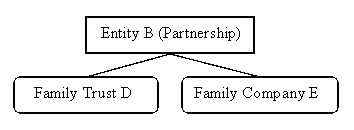
Entity B comprises two partners; Family Trust D (Individual D's family trust (refer note 1)) and Family Company E (Individual E's family company).
Entity C comprises three partners; Individual D, Individual E and Company X. Individuals D and E hold a large number of shares in Company X, but not all shareholders are family members of Individuals D or E.

Entity C has the same tax periods that apply to entities A and B and these three entities also account for GST on the same basis. Entity C does not belong to any other GST group nor does it have any branches that are registered under Division 54 of the GST Act.
Reasons for Decision
Section 48-10 of the GST Act sets out the membership requirements of a GST group. In relation to partnerships, each entity must:
- •
- satisfy the requirements specified in the A New Tax System (Goods and Services Tax) Regulations 1999 (GST Regulations)
- •
- be registered for GST
- •
- have the same tax periods applying to it as the tax periods applying to all the other members of the GST group
- •
- account for GST on the same basis as all the other members of the GST group
- •
- not be a member of any other GST group, and
- •
- not have any branch that is registered under Division 54 of the GST Act.
Entity C is registered for GST, has the same tax periods and accounts for GST on the same basis as the GST group members, is not a member of another GST group and has no branches registered for GST. Therefore, entity C will satisfy the membership requirements if it satisfies the requirements specified in the GST Regulations.
Regulatory membership requirements
Regulation 48-10.02 of the GST Regulations sets out the membership requirements that must be satisfied for a partnership to be a member of a GST group.
Subregulation 48-10.02(2A) of the GST Regulations states:
If the GST group consists only of partnerships:
Entities A and B meet the grouping requirements as they are already in a GST group. Entity C, as the 'candidate partnership', must satisfy the four requirements of subregulation 48-10.02(5) of the GST Regulations to become a member of the GST group.
One of the requirements is that each partner in the candidate partnership is an individual, a family trust of an individual or a family company of an individual (paragraph 48-10.02(5)(b) of the GST Regulations).
The partners in entity C are two individuals (Individuals D and E) and Company X. Therefore, it is necessary to determine whether Company X satisfies the definition of a family company. Paragraph 48-10.02(6)(b) of the GST Regulations defines a family company of an individual as being a company each shareholder of which is either the individual or a family member of an individual. Although Individuals D and E hold shares in Company X, other non-related entities also hold shares in the company. Therefore, Company X is not a family company within the above definition and fails to satisfy paragraph 48-10.02(5)(b) of the GST Regulations.
As entity C does not satisfy this requirement, there is no need to address the other requirements of subregulation 48-10.02(5) of the GST Act.
Entity C does not satisfy the regulatory membership requirements and therefore is unable to satisfy the membership requirements under section 48-10 of the GST Act. Entity C cannot join the existing GST group, comprising entities A and B, from 1 April 2003.
Note 1. Refer to paragraph 48-10.02(6)(a) of the GST Regulations for the definition of the term 'family trust'.
Date of decision: 20 June 2003
Legislative References:
A New Tax System (Goods and Services Tax) Act 1999
section 48-10
Division 54
regulation 48-10.02
subregulation 48-10.02(2A)
subregulation 48-10.02(3)
subregulation 48-10.02(5)
paragraph 48-10.02(5)(b)
paragraph 48-10.02(6)(a)
paragraph 48-10.02(6)(b) A New Tax System (Goods and Services Tax) Amendment Regulations 2003 (No.1) (2003 No.37)
Table of Content Related ATO Interpretative Decisions
ATO ID 2003/1017
ATO ID 2003/919
ATO ID 2003/1019
Keywords
Goods and services tax
GST special rules
GST branches
GST groups
GST regulations
GST tax periods
ISSN: 1445-2782
Copyright notice
© Australian Taxation Office for the Commonwealth of Australia
You are free to copy, adapt, modify, transmit and distribute material on this website as you wish (but not in any way that suggests the ATO or the Commonwealth endorses you or any of your services or products).
