
ATO Interpretative Decision
ATO ID 2006/196
Fringe Benefits Tax
Fringe Benefits Tax: in house residual expense payment fringe benefit - meaning of 'associate'FOI status: may be released
This version is no longer current. Please follow this link to view the current version. |
-
This document incorporates revisions made since original publication. View its history and amending notices, if applicable.
Status of this decision: Decision Current
This ATOID provides you with the following level of protection:
If you reasonably apply this decision in good faith to your own circumstances (which are not materially different from those described in the decision), and the decision is later found to be incorrect you will not be liable to pay any penalty or interest. However, you will be required to pay any underpaid tax (or repay any over-claimed credit, grant or benefit), provided the time limits under the law allow it. If you do intend to apply this decision to your own circumstances, you will need to ensure that the relevant provisions referred to in the decision have not been amended or repealed. You may wish to obtain further advice from the Tax Office or from a professional adviser.
Issue
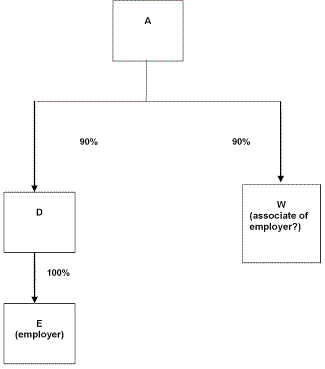
In terms of the definition of 'associate' as provided for at subsection 136(1) of the Fringe Benefits Tax Assessment Act 1986 (FBTAA) and as expressed in the accompanying diagram, is company W an associate of the employer company E?
Decision
Yes. Company W is an 'associate' of employer company E as provided for in subsection 136(1) of the FBTAA.
Facts
Company W is an electricity producer which sells electricity to an unrelated third party electricity retailer.
Company E is an employer that re-imburses their employee's electricity expenses which are incurred to the third party electricity retailer.
Company E is 100% owned and controlled by company D which in turn is 90% owned and controlled by company A.
Company W is 90% owned and controlled by company A.
The payments of the electricity expenses by the employer company E are expense payment benefits under section 20 of the FBTAA and their taxable value is to be calculated under Division 5, Subdivision B of the FBTAA.
Reasons for Decision
In order to calculate the taxable value of an expense payment fringe benefit, it is necessary to consider if a benefit is an 'in house' benefit and therefore subject to concessional valuation rules. In turn a benefit will be an 'in house' benefit only if the expenditure that is re-imbursed by the employer was incurred in purchasing goods or services that the employer or an associate sells to customers in the ordinary course of their business. Therefore it needs to be determined if company W is an associate of company E (employer).
The definition of 'associate' within subsection 136(1) of the FBTAA refers to the definition of 'associate' as provided for in section 26AAB of the Income Tax Assessment Act 1936 (ITAA 1936). To determine if company W is an associate of company E it firstly needs to be considered if company A is an associate of company E under subsection 26AAB(14) of the ITAA 1936.
Step 1. - Is company A an 'associate' of company E?
Subsubparagraph 26AAB(14)(b)(iv)(A) of the ITAA 1936 will apply to deem a parent company (company A) an associate of a subsidiary (company D) or an ultimate subsidiary (company E). This is because company E is, or its directors are, accustomed or under an obligation, whether formal or informal, to act in accordance with the directions, instructions or wishes of company A, whether those directions, instructions or wishes are communicated directly to company A or through any interposed companies, partnerships or trusts.
Alternatively, subparagraph 26AAB(14)(b)(vi) of the ITAA 1936 would have the same effect so that company A is deemed to be an 'associate' of company E. Subparagraph 26 AAB(14)(b)(vi) broadly provides that persons who are associates of a third person who controls the taxpayer company are associates of the taxpayer company.
Company D is a third person (under subparagraph 26AAB(14)(b)(vi) of the ITAA 1936) by virtue of subparagraph (iv), as company D has control over company E. Under subparagraph 26AAB(14)(b)(vi), if company D were the hypothetical taxpayer, then company A would be an 'associate' of that hypothetical taxpayer under another subparagraph of paragraph 26AAB(14)(b) of the ITAA 1936. Therefore, company A is an 'associate' of company E.
Step 2. - Is company W an 'associate' of company E?
Subparagraph 26AAB(14(b)(v) of the ITAA 1936 will apply to deem company W an 'associate' of company E.
Company W is 'another company' whose directors are under an obligation to act in accordance with the directions instructions or wishes of company A which has already been deemed to be an 'associate' of company E in terms of subsubparagraph 26AAB(14)(b)(iv)(A) of the ITAA 1936 (as per step 1 above).
On that basis, company W is an 'associate' of company E under the definition of 'associate' contained in section 26AAB of the ITAA 1936 and as a consequence in terms of the subsection 136(1) definition of 'associate' in the FBTAA.
Date of decision: 25th July 2006Year of income: Year ended 31 March 2007
Legislative References:
Fringe Benefits Tax Assessment Act 1986
subsection 136(1)
subparagraph 136(1)(c)(i)
section 26AAB
subsection 26AAB(14)
paragraph 26AAB(14)(b)
subparagraph 26AAB(14)(b)(iv)
subsubparagraph 26AAB(14)(b)(iv)(A)
subparagraph 26AAB(14)(b)(v)
subparagraph 26AAB(14)(b)(vi)
Keywords
Associate
FBT associates
Fringe benefits tax
In-house residual expense payment fringe benefit
FBT documentary evidence
ISSN: 1445-2782
| Date: | Version: | |
| You are here → | 25 July 2006 | Original statement |
| 16 January 2015 | Updated statement | |
| 11 March 2026 | Updated statement |
Copyright notice
© Australian Taxation Office for the Commonwealth of Australia
You are free to copy, adapt, modify, transmit and distribute material on this website as you wish (but not in any way that suggests the ATO or the Commonwealth endorses you or any of your services or products).
