
Draft Goods and Services Tax Ruling
GSTR 2026/D1
Goods and services tax: determining if you are making cross-border supplies to an Australian consumer
-
Please note that the PDF version is the authorised version of this draft ruling.For information about the status of this draft Goods and Services Tax Ruling, see item 4095 on our Advice under development program.
| Table of Contents | Paragraph |
|---|---|
| What this draft Ruling is about | |
| Relevant legislation | |
| Previous ruling | |
| Ruling | |
| Supplies connected with Australia | |
| Australian consumer – subsection 9-25(7) | |
| Residency element | |
| Consumer element | |
| Australian consumer – safeguard approach | |
| Attribution | |
| Reasonable steps approach – subsection 84-100(1) | |
| Example 1 – reasonable steps not taken | |
| Business systems approach – subsection 84-100(2) | |
| The safeguard approach – residency element of 'Australian consumer' | |
| Consistent information and automated systems | |
| Inconsistent information | |
| Example 2 – residency of an individual | |
| Example 3 – residency of a small business | |
| Example 4 – inconsistent information | |
| Example 5 – reasonable steps taken | |
| Example 6 – supplier becomes aware of additional information after transaction for the supply is finalised | |
| Example 7 – supplier becomes aware that the recipient is an Australian resident after entering into a contract which is a progressive or periodic supply | |
| Example 8 – periodic or progressive supply where full consideration has been received at the start of the contract | |
| Example 9 – customer provides false residency declaration | |
| Example 10 – customer relocates to another country | |
| The safeguard approach: consumer element of 'Australian consumer' | |
| Information to be collected | |
| ABN of the recipient | |
| GST declaration | |
| GST registration | |
| Purpose of acquisition | |
| Example 11 – recipient deregisters during contract period for call centre services | |
| Australian consumer – without safeguard – subsection 9-25(7) | |
| Residency element | |
| Consumer element | |
| Date of effect | |
| Appendix 1 – Compliance approaches | |
| Overview | |
| Section 84-100 safeguard | |
| Section 84-100 safeguard – residency element | |
| Compliance approach – comparable jurisdictions | |
| Section 84-100 safeguard – consumer element | |
| First supplies to a new recipient | |
| Compliance approach – for first supplies to a new recipient | |
| Example 12 – sales facilitation services supplied by an online platform | |
| Subsequent supplies made to the same recipients | |
| Compliance approach – subsequent supplies – GST declaration covering multiple supplies | |
| Regular ABN Lookup | |
| Relevant business information | |
| Compliance approach – subsequent supplies – GST declaration covering a single supply | |
| Without the safeguard approach | |
| Without safeguard – residency element | |
| Without safeguard – consumer element | |
| Compliance approach – business information | |
| How these compliance approaches work | |
| Past transactions | |
| Appendix 2 – Explanation of updates | |
| Appendix 3 – Your comments |
 Relying on this draft Ruling
This publication is a draft for public comment. It represents the Commissioner's preliminary view on how a relevant provision could apply. If this draft Ruling applies to you and you rely on it reasonably and in good faith, you will not have to pay any interest or penalties in respect of the matters covered if this draft Ruling turns out to be incorrect and you underpay your tax as a result. However, you may still have to pay the correct amount of tax. |
What this draft Ruling is about
1. This draft Ruling[1] explains when supplies of things other than goods or real property (such as services, digital products or rights) are made to Australian consumers and, therefore, connected with the indirect tax zone under paragraph 9-25(5)(d) of the A New Tax System (Goods and Services Tax) Act 1999 (GST Act).
2. All legislative references in this Ruling are to the GST Act, unless otherwise indicated.
3. In this Ruling, the 'indirect tax zone' is referred to as 'Australia'. The definition of 'indirect tax zone' is in section 195-1.
4. This Ruling is relevant to you if you are a non-resident supplier making inbound supplies of things other than goods or real property (such as services, digital products or rights) to Australian consumers[2] that use or enjoy those supplies in Australia.[3]
5. Goods and services tax (GST) is payable on taxable supplies. For you, as a non-resident supplier, to be liable for GST on a taxable supply under section 9-5, the supply must be connected with Australia. A supply of anything other than goods or real property made to an Australian consumer is connected with Australia under paragraph 9-25(5)(d).
6. This Ruling explains how you decide whether a recipient of a supply is an Australian consumer and how the safeguard approach under section 84-100 affects this task. It explains what evidence you should have and what steps you may take to collect evidence to establish if the supply is not made to an Australian consumer.
7. Appendix 1 to this Ruling provides compliance approaches non-resident suppliers may consider when establishing whether the recipient is not an Australian consumer.
8. Even if your supply is not made to an Australian consumer (and therefore not connected with Australia under paragraph 9-25(5)(d)), you still need to consider if the supply is connected with Australia under other provisions – for example, if the thing is done in Australia or the supply is made through an enterprise you carry on in Australia.[4] If the supply is not connected with Australia, you are not liable for GST on the supply. Such supplies do not count in determining if you meet the GST registration threshold.[5]
9. In some situations, it may be easier to first consider if the supply is GST-free. If the supply is both GST-free and not made through an enterprise you carry on in Australia, there is no need to consider if that same supply is connected with Australia. For example, if an Australian consumer receives a haircut from a hairdresser in Germany, that supply will be GST-free. Therefore, it will not be subject to GST despite being connected with Australia under paragraph 9-25(5)(d).
10. Diagram 1 of this Ruling shows how supplies made to Australian consumers fit in with the other requirements for a supply to be a taxable supply under section 9-5.
Diagram 1: Interaction between the requirements for a taxable supply
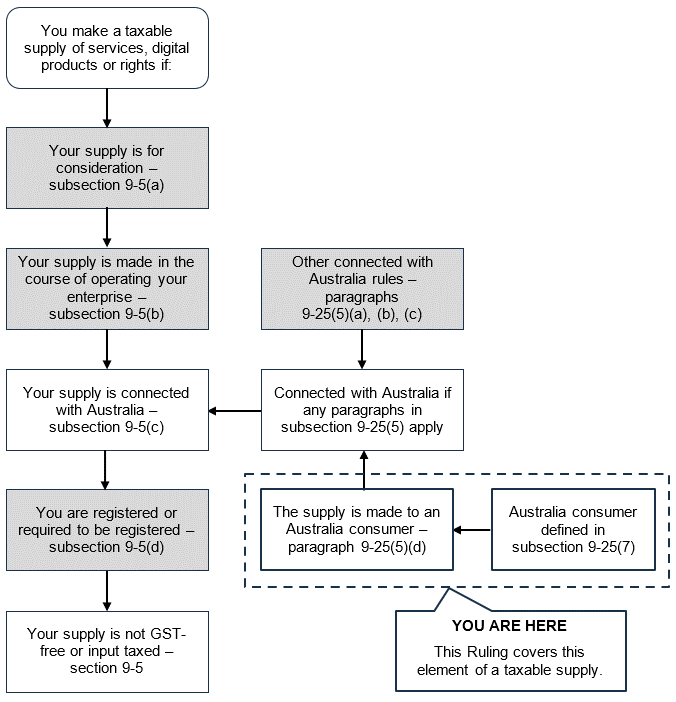
11. Australian consumer has the meaning given by subsection 9-25(7):
An entity is an Australian consumer of a supply made to the entity if:
- (a)
- the entity is an Australian resident (other than an entity that is an Australian resident solely because the definition of Australia in the ITAA 1997 includes the external Territories); and
- (b)
- the entity:
- (i)
- is not registered; or
- (ii)
- if the entity is registered—the entity does not acquire the thing supplied solely or partly for the purpose of an enterprise that the entity carries on.
12. Australian resident means a person who is a resident of Australia for the purposes of the Income Tax Assessment Act 1936 (ITAA 1936). 'Resident' or 'resident of Australia' is defined in section 6(1) of the ITAA 1936 as:
- (a)
- a person, other than a company, who resides in Australia and includes a person:
- (i)
- whose domicile is in Australia, unless the Commissioner is satisfied that the person's permanent place of abode is outside Australia;
- (ii)
- who has actually been in Australia, continuously or intermittently, during more than one-half of the year of income, unless the Commissioner is satisfied that the person's usual place of abode is outside Australia and that the person does not intend to take up residence in Australia; or
- (iii)
- who is:
- (A)
- a member of the superannuation scheme established by deed under the Superannuation Act 1990; or
- (B)
- an eligible employee for the purposes of the Superannuation Act 1976; or
- (C)
- the spouse, or a child under 16, of a person covered by sub-subparagraph (A) or (B); and
- (b)
- a company which is incorporated in Australia, or which, not being incorporated in Australia, carries on business in Australia, and has either its central management and control in Australia, or its voting power controlled by shareholders who are residents of Australia.
13. The GST Act provides an alternative way of determining whether a recipient is an Australian consumer under section 84-100 by setting out circumstances in which entities are not treated as being Australian consumers under the GST law (safeguard approach).[6] Section 84-100 provides:
- (1)
- The GST law applies in relation to you as if another entity was not an Australian consumer of a supply if:
- (a)
- you take reasonable steps to obtain information about whether or not the other entity is an Australian consumer of the supply; and
- (b)
- after taking those steps, you reasonably believe that the other entity is not an Australian consumer of the supply.
- (2)
- Without limiting subsection (1), the GST law applies in relation to you as if another entity was not an Australian consumer of a supply if:
- (a)
- your usual business systems and processes provide you with a reasonable basis for forming a reasonable belief about whether the other entity is an Australian consumer of the supply; and
- (b)
- you reasonably believe that the other entity is not an Australian consumer of the supply.
- (3)
- For the purposes of subsections (1) and (2), to the extent that your belief that the other entity is not an Australian consumer of the supply is based on the other entity being registered, your belief is reasonable only if:
- (a)
- the other entity's ABN, or the other identifying information prescribed under subsection (4) relating to the other entity, has been disclosed to you; and
- (b)
- the other entity has provided to you a declaration or information that indicates that the other entity is registered.
- (4)
- The Commissioner may, by legislative instrument, prescribe identifying information for the purposes of paragraph (3)(a).[7]
14. When finalised, this draft Ruling will replace Goods and Services Tax Ruling GSTR 2017/1 Goods and services tax: making cross-border supplies to Australian consumers.
Ruling
Supplies connected with Australia
15. A supply is 'connected with Australia' under paragraph 9-25(5)(d) if you make a supply of anything other than goods or real property (such as services, rights or digital products) to an 'Australian consumer' – that is, the recipient of the supply is an Australian consumer.
Australian consumer – subsection 9-25(7)
16. A recipient is an Australian consumer if they satisfy subsection 9-25(7). To be an 'Australian consumer' of a supply, the recipient of the supply must meet the following 2 elements:
17. If the recipient of the supply does not meet both these elements, they are not an Australian consumer.
18. Alternatively, under the safeguard approach in section 84-100, you can treat the recipient as not being an Australian consumer of a supply if you reasonably believe they are not an Australian consumer.
19. You must hold sufficient evidentiary information for each individual supply to determine whether the recipient of that supply is an Australian consumer. This requirement applies whether you apply subsection 9-25(7) or the section 84-100 safeguard approach.
20. The residency element in paragraph 9-25(7)(a) is satisfied if the supply is made to an Australian resident.
21. The residency element of the Australian consumer definition relies on the income tax definition of 'resident of Australia' but excludes residents of external Territories.[10]
22. The residency element needs to be considered for recipients that are individuals, as well as companies, trusts and partnerships. GSTR 2004/7[11] explains when a supply is made to a non-resident for the purposes of subsection 38-190(1).[12] We apply the same principles from that Ruling to determine when a supply is not made to an Australian resident.
23. If the recipient of your supply is not an Australian resident, you have not made a supply to an Australian consumer.
24. If you have made the supply to an Australian resident, they will be an Australian consumer if they also satisfy the consumer element in paragraph 9-25(7)(b). The consumer element will be satisfied if the recipient is either:
- •
- not registered for GST[13], or
- •
- registered for GST and has not made the acquisition solely or partly for their enterprise.[14]
25. You can confirm the recipient is registered for GST when the supply is made by checking the recipient's GST registration status on the Australian Business Register (ABR) through the ABN Lookup tools.[15]
26. Indicators that may point to an acquisition being for an enterprise purpose include the:
- •
- nature of the supply
- •
- value of the supply, and
- •
- type of entity (that is, an Australian company).
27. There will be only limited circumstances where acquisitions by an Australian company would not be for an enterprise purpose.
Australian consumer – safeguard approach
28. Under section 84-100, you can treat the supply as having not been made to an Australian consumer if either:
- •
- you have taken reasonable steps to obtain information that the recipient is not an Australian consumer and, after taking those steps, you reasonably believe that the recipient is not an Australian consumer (reasonable steps approach)[16], or
- •
- your usual business systems and processes provide you with a reasonable basis for forming a reasonable belief that the recipient is not an Australian consumer and you reasonably believe that the recipient is not an Australian consumer (business systems approach).[17]
29. To reasonably believe a recipient is not an Australian consumer involves an inclination of the mind to accept, rather than to reject, the proposition. This requires more than a mere possibility but less than certainty and must be rationally supported by the information.[18]
30. The mere fact that you may have access to limited information does not, in itself, make your belief unreasonable, as the information available to you may still support a reasonable belief.
31. It is possible to reasonably believe a recipient is not an Australian consumer based on information and evidence you have from a wholly automated system if your belief is based on the system taking into account all relevant information you have on hand about the recipient.[19]
32. The information you gather under either the reasonable steps or the business systems approach may overlap. What is important is that you gather sufficient information and evidence to support one of the approaches.
33. Your reasonable belief for either approach can be founded on a belief that the recipient does not satisfy the:
- •
- residency element, or
- •
- consumer element.
34. However, subsection 84-100(3) states, for the purposes of both approaches, that to the extent your belief that the recipient is not an Australian consumer of the supply is based on the recipient being registered for GST, your belief is reasonable only if:
- •
- the recipient's Australian business number (ABN) has been disclosed to you, and
- •
- the recipient has provided a declaration or other information which indicates that they are registered for GST.
35. In practice, the time at which you may determine whether a supply is a taxable supply and, therefore, whether GST is payable is usually when payment is sought or an invoice is issued. That same time generally determines the tax period to which the GST on a taxable supply is attributed. In this Ruling, that time is referred to as the 'attribution time'.
36. Where a taxable supply (or a supply that is taxable to some extent) is made for a period or on a progressive basis and consideration is provided on the same basis, each periodic or progressive component is treated as a separate supply for some purposes.[20] Each component in this regard has its own 'attribution time'. If a component is not wholly connected with Australia because the recipient is not an Australian consumer for the whole of that component, the component is treated as a separate supply that is not connected with Australia.[21]
Reasonable steps approach – subsection 84-100(1)
37. The requirement to take reasonable steps to obtain information about whether an entity is an Australian consumer imposes a standard determined objectively by reference to the circumstances in which you make the supply to the recipient and the relationship you have.[22]
38. The requirement to take reasonable steps to obtain information will not be satisfied where no steps are taken – for example, where a supplier does not have details of a recipient's business status, location or other relevant Australian consumer indicators and it does not take any steps to obtain this information.
39. Under the requirement to take reasonable steps, you may need to obtain information that you may not otherwise need for your own business purposes in making the supply.
40. The requirement to take reasonable steps does not mean that you must always obtain the information that you have sought to obtain. You should consider, in all the circumstances, if it is reasonable to rely on the information you have received. If not, you should seek further information.
41. The following factors are relevant to determining whether the steps you have taken to obtain information and evidence are reasonable (none are determinative):
- •
- the level of interaction you have with the recipient in making the supply or in maintaining the commercial relationship
- •
- the type of personal information that a recipient usually shares, or is usually willing to share, in the course of making an acquisition or in maintaining the commercial relationship
- •
- the difficulty and costs involved for you in taking steps to obtain information about whether an entity is or is not an Australian consumer of a supply (including both direct and indirect costs).
42. The type of personal information that a recipient usually shares with suppliers is relevant to whether the steps you have taken are reasonable. This consideration helps identify the limits of what information may be reasonable to ask a recipient to provide a supplier. A recipient will typically share more personal information with you where there is an interactive commercial relationship (as opposed to an automated interaction) or where the supply is of a high value. A recipient will also typically share more personal information with a supplier that acts in a professional advisory relationship, such as a lawyer or financial adviser.
43. In considering the costs you might incur to find out information, you can consider:
- •
- actual costs you incur to take steps to obtain the relevant information, and
- •
- indirect costs attributable to lost sales that occur, or are likely to occur, as a result of asking for additional information.
44. You will also need to consider the reliability of the information you have sought and whether it is reasonable for you to rely on it for these purposes. For example, free publicly available information provided by government bodies, such as ABN lookup and the Australian Securities and Investments Commission (ASIC) company registration data, is a low-cost reliable source of information.
Example 1 – reasonable steps not taken
45. Rishi purchases software from BGL Software by redeeming a face-value voucher (Division 100 voucher)[23] that was gifted to him after being purchased online. BGL Software does not collect any information relevant to whether Rishi satisfies the residency element. The voucher does not give any indication as to whether Rishi satisfies the residency element and BGL Software does not take any other steps that could be used to determine if Rishi satisfies the residency element.
46. In this example, BGL Software has not taken any steps to determine whether Rishi satisfies the residency element. Therefore, BGL Software has not taken reasonable steps to obtain information that Rishi is not an Australian consumer.
Business systems approach – subsection 84-100(2)
47. The information and evidence required to establish that your usual business systems and processes provide you with a reasonable basis to form a reasonable belief that a recipient is not an Australian consumer will depend on the facts and circumstances of the case.
48. Your usual business systems and processes are those systems and processes you normally use for business purposes. It does not matter if the systems and processes you normally use differ from the systems and processes typically used in your industry.
49. Business systems and processes are not limited to computer systems that a recipient interacts with. It also includes a business's standard procedures used for interacting with its customers. This includes standard processes for taking orders for supplies online, over the phone or by email.
50. Some entities may at times change their usual business systems or processes – for example, moving from a phone-based call centre to an online form. If your systems and processes change, it will not impact your past decisions regarding your reasonable belief because they were based on your usual business systems at that time.
The safeguard approach – residency element of 'Australian consumer'
51. Information that supports a reasonable belief about whether the recipient satisfies the residency element include:
- •
- the recipient's billing address
- •
- the recipient's mailing address
- •
- the recipient's banking or credit card details, including the location of the bank or credit card issuer
- •
- location-related data from third-party payment intermediaries
- •
- mobile phone SIM or landline country code
- •
- recipient's country selection
- •
- tracking or geolocation software
- •
- internet protocol (IP) address
- •
- place of establishment of the recipient (for non-individual recipients)
- •
- representations and warranties given by the recipient
- •
- the origin of correspondence, and
- •
- locations, such as a wi-fi spot, where the physical presence of the person receiving the service at that location is needed.
52. The list in paragraph 51 of this Ruling is not an exhaustive list of evidence that can be relevant to establishing whether a recipient satisfies the residency element.[24]
53. If you use the business systems approach, you must consider all the information collected through your usual business systems and processes. These must, on balance, support a conclusion about whether the recipient satisfies the residency element. For example, Australian-incorporated entities are Australian residents and, therefore, if you know the recipient is an Australian-incorporated company, you will not be able to form a reasonable belief they are a non-resident.
Consistent information and automated systems
54. Where you make supplies using fully automated systems, there may be minimal scope for you to collect additional information beyond those systems that might alter your belief about whether your recipient is an Australian consumer because of the residency element.
55. We consider that, for the purposes of section 84-100, your belief that the recipient is not an Australian consumer is reasonable if:
- •
- the supplies do not ordinarily[25] involve any human interaction by you (or on your behalf) with the recipient in real time in entering the transaction for the supply, and
- •
- your usual business systems provide at least 2 pieces of non-contradictory evidence that support the conclusion that the recipient has their residency, usual residence, permanent address or similar at a particular place or jurisdiction outside Australia.
56. Where the information you hold about the recipient does not consistently point to one conclusion about whether the recipient satisfies the residency element, you should weigh up all the available information to determine whether you reasonably believe the recipient is not an Australian consumer.
57. In weighing up all the available information, consider:
- •
- the expected reliability of the information, including whether
- –
- the information is necessary for the commercial transaction itself or you have only requested it for tax or other compliance purposes
- –
- the recipient has an incentive to provide conflicting or false information and the ease with which such information could be provided, and
- •
- whether the majority of the information points towards one conclusion over another.
58. Information that is necessary for the commercial transaction to proceed (for example, compulsory fields in web-based forms) will generally be more reliable than information that is only requested for tax or other compliance purposes. If the recipient has an incentive to provide incorrect information and it is relatively straightforward to provide incorrect information, the information may be less reliable. Incentives which are either related or unrelated to tax also need to be considered, such as whether a recipient has an incentive to provide false information to access a wider range of supplies which are limited on a geographic basis.
59. In forming your belief about the residency element, you should consider all the relevant information that you have on hand about the recipient at the attribution time. This includes any unsolicited information given to you by the recipient.
60. Where you hold sufficient information at the attribution time to form a reasonable belief about the residency element, you do not need to revise your view if you receive further information after the attribution time. However, the further information may be relevant for any future supplies to your recipient (see Example 6 of this Ruling).
Example 2 – residency of an individual
61. Megan purchases online security software from PC Protect, an online software provider. She pays using her German credit card and provides her German billing address. This is the only information that PC Protect's usual business systems and processes collect, which is relevant to determining whether Megan satisfies the residency element.
62. PC Protect's usual business systems and processes provide a reasonable basis for a reasonable belief that Megan does not satisfy the residency element. Because the information collected supports a conclusion that Megan resides in Germany, the systems support a conclusion that Megan does not satisfy the residency element.
Example 3 – residency of a small business
63. SignDezign provides online business logo design services to businesses. Its online enquiry form collects standard information about its customer's business name, current business address, industry, year and place of establishment.
64. JWW Co (a company that is not registered for GST) makes an enquiry to SignDezign about creating a logo for its new business. It completes the form, noting that its current business address is in Melbourne and that it was established in Melbourne in 2016.
65. SignDezign's usual business systems and processes provide a reasonable basis for a reasonable belief that JWW Co satisfies the residency element.
Example 4 – inconsistent information
66. Continuing from Example 2 of this Ruling, another customer, Ana, purchases online security software from PC Protect. When Ana signed up for her account with PC Protect, she provided her home address as in Australia. However, when paying for her software, Ana pays using her German credit card.
67. This is the only information that PC Protect's usual business systems and processes collects, which is relevant to determining whether Ana satisfies the residency element.
68. Given that the information obtained by PC Protect is inconsistent regarding whether Ana satisfies the residency element, PC Protect assesses the quality and reliability of the information it has. Although Ana's account indicates that she has an Australian home address, the fact that she paid with a German credit card supports a conclusion that Ana currently resides in Germany. The credit card information is more reliable because it is contemporaneous with the attribution time.
69. PC Protect's usual business systems and processes provide a reasonable basis for a reasonable belief that Ana does not satisfy the residency element.
Example 5 – reasonable steps taken
70. Steven uses WebEA, an online personal assistant service based in the United Kingdom (UK), to assist him with his personal administration. Steven uses the service regularly, but the value of each supply made to Steven is modest.
71. Steven is a former senior Australian public servant and his membership of a public sector superannuation fund means he is an Australian resident for taxation purposes and satisfies the residency element of the Australian consumer definition in subsection 9-25(7), even though he resides in the UK.
72. WebEA representatives can use different methods or procedures to interact with their clients. In Steven's case, when he signed up to the service, a WebEA representative phoned Steven to ask for his country of residence (to determine his time zone), his credit card number, billing address and what types of administration services he is likely to need.
73. Steven's details are used for each supply of online personal assistant services that WebEA makes to him although, on occasion, WebEA requests further personal details depending on the administrative service being performed.
74. By asking Steven which country he resides in and for additional information (credit card number and billing address) that corroborates that answer, WebEA has taken reasonable steps to obtain information about whether Steven satisfies the residency element. It is relevant that:
- •
- WebEA is not providing professional advisory services to Steven so it would be unusual for them to request further information to determine Steven's income tax residency status
- •
- the value of the supplies made is modest, and
- •
- it is reasonable to expect that many customers would choose to find an alternative provider rather than provide further information about their income tax residency.
75. WebEA does not need to ask any more information about Steven's income tax residency status to have taken reasonable steps to form a reasonable belief as to that status.[26] All the information collected by WebEA from when Steven signed up for the services and from ongoing interactions indicated Steven resided in the UK. From that information, WebEA forms a reasonable belief Steven is not an Australian consumer.
Example 6 – supplier becomes aware of additional information after transaction for the supply is finalised
76. ABC sells software to SDF.[27] At the attribution time for the supply of the software to SDF, ABC holds SDF's credit card details and IP address, which both indicate that SDF has its business address in the United States of America. Those details support a conclusion that SDF is not an Australian consumer and ABC reasonably believes that SDF is not an Australian consumer.
77. Two months after the sale, SDF is having problems with the software. It contacts one of ABC's employees for troubleshooting assistance. During that troubleshooting advice, SDF provides an Australian phone number, a work email address ending in '.au' and advises ABC to only call during Australian business hours.
78. The information ABC receives from SDF as part of the troubleshooting service supports a conclusion that SDF now satisfies the residency element. However, this does not change the fact that ABC was entitled to access the safeguard approach in respect of the supply of software given they held a reasonable belief at the attribution time that SDF was not an Australian consumer.
Example 7 – supplier becomes aware that the recipient is an Australian resident after entering into a contract which is a progressive or periodic supply
79. ABC sells a 2-year licence to use various software programs and charges customers on a monthly basis. Dao is an Australian resident based in Sydney who travels regularly to the UK, where she previously resided. Dao is in London on holiday when she purchases the 2-year licence to use a particular software program from ABC.
80. Dao uses her UK credit card to sign up with ABC. This supports a conclusion that Dao is not an Australian consumer.
81. After Dao returns to Australia, she changes her billing details with ABC and starts making the monthly payments with her Australian credit card.
82. As the supply of the licence and the payments are on a periodic or progressive basis, each month of the licence is attributed separately. ABC, therefore, needs to check whether Dao has become an Australian consumer (and the supply of the licence has become a taxable supply) for the month when this information known to ABC relevant to the residency element has changed.
83. Once Dao starts paying with her Australian credit card, the information held by ABC at subsequent attribution times supports a conclusion that Dao is now an Australian consumer. ABC cannot continue to hold a reasonable belief that Dao is not an Australian consumer for the future monthly components of the supply.
Example 8 – periodic or progressive supply where full consideration has been received at the start of the contract
84. CloudFlow Co (CloudFlow) is a non-resident business that sells access to its cloud-based workflow software to customers around the world through its website.
85. A customer buys a 12-month subscription and pays the full amount upfront. No further payments are required during the subscription period. When the customer signs up, CloudFlow's systems provide enough information for CloudFlow to reasonably believe the customer is not an Australian resident. Because of this, CloudFlow can treat the customer as not an 'Australian consumer', and the access it gives to the workflow software as not a taxable supply.
86. Although the subscription covers a 12-month period, full consideration is paid at the start and there are no ongoing or periodic payments. This means Division 156 does not apply. As a result, CloudFlow does not need to reassess the customer's Australian consumer status throughout the subscription term – its reasonable belief at the time of purchase (attribution time) is sufficient.
Example 9 – customer provides false residency declaration
87. Danika is an Australian resident for income tax purposes who resides in South Australia. She is not registered for GST. She often shops at KeyOrder, an online store which sells goods and digital products to customers around the world. When she signed up for her account with KeyOrder, Danika provides her Australian mailing address.
88. Danika purchases an app from KeyOrder. During checkout, she checks a box to indicate that she is an Australian resident for income tax purposes. She notices the price goes up by 10% when she does this, so she unselects the box and continues. She pays using the payment intermediary she always uses when shopping at KeyOrder. The payment intermediary does not pass on any information to KeyOrder that would indicate whether Danika satisfies the residency element.
89. KeyOrder does not treat Danika as an Australian consumer for the supply of the app and does not charge GST. The section 84-100 safeguard does not apply to KeyOrder. This is because, although Danika incorrectly declared that she was not an Australian resident for income tax purposes, KeyOrder should have used other account information they held about her (such as her Australian mailing address) to determine whether she satisfied the residency element.
90. Even though information about Danika's income tax residency is closely correlated to the residency element, KeyOrder should have considered this information less reliable than the other information Danika has previously provided when signing up for her account. The information about Danika's income tax residency status is less reliable because it is only required for KeyOrder's compliance purposes and Danika has an incentive to incorrectly declare her residency status to avoid the additional GST cost.
91. Because Danika is otherwise an Australian consumer under subsection 9-25(7) and section 84-100 does not apply, the supply by KeyOrder to Danika is connected with Australia under paragraph 9-25(5)(d). If the other requirements in section 9-5 are met, KeyOrder will be liable for GST on the supply.[28]
Example 10 – customer relocates to another country
92. Katherine is an Australian resident for income tax purposes who resides in Brisbane. Katherine moves permanently back to Australia from the UK where she had lived and worked for a number of years. While living in the UK, Katherine subscribed to OneRun, a website where she views and downloads clothing patterns. When she signed up for her account, she used her UK address and credit card. As Katherine still travels to the UK for holidays, she maintains her UK bank accounts and still pays for her subscription from that account.
93. When Katherine accesses OneRun after her move back to Australia, OneRun identifies Katherine's current location (Brisbane) which it uses as one factor to help predict patterns that Katherine will be most interested in, based on the season.
94. In supplying clothing patterns, OneRun does not treat Katherine as an Australian consumer. Although her location is now consistently in Australia, OneRun relies on Katherine's account address and credit card. These provide a reasonable basis for them to reasonably believe that Katherine is not an Australian consumer. OneRun has considered all the information collected in their usual business systems and processes (credit card, address, and current location), assessed its reliability and reached the conclusion that the totality of the information supports their reasonable belief that Katherine is not an Australian consumer. Even though Katherine would otherwise be an Australian consumer under section 9-25(7), section 84-100 applies and Katherine is treated as if she is not an Australian consumer.
The safeguard approach: consumer element of 'Australian consumer'
95. To reasonably believe under section 84-100 that a recipient is not an Australian consumer due to the consumer element[29], you need to consider information you have gathered or hold in your business systems regarding whether the recipient is registered for GST and (if so) made the acquisition partly or solely for an enterprise purpose.
96. Subsection 84-100(3) states, for the purposes of subsections 84-100(1) (reasonable steps approach) and 84-100(2) (business systems approach), that to the extent your belief that the recipient is not an Australian consumer of the supply is based on the recipient being registered for GST (a 'GST registration belief'), your belief is reasonable only if:
- •
- the recipient's ABN has been disclosed to you[30], and
- •
- the recipient has provided a declaration or other information which indicates that they are registered for GST.[31]
97. The information gathered to satisfy subsection 84-100(3) is not sufficient in itself to reasonably believe under paragraphs 84-100(1)(b) or 84-100(2)(b) the recipient is not an Australian consumer.
98. The information you need to collect to satisfy subsection 84-100(3) is:
- •
- the recipient's ABN, and
- •
- a declaration or other information from the recipient indicating a recipient is registered for GST.
99. Paragraph 84-100(3)(a) requires the recipient's ABN to be disclosed to you for your GST registration belief to be reasonable and section 84-100 to apply. It does not matter who discloses the ABN to you (that is, it does not matter whether it is disclosed by the recipient or another source). For example, the Australian Business Registrar publishes ABN details publicly on the ABR[32]. This can satisfy the requirement that the ABN is disclosed to you.
100. To satisfy paragraph 84-100(3)(a), it is important that the ABN disclosed (whether provided by a recipient or obtained on the initiative of the supplier) belongs to the recipient. The steps you could take to check may include:
- •
- ensuring the ABN provided is in the correct format[33]
- •
- ensuring that there are no duplicate ABN entries in your system for different recipients
- •
- using the ABN Lookup database to compare the identity details of the recipient (such as name and postcode) with the business information stored on the ABR.[34]
101. Paragraph 84-100(3)(b) requires that a recipient has provided to you a declaration or information that it is registered for GST. It is not necessary that the declaration or information be provided to you contemporaneously with the supply or supplies to which it relates.[35] Unlike the ABN, which does not necessarily need to be disclosed by the recipient, the declaration or information required under paragraph 84-100(3)(b) must be provided to you by the recipient.
102. A recipient may have an ABN without being registered for GST.[36] When you collect ABN information and a declaration or information indicating GST registration from recipients, these should be treated as 2 separate and distinct items of information. Provision of the ABN by a recipient must not be conflated with a declaration or information indicating GST registration. A recipient may disclose their ABN to you even if they are not registered for GST.
103. The declaration or information provided by a recipient should be provided to you as close as possible to when you make your first supply to the recipient. A supplier should request a declaration or information when onboarding a new customer.
104. A declaration or information provided by a recipient can be used for more than one supply where there is objective evidence that the parties intend for it to apply to more than one supply – for example, through the written agreement or terms and conditions between the supplier and the recipient.
105. The Commissioner may impose a penalty on entities that misrepresent their status as not being an Australian consumer.[37]
106. The information obtained for the purposes of satisfying subsection 84-100(3) is not, of itself, sufficient to form a reasonable belief under paragraphs 84-100(1)(b) or (2)(b) that the recipient is not an Australian consumer in relation to the consumer element. In particular, representation by the recipient that they are GST-registered (whether or in the form of a declaration or otherwise) does not provide a sufficient basis to reasonably believe that the recipient is not an Australian consumer.
107. The ABR includes business identity details, such as GST registration status. ABN Lookup tools and web services allow simple ways for you to build automated checks into your business systems to verify GST registration information (and other ABN information) provided by recipients. How often you need to conduct these checks may depend on information you obtain through your ordinary business interactions.
108. A process that has no ongoing monitoring of the GST registration information previously provided by a recipient (that is, a 'set and forget' process) does not amount to taking reasonable steps or your business system providing a reasonable basis to form a reasonable GST registration belief. This contrasts with a situation where you regularly check the recipient's GST registration status using ABN Lookup and update your systems accordingly.
109. Collecting the information required under subsection 84-100(3) relieves the supplier from having to obtain further evidence that the acquisition by the recipient was made solely or partly for an enterprise purpose.[38]
110. In providing the declaration or information indicating they are registered for GST and, subject to you holding conflicting information, you can rely on this as the recipient holding themselves out as acquiring the supply in their enterprise capacity. The recipient is subject to the reverse charge if they have provided a GST declaration that they are GST-registered but did not acquire for an enterprise purpose.[39]
Example 11 – recipient deregisters during contract period for call centre services
111. ABC supplies call centre services to Maxi Co, an Australian-resident company, for a 2-year period. The services are billed monthly. When entering the contract, Maxi Co provides its ABN and a declaration that it is registered for GST. ABC verifies Maxi Co's identity and GST registration using ABN Lookup before commencing the supply and is satisfied that Maxi Co is not an Australian consumer. As such, the supply is not connected with Australia and ABC does not treat the supply as a taxable supply.
112. If the supply made by ABC becomes a taxable supply at any time during the 2-year contract period, each monthly billing period would be a separate component of the supply and have its own attribution time. Therefore, ABC needs to regularly consider Maxi Co's GST registration status. If Maxi Co ceases to be registered for GST at any time during a monthly component, the supply becomes connected with Australia as it is made to an Australian consumer and the future monthly component is treated as a taxable supply.
113. ABC has integrated ABN Lookup into its business system to carry out monthly checks to confirm recipients are still registered for GST. After 6 months, ABC becomes aware Maxi Co is no longer registered for GST. As an Australian-resident recipient that is not registered for GST, Maxi Co meets the consumer element and, as such, is an Australian consumer and the supply is now connected with Australia.
114. Therefore, from month 7, after ABC becomes aware that Maxi Co is no longer registered, ABC must treat each subsequent component of the supply as a taxable supply.[40]
115. Under section 156-15, ABC can treat the monthly components made prior to this time as a separate supply that is not connected with Australia and therefore not a taxable supply. If, in month 9, Maxi Co declares they have re-registered for GST, the later components of the supply become not connected with Australia and are not subject to GST.
Australian consumer – without safeguard – subsection 9-25(7)
116. You may determine if an entity is not an Australian consumer without applying the safeguard approach.
117. Paragraphs 20 to 23 of this Ruling set out who is an Australian resident.
118. The steps you have taken or the business systems you use may mean the safeguard applies to treat a recipient as not being an Australian consumer due to the residency element even if you have not considered or sought to rely on the safeguard approach.
119. If you subjectively believe that your recipient is not an Australian consumer because they do not satisfy the consumer element, but you have not collected the recipient's ABN and declaration as required in subsection 84-100(3), you do not have a reasonable belief for the purposes of section 84-100. This means section 84-100 does not apply and you will instead need to determine if your supply is connected with Australia by reason of paragraph 9-25(5)(d), considering the definition of Australian consumer in subsection 9-25(7).
120. Without the benefit of the safeguard approach, you must have evidence the acquisition is for an enterprise purpose and the recipient is registered for GST before concluding the recipient does not meet the consumer element (refer to paragraphs 24 to 27 of this Ruling).
121. When finalised, this draft Ruling is proposed to apply before and after date of issue.
Commissioner of Taxation
10 June 2026
Appendix 1 – Compliance approaches
| This Appendix (including the examples) sets out proposed practical administration approaches to assist taxpayers in complying with relevant tax laws. When this Ruling is finalised, provided you follow the compliance approaches in this Appendix in good faith and consistently with the Ruling section, the Commissioner will administer the law in accordance with these approaches. |
122. This Appendix sets out compliance approaches that you, as a non-resident supplier, may follow (with or without the safeguard approach) when determining whether supplies you make of things other than goods or real property are not made to an Australian consumer as defined in subsection 9-25(7).
123. Provided you follow the compliance approaches in this Appendix in good faith and consistently with the Ruling section, these compliance approaches will apply from the date of publication of the finalised Ruling.
124. A summary of the compliance approaches is set out in Table 1 of this Ruling, with a detailed explanation provided in the subsequent paragraphs.
| Safeguard | Relevant part of Australian consumer definition | Compliance approach |
|---|---|---|
| Section 84-100 safeguard | Residency element (paragraph 9-25(7)(a))
(see paragraphs 125 to 129 of this Ruling) |
Acceptable evidentiary approaches from comparable jurisdictions |
| Section 84-100 safeguard | GST registration aspect of the consumer element (paragraph 9-25(7)(b))
(see paragraphs 130 to 156 of this Ruling) |
Compliance approach for:
|
| Without section 84-100 safeguard | Enterprise purpose aspect of consumer element (subparagraph 9-25(7)(b)(ii))
(see paragraphs 158 to 160 of this Ruling) |
Acceptable evidence showing enterprise purpose of acquisition |
Section 84-100 safeguard – residency element
125. For the residency element of the section 84-100 safeguard, if you have already set up your business systems to meet the evidentiary requirements of an overseas jurisdiction with place of consumption rules similar to those in Australia, using residency or comparable tests for supplies of things other than goods or real property, we will not require further system changes. Under this compliance approach, you will not need to collect additional information to satisfy Australia's income tax residency definition.
Compliance approach – comparable jurisdictions
126. Subject to paragraphs 128 and 129 of this Ruling, you satisfy the reasonable belief requirements for determining that a recipient is not an Australian consumer (due to not satisfying the residency element) under section 84-100 where:
- •
- you have set up your systems to comply with an overseas jurisdiction's requirements for evidence necessary to establish residence, place of establishment, usual residence, permanent address or similar for value-added tax or GST purposes, and
- •
- your systems indicate that your recipient's residency, place of establishment, usual residence, permanent address or similar is outside Australia.
127. The following jurisdictions have comparable evidentiary requirements for the purposes of this compliance approach:
- •
- UK
- •
- countries within the European Union
- •
- New Zealand, and
- •
- Norway.
128. For the purposes of this compliance approach, comparable evidentiary requirements can only be relied on in respect of those types of supplies that use residency or a similar test to determine the place of consumption. For example, for the UK, Norway and countries within the European Union, the comparable residency evidentiary requirements are currently limited to supplies of digital products and digital services.
129. The Commissioner may add other jurisdictions to this list when satisfied that they have comparable evidentiary requirements.
Section 84-100 safeguard – consumer element
130. The consumer element of the section 84-100 safeguard will be satisfied if the recipient is either:
- •
- not registered for GST[41], or
- •
- registered for GST and did not make the acquisition solely or partly for their enterprise.[42]
131. The compliance approaches focus on establishing if the recipient is registered for GST when the supply is made. To apply the compliance approaches under the safeguard, you must hold a declaration or the information that satisfies the requirements of paragraph 84-100(3)(b). The declaration relieves the supplier from having to obtain further evidence that the acquisition by the recipient was made solely or partly for an enterprise purpose.[43]
132. The compliance approach to the GST registration aspect of the consumer element in the context of section 84-100 has 2 components:
- •
- compliance approach for first supplies to new recipients
- •
- compliance approach for subsequent supplies to the same recipient.
First supplies to a new recipient
133. To apply the section 84-100 safeguard, you are required to form a reasonable belief that the recipient is not an Australian consumer when the supply is made. You need to hold sufficient information to form this belief.
134. There may be practical difficulties in gathering information to form a reasonable belief the recipient is not an Australian consumer, based on the recipient being registered for GST. This is because it may not be feasible to gather this information prior to making your first supply to that new recipient.
135. ABN Lookup[44] is a simple and reliable tool for determining a recipient's GST registration status at or before making a first supply. While section 84-100 does not require the use of ABN Lookup to confirm a recipient's GST registration, its simplicity and reliability make it a relevant and practical method for meeting the compliance approach outlined in paragraphs 136 to 143 of this Ruling.
Compliance approach – for first supplies to a new recipient
136. We acknowledge that it may not be feasible to complete an ABN Lookup check on or before making your first supply to a new recipient – for example, where supplies occur immediately after the recipient accepts your terms and conditions. In these circumstances, you must complete this check within 7 days of accepting them as a new recipient.
137. If your first check shows the new recipient is not registered for GST, the supplies you make after the check must be treated as satisfying the consumer element. You are not required to review supplies made prior to the check if, within 7 days of accepting[45] a new recipient:
- •
- you completed an ABN Lookup check, and
- •
- the recipient has provided you with a declaration or information indicating that they were GST registered (see paragraphs 101 to 105 of this Ruling).
138. You must maintain records of your findings from ABN Lookup check and how you implemented those findings.
Example 12 – sales facilitation services supplied by an online platform
139. Action Mart is a small online platform that merchants use to sell digital products and goods. Action Mart supplies services to the merchants that facilitate the sales.
140. When merchants sign up to Action Mart's online terms and conditions, they provide information Action Mart requires, including who they are, bank account details, address and, if applicable, their ABN and a declaration they are registered for GST.
141. Action Mart's terms and conditions indicate that the merchant's information gathered when agreeing to the terms and conditions is intended to relate to all the services supplied by Action Mart under those terms and conditions. Action Mart's onboarding system checks for duplicate customers and, if applicable, that the ABN provided is in the correct format.
142. Action Mart onboards an average of 20 new merchants each week. Given its small size, Action Mart has not integrated ABN Lookup into its onboarding process. Instead, once a week, it uses one of the simpler ABN Lookup tools[46] to confirm the identity and GST registration status of new merchants (recipients) who provided their ABN and a GST registration declaration.
143. Before it undertakes its weekly ABN Lookup check for new merchants, Action Mart may treat services supplied to new merchants that provided their ABN and declared they are registered for GST as not being made to an Australian consumer. If that weekly check shows that a new merchant is not registered for GST, supplies made after the completion of that check must be treated as satisfying the consumer element.
Subsequent supplies made to the same recipients
144. At the time you make each subsequent supply to the same recipient, you must be able to demonstrate that the information you hold continues to provide a reasonable basis for believing that the recipient's status has not changed. Therefore, a process that involves ongoing monitoring is necessary.
145. Subsequent supplies relevant to this compliance approach are those that are made to a recipient after an ABN Lookup check has been done that showed the recipient was registered for GST.
146. Subsequent supplies can fall within one of 2 groups depending on whether the recipient's GST declaration[47] covers:
- •
- multiple supplies, or
- •
- a single supply.
Compliance approach – subsequent supplies – GST declaration covering multiple supplies
147. Where you have a GST declaration covering multiple supplies, to maintain your reasonable belief that the recipient is an Australian consumer due to their GST registration status, either of the following can be used for subsequent supplies:
- •
- a regular ABN Lookup (at least every 6 months), or
- •
- relevant business information held within your business systems about the recipient, plus an annual ABN Lookup.
148. Under this compliance approach, it is expected that the GST registration status of the recipient will be verified through ABN Lookup at least every 6 months. This could be done via an automated or manual process.
149. We accept a 6-monthly ABN Lookup check is sufficient to maintain a belief about the GST registration status of the recipient. All supplies made between the 6-monthly ABN Lookup checks can be treated as being made to a recipient that is registered for GST if the previous check indicated the recipient was registered.
150. However, where the 6-monthly ABN Lookup check shows that the recipient is not registered for GST, you must treat supplies made after this check as being subject to GST.
151. You must maintain records of your findings from your regular ABN Lookup checks and how you implemented those findings.
152. Subparagraph 9-25(7)(b)(i) requires the recipient be registered (as opposed to 'required to be registered'). However, for the purposes of applying the safeguard approach, we accept that you can maintain a reasonable belief the recipient is registered for GST if:
- •
- you hold relevant business information that the recipient is required to be registered[48], and
- •
- the recipient has declared that they are registered.
153. It is expected that, in addition to holding relevant business information about the recipient, you will check the recipient is registered for GST through ABN Lookup at least every 12 months.
154. The following information may be used to determine whether the recipient is required to be registered for GST:
- •
- sales facilitation – the actual or projected cumulative value of the supplies made by your recipient to their customers exceeds $75,000 over a 12-month period
- •
- acquisition value or volume – information that indicates your recipient is required to be registered for GST[49]
- –
- transaction volume evidence – the actual or projected cumulative value of the recipient's acquisitions from you exceeds $75,000 within a 12-month period
- –
- large transaction – the acquisition value of the transaction exceeds $75,000.
155. You must maintain records of your findings and how you have used those findings.
Compliance approach – subsequent supplies – GST declaration covering a single supply
156. Where you hold a GST declaration covering a single supply, to maintain the reasonable belief about the recipient's GST registration status for subsequent supplies, you:
- •
- must obtain the information required to satisfy subsection 84-100(3) for the subsequent supply, and
- •
- either
- –
- undertake regular ABN Lookup checks (at least 6 monthly), or
- –
- rely on relevant business information (see paragraph 152 of this Ruling) held about the recipient plus annual ABN Lookup.
Without the safeguard approach
Without safeguard – residency element
157. There is no compliance approach for the residency element without the safeguard.
Without safeguard – consumer element
158. This compliance approach focuses on the enterprise purpose aspect of the consumer element (in particular, subparagraph 9-25(7)(b)(ii)) where you have:
- •
- in fact, established that the recipient is registered for GST at the time of supply[50], and
- •
- not obtained the relevant declaration or information to satisfy subsection 84-100(3).
Compliance approach – business information
159. The business information you hold about the recipient can be used to decide whether the acquisition is likely to be for an enterprise purpose.
160. The following are examples of indicators that may be used in determining whether an acquisition is made for an enterprise purpose. Where you hold information demonstrating one or more of these indicators, we will not have cause to devote compliance resources to verifying the enterprise purpose of the acquisition:
- •
- Type of acquisition – if the acquisition is of one of the following it will be accepted as being made for an enterprise purpose
- –
- advertising services directed to selling larger quantities of trading stock
- –
- advertising services directed to regular services offered for a fee
- –
- software or software services that are relevant only to an enterprise, such as enterprise resource planning systems software.
- •
- Value of the acquisition (in combination with the nature of the acquisition) – an acquisition with a value exceeding $75,000 is treated as being made for an enterprise purpose.
- •
- Australian-incorporated entity – an acquisition made by a company is treated as being made for an enterprise purpose.
How these compliance approaches work
161. Where you have applied a compliance approach (or approaches) in this Appendix in good faith, we will not have cause to devote compliance resources to review your treatment of the recipient as not an Australian consumer.
162. However, from the time you know the recipient is no longer an Australian consumer or you no longer adequately monitor the recipient's likely status as not being an Australian consumer, the compliance approaches set out in this Appendix no longer apply.
163. If you realise you were required to be registered for GST because you meet or exceed the GST turnover threshold and have not accounted for GST for past transactions, you may still be able to apply some of the compliance approaches outlined in this Appendix.
164. You can apply the approach if you hold or can gather information that was relevant at the time of supply. For example, the ABN Lookup might indicate the recipient has been registered for GST since 1 July 2000 and you may also obtain from them a GST registration declaration or information covering all supplies you have made to that recipient.
Appendix 2 – Explanation of updates
|
This Explanation is provided as information to help you understand how the Commissioner's preliminary view has been reached. It does not form part of the proposed binding public ruling.
|
165. When finalised, this draft Ruling will replace GSTR 2017/1. It retains the existing views in that ruling.
166. Like GSTR 2017/1, this draft Ruling provides the Commissioner's views on when a supply is made to an Australian consumer as defined under subsection 9-25(7). Whether an entity is an Australian consumer involves 2 key elements: the residency element (paragraph 9-25(7)(a)) and the consumer element (paragraph 9-25(7)(b)).
167. GSTR 2017/1 places significant emphasis on the residency element and provides only limited guidance on the consumer element. While retaining the approaches and views relating to determining the residency element, this draft Ruling has been prepared to provide more guidance on the consumer element.
168. This draft Ruling also adds Appendix 1, to give practical approaches to determining when a supply is not made to an Australian consumer. Appendix 1 provides compliance approaches you may consider. If you adopt these approaches in good faith and base your decision on relevant facts and calculations supporting a conclusion that the recipient is not an Australian consumer, we will not have cause to allocate compliance resources to review that decision.
Appendix 3 – Your comments
169. You are invited to provide comments on this draft Ruling, including the proposed date of effect. Forward your comments to the contact officer by the due date.
170. In particular, we seek your views on the:
- •
- additional information provided regarding the consumer element
- •
- practical approaches outlined in Appendix 1 to this draft Ruling.
171. A compendium of comments is prepared as part of the finalisation of this draft Ruling. An edited version of the compendium (with names and identifying information removed) is published to the ATO Legal database on ato.gov.au.
172. Advise the contact officer if you do not wish for your comments to be included in the edited compendium.
| Due date: | 24 July 2026 |
| Contact officer details have been removed as the comments period has ended. | |
© AUSTRALIAN TAXATION OFFICE FOR THE COMMONWEALTH OF AUSTRALIA
You are free to copy, adapt, modify, transmit and distribute this material as you wish (but not in any way that suggests the ATO or the Commonwealth endorses you or any of your services or products).
Footnotes
For readability, all further references to 'this Ruling' refer to the Ruling as it will read when finalised. Note that this Ruling will not take effect until finalised.
Subsection 9-25(7) defines when an entity is an Australian consumer of a supply made to the entity. The subsection contains 2 elements, both of which need to be satisfied. Paragraph 9-25(7)(a) is a residency element; paragraph 9-25(7)(b) requires either that the entity be not registered or, if registered, the entity does not acquire the thing supplied solely or partly for the purpose of an enterprise that the entity carries on.
This Ruling does not consider supplies that are GST-free under table item 3 of subsection 38-190(1). Advice on when supplies are used or enjoyed in Australia is contained in Goods and Services Tax Ruling GSTR 2025/2 Goods and services tax: supplies of things (other than goods or real property) where effective use or enjoyment of the supply takes place outside Australia.
Paragraphs 9-25(5)(a), 9-25(5)(b) and the relevant rulings are:
- •
- Goods and Services Tax Ruling GSTR 2019/1 Goods and services tax: supply of anything other than goods or real property connected with the indirect tax zone (Australia), and
- •
- Law Companion Ruling LCR 2016/1 GST and carrying on an enterprise in the indirect tax zone (Australia).
Division 188 and section 23-15 of the GST Act and Division 23 of the A New Tax System (Goods and Services Tax) Regulations 2019.
Section 84-100 is referenced in a statutory note appearing after subsection 9-25(7).
As at the date of issue of this Ruling, there have been no legislative instruments issued under this subsection.
A reference to the 'residency element' in this Ruling is to paragraph 9-25(7)(a) of the 'Australian consumer' definition. Internationally, this is known as 'customer location'.
A reference to the 'consumer element' in this Ruling is to paragraph 9-25(7)(b) of the 'Australian consumer' definition. Internationally, this is known as 'customer status'.
An entity is not an Australian consumer if the entity is an Australian resident solely because the income tax definition of Australia includes the external Territories (paragraph 9-25(7)(a)). For our view on what is an external Territory, see paragraph 100 of Goods and Services Tax Ruling GSTR 2002/6 Goods and Services Tax: Exports of goods, items 1 to 4A of the table in subsection 38-185(1) of the A New Tax System (Goods and Services Tax) Act 1999.
Goods and Services Tax Ruling GSTR 2004/7 Goods and services tax: in the application of items 2 and 3 and paragraph (b) of item 4 in the table in subsection 38-190(1) of the A New Tax System (Goods and Services Tax) Act 1999:
- •
- when is a 'non-resident' or other 'recipient' of a supply 'not in Australia when the thing supplied is done'?
- •
- when is 'an entity that is not an Australian resident' 'outside Australia when the thing supplied is done'?
GSTR 2004/7 also provides an explanation regarding residency status of entities including partnerships and trusts.
See subparagraph 9-25(7)(b)(i).
See subparagraph 9-25(7)(b)(ii).
Search via abr.business.gov.au or use ABN Lookup tools or web services.
Paragraph 84-100(1).
Paragraph 84-100(2).
George v Rockett [1990] HCA 26 at [14]; Western Chinese Language School Incorporated v Fair Work Ombudsman [2026] FCAFC 58 at [31–43].
Paragraph 1.61 of the Explanatory Memorandum to the Tax and Superannuation Laws Amendment (2016 Measures No. 1) Bill 2016.
Division 156.
Section 156-15. See Example 8 of this Ruling and, for the consumer element, see Example 15 of this Ruling. Also, Example 9 of this Ruling considers a supply made for a period where consideration is received upfront.
Australian Securities and Investments Commission v Healey [2011] FCA 717 at [143].
Under Division 100, the attribution time is on redemption for vouchers that satisfy section 100-5. Broadly, these vouchers are ones that entitle the holder to supplies up to a stated monetary value.
We accept the items of evidence in this list as relevant to the safeguard approach in section 84-100, even though some of those items may have little or no relevance to determining income tax residency more generally.
This includes supplies involving limited human interaction can still use this approach, such as to assist a recipient through the standard automated process.
Even if Steven was an Australian consumer because section 84-100 does not apply, the supply might be GST-free under table item 3 in subsection 38-190(1). See GSTR 2025/2.
This example does not consider whether SDF is not an Australian consumer based on the 'consumer element'. Under subparagraph 9-25(7)(b)(i), business entities that are not registered for GST will satisfy the 'consumer element'.
The Commissioner may impose a penalty on a recipient that misrepresents their status as an Australian consumer: paragraph 284-75(4)(b) of Schedule 1 to the Taxation Administration Act 1953.
Paragraph 9-25(7)(b).
Paragraph 84-100(3)(a).
Paragraph 84-100(3)(b).
See abr.business.gov.au.
See Format of the ABN.
There are a variety of ways a supplier can integrate the ABR into its business systems, including through automated checks built into your business system or via bulk checks. Search for ABN Lookup tools and web services on abr.business.gov.au.
Compare with Palmanova Pty Ltd v Commonwealth of Australia [2025] HCA 35 at [63].
Section 8 of the A New Tax System (Australian Business Number) Act 1999 (ABN Act) outlines who is entitled to an ABN. Sections 10 and 10A of the ABN Act outline when the Registrar is required to register an entity in the ABR and provide an ABN. GST registration requirements are outlined in Division 23 and Division 25 outlines when the Commissioner must register an entity for GST. While some of the requirements for ABN and GST registration overlap, they are 2 separate registrations.
Paragraph 284-75(4)(b) of Schedule 1 to the Taxation Administration Act 1953.
See subparagraph 9-25(7)(b)(ii).
See table item 3 of subsection 84-5(1).
The supply meets the requirements of section 9-5.
See subparagraph 9-25(7)(b)(i).
See subparagraph 9-25(7)(b)(ii).
See paragraph 109 of this Ruling.
There are a variety of ways you can use the ABN Lookup services, including searching ABN LookUp one record at a time or in bulk, plus web services to integrate ABN Lookup validation and data into your own systems; see https://abr.business.gov.au/.
For example, signing of a contract (including accepting online terms and conditions).
Available on abr.business.gov.au.
Refer to paragraph 104 of this Ruling.
Section 23-5 sets out who is required to register for GST (see also Goods and Servies Tax Ruling GSTR 2001/7 Goods and services tax: meaning of GST turnover, including the effect of section 188-25 on projected GST turnover).
Refer to subsection 84-5(2).
In relation to the recipient's GST registration status, you must be satisfied that the recipient was registered for GST at the time of each supply.
References
ATO references:
NO 1-WVNF425
Related Rulings/Determinations:
GSTR 2001/7
GSTR 2004/7
GSTR 2019/1
GSTR 2025/2
LCR 2016/1
GSTR 2017/1
Legislative References:
ANTS(GST)A 1999 9-5
ANTS(GST)A 1999 9-25(5)(d)
ANTS(GST)A 1999 9-25(7)
ANTS(GST)A 1999 9-25(7)(a)
ANTS(GST)A 1999 9-25(7)(b)
ANTS(GST)A 1999 9-25(7)(b)(i)
ANTS(GST)A 1999 9-25(7)(b)(ii)
ANTS(GST)A 1999 38-190(1)
ANTS(GST)A 1999 84-100
ANTS(GST)A 1999 84-100(1)
ANTS(GST)A 1999 84-100(1)(a)
ANTS(GST)A 1999 84-100(1)(b)
ANTS(GST)A 1999 84-100(2)
ANTS(GST)A 1999 84-100(2)(b)
ANTS(GST)A 1999 84-100(3)
ANTS(GST)A 1999 84-100(3)(a)
ANTS(GST)A 1999 84-100(3)(b)
ANTS(GST)A 1999 100-5
ANTS(GST)A 1999 Div 156
ANTS(GST)A 1999 156-15
ITAA 1936 6(1)
TAA 1953 Sch 1 284-75(4)(b)
Cases relied on:
Australian Securities and Investments Commission v Healey
[2011] FCA 717
196 FCR 291
(2011) 278 ALR 618
(2011) 83 ACSR 484
[2011] ALMD 4492
[2011] ALMD 4493
George v Rockett
[1990] HCA 26
170 CLR 104
(1990) 64 ALJR 384
(1990) 48 A Crim R 246
(1990) 93 ALR 483
Palmanova Pty Ltd v Commonwealth of Australia
[2025] HCA 35
[2025] ALMD 2290
(2025) 99 ALJR 1362
Western Chinese Language School Incorporated v Fair Work Ombudsman
[2026] FCAFC 58
Other References:
Explanatory Memorandum to Tax and Superannuation Laws Amendment (2016 Measures No. 1) Bill 2016
Copyright notice
© Australian Taxation Office for the Commonwealth of Australia
You are free to copy, adapt, modify, transmit and distribute material on this website as you wish (but not in any way that suggests the ATO or the Commonwealth endorses you or any of your services or products).
