
Draft Practical Compliance Guideline
PCG 2026/D4
Royalty characterisation of payments relating to intermediation or distribution arrangements - ATO compliance approach
-
For information about the status of this draft Guideline, see item 4168 on our Advice under development program.
| Table of Contents | Paragraph |
|---|---|
| What this draft Guideline is about | |
| Background | |
| Date of effect | |
| Structure of this Guideline | |
| Our compliance approach | |
| Apportionment | |
| Restructures | |
| Our risk assessment approach | |
| Glossary | |
| SCHEDULE 1 – software intermediation arrangements | |
| Your comments |
|
Relying on this draft Guideline
This Practical Compliance Guideline is a draft for consultation purposes only. When the final Guideline issues, it will have the following preamble: This Practical Compliance Guideline sets out a practical administration approach to assist taxpayers in complying with relevant tax laws. Provided you follow this Guideline in good faith, the Commissioner will administer the law in accordance with this approach. |
What this draft Guideline is about
1. This draft Guideline[1] outlines our compliance approach to identifying whether any part of a cross-border payment made to a non-resident is a royalty and subject to withholding tax (royalty risk). This includes providing clarity on arrangements that will not attract our attention, thereby providing confidence to, and avoiding unnecessary compliance costs for, in-scope businesses.
2. Taxation Ruling TR 2026/2 Income tax: royalties – character of payments in respect of software and intellectual property rights published on 4 September 2026 and sets out our interpretative position on when an amount paid under a software intermediation arrangement is a royalty and subject to royalty withholding tax. This Guideline should be read together with TR 2026/2.
3. Following the High Court's decision in Commissioner of Taxation v PepsiCo Inc & Anor [2025] HCA 30, we issued a Decision impact statement on 19 March 2026 outlining the Commissioner's response to the decision. We have updated this Guideline[2] and published TR 2026/2 consistent with the view expressed in the Decision impact statement that the economic fundamentals of an arrangement may be relevant to the identification of unrecognised royalties.
4. When finalised, this draft Guideline is proposed to apply to arrangements entered into both before and after its date of issue.
5. This Guideline is structured as follows:
- •
- main body – sets out our compliance approach
- •
- glossary – sets out definitions of terms used in this Guideline
- •
- Schedule 1 – software intermediation arrangements – sets out the risk assessment framework in relation to software.
6. Additional schedules may be added to this Guideline in the future.
7. This framework allows you to self-assess the compliance risk relating to whether a cross-border payment you make to a non-resident relating to software is a royalty subject to Australian tax.
8. Where no portion of a cross-border payment is expressly stated to be a royalty by the instrument under which it is paid (or if there is no instrument), that payment is referred to as an 'undissected payment' for the purposes of this Guideline.
9. We will concentrate our efforts to examine arrangements that pose the highest risk of non-compliance with Australian tax obligations. We will have regard to the factors in the risk assessment framework in reviewing the royalty risk associated with your arrangements.
10. We may also consider the application of the general anti-avoidance rules (including the diverted profits tax and the multinational anti-avoidance law), particularly in circumstances where an arrangement lacks substance or where there is insufficient evidence for the commercial rationale for the arrangement.
11. Our compliance approach to your royalty risk will vary depending on the applicable risk zone. The 'risk zones' and 'risk ratings' in this Guideline relate to the relative likelihood of us having cause to prioritise the application of compliance resources to review a royalty risk rather than the risk that you have not correctly applied the law to your arrangement.
12. You do not need our input or sign off on your self-assessed risk rating. However, you may be asked to tell us if you have self-assessed your risk rating and what your risk rating is.
| Risk zone | Description |
| White | Further risk assessment not required. |
| Green |
Low risk
We will not review your arrangement other than to verify that you meet the requirements of the green zone. |
| Yellow |
Low to medium risk
We are less likely to review your arrangement, other than to verify that you meet the requirements of the yellow zone. We will prioritise review of arrangements in higher risk zones. |
| Amber |
Medium to high risk
Your arrangements will be prioritised for review. |
| Red |
High risk
Your arrangements will be our highest priority for review. |
13. If your arrangement falls within the white zone or green zone, we are unlikely to have cause to apply our resources to further review your arrangement with respect to royalty risk, other than to verify your self-assessment under this Guideline. Where you recognise a royalty, we may ask you to provide evidence supporting how you have arrived at the amount of the royalty recognised and to provide us with a quantitative risk assessment of your payment under the residual risk assessment calculation at paragraph 48 of this Guideline. We will use this to consider whether the royalty you have recognised is reasonable.
14. If your arrangement falls within the yellow zone, we are less likely to have cause to review the royalty risk, other than to verify that you meet the requirements of the yellow zone. We will prioritise higher risk zones. Where you recognise a royalty, we may ask you to provide evidence supporting how you have arrived at the amount of the royalty recognised and to provide us with a quantitative risk assessment of your payment under the residual risk assessment calculation at paragraph 48 of this Guideline. We will use this to consider whether the royalty you have recognised is reasonable.
15. If your arrangement falls within the amber zone, we may engage with you to review the royalty risk. Your arrangement also falls within the amber zone where you have not self-assessed your risk zone or are unable to provide evidence to explain your self-assessment against our risk assessment framework.
16. If your arrangement falls within the red zone, we will prioritise our resources to review the royalty risk. This may involve commencing an audit or other review. While arrangements in the red zone have features we consider indicate higher risk, there is no presumption that you have not complied with Australian tax law because your arrangement is in the red zone.
17. You should ensure that your self-assessed risk profile of your arrangement is supported by appropriate documentation and evidence.
18. We will review the use and application of this Guideline over time and may update it to reflect changes to our risk tolerance or add further schedules relating to other kinds of arrangements.
19. TR 2026/2 states that where a payment is made partly in consideration for items that fall within the definition of a royalty, the payment may need to be apportioned.
20. In essence, a reasonable royalty rate reflects the sharing of the economic benefit derived from the licensed property between the licensor and the licensee. Determining the appropriate apportionment methodology to ascertain a reasonable royalty will depend on the particular facts and circumstances of the arrangement.
21. It is not within the scope of this Guideline to prescribe any particular approach. Instead, this Guideline sets out, under the green and yellow zones, our risk assessment approach as to when we will further examine the quantum of your royalty.
22. Regardless of the outcome under the risk assessment framework, if there has been a change to or restructure of your agreements resulting in a reduction or avoidance of Australian royalty withholding tax, we may have cause to apply compliance resources to review your arrangement.
23. Other provisions (including but not limited to Subdivisions 815-B and 815-C of the Income Tax Assessment Act 1997 and the general anti-avoidance rules in Part IVA of the Income Tax Assessment Act 1936 (ITAA 1936)) may also be relevant. For example, a restructure by a multinational group so that Australian customers contract with an offshore subsidiary (even though activities in connection with the sale continue to be undertaken by an Australian subsidiary) may be a scheme to which Part IVA, including by way of section 177DA of the ITAA 1936, applies.
24. Our risk assessment framework includes an assessment of your royalty risk based on the risk indicators set out in the Schedule to this Guideline.
- •
- 'Royalty' refers to the definition of 'royalty' in subsection 6(1) of the ITAA 1936.
- •
- 'Intellectual property' (IP) refers to the meaning as defined in TR 2026/2.
- •
- 'Offshore supplier' has the meaning described in paragraph 27 of this Guideline.
- •
- 'Software intermediation arrangement' refers to the meaning as defined in TR 2026/2.
- •
- 'Specified jurisdiction' takes its definition from 'specified countries' in the instructions to the International dealings schedule for the relevant income year.
- •
- 'Undissected payment' has the meaning described in paragraph 8 of this Guideline.
- •
- 'You' or 'your' refers to the payer who makes an undissected payment.
- •
- References to a payment should be taken to include a reference to a credit or payment in any other form – for example, where an amount is
- –
- reinvested
- –
- accumulated
- –
- capitalised
- –
- carried to any reserve, sinking fund or insurance fund however designated, or
- –
- otherwise dealt with on behalf of the person who is beneficially entitled to the amount or as the person directs.
Commissioner of Taxation
4 September 2026
SCHEDULE 1 – software intermediation arrangements
| Table of Contents | Paragraph |
| Scope of this Schedule | 26 |
| White zone | 31 |
| Green zone | 34 |
| Where no royalty is recognised | 35 |
| Where a royalty is recognised | 37 |
| Yellow zone | 38 |
| Where a royalty is recognised | 38 |
| Where no royalty is recognised | 40 |
| Operating margin exception | 42 |
| Amber zone | 43 |
| Red zone | 46 |
| Residual risk assessment calculation | 48 |
| Examples | 55 |
| Green zone examples | 55 |
| Example 1 – royalty recognised – downloadable and cloud-based software | 55 |
| Example 2 – internet security software solely acquired for private or domestic use | 63 |
| Example 3 – general administrative software acquired solely for business use | 67 |
| Example 4 – software copies embodied on physical media acquired by a retailer | 76 |
| Example 5 – washing machines with embedded software | 81 |
| Example 6 – smartphones with embedded software | 85 |
| Example 7 – simple distribution – video games | 89 |
| Amber and red zone examples | 93 |
| Example 8 – amber zone – agreement to market and distribute software | 93 |
| Example 9 – red zone – agreement to market, promote, distribute, copy and sell software licences | 98 |
26. This Schedule relates to payments made in relation to software and should be read together with TR 2026/2, which sets out our interpretative position on when an amount paid under a software intermediation arrangement is subject to royalty withholding tax.[3] If we review your arrangement to consider whether an amount should have been withheld from a payment, our position will be in accordance with our views set out in TR 2026/2.
27. This Schedule applies to software intermediation arrangements under which an intermediary makes a payment or payments directly or indirectly to the owner or licensee (offshore supplier) of the software IP rights for the right to be in a position to earn income relating to the use of, or right to use, software IP rights. Table 2 of this Guideline summarises the risk zones for software intermediation arrangements.
28. Payments may be royalties not only because they are for the use of or right to use software IP rights, but also because they are for related IP (for example, trademarks, patents or confidential information) or services which are ancillary to the use or enjoyment of the relevant IP.
29. The character of payments under a software intermediation arrangement depends upon the facts and circumstances of the particular case. This includes the express and implied terms of any agreements between the parties and can include the conduct of the parties. Valuation evidence and the identification of the various monetary and non-monetary undertakings passing under the agreements can also be relevant.
| Risk zone | Description |
| White | Arrangements that meet any of the criteria at paragraph 31 of this Guideline. |
| Green |
Where no royalty is recognised
Where a royalty is recognised
|
| Yellow |
Where a royalty is recognised
Where no royalty is recognised
Where your operating margin exceeds a certain amount
|
| Amber | Arrangements that meet the criteria at paragraph 43 or 44 of this Guideline.
However, where the Australian operating margin exceeds 10% or is within 10 percentage points of the global group's operating margin, the arrangement will not be in the amber zone. |
| Red | Arrangements where your undissected payment meets the amber zone criteria at paragraphs 43 to 44 of this Guideline and the red zone criteria at paragraph 46 of this Guideline, including indicators that the arrangement may be designed to reduce or avoid tax.
OR You have not undertaken a self-assessment of the residual risk assessment calculation. |
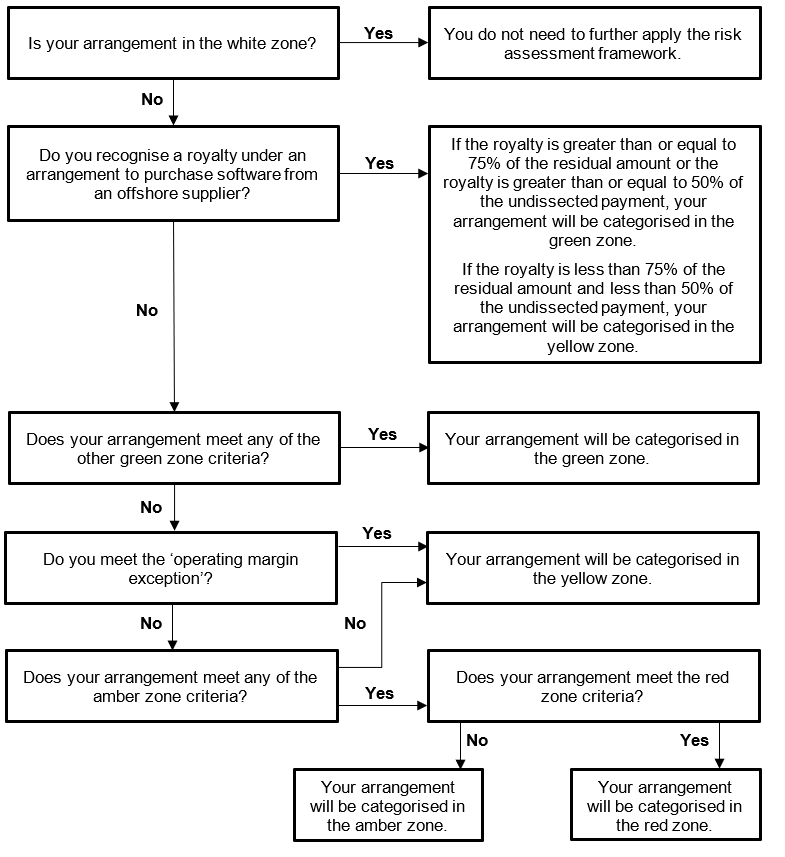
30. Diagram 1 of this Guideline provides an overview of the risk assessment framework.
Diagram 1: Roadmap for the risk assessment framework
31. Your arrangement falls within the white zone if any of the following apply to you for an income year:
- •
- There is a settlement agreement or advance pricing arrangement (APA) between you and the ATO, where the terms of the settlement or APA expressly cover the Australian withholding tax outcomes related to the arrangement for the current year and you have met the conditions of the agreement.
- •
- A court or tribunal has decided (in a proceeding to which you were a party) that a payment under your arrangement does or does not constitute a royalty.
- •
- The income year was subject of a review or audit of the arrangement and we provided you with a 'low risk' rating[4] (or a 'high assurance' rating as part of a justified trust review) in relation to the royalty risk of the arrangement.
32. This is provided there has not been a material change in the available facts and evidence in relation to the arrangement since the time of the settlement agreement, APA, court decision, review or audit. Where information previously provided to us or a court was materially different or incomplete, this condition will not be satisfied.
33. If your arrangement falls within the white zone, you do not need to consider the other zones.
34. If your arrangement falls within the green zone, you do not need to consider the other zones.
Where no royalty is recognised
35. Where no royalty is recognised, your arrangement falls within the green zone if your undissected payment is paid solely for the acquisition of:
- •
- copies of software solely for private or domestic use, or
- •
- copies of software generally available to the public (that is, not customised) and solely for your own business use (that is, not further sold, licensed or otherwise exploited as a primary object of your business), or
- •
- finished tangible goods of which software is an inherent or practically inseparable part and the software is only to enable the tangible goods to perform their intended function (for example, firmware).
36. Where no royalty is recognised, your arrangement also falls within the green zone if your undissected payment is paid solely for the acquisition of copies of software in circumstances where:
- •
- you do not have the right to, and do not, make additional copies of the software, and
- •
- there is no adaptation of the software, pre-sale or implementation services or post-sale services connected with the use of the software by your customers or end users, and
- •
- either
- –
- the software copies that you acquire are embodied on physical media, or
- –
- the software copies are electronic and your customers pay a fixed price (once) for a perpetual or ongoing licence to use the copy of the software.
37. Where a royalty is recognised in relation to the instrument under which you purchase software (including software licences or access to software) from an offshore supplier, your arrangement will fall within the green zone if:
- •
- the royalty is recognised and reported for Australian tax purposes
- •
- you are able to substantiate how you arrived at the royalty amount
- •
- withholding tax has been paid in respect of the royalty, and
- –
- where the offshore supplier is a related party[5], you have undertaken a self-assessment using the residual risk assessment calculation and the royalty is greater than or equal to 75% of the residual amount, or
- –
- the royalty is greater than or equal to 50% of the undissected payment.
38. Where a royalty is recognised in relation to the instrument under which you purchase software (including software licences or access to software) from an offshore supplier, your arrangement will fall within the yellow zone if:
- •
- the royalty is recognised and reported for Australian tax purposes
- •
- you are able to substantiate how you arrived at the royalty amount
- •
- withholding tax has been paid in respect of the royalty, and
39. If your arrangement falls within the yellow zone, we may review the quantum of your royalty depending on the tax at risk.
Where no royalty is recognised
40. Where no royalty is recognised, your arrangement falls within the yellow zone if it is not in the amber or red zones.
41. An arrangement that would otherwise fall within the amber zone or red zone may qualify for the operating margin exception and instead fall within the yellow zone.
42. Your arrangement will fall within the yellow zone where the Australian operating margin for a relevant income year:
- •
- exceeds 10%, or
- •
- is within 10 percentage points of the global group's operating margin.
43. Your arrangement will fall within the amber zone where:
- •
- you sell (to Australian customers) products or services which comprise, or substantially involve, access to or use of software, the IP rights in which (or licence to use) is held by the offshore supplier, and
- •
- any of the following applies
- –
- your agreements with the offshore supplier refer to or permit the use of software held by the offshore supplier (regardless of any description of the rights as being, for example, limited, restricted or royalty-free), or
- –
- in order to use the products or services, your Australian customers require the use of, or the licence or right to use, software held by the offshore supplier (regardless of the description of the rights granted under the agreement, for example, limited, restricted or royalty-free)[8], or
- –
- in order to use the products or services, your Australian customers require access to the software and that software access is protected by security features, such as a key code, password or copy protection.
44. Your arrangement also falls within the amber zone where you have not self-assessed your risk zone or are unable to provide evidence to explain your self-assessment against our risk assessment framework.
45. An arrangement that would otherwise be in the amber zone will be categorised in the red zone if your arrangement meets the additional red zone criteria at paragraph 46 of this Guideline. An undissected payment that falls within the amber zone is considered medium to high risk. We may engage with you to understand the royalty risk.
46. An arrangement in the amber zone will fall within the red zone if under the arrangement:
- •
- you make copies of, or modify the software held by the offshore supplier (or have the right to do so or authorise others to do so) in the course of selling the products or services to Australian customers, or
- •
- you previously paid a royalty to the offshore supplier under the same or a similar agreement, or
- •
- the recipient of the undissected payment is a tax resident in a specified jurisdiction or has a branch in a specified jurisdiction[9] and the payment is made to the branch, or any of the following applies
- –
- the recipient is subject to a preferential tax regime considered to be harmful according to the Organisation for Economic Co-operation and Development Forum on Harmful Tax Practices
- –
- the recipient has (or anticipates the benefit of) a tax holiday, exemption or concession that is likely to substantially shelter or reduce its tax payable
- –
- the recipient has available to it research and development tax offsets or credits, deductible amortisation or depreciation in relation to the IP rights or significant tax losses that are anticipated to substantially offset or shelter its income, or
- –
- the recipient is a foreign hybrid company under Division 830 of the Income Tax Assessment Act 1997 and a member of your tax consolidated group or multiple entry consolidated group or is characterised differently for income tax purposes in 2 or more jurisdictions.
47. If your arrangement falls within the red zone and we select you for an audit or other review, you can expect that we will require you to provide detailed and comprehensive information and documentation to examine your royalty risk including details of the costs incurred by the offshore supplier in relation to the software.
Residual risk assessment calculation
48. The following residual risk assessment calculation will be used for the purposes of a quantitative risk assessment of your royalty apportionment:
Residual amount = payment − offshore supplier costs
49. Offshore supplier costs are the total of the costs in relation to the manufacturing, intermediation services or distribution of software and related goods and services incurred by the offshore supplier in relation to sales to you – for example, infrastructure costs, sales and marketing costs, third-party royalty expenses and direct labour costs plus a mark-up of 5%.
50. Where the offshore supplier is an intermediary supplying goods or services produced by a related party, include the relevant costs incurred by the related party when determining the costs incurred by the offshore supplier (but separately identify and exclude any mark-up on the costs between the related party and the offshore supplier).
51. Exclude the following from the costs incurred by the offshore supplier of the goods or services:
- •
- royalty payments paid by the offshore supplier to a related party
- •
- amortisation of intangible assets
- •
- stock-based compensation payments, and
- •
- costs incurred by the offshore supplier that are not in relation to sales to you.
52. We recognise that the offshore supplier may sell products or services to numerous entities in addition to you, and therefore it may be necessary to conduct a cost allocation for the products or services sold to Australia. In these circumstances, you should make a considered and reasonable allocation of costs to your sales-related transactions and retain the evidence to substantiate the approach you adopted.
53. Consistent with this being a risk assessment framework, provided that your cost base calculation is conducted on a reasonable and 'best efforts' basis, we accept that your calculation may not be precise.
54. To complete the residual risk assessment calculation, subtract the offshore supplier costs from the payment to determine the residual amount. A threshold percentage of the residual amount is used to determine your risk rating. These thresholds relate part of the residual amount to the value of intangible assets used in the value chain while recognising that part of the residual amount may instead relate to mark-ups earned on offshore supplier costs or other profit elements.
Example 1 – royalty recognised – downloadable and cloud-based software
55. An agreement between AusCo and its foreign parent ForeignCo sets out the following key terms:
- •
- AusCo is granted the non-exclusive right to resell ForeignCo's products in Australia.
- •
- ForeignCo sells products to AusCo for resale by AusCo in Australia.
- •
- AusCo is to maintain and enhance the brand and image of ForeignCo and its products in Australia.
- •
- ForeignCo's products are
- –
- computer software available for download from servers owned by ForeignCo and installation onto customers' personal devices, and
- –
- access to cloud-based software via the internet, which is installed and executed on servers owned by ForeignCo.
- •
- AusCo does not have any express right, title or interest to any IP, or any express licence related to any IP to which ForeignCo has rights or licences.
- •
- ForeignCo also provides to AusCo
- –
- order fulfillment services (for example, allowing customers who purchase products from AusCo to download or access software from ForeignCo's computer servers)
- –
- relevant information for the promotion of products.
- –
- For the grant of the non-exclusive right to distribute ForeignCo's products in Australia, and as consideration for ForeignCo's products purchased by AusCo, AusCo is required to pay ForeignCo an amount calculated as AusCo's net profit from the sale of the products, less a small margin representing an arm's length fee for distribution services.
56. Customers in Australia enter into a standardised contract which states that AusCo is the entity with which they contract for the purchase of the products and customers in Australia pay AusCo for the products.
57. Upon a customer in Australia contracting with AusCo and paying the subscription fee for the purchase of the products to AusCo, ForeignCo grants a limited IP licence to the customer directly (for no further payment from the customer) and grants the customer relevant access to the computer software from a computer server it controls.
58. ForeignCo owns or has rights to all the IP in the products and also provides AusCo access to confidential information and know-how regarding the products. ForeignCo is not a party to the sales contract with customers in Australia for the products. However, ForeignCo is a party to the IP licensing agreement with the customer which accompanies AusCo's contract with the Australian customers.
59. As part of their agreement, ForeignCo and AusCo agree that a portion of the payments made by AusCo to ForeignCo under the agreement are royalties. How they arrived at the royalty rate and the self-assessment of the residual risk assessment calculation in this Guideline is documented. Under the residual risk assessment calculation, AusCo has calculated that the royalty payment is a proportion greater than 75% of the residual amount. AusCo withholds an amount from the royalty it pays to ForeignCo and pays the withheld amount to us.
60. ForeignCo and AusCo have also not restructured their related party dealings to lower the amount of royalties recognised prior to any restructure.
61. AusCo is recognising a portion of the payments to ForeignCo as royalties for Australian tax purposes (including by withholding an amount from the royalty it pays to ForeignCo and paying the withheld amount to us), with such an amount not being the result of a reduced royalty rate due to a change in related party arrangements. Further, AusCo's supporting documentation for the royalty amount includes a self-assessment of the residual risk assessment calculation and has calculated that the royalty is greater than or equal to 75% of the residual amount.
62. As a result, AusCo's arrangement is categorised as being in the green zone, and we will not prioritise the allocation of resources to review the royalty risk. If AusCo is selected for review, we will seek AusCo's supporting documentation regarding how they arrived at the royalty rate as well as their self-assessment of the residual risk assessment calculation.
Example 2 – internet security software solely acquired for private or domestic use
63. Sarah wants to enhance her online security and, after researching various internet security software options, decides that she wants a subscription for internet security software from AntiVirus Co.
64. AntiVirus Co is a provider based in a foreign country and specialises in developing internet security software to detect and neutralise computer viruses.
65. Sarah selects a one-year subscription plan on AntiVirus Co's website, enters her payment details, downloads a copy of the software and follows the easy setup instructions to install the internet security software onto her personal computer.
66. For the purposes of this Guideline, the arrangement under which Sarah made payments to AntiVirus Co is categorised in the green zone as the copy of the software acquired is solely for her private or domestic use.
Example 3 – general administrative software acquired solely for business use
67. EducationCo Australia provides education services to Australian customers.
68. EducationCo Australia has an agreement with EducationForCo to obtain access to a comprehensive suite of cloud-based productivity applications which are licensed by EducationForCo from an unrelated offshore global software provider which develops software that is made generally available to the public.
69. These applications include:
- •
- productivity applications used to create documents and spreadsheets
- •
- project management tools (for production scheduling and resource allocation)
- •
- communication platforms (email, messaging, video conferencing)
- •
- enterprise resource planning systems (to manage inventory, finance, and procurement)
- •
- customer relationship management tools (to handle sales and customer interactions).
70. EducationCo Australia cannot modify the source code in the software but is permitted by the global software vendor to configure and customise certain features of the cloud applications to fit its unique business needs, within certain constraints. For instance, EducationCo Australia customises the reporting and dashboards within the customer relationship management to display key performance indicators. EducationCo Australia also configures the security roles and access permissions across staff to vary levels of access based on an employee's role.
71. EducationCo Australia may work closely with the Software as a Service (SaaS) provider or approved third-party vendors to ensure these configurations align with both their operational needs and the cloud provider's software limitations.
72. EducationCo Australia provides access to these cloud-based applications to all staff across its Australian subsidiaries.
73. The cloud services agreement places a number of restrictions on EducationCo Australia's use of the software applications. EducationCo Australia is not permitted to disclose its account credentials to third parties or allow the applications to be used by more than 300 devices. EducationCo Australia can pay an additional amount to add more devices to the user base.
74. For the purposes of this Guideline, the arrangement is categorised in the green zone as the software is used in the course of EducationCo Australia's own business (productivity applications for EducationCo Australia staff use), is generally available to the public, is not substantially customised, and is not further sold, licensed or otherwise exploited as a primary object of its business.
75. The categorisation of EducationCo Australia's arrangement as low risk does not preclude further investigation of the unrelated global software provider's arrangements in Australia.
Example 4 – software copies embodied on physical media acquired by a retailer
76. Electronics Retail Co is a large Australian retail company that resells consumer electronics and white goods at stores located throughout Australia.
77. Electronics Retail Co also resells software such as productivity programs on physical media (for example, CD-ROMs). Electronics Retail Co has wholesale agreements with offshore software companies which enables Electronics Retail Co to purchase the software on physical media at reduced prices.
78. Under the wholesale agreements, Electronic Retail Co has no rights to reproduce, modify or sublicense, nor has any other rights to use the software IP rights of the offshore companies.
79. Further, Electronic Retail Co does not provide to customers any presale or implementation services, or post-sale services connected with use of the software.
80. The arrangement under which Electronics Retail Co makes payments to the offshore software providers under the wholesale agreements is categorised in the green zone as the facts satisfy the criteria in paragraph 36 of this Guideline. The software copies embodied on physical media are acquired for mere resale, Electronics Retail Co does not reproduce, adapt, nor provide value-added services, and the software is embodied on physical media.
Example 5 – washing machines with embedded software
81. White Goods Co manufactures washing machines with smart technology and sells the products to Australian customers through its subsidiary distributor, AusCo. AusCo makes payments to White Goods Co for the washing machines under a distribution agreement.
82. The smart washing machines AusCo purchases from White Goods Co have pre-installed software that allows consumers to remotely control and monitor their washing machine through an application on a smart phone. The software embedded in the washing machine also supports the sensor functions that automatically dispense detergent, monitor energy consumption during wash cycles, and run diagnostic tests and troubleshoot problems.
83. AusCo does not have any rights to modify, or sublicense the rights to modify, the software installed onto the smart washing machines.
84. The arrangement under which AusCo makes payments to White Goods Co is categorised in the green zone as the payments are for finished tangible goods of which software is an inherent and practically inseparable part, and the software is to enable the tangible goods to perform their intended function and the goods are acquired for resale to retail customers.
Example 6 – smartphones with embedded software
85. Tech Co manufactures smartphones with embedded software and sells the products to Australian customers through its subsidiary distributor AusCo. AusCo makes payments to Tech Co for the smartphones under a distribution agreement.
86. The smartphones AusCo purchases from Tech Co have pre-installed software and an operating system that among its functions allows customers to make and receive calls, browse the web, install applications, take photos and video, play media and connect to Wi-Fi and Bluetooth.
87. AusCo does not have any rights to modify, or sublicense the rights to modify, the software installed onto the smartphones.
88. The arrangement under which AusCo makes payments to Tech Co is categorised in the green zone as they are for finished tangible goods of which software is an inherent and practically inseparable part, and the software is to enable the tangible goods to perform their intended function.
Example 7 – simple distribution – video games
89. Software Co, a foreign resident, develops video games for computers and gaming consoles. AusCo, an Australian resident subsidiary of Software Co, markets and distributes the group's software products to customers in Australia.
90. AusCo pays Software Co to acquire electronic copies of the video games for sale in the Australian market. AusCo has no right to, and does not, make additional copies of the video games available as part of the distribution process.
91. Customers make a one-off payment to AusCo, which allows them to download a copy of the video game that AusCo makes available via the internet, install it and play the game. Customers are not required to pay ongoing subscription fees to AusCo to continue playing the game.
92. The facts in this Example satisfy the criteria in paragraph 36 of this Guideline. The arrangement under which AusCo makes payments to Software Co is therefore categorised in the green zone.
Example 8 – amber zone – agreement to market and distribute software
93. IT Software Co, a foreign resident, develops enterprise resource planning (ERP) software. IT Software Co owns all the IP relating to the software. IT Software Co enters into an arrangement with its Australian wholly owned subsidiary AU Software Co to distribute the software to Australian customers.
94. The agreement grants AU Software Co an exclusive right to market and distribute the ERP software to Australian customers. However, the agreement does not grant AU Software Co the right to make copies or modify the ERP software.
95. Australian customers enter into agreements with both AU Software Co and IT Software Co to obtain an access code to the ERP software. Customers pay a subscription fee to AU Software Co which AU Software Co remits to IT Software Co which it describes as a fee for distribution rights after retaining a small margin for distribution services.
96. Under the agreement, the undissected payment is described as being for AU Software Co's right to market and distribute software licences to Australian customers – with no consideration for the use of, or the right to use, IP.
97. AU Software Co's arrangement does not satisfy the criteria for the green or red zones and will be categorised in the amber zone because of the following:
- •
- AU Software Co sells products to Australian customers that comprise, or substantially involve, access to or use of software in which the offshore supplier holds the IP rights.
- •
- The agreement between AU Software Co and the offshore supplier refers to or permits the use of software held by the offshore supplier.
- •
- AU Software Co's customers pay a subscription fee to AU Software Co rather than a one-time payment for a perpetual licence.
- •
- AU Software Co's customers enter into a contract with AU Software Co as a precondition to, or in connection with, receiving any kind of licence to use or access IT Software Co's software.
Example 9 – red zone – agreement to market, promote, distribute, copy and sell software licences
98. International Corporation (International) is a worldwide provider of software (Programs). It is a foreign resident and parent company of the International Group.
99. Intangible Enterprises (IE) is a tax resident in a specified jurisdiction and member of the International Group. Operational Business Australia Co (OBA) is an Australian company and head company of the group.
100. OBA became the principal distributor of the Programs in Australia by entering into a licence agreement (Agreement) with IE. The key terms of the Agreement are:
- •
- Clause 1 – OBA is appointed and authorised as a non-exclusive distributor of the Programs.
- •
- Clause 2 – IE retains all IP rights in the Programs, including all copyright.
- •
- Clause 3 – OBA is granted a right to market, promote, distribute, copy (for the limited purpose of permitting end-users to make copies for their internal use) and sell licences for the Programs to end-users.
- •
- Clause 4 – the distribution rights permit OBA to enter into end-user licence agreements (EULA) for the Programs with end-users in Australia.
- •
- Clause 5 – OBA must pay a fee to IE that equates to 97% of its net revenue from product sales, in consideration for the rights granted under Clause 3. This clause states that the rights granted under Clause 3 are provided royalty-free.
101. End-users obtain use of the Programs through one of 3 ways: electronic download, via cloud content hosted on servers controlled by IE, or through physical copies shipped to them by IE. In each situation, end-users are required to first enter into a EULA with OBA. After entering into a EULA, OBA will invoice the end-user and receive payment from them.
102. Under the agreement, the undissected payment is for OBA's right to market, promote, distribute, copy and sell licences for the Programs to end-users – with no part of the undissected payment for the use of, or the right to use, IP.
103. The agreement between OBA and IE contains clauses where customers are required to enter into a contract with OBA as a precondition to receiving a licence to access the computer software (albeit described as limited or restricted), where that licence specifies the terms upon which the software is made available to the end-user.
104. Further, Clause 3 permits end-users to make copies of the Programs.
105. Accordingly, OBA's arrangement satisfies the amber zone criteria and is not a green zone arrangement:
- •
- OBA sells to Australian customers products or services which comprise, or substantially involve, access to, or use of, software the IP rights in which is held by the offshore supplier.
- •
- OBA is a party to an agreement or agreements with an offshore supplier which contain clauses referring to or permitting the use of any IP (regardless of any description of the rights as being, for example, limited, restricted, or royalty-free).
- •
- OBA enters into agreements with customers under which they are granted rights to use or access software from OBA or an associate of OBA (for example, a EULA).
- •
- OBA grants access to the software and that software access is protected by security features such as a key code, password or copy protection, or has the right to do so.
- •
- At least some of the payment from OBA to IE relates to software where OBA distributes the software through a subscription model.
106. However, based on the following characteristics, OBA's arrangement is characterised in the red zone since it also meets the criteria of the red zone:
- •
- OBA makes copies of the software.
- •
- IE is a tax resident in a specified jurisdiction.
Your comments
107. You are invited to provide comment on this draft Guideline. Forward your comments to the email address below by the due date.
108. A compendium of comments is prepared as part of the finalisation of this Guideline. An edited version of the compendium (with names and identifying information removed) may be published to the ATO Legal database on ato.gov.au.
109. Advise if you do not wish for your comments to be included in the edited compendium.
| Due date: | 2 October 2026 |
| IntangiblesArrangements@ato.gov.au |
© AUSTRALIAN TAXATION OFFICE FOR THE COMMONWEALTH OF AUSTRALIA
You are free to copy, adapt, modify, transmit and distribute this material as you wish (but not in any way that suggests the ATO or the Commonwealth endorses you or any of your services or products).
For readability, all further references to 'this Guideline' refer to the Guideline as it will read when finalised.
Previously issued, on 6 August 2025, as Draft Practical Compliance Guideline PCG 2025/D4 Low-risk payments relating to software arrangements – ATO compliance approach.
For completeness, this Schedule does not cover content streaming.
Including a 'no further action' outcome based on a finding of low risk.
Or an associate thereof.
Or an associate thereof.
The threshold percentage that will be used in the residual risk assessment calculation will be confirmed following the feedback received through this consultation process.
Examples of agreements which may grant such rights include customer agreements or agreements appointing a reseller, sub-reseller or sub-distributor.
Appendix 1: Specified countries or jurisdictions names and codes .
Previously issued as PCG 2025/D4
ATO references: ATO references:NO 1-127XJNYV
Related Rulings/Determinations:
TR 2026/2
Legislative References:
ITAA 1936 6(1)
ITAA 1936 Pt IVA
ITAA 1936 177DA
ITAA 1997 Subdiv 815-B
ITAA 1997 Subdiv 815-C
Case References:
Commissioner of Taxation v PepsiCo Inc & Anor
[2025] HCA 30
2025 ATC 20-969
124 ATR 1
(2025) 99 ALJR 1211
Copyright notice
© Australian Taxation Office for the Commonwealth of Australia
You are free to copy, adapt, modify, transmit and distribute material on this website as you wish (but not in any way that suggests the ATO or the Commonwealth endorses you or any of your services or products).
