
Explanatory Statement
Issued by authority of the Assistant Minister for Productivity, Competition, Charities and Treasury and Parliamentary Secretary to the TreasurerTaxation (Multinational—Global and Domestic Minimum Tax) Amendment (2026 Measures No.2) Rules 2026
Taxation (Multinational—Global and Domestic Minimum Tax) Act 2024
Section 29 of the Taxation (Multinational—Global and Domestic Minimum Tax) Act 2024 (the Assessment Act) provides that the Minister may make Rules required or permitted by the Assessment Act, or necessary or convenient for carrying out or giving effect to the Assessment Act.
The purpose of the Taxation (Multinational—Global and Domestic Minimum Tax) Rules 2024 (the Rules) is to empower the Minister to detail the specifics in computing top-up tax. The Rules include details on:
- •
- computing and allocating GloBE Income or Loss;
- •
- computing and allocating Adjusted Covered Taxes;
- •
- application to Tax Transparent Entities and Reverse Hybrid Entities;
- •
- safe harbour provisions; and
- •
- transitional provisions for MNE Groups in the initial phases of being in scope of the Assessment Act.
The purpose of the Taxation (Multinational—Global and Domestic Minimum Tax) Amendment (2026 Measures No. 2) Rules 2026 (the Amending Rules) is to make amendments to ensure the effective operation of the top-up tax Rules and incorporate elements of the Agreed Administration Guidance released in December 2023, June 2024 and January 2026.
The Amending Rules make amendments to:
- •
- Section 3-255 to amend the Flow-through Entity income allocation rules and related definitions in Chapter 10;
- •
- Section 4-55 to the Blended Controlled Foreign Company (CFC) Allocation Key;
- •
- Section 4-95 to modify the substitute loss carry forward rule; and
- •
- Chapter 8 to make minor amendments to ensure the Safe Harbours operate correctly.
The Rules implement the domestic framework for a multinational top-up tax, by providing for the substantive computations of top-up tax under the GloBE Rules and operate to ensure that future administrative guidance released by the OECD can be incorporated in a timely and efficient manner. It is imperative that the Rules reflect OECD approved documents so that Australia's implementation of the GloBE Rules maintains qualified status, which can only be achieved if the Rules are implemented in a manner consistent with the GloBE Rules, as amended by any Administrative Guidance. All OECD documents are publicly available from the OECD website and could, in 2026, be accessed freely from https://oecd.org.
The Assessment Act does not specify any conditions that need to be satisfied before the power to make the Rules may be exercised.
The Amending Rules are a legislative instrument for the purposes of the Legislation Act 2003. The Amending Rules are subject to disallowance and sunsetting in accordance with sections 42 and 50, respectively, of the Legislation Act 2003.
The Amending Rules commence the day after registration.
The Amending Rules apply from 1 January 2024.
Retrospective application is appropriate because this achieves a start date in line with the OECD's Pillar Two start date and is consistent with the coordinated international approach between implementing jurisdictions. The Assessment Act provides that Rules may be made retrospectively despite subsection 12(2) of the Legislation Act 2003.
Details of the Rules are set out in Attachment A .
A Statement of Compatibility with Human Rights is at Attachment B.
The Office of Impact Analysis (OIA) has been consulted. A list of reports certified as equivalent to a Policy Impact Analysis can be found at https://oia.pmc.gov.au/published-impact-analyses-and-reports/two-pillar-solution-addressing-tax-challenges-arising. The full list of reports and executive summaries of those reports are also available in the Explanatory Memorandum for the Taxation (Multinational-Global and Domestic Minimum Tax) Act 2024 as these reports have been certified for the Assessment Act and the Rules.
ATTACHMENT A
Details of the Taxation (Multinational—Global and Domestic Minimum Tax) Amendment (2026 Measures No. 2) Rules 2026
Section 1 – Name
This section provides that the name of the instrument is the Taxation (Multinational—Global and Domestic Minimum Tax) Amendment (2026 Measures No. 2) Rules 2026 (the Amending Rules).
Section 2 – Commencement
Schedule 1 to the Amending Rules commences on the day after the instrument is registered on the Federal Register of Legislation.
Section 3 – Authority
The Amending Rules are made under the Taxation (Multinational—Global and Domestic Minimum Tax) Act 2024 (the Assessment Act).
Section 4 – Schedule
This section provides that each instrument that is specified in the Schedule to this instrument is amended or repealed as set out in the applicable items in the Schedule, and any other item in the Schedule to this instrument has effect according to its terms.
Glossary
This Explanatory Statement uses the following abbreviations and acronyms.
| Abbreviation | Definition |
| CbCR | Country-by-Country Reporting |
| CFC | Controlled Foreign Company |
| Commentary | Tax Challenges Arising from the Digitalisation of the Economy – Consolidated Commentary to the Global Anti-Base Erosion Model Rules (2025) published by the OECD on 9 May 2025 |
| DTA | Deferred Tax Asset |
| ETR | Effective Tax Rate |
| FANIL | Financial Accounting Net Income or Loss |
| GloBE Rules | OECD GloBE Model Rules (as modified by the Commentary, Agreed Administrative Guidance and Safe Harbours Rules) |
| January 2026 AG | Tax Challenges Arising from the Digitalisation of the Economy – Administrative Guidance on the Global Anti-Base Erosion Model Rules (Pillar Two), January 2026 published by the OECD on 5 January 2026 |
| June AG | Tax Challenges Arising from the Digitalisation of the Economy – Administrative Guidance on the Global Anti-Base Erosion Model Rules (Pillar Two), June 2024 published by the OECD on 17 June 2024 |
| JV | Joint Venture |
| MNE Group | MNE Group, as defined in the Taxation (Multinational—Global and Domestic Minimum Tax) Act 2024. |
| PE | Permanent Establishment |
| QDMTT | Qualified Domestic Minimum Top-up Tax |
| UPE | Ultimate Parent Entity |
Amendments to Chapter 3: modifications to Flow-through entities
The amendments make changes to section 3-255 of the Rules so that the FANIL of a Flow-through Entity is appropriately allocated. Related amendments are also made to the definitions of Reference Entity, Tax Transparent Entity and Reverse Hybrid Entity in Chapter 10 of the Rules. Whether a Flow-through Entity is a Tax Transparent Entity or Reverse Hybrid Entity, is determined by the tax law of the jurisdiction of the Constituent Entity-owner closest to an Entity in the ownership chain that is not itself a Flow-through Entity (see paragraphs 21 and 22 on page 114 of the June AG). This is the 'Reference Entity'. Where there is no Constituent Entity-owner and the UPE of the MNE Group is a Flow-through Entity, the UPE is the Reference Entity.
The tax law of the Reference Entity's jurisdiction refers to all the laws of the jurisdiction that result in treatment of the Flow-through Entity, and each Entity through which the Reference Entity holds its Ownership Interest in the Flow-through Entity, as fiscally transparent for taxation of its income or loss. The Reference Entity's jurisdiction must have tax laws that affirmatively provide for fiscally transparent treatment. Therefore, a jurisdiction that does not have a corporate income tax or a similar Covered Tax, cannot treat an Entity as fiscally transparent.
These amendments provide that the income of a Flow-through Entity is only allocated to a Constituent Entity-owner that is subject to tax on that income and is not itself a Flow-through Entity. For this purpose, paragraph 3-255(1)(c) of the Rules is amended so that the relevant Constituent Entity-owners are the Constituent Entity-owners that are Reference Entities of the Flow-through Entity. If an owner is not subject to tax on the income, then in accordance with the ordinary allocation rules, the income remains with the Flow-through Entity. This outcome ensures that income and taxes on that income are included in the same jurisdictional ETR calculation. There is, however, an exception when the Flow-through Entity is the UPE of the MNE Group. The amendments also preserve the separate rule for a Tax Transparent Entity that would be the UPE of the MNE Group but for a Controlling Interest held by an Excluded Entity.
Ensuring that a Flow-through Entity can only be classified as either a Tax Transparent Entity (i.e. treated as transparent in the owner's jurisdiction) or a Reverse Hybrid Entity (i.e. treated as opaque in the owner's jurisdiction) in relation to an Ownership Interest is important for income allocation. Therefore, amendments are made to the definitions under sections 10-35 and 10-40 of the Rules (see paragraphs 154 and 154.1 on page 311 of the Commentary to Article 10.2.1). Under those amendments, a Flow-through Entity is a Tax Transparent Entity to the extent that the Flow-through Entity, and each interposed Entity through which the Reference Entity holds its Ownership Interest, is fiscally transparent in the Reference Entity's jurisdiction. A Flow-through Entity is a Reverse Hybrid Entity to the extent that it is not a Tax Transparent Entity.
The classification of a Flow-through Entity as Tax Transparent or Reverse Hybrid Entity is made for each Ownership Interest, with regard to the tax law of the jurisdiction of the relevant Reference Entity. It is possible for a Flow-through Entity to have multiple owners, which can result in multiple Reference Entities. However, there is only one Reference Entity for any particular Ownership Interest (see Example 1.1). Consequently, a Flow-through Entity with multiple owners in different jurisdictions could have more than one classification for GloBE purposes. Further, because the definitions apply "to the extent" that the relevant conditions are satisfied, a Flow-through Entity may be a Tax Transparent Entity in relation to one Ownership Interest and a Reverse Hybrid Entity in relation to another Ownership Interest. This can occur where the Reference Entity's jurisdiction treats the Flow-through Entity and each interposed Entity in one ownership chain as fiscally transparent, but that condition is not satisfied in relation to another ownership chain.
In allocating FANIL, subparagraph 3-255(1)(a)(ii) of the Rules applies where the Ownership Interests of the Tested Entity are owned indirectly by non-Group Entities through a Tax Transparent Structure. If a non-Group Entity owns an interest in a Flow-through Entity that sits between the Reference Entity and the Tested Entity in the MNE Group's ownership structure, then that non-Group Entity indirectly owns its interest in a Tested Entity through a Tax Transparent Structure.
Consequential amendments
Corresponding amendments are made to section 4-50 of the Rules to ensure the allocation of Covered Taxes from the Flow-through Entity can also be allocated to the Constituent Entity-owner where amounts of CFC Tax (including Blended CFC Tax) have been allocated to the Tax Transparent Entity (see paragraph 57.1 to 57.4 to Article 4.3.2(b) of the Commentary). Consistent with the principle that Covered Taxes follow the GloBE Income or Loss to which they relate, this ensures that, where Covered Taxes relating to a CFC charge have first been allocated to a Tax Transparent Entity under section 4-55 of the Rules, those taxes may be allocated onward to the relevant Constituent Entity-owner to the extent the taxes are in respect of GloBE Income or Loss allocated to that Constituent Entity-owner under paragraph 3-255(1)(c) of the Rules. Where the Tax Transparent Entity has more than one Reference Entity, this onward allocation is made by reference to the Constituent Entity-owner through which the Parent Entity that paid the CFC tax holds the relevant Ownership Interest in the Tax Transparent Entity. Paragraph 4-50(b) of the Rules limits the onward allocation in this way by requiring the amount to be in respect of GloBE Income or Loss allocated to that Constituent Entity-owner under paragraph 3-255(1)(c) of the Rules.
For a Tax Transparent Entity that is also a CFC, section 4-55 of the Rules first determines the amount of CFC tax to be allocated to the CFC. If the CFC is a Tax Transparent Entity, section 3-255 of the Rules then determines the Constituent Entity-owner to which the relevant GloBE Income or Loss is allocated. Section 4-50 of the Rules then performs the onward tax allocation step for amounts that have either accrued in the financial accounts of the Tax Transparent Entity or have been allocated to the Tax Transparent Entity under section 4-55 of the Rules.
In the case of a Blended CFC Tax Regime, the Blended CFC Allocation Key is worked out before the income of the Flow-through Entity is allocated under section 3-255 of the Rules. This is because the allocation key under section 4-55 of the Rules is calculated by reference to the attributable income of the relevant Entity before section 3-255 of the Rules reallocates the Flow-through Entity's FANIL.
Amendments to Chapter 10: Hybrid Entities
The amendments also modify section 10-55 of the Rules, which defines Hybrid Entity. The existing Hybrid Entity rule is retained as subsection 10-55(1). That rule applies where an Entity is treated as a separate taxable person in the jurisdiction in which it is located and is treated as fiscally transparent in the jurisdiction in which its owner is located.
The amendments extend the definition so that an Entity located in a jurisdiction that has no corporate income tax system may also be a Hybrid Entity. This applies to the extent that the Entity is fiscally transparent in the jurisdiction in which its owner is located, and section 10-50 of the Rules does not apply to the Entity.
The definition of Hybrid Entity continues to refer to the Entity's owner, rather than a Reference Entity. This is because the Hybrid Entity definition is relevant to the allocation of Covered Taxes imposed on an owner in respect of the Entity's income. It does not determine the allocation of FANIL of a Flow-through Entity under section 3-255 of the Rules. In the context of section 10-55 of the Rules, the word "owner" refers to both direct and indirect owners of Ownership Interests in the Hybrid Entity. The phrase "with respect to its income, expenditure, profit or loss to the extent that it is fiscally transparent in the jurisdiction in which its owner is located" means that an Entity may be considered a Hybrid Entity only with respect to the owners that treat it as fiscally transparent.
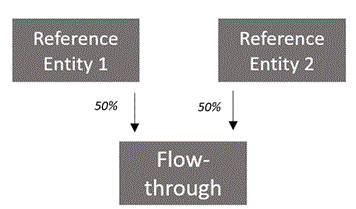
Example 1.1
A Flow-through Entity is owned by two Constituent Entity parent entities located in different jurisdictions. Reference Entity 1 in jurisdiction A classifies the Flow-through Entity as not fiscally transparent for tax purposes, resulting in 50% of the relevant FANIL and Covered Taxes being allocated to the Flow through Entity. Conversely, Reference Entity 2 in jurisdiction B classifies the Flow-Through Entity as tax transparent for tax purposes and therefore the relevant income and covered taxes are allocated to Reference Entity 2 (this reflects s3-255(4) of the Rules).
Amendments to the Blended CFC regimes under section 4-55
The amendments to section 4-55 of the Rules expand the range of entities included in the Blended CFC Allocation Key, ensuring that Covered Taxes under Blended CFC Tax Regimes are allocated consistently across all relevant entities and jurisdictions, including those that are not Constituent Entities. Subparagraph 4-55(5)(a)(i) of the Rules is amended so that the allocation rules now apply to PEs, expanding the calculation of the sum of all Blended CFC Allocation Keys to include PEs to be treated separately under a Blended CFC Tax Regime.
Minor amendments are made to subsection 4-55(5) of the Rules to remove existing jurisdictional requirements, having the effect of removing the requirement that an entity be located in the same jurisdiction as the tested Constituent Entity. These changes ensure that the Constituent Entity-owner computes Blended CFC Allocation Keys for all entities in which it has an Ownership Interest, regardless of whether those entities are located inside or outside the jurisdiction of the tested Constituent Entity. This ensures that the formula in subsection 4-55(3) of the Rules works correctly in allocating taxes imposed under a Blended CFC Tax Regime. The scope of entities included in the sum of the Allocation Key is widened, although many of these entities will still contribute a zero Allocation Key if they have no attributable income.
Lastly, subparagraph 4-55(5)(b)(ii) of the Rules is amended to ensure non-GloBE PEs are captured in the Constituent Entity-owner's computation of Blended CFC Allocation Keys, treating each non-GloBE Entity or PE as if it were a Constituent Entity of the MNE Group. This deeming ensures that an amount of tax imposed under the Blended CFC Tax Regime in respect of non-GloBE Entities can be appropriately excluded from the Adjusted Covered Taxes of GloBE Entities.
Meaning of GloBE Jurisdictional ETR
The Amending Rules expand the definition of GloBE Jurisdictional ETR for the purposes of calculating the Blended CFC Allocation Key (new section 4-56). This provides an alternative methodology for Constituent Entities that are not required to compute an ETR, as well as for Entities or PEs that are not Constituent Entities.
In particular, the updated meaning of the GloBE Jurisdictional ETR provides a different outcome for Tested Entities subject to different conditions including:
- •
- the Tested Entity is a Constituent Entity of an MNE Group that is required to compute an ETR under section 5-5 of the Rules;
- •
- the Tested Entity is a Constituent Entity of an MNE Group that is not required to calculate an ETR under section 5-5 for the Tested Entity's jurisdiction (e.g. due to the application of the Transitional CbCR Safe Harbour, QDMTT Safe Harbour, or the De Minimis exclusion for the Fiscal Year); or
- •
- the Tested Entity is not a Constituent Entity but is treated as one for the purposes described in subparagraph 4-55(5)(b)(ii).
Multiple ETRs in the same jurisdiction
In some cases, Blended CFC Allocation Keys may be required for Constituent Entities that are part of different GloBE blending groups in a jurisdiction, and which are subject to separate ETR calculations. The intention of the amendments is to link the GloBE blending groups for such Tested Entities to the ETR calculated for the jurisdictional blending group to which the Tested Entity belongs. For example, where a Constituent Entity that is an Investment Entity is located in the same jurisdiction as an ordinary Constituent Entity of the broader MNE Group, section 7-100 of the Rules requires that the Investment Entity compute a separate ETR (along with any other investment entities in the jurisdiction) from ordinary Constituent Entities located in the jurisdiction. The Blended CFC Allocation Key for each of the two blending groups of Constituent Entity will be determined based on the GloBE Jurisdictional ETR applicable to each blending group. The Sum of All Blended CFC Allocation Keys includes those computed for all of the Entities and PEs located in the jurisdiction, notwithstanding that some may have been computed based on different GloBE Jurisdictional ETRs.
Alternative calculation if an ETR is not required to be computed.
Where the MNE Group is not required to compute an ETR under Part 5-1 of the Rules, in respect of the Constituent Entity, the MNE Group will calculate the Blended CFC Allocation Key using an alternative GloBE Jurisdictional ETR.
For a tested jurisdiction for which the MNE Group has elected the Transitional CbCR Safe Harbour, the MNE Group uses the simplified ETR, regardless of whether the election is based on the simplified ETR test, the routine profits test, or the de minimis test.
For a jurisdiction for which the MNE Group has elected the QDMTT Safe Harbour, the MNE Group instead uses an ETR determined by taking the sum of:
- •
- taxes used to determine the ETR for the jurisdiction pursuant to the jurisdiction's QDMTT; and
- •
- any QDMTT payable in the jurisdiction for the Fiscal Year in respect of the Constituent Entities of the MNE Group that are located in that jurisdiction, to the extent the Blended CFC Tax Regime allows a foreign tax credit for that tax payable on the same terms as any other creditable Covered Tax;
- •
- divided by the Net GloBE Income determined pursuant to the jurisdiction's QDMTT.
For any other jurisdiction for which the MNE Group is not required to compute an ETR under Part 5-1 of the Rules, the rate that would be the simplified ETR under the Transitional CbC Reporting Safe Harbour is used, with the modification that, instead of using Profit (Loss) before Income Tax from a Qualified CbC Report, the MNE Group uses equivalent information from the Qualified Financial Statements.
Non-GloBE Entities and PEs
To ensure that amounts of tax imposed under a Blended CFC Tax regime in respect of non-GloBE Entities and PEs are not allocated to Constituent Entities, a Blended CFC Allocation Key is calculated for each non-GloBE Entity or PE in which the Constituent Entity-owner holds an Ownership Interest. Non-GloBE Entities and PEs are any Entity or PE that is not a Constituent Entity.
The adjustment requires each non-GloBE Entity and PE to compute a Blended CFC Allocation Key using the GloBE Jurisdictional ETR for the blending group in the same jurisdiction that has the largest aggregate amount of attributable income of the entity. The non-GloBE Entity or PE includes its Blended CFC Allocation Key in the Sum of All Blended CFC Allocation Keys.
If the non-GloBE Entity or PE is located in a jurisdiction in which the MNE Group does not compute any GloBE jurisdictional ETR (for instance, because the MNE Group has no Constituent Entities in the jurisdiction), the GloBE Jurisdictional ETR for the non-GloBE Entity or PE is computed based on the aggregate income and taxes shown in the financial accounts of all non-GloBE Entities or PEs in the jurisdiction with respect to which the Constituent Entity is subject to the Blended CFC Tax Regime.
Amendments to the Substitute Loss Carry Forward Rule under section 4-95
Amendments are made to the Substitute Loss Carry-Forward provisions to ensure that there are three distinct types of Substitute Loss Carry-Forward DTAs (SLCF DTA) that may arise depending on how the tax regime of the Constituent Entity's jurisdiction applies.
- •
- Category 1 arises where the jurisdiction requires foreign source income to be offset by a domestic source loss before foreign tax credits may be applied and allows foreign tax credits that arise in respect of that foreign source income to be carried forward to offset a tax liability in a subsequent Fiscal Year.
- •
- Category 2 arises in similar situations to Category 1, except that instead of allowing the carry forward of foreign tax credits, the jurisdiction permits domestic source income from a later Fiscal Year to be recharacterised as foreign source income. The effect of that recharacterisation is to allow foreign tax credits arising in that later Fiscal Year to offset tax liability in relation to income included in GloBE Income or Loss for that later Fiscal Year.
- •
- Category 3 arises as a combination of 1 and 2 where the jurisdiction allows a foreign tax credit to be carried forward as well as a recharacterisation of domestic source income in a later Fiscal Year that enables foreign tax credits arising in that later Fiscal Year to be used.
The generation amount for a SLCF DTA arising under subsection 4-95(1) of the Rules and corresponding calculation under subsection 4-95(4) of the Rules is largely unchanged. Minor changes are made to paragraph 4-95(1)(b) of the Rules to specify that the foreign tax credit must arise in respect of the foreign source income that is offset by the domestic loss. Minor amendments are made to reflect the structuring of section 4-95 of the Rules, including updating the definition of foreign source income under subsection 4-95(6) of the Rules to include foreign source income of foreign PEs, Hybrid Entities, and Reverse Hybrid Entities, in addition to foreign source income of controlled foreign companies, consistent with paragraph 82.1 on page 91 of the June AG.
The amendments to section 4-95 of the Rules make categories 2 and 3 distinct and clarify that for these categories the applicable amount of SLCF DTA is the amount of the Constituent Entity's domestic source income that the jurisdiction permits to be recharacterised as foreign source income in a later Fiscal Year and which relates to the amount of the tax loss offset by foreign source income, multiplied by the tax rate applicable in the jurisdiction.
Minor amendments are made to clarify that category 2 applies where the jurisdiction does not allow foreign tax credits to be carried forward but permits a recharacterisation of domestic source income in a later Fiscal Year, effectively allowing foreign tax credits arising in that later Fiscal Year to offset tax liability in respect of the recharacterised income.
Consequential amendments are made to section 4-90 of the Rules to ensure that it appropriately takes into account the effect of a SLCF DTA in the calculation of the Total Deferred Tax Adjustment Amount, having regard to the three categories of SLCF DTAs provided for in section 4-95 of the Rules.
The Amending Rules repeal subsection 4-90(2) of the Rules. Consequently, subsection 4-90(3) applies to all three categories of SLCF DTAs. It requires the Constituent Entity to treat the SLCF DTA as a deferred tax asset in computing the relevant deferred tax expense mentioned in subsection 4-85(1) in relation to the Fiscal Year.
The deferred tax expense impact of the SLCF DTA is included in the Constituent Entity's Total Deferred Tax Adjustment Amount in the Fiscal Year the SLCF DTA arises (as a negative amount) and in the Fiscal Years in which it reverses (as positive amounts). As it is included in the Total Deferred Tax Adjustment Amount, the SLCF DTA remains subject to recasting at the minimum rate under subsection 4-85(1).
Subsection 4-90(4) of the Amending Rules sets out rules for working out when and how much of the SLCF DTA is taken to reverse.
For category 1 cases, the SLCF DTA reverses in a Fiscal Year to the extent the foreign tax credit that gave rise to the SLCF DTA is used to offset tax liability on income included in the Constituent Entity's GloBE Income or Loss. For category 2 and 3 cases, the SLCF DTA reverses in a Fiscal Year to the extent the recharacterisation of income increases the foreign tax credits used to offset tax liability on income included in the Constituent Entity's GloBE Income or Loss.
Amendments to Chapter 8: modifications to Safe Harbours
The heading for Chapter 8 has been updated to align with the OECD Model Rules by allowing for Chapter 8 to deal with Safe Harbour rules in addition to administrative matters.
Time period extension for the Transitional CbC Safe Harbour
Amendments are made to section 8-15 of the Rules to extend the transition period for the Transitional CbCR Safe Harbour by 12 months. This aligns with the OECD agreement in the January 2026 AG to allow Constituent Entities to access the Transitional CbCR Safe Harbour for Fiscal Years that begin prior to 31 December 2027 and end before 1 July 2029.
Amendments are made to section 8-50 of the Rules to clarify how a PE's income tax expense contributes to the Simplified Covered Taxes of an MNE Group. Depending on how the Qualified Financial Statements are prepared for a PE, tax payable in respect of the PE's jurisdiction may be recorded as arising in the Main Entity's jurisdiction. However, for the purposes of the Transitional CbC Reporting Safe Harbour, it is important that the income tax imposed in the jurisdiction in which the PE is located is not included in the Main Entity's jurisdiction. This is because the PE's income tax expense incurred in the PE's jurisdiction must be allocated to the PE's jurisdiction for inclusion in the simplified ETR Test for that jurisdiction. This may require allocating the tax imposed by the PE jurisdiction in respect of the PE from the Main Entity's jurisdiction to the PE's jurisdiction, where it is recorded in the Qualified Financial Statements of the Main Entity. There is no allocation required for taxes payable in the Main Entity's jurisdiction in respect of the PE (consistent with paragraph 88 on page 343 of the Commentary).
Investment Entities
The Amending Rules replace section 8-95 of the Rules to ensure all amounts in respect of Investment and Insurance Investment Entities are appropriately allocated to their Constituent Entity-owner in proportion to their ownership interest to avoid double counting that may arise depending on how it is recorded under the CbC Report. Therefore, for the purposes of applying the tests under the CbC Safe Harbour, the relevant calculation (e.g. Profit (Loss) before Income Tax, total revenue or simplified covered taxes) must be adjusted as necessary so that the income and associated taxes of the qualifying Investment Entity is only considered in the Constituent Entity-owner's calculations.
New section 8-95 of the Rules also removes the election that was present in former subsection 8-95(7) of the Rules. That subsection required MNE Groups to make a separate election for a particular Investment Entity in order for it to be treated under subsection 8-95(6) of the Rules as an ordinary Constituent Entity for the purpose of section 8-10 of the Rules and potentially benefit from the Transitional CbCR Safe Harbour. The new section does not require this separate election to be made. Subsection 8-95(6) of the Rules will now automatically apply to an Investment Entity that satisfies the conditions in subsection 8-95(2) of the Rules.
Minor amendments are also made to the Transitional CbC Reporting Safe Harbour to align with the commentary and produce consistent policy outcomes, including:
- •
- referring to the correct Report so that MNE Groups not required to file a CbC Report are appropriately captured instead of referring to qualified CbC Reports, which is specific for the OECD GloBE Rules (subsection 8-35(2) of the Rules) (consistent with paragraph 85 on page 342 of the Commentary);
- •
- confirming that where financial statements are based on an Authorised Financial Accounting Standard, adjustments are required to prevent Material Competitive Distortions (subparagraph 8-70(1)(b)(i) of the Rules); and
- •
- capturing JVs, and each JV Subsidiary of a JV under references to a 'CbCR Resident' in the Transitional CbC Reporting Safe Harbour with respect to the jurisdiction in which the JV or JV Subsidiary is located (subsection 8-80(2A) of the Rules).
QDMTT Safe Harbour
Amendments to new section 8-201 and section 8-205 of the Rules provide that the QDMTT Safe Harbour also captures Stateless Constituent Entities created in a QDMTT jurisdiction that is eligible for the QDMTT Safe Harbour. This enables Stateless Constituent Entities or Stateless JVs covered by the QDMTT in that QDMTT Safe Harbour jurisdiction to also benefit from the QDMTT Safe Harbour. Stateless Constituent Entities that are PEs are also captured if the PE's place of business is located in a QDMTT jurisdiction. This does not affect the calculation of top-up tax as Stateless Constituent Entities and JVs are still required to compute their ETR separately to the main MNE Group.
Application
New section 15-15 of the Rules provides that the amendments made by the Amending Rules apply in relation to Fiscal Years starting on or after 1 January 2024.
ATTACHMENT B
Statement of Compatibility with Human Rights
Prepared in accordance with Part 3 of the Human Rights (Parliamentary Scrutiny) Act 2011
Taxation (Multinational—Global and Domestic Minimum Tax) Amendment (2026 Measures No.2) Rules 2026
This Legislative Instrument is compatible with the human rights and freedoms recognised or declared in the international instruments listed in section 3 of the Human Rights (Parliamentary Scrutiny) Act 2011.
Overview of the Legislative Instrument
The purpose of the Taxation (Multinational—Global and Domestic Minimum Tax) Amendment (2026 Measures No. 2) Rules 2026 (the Amending Rules) is to make amendments to ensure the effective operation of the top-up tax rules and incorporate elements of the Agreed Administrative Guidance released in December 2023, June 2024 and January 2026.
The Amending Rules ensure that key elements of the Top-up Tax framework operate effectively by refining the Flow-through Entity income allocation rules and related definitions, the Blended CFC Allocation Key and the substitute loss carry-forward rule. Minor amendments are also made to ensure that Safe Harbour provisions function correctly within the overall Domestic framework.
Human rights implications
This Legislative Instrument does not engage any of the applicable rights or freedoms.
Conclusion
This Legislative Instrument is compatible with human rights as it does not engage or raise any human rights issues.
Copyright notice
© Australian Taxation Office for the Commonwealth of Australia
You are free to copy, adapt, modify, transmit and distribute material on this website as you wish (but not in any way that suggests the ATO or the Commonwealth endorses you or any of your services or products).
