
Explanatory Memorandum
(Circulated by authority of the Minister for Housing and Assistant Treasurer, the Hon Michael Sukkar MP)Chapter 1 - Capital gains tax changes for foreign residents
Outline of chapter
1.1 Schedule 1 to the Primary Bill amends the ITAA 1997 to:
- •
- remove the entitlement to the CGT main residence exemption for foreign residents other than where certain life events occur during the period that a person is a foreign resident where that period is six years or less; and
- •
- modify the foreign resident CGT regime to clarify that, for the purpose of determining whether an entity's underlying value is principally derived from TARP, the principal asset test is applied on an associate inclusive basis.
1.2 All legislative references in this Chapter, unless otherwise stated, are to the ITAA 1997 and that referencing at the end of paragraphs, unless otherwise stated, is to the Primary Bill.
Context of amendments
1.3 As part of the 2017-18 Budget, the Government announced a range of reforms to reduce pressure on housing affordability. Schedule 1 to the Primary Bill implements two of the reforms to the operation of the CGT rules for foreign residents.
1.4 Another reform to the CGT rules for foreign residents is contained in the Treasury Laws Amendment (Foreign Resident Capital Gains Withholding Payments) Act 2017. That Act modified the foreign resident capital gains withholding payments regime from 1 July 2017 to:
- •
- increase the withholding rate to 12.5 per cent; and
- •
- reduce the withholding threshold to $750,000.
Main residence exemption
1.5 The amendments in Part 1 of Schedule 1 to the Primary Bill generally remove the entitlement to the CGT main residence exemption for foreign residents that have dwellings that qualify as their main residence. Therefore any such capital gain or loss arising upon disposal of a foreign resident's main residence generally needs to be recognised.
1.6 However, an individual who has been a foreign resident for six years or less at the time of the CGT event, may still be entitled to the main residence exemption if certain life events occur.
1.7 The main residence exemption disregards a taxpayer's capital gain or loss for CGT purposes (providing an exemption) if:
- •
- the taxpayer is an individual; and
- •
- the dwelling was the taxpayer's main residence throughout the ownership period.
1.8 The main residence exemption also provides a partial exemption if the dwelling was the taxpayer's main residence for only part of the ownership period or if it was also used in part to produce assessable income.
1.9 For the purpose of the main residence exemption, a dwelling includes:
- •
- a building (for example a house) or part of a building (for example, an apartment or townhouse) that consists wholly or mainly of accommodation;
- •
- a caravan, houseboat or other mobile home; and
- •
- any land immediately under the unit of accommodation.
1.10 It also includes adjacent land that, together with the land under the dwelling, does not exceed two hectares, and adjacent structures (for example a storeroom, shed or garage) to the extent that they are used mainly for domestic or private purposes.
1.11 The main residence exemption may also apply to:
- •
- an individual who is a beneficiary in, or any entity that is a trustee of, a deceased estate of a deceased person who used the dwelling as a main residence; and
- •
- the trustee of a trust that is or has been a special disability trust where the dwelling was the main residence of the individual who is or has been:
- -
- the principal beneficiary of the trust; or
- -
- another beneficiary who inherits the dwelling upon the death of the principal beneficiary.
Principal asset test
1.12 The amendments in Part 2 of Schedule 1 to the Primary Bill modify the foreign resident CGT regime to clarify that, for the purpose of determining whether an entity's underlying value is principally derived from TARP, the principal asset test is applied on an associate inclusive basis.
1.13 Under the foreign resident CGT regime, a capital gain or capital loss made by a foreign resident in respect of a membership interest is disregarded unless both the non-portfolio interest test and the principal asset test are satisfied in relation to the interest.
1.14 The purpose of the non-portfolio interest test is to establish whether a foreign resident entity has sufficient interest in another entity. The test is satisfied if the sum of the direct participation interests held in the other entity by the foreign resident entity and its associates is 10 per cent or more.
1.15 The purpose of the principal asset test is to determine when an entity's underlying value is principally derived from TARP. A membership interest held by a foreign resident in another entity will pass the principal asset test if the sum of the market values of that entity's assets that are TARP exceed the sum of the market values of its assets that are non-TARP.
Summary of new law
1.16 Schedule 1 to the Primary Bill amends the ITAA 1997 to:
- •
- remove the entitlement to the CGT main residence exemption for foreign residents, other than where certain life events occur during the period that a person is a foreign resident where that period is six years or less; and
- •
- clarify that, for the purpose of determining whether an entity's underlying value is principally derived from TARP under the foreign resident CGT regime, the principal asset test is applied on an associate inclusive basis.
Comparison of key features of new law and current law
| New law | Current law |
| Main residence exemption - individuals | |
| Generally, individuals who are foreign residents at the time a CGT event occurs to a dwelling (or for a compulsory acquisition, a part of a dwelling) in which they have an ownership interest are not entitled to the CGT main residence exemption.
However, individuals who have been foreign residents for a period of six years or less may be able to access the CGT main residence exemption if, during the period of that foreign residency, certain life events occurred. |
Individuals who are foreign residents are entitled to the CGT main residence exemption in the same way as individuals who are residents of Australia for taxation purposes. |
| Main residence exemption - deceased is foreign resident at time of death | |
| A trustee of a deceased estate is not entitled to the CGT main residence exemption in respect of an ownership interest in a dwelling of a deceased individual if the deceased was an excluded foreign resident at the time of death.
A beneficiary of a deceased estate is not entitled to the portion of the CGT main residence exemption in respect of an ownership interest in a dwelling of a deceased individual if the deceased was an excluded foreign resident at the time of death. |
A trustee of a deceased estate is entitled to the CGT main residence exemption in respect of an ownership interest in a dwelling of a deceased individual who was a foreign resident at the time of death in the same way as if the deceased had been a resident at that time.
A beneficiary of a deceased estate is entitled to the CGT main residence exemption in respect of an ownership interest in a dwelling of a deceased individual who was a foreign resident at the time of death in the same way as if the deceased had been a resident at that time. |
| Main residence exemption - beneficiary of deceased estate is a foreign resident | |
| A beneficiary of a deceased estate is entitled to the portion of the CGT main residence exemption in respect of an ownership interest in a dwelling of a deceased individual if the deceased was not an excluded foreign resident at the time of death. This applies even if the beneficiary is a foreign resident at the time a CGT event occurs to the dwelling. However, the beneficiary is denied any additional component of the main residence exemption that they are otherwise entitled to in their own right if they are a foreign resident at the time a CGT event occurs to the dwelling. | A beneficiary of a deceased estate is entitled to the CGT main residence exemption in respect of an ownership interest in a dwelling of a deceased individual if the beneficiary is a foreign resident in the same way as individuals who are residents of Australia for taxation purposes. |
| Main residence exemption - special disability trusts | |
| A trustee of a special disability trust is not entitled to the CGT main residence exemption in respect of an ownership interest in a dwelling if the principal beneficiary of the trust was a foreign resident and did not satisfy the life events test concerning the dwelling.
A trustee of a special disability trust is not entitled to the CGT main residence exemption in respect of an ownership interest in a dwelling if the principal beneficiary was an excluded foreign resident at the time of their death. A beneficiary who receives an ownership interest in a main residence at the time of death of the principal beneficiary of a special disability trust is not entitled to the CGT main residence exemption accrued by the special disability trust if the principal beneficiary was an excluded foreign resident at the time of their death. |
A trustee of a special disability trust is entitled to the CGT main residence exemption in respect of an ownership interest in a dwelling if the principal beneficiary of the trust was a foreign resident at the time a CGT event occurs to the dwelling. This applies in the same way as if the principal beneficiary had been a resident at that time.
A trustee of a special disability trust is entitled to the CGT main residence exemption in respect of an ownership interest in a dwelling if the principal beneficiary of the trust was a foreign resident at the time of their death. This applies in the same way as if the principal beneficiary had been a resident at that time. A beneficiary who receives an ownership interest in a main residence by the principal beneficiary of a special disability trust is entitled to the CGT main residence exemption accrued by the special disability trust. This includes where the principal beneficiary was a foreign resident at the time of their death. The exemption applies in the same way as if the principal beneficiary had been a resident at that time. |
| Principal asset test | |
| Under the foreign resident CGT regime, a capital gain or capital loss made by a foreign resident in respect of a membership interest is disregarded unless both the non-portfolio interest test and the principal asset test are satisfied in relation to the interest.
The principal asset test applies in relation to certain membership interests held by a foreign resident entity in another entity and is satisfied if the market value of the other entity's TARP assets exceeds the market value of its non-TARP assets. For these purposes, if the entity being tested holds a membership interest in another entity, the membership interest is treated as if it were two assets - a TARP asset and a non-TARP asset. However, the market value of the TARP asset is taken to be nil if the total participation interests held by the holding entity and its associates in the other entity is less than 10 per cent. |
Under the foreign resident CGT regime, a capital gain or capital loss made by a foreign resident in respect of a membership interest is disregarded unless both the non-portfolio interest test and the principal asset test are satisfied in relation to the interest.
The principal asset test applies in relation to certain membership interests held by a foreign resident entity in another entity and is satisfied if the market value of the other entity's TARP assets exceeds the market value of its non-TARP assets. For these purposes, if the entity being tested holds a membership interest in another entity, the membership interest is treated as if it were two assets - a TARP asset and a non-TARP asset. However, the market value of the TARP asset is taken to be nil if the entity's direct participation interest, or the holding entity's total participation interest, in the other entity is less than 10 per cent. |
Detailed explanation of new law
Main residence exemption
1.17 The amendments to the main residence exemption are contained in Part 1 of Schedule 1 to the Primary Bill. Individuals who are foreign residents at the time a CGT event occurs to a dwelling in which they have an ownership interest are generally not entitled to the main residence exemption for any part of the exemption that arises from their use of the dwelling.
1.18 For individuals that have an ownership interest in a dwelling, the most common CGT event is CGT event A1 which occurs on the sale or disposal of that interest. CGT event A1 occurs at the time a contract is entered into. Other CGT events that may apply are listed in section 118-110 and the details and timing of when they occur are contained in Division 104.
1.19 As the main residence exemption does not generally apply, affected foreign residents need to recognise the capital gain or loss that arises from the CGT event. If it is:
- •
- a capital gain - the amount of the capital gain would be determined, then offset by any current year and prior year capital losses, then the remaining capital gain would be reduced by any discount capital gain, after which the remaining capital gain would be added with any other capital gains for the income year and included in assessable income (refer to section 102-5 for further details); or
- •
- a capital loss - the amount of that loss would be determined and then be available to offset first against the current income year and then future income years' capital gains (refer to section 102-10 for further details).
1.20 An individual who has been a foreign resident for six years or less may be able to access the main residence exemption if certain life events occur during that period of foreign residency. There are no other changes to the CGT main residence exemption provisions.
1.21 For the purposes of the main residence exemption a dwelling includes the land on which the dwelling is located.
1.22 An individual is a foreign resident if they are not an Australian resident for taxation purposes (as defined in section 6 of the ITAA 1936). Individuals who are Australian residents for taxation purposes at the time a CGT event occurs to a dwelling are not affected by this measure.
Example 1.1 - Residency status of working visa holder
James, a New Zealander, moves to Australia in July 2018 and obtains a special category visa. He purchases a dwelling in Australia and establishes it as his main residence. He is a resident of Australia for taxation purposes while he resides here. James continues to reside in the dwelling for several years. He signs a contract to sell the dwelling, departing Australia several months later (to return to live in New Zealand).
James was an Australian resident for taxation purposes at the time CGT event A1 occurs to the dwelling - that is, when he signs the contract to sell it. As James was not a foreign resident at the time CGT event A1 occurred he is entitled to the main residence exemption in respect of his ownership of the dwelling.
1.23 To give effect to this measure amendments are made to the main residence exemption provisions in Subdivision 118-B.
General anti-avoidance provisions
1.24 The main residence exemption that may otherwise apply, does not apply if the Commissioner makes a determination that the general anti-avoidance provisions apply. This will occur where, based on an objective consideration by the Commissioner, the Commissioner determines that an arrangement has been entered into by a person for the sole or dominant purpose of enabling that person or another person to obtain the main residence exemption.
Main residence for the whole of the ownership period
1.25 The main residence exemption does not generally apply if, at the time a CGT event occurs to an ownership interest in a dwelling, the individual that owns it was a foreign resident. However, an individual who has been a foreign resident for six years or less may be able to access the CGT main residence exemption if certain life events occur during their period of foreign residency. [Schedule 1, item 4, subsection 118-110(3)]
1.26 Furthermore, if at the time the CGT event occurs the individual is a resident for taxation purposes in Australia, they continue to be eligible for the CGT main residence exemption (provided they satisfy the other existing requirements).
1.27 The main residence exemption applies to disregard a capital gain or loss in relation to a CGT event that happens to a CGT asset that is an ownership interest in a dwelling if:
- •
- it is held by an individual;
- •
- the dwelling was, or was taken to be, the main residence of the individual throughout their ownership period; and
- •
- the interest did not pass to the individual as a beneficiary in, or as trustee of, the estate of a deceased person.
1.28 The main residence extension provisions that allow a dwelling to be taken to be a main residence in certain circumstances continue to apply. They include moving into a dwelling, changing main residences, absences and repairing or renovating a dwelling.
1.29 The main residence exemption continues to be apportioned if part of the dwelling to which the main residence exemption would otherwise apply was used for income producing purposes.
Example 1.2 - Main residence exemption denied
Vicki acquired a dwelling in Australia on 10 September 2010, moving into it and establishing it as her main residence as soon as it was first practicable to do so.
On 1 July 2018 Vicki vacated the dwelling and moved to New York. Vicki rented the dwelling out while she tried to sell it. On 15 October 2020 Vicki finally signs a contract to sell the dwelling with settlement occurring on 13 November 2020. Vicki was a foreign resident for taxation purposes on 15 October 2020.
The time of CGT event A1 for the sale of the dwelling is the time the contract for sale was signed, that is 15 October 2020. As Vicki was a foreign resident at that time she is not entitled to the main residence exemption in respect of her ownership interest in the dwelling.
Note: This outcome is not affected by:
- •
- Vicki previously using the dwelling as her main residence; and
- •
- the absence rule in section 118-145 that could otherwise have applied to treat the dwelling as Vicki's main residence from 1 July 2018 to 15 October 2020 (assuming all of the requirements were satisfied).
Example 1.3 - Main residence exemption applies
Amita acquired a dwelling in Australia on 20 February 2003, moving into it and establishing it as her main residence as soon as it was first practicable to do so. On 15 August 2021 Amita signs a contract to sell the dwelling and settlement occurs on 12 September 2021.
Amita used the dwelling as follows during the period of time for which she owned it:
- •
- residing in the dwelling from when she acquired it until 1 October 2007;
- •
- renting it out from 2 October 2007 until 5 March 2011 while she lived in a rented home in Paris as a foreign resident (assume the absence provision applies to treat the dwelling as her main residence);
- •
- residing in the dwelling and using it as a main residence from 6 March 2011 until 15 April 2012;
- •
- renting it out from 16 April 2012 until 10 June 2017 while she lived in a rented home in Hong Kong as a foreign resident (assume the absence provision applies to treat the dwelling as her main residence); and
- •
- residing in the dwelling from 11 June 2017 until it was sold.
The time of CGT event A1 for the sale of the dwelling is the time the contract for sale was signed, that is 15 August 2021. As Amita was an Australian resident for taxation purposes at that time (as she had re-established her Australian residency) she is entitled to the full main residence exemption for her ownership interest in the dwelling as it is, or is taken to be, her main residence for the whole of the time that she owned it.
Main residence for part of the ownership period
1.30 The partial main residence exemption generally no longer applies if, at the time a CGT event occurs to the ownership interest in a dwelling, the individual that owns it is a foreign resident. [Schedule 1, item 11, paragraphs 118-185(3)(a) and (b)]
1.31 An individual who has been a foreign resident for six years or less may be able to access the partial main residence exemption if certain life events occur during that period of foreign residency. [Schedule 1, item 11, paragraphs 118-185(3)(a) and (b)]
1.32 The main residence exemption continues to apply to Australian residents to partially disregard a capital gain or loss from a CGT event that happens to a CGT asset that is an ownership interest in a dwelling if:
- •
- it is held by an individual;
- •
- the dwelling was, or was taken to be, the main residence of the individual for part of their ownership period; and
- •
- the interest did not pass to the individual as a beneficiary in, or as trustee of, the estate of a deceased person.
1.33 The partial main residence exemption applies to exempt the portion of the capital gain or loss that relates to the period when the dwelling was the individual's main residence. The individual accounts for the portion of the capital gain or loss for the period they owned the dwelling for which it was not their main residence in the manner set out in paragraph 1.19 (apportioned on a number of days basis).
1.34 The special rule in section 118-192 where a dwelling that is a main residence is first used to produce income to assist in working out a capital gain or loss made from a dwelling generally does not apply if at the time a CGT event occurs to the ownership interest in a dwelling, the individual that owns it is a foreign resident. This is because the requirement for the rule to apply - that the individual is entitled to a partial main residence exemption at the time a CGT event occurs to the dwelling - is generally not satisfied in such cases.
1.35 In other respects the partial main residence exemption applies in the same way as the full main residence exemption.
Example 1.4 - Partial main residence exemption denied
Terry acquired a dwelling on 20 August 2008.
On 13 November 2020 Terry signs a contract to sell the dwelling and settlement occurs on 11 December 2020. At this time he was a foreign resident.
Terry used the dwelling as follows during the period of time for which he owned it:
- •
- establishing the dwelling as a main residence and residing there from when he acquired the property until 31 January 2010;
- •
- renting it out from 1 February 2010 until 5 June 2011;
- •
- re-establishing the dwelling as his main residence and residing there from 6 June 2011 until 17 June 2020; and
- •
- leaving the property vacant from 18 June 2020 until it was sold. From 19 June 2020 Terry resided in London as a foreign resident.
The time of CGT event A1 for the sale of the dwelling is the time the contract for sale was signed, that is 13 November 2020. As Terry was a foreign resident at that time he is not entitled to the main residence exemption in respect of his ownership interest in the dwelling, even though he used the dwelling as his main residence for part of the time that he owned it.
Terry first used the dwelling to produce assessable income, by renting it out, on 1 February 2010. However, the special rule for when a dwelling is first used to produce assessable income (which would allow him to be taken to have acquired the dwelling for its market value at that time) will not apply. This because he is not entitled to a partial main residence exemption at the time the CGT event occurs. This is because Terry was a foreign resident at the time CGT event A1 occurs to the dwelling.
Part of the property on which the main residence is located is compulsorily acquired
1.36 The main residence exemption also no longer applies if the individual is a foreign resident at the time a CGT event occurs to part of their ownership interest in a dwelling as a result of a compulsory acquisition. An individual who has been a foreign resident for six years or less at the time a CGT event occurs to part of their ownership interest in a dwelling as a result of a compulsory acquisition may still be able to access the CGT main residence exemption if certain life events occur. [Schedule 1, item 29, paragraphs 118-245(3)(a) and (b)]
1.37 This component of the main residence exemption applies where a part, but not the whole, of an ownership interest in a dwelling that is a main residence is being compulsorily acquired. Examples where this may occur include a compulsory acquisition of:
- •
- adjacent land, for example for a transport corridor; and
- •
- rights over the adjacent land that restrict its use, for example placing an easement over part of the property to use it as a corridor for utilities or drainage.
Example 1.5 - Compulsory acquisition of land adjacent to dwelling that is a main residence
Samuel acquired a dwelling on 23 July 2016 on a 1,000 square metre block of land. He moved into it and established it as his main residence as soon as it was first practicable to do so.
Samuel used the dwelling as follows from when he acquired it:
- •
- residing in the dwelling until 24 June 2018; and
- •
- renting it out from 25 June 2018, when he started living in a rented residence in Los Angeles as a foreign resident (assume the absence rule applies to treat the dwelling as his main residence).
On 16 June 2021 the local council compulsorily resumed 100 square metres of the land on which Samuel's dwelling was situated. Settlement occurred on 14 July 2021.
The time of the CGT event for the compulsory acquisition of the land occurred on 16 June 2021. As Samuel was a foreign resident at that time he is not entitled to the main residence exemption for the compulsory acquisition of part of his ownership interest in the adjacent land.
Deceased estate - where the beneficiary was a foreign resident beneficiary
1.38 If the deceased was a resident of Australia (or was a foreign resident for six years or less) for taxation purposes at the time of death, then the main residence exemption accrued by the deceased for the dwelling continues to be available to the trustee or beneficiary or beneficiaries of the deceased estate that are bequeathed the property. This includes the exemption attributable to:
- •
- the period during the deceased person's lifetime they used the dwelling as their main residence;
- •
- the period that occurs within two years of the deceased's death (or within such longer period allowed by the Commissioner); and
- •
- the period following the deceased's death where the dwelling was the main residence of an individual who was the spouse of the deceased immediately before their death and/or an individual who had a right to occupy the dwelling under the deceased's will (regardless of the residency status of that spouse or individual).
1.39 However, the beneficiary is denied any additional component of the main residence exemption that they accrued in their own right if they were a foreign resident at the time at which a CGT event occurred to the dwelling. [Schedule 1, item 13, paragraph 118-195(1A)(b)]
Example 1.6 - Foreign resident beneficiary inherits main residence from a deceased person - Australian resident at time of death
Con acquired a dwelling on 7 February 2001, moving into it and establishing it as his main residence as soon as it was first practicable to do so. He continued to reside in the property and it was his main residence until his death on 9 August 2017. He was at all times a resident of Australia.
Jacqui, Con's daughter, inherited the dwelling following Con's death. Upon inheriting the dwelling, Jacqui rented it out. It was not her main residence at any time. On 25 January 2021 Jacqui signs a contract to sell the dwelling and settlement occurs on 23 February 2021.
Jacqui resides in Buenos Aires and was a foreign resident in the period from 2010 until the time of sale of her ownership interest in the dwelling.
Jacqui is entitled to a partial main residence exemption for the ownership interest that she has in the dwelling at the time she sells it, being the exemption that accrued while Con used the residence as his main residence (7 February 2001 until 9 August 2017). She is not entitled to any main residence exemption that she accrued in respect of the dwelling (9 August 2017 until 25 January 2021). This is because she was an excluded foreign resident on 25 January 2021, the day on which she signed the contract to sell her ownership interest, which is the day on which CGT event A1 occurred.
Note: Jacqui will need to apply section 118-200 to work out the amount of the capital gain or loss that she realises from the sale of the ownership interest in the dwelling.
If Jacqui had instead sold the dwelling on or before 9 August 2019 she would have been entitled to a full main residence exemption. This is because the whole of the main residence exemption would have, or would be taken to have, accrued from Con's use of the residence. This includes the two year period following Con's death.
Deceased estate - deceased was foreign resident
1.40 If the deceased person was an excluded foreign resident at the time of their death then the portion of the main residence exemption accrued by the deceased in respect of the dwelling (see paragraph 1.38) is not available to the beneficiary. [Schedule 1, items 12 and 13, paragraphs 118-195(1)(c) and 118-195(1A)(a)]
1.41 Beneficiaries continue to be entitled to the main residence exemption for any part of the exemption that they accrue in their own right (provided that they are not a foreign resident at the time the CGT event for the ownership interest in the dwelling occurs). For the purposes of calculating a capital gain or loss, to ensure that no portion of the main residence exemption of the deceased is included, the following apply:
- •
- cost base and reduced cost base - the first element of the dwelling's cost base and reduced cost base for the beneficiary is the cost base and reduced cost base of the deceased as they were immediately before the deceased's death;
- •
- building, repairing or renovating a dwelling - a surviving joint tenant of a dwelling is not able to treat the dwelling as the deceased's main residence where that dwelling was being built, repaired or renovated if the deceased was a foreign resident at the time of their death; and
- •
- the apportionment calculation - the days for which the deceased person (or any deceased person if the property has been bequeathed more than once) held the ownership interest in the dwelling are treated as non-main residence days. This ensures that no component of the main residence exemption applies for this period.
[Schedule 1, items 6, 15, 16, 17, 18 and 30, subsection 118-155(5), paragraphs 118-200(2)(aa), (3)(d), (4)(c) and subsection 118-205(4) and table item 3 in subsection 128-15(4)]
1.42 The main residence exemption does not apply if:
- •
- the deceased person was an excluded foreign resident at the time of their death; and
- •
- the beneficiary that inherits the ownership interest in the dwelling was a foreign resident at the time the CGT event occurs.
1.43 If the main residence exemption does not apply, the beneficiary must account for the whole of the capital gain or loss (see paragraph 1.19) that accrues on the ownership interest in the dwelling.
1.44 The main residence exemption also does not apply to a trustee that acquires a dwelling under a will from an excluded foreign resident. [Schedule 1, item 20, subsection 118 210(6)]
1.45 In particular, the main residence exemption does not apply to a trustee of a deceased estate if:
- •
- the deceased person was an excluded foreign resident at the time of their death;
- •
- the trustee of the deceased estate acquired a dwelling after the deceased person's death for an individual to occupy under the terms of the will; and
- •
- the dwelling was later disposed of by the trustee of the deceased estate.
[Schedule 1, item 20, subsection 118-210(6)]
Example 1.7 - Resident beneficiary inheriting a dwelling from a deceased person who was a foreign resident at the time of death
Edwina acquired a dwelling on 7 February 2011, moving into it and establishing it as her main residence as soon as it was first practicable to do so. Edwina used the property as follows:
- •
- residing in the dwelling until 25 September 2016 whilst an Australian resident; and
- •
- renting the property out from 26 September 2016 at which time Edwina moved to Johannesburg.
Edwina passed away on 20 January 2018. At the time of her death, Edwina was a foreign resident for taxation purposes. However, as Edwina was a foreign resident for less than six years, she is not an excluded foreign resident.
Rebecca, an Australian resident, inherits the dwelling from Edwina. Rebecca moves into the dwelling and establishes it as her main residence on 21 April 2018. She continues to reside in it and use it as her main residence until she sells it. She signs the contract to sell the dwelling on 2 February 2021 with settlement occurring on 2 March 2021.
Rebecca is able to access the main residence exception for the whole period of ownership because:
- •
- Edwina was not an excluded foreign resident at the time of her death. This means that the main residence exemption she accrued while she used the dwelling as her main residence is available to Rebecca; and
- •
- the whole period between when Edwina passed away and when Rebecca moved into the dwelling and established it as her main residence is less than two years.
Rebecca is also able to access the main residence exemption for the period from when she moved into the property until she signed the contract for sale as she used the property as her main residence at all times and was an Australian resident at the time of the sale.
Therefore Rebecca is able to access the main residence exemption for the entire ownership period.
Australian residency ends
1.46 Schedule 1 to the Primary Bill amends the main residence exemption so it does not apply if CGT events I1 or I2 occur to an ownership interest in a dwelling. [Schedule 1, items 3, 14 and 19, paragraphs 118-110(2)(a), 118-195(2)(a) and 118-210(5)(a)]
1.47 CGT event I1 and I2 may occur to dwellings that are a unit of accommodation that is a caravan, houseboat or other mobile home (mobile homes). They do not apply to dwellings that are TARP (which for this measure is real property situated in Australia (including leases of land)).
1.48 CGT events I1 and I2 happen at the time an individual or trust stops being a resident of Australia for taxation purposes. When the CGT event happens:
- •
- for CGT events I1 and I2 - the individual or trustee of the trust must consider each CGT asset that they owned just before Australian residency ended, determine if a capital gain or loss has been made on them and account for any capital gains or losses (in the way outlined in paragraph 1.19). For the purpose of working out that capital gain or loss the taxpayer is taken to have disposed of the CGT asset for its market value at that time; or
- •
- for CGT event I1 - an individual may also defer the CGT liability by choosing to disregard the capital gain or loss that arises from CGT event I1 occurring. However, if they choose to do so the CGT asset will be taken to be TARP until either another CGT event occurs to that asset or the person once again becomes an Australian resident.
1.49 The amendments that affect the entitlement to the main residence exemption where CGT events I1 and I2 occur ensure consistent application of the exemption, whether a foreign resident has an ownership interest in a dwelling that is real property or a mobile home. Without this change, the main residence exemption would be available for a mobile home at the time the owner changes their residency (as CGT events I1 or I2 occur at this time), but not for real property in the same circumstances (as no CGT event occurs at this time).
Special disability trusts
1.50 The main residence exemption applies to a dwelling held by a special disability trust for the benefit of its principal beneficiary provided this beneficiary uses it as their main residence. The main residence exemption applies in this way to enable it to apply to a special disability trust in the same way as it would if the principal beneficiary had directly owned the dwelling.
1.51 The main residence exemption no longer applies if:
- •
- at the time a CGT event occurs to the ownership interest in a dwelling of a special disability trust, the principal beneficiary of that trust was a foreign resident (unless that principal beneficiary satisfies the life events test); or
- •
- a CGT event occurs to a dwelling while it is held by the trustee of the special disability trust after the death of the principal beneficiary and at the time of death the principal beneficiary was an excluded foreign resident.
[Schedule 1, items 23 and 25, note to subsection 118-218(1) and subsection 118-225(5)]
1.52 Any component of the main residence exemption that was accrued by the special disability trust while it held the dwelling on behalf of the principal beneficiary is denied to a beneficiary [1] that acquires the dwelling after the principal beneficiary's death if, at the time of death, the principal beneficiary was an excluded foreign resident. The first element of the dwelling's cost base and reduced cost base for the beneficiary are the cost base and reduced cost base of the special disability trust as they were immediately before the deceased's death. [Schedule 1, items 25 and 26, subsection 118-225(5) and paragraph 118-227(1)(ca)]
1.53 This ensures that the main residence exemption for a special disability trust that holds a dwelling on behalf of a principal beneficiary continues to operate in the same way as the main residence exemption does for an individual that holds a dwelling in their own right.
Consequential amendments
1.54 Schedule 1 to the Primary Bill also makes consequential amendments to the guide material, examples and notes contained in the law for the main residence exemption to reflect the substantive amendments. [Schedule 1, items 1, 2, 5, 7 to 10, 21, 22, 27 and 28, section 118-100, examples following subsections 118-145(4), 118-170(4), 118-178(2) and 118-185(2) and notes to sections 118-105, 118-215 and 118-240]
Certain life events
1.55 The amendments in Schedule 1 to the Primary Bill allow a foreign resident to continue to access the main residence CGT exemption for CGT events concerning certain life events if they have been a foreign resident for a continuous period of six years or less at the time of the CGT event (ie they are not an 'excluded foreign resident'). [Schedule 1, item 4, subsections 118-110(3), (4) and (5)]
Excluded foreign resident
1.56 An 'excluded foreign resident' is a person who, at the time of the CGT event, has been a foreign resident for a continuous period of more than six years. A person who is an 'excluded foreign resident' (eg a long term non-resident) is not able to access the CGT main residence exemption even if certain life events occur. [Schedule 1, item 4, subsection 118-110(4)]
1.57 A beneficiary of a person's estate, or a person surviving the foreign resident, may be able to access the main residence exemption, provided that at the time of the foreign resident's death they were not an 'excluded foreign resident' (i.e. they had not been a foreign resident for a continuous period of more than six years). [Schedule 1, items 6, 12, 13, 15, 16, 17, 18, 20, 25, 26, 30, subsections 118-155(5), 118-195(1A), 118-205(4), 118-210(6), 118-225(5) and 128-15(4), paragraphs 118-195(1)(c), 118-200(2)(aa), 118-200(3)(d), 118-200(4)(c) and 118-227(1)(ca)]
The life events test
1.58 A foreign resident may be able to access the CGT main residence exemption if they satisfy the 'life events test'. [Schedule 1, item 4, subsection 118-110(5)]
1.59 The first element of the life events test requires that at the time of the CGT event, the person has been a foreign resident for a continuous period of six years or less. [Schedule 1, item 4, paragraph 118-110(5)(a)]
1.60 The second element of the life events test is that during the person's period of foreign residency, one of the specified circumstances occurred or the CGT event occurred in relation to a family law matter. [Schedule 1, item 4, paragraph 118-110(5)(b)]
Terminal medical condition
1.61 If, during all or part of the period of a person's foreign residency, either they, their spouse or their child who was under 18 years of age had a 'terminal medical condition', then they will satisfy this element of the test. [Schedule 1, item 4, subparagraphs 118-110(5)(b)(i) and (ii)]
1.62 A 'terminal medical condition' has the meaning given by regulation 303-10.01 of the Income Tax Assessment Regulations 1997. This requires, amongst other things, that two medical practitioners, jointly or separately, have certified that the illness, or injury, the affected person suffers from is likely to result in their death within 24 months of the certification. [Schedule 1, item 4, subparagraphs 118-110(5)(b)(i) and (ii)]
1.63 For a child of the foreign resident, it is necessary that during at least part of the period of foreign residency the child was suffering from a terminal medical condition. [Schedule 1, item 4, subparagraph 118-110(5)(b)(ii)]
Death
1.64 If, during a person's period of foreign residency, their spouse, or their child who is under 18 years of age at the time of their death dies, then the person will satisfy this element of the test. [Schedule 1, item 4, subparagraph 118-110(5)(b)(iii)]
Divorce or separation
1.65 If the CGT event occurs because of a matter referred to in a paragraph of subsection 126-5(1) (family law) involving the person or their spouse (or former spouse) the person will satisfy this element of the test. The matters referred to in subsection 126-5(1) involve the distribution of assets between the person and their spouse in a family law context, such as in the event of divorce or separation or similar maintenance agreements. This includes where an enforceable distribution takes place under a corresponding foreign law. [Schedule 1, item 4, subparagraph 118-110(5)(b)(iv)]
1.66 If the CGT event has not occurred because of one of the matters in subsection 126-5(1), then the person is not able to access the main residence exemption even if the matter has occurred during their period of foreign residency. [Schedule 1, item 4, subparagraph 118-110(5)(b)(iv)]
Consequential amendments
1.67 The terms 'excluded foreign resident' and 'life events test' are included in the dictionary in subsection 995-1(1). [Schedule 1, item 31, subsection 995-1(1) definitions of 'excluded foreign resident' and 'life events test']
Example 1.8 - Main residence exemption - life events test
Joan acquired a dwelling on 7 February 2015, moving into it with her spouse John and establishing it as their main residence as soon as it was first practicable to do so. Joan and John are residents of Australia at the time of the purchase of the property. In 2020 they retire to live in the Bahamas and acquire a new residence there. They become foreign residents at this time. They rent out their former Australian residence after they leave Australia and it is not maintained as their main residence in the rental period. In 2021 John dies and Joan decides to sell their former residence. As Joan has been a foreign resident for less than six years at the time of entering into the CGT event for the sale and her spouse has passed away during the period of her foreign residency, she is entitled to a partial main residence exemption for the sale of the residence based on the period that it was her main residence.
Principal asset test
1.68 The amendments in Part 2 of Schedule 1 to the Primary Bill modify the foreign resident CGT regime to clarify that, for the purpose of determining whether an entity's underlying value is principally derived from TARP, the principal asset test is applied on an associate inclusive basis. This will remove any doubt that disaggregated holdings of membership interests are properly taken into account when applying the principal asset test.
1.69 Under the foreign resident CGT regime, a capital gain or capital loss made by a foreign resident in respect of a membership interest is disregarded unless both the non-portfolio interest test (section 960-195) and the principal asset test (section 855-30) are satisfied in relation to the interest.
1.70 The principal asset test applies in relation to certain membership interests held by a foreign resident entity in another entity. The test is satisfied if the market value of the other entity's TARP assets exceeds the market value of its non-TARP assets.
1.71 For these purposes, if the entity being tested holds a membership interest in another entity, the membership interest is treated as if it were two assets - a TARP asset and a non-TARP asset. However, the market value of the deemed TARP asset is taken to be nil if the total participation interests (as defined in section 960-180) held in the other entity by the foreign resident holding entity and its associates (as defined in section 318 of the ITAA 1936) is less than 10 per cent. That is, the holding entity's total participation interests are worked out on an associate inclusive basis. [Schedule 1, item 34, item 1 of the table in subsection 855-30(4)]
1.72 In determining the holding entity's total participation interests in the other entity on an associate inclusive basis, the following amounts will be added together:
- •
- the holding entity's direct participation interest (as defined in section 960-190) and indirect participation interest (as defined in section 960-185) in the other entity; and
- •
- if an entity is an associate of the holding entity, the associate entity's direct participation interest and indirect participation interest in the other entity.
1.73 However, applying the principal asset test on an associate inclusive basis may result in a particular direct participation interest or indirect participation interest being counted more than once. Therefore, for the purposes of working out the total participation interests held by the holding entity and its associates, each particular direct participation interest and indirect participation interest held in the other entity is counted only once. [Schedule 1, item 35, subsection 855-30(4A)]
Example 1.9 - Operation of the principal asset test
An Australian entity, Aus Land Rich Co, holds land (which is TARP).
Foreign Resident has an indirect interest in Aus Land Rich Co through its wholly owned subsidiaries:
- •
- A Co - which holds 9 per cent of the membership interests in Aus Land Rich Co; and
- •
- B Co - which holds 7 per cent of the membership interests in Aus Land Rich Co.
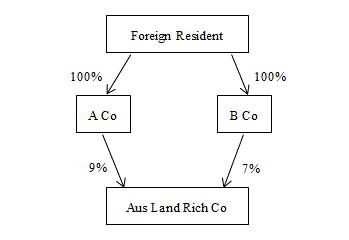
Foreign Resident simultaneously disposes of its interests in A Co and B Co.
The non-portfolio interest test (section 960-195) is satisfied in relation to each of these holdings as Foreign Resident holds more than 10 per cent of the membership interests in A Co and B Co respectively.
The principal asset test (section 855-30) will be satisfied in relation to each of these holdings if the market value of A Co's and B Co's TARP assets exceeds the market value of their non-TARP assets.
In applying the principal asset test, the membership interests A Co and B Co hold in Aus Land Rich Co are treated as if they were two assets - a TARP asset and a non-TARP asset.
Under item 1 of the table in subsection 855-30(4), the market value of the deemed TARP asset will be taken to be nil if the total participation interests Foreign Resident and its associates hold in Aus Land Rich Co is less than 10 per cent. However, the item does not apply because the total participation interests Foreign Resident and its associates (A Co and B Co) hold in Aus Land Rich Co is 16 per cent.
Consequently, for the purpose of applying the principal asset test in relation to the interests Foreign Co holds in A Co and B Co, the market value of the deemed TARP asset and the deemed non-TARP asset must be worked out under item 2 of the table in subsection 855-30(4).
Application and transitional provisions
1.74 Schedule 1 to the Primary Bill commences on the first day of the next quarter following the day of Royal Assent. [Clause 2]
Main residence exemption
1.75 The amendments to the main residence exemption in Part 1 of Schedule 1 to the Primary Bill generally apply to CGT events happening at or after their announcement at 7.30 pm, by legal time in the ACT, on 9 May 2017 (application time). Accordingly, the amendments to the main residence exemption do not apply prior to its announcement date to ensure that taxpayers are not adversely affected by a retrospective change before being made public. However, the measure needs to generally apply from the date of announcement (subject to a transitional period for some taxpayers see paragraph 1.76) to prevent opportunities for affected taxpayers to dispose of their dwelling and avoid the application of the measure. [Schedule 1, item 33]
1.76 The amendments to the main residence exemption do not apply for certain dwellings held before the application time (see paragraph 1.75). The amendments do not apply to a capital gain or loss from a CGT event that occurs to a dwelling if the CGT event occurs on or before 30 June 2020 if:
- •
- an individual, or trustee of a special disability trust held an ownership interest in the dwelling to which the CGT event relates at all times from immediately before the application time until immediately before the CGT event happens; or
- •
- an individual acquired the property as a beneficiary of a deceased estate and at all times from immediately before the application time until immediately before the CGT event happens to the dwelling, the following entities held the ownership interest in the dwelling:
- -
- that individual;
- -
- the deceased person;
- -
- the trustee of the deceased estate of the deceased person;
- -
- the trustee of a special disability trust on behalf of a principal beneficiary; or
- -
- a combination of these entities.
[Schedule 1, item 32, section 118-110 of the Income Tax (Transitional Provisions) Act 1997]
Example 1.10 - Dwelling that is a main residence that was owned before 9 May 2017 is disposed of on or before 30 June 2020
Samantha acquired a dwelling on 13 April 2013 moving into it and establishing it as her main residence as soon as it was first practicable to do so. On 10 January 2019 Samantha signs a contract to sell the dwelling and settlement occurs on 7 February 2019.
Samantha used the dwelling as follows when she owned it:
- •
- residing there until 15 September 2016; and
- •
- renting the property out from 16 September 2016 until it was sold (assume the absence provision applies to treat the dwelling as her main residence during this later period).
From 16 September 2016 Samantha resided in rented accommodation in Bahrain and was a foreign resident.
CGT event A1 for the sale of the dwelling occurs when the contract for sale was signed, that is 10 January 2019. As Samantha held her ownership interest in the dwelling on or before 9 May 2017, she continued to own it until it was sold and as it was sold before 1 July 2020 she is entitled to the main residence exemption under the transitional rule.
Principal asset test
1.77 The amendments in Part 2 of Schedule 1 to the Primary Bill clarify that, for the purpose of determining whether an entity's underlying value is principally derived from TARP under the foreign resident CGT regime, the principal asset test is applied on an associate inclusive basis. These amendments apply in relation to CGT events happening on or after announcement at 7.30 pm, by legal time in the ACT, on 9 May 2017. Accordingly, the amendments to the principal asset test do not apply prior to the announcement date to ensure that taxpayers are not adversely affected by a retrospective change. However, the amendments need to apply from the date of announcement to prevent opportunities for multinational entities to dispose of assets and avoid the application of the amendments after the date of announcement. [Schedule 1, item 34]
Copyright notice
© Australian Taxation Office for the Commonwealth of Australia
You are free to copy, adapt, modify, transmit and distribute material on this website as you wish (but not in any way that suggests the ATO or the Commonwealth endorses you or any of your services or products).
