
Wine Equalisation Tax Ruling
WETR 2006/1A6 - Addendum
Wine equalisation tax: the operation of the producer rebate for producers of wine in New Zealand
-
Please note that the PDF versionView the consolidated version for this notice.
Addendum
This Addendum is a public ruling for the purposes of the Taxation Administration Act 1953. It amends Wine Equalisation Tax Ruling WETR 2006/1 to:
- •
- reflect amendments made to the A New Tax System (Wine Equalisation Tax) Act 1999 by the Treasury Laws Amendment (Supporting Choice in Superannuation and Other Measures) Act 2026 to increase the maximum amount of WET producer rebate from 1 July 2026
- •
- update references to the repealed A New Tax System (Wine Equalisation Tax) Regulations 2000 to A New Tax System (Wine Equalisation Tax) Regulations 2019, and
- •
- update references to the A New Tax System (Wine Equalisation Tax) (New Zealand Producer Rebate Foreign Exchange Conversion) Determination 2026.
WETR 2006/1 is amended as follows:
Omit table of contents; substitute:
| Table of Contents | Paragraph |
| Summary – what this Ruling is about | 1 |
| Background | 6 |
| How does the WET work? | 6 |
| Producer rebates | 11 |
| Frequently used terms | 14AA |
| Ruling | 16 |
| Who is eligible for the producer rebate? | 16 |
| Approval as a New Zealand participant | 17 |
| Rebatable wine | 19A |
| Producer of rebatable wine | 19C |
| Manufacture of wine | 21 |
| Example 1 - manufacture from grapes | 29 |
| Example 2 - purchasing and bottling | 31 |
| Blending as manufacture | 32A |
| Example 3 - manufacture by blending own wine with purchased wine | 32C |
| Example 4 - blending wine with grape juice concentrate | 32E |
| 'Producer' of wine - contract manufacture | 35A |
| Source product | 35C |
| Wine produced in New Zealand | 36 |
| Example 5 - wine that is not produced in New Zealand | 38 |
| Wine has been, or is likely to be, exported to Australia | 39 |
| Meaning of export | 40 |
| Meaning of Australia | 45 |
| 'Likely to be' | 48 |
| Entitlement to claim the rebate | 61 |
| Wine exported to Australia | 62 |
| WET paid for an assessable dealing with the wine | 64 |
| Source product - 85% ownership rule | 71A |
| Example 6 - ownership of source product at all times | 71I |
| Example 7 - retention of title clause | 71N |
| Source product - deeming provisions | 71R |
| Example 8 - grape juice concentrate more than 10% of total volume of wine | 71U |
| Example 9 - purchased grape pulp not source product | 71X |
| Example 10 - any other substances - not similar | 71AI |
| Example 11 - any other substances - similar | 71AK |
| Example 12 - 85% source product ownership rule satisfied | 71AO |
| Example 13 - 85% source product ownership rule not satisfied | 71AS |
| Example 14 - beverage that falls under the grape wine product definition - 85% ownership of source product rule not satisfied | 71AV |
| Example 15 - grape wine product - 85% ownership not satisfied | 71AZ |
| Transitional rules | 71BC |
| 2018 vintage wine | 71BC |
| 2017 and earlier wine - 85% source product ownership rule | 71BE |
| 2017 and earlier wine | 71BG |
| Example 16 - 85% source product ownership rule deemed to be satisfied for 2017 vintage wine | 71BK |
| 2017 year and earlier fortified wine | 71BP |
| Example 17 - fortified wine made from blending wines stored immediately prior to 1 January 2018 | 71BW |
| Example 18 - blend of stored wine, wine produced by the producer after 1 January 2018 and purchased wine | 71BX |
| Example 19 - fortified wine in a solera system | 71BZ |
| Container for retail sale | 71CD |
| Example 20 - container for retail sale rule satisfied | 71CG |
| Example 21 - size and not suitable for retail sale | 71CJ |
| Bulk wine exported to Australia where it is bottled, labelled and sold | 71CL |
| Example 22 - bulk wine packaged in Australia | 71CO |
| Branded with a trade mark | 71CS |
| What is a trade mark? | 71CU |
| 'Identifies' or 'readily associated with' you | 71CW |
| Example 23 - trade mark that identifies the producer | 71DA |
| Ownership of the trade mark | 71DD |
| Registered trade mark | 71DG |
| Example 24 - registered trade mark | 71DH |
| Application pending | 71DJ |
| In use since 1 July 2015 | 71DK |
| Calculation of the producer rebate | 72 |
| Associated producers | 73 |
| Amount of producer rebate | 82 |
| Example 25 - amount of producer rebate | 83 |
| Approved selling price of the wine | 84 |
| Example 26 - costs excluded from approved selling price | 86 |
| Trade incentives | 87 |
| Foreign exchange conversion | 93 |
| Method 1 - average yearly Reserve Bank of New Zealand rate | 95A |
| Method 2 - Reserve Bank of Australia rate | 97A |
| Consistent use of exchange rate | 100 |
| Accompanied by supporting evidence | 103 |
| Date of effect | 118A |
| Appendix 1 - Explanation | 118B |
| Rebatable wine | 118B |
| Appendix 2 - Compliance guide | 118C |
| Approval or refusal of application - New Zealand participant | 118CA |
| Example 27 - approval backdated | 118E |
| Revocation of approval as New Zealand participant | 118J |
| How do you claim the producer rebate? | 118M |
| Approved form | 118M |
| Timing | 118N |
| What happens if the producer rebate is claimed when it should not have been claimed or when it is over-claimed | 118S |
| Not entitled to the producer rebate | 118S |
| Excess claim - single producer | 118U |
| Excess claim - associated producer | 118X |
| Impact of volume rebates and discounts | 118AA |
| A$200 exclusion | 118AD |
| What records do you need to keep and how long do you need to keep them? | 118AE |
| Appendix 3 - Conversion of foreign currency | 118AG |
| Example 28 - calculation of approved selling price in Australian currency where the components that make up the approved selling price are expressed in New Zealand currency | 118AG |
| Appendix 4 - Wholesalers' statement | 118AM |
Omit 'A New Tax System (Wine Equalisation Tax) Regulations 2000 (WET Regulations)'; substitute 'A New Tax System (Wine Equalisation Tax) Regulations 2019'.
After 'WETR 2009/1', insert 'Wine equalisation tax: the operation of the wine equalisation tax system'.
(a) Omit 'A$350,000'; substitute 'A$400,000'.
(b) After the paragraph, following the heading, insert new paragraph 14AA:
14AA. Paragraphs 14B and 14C of this Ruling define terms used throughout this Ruling.
Omit the quote; substitute:
- (a)
- production;
- (b)
- combining parts or ingredients so as to form an article or substance that is commercially distinct from the parts or ingredients; and
- (c)
- applying a treatment to foodstuffs as a process in preparing them for human consumption; …
In footnote 10, after 'Sales Tax Assessment Act (No. 1) 1930', insert '(repealed)'.
Omit 'Chard Pty Ltd'; substitute 'Chard Co'.
Omit the wording of the paragraph; substitute:
In the wine industry it is a normal part of winemaking to blend wines. In some cases, the wines that are blended may be different varieties of wine, for example, Cabernet Sauvignon and Merlot. In other cases, the blended wines may be the same variety of wine but with each individual blended wine having characteristics that, when combined with the characteristics of the other blended wine, results in a wine with its own commercially distinct characteristics.
Omit all instances of 'NH Wines Ltd'; substitute 'NH Wines Co'.
Omit the wording of footnote 12A; substitute:
Paragraph 1.16 of Explanatory Memorandum to Treasury Laws Amendment (2017 Measures No. 4) Bill 2017.
Omit 'paragraph 45'; substitute 'paragraph 46'.
In footnote 17B, omit 'GSTR 2005/2'; substitute 'Goods and Services Tax Ruling GSTR 2005/2 Goods and services tax: supplies of goods and services in the repair, renovation, modification or treatment of goods from outside Australia whose destination is outside Australia'.
Omit the wording of the paragraph; substitute:
We consider that it is reasonable for you to assume that WET on the wine for which the rebate is being claimed has been remitted to the ATO by the end of the financial year in which the assessable dealing took place, given that you are:
- •
- required to substantiate a claim for the rebate by providing supporting documents to evidence that WET has been included in an assessable dealing with the wine27, and
- •
- not eligible to lodge the claim until after the end of the financial year in which the relevant taxable dealing took place.
However, it is not reasonable for you to make this assumption if you are aware, or should reasonably have been aware that the WET has not been paid to the Commissioner in respect of that wine (for example, if the entity that has the liability for WET is in liquidation).
Omit 'this Ruling set'; substitute 'this Ruling sets'.
Omit the wording of footnote 31B; substitute:
Paragraph 1.16 of Explanatory Memorandum to Treasury Laws Amendment (2017 Measures No. 4) Bill 2017.
Omit 'Grapey Grapes Ltd'; substitute 'Grapey Grapes Co'.
Omit the wording of footnote 31G; substitute:
Paragraph 1.21 of Explanatory Memorandum to Treasury Laws Amendment (2017 Measures No. 4) Bill 2017.
Omit the wording of footnote 31H; substitute:
Refer to Appendix 1 to this Ruling.
Omit the wording of footnote 31I; substitute:
Refer to Goods and Services Tax Ruling GSTR 2003/5 Goods and Services Tax: Vouchers.
Omit 'dioxide for example are'; substitute 'dioxide, for example, are'.
(a) After 'Accordingly', insert a comma.
(b) After 'Therefore', insert a comma.
Omit the wording of footnote 31J; substitute:
Paragraph 1.20 of Explanatory Memorandum to Treasury Laws Amendment (2017 Measures No. 4) Bill 2017.
23. Paragraphs 71AO, 71AP, 71AQ and 71AR
Omit all instances of 'WeFortify Ltd'; substitute 'WeFortify Co'.
24. Paragraphs 71AS, 71AT and 71AU
Omit all instances of 'OwnGrape Pty Ltd'; substitute 'OwnGrape Co'.
Omit 'GWP Ltd'; substitute 'GWP Co'.
Omit the wording of footnote 31O; substitute:
Paragraph 1.68 of Explanatory Memorandum to Treasury Laws Amendment (2017 Measures No. 4) Bill 2017.
Omit the wording of footnote 31P; substitute:
Subsection 20(5) of the Treasury Laws Amendment (2017 Measures No. 4) Act 2017. Refer also to Earlier producer rebate amounts.
Omit the wording of footnote 31Q; substitute:
Refer also to Earlier producer rebate amounts.
(a) Omit 'characteristics for example will'; substitute 'characteristics, for example, will'.
(b) Omit the wording of footnote 31T; substitute:
Paragraph 1.75 of Explanatory Memorandum to Treasury Laws Amendment (2017 Measures No. 4) Bill 2017.
Omit the wording of footnote 31U; substitute:
Subsection 20(5) of the Treasury Laws Amendment (2017 Measures No. 4) Act 2017. Refer also to Earlier producer rebate amounts.
After 'Therefore', insert a comma.
Omit the wording of footnote 31W; substitute:
Refer also to Earlier producer rebate amounts.
Omit the wording of footnote 31Z; substitute:
For example, grape wine labels are governed by the Wine Australia Act 2013 and Regulations, the Australia New Zealand Food Standards Code, National Trade Measurement Regulations 2009, the Competition and Consumer Act 2010 and state consumer laws.
In footnote 31AA, omit '19-5(7)(b)-(f)'; substitute '19-5(7)(b) to (f)'.
Omit the wording of footnote 31AD; substitute:
For further information refer to New Zealand Intellectual Property Office.
Omit the wording of footnote 31AE; substitute:
For further information refer to New Zealand Intellectual Property Office.
(a) Omit the wording of the paragraph (excluding footnote 33); substitute:
From 1 July 2018 to 30 June 2026, the maximum amount of producer rebate for a financial year is A$350,000. Where producers are associated, the maximum entitlement for the group must not exceed A$350,000 for each financial year.[33]
(b) After the paragraph, insert new paragraph 72A:
72A. For each financial year commencing on or after 1 July 2026, the maximum producer rebate entitlement is A$400,000. Where producers are associated, the maximum entitlement for the group must not exceed A$400,000 for each financial year.[33AA]
(c) In new paragraph 72A, after 'for each financial year.', insert new footnote 33AA:
33AA Subsections 19-15(2) and (3). Refer to paragraphs 73 to 74C of this Ruling for a discussion about when producers will be associated.
Omit the first list point; substitute:
- •
- you are 'connected with' each other (you are connected with each other if you would be 'connected with' each other under section 328-125 of the Income Tax Assessment Act 1997 (ITAA 1997) if subsection 328-125(8) of the ITAA 1997 were omitted), or [35]
Omit the wording of the paragraph (excluding footnote 37); substitute:
You are an associated producer of another producer if each of you is under an obligation (formal or informal), or might reasonably be expected to, act in accordance with the directions, instructions or wishes of the same third entity in relation to your financial affairs.[37]
Omit the wording of the paragraph (excluding footnote 38); substitute:
Further, you (first producer) are an associated producer of another producer (second producer) if you are under an obligation (formal or informal), or might reasonably be expected, to act in accordance with the directions, instructions or wishes of a third producer and the third producer is under an obligation (formal or informal), or might reasonably be expected, to act in accordance with the directions, instructions or wishes of the second producer in relation to their financial affairs.[38]
Omit 'producer(s)'; substitute 'producers'.
(a) Omit the heading; substitute ' Example 25 - amount of producer rebate '.
(b) Omit the wording of the paragraph; substitute:
Where the approved selling price = A$225,000, the producer rebate for a New Zealand participant is:
A$225,000 × 29% = A$65,250
After 'for example', insert a comma.
(a) Omit the wording of footnote 46; substitute:
Paragraph (a) of the definition of 'approved selling price' in subsection 19-15(1C),
(b) Omit the wording of footnote 47; substitute:
Paragraph (b) of the definition of 'approved selling price' in subsection 19-15(1C).
Omit the wording of the paragraph (excluding footnote 48); substitute:
Calculation of approved selling price, excluding unrelated costs:
| Total selling price of wine as per sales invoice | A$4,500 | |
| Less producer's expenses unrelated to the production of wine in New Zealand: | ||
| Transportation | A$220 | |
| Insurance | A$115 | |
| Agent's fees | A$250 | |
| Approved selling price | A$3,915 [48] | |
Omit the wording of footnote 50; substitute:
A New Tax System (Wine Equalisation Tax) (New Zealand Producer Rebate Foreign Exchange Conversion) Determination 2026.
Omit the wording of the paragraph; substitute:
The Commissioner's Determination provides you with the following methods for converting to Australian currency any component used to determine the approved selling price, depending on whether the component is expressed in New Zealand currency or a currency other than Australian or New Zealand currency.
(a) Omit the paragraph, including heading.
(b) After the paragraph, insert new paragraphs 95A and 95B, including heading:
Method 1 - average yearly Reserve Bank of New Zealand rate
95A. You may convert components of the approved selling price that are expressed in New Zealand currency by using a single average rate of conversion for a financial year. The conversion under this option is calculated by multiplying the value of the component of the approved selling price expressed in New Zealand currency by the average yearly Reserve Bank of New Zealand (RBNZ) rate.
95B. The average yearly RBNZ rate is the total of the RBNZ average monthly exchange rates for the financial year in which the conversion day occurs, divided by twelve. The ATO publishes the average RBNZ rate for each financial year at Producer rebate calculation sheet.
Omit the paragraph.
(a) Omit the paragraph.
(b) After the paragraph, insert new paragraphs 97A and 97B including heading:
Method 2 - Reserve Bank of Australia rate
97A. The conversion under this method is calculated by multiplying the value of the component of the approved selling price, expressed in foreign currency, by the inverse of the foreign exchange rate calculated by the Reserve Bank of Australia (RBA) on the conversion day.
97B. The conversion day is the day you use to convert foreign currency into Australian currency. This date is the earlier of:
- •
- the day on which you receive any of the consideration for the supply of the wine, or
- •
- the date the invoice is issued for that supply.
Omit the paragraph, including heading.
Omit the paragraph.
(a) Omit 'foreign exchange rate'; substitute 'method'.
(b) Omit the wording of footnote 55; substitute:
Section 6 of the A New Tax System (Wine Equalisation Tax) (New Zealand Producer Rebate Foreign Exchange Conversion) Determination 2026.
Omit 'Appendix 3 of this Ruling'; substitute 'Appendix 3 to this Ruling'.
After 'sales invoices', insert a comma.
Omit 'wholesaler's statement'; substitute 'wholesalers' statement'.
Omit the wording of the paragraph; substitute:
This Ruling applies both before and after its date of issue.
(a) Omit the headings; substitute:
Appendix 1 - Explanation
This Explanation is provided as information to help you understand how the Commissioner's view has been reached. It does not form part of the binding public ruling.
(b) Omit 'A New Tax System (Wine Equalisation Tax) Regulations 2000'; substitute 'A New Tax System (Wine Equalisation Tax) Regulations 2019'.
(c) Omit 'excise/duty regime'; substitute 'excise or duty regime'.
(d) Omit the table; substitute Table 1 including caption:
| Definitions | Examples |
|---|---|
|
Grape wine
Grape wine is a beverage that:
Note: a beverage does not cease to be the product of the complete or partial fermentation of fresh grapes or products derived solely from fresh grapes merely because grape spirit, brandy, or both grape spirit and brandy have been added to it. |
Grape wine
Grape wine includes:
|
|
Grape wine product
Grape wine product is a beverage that:
|
Grape wine product
Grape wine products include (but only where they satisfy the requirements in the column on the left):
Grape wine products do not include:
|
|
Fruit or vegetable wine
Fruit or vegetable wine is a beverage that:
Note: a product is only a fruit or vegetable wine after the addition of grape spirit or neutral spirit if that product met the definition of fruit or vegetable wine before the spirit was added. |
Fruit or vegetable wine
Fruit or vegetable wines include:
Fruit or vegetable wines do not include:
|
|
Cider or perry
Cider or perry is a beverage that:
|
Cider or perry
Cider or perry includes:
Cider or perry does not include:
|
|
Mead
Mead is a beverage that:
Note: if fruit or product derived from fruit is added and it contains concentrated fruit juice or fruit pulp, the proportion of fruit or product in the mead is worked out by assuming that it has been reconstituted according to the recommendations of the manufacturer of the concentrated fruit juice or pulp. |
Mead
Mead includes:
|
|
Sake
Sake is a beverage that:
|
Sake
Sake includes:
Distilled sake does not satisfy the definition and is not included. |
(a) Omit 'Australian Taxation Office'; substitute 'ATO'.
(b) Omit 'New Zealand Inland Revenue, or its website www.ird.govt.nz'; substitute 'New Zealand Inland Revenue'.
Omit 'Schedule 1 to the TAA'; substitute 'Schedule 1 to the Taxation Administration Act 1953 (TAA)'.
(a) After 'for example', insert a comma.
(b) Omit 'further'.
Omit 'Appendix 2 of'.
(a) Omit the headings; substitute:
Appendix 3 - Conversion of foreign currency
Example 28 - calculation of approved selling price in Australian currency where the components that make up the approved selling price are expressed in New Zealand currency
(b) Omit '2017–18'; substitute '2025–26'.
Omit the table; substitute Table 2 and caption:
| Invoice date | Invoice amount (NZ$) including transport costs | Transport costs to shipping dock | Invoice amount (NZ$) excluding transport costs | Date payment received |
|---|---|---|---|---|
| 21 July 2025 | $26,500 | $500 | $26,000 | 21 Aug 2025 |
| 15 Sept 2025 | $69,000 | $1,000 | $68,000 | 21 Oct 2025 |
| 4 Dec 2025 | $126,000 | $2,000 | $124,000 | 21 Jan 2025 |
| 7 April 2026 | $22,500 | $500 | $22,000 | 21 May 2026 |
After the paragraph, insert new paragraph 118AIA including, heading, Table 3 and caption.
Method 1 - average yearly RBNZ rate
118AIA. Assume the average yearly RBNZ rate for a unit of Australian currency per New Zealand dollar is calculated to be $0.8630 for the 2025–26 financial year.
Table 3: Amounts in NZ$ for conversion to Australian currency Invoice date Invoice amount (NZ$) excluding transport costs 21 July 2025 $26,000 15 Sept 2025 $68,000 4 Dec 2025 $124,000 7 April 2026 $22,000
Note 1: The total invoice amount excluding transport costs is NZ$240,000. At a conversion rate of 0.8630, the total invoice amount is A$207,120 .
Omit the wording of the paragraph, including headings and table; substitute:
Method 2 - the RBA rate
Assume the following RBA exchange rate for a unit of New Zealand currency per Australian dollar :
- •
- 21 July 2025: 1.0937
- •
- 15 Sept 2025: 1.1178
- •
- 4 Dec 2025: 1.1459
- •
- 7 April 2026: 1.2129
Table 4: Conversion to Australian currency Invoice date Invoice amount (NZ$) excluding transport costs Conversion rate Invoice amount (A$) 21 July 2025 $26,000 1.0937 $23,773 15 Sept 2025 $68,000 1.1178 $60,834 4 Dec 2025 $124,000 1.1459 $108,212 7 April 2026 $22,000 1.2129 $18,138
Note 1: The total invoice amount is A$210,957 .
Note 2: In this example Kiwi Wines may wish to use the RBA rate to maximise its rebate claim.
Omit the paragraph.
Omit the paragraph.
(a) Omit the heading; substitute:
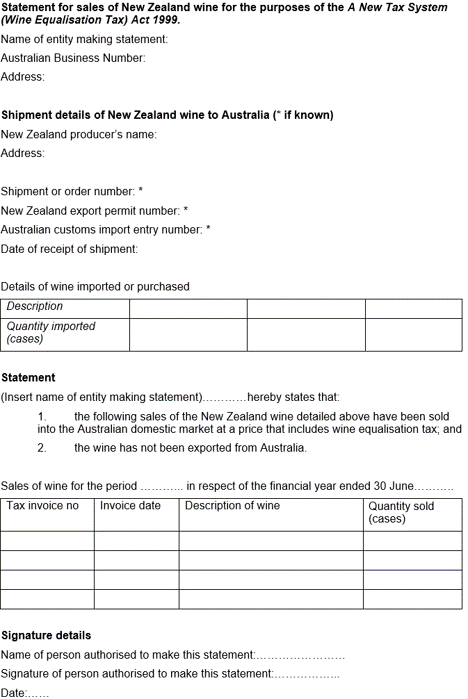
Appendix 4 - Wholesalers' statement
(b) Omit 'Set out below is an examples of a wholesaler's statement.'; substitute: 'This paragraph provides an example of a wholesalers' statement:'.
(c) Omit the statement; substitute:
Figure 1: Example of a wholesalers' statement
Omit the paragraph, including heading.
This Addendum applies from 1 October 2019 (in relation to changes that reference A New Tax System (Wine Equalisation Tax) Regulations 2019), from 1 July 2026 (in relation to changes made by the A New Tax System (Wine Equalisation Tax) Act 1999 by the Treasury Laws Amendment (Supporting Choice in Superannuation and Other Measures) Act 2026) and from 12 August 2026 (in relation to changes that reference A New Tax System (Wine Equalisation Tax) (New Zealand Foreign Exchange Conversion) Determination 2026).
Commissioner of Taxation
26 August 2026
© AUSTRALIAN TAXATION OFFICE FOR THE COMMONWEALTH OF AUSTRALIA
You are free to copy, adapt, modify, transmit and distribute this material as you wish (but not in any way that suggests the ATO or the Commonwealth endorses you or any of your services or products).
References
ATO references:
NO 1-1BL1LHDP
Copyright notice
© Australian Taxation Office for the Commonwealth of Australia
You are free to copy, adapt, modify, transmit and distribute material on this website as you wish (but not in any way that suggests the ATO or the Commonwealth endorses you or any of your services or products).
