

Draft Practical Compliance Guideline
PCG 2026/D1
Thin capitalisation and the attribution of risk-weighted assets to Australian branches of foreign banks - ATO compliance approach
-
For information about the status of this draft Practical Compliance Guideline, see item 4211 on our Advice under development program.
| Table of Contents | Paragraph |
|---|---|
| What this draft Guideline is about | |
| Date of effect | |
| Background | |
| Overview of legislation | |
| Attribution of risk-weighted assets in section 820-405 – our compliance approach | |
| Green zone | |
| Amber zone | |
| Red zone | |
| Economically significant activities | |
| Our expectations in relation to documentation and evidence | |
| Reliance on books of accounts as a basis for identifying the risk-weighted assets attributable to a branch of a foreign bank | |
| Appendix A – Examples | |
| Example 1 – Australian branch with Australian customers – economically significant activities performed in Australia | |
| Example 2 – attribution of risk-weighted assets based on location of attribution of profit | |
| Example 3 – attribution of risk-weighted assets based on Australian Prudential Regulation Authority guidelines | |
| Example 4 – risk-weighted assets attributed offshore based on infrastructure and loan currency | |
| Example 5 – risk-weighted assets attributed offshore based on client preference – economically significant activities performed in Australia | |
| Example 6 – transactions booked offshore – interbranch funding from Australian branch attributed as risk-weighted assets | |
| Example 7 – risk-weighted assets attributed offshore – no interbranch funding from Australian branch | |
| Example 8 – risk-weighted assets attributed based on client location | |
| Example 9 – risk-weighted assets attributed to Australia – economically significant activities in both Australia and offshore | |
| Example 10 – risk-weighted assets attributed offshore – support services provided from Australia | |
| Appendix B – Factors historically considered by foreign banks in attribution of risk-weighted assets | |
| Appendix C – Other tax issues | |
| Your comments |
|
Relying on this draft Guideline
This Practical Compliance Guideline is a draft for consultation purposes only. When the final Guideline issues, it will have the following preamble: This Practical Compliance Guideline sets out a practical administration approach to assist taxpayers in complying with relevant tax laws. Provided you follow this Guideline in good faith, the Commissioner will administer the law in accordance with this approach. |
What this draft Guideline is about
1. This draft Guideline[1] outlines our compliance approach to determining the risk-weighted assets (RWAs) attributable to a branch for the purposes of section 820-405 of the Income Tax Assessment Act 1997 (ITAA 1997). It also highlights several other tax issues you should actively consider relevant to assigning a location to assets.[2]
2. We will use a risk assessment framework to decide whether to devote compliance resources to further examine your arrangements. The framework is summarised at Table 1 of this Guideline. Appendix A to this Guideline contains examples of how we apply the framework.
3. If we assess your arrangement to be low risk, we will generally not allocate compliance resources to review your arrangement, except to confirm that your arrangement satisfies the low-risk requirements.
4. Where relevant[3], this Guideline applies to the attribution of notional RWAs arising from interbranch dealings (that is, internal RWAs) in the same way it applies to the attribution of actual external RWAs.
5. This Guideline does not replace, alter or affect our interpretation of the law in any way. It does not relieve you of your obligation to comply with the relevant tax law. It is designed to give you confidence that we will allocate compliance resources in line with the risk approach outlined in this Guideline.
6. All further legislative references in this Guideline are to the ITAA 1997 unless otherwise indicated.
7. This draft Guideline is proposed to take effect from the first income year that commences 6 months after its date of issue.
8. This draft Guideline is proposed to apply to assets in existence from the date of effect of this Guideline, which includes assets that came into existence prior to the date of effect.
9. We will review the use and application of this Guideline over the next 3 years following its finalisation. We will consult in relation to any proposed material changes to this Guideline.
10. Prior to the release of this Guideline, we discovered that several different factors were taken into account by foreign banks in deciding where RWAs were attributed, and, in general, there was not a consistent approach. These factors are listed in Appendix B to this Guideline. In addition, some taxpayers were unable to adequately explain their decision-making process around RWA attribution.[4]
11. The thin capitalisation rules apply to foreign banks that conduct their banking business in Australia through one or more branches.[5] Branches are treated as if they are separate entities that require a minimum level of capital to operate a banking business in Australia.
12. Debt deductions will not be disallowed under these rules if the bank allocates a minimum amount of capital to the branch. Typically, foreign banks use the safe harbour rule in section 820-405 to work out the minimum capital amount. This requires a foreign bank to work out the part of its RWAs that are attributable to its Australian branch.
13. The rules are broadly based on the methodology of the capital adequacy requirements prescribed by prudential regulators.
14. Step 1(a) of the method statement in section 820-405 requires an entity to (emphasis added):
Work out the average value, for the income year, of that part of the risk-weighted assets of the entity that:
- (a)
- is attributable to the [branch] at or through which it carries on its banking business in Australia …
'Risk-weighted assets' is defined in section 995-1 as the sum of the entity's risk exposures as determined by the prudential standards of the Australian Prudential Regulation Authority (APRA) or the prudential regulator in the bank's country of residence.
15. The term 'attributable' is not defined in the legislation, though is used in other parts of the legislation including in other parts of Division 820. Taxation Ruling TR 2005/11 Income tax: branch funding for multinational banks (which deals with issues relating to the funding of a branch of a multinational bank) recognises the allocation of equity in an Australian bank's books of account as a basis for the attribution of equity amounts to the bank's foreign branches for Division 820 purposes. Part II of TR 2005/11 deals with the attribution of equity capital to a branch of a bank and focuses on the interaction of Australia's permanent establishment (PE) attribution rules and Division 820. TR 2005/11 states at paragraphs 11 to 12 that:
Subject to paragraph 12, the amount of equity attributable to an Australian bank's foreign branches for Division 820 purposes is the amount actually allocated to them in the bank's books of account.
Where an amount of equity capital allocated to a foreign branch in the bank's books of account is adjusted for foreign tax purposes or by the Tax Office for other tax purposes, the adjusted amount should be used in the calculation of the equity capital attributable to the branch for Division 820 purposes.
16. The reference to the books of account is qualified in 2 important ways and there are 2 instances where the amount may be substituted. First, as noted in paragraph 35 of TR 2005/11, accounts are acceptable only if they have been 'properly maintained in accordance with applicable accounting laws and standards'. Secondly, if the amount allocated in the books of account is adjusted for foreign tax purposes or by us for other tax purposes, that adjusted amount is to be used. It has therefore never been our position that the books of account per se are acceptable to determine the equity capital attributable to a branch and, similarly, we do not consider that books of account per se would necessarily reflect what is required to demonstrate that RWAs are attributable to a branch in compliance with section 820-405. Rather, what is important is the principles that inform those accounts and that those accounts could always be adjusted by the ATO to reflect our view on the appropriate amount of RWAs that ought to be attributed to a PE.[6] We note, in this regard, that while the Corporations Act 2001 requires you to maintain accounts, it does not require you to prepare those accounts at a stand-alone branch level in accordance with applicable accounting standards.
17. We will seek to administer section 820-405 on the basis of our view that the RWAs attributable to the PE should reflect the geographical location of the economically significant activities relevant to the assets.
Attribution of risk-weighted assets in section 820-405 – our compliance approach
18. Our compliance approach is based on risk zones outlined in Table 1 of this Guideline. These zones outline the compliance risks associated with your approach to attribution.
19. Your risk rating will influence our engagement with you, including whether we are likely to engage with you to review your arrangement and the intensity of any compliance activities. We generally prioritise our resources and undertake more intensive activities to address tax outcomes which are rated as higher risk.
20. From a compliance perspective, fact patterns falling within the low-risk category will be acceptable to us. As scenarios move from low risk to high risk, there is an increasingly higher threshold for taxpayers to justify compliance, both from a technical and an evidentiary perspective.
| Risk zone | Risk assessment | Compliance approach |
|---|---|---|
| Green | Low risk | We will not devote compliance resources to review your arrangement, other than to verify your self-assessment that you fall within the green risk zone. |
| Amber | Medium risk | We may conduct further analysis to understand your arrangement, including resolving any areas of difference. |
| Red | High risk | We are likely to prioritise our compliance resources to review your approach to the attribution of RWAs in section 820-405.
If further analysis confirms the facts and circumstances of your arrangement are not aligned with our approach, we may proceed to audit where appropriate. |
21. You are in the green zone if both of the following apply:
- •
- RWAs are attributed on the basis of where the economically significant activities[7] are undertaken, as is further explained in paragraphs 27 to 31 of this Guideline. This includes the attribution of any RWAs which were in existence prior to the date of effect of this Guideline and continue to exist after the date of effect.
- •
- You prepare and maintain documentation and evidence (including a written policy) of the kind described at paragraphs 35 to 41 of this Guideline.
22. Where you depart from the policy at a transaction level, or your policy allows a departure or an alternative approach in certain scenarios, you will not meet the requirements for the green zone.
23. You are in the amber zone if all of the following apply:
- •
- Your approach to the attribution of RWAs is not, or is not wholly, based on where economically significant activities are undertaken, but your approach will generally lead to an RWA attribution outcome consistent with attribution based on where the economically significant activities are undertaken. These approaches are attribution based on:
- –
- location of attribution of profit[8] (see Example 2 of this Guideline)
- –
- adherence to APRA guidelines (see Example 3 of this Guideline), or
- –
- infrastructure and loan currency (see Example 4 of this Guideline).
- •
- You have prepared and maintained documentation and evidence, in relation to your approach, of the kind described at paragraphs 35 to 41 of this Guideline.
24. The documentation and evidence includes an explanation of your approach, and why your approach will generally produce an outcome consistent with attribution based on where the economically significant activities are undertaken.
25. You are in the red zone if either of the following apply:
- •
- Your approach to the attribution of RWAs is not based on where economically significant activities are undertaken or will not produce an outcome consistent with such attribution.
- •
- You contend that your RWAs are attributed based on where economically significant activities are undertaken but do not prepare and maintain documentation and evidence of the kind described at paragraphs 35 to 41 of this Guideline.
26. Where your tax position under section 820-405 falls within the red zone, this may reflect that you are not in line with APRA guidelines, and you should consider approaching APRA to disclose and clarify your asset booking arrangements.
Economically significant activities
27. Following the approach in the green zone will mean that:
- •
- Where all the economically significant activities pertinent to the creation and management of the relevant asset are carried out in a single jurisdiction, an asset should be wholly attributed to that jurisdiction.
- •
- Where the economically significant activities pertinent to the creation and management of the relevant asset are carried out in more than one jurisdiction, an asset may either be wholly attributed to the jurisdiction where the majority of the economically significant activities are carried out, or an asset may be split between jurisdictions by reference to where the economically significant activities are carried out.[9],[10]
28. The identification of an economically significant activity will depend on the way value is created in the enterprise and the role of the branch. In the case of a loan, economically significant activities include (but are not limited to):
- •
- creation of a loan: negotiating contractual terms (including pricing and credit enhancements), evaluating credit, currency and market risks, assessing the client's creditworthiness and the bank's credit exposure to the client, and committing the bank to the loan
- •
- management of a loan: decision-making in connection with whether and to what extent various risks should continue to be borne by the bank. This may involve decisions relating to the use of derivatives to transfer or hedge risks.
29. Following this approach would generally mean that:
- •
- a loan made by the bank to a client located outside Australia should generally be attributed to the Australian branch if the majority of the relevant economically significant activities are performed in Australia, and
- •
- a loan made to a client located in Australia should generally not be attributed to the Australian branch if the majority of the relevant economically significant activities are performed outside Australia.
30. We acknowledge that different functions may be involved in creating and managing different asset classes. Different factors may also need to be weighed up for varying asset classes when determining the functions performed and their relative importance.[11]
31. Not all functions relating to RWAs are economically significant activities. Support functions, sometimes called back-office functions, are generally not economically significant activities. These include general management, the setting of business strategies, personnel functions, clerical and administrative functions, and accounting and information technology services.
32. This approach is consistent with the factual and functional analysis stipulated in Taxation Ruling TR 2001/11 Income tax: international transfer pricing – operation of Australia's permanent establishment attribution rules, the Commentary on Article 7 of the July 2008 Organisation for Economic Co-operation and Development (OECD) Model Tax Convention[12], and section 820-960 which requires records (including records setting out the assets of the entity) to be prepared as if the branch were a hypothetical 'notional entity'.
33. We expect that this approach would also generally be consistent with outcomes under APRA's approach to asset booking.[13] APRA's guidelines for overseas banks operating in Australia[14] state:
APRA has generally taken the position that overseas banks soliciting and operating an active business in Australia should be subject to Australian prudential regulation and supervision … An Australian branch of a foreign [authorised deposit-taking institution] is expected to be able to operate on a semi-stand-alone basis. It is expected to book its Australian business in the Australian branch (unless otherwise agreed by APRA … and is expected to maintain local staffing sufficient to demonstrate adequate local control over the Australian business and compliance with all of APRA's prudential requirements applicable to foreign ADIs.
34. Consequently, APRA generally expects foreign banks licensed as a foreign authorised deposit-taking institution (ADI) in Australia to book their Australian business in their Australian branch.[15]
Our expectations in relation to documentation and evidence
35. You should prepare and maintain the documentation specified in section 820-960, based on the requirements in section 820-960 , the commentary in the Explanatory Memorandum relevant to that section and, more generally, section 262A of the Income Tax Assessment Act 1936 (ITAA 1936) (in particular, subsection 262A(1B) of the ITAA 1936). (See explanation at paragraphs 42 to 46 of this Guideline.)
36. To support your calculations, you should also prepare and maintain evidence which supports and explains your RWA attribution process, including a written policy that explains the factors you consider in determining whether to attribute an RWA to the accounts of your Australian branch or offshore.
37. The policy should describe the attribution methodology for each type of RWA, for example, loans and derivatives. In addition, an explanation should be provided to justify the fact patterns where:
- •
- the client is Australian but the RWA is not attributed to the accounts of the Australian branch
- •
- the client is offshore but the RWA is attributed to the accounts of the Australian branch – that is, offshore banking unit business.
38. The policy should explain what the economically significant activities for particular business activities are and where they are performed. The policy should also explain whether there is any difference between your approach to booking assets in your accounts (which may also be used for APRA reporting purposes) and attribution for the purposes of the thin capitalisation provisions, and if so, what that difference is.
39. You should not rely solely on documentation prepared for other tax purposes (for example, transfer pricing documentation prepared for the purposes of Division 815 ) if this documentation does not contain the detail outlined in paragraphs 36 to 38 of this Guideline.
40. Where you depart from the policy at a transaction level, or your policy allows a departure or an alternative approach in certain scenarios, you should explain the departure in your records to assist the ATO with any follow up review activity.
41. Where changes are made in respect of the RWA attributed to the Australian branch, post lodgment, for example, as a result of consideration of this Guideline, you should record in your workpapers the reason for the change.
Reliance on books of accounts as a basis for identifying the risk-weighted assets attributable to a branch of a foreign bank
42. Relying on branch accounts, including those prepared for APRA reporting purposes, is not, of itself, sufficient to meet the conditions to fall within the green zone. This is because there can be differences between the basis for these accounts and the requirements of section 820-960 and such accounts do not explain how assets have been attributed. In prior years, in responding to questions from the ATO, many banks indicated that they relied on the assets recorded in the accounts of their Australian branch for management and APRA reporting purposes to identify the RWAs attributable to the branch. The responses generally lacked sufficient explanation and evidence of the bank's decision-making pursuant to the attributable requirement in section 820-405.
43. Subsection 820-960(1) requires you to prepare statements of financial position and financial performance for the Australian branch in accordance with the relevant Australian or international accounting standards. These records are relevant for the application of the thin capitalisation rules, but also for all other income tax purposes.[16]
44. Importantly, under paragraph 820-960(2)(b), the records must be prepared as if the branch were an entity (notional entity) and the assets, liabilities, equity capital, revenues and expenses attributable to the branch were assets, liabilities, equity capital, revenues and expenses 'of the' notional entity. Relevantly, the Explanatory Memorandum relevant to section 820-960 notes that in preparing separate financial statements for the branch (emphasis added)[17]:
… it will be necessary for entities to undertake an analysis of the functions performed, the assets used and risks borne by their Australian permanent establishments in order to determine the assets, liabilities, equity, revenue and expense which should be attributed to the notional entity.
45. This legislative requirement is reinforced in paragraphs 49 and 51 of TR 2005/11 which specifically states that a taxpayer carrying on a business through a PE (emphasis added):
… must keep records evidencing the basis for allocation of income, expenditure, assets, liabilities and capital …
…
Taxation Ruling TR 2001/11, in particular paragraphs 4.46 to 4.51, discusses the documentation requirements for Australia's PE attribution rules. A bank's books of account will be the starting point in attributing income, expense and funding to its branches. However, the accounts will only determine attribution for purposes of Australia's PE attribution rules where they accord with economic substance, having regard to the functions performed, assets used and risks assumed by the branches.
46. We expect that, in practice, the assets recognised under relevant accounting standards, that are accounts prepared in line with the requirements in section 820-960 and the expectations in the EM, will generally mean assets are attributed on a basis that is consistent with where the majority of economically significant activities are performed.
Commissioner of Taxation
25 March 2026
Appendix A – Examples
47. This Appendix sets out examples to illustrate the practical application of our compliance approach.[18] The facts in the examples are limited to the funding arrangements and functions relevant to the specific RWA that is the focus of the example. In practice, Australian branches of foreign banks use a mix of debt and equity funding, including funding sourced from head office or related parties, or funding obtained from the market such as wholesale Australian customer deposits and notes issued to the market. In addition, banks may provide a variety of financial services including but not limited to lending, global derivative trading, and assisting in merger and acquisitions.
48. However, for the purposes of illustrating the principles in this Guideline, the examples focus solely on loan assets and assume that the Australian branch of the foreign bank is entirely funded by interest-bearing debt from head office, or other branches of the same legal entity, or both. We acknowledge that, in most cases, the branch balance sheet would in fact only be in part funded through intra-entity funding from the parent.
49. Any change to the location of asset attribution – for example, changing the attribution of an RWA from the foreign parent to the Australian branch, will also require changes to the associated debt or equity funding.
50. In addition, for the abundance of clarity, despite the examples only using loan assets as the RWAs, this Guideline applies equally to other classes of RWAs such as derivatives.
Example 1 – Australian branch with Australian customers – economically significant activities performed in Australia
Diagram 1: Australian branch performs economically significant activities and provides loans to Australian customers
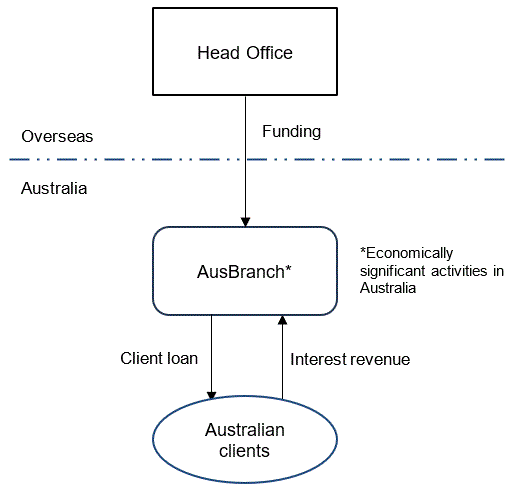
51. AusBranch is the Australian branch of a foreign bank. All of the economically significant activities of the banking business in relation to the client loans are performed in Australia.
52. The foreign bank books its client loans in AusBranch's accounts and attributes the relevant RWAs to AusBranch for thin capitalisation purposes based on where the economically significant activities relevant to the RWAs (the client loans) are performed. The bank has maintained documentation and evidence in line with paragraphs 35 to 41 of this Guideline.
53. We consider this scenario falls within the green zone as the bank's approach is that relevant RWAs are attributed to the place where the economically significant activities relevant to the RWAs are performed. In addition, the bank has met the requirements in paragraphs 35 to 41 of this Guideline. Consequently, we would not dedicate compliance resources to further review this approach to the attribution of RWAs.
Example 2 – attribution of risk-weighted assets based on location of attribution of profit
Diagram 2: Client loan is attributed to an offshore branch based where the profits associated with the client loan are located
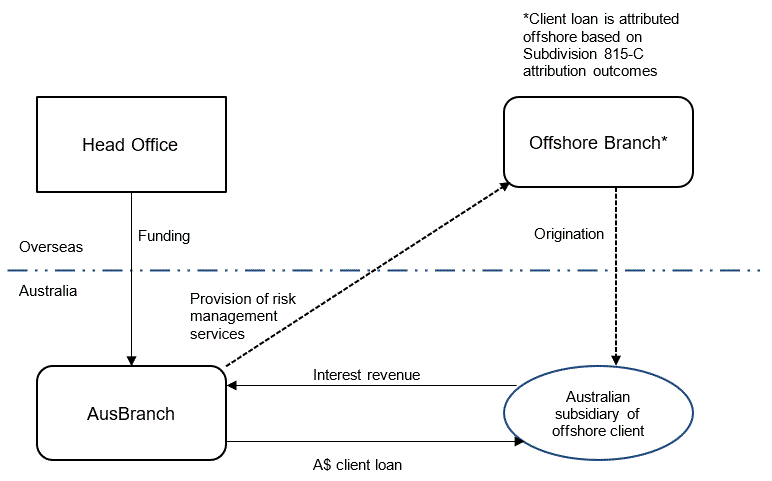
54. AusBranch is the Australian branch of a foreign bank. The foreign bank has told the ATO that its approach to the attribution of RWAs is based on the location where the majority of the arm's length profit from each particular RWA is attributed under Subdivision 815-C. The foreign bank contends that this should produce an appropriate outcome and one that would be consistent with the attribution outcomes expected under the green zone. In this example, the foreign bank has attributed an Australian client loan to the offshore branch on the basis that the majority of the profit associated with the client loan is attributed to the offshore branch.
55. The foreign bank has prepared documentation and evidence based on its approach of attributing RWAs to the location where the majority of the profit is attributed under Subdivision 815-C. The documentation and evidence addresses any scenarios that do not produce an outcome consistent with that expected under the green zone.
56. As such, the documentation and evidence have sufficient information to explain that AusBranch's approach will produce an outcome consistent with that expected under the green zone.
57. This example falls into the amber zone. The bank's approach to attribution of RWAs is not explicitly based on where economically significant activities are located and therefore further work would be required to confirm the approach adopted produces outcomes consistent with the green zone.
Example 3 – attribution of risk-weighted assets based on Australian Prudential Regulation Authority guidelines
Diagram 3: Client loan is attributed to an offshore branch based on grounds that align with APRA guidelines

58. AusBranch is the Australian branch of a foreign bank. The foreign bank has told the ATO that its approach to the attribution of RWAs is based on an approach consistent with APRA guidelines on asset booking. The foreign bank contends that this should produce an appropriate outcome that would be consistent with the outcomes expected under the green zone.
59. In this example, a particular offshore client loan is booked in the accounts of Offshore Branch, which has been permitted by APRA, on grounds that align with APRA guidelines.
60. The foreign bank prepares documentation and evidence based on its approach of attributing RWAs to a location that is consistent with the booking location allowed under APRA guidelines.
61. The documentation and evidence have sufficient information to explain that AusBranch's approach will produce an outcome consistent with that expected under the green zone.
62. This example falls into the amber zone. The bank's approach to attribution of RWAs is not explicitly based on where economically significant activities are located and therefore further work would be required to confirm the approach adopted produces outcomes consistent with the green zone.
Example 4 – risk-weighted assets attributed offshore based on infrastructure and loan currency
Diagram 4: Loan with Australian clients is attributed to an offshore branch based on the location of the bank's infrastructure platforms, and the loan's currency
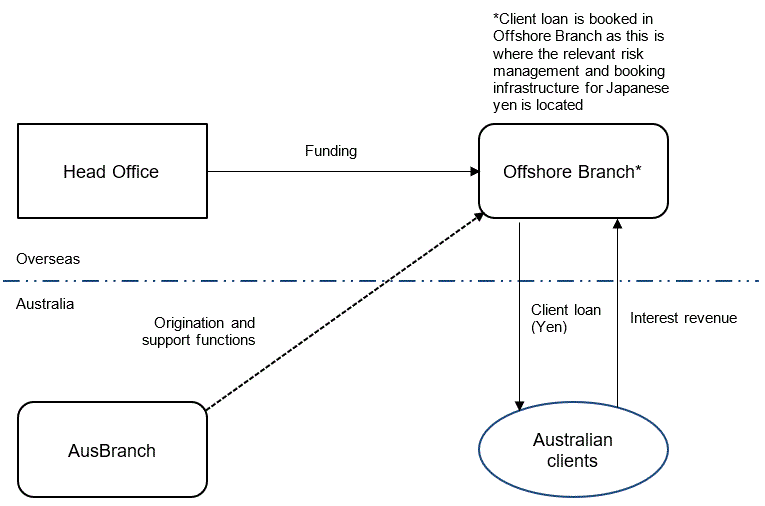
63. AusBranch is the Australian branch of a foreign bank. The foreign bank conducts lending activity and has branches in Australia and offshore. The bank books and manages all loans denominated in a particular currency in one location, for example, all loans denominated in Yen are booked and managed by individuals in a Japanese branch. Centralisation of booking on this basis and loan management technology and infrastructure produces cost savings and other benefits for the bank.
64. Consequently, non-A$ loans to Australian clients are booked and managed where the relevant booking and loan management technology and infrastructure for the relevant currency reside.
65. AusBranch receives a service fee for assisting in the origination of the client loan and back-office support services.
66. The foreign bank has not attributed its RWAs explicitly based on where economically significant activities are located, and has instead used an approach involving the attribution of RWAs based on the currency the loan is denominated in. This is because their platforms and infrastructure are set up so that loans of a particular currency can only be booked in the location of the natural home for that currency. The foreign bank has assessed that the economically significant activities associated with the ongoing management of the loans are the most important functions and therefore the majority of the economically significant activities are located in the relevant branch. The foreign bank contends that this approach should produce an outcome consistent with the green zone on the basis that the majority of economically significant activities are located in the location that manages its country's currency.
67. The bank has maintained documentation and evidence in line with its own approach to the attribution of RWAs.
68. The documentation and evidence has sufficient information to evidence that AusBranch's approach will produce an outcome consistent with that expected under the green zone.
69. This example falls into the amber zone. The bank's approach to attribution of RWAs is not based on where economically significant activities are located and therefore further work would be required to confirm the approach adopted produces outcomes consistent with the green zone.
Example 5 – risk-weighted assets attributed offshore based on client preference – economically significant activities performed in Australia
Diagram 5: Australian branch performs economically significant activities. The client loans are booked and attributed offshore based on client preference

70. AusBranch is the Australian branch of a foreign bank. All of the economically significant activities of the banking business in relation to the client loans are performed in Australia.
71. Some of the bank's global clients have subsidiaries in Australia. It is the preference of one particular offshore client that loans taken out by their Australian subsidiary are recorded as being contracted with Offshore Branch. To accommodate this preference, these client loans are booked in, and the relevant RWAs are attributed to, the accounts of Offshore Branch, despite all the economically significant activities relating to these loans being performed in Australia.
72. The foreign bank has prepared documentation and evidence to support the approach it has applied to this arrangement. However, because of the facts and circumstances in this example, the documentation and evidence cannot explain that their approach will produce an outcome consistent with that expected under the green zone. This is because all the economically significant activities in relation to the client loans are performed in Australia.
73. This example falls into the red zone. While there is a documented approach, it is not one that would appear to produce results consistent with the green zone and we are therefore likely to prioritise compliance resources to investigate the taxpayer's approach to the attribution of RWAs. This approach still falls within the red zone even if treating the client loans as attributable to Australia would result in AusBranch having a significant amount of average equity capital in excess of its minimum capital amount.
74. Finally, as this arrangement falls within the red zone, it may not align with APRA's expectations on asset booking. AusBranch is encouraged to approach APRA to disclose and clarify their asset booking arrangement.
Example 6 – transactions booked offshore – interbranch funding from Australian branch attributed as risk-weighted assets
Diagram 6: Australian branch performs economically significant activities and provides interbranch funding to an offshore branch. Client loans are booked offshore

75. AusBranch is the Australian branch of a foreign bank. AusBranch has a team of loan specialists and loan management personnel, among other professional staff. Offshore Branch has only 2 (administrative) staff. Loans to Offshore Clients are booked in the accounts of Offshore Branch, but the loans are originated and structured by the AusBranch team in Australia and the loan risk management functions are performed mainly by AusBranch staff – that is, the economically significant activities are performed in Australia.
76. To fund its lending activity, Offshore Branch sources its funding via an interbranch loan from AusBranch, which, in turn, is debt funded by its overseas head office (in addition to other external funding sources).
77. AusBranch uses the approach in the green zone to determine its attribution of RWAs and ensures it also applies this approach to notional interbranch loans. AusBranch records the interbranch loan to Offshore Branch as an asset in its accounts. The notional interbranch loan is included as an RWA for thin capitalisation purposes, and because the bank is able to trace the funding for the external client loan, the risk weighting of the actual external client is applied. Applying a risk weighting on the interbranch loan equal to the risk weighting on the external client loan is critical as the economically significant activities are carried out in AusBranch and therefore AusBranch is exposed to the key risks. This notional RWA is attributed to AusBranch based on where the economically significant activities related to the external loan are located.
78. The bank has maintained documentation and evidence in line with paragraphs 35 to 41 of this Guideline and the documentation and evidence extends to internal RWAs.
79. This example falls in the green zone as the bank's approach is that relevant RWAs are attributed to the place where the economically significant activities relevant to the external client loan are performed. In addition, the bank has met the requirements paragraphs 35 to 41 of this Guideline. Consequently, we will not dedicate compliance resources to further review the approach to the attribution of RWAs.
Example 7 – risk-weighted assets attributed offshore – no interbranch funding from Australian branch
Diagram 7: Australian branch performs economically significant activities and client loans are booked and attributed offshore
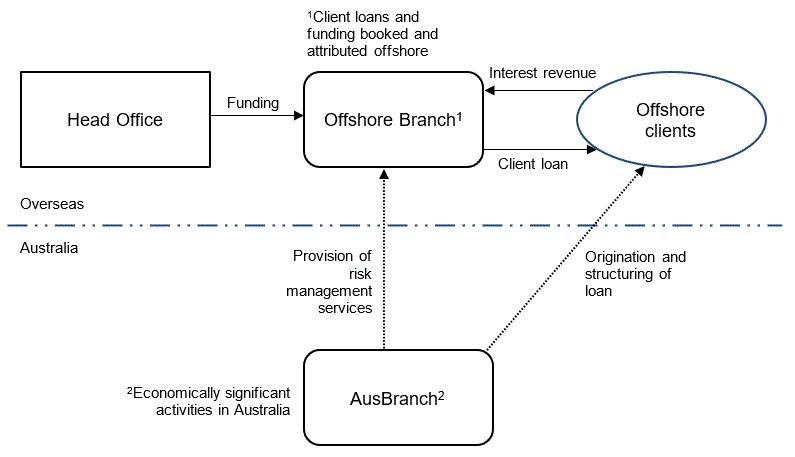
80. Assume the same facts as in Example 6 of this Guideline, except in certain limited scenarios, the foreign bank has not attributed any RWAs to AusBranch. In this example, the foreign bank records the funding for the client loan as being provided by head office to Offshore Branch. Consequently, there is no interbranch loan booked as an asset in the accounts of AusBranch.
81. The documentation and evidence maintained by the foreign bank explains its departure from attribution based on economically significant activities in certain situations.
82. This example falls into the red zone because the bank's approach to attribution is not based on where economically significant activities are located. Despite the fact that this occurs only in limited scenarios, and the foreign bank has documentation and evidence to explain its approach to attribution, it does not comply with the requirements of the green zone. We are therefore likely to prioritise compliance resources to investigate the taxpayer's approach to the attribution of RWAs.
83. Finally, as this arrangement falls within the red zone, it may not align with APRA's expectations on asset booking. AusBranch is encouraged to approach APRA to disclose and clarify their asset booking arrangement.
Example 8 – risk-weighted assets attributed based on client location
Diagram 8: Offshore branch performs economically significant activities and loans are booked and attributed to Australia based on client location

84. AusBranch is the Australian branch of a foreign bank. In this example, in relation to some specific loans, the clients are in Australia, client loans are booked in the accounts of AusBranch and the relevant RWAs are also attributed to AusBranch for Australian tax purposes. The AusBranch accounts are prepared on the basis that AusBranch borrowed internal funding from Head Office to fund the client loan assets.
85. However, these client loans are originated by Offshore Branch and the majority of the economically significant activities such as risk monitoring, loan management, and all decision-making in respect of the loans are performed by Offshore Branch.
86. The foreign bank has explained to the ATO that its approach to the attribution of RWAs is to attribute the RWA to the same location of the client. The foreign bank has maintained documentation and evidence in line with its client location approach.
87. This example falls into the red zone because the approach to attribution is not based on where economically significant activities are located and it is not one of the approaches which satisfy the amber zone. We are therefore likely to prioritise compliance resources to investigate the taxpayer's approach to the attribution of RWAs.
88. AusBranch is also encouraged to approach APRA to disclose and clarify this asset booking arrangement.
Example 9 – risk-weighted assets attributed to Australia – economically significant activities in both Australia and offshore
Diagram 9: Both offshore branch and Australian branch perform economically significant activities

89. AusBranch is the Australian branch of a foreign bank. The foreign bank has indicated it attributes its RWAs based on the location of economically significant activities. The foreign bank runs a globally integrated business with valuable functionality occurring in more than one jurisdiction. Loan transactions are booked in the location where the majority of the economically significant activities occur – that is, loan assets are not split between 2 locations.
90. In this example, a client loan is originated by Offshore Branch, while the remaining and majority of the economically significant activities such as risk monitoring, loan management, and decision-making in respect of the loans are performed in Australia by AusBranch. Following a factual and functional analysis of the business, the bank determines that around 60% of the total economically significant activities associated with the client loans are performed in Australia and around 40% of the functions are performed offshore. Accordingly, in this example, the client loan is attributed to AusBranch for thin capitalisation purposes.
91. The bank has maintained documentation and evidence in line with paragraphs 35 to 41 of this Guideline and the documentation and evidence clearly articulates the process and analysis undertaken to determine where the majority of the economically significant activities are occurring.
92. This example falls in the green zone as the bank's approach is that relevant RWAs are attributed to the place where the majority of the economically significant activities relevant to the RWAs are performed. In addition, the bank has met the requirements in paragraphs 35 to 41 of this Guideline. Consequently, we will not dedicate compliance resources to further review the approach to the attribution of RWAs.
Example 10 – risk-weighted assets attributed offshore – support services provided from Australia
Diagram 10: Economically significant activities in relation to client loans are performed offshore, and the Australian branch provides back-office support services to the offshore branch

93. AusBranch is the Australian branch of a foreign bank. The foreign bank conducts lending activity and has branches in Australia and offshore jurisdictions. Loan transactions with offshore clients are booked in the accounts of the respective offshore branches where the loans are originated and risk managed, along with other functions critical to the management of the loans – that is, the economically significant activities are performed offshore.
94. AusBranch provides some back-office support services such as information technology, human resources and legal and accounting support to the regional loans desk. AusBranch is paid a service fee for the back-office support provided to the region. The client loans are attributed offshore because the economically significant activities occur offshore with the functions in Australia being only low value support functions. The bank has followed the approach in the green zone. The low value support functions performed by AusBranch are not economically significant activities.
95. The bank has maintained documentation and evidence in line with paragraphs 35 to 41 of this Guideline.
96. This example falls in the green zone as the bank's approach is that relevant RWAs are attributed to the place where the majority of the economically significant activities relevant to the RWAs are performed. In addition, the bank has met the requirements in paragraphs 35 to 41 of this Guideline. Consequently, we will not dedicate compliance resources to further review the approach to the attribution of RWAs.
Appendix B – Factors historically considered by foreign banks in attribution of risk-weighted assets
97. This Appendix provides historical context to assist in understanding the rationale for developing this Guideline.
98. During historical review activity, we observed that foreign banks had regard to a number of different factors and weighting of factors in deciding where RWAs are attributed. The factors used differed between and within classes of RWAs. The factors listed in this paragraph are a non-exhaustive list of the factors used by foreign banks. It should be noted that there can be a high degree of overlap and relationship between these factors because they are not mutually exclusive.
- •
- Prudential regulator or central bank – regulations or preference: this could either be APRA, or the prudential regulator or, central bank in the home jurisdiction. Some asset bookings are based on strict regulations, others on mere preferences.
- •
- Client location: attribution may be aligned with the location of the client – that is, Australian client deals are booked in and attributed to Australia.
- •
- Significant people functions: attribution may be based on where the significant people functions, as outlined in OECD guidance, are undertaken.
- •
- Specific people functions: attribution may be where a specific people function is located – that is, authority or delegation to use funds or where the risk management function is performed.
- •
- Profit generation, or alignment with Division 815: booking is aligned with the location that derives the majority of the profit, or from a tax perspective, the location entitled to the majority of the profit attribution from the particular RWAs.
- •
- Bank or client preference: in some cases, the bank may have a commercial preference to attribute RWAs to a particular jurisdiction. This may be influenced by client preference as they want to be transacting, or dealing with the bank in a particular jurisdiction.
- •
- Accounting standards: using principles related to the definition of an asset under accounting standards – that is, ownership, control and economic benefit.
Appendix C – Other tax issues
99. There are other tax issues which you may need to consider if you have made changes to your approach to attribution of RWAs as a result of adopting an approach based on economically significant activities:
- •
- the attribution of associated interest-bearing debt which funded the attributable asset
- •
- interest withholding tax – for example, where an attributable asset has been erroneously omitted from the balance sheet of an Australian branch, withholding tax may be payable on associated funding costs of the attributable asset
- •
- hybrid mismatch rules – for example, you should ensure that RWA attribution under section 820-405 does not result in a potential application of the hybrid mismatch rules and, where they do, ensure that any hybrid mismatch is appropriately neutralised – (as an example, one situation that can arise is where a taxpayer claims a deduction in one country for interest paid on the funding associated with a loan attributed offshore but subsequently determines that the asset should have been attributable to Australia)
- •
- the attribution of profit to the branch – for example, where transfer pricing methodologies, such as a residual profit split, refer to RWA or capital usage as a component or allocation key in the calculation. In addition, it is important to note that RWA attribution is separate and distinct from the requirement under Division 815 to determine the profit attributable to an Australian branch. The fact that an RWA may be wholly attributed to a particular location will not necessarily mean the whole profit associated with that RWA is also attributed there. Under Division 815, there is scope to reward functions in various jurisdictions associated with the creation and management of an RWA through the appropriate transfer pricing methodology.
Your comments
100. You are invited to comment on this draft Guideline including the proposed date of effect. Forward your comments to the contact officer by the due date.
101. A compendium of comments is prepared as part of the finalisation of this Guideline. An edited version of the compendium (names and identifying information removed) is published to the ATO Legal database on ato.gov.au.
102. Advise the contact officer if you do not wish for your comments to be included in the edited compendium.
| Due date: | 8 May 2026 |
| Contact officer: | Johanna Tang |
| Email: | pgbanking@ato.gov.au |
| Phone: | 02 9374 1689 |
© AUSTRALIAN TAXATION OFFICE FOR THE COMMONWEALTH OF AUSTRALIA
You are free to copy, adapt, modify, transmit and distribute this material as you wish (but not in any way that suggests the ATO or the Commonwealth endorses you or any of your services or products).
For readability, all further references to 'this Guideline' refer to the Guideline as it will read when finalised. Note that this Guideline will not take effect until finalised.
See Appendix C to this Guideline for further detail.
This will be relevant for taxpayers that have a practice of recording notional internal assets and liabilities between different parts of the same legal entity.
These observations were conveyed to the Australian Financial Markets Association and the Australian Banking Association in a letter dated 1 April 2021 and titled 'Justified Trust Top 1000 Program, Banking and Finance: Key Observations – Income Tax'.
The thin capitalisation rules are contained in Division 820. Most foreign banks operating in Australia are classified as inward investing entities (authorised deposit-taking institutions (ADI)) for thin capitalisation purposes and are thus subject to the thin capitalisation rules in Subdivision 820-E. Unless otherwise indicated, references to a branch or branches mean an Australian branch (or branches). The relevant legislation refers to a branch as a 'permanent establishment'. Throughout this Guideline, it has been assumed that the foreign bank has a single branch which carries on banking business in Australia.
Consistent with this view, as noted in paragraph 17 of Practical Compliance Guideline PCG 2018/1 ATO compliance approach – attribution of ADI equity capital and controlled foreign entity equity, while it may be expected that the Commissioner will accept that the amount of ADI equity capital allocated to an overseas PE in the book of accounts is equal to the amount actually attributable, there may be circumstances where the Commissioner reviews that amount allocated and determines that the amount allocated is not properly attributable.
References throughout this Guideline (including the examples at Appendix A) to 'economically significant activities' means significant activities of the kind outlined in paragraphs 28 to 31 of this Guideline.
On the assumption that your branch profit attribution outcomes are consistent with the arm's length principle.
Asset splitting is consistent with the requirements in section 820-420 and the OECD guidance. See OECD (2008) Report on the Attribution of Profits to Permanent Establishments, OECD Publishing, Paris https://doi.org/10.1787/c628bb9f-en (OECD Report on the Attribution of Profits to Permanent Establishments) p 93 at [76].
For completeness, we note that attributing individual assets to one part of an entity does not necessarily impact the tax outcome under Division 815, given that determining the correct profit attribution to an Australian permanent establishment of a non-resident under Division 815 is a separate and independent decision to determining RWA attribution under Division 820. It can, however, raise concern about the reasonableness of the use of residual profit split methodologies that allocate profit based on the amount of RWAs (or capital allocated to RWAs) if it is seen as not producing a reasonable split of profit based on the functional profile of the entity.
OECD Report on the Attribution of Profits to Permanent Establishments, pp 77–78 at [9–10].
OECD (2008) Model Tax Convention on Income and on Capital – Condensed Version, OECD Publishing, Paris https://doi.org/10.1787/mtc_cond-2008-en p 123, at [18]. Regarding the identification of the economically significant factors relevant to the loan as outlined in paragraph 28 of this Guideline, see the OECD Report on the Attribution of Profits to Permanent Establishments p 76.
However, it will not always be consistent and for that reason, solely relying on records prepared for APRA purposes will not place you in the green zone.
APRA (2021) Guidelines – Overseas Banks: Operating in Australia, Australian Prudential Regulation Authority https://www.apra.gov.au/sites/default/files/2021-08/Guidelines%20-%20Overseas%20Banks%20Operating%20in%20Australia.pdf p 36.
In limited circumstances, APRA may permit a foreign ADI to book parts of their Australian business offshore if it:
- i)
- does not have the potential to lessen APRA's ability to provide effective prudential supervision of the foreign ADI
- ii)
- is immaterial compared to the total business operations of the foreign ADI's branch in Australia, and
- iii)
- is not a critical function to the Australian financial services industry. This scenario can be relevant where the economically significant activities in relation to a transaction with an Australian client is performed in a part of the legal entity that is offshore.
There would also be instances where the Australian branch is transacting with an offshore client where the asset should be booked in Australia (that is, activity related to an offshore banking unit business of a bank).
Explanatory Memorandum to the New Business Tax System (Thin Capitalisation) Bill 2001, paragraphs 9.3 to 9.5.
Explanatory Memorandum to the New Business Tax System (Thin Capitalisation) Bill 2001, paragraph 9.17.
Consistent with TR 2005/11 at paragraph 19, the examples in this Guideline proceed on the reasonable presumption that the vast bulk of funds transferred interbranch have been borrowed at some stage from third parties.
Not previously issued as a draft.
ATO references: ATO references:NO 1-1411GJJM
Related Rulings/Determinations:
PCG 2018/1
TR 2005/11
TR 2001/11
Legislative References:
ITAA 1936 262A
ITAA 1936 262A(1B)
ITAA 1997 Div 815
ITAA 1997 Div 820
ITAA 1997 820-395(1)
ITAA 1997 820-405
ITAA 1997 820-960
ITAA 1997 820-960(1)
ITAA 1997 820-960(2)(b)
ITAA 1997 995-1
Corporations Act 2001
Other References:
APRA (2021) Guidelines – Overseas Banks: Operating in Australia, Australian Prudential Regulation Authority Guidelines Overseas Banks Operating in Australia.pdf
Explanatory Memorandum to the New Business Tax System (Thin Capitalisation) Bill 2001
OECD (2008) Model Tax Convention on Income and on Capital: Condensed Version, OECD Publishing, Paris https://doi.org/10.1787/mtc_cond-2008-en.
OECD (2008) Report on the Attribution of Profits to Permanent Establishments, OECD Publishing, Paris https://doi.org/10.1787/c628bb9f-en