

Explanatory Memorandum
(Circulated by authority of the Minister for Housing and Assistant Treasurer, the Hon Michael Sukkar MP)Chapter 2 - Additional capital gains discount for affordable housing
Outline of chapter
2.1 Schedule 2 to the Primary Bill amends the ITAA 1997 to provide an additional affordable housing capital gains discount. The additional discount of up to 10 per cent applies if a CGT event occurs to an ownership interest in residential premises that has been used to provide affordable housing.
2.2 All legislative references in this Chapter, unless otherwise stated, are to the ITAA 1997 and that referencing at the end of paragraphs, unless otherwise stated, is to the Primary Bill.
Context of amendments
2.3 In the 2017-18 Budget, the Government announced a package of measures to improve outcomes across the housing sector, from Australians struggling to put a roof over their head to those in affordable housing, private renters and first home buyers.
2.4 Several of these measures specifically address housing affordability for members of the community earning low to moderate incomes by providing incentives for investors to increase the supply of affordable housing that is available. Having access to affordable housing on a long-term basis will help to support Australian households manage life's challenges and assist in relieving the pressure from rising cost of living.
2.5 The Government recognises that increased private investment is required to provide more Australians with access to affordable rental housing. This measure provides a CGT incentive for investment in affordable housing.
2.6 This measure provides an additional incentive to individual and institutional investors to increase the supply of affordable housing by allowing investors (including resident investors in MITs) to retain an increased amount of the capital gains they realise from their investments in affordable housing. Individual investors may invest by holding an ownership interest in affordable housing directly or through certain trusts.
2.7 States and territories have their own affordable housing policies which are designed to encourage housing investment and the Government's affordable housing measures are intended to complement these existing policies. In this regard, the intent is not to duplicate or interfere with existing state and territory housing policies that operate to define affordable housing in each jurisdiction, including in relation to tenant eligibility and rent setting.
2.8 Capital gains arising from CGT assets of individuals that they hold for at least 12 months generally receive a 50 per cent capital gains discount. The individual's net capital gain (including a discounted capital gain) forms part of their assessable income. This amount, and the individual's other assessable income less allowable deductions forms their taxable income which is taxed at marginal tax rates.
Summary of new law
2.9 Schedule 2 to the Primary Bill encourages investment in affordable housing for members of the community earning low to moderate incomes. This is achieved by allowing investors to have an additional affordable housing capital gains discount of up to 10 percent in relation to an ownership interest in a dwelling that is residential premises that has been used to provide affordable housing. By reducing the CGT that is payable upon disposal of affordable housing, it ensures that a greater proportion of the gain realised at disposal is retained by the investor.
2.10 The additional capital gains discount applies to investments by individuals directly in affordable housing or investments in affordable housing by individuals through trusts (other than public unit trusts and superannuation funds), including MITs to the extent the distribution or attribution is to the individual and includes such a capital gain.
Comparison of key features of new law and current law
| New law | Current law |
| Individuals - direct investment: additional 10 per cent capital gains discount | |
| Individuals are generally entitled to a 50 per cent discount on capital gains for assets held for at least 12 months.
Individuals also are entitled to an additional capital gains discount of up to 10 per cent for capital gains on such assets to the extent they are attributable to capital gains on dwellings used to provide affordable housing for a period or periods totalling at least three years. |
Individuals are generally entitled to a 50 per cent discount on capital gains for assets held for at least 12 months. |
| Individual - indirect investment through trusts and MITs: additional 10 per cent capital gains discount | |
| Individuals are generally entitled to a 50 per cent capital gains discount on capital gains that are distributed or attributed to them directly or through an interposed entity from a trust or MIT (if the trust or MIT is entitled to a discount capital gain).
Individuals are also entitled to an additional capital gains discount of up to 10 per cent on capital gains:
However, the trust or MIT must have used the dwelling to provide affordable housing for a period or periods totalling at least three years. The interposed entity or trust may be a trust or partnership (other than a public unit trust or superannuation fund). |
Individuals are generally entitled to a 50 per cent capital gains discount on capital gains that are distributed or attributed to them directly or through an interposed entity from a trust or MIT (if the trust or MIT is entitled to a discount capital gain). |
Detailed explanation of new law
2.11 The additional affordable housing capital gains discount may apply to reduce an individual's capital gain from a CGT event occurring to a dwelling that was either owned by the individual or a trustee of certain types of trusts in which the individual is a beneficiary (directly or through a partnership or a trust of any of those types). If the individual is eligible for an additional affordable housing capital gains discount it is applied to reduce the capital gain in working out their net capital gain for the income year.
Eligibility for an additional affordable housing capital gains discount
2.12 The additional affordable housing capital gains discount applies separately to each capital gain from affordable housing made by an individual, or distributed or attributed to an individual by certain trusts, if eligibility conditions are met. [Schedule 2, item 2, subsection 115-125(1)]
2.13 An individual is eligible for an additional affordable housing capital gains discount (direct investment) on a capital gain if they:
- •
- make a discount capital gain from a CGT event happening in relation to a CGT asset that is their ownership interest in a dwelling; and
- •
- used the dwelling to provide affordable housing for at least three years (1095 days) which may be aggregate usage over different periods.
[Schedule 2, item 2, subsection 115-125(2)]
2.14 An individual will also be eligible for an additional affordable housing capital gains discount on a capital gain (trust investment) if:
- •
- that capital gain was distributed or attributed to them:
- -
- directly from a trust; or
- -
- from a trust through a partnership or another trust;
- •
- the capital gain was a discount capital gain for the trust that realised that gain;
- •
- the dwelling was used to provide affordable housing for at least three years (1095 days) which may be aggregated use in different periods; and
- •
- the trust which used the dwelling to provide affordable housing and any interposed entities (if any) through which the capital gain was distributed or attributed to the individual was one of the following specified entities:
- -
- a trust (other than a public unit trust or a superannuation fund);
- -
- a MIT; or
- -
- a partnership.
[Schedule 2, item 2, subsections 115-125(2) and (3)]
2.15 This Chapter first explains the requirements to qualify for the capital gains discount for direct investment in affordable housing. Where these differ for trust investments in affordable housing, they are explained later in this Chapter.
CGT event happening in relation to a CGT asset that is an ownership interest in a dwelling
2.16 The CGT event that generally applies to ownership interests in dwellings is CGT event A1 disposals (see section 104-10). However other CGT events can also apply to an ownership interest in a dwelling.
2.17 For this measure, dwelling takes its existing meaning as defined in section 118-115, that is a dwelling includes:
- •
- a building (for example a house) or part of a building (for example an apartment or townhouse) that consists wholly or mainly of accommodation; and
- •
- any land immediately under the unit of accommodation.
2.18 It also includes adjacent land that, together with the land under the dwelling, does not exceed two hectares, and adjacent structures (for example, a storeroom, shed or garage).
2.19 While caravans, houseboats and other mobile homes are included in the definition of dwelling for CGT purposes, only dwellings that are residential premises that are not commercial residential premises can be used to provide affordable housing for the purposes of this measure. Therefore this measure does not apply to caravans, mobile homes and houseboats as they are not residential premises (see paragraph 2.32).
2.20 Section 118-130 provides that an ownership interest in a dwelling is:
- •
- for land - a legal or equitable interest in it or a right to occupy it;
- •
- for a dwelling that is not a flat or home unit - a legal or equitable interest in the land on which it is erected, or a licence or right to occupy it; or
- •
- for a flat or home unit - a legal or equitable interest in a stratum unit in it, a licence or right to occupy it, or a share in a company that owns a legal or equitable interest in the land on which the flat or home is erected and provides a right to occupy it.
Discount capital gain
2.21 For the purposes of this measure a discount capital gain is a capital gain of an individual that:
- •
- resulted from a CGT event happening to an ownership interest in a dwelling which the individual has owned for at least 12 months; and
- •
- the cost base was worked out without the application of indexation.
2.22 A discount capital gain includes an amount that is treated as a capital gain of an individual under section 115-215 for the purposes of calculating their net capital gain where that individual is entitled to the capital gains tax discount. An individual's capital gains from the application of section 115-215 are those capital gains realised by trusts that have been distributed, either directly or through an interposed entity to that individual (see paragraphs 2.51 to 2.53 below).
2.23 Capital gains realised by trusts include capital gains that have been attributed to a resident individual by an AMIT to which subsection 276-80(2) has applied. This provision treats the member as having derived, received or made the amount reflected in the determined member component in the same circumstance as the AMIT derived, received or made it.
Used the dwelling to provide affordable housing
2.24 The additional affordable housing capital gains discount only applies to certain capital gains if the dwelling in which the ownership interest was held was used to provide affordable housing for a period or periods totalling three (1095 days) or more years after 1 January 2018. The capital gain must have been realised by an individual or be a capital gain that was distributed or attributed (directly or via a partnership or certain trusts) to an individual by certain trusts. The period that the dwelling was used to provide affordable housing may be a continuous period or an aggregation of periods totalling three or more years. [Schedule 2, item 2, subsection 115-125(2)]
Example 2.1 - Aggregated period of affordable housing use
Lisa signs a contract to acquire a dwelling that is residential premises (but not commercial residential premises) on 15 August 2018.
Lisa used the dwelling as follows when she owned it:
- •
- left it vacant and undertook repairs from when she acquired it on 15 August 2018 (the acquisition date for CGT purposes) until 1 December 2018 (109 days);
- •
- rented it out by providing affordable housing from 2 December 2018 until 20 August 2020 (628 days);
- •
- rented it out through a real estate property manager at market rates (that is not providing affordable housing) from 21 August 2020 until 31 August 2021 (376 days);
- •
- rented it out by providing affordable housing from 1 September 2021 until 15 January 2023 (502 days); and
- •
- vacated the property and prepared it for sale on and after 16 January 2023 (57 days).
On 13 March 2023 Lisa signed a contract to sell the dwelling with settlement occurring on 11 April 2023.
Lisa has held the dwelling for a total of 1,672 days of which it was used to provide affordable housing for 1,130 days. As the dwelling was used to provide affordable housing for more than 1,095 days, Lisa is eligible for the additional affordable housing capital gains discount (assuming the dwelling meets the other requirements).
2.25 Under section 980-5, a dwelling is used to provide affordable housing on a day if the following conditions are satisfied:
- •
- residential premises condition - the dwelling is TARP and is residential premises that is not commercial residential premises and is tenanted or available to be tenanted;
- •
- property management condition - the tenancy of the dwelling or its occupancy is exclusively managed by an eligible community housing provider;
- •
- providing affordable housing certification condition - the eligible community housing provider has given each entity that holds an ownership interest in the dwelling certification that the dwelling was used to provide affordable housing;
- •
- NRAS condition - no entity that has an ownership interest in the dwelling is entitled to receive an NRAS incentive for the NRAS year; and
- •
- MIT membership condition - if the ownership interest in the dwelling is owned by a MIT the tenant does not have an interest in the MIT that passes the non-portfolio test.
2.26 To satisfy the requirements to receive the additional affordable housing CGT discount, the affordable housing use must have occurred on or after 1 January 2018 (the day this measure applies from).
Residential premises condition
2.27 Under paragraph 980-5(a), the residential premises condition is satisfied if the dwelling is:
- •
- TARP;
- •
- residential premises that are not commercial residential premises; and
- •
- tenanted or available to be tenanted.
2.28 The term 'TARP' is defined in section 855-20. For the purposes of section 980-5, TARP is real property situated in Australia (including a lease of land, if the land is situated in Australia). While mining, quarrying and prospecting rights are also TARP if the minerals, petroleum or quarry materials are situated in Australia, they are excluded from this measure because they are not real property that are dwellings (see paragraph 2.17 regarding dwellings).
2.29 The term 'residential premises' is defined in subsection 995-1(1) of the ITAA 1997 as having the same meaning as in the GST Act. Section 195-1 of the GST Act provides that the term 'residential premises' means land or a building that:
- •
- is occupied as a residence or for residential accommodation; or
- •
- is intended to be occupied, and is capable of being occupied, as a residence or for residential accommodation.
2.30 The definition specifies that land or a building that meets these requirements is residential premises regardless of the term of the occupation or intended occupation. It also specifies that the term residential premises includes a floating home.
2.31 Due to its use in the GST law, this defined term is already the subject of considerable judicial scrutiny and interpretative guidance. Broadly, land or a building will be residential premises if it provides, at minimum, shelter and basic living facilities and is either occupied by a person or designed for occupation. This is to be ascertained by an objective consideration of the character of the property - the purpose for which an entity may hold the property is not relevant.
2.32 Residential premises need only be suitable for occupation, rather than long-term occupation - they include, for example, a hotel room that may only be suitable for short term accommodation. However, it does not include things that people may occupy that are not land or a building, such as a caravan or mobile home.
2.33 The term 'commercial residential premises' is defined in subsection 995-1(1) of the ITAA 1997 as having the same meaning as in the GST Act. Section 195-1 of the GST Act defines commercial residential premises as:
- •
- a hotel, motel, inn, hostel or boarding house;
- •
- premises used to provide accommodation in connection with a school;
- •
- a ship that is mainly let out on hire in the ordinary course of a business of letting ships out on hire;
- •
- a ship that is mainly used for entertainment or transport in the ordinary course of a business of providing ships for entertainment or transport;
- •
- a marina at which one or more of the berths are occupied, or are to be occupied, by ships used as residences;
- •
- a caravan park or a camping ground; or
- •
- anything similar to residential premises described in the preceding dot points.
2.34 The definition of commercial residential premises also expressly excludes premises to the extent that they are used to provide accommodation to students in connection with an educational institution that is not a school. For further information about commercial residential premises refer to Goods and Services Tax Taxation Ruling GSTR 2012/6 - Goods and services tax: commercial residential premises.
2.35 A vacant dwelling would generally be regarded as being available to be tenanted if the property is advertised or otherwise features in relevant rental vacancy websites so it has broad exposure to potential eligible tenants and, having regard to all of the circumstances; tenants are reasonably likely to rent it. It must also not be advertised as being available for other tenants who would not be eligible tenants at the same time. For example, advertising a property for short term holiday accommodation at market rates (for ineligible tenants) at the same time it is advertised as vacant by a community housing provider would breach this rule.
2.36 A vacant dwelling would not be regarded as being available to be tenanted if it is in a state where it cannot be rented out. This would include, for example, situations where construction or extensive repairs and renovations are being undertaken where it is in a state that it is not suitable for occupation.
Property management condition
2.37 The property management condition set out in paragraph 980-5(b) requires the tenancy of the dwelling or its availability for rent to be exclusively managed by an eligible community housing provider.
2.38 Community housing providers provide rental housing to tenants who are members of the community earning low to moderate incomes. Community housing providers may own some of the dwellings, however they also manage dwellings on behalf of investors, institutions and state and territory governments. Many community housing providers specialise in providing accommodation to particular client groups which may include disability housing, aged tenants and youth housing.
2.39 Community housing providers are regulated by the states and territories. For the purposes of section 980-5, section 980-10 defines an eligible community housing provider as an entity that is registered as a community housing provider to provide community housing services under a law of the Commonwealth, state or territory or is registered by an Australian government or government entity.
2.40 Under the definition in section 980-10, an organisation that was a community housing provider will continue to be recognised as an eligible community housing provider for a period of 90 days from when its registration as a community housing provider is cancelled by a state or territory registrar. This ensures that investors do not immediately lose access to the additional capital gains discount for the dwelling by giving them a transition period to find a new community housing provider.
2.41 The management of a tenancy generally includes being the point of contact for the property for tenants, collecting rent from the tenants, conducting property inspections, scheduling and managing the carrying out of repairs and maintenance for the dwelling, keeping of records, giving of notices to tenants on behalf of the owner (if required) and, if the dwelling is vacant, advertising it as being available for rent and arranging tenancy agreements. A dwelling is available for rent if it is advertised so it has broad exposure to potential eligible tenants and having regard to all of the circumstances, tenants are reasonably likely to rent it.
2.42 The part of the condition that the dwelling is 'exclusively managed by a community housing provider' requires the community housing provider to have exclusive responsibility and oversight of the management of the dwelling. However the community housing provider does not have to perform all aspects of the management of the dwelling themselves and could subcontract out any or all of the responsibilities provided they retain oversight of decisions. For example they may contract out the scheduling and carrying out of repairs and maintenance or advertising of vacant properties for rent.
Example 2.2 - Property management - direct management
ACF Community Housing is a community housing provider registered under a state law that manages the tenancy and occupancy of dwellings on behalf of owners to eligible tenants.
Eligible tenants are tenants that ACF Community Housing assesses as being eligible to live in affordable housing properties. ACF Community Housing undertakes the assessment. It applies guidelines and criteria in operation in the applicable state or territory in making eligibility decisions.
In managing the tenancy or occupancy of dwellings ACF Community Housing manages the tenancy and occupation of dwellings, deals with tenants and property owners, collects rent, undertakes property inspections, organises repairs and maintenance of properties, keeps records, gives notices to tenants for owners and advertises vacant properties for rent.
As such ACF Community Housing is exclusively managing the tenancy and occupancy of the dwellings.
Example 2.3 - Property management - outsourcing
BDG Community Housing is a community housing provider registered under a state law that manages the tenancy and occupancy of dwellings on behalf of owners to eligible tenants.
Eligible tenants are tenants that BDG Community Housing assesses as being eligible to live in affordable housing properties. BDG Community Housing undertakes the assessment applying guidelines and criteria in operation in the applicable state or territory in making eligibility decisions.
To assist it in managing the tenancy or occupancy of the dwellings BDG Community Housing contracts JKL property management agency to undertake some tenancy and occupancy related tasks, that is the managing of property repairs and maintenance and engagement with tenants and owners and advertising properties that are vacant on its behalf (with BDG Community Housing having oversight).
As BDG Community Housing has full oversight of the property management services that JKL property management agency provides, BDG Community Housing is accepted as exclusively managing the dwellings itself. Therefore BDG Community Housing satisfies the property management condition.
Providing affordable housing certification condition
2.43 Under paragraph 980-5(c), a dwelling can only be taken to be used for providing affordable housing use for a day if the community housing provider has provided an affordable housing certificate that meets the requirements set out in section 980-15. This means the certificate must state that it declares that the residential premises and property management conditions have been satisfied on that day.
2.44 Section 980-15 also requires that the affordable housing certificate must be provided in the approved form. This will allow the Commissioner to specify the information that is required to be included in affordable housing certificates and to review and update it as required. The certificate will need to state the number of days the dwelling was used to provide affordable housing in the income year.
2.45 The community housing provider must provide the affordable housing certificate to the individuals or trusts that hold an ownership interest in the property on or before the 31st day after the end of the individuals' or trusts' income year (31 July for most individuals and trusts).
NRAS condition
2.46 Under paragraph 980-5(d) a dwelling can only be taken to provide affordable housing for a day if no entity that has an ownership interest in the dwelling is entitled to an NRAS incentive for the NRAS year that includes that day.
2.47 The National Rental Affordability Scheme Regulations 2008 set out the benefits that can be provided to an entity under the NRAS for making a dwelling available to be used as part of the scheme. They are:
- •
- a tax offset - as set out in the tax offset certificate provided to the approved participant in relation to the dwelling by the Secretary of the Department of Social Services; or
- •
- a payment or other non-cash benefit - a payment made by the Secretary of the Department of Social Services to an entity in relation to the use of that dwelling under the NRAS.
2.48 For this condition, the NRAS year is the year that begins on 1 May in which the day under consideration occurs.
MIT membership condition
2.49 The final condition in section 980-5, the MIT membership condition set out in paragraph 980-5(e), only applies if the ownership interest in the dwelling is owned by a MIT. It is satisfied if the tenant does not have an interest in the MIT that passes the non-portfolio test (that is broadly with associates has a less than 10 per cent interest in the MIT).
2.50 Section 960-195 provides that an interest passes the non-portfolio test if the holding entity (in this case the tenant) holds in another entity (in this case the MIT) and the sum of the direct participation interests held by the holding entity and its associates in that other entity at that time is 10 per cent or more.
Capital gain that was distributed or attributed to them directly or through an interposed entity by a trust
2.51 A capital gain is distributed or attributed by a trust directly to an individual if the trust:
- •
- realises that capital gain itself, that is the CGT event occurs to a CGT asset of the trust (the ownership interest in the dwelling); and
- •
- the gain is distributed or attributed by the trust directly to the individual (with there being no intervening entity).
2.52 A capital gain is distributed or attributed by a trust through an interposed entity to an individual if a trust (the first trust):
- •
- realises that capital gain, that is the CGT event occurs to a CGT asset of the first trust (the ownership interest in the dwelling);
- •
- the gain is distributed or attributed by the first trust (or a subsequent trust) to another entity that is another trust or a partnership; and
- •
- the other trust or partnership then distributes the capital gain to the individual.
2.53 A capital gain of an individual that resulted from a CGT event occurring to units in a unit trust (including a MIT) that holds affordable housing will not qualify for an additional discount capital gain for affordable housing. The capital gain may have been realised by the individual or by another entity and be distributed or attributed to the individual. However as this capital gain arose from the sale of units in a unit trust, and not from a holding by an entity in an ownership interest in a dwelling, it will not qualify as it does not satisfy this requirement.
Example 2.4 - Trust distributing capital gain to an individual through an interposed entity
BDF Unit Trust signs a contract on 5 September 2022 to sell a dwelling. The settlement of the sale of the dwelling is on 3 October 2022. It had acquired the dwelling on 1 March 2018.
The BDF Unit Trust used the dwelling to provide affordable housing for more than 1095 days (3 years) during its ownership period.
The BDF Unit Trust realised a capital gain of $200,000 from the sale of the dwelling, which was reduced to $100,000 following application of the discount capital gain of 50 per cent. The trust did not realise any other capital gains or losses during the income year.
The BDF Unit Trust distributed this capital gain in equal proportion to its unit holders, including the HLJ Trust (a discretionary trust) which received a distribution of $50,000. The HLJ Trust distributes the whole of this capital gain of $50,000 to Martin. (In doing so the HLJ Trust grossed up the distribution and re-applied the capital gains discount.)
Martin's capital gain has been distributed to him by a trust (BDF Unit Trust) through an interposed entity (the HLJ Trust). Martin therefore satisfies this requirement for claiming the additional 10 per cent capital gains discount for affordable housing.
Capital gains distributed by or attributed by a trust covered by the specified entities
2.54 The incentive to invest in affordable housing provided by this measure is directed at individuals, who either invest directly in affordable housing (that is they directly have an ownership interest in the property used to provide affordable housing) or through trusts, but only closely held trusts or MITs.
2.55 For investments by individuals made through other entities, the entity that realises the capital gain from a CGT event occurring to an ownership interest in the property used to provide the affordable housing and any entity through which the capital gain is distributed or attributed to the individual must be either a certain type of trust or a partnership. For this purpose these trusts must not be:
- •
- a public unit trust (other than a MIT); or
- •
- a superannuation fund.
[Schedule 2, item 2, subsection 115-225(3)]
2.56 Public unit trust is defined in section 102P of the ITAA 1936. Broadly, a unit trust will be a public unit trust if the units in the trust are listed for quotation in the official list of a stock exchange, offered to the public in a public offer, held by more than 50 people or where a tax-exempt investment vehicle, such as a foreign superannuation fund, is a substantial unitholder (see subsections 102P(1) and (2) of the ITAA 1936). However, a trust will not be a public unit trust if 20 or fewer people hold a beneficial interest in 75 per cent or more of the income or property of the trust, or if other integrity rules are not satisfied (see section 102P of the ITAA 1936).
Working out the net capital gain where additional affordable housing capital gains discount applies
2.57 The additional affordable housing capital gains discount is taken into account in working out an individual's capital gain:
- •
- from a CGT event occurring to an ownership interest in residential premises that has been used to provide affordable housing they held, or
- •
- that was distributed or attributed to them directly or through an interposed entity by a trust.
2.58 Section 102-5 sets out five steps to work out the net capital gain for an income year. They are:
- •
- Step 1 - reduce the capital gains made during the income year by the capital losses (if any) made during the income year;
- •
- Step 2 - reduce the capital gains remaining at the end of Step 1 by any previously unapplied net capital losses from earlier income years;
- •
- Step 3 - reduce by the discount percentage each amount of a discount capital gain remaining after Step 2;
- •
- Step 4 - apply the small business concession to any capital gain to which they apply (if applicable);
- •
- Step 5 - Add up the amounts of any capital gains (if any) remaining after step 4. The sum is the net capital gain for the income year.
2.59 Following the amendments made by this measure, at Step 3, the capital gain is reduced by the discount percentage. The discount percentage is the discount percentage that would ordinarily apply plus the additional affordable housing discount percentage. [Schedule 2, item 2, subsection 115-125(4)]
2.60 The affordable housing discount percentage is equal to:

where:
Subdivision 115-B discount percentage is the discount percentage that applies under Subdivision 115-B.
Affordable housing days are the number of days the dwelling was used to provide affordable housing during its ownership period less the number of days when the individual receiving the affordable housing capital gains discount was a foreign or temporary resident.
Total ownership days are the number of days the dwelling was held from the time it was acquired until a CGT event occurred to it.
[Schedule 2, item 2, subsection 115-125(5)]
2.61 The Subdivision 115-B discount percentage is used as the basis for determining the affordable housing discount percentage as:
- •
- the affordable housing discount percentage (before adjustment) of 10 per cent is one-fifth of the discount capital gain percentage of 50 per cent that applies to individuals (noting that only individuals are entitled to an affordable housing capital gains discount); and
- •
- it reduces the amount of the discount to take into account the time the individual was either a foreign resident or temporary resident for taxation purposes - this ensures consistency with the discount capital gain, removes the need to apportion separately and also takes into account the transitional arrangements that applied to this apportionment (that is not reducing the discount for foreign or temporary residence days occurring before 9 May 2012).
[Schedule 2, item 1, paragraph 115-100(e)]
2.62 The affordable housing discount percentage must also be adjusted to ensure that a capital gains discount is only available to the extent that the property was used for affordable housing use on and after 1 January 2018. This is achieved by applying an adjustment factor calculated by dividing the affordable housing days by total days in the ownership period. However, both the denominator and numerator in this calculation exclude the number of days the individual was a foreign or temporary resident after 8 May 2012. This exclusion to the number of days applies as the period that an individual was a foreign or temporary resident is already accounted for through the use of the Subdivision 115-B discount percentage.
2.63 As with the existing discount capital gain, the additional 10 per cent capital gains discount for affordable housing will not be available if they have a net capital loss for the income year that is the sum of their capital losses for the income year exceeds the sum of their capital gains.
Example 2.5 -Affordable housing capital gain
Erica signed a contract to purchase a dwelling that was residential premises (but not commercial residential premises) on 15 May 2018 for $600,000.
On 15 September 2024 Erica signs a contract to sell the property. She makes a gross capital gain (before any capital gains discount applies) of $140,000.
Erica was an Australian resident for taxation purposes for the whole of the ownership period for the dwelling.
Erica also realises a capital loss of $30,000 in the 2024-25 income year and has a $10,000 carry forward capital loss from a prior income year.
Erica used the dwelling as follows during the period of time for which she owned it:
- •
- left it vacant and undertook repairs from when she acquired it on 15 May 2018 (the acquisition date for CGT purposes) until 9 September 2018 (118 days);
- •
- rented it out by providing affordable housing to eligible tenants through an eligible community housing provider from 10 September 2018 until 17 May 2022 (1346 days);
- •
- rented it for rent at market value (that is not providing affordable housing) from 18 May 2022 until 1 February 2023 (260 days);
- •
- rented it out by providing affordable housing to eligible tenants through an eligible community housing provider from 2 February 2023 until 1 August 2024 (547 days);
- •
- vacated the property and prepared it for sale on and after 2 August 2024 through until 15 September 2024 (45 days).
Therefore Erica owned the dwelling for a total of 2,316 days of which she used it to provide affordable housing for 1,893 days.
Erica's net capital gain for the 2024-25 income year is calculated as follows:
Step 1 - reduce the capital gains made during the income year by the capital losses (if any) made during the income year
Erica's capital gain from Step 1 is $110,000, being the $140,000 capital gain less the capital loss of $30,000 she realised during the current income year.
Step 2 - reduce the capital gains remaining at the end of Step 1 by any previously unapplied net capital losses from earlier income years
Erica's capital gain from Step 2 is $100,000, being the $110,000 capital gain at the end of Step 1 less the prior year capital loss of $10,000.
Step 3 - reduce by the discount percentage each amount of a discount capital gain remaining after Step 2
For the purpose of Step 3 the discount percentage is equal to the sum of the Subdivision 115-B discount capital gain percentage plus the affordable housing capital gains discount percentage.
Erica's Subdivision 115-B discount capital gains discount percentage is equal to 50 per cent (Erica was an individual and she was a resident of Australia for the whole of the ownership period).
The affordable housing discount capital gain percentage is equal to:
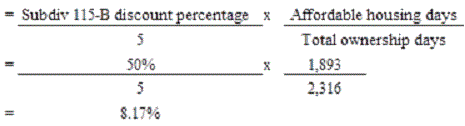
The discount percentage is equal to the sum of the Subdivision 115-B discount capital gain percentage and the affordable housing capital gains discount percentage that is 58.17 per cent (50 per cent plus 8.17 per cent).
The capital gain from Step 3 is the capital gain following step 2 reduced by the discount percentage, that is:
Step 4 - apply the small business concession to any capital gain to which they apply (if applicable)
The small business concessions do not apply to Erica's capital gain from the sale of the investment property. Therefore Erica's capital gain continues to be $41,830.
Step 5 - add up the amounts of any capital gains (if any) remaining after step 4 - the sum is the net capital gain for the income year
Erica's capital gain from the sale of the investment property at the end of Step 4 is $41,830. This is also her total capital gain for the 2024-25 income year as she has not realised any other capital gains during that year.
Example 2.6 - Affordable housing capital gain - individual is a resident for only some of the ownership period
William purchased a dwelling that was residential premises on 1 January 2015 which he used to earn rent for the whole time he owned it. William used the property to provide affordable housing from 1 January 2018 until 30 June 2023.
On 30 June 2023 William signs a contract to sell the dwelling. He makes a capital gain (before any capital gains discount) of $200,000.
William moved to the United States of America on 1 July 2022, becoming a foreign resident for taxation purposes on and from that day. Therefore William was an Australian resident for taxation purposes for 2,738 days and a foreign resident for 365 days of the 3,103 day ownership period of the dwelling.
William does not realise any other capital gains or losses in the 2022-23 income year and does not have any prior year capital losses.
William's net capital gain for the 2022-23 income year is calculated as follows:
Step 1 - reduce the capital gains made during the income year by the capital losses (if any) made during the income year
William's capital gain from Step 1 is $200,000 as he has not realised any capital losses during the 2022-23 income year.
Step 2 - reduce the capital gains remaining at the end of Step 1 by any previously unapplied net capital losses from earlier income years
William's capital gain from Step 2 is $200,000 as he does not have any capital losses from prior income years.
Step 3 - reduce by the discount percentage each amount of a discount capital gain remaining after Step 2
For the purpose of Step 3 the discount percentage is equal to the sum of the Subdivision 115-B discount capital gain percentage plus the affordable housing capital gains discount percentage.
The Subdivision 115-B discount capital gain percentage is equal to:
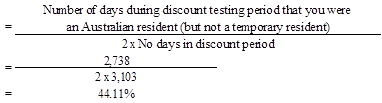
The affordable housing discount capital gain percentage is equal to:
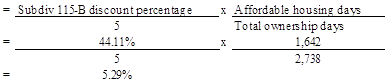
Affordable housing days and total ownership days both exclude the number of days when the individual was a foreign or temporary resident.
The discount percentage is equal to the sum of the Subdivision 115-B discount capital gain percentage and the affordable housing capital gains discount percentage that is 49.4 per cent (44.11 per cent plus 5.29 per cent).
The capital gain from Step 3 is the capital gain following step 2 reduced by the discount percentage, that is:
= Step 2 capital gain x (1 - discount percentage)
= $200,000 x (1 - 49%)
= $101,200
Step 4 - apply the small business concession to any capital gain to which they apply (if applicable)
The small business concessions do not apply to William's capital gain from the sale of the investment property. Therefore William's capital gain continues to be $101,200.
Step 5 - Add up the amounts of any capital gains (if any) remaining after step 4 - the sum is the net capital gain for the income year.
William's capital gain from the sale of the investment property at the end of Step 4 is $101,200. This is also his total capital gain for the 2022-23 income year as he has not realised any other capital gains during that year.
Reporting requirements for community housing providers
2.64 Under section 396-55 in Schedule 1 to the TAA 1953, community housing providers that issue affordable housing certificates must provide an annual report notifying the Commissioner in the approved form of the details of all certifications that they provide during an income year, including in relation to this measure (unless the Commissioner notifies that it is not required). Notification for an income year must be provided to the Commissioner on or before 31 days following the end of the relevant income year or within such further time that the Commissioner allows.
Disclosure of information to state registrars about community housing providers
2.65 The confidentiality of taxpayer information provisions in section 355-25 of Schedule 1 to the TAA 1953 make it an offence for a taxation officer to disclose tax information that identifies any entity, or is reasonably capable of being used to identify any entity, except in specified circumstances.
2.66 Community housing providers are regulated at the state and territory government level. The Commissioner is permitted under table items 9 and 10 of the subsection 355-65(8) of Schedule 1 to the TAA 1953 to disclose to the state and territory community housing registrars information about community housing providers for the purpose of the registrars determining whether they should be, or should continue to be, registered. The Commissioner can inform the relevant state or territory registrar about information concerning a community housing provider registered with it if the Commissioner has information suggesting that community housing provider should no longer be registered.
Application and transitional provisions
2.67 These amendments to provide an additional CGT discount applies to CGT events occurring on and after 1 January 2018 for affordable housing provided on and after that day. Although this change is retrospective in application, the additional CGT discount provides a benefit to taxpayers and does not disadvantage any taxpayers. [Schedule 2, item 3]
2.68 Schedule 2 to the Primary Bill commences on the first day of the next quarter following the day of Royal Assent. [Clause 2]