

Explanatory Memorandum
(Circulated by authority of the Treasurer, the Hon Jim Chalmers MP)Chapter 1: CGT adjustments
Outline of chapter
1.1 Schedule 1 to the Bill and the Imposition Bill amend the income tax law to make a range of changes to CGT to improve the efficiency and fairness of the tax system.
- •
- First, the amendments replace the 50 per cent CGT discount for individuals, trusts and partnerships with cost base indexation from 1 July 2027. This will realign the CGT regime with its original policy intent that only real gains are subject to taxation.
- •
- Second, the amendments impose a 30 per cent minimum tax on capital gains. This reduces the benefit to taxpayers of deferring realisation to years in which their marginal tax rates are low. It also ensures that capital gains face a tax rate that is closer to the tax rate most taxpayers face during their working life. Certain income support recipients will be exempt from the minimum tax to ensure that low-income, low-wealth individuals are not adversely affected.
- •
- Third, the amendments ensure these new arrangements apply to all capital gains arising from 1 July 2027 onwards. This includes assets owned prior to but disposed of after 1 July 2027, in respect of gains arising after that time, and assets purchased and disposed of after this date. The amendments also provide transitional arrangements for all CGT assets – other than new builds and affordable housing, which benefit from specific concessions – to ensure that existing arrangements continue to apply to assets acquired and disposed of before 1 July 2027 and capital gains accrued prior to 1 July 2027.
- •
- Fourth, the amendments bring pre-CGT assets (legacy assets held before 1985) into the CGT base for gains accruing after 1 July 2027 to improve horizontal equity and build on the intergenerational equity objectives of this measure. Gains on pre-1985 assets accrued before 1 July 2027 continue to be exempt from CGT.
- •
- Fifth, the amendments provide transitional arrangements for other legacy CGT assets purchased between 1985-1999 for which the 50 per cent CGT discount or indexation under prior indexation rules could apply. Under these amendments, after 1 July 2027, individuals and trusts can only use the 50 per cent CGT discount in respect of gains accruing before this date. Eligible companies, foreign residents and temporary residents will remain eligible for the previous cost base indexation arrangements under the current rules (with cost base indexation available only up to 30 September 1999).
- •
- Sixth, the amendments allow individual investors in new residential dwellings to choose between a 50 per cent CGT discount and the new arrangements. This maintains incentives for investors to supply new housing.
- •
- Seventh, the amendments allow investors in affordable housing to choose between the current CGT discount of up to 60 per cent and the new arrangements. This maintains incentives for investors to supply affordable housing.
- •
- Finally, there will be no changes to the operation of the small business CGT concessions as a result of these amendments.
1.2 References to legislation in this Explanatory Memorandum are to the ITAA 1997 unless stated otherwise.
Context of amendments
1.3 Younger Australians are finding it harder than earlier generations to build wealth and buy a home, as house prices have risen much faster than incomes. At the same time, tax concessions on asset income are adding to housing demand, while also weakening the fairness and resilience of the tax system.
The 50 per cent CGT discount
1.4 Capital gains are the income earned from an increase in asset values over time – such as for shares or investment properties. Under current rules, capital gains income earned by individuals (including individual partners in a partnership) and trusts are discount capital gains when an asset is sold and attracts the 50 per cent CGT discount if the asset has been held for at least 12 months.
1.5 Before the 50 per cent CGT discount was introduced in 1999, capital gains were adjusted for inflation so that only the real component of gains were taxed. The 50 per cent CGT discount was introduced following the Review of Business Taxation, which argued that among other things, the introduction of a generally more generous tax treatment of capital gains would encourage investment in the Australian share market, spur investors to buy and sell assets more frequently, and increase tax revenues.
1.6 Over 25 years since the introduction of the CGT discount, the share of Australians receiving dividend income has fallen, while the share with investments in property has grown considerably. Further, the flat CGT discount is arbitrary and does not accurately compensate for inflation. Compared to cost base indexation, the flat discount overcompensates some investors while undercompensating others.
1.7 Over the past 20 years, property has typically been overcompensated for inflation, with the inflation share of capital appreciation averaging 38 per cent for properties held for ten years. At the same time, parts of the property market, such as investments in units especially in regional areas, have been undercompensated for inflation. Australian shares have typically seen inflation account for close to 50 per cent of nominal gains over this period. Over the past 15 years, more often than not, share investors holding for ten years would have been undercompensated for inflation on average.
1.8 This means the current CGT discount has the potential to significantly distort investment decisions, incentivising investment in existing houses.
1.9 The benefits of the CGT discount predominantly flow to Australians who earn among the highest incomes over the course of their lives. One-third of all capital gains are realised by individuals who earn incomes in the highest 1 per cent during their working lives, and more than half of all gains are realised by the highest 10 per cent.
1.10 The current treatment of capital gains also creates opportunities for taxpayers to time the sale of assets for tax reasons. Unlike most income, capital gains are taxed on realisation, when the asset is sold, not when the gains accrue. As realised capital gains are taxed at an individual's marginal tax rate, there are strong incentives for investors to hold onto assets and sell them in years when their marginal tax rates are lower than usual, such as after retirement. Choosing to sell assets when marginal rates are low can provide a large tax benefit, compounding the benefits of the CGT discount.
Negative gearing compounds the effects of the CGT discount on housing
1.11 An investment is negatively geared when it runs at a current net loss and these losses are used to reduce the investor's annual taxable income from unrelated sources, such as wages and salaries. Property investments account for over 98 per cent of the net losses from negatively geared investments, largely reflecting the ready availability of finance for property. Interest costs from financing loans used to buy the property typically drive these losses.
1.12 This practice reflects the general principle of taxing net increases in income after deducting related expenses. However, international practice is that net rental losses are often not deductible from unrelated income, such as salary and wages. Australia is in a minority of OECD countries that allow unlimited deduction of rental losses against other income. Further, there are broader international trends toward separating how wages and asset income are taxed. There are strong equity and efficiency arguments for drawing a stronger link between rental losses and the earnings which they can be deducted against.
1.13 Low effective tax rates on property investments caused by the interaction between the 50 per cent CGT discount and negative gearing create strong incentives for investors to take on highly leveraged housing investments. This leads to higher house prices – as investors bid up the price on a scarce resource to receive the concession. It also distorts investment away from higher income-generating assets with lower capital returns, such as higher density housing, and investments in shares that are less easily funded with leverage.
1.14 Further, the tax benefits from negative gearing are concentrated among high income earners. Higher income individuals are more likely to invest in property, report larger rental losses, and have more negatively geared property interests.
1.15 Over time, rental property investments are also becoming more out of reach as property prices continue to rise faster than wages, making it more challenging for first home buyers to enter the market.
Commentary
1.16 Reflecting these issues the OECD have recommended cutting or eliminating the CGT discount and phasing out negative gearing.
1.17 The Select Committee on the Operation of the CGT Discount also found that the benefits of the CGT discount are unequally distributed, have the potential to encourage tax planning and can distort the allocation of investment across the economy, including skewing home ownership away from owner-occupiers.
The Government's changes
1.18 In the 2026-27 Budget, the Government announced reforms to negative gearing and capital gains tax to help improve the fairness of the tax system, support home ownership and help fund new tax cuts for workers.
1.19 These amendments reintroduce cost base indexation to achieve a more neutral and fair treatment of capital gains compared with the fixed 50 per cent CGT discount which applied to nominal capital gains. This change is expected to reduce the overall level of concession provided to some capital gains, especially established detached housing in capital cities.
1.20 These amendments also introduce a minimum tax rate on real capital gains income earned from 1 July 2027 to reduce the benefits of timing the realisation of capital gains to minimise tax paid. This ensures that affected taxpayers are subject to a tax rate that is closer to the marginal rate they faced during their working life. If applied in 2022–23, over 95 per cent of net capital gains income would have been earned by people who are either not affected by the minimum tax or who had a marginal tax rate of more than 30 per cent during their working lives.
1.21 These amendments will improve the fairness of the tax system and help address housing affordability pressures facing first homebuyers, allowing more younger Australians and future generations to own their own home. These amendments are expected to reduce investor demand for existing properties, while eligible new builds will be exempt from the changes, ensuring the benefits of negative gearing are directed to investment that support growth in Australia's housing stock.
1.22 Together, these reforms will help to level the playing field for first homebuyers, while maintaining support for investment in new housing supply.
Comparison of key features of new law and current law
Table 1.1 Comparison of new law and current law
| New law | Current law |
| Cost base indexation for Australian resident individuals and trusts
For CGT events that occur on or after 1 July 2027:
For CGT events that occur before 1 July 2027, there is no change in the application of cost base indexation or CGT discount. Cost base indexation for other entities There is no change in the availability of cost base indexation for other entities. |
Cost base indexation
Cost base indexation is only available for assets that are acquired between 20 September 1985 and 21 September 1999 and held for at least 12 months. Indexation only takes into account inflation up to 30 September 1999, at which time indexation was frozen. Certain entities (including Australian resident individuals and trusts) can choose to apply the 50 per cent CGT discount for their discount capital gains instead of cost base indexation. |
| Minimum tax on capital gains
A 30 per cent minimum rate of tax applies to capital gains of Australian resident individuals from 1 July 2027. Recipients of certain income support payments will be exempt. An exemption applies to capital gains on CGT assets that are new residential dwellings and affordable housing if taxpayers choose to access the CGT discounts available for these assets (instead of indexing the cost base). |
Minimum tax on capital gains
Not applicable. |
| Pre-CGT assets
Capital gains and losses accrued before 1 July 2027 are still disregarded for CGT. From 1 July 2027, all assets cease to be pre-CGT assets and any gains accruing after that day are subject to CGT. |
Pre-CGT assets
Capital gains and losses arising from pre-CGT assets are disregarded. |
| New residential dwellings and affordable housing
The additional CGT discount for affordable housing (up to 60 per cent) continues to apply. A CGT discount of 50 per cent is available for individuals for new residential dwellings. An individual or trust who makes a capital gain from a CGT event relating to a new residential dwelling or affordable housing can choose between the CGT discount or the new arrangements (cost base indexation plus the minimum 30 per cent tax). |
New residential dwelling and affordable housing
No distinction is made between new and existing residential dwellings for CGT. New residential dwellings may be eligible for the CGT discount. Certain entities (including individuals and trusts) are eligible to apply an additional CGT discount (up to 60 per cent) on capital gains from affordable housing. |
| Small business concessions
No change. |
Small business concessions
Eligible small businesses have access to four broad-based small business CGT concessions in Division 152. |
| Calculating net capital gain
The net capital gain method statement is amended to seven steps. This accommodates four new categories of capital gains that are established to differentiate whether the capital gain relates to a residential or non-residential CGT asset, and to a period that ended or began on 1 July 2027. The key changes to the method statement include:
|
Calculating net capital gain
Net capital gain is calculated through a five-step process set out in section 102-5, which broadly provides:
Capital gains are pooled and have no asset-based character. The gains used in working out the net capital gain take into account the effects of cost base indexation, to the extent that it applied. |
| Trustee reporting requirements
If required by the Commissioner of Taxation, trustees must provide beneficiaries with a statement for an income year in the approved form. This statement will provide beneficiaries sufficient information in relation to their attributable capital gains to comply with their tax obligations. An administrative penalty is included for non-compliance. |
Trustee reporting requirements
No existing equivalent reporting requirements. |
Detailed explanation of new law
Overview of CGT amendments
1.23 From 1 July 2027, Schedule 1 amends the tax law to repeal the 50 per cent CGT discount and replace it with cost base indexation. The new indexation regime applies to capital gains made directly or indirectly (through an interposed entity) by Australian resident individuals (including individual partners in a partnership) and trusts.
1.24 The reforms also introduce a minimum tax of 30 per cent on capital gains of Australian resident individuals from 1 July 2027.
1.25 The changes do not apply to capital gains made directly or indirectly by:
- •
- foreign residents and temporary residents; or
- •
- companies, superannuation funds and life insurance companies.
1.26 These entities were not previously entitled to the CGT discount or have their own discrete CGT treatment; therefore, they will not receive the benefit of cost base indexation or be affected by the related minimum tax.
1.27 Cost base indexation will apply for all eligible CGT assets of individuals and trusts going forward, except those assets to which a CGT discount continues to apply. For example, CGT discount settings will continue to be available for investors to apply to certain assets if they choose, including the discount for investments in affordable housing in section 112-125 and for new residential dwellings to maintain incentives to invest in these property assets.
1.28 The Bill also brings all pre-CGT assets (which are assets acquired before 20 September 1985) into the CGT regime from 1 July 2027. While any capital gains accrued on these assets before 1 July 2027 will continue to be exempt from CGT (subject to existing rules such as CGT event K6), capital gains from these assets accruing on or after 1 July 2027 will be subject to the new arrangements.
1.29 This change for pre-CGT assets is not limited to entities that are subject to the new indexation regime and includes all entities (including companies). This means that an entity that has a pre-CGT asset and sells it in future will need to calculate the capital gain that accrues between 1 July 2027 and the realisation event (such as, the date of sale) under the new regime and apply the applicable CGT rules to that asset.
Structure of changes
1.30 Schedule 1 to the Bill makes extensive amendments to the ITAA 1997 to give effect to these changes.
1.31 Some of the key provisions that are amended include:
- •
- Division 102, which provides that a net capital gain is included in assessable income for an income year and sets the method to work out a net capital gain.
- •
- Division 110, which sets out how to work out the cost base and reduced cost base of a CGT asset, which are used in calculating whether you make a capital gain or loss from most CGT events. Indexation is relevant to calculating the cost base, as provided by section 110-36.
- •
- Division 112, which explains how to modify the cost base in certain situations.
- •
- Division 114, which provides how to index expenditure and when indexation is relevant or not relevant to expenditure in each element of the cost base. In particular, it provides for indexation of the cost base by multiplying each element of the cost base (except the third element) by the relevant indexation factor. The Division contains a number of other rules which affect how indexation works.
- •
- Division 115, which deals with discount capital gains and trusts' net capital gains.
- •
- Subdivision 960-M, which provides the indexation rules. The indexation factor is calculated using formula in subsection 960-275.
1.32 Schedule 1 also introduces the new Division 119 to implement a new minimum tax on individuals for certain capital gains.
Table 1.2 Overview of treatment of CGT assets and pre-CGT assets for Australian resident individuals and trusts
| Situation | Treatment under the new law |
| 1. CGT asset acquired and disposed of before 1 July 2027 | Capital gains and losses are handled under the old law that applied prior to these amendments commencing. The new law does not apply. |
| 2. Pre-CGT asset (acquired before 20 September 1985) | Gains on pre-CGT assets accrued before 1 July 2027 will continue to be exempt (noting rules under the tax law that could already tax these gains, such as CGT event K6 continue to apply). Gains made from CGT events that happen on or after 1 July 2027 are taxed on the portion of the gain that has accrued from 1 July 2027.
Note, this applies broadly to all entities, including companies. |
| 3. CGT asset acquired between 1985 and 1999 | There is a choice whether to index the cost base or apply the CGT discount in relation to a CGT asset that applies until 1 July 2027. From 1 July 2027, individuals (including partners in a partnership) and trusts are only able to apply the 50 per cent CGT discount on eligible CGT assets up until 1 July 2027. New settings apply to gains accrued after 1 July 2027 for these assets. Other entities, including companies, may retain the current treatment. |
| 4. CGT asset acquired before 1 July 2027 and CGT event happens on or after 1 July 2027 | The capital gain or loss is calculated in the income year in which the CGT asset is disposed of. It consists of two components reflecting the pre- and post-1 July 2027 periods as follows:
|
| 5. CGT asset acquired and CGT event happens after 1 July 2027 | The new law applies: for resident individuals, the capital gains may be subject to cost base indexation and a minimum 30 per cent tax. |
Indexation of the cost base
1.33 The first key change made by Schedule 1 to the Bill is to amend the ITAA 1997 to provide for the indexation of capital gains of individuals and trusts from 1 July 2027 and remove the CGT discount for individuals and trusts from 1 July 2027. The amendments also specify how indexation is to be determined for these gains and include consequential changes to the provisions under which indexation was previously calculated.
1.34 Cost base indexation ensures that only the real (inflation-adjusted) increase in the value of the asset is taxed. This means that taxpayers will adjust the cost base of their asset for inflation before calculating their capital gain.
1.35 This section of the Explanatory Memorandum steps through changes to Divisions 110 (how to work out the cost base and reduced cost base of a CGT asset) and 114 (indexation of the cost base) and to Subdivision 960-M (how to index and indexation factors), which specify how indexation is applied when calculating the cost base of a CGT asset. The removal of the CGT discount for individuals and trusts, the introduction of a new CGT discount for new residential dwellings and related changes in how discounts apply under the new approach are discussed separately below.
Division 110. When to use indexation in calculating cost base
1.36 Division 110 of the ITAA 1997 sets out how to work out the cost base and reduced cost base of a CGT asset, which are used in calculating whether you make a capital gain or loss from most CGT events. Indexation may affect the calculation of the cost base, as provided by section 110-36.
1.37 The Bill amends section 110-36 to provide for a separate regime for calculating capital gains of Australian resident individuals and trusts for CGT events happening on or after 1 July 2027. The amended section distinguishes between the capital gains which are covered by the new arrangements and capital gains that fall under the existing indexation regime for assets acquired between 1985 and 1999 (which continues to operate in generally the same way for most entities).
1.38 The Bill does not alter the methodology for calculating capital losses, which has largely remained unamended since the introduction of CGT in 1985. Capital losses are calculated using the reduced cost base of a CGT asset, rather than the asset's cost base that is used when calculating a gain. In contrast with cost base, reduced cost base excludes certain elements and is not indexed (and has never been indexed) for a range of important integrity reasons that remain as relevant in 2026 as they were in 1985.
New rules for Australian resident individuals and trusts for CGT events after 1 July 2027
1.39 An Australian resident individual, partner or trust working out their capital gain from a CGT event that happens on or after 1 July 2027 is to include an adjustment for indexation in calculating the cost base of the eligible CGT asset. Expenditure incurred in each element of the cost base is indexed except the third element (the costs of owning the CGT asset – see section 110-25) subject to the other requirements of Division 114 (relating to indexation of the cost base). [Schedule 1, item 8, subsection 110-36(1A) of the ITAA 1997]
1.40 Under the new provisions for capital gains arising after 1 July 2027, cost base indexation:
- •
- applies to an individual, to an individual in respect of a capital gain that is attributable to a partnership of which they are a partner, and to a trust to the extent the capital gain is relevant to individual beneficiaries of the trust who are Australian residents;
- •
- does not apply to a foreign resident or temporary resident in accordance with section 114-25, discussed further below; and
- •
- for assets held on 30 June 2027 (including pre-CGT assets and CGT assets deemed to have been sold and reacquired just before 1 July 2027 under sections 112-155(2), 112-165(2) and 112-175(2)) — only applies for the period the asset is held after 1 July 2027 (see subsection 960-275(1B), on how to calculate the indexation factor). The deeming process is discussed below under Division 112 (Modifying the cost base).
- [Schedule 1, item 8, subsection 110-36(1A) of the ITAA 1997]
Preservation of indexation rules for assets acquired between 20 September 1985 and 21 September 1999
1.41 The new provisions preserve the rules for indexation that applied prior to 1 July 2027 in relation to CGT assets acquired between 20 September 1985 and 21 September 1999. These rules generally continue to apply in the same way. However, a number of consequential changes are made to these rules to ensure that they do not overlap with the new rules applying to Australian resident individuals and trusts relating to indexation for CGT events occurring on or after 1 July 2027. [Schedule 1, item 8, subsection 110-36(1) of the ITAA 1997]
1.42 Consistent with the prior law, subsection 110-36(1) provides that the cost base of a CGT asset includes indexation of the elements of the cost base (except for the third element of the cost base, prescribed by section 110-25). Its application remains limited to working out the capital gain of an entity from a CGT event happening in relation to the CGT asset if the most recent acquisition of the CGT asset is at or before 11.45am (ACT legal time) on 21 September 1999 and the requirements of Division 114 (indexation of cost base) are met.
1.43 Subsection 110-36(1) is amended to also require that such indexation of the relevant elements of the cost base will only be included for an entity that is an individual or trust if the CGT event happens before 1 July 2027 (but not because of subsections 112-155(2) or 112-165(2), which deem the sale and reacquisition of certain CGT assets as discussed further below). [Schedule 1, item 8, subsection 110-36(1) of the ITAA 1997]
1.44 This means that for entities other than individuals and trusts, there are no changes to indexation arrangements for CGT assets acquired between 20 September 1985 and 21 September 1999. Assets acquired before 20 September 1985 are pre-CGT assets (see further below for discussion of the new tax treatment of pre-CGT assets).
1.45 In relation to individuals and trusts, existing indexation settings are retained for CGT assets acquired between 20 September 1985 and 21 September 1999 and for which the CGT event occurs before 1 July 2027 (excluding the new deeming mechanism discussed below). This means that individuals and trusts retain their existing choice between indexation and the CGT discount for these CGT assets.
1.46 However, for CGT events occurring on or after 1 July 2027, and CGT events occurring as a result of the deemed disposal of CGT assets immediately before 1 July 2027, individuals and trusts will no longer have a choice between indexation and the CGT discount and will instead only be able to apply the CGT discount to the discount capital gains up to 1 July 2027. This is reflected in amendments to subsections 110-36(2) and (3) (about the cost base including indexation only if a relevant entity chooses), which ensure those provisions only apply in relation to working out capital gains where the cost base includes indexation because of subsection (1). [Schedule 1, items 9 to 11, subsections 110-36(2) and (3) of the ITAA 1997]
1.47 This excludes individuals and trusts from the operation of those provisions in relation to CGT events occurring on or after 1 July 2027 and CGT events occurring as a result of the deemed disposal of CGT assets immediately before 1 July 2027, as for such events the cost base of a CGT asset for individuals and trusts includes indexation because of subsection 110-36(1A) (and subsection 110-36(1) does not apply to them).
Division 114 Indexation rules
1.48 Division 114 of the ITAA 1997 provides when and how cost base indexation is relevant or not relevant to expenditure in each element of the cost base, and other rules that affect how cost base indexation works. The indexation formula is set in Subdivision 960-M, discussed separately in the section below.
When indexation applies
1.49 Under the replacement section 114-1, cost base indexation applies to expenditure incurred in each element of the cost base except the third element under section 110-25. This means the expenses incurred to acquire the asset, incidental costs, and expenses to increase or preserve its value and to defend the title or right to the asset; but indexation is not available for the costs of owning the asset, consistent with subsection 960-275(4). This approach applies to:
- •
- An individual or trust working out the cost base of a CGT asset after 1 July 2027 under subsection 110-36(1A); and [Schedule 1, item 14, section 114-1(1) of the ITAA 1997]
- •
- An entity working out the cost base of a CGT asset in other circumstances under subsection 110-36(1) – noting in this case, the CGT asset must be acquired at or before 11.45am (ACT legal time) on 21 September 1999 and only applies to expenditure incurred prior to that time. [Schedule 1, item 14, section 114-1(2) of the ITAA 1997]
1.50 This provides a consistent approach to cost base indexation for individuals and trusts operating under the new arrangements from 1 July 2027, as well as entities that acquired a CGT asset between 20 September 1985 and 21 September 1999 and sold the asset before 1 July 2027.
1.51 Other existing rules continue to apply in calculating indexation of the cost base. In particular:
- •
- Expenditure can include giving property per section 103-5.
- •
- Subdivision 960-M shows how to index amounts. For indexation under subsection 110-36(1A), see subsections 960-275(1B) and (1C). For indexation under subsection 110-36(1), do not take account of inflation after 30 September 1999, per subsections 960-275(2) and (3) – indexation can still be used, but only until 30 September 1999 as it is frozen at that time.
- •
- The cost base of a CGT asset must be worked out if a CGT event happens in relation to it or if there is a cost base modification.
- •
- Expenses under the third element of the cost base are not indexed, consistent with subsection 960-275(4).
- •
- Indexation under subsection 110-36(1) is not relevant to expenditure incurred after 11.45 am on 21 September 1999 (ACT legal time) or any expenditure relating to a CGT asset acquired after that time. This is the date that indexation was previously frozen and replaced with the 50 per cent CGT discount. [Schedule 1, item 14, explanatory notes to subsections 114-1(1) and (2) of the ITAA 1997]
1.52 Section 114-5 provides when indexation is relevant. Under subsection 114-5(1), indexation is relevant if the cost base of a CGT asset is relevant to a CGT event. The amendments retain the existing approach under which specified entities may choose between indexing the cost base or using the CGT discount for CGT assets acquired prior to 11.45am (ACT legal time) on 21 September 1999 and sold before 1 July 2027. [Schedule 1, items 15 and 16, subsections 114-5(2) and (3) of the ITAA 1997]
1.53 The choice between indexation and CGT discount is removed for individuals and trusts that acquired a CGT asset between 20 September 1985 and 21 September 1999 and for which the realisation event occurs after 1 July 2027. This means that after 1 July 2027, individuals and trusts cannot choose to apply cost base indexation to gains referrable to the period prior to 1 July 2027 (the deferred gain, discussed further below) and must instead apply the CGT discount. This is because indexation is not available in relation to the deferred gain. Other entities, such as companies that acquired a CGT asset between 20 September 1985 and 21 September 1999 and could choose indexation under the law prior to 1 July 2027, will retain that ability to apply cost base indexation (with indexation continuing to only apply up until 30 September 1999 when it was frozen).
1.54 Consequential amendments are made to the cost base modification and roll-over provisions in Division 114 to reflect amendments to section 110-36 that provide the two situations where indexation applies. [Schedule 1, items 21 to 23, subsections 114-15(1) and (6) and section 114-20 of the ITAA 1997]
12-month ownership
1.55 The rule that indexation is only available for expenditure forming the cost base of a CGT asset if the asset has been owned for at least 12 months continues to apply. This 12-month rule in subsection 114-10(1) is amended to apply it to the existing law as well as to the new arrangements. [Schedule 1, item 17, subsection 114-10(1) of the ITAA 1997]
1.56 There are a number of exceptions to the 12-month ownership rule, which the Bill expands from 5 to 6. The new exception is for a sale and reacquisition taken to have happened under subsections 112-155(2), 112-165(2) or 112-175(2). Such a deemed sale and reacquisition are disregarded for the purposes of applying the 12-month rule. Those provisions deem the sale and reacquisition of a CGT asset to create notional capital gains for the purpose of apportioning gains on assets that were acquired before commencement of these amendments and which are realised when a later CGT event happens (see section 977-5 of the ITAA 1997 for the definition of realisation event for a CGT asset). [Schedule 1, items 18 to 20, subsections 114-10(2) and (9) of the ITAA 1997]
1.57 This exception is necessary as the entire period in which a CGT asset is held should count towards the 12-month ownership rule. It would be inappropriate for operation of the 12-month ownership rule to be affected by a deemed sale and reacquisition that occurs purely for technical CGT reasons and is out of the control of the taxpayer. It is sufficient that an entity actually owned the asset for at least 12 months irrespective of whether it is before or after 1 July 2027.
Example 1.1 12-month rule
Eva acquires an asset under a contract dated 11 August 2025 and sells that asset on 2 January 2028. Although the period between 1 July 2027 and 2 January 2028 is less than 12 months, indexation is available as the rule takes into account Eva's actual continuous period of ownership of the asset, disregarding the deemed sale and reacquisition in 2027, which exceeds 12 months.
Australian residency requirements for CGT events that happen from 1 July 2027
1.58 There are residency requirements that must be satisfied for indexation of the cost base of a CGT asset to be available for an individual in relation to CGT events that happen on or after 1 July 2027. Under the amendments, cost base indexation is not available to foreign residents or temporary residents.
1.59 Similar to the requirements for the previous 50 per cent CGT discount, access to indexation can be affected by residency. For cost base indexation to apply, the individual who held the CGT asset at the time of the CGT event must have been an Australian resident between 1 July 2027 or the day the CGT asset was acquired (whichever is later) and the day of the CGT event. This time period is referred to as the testing period. The individual cannot have been a foreign resident or a temporary resident at any time during that testing period (however, please see the section on Future Amendments below). [Schedule 1, item 24, subsections 114-25(1) and (2) of the ITAA 1997]
1.60 This requirement applies for working out a capital gain made from directly holding the asset. A similar result arises for any capital gain made indirectly as a beneficiary of a trust (see Subdivision 115-C, in particular subsections 115-225(4) and (5)). [Schedule 1, item 24, explanatory note to subsection 114-25(1) of the ITAA 1997]
1.61 In some cases, such as where an asset is acquired in circumstances giving rise to certain roll-overs, section 115-30 provides that an individual may be treated as having acquired a CGT asset on the day it was acquired by another person (the past owner). Where this is the case, if the past owner held the CGT asset on any day within the testing period the individual is also treated as having the residency status of the past owner on that day. The existing special rules about the time of acquisition of CGT assets in section 115-30 applies to the new rules around foreign and temporary residents and indexation in subsections 114-25(2) and (3) in a corresponding way to the way it applies in relation to the existing rules for foreign and temporary residents accessing the CGT discount in section 115-105. [Schedule 1, item 24, subsections 114-25(3) and (4) of the ITAA 1997]
1.62 In practice, this means that an individual must have been an Australian resident for the entire time they owned the CGT asset to apply cost base indexation. If at any point they were a foreign or temporary resident, the individual cannot apply indexation to the cost base under these amendments.
1.63 However, future amendments may be considered in relation to how entities that are resident for only part of the period they hold a CGT asset (themselves, or because their ownership period was interrupted by someone else holding the asset who in turn was not an Australian resident during that period) may access indexation.
Example 1.2 Australian resident
Michelle is an Australian resident. On 1 January 2028 she purchases ASX listed shares. On 1 July 2029, Michelle sells the shares and makes a capital gain.
Michelle's indexation testing period commences on 1 January 2028 and ends 1 July 2029. Michelle was an Australian resident for the entire testing period (and held the shares for longer than 12 months). Michelle can apply indexation to the cost base of her shares to calculate the capital gain to include in working out a net capital gain for the year of income.Example 1.3 Temporary resident
Maria moves to Australia on 1 July 2026 and is a temporary resident. On 1 July 2027 Maria purchased ASX listed shares. Maria sells the shares on 1 January 2029.
Maria's indexation testing period commences on 1 July 2027 and ends on 1 July 2029. As Maria was a temporary resident during the testing period, she cannot apply indexation to the elements of the cost base of the property in working out whether she makes a capital gain.Example 1.4 Foreign resident
Paul is a resident of France. On 1 January 2028 he receives all necessary approvals and enters into a contract to purchase vacant land in Sydney. On 1 July 2029 Paul enters into a contract to sell the land.
Paul's indexation testing period commences on 1 January 2028 and ends on 1 July 2029. As Paul was a foreign resident during the testing period, he cannot apply indexation to the gain.
New residential dwellings and affordable housing
1.64 Individuals and trusts that hold new residential dwellings or affordable housing after 1 July 2027 will have a choice between applying relevant CGT discounts or cost base indexation in respect of the period after 1 July 2027 and the minimum tax. The chosen treatment will apply to the whole holding period, even if the asset is purchased before and sold after 1 July 2027. This reflects the intent of these reforms to maintain incentives for new residential dwelling and affordable housing supply.
1.65 New section 114-30 provides that cost base indexation will not be available in relation to a CGT event happening for a new residential dwelling or affordable housing if the taxpayer has chosen to instead apply the relevant CGT discount under new sections 115-102 or 115-125. [Schedule 1, item 24, section 114-30 of the ITAA 1997]
Example 1.5 Investor disposing of property used for affordable housing
Richard, an Australian resident, purchases a dwelling on 1 July 2027. The dwelling is used to provide affordable housing from 1 December 2027 until 2 December 2030. Richard sells the property on 1 February 2031.
In working out his residential capital gain, Richard can choose to apply either the CGT discount or indexation. If Richard chooses to apply the CGT discount, he can apply an additional 10 per cent CGT discount under section 115-125.
1.66 In relation to beneficiaries of a trust, the choice between indexation and CGT discount is made by the trustee of the trust. It cannot be altered by the beneficiary. [Schedule 1, item 24, explanatory note 2 to subsection 114-30(2) of the ITAA 1997]
Indexation formula
1.67 Where an amount which forms part of an element of the cost base (except the third element) is required to be indexed, Subdivision 960-M of the ITAA 1997 provides how to index those amounts and how to calculate the indexation factor.
1.68 The indexation factor is calculated using the formula in subsection 960-275.
1.69 Following the amendments, subsections 960-275(2) and (3) continue to provide the indexation factors for indexation of the cost base of a CGT asset, under section 110-36(1). These are the rules for indexation that apply in relation to assets acquired between 20 September 1985 and 21 September 1999, which generally continue to apply in the same way as provided for under the law prior to 1 July 2027 (see above for further information). [Schedule 1, items 49 and 50, subsections 960-275(2) and (3) of the ITAA 1997]
1.70 New subsections are added to provide for indexation under section 110-36(1A), for an Australian resident individual or trust to index the cost base of capital gains for CGT events which happen from 1 July 2027. [Schedule 1, item 48, subsections 960-275(1B) and (1C) of the ITAA 1997]
1.71 New subsection 960-275(1B) provides the indexation factor for expenditure in an element of the cost base incurred on or after 1 July 2027 (except the first element of the cost base for a share in a company or a unit in a unit trust). This indexation factor is the outcome of the index number for the quarter in which the CGT event happens, divided by the index number for the quarter is which the expenditure is incurred. That expenditure can include giving property, per section 103-5. [Schedule 1, item 48, subsection 960-275(1B) of the ITAA 1997]
1.72 This calculation includes expenditure deemed to have occurred from reacquisition on 1 July 2027 (under paragraphs 112-155(2)(b), 112-165(2)(b) or 112-175(2)(b)). This means the earliest quarter covered by the denominator (the index number for the quarter is which the expenditure is incurred) is the quarter starting on 1 July 2027 (not the quarter ending on 30 June 2027). [Schedule 1, item 48, subsection 960-275(1B) of the ITAA 1997]
1.73 The ATO has historically published guidance materials and tools to support taxpayers in calculating the indexation factor to adjust relevant amounts of the cost base.
Example 1.6 Application of indexation formula to purchase in instalments
Marcus agrees to acquire an investment asset in July 2027 for 10 equal quarterly instalments of $10,000. He makes the first payment on 1 July 2027 and then pays a further $10,000 every three months, with the final instalment paid on 1 April 2030.
Under the indexation method, each instalment is treated as a separate amount of expenditure incurred at the time it is paid. Marcus cannot treat the $100,000 as a single cost as this is different to the real cost of the asset that was paid over time. Instead, each of the ten $10,000 payments forms part of the first element of the cost base at the point in time it is paid.
Assuming indexation is available up to the time of disposal, Marcus follows ATO guidance and tools to separately index each instalment with reference to CPI. Each $10,000 payment is multiplied by a factor calculated at the CPI for the quarter in which he sells the asset divided by the CPI for the quarter in which that particular instalment was paid.
1.74 Subsection 960-275(1C) provides a separate indexation factor for indexation of the first element of the cost base of a CGT asset (the cost to acquire it, per subsection 110-25(1)) that is a share in a company or a unit in a unit trust. This indexation factor applies to an amount that was paid to a company or trust on or after 1 July 2027. The indexation factor is the outcome of dividing the index number for the quarter in which the CGT event happens, by the index number for the quarter is which the amount is paid. The payment can include giving property, per section 103-5. Providing a separate calculation for this element, for CGT assets that are shares and units, is consistent with the approach to calculating the indexation factor under the existing law. [Schedule 1, item 48, subsection 960-275(1C) of the ITAA 1997]
Example 1.7 Application of indexation formula to shares in a company
Peter acquires shares in a company on 10 April 2028. The shares are partly paid, and the company makes a call on the shares on 10 August 2030, due for payment in 6 months on 1 February 2031. Peter sells the shares to Narina on the 15 August 2030, before the payment call is due.
The amount Narina paid to Peter for the shares is indexed under subsection 960-275(1B) from the quarter in which she incurred the expenditure to acquire the shares (the first quarter ending 30 September 2030).
The amount Narina later pays for the call on the shares is indexed in accordance with subsection 960-275(1C) from the quarter in which she made that later payment (the quarter ending 31 March 2031).
Assessable income includes net capital gains
1.75 The next section of the Explanatory Memorandum steps through how to calculate a net capital gain, focussing on amendments to provisions about calculating and modifying the cost base (which, as above, may be indexed). These amendments are necessary due to various amendments made to the tax law by the Bill, including the amendments to limit application of quarantined amounts (i.e. rental losses – see the Chapter relating to negative gearing amendments) which permit the application of those amounts only against specific categories of capital gains.
Division 102. Calculating your net capital gain
1.76 Division 102 determines how entities work out if they have made a net capital gain, which is included in their assessable income for an income year.
1.77 The amendments to Division 102 principally give effect and address consequences of the changes to the CGT treatment of individuals and trusts from 1 July 2027, including the re-introduction of indexation and the removal of the 50 per cent discount.
1.78 Within Division 102, subsection 102-5(1) sets out the method statement to work out if you have made a net capital gain that is to be included in your assessable income.
1.79 The amendments remove the existing method statement and provide a new method statement in subsection 102-5(1) for calculating net capital gains. [Schedule 1, item 5, subsection 102-5(1) of the ITAA 1997]
1.80 The main changes are creating asset-based categories of capital gains in order to separately identify residential and non-residential capital gains. This allows capital losses and quarantined amounts (i.e. rental losses – see the Chapter relating to negative gearing amendments) to be applied correctly across different categories of capital gains. This will ensure the appropriate outcomes across both the CGT and negative gearing amendments.
1.81 This new process of calculating net capital gains is set out in the diagram below.
Diagram 1.1 How to calculate your net capital gain (simplified)
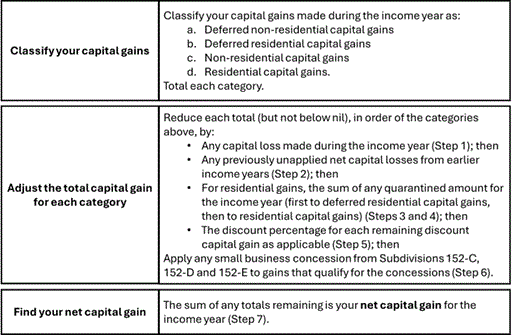
Step 1 – Reduce your current year capital gains against current year capital losses in the order of the new categories of capital gains
1.82 Under step 1 in the new method statement, an entity is required to classify their capital gains into four categories for an income year:
- •
- deferred non-residential capital gains;
- •
- deferred residential capital gains;
- •
- non-residential capital gains; and
- •
- residential capital gains.
Residential capital gains
1.83 'Residential capital gains':
- •
- excludes gains arising under Subdivision 112-E where there is a deferred gain arising from the deemed sale of a CGT asset on 30 June 2027; and
- •
- includes the gains arising from a CGT event happening in relation to the CGT asset that is a residential dwelling to the extent it has been used or held to provide residential accommodation.
1.84 The amendments provide a calculation to determine how much of the capital gain is a 'residential capital gain'. A residential capital gain is broadly the capital gain arising from a residential dwelling over the time the dwelling was used to provide residential accommodation. The residential capital gain is calculated determining the percentage of the total ownership period of the asset on or after 1 July 2027 in which the dwelling was used for residential accommodation, with the residential capital gain being that percentage of the total capital gain. This calculation excludes periods, to the extent that it is reasonable to conclude that the main residence exemption already applied to reduce the capital gain as a result of the use of the dwelling during those periods. This reflects the fact that the gain attributable to that period is not included in the capital gain at all to the extent that the main residence exemption applies. [Schedule 1, item 6, subsection 102-6(2) of the ITAA 1997]
1.85 These capital gains relate only to gains that accrued after 1 July 2027.
Example 1.8 Calculating residential capital gains
On 13 October 2027, Minh Anh becomes the owner of seaside land on which a large, two-level residential dwelling is constructed. She commences using the lower level as her main residence and providing the top level as residential accommodation.
On 8 May 2032, at the ending of a tenancy for the part used for residential accommodation, the dwelling is demolished. A building suitable for use as a wellness retreat is constructed and Minh Anh leases out the property to commercial tenants.
On 14 June 2035, Minh Anh ceases to be the owner of the property when it is sold. The capital gain that would be made on the sale of the property, apart from the application of the CGT main residence exemption and after taking into account cost base indexation, would be $3.9 million.
Minh Anh applies the Subdivision 118-B main residence exemptions to reduce the amount of that capital gain, taking into account:
- •
- the number of non-main residence days in the ownership period (1132 of 2792); and
- •
- the reasonable extent to which the original dwelling was used for an income producing purpose (40 per cent).
On the application of those exemptions, Minh Anh reduces the capital gain of $3.9 million by $1,391,260.
The amount of capital gain to be included in determining if Minh Anh has a net capital gain for the 2034/35 income year is $2,508,740.
None of this gain is a deferred residential capital gain or a deferred non-residential capital gain. The amount of the gain that is a residential capital gain is equal to the amount of the capital gain multiplied by a fraction, being the number of residential accommodation days divided by the total number of days in the post-1 July 2027 ownership period. The remainder of the gain will be a non-residential capital gain.
The residential accommodation days includes the fractional part of those days in which the dwelling was used for providing residential accommodation, with the fraction determined based on the extent of use. Based on the apportionment made for the main residence exemption this is a 4/10th fraction of 1660 days = 664.
Days in the post-2027 ownership period is 2792, reduced by the parts of days for which it is reasonable to expect a capital gain has been disregarded by the operation of the main residence exemption. In Minh Anh's circumstances, it is reasonable to ascertain on the basis of the attribution made under the exemption that this will be a 6/10th fraction of each of the 1660 days. Given this, the days in the post-2027 ownership period are 1796 (2792 less 996).
As a result, Minh Anh has:
- •
- a residential capital gain of $927,507 ($2,508,740 x 664/1796)
- •
- a non-residential capital gain of $1,581,233.
Non-residential capital gains
1.86 'Non-residential capital gains':
- •
- excludes gains arising under Subdivision 112-E where there is a deferred gain arising from the deemed sale of a CGT asset on 30 June 2027; and
- •
- includes any gains that do not fall within the meaning of 'residential capital gains' (set out above). [Schedule 1, item 6, subsection 102-6(1) of the ITAA 1997]
1.87 This covers capital gains arising from asset classes including commercial property, company shares or interests in a trust, provided the gains arise from assets held on or after 1 July 2027.
Deferred residential capital gains
1.88 'Deferred residential capital gains' include:
- •
- gains arising from CGT assets covered by Subdivision 112-E where there is a deferred gain arising from the deemed sale of the asset on 30 June 2027; and
- •
- gains arising from the CGT event happening to a CGT asset that is a residential dwelling to the extent it was used or held for residential accommodation.
1.89 The amendments provide a calculation to determine how much of the capital gain is a 'deferred residential capital gain'. A deferred residential capital gain is broadly the capital gain arising from a residential dwelling over the time the dwelling was used to provide residential accommodation before 1 July 2027. The residential capital gain is calculated by determining the percentage of the total ownership period of the asset before 1 July 2027 in which the dwelling was used for residential accommodation, with the deferred residential capital gain being that percentage of the total capital gain. A period that ends on a day includes that day (see subsection 36(1) of the Acts Interpretation Act 1901). As discussed above, this calculation excludes periods to the extent that it is reasonable to conclude that the main residence exemption already applied to reduce the capital gain as a result of the use of the dwelling during those periods. [Schedule 1, item 6, subsection 102-6(4) of the ITAA 1997]
1.90 This category of capital gains arises because there has been a realisation event relating to the CGT asset for which an initial notional gain was disregarded (see the discussion of Division 112 below). Due to the realisation event, the deferred gains are crystallised and the individual or individual beneficiary is treated as having made a gain equal to the deferred gain in the income year in which the realisation event occurs. [Schedule 1, item 6, subsection 102-6(5) of the ITAA 1997]
Deferred non-residential capital gains
1.91 'Deferred non-residential capital gains':
- •
- includes gains arising from CGT assets covered by Subdivision 112-E where there is a deferred gain arising from the deemed sale of the asset on 30 June 2027; and
- •
- excludes so much of the gains that fall within the meaning of 'deferred residential capital gains' (set out above). [Schedule 1, item 6, subsection 102-6(3) of the ITAA 1997]
1.92 This covers capital gains arising from asset classes including commercial property, company shares or interests in a trust where the gains are arising from assets that was deemed to have been sold on 30 June 2027 and reacquired on 1 July 2027.
1.93 This category of capital gains arises because there has been a realisation event relating to the CGT asset for which the initial notional gain was disregarded under the new Subdivision 112-E (see the discussion of Division 112 below). Due to the realisation event, the deferred gains are crystallised and the individual or individual beneficiary is treated as having made the deferred gains. [Schedule 1, item 6, subsection 102-6(5) of the ITAA 1997]
Capital losses
1.94 Once an entity has identified the different categories of capital gains, an entity can apply its current year capital losses against each category in the following order:
- •
- deferred non-residential capital gains;
- •
- deferred residential capital gains;
- •
- non-residential capital gains; and then
- •
- residential capital gains.
1.95 This means you first reduce any deferred non-residential capital gains in an income year by any capital losses in that income year. Then, if any losses remain after the gains in the category have been reduced to nil, you reduce any deferred residential capital gains by any capital losses that remain after you have reduced gains in the previous category.
1.96 This process allows for capital losses to be utilised against older capital gains first and also distinguishes them between residential and non-residential gains to cater for step 3 (about quarantined amounts).
Deferred capital losses
1.97 A capital loss in an income year can include losses arising from CGT assets covered by Subdivision 112-E where there is a deferred loss arising from the deemed sale of the asset on 30 June 2027 that has been crystallised.
1.98 In an income year where there is a realisation event happening in relation to the CGT asset, the entity is treated as having made a capital loss equal to the amount of initial notional loss (which was previously disregarded). These capital losses can be used to reduce capital gains made in the income year or carried forward to later income years.
Step 2 – Apply any carried forward net capital losses against any remaining capital gains in the same order as they appear in Step 1.
1.99 Under step 2, an entity applies any unapplied net capital losses from earlier income years to further reduce any remaining amounts after step 1 within each category of capital gains. The same order applies as in step 1, so you start with further reductions to any deferred non-residential capital gains and proceed through the categories in order.
Step 3 – Apply any current year quarantined amount against any deferred residential capital gains that are remaining.
1.100 The term 'quarantined amount' is discussed in Chapter 2 of this Explanatory Memorandum dealing with amendments relating to negative gearing. Broadly, this refers to any amount by which a taxpayer's other deductible expenditure incurred in using or holding residential dwelling for residential accommodation exceeds their assessable income from using or holding residential dwellings in an income year. [Schedule 1, item 6, subsection 102-5(1) of the ITAA 1997]
1.101 A quarantined amount can be applied against any deferred residential capital gains remaining amount after step 2. This enables entities with un-deducted amounts arising from expenditure relating to residential dwellings used as residential accommodation to use these amounts to reduce their residential capital gains amounts, including from the disposal of new residential dwellings or affordable housing.
Step 4 – Apply any remaining quarantined amount against residential capital gains that are remaining.
1.102 Similar to step 3, a quarantined amount can be applied against any residential capital gains remaining amount after step 3.
Step 5 – Reduce the amount by any discount percentage that can apply
1.103 Reduce by the discount percentage (calculated under Division 115) each amount of a discount capital gain remaining after step 4 (if any).
1.104 Note that only some entities and CGT assets are eligible for discount capital gains under these amendments.
Step 6 – Apply any small business CGT concessions
1.105 If any remaining capital gains after step 5 are eligible for a small business concession under Subdivisions 152-C to 152-E, apply those concessions to each of the capital gains as provided by the Subdivisions.
Step 7 – Add up any remaining capital gains: this is the net capital gain
1.106 Add up the amounts of any remaining capital gains in each category, the sum of those amounts is an entity's net capital gain for the income year.
Example 1.9 How to calculate your net capital gain
Asher is an Australian resident who conducts a range of investment activities including in property used to provide residential accommodation. Asher sells the following investments in the 2030/31 income year:
- •
- Rights, purchased in May 2002, for a sale price of $1.2 million;
- •
- Property A, purchased in January 2008 and used from that time to provide residential accommodation, for a sale price of $3.2 million
- •
- Property B, purchased in April 2029 and used to provide residential accommodation, for a sale price of $1.4 million; and
- •
- ASX shares purchased in August 2030 and sold in November of that year for $50,000.
Asher has, for that income year, a carried forward capital loss of $200,000 and a quarantined amount from the conduct of a portfolio of residential property investments of $1.4 million. The capital gains will not meet the conditions for the small business concessions in Division 152.
Asher calculates the following capital gains:
- •
- Rights: a deferred non-residential capital gain of $600,000 and a non-residential capital gain of $400,000.
- •
- Property A: a deferred residential capital gain of $1 million and a residential capital gain of $500,000.
- •
- Property B: a residential capital gain of $280,000.
- •
- ASX shares: a non-residential capital gain of $12,000.
Asher applies the section 102-5 method statement as follows:
Step 1: Asher has:
- •
- Deferred non-residential capital gain of $600,000;
- •
- Deferred residential capital gain of $1 million;
- •
- Non-residential capital gain of $12,000;
- •
- Residential capital gain of $780,000; and
As Asher has no current year capital losses, no reduction is made to these amounts at Step 1.
Step 2: The deferred non-residential capital gains amount of $600,000 is reduced by the carried forward capital loss ($200,000) to $400,000.
Step 3: The deferred residential capital gains amount of $1 million is reduced by the quarantined amount ($1.2 million) to nil.
Step 4: The residential capital gains amount of $780,000 is reduced by the remaining quarantined amount ($200,000) to $580,000.
Step 5: The deferred non-residential capital gain that Asher made on the sale of the rights relates to a pre-1 July 2027 gain and is therefore a discount capital gain. The discount percentage (50 per cent) is applied to reduce the remaining $400,000 of this capital gain to $200,000.
Step 6 does not apply, as the conditions for the small business concessions are not met.
Step 7: Asher has a net capital gain of $792,000 for the 2030-31 income year, made up of $200,000 (deferred non-residential capital gain) plus $12,000 (non-residential capital gain) plus $580,000 (residential capital gain). This amount is included in assessable income.
1.107 Consequential amendments are made to the guidance provisions outlining how to work out a net capital gain or loss, to reflect the new method statement in section 102-5. Key changes explain that certain gains are reduced in a particular order, and to apply any quarantined amount when adjusting relevant residential capital gains. [Schedule 1, item 3, section 100-50 of the ITAA 1997]
Division 112. Modifications to the cost base
1.108 The new CGT regime distinguishes capital gains that accrue before and after 1 July 2027.
1.109 The Bill amends Division 112 of the ITAA 1997 (Modifications to the cost base) to deal with situations where a CGT asset was acquired before 1 July 2027 and a CGT event happens to it after that date. It does so by deeming the CGT asset to be disposed of just before 1 July 2027 and reacquired on 1 July 2027. Any gain or loss from the deemed sale is deferred. Then, once there is a later realisation event in relation to the CGT asset, the taxpayer is treated as making a capital gain or loss equal to the amount of any initial notional gain or loss, in addition to any capital gain or loss from the realisation event. This means that the total amount included in the taxpayer's capital gains for the income year in which the asset is disposed of effectively has two components. It is possible that one or both of these components may be nil.
1.110 The first component is equal to the initial deferred gain or loss - the gain or loss accrued between when the asset was acquired on 1 July 2027. This gain is calculated under the law as it applied prior to the amendments made by this Bill in respect of the deemed sale, and will be a discount capital gain if the initial notional gain was a discount gain. The capital proceeds for the sale are generally taken to have been equal to the market value of the asset as at 1 July 2027. However, the taxpayer may instead choose to calculate the value using an apportioning method determined by the Minister by legislative instrument. [Schedule 1, item 13, sections 112-155, 112-160, 112-165 and 112-170 of the ITAA 1997]
1.111 The rules applying to the first component (the notional gain just before 1 July 2027) deem CGT events and capital gains or losses to have occurred. They are modelled on sections 294-115 and 294-120 of the ITTP Act, for consistency of approach.
1.112 The second component is the gain accrued between 1 July 2027 and the time of the CGT event that occurred when the asset was realised, which is calculated under the law as amended by the Bill.
1.113 Both amounts are included in the taxpayer's assessable income in the income year in which the CGT event occurs.
1.114 In summary, for an Australian resident individual or trust:
- •
- A CGT asset held before 1 July 2027 is deemed to be sold just before 1 July 2027 and reacquired on 1 July 2027, to ascertain its market value (or equivalent) at that time (sections 112-155 and 112-165).
- •
- If the deemed sale results in an initial deferred gain or loss (calculated under the old law) – this gain or loss is disregarded. Recognition of this gain or loss is deferred until a CGT event happens to the CGT asset (a realisation event within the meaning of section 977-5) (sections 112-160 and 112-170).
- •
- In the income year in which a realisation event occurs in relation to the CGT asset, both an amount equal to the initial deferred gain or loss up until 1 July 2027 and the capital gain (or loss) arising from that date until the realisation event are included in calculating any net capital gain for that year under Division 102 (and, in the case of a trust, Subdivision 115-C).
1.115 Similar arrangements are made for pre-CGT assets under sections 112-175 and 112-180 – these are discussed in more detail separately, below.
1.116 The Bill inserts new Subdivision 112-E to house these provisions relating to deemed sales and acquisitions that result in modification to the general rules for calculating the cost base. [Schedule 1, items 12 and 13, subsection 112-5(6A) and Subdivision 112-E of the ITAA 1997]
Example 1.10 Consequences of a deemed disposal before realisation
Jasper acquired shares in an ASX listed company in 2019 for $50,000. His shares have performed well and he plans to keep holding them until at least 2035.
Immediately before 1 July 2027 Jasper's shares have a market value of $120,000. At this time, he is deemed to have disposed of the shares, and assuming Jasper later elects to use the market value method, this would involve an initial notional gain of $70,000 (before considering the CGT discount). Immediately after the deemed sale, Jasper is taken to have reacquired the shares at their market value.
Jasper does not have to report or pay tax on this initial notional gain in his 2026/27 income tax return. When Jasper eventually sells his shares, assuming Jasper does not elect to use an apportioning method, he will pay tax on his notional gain (which will be subject to the 50 per cent CGT discount) in addition to paying tax on any future capital gains on the shares arising after 1 July 2027 (after applying cost base indexation).
Diagram 1.2 Modifying the cost base by an Australian resident individual or trust
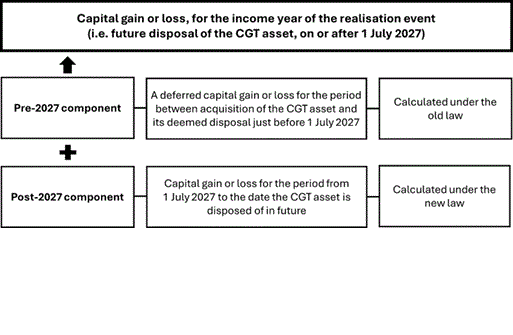
Australian resident individuals and trusts – modifying the cost base
1.117 For the purposes of Parts 3-1 and 3-3 and Subdivision 960-M of the ITAA 1997 (capital gains and losses, general and special topics), individuals and trusts are deemed to dispose of CGT assets they hold immediately before 1 July 2027 and to reacquire those assets just after that disposal. [Schedule 1, item 13, subsections 112-155(2) and 112-165(2) of the ITAA 1997]
1.118 This approach applies to a CGT asset held by an Australian resident individual (including an individual partner in a partnership) or trust that held the asset before the end of 30 June 2027, and continues to hold it until a realisation event happens in relation to the asset in an income year that starts on or after 1 July 2027. [Schedule 1, item 13, paragraphs 112-155(1(a) to (c) and 112-165(1)(a) to (c) of the ITAA 1997]
1.119 This approach does not apply if, assuming the gain was a discount capital gain, section 115-105 dealing with capital gains for foreign or temporary resident would apply to the gain. In the case of a trust, the approach will not apply if section 115-110 would apply to all of the beneficiaries of the trust in relation to the gain. This is consistent with the residency requirements for applying the new CGT rules in section 114-25. It means the deemed disposal and re-acquisition cannot be used to restore or increase a foreign or temporary resident's entitlement to the CGT discount. Note: there is an intention to further consider how these amendments apply to entities that are Australian residents for only part of the period in which they hold a CGT asset. [Schedule 1, item 13, paragraph 112-155(1)(d) and paragraph 112-165(1)(d) of the ITAA 1997]
1.120 The approach also does not apply to a new residential dwelling that benefits from the new discount in section 115-102 or affordable housing covered by section 115-125. In the case of a trust, this exclusion only applies if all of the gains would be made by beneficiaries that are entitled to the CGT discount for new residential dwellings or affordable housing in section 115-125. [Schedule 1, item 13, paragraphs 112-155(1)(e) and 112-165(1)(e) and section 112-175 of the ITAA 1997]
1.121 The capital proceeds and the amount for which the asset was reacquired are both generally established using the market value of the asset immediately before 1 July 2027. However, a taxpayer may instead choose to calculate both amounts using an apportioning method that is determined by the Minister in a legislative instrument. There are rules in the ITAA 1997 that could substitute the market value for the capital proceeds in some situations. The rules in Subdivisions 112-A, 112-B, 112-C and 112-D and sections 116-25 to 116-60 do not apply where a choice has been made to use an apportioning method. [Schedule 1, item 13, subsections 112-155(3)and (5) and subsections 112-165(3) and (5) of the ITAA 1997]
1.122 The making of this choice is governed by the rules for choices in relation to CGT in section 103-25. However, the later CGT event (the realisation event), not the CGT event arising from the deemed sale, is the relevant CGT event for this choice for the purposes of paragraph 103-25(1)(a). This means that the choice must be made by the time a taxpayer lodges their income tax return for the year in which the realisation event occurs. [Schedule 1, item 13, subsections 112-155(4) and 112-165(4) of the ITAA 1997]
1.123 The Minister is empowered to make a legislative instrument to determine a method of apportioning consideration from realisation events happening on or after 1 July 2027 for deemed disposal and reacquisition of a CGT asset under these amendments. In determining a method for apportioning, the method must take into account the deemed acquisition of the CGT asset on 1 July 2027 and any expenditure including indexation in an element of the cost base or the reduced cost base. The method must enable the capital proceeds of the deemed sale just before 1 July 2027, and the cost base (and reduced cost base) of the CGT asset when it is deemed to be reacquired on 1 July 2027, to be worked out. The method may take into account other matters the Minister considers relevant and may enable other things to be worked out. This approach provides flexibility and enables the Minister to determine other methods which are appropriate to determine the value of the asset but may be simpler than calculating market value. Making such a determination in a legislative instrument ensures it is subject to appropriate Parliamentary scrutiny, disallowance and sunsetting. [Schedule 1, item 13, section 112-185 of the ITAA 1997]
1.124 The purpose of the deemed disposal and reacquisition is to allow any gains or losses referable to the period before 1 July 2027 to be dealt with under the old rules, and to fix the cost base of the asset at the beginning of the new regime for the purposes of indexation.
1.125 Any capital gain or loss (an initial deferred gain or initial deferred loss) from the deemed disposal is disregarded. [Schedule 1, item 13, subsections 112-160(1) and (2) and 112-170(1) and (2) of the ITAA 1997]
1.126 Instead, when the CGT asset is later subject to a realisation event, the taxpayer is then taken to have a capital gain or loss equal to the initial deferred gain or loss. In working out this gain or loss, the rules in section 102-20 around market value substitution are disregarded, given the specific rules for determining the capital proceeds that already apply. Also, the gain will be a discount capital gain if the initial deferred gain was a discount capital gain. [Schedule 1, item 13, subsections 112-160(3) and (4) and 112-170(3) and (4) of the ITAA 1997]
1.127 Additionally, in determining if the small business concessions in Division 152 may apply to the CGT event resulting from the deemed sale, that CGT event is taken to have happened on the day of the realisation event. Further, the deemed sale is likewise disregarded when determining the period the asset has been held for the purposes of applying the small business concessions to the realisation event. This ensures that the deemed sale does not distort the operation of the small business concessions, by effectively allowing it to be disregarded and the full period of ownership taken into account in applying the active asset test. [Schedule 1, item 13, paragraphs 112-160(3)(d) and 112-170(3)(d) of the ITAA 1997]
1.128 The deemed disposal and reacquisition are taken to occur for the purposes of Part 3-1, Part 3-3 and Subdivision 960-M of the ITAA 1997. The amendments include, for the avoidance of doubt, an express provision to confirm that they have no wider effect, including in the context of other provisions relating to gains by trusts, such as Subdivision EA of Division 7A of the ITAA 1936. [Schedule 1, item 13, subsection 112-165(6) of the ITAA 1997]
1.129 A separate capital gain or loss may be made as a result of the realisation event, when the CGT asset is actually disposed of in the future. For the purposes of working out whether the individual or trust makes a capital gain or capital loss referable to the period between 1 July 2027 and the realisation event, and whether concessions are available, they are taken to have acquired the CGT asset for its market value (or equivalent) on 1 July 2027. [Schedule 1, item 13, subsections 112-160(5) and (6) and 112-170(5) and (6) of the ITAA 1997]
1.130 Additionally, for the purposes of the small business concessions, the deemed sale and acquisition are effectively disregarded and the eligibility of the taxpayer for the concessions is calculated at the time of the realisation event, looking at the whole period that the taxpayer has owned the asset for both any deferred notional gain and any gain for the later CGT event when the asset is realised. [Schedule 1, item 13, paragraphs 112-160(3)(d) and 112-170(3)(d) of the ITAA 1997]
1.131 In summary, the old law is applied to calculate a notional gain from a deemed CGT event on 1 July 2027, and the new law is applied to calculate any gains which accrue on or after 1 July 2027. Both amounts go towards calculating the individual's net capital gain for the income year of the realisation event (when a CGT event occurs to the asset in future, after 1 July 2027).
Example 1.11 Modifying the cost base by an Australian individual
Otis, an Australian resident, purchases shares in January 2020 for $100,000 and sells them on 1 March 2029 for $160,000.
The shares are deemed to be disposed of on 30 June 2027 and reacquired on 1 July 2027. Assuming Otis later elects to use the market value method, the deemed capital proceeds for the deemed disposal at that date are worked out to be $120,000.
The deemed disposal has resulted in a notional gain of $20,000. This notional gain is the amount of Otis' net capital gain for the 2026-27 income year, relating to that CGT asset, calculated according to the old law. The taxing point is deferred until the shares are sold in the future.
Otis sells the shares on 1 March 2029 for $160,000. This is the realisation event. The increase in value between 1 July 2027 and 1 March 2029 is $40,000. That is a capital gain, calculated under the new law when the cost base of the shares is subject to indexation and may incur a minimum tax on the capital gain.
Both the deferred gain from the deemed disposal just before 1 July 2027, and the separate capital gain for the sale (the realisation event) on 1 March 2029, are included in working out Otis' net capital gain for the 2029-30 income year.Example 1.12 Modifying the cost base by a trust
The Trustee of the XYZ trust acquires shares in ABC Ltd for $100,000 in 2022, and sells them for $300,000 in 2032. All of the beneficiaries of the XYZ trust are Australian resident individuals or companies.
The shares are deemed to be sold just before 1 July 2027 and repurchased immediately. Later, following the realisation event in 2032, the Trustee works out (using the apportioning method) capital proceeds at the time of the deemed sale of $180,000.
At the time of the realisation event, the Trustee recognises two capital gains:
- (1)
- The initial notional gain of $80,000 (which is a discount capital gain that the trust can apply its discount percentage to in working out its net capital gain) that has been deferred until the time of the realisation event (now the 'trust's deferred gain').
- (2)
- The separate capital gain from the realisation event. Assuming indexation on an initial cost base of $180,000, the cost base at the time of the realisation event is $200,000, and this separate indexed capital gain is $100,000.
Before year end, the Trustee resolves to make VP Pty Ltd (a private company) and Ishaan (a resident individual) each specifically entitled to 50 per cent of those capital gains.
The beneficiaries work out their capital gains tax liabilities as follows:
Ishaan
Ishaan first works out his attributable gains under 115-225 as:
- •
- $80,000 x 50 per cent (discount applied by the trustee) x 50 per cent (his share, expressed as a percentage) = $20,000; and
- •
- $100,000 x 50 per cent (his share, expressed as a percentage) = $50,000.
He does not re index the cost base for the separate capital gain from the realisation even, as indexation has already been applied at the trust level.
Ishaan then includes those capital gains in working out if he has made a net capital gain for the income year.
VP Pty Ltd
VP Pty Ltd is not entitled to indexation or the CGT discount. Under subsections 115-225(4)-(5), it must recalculate its attributable gain for the separate capital gain, as if it had been calculated without indexation.
VP Pty Ltd first works out its attributable gains under section 115-225 as:
- •
- $80,000 x 50 per cent (discount applied by the trustee) x 50 per cent (its share, expressed as a percentage) = $20,000; and
- •
- $120,000 (being $300,000 - $180,000) x 50 per cent (its share, expressed as a percentage) = $60,000.
Division 102 applies to Ishaan and VP Pty Ltd as follows:
Ishaan is treated as having:
- •
- a capital gain of $40,000 (under paragraph 115-215(3)(b)) (the $20,000 attributable gain is doubled in his hands, to remove the discount applied at the trust level). Ishaan can apply a discount percentage of 50 percent to this capital gain if it remains at the step 5 of the method statement (i.e. where the discount is applied); and
- •
- a capital gain of $50,000, to which no discount percentage reduction can be applied, but which has been calculated with an indexed cost base.
VP Pty Ltd is treated as having:
- •
- a capital gain of $40,000 (under paragraph 115-215(3)(b)) (the $20,000 attributable gain is doubled in its hands, to remove the discount applied at the trust level) VP Pty Ltd cannot apply a discount; and
- •
- a capital gain of $60,000, for which similarly no discount is available for.
The Trustee must provide VP Pty Ltd and Ishaan with a notification meeting the requirements of section 115-235, which will set out the amount of the gains each beneficiary is treated as having, and in this case, which capital gains are discount capital gains.
Division 115 Discount capital gains
Overview
1.132 Schedule 1 to the Bill amends Division 115 to remove the 50 per cent discount for capital gains for individuals and trusts in relation to CGT events happening on or after 1 July 2027.
1.133 The amendments do not change the availability of the CGT discount for capital gains arising from a CGT event happening before 1 July 2027.
1.134 A CGT discount of 50 per cent remains available for CGT events happening on or after 1 July 2027 relating to new residential dwellings, and any other CGT assets determined by the Minister by legislative instrument. A CGT discount of up to 60 per cent remains available for CGT events happening on or after 1 July 2027 in relation to investment in affordable housing.
Removal of the CGT discount for trusts and individuals except for new residential dwellings and affordable housing CGT assets from 1 July 2027
1.135 Discount capital gain is defined by section 115-5. In brief, it means a capital gain made by certain entities after 21 September 1999, that does not have an indexed cost base and relates to a CGT asset the entity has owned for at least 12 months. The amendments do not change this.
1.136 The amendments remove the 50 per cent CGT discount for individuals and trusts for capital gains arising on or after 1 July 2027. As part of this change, the amendments reduce the default discount percentage for a discount capital gain to 0 per cent. This ensures that the CGT discount is not available unless a taxpayer meets the requirements for a particular CGT discount in section 115-100, such as the new 50 per cent discount that maintains support for new residential dwellings, the discount of up to 60 per cent available for investment in affordable housing and the 33.3 per cent discount for superannuation entities. [Schedule 1, items 4, 28 and 29, paragraphs 102-3(2)(a) and (c) and 115-100(a) and (f) of the ITAA 1997]
1.137 The amendments insert section 115-102 and amend section 115-125 to specify when capital gains relate to new residential dwellings and affordable housing, for the purpose of access to CGT discounts and the choice not to be subject to cost base indexation or the minimum 30 per cent tax on capital gains. [Schedule 1, items 30 and 36, sections 115-102 and 115-125 of the ITAA 1997]
New residential dwellings
1.138 The meaning of 'new residential dwelling' is discussed in Chapter 2 of this Explanatory Memorandum dealing with amendments relating to negative gearing. Essentially, the requirements for a dwelling to be a new residential are to be set by the Minister by legislative instrument.
1.139 Individuals that make capital gains from assets that are new residential dwellings can choose to apply the CGT discount method under section 115-102. Where this occurs, if the assets are held directly by the individuals or in some circumstances, covered in the discussion of Division 112 above, by trusts, the asset may be excluded from the deemed sale and deemed reacquisition provisions under Subdivision 112-E. [Schedule 1, items 13 and 30, paragraphs 112-155(1)(e), 112-165(1)(e) and subsection 115-102(5) of the ITAA 1997]
1.140 Where an individual makes a gain through an interposed entity that is a trust or a MIT (which includes an AMIT), section 115-102 also applies. Specifically, the section applies where:
- •
- An individual was an Australian resident for the time they held the CGT asset;
- •
- The individual is a beneficiary who is treated under Division 102 as having made a discount capital gain of a trust (including a MIT) because of section 115-215;
- •
- The trust's gain was made directly or indirectly through a trust, a public unit trust or a partnership (these entities are prescribed by subsection (4)); and
- •
- The gain is in relation to a CGT asset covered by subsection (2), namely a new residential dwelling or another CGT asset determined by the Minister.
- [Schedule 1, item 30, subsections 115-102(1), (2) and (4) of the ITAA 1997]
1.141 The Minister may make a legislative instrument to determine additional types of CGT asset covered by section 115-102(2). This power gives flexibility for the Minister to ensure the CGT arrangements reflect Australia's needs as they evolve over time, while ensuring the arrangements are subject to Parliamentary scrutiny, disallowance and sunsetting. [Schedule 1, item 30, subsection 115-102(3) of the ITAA 1997]
1.142 Instead of applying the CGT discount, an individual or trustee may choose to index the cost base of the new residential dwelling asset. The existing 'choice' rules under section 103-25 apply to the making of this choice, with the modification that the realisation event is the relevant CGT event for the choice. This means that the choice must be made on or before the day the entity's income tax return is lodged for the income year in which the realisation event happens. [Schedule 1, item 30, subsection 115-102(5) of the ITAA 1997]
1.143 If a trustee chooses for the cost base indexation method to apply to the capital gain, the same method applies to a beneficiary as though the choice to apply indexation was made by the beneficiary.
Example 1.13 Making a discount gain under section 115-102 (direct)
Siobhan, an Australian resident, acquires land in May 2028 and constructs a building that meets the conditions prescribed for meeting the definition of a 'new residential dwelling'. Siobhan will continue to be an Australian resident and holds the land on which the dwelling is constructed for more than 12 months.
For working out a net capital gain in a later year sale, a calculated capital gain for the sale will be a residential capital gain which is a discount capital gain. A discount percentage of 50 per cent can be applied to the capital gain. Alternatively, Siobhan can choose not to apply the discount percentage and instead calculate the capital gain using an indexed cost base.Example 1.14 Making a discount gain under section 115-102 (indirect)
The Trustee of the Gardenia Trust, an Australian resident trust, makes a capital gain of $800,000 from the sale of a CGT asset that comprises a new residential dwelling. The asset was held for more than 12 months. The Trustee applies the discount percentage (which, for the trust, is 0 per cent) to the capital gain in working out a net capital gain for the income year and makes an individual beneficiary Henri specifically entitled to a 40 per cent share of the capital gain. Henri is an Australian resident.
Henri will apply the method in section 115-215 to determine that he has a capital gain equal to $320,000. In determining if he has a net capital gain for the income year, Henri can apply the discount percentage of 50 per cent which is applicable to him as an individual with a capital gain from a new residential dwelling, to any part of the capital gain remaining after step 4 of the method statement in subsection 102-5(1). Henri is not able to make a choice to apply indexation instead.
Investor disposing of property used for affordable housing
1.144 For individuals and trusts that hold CGT assets which are dwellings used to provide affordable housing, they can continue to apply the discount method in determining their net capital gains.
1.145 Entities that make capital gains from assets that are used to provide affordable housing can choose to apply the CGT discount method under section 115-125. Where this occurs, these assets are excluded from cost base indexation. Further, if the assets are held directly by the individuals or in some circumstances by trusts (covered in the discussion of Division 112 above), the asset may be excluded from the deemed sale and deemed reacquisition provisions under Subdivision 112-E. [Schedule 1, items 13 and 36, paragraphs 112-155(1)(e), 112-165(1)(e) and subsection 115-125(6) of the ITAA 1997]
1.146 Section 115-125 applies where an investor disposes of a property that was used for affordable housing for at least 1095 days (3 years) since 1 January 2018. Under the old law, the discount percentage which would apply apart from this section was increased by a percentage calculated using a formula that accounts for the time the property was used for affordable housing.
1.147 Previously, section 115-125 provided for an increase in the 50 per cent CGT discount that would otherwise apply that could result in a discount of up to 60 per cent for an Australian resident individual. The amendments maintain the existing base CGT discount of 50 per cent for individuals and trusts and continue to allow this discount to increase to up to 60 per cent. The amendments also ensure that the existing proportionate reductions in the discount for individuals who are foreign or temporary residents continue to apply. [Schedule 1, items 35, paragraph 115-125(4)(a) of the ITAA 1997]
1.148 If the discount percentage calculated under section 115-125 is 60 per cent, then the individual or trustee disposing of the property may choose to index the cost base under section 110-36(1A) instead of applying the CGT discount. An explanatory note is inserted earlier in the provision to alert readers to this choice. [Schedule 1, items 31, 32 and 36, explanatory notes to subsection 115-125(2) and subsection 115-125(6) of the ITAA 1997]
1.149 If indexation is chosen by the individual or trustee, the existing 'choice' rules under section 103-25 apply. The realisation event is the relevant CGT event for the choice. The choice must be made on or before the day the entity's income tax return is lodged for the income year in which the realisation event happens. [Schedule 1, item 36, subsection 115-125(6) of the ITAA 1997]
1.150 If a trustee chooses the indexation method to apply to the capital gain, the same method applies to a beneficiary as though the choice to apply indexation was made by the beneficiary.
Subdivision 115-C amendments for trusts with net capital gains
1.151 Broadly, the existing Subdivision 115-C provides that amounts of the trust's net income that are attributable to capital gains are treated as a beneficiary's capital gain when the beneficiary is assessed. This allows the beneficiary to apply the beneficiary's capital losses and their own discount percentage against the capital gain they receive through the trust estate.
1.152 The rules also apply to attribute capital gains where the trustee is assessed where a beneficiary is under a legal disability or is subject to trustee taxation.
Attributable gains under section 115-225 to reverse out indexation for CGT events happening on or after 1 July 2027
1.153 Under the current law, the attributable gain calculation under subsection 115-225(1) requires the trust to determine the amount of the capital gain remaining after applying steps 1-4 of the existing method statement in section 102-5. This would take into account any discount or indexation available to the trust in determining the benefits to which beneficiaries may be made presently entitled.
1.154 A different amount is substituted where the net income of the trust for an income year is less than the sum of the trust's net capital gain and certain amounts related to franked distributions. The amendments provide a modification to the general rule in subsection 115-225(1) (by feeding into new subsections 115-225(4) to (6)) where a capital gain has been worked out under the new CGT law (i.e. indexation of the cost base of CGT assets for CGT events occurring on or after 1 July 2027) for the following cases:
- •
- for the deemed attribution of capital gains of a trust estate to a beneficiary where the beneficiary is not entitled to indexation in relation to the cost base (i.e. because they are a company or a foreign resident beneficiary); or
- •
- where for the deemed attribution of capital gains of a trust estate to a beneficiary where the trustee has a choice to choose between applying the CGT discount or indexation because the capital gains arise from new residential dwellings or affordable housing; or
- •
- a calculation is being done to determine a trustee's taxation amount. [Schedule 1, items 41 and 42, subsection 115-225(4) of the ITAA 1997]
1.155 In working out the trust's capital gains in these situations, the amendments apply to reverse out the cost base indexation amounts for the relevant capital gain. This is because the beneficiary or trustee who is subject to tax on the capital gain is not entitled to indexation.
1.156 In addition, for these calculations to reverse indexation, it is assumed that the application of capital losses (current and carried forward) and quarantined amounts (under the negative gearing changes) would still be the same and would not reduce the capital gain. This ensures the reversal of indexation does not affect the capital losses or quarantined amounts being applied. [Schedule 1, item 42, subsections 115-225(5) and (6) of the ITAA 1997]
Example 1.15 Trust capital gains attributable to corporate beneficiary who is not entitled to indexation
The JTS Trust is a discretionary trust. During the 2030–31 income year, its only activity is the disposal of shares acquired on 1 July 2027 for $100,000.
After applying CPI indexation, the trust calculates an indexed cost base of $110,000. The shares are sold for $200,000, giving rise to a capital gain of $90,000. As this is the trust's only income, the trust's net income is also $90,000, calculated on the basis that the trust is a resident individual and therefore entitled to apply indexation.
Before year end, the trustee resolves to make XYZ Pty Ltd (a private company) and Catherine (a resident individual) each specifically entitled to 50% of the capital gain. This means the indexed gain is split evenly, so each beneficiary is attributed a $45,000 share. In effect, the indexation adjustment is shared 50–50 between them.
Catherine includes her $45,000 share of the capital gain in working out her net capital gain. She does not re-index the cost base, as indexation has already been applied at the trust level.
XYZ Pty Ltd, however, is not entitled to indexation. It must recalculate its attributable gain as if the capital gain had been calculated without indexation.
On that basis, its attributable gain is equal to its 50 per cent share (expressed as a fraction) of the capital gain, being $200,000 capital proceeds less the unindexed cost base ($100,000), giving a capital gain of $50,000.
1.157 The amendments also make consequential changes to Subdivision 115-C to reflect the new CGT laws starting from 1 July 2027 including where a trust still has the choice to refrain from choosing indexation to apply the CGT discount on capital gains arising from new residential dwellings and affordable housing CGT assets, so as to allow relevant beneficiaries to choose the discount. [Schedule 1 items 25, 26, 37, 38, 39, 40, 67, 69, 70, 71 and 72, subparagraph 115-225(3)(a)(i), paragraphs 115-215(4)(a), 115-215(3)(a), (b) and (c), 115-220(2)(b), 115-222(4)(a), 115-225(1)(a), subsection 115-215(4), sections 115-1 and 115-200, note to subsection 115-210(1) and heading to Division 115 of the ITAA 1997]
Providing information to beneficiaries
1.158 Under the amendments, the Commissioner of Taxation can, by legislative instrument, require a trustee of a trust estate to provide sufficient information to each beneficiary of the trust who, in relation to that income year, is treated as having any capital gain under Subdivision 115-C because of a capital gain of the trust estate. [Schedule 1, item 43, subsection 115-235(1) of the ITAA 1997]
1.159 This information enables each beneficiary to comply with their own obligations in relation to Part 3-1 and Part 3-3. The requirement for trustees to report is broadly similar to existing requirements for trustees of MITs, though given the differences between MITs and other trusts there are likely to be significant differences in many features of the reporting, including timing.
1.160 As the information is necessary for beneficiaries, a trustee's failure to comply with the requirement to provide information to beneficiaries is subject to an administrative penalty. The penalty is set in the TAA and is consistent with other penalties for non-compliance with reporting obligations. [Schedule 1, items 52 and 53, subsection 286-75(2) and paragraph 286-80(2)(a) of the TAA 1953]
1.161 The statement provided to each beneficiary must:
- •
- be in the approved form; and
- •
- provide the relevant information in relation to the class of capital gains and the effect of each of those gains under subsection 115-215(4). [Schedule 1 item 43, subsection 115-235(2) of the ITAA 1997]
1.162 The due date for providing information to beneficiaries is the date determined by the Commissioner of Taxation by legislative instrument. This aligns with similar arrangements under which the Commissioner determines appropriate timing and operational matters (such as the Annual Investment Income Report in section 393-10 in Schedule 1 to the TAA 1953).
1.163 This amendment is not intended to duplicate existing reporting requirements for trustees under the Annual Investment Income Report. The amendments only cover the trustees who do not currently provide this information to its beneficiaries in an existing reporting regime. [Schedule 1, item 43, subsection 115-235(3) of the ITAA 1997]
Extended application of Subdivision 115-C – where indexation means trust has no net capital gain
1.164 The amendments extend the application of Subdivision 115-C to situations where:
- •
- a trust has one or more capital gains that have been worked out under the new CGT law (i.e. indexation of the cost base for CGT events occurring on or after 1 July 2027); and
- •
- Subdivision 115-C does not apply because the trust does not have net income arising from a capital gain and therefore subsection 115-210(1) does not apply; and
- •
- Subdivision 115-C would apply if, in working out the trust's net capital gain for the income year, the following assumptions were applied in relation to each capital gain:
- -
- the cost base indexation amounts for the relevant capital gain is reversed out; and
- -
- the application of capital losses (current and carried forward) and quarantined amounts (under the negative gearing changes) would still be the same and would not reduce the capital gain. [Schedule 1, item 44, subsection 115-255(1) of the ITAA 1997]
1.165 The amendments extend the application of Subdivision 115-C to allow a trustee to stream a capital gain to a beneficiary where the trust has no net capital gain because of indexation.
1.166 As a result of the extended application of Subdivision 115-C, the reporting requirements between the trustee and beneficiary would also apply to this capital gain. [Schedule 1, item 44, subsection 115-255(2) of the ITAA 1997]
1.167 For the avoidance of doubt:
- •
- The reference to the trust estate's net income in subsection 115-215(1), which sets out the purpose of the section (broadly, being to ensure that appropriate amounts of the trust estate's net income attributable to capital gains are treated as the beneficiary's capital gains), does not limit the application of section 115-215 for those purposes.
- •
- Subsection 115-210(2) ensures that like Subdivision 115-C, Subdivision 115-CA only applies to complying superannuation in their capacity as a beneficiary of other trusts (but not as a trust estate in its own right).
- •
- Any reference in a taxation law to Subdivision 115-C or a provision in Subdivision 115-C includes a reference to Subdivision 115-CA (which is within that Subdivision) or that provision as it applies because of Subdivision 115-CA. [Schedule 1, item 44, subsections 115-255(3) to (5) of the ITAA 1997]
Application of amendments
1.168 The amendments to Subdivision 115-C apply in relation to assessments for the income year that includes 1 July 2027 and later income years. [Schedule 1, subitem 84(1)]
1.169 The amendments which require a trustee to provide information to beneficiaries relating to their capital gains applies in relation to the income year that includes 1 July 2027 and later income years. [Schedule 1, subitem 84(2)]
1.170 The new Subdivision 115-CA which extends the application of Subdivision 115-C applies in relation to assessments for the income year that includes 1 July 2027 and later income years. [Schedule 1, subitem 84(3)]
Minimum tax on capital gains
Overview
1.171 A minimum 30 per cent income tax on capital gains that are realised on or after 1 July 2027 is introduced by new Division 119 of the ITAA 1997 and amendments to the Rates Act. [Schedule 1, items 58 and 60, Division 119 of the ITAA 1997 and Division 119 of the ITTP Act 1997 and the Imposition Bill, Schedule 1, item 1, section 12AA of the Rates Act]
1.172 The introduction of the minimum tax reduces the benefit of taxpayers deferring the realisation of capital gains to years where their marginal tax rates are low. This approach ensures gains are subject to a tax rate closer to the rate an individual faced during their working life and is commensurate with the tax rate paid by most workers.
1.173 An individual who is an Australian resident may have to pay an extra amount of tax to ensure a minimum 30 per cent rate of tax applies to relevant capital gains (before applying offsets). New Division 119 sets out how to work out when extra income tax is payable and matters relating to the amount of that tax. Having determined that an individual is subject to extra tax, the tax rate is set by the Rates Act.
1.174 The minimum tax will not apply to recipients of certain payments of a kind prescribed in a legislative instrument by the Minister, if they receive a payment at any time in the income year. It is intended that such payments include payments or pensions relied upon for basic living expenses, such as the Age Pension or JobSeeker. See below for further information. The minimum tax will also not affect individuals who are already taxed at rates of tax of at least 30 per cent on capital gains.
1.175 The minimum tax applies in relation to capital gains from CGT events happening on or after 1 July 2027. The minimum tax also only applies in relation to gains accrued after 1 July 2027, excluding deferred residential and non-residential gains (i.e. the gains an entity is treated as having made from a deemed sale of CGT assets held just before 1 July 2027 under Subdivision 112-E). [Schedule 1, items 6, 58 and 60, paragraph 119-5(2)(a), subsections 102-6(1), (2) and (5), Division 119 of the ITTP Act]
1.176 The minimum tax applies to all CGT assets. However, the minimum tax does not apply in relation to new residential dwellings or affordable housing unless the relevant entity with these asset classes chooses indexation and the minimum tax over applying the CGT discount. [Schedule 1, items 58, 30 and 36, paragraphs 119-5(2)(b) and (c) and subsections 115-102(5), 115-125(6) of the ITAA 1997]
When the minimum tax is payable
1.177 Extra income tax must be paid on the 'minimum tax capital gain' for an income year by an individual who was an Australian resident at any time during the income year who has a 'minimum tax gap amount' for the income year. [Schedule 1, item 58, subsection 119-10(1) of the ITAA 1997]
1.178 This means that the minimum tax may be payable by an individual who was a foreign or temporary resident during part of the income year. Further consideration will be given to the appropriate application of the minimum tax to such individuals as part of a further tranche of amendments.
1.179 A 'minimum tax capital gain' for an income year is the total amount of covered capital gains that are remaining after step 6 in the method statement for working out net capital gains in the new subsection 102-5(1). Covered capital gains are the post 1 July 2027 portion of a capital gain from a CGT event happening on or after 1 July 2027 in relation to a CGT asset. As discussed above, this is because the covered gains are defined by reference to 'residential capital gains' and 'non-residential gains'. Generally, all asset classes are covered. However, gains from a CGT event happening to new residential dwellings and affordable housing are excluded unless the relevant entity chooses indexation and the minimum tax over applying the CGT discount. Capital gains attributed to a beneficiary of a trust under section 115-215 are covered. [Schedule 1, item 58, section 119-5 of the ITAA 1997]
1.180 The method to work out whether an individual has a minimum tax gap amount for the income year and the quantum of that amount is:
- •
- Step 1: Multiply your minimum tax capital gain by 30 per cent.
- •
- Step 2: Work out your basic income tax liability for the income year (apart from Division 119) in accordance with step 2 in subsection 4- 10(3).
- •
- Step 3: Work out what the amount under step 2 would be if your taxable income for the income year were reduced (but not below nil) by the amount of your minimum tax capital gain.
- •
- Step 4: Subtract the amount at step 3 from the amount at step 2.
- •
- Step 5: Subtract the amount at step 4 from the amount at step 1.
- •
- Step 6: Round the result down to the nearest whole dollar if the result is not already a number of whole dollars.
- •
- Step 7: If the result (as rounded) is more than nil, you have a minimum tax gap amount for the income year equal to that amount.
- [Schedule 1, item 58, subsection 119-10(2) of the ITAA 1997]
1.181 The minimum tax gap amount is designed to equate to the extra income tax that a taxpayer must pay, to ensure that a minimum 30 per cent tax applies to the capital gain. As such, the method statement ensures that only a positive figure for the minimum tax gap amount results in extra income tax, as a nil or negative amount means a taxpayer is already paying at least 30 per cent tax in relation to the capital gain.
1.182 Step 1 is designed to calculate a benchmark figure for the amount of tax that would be payable if the relevant capital gain were subject to a rate of 30 per cent tax.
1.183 Steps 2 to 4 are designed to work out what amount of tax the taxpayer would already be subject to on that capital gain (disregarding the minimum tax provisions introduced by these amendments), assuming that the capital gain is the last slice of the taxpayer's income when applying the taxpayer's marginal tax rates to their income and before applying any offsets to the taxpayer's basic income tax liability.
1.184 Steps 5 to 7 calculate the difference between the benchmark from step 1 and the amount of tax the taxpayer would already be subject to on that capital gain, as worked out under steps 2 to 4, and round the result.
1.185 Various consequential amendments are made to reflect the introduction of Division 119. These amendments are to guidance provisions as well as operative provisions including those which explain how to calculate tax liability and define terms used within the Division. [Schedule 1, items 54, 55, 56, 57 and 59, section 4-25 and subsection 995-1(1) of the ITAA 1997]
Exceptions for recipients of certain payments
1.186 The requirement to pay top up tax does not apply to an individual if they received a payment of a kind specified in a legislative instrument made by the Minister for this purpose, at any time during the income year. The Minister may specify a kind of payment that is:
- •
- a social security payment, as defined in the Social Security Act 1991; or
- •
- a payment made by an Australian government agency under an Australian law, where eligibility for the payment or the amount of the payment depends on the recipient's means or financial position or the recipient's impaired capacity to work or incapacity more broadly.
- [Schedule 1, item 58, subsections 119-15(1) and (2) of the ITAA 1997]
1.187 The kinds of payments that are intended to be prescribed for this purpose include:
- •
- an income support payment within the meaning of the Social Security Act 1991 (including but not limited to the Age Pension, Disability Support Pension, JobSeeker, Parenting Payment, Youth Allowance and certain DVA payments);
- •
- farm household allowance within the meaning of the Farm Household Support Act 2014;
- •
- an amount identified as living allowance under the ABSTUDY scheme (noting this would only pick up the living allowance component of an ABSTUDY payment, no other components); and
- •
- a special rate disability pension under Part 6 of Chapter 4 of the Military Rehabilitation and Compensation Act 2004.
1.188 The kind of payment specified by the Minister could be a specific payment or a broader category of payments.
1.189 Individuals receiving such payments or pensions, which are intended to include those generally relied upon for basic living expenses, will not be subject to the minimum tax to ensure low-income, low-wealth individuals are not disadvantaged.
1.190 The Ministerial instrument power to specify other payments is considered appropriate and necessary to ensure that the types of payments can be updated over time to ensure fair application of the minimum tax. The limits on the scope of payments that can be specified means that this power can only be exercised to include payments that are linked to the income, wealth or capacity of the recipient (that is, payments reflecting an identified need for government support), consistent with the policy intent. In accordance with the Legislation Act 2003, a legislative instrument made by the Minister is disallowable and subject to sunsetting and will therefore be subject to appropriate parliamentary scrutiny and periodic review.
Example 1.16 Application of minimum tax when receiving other payments
Jenny is an Australian resident and purchases shares on 1 January 2028. On 1 July 2029, Jenny sells the shares and makes a gain. Jenny is a recipient of income support payment determined by the Minister for the income year.
Jenny will not be subject to the minimum tax as she is also a recipient of a prescribed income support payment in the year that she sells the asset.
Diagram 1.3 Application of the minimum tax
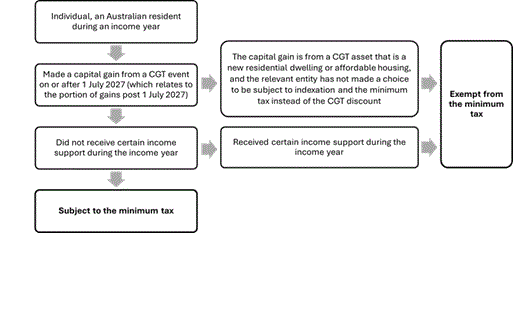
Rate of tax
1.191 Once an individual is liable to pay extra income tax on their 'minimum tax capital gain' under Division 119, the Rates Act prescribes a tax rate that applies to that capital gain, which ensures that a minimum 30 per cent rate of tax applies for the gain.
1.192 New section 12AA of the Rates Act prescribes a formula to calculate the rate of extra income tax payable under subsection 119-10(1) on every dollar of a taxpayer's minimum tax capital gain for a year of income. The formula is to divide the minimum tax gap amount by the minimum tax capital gain. Each term is defined by the ITAA 1997, as explained above, and is the amount in whole dollars. [Imposition Bill, Schedule 1, item 1, section 12AA of the Rates Act]
1.193 The extra income tax that a taxpayer must pay in relation to their minimum tax capital gain is designed to equate to their minimum tax gap amount. The formula in the Rates Act for the rate of tax that applies to the minimum tax capital gain ensures this result.
Example 1.17 Calculating minimum capital gains tax
Genevieve makes a net capital gain from the sale of listed shares in the 2029 income year. She does not have any other capital gains for that year. After applying the relevant steps in subsection 102-5(1), her minimum tax capital gain is $50,000.
Excluding that capital gain, Genevieve's 2029 taxable income is $40,000.
As a single homeowner with more than $750,000 in assets, Genevieve does not qualify for any government payments, which means that she cannot be exempt from the minimum capital gains tax. Genevieve works out her minimum tax gap amount for the 2029 income year using the method statement in subsection 119-10(2) as follows:
- •
- Step 1: Multiplying her $50,000 minimum tax capital gain by 30 per cent gives a result of $15,000.
- •
- Step 2: Disregarding Division 119, Genevieve's basic 2029 income tax liability on her taxable income of $90,000 under step 2 of the method statement in subsection 4-10(3) is $18,000.
- •
- Step 3: If Genevieve's step 2 amount was worked out on the basis that her $50,000 minimum tax capital gain was excluded from her $90,000 taxable income (but not reducing it below nil) her basic 2029 income tax liability on the remaining taxable income of $40,000 would be $3,500.
- •
- Step 4: Subtracting the amount at step 3 ($3,500) from the amount at step 2 ($18,000) gives Genevieve a result of $14,500.
- •
- Step 5: Subtracting the amount at step 4 ($14,500) from the amount at step 1 ($15,000) gives Genevieve a result of $500.
- •
- Step 6: The step 5 result is a whole dollar amount, so rounding it down to the nearest whole dollar is not relevant.
- •
- Step 7: The $500 result, being more than nil, means Genevieve has a $500 minimum tax gap amount for the 2029 income year.
Section 12AA of the Rates Act provides that an additional rate of income tax applies to Genevieve's $50,000 minimum tax capital gain, which results in extra income tax equal to her $500 minimum tax gap amount. That rate is worked out using the formula:
minimum tax gap amount / minimum tax capital gain
Applying that formula (500 / 50,000) results in a 1 per cent rate for Genevieve, which results in $500 extra tax when applied to her $50,000 minimum tax capital gain.
Pre-CGT Assets
Overview
1.194 Schedule 1 also amends the ITAA 1997 to bring pre-CGT assets into the CGT regime for capital gains that arise on or after 1 July 2027. These changes apply to all entities that hold pre-CGT assets.
New tax treatment of pre-CGT assets
1.195 The amendments apply to pre-CGT assets held on 30 June 2027. From 1 July 2027, these assets are subject to the CGT regime. However, CGT only applies in respect of capital gains that arise on or after 1 July 2027 and only once a realisation event that happens in relation to the asset (i.e. it is sold) on or after 1 July 2027. [Schedule 1, item 13, subsection 112-175(1) of the ITAA 1997]
1.196 An entity that is entitled to apply indexation under the new CGT regime can do so to the cost base of the CGT asset (which is no longer a pre-CGT asset) after 1 July 2027 in calculating their capital gains.
Deemed sale and reacquisition of pre-CGT assets
1.197 The amendments remove the pre-CGT status for assets by deeming them to be sold on 30 June 2027 and reacquired on 1 July 2027 for market value (or equivalent). As a result, from 1 July 2027 there will no longer be any remaining pre-CGT assets. [Schedule 1, item 13, subsections 112-175(2) and (3) of the ITAA 1997]
1.198 This provision applies to all entities that hold pre-CGT assets, including companies, individuals and trusts.
1.199 Any capital gains or losses arising from the deemed sale of a pre-CGT asset are disregarded under the pre-existing rules for disregarding gains arising from pre-CGT assets.
1.200 However, the deemed reacquisition on 1 July 2027 means that the asset will no longer be a pre-CGT asset. The CGT regime will apply to these assets in relation to any capital gains arising on or after 1 July 2027.
1.201 To determine the capital proceeds for the deemed sale and the new cost base of the CGT asset that is taken to have been reacquired on 1 July 2027, the entity has a choice between market value (the default option), or an apportioning method set out in a legislative instrument made by the Minister.
1.202 The existing 'choice' rules in section 103-25 apply to the making of a choice to use an apportioning method, subject to the modification that the realisation event is the relevant CGT event for the choice. This means that the choice must be made on or before the day the entity's income tax return is lodged for the income year in which the realisation event happens. [Schedule 1, item 13, subsection 112-175(4) of the ITAA 1997]
1.203 See discussion above regarding the Minister's ability to determine an apportioning method under new section 112-185.
1.204 Consequential amendments are made to Division 149, to add an explanatory note into section 149-10 that a CGT asset will cease to be a pre-CGT asset on 1 July 2027 as a result of section 112-175. [Schedule 1, items 45 and 46, section 149-10 of the ITAA 1997]
Example 1.18 Application of the deemed disposal and reacquisition for pre-CGT assets.
Eileen acquired an investment property in 1980 for $100,000. The property is a pre-CGT asset
On 30 June 2027, the property has market value of $1,000,000.
Under the amendments, Eileen is taken to have disposed of the property just before 1 July 2027 and reacquired it on 1 July 2027. Any capital gain arising from the deemed disposal is disregarded, upon a realisation event, as the asset was pre-CGT.
Eileen is taken to have acquired the property on 1 July 2027 with a cost base of $1,000,000 (being its market value at that time).
In 2030, Eileen sells the property for $1,500,000.
Eileen makes a capital gain of $500,000, being the difference between the sale proceeds and the cost base of $1,000,000.
The gain attributable to the period before 1 July 2027 is not subject to CGT.
CGT event K6 and pre-CGT assets
1.205 CGT event K6 is an exception to the general rule that capital gains and losses on pre-CGT assets are disregarded. Broadly, it can apply where certain other CGT events, including CGT event A1 for the disposal of a CGT asset, happen in relation to a taxpayer's pre-CGT asset that is shares in a private company or an interest in a trust if among other things, the company or trust holds post-CGT property that makes up at least 75 per cent of its net value (the 75 per cent test) (see section 104-230).
1.206 The purpose of CGT event K6 is to ensure that taxpayers cannot shelter capital gains from CGT by holding significant post-CGT assets in a pre-CGT company or trust.
1.207 On 1 July 2027, all pre-CGT assets will be deemed to be sold and reacquired for market value. As a result, CGT event K6 will apply if assets satisfy the 75 per cent test and meet the other requirements for CGT event K6 to occur.
1.208 However, the amendments mean that any liability for any capital gain arising from CGT event K6 from the deemed sale and reacquisition is deferred until the taxpayer disposes of the share in the company or interest in the trust.
1.209 Despite this deferral, in working out whether CGT event K6 occurs and the amount of any capital gain, the taxpayer must use the market value of its assets and the assets of the company or trust as at 1 July 2027.
1.210 In effect, the amendments mean that any capital gains from CGT event K6 that would arise as a result of the deemed sale are crystallised immediately before 1 July 2027, but any resulting CGT event K6 liability is deferred until the subsequent realisation of the underlying asset. This ensures that CGT event K6 does not apply to any capital gains arising after 1 July 2027, which will already be subject to CGT.
1.211 From 1 July 2027, there will no longer be any remaining pre-CGT assets (as outlined above about bringing pre-CGT assets into the CGT regime). As a result, after that time the operation of CGT event K6 is expected to be limited to its application to pre-1 July 2027 gains on the realisation of assets that were previously pre-CGT assets.
Example 1.19 CGT event K6 and deferral of liability
Fahdi has owned the only share in Pony Co since the company was incorporated in June 1983. He acquired the share for $10. Pony Co carries on a retail and trading business that has grown significantly over time, including through substantial acquisitions of land after 20 September 1985. As a result, a significant proportion of the company's assets are post-CGT property.
At the end of 30 June 2027, Fahdi is taken to dispose of his share in Pony Co and reacquire it on 1 July 2027 at market value. No gain arises from the deemed sale, as the share is a pre-CGT asset. However, the asset ceases to be a pre-CGT asset and CGT event K6 may occur in respect of the asset. Any gain from CGT event K6 occurring is deferred and disregarded at that time.
In October 2030, Fahdi sells the share for $7 million. His capital gains for the year ending 30 June 2031 will include:
- •
- the capital gain from the realisation event that happens to his share when it is sold; and
- •
- the capital gain, if any, arising under CGT event K6 for the deemed disposal (relating to the period up to 1 July 2027 but deferred until the later realisation event).
Fadhi chooses the apportioning method and determines that the amount representing the value of the share just before 1 July 2027 for the purposes of the deemed sale and reacquisition is $5.2 million. In working out his capital gain from the share sale, the first element of his cost base is $5.2 million. That amount, and other amounts included in cost base after 1 July 2027, may be able to be indexed. The capital proceeds are the sale price of $7 million.
Fadhi further determines that, just before 1 July 2027, the market value of Pony Co's post-CGT property (owned directly and indirectly) was less than 75 per cent of its net value. Accordingly, CGT K6 did not happen, and there is no deferred gain to be included.
Consequential amendments
1.212 Schedule 1 to the Bill makes a range of consequential amendments to the ITAA 1997 and related legislation to address the consequences of the primary amendments relating to cost base indexation and the CGT discount, including adding definitions to the Dictionary and incorporating and updating guide material. [Schedule 1, items 1 to 3, 7, 33 to 35, 47, 51, 64 to 79, 80 and 81, sections 100-25(1), 100-40(2), 100-50), 102-30 (table item 2AA), subsection 104-71(4) and 115-125(2) and (3), paragraph 115-125(4)(a), paragraphs 115-215(3)(a),(b) and (c), 115-215(4)(b), 115-220(2)(b), 115-222(4)(a), 115-225(1)(a), subparagraph 115-225(3)(a)(i), subsection 115-228(1), sections 152-1, 152-200, 152-205, and subsection 995-1(1) of the ITAA 1997 and subsections 12-405(2) and 12A-110(5) in Schedule 1 to the TAA 1953]
1.213 In addition, various consequential amendments are made to reflect the addition of Division 119 and the introduction of the minimum tax on capital gains. These amendments are to guidance provisions as well as operative provisions including those which explain how to calculate tax liability and define terms used within the Division. [Schedule 1, items 54 to 56, and 58 to 60, section 4-25 and subsection 995-1(1) of the ITAA 1997]
Commencement, application, and transitional provisions
Commencement
1.214 Schedule 1 to the Bill (excluding the provisions relating to the minimum tax) and the Imposition Bill commence on the first 1 January, 1 April, 1 July or 1 April to occur after the day the Bill receives Royal Assent. [items 2 and 4 of the commencement table in clause 2 of the Bill and item 1 of the commencement table in clause 2 of the Imposition Bill]
1.215 The provisions in Schedule 1 to the Bill relating to the minimum tax commence immediately after the commencement of the Imposition Bill. This ensures that these provisions do not commence if the tax to which they relate is not imposed. [item 3 of the commencement table in clause 2 of the Bill]
Application
1.216 Division 119 (minimum rate of tax on capital gains) applies to capital gains from CGT events happening on or after 1 July 2027. [Schedule 1, item 60, Division 119 of the ITTP Act]
1.217 The amendments made by Part 1 of this Schedule to section 115-125 (relates to affordable housing) apply in relation to CGT events happening on or after 1 July 2027. [Schedule 1, item 83]
1.218 Section 115-235 (relates to giving information to beneficiaries), as inserted by Part 1 of this Schedule, applies in relation to the income year that includes 1 July 2027 and later income years. [Schedule 1, subitem 84(2)]
1.219 All other amendments in this Schedule apply in relation to assessments for the income year that includes 1 July 2027 and for later income years. [Schedule 1, item 82 and subitems 84(1) and (3)]
Transitional provisions
1.220 Schedule 1 to the Bill provides for a number of transitional arrangements to ensure taxpayers have time to understand and make arrangements to comply with the new regime. These arrangements are discussed in detail under the relevant sections above. In summary, for CGT assets other than new residential dwellings or affordable housing:
- •
- assets owned and sold prior to 1 July 2027 are unaffected;
- •
- assets owned prior to 1 July 2027 and sold after 1 July 2027 will be treated under current arrangements on gains made prior to this date, and under the new arrangements for gains made after this date (with no impact until realised); and
- •
- assets purchased after 1 July 2027 will be treated under the new arrangements.
Future amendments
1.221 These amendments are the first tranche of changes to establish the new CGT regime. Legislating significant reforms in tranches is a standard approach, and is appropriate to ensure the core policy features that apply broadly to most taxpayers are in place, providing certainty to taxpayers and market participants, while enabling further consideration and consultation on subsequent tranches of legislation dealing with more complex or specific policy issues.
1.222 A range of areas are under consideration to determine if future amendments may be appropriate, including to manage complex interactions between CGT and other rules. Given the complexity and specificity of these amendments, they will benefit from time for closer engagement with experts and affected stakeholders.