

Income Tax Assessment Act 1997
 View history note
 Hide history note
This section applies if section 115-105 or 115-110 applies to a * discount capital gain.
Periods starting after 8 May 2012
115-115(2)
If the discount testing period starts after 8 May 2012, the following (expressed as a percentage) is the percentage resulting from this section:
| Number of days during discount testing period that you
were an Australian resident (but not a * temporary resident) |
| 2 × Number of days in discount testing period |
Note 1:
The percentage will be 0% if you were a foreign resident or temporary resident during all of the discount testing period.
Note 2:
Subsection 115-105(3) or 115-110(3) may change your residency status for this formula.
Periods starting earlier - Australian residents
115-115(3)
If:
(a) the discount testing period starts on or before 8 May 2012; and
(b) you were an Australian resident (but not a * temporary resident) on 8 May 2012;
the following (expressed as a percentage) is the percentage resulting from this section:
.gif "115-115(3) formula")
where:
apportionable day
means a day, after 8 May 2012, during the discount testing period.
Note:
Subsection 115-105(3) or 115-110(3) may change your residency status for this formula.
Periods starting earlier - other residents may choose market value
115-115(4)
The percentage resulting from this section is worked out from the following table if:
(a) the discount testing period starts on or before 8 May 2012; and
(b) you were a foreign resident or * temporary resident on 8 May 2012; and
(c) the most recent * acquisition (before the * CGT event) of the * CGT asset happened on or before 8 May 2012; and
(d) the CGT asset ' s * market value on 8 May 2012 exceeds the amount that was its * cost base at the end of that day; and
(e) you choose for this subsection to apply.
Note 1:
The CGT event and CGT asset are those expressly or impliedly referred to in section 115-105 or 115-110 .
Note 2:
Section 115-30 has special rules about when assets are acquired.
| Percentage using market value | ||
| Item | Column 1 | Column 2 |
| If the excess from paragraph (d): | then, the percentage is: | |
| 1 | is equal to or greater than the amount of the * discount capital gain | 50%. |
| 2 | falls short of the amount of the * discount capital gain | worked out under subsection (5). |
115-115(5)
For the purposes of table item 2 in subsection (4), the following (expressed as a percentage) is the percentage resulting from this section:
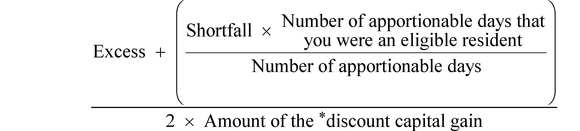
where:
apportionable day
means a day, after 8 May 2012, during the discount testing period.
eligible resident
means an Australian resident who is not a
*
temporary resident.
excess
means the excess from paragraph (4)(d).
shortfall
means the amount that the excess falls short of the amount of the
*
discount capital gain.
Note:
Subsection 115-105(3) or 115-110(3) may change your residency status for this formula.
Periods starting earlier - other residents not choosing market value
115-115(6)
If:
(a) the discount testing period starts on or before 8 May 2012; and
(b) you were a foreign resident or * temporary resident on 8 May 2012; and
(c) subsection (4) does not apply;
the following (expressed as a percentage) is the percentage resulting from this section:
| Number of apportionable days that you were an
Australian resident (but not a * temporary resident) |
| 2 × Number of days in discount testing period |
where:
apportionable day
means a day, after 8 May 2012, during the discount testing period.
Note 1:
The percentage will be 0% if you were a foreign resident or temporary resident on each of the apportionable days.
Note 2:
Subsection 115-105(3) or 115-110(3) may change your residency status for this formula.
This information is provided by CCH Australia Limited Link opens in new window. View the disclaimer and notice of copyright.