

Explanatory Memorandum
(Circulated by authority of the Assistant Treasurer and Minister for Financial Services, the Hon Dr Daniel Mulino MP)Glossary
This Explanatory Memorandum uses the following abbreviations and acronyms.
| Abbreviation | Definition |
| ATO | Australian Taxation Office |
| Commissioner | Commissioner of Taxation |
| DBS | defined benefit superannuation |
| GIC | General Interest Charge |
| ITAA 1997 | Income Tax Assessment Act 1997 |
| MCB | maximum contributions base |
| OTE | ordinary time earnings |
| QE day | qualifying earnings day |
| RSA | Retirement Savings Account |
| SG | superannuation guarantee |
| SGA Act | Superannuation Guarantee (Administration) Act 1992 |
| SGC Act | Superannuation Guarantee Charge Act 1992 |
| SIS Act | Superannuation Industry (Supervision) Act 1993 |
| TAA 1953 | Taxation Administration Act 1953 |
| The Bill | Treasury Laws Amendment (Payday Superannuation) Bill 2025 |
General outline and financial impact
Payday Superannuation
Outline
Treasury Laws Amendment (Payday Superannuation) Bill 2025 and the Superannuation Guarantee Charge Amendment Bill 2025 (the Bills) amend the SGC Act and the SGA Act to reform the SG framework. The reforms will create a strong incentive for employers to make superannuation contributions for their employees at the same time as they pay the employee's qualifying earnings. The amendments address the issue of unpaid superannuation and help to secure dignified retirement outcomes for working Australians.
Date of effect
The Bills commence on 1 July 2026.
The Bills apply to SG contributions in respect of QE days on or after 1 July 2026.
Proposal announced
The Bills fully implement the 'Securing Australians' Superannuation Package – increasing the frequency of the Superannuation Guarantee and investing in SG compliance' from the Budget papers measure in the 2023-2024 Budget.
Financial impact
The Bills are estimated to increase revenue by $589.0 million over the three years from 2026-27 to 2028-29.
All figures in this table represent amounts in $m.
| 2024-25 | 2025-26 | 2026-27 | 2027-28 | 2028-29 |
| - | - | 1,405.0 | -929.0 | 113.0 |
Impact Analysis
The Impact Analysis relating to the amendments in the Bills has been included in Attachment 1
Superannuation
The Bills are compatible with the objectives of superannuation to preserve savings to deliver income for a dignified retirement, alongside government support, in an equitable and sustainable way. See Statement of Compatibility with the Objectives of Superannuation – Chapter 2
Human rights implications
The Bills raise human rights issues. See Statement of Compatibility with Human Rights — Chapter 3.
Compliance cost impact
The changes are expected to result in some transitional and some ongoing compliance costs for employers, particularly those employers that do not currently make SG contributions at the same time as they pay qualifying earnings. The compliance cost impact includes the need for digital service providers to update payroll and other business software, with this cost likely passed on to employers that use these services. Superannuation funds will also need to ensure their systems will be capable of handling an increase in contribution volume.
Chapter 1: Payday Superannuation
Outline of chapter
1.1 Treasury Laws Amendment (Payday Superannuation) Bill 2025 and the Superannuation Guarantee Charge Amendment Bill 2025 amend the SGC Act and the SGA Act to create a strong incentive for employers to make superannuation contributions for their employees at the same time as they pay the employee's qualifying earnings.
1.2 The increased frequency for making SG contributions (compared to the previous quarterly SG model) will enable unpaid or underpaid SG to be detected and managed at an earlier stage.
1.3 Under the payday SG framework, employers that make SG contributions so that they are received by the employee's superannuation fund within a specified period (usually seven business days) after the employer has paid qualifying earnings will be able to reduce their liability to pay the SG charge to nil.
1.4 Where SG contributions are received after the specified period, or are not made at all, the employer will have an SG shortfall and will be liable for the SG charge. Notional earnings will accrue on unpaid SG to compensate the employee for lost superannuation earnings. Employers can reduce the amount of SG charge that they will be liable for by making late SG contributions and promptly submitting a voluntary disclosure statement to the Commissioner.
1.5 The Bill also includes new administrative penalties for employers who do not pay their SG charge.
1.6 The payday SG framework is intended to address the issue of unpaid superannuation and help to secure dignified retirement outcomes for working Australians.
Context of amendments
1.7 The superannuation system is one of the core pillars of Australia's retirement income system, with the total pool of superannuation assets valued at over $4.1 trillion as at September 2024. Superannuation plays a central role to fund and support a dignified retirement for Australians.
1.8 A foundational feature of Australia's superannuation system is the SG, which ensures employees receive a minimum level of superannuation support from their employers. All employers are liable to pay a tax, called the SG charge. However, employers can reduce the amount of the SG charge (including to nil), by making SG contributions for their employees within legislated timeframes.
1.9 In the 2023-24 Budget, the Government announced reforms to the SG framework to align the payment of SG contributions with the payment of salary or wages (which is usually on a weekly, fortnightly, or monthly basis), instead of the current quarterly requirements.
1.10 This reform will strengthen Australia's superannuation system and help ensure that SG is paid on time and in full. The measure is intended to address unpaid superannuation, which totalled nearly $5.2 billion in 2021-22 alone.
1.11 Employees will benefit from higher retirement savings from more frequent and earlier superannuation contributions throughout their working life. It will also improve the ability to identify and manage unpaid SG earlier.
1.12 Employers will benefit from smoother payroll management where making SG contributions becomes better integrated with payment of salary and wages. There will also no longer be a need to calculate SG on two different earnings bases (OTE or salary or wages) when an employer has an SG shortfall, and there will be more options to self-correct unpaid SG. Smaller, more frequent payments (and earlier intervention) will help prevent a build-up of large SG liabilities for employers.
1.13 Where eligible SG contributions are not made and the assessed SG charge remains outstanding, it has significant impacts on retirement outcomes. Impacts include reduced retirement savings due to the loss of compounding returns in the fund, delaying retirement, and loss of insurance coverage for some members. Additionally, employers who do not regularly make SG contributions for their employees and/or do not pay SG charge on time obtain an unfair advantage over employers who do.
1.14 The new SG framework will better ensure employees are accurately compensated for lost earnings if employers do not make timely SG contributions. It will also create incentives for employers to promptly rectify any late or missed payments. Additionally, the new SG framework will deliver more significant consequences and penalties for ongoing and repeated non-payment of the SG charge.
1.15 This reform will require an economy-wide transition, with large-scale ICT infrastructure and system upgrades required by employers, the software providers they rely on for digital contributions processing, payment intermediaries, and superannuation funds. Stakeholder feedback during consultation indicates that extra time may be needed to implement all necessary IT updates. To address this, the Commissioner of Taxation has advised the Government that the ATO intends to consult on a Practical Compliance Guideline outlining its approach to the allocation of compliance resources for the first 12 months following commencement of the legislation. It will outline low-risk, medium-risk, and high-risk categories of employers, with compliance resources prioritised to address the higher risk categories.
Comparison of key features of new law and current law
Table 1.1 Comparison of new law and current law
| New law | Current law |
| Accrual and calculation of SG shortfalls | |
| A tax, the SG charge, is imposed on employers if they have an SG shortfall for the relevant QE day. This will be the case if they have one or more individual base SG shortfalls, or one or more choice loadings, for the QE day. The SG charge is an amount equal to the SG shortfall. | A tax, the SG charge, is imposed on employers if they have an SG shortfall for the quarter. This will be the case if they have one or more individual SG shortfalls (including shortfall for contributions not made in compliance with choice of fund requirements) for the quarter. |
| Eligible contributions relevant for a QE day (generally those received within 7 business days after the QE day, and therefore on-time) reduce the individual base SG shortfalls for a QE day, including to nil.
An eligible contribution is made when it is received by the relevant superannuation fund and able to be allocated to the relevant employee's account. |
SG contributions received within 28 days after the end of the relevant quarter reduce the individual SG shortfall for the quarter, including to nil. |
| Employers have an individual SG amount for an employee in relation to the relevant QE day for that employee.
The employer's individual base SG shortfall is then calculated as the individual SG amount minus any on-time eligible contributions. |
Employers have an individual SG shortfall for an employee for a quarter (a period of 3 months beginning on 1 January, 1 April, 1 July, or 1 October), which can be reduced by making SG contributions to that employee's superannuation fund. |
| Eligible contributions that are not on-time but made in the late period before an SG charge assessment is made, will be applied to calculate the individual final SG shortfall amount for the relevant employee. | Employers can elect to have late SG contributions (other than a sacrificed contribution) offset the SG charge for the quarter (the late SG contribution is applied firstly to reduce the nominal interest component of the SG charge, and any remaining amount then offset the individual SG shortfall for that employee for that quarter.) |
| Eligible contributions are automatically applied to the earliest QE day that they can be applied to.
Any eligible contributions in surplus of the individual base SG shortfall for a QE day will be applied (carried forward) to the next QE day that has an individual base SG amount not yet covered by other contributions. Contributions may be applied up to 12 months after the day they are made. |
The employer may elect for SG contributions made in a quarter to be treated as if they had been made during a future quarter up to 12 months after the beginning of the quarter in which the contribution is made. |
| The MCB limits the amount of qualifying earnings for a year for which an employer can have an individual superannuation guarantee amount. The MCB is calculated as the concessional contributions cap, multiplied by 100, and divided by the charge percentage.
The charge percentage is expressed as a whole number, without being a percentage or decimal. |
The MCB limits the amount of OTE for which an employer will have an SG shortfall. It is worked out quarterly, and is the lower of:
|
| Calculating SG charge | |
| An employer's total SG shortfall for the relevant QE day comprises:
|
An employer's total SG shortfall for the relevant quarter comprises:
|
| The individual notional earnings component for an employee is calculated by applying the general interest charge rate to the individual base SG shortfall, on a daily compounding basis until the day a late eligible contribution is made that reduces the relevant individual final SG shortfall for the employee to nil, or otherwise until the day an SG charge assessment is made. | The nominal interest component of the SG shortfall amount is calculated by applying the interest rate prescribed by the regulations, to the total individual SG shortfalls for the quarter, from the beginning of the quarter until the date on which the SG charge is due and payable. |
| Employers have an initial administrative uplift amount of 60 per cent of the sum of their individual final SG shortfalls and individual notional earnings components for a QE day.
The administrative uplift may be reduced (including to, but not below, nil) in accordance with the regulations. |
The administration component of the SG shortfall amount is calculated by multiplying $20.00 by the number of employees in respect of whom employers have an individual SG shortfall for that quarter. |
| When an amount of SG charge is unpaid 28 days after it becomes due and payable, the Commissioner is required to give the employer a written notice to pay a specified amount of SG charge that is unpaid at that time.
The employer will become liable to pay a penalty if they do not pay the amount in the notice in full within 28 days of the notice being issued. The penalty is equal to 25% of the outstanding amount, or 50% of the outstanding amount if the employer has previously been liable for the penalty in the previous 24 months. The penalty cannot be remitted and does not accrue GIC. |
Employers may face additional SG charge (the Part 7 penalty) if they fail to lodge an SG statement or supply information relevant to assessing their SG charge liability by the end-of-quarter lodgement date or relevant due date to supply that information.
The additional SG charge can be up to 200% of the amount payable and can be remitted by the Commissioner. |
| Administration | |
| Employers with an SG shortfall for a QE day may lodge a voluntary disclosure statement before the day an assessment is made by the Commissioner for the QE day. Lodging a voluntary disclosure statement in the approved form before SG charge is assessed may reduce the administrative uplift amount of the SG shortfall for that QE day. | Employers with an SG shortfall for a quarter must lodge an SG Statement on or before the 28th day of the second month of the next quarter.
An employer who fails to lodge an SG Statement by the due date is liable, by way of penalty, to additional SG charge. |
| The Commissioner may assess an employer's SG shortfall and the amount of SG charge payable for a QE day.
The Commissioner may make this assessment:
The SG charge is payable on the day the assessment is made. |
The lodgement of an SG Statement is taken to be an assessment of the employer's SG shortfall and the amount of SG payable for that quarter.
If an employer has not lodged an SG Statement for a quarter, and the Commissioner is of the opinion that they are liable to pay SG charge for that quarter, the Commissioner may make a default assessment. |
Detailed explanation of new law
Table 1.2 Summary of Introduced Terms
| New Term | Definition | Section |
| Qualifying earnings | Qualifying earnings are the amount of earnings an employee is paid on which individual SG amounts are calculated. This is a new term, which relies on and streamlines existing concepts such as OTE.
Qualifying earnings consists of:
Qualifying earnings does not include certain payments that are currently excluded from OTE and/or 'salary or wages' under the old law. Some exclusions that were previously in the SGA Act will be moved into the regulations to consolidate all exclusions into the one place. |
10A |
| QE day | The day on which the employer makes a payment of qualifying earnings to or for the employee. | 17A |
| Individual SG amount | Qualifying earnings multiplied by the charge percentage (12%).
Where an employee's earnings reach the maximum contributions base for that employer, the amount of qualifying earnings is treated as being reduced (including to nil) for the purpose of determining the individual SG amount. |
17A |
| Individual base SG shortfall | The individual base SG shortfall is worked out by subtracting any on-time eligible contributions received for the employee from the individual SG amount for that employee.
If an employer has an individual base SG shortfall greater than nil, it means they either made no SG contribution or made SG contributions less than the individual SG amount that arose when they paid QE for the employee. The individual base SG shortfall is used to calculate the notional earnings component of the SG shortfall. |
18C |
| Individual final SG shortfall | The individual final SG shortfall is used to determine the SG charge.
It is calculated by subtracting any eligible late period SG contributions for that employee from the individual base SG shortfall for that employee. In practice, it is a measure of how much of the original individual SG amount remains outstanding at the time an SG charge assessment is made after applying all on--time and late SG contributions. |
18D |
| SG shortfall | An employer has an SG shortfall for a QE day if they have one or more individual base shortfalls for a QE day that are greater than nil, or one or more choice loadings for that day that are greater than nil.
The SG shortfall for the QE day is equal to the sum of the:
|
16B |
| SG charge | SG charge imposed on an employer's SG shortfall for a QE day. | 16A |
1.16 In addition to the introduction of key terms discussed at Table 1.2 above, the Bill also repeals and introduces several definitions into the SGA Act that reflect the new framework. [Schedule 1, items 1-10 and 24-27 , subsection 6(1), item 11, section 10A, item 12, sections 18A and 20B and item 17, subsection 63A(2) of the SGA Act]
Liability for SG charge
1.17 An employer will have an individual SG amount for an employee if they make a payment of qualifying earnings (including an entitlement to qualifying earnings that is reduced in exchange for a superannuation contribution made as part of a salary sacrifice arrangement) to or for that employee on a particular day. The day the qualifying earnings are paid to an employee is a 'QE day'.
1.18 The individual SG amount for each employee is calculated by multiplying the total amount of qualifying earnings paid to the employee, whether in one or more payments, on the QE day, by the charge percentage divided by 100. The charge percentage is 12, which is the charge percentage that has applied under the SGA Act on and after 1 July 2025. Dividing this amount by 100 ensures the formula produces the accurate individual SG amount. [Schedule 1, item 12, sections 17 and 17A of the SGA Act]
1.19 An employer will be liable for the SG charge if they have a SG shortfall due to the following:
- •
- they do not make 'on-time' eligible contributions equal to or in surplus of individual SG amounts (and so have an individual base SG shortfall greater than nil) for the relevant QE day for any employee; and/or
- •
- they fail to comply with the choice of fund requirements and incur a choice loading amount (this is further discussed below).
1.20 Under the payday SG framework, SG charge is imposed on any SG shortfall of an employer for a QE day. [Schedule 1, item 12, sections 16, 16A, 16B of the SGA Act; and Schedule 1, item 1 of the SG Charge Amendment Bill, sections 5 and 6 of the SGC Act]
Qualifying earnings
1.21 The previous SG framework used two distinct 'earnings bases'. OTE was used to determine the amount of SG contributions that an employer would need to make to reduce their SG charge liability to nil. However, 'salary or wages' was used to calculate an employer's individual SG shortfalls if they were liable for the SG charge. In practice, this meant employers would need to contribute 12% of an employee's OTE if they made SG contributions for the employee, but if they did not make SG contributions, they would be liable to pay 12% of the employee's 'salary or wages' as part of the SG charge. As the salary or wages base could include different amounts, for some employers it would be a greater amount than the OTE earnings base.
1.22 The payday SG framework will use a single earnings base called 'qualifying earnings' for working out the individual SG amount required to avoid an SG shortfall and for calculating the amount of SG charge if an employer has an SG shortfall. The definition of qualifying earnings consolidates a number of provisions relating to payments for employees that are relevant for determining the SG amount for an employee. This includes OTE, as well as payments as part of a salary sacrifice arrangement, and other types of payments that are relevant to the expanded definition of employee which is an existing concept in the SGA Act. For most employers, the qualifying earnings base remains similar to the OTE earnings base (besides adjustments to the MCB), so determining how much an employer needs to contribute to avoid liability for the SG charge is not fundamentally changing. [Schedule 1, item 11, subsection 10A(1) of the SGA Act]
1.23 The OTE component of qualifying earnings remains unchanged under this amended SG framework. Earnings in respect of ordinary hours of work and earnings consisting of over-award payments, shift--loading or commission will continue to have the same meaning and be calculated in the same way for SG purposes. The following lump sum payments made to the employee on the termination of their employment are still excluded from qualifying earnings:
- •
- a payment in lieu of unused sick leave; and
- •
- any unused annual leave payment or unused long service leave payment within the meaning of the ITAA 1997.
The only substantive change is for employees who exceed the MCB, discussed further below. [Schedule 1, items 6 and 11, subsections 6(1) and 10A(1) of the SGA Act]
1.24 As outlined above, the previous 'salary or wages' base will no longer be used. Therefore, most refences to this phrase are removed. However, the new SG framework will still need to include reference to certain payments that have been specifically included in, or excluded from, 'salary or wages' under the old law. This includes certain payments to workers who fall within the extended meaning of employee for the SGA Act. The existing inclusions and exclusions are retained for the purposes of determining employers' individual SG amounts. This change is intended to reduce complexity in the administration of the SG framework, whilst ensuring that the treatment of earnings or payments remains the same.
1.25 The exclusions for certain payments from the SG framework were previously set out in both the SGA Act and the regulations. No change is being made to the exclusions, but they will all be consolidated in the regulations to improve readability of the legislation. It is appropriate that the exclusions are set out in regulations as they are technical and specific exclusions to the general law. [Schedule 1, item 11, subsections 10A(1) and 10A(3) of the SGA Act]
1.26 If an amount paid to the employee is covered by more than one of the payment types covered by the definition of qualifying earnings, it will only be counted once (in full) for the purpose of determining qualifying earnings. For example, if an employee receives a commission, this may be fully or partially covered by paragraph (b) of the definition of OTE in subsection 6(1) as well as paragraph (b) of the definition of qualifying earnings in section 10A. The amount should therefore be counted in full, but should not be double counted to work out the employee's qualifying earnings. [Schedule 1, item 11, subsection 10A(2) of the SGA Act]
1.27 The day on which the employer pays qualifying earnings to or for an employee is the QE day. This is used for the purposes of determining when the employer has an individual SG amount and to subsequently calculate the employer's SG shortfall for that QE day (if any). [Schedule 1, item 12, subsection 17A(1) of the SGA Act]
Salary sacrifice arrangements
1.28 The Bill does not make significant changes to the operation of salary sacrifice arrangements or to how salary sacrifice arrangements are recognised for SG purposes. The definition and treatment of a salary sacrifice arrangement remains the same, but the reduction of earnings as part of such an arrangement has been included in the definition of qualifying earnings. Therefore, the amount of a sacrificed contribution is part of a person's qualifying earnings and will be included in the calculation of the employer's individual base SG shortfall for that employee. Sacrificed contributions also continue to be excluded from eligible contributions that can reduce an employer's individual SG amount. [Schedule 1, items 8, 11 and 12, subsection 6(1), paragraph 10A(1)(h) and section 17A of the SGA Act]
1.29 The salary sacrifice integrity measures continue to ensure that salary sacrifice arrangements do not result in employees receiving less than the appropriate amount of SG for each QE day.
1.30 Any amount that initially constituted a sacrificed contribution that is subsequently paid to the employee as part of a reversal of the salary sacrifice arrangement, is excluded from qualifying earnings in relation to the calculation of a later individual base SG shortfall for that employee. This prevents double counting this amount. [Schedule 1, item 11, paragraph 10A(3)(a) of the SGA Act]
Maximum contributions base
1.31 The MCB is an existing concept, which is used to set an upper limit on the minimum amount of SG contributions payable by an employer for an employee in order to avoid potential SG charge liability. Under the payday SG framework, the MCB will be applied as an annual limit, rather than as a quarterly limit.
1.32 If during a financial year an employer's payment of qualifying earnings to or for an employee exceeds the MCB, any subsequent payment of qualifying earnings by that employer in that financial year is treated as equal to nil for the purpose of calculating the individual SG shortfall amount. If a payment of qualifying earnings is made to an employee that would exceed the MCB, the amount of that qualifying earnings payment that would not cause the MCB to be exceeded is included in the calculation of the individual SG amount. [Schedule 1, item 11, subsection 10A(6) of the SGA Act]
1.33 The MCB is calculated by using the following formula (rounded down to the nearest 10 dollar multiple):

1.34 The charge percentage is currently 12%, and the concessional contributions cap is the basic concessional contributions cap (within the meaning of the ITAA 1997) for the financial year in which the payment is made. [Schedule 1, item 11 subsection 10A(5) and 17A(2) of the SGA Act]
Example 1.1 Maximum contributions base and lump sum earnings
Michael's base pay includes $140,000 of qualifying earnings each financial year. Michael also receives a lump sum performance bonus of $50,000, which is also qualifying earnings. The MCB for the financial year he receives his bonus is $250,000. Because Michael's total qualifying earnings for the financial year is less than the MCB, his employer must pay SG contributions on all $190,000 of his qualifying earnings to avoid an SG shortfall.
Employer exemption certificates
1.35 The provisions relating to shortfall exemption certificates have been simplified, with some minor changes made to the operation of these provisions. If a shortfall exemption certificate is in force for an employee, the employee is treated as having already reached the MCB in relation to qualifying earnings from the specified employer for that financial year. [Schedule 1, item 12, section 17B of the SGA Act]
1.36 The Commissioner may issue an employer shortfall exemption certificate on application by an employee, for a specified employer of the applicant and for a specified period, which ceases at the end of a financial year. [Schedule 1, item 12, subsection 17C(1) of the SGA Act]
1.37 To issue the certificate, the Commissioner must be satisfied that the following conditions are met:
- •
- if the certificate is not issued, the applicant is likely to have excess concessional contributions for the financial year (whether or not issuing the certificate would prevent that result);
- •
- if the certificate is issued, at least one other employer of the applicant is likely to have an individual SG amount for the applicant for a QE day in that financial year, which is greater than nil; and
- •
- it is appropriate in the circumstances to issue the certificate.
1.38 The second condition listed above, relating to the employee having at least one other employer, has been amended to cover situations where an employee changes employers part-way through a year. This enables employees to apply for an exemption certificate if they commence working for a new employer and are likely to have excess concessional contributions for the financial year as a result of the combined SG contributions made by both their new employer and their former employer. Previously, exemption certificates could only be granted if another employer was likely to have an SG amount for the person in that quarter (that is, if they worked for two or more employers concurrently). [Schedule 1, item 12 subsection 17C(2) of the SGA Act]
1.39 Prior to issuing a shortfall exemption certificate, the Commissioner must have regard to the following matters:
- •
- whether any other shortfall exemption certificate has been issued, or is proposed to be issued to the applicant for the financial year;
- •
- the effect that issuing the certificate is likely to have on the applicant's concessional contributions for the financial year; and
- •
- any other matters that the Commissioner considers relevant.
1.40 The sort of matters that the Commissioner may have regard to in determining whether it is appropriate in the circumstances are set out in the Explanatory Memorandum to the Treasury Laws Amendment (2018 Superannuation Measures No. 1) Bill 2019, which introduced the exemption certificate provisions into the SGA Act. These factors may include whether a certificate would result in contributions being reduced by a substantially larger amount than necessary, or whether the individual has engaged in behaviour that artificially enables them to apply for a certificate. [Schedule 1, item 12, subsections 17C(2) and 17C(3) of the SGA Act]
1.41 The shortfall exemption certificate application requirements have been updated to remove the references to quarter and instead refer to a specified period. The applicable timeframe for making the application has been reduced from 60 days to 30 days before the first day of the specified period. The requirements are that the application:
- •
- must be in the approved form; and
- •
- must specify the employer, period and financial year to be specified in the certificate; and
- •
- must be made at least 30 days before the first day of the period.
[Schedule 1, item 12 subsection 17C(4) of the SGA Act]
1.42 A shortfall exemption certificate may be issued after the first day of the period that is specified in the certificate. This enables the certificate to apply retrospectively from the start of the period specified in the application. This is necessary because the period for making the application has been shortened from 60 days to 30 days, so if the certificate is not granted within that shortened timeframe, it will still be able to apply from the first day of the period specified in the application. If a certificate is not issued before 60 days elapses from the time of application, it is taken to have not been granted. A person may object against the decision of the Commissioner to issue, or not issue, an employer shortfall exemption certificate in the manner set out in Part IVC of the TAA. [Schedule 1, item 12, subsection 17C(5) of the SGA Act]
1.43 The Commissioner may not vary or revoke an employer shortfall exemption certificate. [Schedule 1, item 12, subsection 17C(6) of the SGA Act]
1.44 An employer shortfall exemption certificate is not a legislative instrument. This certificate is declaratory and is covered by item 19 of the table in section 6 of the Legislation (Exemptions and Other Matters) Regulations 2015. A shortfall exemption certificate may also be issued after the first day of the period that is specified in the certificate. [Schedule 1, item 12, subsection 17C(7) of the SGA Act]
Example 1.2 – Exemption certificate: employee with two concurrent employers
Sage is an employee who has two employers. Both of Sage's employers will be paying her qualifying earnings of $150,000 in 2027-28 (Sage will have a total of $300,000 in qualifying earnings paid in that financial year). Sage realises that with both employers making SG contributions for her in relation to her qualifying earnings, she may have excess concessional contributions for the year (and have to pay additional tax).Sage applies for and receives a shortfall exemption certificate in relation to one of her employers. This results in the employer specified in the certificate not paying SG contributions on her qualifying earnings during the period specified in the certificate.Example 1.3 – Exemption certificate: employee changes job
Alex is an employee who changes jobs during the financial year, so has two consecutive employers for that year. He works for Employer A from 1 July 2028 to 31 December 2028 and is paid a total of $250,000 in qualifying earnings during this time. He commences working for Employer B on 1 January 2029, and expects to be paid a total of $200,000 in qualifying earnings over the rest of that financial year. Alex realises that the amount of SG contributions made by his employers may result in him having excess concessional contributions for the year (and have to pay additional tax). Alex applies for and receives an exemption certificate for Employer B. Employer B is not required to make SG contributions for Alex.
The SG shortfall
1.45 An employer has an SG shortfall for a QE day if they have one or more individual base SG shortfalls greater than nil for that QE day, or if they have choice loadings greater than nil for that QE day.
1.46 Choice loading is an additional amount imposed on employers if they do not comply with choice of fund requirements (discussed below). [Schedule 1, item 12, section 16B of the SGA Act]
Individual base SG shortfalls and individual final SG shortfalls
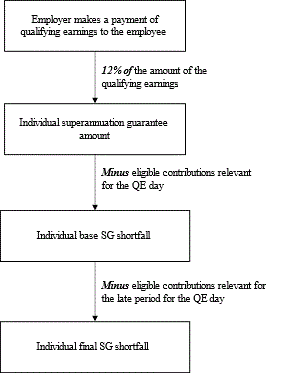
1.47 The first component of the employer's SG shortfall is the sum of any individual final SG shortfalls they have for any employees for the relevant QE day. In effect, the individual final SG shortfall reflects any portion of the individual SG amount for that employee that remains unpaid after applying all eligible contributions. The below diagram illustrates the calculation sequence used to determine an individual final SG shortfall:
Diagram 1.1
Eligible contributions
1.48 Employers can reduce their individual base and individual final SG shortfalls (including to nil), by making one or more eligible contributions. An eligible contribution is a contribution (other than a contribution made as part of a salary sacrifice arrangement) for the benefit of the employee to a complying superannuation fund or to an RSA as defined in the Retirement Savings Accounts Act 1997. The contribution must be able to be allocated to that employee's account within the fund or RSA. A contribution will also be an eligible contribution if made to the employee's legal personal representative if the employee has died. If an employee is a defined benefit member of a DBS scheme, an eligible contribution is a contribution that is notionally paid to the DBS scheme for the benefit of the employee in accordance with a benefit certificate. [Schedule 1, item 12, section 18A of the SGA Act]
1.49 The phrase 'able to be allocated' is a key concept in the definition of eligible contribution. Able to be allocated is intended to describe the ability of the superannuation fund to allocate an amount received from, or on behalf of, an employer for the benefit of an employee. This means that the superannuation fund or RSA must be able to identify the member or RSA holder the contribution relates to in order to be able to allocate the contribution to an active account of the employee within the fund or RSA. An employer does not need an active confirmation from the fund that a received contribution can be allocated before the contribution can be recognised as eligible for the purposes of calculating an individual base SG shortfall. However, if a contribution is rejected by the fund, for example because the TFN provided is incorrect, the contribution is not 'able to be allocated' and is not an eligible contribution.
1.50 If the employer makes one or more eligible contributions the sum of which are equal to or in surplus of the individual SG amount for an employee for a particular QE day before the end of the 'usual period' or other applicable timeframe for making eligible contributions for a QE day (discussed further below), the employer will have a nil individual base SG shortfall for that employee. They will not be liable for SG charge for that employee and that QE day (provided the employer has complied with choice of fund requirements). The usual period for making eligible contributions is generally 7 business days after the QE day, but can be extended in certain circumstances (discussed below).
1.51 If an employer does not make one or more eligible contributions the sum of which are equal to or in surplus of the individual SG amount before the end of the usual period or other applicable timeframe for the QE day, they will have an individual base SG shortfall in respect of that employee and QE day. The employer will be liable for the SG charge. However, the employer can reduce their individual final SG shortfall (and the amount of SG charge) by making eligible contributions during the late period for the QE day. This means that contributions received after the end of the usual period or other applicable timeframe for making eligible contributions and before the Commissioner makes an assessment for that QE day will reduce the employer's individual final SG shortfall.
1.52 Contributions made to a superannuation fund for the benefit of an employee are conclusively presumed to be contributions to that complying superannuation fund if the employer has obtained a written statement by, or on behalf, of the trustee of the fund that the fund is a resident regulated superannuation fund that is not subject to a direction under section 63 of the Superannuation Industry (Supervision) Act 1993. This presumption is not available if the employer is a trustee or manager, or an associate of the trustee or manager, of the fund or scheme, or if the trustee or manager of the fund or scheme is an associate of the employer and the employer reasonably believes the fund or scheme is not a resident regulated superannuation fund or is operating in contravention of a regulatory provision of the Superannuation Industry (Supervision) Act 1993. [Schedule 3, item 12, subsection 18A(2) and section 18B of the SGA Act]
Example 1.4 Eligible contributions
Eddy pays his employee, Anna, $1,000 of qualifying earnings on 7 August 2026 (the QE day). Eddy has an individual SG amount in relation to Anna of $120. On 13 August 2026 Eddy then sends $120 to Anna's nominated superannuation fund. Anna's fund receives this amount on 17 August 2026, six business days after the QE day.
Contribution is able to be allocated
If Anna's fund receives the $120 contribution on 17 August 2026 but the fund takes until 20 August 2026 to allocate it to Anna's account (in this case, 9 business days after the QE day), Eddy has still made an eligible contribution because the contribution he made was received within 7 business days and was ultimately allocable to Anna's fund account.
In this scenario, Eddy has made the contribution in full, and it was received and able to be allocated by the fund in less than 7 business days. Therefore, Eddy's individual base SG shortfall in relation to Anna is nil. If Eddy has no other employees and has no choice loading, he will have no SG shortfall for this QE day.
Contribution is not able to be allocated
However, if Anna's fund receives the $120 on 17 August 2026 but is unable to allocate the amount (because incorrect employee details were supplied) and instead returns the amount to Eddy, even though the fund received the amount within 7 business days, because the amount was not able to be allocated to Anna's account Eddy has not made an eligible contribution.
Eddy subsequently re-sends the contribution (with corrected employee details) on 23 August 2026 and the fund receives it on 28 August 2026. This time the fund is able to allocate the amount. As the contribution was not received and able to be allocated by the fund within 7 business days of the QE day, Eddy has not made an on-time contribution. Instead, this amount can be applied as a contribution made in the late period for the QE day, which will reduce Eddy's individual final SG shortfall for Anna for that QE day.
'On-time' eligible contributions relevant for the QE day
1.53 As noted above, eligible contributions made on-time for the benefit of an employee are recognised in the calculation for the individual base SG shortfall in relation to that employee for that QE day. These are contributions that are received by the superannuation fund (and able to be allocated to the member's account) before the end of the applicable timeframe, which in most cases will be the 7th business day after the QE day. [Schedule 1, item 12, sections 18A and 18C of the SGA Act]
1.54 Eligible contributions are applied for QE days in the order that they are received by the relevant fund or RSA. For an eligible contribution to be relevant for the QE day for a particular employee, it cannot have been applied for a previous QE day, nor can it have been applied during the late period for another QE day for that employee. [Schedule 1, item 12, paragraphs 18C(1)(a) and (b) of the SGA Act]
Usual period
1.55 Generally, to reduce an individual base SG shortfall for an employee in relation to the current QE day (and therefore the employer's SG shortfall itself), employers must make eligible contributions so that the employee's fund or RSA receives an eligible contribution for the benefit of that employee before the end of the 7th business day (for the employer) after the QE day. Contributions received during this time are described as being made during the 'usual period'. [Schedule 1, items 10 and 12, subsection 6(1) and subparagraph 18C(1)(c)(i) of the SGA Act]
Contributions made prior to the QE day
1.56 Eligible contributions made within 12 months before the QE day can also be applied to the individual base SG shortfall for that QE day, providing the contribution has not been applied for any other QE day. For example, if an employer makes an eligible contribution for a previous QE day that is greater than the individual SG amount for that employee and that previous QE day (with the individual base SG shortfall for the previous QE day already reduced to nil), the unapplied amount of that contribution will carry forward to reduce the individual base SG shortfall for the current QE day. The 12-month timeframe is in line with the existing carry forward rules. [Schedule 1, item 12, subparagraph 18C(1)(c)(ii) of the SGA Act]
Example 1.5 Employer SG payment ordering (overpayment)
A tutoring company employs Vivek to provide tutoring. The company pays Vivek $1,000 of qualifying earnings on a weekly basis. On Day 1 of the month, the company pays Vivek $1,000 of qualifying earnings. The company has an individual SG amount of $120. To avoid liability for SG charge, the company needs to make an eligible contribution(s) equivalent to this amount within seven business days. The company made $220 of eligible contributions on Day 6 (within seven business days), which is $100 more than the individual SG amount for that QE day. The company's individual base SG shortfall for Vivek for that QE day is equal to nil (individual SG amount of $120 less eligible contributions relevant for the QE day of $120). Assuming the company has no other individual base or final SG shortfalls for Vivek at that time, the $100 of additional eligible contributions will automatically be applied to offset any subsequent individual SG amount for Vivek.
For example, on Day 8 of the month, the company pays Vivek another $1,000 of qualifying earnings. The company makes $20 of eligible contributions on Day 14 (within seven business days). The company's eligible contributions relevant for the QE day will now comprise the additional $100 contribution made on Day 6 and the $20 contribution made on Day 14. Accordingly, the company's individual base SG shortfall for Vivek for this second QE day will be equal to nil (the individual SG amount of $120 less eligible contributions relevant for the QE day of $120).Example 1.6 Employer SG payment ordering (underpayment)
A construction company employs Vanessa and pays her $1,000 of qualifying earnings on a weekly basis. On Day 1 of the month the company pays Vanessa $1,000 of qualifying earnings. The company now has an individual SG amount of $120. To avoid liability for SG charge the company needs to make an eligible contribution(s) equal to this amount within seven business days. The company makes a $50 eligible contribution on Day 10, which is the last day in the usual period for this Day 1 QE day. Accordingly, the company's individual base SG shortfall for Vanessa for the QE day is equal to $70 (individual SG amount of $120 less eligible contributions relevant for the QE day of $50).
On Day 8 of the month the company pays another $1,000 of qualifying earnings to Vanessa. The company also makes a $190 eligible contribution on Day 14. According to the ordering rules for eligible contributions, $70 of this amount is first applied to reduce the company's individual final SG shortfall for Vanessa for the Day 1 QE day. In other words, the company's individual final SG shortfall for Vanessa for QE Day 1 is reduced to nil. The remaining $120 of the contribution will be allocated to the SG obligation arising from the Day 8 payment of QE, which, as an on--time payment, will reduce the individual base SG shortfall for Vanessa to nil.
Alternatively, if in this scenario the company paid $120 instead of $190 on Day 14 (e.g., because it was not aware of the underpayment on Day 1), $70 of this amount is first applied to reduce the company's individual final SG shortfall for Vanessa for the Day 1 QE day. In other words, the company's individual final SG shortfall for Vanessa for QE Day 1 is reduced to nil. The remaining $50 of the contribution will be allocated to the SG obligation arising from the Day 8 payment of QE. Accordingly, the company's individual base SG shortfall for Vanessa for the QE day (Day 8) is equal to $70 (individual SG amount of $120 less eligible contributions relevant for the QE day of $50).
If the ATO assesses the company's SG shortfall for the QE day (Day 8), any additional contributions made by the company after that time would become eligible contributions for the next QE day. This is because the SG shortfall for that QE day (Day 8) has now become crystallised as SG charge payable to the ATO.
New employees and switching superannuation funds
1.57 Employers will have additional time to make SG contributions for QE days where it is the first time they have made an eligible contribution to a particular superannuation fund or RSA for the benefit of the employee. This will cover the first payment to a new employee, as well as scenarios where the employer needs to make contributions to a new fund or RSA for an existing employee. In these scenarios, an eligible contribution will be applied to reduce the individual base SG shortfall for the current QE day if it is made before the end of the 20th business day after that QE day. This is known as the 'extended usual period'. [Schedule 1, items 5 and 12, subsection 6(1), subsection 18C(2) table item 1 of the SGA Act].
1.58 The extended usual period applies for the first payment of qualifying earnings after an employee has commenced employment with the employer (including if the employee had previously worked for that employer, ceased that employment, and then subsequently recommenced working for them). This is to accommodate the additional time it may take to onboard new employees and obtain the details of the superannuation fund to which contributions need to be made.
1.59 The extended usual period also applies where the eligible contribution is the first such contribution to a particular superannuation fund or RSA for the benefit of the employee after the employer has ceased making eligible contributions to another superannuation fund for the benefit of that employee. This is intended to cover circumstances where contributions need to be made to a different superannuation fund for an employee mid-way through their employment with that employer. This can occur due to various reasons, including the employee making a new choice of fund, or where a chosen, stapled or default superannuation fund is not able to, or becomes unable to, accept eligible contributions for the benefit of that employee.
1.60 The extended usual period is not intended to cover an employee taking a period of leave, including an extended period of leave from their employer, if there is no change to the employee's superannuation fund when the employee returns from their period of leave. Several examples are included below to assist understanding of the intended application.
1.61 Where the period for making contributions for a QE day is extended to a longer period than the usual period, a 'bunching rule' applies to contributions relevant to the later QE day(s). This rule aligns align the period for making contributions for any subsequent QE days where the usual period for making contributions would end before the extended period for the earlier QE day. In those cases, the contribution for the later QE day must be received by the end of the latest applicable due day. The bunching rule would apply in relation to the extended usual period for new employees, as well as in other circumstances where an allowable longer period for making contributions for a QE day applies (discussed further below). [Schedule xx, item 12, subsection 18C(2) table item 4 of the SGA Act]
Example 1.7 New employee
Kevin starts work with a new employer on 4 August 2028. Kevin's employer makes a payment of qualifying earnings to Kevin on 9 August 2028 (the QE day). Because 9 August 2028 is the first ever QE day for Kevin, Kevin's employer has additional time to make the SG contribution for this QE day, which must be received by Kevin's superannuation fund within 20 business days following the QE day. As there are no public holidays over this period, the 20th business day after the QE day is 6 September 2028.
Kevin's employer pays qualifying earnings every two weeks, and the next QE day for Kevin is 23 August 2028. The usual period for this second QE day would be 7 business days after the QE day – that is, on 1 September 2028. However, as the extended usual period means the contribution relevant for Kevin's first QE day can be received by 6 September 2028, the applicable period for the second QE day will also be extended so that it is not required to be received before the contribution for the earlier QE day. The contribution for both Kevin's first and second QE days must be received by 6 September 2028 for the employer to have an individual base SG shortfall of nil in respect of Kevin.Example 1.8 Employee taking unpaid leave
Emma agrees with her employer to enter a period of unpaid leave between January and June 2028.
On 3 July 2028, Emma returns from her period of unpaid leave. The employer makes a first payment of qualifying earnings to Emma since her return on 12 July 2028 (the QE day). Emma does not notify her employer of any changes to her superannuation account details. Therefore, the employer pays to the same superannuation fund as it did for Emma prior to her period of leave. Because there is no change of fund, and Emma is not a new employee, the due date for the contribution is the usual period of 7 business days following the QE day.Example 1.9 Employee resigning and rejoining the same employer
In January 2028, Gary resigns from his employer.
Gary returns to work for the same company on 3 July 2028. As Gary previously resigned from employment, he signs a new employment contract shortly before starting. Gary's first QE day is 12 July 2028. Despite having previously worked for this employer, Gary is considered a new employee as his previous connection to the employer ended. Therefore, the contribution for Gary's first QE day must be received by the end of 20 business days following that QE day. The extended usual period applies in this situation, even if the contribution is made to the same fund that contributions were made to under Gary's previous employment with this employer.Example 1.10 Commencing a new employment relationship with a former employer
Kyle is a teacher who worked a number of years at a private school. In 2025, he retired from teaching. However, on 1 May 2028, Kyle signs a contract to work for the same school as a casual relief teacher. Kyle works two days at the school on 3 and 4 May 2028.
The school pays Kyle qualifying earnings for the two days of work on 9 May 2028. As this is a new employment arrangement with Kyle, and this is the first contribution after Kyle commenced employment, the contribution must be received within the extended usual period following the QE day – that is, 20 business days after 9 May 2028.Example 1.11 An existing employee changes fund
Chris has been working with his current employer for a number of years. Chris has two superannuation accounts with two different funds – Fund A and Fund B. Chris currently receives superannuation contributions from his employer to his chosen fund, which is Fund B. On 3 November 2028, Chris completes a transfer request through ATO online services to roll the balance of his Fund B account into his Fund A account. On 7 November 2028 the rollover is complete and Chris's account with Fund B is immediately closed.
Chris's employer pays his regular qualifying earnings amount on 8 November 2028 and also attempts to make a contribution to Chris's account with Fund B. However, Chris forgot to inform his employer he had performed a fund roll-over and has not provided his Fund A details. On 13 November 2028 Chris's employer receives a notification that the payment to Chris's superannuation account with Fund B was unsuccessful and the contribution is returned to the employer.
On 15 November 2028, Chris's employer issues Chris a standard choice form. Once Chris returns his choice of fund form with details for Fund A, his employer makes the contribution in relation to the qualifying earnings paid on 8 November 2028 to Fund A.
Because Chris's employer is now paying to a different superannuation fund for Chris than occurred for the previous QE day, the employer has 20 business days after the relevant QE day (8 November 2028) to make a contribution to Chris's Fund A account. This means the contributions must be received by Fund A by 6 December 2028 (as there are no public holidays over this period).Example 1.12 – An existing employee's fund becomes non-compliant
Olivia's Café pays superannuation contributions into an SMSF on behalf of its employee, Myles, who is a member of the SMSF. Just prior to making a regular payment of qualifying earnings to Myles on 24 March 2027, the Café's owner Olivia becomes aware that the SMSF has been marked as 'non-complying' in the ATO's Super Fund Lookup tool. As such, Olivia is no longer able to make eligible contributions to Myles' SMSF.
Because Myles' SMSF was his chosen fund, Olivia provides Myles a standard choice form. Myles provides the details of Fund C as his chosen fund.
Because Olivia has to pay to a new fund, she has 20 business days from the QE day (24 March 2027) to make the contribution to the Fund C account for Myles.
Out-of-cycle payments of qualifying earnings
1.62 An extended period to make eligible contributions also applies for out-of-cycle qualifying earnings, which may include commissions, bonuses, payments in advance, and back payments. The Commissioner may, by legislative instrument, determine the kinds of payments to employees that constitute an out-of-cycle payment and the requirements that must be met for a particular payment to be treated as an out-of-cycle payment. If the current QE day relates to a payment that the Commissioner has determined to be out-of-cycle, the employer has until the end of the usual period for the next QE day to make contributions in relation to that out-of-cycle amount. However, if there are no further QE days for which the employee is paid qualifying earnings that are not out-of-cycle, then this extension does not apply. [Schedule 1, item 12, subsection 18C(2) table item 2 and subsection 18C(3) of the SGA Act]
1.63 The extension for out-of-cycle payments ensures that employers can maintain a regular schedule of SG contributions based on their usual pay cycle, without needing to make small ad hoc SG contributions due to out-of-cycle payments. The ability for the Commissioner to determine that certain payments are out-of-cycle ensures that the SG framework remains up to date as different forms of employee remuneration develop over time.
Exceptional circumstances determinations
1.64 An extended period for making eligible contributions applies where the employer and the QE day are covered by an exceptional circumstances determination. Exceptional circumstances covers events that may impact the ability of a class of employers to make SG contributions on time, for example, natural disasters or widespread information and communications technology outages. In these circumstances the Commissioner can make a determination that a class of employers are affected by exceptional circumstances of a kind that are prescribed by the regulations, as well as the period during which any QE days by those employers are affected by such circumstances.
1.65 Where an employer and a QE day is covered by an exceptional circumstances determination, the eligible contribution is due by the later of 20 business days from the day after the determination is made or the extended usual period for the current QE day. This means where an employer covered by a determination paid qualifying earnings for a QE day covered by the determination, and this occurred before the determination was made, the employer will have a further 20 business days from the day after the determination is made to make an eligible contribution and reduce their individual base SG shortfalls for that QE day. Where the employer is covered by a determination and pays qualifying earnings for a QE day during the period of time specified in the determination, they will have 20 business days from the QE day to make an eligible contribution. [Schedule 1, item 123, subsection 18C(2) table item 3 and subsection 18C(4) of the SGA Act]
1.66 The regulations will set out the types of exceptional circumstances where a determination can be made. As noted above, the intention is that this will include exceptional circumstances of a kind that could impact the ability of a class of employers to make eligible contributions within the usual period for one or more QE days. It is appropriate that these details be specified in regulations, as this is a limited exception to the general rules, and will enable agility to respond to potential unforeseen types of exceptional circumstances should they arise in future.
1.67 It is also appropriate that the power to make an exceptional circumstances determination is delegated to the Commissioner, who has the role of administering the SGA Act. The circumstances necessitating a determination will be unforeseen, and it is necessary to have capacity to respond in a manner that is suitably tailored to the nature of the particular exceptional circumstance by considering the class of employers and the period during which the determination is to apply.
Example 1.13
John and Joe's Bakery employs 5 staff and are located in a regional area. On 8 October 2027 a flood impacts the region in which the business operates, and the owners close the bakery for the safety of staff. On Wednesday 13 October 2027, the Commissioner issues an exceptional circumstances determination that applies to all employers in the Local Government Area where the bakery is located. The determination applies from 8 to 27 October 2027.
The bakery's regular fortnightly payment of qualifying earnings for its employees occurred on Monday 11 October 2027. Although the Commissioner's determination was issued after the Bakery's QE day, the Bakery receives an extended due date as the determination applies to the period beginning 8 October – which is before the bakery's QE day on 11 October. Therefore, contributions for the QE day are due 20 business days after the date that the determination is made – in this case, 20 business days from the day after 13 October 2027. With no public holidays over this period, this means the contributions must be received by 10 November 2027.
Jane's Pottery and Art Shop also operates in the flooded area and is also in the class of employers included in the Commissioner's determination. The Shop makes its regular fortnightly payment of QE for its employees on Thursday 14 October 2027. In this case, contributions for the QE day are due 20 business days after 14 October 2027 (the QE day) – that is, 11 November 2027. This is because the alternate due date – of 20 business days after the date the determination is made – falls before 11 November 2027.Example 1.14 Multiple extensions for same QE day
John and Joe's Bakery has a new employee, Stephen, who worked his first day at the bakery on Monday 4 October. The bakery pays Stephen his first fortnightly payment of qualifying earnings on Monday 11 October. Because it is the first QE day for Stephen, the extended due date for new employees means contributions for the QE day must be received by Stephen's superannuation fund within 20 business days after the QE day. However, there is also an exceptional circumstances determination in place on the QE day. Because the determination was made on 13 October 2027 the due date for contributions for the QE day is instead 10 November 2027, as this due date falls after the new employee due date of 8 November 2027.
Late period contributions for the QE day
1.68 Employers can make eligible contributions to their employees' superannuation funds to reduce their SG shortfall after the usual period (or other applicable timeframe) for the QE day, and before they have been assessed by the Commissioner for SG charge. Eligible contributions made during this period are contributions made during the 'late period' for the QE day.
1.69 Eligible contributions made during the late period reduce an employer's SG shortfall by the same amount as eligible contributions made during the usual period. However, as the employer will have an individual base SG shortfall, there will be a notional earnings component that will accrue until the individual final SG shortfall amount is reduced to nil by eligible contributions made during the late period, or when the Commissioner makes an assessment. The notional earnings component is discussed further below.
1.70 In the payday SG framework, the employer is no longer required to elect or notify the Commissioner for a late contribution to offset the employer's SG shortfall. Instead, eligible contributions made during the late period for the QE day will be applied automatically (in the order they are received by the fund) to reduce the SG shortfall in the calculation of the individual final SG shortfall. [Schedule 1, item 12, subsections 18D(1) and (2) of the SGA Act]
1.71 The same eligible contribution cannot be used to reduce an employer's SG shortfall more than once. An eligible contribution made during the late period for the QE day cannot be applied to reduce the employer's individual final SG shortfall to the extent that it has already been applied to reduce an individual base or final SG shortfall for that employee in relation to a previous QE day. [Schedule 1, item 12, paragraph 18D(2)(c) of the SGA Act]
1.72 The late period for a QE day starts on the day after the usual period, extended usual period or other applicable period for making eligible contributions ends. The late period ends on the day before the day the Commissioner makes an assessment of the employer's SG shortfall for that QE day or when the late contributions reduce the individual final SG shortfall to nil. [Schedule 1, item 5, subsection 6(1) of the SGA Act]
Eligible contributions and defined benefit schemes
1.73 The existing framework recognises that employers with employees that are members of a DBS scheme may not make contributions for each individual employee that neatly reflect the level of superannuation support the SG regime provides, as the employees' benefits in that scheme may be ascertained by different factors. Instead, an employer obtains a benefit certificate for the members in that scheme. A benefit certificate attests to the level of superannuation contributions that the members' benefits are equivalent to – this is known as the notional employer contribution rate.
1.74 The benefit certificates arrangements will continue to apply under the payday SG framework. However, a minor update is being made to those provisions to reflect that some DBS schemes may only have a small number of defined benefit members, while the other members of the scheme are accumulation members (that is, members who have an 'account' and the end benefit is based on the actual contributions made to that account). The benefit certificate provisions will apply to defined benefit members of DBS schemes, rather than applying to the whole of the scheme. This will mean that actual SG contributions will be relevant for non-defined benefit members of DBS schemes, rather than the notional contributions in accordance with the benefit certificate. The existing definition of defined benefit member covers those who are full defined benefit members and those who are 'hybrid' defined benefit members.
1.75 Employers with employees who are defined benefit members of DBS schemes will obtain benefit certificates in order to reduce or eliminate their exposure to SG shortfalls. To accomplish this, eligible contributions include a notional contribution, made by the employer for the benefit of the defined benefit member employee, that is deemed to have been received by the DBS scheme, on the QE day, where that employee is covered by a valid benefit certificate. This notional contribution is ascertained by multiplying the notional employer contribution rate by the amount of qualifying earnings for that QE day. [Schedule 1, item 12, subsection 18A(3) of the SGA Act]
1.76 Consequential changes are also made to the provisions relating to conversion notices, which apply when a superannuation fund notifies the Commissioner that the fund or scheme is to be treated as a DBS scheme. Trustees of the relevant fund must notify employers who are contributing to that fund or scheme about their intention to give a conversion notice (or revoke a conversion notice) before doing so. If an employer commences contributing to a fund or scheme for the benefit of employees who are defined benefit members of a scheme subject to a conversion notice, the trustee must give the employer written notice of the conversion notice within 7 business days (rather than 30 days) of receipt by the fund of the employer's first contribution. [Schedule 1, items 31 and 32, subsections 6B(1), 6B(4) to 6B(6) of the SGA Act]
Components of the SG shortfall
1.77 An employer has an SG shortfall if one or more individual base SG shortfalls for a QE day are greater than nil or one or more choice loadings for a QE day are greater than nil. [Schedule 1, item 123, subsection 16B(1) of the SGA Act]
1.78 If an employer has an SG shortfall for the QE day it comprises:
- •
- the total of all of the employer's individual final SG shortfalls for that QE day;
- •
- the total of the employer's individual notional earnings components for that QE day;
- •
- the employer's administrative uplift amount for that QE day; and
- •
- the total of the employer's choice loadings for that QE day.
[Schedule 1, item 12, subsection 16B(2) of the SGA Act]
Individual notional earnings component
1.79 The individual notional earnings component of the employer's SG shortfall is similar to the nominal interest component of the previous SG framework. To incentivise employers to make eligible contributions promptly, individual notional earnings will begin to accrue when the employer has an individual base SG shortfall greater than nil for that QE day. The individual notional earnings will then compound at a daily rate during the late period for that QE day for each day the employer has an individual final SG shortfall greater than nil. This ensures that employees are compensated for delayed payment of their minimum SG contribution.
1.80 The individual notional earnings component for each day during the late period for an employee is calculated by multiplying the individual base SG shortfall for that employee for the QE day by the general interest charge rate (as determined under section 8AAD of the TAA 1953). For each subsequent day during the late period, the general interest charge rate is then applied to the sum of the individual base SG shortfall for that employee and the notional earnings amount for that employee for that QE day in relation to previous days in the late period. Effectively, this calculation means that notional earnings will accrue until the day a late contribution finally 'satisfies' the original individual SG amount by reducing the individual final SG shortfall to nil. [Schedule 1, item 12, section 19A of the SGA Act]
1.81 Notional earnings, together with GIC imposed on the employee entitlement components of the SG charge, are intended to collectively provide a continuous and non-overlapping period of an interest-like payment, compensating an employee for lost earnings on an outstanding individual SG amount.
Administrative uplift amount
1.82 Under the payday SG framework, the administration component of the SG charge will be substituted with a scalable administrative uplift amount. This administrative uplift amount is intended to:
- •
- recognise and recoup some of the cost to taxpayers of the Commissioner's activity in investigating and assessing the SG charge; and
- •
- incentivise employers to make prompt voluntary disclosures if they have an SG shortfall to minimise the above costs.
1.83 Employers are initially liable for an administrative uplift amount equal to 60% of the sum of the total of the employer's individual final SG shortfalls and individual notional earnings components for the QE day. This amount can be reduced (but not below nil) in accordance with the regulations. [Schedule 1, item 12, section 19B of the SGA Act]
1.84 The regulations may prescribe a method for reducing an employer's administrative uplift amount for a QE day that relies, for example, on one or more of the following:
- •
- whether the Commissioner has previously made an assessment on the Commissioner's own initiative or an estimate under subsection 268-10(1) in Schedule 1 to the TAA, and
- •
- whether and when the employer lodges a voluntary disclosure statement under section 33 for the QE day and in the approved form.
1.85 It is appropriate that the regulations set out the details of how the administrative uplift amount can be reduced, as this will involve detailed rules and prescriptive timeframes. Prescribing these details in regulations will also enable the uplift provisions to be adjusted if necessary to ensure the administrative uplift amount continues to provide a suitably scaled incentive to encourage employers to make prompt disclosures where they have an SG shortfall. [Schedule 1, item 12, subsection 19B(3) of the SGA Act]
Choice loading
1.86 Under the payday SG framework, a choice loading applies where an employer makes one or more contributions to a complying superannuation fund or RSA for the benefit of an employee, and the contribution is not made in compliance with the choice of fund requirements. The choice loading is a separate component of the SG shortfall. [Schedule 1, item 12, paragraph 16B(2)(d) of the SGA Act]
1.87 The choice loading is an additional 25 percent calculated on the value of the eligible contributions for any QE day where the employer has not complied with the choice of fund provisions. [Schedule 1, item 12, section 20A of the SGA Act]
1.88 Choice loading will apply for contributions made to a superannuation fund or RSA that are not in compliance with the choice of fund requirements for a QE day. Additionally, choice loading will also apply for contributions notionally made to a defined benefit superannuation scheme. To support compliance, the exception disregarding the requirement for a fund to include a MySuper product for defined benefit schemes has been brought into the Act. [Schedule 1, item 12, subsections 20A(2) and 20A(3) of the SGA Act]
1.89 The limit on the shortfall increase from a failure to comply with the choice of fund requirements was originally set at $500 per notice period in 2005 and has not been adjusted since. Under the payday SG framework, the choice loading limit will be $1,200 per notice period. This increase reflects that the SG rate (charge percentage) has increased since 2005. A notice period may cover multiple QE days. The choice loading limit for the current QE day will be reduced by the amount of choice loading applied if the employer had a choice loading for a previous QE day which occurred during the same notice period as the current QE day. The notice period begins on either 1 July 2026, the day the employee's employment starts with that employer, or the day after the end of a previous notice period. The notice period ends on the day the Commissioner gives written notice that the notice period has ended. This ensures that the choice loading limit applies across multiple QE days during the notice period. [Schedule 1, item 12, section 20C of the SGA Act]
1.90 Choice loading will not apply where an employer attempts to pay a contribution to a fund in accordance with information provided by the Commissioner that a fund is the employee's stapled fund, but the fund will not accept the contribution, and the employer makes a contribution to another fund for the benefit of the employee. [Schedule 1, item 12, section 20D of the SGA Act]
Example 1.15 Calculation of the employer's SG shortfall and charge
Juliet has one hundred employees whom she each pays $1,000 of qualifying earnings. She makes a $120 on-time eligible contribution (i.e. a contribution in the "usual period") for seventy of her employees for this QE day, totalling $8,400. She makes a further $120 contribution during the late period (i.e. a contribution after the usual period but before her SG shortfall has been assessed) for each of the remaining thirty employees totalling $3,600. These late period contributions are received by the employees' funds 25 days after the end of the usual period (i.e. 7 business days after QE day). For one of these employees, Juliet also makes a contribution to a default fund rather than the employee's chosen fund, in contravention of choice of fund requirements. Juliet is assessed for her SG shortfall 35 days after the usual period and must pay the resulting SG charge.
When Juliet first pays her employees $1,000 in qualifying earnings, the total of Juliet's individual SG amounts equals: 100 employees x $120 = $12,000. If she made no SG contributions, the total of her individual base SG shortfalls would be equal to $12,000. However, as she has made some contributions, the total of her base individual SG shortfalls is then reduced by $8,400 for the on-time contributions she makes for seventy of her employees.
Because Juliet has outstanding individual base SG shortfalls totalling $3,600 (for the thirty employees she did not make on-time eligible contributions for) after the usual period, she will now be liable for the SG charge.
Juliet did eventually make full contributions for the remaining thirty employees during the late period. This reduces the individual final SG shortfall for each of these employees to nil. However, because these were late contributions they accrue notional earnings.
Assuming a GIC rate of 10%, the notional earnings component for each of the remaining 30 employees is their individual base SG shortfall ($120 for every employee in this case) multiplied by 25 days of pro-rated GIC. This equals 82.46c of notional earnings for each employee, or $24.74 in total.
In addition to the notional earnings, Juliet's SG shortfall may also include an administrative uplift amount of up to 60% of the total of her individual final SG shortfalls and total notional earnings components(regulations allow for employers to reduce the administrative uplift percentage depending on previous behaviour and if, and how quickly, the employer discloses to the ATO their late contributions). Because Juliet has reduced her individual final shortfalls to nil, the 60% administrative uplift will only apply in relation to the $24.74 notional earnings for a potential maximum of $24.74 *60% = $14.84.
Finally, because Juliet made a contribution to the wrong fund for one employee, her SG shortfall will include a choice loading. The loading will be $120 * 25% = $30.
Therefore, when Juliet's SG shortfall for the QE day is assessed, she will have the following SG charge:
- •
- Total individual final shortfalls = $0
- •
- Sum of all individual notional earnings components = $24.74
- •
- Administrative uplift amount of up to $24.74 * 60% = $14.84
- •
- Choice loading = $30
- •
- Maximum SG charge amount she may be liable for = $69.58
By comparison, if, in the above scenario Juliet does not make any late contributions for thirty of her employees before she is assessed for the SG charge 35 days after the on-time period, her total SG charge would look like the following:
- •
- Total individual final shortfalls = $3,600
- •
- Sum of all individual notional earnings components = $34.68
- •
- Administrative uplift amount of up to ($3,600 + $34.68) * 60% = $2,060.81
- •
- Choice loading = $30
- •
- Maximum SG charge amount she may be liable for = $5,725.49
In the original scenario Juliet's notional earnings stopped accruing when she reduced her individual final SG shortfalls to nil (i.e. she makes late contributions equal to the amount she missed during the usual period). In this alternate scenario Juliet does not reduce the individual final SG shortfalls to nil (i.e. she makes no contributions for thirty of her employees before her SG shortfall is assessed). This results in an additional 10 days of notional earnings. That is, instead of notional earnings accruing for 25 days (up until the point that the late contributions are received by the employees' funds), notional earnings accrue for the full 35 days until Juliet is assessed.
Defined benefit members
1.91 Where an employee is a defined benefit member of an existing DBS scheme, they are unable to choose another fund. The existing settings that deal with the application of choice loading to these employees are retained. [Schedule 1, item 12, section 20B of the SGA Act]
1.92 For an employee who is a defined benefit member of an existing DBS scheme, an employer, subject to the relevant criteria being met, is not subject to choice loading for a failure to comply with the choice of fund provisions. The criteria are as follows:
- •
- the scheme is in surplus as certified by an actuary;
- •
- an actuary has also certified that the employer is not required to make contributions for a period including the QE day (and there has been such a certificate covering all times since 1 July 2005);
- •
- the employee has been a member of the defined benefit fund continuously since before 1 July 2005;
- •
- the employee has accrued their maximum benefit, and any increases will be because of increases in the employee's salary or remuneration, or accruals of investment earnings or indexation, or in some other way prescribed by the regulations; or
- •
- the employee's benefits would not be affected if the employer made contributions to a fund other than the DBS scheme.
[Schedule 1, item 12, subsections 20B(2),(3) and (4) of the SGA Act]
Voluntary disclosure statements
1.93 Under the payday SG framework, employers are no longer required to lodge SG statements. Instead, employers can lodge a voluntary disclosure statement reporting that they have an SG shortfall (and other matters relevant to their liability for SG charge). Employers can make such a disclosure at any time before the Commissioner makes an assessment of the SG shortfall for a QE day. A disclosure must be in the approved form. If the employer makes the voluntary disclosure before the SG shortfall for the QE day is assessed (or an estimate is made under subsection 268-10(1) of Schedule 1 to the TAA) by the Commissioner, the disclosure may reduce the administrative uplift amount of the employer's SG shortfall (in accordance with the regulations). [Schedule 1, item 14, section 33 of the SGA Act]
1.94 Employers are incentivised to lodge a voluntary disclosure statement because it can reduce the administrative uplift amount of the SG shortfall. A voluntary disclosure statement that does is not in the approved form will not be a valid voluntary disclosure statement and therefore will not reduce the administrative uplift amount of the employer's SG shortfall. However, under relevant circumstances, section 25C of the Acts Interpretation Act 1901 will apply so that minor errors in a voluntary disclosure statement will not affect validity. [Schedule 1, item 12, subparagraph 19C(3)(a)(ii) of the SGA Act]
1.95 A voluntary disclosure statement in the approved form may include either or both: the date an eligible contribution was received by the relevant fund (receipt day) and/or the date the contribution was paid (payment day) by or on behalf of the employer. One of the key data points required to calculate the SG charge is the date that SG contributions are received by the employee's fund. However, as this may not be readily available to the employer to include when making a voluntary disclosure statement, the voluntary disclosure statement can include either payment day or received day. To facilitate efficient administration, where an employer provides only a payment day, a deeming rule will apply to work out the received day for the purposes of calculating the notional earnings component of the SG shortfall. This deemed day will be seven business days from the payment day for the eligible contribution. [Schedule 1, items 14 and 15, subsections 33(3) and 36(3) of the SGA Act]
Example 1.16 lodging a voluntary disclosure
Jaxson is an employer and makes a late SG contribution for his employee for a QE day. The late SG contribution reduces his individual final SG shortfall in respect of this employee to nil. He lodges a voluntary disclosure statement to the ATO before his SG shortfall is assessed. Prior to lodging a voluntary disclosure statement, his SG shortfall comprises of the sum of his individual notional earnings components for the QE day and an administrative uplift amount (equal to 60% of the sum of individual notional earnings components for the QE day).
Lodging a voluntary disclosure statement may reduce the administrative uplift amount of the SG shortfall for the relevant QE day. For Jaxson's voluntary disclosure statement to be accepted by the ATO it must be in the approved form and should include either or both the receipt day and the payment day.
Jaxson does not know or provide a day for which the contribution(s) were received, and instead provides only the day the contribution was paid from his account. The Commissioner uses the information in the voluntary disclosure statement to make an assessment of Jaxson's SG shortfall. Accordingly, the notional earnings component of Jaxson's SG charge will be calculated as if the receipt day for the contribution(s) was the seventh business day from the day he paid the SG contribution from his account.
Assessments of SG charge
1.96 Under the payday SG framework, the Commissioner may make an assessment of an employer's SG shortfall amount for a specified QE day and the SG charge payable on that shortfall at any time. An assessment may be made on the Commissioner's own initiative or if the employer has lodged a valid voluntary disclosure statement for that QE day, based on the information in the disclosure statement. If the employer is liable for any SG charge, it is payable on the day that the assessment is made by the Commissioner. [Schedule 1, item 15, section 36 of the SGA Act]
1.97 As employers are no longer required to lodge SG statements, the Commissioner will use data available through sources including employer voluntary disclosure statements, single touch payroll and superannuation fund reporting to determine the amount of SG charge and issue an SG charge Notice of Assessment.
1.98 Consistent with the old law, the employer will be liable to pay the GIC for each day from the date the SG charge is due and payable until the date the SG charge is paid in full. Section 8AAD of the TAA 1953 specifies how the GIC is calculated. Under the payday SG framework, the notional earnings component and the GIC collectively provide an unbroken stream of compensation for the lost earnings from the outstanding individual SG amount until the SG charge is paid in full.
1.99 One change under the payday SG framework is that GIC is applied on the entire SG charge amount rather than just the sum of the individual SG shortfalls. [Schedule 1, items 55 to 59, section 49 of the SGA Act]
1.100 Employers can still receive refunds for any overpaid amounts of SG charge. The amount that is to be included in a refund to an employer has been amended to reflect the new framework, and will include:
- •
- any overpaid amount of SG charge in the form of GIC that became payable under section 49 of the SGA Act;
- •
- if the reduction in the liability results in an amended assessment of an administrative penalty—any overpayment of the administrative penalty;
- •
- any overpayment of administrative penalty under Part 4-25 in Schedule 1 to the TAA 1953 relating to the reduction in the liability.
[Schedule 1, item 53, subsection 38(2) of the SGA Act]
Distribution of the SG charge for the benefit of employees
1.101 The SG charge that is imposed on an employer's SG shortfall for a QE day is payable by an employer. After the SG charge has been paid, the total individual final SG shortfalls, individual notional earnings and choice loading components of the SG charge are distributed for the benefit of the employee into their superannuation fund or directly to the employee in some circumstances.
1.102 GIC accrues on the whole unpaid SG charge and will be allocated so it follows the components of the SG charge. This means the amounts will be apportioned and distributed to the employee or retained in consolidated revenue as appropriate.
1.103 The SG shortfall components have been amended to reflect the amounts that will make up the SG shortfall under the new framework. The 'employee entitlement' (as they relate to the particular employee) and 'total employee entitlement' (as they relate to the total of these component for all the relevant employees) amounts for an assessment will now be made up of the following amounts:
- •
- the total of the employer's individual final superannuation guarantee shortfall for the QE day specified in the assessment; and
- •
- the total of the employer's individual notional earnings for the QE day; and
- •
- the total of the employer's choice loading for the QE day; and
- •
- the amount of GIC that is payable in relation to these components.
1.104 The 'employee entitlement' and 'total employee entitlement' amounts are reduced by the amounts of any previous payments that relate to the relevant assessment, employer, and employee. [Schedule 1, items 19 and 21, subsection 64A(3) and subsection 64B(4) of the SGA Act]
1.105 The Bill amends the calculation for determining an employee's proportion of an amount (where there is more than one benefitting employee) to the following formula:
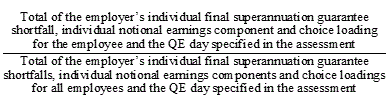
[Schedule 1, item 20, subsection 64B(3) of the SGA Act]
1.106 The definition of charge payment has been amended to reflect that a payment of SG charge is made in relation to an assessment in relation to a QE day. [Schedule 1, item 17, subsection 63A(2), definition of charge payment, SGA Act]
Penalties for late or non-payment of SG charge
1.107 The late payment penalty is intended to provide a strong incentive for employers who are assessed for SG charge to pay the outstanding amounts promptly, so that benefits can be distributed into employees' funds in a timely manner.
1.108 If an employer is liable to pay an amount of SG charge and it is unpaid on the day after 28 days from the date the charge became payable, that day is the 'current notice trigger day'.
1.109 The Commissioner must, as soon as practicable after the current notice trigger day, issue a written notice to the employer to pay the amount specified in the notice when the following conditions are met:
- •
- an amount of SG charge remains unpaid on the day after the 28-day period that started on the day the SG charge became payable;
- •
- the amount of SG charge and GIC that remains unpaid is greater than $30 (or a higher amount if specified by the regulations);
- •
- the notice to pay does not include SG charge amounts that have been specified as payable in a previous notice to pay; and
- •
- a notice to pay has not been issued to the employer in the past 50 days, ending on the day before the current notice trigger day.
[Schedule 1, item 16, sections 59 and 59A of the SGA Act]
1.110 Where a notice to pay is issued to an employer, they must pay the full amount specified in the notice by the end of the 28th day after the day specified in the notice. This is the 'current notice payment period'. An employer who fails to pay this amount in full or otherwise discharge the amount of SG charge and any GIC specified in the notice will become liable for a late payment penalty for the unpaid amount. [Schedule 1, item 16, subsection 59A(3) and section 59C of the SGA Act]
1.111 For completeness, the GIC on any unpaid SG charge will continue to accrue until the SG charge is paid in full, even after the notice to pay has been issued. To avoid any late payment penalty, the employer must pay the amount specified in the notice to pay issued to them by the Commissioner. While GIC that accrues between the time the notice to pay was issued and payment will not increase the amount specified on the notice, it will still form part of the debt to the Commonwealth that needs to be paid by the employer.
1.112 If an SG charge assessment is amended so that liability for the charge is reduced after a notice to pay has been issued, it is intended that any potential exposure to the late payment penalty is similarly reduced. To achieve this, when a notice to pay relating to the amended SG charge amount has been issued and the current notice payment period has not expired, the law provides that the amount specified in the notice to pay is treated as if it were reduced by the amount the SG charge liability has been reduced. If an SG charge assessment is amended resulting in the specified amount being reduced to nil or ceasing to exist, the law provides that the notice is treated as having been revoked. An amended SG charge assessment that increases the liability will not impact the amount specified in the notice to pay (though the additional amount will need to be paid to discharge the debt to the Commonwealth). [Schedule 1, item 16, section 59B of the SGA Act]
1.113 The standard amount of the late payment penalty is 25 percent of the unpaid portion of the amount specified in the notice to pay, where the amount remains unpaid after the end of the current notice payment period. That is, if an employer makes a partial payment of the amount specified in the notice to pay, the late payment penalty is calculated on the amount that remains unpaid. If the amount specified in the notice to pay has been reduced in accordance with section 59B, the late payment penalty will be calculated by reference to the reduced amount. Similarly, if a notice to pay has been treated as revoked under section 59B, no late payment penalty will be imposed in respect of that notice.
1.114 The penalty amount will increase to 50 percent if a late payment penalty has been imposed on the employer on a previous occasion within the 24 months prior to the date the employer became liable for the current relevant late payment penalty.
1.115 The penalty amount will be nil if a determination is made by the Commissioner under subsection 18C(4) covering the employer for any part of the period starting on the imposition day and ending on the last day of the current notice payment period, even if the determination is made after that period. This approach recognises that in circumstances where an employer is a member of a class of employers impacted by exceptional events, such as a natural disaster, they will not be further penalised for late payment of SG charge. The employer will still be required to discharge their SG charge liability, they will just not be subject to an additional administrative penalty. The notice to pay provision will not be impacted, as this will serve as a useful prompt to alert the employer that they have overdue SG charge. [Schedule 1, item 16, section 59C of the SGA Act]
1.116 The Commissioner must make an assessment of the amount of an administrative penalty payable by the employer and must give written notice of the assessment to the employer. However, the Commissioner does not have to give written notice if the amount of administrative penalty is nil. [Schedule 1, item 16, subsections 59D(1) and(2) of the SGA Act]
1.117 The penalty will become due for payment on the day specified in the notice from the Commissioner, which must be at least 14 days after the day the notice is given to the employer. This allows the Commissioner to provide an employer sufficient time to make the payment. The GIC does not accrue on any late payment of the penalty. [Schedule 1, item 16, subsection 59D(3) of the SGA Act]
1.118 If an employer is dissatisfied with the assessment of late payment penalty, the employer may object against it in the manner set out in Part IVC of the TAA 1953. [Schedule 1, item 16, subsection 59D(4) of the SGA Act]
1.119 The Commissioner cannot remit all or part of the penalty set out in an assessment for a late payment penalty. This is intended to be a strong deterrent against late payment of SG charge, since unpaid SG charge results in employees missing out on superannuation. However, the Commissioner must amend such an assessment if a liability under the SGA Act to pay an amount relevant to the assessment is reduced, including to nil, or ceases to exist. The Commissioner must also amend a penalty assessment if the late payment penalty is reduced to nil because of a determination made under exceptional circumstances under subsection 18C(4), which may cover an employer for a period starting before the determination is made. [Schedule 1, item 16, subsections 59E(1) and (2) of the SGA Act]
1.120 The amount of penalty payable under any amended assessment is to be worked out in the same way that the amount is worked out under the original assessment of late payment penalty. [Schedule 1, item 16, subsection 59E(3) of the SGA Act]
Example 1.17 Calculating the late payment penalty
A company has an SG charge (SGC #1) of $1,424.64 assessed on 15 July (the imposition day). On 23 July the company is assessed for another SG shortfall and becomes liable to pay an SG charge of $956.45 (SGC #2). The company takes no action to pay any of this SG charge. On 12 August (the current notice trigger day – the day after the 28-day period starting on the day the SG charge (SGC #1) became payable) the Commissioner sends the company a notice to pay the unpaid SG charge amount within 28 days from 12 August or become liable for the late payment penalty.
Because GIC accrues on SG charge daily, assuming a GIC rate of 10%, the amount specified in the notice is equal to SGC #1) $1,424.64*(1+(0.1/365))^28= $1,435.61 and SGC #2) $956.45*(1+(0.1/365))^20= $961.70, for a total of $,2397.31.
On 15 August, the company is assessed for an additional SG shortfall resulting in SG charge (SGC #3).
A further 28 days elapse without the company paying the amount specified in the notice. On 9 September (the day after 28 days from 12 August – i.e. the day after the current notice payment period expires) the company becomes liable for a late payment penalty of $2,397.31*25% = $599.33 because it has not been liable for another late payment penalty in the 24 months prior to becoming liable for this late payment penalty.
The company continues to not pay any SG charge. Fifty (50) days after the first notice is sent, the Commissioner sends another notice. The notice specifies all the SG charge that was not specified in the previous notice, including all associated GIC that has accrued on the SG charge and was not specified in the original notice. In this scenario, the second notice specifies an amount equal to SGC #3, SGC #3's associated GIC, and all additional GIC that has accrued on SGC #1 and SGC #2 since the last notice. The notice requires the company to pay the amount within 28 days of the date the notice issued.
The company continues to not pay its SG charge for the next 28 days after the Commissioner issues its second notice to pay. It therefore becomes liable for a second late payment penalty equal to 50% of the assessed SG charge amount from 15 August (SGC #3) and all GIC that has accrued on its total unpaid SG charge not already included in the previous notice.Example 1.18 Late payment penalty when covered by exceptional circumstances determination
A company becomes liable to pay SG charge on 12 July (the imposition day). The company does not pay this amount so the Commissioner sends a notice to pay the SG charge amount on 9 August (the current notice trigger day – i.e. the day after the 28 day period starting on the day the SG charge became payable). The notice specifies that the amount in the notice must be paid within 28 days from 9 August. The company does not pay the amount in the notice within this timeframe and therefore also becomes liable for a late payment penalty on 6 September. Two days after the employer becomes liable for the late payment penalty the Commissioner makes a determination that a class of persons (which includes the employer) is subject to exceptional circumstances for a period of time from 1 September to 2 September. Because the determination covers the employer and a period of time between the imposition day and the end of the current notice payment period, any assessment of the penalty must be reduced to nil. For completeness, the SG charge remains payable and GIC will continue to accrue.
Consequential and other miscellaneous amendments
Superannuation Guarantee (Administration) Act
1.121 Division 2 of Part 1 to Schedule 1 of the Bill includes a number of consequential changes to the SGA Act.
1.122 Definitions and certain provisions that are no longer necessary are repealed, and existing definitions are updated to reflect the main amendments to the SGA Act, including where provision numbers that are cross referenced by those definitions have changed. [Schedule 1, items 22 to 29 and 33 to 38 and 40, subsections 5(3), note to section 6, subsections 6(1), 6(3) and 6A(1) and sections 7, 7A, 8 and 9 and subsection 10(1), sections 15 and 15A of the SGA Act]
1.123 Consequential amendments are made to replace references to 'quarters' with references to 'QE days' and related changes to reflect the increased frequency for payment of SG to avoid the SG charge. [Schedule 1, items 18, 30, 32, 44, 45, 47 and 63, subsection 6A(4) and section 30, paragraph 30(b) and sections 32A and note to subsection 63A(3) and subsection 79(2) of the SGA Act]
1.124 Consequential amendments are also made to a number of provisions to update the terminology to qualifying earnings and remove references to 'salary or wages'. The provision that stipulates various payments as classifying as salary and wages is also repealed, as these inclusions have been moved into the definition of 'qualifying earnings'. Excluded payments will be prescribed by the regulations. [Schedule 1, items 39 and 41 to 43, sections 11 and 15B and subsection 15C(8) of the SGA Act]
1.125 Provisions dealing the old nominal interest component and administration component of the SG charge are repealed or replaced as these components have been replaced by the new components of the SG charge. [Schedule 1, item 46, sections 31 and 32 of the SGA Act]
1.126 Consequential changes to update terminology and cross-references to amended provisions are also made throughout the SGA Act. [Schedule 1, items 49 to 53, section 32C, paragraph 32D(d), subsections 32NA(7), 37NA(8) and 38(2) of the SGA Act]
1.127 Consequential changes to the provisions relating to collection and recovery of SG charge repeal unnecessary provisions and update the provisions to reflect the revised SG charge. [Schedule 1, items 54 to 60, sections 46, 47, 49 and 50 of the SGA Act]
1.128 The Commissioner may also recover amounts of an SG shortfall component that have been distributed for an employee but exceed what is payable under the legislation. The Commissioner may recover overpayments from:
- •
- the person to whom the overpayment was made (usually this will be the trustee of the employee's superannuation fund, unless it was paid directly to the employee); or
- •
- the trustee of another superannuation fund, where the amount has been transferred to that fund (for example, where funds have been rolled-over from one fund to another, either as a result of action on behalf of the member or as a successor fund transfer); or
- •
- if it is not possible to recover the overpaid amount from such persons – the relevant employee (or their legal personal representative).
1.129 The updates to this provision ensure that the Commissioner can recover the excess amount if it is no longer held in a superannuation fund. The changes are consistent with similar provisions dealing with recovery of overpayments by the ATO.
1.130 Before seeking to recover an overpaid amount, the Commissioner must give the person written notice of the proposed recovery, which details the amount to be recovered and an explanation of this legislative provision. This notice is not a legislative instrument, as it does not determine or alter the law but explains how the law applies to enable the Commissioner to recover the overpaid amount. The Commissioner can only recover the overpayment 28 days after giving this written notice. [Schedule 1, items 61 and 62, sections 69 and 70 of the SGA Act]
1.131 Under the payday SG framework, there will no longer be provisions relating to approved clearing houses. Currently, the only approved clearing house is the Australian Taxation Office, which has operated a clearing house for small business employers. This clearing house is being retired from 1 July 2026, as it will not be fit-for-purpose for payday superannuation. Therefore, references to approved clearing houses are repealed. [Schedule 1, items 48 and 64, subsection 32C(2B) and section 79A of the SGA Act]
Consequential amendments of other Acts
Administrative Decisions (Judicial Review) Act 1977
1.132 A consequential amendment updates the cross-reference referring to decisions made under section @17C of the SGA Act as decisions to which the ADJR Act does not apply. This amendment does not make any substantive change to the existing exemption from the ADJR Act and remains consistent with the judicial review processes available for a decision to issue or refuse to issue a shortfall exemption certificate with those available for other taxation decisions by the Commissioner. Review of taxation decisions are available under Part IVC of the TAA 1953, which is a well-established and comprehensive review scheme. [Schedule 1, item 65, paragraph (gae) of Schedule 1 of the ADJR Act]
Competition and Consumer Act 2010
1.133 A consequential amendment updates the definition of superannuation percentage to reflect changes to the charge percentage. This amendment does not make any substantive change to the existing provision, which sets a limitation on the amount of compensation that can be awarded for economic loss due to loss of employer superannuation contributions. [Schedule 1, item 66, section 87Z of the Competition and Consumer Act]
Corporations Act 2001
1.134 Consequential amendments update the provisions dealing with priority of payments in the winding up of a company in the Corporations Act to reflect the changes in terminology in the payday SG framework. This includes removing references to quarter and updating with references to the newly defined term 'QE day'. While the subsections have been redrafted, the changes are intended to maintain the current rules for determining how SG charge relating to an SG shortfall is to be prioritised. [Schedule 1, items 67 to 70, subsections 556(1AB) to (1AG) and section 1713 of the Corporations Act]
Crimes (Taxation Offences) Act 1980
1.135 Consequential amendments update the reference to SG charge and remove references to the additional SG charge that have been replaced by the new administrative penalty provisions. [Schedule 1, item 71, subsection 3(1) of the Crimes (Taxation Offences) Act]
Defence Act 1903
1.136 A consequential amendment updates the terminology in relation to the Minister's power to make a determination for the purpose of providing a superannuation benefit for certain defence force personnel. The amendments update the reference to a superannuation guarantee shortfall for a quarter to refer to an individual base superannuation guarantee shortfall for a QE day. [Schedule 1, item 72, subsection 52(3A) of the Defence Act]
Fair Work Act 2009
1.137 A consequential amendment to the provision dealing with preventing multiple actions updates the terminology to refer to individual base SG shortfall and choice loading greater than nil. [Schedule 1, item 73 and 74, paragraph 116D(2)(c) and section 130 Schedule 1 to the Fair Work Act]
Governor-General Act 1974
1.138 Consequential amendments update the terminology to refer to individual base SG shortfalls. [Schedule 1, items 75 to 77, section 4AA of the Governor-General Act].
Income Tax Assessment Act 1936
1.139 A note explaining the meaning of relevant periods for the purpose of determining a required superannuation guarantee contribution amount, which is no longer necessary, has been repealed. [Schedule 1, item 78, subsection 57-50(8) of schedule 2D of the Income Tax Assessment Act 1936]
Income Tax Assessment Act 1997
1.140 The payday SG framework changes the rules for tax deductibility of contributions and the SG charge. Under the previous SG framework, only on-time contributions were deductible. Under the new framework, both on-time and late eligible contributions are deductible, and the SG charge is also deductible. This reflects the fact that the SG charge is, at its core, a fiscal incentive that operates as a substitute the payment of superannuation contributions for employees in respect of services rendered, which is itself deductible expenditure for employers.
1.141 Any applicable GIC or late payment penalty related to SG charge is not tax deductible. The late payment penalty is also not deductible, since it is a penalty for failing to pay the SG charge.
1.142 For employers who have a payment plan with the ATO that consists of SG charge and other tax debts, payments made towards the plan will be deductible up to the value of the amounts of the core SG charge, being the total of the individual final SG shortfall components, the total of the individual notional earnings components, administrative uplift amount and any choice loading. [Schedule 1, items 79, 80 and 92, sections 12-5, 26-95 and 290-95 of the ITAA 1997]
1.143 To ensure deductions for superannuation contributions continue to operate as intended, several amendments are made to the ITAA 1997 to update the relevant provisions for new concepts included in the SGA Act. [Schedule 1, items 81 to 91 and 96 to 98, sections 85-25, 86-75, 290-80, 290-85 and 290-95 and subsection 995-1(1) of the ITAA 1997]
1.144 The integrity measures limiting taxpayers and personal services entities from deducting a super contribution paid to their associate or an individual are updated to reflect new concepts and terminology outlined in the SGA Act. This includes 'individual final superannuation guarantee shortfalls' and 'QE days', in replacement of 'individual superannuation guarantee shortfalls' and 'quarters' respectively. [Schedule 1, items 81 and 84, subsection 85-25(3) and subsection 86-75(2) of the ITAA 1997]
1.145 The amount required to be contributed by the taxpayer or the personal services entity to be eligible for the deduction, is updated to be calculated with reference to payments of qualifying earnings defined within the SGA Act. [Schedule 1, items 82 and 85, subsection 85-25(4) and subsection 86-75(3) of the ITAA 1997]
1.146 Similarly, the conditions limiting the ability of employers to deduct a contribution made to employees or former employees are updated to reflect the alignment of qualifying earnings to the calculation of both contributions and the amount of SG charge. Subsequent references to this requirement in forming the amount required for a contribution to be deductible are also updated. [Schedule 1, items 86-91, sections 290-80 and 290-85 of the ITAA 1997]
1.147 A reference to late payment offsets made under previous amnesty provisions is removed from the list of low tax contributed amounts for Division 293 tax. This provision related to a specific amnesty arrangement, and is no longer necessary. [Schedule 1, items 93 and 94, section 293-30 of the ITAA 1997]
1.148 The definitions section of the ITAA 1997 is amended to include and align the newly defined terms of 'individual final superannuation guarantee shortfall', 'QE day' and 'superannuation guarantee shortfall' to their corresponding references in the SGA Act. [Schedule 1, items 95 to 98, subsection 995-1(1) of the ITAA 1997]
Judges' Pensions Act 1968
1.149 References to 'individual superannuation guarantee shortfalls" are updated with the current terminology of "individual base superannuation guarantee shortfalls for the person that are greater than nil" to preserve the entitlements that were payable under this provision. [Schedule 1, items 99 to101, paragraph 12A(2)(a) and subsection 12A(16) of the Judges' Pensions Act]
Paid Parental Leave Act 2010
1.150 A consequential amendment updates the reference to the SG charge percentage to cross refer to the amended provision in the SGA Act. [Schedule 1, item 102, subsection 115C(4) of the Paid Parental Leave Act]
Parliamentary Contributory Superannuation Act 1948
1.151 References to 'individual superannuation guarantee shortfalls' are updated with the new terminology of 'individual base superannuation guarantee shortfalls for the person that are greater than nil' to preserve the method of which to calculate the superannuation guarantee safety-net amount. Because the changeover day has occurred, the distinction between contributions that were made on a monthly and fortnightly basis, based on whether they were made before or after the changeover day is no longer necessary, and the definition of changeover day has been repealed. [Schedule 1, items 103 to 108, section 16A of the Parliamentary Contributory Superannuation Act]
Parliamentary Superannuation Act 2004
1.152 Consequential amendments remove references to 'quarter' and update cross references to provisions of the SGA Act, in addition to the terminology of 'QE day' and 'individual base superannuation guarantee shortfall'. These amendments preserve the amounts the Commonwealth must pay to discharge its obligation to make contributions. [Schedule 1, items 109 to 111, sections 3 and subsections 8(4) and 8(5) of the Parliamentary Superannuation Act 2004]
Retirement Savings Accounts Act 1997
1.153 A number of consequential changes update terminology and align provisions with the amendments to the SGA Act. [Schedule 1, items 112 to 115, section 183 of Retirement Savings Accounts Act 1997]
Small Superannuation Accounts Act 1995
1.154 A consequential amendment to update the note regarding false or misleading declarations to remove reference to a provision of the SGA Act that is being repealed has been made. [Schedule 1, item 116, section 31 of the Small Superannuation Accounts Act]
Superannuation Act 1976
1.155 Consequential amendments make updated references to 'individual base superannuation guarantee shortfall' and 'QE day' to align entitlement to superannuation guarantee top-up benefit with the amendments to the SGA Act. The provisions dealing with CSC determinations have also been removed because no new determinations will be made because the salary base referenced is no longer relevant for SG purposes. [Schedule 1, items 117 to 124, sections 3, 110SA, 110SC, 110SE, 128, 153AA and 155C of the Superannuation Act 1976]
Superannuation Act 2005
1.156 Consequential amendments update the terminology to 'qualifying earnings' to preserve the operation of provisions governing when a person it taken to have become a member of the Public Sector Superannuation accumulation plan (PSSAP), when PSAAP is their chosen, stapled or mandated fund, and when the SGA Act does not apply in certain circumstances. [Schedule 1, items 125 to 128, sections 14 and 18 of the Superannuation Act 2005]
Superannuation Industry (Supervision) Act 1993
1.157 Several amendments are made to the SIS Act so that those provisions still operate effectively under the amended SG Act.
1.158 The definition of salary or wages is being repealed and replaced with qualifying earnings. This reflects the updated terminology in the SGA Act. [Schedule 1, items 129 and 130, subsection 10(1) of the SIS Act]
1.159 Several provisions are updated to reflect that a failure to comply with the choice of fund provisions will now result in a choice loading, rather than an increased individual superannuation guarantee shortfall. [Schedule 1, items 131, 142 and 143, sections 29R and 68A of the SIS Act]
1.160 The SIS Act is amended to reflect the removal of the term salary or wages from the SG framework. Additionally, this provision is updated to apply the SGA Act to include a part-time domestic workers' remunerations in qualifying earnings. [Schedule 1, items 133 to 134 and 136, section 64 of the SIS Act]
1.161 Subsection 64(2A) is being repealed, as the concept of 'approved clearing house' is being removed from the SGAA. [Schedule 1, item 135, subsection 64(2A) of the SIS Act]
1.162 The provision dealing with the employer-sponsor contribution exception is amended to align with the amendments in the SG Act, including the substitution of QE day for quarter. [Schedule 1, items 137 to 141, section 68AAE of the SIS Act]
Superannuation (Productivity Benefit) Act 1988
1.163 Several consequential amendments to the Superannuation (Productivity Benefit) Act 1988 ensure that the provisions operate effectively under the amended SGA act.
1.164 The definition of quarter in subsection 3(1) is being repealed and replaced with usual period, individual base superannuation guarantee shortfall and QE day to reflect the updated terminology in the SGA Act. [Schedule 1, items 144 to 146, subsection 3(1) of the Superannuation (Productivity Benefit) Act]
1.165 Paragraph 4F(1)(aa) is being repealed and replaces quarter with QE day, and individual superannuation guarantee shortfall with individual base superannuation guarantee shortfall to reflect the updated terminology in the SGA Act. Similarly, subsection 4F(2) has been updated to be consistent with the updates in the SGA Act so that under this provision, continuing contributions are payable by the end of the 7 days after the QE day. Subsection 8A(2) updates the definition of notional contributions to reflect the updated terminology in the SGA Act. [Schedule 1, items 147 to 149, sections 4F and 8A of the Superannuation (Productivity Benefit) Act]
Taxation Administration Act 1953
1.166 Several consequential amendments to the TAA to support the effective administration of the updated SGA Act. This includes amendments to update terminology and cross-reference the renumbered provisions. [Schedule 1, items 145 to 180 sections 8K, 8N, 15C of the TAA and sections 250-10, 265-90, 268-10, 268-90, 269-10, 269-30, 284-75, 355-65, 384-10, 389-5, 389-25 in Schedule 1 to the TAA]
1.167 To support the Commissioner's ability to estimate the unpaid and overdue amount of a liability to pay an SG charge for a QE day, the SG charge for a QE day is to be treated as being payable on the first day at the end of the usual period (within the meaning of the SG Act) for the QE day, even if the charge has not actually been assessed yet. [Schedule 1, item 160, subsection 268-10(1A) in Schedule 1 to the TAA]
1.168 To support the Commissioner's visibility of contributions/amounts that will be relevant for determining whether an SG shortfall exists, amendments are made to clarify that employers must report any amounts that constitute qualifying earnings. [Schedule 1, item 178, table items 2 and 2A in subsection 389-5(1) in Schedule 1 to the TAA]
1.169 Amendments are also made so that, for the Director Penalty Notice provisions, a company's SG charge is treated as being payable on the earlier of the first day after the end of the 60-day period starting on the QE day, and the day the charge is payable under an assessment of the SG charge, even if the charge has not yet been assessed under that Act. [Schedule 1, item 166, subsection 269-10(3) in Schedule 1 to the TAA]
Commencement, application, and transitional provisions
1.170 The Bills commence on 1 July 2026.
1.171 The amendments apply in relation to a QE day that is on or after 1 July 2026. This will include for payments of qualifying earnings that relate to work, labour or performance of duties on or after 1 July 2026, and for arrangements of such payments made before, on or after 1 July 2026. [Schedule 1, item 182]
1.172 A savings provisions ensures that the 'old Act' (the SGA Act as it was in force immediately before 1 July 2026), continues to apply on and after 1 July 2026 in relation to a quarter ending before that day as if the amendments had not been made. This savings provision ensures that arrangements for the payment of SG and SG charge prior to the amendments continues to operate after 1 July 2026. This savings provision is necessary because employers may still have SG arrangements under the old law that continue after commencement of the new law, including finalising SG contributions, lodging SG statements and paying SG charge under the old law. [Schedule 1, items 181 and 182]
1.173 An exception to the savings provision for the old law is in relation to the late payment offset. Subitem 182(5) provides that section 23A of the old Act continues to apply only in relation to contributions made before 1 July 2026. This means that an employer will not be able to elect to have a late contribution be offset against the employer's liability to pay SG charge in relation to a quarter under the old law if that contribution is made after 1 July 2026. This is necessary to reduce complexity and uncertainty in administering the laws. Contributions for QE days after 1 July 2026 will be automatically applied against SG obligations from that date, and if such contributions can be offset retrospectively against past quarters under the old law, it will make it challenging to identify and apply contributions against the correct QE day. [Schedule 1, item 182]
1.174 Similar application and savings provisions will apply to amendments to other Acts made by this Bill. This will mean that the amendments will apply for a QE day on or after 1 July 2026, but the old law will continue to apply in relation to SG arrangements and liabilities prior to that date. [Schedule 1, item 183]
1.175 A transitional rule clarifies that for the new law, a reversal of a sacrificed contribution includes a payment made on or after 1 July 2026 that represents the reversal of all or part of a contribution that was a sacrificed contribution made before 1 July 2026. [Schedule 1, item 184]
1.176 A transitional rule deals with contributions that are made before 1 July 2026 and would be an eligible contribution under the new Act because they are made 12 months prior to the QE day. This may occur if an employer has made excess contributions under the old law. The rule clarifies that such contributions can satisfy the definition of eligible contribution for the QE day and be counted for the new law. It also ensures there will be no double counting, by providing that the amount of the contribution that is not applied under the old law to reduce charge percentage or offset as a late payment offset, is treated as an eligible contribution for the employee. [Schedule 1, item 185]
Example 1.19 Contributions made before 1 July 2026
Smith's Automative Warehouse has one employee, who commences employment during March 2026. It does not make any SG contributions for that employee for the January-March 2026 quarter and so is liable for SG charge for that quarter. In the following April-June 2026 quarter, Smith's Automative Warehouse must make a $1,000 contribution to reduce its SG shortfall for that quarter to nil. However, Smith's Automative Warehouse instead makes a $1,250 contribution for its one employee at the end of June 2026. This reduces its SG shortfall for the April-June 2026 quarter to nil and means it has made an additional $250 contribution above the required amount for that quarter.
On 15 July 2026 Smith's Automative Warehouse pays QE to its employee for the first time under the new payday SG regime. If Smith's Automative Warehouse takes no additional action, the additional $250contribution it made in June 2026 will be automatically applied to the next relevant individual base SG shortfalls for this employee arising after 1 July 2026.
As at the end of November 2026, the ATO has not made an assessment of Smith's Automative Warehouse's SG charge for the January-March 2026 quarter. In December 2026, Smith's Automative Warehouse wants to crystallise and pay its SG charge for the January-March 2026 quarter. Because it made a $250 "excess" contribution before 1 July 2026, it can elect to make a late payment offset to have the $250 applied to its SG charge for the January-March 2026 quarter, which can only be done if the "excess" contribution was made prior to the SGC assessment being raised. Accordingly, Smith's Automative Warehouse lodges an SG statement and makes an election for the $250 to apply against the self-assessed SG charge amount. Smith's Automative Warehouse pays the balance of the self-assessed SG charge amount to the ATO.
Depending on what other contributions Smith's Automative Warehouse has made, this could create an SG shortfall for one or more QE days under the new payday SG framework.
1.177 A transitional rule deals with how contributions made between 1 July 2026 and 28 July are to be applied. This rule is necessary because there will be a period of overlap between the old and new law. Under the old law, employers have until the 28th day after the end of the quarter to make contributions to reduce their SG shortfall. However, from 1 July 2026 under the new law, contributions need to be received by the relevant superannuation fund within 7 business days. This means that it could be unclear whether a contribution made between 1 and 28 July is intended to be counted for the old or new law. The transitional rule provides clarification that a contribution is first to be applied under the old law, with any remainder then applied under the new law. [Schedule 1, item 186]
Example 1.20 Contributions made between 1 July and 28 July 2026
Taba's Gardening have one employee who is paid wages monthly. Taba's Gardening have historically paid SG contributions at the end of each quarter. The amount Taba's Gardening needs to contribute to reduce its SG shortfall to nil for the quarter ending June 2026 is $2,600. However, because of a miscalculation, Taba's Gardening only contributes $2,500 in July 2026, leaving it with an SG shortfall of $100 for the April-June 2026 quarter.
In July 2026 Taba's Gardening also pays qualifying earnings to its employee under the new payday SG framework, and has an individual SG amount of $200 for the employee for that QE day. Because Taba's Gardening hasn't realised its mistake, rather than making a contribution of $300 to cover both the $100 individual SG shortfall for the April-June 2026 quarter and $200 for the individual SG amount arising under the new law, it contributes only $200 to its employee's fund in July 2026.
The result is that $100 of the $200 contribution made in July 2026 will be applied to the individual SG shortfall for the April-June 2026 quarter (reducing it to nil), with the remaining $100 applied for the QE day in July. This leaves Taba's Gardening with a $100 individual final SG shortfall for its July 2026 QE day if it does not take further action.Example 1.21 Contributions made after 28 July 2026
Due to an administrative error, Big Corp does not make an SG contribution for one of its employees for the April-June 2026 quarter by the end of July. Not realising this, Big Corp makes contributions in July 2026 in an attempt to reduce the individual base SG shortfall for the employee for their QE days in July 2026. However, because of the transitional rule, these contributions are instead first used to reduce the individual SG shortfall for the quarter ending June. However, the SG contributions made in July 2026 do not fully reduce the individual SG shortfall for the quarter ending June 2026 to nil. As a result, after 28 July, Big Corp becomes liable for SG charge for the April-June 2026 and SG charge for any remaining individual base SG shortfalls greater than nil for QE days that occurred in July 2026.
In August 2026 Big Corp realises its mistake and makes an additional contribution to the employee's fund in an attempt to correct it. Under the old law Big Corp would be able to make contributions to the employee's fund in this situation and use them as a late payment offset against the SG charge. However, under the transitional rules this is not possible because the contributions were made after 1 July 2026. As a result, the additional contributions made in August will be first applied to any remaining individual base and individual final SG shortfalls greater than nil for QE days since 1 July 2026, and where there are none, automatically carried-forward to reduce any future individual base SG shortfalls.
To pay the SG charge for the April-June 2026 quarter Big Corp must pay the amount in full to the ATO.
1.178 Another transitional rule provides that an employer's notice period under subsection 19A(4) of the old Act is taken to end at the end of 30 June 2026. The notice period relates to the limit on shortfall increase for failure to comply with choice of fund requirements. As the Bill makes changes to those provisions, the transitional rule is necessary to ensure that it is clear that the notice period under the old law ceases on 30 June 2026, so that any notice period applicable under the new law will apply from 1 July 2026 or later. [Schedule 1, item 187]
1.179 The amendments to section 69 in the new law will apply in relation to a payment by the Commissioner before, on or after 1 July 2026. Section 69 relates to recovery of overpaid amounts distributed by the Commissioner for the benefit of employees under Part 8 of the SGA Act. These changes are intended to make the recovery of overpayments provisions consistent with similar provisions in other taxation law, and ensure that amounts can be recovered where they have been rolled-over to a new fund or paid out as benefits to the member, such that it is not possible for the Commissioner to recover the monies from the person it was originally paid to. As this is a technical amendment to address a gap in the recovery provisions, retrospective operation is appropriate to allow recovery of overpaid amounts. Safeguards apply to this provision, including the requirement to give the person notice in writing. [Schedule 1, item 188]
1.180 A transitional provision preserves the existing operation of the Norfolk Island transitional SG arrangements. This will mean that the amount of qualifying earnings for Norfolk Island salary or wages are treated as if they are reduced by one twelfth. Essentially this preserves existing arrangements allowing Norfolk Island salary or wages to catch up to the broader SG rate of 12 percent by 1 July 2027. [Schedule 1, item 189]
Chapter 2: Statement of Compatibility with the Objective of Superannuation
Prepared in accordance with section 6 of the Superannuation (Objective) Act 2024
Treasury Laws Amendment (Payday Superannuation) Bill 2025
Overview
2.1 The Superannuation Guarantee Charge Amendment Bill 2025 and the Treasury Laws Amendment (Payday Superannuation) Bill 2025 are compatible with the objective of superannuation as set out in section 5 of the Superannuation (Objective) Act 2024. The objective of superannuation is to preserve savings to deliver income for a dignified retirement, alongside government support, in an equitable and sustainable way.
2.2 The updated SG framework as a result of this policy will help ensure SG is paid on time and in full, and address the issue of unpaid superannuation. This increases the level of preserved savings to deliver a dignified retirement for working Australians.
Detailed assessment
2.3 A foundational feature of Australia's superannuation system is the SG. It ensures employees receive a minimum level of superannuation from their employers to support a dignified retirement, alongside government support. As of 1 July 2025, the SG rate has increased to 12 per cent. Unpaid superannuation is a significant problem affecting many working Australians. The Australian Taxation Office (ATO) estimates that unpaid SG totalled around $5.2 billion in 2021-22.
2.4 Unpaid SG decreases an individual's preserved retirement savings due to loss of contributions and associated foregone compounded earnings, which can lead to poorer retirement outcomes. It may also extend the working lives of individuals who need to work longer to make up for these lost contributions. This is of particular concern where SG remains unpaid or underpaid despite ATO efforts to recover amounts, which may occur, for example, in cases of insolvency.
2.5 Payday Super will increase the frequency employees receive SG contributions to their superannuation funds, which will benefit around 9.4 million working Australians. The increased frequency will mean higher investment earnings over their working lives because of the compounding effect of having SG invested sooner. For example, Treasury cameo analysis suggests that a 25-year-old median income earner currently receiving their super quarterly and wages fortnightly could be around $6,000 or 1.5 per cent better off at retirement.
2.6 These changes will also improve the ATO's ability to identify employers not making contributions earlier. Smaller, more frequent payments (and earlier intervention) will help prevent a build-up of large liabilities for employers that puts employees' SG at risk, and help employers manage their accounts. In 2023-24, over a third of outstanding ATO super debt was owed by insolvent businesses.
2.7 Further, the updated SG charge will better ensure employees are appropriately compensated for lost earnings if their contributions are delayed. It will also prompt employers to immediately rectify any late or missed payments while imposing more significant consequences and penalties for ongoing and repeated non-payment of the SG charge.
2.8 Together these changes work to increase preserved savings and therefore deliver an improved standard of living in retirement.
2.9 The changes also ensure the superannuation system continues to deliver these outcomes in an equitable way. The inclusion of the term 'equitable' within the objective of superannuation reflects the fact that superannuation policy can have a distributional impact across Australian society, and policymakers should be aware of these impacts. Its inclusion in the context of the objective of superannuation captures the importance that the system delivers similar outcomes to people in similar situations and targets support in the superannuation system to those most in need.
2.10 The issue of unpaid or underpaid SG disproportionately impacts younger and lower income workers. In 2021-22, almost half of people who reported unpaid super to the ATO were under 35 years, and Productivity Commission analysis in 2018 found that just over three quarters of employees reporting underpayment earned under $60,000, compared with two thirds for all employees. Cameo modelling from the Retirement Income Review (2020) shows that a lower-income, younger employee who is not paid SG for two years experiences a larger decrease in their superannuation balance and retirement income than an older worker who is not paid the SG for the same period. Thus, the proposed reforms stand to improve equity within the system by benefiting those disproportionately impacted by unpaid SG – younger and lower income workers – and most vulnerable to its impact on retirement savings
Conclusion
2.11 This Bill is compatible with the objective of superannuation as it helps to address the issue of unpaid superannuation, taking key positive steps to improve the level of preserved savings and secure dignified retirement outcomes for working Australians in an equitable way. Employees stand to benefit from more timely contributions that compound over their working lives through increased frequency of payments and an SG charge that adequately compensates them for lost earning, and which incentivises employers to rectify late or missed payments immediately.
Chapter 3: Statement of Compatibility with Human Rights
Prepared in accordance with Part 3 of the Human Rights (Parliamentary Scrutiny) Act 2011.
Treasury Laws Amendment (Payday Superannuation) Bill 2025
Overview
3.1 The Superannuation Guarantee Charge Amendment Bill 2025 and the Treasury Laws Amendment (Payday Superannuation) Bill 2025 are compatible with the human rights and freedoms recognised or declared in the international instruments listed in section 3 of the Human Rights (Parliamentary Scrutiny) Act 2011.
3.2 The Bills amend the SGC Act and the SGA Act to create a strong incentive for employers to make superannuation contributions for their employees at the same time as they pay the employee's qualifying earnings.
3.3 The increased frequency for making SG contributions (compared to the previous quarterly SG model) will enable unpaid or underpaid SG to be detected and managed at an earlier stage.
3.4 Under the payday SG framework, employers that make SG contributions so that they are received by the employee's superannuation fund within a specified period (usually 7 business days) after the employer has paid qualifying earnings will be able to reduce their liability to pay the SG charge to nil.
3.5 Where SG contributions are received after the specified period, or are not made at all, the employer will have an SG shortfall and will be liable for the SG charge. Notional earnings will accrue on unpaid SG to compensate the employee for lost superannuation earnings. Employers can reduce the amount of SG charge that they will be liable for by making late SG contributions and promptly submitting a voluntary disclosure statement to the Commissioner.
3.6 The Bill also includes new administrative penalties for employers who do not pay their SG charge.
3.7 The payday SG framework is intended to address the issue of unpaid superannuation and help to secure dignified retirement outcomes for working Australians.
Human rights implications
3.8 The Bills engage the following rights:
- •
- The right to social security – Article 9 of the International Covenant on Economic, Social and Cultural Rights (ICESCR) and Article 11(1)(e) of the Convention on the Elimination of All Forms of Discrimination Against Women (CEDAW)
- •
- The right to a standard of living and security – Article 25 of the Universal Declaration of Human Rights (UDHR).
The right to social security at retirement and old age
3.9 Article 9 of the ICESCR recognises the right to an adequate standard of living and the right to health. It recognises the importance of adequate social benefits in reducing the effects of poverty.
3.10 Article 11(1)(e) of the CEDAW recognises the right to social security, particularly in cases of retirement, unemployment, sickness, invalidity and old age and other incapacity to work, as well as the right to paid leave.
3.11 The Bills support these rights by requiring employers to make eligible superannuation contributions on a more frequent basis, based on the day their employees are paid salary or wages. The amendments to calculate SG shortfalls, and therefore the SG charge components, further provide incentive to employers to make on-time contributions for the benefit of employees to reduce their SG shortfall liability and any associated SG charge amounts. Employers are similarly incentivised to submit voluntary disclosures to reduce their SG shortfall liability, facilitating more accurate SG shortfall assessments.
3.12 As such, these amendments help bolster employees' social security at retirement stage, by combating unpaid and underpaid superannuation.
The right to a standard of living and security
3.13 Article 25(1) of the UDHR recognises that everyone has the right to a standard of living adequate for the health and well-being of himself and of his family, and the right to security in the event of old age.
3.14 The Bills will support this right by encouraging employers to pay the correct amount of superannuation, therefore ensuring employees are paid the right amount of superannuation in a timely manner. This will contribute towards the family's financial security in old age, supporting their right to an adequate standard of living in retirement.
Conclusion
3.15 These Bills are compatible with human rights as it promotes employees' right to social security at old age by improving the frequency and transparency of superannuation guarantee payments.
Attachment 1: Impact Analysis
Abbreviations
| Acronym or term | Meaning |
| ANAO | Australian National Audit Office |
| ATO | Australian Taxation Office |
| DSP | Digital Service Provider |
| EN | Employee Notification |
| FEG | Fair Entitlement Guarantee |
| ICT | Information and communications technology |
| MAAS | Member Account Attribute Service |
| MATS | Member Account Transaction Service |
| OTE | Ordinary Time Earnings |
| SGA Act | Superannuation Guarantee (Administration) Act 1992 |
| SGC Act | Superannuation Guarantee Charge Act 1992 |
| SME | Small and Medium-Sized Enterprise |
| STP | Single Touch Payroll |
Executive Summary
Unpaid superannuation has significant negative impacts on individuals, by reducing superannuation savings and delaying retirement. In 2019-20, more than $3.3 billion in Superannuation Guarantee (SG) entitlements remained unpaid and owing to eligible employees.
The Australian Taxation Office (ATO) is responsible for administering the SG scheme, including following up with employers where SG obligations go unpaid and administering the SG charge. However, due to the design of the SG system (including the frequency with which employers are required to pay SG, the operation of the SG charge, and limitations with the ATO's IT capabilities to identify unpaid SG), many SG obligations remain unpaid for extended periods of time. This causes significant issues when employers enter liquidation without having paid their SG obligations.
During the 2022 election campaign, the Government made a public commitment to set unpaid superannuation recovery targets for the ATO which would be made public and reported on annually. In this Impact Analysis (IA), Treasury has considered options that would implement the setting of unpaid superannuation recovery targets for the ATO, alongside more comprehensive policy and administrative changes that would address the structural drivers of unpaid superannuation outlined above.
Three options were considered in this IA to implement the Government's election commitment and address the problem of unpaid SG:
Option 1: Maintain the status quo (no change).
Option 2: Investment in ATO data matching.
Option 3: Require SG to be paid alongside an employee's salary and wages (on payday).
A range of impacts of these options were considered including fewer instances and quicker recovery of unpaid SG, regulatory costs and Government expenses.
Given the issue of unpaid SG is driven by structural issues within the SG system and the SG gap has remained steady for several years, maintaining the status quo under Option 1 is unlikely to lead to a material improvement in the incidence of unpaid SG. As such, informed by this IA, Treasury recommends Option 2 and 3 be progressed. Together, these options present the best opportunity to address the structural drivers of unpaid SG. Compared with maintaining the status quo, these options would give the ATO greater oversight over SG entitlements and a timelier ability to follow up instances of unpaid SG. Importantly, these options would reduce the risk of employers accruing large unpaid SG debts and reduce the SG gap, ensuring that employees are receiving the entitlements they are owed and improving their retirement outcomes. In addition to these options, two new interim unpaid SG recovery targets would be implemented along with new improved unpaid SG recovery measures and targets.
Limited consultation has been undertaken on these options. This is due to the market sensitivity of the options presented, and the risk of unacceptable market advantage that consultation prior to public announcement would pose. However, many stakeholders have expressed their public support for the recommended options. An extensive post-decision consultation would be required should the recommended options be agreed by Government. This consultation would consider the impact of the changes on employers, superannuation funds, payroll providers and superannuation clearing houses.
The implementation of Option 2 and 3, and interim and improved targets, would enable the Government to achieve their election commitment, and ultimately improve retirement outcomes.
Background
During the 2022 election campaign, the Government made a public commitment to set unpaid superannuation recovery targets for the ATO which would be made public and reported on annually. The key intent of this election commitment was to reduce the amount of employer SG obligations either not paid or underpaid to employee superannuation accounts each year.
This IA has been prepared by Treasury to analyse options to address the issue of unpaid SG in preparation for consideration of these potential options by the Government for inclusion in the 2023-24 Budget. The options analysed would implement the setting of unpaid superannuation recovery targets for the ATO, alongside more comprehensive policy and administrative changes that would address the structural drivers of unpaid superannuation.
This IA has been finalised by Treasury prior to the Government making an initial decision to implement these options. The analysis is intended to inform the decision of Government to implement the options outlined which would involve Government expenditure and amendments to legislation.
If the Government proceeds with the recommended options Treasury would undertake further consultation and analysis on these proposals to inform future major decision points which may include detailed policy design, further Government expenditure and the development of legislation.
The Superannuation Guarantee (SG)
The SG was introduced on 1 July 1992 with the enactment of the Superannuation Guarantee (Administration) Act 1992 (SGA Act) and the Superannuation Guarantee Charge Act 1992 (SGC Act).
An employee's SG entitlement is calculated based on the employee's ordinary time earnings (OTE) for a given period multiplied by the SG rate.
OTE refers to the amounts earned for 'ordinary hours of work', which does not include payments related to overtime hours worked (for example, allowances and loadings only referable to overtime hours) and some forms of leave, such as parental leave.
Currently the SG rate is 10.5 per cent and is legislated to rise by 0.5 percentage point per year until it reaches 12 per cent on 1 July 2025. Some employees receive superannuation contributions above the SG rate from their employers, such as those negotiated through enterprise agreements.
Some workers are not covered by the SG including self-employed people, employees who are under 18 and work less than 30 hours per week, and people who do work of a private or domestic nature for less than 30 hours per week.[1]
Under legislation, employers are required to pay SG entitlements to an employees' superannuation account on at least a quarterly basis. Some superannuation funds, awards and contracts require superannuation to be paid more regularly (for example, monthly) than the minimum quarterly requirement.
Administration of the SG
The administrative arrangements for the operation of the SG system are set out in the SGA Act. The Commissioner of Taxation is responsible for the day-to-day administration of the SGA Act, and the ATO has a range of compliance responsibilities under it. These responsibilities include:
- •
- educating employers and employees about their SG responsibilities,
- •
- monitoring employer compliance with the SG obligations,
- •
- the receipt and redistribution of the SG charge (the penalty paid by employers which do not comply with their SG obligations), and
- •
- investigating employers for possible breaches of their SG obligations.
Unpaid SG
What is unpaid SG?
Employers have an obligation under the SGA Act and the SGC Act to pay the correct SG entitlements on behalf of their eligible employees.
If an employer does not pay the correct SG entitlements to an employee's nominated fund by the quarterly payment due date, they may be liable for the SG charge, payable to the ATO. At this stage under superannuation law unpaid SG becomes a tax liability to the Commonwealth.
The SG charge is made up of three components:
- •
- the shortfall amount (that is, SG owing calculated based on salary and wages)
- •
- nominal interest to compensate the employee for lost earnings in their superannuation fund (currently set at a rate or 10 per cent per annum) and
- •
- an administration fee (currently $20 per employee, per quarter).
How is unpaid SG recovered?
As part of the SG charge collection process, the ATO negotiates with employers to come up with mutually satisfactory outcomes. This can include agreeing to enter a payment arrangement with the employer. If an agreement is unable to be reached, or if an agreement is reached but the payment arrangement defaults, the ATO will assess whether further negotiation with the employer is necessary, or whether the taxation compliance history of the employer dictates that they should proceed to stronger action.
From there, the ATO can use its administrative powers to issue director penalty notices and seek court ordered penalties. The ATO can issue director penalty notices to hold employers to account when they do not meet their superannuation obligations. They can also seek court-ordered penalties in the most egregious cases of non-payment, including up to 12 months jail for employers who are repeatedly caught but fail to pay SG liabilities.
What happens if an employer identifies unpaid SG?
Where an employer identifies that they have underpaid SG to an employee after the quarterly due date they need to:
- •
- calculate the SG charge amount they owe and make the payment to the ATO, and
- •
- lodge an SG charge statement with the ATO.
The due date for payment of the SG charge and lodging of the statement is one calendar month after the quarterly SG due date. The ATO then forwards the shortfall amount and nominal interest component of the SG charge to the employee's superannuation fund.
What happens if an employee identifies unpaid SG?
Where an employee identifies that they have been underpaid SG after the quarterly due date they can lodge an enquiry (known as an employee notification or EN) with the ATO. When an employee lodges an EN with the ATO, the ATO will commence an investigation on their behalf.
The ATO will then update the employee on the progress of their complaint through a series of letters. The letters will generally advise the employee on the progress the ATO has made with the investigation of their unpaid superannuation complaint and what steps are being taken to recover the unpaid SG from their employer.
Further, the Government announced in 2022 that it will legislate to include a right to the SG within the National Employment Standards (NES) which will give Australian workers the power to pursue their unpaid SG as a workplace entitlement. The inclusion of SG in the NES was recommended by the 2022 Senate Economics References Committee, 'Systemic, sustained and shameful: Unlawful underpayment of employees' remuneration'.
What happens if the ATO identifies unpaid SG?
The ATO completes self-initiated, proactive SG compliance where they manually analyse data to identify high-risk employers (employers most likely to have unpaid SG). Where the ATO identifies that an SG obligation has been unpaid, they will contact the employer to review their records and advise them to submit an SG charge statement.
If an employer either contests that the obligations have been unpaid or otherwise does not comply, the ATO will undertake an SG audit and raise an SG charge assessment with additional penalties for not lodging the SG charge statement by the due date. The employer will then pay any SG charge accrued to the ATO who will remit the shortfall and nominal interest components recovered to the employee.
1. What is the problem you are trying to solve?
1.1 Defining the problem of unpaid SG
The SG gap
The SG gap is a measurement of the total amount of the SG owed to employees that has not been paid by their employer. The unpaid SG gap is an estimate of the difference between the amount of SG that is paid and what would have been paid if every employer was fully compliant with their obligations. The ATO has measured the gap 'top-down', using economy-wide data to provide a national figure. The top-down measurement does not indicate the number of employees affected or the average amount of superannuation lost per person.
As shown in Table 1, latest ATO estimates put the SG gap at 5.9 per cent in 2019-20 before ATO compliance activities (the gross SG gap), or at 4.9 per cent after compliance activities (the net SG gap). Over six years from 2014-15 to 2019-20, the gross SG gap has fallen from 6.9 per cent ($3.9 billion) to 5.9 per cent ($4.0 billion). The net SG gap has fallen from 6.0 per cent ($3.4 billion) to 4.9 per cent ($3.4 billion) in this period.[2]
Table 1. Superannuation Guarantee gap, 2014–15 to 2019–2020[3]
| 2014–15 | 2015–16 | 2016–17 | 2017–18 | 2018–19 | 2019–20 | |
| Gross gap ($ million) | 3,901 | 3,885 | 3,519 | 3,968 | 4,198 | 4,045 |
| Amendments ($ million) | 516 | 577 | 744 | 858 | 851 | 672 |
| Net gap ($ million) | 3,385 | 3,308 | 2,775 | 3,110 | 3,348 | 3,374 |
| SG paid ($ million) | 52,882 | 54,926 | 56,521 | 59,274 | 62,270 | 65,583 |
| Theoretical SG liabilities ($ million) | 56,267 | 58,234 | 59,296 | 62,384 | 65,618 | 68,957 |
| Gross gap (per cent) | 6.9 | 6.7 | 5.9 | 6.4 | 6.4 | 5.9 |
| Net gap (per cent) | 6.0 | 5.7 | 4.7 | 5.0 | 5.1 | 4.9 |
ATO recovery efforts
The ATO releases a report annually of its recovery efforts for the financial year. In 2021-22[4], the ATO:
- •
- Reported receiving 19,600 employee complaints of unpaid superannuation, and that 30,800 employers came forward to make a voluntary disclosure of unpaid superannuation.
- •
- Raised a total of $1,059 million[5] in SG charge liabilities:
- -
- $380 million through voluntary employer disclosures; and
- -
- $1,125 million through ATO compliance action.
- •
- Finalised approximately 17,300 SG cases, resulting in around $550 million in SG charge liabilities and $215 million in part 7 penalties raised.
- -
- 15,200 cases were because of employee notification complaints raising $495 million in SGC liabilities.
- -
- 2,100 cases were because of other ATO initiated reviews raising $55 million in SGC liabilities.
- •
- Distributed $645.4 million of superannuation entitlements to individuals or superannuation fund accounts. This includes SG amounts collected for liabilities raised arising from employee complaints, ATO initiated compliance activities and employer voluntary disclosures.
A large portion of SG debts raised by the ATO are deemed unrecoverable. Unpaid SG is primarily accrued by micro and small enterprises, many of which have become insolvent. As at 28 February 2022, of the $1.89 billion in collectable SG charge debt raised by the ATO against employers, $1.40 billion was owed by micro enterprises with an annual turnover of less than $2 million, and $0.45 billion was owed by small and medium enterprises (SMEs) with annual turnover greater than $2 million and less than $250 million.[6] An additional $1.14 billion of SG charge debt was subject to insolvency.
1.2 Impacts of unpaid SG
Who is most likely to not pay the SG?
Productivity Commission analysis of ATO data found that lower-skilled services industries had the highest incidence of unpaid SG. In 2016-17, 7 per cent of all accommodation and food services employers were subject to ATO action for unpaid SG compared with an average of 1.8 per cent of employers across all industries. These cases made up 17 per cent of all unpaid SG cases.[7]
The ATO's analysis of ATO and third-party data found small and micro businesses were most likely to have unpaid SG. Of the businesses audited by the ATO for unpaid SG, 92 per cent had a turnover of under $10 million.[8] Only 14 per cent of these audits were on employers with more than 30 employees. Smaller employers with between 30 and 11 employees accounted for 34 per cent of employer audits, and 44 per cent of total audits were conducted against employers with 10 or fewer employees.
Australian National Audit Office (ANAO) analysis of ATO data found that the three most high-risk industries, accommodation and food services, construction and retail trade accounted for 25 per cent of all ATO SG compliance activity in 2017-18.[9] This share declined to around 14 per cent in 2020–21.
Who is most likely to be impacted by unpaid SG?
The analysis by the Retirement Income Review in 2020 on ATO compliance activity found that employees were more likely to have unpaid SG if they were:
- •
- working for businesses with annual turnover of less than $2 million, which account for most cases of SG underpayment,
- •
- working in the accommodation and food services, and construction industries, which were over-represented in SG non-compliance relative to their proportion of total employment,
- •
- on lower incomes, and
- •
- working for insolvent businesses, which were responsible for about half of superannuation debt, especially those engaging in 'phoenix activity'.[10]
In 2018, the Productivity Commission found that data on the employees who lodged an SG underpayment notification with the ATO were typically younger and had lower income than the working population more broadly. For example, nearly 50 per cent of employees reporting underpayment were aged under 34 years, compared with the rate of 38 per cent for all employees. Further, 76 per cent of employees reporting underpayment earned under $60,000, compared with 66 per cent for all employees.[11]
What are the impacts of unpaid SG?
Lower retirement savings
Unpaid SG can result in lower retirement outcomes for individuals due to the loss of SG contributions and the associated foregone compounded earnings.
Cameo modelling from the Retirement Income Review shows that a lower-income, younger employee who is not paid the SG for two years experiences a larger decrease in their superannuation balance and retirement income than an older worker who is not paid the SG for the same period.[12] This is because the younger employee misses out on the benefits of compounding returns.
The Productivity Commission report found that unpaid SG was a significant source of erosion on individuals' superannuation savings. Cameo modelling completed by the Productivity Commission indicated that a person whose employer does not pay 50 per cent of due contributions during the early years of the person's career (while they are aged 21 to 25) would have a retirement balance 7.6 per cent ($63,000) lower than a peer who received all their contributions.[13]
Longer working lives
Where SG remains unpaid or underpaid, despite ATO efforts to recover amounts, some individuals may work longer to make up for these amounts lost during their working life.[14] This is particularly the case where a business becomes insolvent, and amounts cannot be recovered.
Figures from the Australian Securities and Investments Commission (ASIC) reported by the Senate Economics References Committee showed that in 2018-19 nearly 48 per cent of insolvencies involved unpaid SG contributions.[15] A large portion of SG debts raised by the ATO are deemed unrecoverable with the ATO Annual Report stating that in 2021-22, $1.2 billion of SG charge debt was subject to insolvency.[16]
Loss of insurance cover
In 2022 the Senate Economics References Committee reported that a consequence of unpaid SG is that some employees can become ineligible for certain insurance cover such as disability or income protection as some insurance policies require members to make regular SG contributions.[17]
Inequity between compliant and non-compliant employers
Unpaid SG can allow non-compliant employers to benefit at the expense of compliant employers, as non compliant employers can use unpaid amounts to artificially bolster the profitability of their business. The Senate Economics References Committee reported that unpaid SG "raises competition issues where those firms that have deliberately underpaid workers have acquired an economic advantage over their competitors who have done the right thing and paid the correct entitlements."[18]
Underpayments also may assist marginal or insolvent businesses keep afloat by enabling them to use employees' entitlements for cash flow. Where SG payments are delayed to prolong a business' life, this ultimately comes at the detriment of employees whose SG is left unpaid, and other businesses who are competing in the market with non-compliant employers.
1.3 Visibility of unpaid SG
ATO
Detecting non-compliance
The ATO cannot independently identify incidences of unpaid SG at scale and primarily rely on Employee Notifications (ENs). This means the ATO's compliance is mainly reactive (responding to ENs), rather than proactive (identifying unpaid SG and raising debts).
The ATO does not have the digital infrastructure required to easily match SG data it receives from employers through Single Touch Payroll (STP) to the data reported from superannuation funds through the Member Account Transaction Service (MATS). Employers and superannuation funds report information to the ATO using different software, different reporting criteria, and on different timeframes. Therefore, to action compliance cases and determine SG debts, the ATO must manually match these two large reporting data sets. This process is time consuming, difficult to scale and not optimally effective in identifying non-compliance.
Timeliness
Employers have until 28 days after the end of quarter for the money to be received in an employee's superannuation account. If this timeframe is not met, the employer has an additional 28 days to lodge an SG statement with the ATO and either pay the SG charge amount or enter a payment plan. This means that there is effectively a two-month delay before the ATO can contact an employer about unpaid SG. This can mean that an employer may have become insolvent by the time the ATO makes contact about outstanding SG obligations.
It is difficult for the ATO to identify and recover unpaid SG in a timely manner before an employer becomes insolvent and any amounts are unrecoverable due to the length of time it takes for incidents to be identified. Currently, employers are required to make SG contributions at least quarterly, superannuation funds then confirm receipt of these contributions to the ATO. The delay between the payment of wages and SG, and limitations on ATO visibility of these transactions creates significant issues for ATO enforcement, increasing the risk that the employer will become insolvent, and the SG debt becomes non-recoverable before the ATO can intervene.
Employees
Detecting non-compliance
To identify unpaid SG, 28 days after the end of the quarter (the due date) employees must check with their fund(s) to determine whether their SG contributions were paid late or were unpaid. They then must report this to the ATO who can act on their behalf to recover these amounts. This places the onus on the employee to monitor and report SG non-compliance.
Payslips vs SG due date
While an employee's SG entitlements for the pay period are required by law to be listed on the employees' payslip, the employer is not legally required to make the SG contribution to the employee's superannuation fund until 28 days after the end of the quarter. This can cause confusion for employees as the SG entitlements is listed on their payslip, they believe the SG contribution has also been made to their superannuation fund. Further, the SG entitlements listed on the employee's payslip will usually be for a pay period, but the amount paid to their superannuation fund can be an aggregated amount for the quarter.
Superannuation funds
Under the current reporting structure, superannuation funds may not have oversight over which pay periods an employees' SG contributions relate to. This occurs when SG contributions are made on a quarterly basis, and the accompanying data provided by the employer to the superannuation fund does not include information on the pay period and/or the accompanying data contains errors.
2. Why is Government action needed?
2.1 Why is Government intervention needed?
Unpaid SG will not be resolved without Government intervention
The Government is the only entity who can pursue unpaid SG
The ATO are the only entity empowered by the SGA Act to pursue unpaid SG on behalf of all employees. For unpaid SG to be recovered it must be raised by the ATO as a tax, known as the SG charge. The raising of the SG charge then allows the ATO to recover these amounts from employers.
Further, due to privacy rules, only the ATO can collect information from employers and superannuation funds to identify that SG is unpaid.
Therefore, Government intervention is required to make changes to the recovery process to address unpaid SG.
Voluntary SG compliance by employers is not increasing significantly over time
Since estimates of the SG gap were first calculated in 2014-15, voluntary compliance has only increased by 1 percentage point over the six years to 2019-20 (a reduction in the gross SG gap from 6.9 to 5.9 per cent). This effectively means only 1 percentage point more of total SG is being paid voluntarily than six years ago. This suggests that without Government intervention, voluntarily compliance will not improve at a rate significant enough to reduce incidents of unpaid SG in the foreseeable future.
This is despite significant improvements in technology available to businesses to manage their affairs, such as STP. This suggests that more innovative compliance approaches are needed to address SG non-compliance.
The ATO face significant barriers to reduce the incidence of unpaid SG.
The net SG gap remaining after ATO compliance activities has declined from 6.0 per cent in 2014-15 to 4.9 per cent in 2019-20. While this potentially shows an improvement in ATO recovery mechanisms, there is still a large amount of SG remaining unpaid in the system. For the ATO to have a more significant impact on reducing the incidence of unpaid SG they need to be able to commence their compliance actions from a higher base (more voluntary compliance) and to have additional resources, either through staff or improved systems, to be able to recover unpaid SG.
Policy and administrative settings are contributing to unpaid SG
Key reports have found that the only way to reduce unpaid SG is through changes to Government policy and compliance. In 2018, the Productivity Commission found that delayed and unpaid SG was a significant source of erosion on individuals superannuation savings and that "given this leakage effectively occurs before a fund has a member's contributions, there is little funds can do to rectify it." As a result, the Productivity Commission argued that the issue of unpaid SG was deemed to be primarily about policy and the compliance framework.[19]
In 2022, the Senate Economics References Committee found that in many industries underpayment is "deliberate and systematic, and often normalised."[20]
The introduction of STP has not been fully effective in increasing the visibility of unpaid SG
The 2018 Productivity Commission report highlighted that the implementation of the 2019 Superannuation Guarantee Integrity package, which included the extension of STP to all employers, was an important policy change. The Productivity Commission stated that "regular data on SG obligations and SG contributions received for all employees … will enable the ATO to identify non-compliant employers and take action to recover unpaid SG contributions much more effectively than it is currently able to."[21]
However, the ANAO report and Senate Economics References Committee report, both released in 2022, had contradictory findings on the effectiveness of these changes:
- •
- The Senate Economics References Committee reported that despite the introduction of STP which theoretically improves ATO visibility, the ATO "does not have accurate visibility of the extent of unpaid superannuation."[22]
- •
- The ANAO reported that the SG Taskforce (2018 to 2021) "partly achieved the planned outcomes … but it did not achieve several of its objectives associated with the usage of STP and other data."[23]
Without Government intervention, inequities will persist
There are market inequities between compliant and non-compliant employers
Reports show that compliant employers are currently disadvantaged by non-compliant competitors.[24] Often, this is because some employers use the quarterly payment requirements and lack of ATO visibility over SG non-compliance to not pay their employees' SG entitlements to ease cash flow pressures. Government interventions, such as increasing the frequency of SG payments or increasing the visibility for the ATO, would enable the Government to address these structural issues which contribute to these inequities.
Low-income employees are most likely to be impacted by unpaid SG
The cohorts most likely to be impacted by unpaid SG are lower income employees.[25] The Retirement Income Review found that those with lower incomes in working life, have lower retirement savings. This means that lower income employees who also have unpaid SG have significantly lower retirement outcomes than other cohorts. Government interventions which reduce the incidence of unpaid SG would address the compounding impacts that unpaid SG has on lower income earners' retirement outcomes.
2.2 What capacity does the Government have to intervene?
The Government has the capacity to intervene in a few key ways including through policy and legislative changes, administrative and reporting changes, and investments in ATO capabilities.
Policy and legislative changes
The Government has responsibility for several acts and regulations, including the SGA Act and the SGC Act, and could introduce legislation to change policy settings which would improve voluntary SG compliance and ATO visibility of unpaid SG.
Administrative and data reporting changes
As the Government have responsibility for several acts and regulations, including the SGA Act and the SGC Act, and for setting the statutory obligations of the ATO. Changes to administration and data reporting requirements could improve visibility of SG liabilities and payments for employees, superannuation funds and the ATO.
Investments in ATO to recover unpaid SG
The Government could provide the ATO with additional funding to increase the recovery of unpaid SG. For example, funding could be provided to increase the manual compliance efforts of the ATO, to increase the speed at which it assesses employee notifications and self-initiated audits. This could increase the recovery of unpaid SG.
2.3 What are the objectives of Government action?
Addressing the problem of unpaid SG, Government action would have two primary objectives, each with two related measures by which to assess performance against these objectives:
- 1. Increase the amount of SG being paid by employers on time and in full.
- •
- 1.1. Measure 1: Increase the proportion of employers complying with their SG obligations without intervention. In 2019-20 employers paid approximately 94.1 per cent of their SG contributions as required without ATO intervention.[26]
- •
- 1.2. Measure 2: Create an improved gross SG gap measure based on higher quality data. Reduce this gap over the following 5 to 10 years.
- 2. Increase the recovery capabilities of the ATO by enabling more timely, efficient, and proactive compliance approaches.
- •
- 2.1. Measure 1: Increased proportion of SG recovered in a timely manner, including increased amounts of SG distributed as a proportion of SG raised in a recent financial year, and an increased proportion of SG charge raised and distributed within 12 months. The ATO currently reports data on SG charge activities each year and would be able report these as new additional measures.
- •
- 2.2. Measure 2: Increase the proportion of compliance cases that are proactively identified by the ATO compared to those commenced through ENs or other activities.
As the ATO currently has limitations on ATO estimation of the SG gap, and as some measures have yet to be reported, appropriate benchmarks and targets for these measures would need to be considered. Once improved data is available for analysis assessments can be made on the capabilities for their improvement.
3. What policy options are you considering?
3.1 Option 1 – Status Quo
This option would involve no changes to policy settings.
3.2 Option 2 – Investment in ATO data matching
Under Option 2, the ATO would be granted funding to develop capabilities to automatically match SG contributions data, which would enable the ATO to have near-real time visibility of SG positions for employees and employers by June 2024. The ATO would invest in creating a new unified database which matches STP data from employers and MATS data from superannuation funds at scale. This database would provide a single source showing the near-real time recorded SG position for employers and employees, helping the ATO to improve its capabilities to identify instances and patterns of late or underpayment of the SG as the non-compliance occurs.
Option 2 is a non-regulatory approach that would increase employer compliance with their SG obligations without the need for new legislation or regulatory arrangements. It would place relatively less regulatory impost on employers than the existing SG compliance regime. The legal obligations, administration and frequency employers are required to pay their employee's SG would be uninterrupted.
The matched data sets would be available to support client interactions during SG compliance audits from June 2024 onward. The matched data sets would underpin new support tools reducing need for manual analysis.
The data would be used to identify historical non-compliance and facilitate earlier intervention through employer nudges. Trends of incorrect reporting would be identified, and the ATO would work with stakeholders to identify opportunities to improve the quality of reporting from either funds or employers.
Enabling the ATO to undertake earlier interventions and process unpaid SG cases in a more timely and efficient way is particularly important. In 2021-22, 37.5 per cent of SG charge debt ($1.2 billion) held by the ATO was accrued by employers in insolvency.[27]
Enabling data matching would also improve measurement of the current SG gap and enable the government to set improved SG recovery targets in line with its election commitment. Establishing a near-real time view of SG compliance would also be necessary to deliver on the ANAO's recommendation for the ATO to set targets for SG related measures including the SG gap.[28]
3.3 Option 3 – SG on payday
Option 3 would involve amending the SGA Act and the SGC Act from 1 July 2026 to:
- •
- Increase the payment frequency of the SG by employers to their employees' nominated superannuation fund from a quarterly model to a payday model, where SG amounts are required to be paid the same day employees are paid their wages and salaries; and
- •
- redesign the calculation of the SG charge to align it with this more frequent payment schedule.
The redesigned SG charge, including Part 7 penalties in the SGC Act, would move to a tiered approach whereby tax and penalties levied against the employer would increase over time as SG amounts remain unpaid. Changes to the calculation of the SG charge would ensure the charge is proportionate to the more frequent payday model.
Requiring employers to pay SG on payday would result in SG charge liabilities accumulating on unpaid SG amounts sooner creating stronger disincentives for employers to leave SG amounts unpaid. Requiring timelier payment of SG, aligned with payment of wages and salaries, would improve visibility of SG payments for the ATO and employees. Enhancing visibility would further disincentivise non-payment and underpayment of SG and improve capabilities of the ATO to identify and recover unpaid SG.
To implement the SG on payday reform, the Commissioner of Taxation may be granted some flexibility to remit or reduce the redesigned SG charge under very discrete circumstances, for example where an employer has been impacted by a natural disaster. Allowing limited flexibility would be consistent with the Commissioner's flexibility available in other areas of the law.
This reform would commence on 1 July 2026 to enable the ATO, payroll service providers and superannuation funds to make necessary system changes to accommodate the increased frequency of payment. This timeframe would also allow digital service providers (DSPs) time to upgrade their payment software and allow businesses to adjust their cash flow strategies to account for more frequent SG payments.
Establishing a near-real time view of SG compliance through Option 2 would be necessary for the ATO to effectively support the proposed policy reforms for SG on payday. The ATO would require the improvements to ATO data matching capabilities outlined in Option 2 to take advantage of the improved timeliness of SG reporting with increased SG payment frequently under Option 3. If Option 3 was progressed without implementing Option 2, the ATO would require a separate technological solution to adapt to SG on payday which may not result in identifying unpaid SG in a timely way. Without such improvements the ATO's ability to collect and manage data would be less effective in materially reducing instances of unpaid SG. The amount of data that would be reported to the ATO would increase without concordant increase in the ATO's capacity to match, process and use this data in compliance activities.
3.4 Other options considered
Increase the payment frequency of the SG to monthly
Under this option, employers would be required to pay SG entitlements to their employees on at least a monthly basis. This would align the payment of SG with requirements for the payment of salary and wages, which under the Fair Work Act 2009 must be paid at least monthly. This option could address some of the SG visibility issues by allowing employees to confirm if they have received their SG entitlement at least monthly.
However, this option has not been considered as an option for this IA as it is deemed be very similar but less effective than a shift to requiring SG on payday included as Option 3. While either option would increase the frequency of SG payments, in comparison to the increase to the shift to SG on payday a requirement to pay SG monthly would not address the more significant complexity and visibility issues that currently occur. SG entitlements would still appear on employees pay slips when their wages are paid, while some employees would still not actually receive their SG until a later date after the end of the month. A shift to monthly SG would only partially address the issue of unpaid SG as there would still be a considerable delay between when SG is paid, and when a missed or partial payment could be identified by the employee or the ATO.
Provide funding to the ATO to increase their debt collection activities
Under this option the Government could provide the ATO with additional funding to increase their manual compliance efforts in recovering unpaid SG debts. Specifically, funding could be provided to the ATO to increase the speed at which employee notifications or self-initiated audits are assessed.
While increased ATO funding for current activities could potentially increase the recovery of unpaid SG, it would likely be costly to create material improvements given existing constraints and would not address the structural issues (payment frequency and visibility) that are driving the incidence of unpaid SG. Increasing voluntary compliance (stopping unpaid SG accruing in the first place) and improving ATO data capabilities would be more effective ways of reducing the amount of unpaid SG in the system.
Funding for ATO debt collection activities has not been assessed in this IA given that Option 2, investment in ATO data matching, would be a more robust non-regulatory option which would achieve a similar result in improving the ATO's capabilities while additionally addressing underlying issues with the visibility of unpaid SG amounts to the ATO.
Include superannuation in the Fair Entitlements Guarantee
Under this option the Government could consider including superannuation in the Fair Entitlements Guarantee (FEG). Under the FEG employees which have been left with an unpaid employment entitlement due to their employer being insolvent or bankrupt can be reimbursed some of these entitlement by the Government, provided certain conditions are met. While the FEG covers unpaid entitlements such as wages, annual leave and redundancy pay it does not cover superannuation. The inclusion of superannuation in the FEG was recommended by the Senate Economics References Committee.[29]
This option has not been considered in this IA as while including superannuation in the FEG may result in a greater number of employees receiving unpaid SG amounts it would not address the structural issues (payment frequency and visibility) that are driving the incidence of unpaid SG. Further, the 2017 Superannuation Guarantee Non-compliance report by Superannuation Guarantee Cross Agency Working Group recommended against expanding the FEG to include superannuation because of administrative complexity, the significant costs to government, and because the FEG had been designed to cover more immediate entitlements such as wages and leave.[30]
4. What is the likely net benefit of each option?
4.1 Option 1 – Status Quo
Option 1 maintains the status quo, where the current prevalence of unpaid SG and the constraints on the ATO's SG recovery activities would continue.
Continued prevalence of unpaid SG
The problems identified in Section 1 would continue to persist without intervention. Through the maturation of the superannuation system, employees may engage more with their superannuation to identify underpayments of the SG. However, they would still encounter existing issues of difficulties in reconciling unpaid amounts due to infrequent payment periods, limited capabilities of the ATO, and unpaid SG amounts being held by insolvent employers where debts cannot be recovered. Disincentives for employers to voluntarily come forward about unpaid SG amounts would still exist due to the punitive nature of the SG charge, and a lack of discretion available to the Commissioner of Taxation.
The SG gap may incrementally improve over time with current SG recovery arrangements, but structural issues will limit the ability for the gap to significantly close due to the manual and resource intensive nature of SG recovery, unless other improvements are made to identify unpaid amounts.
Continued slow recovery of unpaid SG
Continued reliance on self-disclosure by employers and employees to the ATO of unpaid superannuation amounts will mean an ongoing time lag in SG recovery, perpetuating negative impacts to retirement balances. Those employees that do not notify the ATO or notify after an extended period will have a limited ability to recover overdue SG amounts.
Summary of Option 1
This option places no additional requirements on participants of the superannuation system or Government and therefore has no additional compliance cost. However, retirement balances will continue to be negatively impacted by less SG payments and a loss of compounding earnings over time. This option has been used as the benchmark for considering the costs and benefits of other options.
4.2 Option 2 – Investment in ATO data matching
Option 2 would provide funding for the ATO to upgrade their data matching infrastructure. The ATO would be granted $27 million in funding to develop capabilities to automatically match SG contributions data reported by employers and superannuation funds. This option would afford the ATO greater visibility of the superannuation compliance landscape and enable sophisticated data analysis, including new ways to measure the SG gap.
Impact 1: Fewer incidences of unpaid SG
Option 2 would enable the ATO to initiate more proactive compliance cases. Automatic data matching would lead to fewer instances of unpaid SG going undetected and more instances of unpaid SG being recovered by the ATO. Most employee notifications are submitted after an employee leaves employment, resulting in a significant period for which SG has not been paid, reducing the likelihood of recovery, and therefore adversely impacting an employee's retirement outcomes. Through improved data matching the ATO would also be able to identify instances of unpaid SG sooner and finalise more cases before larger debts accumulate and/or amounts become unrecoverable, for example when employers become insolvent.
While this option will provide the ATO with greater visibility of the SG system, and therefore enable a more targeted compliance regime, this investment will not directly impact some of the underlying causes of unpaid SG. Moreover, the ATO will continue to face challenges in successfully matching SG contributions data as the amounts recorded as wages and SG may continue to be paid for different time periods.
This option is likely to have a material impact on the incidences of unpaid SG, but a minor impact in reducing the overall SG gap, as the ATO's ability to intervene will continue to be limited by the infrequency of SG payments.
The impact of investments in ATO digital infrastructure on the incidence of unpaid SG is unquantifiable due to the degree of uncertainty around the level of additional unpaid SG which could be detected and recovered, and uncertainties around the behavioural impact on employers. To the extent that this option reduces the unpaid SG gap, the amount of SG which would be paid to employees that would have otherwise gone unpaid under 4 potential scenarios is given by Table 3.2 below.
Table 2. Scenarios for improvements in the SG gap ($ million)[31]
| SG impact scenario | Gross SG gap | Increase in SG paid |
| Status quo (2019-20) | 4,045 | nil |
| 2 per cent reduction | 3,964 | 81 |
| 5 per cent reduction | 3,843 | 202 |
| 10 per cent reduction | 3,641 | 405 |
| 15 per cent reduction | 3,438 | 607 |
As outlined in Section 1.1, the ATO finalised 17,300 unpaid SG cases in 2021-22 resulting in $550 million in unpaid SG (SG charge liabilities) recovered by the ATO, an average of around $32,000 per case. If the $27 million investment in Option 2 improved the number of finalised cases by 15 per cent, assuming each case returned $32,000 from the employer in each case, this could result in $81 million in additional SG being paid each year. Using the most recent estimate for the gross SG gap published by the ATO for 2019-20, this is equivalent to a 2 per cent reduction in the SG gap.
Employees
Any increase in the amount SG paid into employee superannuation accounts because of fewer instances of SG remaining unpaid would in turn have compounding effects in an employee's superannuation account, delivering higher superannuation balances.
Employers
Employer compliance with SG obligations is expected to increase under this option. As employers become aware that the ATO have greater visibility to proactively manage outstanding amounts of SG, they will likely prioritise paying their employees' SG entitlements before the quarterly due date to avoid non-compliance penalties.
The ATO will also have capacity to identify and contact more employers, who would incur unpaid SG penalties. The ability to target and action newer and smaller debts would improve payment by employers. Timely visibility of an employer's SG position would enable the ATO to identify instances and patterns of underpayment or non-payment of SG and support earlier interventions with employers to address reporting, calculation, or payment issues and ensure they understand their future obligations.
Data suggests that any improvement to the rate of recovery of unpaid SG would have the greatest impact on micro businesses and SMEs. Micro enterprises and SMEs (annual turnover less than $250 million) owed $1.85 billion (98 per cent) of the $1.89 billion in collectable SG charge debt owed to the ATO by non-compliant employers as at 28 February 2022.[32]
As outlined in Section 1.2, currently there are potentially market competition and profitability advantages for employers which do not pay their employee's SG entitlements in full, and do not have SG charge liabilities raised. If SG charge liabilities are raised and recovered by the ATO more efficiently because of improved data matching capabilities such non-compliant employers would have a reduced competitive advantage over employers who are consistently complying with their SG obligations.
Superannuation funds
An increase in contributions received by superannuation funds would grow the pool of assets they manage, as well as the size of the overall superannuation system. As individual member balances grow with additional contributions, total fee revenue may increase with percentage-based investment and administration fees. Whether superannuation funds would increase the fixed component of their administration fees is uncertain, while funds may face increased complexity in managing a larger pool of assets and potential higher costs, the increased scale might also allow funds to access a greater range of investment opportunities with higher investment returns.
Impact 2: Quicker recovery of unpaid SG
As outlined in Section 1.3, current limitations on the data infrastructure of the ATO are constraining the efficiency with which the ATO can create and action unpaid SG cases. Employee notifications can be submitted after an employee leaves employment, resulting in a significant period for which SG has not been paid.
Once the automatic SG matching system is operational for use in support of the ATO's SG compliance audits, processes to recover unpaid SG will become more targeted, efficient, and timely. Automatic data matching will reduce the administrative burden on the ATO, improving their response time to employee-initiated complaints.
However, the delay between the payment of wages and SG would still create significant issues for the timeliness of ATO enforcement which would not be addressed through Option 2.
As the investment in data matching in Option 2 would address ATO data capability constraints, but not underlying issues of delays in SG payment it would have a moderate impact on the pace of recovery of unpaid SG.
Employees
Where SG contributions are recovered and deposited into a superannuation account sooner, retirement outcomes will improve through increased balances and compounding returns as investment time horizons increase.
Employers
Data quality improvements would allow the ATO to engage sooner and more frequently with employers. Employers would increasingly be contacted by the ATO in a timelier manner because of unpaid SG being identified through data reconciliation, not employee complaints. Overtime, as employers would be contacted closer to the event where SG was not paid, larger SG charge debts would be prevented from accruing, including penalties.
Due to the quicker recovery of unpaid SG amounts, employers would accrue smaller and more manageable debts, increasing the likelihood they will be able to repay the necessary amounts to the ATO. This is particularly so for inadvertent non-compliance where employers have accidentally underpaid SG entitlements.
Australian Taxation Office
The ATO will have greater ability to proactively identify unpaid SG by employers. In addition to increased efficiency, the ATO will also benefit from improved community confidence and trust in SG administration. Key benefits to the ATO from being enabled to recover unpaid SG sooner are outlined in Table 3.3.
Table 3. Benefits to the ATO from quicker recovery of unpaid SG
| Outcome | Detail | Benefit |
| Increased data availability to facilitate greater use and innovation |
|
Improved efficiency in ATO processes |
| Improved service delivery and administration of the SG within the ATO and externally |
|
Improved efficiency in ATO processes |
| Increased government & community confidence and trust in SG administration |
|
Improved reputation of the ATO |
Impact 3: Regulatory costs
This option would have an average annual regulatory save of $0.4 million over 10 years. Broadly, this option increases the capability of the ATO to proactively identify unpaid SG amounts. This reduces the burden on employees needing to actively reconcile and initiate a claim with the ATO. The burden on individuals initiating a complaint with the ATO for unpaid superannuation would reduce due to automation and a streamlined user experience. The decision-making process for employees to pursue unpaid SG would be simplified when they are aware that the ATO are actively monitoring non-compliance.
This option would effectively defer the responsibility to detect unpaid SG and initiate compliance action from the individual to the ATO, potentially reducing the number of employee-initiated complaints each year. Under automatic data matching unpaid SG cases will be proactively identified more often, reducing the burden on employees to initiate a complaint. Employees would still engage with the ATO during their investigations. This burden would remain the same as the status quo.
Superannuation funds and DSPs may make some minor changes to their products to ensure that employers have appropriate guidance in calculating, reporting and paying SG as a result of data quality issues identified by the ATO, but this would be expected to have minimal impact. This is due to Option 2 largely involves providing additional resourcing to the regulator. However, some consequential changes are expected for participants in the superannuation industry. Specifically, industry bodies, unions and consumer groups have actively campaigned to improvements in recovery of unpaid SG. Updates to these communications are expected.
The regulatory impacts in summarised in Table 4 consider 1,530 APRA[33] regulated funds would be affected and make minor updates to their communications, along with 87 DSPs which currently operate payroll products which meet the ATO's SuperStream requirements.[34] Further assumptions on regulatory costs can be found in Appendix C – Calculation of Regulatory Costs.
Table 4. Regulatory burden estimate (RBE) ($million)
| Table 3.1 Average annual regulatory costs over the next 10 years | ||||
| Change in costs | Individuals | Business | Community organisations | Total change in cost |
| Total, by sector | (0.5) | 0.1 | - | (0.4) |
Impact 4: Government expenditure
To develop enhanced data matching capability, the ATO would require $27.0 million in funding to upgrade existing legacy systems. The ATO would develop a digital system to match STP and MATS data at scale to support the ATO to undertake compliance activity.
The ATO will need also need to ensure they continue to complete employee notifications in a timely manner while this new system is being developed. A breakdown in these costs is in Table 5.
Table 5. ATO expenditure ($ million)
| Item | 2023-24 | |
| ATO Expenditure | Project Costs | 11.2 |
| ICT | 15.8 | |
| Total | 27.0 |
Summary of Option 2
As outlined in Table 6, Option 2 would address current limitations on the ATO's ability to match SG related data from employers and funds having a minor benefit on reducing overall instances of unpaid SG and a moderate benefit on the timeliness of recovery of unpaid SG.
Option 2 would improve the visibility of employer and employee SG positions enabling the ATO to recover SG in more cases, recover amounts more efficiently and disincentivise employer non-compliance with their SG obligations. However, as the ATO would still face issues with the infrequency of SG payments, it would have a minor impact in reducing the overall SG gap.
Option 2 is expected to improve the ATO's visibility of SG payments and therefore reduce the instances of unpaid SG occurring. The impact that this will have on SG compliance is unquantifiable due to uncertainty around additional unpaid SG which could be recovered and the behavioural impact on employers.
To the extent that this option reduces the unpaid SG gap, the amount of SG which would be paid to employees that would have otherwise gone unpaid under 4 scenarios is outlined in Table 2. For example, if the $27 million investment in Option 2 improved the number of finalised ATO compliance cases by 15 per cent this could result in an additional $81 million of SG contributions paid each year. As shown in Table 2, using the most recent estimate for the gross SG gap published by the ATO for 2019-20, this is equivalent to a 2 per cent reduction in the SG gap.
Table 6. Summary of Option 2 impacts on unpaid SG
| Impact | Impact level |
| 1. Fewer incidences of unpaid SG | Minor benefit |
| 2. Quicker recovery of unpaid SG | Moderate benefit |
Table 7 below summarise the costs and benefits of improved data matching by the ATO. These are aggregate dollar impacts over 10 years. It is expected that there would only be upfront regulatory costs for superannuation funds and DSPs in the first year. Employees would experience a regulatory save of $5.5 million over the 10 years, denoted by the parentheses below. Expenditure for the ATO is for the 2023-24 Financial Year.
Table 7. Summary of Option 2 other impacts ($ million)
| Impact | Group | Type of impact | Impact |
| 3. Regulatory costs | Superannuation funds | Administrative costs | 0.6 |
| Digital service providers | Administrative costs | 0.1 | |
| Employees | Automation of manual process | (5.5) | |
| 4. Government expenditure | ATO | Implementation costs | 27.0 |
4.3 Option 3 – SG on payday
Option 3 would require employers to pay their SG obligations at the same time as salary and wages. Alongside changes to the SG charge to operationalise this change, this would the improve timely payment of SG obligations and enable quicker recovery of unpaid amounts.
Impact 1: Fewer instances of unpaid SG
Changing the SG payment frequency to align with wages would address a major underlying issue identified in Section 1 leading to under and non-payment of the SG. This Option would address the visibility issues created by unaligned transactions, SG debts in insolvency and cash-flow management strategies which all drive higher rates of unpaid SG.
The change would most impact employer segments more likely to underpay SG. As outlined in Section 4.2, micro businesses and SMEs are most likely to have unpaid SG. These employer segments are also most likely to pay the SG less frequently than wages. In 2021-22, 69 per cent of micro-businesses, and 46 per cent of SMEs paid SG quarterly.[35] Comparatively, only 13 per cent of Government and 15 per cent of large market employers paid SG quarterly.
As this option will address the underlying issue of delays in receiving SG contributions, particularly for key employer segments, it will have a substantial impact on reducing the incidence of unpaid SG by requiring employers to meet their SG obligations at every pay cycle and creating stronger disincentives to leaving SG unpaid.
The impact this will have on SG compliance is unquantifiable due to uncertainty around the level of additional unpaid SG which could be recovered and the behavioural impact on employers. To the extent this option reduces the amount of SG which goes unpaid can be considered under the 4 scenarios given by
Table 2. For example, if the $201.6 million investment in Option 3 improved the SG gap by 5 per cent, as shown in Table 2 this would result in additional $202 million of SG contributions paid each year.
Employers
The requirement to pay the SG alongside wages would involve the redesigned SG charge. Aligning the SG charge with an SG on payday will provide bigger disincentives for employers to neglect paying the SG, as the charge will accrue more frequently. Further changes to the SG charge structure, including increased ATO flexibility in remitting the redesigned SG charge in discrete circumstances such as in the case of natural disasters, will ensure that employers are incentivised adequately but fairly to pay their SG obligations on time.
Employers which may not previously have been compliant with their SG obligations will be required to manage the cash flow impacts of paying the SG more contemporaneously on an ongoing basis, rather than finding they cannot meet their SG obligations at the end of the quarter.
As outlined in Section 1.2, currently there are potentially market competition and profitability advantages for employers which do not pay their employee's SG entitlements in full, and do not have SG charge liabilities raised. If SG charge liabilities are raised and recovered by the ATO more efficiently because of improved timeliness of identification such non-compliant employers would have a reduced competitive advantage over employers which are consistently complying with their SG obligations.
Employees
Through more frequent SG contributions, employees may see an increase in their retirement income, because of improved compliance with SG obligations by employers.
Impact 2: Quicker recovery of unpaid SG
This option will allow the ATO to recover unpaid SG sooner, as the instances of unpaid SG could be identified sooner than after the end of the quarter. This would have a moderate impact on the speed at which SG could be recovered, noting this impact would be higher if combined with investments in the ATO to alleviate constraints in their data matching capabilities. If Option 3 is implemented without improvements in ATO data matching capabilities outlined in Option 2, the ATO may still have issues for the timeliness of ATO enforcement.
As the investment in data matching in Option 3 would address issues with the timeliness and mis-matched timing of ATO data raised in Section 1.3, but not underlying issues with data matching constraints, it would have a moderate impact on the pace of recovery of unpaid SG.
Employees
Due to the current infrequent minimum payment frequency of the SG, businesses often enter liquidation before any outstanding SG debts are identified and recovered. While the ATO is committed to reducing this gap and successfully raises over $1 billion of SG charge against non-compliant employers each year, there remains $3 billion of unpaid debt outstanding as at 30 June 2022.[36] At this time, $1.2 billion of this SG charge debt was levied against insolvent employers. These metrics would be expected to improve with more frequent SG payments, making it easier to identify and distribute unpaid SG to individuals before the employer's debt becomes unserviceable.
Through more frequent SG contributions, employees will see an increase in their superannuation balances at retirement because of more timely action taken by the ATO to address underpayment. Employees may also receive their unpaid SG sooner as the SG charge would be brought forward from a quarterly basis.
Employers
This option would reduce the likelihood of employers accruing large SG debts. Currently, employers who choose to pay SG quarterly are able accrue large debts before the employee or the ATO can identify the issue. These employers may become insolvent before the debt can be recovered. This can be a common occurrence where financially constrained employers use their employees' SG as a cash-flow management strategy to remain solvent. The Senate report 'Superbad – Wage theft and non-compliance of the Superannuation Guarantee' heard evidence that paying superannuation alongside wages could help businesses to manage their cash flow (See Appendix A: Previous reviews and reports).[37]
Employers who are non-compliant with their SG contributions obligations would be penalised by the ATO under the SG Charge on a more frequent basis, due to both changes to the SG charge and the improvements to the ATO's capacity in unpaid SG identification and compliance activities. More frequent payments would allow the ATO, employers and employees to identify and recover smaller debts as they arise and before employers become insolvent, increasing the likelihood of recovery.
This option will reduce disincentives for employers which have mistakenly underpaid SG to delay or avoid self identifying or rectifying the underpayment. The redesigned SG charge would remove harsher penalties to employers that have paid some of their liability late and have not lodged an SG charge statement, compared to employers that have not paid their liability at all but have lodged an SG charge statement.
Australian Taxation Office
This option would improve the ATO's capability to undertake SG compliance activities. Aligning the payment of the SG with wages would allow the ATO to identify debts sooner and recover larger amounts. Earlier identification will result in more efficient debt collection.
Currently, the ATO cannot reliably match SG payment data provided by superannuation funds to wage data provided by employers at scale. Matching the data sets is a resource-intensive exercise as the SG amounts listed do not align with pay cycles reported through STP. Under this option, employees and the ATO would be able to confirm that the SG entitlement listed on an employee's payslip correspond to the amount received by their nominated superannuation fund. Any discrepancies between the entitlement and the amount paid could be resolved contemporaneously, ensuring that workers are remunerated what they are owed.
Impact 3: More frequent SG contributions
Under Option 3, employers who currently pay SG less frequently than wages would need to increase the frequency with which they pay SG.
Table 8 shows ATO data from the 2021-22 financial year (FY2022) for the aggregate amounts of SG paid by employers with different levels of frequency for their payments of SG and wages. In FY2022, $16.2 billion in SG was paid quarterly, of which $4.4 billion was paid by employers who paid wages weekly and $5.4 billion by those which paid wages fortnightly.
Table 8. Total SG paid by employer frequency of SG and wage payments ($ millions, FY2022)[38]
| Employer SG cycle | Employer wage payment cycle[39] | ||||
| Weekly | Fortnightly | Monthly | Unknown | Total | |
| Weekly | 947.0 | 7.7 | 5.4 | 17.3 | 977.4 |
| Fortnightly | 214.6 | 20,085.6 | 100.5 | 108.8 | 20,509.5 |
| Monthly | 12,891.7 | 16,906.6 | 10,915.2 | 2,625.4 | 43,339.0 |
| Quarterly | 4,443.7 | 5,384.7 | 2,643.1 | 3,773.7 | 16,245.2 |
| Unknown | 211.5 | 695.2 | 29.9 | 133.4 | 1,070.0 |
| Total | 18,708.5 | 43,079.9 | 13,694.2 | 6,658.5 | 82,141.1 |
The employer SG-wages payment frequency category with the highest aggregate amount of SG were employers with a fortnightly cycle for both SG and wages, which totalled $20.1 billion. The second highest was for employers with monthly SG cycles and fortnightly wage cycles at $16.9 billion. Overall, $32.1 billion in SG payments were paid by employers with same or greater SG cycle frequency than wages.
If the SG was required to be paid with at least the same frequency as wages, employers paying SG less frequently than wages would be required to pay SG more frequently. As outlined in Table 9, if implemented in FY2022 this would have affected $42.5 billion in SG payments, accounting for 56 per cent of all SG paid. This is predominantly made up of SG amounts paid by employers who pay SG monthly and wages either weekly ($12.9 billion) or fortnightly ($16.9 billion).
Table 9. Estimated amount of SG impacted by SG on payday ($ millions, FY2022)[40]
| SG cycle | Wage cycle | Total SG paid in FY2022 |
| Fortnightly | Weekly | 214.6 |
| Monthly | Weekly | 12,891.7 |
| Monthly | Fortnightly | 16,906.6 |
| Quarterly | Weekly | 4,443.7 |
| Quarterly | Fortnightly | 5,384.7 |
| Quarterly | Monthly | 2,643.1 |
| Quarterly | Unknown[41] | 3,773.7 |
| Total | 46,258.2 |
Additional to this estimate, employers for which either the SG cycle or wages cycle was unknown contributed $7.5 billion in SG, 5 per cent of SG paid in FY2022. An unknown proportion of this amount would be affected by the change to the frequency of SG payments requiring the SG to be paid as frequently as wages.
Employers who pay wages more frequently than they are mandated to by the Fair Work Act 2009, a modern award or enterprise agreement may choose to change payment patterns of wages to the minimum frequency to avoid any potential cash flow issues because of this change. However, the risk of this occurring is low as SG is a small part of remuneration and the total amount of SG entitlement obligations will remain unchanged. Further, the Fair Work Act 2009, modern awards and enterprise agreements will limit the extent to which this is possible.
Employees
Treasury estimates that employees in at least 71 per cent of jobs (13.4 million) were held with employers who did not pay SG with the same or greater frequency than wages in 2021-22. Of these jobs, 51 per cent were held by males.
Through more frequent SG contributions, employees may see an increase in their superannuation balances through increased earnings in the financial year they are contributed. Portions of these employee SG payments would be paid into their accounts sooner than they currently are, giving these amounts more time to experience compounding returns in the fund.
As outlined in Table 10, the amount of returns which could be expected to be experienced on SG contributions made in FY2022 are estimated to be $1.2 billion, based on an assumed rate of return on investment of 7.22 per cent[42] on SG amounts after the contributions tax of 15 per cent is paid.[43] If the change to require SG to be paid on payday were implemented for FY2022, estimated returns on SG contributions would increase by around 12 per cent or $136.8 million to $1.3 billion.
Table 10. Estimated impact of increased compounding ($ millions, FY2022)[44]
| SG cycle | Wage cycle [45] | SG after tax | Current estimated returns on SG | Additional returns if SG paid with wages |
| Fortnightly | Weekly | 182.4 | 6.5 | 0.1 |
| Monthly | Weekly | 10,958.0 | 370.0 | 27.1 |
| Monthly | Fortnightly | 14,370.6 | 485.2 | 24.9 |
| Quarterly | Weekly | 3,777.1 | 103.5 | 33.4 |
| Quarterly | Fortnightly | 4,577.0 | 125.4 | 37.0 |
| Quarterly | Monthly | 2,246.7 | 61.6 | 14.3 |
| Total | 36,111.9 | 1,152.2 | 136.8 |
Superannuation funds
The increase in frequency of SG payments would result in a higher level of funds under management for superannuation funds at earlier points during the financial year. As funds under management increase, superannuation funds can lower their administrative costs through economies of scale in operating expenses. Members in larger funds also benefit from access to alternative assets such as infrastructure and private equity, that have historically provided stable and strong returns, where management costs are typically higher.
A higher frequency of contributions being paid into superannuation funds assists trustees in making long-term investment decisions and to manage their liquidity risks. APRA-regulated superannuation funds have a duty to consider expected cash-flow requirements, liquidity of investments, and the ability of the fund to discharge its liabilities. The guaranteed cash flows from more frequent SG contributions would provide a cash buffer and help strengthen overall liquidity for all types of superannuation funds.
Superannuation funds would also have greater total assets because of the increased compounding effect estimated in the section above to be $137 million for FY2022. Superannuation funds and service providers to those funds would be expected to benefit from increased revenue from fees levied on these amounts of around $0.6 million per year, based on an assumed annual fee rate of 0.42 per cent.[46]
Given superannuation funds held $3.3 trillion in total assets as at June 2022, the increase in the frequency of $42.5 billion in SG payments and a potential increase in annual returns of $137 million would be unlikely to have a significant impact on the complexity of fund operations.
Employers
Employers that do not currently pay SG with the same frequency as wages and salaries will be required to change their payment practices. Based on 2021-22 data, this would result in at least 56 per cent of SG paid each year needing to be paid more frequently. In 2021-22, at least 88 per cent of employers (around 697,000 employers) did not pay SG with the same or greater frequency than wages and would be required to make more frequent SG contributions under Option 3 (see Table 11).
Of the employers expected to be impacted, around 94 per cent of employers would be either SMEs or micro businesses. SMEs or micro businesses also paid 55 per cent of the amount of SG which would be impacted. The impacts may be greater for smaller employers, given that they are currently most likely to pay SG less frequently than pay day, even though payment frequency and reporting requirements would be consistent between employers of different sizes and market segments.
Conversely, many employers, especially large businesses, would not be required to change their SG payment frequencies as they already pay SG as frequently as wages. Around 51 per cent of Government and 33 per cent of large market employers paid SG at least as frequently as wages in 2021-22.
Table 11. Proportion of employers impacted by SG on payday by segment (per cent, FY2022)[47]
| Employer segment | Change needed | Uncertain impact [48] | No change needed |
| Micro businesses | 89 | 3 | 8 |
| Small and medium enterprises | 87 | 3 | 10 |
| Not for profit | 88 | 3 | 10 |
| Large-market employer | 62 | 5 | 33 |
| Government | 33 | 16 | 51 |
| Overall | 88 | 4 | 9 |
Businesses that need to increase the frequency of their SG payments may have impacts on their cash-flow positions within each financial quarter. Employers who currently use funds within a quarter which would otherwise be expended on their employees' SG entitlements will likely need to make more substantial adjustments to pay these entitlements. Some of these businesses may experience increased cash-flow pressures and increased costs, at least in the short-term when the change is introduced. However, a 3-year lead in time before commencement of the change will provide employers time to prepare. Further, as there is currently a lack of data on the extent to which cash-flow practices would be sensitive to such changes it has not been possible to quantify these impacts.
As outlined in Section 1.2, unpaid SG can allow non-compliant employers to benefit at the expense of compliant employers, as non-compliant employers can use unpaid amounts to artificially bolster the profitability of the business. Where SG payments are delayed to prolong a business' life, this ultimately comes at the detriment of employees whose SG is left unpaid, and other businesses who are competing in the market with non-compliant employers. While some micro and SMEs are likely to experience cashflow challenges, marginal businesses that cannot meet SG obligations in a timely way should be aware of the potential for re-allocation of labour resources to more productive businesses, particularly in the context of a tighter labour market.
Impacts would be mitigated by introducing flexibility in how the ATO administers the SG charge, to avoid unduly punishing employers for minor non-compliance or where late payments are made due to circumstances beyond their control.
Impact 4: Regulatory costs
This option has an average annual regulatory over cost over 10 years of $136.0 million. There is expected to be a significant upfront regulatory cost, as 697,000 employers will be required to adhere to this change. This includes employers being aware and familiarising themselves with new requirements and making necessary changes to payroll and cashflow. However, once these changes are made it is expected that there would be no additional regulatory burden in future years, as the SG on payday would become a 'business as usual' transaction for employers. There would be a minor regulatory save for individuals as the identification of unpaid SG amounts by the ATO will be faster reducing the time an individual spends reconciling their superannuation payments. Further assumptions on regulatory costs can be found in Appendix C – Calculation of Regulatory Costs.
Employers
Employers would be required to fund any implementation costs including potential updates to STP reporting and to the Superannuation Contributions Standard which specifies the data that accompanies contribution payments to funds. For employers needing to pay SG more frequently there may be a regulatory burden in adjusting the related changes in reporting SG through STP, changing their arrangements with DSPs and superannuation clearing houses, and potentially higher expenditure on these services.
In the last 20 years, there have been significant improvements in digital payment and payroll reporting software, allowing employers to make and receive payments and data in near real-time. This option would draw on these technological improvements, requiring employers to make SG payments to their employees on the same day that they pay their wage and salary entitlements.
Complimentary changes to STP reporting to enable improved ATO oversight of SG payments will also impact employers. This may involve new reporting fields, existing voluntary fields becoming mandatory, harsher penalties for incorrect reporting and requirements to report in shorter timeframes.
A lead in time from announcement to commencement date will allow businesses who currently pay quarterly, the majority of which are SMEs or micro businesses, time to upgrade payment software and adjust cash flow strategies to account for more frequent SG payments. Changes to improve flexibility in how the ATO administers the SG Charge will also help mitigate impacts on small businesses. These changes would enable the ATO to potentially show discretion in cases where small businesses are having compliance difficulties due to factors outside their control.
Further, there is already digital infrastructure in place that can be leveraged which would limit the regulatory burden on employers. The continued rollout of STP is making it easier for employers to comply with their SG obligations. STP reduces the regulatory burden on business and transforms compliance by aligning payroll functions with regular reporting of taxation and superannuation obligations.
Digital service providers
Changing the frequency of SG payments would require significant work for DSPs which produce and maintain the systems used by employers and superannuation funds to record, report and process SG contributions. DSPs are also likely to need to undertake software updates to match any required changes to STP reporting. This will be mitigated by involving DSPs in a co-design process with Government in developing the policy and administrative changes, including potential changes to reporting requirements and systems. Providing 18-months in lead time between the planned legislating of the changes in late 2024 and the start date of 1 July 2026 will also mitigate negative impacts on DSPs.
For SMEs, where payroll software is already used, costs would initially be borne by DSPs who would need to update payroll systems to adjust for the increased payment frequency. These costs are likely to be passed on to employers as users of this software to meet their obligations. Employers who do not currently use sophisticated payroll software will potentially face increased administrative costs for adopting new payroll systems. Funds would be required to update their superannuation accounts and contributions reporting to the ATO which may be costly and resource intensive.
Like Option 2, approximately 87 DSPs (those who choose to be listed) will be impacted by this change. The regulatory costs include DSPs familiarising themselves with the new requirements for SG on payday, and making the changes outlined above to implement this change. However, given the role of DSPs is to provide software that allows employers to meet their legal payroll and reporting obligations, they are regularly required to update their processes and platforms for regulatory change in line with their market function.
Superannuation funds
Under this option, superannuation funds will need to process a higher volume and more frequent SG contributions to member's accounts. Currently, once a fund receives a contribution they match the payment with internal data to allocate amounts to a members account which can take 1 to 3 days. Funds rely on a feed of data from their bank, normally daily, to identify and match payments to their internal data (by SuperStream Payment Reference Numbers). Where it cannot be matched, or there are errors in the contributions data, it may take up to 28 days from when the fund receives the payment before it may be returned to the employer.
There will need to be updates to superannuation fund data and reporting systems, particularly required changes to the system that flows superannuation contributions information through to the ATO via MATS. Superannuation funds would be required to fund any implementation costs including potential updates to STP reporting and to the Superannuation Contributions Standard which specifies the data that accompanies contribution payments to funds.
Superannuation clearing houses
The operations of superannuation clearing houses would be impacted by increasing frequency of payments, and adjustments to the SG charge. The vast majority of employers use a clearing house to make SuperStream compliant SG contributions. Formal reporting on the rate of compliant and non-compliant SuperStream contributions to APRA finished in 2019, with the rate of non-compliant contributions being 2.5 per cent, approximately half of the SG gap.[49] Employers may not engage with a clearing house directly as they may connect to one through their payroll software. Employers may also be using a portal operated by a superannuation fund or payroll providers partnered with a clearing house.
There are currently 7 commercial clearing houses offering integrated data and payment clearing solutions which meet the ATO's SuperStream requirements.[50] Some of these services are offered by major banks while others are entities primarily or solely conducting clearing house activities. Most of these services do not require employers to pay transaction fees for each payment. These clearing houses advise maximum processing times for employer contributions of between 2 and 5 days.[51]
Employers with 19 or fewer employees, or an annual aggregated turnover of less than $10 million, can access the free ATO's Small Business Superannuation Clearing House service. Around 260,000 employers made payments through the Small Business Superannuation Clearing House in the 2021-22 financial year, 67 per cent of which had fewer than 5 employees.[52]
Payment by employers to clearing houses can be via BPAY or electronic funds transfer (EFT) in most cases, with some clearing houses also allowing direct debit and credit card payments. Once the funds have cleared in the clearing house's account, it is then matched to the employer's payment. The clearing house then disperses the relevant amounts and data to the various funds for each employee, with payments made by EFT Direct Credit.
The institutions managing these services may need to upgrade their systems to reduce the time taken to process payments to enable their clients (employers) to be compliant with the new regulations. Otherwise, employers may incur SG charge if amounts are not received by superannuation funds within required timeframes. Clearing houses may need to consider moving to faster payment systems to reduce their processing and payment times. These operations may need to migrate to real-time New Payments Platform services currently operating for payments between consumers and businesses through services such as Osko.[53] Clearing house managers may also be required to improve the speed of their matching and allocation processes and their update system capacity for increased frequency of transactions.
Clearing houses may be required to reduce the amount of time they hold employer superannuation contributions, potentially involving changes to their operating revenue models. Superannuation clearing houses may run on an investment model where, rather than charging fees to employers, contributions paid by employers are invested to earn returns before being transferred to the appropriate superannuation funds. Regulatory costs and reductions in investment revenue due to reduced holding times may be passed on to employers through higher service fees.
Additional service fees charged to employers would be lessened for smaller employers by the availability of the Small Business Superannuation Clearing House. Currently, 94 per cent of employers have less than 20 employees[54] and therefore would be able to utilise this service and avoid any additional fees. Many employers are also offered free clearing house services through their default fund, which could be another way to avoid additional fees.
To avoid any adverse outcomes, there may need to be a higher level of regulation placed on clearing houses to protect the interests of employers in maintaining compliance with the reforms.
Given the impost on clearing houses that will be required to implement Option 3, close collaboration and engagement with these stakeholders would be essential in finalising the design of changes to the frequency of SG payments, payment timeframes and the operation of the SG charge. The post-decision consultation strategy is outlined in Section 5.
The ATO does not have direct visibility of transactions made through clearing houses, and there is no regulation mandating the time in which payments should be processed. While this market is largely unregulated, most clearing houses process payments within three business days. Additionally, with the introduction of the New Payment Platform, delays in transfers are expected to continue to decrease.
Other financial intermediaries
Financial intermediaries, such as banks, which process SG contribution payments between employers and superannuation funds (and other intermediaries) may also need to invest in changes to adjust to a higher frequency of superannuation contribution transactions. However, these impacts on other financial intermediaries are likely to be minimal given the small scale of SG payments in comparison to the high volume of day-to-day transactions they facilitate.
Summary
The estimated average regulatory impacts over the next 10 years are summarised in Table 12. Further assumptions on regulatory costs can be found in Appendix C – Calculation of Regulatory Costs.
Table 12. Regulatory burden estimate (RBE) ($ million)
| Table 3.3 Average annual regulatory costs over the next 10 years | ||||
| Change in costs | Individuals | Business | Community organisations | Total change in cost |
| Total, by sector | (0.5) | 136.5 | - | 136.0 |
Impact 5: Government expenditure
Australian Taxation Office
The ATO require funding to both design and implement this option, including to:
- •
- Consult on the changes to reporting requirements for employers, DSPs, and superannuation funds.
- •
- Improve data migration systems to ensure more timely data transfer between the ATO, funds and employers
- •
- Undertake the necessary infrastructure improvements to accommodate the significant increase in reporting data associated with the payday frequency.
- •
- Communicate upcoming changes to stakeholders both through face-to-face and digital platforms.
- •
- Provide support to affected stakeholders during the implementation and rollout.
As a rough order of magnitude, the ATO would be expected to require expenditure of around $200 million to support the SG on payday reforms. This estimate has been based on the actual costs the ATO has incurred for delivering projects with similar complexity, scope and components.
As outlined in Table 13, this cost estimate includes $13.2 million in the 2023-24 financial year for the ATO to conduct consultation and co-design on implementation solutions. This process would be necessary to calculate a more specific estimate of the ATO expenditure required. For the purposes of estimating impacts, Option 3 is assumed to involve a mid-point estimate of $93.4 million in each of the following 2 financial years for the ATO to administer the reforms.
Table 13. ATO expenditure ($ million)
| 2023-24 | 2024-25 | 2025-26 | 2026-27 | |
| ATO Expenditure | 13.2 | 93.4 | 93.4 | 0.0 |
Treasury
As outlined in Table 14, Treasury requires $1.6 million in funding to:
- •
- Undertake 2 periods of public consultation.
- •
- Manage the drafting and preparation of the legislation required to give effect to the package (across multiple primary and secondary legislative documents).
- •
- Respond to an expected high number of requests from the public and key stakeholders regarding the changes (given the far-reaching application of the measures across the economy).
- •
- Manage the implementation of the package which will include working with the ATO to ensure all implementation deadlines are met.
- •
- Manage any emerging policy or administrative issues that may arise over the implementation period that require a Government response.
Table 14. Treasury expenditure ($ million)
| 2023-24 | 2024-25 | 2025-26 | 2026-27 | |
| Treasury expenditure | 1.1 | 0.5 | 0.0 | 0.0 |
Summary of Option 3
As outlined in Table 15, Option 3 would address current limitations on the recovery of unpaid SG relating to infrequent payment timeframes. Option 3 would have a more substantial benefit of reducing overall instances of unpaid SG and a moderate impact on the timeliness of recovery of unpaid SG.
The impact that Option 3 will have on SG compliance is unquantifiable due to uncertainty around additional unpaid SG which could be recovered and the behavioural impact on employers. To the extent that this option reduces the unpaid SG gap, the amount of SG which would be paid to employees that would have otherwise gone unpaid under 4 scenarios is outlined in Table 2. For example, if the $201.6 million investment in Option 3 improved the SG gap by 5 per cent, as shown in Table 2 this would result in additional $202 million of SG contributions paid each year.
Table 15. Summary of Option 3 impacts on unpaid SG
| Impact | Impact level |
| 1. Fewer incidences of unpaid SG | Substantial benefit |
| 2. Quicker recovery of unpaid SG | Moderate benefit |
Table 16 below summarise the costs and benefits of aligning the payment of SG to the same day as wages. These are aggregate dollar impacts over 10 years. It is expected that employees would receive a benefit of around $1.4 billion in an increased compounding returns as shown in impact 3. It is expected there would only be upfront regulatory costs for employers, clearing houses, superannuation funds and DSPs in the first year. Employees would experience a regulatory save of around 5.5 million over the 10 years, denoted by the parentheses below.
Due to the large quantity of employers required to make system changes (697,000) this would directly increase aggregate regulatory costs for employers by $1,221.0 million. However, the regulatory impacts to each individual employer are expected to be mitigated by the continued improvements of digital infrastructure and the lead time before more frequent SG obligations would commence on 1 July 2026.
Total government expenditure is denoted over the four years, with any future spending on Option 3 to be a decision of Government.
Table 16. Summary of Option 3 impacts ($ million)
| Impact | Group | Type of impact | Impact |
| 3. More frequent SG payments | Employees | Increased compounding of returns | 1,368.4 |
| Superannuation funds | Increased fee revenue | 5.7 | |
| Employers | Cash-flow adjustments | Unquantifiable | |
| 4. Regulatory costs | Employees | Automation of manual process | (5.5) |
| Employers | System upgrades | 1,221.0 | |
| Clearing houses | System upgrades & fee structure changes | 0.3 | |
| Superannuation funds | System upgrades | 5.7 | |
| Digital service providers | System upgrades | 10.4 | |
| Employers | Understanding new regulations | 126.8 | |
| Clearing houses | Understanding new regulations | 0.0 | |
| Superannuation funds | Understanding new regulations | 0.2 | |
| Digital service providers | Understanding new regulations | 0.1 | |
| 5. Government expenditure | ATO | Implementation costs | 200.0 |
| Treasury | Implementation costs | 1.6 |
5. Who did you consult and how did you incorporate their feedback?
Design of Options 2 and 3 were heavily influenced by stakeholder insights, recommendations, and engagement on the issue of unpaid SG. Feedback on options to address unpaid SG has been collected through multiple public reviews including:
- •
- Superannuation Guarantee Non-compliance, Superannuation Guarantee Cross Agency Working Group (March 2017)
- •
- Superbad – Wage theft and non-compliance of the Superannuation Guarantee, Senate Report (May 2017)
- •
- Superannuation: Assessing Efficiency and Competitiveness, Productivity Commission Inquiry Report (December 2018)
- •
- Retirement Income Review (July 2020)
- •
- Addressing Superannuation Guarantee Non-Compliance, Australian National Audit Office (April 2022)
- •
- Systematic, sustained and shameful, Senate Report (May 2022)
Stakeholders in these forums and others have been overwhelmingly in support of the principle of SG being required to be paid on payday. These stakeholders include superannuation funds, consumer representatives, unions, and employee groups. See Table 17 for a summary of views.
Table 17. Stakeholder views on SG on payday
| Stakeholder | Support? | Stakeholder comments |
| Industry Super Australia | Yes |
|
| CBUS Super | Yes |
|
| Australian Institute of Superannuation Trustees (AIST) | Yes |
|
| Super Consumers Australia | Yes |
|
| Council of Small Business Organisations Australia (COSBOA) | No |
|
| Australian Council of Trade Unions (ACTU) | Yes |
|
| Shop, Distributive and Allied Employees' Association | Yes |
|
| CPA Australia | Yes |
|
| Council on the Aging (COTA) | Yes |
|
Reforming the SG charge is necessary to administer and enforce an SG on payday framework under Option 3. While there are limited stakeholder comments on reforming the SG charge, stakeholders such as COSBOA, who do not support SG on payday, have commented that the ATO "should take a much stricter and more proactive approach to imposing penalties on those who do not meet their Superannuation Guarantee obligations."[65]
In assessing Options 2 and 3, Treasury consulted closely with the ATO as the administrator of the SG compliance framework. This was crucial in ensuring the proposed changes support the policy intent of reducing the incidence and improving recoverability of unpaid SG.
The market sensitivity of the proposed changes to the SG system means there has been limited ability to consult on Option 3 policy details either publicly or confidentially before the major decision to proceed with the policy in the 2023-24 Budget. Consulting with a limited number of stakeholders on the specifics of the SG on payday reform involved in Option 3 would have afforded unacceptable market advantage, allowing some businesses advanced opportunities to develop implementation strategies, begin digital infrastructure investments and/or hire staff to complete these roles in an already tight labour market. The competitor advantage would be particularly relevant in the commercial clearing house industry, where almost all superannuation payments are made through 7 competitors. Restricting confidential consultation to one of these clearing houses would both limit the quality of the consultation and unfairly disadvantage competitors. As such, post-decision consultation for detailed feedback on implementing recommended options would be most appropriate for this proposal.
Post-decision consultation
Given the involvement from employers, superannuation funds, clearing houses, and DSPs that will be required to implement Option 3, close collaboration and engagement with these stakeholders would be essential in finalising the design of these changes.
Subject to the decision of Government, a consultation period could include the release of a public consultation paper and roundtable meetings held by Treasury and the ATO with interested stakeholders. The consultation period could focus on how Options 2 and 3 would be implemented to achieve the key objectives, whilst also limiting regulatory burden on affected stakeholders.
The consultation could focus on 3 key topics which would inform the design of the unpaid SG package. Targeted policy design considerations for these topics are included in Table 18.
Table 18. Treasury's proposed consultation considerations
| Consultation topics | Targeted policy design considerations |
| Increasing the payment and reporting frequency of the SG to align it with an employees' payday |
|
| Automatic ATO compliance systems |
|
| Changes to the SG charge |
|
To effectively administer the unpaid SG package, changes would be required to the infrastructure that underpins the SG system, including those that impact external stakeholders. Clearing houses will be essential in ensuring that SG contributions are deposited into an employee's superannuation fund in a shorter timeframe than the existing 28-day period after the end of the quarter. As such, extensive consultation with clearing houses among other stakeholders will inform the policy design for payment processing times of employee contributions. Policy design considerations will include the changes required to ICT infrastructure, technological limitations, reporting systems and business strategies that will be required to accommodate the shorter payment timeframe.
6. What is the best option from those you have considered?
Outcomes of consultation
There is widespread stakeholder support for Government action to address the incidence of unpaid SG. From public reports and statements, the majority of stakeholders for which views are known support Option 3.
Extensive consultation post-Budget announcement is planned with stakeholders, including superannuation funds, employers, DSPs and clearing houses. This will include the release of a public consultation paper and will be supported by roundtables with stakeholder representatives. Stakeholders are integral to the delivery of the unpaid SG package to ensure it is fit for purpose and does not impose any undue burdens on stakeholders.
Recommended options – 2 and 3
Treasury recommends Options 2 and 3 be considered by the Government in the form of an unpaid SG package as together this will have a significant impact on addressing the underlying drivers of unpaid SG. Alternatively, if the status quo were to be maintained, there will likely minimal improvement in the unpaid SG gap. In this scenario, the issue of unpaid SG would continue to persist, and the gap would potentially grow in line with a maturing superannuation system.
Addressing unpaid SG
Together, Options 2 and 3 will reduce unpaid SG in the superannuation system. These options will do this by addressing the several underlying causes of unpaid SG being:
- •
- Lack of visibility of SG payments
- •
- Delay in receipt of SG payments
Implementing Options 2 and 3 would improve the ability for employees, employers, the ATO and superannuation funds to recognise unpaid SG in the system, in addition to reducing the likelihood of it occurring in the first place.
Options 2 and 3 have the cumulative effect of increasing the transparency of unpaid SG. These options will further disincentivise the non-payment of SG; empower individuals to raise the issue of unpaid SG early with the ATO; and improve ATO capabilities to claw back superannuation where it remains unpaid.
Investments in an SG package would enable the Government to ensure workers are paid their superannuation entitlements and that compliant employers are not disadvantaged by non-compliant competitors.
Frequency of SG contributions
Under Option 3 the increase in frequency of SG payments would impact approximately $46.3 billion in SG payments, impacting around 13.4 million employee positions held with 700,000 employers (based on 2021-22 data). While this may have adverse impacts on employer cash-flows it would have positive impacts on employee superannuation balances and superannuation funds. While these effects would be most substantial on smaller businesses, it is justified given instances of unpaid SG most frequently involve smaller businesses such that the benefits from addressing the issue of unpaid SG would outweigh the potential adverse impacts of the change in frequency on employers.
Regulatory costs
As summarised in Table 19, Option 2 is a deregulatory option and would shift the burden away from employees needing to actively engage with the ATO to investigate unpaid SG amounts. The capacity to match STP and MATS data sets automatically would allow the ATO to better engage with employers and employees, informing them of their SG obligations and entitlements as well as allowing the ATO greater scope to recover unpaid SG.
However, this in isolation would have a lesser impact on unpaid SG than additionally pursing Option 3. While regulatory costs for Option 3 are high in comparison to the status quo, there are substantial benefits to pursing both Options 2 and 3 due to the impacts they have on reducing unpaid SG and increasing equity by improving retirement outcomes for lower income employees. It will also see employers who are already compliant not disadvantaged by practices of non-compliant employers, and greater discretion from the Commissioner of Taxation for inadvertent non-compliance. These options also result in a positive deregulatory benefit for individual employees.
An additional benefit to pursuing these options together is the enhanced ability for the ATO to identify and recover unpaid SG in a timelier manner before an employer becomes insolvent and any unpaid SG amounts are non-recoverable. Option 3 will leverage existing digital reporting systems. Recent changes to SG coverage by abolishing the $450 per month threshold for eligible employees has been positively received and caused no major issues implementation issues with employers. With the legislated increase in the SG rate to 12 per cent by 1 July 2025, there is a potential for greater unpaid SG obligations to accrue as the burden on employers to meet higher SG amounts increases. Accordingly, only pursuing Option 2 would leave employees entitled to this legislated increase but with less protection against unpaid SG than they could otherwise have by also pursing Option 3.
Table 19. Summary of Regulatory Costs ($ million)
| Options | Regulatory Costs |
| Option 2 – Investment in ATO Data Matching | (0.4) |
| Option 3 – SG on Payday | 136.0 |
| Total | 135.6 |
Government expenses
Table 20 summarises the overall Government expenditure involved in implementing Options 2 and 3 as the unpaid SG package.
Table 20. Summary of Government Expenses ($ million)
| Options | Government Expenses |
| Option 2 – Investment in ATO Data Matching | 31.6 |
| Option 3 – SG on Payday | 201.6 |
| Total | $233.2* |
*Implementing Options 2 and 3 at the same time will allow for a number of design and implementation processes to be completed concurrently. This will result in a lower expense to Government than implementing these options separately.
7. How will you implement and evaluate your chosen option?
Policy evaluation and performance
As outlined in Section 2.3, there would be two primary objectives for Government policy in addressing unpaid SG:
- •
- 1. Increase the amount of SG being paid by employers on time and in full.
- •
- 2. Increase the recovery capabilities of the ATO by enabling more timely, efficient and proactive compliance approaches.
The primary metric to track the success of the unpaid SG package in meeting both objectives would be movements in the net SG gap, as calculated and reported by the ATO.
Improvements to ATO systems would mean ATO methodology to calculate the SG gap would be more accurate and contemporaneous. This would enable the ATO to deliver the ANAO report Addressing Superannuation Guarantee Non-Compliance recommendation to set targets for the SG gap.[66] From 1 July 2026, improvements in the SG gap would reflect any changes following the commencement of the unpaid SG package reforms.
Employer SG compliance measures
The SG gap calculation enables estimation of both the proportion of SG contributions paid without ATO intervention and the gross SG gap which were both outlined in Section 2.3 as measures for assessing whether there has been an increase in employers paying SG on time and in full. These measures would be monitored for improvement against relevant benchmarks to evaluate performance of Options 2 and 3 once implemented.
ATO recovery capability measures
As outlined in Section 2.3, Options 2 and 3 would be evaluated against measures for ATO recovery capabilities. The ATO currently reports 3 performance targets related to amounts of unpaid SG recovered and amounts held as debts each financial year. These include:
- •
- Value of SG charge for the financial year, both raised (including penalties and interest) and collected.
- •
- Value of SG entitlements distributed to individuals and funds during the financial year.
- •
- Value of SG charge debt holdings, both on hand and irrecoverable at law or uneconomical to pursue.
While the ATO currently reports data on SG charge activities each year, to evaluate the timeliness of SG recovery the unpaid SG package would involve the ATO introducing two new interim unpaid SG recovery targets:
- •
- SG distributed as a proportion of SG raised: The proportion of SG charge liabilities raised for a financial year which has been collected and distributed to individuals or funds.
- •
- SG Charge raised and distributed within 12 months: The value of SG charge liabilities raised, then collected and distributed to individuals or funds within 12 months.
The ATO also publishes metrics on its service commitments related to the timeliness in processing unpaid SG cases against set targets monthly.
To evaluate performance of Options 2 and 3 against the objective outlined in Section 2.3, the proportion of compliance cases that are proactively identified can be measured from data the ATO publishes on the number of cases initiated based on employee complaints (ENs) and those initiated by the ATO. These metrics would be expected to improve as the unpaid SG package is implemented, as employer compliance improves and the ATO has improved visibility of the SG system.
Improvements in the ATO's data matching capabilities would also allow the ATO to establish new measures and targets across the SG system. These improved targets would provide useful insights into employer compliance with SG obligations and the efficacy of the ATO's capability to identify unpaid SG.
Implementation
The ATO is well placed to deliver the preferred solution and has existing committees and governance arrangements which will be used to monitor and assure successful delivery. Transitional arrangements for impacted stakeholders would be managed through close consultation on final design parameters and long lead times for policy commencement.
Implementation risks and considerations
Table 21 details the implementation challenges associated with this proposal, including their likelihood, consequences, and management.
Table 21. Implementation risks – likelihood, consequences, and management
| Implementation risk | Likelihood | Consequences | Management |
| Unforeseen barriers to developing and processing system changes required e.g., undue costs or unforeseen issues with building systems | Low | Delay in reducing the unpaid SG gap, resulting in lower superannuation balances at retirement.
Possible non-implementation of the policy. |
Proactively managed by close consultation with stakeholders in designing final policy parameters. |
| Stakeholders not meeting implementation timeframes | Medium | Delay in reducing the unpaid SG gap, resulting in lower superannuation balances at retirement. | Close consultation with stakeholders on final design of the policy parameters and requirements to ensure it can be implemented within set timeframes.
Ongoing conversations with stakeholders throughout the implementation process. |
| Interaction with other superannuation reforms | Medium | Delay in reducing the unpaid SG gap, resulting in lower superannuation balances at retirement. Package not meeting policy intent. | Ensure other reforms consider implementation of the unpaid SG package. |
The ATO would be responsible for implementing and delivering the Government system upgrades required to operationalise this package. A detailed implementation plan is available in the ATO's First Pass Business Case, developed in conjunction with the Digital Transformation Agency.
References
ABC News, Workers' superannuation used to prop up small businesses struggling with cashflow. Should it?, available at:~https://www.abc.net.au/news/2021-10-29/workers-superannuation-is-being-used-to-prop-up-small-businesses/100577450.
ATO (2019), SRF711.0 quarterly report, available at: https://www.ato.gov.au/misc/downloads/pdf/qc56074.pdf.
ATO (2022), Superannuation Guarantee Gap Latest estimates and trends, available at: www.ato.gov.au/about-ato/research-and-statistics/in-detail/tax-gap/superannuation-guarantee-gap/?page=3#Latest_estimates_and_trends.
ATO (2023), SuperStream Certified Product register, available at: softwaredevelopers.ato.gov.au/SuperStream-certifiedproductregister.
Australian Bureau of Statistics, Counts of Australian Businesses, including Entries and Exits, 2022.
ANAO (2022), Addressing Superannuation Guarantee Non-Compliance.
APRA (2023), Annual superannuation bulletin, available at: www.apra.gov.au/annual-superannuation-bulletin.
CHOICE (2022), What to do if your employer doesn't pay your super, available at: https://www.choice.com.au/money/financial-planning-and-investing/superannuation/articles/unpaid-super.
Commissioner of Taxation Annual Report 2021-22.
Productivity Commission (2018), Superannuation: Assessing Efficiency and Competitiveness.
Retirement Income Review (2020).
Senate Economic References Committee (2022), Systemic, sustained and shameful: Unlawful underpayment of employees' remuneration.
Senate Economics References Committee (2017), Superbad – Wage theft and noncompliance of the Superannuation Guarantee.
Sydney Morning Herald (2019), 'A nightmare': Funds push for tougher action to stop unpaid super, available at: https://www.choice.com.au/money/financial-planning-and-investing/superannuation/articles/unpaid-super.
2022-23 October Pre-Budget submissions.
Appendix A: Previous reviews and reports
'Enforcement of the superannuation guarantee charge', Senate Select Committee on Superannuation and Financial Services, 2001
In April 2001, the Senate Select Committee on Superannuation and Financial Services tabled its report into the enforcement of the Superannuation Guarantee Charge.
The report recommended increasing the payment frequency of the SG from annually to quarterly. The committee reported that the annual frequency was contributing to employer non-compliance and the following risks:
- •
- Loss of investment earnings for employees
- •
- Loss of entitlements due to employer insolvency
- •
- Loss of disability or income protection insurance and
- •
- Disadvantages for complying employers, compared to non-compliant competitors.
Shortly after this report, the SG payment frequency was increased to quarterly by the Government. The changes came into effect from 1 July 2003.
'Superannuation Guarantee Non-compliance', Superannuation Guarantee Cross Agency Working Group, 2017
The Superannuation Guarantee Cross Agency Working Group (the 'Working Group') was established in December 2016 to report to the then Government on the operation, administration and extent of non-compliance in the SG system in Australia.
The Working Group identified two key barriers to maintaining or improving SG compliance:
- •
- The ATO did not have any visibility over an employer's SG obligations to their employees.
- •
- The ATO only received information on SG payments received by superannuation funds on an annual basis.
The Working Group reported that a significant reduction in the amount of unpaid SG charge could be achieved by some improvements in the effectiveness of Commissioner and insolvency practitioner recovery powers, or by the introduction of measures that would reduce the capacity or further increase the personal disincentives for employers to incur SG charge liabilities.
The Working Group suggested that improvements to data visibility should be the main priority, after which increases to the payment frequency of the SG could be reviewed.
'Superbad – Wage theft and non-compliance of the Superannuation Guarantee', Senate Economics References Committee, 2017
On 1 December 2016 the Senate referred an inquiry to the Superannuation Guarantee to the Senate Economics References Committee (the Committee). The Committee released its report, 'Superbad – Wage theft and noncompliance of the Superannuation Guarantee' on 2 May 2017, including 32 recommendations intended to address the rate of SG non-compliance.
The Committee linked unpaid superannuation to loss of retirement income, lowering standards of living and increasing reliance on the age pension. The Committee concluded that the current approach of the ATO in identifying and addressing SG non-compliance was inadequate. Importantly, the Committee made the following recommendations:
- •
- Recommendation 2: The Committee recommended that the ATO prioritise its work on calculating and publishing an accurate, reliable estimate of the SG gap.
- •
- Recommendation 5: The Committee recommended that the Government strongly consider introducing amendments to the SGA Act to require SG to be paid at least monthly, and preferably in alignment with regular pay cycles.
- -
- Relatedly, the Committee found that the current technological solutions available to businesses regarding payroll and other related activities mean that a more frequent schedule of SG payments would not place an undue administrative burden on businesses.
- •
- Recommendation 7: The Committee recommended the Government review the definition of Ordinary Time Earnings for the purposes of SG obligation calculations and undertake an examination on the wider implications of any potential changes.
- •
- Recommendation 8: The Committee recommended the Government consider further initiatives that will assist small business employers in managing their cash flow responsibly in order to provide them the best possible chance of fulfilling their SG obligations.
- •
- Recommendation 16: The Committee recommended that the Government review the SG charge regime and its management by the ATO to ascertain whether it is adequate, with a view to increasing penalties for deliberate and repeated acts of non-compliance by employers.
The Committee concluded that these proposed recommendations would improve the retirement outcomes for Australians and ensure that SG-compliant employers are not disadvantaged by their non-compliant competitors.
'Superannuation: Assessing Efficiency and Competitiveness', Productivity Commission, 2018
The Productivity Commission released the report Superannuation: Assessing Efficiency and Competitiveness in December 2018. Relevant findings from the report were:
Finding 6.1: Several proposed policy changes will promote Superannuation Guarantee payment compliance.
- •
- Single Touch Payroll being extended to small employers (with less than 20 employees) from 1 July 2019.
- •
- Funds being required to report contributions to the ATO at least monthly.
- •
- The ATO having stronger powers to penalise non-compliant employers and recover unpaid superannuation contributions.
The report found that recent policy initiatives had improved the situation, but current policy settings were inevitably making slow progress by treating the symptoms and not the structural cause. The report stated that "The new regime for employers and funds to report to the ATO (with some important as-yet unlegislated elements) is needed to make monitoring and enforcement simpler and effective."[67]
The report argued that the proposed SG compliance measures will make it "much easier for the ATO to detect unpaid contributions" and that "it would be worth considering any necessary policy improvements to address the issue of unpaid contributions once the proposed policy initiatives are in place."[68]
Finding 6.2: The superannuation system, primarily due to its policy settings, does not minimise the unnecessary and undesirable erosion of member balances.
The report found that delayed and unpaid SG was a significant source of erosion on individuals' superannuation savings. The report noted that "given this leakage effectively occurs before a fund has a member's contributions, there is little funds can do to rectify it." As a result, the Productivity Commission argued that the issue of unpaid SG was deemed to be primarily about policy and the compliance framework.[69]
'Retirement Income Review', 2020
The Retirement Income Review (the Review) was a report commissioned by the then Government for an independent panel to review the retirement income system. The review was published in 2020.
The Review reported that unpaid SG was typically experienced by lower-income employees, particularly in the accommodation and food services, and construction industries; and employers with an annual turnover of less than $2 million. The impact of unpaid SG was generally worse for younger employees as they missed out on the benefits of compounding interest.
The Review found that facilitating employees and the ATO to identify underpayment more quickly would help people get the SG to which they are entitled. The Review also found that paying the SG at the same time as wages would make it easier for employees to monitor SG compliance, however also identified that it may create cash flow issues for employers.
The Review also looked at the impact of expanding the earnings base that attracts the SG. The Review found that "such a change would equalise the SG received per dollar of earnings between employees, regardless of their working arrangements. This would boost the superannuation balances and retirement incomes of about 20 per cent of employees, particularly those in mining, manufacturing and construction jobs, who typically receive a greater proportion of their earnings as overtime." "For employees in these industries, the forgone SG on overtime significantly reduces both their potential superannuation balances at retirement and their retirement incomes." However, the Review also asserted that this may have significant labour market impacts in sectors where overtime represents a large share of remuneration.
'Systemic, sustained and shameful: Unlawful underpayment of employees' remuneration', Senate Economics References Committee, 2022
On 13 November 2019, the Senate referred an inquiry into the causes, extent and effects of unlawful non-payment or underpayment of employees' remuneration by employers and measures that can be taken to address the issue.
The committee tabled its report 'Systemic, sustained and shameful: Unlawful underpayment of employees' remuneration on 30 March 2022. The report found that in many industries underpayment is 'deliberate and systematic, and often normalised' and made 19 recommendations to address these issues. Importantly, the committee made the following recommendations:
- •
- Recommendation 9: The committee recommends that the Australian Government consider bringing forward amendments to the Superannuation Guarantee (Administration) Act 1992 to:
- -
- require SG payments to be aligned with the payment of wages,
- -
- require SG payments to be made on every dollar earned to achieve simplicity and ease of compliance, and
- -
- consider an incremental implementation strategy, similar to that used for the rollout of STP, to ensure small businesses are adequately prepared for changes to the timing of SG payments.
- •
- Recommendation 13: The committee recommends that the Australian Government review all current compliance and recovery activities related to unpaid SG contributions, including:
- -
- determining which cases should remain with the ATO, and which ones could be transferred to, or shared with, the Fair Work Ombudsman or an alternative body,
- -
- directing the Fair Work Ombudsman to begin receiving and acting on SG non-payment complaints where appropriate, rather than simply referring the affected employees to the ATO,
- -
- reviewing the SG contribution regime and its management by the ATO to ascertain whether it is adequately deterring underpayments and recovering unpaid SG entitlements, and
- -
- improving proactive SG initiatives including strengthening and increasing penalties for deliberate and repeated acts of non-compliance, the inclusion of random audits, and the publication of enforcement activities in relation to SG payments.
There has been no official Government response to the report as yet.
'Addressing Superannuation Guarantee Non-Compliance', Australian National Audit Office (ANAO), 2022
After employer non-compliance with SG obligations was identified as a parliamentary priority in 2019-20, the ANAO conducted an audit and release a report titled 'Addressing Superannuation Guarantee Non-Compliance' in April 2022.
The objective of the audit was to assess the effectiveness of the ATO's activities in addressing SG non-compliance. The audit found that:
- •
- The ATO's activities in addressing SG non-compliance and their risk-based SG compliance framework are partly effective.
- •
- The risk rating for unpaid SG is lower than the ATO's own framework would indicate if consideration of risk to revenue were applied.
- •
- The ATO's activities are partly effective in achieving greater employer SG compliance and these activities have only had a small influence on reducing the SG gap over time.
- •
- Compliance activities were found to be mainly corrective and reactive. Current risk-based compliance activities are limited to assessing known compliance cases and a sample of ATO held data. These activities require manually intensive use of Microsoft Excel by a few experienced staff.
The report had 3 recommendations outlined in Table 22 to improve the ATO's compliance framework and ensure that their compliance efforts are effective in achieving greater employer compliance with their SG obligations.
Table 22. Recommendations from the ANAO report, 2022
| Rec # | Recommendation | Australian Taxation Office response |
| 1 | The ATO to implement the proposed preventative approach to SG compliance as documented in the risk-based compliance strategy. | Agreed |
| 2 | The ATO assess its performance measures against the Public Governance, Performance and Accountability Rule 2014 and enhance its public SG performance information by:
(a) setting targets for measures, including the SG gap; and (b) including explanations for performance results, including performance changes over time. |
(a) Agreed with qualification that the SG gap is not a suitable target measure.
(b) Agreed. |
| 3 | To maximise the benefit to employees' superannuation funds, the ATO:
(a) make more use of its enforcement and debt recovery powers (b) develop performance measures for evaluating the effectiveness of debt recovery and (c) consider the merit of incorporating debtors holding the majority of debt into the prioritisation of debt recovery actions. |
Agreed |
Appendix B: Previous Government action
The Superannuation Guarantee Taskforce, July 2018 to June 2021
In August 2017 the then Government announced the Superannuation Guarantee Taskforce (SG Taskforce) which was part of a package of reforms intended to give the ATO near real-time visibility over SG compliance by employers. The ATO received funding of $20.92 million over four years for the SG Taskforce to undertake additional data modelling, and early intervention compliance activities using STP and MATS data; and conduct debt collection activities for unpaid SG.
SG Taskforce operations commenced on 1 July 2018 and ended on 30 June 2021.
The ATO advised the ANAO that, during the three years of the SG Taskforce: around 6800 audits were conducted; $600 million of debt was raised; $340 million was collected or credited to the debtor accounts; 4800 clients made at least one payment; and 1472 payment plans were in effect as at 3 September 2021, to a value of $73 million.[70]
The ANAO reported that the SG Taskforce "partly achieved the planned outcomes. It achieved a higher strike rate from a smaller case pool, but it did not achieve several of its objectives associated with the usage of STP and other data."[71] The ATO did not report on SG Taskforce outcomes.
Superannuation Guarantee Integrity package, March 2019
In March 2019 the then Government passed the Treasury Laws Amendment (2018 Measures No. 4) Bill 2018 which legislated the Superannuation Guarantee Integrity package.
The package contained a range of measures targeted at employer non-compliance including:
- •
- allow the Commissioner in cases where employers fail to comply with their SG obligations, to issue directions to pay unpaid SG and undertake SG education courses
- •
- allow the Commissioner to disclose more information about SG non-compliance to affected employees
- •
- extend Single Touch Payroll reporting to all employers
- •
- facilitate more regular reporting by superannuation funds
- •
- streamline employee commencement processes and
- •
- improve the operation of the Commissioner's collection and compliance measures.
- -
- Strengthen the rules imposing penalties on directors of non-compliant employers and
- -
- empower the Commissioner to seek court orders to compel an entity to comply with a requirement to provide a security deposit for an existing or future tax related liability under s 255-100 of Schedule 1 to the Taxation Administration Act 1953.
The Superannuation Guarantee Amnesty, May 2018 to September 2020
In May 2018 the then Government announced a Superannuation Guarantee Amnesty (SG Amnesty) for unpaid SG for the period 1 July 1992 to 31 March 2018. The SG Amnesty was legislated in February 2020 Treasury Laws Amendment (Recovering Unpaid Superannuation) Bill 2019. The start date for the SG Amnesty was 24 May 2018 and the end date was 7 September 2020.
The SG Amnesty was a one-off opportunity for employers to voluntarily disclose and pay any shortfall that they owed for their employees without incurring the usual $20 per employee per quarter administration fees or penalties, while retaining tax deductibility of disclosed amounts.
The ATO reported that as at 30 April 2021:
- •
- Around 28,300 employers qualified for the amnesty, disclosing around $911.5 million and covering around 195,600 quarters.
- •
- The amnesty will result in a total of over $850 million flowing to superannuation funds, benefiting the retirement savings of more than 692,200 employees. Of this:
- -
- $796.1 million has been paid
- -
- $62.3 million are under agreed payment plans.[72]
ATO analysis of employers who qualified for the amnesty found that:
- •
- 70 per cent were small businesses with an annual turnover less than $2 million; and
- •
- 55 per cent of employers, and 45 per cent of amounts disclosed, were from the top five high-risk industries: construction, retail trade, professional scientific and technical services, accommodation and food services, and other services.[73]
The ATO also found that:
- •
- 62 per cent ($561 million) of amounts disclosed were for three financial years immediately before the Amnesty — 2015–16, 2016–17 and 2017–18.[74]
The ANAO report found that that the SG Amnesty "supported the ATO's transition to a preventative compliance approach by encouraging employers to self-correct non-compliance and is associated with higher voluntary employer lodgements." However, "Its reporting of SG Amnesty outcomes could have been improved by adjusting the results achieved to account for the business-as-usual level of voluntary lodgements."[75]
Appendix C: Calculation of Regulatory Costs
Option 2
Methodology used to estimate regulatory costs for individuals
Under Option 2, a regulatory save for individuals comes from the time they would save through either greater efficiency in unpaid SG cases processed by the ATO or reduced need to engage with the ATO to raise a complaint about unpaid SG. This is due to automatic data matching given the ATO more efficient and effective data matching capabilities and timely oversight of unpaid SG liabilities.
Data for the number of individuals (15,200) benefitting from the change is based on the SG cases finalised in 2021-22 which were raised through an employee complaint with the ATO, published on their website.
Several further assumptions were made to calculate the regulatory save for individuals:
- •
- Individuals would save an hour of their time per year from either more efficient ATO data matching processes in SG cases or reduced need to identify unpaid SG amounts and raise a complaint with the ATO. However, individuals would still be required to engage with the ATO notification process for the recovery of unpaid SG even with automatic data matching.
- •
- The Office of Impact Analysis Regulatory Burden Measurement Framework was used to determine a non-work-related labour cost of $36 per hour.
Based on these assumptions, the total annual average regulatory savings for individuals would be $0.5 million.
Methodology used to estimate regulatory costs for businesses
Under Option 2, a regulatory cost for superannuation funds and digital services providers comes from the time it would take to provide appropriate guidance by updating their documentation and communications to employers regarding of unpaid SG and improved capability of the ATO to identify unpaid amounts.
Data for the number of superannuation funds affected is from the January 2023 APRA superannuation bulletin (1,530) and unique digital service providers as listed on the ATO website (57).
Several further assumptions were made to calculate the regulatory costs for businesses:
- •
- 3 staff from each superannuation fund would be required to make the updates to guidance for employers, on average taking 1.5 hours each.
- •
- 3 staff from each digital service provider would take approximately 8 hours each to update their guidance for employers.
- •
- The Office of Impact Analysis Regulatory Burden Measurement Framework was used to determine a work-related labour cost of $79.63 per hour.
Based on these assumptions, the total annual average regulatory cost for businesses would be $0.1 million.
Option 3
Methodology used to estimate regulatory costs for individuals
Under Option 3, a regulatory save for individuals comes from the time they would save through either greater efficiency in unpaid SG cases processed by the ATO or reduced need to engage with the ATO to raise a complaint about unpaid SG. This is due to SG being paid more frequently (alongside salary and wages), which alongside automatic data matching would allow earlier detection by the ATO of SG non-compliance.
Data for the number of individuals (15,200) benefitting from the change is based on the SG cases finalised in 2021-22 which were raised through an employee complaint with the ATO, published on their website.
Several further assumptions were made to calculate the regulatory save for individuals:
- •
- Individuals would save an hour of their time per year from either more efficient ATO data matching processes in SG cases or reduced reconciling their superannuation and raising a complaint with the ATO. However, individuals would still engage with the ATO notification process about the recovery of unpaid SG even with greater SG frequency. If Option 2 and 3 are implemented together, automatic data matching will also assist individuals in saving time, but it may not result in any further regulatory save.
- •
- The Office of Impact Analysis Regulatory Burden Measurement Framework was used to determine a non-work-related labour cost of $36 per hour.
Based on these assumptions, the total annual average regulatory savings for individuals would be $0.5 million.
Methodology used to estimate regulatory costs for business
Under Option 3, a regulatory cost for digital service providers, employers, superannuation funds and clearing houses comes from the significant system updates needed to be undertaken to facilitate SG paid at the same frequency as wages.
The number of unique digital service providers and superannuation clearing houses assumed to be impacted is based on the number of these entities listed on the ATO website, being 57 and 8 respectively. Treasury received data from the ATO for 2021-22 on the total number of employers (796,095) and those that do not currently pay SG with the same or greater frequency than wages (697,000). It is assumed 697,000 employers would be impacted for system changes, while all 796,095 employers would familiar themselves with any new SG payment obligations. We assume all superannuation funds would be affected, being 1,530 funds (based on the number listed in the January 2023 APRA superannuation bulletin).
A number further assumptions were made to calculate the regulatory costs for businesses, as outlined below.
System change costs
- •
- All businesses would be required to undertake system changes to process and/or deliver more frequent SG payments. Assumptions include business areas making changes, and where necessary manager and executive approval. Hours vary between businesses depending on the magnitude of changes required.
- -
- Digital Service Providers: 5 staff, 1 manager and 1 executive manager member would be required to implement changes involving approximately three months' work (456 hours) plus review time of senior staff (12 hours).
- -
- Employers: 2 staff and 1 manager or small business owner would take 12 hours.
- -
- Superannuation funds: 3 staff and 1 manager would take 17 hours to implement and review changes.
- -
- Clearing houses: 3 staff and 1 manager would be required to implement changes involving approximately one month's work (152 hours) and review time of manager (2 hours).
- •
- Additionally, 2 staff and a manager from clearing houses would each spend 5 hours reviewing their fee structures and operating strategies. Any activities involved in implementing any required changes would be assumed to be incorporated in the time estimate above.
- •
- The Office of Impact Analysis Regulatory Burden Measurement Framework was used to determine a work-related labour cost of $79.63 per hour.
Based on these assumptions, the total annual average regulatory costs for system changes would be $123.8 million.
Education costs
- •
- All businesses would spend additional time familiarising themselves with changes to the frequency of SG payments. Depending on the impacts of the changes, the number of individuals (payroll staff or IT technicians) and time taken may vary.
- -
- Digital Service Providers: A team of 5 staff would take 2 hours to familiarise themselves.
- -
- Employers: 2 payroll staff would take 1 hour to familiarise themselves.
- -
- Superannuation funds: 2 staff would take 1 hour to familiarise themselves.
- -
- Clearing houses: 3 IT staff would take 1.5 hours to familiarise themselves.
- •
- The Office of Impact Analysis Regulatory Burden Measurement Framework was used to determine a work-related labour cost of $79.63 per hour.
Based on these assumptions, the total annual average regulatory costs for education would be $12.7 million.
Retirement Income Review (2020).
Australian Taxation Office (ATO) (2022), Superannuation Guarantee Gap Latest estimates and trends, available at: www.ato.gov.au/about-ato/research-and-statistics/in-detail/tax-gap/superannuation-guarantee-gap/?page=3#Latest_estimates_and_trends.
Ibid.
ATO (2022), Super guarantee - annual employer compliance results, available at: Super guarantee - an...~https://www.ato.gov.au/Business/Super-for-employers/Super-guarantee---annual-employer-compliance-results/
This includes the total amount of $1,125 million raised from ATO compliance actions and employer disclosures of unpaid super, less adjustments for amendments and objections.
Unpublished ATO data.
Productivity Commission (2018), Superannuation: Assessing Efficiency and Competitiveness.
Australian National Audit Office (ANAO) (2022), Addressing Superannuation Guarantee Non-Compliance.
ANAO (2022), Addressing Superannuation Guarantee Non-Compliance.
Retirement Income Review (2020).
Productivity Commission (2018), Superannuation: Assessing Efficiency and Competitiveness.
Retirement Income Review (2020). Table 3D-5.
Productivity Commission (2018), Superannuation: Assessing Efficiency and Competitiveness.
Senate Economic References Committee (2022), Systemic, sustained and shameful: Unlawful underpayment of employees' remuneration.
Ibid.
Commissioner of Taxation Annual Report 2021-22.
Senate Economic References Committee (2022), Systemic, sustained and shameful: Unlawful underpayment of employees' remuneration.
Ibid.
Productivity Commission (2018), Superannuation: Assessing Efficiency and Competitiveness.
Senate Economic References Committee (2022), Systemic, sustained and shameful: Unlawful underpayment of employees' remuneration; Senate Economics References Committee (2017).
Productivity Commission (2018), Superannuation: Assessing Efficiency and Competitiveness.
Senate Economic References Committee (2022), Systemic, sustained and shameful: Unlawful underpayment of employees' remuneration.
ANAO (2022), Addressing Superannuation Guarantee Non-Compliance.
Senate Economic References Committee (2022), Systemic, sustained and shameful: Unlawful underpayment of employees' remuneration; Senate Economics References Committee (2017), 'Superbad - Wage theft and noncompliance of the Superannuation Guarantee'.
Retirement Income Review (2020).
Commissioner of Taxation Annual Report 2021-22.
Commissioner of Taxation Annual Report 2021-22.
ANAO (2022), Addressing Superannuation Guarantee Non-Compliance.
Senate Economic References Committee (2022), Systemic, sustained and shameful: Unlawful underpayment of employees' remuneration.
Superannuation Guarantee Cross Agency Working Group (2017), Superannuation Guarantee Non-compliance.
Treasury analysis of ATO data SG gap data for 2019-20.
Unpublished ATO data.
Australian Prudential Regulation Authority (APRA) (2023), Annual superannuation bulletin, available at: www.apra.gov.au/annual-superannuation-bulletin.
ATO (2023), SuperStream Certified Product register, available at: softwaredevelopers.ato.gov.au/SuperStream-certifiedproductregister. SuperStream transmits money and information consistently across the superannuation system between employers, funds, service providers and the ATO. With SuperStream money and data are sent electronically in a standard format, with data linked to the payment by a unique payment reference number. SuperStream is the way employers must pay employee SG contributions to superannuation funds.
Treasury Analysis of ATO data, 2022.
Commissioner of Taxation Annual Report 2021-22.
Senate Economics References Committee (2017), 'Superbad - Wage theft and noncompliance of the Superannuation Guarantee'.
Treasury analysis of ATO data for the 2021-22 financial year, 2023.
For each employer the number of payments to identify 'Employer wage payment cycle' as below: - Weekly: 4 to 5 payments per month - Fortnightly: 2 to 3 payments per month - Monthly: 1 payment per month - Unknown: ad hoc wage cycle or more than 5 payments per month
Treasury analysis of ATO data, 2023
For this estimation it is assumed that all employers which paid SG quarterly in 2021-22 for which wage cycle was unknown would need to pay SG more frequently, given that wages are legally required to be paid at least monthly. The impact is assumed to be uncertain for other employers for which either the wage cycle was unknown, or the SG cycle was unknown.
Treasury analysis of APRA (2023) Annual superannuation bulletin June 2022. The rate of return on investment is assumed to be the equal to the 10-year average annualised rate of return for APRA-regulated entities with more than 4 members.
Analysis assumes the total amount of SG in each category is paid through equal instalments with the given frequency (i.e. quarterly involves 4 payments per year, monthly 12, fortnightly 26). Analysis only covers SG amounts for which employer SG cycle and wage cycle are known. This analysis does not take into account related changes in employee balances because of LISTO co-contributions made by Government, SG amounts which become excess concessional contributions, early releases, benefits or Division 293 Tax.
Treasury analysis based on ATO and APRA data.
Only employers for which both SG and wages cycles in 2021-22 were known are included in these estimates.
Treasury analysis of APRA (2023) Annual superannuation bulletin June 2022. Assumed annual fee rate estimated as the ratio of total fees to total assets held by APRA-regulated funds in June 2022.
Treasury analysis of ATO data, 2023
The impact is assumed to be uncertain for employers for which either the wage cycle was unknown, or the SG cycle was unknown.
ATO (2019), SRF711.0 quarterly report, available at: https://www.ato.gov.au/misc/downloads/pdf/qc56074.pdf.
ATO (2023), SuperStream Certified Product register, available at: softwaredevelopers.ato.gov.au/SuperStream-certifiedproductregister. LUCRF Pty Ltd Clearing House had been closed at the time of this IA.
Treasury web review of clearing house operator offerings and product disclosure statements. Limited data is available on commercial clearing house activities.
Treasury analysis of ATO data, 2021-22.
The New Payments Platform is an open access infrastructure developed by the Reserve Bank of Australia and industry to enable electronic payments with near real-time funds availability to the recipient.
Australian Bureau of Statistics (2022) (ABS), Counts of Australian Businesses, including Entries and Exits.
ABC (2021), Workers' superannuation used to prop up small businesses struggling with cashflow. Should it?, available at: https://www.abc.net.au/news/2021-10-29/workers-superannuation-is-being-used-to-prop-up-small-businesses/100577450.
Industry Super Australia (2022), Government urged to stop the $77 million Tasmanian super rip off, available at: https://www.industrysuper.com/assets/FileDownloadCTA/Government-urged-to-stop-the-77-million-Tasmanian-super-rip-off.pdf.
CBUS (2020), Submission to Senate Economics References Committee (2022), Unlawful underpayment of employees' remuneration'.
AIST (2022), 2022-23 October Pre-Budget submission.
CHOICE (2022), What to do if your employer doesn't pay your super, available at: https://www.choice.com.au/money/financial-planning-and-investing/superannuation/articles/unpaid-super.
Sydney Morning Herald (2019), 'A nightmare': Funds push for tougher action to stop unpaid super, available at: https://www.smh.com.au/business/small-business/a-nightmare-funds-push-for-tougher-action-to-stop-unpaid-super-20190819-p52igc.html.
ACTU (2018), Submission to Senate Economics Legislation Committee, Inquiry into Treasury Laws Amendment (2018 Measure No.4) Bill 2018.
Shop, Distributive and Allied Employees' Association (2020), Submission to Senate Economics References Committee (2022), Unlawful underpayment of employees' remuneration'.
CPA Australia (2017), Submission to Senate Economics References Committee (2017), 'Superbad - Wage theft and noncompliance of the Superannuation Guarantee'.
COTA (2017), Submission to Senate Economics References Committee (2017), 'Superbad - Wage theft and noncompliance of the Superannuation Guarantee'.
Senate Economics References Committee (2017), 'Superbad - Wage theft and noncompliance of the Superannuation Guarantee'.
ANAO (2022), Addressing Superannuation Guarantee Non-Compliance.
Superannuation: Assessing Efficiency and Competitiveness, Productivity Commission 2018.
Ibid.
Ibid.
ANAO (2022), Addressing Superannuation Guarantee Non-Compliance.
Ibid.
ATO (2021), Superannuation guarantee amnesty, available at: www.ato.gov.au/business/super-for-employers/missed-and-late-super-guarantee-payments/the-super-guarantee-charge/Superannuation-guarantee-amnesty/#Amountsdisclosed.
Ibid.
ANAO (2022), Addressing Superannuation Guarantee Non-Compliance.
Ibid.