

Explanatory Statement
Issued by authority of the Assistant Treasurer and Minister for Financial ServicesIncome Tax Assessment (1997 Act) Amendment (Building a Stronger and Fairer Super System and Other Measures) Regulations 2026
Income Tax Assessment Act 1997
Income Tax Assessment (Transitional Provisions) Act 1997
Section 909-1 of the Income Tax Assessment Act 1997 (ITAA 1997) and section 909-1 of the Income Tax Assessment (Transitional Provisions) Act 1997 (ITTP Act) each provide that the Governor-General may make regulations prescribing matters required or permitted by the Act to be prescribed, or necessary or convenient to be prescribed for carrying out or giving effect to the Act.
The Treasury Laws Amendment (Building a Stronger and Fairer Super System) Act 2026 (the Amending Act), together with the Superannuation (Building a Stronger and Fairer Super System) Imposition Act 2026, reduce the tax concessions available to individuals with a total superannuation balance (TSB) exceeding the large superannuation balance threshold (currently $3 million) for income years on and after 1 July 2026. The Amending Act inserts a new Division 296 into the ITAA 1997, setting out rules for how Division 296 tax is calculated, amends rules for calculating an individual's TSB and introduces the concept of a TSB value for each of the individual's superannuation interests.
The ITAA 1997 provides that regulations may be made under several provisions in relation to the Division 296 tax:
- •
- Prescribing the amount of relevant superannuation earnings for a superannuation interest to be nil (paragraph 296-55(2)(c));
- •
- Declaring individuals who hold an excluded interest in a constitutionally protected fund (item 1 of subsection 296-55(3));
- •
- Setting rules for how Division 296 fund earnings are to be attributed to members (subsections 296-65(3) and (5));
- •
- Prescribing superannuation interests that do not use the general rule for working out your relevant superannuation earnings (subsection 296-65(2)) and matters relevant to that earnings formula, including a prescribed factor, 'your contributions total' and 'your withdrawals total' (subsection 296-70(1));
- •
- Modifying the operation of sections 296-65 and 296-70 which deal with working out an individual's relevant superannuation earnings (subsection 296-75(1));
- •
- Setting out circumstances where a non-member spouse is to be treated as having a superannuation interest where the member spouse's interest is the subject of a family law payment split (subsections 307-230(3) and (4));
- •
- Specifying a value or method for determining the TSB value of a superannuation interest (paragraph 307-230A(1)(a)); and
- •
- Prescribing a factor for the purpose of the transitional arrangements that will adjust the net capital gains component used in working out the Division 296 earnings of certain entities for the first four transitional years (section 296-60 of the ITTP Act).
The purpose of the Income Tax Assessment (1997 Act) Amendment (Building a Stronger and Fairer Super System and Other Measures) Regulations 2026 (the Regulations) is to amend the Income Tax Assessment (1997 Act) Regulations 2021 (the Principal Regulations) to prescribe certain values, calculations, and methods so that all applicable superannuation interests are properly assessed for the purposes of the Division 296 tax.
Schedule 1 of the Regulations contains attribution rules for working out a member's share of a fund's Division 296 earnings, which is relevant to working out the member's Division 296 tax liability. Schedule 1 also sets out the kinds of superannuation interests that do not use the general rule for working out earnings, but instead use a formula based on the change in TSB value. This will provide commensurate treatment for defined benefit and other prescribed interests for Division 296 tax purposes.
Schedule 2 prescribes rules for valuing defined benefit interests and certain other superannuation interests. These modified rules are necessary where the withdrawal benefit value (set out in the ITAA 1997) is inappropriate to value the interest, and would understate or overstate earnings for some individuals which would undermine the intent to provide commensurate treatment of those defined benefit interests, and allow some individuals to avoid any Division 296 tax being imposed.
Schedule 3 makes adjustments to TSB values for defined benefit interests subject to a family law payment split, where that interest is not able to be split between the member spouse and non-member spouse at the time of the order or agreement.
Schedule 4 updates some of the method assumptions in Schedules 1A and 1AA of the Principal Regulations, which are used to value notional taxed contributions and defined benefit contributions. Schedule 4 also lists State higher level office holders whose earnings from interests in a constitutionally protected fund are not subject to Division 296 tax.
The Acts do not specify any conditions that need to be satisfied before the power to make the Regulations may be exercised.
Public consultation on an exposure draft of the Regulations was undertaken between 17 March and 7 April 2026. Treasury held eight targeted meetings and received 13 written submissions. Feedback covered a range of issues, including views on policy, technical drafting and administrative matters. Key changes made following consultation included additional flexibility for the use of an alternative valuation methodology; changing the valuation method for deferred innovative income streams; the small fund attribution formula; and changes to ensure provisions operate as intended.
The Regulations are a legislative instrument for the purposes of the Legislation Act 2003, and are subject to disallowance and sunsetting under sections 42 and 50 of that Act.
Schedule 4 to the Regulations commenced the day after this instrument was registered. Schedules 1 and 2 to the Regulations commenced immediately after the commencement of Schedule 4, and Schedule 3 commenced immediately after Schedules 1 and 2.
Details of the Regulations are set out in Attachment A .
A statement of Compatibility with the Objective of Superannuation is at Attachment B .
A statement of Compatibility with Human Rights is at Attachment C .
The Office of Impact Analysis (OIA) has been consulted and agreed that an Impact Analysis is required. The full text of the Impact Analysis was attached to the Explanatory Memorandum to the Treasury Laws Amendment (Building a Stronger and Fairer Super System) Bill 2026.
ATTACHMENT A
Details of the Income Tax Assessment (1997 Act) Amendment (Building a Stronger and Fairer Super System and Other Measures) Regulations 2026
Section 1 – Name
This section provides that the name of the regulations is the Income Tax Assessment (1997 Act) Amendment (Building a Stronger and Fairer Super System and Other Measures) Regulations 2026 (the Regulations).
Section 2 – Commencement
Schedule 4 to the Regulations commenced on the day after this instrument is registered. Schedules 1 and 2 to the Regulations commenced immediately after the commencement of Schedule 4, and Schedule 3 to the Regulations commenced immediately after Schedules 1 and 2.
Section 3 – Authority
The Regulations are made under the Income Tax Assessment Act 1997 (ITAA 1997) and the Income Tax (Transitional Provisions) Act 1997 (ITTP Act).
Section 4 – Schedules
This section provides that each instrument that is specified in the Schedules to this instrument is amended or repealed as set out in the applicable items in the Schedules, and any other item in the Schedules to this instrument has effect according to its terms.
Schedule 1 – Better targeted superannuation concessions
Item 2 – Division 296 – Better targeted superannuation concessions
Item 2 inserts Division 296 and Subdivision 296-B into the Income Tax Assessment (1997 Act) Regulations 2021 (the Principal Regulations). Subdivision 296-B contains the main regulations giving effect to the better targeted superannuation concessions regime, as outlined below.
The matters inserted by Item 2 deal with matters of a specific and technical nature, and the detailed provisions are appropriate to be included in Regulations rather than primary law. As there are many types of superannuation interests, including defined benefit interests, exempt public sector interests and a range of interests that are covered by legacy provisions, it is necessary and consistent with existing approaches to set out the rules for these types of interests in the Regulations. This helps to ensure the general rules set out in the Act are appropriately modified to take account of the different types of interests. It also promotes readability of the laws, with the general rule in the primary law and the more specific and technical rules that are applicable to only certain cases set out in the Regulations.
Section 296-55.01 Meaning of Division 296 excluded interest—current and former constitutionally protected State higher level office holders
New section 296-55.01 provides that a State higher level office holder (as defined in section 995-01.01) is declared for the purpose of table item 1 in subsection 296-55(3) of the ITAA 1997. The declaration also covers former State higher level office holders. This means that an interest in a constitutionally protected fund held by a declared State higher level office holder is a Division 296 excluded interest, and will not be subject to tax on earnings attributable to that interest.
Section 296.55.02 Amount taken to be nil—pensions payable under section 123 of the Federal Circuit and Family Court of Australia Act 2021
New section 296-55.02 prescribes that the relevant superannuation earnings for a superannuation interest that supports an income stream that is a pension payable under section 123 of the Federal Circuit and Family Court of Australia Act 2021 is nil. This means that the Division 296 tax will not apply to these pensions, which is consistent with the treatment of other defined benefit judicial pensions.
Section 296-60.01 Capital Gains Tax (CGT) adjustment—prescribed factors for subsection 296-60(2) of the ITTP Act
New section 296-60.01 prescribes factors for the purpose of subsection 296-60(2) of the ITTP Act. This provides transitional CGT arrangements for working out Division 296 fund earnings in the first four years of the Division 296 tax. In each of those years, when working out the Division 296 fund earnings for complying superannuation funds (other than small superannuation funds) and Pooled Superannuation Trusts (PSTs), any net capital gain amount used in working out its Division 296 fund earnings is multiplied by the prescribed factor for the year.
The prescribed factors are as follows:
- •
- 2026-27 – 0.2
- •
- 2027-28 – 0.4
- •
- 2028-29 – 0.6
- •
- 2029-30 – 0.8
This means that in the 2026-27 income year, the prescribed factor is 0.2, so if a fund had any net capital gain amount used to work out its Division 296 earnings, 20 per cent of that amount is used for the purpose of working out the fund's Division 296 fund earnings.
Example 1: Division 296 fund earnings for complying superannuation funds (other than small superannuation funds) and PSTs with segregated current pension assets and CGT adjustments under the transitional arrangements
Star Super is a large APRA-regulated superannuation fund. The fund holds segregated current pension assets to support retirement-phase income streams, and segregated non-current assets to support accumulation interests.
As part of Star Super's 2027-28 income tax return, it reports $45 million of gross income, including $2 million of assessable contributions and a $30 million net capital gain. It has $3 million in gross expenses. This does not include $9 million in capital gains resulting from the disposal of segregated current pension assets in the year, which the fund has disregarded for the purposes of fund income tax.
As Star Super has segregated current pension assets that support retirement-phase income streams, all income from these assets is exempt from tax. Star Super's Exempt Current Pension Income (ECPI) is $8 million, and it has $1 million of related expenses that would have been deductions if it were assessable income.
Star Super's taxable income will be:
Gross income – ECPI – total deductible expenses
= $45 million – $8 million – $2 million
= $35 million
To calculate its Division 296 fund earnings, Star Super is required to calculate a modified net capital gain to include any capital gains or capital losses resulting from the disposal of its segregated current pension assets. As such, it includes the previously disregarded $9 million in capital gains in the modified net capital gain calculation. This increases Star Super's net capital gain to $36 million (a $6 million increase) after the application of the relevant CGT discounts.
However, as 2027-28 is a relevant year for the CGT adjustment transitional arrangements for complying superannuation funds (other than small superannuation funds) and PSTs, the regulations prescribe that Star Super's net capital gain used in working out its Division 296 earnings be multiplied by 40 per cent. This represents the approximate share of capital gains of a large APRA-regulated fund's assets that accrued after commencement of the amendments. Accordingly, Star Super's:
- -
- net capital gain used in working out its Division 296 earnings has been reduced to $14.4 million ($36 million x 40%), and
- -
- gross income has been reduced to $29.4 million (($45 million + $6 million) – ($36 million – $14.4 million))
Star Super's relevant taxable income for Division 296 purposes will be:
$29.4 million – $8 million – $2 million
= $19.4 million
Star Super's Division 296 fund earnings will be:
Relevant taxable income – assessable contributions + net ECPI
= $19.4 million – $2 million + $8 million – $1 million
= $24.4 millionExample 2: Division 296 fund earnings for complying superannuation funds (other than small superannuation funds) and PSTs with segregated current pension assets and CGT adjustments under the transitional arrangements
Further to the above example, as part of Star Super's 2030-31 income tax return, it reports $50 million of gross income, including $5 million of assessable contributions and a $20 million net capital gain. It has $3 million in gross expenses.
This does not include $6 million in capital gains resulting from the disposal of segregated current pension assets in the year, which the fund has disregarded for the purposes of fund income tax.
As Star Super has segregated current pension assets that support retirement-phase income streams, all income from these assets is exempt from tax. Star Super's ECPI is $10 million, and it has $1 million of related expenses that would have been deductions if it were assessable income.
Star Super's taxable income will be:
Gross income – ECPI – total deductible expenses
= $50 million – $10 million – $2 million
= $38 million
To calculate its Division 296 fund earnings, Star Super is required to calculate a modified net capital gain to include any capital gains or capital losses resulting from the disposal of its segregated current pension assets. As such, it includes the previously disregarded $6 million in capital gains in the modified net capital gain calculation. This increases Star Super's net capital gain to $24 million (a $4 million increase) after the application of the relevant CGT discounts.
Given that 2030-31 is not a relevant year for the CGT adjustment transitional arrangements for complying superannuation funds (other than small superannuation funds) and PSTs, Star Super cannot adjust its modified net capital gain by a prescribed factor.
Accordingly, Star Super's relevant taxable income for Division 296 purposes will be:
$54 million – $10 million – $2 million
= $42 million
Star Super's Division 296 fund earnings will be:
Relevant taxable income – assessable contributions + net ECPI
= $42 million – $5 million + $10 million – $1 million
= $46 millionExample 3: Division 296 fund earnings for complying superannuation funds (other than small superannuation funds) and PSTs with unsegregated current pension assets and CGT adjustments under the transitional arrangements
Melrose Super is a large APRA-regulated superannuation fund with members who have accumulation interests and members receiving retirement-phase income streams.
As part of Melrose Super's 2026-27 income tax return, it reports $13 million of gross income, including $1 million of assessable contributions and a $10 million net capital gain. It has $1 million in gross expenses.
As Melrose Super does not set aside specific assets to support its retirement-phase income stream liabilities, it uses the proportionate method to calculate its ECPI. An actuarial certificate certifies that 25 per cent of its gross income relates to earnings supporting retirement-phase income streams (based on the proportion of the fund's total superannuation liabilities that are current pension liabilities).
Melrose Super's ECPI is $3 million (($13 million – $1 million) x 25%), and it has worked out that $250,000 ($1 million x 25%) of related expenses would have been deductions if it were assessable income.
Melrose Super's taxable income will be:
Gross income – ECPI – total deductible expenses
= $13 million – $3 million – $750,000
= $9.25 million
As 2026-27 is a relevant year for the CGT adjustment transitional arrangements for complying superannuation funds (other than small superannuation funds) and PSTs, the regulations prescribe that Melrose Super's net capital gain used in working out its Division 296 earnings be multiplied by 20 per cent. This represents the approximate share of capital gains of a large APRA-regulated fund's assets that accrued after commencement of the amendments. Accordingly, Melrose Super's:
- -
- net capital gain used in working out its Division 296 earnings has been reduced to $2 million ($10 million x 20%)
- -
- gross income has been reduced to $5 million
- -
- ECPI has been reduced to $1 million (($5 million – $1 million) x 25%)
Melrose Super's relevant taxable income for Division 296 purposes will be:
$5 million – $1 million – $750,000
= $3.25 million
Melrose Super's Division 296 fund earnings will be:
Relevant taxable income – assessable contributions + net ECPI
= $3.25 million – $1 million + $1 million - $250,000
= $3 millionExample 4: Division 296 fund earnings for complying superannuation funds (other than small superannuation funds) and PSTs with unsegregated current pension assets that is a unit holder in a PST
Further to example 3, assume that Melrose Super holds units in Olympic PST to support its accumulation interests. Over the course of 2026-27, Olympic PST has 100 units on average, and on average 40 units are attributed to Melrose Super – or 40 per cent. Olympic PST does not invest in any assets to support retirement-phase income streams of its investing superannuation funds.
As part of Olympic PST's 2026-27 income tax return, it reports $1.5 million of gross income, including a $1.25 million net capital gain. It has $50,000 in gross expenses.
As Olympic PST does not derive any of its gross income to meet the current pension liabilities in respect of the retirement-phase income streams of its investing superannuation funds, it does not have any ECPI to calculate.
Olympic PST's taxable income will be:
Gross income – total deductible expenses
= $1.5 million – $50,000
= $1.45 million
As 2026-27 is a relevant year for the CGT adjustment transitional arrangements for complying superannuation funds (other than small superannuation funds) and PSTs, Olympic PST's net capital gain used in working out its Division 296 earnings is multiplied by 20 per cent. Accordingly, Olympic PST's:
- -
- net capital gain used in working out its Division 296 earnings has been reduced to $250,000 ($1.25 million x 20%) and
- -
- gross income has been reduced to $500,000
Accordingly, Olympic PST's relevant taxable income for Division 296 purposes will be:
$500,000 – $50,000
= $450,000
Olympic PST's Division 296 fund earnings will be $450,000. Accordingly, Melrose Super's share of Olympic PST's Division 296 earnings is $180,000 ($450,000 x 40%).
Melrose Super's Division 296 fund earnings for 2026-27 will be:
Relevant taxable income – assessable contributions + net ECPI + PST component
= $3.25 million – $1 million + $1 million – $250,000 + $180,000
= $3.18 millionExample 5: Division 296 fund earnings for complying superannuation funds (other than small superannuation funds) and PSTs with segregated current pension assets, capital losses and CGT adjustments under the transitional arrangements
Prosperity Super is a large APRA-regulated superannuation fund. The fund holds segregated current pension assets to support retirement-phase income streams, and segregated non-current assets to support accumulation interests.
Prosperity Super reports the following for the 2028-29 income year:
- -
- $2 million in assessable contributions
- -
- $0.5 million in carried forward capital losses
- -
- $2 million capital gain from segregated exempt current pension assets (discountable)
- -
- $11 million capital gain (discountable)
- -
- $11 million capital loss
- -
- $13 million in other gross income
- -
- $3.5 million in gross expenses
- -
- $0.5 million of gross expenses that relate to ECPI
- -
- $5 million in ECPI
Prosperity Super's net capital gain for the year is:
$11 million – $11 million
= $0 (zero)
As part of Prosperity Super's 2028-29 income tax return, it reports $20 million of gross income, including $2 million of assessable contributions, and a net capital gain of zero. It has $3.5 million in gross expenses. This does not include $2 million in capital gains resulting from the disposal of segregated current pension assets in the year, which the fund has disregarded for the purposes of fund income tax.
As Prosperity Super has segregated current pension assets that support retirement-phase income streams, all income from these assets is exempt from tax. Prosperity Super's ECPI is $5 million, and it has $500,000 of related expenses that would have been deductions if it were assessable income.
Prosperity Super's 2028-29 taxable income will be:
Gross income – ECPI – total deductible expenses
= $20 million – $5 million – $3 million
= $12 million
To calculate its Division 296 fund earnings, Prosperity Super is required to calculate a modified net capital gain to include any capital gains or capital losses resulting from the disposal of its segregated current pension assets. As such, it includes the previously disregarded $2 million in capital gains in the modified net capital gain calculation.
Prosperity Super's net capital gain for Division 296 earnings is:
($11 million +$2 million – $11 million – $0.5 million) x 2/3 (applying the CGT discount)
= $1.5 million x 2/3
= $1 million
For Division 296 purposes, Prosperity Super has used its carried forward capital losses of $0.5 million. However, this modified net capital gain calculation for Division 296 purposes does not affect the fund's balance of carried forward capital losses. Accordingly, the $0.5 million of carried forward capital losses will remain available for Prosperity Super to use in a future income year (including for Division 296 purposes).
Further, as 2028-29 is a relevant year for the CGT adjustment transitional arrangements for complying superannuation funds (other than small superannuation funds) and PSTs, the regulations prescribe that Prosperity Super's net capital gain used in working out its Division 296 earnings be multiplied by 60 per cent. This represents the approximate share of capital gains of a large APRA-regulated fund's assets that accrued after commencement of the amendments. Accordingly, Prosperity Super's:
- -
- net capital gain used in working out its Division 296 earnings has been reduced to $0.6 million ($1 million x 60%)
- -
- gross income has increased to $20.6 million
Prosperity Super's relevant taxable income for Division 296 purposes will be:
$20.6 million – $5 million – $3 million
= $12.6 million
Prosperity Super's Division 296 fund earnings will be:
Relevant taxable income – assessable contributions + net ECPI
= $12.6 million – $2 million + $5 million – $500,000
= $15.1 million
Section 296-65.01 Relevant superannuation earnings—prescribed superannuation interests
New section 296-65.01 prescribes the superannuation interests that will use the TSB value earnings formula set out in section 296-70 of the ITAA 1997. The prescribed interests are:
- •
- Interests supporting a superannuation income stream if there is no account balance attributable to the beneficiary in relation to the income stream. Many of these interests are not funded (or not fully funded) from underlying investments that would have any Division 296 fund earnings that could be attributed. Even where these income streams are provided by a superannuation fund that has Division 296 fund earnings, as there is no account balance for the income stream where those fund earnings would increase the member's entitlement, these interests are not able to use the general earnings attribution method. In some cases, such as flexi pensions, there may be a notional account balance or amount that may be commuted from the interest, but this will generally not reflect the appropriate value of the interest. These interests include:
- o
- an interest supporting a SIS pension that is provided under rules that meet the standards of subregulation 1.06(2), 1.06(6) or 1.06(7) of the Superannuation Industry (Supervision) Regulations 1994 (SIS Regulations) – that is a complying lifetime pension, flexi pension or life expectancy pension;
- o
- an interest supporting a SIS annuity that is provided under a contract that meets the standards of subregulation 1.05(2) or 1.05(9) of the SIS Regulations – that is, a complying lifetime annuity or life expectancy annuity;
- o
- an interest supporting a SIS pension that is provided under rules that otherwise meet the standards of subregulation 1.06(9A)(b) of the SIS Regulations – this includes income streams with legacy treatment under subparagraph 1.06(9A)(b)(iv) or subregulation 1.06(9C) of those Regulations;
- o
- an interest supporting an 'innovative income stream' that is provided under a contract or rules that meet the standards of subregulation 1.06A(2) of the SIS Regulations and where the rules providing the income stream are not based on an identifiable amount that is in the member's account; and
- o
- other interests supporting non-account-based superannuation income streams with legacy treatment, such as those covered by paragraphs 307-70.02(1)(b) and (ba) of the Principal Regulations.
- •
- Interests supporting a military invalidity income stream, which covers invalidity pay under the Defence Force Retirement and Death Benefits Act 1973, an invalidity pension under the Military Supervision and Benefits Scheme (established under the Military Supervision and Benefits Act 1991), and a pension payable under section 16 of the Australian Defence Force Cover Act 2015.
- •
- Interests in the superannuation fund mentioned in paragraph 29(1)(a) of the State Superannuation Act 2000 (WA), and an interest in a fund established by a provision of the Southern State Superannuation Act 2009 (SA) other than paragraph 30(2)(h) of that Act. These are untaxed constitutionally protected accumulation-style public sector superannuation schemes and the general rule for attributing fund earnings would not be workable for interests in these schemes.
- •
- Notional interests of non-member spouses that are treated under subsection 307-230(3) of the ITAA 1997 as being an interest of the non-member in relation to a superannuation interest where the member spouse's interest is the subject of a family law payment split. As these kinds of 'notional splits' can only happen to superannuation interests that would themselves be prescribed, it is appropriate for the notional interest to also be prescribed.
Section 296-65.02 Relevant superannuation earnings—determination of amount attributable to superannuation interest (general attribution method)
New section 296-65.02 sets out the matters that must be considered when attributing earnings to a member under subsection 296-65(3) of the ITAA 1997. Under the general rule for working out your relevant superannuation earnings, the Division 296 fund earnings of the entity are worked out and then attributed to members on a fair and reasonable basis, having regard to the matters prescribed by the regulations. This general attribution rule applies to superannuation interests other than those covered by section 296-70 of the ITAA 1997 (defined benefit interests not in the retirement phase and other prescribed interests discussed above), since the earnings on those interests are worked out using the formula in that section. A separate attribution methodology also applies to small superannuation funds (discussed below).
When attributing earnings on a fair and reasonable basis under subsection 296-65(3) of the ITAA 1997, funds are required to have regard to a number of matters. These matters are intended to provide funds guidance when attributing earnings to members, and recognise the diversity amongst funds in the types of products and investment options offered to members. Funds are not required to strictly satisfy each individual matter, but should consider these matters in a balanced and holistic manner that best achieves attribution earnings on a fair and reasonable basis. While a fund's overall Division 296 earnings cannot be a negative amount, when attributing earnings under section 296-65.02, it is possible that the amounts attributed could be negative. For example, where capital underpinning a particular interest experienced a loss during the year, the amount attributed to that interest may be negative (if that is fair and reasonable having regard to all relevant factors).
The prescribed matters (outlined below) ensure that earnings are attributed having regard to the nature of the member's interest during that relevant year, including characteristics, the period held, and changes of value. In attributing earnings, it is expected that funds will be able to draw on existing practices and methodologies for attributing earnings to interests, such as unit pricing or remediation practices, providing this is fair and reasonable, having regard to the prescribed matters. Funds are expected to develop and maintain a written attribution policy and make that policy available to members or the ATO on request. It is expected that funds will provide members with access to the fund's attribution method, so they can understand how the fund has attributed their relevant superannuation earnings to them.
The characteristics of the interest
This includes characteristics such as the type of products or investment options that the interest has invested in. Examples include where an interest is invested in a particular asset class, if the interest is supported by an investment in a PST, or if the interest is a non-pooled product, such as a wrap platform product.
- •
- A key characteristic of a wrap platform product is that it enables members to direct their investment, and the earnings are not pooled with earnings of other interests. Therefore, in those cases, the characteristics of the product would mean that it would be fair and reasonable to attribute the actual earnings from that wrap platform product to the member.
- •
- If a characteristic of the interest is that it is supported by investment in a PST, then the fund would have regard to the amount of the PST component of its Division 296 fund earnings in considering what is fair and reasonable. The PST component of Division 296 fund earnings is worked out under subsection 296-60(2) of the ITAA 1997.
The period in the year for which the interest existed
This is intended to ensure that the attribution takes account of whether an interest was held for the full year or only part of the year. If an interest is only held for part of the year, it would be appropriate to attribute earnings in a proportionate manner having regard to the period that the interest existed.
If an interest begins supporting a retirement phase superannuation income stream following the death of the member, the period for the member is up to the point the income stream commences being paid. The period for the retirement phase recipient of the superannuation income stream is the period from the point the income stream commenced being paid. If a person dies, the period the interest existed extends to when the interest is cashed out (and this may extend into subsequent income years), consistent with the provisions in section 296-70.04.
The earnings associated with the interest, including any amounts of earnings associated with reserves
This would include having regard to the earnings generated during the year by the assets in which the interest was invested. For example, if earnings include significant capital gains relating to assets that support a particular product or investment option that the member was invested in, it would be fair and reasonable to reflect this amount of earnings for interests associated with that product, and not attribute that amount of capital gain to members who are not invested in that product. Funds should also have regard to earnings attributable to amounts held in reserves and consider if it would be fair and reasonable to attribute those amounts to members. In general, the expectation is that earnings attributable to reserves may be included where the reserves may be distributed to members, but fund level reserves that are not expected to be distributed to members would not be included.
Any changes in the value of the interest
Changes in value of the interest may take account of any significant earnings or losses on assets associated with a particular product or investment option. Changes in value could also include if the interest shifts from accumulation to retirement phase during the year, noting that different tax concessions apply to earnings on assets that support retirement phase interests. Changes in value may also be a result of a member's level of investment in the interest due to withdrawals and/or contributions during the year.
The investment options that the interest is invested in and any changes to the investment options during the year
This is intended for funds to take account of the different products or investments options that an interest is invested in, including having regard to if the member changes the distribution of their interest into different products or investments options during the year. Where there are changes in value due to a member switching products or investment options during the year, the earnings associated with those different products or investment options should be applied proportionately for the relevant period that the member's interest was invested in that option.
Consistent attribution
A key overarching principle is for funds to attribute earnings consistently for the same superannuation products or investment options.
Fair to all members and other beneficiaries
Another key overarching principle is for funds to attribute earnings so that it is fair to all members and other beneficiaries. The reference to other beneficiaries includes recipients of reversionary pensions and non-member spouses with a notional interest as a result of a family law payment split.
Not include earnings attributable to superannuation interests covered by the formula earnings method
This will be relevant for funds that have interests covered by the general earnings formula as well as defined benefit interests or other interests that use the formula method under section 296-70 of the ITAA 1997. Earnings on assets that support defined benefit interests and other interests prescribed for the formula method, should not be included in the earnings that are attributed to members under section 296-65 of the ITAA 1997.
Example 6: Determination of amount attributable to superannuation interest for member invested in one option in a large APRA-regulated superannuation fund
Indi has a TSB of $4 million at the end of the 2026-27 income year. She is a member of Pentland Super, which is a large APRA-regulated superannuation fund with members who have accumulation interests and members receiving retirement-phase income streams. As Indi's TSB at the end of the 2026-27 income year is greater than the large superannuation balance threshold of $3 million, she is in-scope for Division 296 tax.
Indi's superannuation was invested entirely for the full year in a high-growth accumulation investment option of Pentland Super, and she makes a total $30,000 in contributions to the fund across the year. Pentland Super also offers other pooled investment options and direct investment options to members to invest in. Pentland Super's Division 296 fund earnings are $10 million for the year (inclusive of any CGT transitional arrangements).
As Indi is in-scope for Division 296, the ATO sends a request for information to Pentland Super to collect additional information relating to Indi's superannuation interest, including the relevant superannuation earnings for her interest in the fund.
To attribute a share of Pentland Super's Division 296 fund earnings to Indi's interest on a fair and reasonable basis, her super fund considers various factors (including her member balance, contributions made, time and period in which she was invested in the particular investment options, the relative performance of her investment options, and whether the assets and earnings of her investments are identifiable).
Pentland Super fund attributes 1.01 per cent, or $101,000, of its Division 296 fund earnings to Indi's superannuation interest. This is based on her member balance, period and time held, and performance of the high-growth investment option relative to other investment options of Pentland Super.Example 7: Determination of amount attributable to superannuation interest for member that changes investment from one option to another in the same large APRA-regulated superannuation fund
Jane has a TSB of $4 million at the end of the 2026-27 income year. She is a member of Big Super, which is a large APRA-regulated superannuation fund with members who have accumulation interests and members receiving retirement-phase income streams. As Jane's TSB at the end of the 2026-27 income year is greater than the large superannuation balance threshold of $3 million, she is in-scope for Division 296 tax.
Jane's superannuation was invested in two investment options of Big Super:
- -
- in a balanced growth option for the first three months of the year; and
- -
- in a high growth option for the remainder of the year.
Big Super also offers other pooled investment options and direct investment options to members to invest in. Big Super's Division 296 fund earnings are $10 million for the year (inclusive of any CGT transitional arrangements).
As Jane is in-scope for Division 296, the ATO sends a request for information to Big Super to collect additional information relating to Jane's superannuation interest, including the relevant superannuation earnings for her interest in the fund.
To attribute a share of Big Super's Division 296 fund earnings to Jane's interest on a fair and reasonable basis, her superannuation fund considers various factors including her member balance, contributions made, time and period in which she was invested in the particular investment options, the relative performance of her investment options, and whether the assets and earnings of her investment options are identifiable.
Big Super attributes 0.95 per cent, or $95,000, of its Division 296 fund earnings to Jane's superannuation interest. This is based on her member balance, period and time held, and performance of:Example 8: Determination of amount attributable to superannuation interest for member invested in a non-pooled interest in a large APRA-regulated superannuation fund
- -
- the balanced growth investment option relative to other investment options of Big Super; and
- -
- the high growth investment option relative to other investment options of Big Super.
Samantha has a TSB of $4 million at the end of the 2026-27 income year. She is a member of Success Super, which is a large APRA-regulated superannuation fund with members who have accumulation interests and members receiving retirement-phase income streams. As Samantha's TSB at the end of the 2026-27 income year is greater than the large superannuation balance threshold of $3 million, she is in-scope for Division 296 tax.
Samantha's superannuation was invested entirely for the full year in a direct (non-pooled) investment option. Success Super also offers pooled investment options to members to invest in. Success Super's Division 296 fund earnings are $10 million for the year (inclusive of any CGT transitional arrangements).
As Samantha is in-scope for Division 296, the ATO sends a request for information to Success Super to collect additional information relating to Samantha's superannuation interest, including relevant superannuation earnings for her interest in the fund.
To attribute a share of Success Super's Division 296 fund earnings to Samantha's interest on a fair and reasonable basis, her superannuation fund considers various factors including her member balance, contributions made, time and period in which she was invested in the particular investment options, the relative performance of her investment, and whether the assets and earnings of her investments are identifiable.
As Samantha is invested in a direct investment option, Success Super is able to identify particular investments attributable to her and therefore her earnings for Division 296 purposes. Her fund attributes $50,000 of its Division 296 fund earnings to her superannuation interest.
Section 296-65.03 Relevant superannuation earnings—interests in small superannuation funds
Subsection 296-65(4) of the ITAA 1997 provides that the general attribution methodology discussed above does not apply to a superannuation interest in a small superannuation fund. A small superannuation fund is a complying superannuation fund with no more than six members, such as an SMSF or small APRA fund. A separate attribution methodology for these interests is prescribed for the purpose of subsection 296-65(5) of the ITAA 1997. Note that the small superannuation fund attribution methodology does not apply to an interest to which subsection 296-65(2) applies (for example, a defined benefit interest), since the earnings on those interests are worked out using the formula in section 296-70 of the ITAA 1997.
New section 296-65.03 prescribes the small fund attribution methodology, which is worked out using the following formula:

The formula requires that small funds will attribute the Division 296 fund earnings for the year (which are worked out under section 296-60 of the ITAA 1997) to members based on the member's share of the value held in the fund. The member's share of value is based on the average value of their interest over the year, to account for increases and decreases in value that occur over the course of the year. The value is also time-weighted, recognising that earnings should only be attributed whilst the member holds their interest in the fund, with the value of an interest taken to be nil for any period in the year that the interest does not exist.
The value held in the fund is worked out by adding the average sum of the TSB values of non-excluded superannuation interests with the average sum of the value of all pension reserves. The meaning of 'non-excluded superannuation interests' is the superannuation interests in the fund that are not interests to which subsection 296-65(2) of the ITAA 1997 applies, such as a defined benefit pension. Instead, the full capital value that underpins any prescribed interest is included in the value of the pension reserves element of the formula. Pension reserve is an existing term that has the meaning given by subsection 292-90.02(7) of the Principal Regulations. The value of all pension reserves in the fund is used as a proxy for the value of assets associated with prescribed interests to ensure an appropriate outcome.
The amount of fund earnings attributed to the relevant superannuation interest under this provision must be determined by reference to an actuary's certificate. This may be satisfied if the actuary's certificate specifies a percentage for interests to be attributed, and the amount is worked out by reference to that percentage when applied to the fund's Division 296 fund earnings.
An actuary's certificate does not have to be obtained if the small superannuation fund has nil Division 296 fund earnings for the year. A certificate is also not required where the following conditions are all met:
- •
- there is only one member of the small superannuation fund for all or part of the relevant year;
- •
- there are no other members of the fund at any time in the relevant year; and
- •
- the sole member does not at any time in that year hold an interest in the fund that subsection 296-65(5) of the ITAA 1997 does not apply to (for example, they do not hold an interest such as a defined benefit pension in the fund).
If a small superannuation fund has no members in scope for Division 296 tax for an income year, the fund is also not required to obtain an actuary's certificate. This is because the actuary's certificate is necessary to support the amount that is reported for Division 296 purposes. A fund that has no members in scope will not need to report an amount, so therefore is not required to obtain an actuary's certificate.
It is appropriate to attribute earnings to an in-scope member of a small fund under this prescribed method, as opposed to the general fair and reasonable basis described in the section above, as small funds do not have the same diversity in structures, pooled investment options and member cohorts as large funds. Further, this prescribed method for small funds is an important integrity measure to prevent the selective allocation and cycling of assets between small fund members to avoid Division 296 tax liabilities.
If a member dies in an income year, the average TSB value of their interest should continue to be included and an amount of Division 296 fund earnings attributed to the interest until the time when all superannuation death benefits have been paid or distributed from the interest, or the time when, because of the deceased individual's death, another person starts to receive a death benefit income stream supported by the relevant interest. This may extend into subsequent income years as set out in section 296-70.04 (discussed below). The TSB value of the deceased member's relevant interest is to be taken to be nil for the purpose of working out the average TSB value of the relevant interest from the time when either of these two conditions are met.
The TSB value of the relevant interest at the time a beneficiary starts to receive a death benefit income stream supported by the relevant interest because of the deceased individual's death, will then count towards working out the beneficiary's relevant superannuation earnings (see section 296-70.02). Similarly, a superannuation death benefit that is rolled over from the relevant interest of the deceased person into a separate superannuation interest for a beneficiary (for instance to commence a new superannuation income steam) will count towards working out the beneficiary's relevant superannuation earnings.
Example 9: Determination of amounts attributable to a superannuation interest in a SMSF
Jack and Jill are members of an SMSF on 1 July 2028. The SMSF only holds non-excluded superannuation interests. The TSB value of Jack's interest in the SMSF was $9.8 million just before the start of the income year, while the TSB value of Jill's interest was $4.2 million.
Jack and Jill have not made any contributions or received any benefit payments over the year. The SMSF's investment returns are allocated to them in proportion to their balances.
The SMSF's Division 296 fund earnings for the 2028-29 income year are $800,000. Jack and Jill have held their interests in the SMSF for the full income year.
The SMSF obtains an actuary's certificate that determines the relevant superannuation earnings for Jack and Jill's interests using the following formula:

This results in $560,000 (70 per cent) of the SMSF's Division 296 fund earnings attributed to Jack's interest and $240,000 (30 per cent) attributed to Jill's interest, which reflects the size of their interest and the proportion of the year they held the interest in the SMSF.Example 10: Determination of amounts attributable to a superannuation interest in an SMSF for a portion of the income year
Jasmine joins an established SMSF on 30 September 2028 and rolls over her entire superannuation balance of $4 million into the SMSF. The fund already had other members with a combined interest value of $16 million on 1 July 2028. The SMSF only holds non-excluded superannuation interests.
None of the members make any other contributions or receive any benefit payments.
The fund obtains an actuary's certificate that determines the relevant superannuation earnings for Jasmine's and the other members' interests using the following formula:

The fund's Division 296 earnings for the 2028-29 income year are $1 million, of which $158,000 (15.8 per cent) is attributed to Jasmine's interest for her relevant superannuation earnings. This share is her average TSB value over the year as a proportion of the average TSB values of all three members, which reflects the size of her interest and the proportion of the year she held the interest in the SMSF.
Regulations relating to the TSB value earnings formula
Section 296-70 of the ITAA 1997 provides a formula for working out your relevant superannuation earnings for defined benefit interests that are not in the retirement phase and other prescribed superannuation interests (see 296-65.01 above). This formula is based on the change in TSB value of the superannuation interest, as follows:
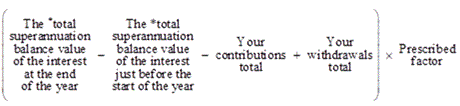
Various elements of this formula are prescribed in the regulations, as outlined below.
296-70.01 Relevant superannuation earnings—prescribed factor
New section 296-70.01 prescribes the value 0.825 for the TSB earnings formula in subsection 296-70(1) of the ITAA 1997. The prescribed factor is applied to reduce the amount worked out under the first part of the formula. The value has been determined based on advice from the Australian Government Actuary and is intended to provide commensurate treatment with the general earnings approach under section 296-65 of the ITAA 1997.
Example 11: Application of the prescribed factor to an individual's Division 296 liability
Declan is 55 years old and holds a defined benefit interest that is not in the retirement phase. This interest is the only superannuation interest that he holds.
Declan's interest has a TSB value of $4.5 million on 30 June 2028. On 30 June 2029, the interest's TSB value has grown to $4.62 million. Declan's defined benefit contributions are $30,000 for his interest. As Declan has not retired, no withdrawals were made.
Declan's relevant superannuation earnings are calculated by taking his end year TSB value, subtracting his TSB value just before the start of the year, subtracting any contributions, and adding back any withdrawals, and then multiplying that value by the prescribed factor.
Declan's relevant superannuation earnings will be:
($4.62 million – $4.5 million – $30,000 + 0) x 0.825 = $74,250
Assuming the large balance threshold has not been indexed, the proportion of Declan's TSB above the threshold is 35.06 per cent (($4.62 million – $3 million) / $4.62 million).
Declan's taxable superannuation earnings for Division 296 purposes are calculated as $26,032.05 by multiplying his total superannuation earnings by the percentage above the threshold (35.06 per cent of $74,250).
This taxable superannuation earnings amount will be taxed at 15 per cent. Declan will have a Division 296 tax liability of $3,904.80 for the 2028-29 income year (15 per cent of $26,032.05).
As Declan's interest is a defined benefit interest that has not begun paying benefits, he can elect to defer this Division 296 tax liability, which will become payable (i.e., due) when his benefits become payable from his interest. He may then use a release authority to pay this deferred debt from the interest, or pay it directly himself.
Section 296-70.02 Relevant superannuation earnings—your contributions total
New section 296-70.02 sets out how to determine 'your contributions total' for the purpose of the TSB value earnings formula in section 296-70 of the ITAA 1997. Broadly, contributions include certain amounts that are received into or otherwise increase the TSB value of the superannuation interest during the relevant income year, as discussed further below. These amounts are subtracted from the formula to ensure that these amounts are not counted as earnings for the superannuation interest.
Your contributions total is the sum of the amounts set out in the new section 296-70.02, which are discussed below. In some cases, these amounts will only be relevant to certain types of superannuation interests. If an amount (or part of an amount) could be counted under more than one provision, it is only to be counted once.
Paragraphs 296-70.02(1)(a), (b) and (c) cover member contributions or similar (depending on the type of interest).
- •
- If the interest is or includes a defined benefit interest and is not in the retirement phase, the non-retirement phase member contributions amount for the year is included as a contribution. This is the amount of member contributions paid by or on behalf of you in respect of the interest for the year (other than a time when the interest was in the retirement phase), and which are not assessable income of the superannuation fund.
- •
- The amount of defined benefit contributions for the year is included as a contribution. Defined benefit contributions is an existing concept in Subdivision 293-D of the Principal Regulations.
- •
- For an interest in a constitutionally protected fund that is not a defined benefit interest, all contributions made to the fund in respect of the member and the relevant interest for the year are included as contributions.
Paragraph 296-70.02(1)(d) covers various amounts that are rolled-over, transferred, allotted or credited into the relevant superannuation interest during the year. This would include:
- •
- a roll-over superannuation benefit, which is defined in section 306-10 of the ITAA 1997;
- •
- an amount of contributions splitting superannuation benefit;
- •
- an amount of family law superannuation payment paid into the relevant interest for your benefit during the year that is made because a superannuation interest of another person is subject to a family law payment split; and
- •
- the amount of an unclaimed money payment credited during the year to the interest.
Paragraphs 296-70.02(1)(e), (f) and (g) provide for the 'starting' TSB value of an interest to be included in your contributions total, where the interest did not exist or would have had a nil value for that person at the start of the income year.
- •
- The TSB value of a notional interest that begins to be deemed to be an interest of yours under subsection 307-230(3) of the ITAA 1997, which deals with the deemed interest of a non-member spouse in the context of a family law superannuation notional split (see discussion of family law splits below).
- •
- The TSB value of the relevant interest on the day you start to receive a death benefit income stream due to the death of another person. This is included because the interest is treated as not existing for the beneficiary at the start of the year (i.e., it is not included in their TSB). So, it is necessary to add the 'starting' TSB value of the death benefit income stream for the beneficiary into the formula as a contribution.
- •
- The TSB value of an invalidity pension that begins to be payable under section 16 of the Australian Defence Force Cover Act 2015. These interests do not exist until the invalidity pension commences, so the 'starting' TSB value will need to be included in the formula.
Paragraphs 296-70.02(1)(h), (i) and (j) cover amounts paid into a superannuation interest under certain insurance policies and insurance-like arrangements. Paragraph 296-70.02(1)(h) covers an amount that becomes included in the relevant interest during the year because of an amount paid under an insurance policy that is payable because of the death or total and permanent disability (TPD) of the insured person or because a terminal medical condition exists in relation to the person. Paragraph 296-70.02(1)(i) ensures that an amount paid under an insurance policy for death, TPD or a terminal medical condition that is paid into the relevant interest after your death will be counted as a contribution for the final income year, even if that payment occurs in a later income year. This is necessary to ensure that any such amount is included and gives the correct result for the final year Division 296 assessment.
Paragraph 296-70.02(1)(j) covers insurance-like arrangements that may exist for some defined benefit interests, and ensures that any increase in TSB value that is triggered by the crystallisation of death, permanent incapacity or terminal medical condition entitlements is included as a contribution. Note that paragraph 296-70.02(1)(j) is only intended to apply if there has been no payment for the same event under an insurance policy mentioned in paragraphs 296-70.02(1)(h) and (i). In effect this ensures that paragraph 296-70.02(1)(j) is only relevant for 'self-insured' arrangements where the scheme provides funding for the entitlements, without receiving insurance policy proceeds.
Paragraph 296-70.02(1)(k) covers an amount transferred from a foreign superannuation fund, worked out using the formula in subsection 296.70.02(3). This formula takes account of whether or not the member has made a choice regarding whether their applicable fund earnings are included in the assessable income of the superannuation plan.
For an interest that supports a deferred superannuation income stream that is not a pooled investment pension or pooled investment annuity, paragraph 296-70.02(1)(l) covers any amount of consideration paid in the year for that interest. While these consideration payments may in some circumstances be captured by other paragraphs if they come in the form of additional contributions or a roll-over superannuation benefit, paragraph 296-70.02(1)(l) ensures consideration payments will always be recognised regardless of how they are made.
Paragraph 296-70.02(1)(m) covers an amount by which the TSB value of the relevant interest increases as a result of certain events:
- •
- a payment for compensation for loss as a result of fraud or dishonesty;
- •
- a remediation payment;
- •
- a military invalidity income stream becomes payable to you; or
- •
- the amount payable from an interest that supports a military income steam increases as a result of reclassification in respect of incapacity.
The reference to the increase in TSB value reflects that the events described in this provision may result in changes to the value of the interest. To work out the change in value due to the event, the TSB value of the interest just before the event is compared to the TSB value of the interest just after the event.
Paragraph 296-70.02(1)(n) covers an amount that is allocated to the relevant interest from reserves, since these allocations are not intended to be treated as earnings for Division 296 purposes.
Section 296-70.03 Relevant superannuation earnings—your withdrawals total
New section 296-70.03 sets out how to determine 'your withdrawals total' for the purpose of the TSB value earnings formula in section 296-70 of the ITAA 1997. Broadly, withdrawals include amounts that are paid out of or otherwise reduce the value of the superannuation interest during the relevant income year. These amounts are added to the formula to ensure that the earnings formula accounts for earnings on the amount in the superannuation interest during the relevant income year.
Your withdrawals total is the sum of the amounts set out in the new section 296-70.03, which are discussed below. In some cases, these will only be relevant to certain types of superannuation interests. To the extent that an amount could be counted under more than one provision, it is not to be double counted.
Any superannuation benefit that is paid, rolled-over, transferred or allotted from the relevant interest will be covered as a withdrawal under paragraph 296-70.03(1)(a). 'Superannuation benefit' is defined in section 307-5 of the ITAA 1997 to include a range of payments or transfers from the interest. Superannuation benefits include roll-over superannuation benefits. Note that there are some amounts that would otherwise be a superannuation benefit, which are disregarded from this provision (see further discussion below).
Certain adjustments relating to family law payment splits are also included as withdrawals under paragraph 296-70.03(1)(b) and subsections 296-70.03(2) and (3) (see discussion of family law splits below).
If you die during the year and another person starts to receive a death benefit income stream that is supported by the relevant interest, the TSB value of the interest is included as a withdrawal for the member under paragraph 296-70.03(1)(c). For clarity, the TSB value of the interest for these purposes is the TSB value of the death benefit income stream when another person starts to receive it. This amount will be included as a withdrawal in the year of death, even if the death benefit income stream commences to be payable to the beneficiary in the following year. As the superannuation interest supporting the death benefit income stream still exists (to support the death benefit income stream), subsection 296-70.03(4) provides that any amount paid from the death benefit income stream is disregarded and not counted as a superannuation benefit under paragraph 296-70.03(1)(a) in relation to your withdrawals total for the deceased person. (For completeness, the TSB value of the interest supporting the death benefit income stream will be included as a contribution for the beneficiary as discussed previously.)
If you die and a superannuation death benefit is paid to another person from the relevant interest (for example, a lump sum payment made to a beneficiary), this is also counted as a withdrawal under paragraph 296-70.03(1)(d). As with death benefit income streams, the amount will count as a withdrawal for the year of death, even if it occurs in a later income year. Since the meaning of 'superannuation death benefit' in section 307-5 of the ITAA 1997 also includes a payment under a death benefit income stream, those payments are disregarded by subparagraph 296-70.03(1)(d)(iii) to ensure there is no double counting.
Subsection 296-70.03(4) also ensures that any amounts paid as superannuation death benefits or amounts paid to another person from a death benefit income stream do not count under paragraph 296-70.03(1)(a). This clarification is necessary to ensure there is no double counting, since the treatment of amounts paid as a superannuation death benefit or amounts paid to a beneficiary from a death benefit income stream are specifically dealt with under paragraphs 296-70.03(c) and (d).
A withdrawal is also included for the amount by which the TSB value of the interest decreases because a military invalidity income stream ceases to be payable, or the amount decreases as a result of reclassification in respect of incapacity (paragraph 296-70.03(1)(e)).
Subsection 296-70.03(5) provides that certain arrears payments from a military invalidity income stream for retrospective decisions about incapacity are to be disregarded and not counted as a superannuation benefit under paragraph 296-70.03(1)(a) for the purpose of 'your withdrawals total'. This is necessary to avoid the unintentional result where an arrears payment, which would be treated as superannuation benefit, would be added into the formula as a withdrawal and result in a large earnings amount for the income year, despite it relating to a decision about a past period of invalidity. This amount is only disregarded if there is no amount or corresponding amount included in 'your contributions total' for the year or a previous income year. If there has been a corresponding contribution, then the amount would be treated as a withdrawal under paragraph 296-70.03(1)(a). This is intended to allow for a range of potential scenarios, such as where the arrears payment or part of that arrears amount is paid into the interest as a contribution, or cases where there is no contribution and the amount is just paid directly to the member.
If an amount is paid or transferred out of a superannuation interest during the year as a result of fraud or dishonesty, this is not included in the withdrawals total if the conditions of subsection 296-70.03(6) are met. The conditions include that a person has been convicted of an offence that involved fraud or dishonesty, and the Commissioner has been notified in the approved form.
Example 12: Calculating relevant superannuation earnings for a prescribed interest
Leah has a superannuation interest that supports a complying lifetime pension, which is a prescribed interest under section 296-65.01. The TSB value of her interest is its family law value. Just before the start of the year, the interest's TSB value is $3,339,616.
During the year Leah receives 26 fortnightly pension payments totalling $280,000, which count towards her 'withdrawals total'. At the end of the year the interest's TSB value is $3,279,778.
The relevant superannuation earnings for Leah's interest are calculated as follows:
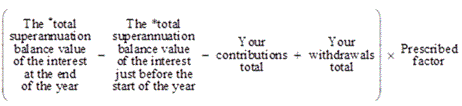
= ($3,279,778 – $3,339,616 – $0 + $280,000) x 0.825
= $220,162 x 0.825
= $181,633.65Example 13: Calculating relevant superannuation earnings for a prescribed interest that ceases to exist partway through the year
Jacob had a defined benefit interest, which provided an entitlement to a lump sum upon retirement. Its TSB value just before the start of the income year was $3,185,082. Jacob retired upon reaching age 60 on 1 October. On the same day he became entitled to a lump sum benefit of $3,260,416. He directed his defined benefit scheme provider to pay the lump sum as a roll-over superannuation benefit into an accumulation account in his SMSF.
Jacob's defined benefit contributions for the year were $10,888, and he had no member contributions.
As Jacob's defined benefit interest no longer existed at the end of the income year, its TSB value is taken to be nil (see subsection 296-70(2) of the ITAA 1997).
The relevant superannuation earnings for Jacob's defined benefit interest are calculated as follows:
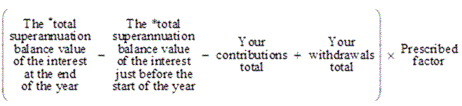
= ($0 – $3,185,082 – $10,888 + $3,260,416) x 0.825= $64,446 x 0.825= $53,167.95
Jacob's SMSF's Division 296 fund earnings for the income year totalled $254,022, of which $82,850.30 was attributed to determine the relevant superannuation earnings of Jacob's accumulation account (as specified in an actuary's certificate obtained by the SMSF).
Jacob's total superannuation earnings for the year is the sum of the relevant superannuation earnings for each of his interests: $53,167.95 + $82,850.30 = $136,018.25
Section 296-70.04 Modification of sections 296-65 and 296-70 of the Act in relation to deceased individual
New section 296-70.04 modifies the general earnings rules in sections 296-65 and 296-70 of the ITAA 1997 for the year in which a person dies.
The modifications regarding the Division 296 treatment for the year in which a person dies are specifically contemplated by paragraph 296-75(2)(i) and subsection 296-75(3) of the ITAA 1997. This is necessary, because if a person dies, their superannuation interest continues to exist until it is fully cashed out. The interest may continue to exist as the deceased's superannuation interest if it supports a death benefit income stream, such as where a reversionary pension is payable to a dependant from the interest. The modifications recognise that depending on the timing of death and when the superannuation interest is finally cashed out, there may be events that are relevant to the earnings on the interest. As the final Division 296 tax assessment will relate to the year in which the person dies, it is appropriate and necessary for the regulations to modify the primary law in relation to this specific situation to ensure consistent and appropriate Division 296 tax treatment to all types of superannuation interests in that final income year.
Subsection 296-70.04(2) modifies the general earnings rule in section 296-65 so that if a person dies in a year, the superannuation earnings for that final income year will include earnings attributable to the superannuation interest in that year up to their death and earnings that occur after death until the interest is fully 'cashed out'. The interest will be fully cashed out at the earlier of either the time that all superannuation death benefits have been paid or distributed from the interest, or the time when because of the deceased individual's death, another person starts to receive a death benefit income stream supported by the relevant interest.
The modification to the general earnings rule in section 296-65 also means that if the deceased person's superannuation interest is not fully 'cashed out' in the year of their death, their relevant superannuation earnings will include any earnings attributable to the superannuation interest in any later income year or years until the earlier of either of the above two conditions.
As a deceased member's superannuation interest will continue to accrue earnings after their death until the earlier time of either of the two conditions noted earlier, this modification is necessary to ensure that any and all earnings on the superannuation interest of the deceased individual are subject to appropriate tax treatment, consistent with accepted fund income tax principles and treatment of interests for fund tax purposes.
For instance, for the purposes of a fund's tax assessment under existing Division 295 of the ITAA 1997, the earnings on assets underpinning a deceased member's interest may affect the fund's taxable income until the interest exits the fund. Where an asset supporting a superannuation interest is sold (whether that person is alive or deceased), the earnings are included in the fund's tax assessment. The taxation of these earnings is accounted for in the member's balance and any death benefit that is paid from the interest. For Division 296 tax purposes, the same principle applies because a fund's Division 296 fund earnings are based on its income, so when an asset is sold the fund's Division 296 fund earnings will generally increase. In both cases, any earnings that accrue in the period between death and when benefits are paid will be subject to taxation.
This modification is an important integrity rule, since funds may realise or seek to realise capital assets after death in order to pay death benefits to beneficiaries, which may result in a significant increase in earnings attributable to that interest (reflecting capital growth that accumulated in previous years while the member was alive) that would otherwise avoid proper taxation. It is expected that in most cases for those deceased individuals in scope, all relevant superannuation earnings of a deceased individual's interests will be included in the final Division 296 assessment, reducing compliance costs and complexities for the legal personal representative of the deceased individual's estate who will know that there will only be one relevant original assessment for the final Division 296 income year. However, there may be instances where amendments to the original assessment will be required, as the deceased's interests may have further relevant superannuation earnings attributed following death.
Example 14: Relevant superannuation earnings in relation to a superannuation interest of a deceased individual, with benefits distributed from the interest in a year after death
Tim and Dawn are members of an SMSF with non-excluded accumulation superannuation interests worth a total of $8 million on 30 June 2028. An actuary has certified that the share of the total funds is distributed evenly between Tim (50 per cent) and Dawn (50 per cent) such that their respective TSBs are valued at $4 million. As Tim and Dawn's respective TSBs at the end of the 2027-28 income year are greater than the large superannuation balance threshold of $3 million, they are both in-scope for Division 296 tax.
On 23 June 2029, Dawn passes away. Dawn's TSB upon that date is subsequently taken to be nil (see section 296-50 of the ITAA 1997). However, Dawn's interest is composed of several different assets which take time to be sold in order to pay out the superannuation death benefits related to this interest. The fund sells a number of assets and her interest in the SMSF is fully distributed on 12 September 2029.
As Dawn's superannuation interest had not been fully distributed as a superannuation death benefit until the following income year after her death, this means that to work out Dawn's relevant superannuation earnings for Division 296 purposes and her Division 296 tax liability for the 2028-29 income year, her earnings must also take into account earnings of her interest in the 2029-30 income year up to and until the interest is paid out.
In the 2028-29 income year the SMSF had Division 296 fund earnings of $500,000 for the fund year. An actuary certified that the amount attributable to Dawn's interest was $250,000. Her interest was valued at $4.25 million on 30 June 2029.
In the 2029-30 income year, the SMSF had Division 296 fund earnings of $1 million for the fund year (in part due to the sale of several assets to pay out her death benefit). An actuary certified that the amount attributable to Dawn's interest was $162,848. The actuary determined her interest in the fund was valued at $4.25 million for 20 per cent of the year, and then $0 for the remaining part of the year as a result of her interest being paid out as a superannuation death benefit, giving an average value of $850,000.
Dawn's total superannuation earnings for 2028-29 (the year she died) is $412,848. This is the sum of the relevant superannuation earnings attributed to her interest in the 2028-29 and 2029-30 fund income years.
Subsection 296-70.04(3) modifies the TSB value earnings formula in section 296-70 of the ITAA 1997 to ensure that, for the purposes of working out the relevant superannuation earnings for the relevant year in which a person dies, the TSB value of the interest at the end of the relevant year is taken to be nil. This modification will ensure that for the final year calculation of a deceased person's relevant superannuation earnings for the relevant interest (those superannuation interests covered by section 296-65(2) of the ITAA 1997), the TSB value of the interest will always be nil at the end of the relevant year.
This is necessary to allow the correct calculation of the deceased person's relevant superannuation earnings for the relevant interest in the year that they die. As discussed above, if you die and another person starts to receive a death benefit income stream that is supported by the relevant interest, the TSB value of the relevant interest is counted as a withdrawal in 'your withdrawals total' (see section 296-70.03). Similarly, an amount that is paid to another person (including the trustee of the deceased person's estate) as a superannuation death benefit, is counted as a withdrawal under section 296-70.03. This includes superannuation death benefit lump sums, including amounts that are rolled over from the relevant interest of the deceased person into a separate superannuation interest for a beneficiary to commence a new superannuation income stream.Example 15: prescribed interest where the member dies during the year, or the reversionary beneficiary becomes entitled to the pension
Conan is receiving a lifetime pension, which will become payable to his spouse Matilda upon his death. The interest supporting the lifetime pension is a prescribed interest under section 296-65.01. Just before the start of the income year the interest's TSB value is $3,855,768.
Conan receives payments of $12,500 each fortnight from the pension. He receives 15 fortnightly payments (totalling $187,500) prior to his death on 27 January. Upon his death, the pension transfers to Matilda as a reversionary beneficiary. Matilda receives the remaining 11 fortnightly payments for the income year (totalling $137,500).
At the time the pension begins being payable to Matilda, the TSB value of the interest is $3,798,275. At the end of the income year, the TSB value of the interest is $3,773,335.
To work out Conan's relevant superannuation earnings for the year, the TSB value of the interest is taken to be nil at the end of the year, as he had already died and the pension had already reverted to Matilda before then. His 'your withdrawals total' will also include the TSB value of the interest at the time it reverted. The pension payments that were paid to him before his death also count towards his 'your withdrawals total', but the pension payments that were paid to Matilda after his death do not.
Conan's relevant superannuation earnings for the interest are:
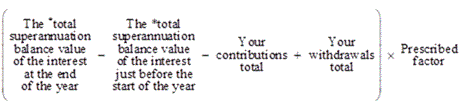
= ($0 – $3,855,768 – $0 + ($187,500 + $3,798,275)) x 0.825
= $130,007 x 0.825
= $107,255.78
To work out Matilda's relevant superannuation earnings for the year, the TSB value of the interest is taken to be nil at the start of the year, and her 'your contributions total' include the TSB value of the interest at the time it reverted.
Matilda's relevant superannuation earnings for the interest are:
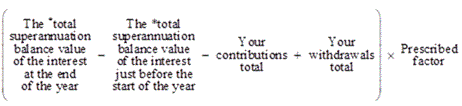
= ($3,773,335 – $0 – $3,798,275 + $137,500) x 0.825
= $112,560 x 0.825
= $92,862Example 16: Relevant superannuation earnings in relation to a superannuation interest where there is a reversionary superannuation income stream and the member dies
David and Chris are both members of a SMSF which has both non-excluded accumulation and retirement phase superannuation interests worth a total of $6 million on 30 June 2028. David has a two-third share ($4 million) of the total funds, while Chris has the remaining one-third ($2 million). These proportions are actuarially certified.
At 30 June 2028, David has two superannuation interests in the SMSF – a retirement phase interest actuarially valued at $2 million that supports a superannuation income stream (an account-based pension) that becomes payable to his spouse upon his death, and the remaining $2 million in an accumulation interest. Chris is David's spouse and has one accumulation interest of $2 million in the fund.
As David has a TSB at the end of the 2027-28 income year greater than the large superannuation balance threshold of $3 million, he is in-scope for Division 296 tax for the 2027-28 income year.
In the 2028-29 income year, David passes away (5 February 2029). Since David's TSB just before the start of the year (i.e. on 30 June 2028) was $3 million, David is also in scope for Division 296 tax in the 2028-29 income year.
David's retirement phase superannuation income stream reverts to Chris after David's death. Chris now has both an accumulation interest and becomes the recipient of a retirement phase superannuation income stream supported by David's interest. Chris' TSB is $4 million at 30 June 2029.
David's superannuation accumulation interest is distributed as a superannuation death benefit to Chris inside the same income year (12 May 2029). In addition, as Chris has a TSB at the end of the 2028-29 income year greater than the large superannuation balance threshold of $3 million (assuming the threshold has not been indexed,), he is in-scope for Division 296 tax.
In the 2028-29 income year the SMSF had Division 296 fund earnings of $1.5 million for the fund year (in part due to the sale of several assets to pay out the death benefit). An actuary certificate was relied upon to determine that an amount of:
- -
- $452,153 is attributable earnings for David's accumulation interest, determined by the actuary using the small fund methodology which determined the interest's average TSB value was $1.73 million.
- -
- $314,354 is attributable earnings for David's interest supporting his retirement phase income stream, determined by the actuary using the small fund methodology which determined the interest's average TSB value was $1.20 million.
Similarly, the actuary certified an amount of:
- -
- $523,923 is attributable earnings for Chris's accumulation interest, determined by the actuary using the small fund methodology which determined the interest's average TSB value was $2 million.
- -
- $209,569 is attributable earnings for to the relevant interest supporting the death benefit income stream which Chris is in receipt of, determined by the actuary using the small fund methodology which determined the supporting interest's average TSB value was $0.8 million.
Items 1, 3 and 4 – Consequential amendments
Item 1 of Schedule 1 is a consequential amendment to clarify that the new section 296-60.01 is made under the authority of the Income Tax (Transitional Provisions) Act 1997.
Item 3 of Schedule 1 ensures that the rule in section 307-200.03 of the Principal Regulations does not apply to Division 296. Section 307-200.03 provides for interests in certain public sector superannuation schemes to be treated as two separate superannuation interests for various purposes within the ITAA 1997. However, for Division 296, this kind of interest is to be treated as a single interest to ensure the appropriate outcome.
Item 4 of Schedule 1 inserts some new definitions into section 995-1.01.
death benefit income stream is used to refer to:
- •
- a superannuation income stream that a person is a retirement phase recipient of because of the death of another person that is supported by the relevant interest; or
- •
- an income stream that is not a superannuation income stream, payable to a person because of the death of another person and is supported by the relevant interest.
The first dot point is intended to refer to reversionary pensions that automatically become payable to a dependent upon a person's death, as well as other death benefit superannuation income streams, such as where a beneficiary elects to take a superannuation death benefit as an income stream.
The reference in the second dot point to an income stream that is not a superannuation income stream is intended to pick up certain pensions that, for technical reasons, are not treated as superannuation income streams under the ITAA 1997. For example, pensions referred to under section 307-70.02(1A) of the Principal Regulations.
military invalidity income stream is a label that enhances readability of the provisions by grouping military invalidity income streams together. It covers the following:
- •
- a pension payable within the meaning of the Defence Force Retirement and Death Benefits Act 1973;
- •
- an invalidity pension under the Military Superannuation and Benefits Scheme; and
- •
- a pension payable under section 16 of the Australian Defence Force Cover Act 2015.
Schedule 2 –Total superannuation balance value and the value of superannuation interests
Part 1, items 1 to 3 – Consequential amendments relating to the Amending Act
Items 1, 2 and 3 make consequential amendments to the Principal Regulations to ensure the Regulations correctly reference the ITAA 1997 as amended by the Amending Act. The meaning of the amended provisions are otherwise unchanged.
Part 2, item 4 – Total superannuation balance value and the value of superannuation interests
Items 4 and 5 amend the existing valuation rules in section 307-205.02C of the Principal Regulations that deal with the value of deferred innovative income streams. This new valuation methodology creates a more appropriate distinction between the value of the interest during the deferral period and once payments commence. During the deferral period, the existing methodology (withdrawal benefit) will continue to apply, with any amounts previously commuted from the interest to be subtracted. After the deferral period has ended, the value of the interest is equal to the maximum commutation amount of the interest, which is worked out under paragraph 1.06B(1)(c) of the SIS Regulations (the Capital Access Schedule).
Item 6 inserts sections 307-230A.01, 307-230A.02, 307-230A.03, 307-230A.04, 307-230A.05, 307-230A.06, 307-230A.07, 307-230A.08 and 307-230A.09 at the end of Subdivision 307-D in the Principal Regulations. These sections prescribe various methods for valuing certain types of superannuation interests for the purposes of determining an individual's TSB under paragraph 307-230A(1)(a) of the ITAA 1997.
These valuation methods are used to value interests where the default method in paragraph 307-230A(1)(b) of the ITAA 1997 is not appropriate. The valuation methods apply to three broad categories of superannuation interests:
- •
- defined benefit interests that are not in the retirement phase – commonly referred to as the 'growth phase'. The value of these interests is generally not reflected by an identifiable 'account' comprising contributions and investment returns, with an individual's entitlement instead being calculated based on a series of factors (for example, by multiplying their salary by a service-based factor);
- •
- interests supporting retirement phase income streams that do not have an account balance or identifiable lump sum amount; and
- •
- certain other superannuation interests, including some invalidity pensions and innovative superannuation income streams.
Defined benefit interests that are not in the retirement phase
The following diagram illustrates how 'growth phase' defined benefit interests are valued under these provisions.
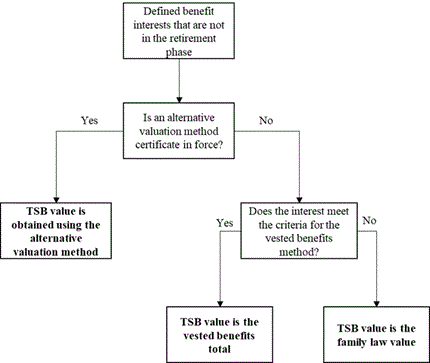
Section 307-230A.01 prescribes the method to be used for determining the value of a defined benefit interest if that interest is not in the retirement phase. If the interest is not in the retirement phase, has a family law value, and is not an interest covered by subsection 307-230A.01(4), then the prescribed method is the alternative valuation method (discussed below) if there is one for the interest, and if not, the prescribed method is the family law method (explained below). The family law method reflects an approach considered by the Government to be an appropriate benchmark for TSB valuation, not only for the purposes of Division 296 tax, but more generally in the superannuation system. This method is already used to provide a suitable 'point in time' value for a defined benefit interest when that interest is subject to family law proceedings.
For lump sum-only interests that are not in the retirement phase and fulfil certain other criteria, subsection 307-230A.01(4) provides that the method that applies is the vested benefit method, unless an alternative valuation method applies for the interest, in which case it is that alternative valuation method. The vested benefit method reflects a cost-effective approach for certain lower value interests where, due to the nature of benefits provided under these schemes, the method will generally not result in an undervaluation when compared to a family law value.
Retirement phase and certain other interests
The following diagram illustrates how interests supporting retirement phase income streams are valued under these provisions:
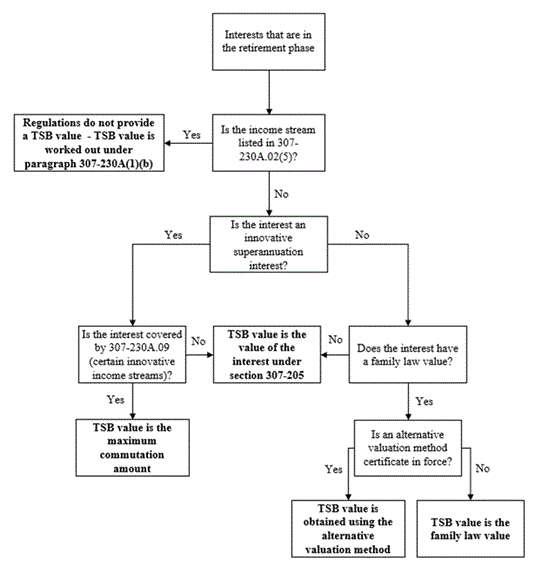
Section 307-230A.02 prescribes the method to be used for determining the value of an interest in the retirement phase. If the interest is in the retirement phase and has a family law value, subsections 307-230A.02(1) and (2) provide that the prescribed method is the family law method, unless an alternative valuation method applies for the interest, in which case it is that alternative valuation method.
Subsections 307-230A.02(3) and (4) deal with certain superannuation interests that do not have a family law value, which will use the value of the superannuation interest within the meaning of section 307-205 of the ITAA 1997. This approach maintains existing methods used to value such interests for other superannuation purposes and is an appropriate option where they do not have an applicable family law method.
The valuation methods set out in section 307-230A.02 do not apply to certain allocated, account-based, and market-linked pensions and annuities that are set out in subsection 307-230A.02(5). For those interests, the valuation method is the withdrawal benefit, which is the default method in the ITAA 1997. These income streams all have identifiable account balances that provide a suitable value for the interest using the withdrawal benefit method. Subsection 307-230A.02 also does not apply to a superannuation interest that is covered by subsection 307-230A.03(2) or (4).
Certain other superannuation interests
Subsections 307-230A.03(1) and (2) provide the valuation methodology for a superannuation interest that supports an income stream that is a pension payable under sections 16 or 26 of the Australian Defence Force Cover Act 2015, or that supports an income stream that is a pension payable under section 123 of the Federal Circuit and Family Court of Australia Act 2021. These interests will use the family law method unless an alternative valuation method is specified, in which case the method is the alternative valuation method. Due to the particular characteristics of these two kinds of income streams they may not be captured by sections 307-230A.01 or 307-230A.02, so this provision ensures they are correctly valued.
Subsections 307-230A.03(3) and (4) provide that if the interest supports an innovative income stream provided under a contract or rules that meet the standards of subregulation 1.06A(2) of the SIS Regulations, the valuation methodology will be the maximum commutation amount of the interest if subsection 307-230A.09 applies, otherwise the value of the interest within the meaning of section 307-205 of the ITAA 1997. For these kinds of interests, existing methods in sections 307-205.02C, 307-205.02D and 307-205.02E of the Principal Regulations provide suitable methods to determine their TSB value.
Family law value method
Subsection 307-230A.04 sets out how the family law values apply for the purpose of working out a superannuation interest's TSB value.
The family law method is based on the method in the Family Law (Superannuation) Regulations 2025 (Family Law Regulations), which contain default valuation factors and methods of calculation to be used for the valuation of superannuation interests, including defined benefit interests, for the purpose of dividing superannuation in a family law separation process. The methods and factors are designed to provide a best estimate of the value of these superannuation interests at a given point in time.
The Family Law Regulations also provide the Attorney-General with the power to approve, by legislative instrument, valuation methods and factors that apply to a specific scheme or interest. Generally, this occurs if the default valuation methods or factors are considered inappropriate considering the benefit design or underlying experience of a particular scheme. Under these provisions, if a scheme or interest has methods or factors approved in such an instrument, the family law method will be based on those methods or factors.
The default family law method will apply to applicable interests in an SMSF, despite paragraph 44(2)(b) of the Family Law Regulations.
When applying the Family Law Regulations for determining TSB value under these provisions, if there is different treatment depending on the member's gender, they are to be treated as if the member were male. This is to avoid any inequitable outcomes based on gender, so the relevant factors for all members will use male or unisex factors. In the absence of this treatment, female members (all other things being equal) may have higher tax liabilities purely based on their longer assumed life expectancies compared to males.
Similarly, if there is a method or factor that applies differently depending on whether the member has a reversionary beneficiary, it is to be assumed that the member does not and will not have a reversionary beneficiary. This will mean that the value of the interest is not inflated to take account of the value of a reversionary pension where the method in the Family Law Regulations includes an extra component based on the prospective entitlement of a current spouse.
Alternative valuation method
Sections 307-230A.05, 307-230A.06 and 307-230A.07 deal with the alternative valuation method. An alternative valuation method can be used for certain interests instead of the family law method. To use an alternative valuation method, there must be a family law value for the interest, and a certificate under section 307-230A.06 must be in force. The alternative valuation method must have been used by the trustee to value the interests just before 1 July 2026 or if the trustee did not use a method before that date, the alternative value method must be the vested benefits total of an interest.
This approach reflects a recognition that a superannuation actuary may have an existing valuation method that could be used instead of the family law method that would result in a very similar value to the benchmark family law method for a particular benefit category or whole scheme. This is intended to reduce the regulatory burden of additional costs associated with moving to the family law method, where an alternative valuation method would achieve an appropriate value.
Section 307-230A.06 provides for a superannuation actuary to issue an alternative valuation certificate if certain criteria are met. A superannuation actuary may issue a certificate if the actuary is requested to do so by the trustee of the fund. The certificate may set out an alternative method for valuing the interests in the fund, providing this method is either the method used just before 1 July 2026 or the vested benefits total. To issue a certificate, the actuary must be of the opinion that if the alternative valuation method is used, the value determined for at least 95 percent of the specified superannuation interests would be no less than 90 per cent, and no more than 110 per cent, of the value that would be determined if it was the family law valuation method that was used for those interests.
To be valid, the certificate must be in writing and state the name of the fund, the name of the actuary, and that, in the actuary's opinion, the specified alternative valuation method meets the criteria.
The certificate comes into force at the time specified in the certificate, and ceases to be in force either:
- •
- at the end of three years from when the certificate came into force;
- •
- when it is withdrawn under section 307-230A.07; or
- •
- when another certificate comes into force that meets the requirements of a certificate and is issued in relation to any of the superannuation interests to which the initial certificate relates.
However, the certificate is not in force at a time before it is issued if the trustee of the fund has given the Commissioner of Taxation a member information statement under subsection 390-5(1) of Schedule 1 to the Taxation Administration Act 1953, and the statement contains the TSB value of any of the specified interests at that time. This limitation ensures that a certificate cannot apply retrospectively when a statement has already been provided to the Commissioner – that is, if the trustee has already reported TSB values for the interests for a time prior to the certificate's issue, those values cannot be rendered incorrect by the certificate.
Section 307-230A.07 provides that a certificate may be withdrawn, either by a superannuation actuary, or by a trustee of a defined benefit fund in relation to which the certificate was issued. An actuary is required to withdraw a certificate if the actuary forms the opinion that the alternative valuation method in the certificate does not meet the requirements in subsection 307-230A.06(3). The actuary must make the withdrawal in writing, and it must be given to the trustee of the relevant defined benefit fund. A trustee of a defined benefit fund may withdraw a certificate at any time, and the withdrawal must be in writing.
A certificate that is withdrawn will cease to apply from the time it is withdrawn. However, any TSB values that were determined using the alternative valuation method in the certificate while it was in force prior to its withdrawal are not rendered incorrect by the withdrawal.
Example 17: Withdrawal of certificate during the three-year period
The QQQ scheme is a defined benefit scheme. It has a class of 20 members in 'benefit category A', whose entitlements are calculated under the same rules.
The QQQ scheme trustee wishes to use its existing 'scheme value' method to ascertain TSB values, rather than changing to the family law method. The trustee engages an actuary to provide an alternative valuation method certificate for the purposes of determining TSB values. The actuary certifies that, as at 30 June 2026, for all of the members in benefit category A the value produced by the 'scheme value' method would be within 90 and 110 per cent of the family law value.
The certificate is issued to the trustee in September 2026, with a specified date of 30 June 2026. The TSB values for benefit category A members are determined using the 'scheme value' method for 30 June 2026 and 30 June 2027.
In August 2027 there is an amendment to the governing rules of the QQQ scheme that materially impacts how entitlements are calculated for benefit category A members. The QQQ scheme trustee engages their actuary to review their certificate. The actuary forms the opinion that the 'scheme value' method would no longer produce values within 90 and 110 per cent of family law value and withdraws the certificate on 30 August 2027.
On 30 June 2028 the TSB values for benefit category A members will be determined using the family law method. However, the previous use of the 'scheme value' method for 30 June 2026 and 30 June 2027 remains valid.
Vested benefits total
Section 307-230A.08 sets out criteria to determine whether a superannuation lump sum only interest is valued using the vested benefits method, and rules to work out the vested benefits total for these interests. The vested benefits method is used for those interests if there is no alternative valuation method certificate in force.
The section applies to an interest in a superannuation fund at a particular time if:
- •
- under the fund rules, the interest can never support a superannuation income stream, and;
- •
- the interest cannot cease in order to commence another superannuation interest in the fund that supports an income stream, and;
- •
- 12 months before valuation:
- -
- the vested benefits total in relation to the interest was 50 per cent or less of the large superannuation balance threshold at the test time, and it met these same criteria (and accordingly was valued under the vested benefits method), or
- -
- the interest did not exist, or
- -
- if the interest arose in the 12 months before the application time as a direct result of an involuntary roll-over, the previous interest (that ceased due to the involuntary roll-over) did not exist.
For the avoidance of doubt, the vested benefits method is not used if the interest is a military invalidity income stream or pension to which subsection 307-70.01(1A) applies. This clarification is included since those income streams and pensions are not superannuation income streams in the retirement phase under the ITAA 1997. Those interests will use the valuation method in section 307-230A.01.
The criteria mean that, if a superannuation lump sum only interest is under the threshold value of 50 per cent of the large superannuation balance threshold, that interest is valued using the vested benefits method. If an interest's value exceeds 50 per cent of the large superannuation balance threshold on 30 June of a year, it will still use the vested benefits method for that valuation, however from the following 30 June onwards the interest will be valued using the family law method.
The large superannuation balance threshold is $3 million for the 2026-27 income year, and is subject to indexation. This means that the threshold for the vested benefits method will initially be $1.5 million, and will increase with any subsequent indexation of the large balance threshold so it will remain at 50 per cent of that amount.
Subsection 307-230A.08(2) clarifies that the requirements in paragraph 307-230A.08(1)(a) for the interest to be a superannuation lump sum only interest are not intended to preclude an interest that may support payment of an amount from an income stream that is payable for temporary or permanent incapacity. This also covers insurance-like arrangements for temporary and permanent incapacity.
Example 18: lump sum only interest surpassing the vested benefit threshold
Michelle is a member of the XYZ scheme, a defined benefit scheme that pays a single lump sum when a member retires.
On 30 June 2027, the TSB value of Michelle's interest was calculated using the vested benefits method, with a TSB value of $1,480,000.
On 30 June 2028, the vested benefits method is again used to determine the TSB value of Michelle's interest, as on 30 June 2027:
- •
- the interest met the criteria in subsection 307-230A.08(1) to be valued using the vested benefits method; and
- •
- the vested benefits total was less than 50% of the large superannuation balance threshold, which was $3 million on 30 June 2026 (meaning the vested benefit threshold was $1.5 million).
Using the vested benefits method, the TSB value on 30 June 2028 is $1,510,000.
Assuming there is no indexation increase to the large superannuation balance threshold:
- •
- On 30 June 2029, the family law method must be used to determine the TSB value of Michelle's interest, as the vested benefits total was greater than $1.5 million on 30 June 2028. Using the family law method, the TSB value is $1,450,000.
- •
- On 30 June 2030, the family law method must still be used to determine the TSB value of Michelle's interest, irrespective of whether the vested benefits total was above or below $1.5 million. This is because the interest did not satisfy all of the criteria in subsection 307-230A.08(1) on 30 June 2029.
The vested benefits total for an interest covered by this section is the total value of the superannuation benefits to which an individual would be entitled if the individual had the right to and voluntarily caused the superannuation interest to cease or became entitled to a pension (noting the interests in question do not carry pension entitlements) or deferred benefit from the scheme.
A deferred benefit is a right or interest that was part of a defined benefit interest which became deferred after the individual holding the right or interest ceased contributing to the defined benefit scheme. The deferred benefit remains deferred until the individual becomes eligible to receive the benefit. The value of a deferred benefit is included for the purpose of determining the vested benefits total for an individual.
To determine the value of a superannuation lump sum only interest at a particular time, total vested benefits at the time is to be worked out in accordance with accounting standards in force at the time.
Item 11 (discussed below) sets out transitional arrangements relevant to valuations under section 307-230A.08, to work out whether the criteria are met for the first year the provisions apply.
Maximum commutation amount
Section 307-230A.09 provides the valuation method for certain superannuation income streams. This section covers a superannuation interest that at a particular time supports one or more superannuation income streams that are:
- •
- provided under a contract or rules that meet the standards of subregulation 1.06A(2) of the SIS Regulations; and
- •
- are not covered by sections 307-205.02C, 307-205.02D or 307-205.02E of the Principal Regulations.
Subregulation 1.06A(2) of the SIS Regulations provides standards for certain innovative superannuation income streams. This section applies to a subset of those income streams that are not deferred superannuation income streams (which have a method provided in section 307-205.02C), and are also not pooled investment pensions or annuities (which have methods provided in sections 307-205.02D and 307-205.02E respectively).
The valuation method for the interests covered by section 307-230A.09 is the maximum commutation amount, which is the total at the time of the amounts worked out under paragraph 1.06B(1)(c) of the SIS Regulations for each of those superannuation income streams.
Items 7 to 10 – Definitions
Items 8 and 9 amend the existing definitions of benefit category and defined benefit fund in section 995-1.01 of the Principal Regulations so that the existing definitions apply when the term is used in Subdivision 307-D.
Items 7 and 10 add new definitions to section 995-1.01 of the Regulations.
alternative valuation method means the method specified in the certificate issued under section 307-230A.06. This meaning is given by subsection 307-230A.05(2).
family law value means the value of the interest, determined using the method approved for that interest in the Family Law Regulations. This meaning is given by subsection 307-230A.04(2).
maximum commutation amount means, in relation to an interest, the total at the time of the amount worked out under paragraph 1.06B(1)(c) of the SIS Regulations for each of those superannuation income streams. This meaning is given by subsection 307-230A.09(2).
superannuation actuary has the same meaning as in the Superannuation Industry (Supervision) Act 1993 (SIS Act).
vested benefits total means, in relation to an interest, the total value of the benefits to which an individual would become entitled if the individual had the right to, and did voluntarily, cause the superannuation to cease, or became entitled to a pension or deferred superannuation benefit. This meaning is given by subsection 307-230A.08(3).
Item 11 – Application of amendments
Item 11 inserts transitional and application provisions into Chapter 7 of the Principal Regulations which deal with when the new TSB value provisions apply.
Subsection 1000-8.01(1) provides that amendments of section 307-205.02C apply in relation to working out the value of a superannuation interest at a particular time if that time occurs on or after 1 July 2026.
Subsection 1000-8.01(2) provides that sections 307-230A.01, 307-230A.02, 307-230A.03 and 307-230A.09 apply in relation to working out the TSB value of an interest on or after 1 July 2026.
As a result of this application provision, the TSB value for an interest just before 1 July 2026 will generally be worked out using the methodology that applied before the commencement of the Amending Act (see also the transitional rule in section 1000-8.03). If the TSB value of a superannuation interest is to be worked out on or after 1 July 2026, the new valuation provisions apply. Generally, this will be relevant to working out the TSB value at the end of the income year, but it may also be necessary to work out the TSB value of an interest at a particular time during the year for the purpose of 'your contributions total' or 'your withdrawals total', such as where an interest commences or ceases during the year.
Section 1000-8.02 deals with where there is a difference in TSB value of a superannuation interest caused solely by a change in the valuation methodology used just before 1 July 2026 and the valuation at 30 June 2027. If the new method value exceeds the TSB value just before 1 July 2026, the difference will be included in your contributions total under subsection 296-70.02(1). If the new method value is less than the TSB value just before 1 July 2026, the difference will be included in your withdrawals total under subsection 296-70.03(1).
Section 1000-8.03 prescribes the TSB value of an interest that is in the retirement phase and does not support a superannuation income stream mentioned in subsection 307-230A.02(5) just before 1 July 2026. The TSB value is worked out by dividing the amount of the person's transfer balance account at that time by the number of superannuation interests to which this section applies. For the purpose of working out the amount in the person's transfer balance account, certain transfer balance credits and debits are disregarded, which is to ensure there is no double counting.
This transitional provision will enable a person's TSB to be worked out to provide a similar outcome to the provisions that applied prior to the commencement of the Amending Act. The old law took the amount of a person's transfer balance account rather than adding together the value for each superannuation interest in the retirement phase. This section prescribes a TSB value to each of the interests covered by this section. The provision excludes certain interests mentioned in subsection 307-230A.02(5), which is also consistent with the TSB provisions prior to the commencement of the Amending Act.
If section 1000-8.03 applies to a superannuation interest that is subject to a family law payment split and a non-member spouse is treated under subsection 307-230(3) of the ITAA 1997 as having a superannuation interest because of that payment split, then section 1000-8.03 also applies to the non-member spouse's notional interest. Section 1000-8.03 also switches off the normal family law payment splitting provisions in sections 307-230A.10 (for the non-member spouse) and 307-230A.11 (for the member spouse) when the transitional rule in section 1000-8.03 applies to those interests (see discussion of family law splits below). This is because under existing transfer balance account arrangements for these family law payment splits, the transfer balances in both the member spouse and the non-member spouse's transfer balance accounts are already adjusted to reflect the notional family law splits.
Section 1000-8.04 provides that the conditions are altered for the purposes of working out whether section 307-230A.08 applies to a superannuation interest at a particular time if that time occurs before 30 June 2028. In that case, the requirement that the conditions applied 12 months before valuation is to be disregarded, and the reference to vested benefits total of the interest should be treated as being a reference to the value of the superannuation interest.
Given the criteria in section 307-230A.08 require the consideration of circumstances from 12 months prior, this alteration ensures that the provision still operates correctly for determining TSB values on 30 June 2027, which is the first time TSB values will need to be obtained under relevant provisions of the ITAA 1997.
Schedule 3 – Family law splits
Under the Family Law Act 1975, a superannuation interest may be split between spouses via a court order or via an agreement between the parties (see sections 90 XT or 90XJ of the Family Law Act 1975). Where the interest is actually split, both the member spouse and non-member spouse will be left with separate superannuation interests. The earnings from their respective (split) interests will be included for the purposes of determining their respective superannuation earnings in the normal way (that is, using either the general attribution rule in section 296-65 or the TSB value formula method in section 296-70, whichever applies to that type of superannuation interest).
However, some defined benefit interests are unable to be split between a member spouse and non-member spouse at the time the splitting order or agreement is made. Where the full (unsplit) amount of the defined benefit interest must be kept in the name of member spouse until retirement (and possibly beyond, depending on the rules of the specific defined benefit scheme), further modifications are needed to both spouses' TSB values to reflect the notional split between the two spouses. The amendments (outlined below) ensure superannuation earnings are calculated appropriately for the purposes of Division 296 in the years an interest is notionally split (but remains solely in the name of the member spouse).
Part 1, item 1 – Deeming provision for non-member spouse's notional interest
Subsection 307-230(3) of the ITAA 1997 provides that, if a superannuation interest is subject to a family law payment split, and circumstances prescribed by regulations exist, the non-member spouse is taken to have a superannuation interest in that superannuation plan despite the interest that is subject to the split remaining an interest of the member spouse. This effectively creates a 'notional' superannuation interest for the non-member spouse, which must be included when determining their superannuation earnings each year (while the underlying interest remains in the name of the member spouse).
Item 1 inserts section 307-230.01, which prescribes these circumstances as follows:
- •
- the superannuation interest is a defined benefit interest;
- •
- the interest is subject to a splitting order or agreement (under sections 90 XT or 90XJ of the Family Law Act 1975);
- •
- the interest is either in the growth phase or, if it is in the retirement phase, it supports a superannuation income stream via a pension or annuity; and
- •
- the non-member spouse's share of that defined benefit interest cannot be split from the member spouse's share, that is:
- -
- the non-member spouse's share cannot be transferred or rolled over to the non-member spouse; and
- -
- a separate interest cannot be created within the defined benefit plan in which the non-member spouse's share could be held in their own name.
Section 307-230.01 also ensures that the share of the defined benefit interest notionally allocated to the non-member spouse will be treated as a defined benefit interest for the purposes of calculating their Division 296 tax liability.
Part 1, item 2 – Annual modifications to TSB values to reflect notional splits
While the defined benefit interest remains subject to the payment split – that is, while the non-member spouse's share remains in the name of the member spouse – the TSB values of both the member and non-member spouse need to be modified each year to reflect the notional splits. This means annual modifications to both parties' TSB values are required as follows:
- •
- during the growth phase—each year; and
- •
- during the payment phase, if the defined benefit interest is paid out as a pension—each year, except the final payment year (the member's ordinary TSB value for this defined benefit interest will be nil in the final payment year).
No modifications are needed in the year that the defined benefit interest is fully paid out, since the TSB value is taken to be nil when the interest ceases to exist (see subsection 296-70(2) of the ITAA 1997).
Item 2 sets out the methodology to determine TSB values for interests subject to a family law payment split for the non-member spouse (section 307-230A.10) and for the member spouse (section 307-230A.11).
Non-member spouse's share
First, the TSB value of the full defined benefit interest – referred to as the unsplit TSB value – is calculated using the appropriate valuation method as outlined in Schedule 2 (e.g. family law method). Once the unsplit TSB value has been determined, one of the methods in section 307-230A.10 would then be used to split that interest between the member and non-member spouse.
The appropriate method for calculating the non-member spouse's share of the defined benefit interest depends on whether the splitting order or agreement specifies a base amount payment split or a percentage payment split.
For base amount payment splits during the growth phase:
- •
- In the first year, the non-member spouse's share is the base amount allocated to them in the splitting order or agreement (subsection 307-230A.10(4)).
- •
- In subsequent years, the non-member spouse's share is the adjusted base amount calculated in accordance with the SIS Regulations (subsection 307-230A.10(3)). This reflects an annual increase to the base amount reflecting an interest accrual, as provided by the Family Law Regulations.
For example, if a splitting order prescribed a base amount of $500,000 for a non-member spouse, in the year the splitting order was made the non-member spouse's TSB value would be $500,000. If, in the subsequent year, the adjusted base amount was $525,000 after adding interest, the non-member spouse's TSB value would be $525,000.
For base amount payment splits during the retirement phase, where the non-member spouse's share cannot be paid as a lump sum, their share is calculated as follows (subsection 307-230A.10(5)):
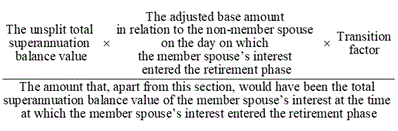
This formula converts the adjusted base amount owing to the non-member spouse at the time the member spouse enters the retirement phase into a percentage of the full unsplit TSB value of the defined benefit interest at that time. This mirrors the formula in subsection 85(2) of the Family Law Regulations, which also includes a transition factor. The transition factor reduces any impact on the non-member spouse's share that would otherwise be caused by a change in the methods or factors used to value the member spouse's superannuation interest (compared to the methods or factors used to value that interest at the time the splitting order or agreement was made). The same transition factor from subsection 85(2) of the Family Law Regulations applies in calculating the non-member spouse's share using the formula in subsection 307-230A.10(5) of the Regulations.
The non-member spouse then receives that percentage out of each pension payment that is made to the member. This ensures the notional split allocated to the non-member spouse reflects the actual proportion of payments they receive from that superannuation interest each year during the retirement phase.
For example, if at the time the member spouse entered the retirement phase:
- •
- the adjusted base amount in relation to the non-member spouse was $500,000; and
- •
- the full unsplit TSB value of the defined benefit interest was $2,000,000; and
- •
- the transition factor is 1 (that is, there had been no change to the methods and factors used to value the superannuation interest);
- the non-member spouse would effectively become entitled to 25 per cent of pension payments being paid from that defined benefit interest. If in the subsequent year the unsplit TSB value of the interest grew to $2,200,000, the non-member spouse's TSB value would be calculated as:

For percentage payment splits, the non-member spouse's share is calculated as follows (subsection 307-230A.10(6)):

For example, if a splitting order allocates 40 per cent of the defined benefit interest to the non-member spouse and 60 per cent to the member spouse, then each year 40 per cent of the unsplit TSB value (calculated using the appropriate method, e.g. family law method) would be allocated to the non-member spouse. For percentage payment splits, this same method applies whether the defined benefit interest is in the growth phase or the retirement phase (other than when the unsplit TSB value is nil).
Subsections 307-230A.10(7) and (8) apply to percentage payment splits, where the splitting order or agreement relates to a percentage-only superannuation interest.
If the percentage-only superannuation interest is an interest in a superannuation annuity (that is, either section 42 or section 49 of the Family Law Regulations applies to the payment split), subsection 307-230A.10(8) provides that the non-member spouse's interest is calculated in the same way as a standard percentage payment split.
However, if the percentage-only superannuation interest is not an interest in a superannuation annuity (that is, either section 41 or section 48 of the Family Law Regulations applies to the payment split), a modified calculation is needed to effectively 'lock' the entitlement of the non-member spouse to the stipulated portion of the superannuation interest at the time of separation, with any subsequent growth in the superannuation interest going solely to the member spouse (commonly referred to as a 'locked split'). Subsection 307-230A.10(7) provides that, in this situation, the non-member spouse's interest is calculated as follows:
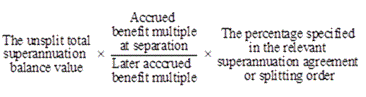
Accrued benefit multiple at separation is the member spouse's accrued benefit multiple, as defined in the governing rules of the eligible superannuation plan in which the superannuation interest is held, at the date when the member spouse and non-member spouse separated or, if there have been two or more separations, at the date of the most recent separation.
Later accrued benefit multiple means one of the following:
- •
- if the non-member spouse's interest is in the retirement phase—it means the accrued benefit multiple at payment, which is the member spouse's accrued benefit multiple, as defined in the governing rules of the eligible superannuation plan in which the superannuation interest is held, at the date when the splittable payment becomes payable in respect of the superannuation interest; or
- •
- otherwise—it means the member spouse's accrued benefit multiple, as defined in the governing rules of the superannuation plan in which the member spouse's interest exists.
Member spouse's share
Subsection 307-230A.11(3) provides that the member spouse's share of the defined benefit interest is calculated as the residual amount, after the non-member spouse's share has been subtracted from the unsplit TSB value each year:

Waiver notices
Sections 90XZA and 90YZQ of the Family Law Act 1975 allow a non-member spouse to serve a waiver notice on a trustee with respect to a payment split contained in a splitting order or superannuation agreement. The effect of such a waiver is:
- •
- the non-member spouse is no longer entitled to be paid any amount under the payment split; and
- •
- the entitlement of the member spouse continues to be reduced to reflect the payment split as if the entitlement of the non-member spouse had not been waived.
For example, assume the member spouse has a superannuation interest that is subject to a 50:50 payment splitting order, and the non-member spouse serves a waiver notice on the trustee, in exchange for a lump sum payment made by the trustee to another fund for the benefit of the non-member spouse (which will then be included in the non-member spouse's TSB for Division 296 tax purposes in the normal way). The effect is that the member spouse's interest will continue to be reduced by half in accordance with the payment split, but the non-member spouse no longer receives a notional split (and will not receive any (further) payments) from that superannuation interest under the payment splitting order.
In the event that the non-member spouse serves an effective waiver notice for the purposes of section 90XZA or 90YZQ of the Family Law Act 1975:
- •
- subsection 307-230A.10(9) provides that the non-member spouse's interest is taken to be nil; and
- •
- subsection 307-230A.11(5) provides that the value of the member spouse's interest continues to be reduced to reflect the payment split as if the entitlement of the non-member spouse had not been waived.
Multiple payment splits
Subsections 307-230A.10(10) and (11) and subsection 307-230A.11(6) deal with the situation where multiple payment splits apply to the same superannuation interest. In line with the Family Law Act 1975, priority is accorded to earlier payment splits (regardless of whether it was a marriage or de facto relationship) when calculating notional splits for Division 296 tax purposes. Subsequent payment splits are applied in chronological order.
Example 20: multiple payment splits
As at 30 June 2027, Jason has a defined benefit superannuation interest which is subject to two splitting orders. The rules of Jason's superannuation fund do not allow part of a defined benefit interest to be transferred to a non-member spouse before the member reaches retirement age. Jason has not reached retirement age. Accordingly, notional splits will need to be calculated to apportion the interest between Jason and the two non-member spouses.
The first splitting order was issued in 2015. It stipulates that Anika (the first non-member spouse) is entitled to 50% of Jason's defined benefit superannuation interest. As at 30 June 2027:
- •
- The unsplit TSB value of Jason's interest is $5 million.
- •
- The TSB value of Anika's share of the interest is $2.5 million (50% x $5 million).
- •
- Therefore, the TSB value of Jason's share of the interest is $2.5 million after the first splitting order is taken into account ($5 million – $2.5 million).
The second splitting order was issued in 2026. It stipulates that Mary (the second non-member spouse) is entitled to a sum of $1 million from Jason's defined benefit superannuation interest. As at 30 June 2027:
- •
- The unsplit TSB value of Jason's interest is $2.5 million (that is, Jason's share of the interest after the first splitting order has been taken into account).
- •
- The TSB value of Mary's share of the interest is $1 million.
- •
- Therefore, the TSB value of Jason's share of the interest is $1.5 million after the second splitting order is taken into account ($2.5 million – $1 million).
So, after both splitting orders have been taken into account, Jason's defined benefit interest – valued at $5 million as at 30 June 2027 – will be notionally split as follows:
- •
- Jason – $1.5 million;
- •
- Anika – $2.5 million; and
- •
- Mary – $1 million.
Schedule 1, item 2 – Adjustments to withdrawals and contributions
Further adjustments to withdrawals and contributions are needed to ensure earnings calculations are not adversely affected by changes to TSB values when a superannuation interest first becomes subject to notional splits, and when it enters the payment phase. These provisions are contained in Schedule 1 with the other withdrawals and contributions (described above), but are included below to provide a complete picture of how the Division 296 tax regulations apply to family law notional splits.
Initial adjustments following a splitting order or agreement
In the first year that notional splits are applied to the defined benefit interest, a one-off adjustment to withdrawals and contributions is needed to neutralise the impact of the notional splits on each spouse's earnings for the year.
Initial adjustment for the member spouse: Paragraph 296-70.03(1)(b) (inserted at Item 2 of Schedule 1) includes an amount in the withdrawals total for the member spouse in the first year that notional splits are applied to the defined benefit interest. This ensures that the member spouse's TSB value does not experience a decrease compared to the previous year due to the notional split (which would otherwise result in reduced earnings for the year and hence lower Division 296 tax).
Initial adjustment for the non-member spouse: Paragraph 296-70.02(1)(e) (inserted at Item 2 of Schedule 1) includes an amount in the contributions total for the non-member spouse in the first year that notional splits are applied to the defined benefit interest. This ensures that a non-member spouse's notional interest does not experience an arbitrary jump equivalent to the 'starting' TSB value (which would otherwise result in higher earnings for the year and hence higher Division 296 tax).
The amount of the withdrawal for the member spouse (under paragraph 296-70.03(1)(b)) matches the amount of the contribution for the non-member spouse (under paragraph 296-70.02(1)(e)). This amount is the non-member spouse's TSB value at the time of the splitting order or agreement (calculated in accordance with section 307-230A.10 as described above).
Final adjustments in the payment phase
Once the defined benefit interest reaches the payment phase, the actual amounts received by the member and non-member spouse need to be treated as withdrawals for the purposes of calculating their respective relevant superannuation earnings. The Regulations include provisions to ensure that the portion of the payment made to the non-member spouse is included in their withdrawals for the year and excluded from the member spouse's withdrawals for that year.
For interests that are paid out entirely via a single lump sum payment, these adjustments would only be made in the year that the defined benefit interest is paid out. For pensions and annuities, these adjustments would be made each year a payment is made from the defined benefit superannuation interest.
Payment phase adjustment for the member spouse (withdrawals): Subsection 296-70.03(3) (inserted at Item 2 of Schedule 1) adjusts the withdrawals total for the member spouse if a payment is made to the non-member spouse from the member spouse's superannuation interest during the year. The member's TSB value will not be affected by the non-member's share of any payments, as this value is included in the non-member's TSB. This ensures that only the payments to the member, which decrease the member's TSB value, are recognised as withdrawals.
Payment phase adjustment for the non-member spouse (withdrawals): Subsection 296-70.03(2) (inserted at Item 2 of Schedule 1) includes an amount in the withdrawals total for the non-member spouse if a payment is made to them from the member spouse's superannuation interest during the year. This ensures these decreases in the value of the non-member's notional interest are recognised as withdrawals.
The amount of the withdrawal adjustment for the member spouse (under subsection 296-70.03(2)) matches the amount of the withdrawal for the non-member spouse (under subsection 296-70.03(3)). This is the amount paid to the non-member spouse, calculated in accordance with section 307-230A.10 (as described above).
Part 1, item 3 – Definitions
Item 3 of Schedule 3 adds new definitions to section 995-1.01 of the Regulations.
adjusted base amount has the same meaning as in the SIS Regulations.
base amount payment split has the same meaning as in the SIS Regulations.
percentage payment split has the same meaning as in the SIS Regulations.
RSA annuity means an annuity (within the meaning of the Retirement Savings Accounts Act 1997 (RSA Act)).
RSA pension means a pension (within the meaning of the RSA Act).
SIS annuity means an annuity (within the meaning of the SIS Act).
SIS pension means a pension (within the meaning of the SIS Act).
splitting order has the same meaning as in the SIS Regulations.
superannuation agreement has the same meaning as in the SIS Regulations.
Part 2, items 4 to 13 – Consequential amendments
Items 4 to 13 make consequential amendments to the Principal Regulations. These changes are to ensure consistent use of terminology when referring to a SIS pension, SIS annuity, RSA pension and RSA annuity, and do not change the operation of those provisions.
Schedule 4 – Other Amendments
Part 1 – Valuation parameters
Division 1, items 1 to 13 – Amendments to Schedules 1A and 1AA of the Principal Regulations
Division 1 makes various amendments to Schedule 1A and Schedule 1AA of the Principal Regulations to update values tables that are used to work out a fund members' amount of notional taxed contributions and defined benefit contributions. The amendments reflect updated guidance from the Australian Government Actuary. The amendments will improve the accuracy of contributions calculations.
The changes in Division 1 will impact the 'new entrant rate' that is calculated by an actuary for the purposes of the formulae used in Schedule 1A and Schedule 1AA to determine notional taxed contributions and defined benefit contributions respectively. As such, it is expected that an actuary will be required to recalculate the 'new entrant rate' following the commencement of these amendments.
Items 1 and 7 reduce the rate to be used to discount projected future benefits and salaries from 8 per cent to 6 per cent.
Items 2 and 8 reduce the assumed fund earning rate from 8 per cent to 6 per cent.
Items 3 and 9 reduce the salary growth rate in subclause 3.4(1) of Schedule 1A and subclause 13(1) of Schedule 1AA from 4.5 per cent to 3.5 per cent.
Items 4, 10, and 11 replace the table of voluntary exit rates listed in subclause 3.7(1) of Schedule 1A and subclause 16(1) of Schedule 1AA with updated voluntary exit rates. The amendments insert two separate tables, with one table to apply if the fund has a normal retirement age of less than or equal to 62, and the other table to apply in all other cases.
Items 5 and 12 amend the method of valuing a reversionary pension as set out in subclause 3.8 of Schedule 1A and subclause 17(2) of Schedule 1AA by reducing the 'single life pension assumption' markup from 10 per cent to 2.5 per cent.
Items 6 and 13 replace the table of pensioner mortality rates listed in clause 3.9 of Schedule 1A and clause 18 of Schedule 1AA with updated tables and a formula for working out the pensioner mortality rate. Gender neutral valuation mortality rates have been adopted, which have been based on male life expectancy as this results in the lowest resultant notional taxed contributions and defined benefit contributions.
Division 2, items 14 to 19 – Other amendments to the Principal Regulations
Items 14 to 17 amend sections 291-170.05 and 292-170.07 of the Principal Regulations to ensure that the amendments made by Division 1 of Schedule 4 do not disqualify defined benefit interests from otherwise qualifying for the preserved notional tax contributions treatment provided for by section 291-170 of the Income Tax (Transitional Provisions) Act 1997.
Sections 291-170.05 and 292-170-07 specify certain conditions that must be met for defined benefit interests to qualify for preserved treatment, including that the new entrant rate for a benefit category must not have increased since the specified date. The variables that are amended in Division 1 are used to calculate the new entrant rate for benefit categories and so could automatically disqualify preserved benefits if they caused the new entrant rate to increase. The amendments to sections 291-170.05 and 292.170.07 exclude increases to the new entrant rate that are a direct result of the amendments contained in these Regulations from consideration in meeting that condition.
Items 15 and 17 further ensure that the preserved treatment is retained where the new entrant rate increases only due to a change to a Commonwealth law, changes to what methods or factors are approved under the Family Law Regulations for determining the gross value of a superannuation interest, or the exercise of discretion.
Items 18 and 19 make a technical change to the headings of Part 5 of Schedule 1A and Part 5 of Schedule 1AA, better reflecting the application of those provisions where either a member has changed benefit category or there has been an exercise of a discretion for the purposes of the formula for working out the notional employer contribution.
Part 2, items 20 and 21 – State higher level office holders
The amendments in Part 2 relate to those interests that are excluded from Division 293 and Division 296 tax due to constitutional limitations.
Item 20 repeals the current list of constitutionally protected State higher level office holders in section 293-145.01 of the Principal Regulations. This list is replaced by the definition of State higher level office holder inserted by item 2, which applies to both Division 293 and Division 296 tax.
Item 21 inserts a new definition of State higher level office holder into section 995-1.01 of the Principal Regulations. This list is consistent with the previous list of declared State higher level office holders for Division 293, but has been updated for enhanced readability and to include additional higher level office holders that have been identified through judicial interpretation of Division 293. State higher level office holders are offices that are critical to the constitutional functioning of a State. The list includes Governors, Ministers and members of Parliament, heads of State departments, offices and commissions, judges, magistrates, and senior legal office holders, such as solicitors-general and directors of public prosecution.
Part 3, item 22 – Application provisions
Item 22 inserts Part 1000-8 into the Principal Regulations, which deals with transitional matters and the application of the amendments.
Section 1000-8.05 deals with the application of amendments to the valuation parameters in Schedules 1A and 1AA made by Division 1 of Part 1 of Schedule 4 of the Regulations. The amendments to Schedule 1A apply for the purposes of working out an individual's notional taxed contributions for a financial year starting on or after 1 July 2026. The amendments to Schedule 1AA apply for the purposes of working out an individual's defined benefit contributions for a financial year starting on or after 1 July 2026.
Section 1000-8.06 deals with application of subparagraphs 291-170.05(3)(d)(ia) and 291-170.07(2)(d)(ia) in relation to notional taxed contributions. The application provision ensures that the preserved treatment for notional taxed contributions continue to apply if the new entrant rate has only increased as a result of a change to a Commonwealth law that occurs on or after the commencement of this section.
Section 1000-8.07 deals with the application of amendments relating to exclusions of certain earnings of State higher level office holders made by Part 2 of Schedule 4. Those amendments apply in relation to income years starting on or after 1 July 2026.
ATTACHMENT B
Statement of Compatibility with the Objective of Superannuation
Prepared in accordance with section 7 of the Superannuation (Objective) Act 2024
Income Tax Assessment (1997 Act) Amendment (Building a Stronger and Fairer Super System and Other Measures) Regulations 2026
This Legislative Instrument is compatible with the objective of superannuation to preserve savings to deliver income for a dignified retirement, alongside government support, in an equitable and sustainable way, as defined in section 5 of the Superannuation (Objective) Act 2024.
Overview of the Legislative Instrument
The Treasury Laws Amendment (Building a Stronger and Fairer Super System) Act 2026 (the Amending Act), together with the Superannuation (Building a Stronger and Fairer Super System) Imposition Act 2026 (the Imposition Act), reduce the tax concessions available to individuals with a total superannuation balance (TSB) exceeding $3 million for income years on and after 1 July 2026. The Amending Act inserts a new Division 296 into the ITAA 1997, setting out rules for how the new Division 296 tax is to be calculated, amends rules for calculating an individual's TSB and introduces the concept of a TSB value for each of the individual's superannuation interests.
The purpose of the Income Tax Assessment (1997 Act) Amendment (Building a Stronger and Fairer Super System and Other Measures) Regulations 2026 (the Regulations) is to amend the Income Tax Assessment (1997 Act) Regulations 2021 (the Principal Regulations) to prescribe certain values, calculations, and methods so that all applicable superannuation interests are properly assessed for the purposes of the Division 296 tax.
Schedule 1 of the Regulations contains attribution rules for working out a member's share of a fund's Division 296 earnings, which is relevant to working out the member's Division 296 tax liability. Schedule 1 also sets out the kinds of superannuation interests that do not use the general rule for working out earnings, but instead use a formula based on the change in TSB value. This will provide commensurate treatment for defined benefit and other prescribed interests for Division 296 tax purposes.
Schedule 2 prescribes rules for valuing defined benefit interests and certain other superannuation interests. These modified rules are necessary where the withdrawal benefit value (set out in the ITAA 1997) is inappropriate to value the interest, and would understate or overstate earnings for some individuals which would undermine the intent to provide commensurate treatment of those defined benefit interests, and allow some individuals to avoid any Division 296 tax being imposed.
Schedule 3 makes adjustments to TSB values for defined benefit interests subject to a family law payment split, where that interest is not able to be split between the member spouse and non-member spouse at the time of the order or agreement.
Schedule 4 updates some of the method assumptions in Schedules 1A and 1AA of the Principal Regulations, which are used to value notional taxed contributions and defined benefit contributions. Schedule 4 also lists State higher level office holders whose earnings from interests in a constitutionally protected fund are not subject to Division 296 tax.
Assessment of Compatibility with Objective of Superannuation
The Regulations engage the equitable component of the objective of superannuation.
The Amending Act and the Imposition Act (together, the Acts) reduce the tax concessions afforded to individuals with very large superannuation balances that exceed what is necessary to deliver a dignified retirement. The Amending Act also contains changes to the superannuation system to boost the Low Income Superannuation Tax Offset. These changes make the retirement income system more sustainable and equitable into the future, while ensuring that superannuation is preserved for the purpose of delivering retirement income for Australians.
The Regulations support the Acts by ensuring all superannuation interests are treated commensurately across the tax and superannuation system, regardless of the type of interest an individual may have.
Schedules 1 to 3 of the Regulations ensure that the Acts apply to all retirement interests in a consistent and broadly commensurate fashion. This improves the equity of the retirement income system by ensuring that certain types of interests do not receive preferential tax treatment. The Regulations make sure individuals in similar situations receive commensurate treatment for Division 296 purposes regardless of whether they have a defined benefit superannuation interest, an accumulation superannuation interest, or both.
Changes made to valuation methodologies and assumptions contained in Schedule 4 of the Regulations also enhance the equity of the retirement system by ensuring notional taxed contributions and defined benefit contributions are fair and accurate according to actuarial principles.
Conclusion
The Regulations are compatible with the objective of superannuation as they ensure equitable treatment of different types of superannuation interests under the Acts. The Regulations support the effective operation of the Acts and help to achieve the measure's broader policy intent of improving the fairness and sustainability of the superannuation system.
ATTACHMENT C
Statement of Compatibility with Human Rights
Prepared in accordance with Part 3 of the Human Rights (Parliamentary Scrutiny) Act 2011
Income Tax Assessment (1997 Act) Amendment (Building a Stronger and Fairer Super System and Other Measures) Regulations 2026
This Legislative Instrument is compatible with the human rights and freedoms recognised or declared in the international instruments listed in section 3 of the Human Rights (Parliamentary Scrutiny) Act 2011.
Overview of the Legislative Instrument
The Treasury Laws Amendment (Building a Stronger and Fairer Super System) Act 2026 (the Amending Act), together with the Superannuation (Building a Stronger and Fairer Super System) Imposition Act 2026 (the Imposition Act), reduce the tax concessions available to individuals with a total superannuation balance (TSB) exceeding $3 million for income years on and after 1 July 2026. The Amending Act inserts a new Division 296 into the ITAA 1997, setting out rules for how the new Division 296 tax is to be calculated, amends rules for calculating an individual's TSB and introduces the concept of a TSB value for each of the individual's superannuation interests.
The purpose of the Income Tax Assessment (1997 Act) Amendment (Building a Stronger and Fairer Super System and Other Measures) Regulations 2026 (the Regulations) is to amend the Income Tax Assessment (1997 Act) Regulations 2021 (the Principal Regulations) to prescribe certain values, calculations, and methods so that all applicable superannuation interests are properly assessed for the purposes of the Division 296 tax.
Schedule 1 of the Regulations contains attribution rules for working out a member's share of a fund's Division 296 earnings, which is relevant to working out the member's Division 296 tax liability. Schedule 1 also sets out the kinds of superannuation interests that do not use the general rule for working out earnings, but instead use a formula based on the change in TSB value. This will provide commensurate treatment for defined benefit and other prescribed interests for Division 296 tax purposes.
Schedule 2 prescribes rules for valuing defined benefit interests and certain other superannuation interests. These modified rules are necessary where the withdrawal benefit value (set out in the ITAA 1997) is inappropriate to value the interest, and would understate or overstate earnings for some individuals which would undermine the intent to provide commensurate treatment of those defined benefit interests, and allow some individuals to avoid any Division 296 tax being imposed.
Schedule 3 makes adjustments to TSB values for defined benefit interests subject to a family law payment split, where that interest is not able to be split between the member spouse and non-member spouse at the time of the order or agreement.
Schedule 4 updates some of the method assumptions in Schedules 1A and 1AA of the Principal Regulations, which are used to value notional taxed contributions and defined benefit contributions. Schedule 4 also lists State higher level office holders whose earnings from interests in a constitutionally protected fund are not subject to Division 296 tax.
Human rights implications
This Legislative Instrument does not engage any of the applicable rights or freedoms.
The Parliamentary Joint Committee on Human Rights has previously noted that the area of superannuation may engage the right to social security in Article 9 and the right to an adequate standard of living in Article 11 of the International Covenant on Economic, Social, and Cultural Rights. The Regulations do not engage these rights. While these changes reduce tax concessions for a small number of individuals with large superannuation balances, they do not prevent affected individuals from using superannuation to support an adequate standard of living in retirement.
Conclusion
This Legislative Instrument is compatible with human rights as it does not raise any human rights issues.