

Taxation Ruling
TR 2010/1A4 - Addendum
Income tax: superannuation contributions
-
Please note that the PDF version is the authorised version of this ruling.View the consolidated version for this notice.
Addendum
This Addendum is a public ruling for the purposes of the Taxation Administration Act 1953. It amends Taxation Ruling TR 2010/1 to explain the interactions between the non-arm's length income provisions and the rules concerning superannuation contributions. It also contains changes to reflect the removal of the maximum earnings test for the purpose of deducting personal contributions, which commenced from 1 July 2017.
TR 2010/1 is amended as follows:
Omit the Table of Contents; substitute:
| Contents | Para |
| LEGALLY BINDING SECTION: | |
| What this Ruling is about | 1 |
| Ruling | 4 |
| Examples | 73 |
| Date of effect | 103 |
| NOT LEGALLY BINDING SECTION: | |
| Appendix 1: | |
| Explanation | 107 |
| Appendix 2: | |
| Compliance approach | 276B |
| Appendix 3: | |
| Detailed contents list | 277 |
(a) Omit 'Commissioner's'; substitute 'Commissioner of Taxation's'.
(b) Omit footnote 1.
(c) After the paragraph, insert new paragraph 1A:
1A. All further legislative references in this Ruling are to the ITAA 1997 unless otherwise indicated.
At the end of paragraph 9, insert new footnote 1A:
1A See paragraph 25A of this Ruling concerning the application of the non-arm's length income provisions in section 295-550.
Omit the wording of the paragraph, including table; substitute:
Table 1 of this Ruling summarises the ways in which funds are typically transferred and when the contribution is made.
| Fund transfer methods | When contribution is made |
|---|---|
| Making a cash payment (either in Australian or foreign currency) to the superannuation provider | A contribution is made when the cash is received by the superannuation provider. |
| Electronic transfer of funds to the superannuation provider | A contribution is made when the funds are credited to the superannuation provider's account. |
| Giving the superannuation provider a money order or bank cheque on which payment is made | A contribution is made when the money order or bank cheque is received by the superannuation provider, unless the order or cheque is dishonoured.[2] |
| Giving the superannuation provider a personal cheque (other than one that is post-dated[3]) that is presented and honoured with cash or its electronic equivalent | A contribution is made when the personal cheque is received by the superannuation provider, so long as the cheque is promptly presented and is honoured. |
| Giving the superannuation provider a personal cheque that is post-dated and that is presented and honoured with cash or its electronic equivalent | A contribution is made when the cheque is able to be presented for the payment (that is, the date on the cheque), so long as the cheque is promptly presented and is honoured. |
| A related party (as maker) issuing a promissory note, payable on demand at face value, to the superannuation provider and the note is paid with cash or its electronic equivalent | A contribution is made when the promissory note is received, so long as payment is demanded promptly and the note is honoured. |
| A related party (as maker) issuing a promissory note, payable on a future date at face value, to the superannuation provider and the note is paid with cash or its electronic equivalent[4] | A contribution is made when payment is able to be demanded or required to be made, so long as the demand (if required) is promptly made and the note is honoured. |
Omit 'the Commissioner'; substitute 'us'.
Omit 'The Commissioner accepts'; substitute 'We accept'.
7. Paragraphs 21, 194, 196 and 200
Omit 'the Commissioner accepts'; substitute 'we accept'.
Omit 'Australian Stock Exchange'; substitute 'Australian Securities Exchange'.
(a) After the paragraph, insert new paragraphs 25A to 25C
25A. The acquisition of an asset by a superannuation provider is not a contribution referred to in paragraph 18 of this Ruling (an in specie contribution) where the asset is purchased from an entity under a sale contract. However, an in specie contribution may be made in conjunction with the purchase of an asset.7A This may occur, for example, where 50% of the asset is purchased with the remaining 50% of the asset being subject to an in specie contribution.
25B. An in specie contribution is required to be reflected at its market value in the fund's accounts and the member's superannuation interest. That is, the amount of the member's contribution is equal to the market value of the in specie contribution.7B If the relevant asset is recorded at less than market value in the fund's account and the member's superannuation interest, the trustee is required to update the fund's accounts and member's superannuation interests to reflect the appropriate market value.7C Further, the amount of the contribution for the purposes of applying the concessional and non-concessional contributions cap rules is the market value of the asset.
25C. In circumstances where a superannuation provider purchases an asset under a contract at less than market value, the superannuation provider has incurred non-arm's length expenditure under a non-arm's length dealing for the purposes of applying the 'non-arm's length income' provisions in section 295-550. We do not consider that the difference between the consideration paid (if any) and the market value represents an in specie contribution being made as the asset has been acquired under the terms of the contractual agreement and not through an in specie contribution.7D
(b) In new paragraph 25A, after 'the purchase of an asset.', insert new footnote 7A:
7A For further guidance on the acquisition of assets by self-managed superannuation funds, refer to SMSFR 2010/1.
(c) In new paragraph 25B, after 'market value of the in specie contribution.', insert new footnote 7B:
7B This is consistent with subsection 66(2) of the SISA which deals with a superannuation provider acquiring certain assets such as business real property and listed securities from a related party at market value.
(d) In new paragraph 25B, after 'reflect the appropriate market value.', insert new footnote 7C:
7C See paragraphs 52(2)(a) and (b), 52A(2)(a) and (b), 52B(2)(a) and (b), and subsection 52C(2) of the SISA with respect to relevant covenants by each trustee or director of a corporate trustee.
(e) At the end of new paragraph 25C, insert new footnote 7D:
7D See Law Companion Ruling LCR 2021/2 Non-arm's length income – expenditure incurred under a non-arm's length arrangement for further information and in particular paragraphs 27 to 30 of that Ruling in respect of a purchase of an asset under a non-arm's length arrangement.
(a) Omit 'contractual right or other'.
(b) After 'asset acquired by the superannuation provider', insert 'and'.
(c) At the end of the paragraph, insert 'However, the acquisition of a legal right is not a contribution (an in specie contribution) where the right is purchased under a sale contract.7E'.
(d) At the end of the new sentence, insert new footnote 7E:
7E See paragraphs 25A to 25C of this Ruling.
Omit 'contractual right or other'.
(a) After the paragraph, insert new paragraphs 32A and 32B:
32A. Where a contribution is made by way of value shifting to an asset owned by the superannuation provider and the parties to the arrangement are dealing on an arm's length basis, the superannuation provider would record the market value of the increase in capital as a contribution to the relevant member or members of the fund as required under the SISR.8A In these circumstances, the 'non-arm's length income' provisions in section 295-550 will not apply to ordinary or statutory income that is derived with respect to the asset to which the contribution relates.
32B. Where a contribution is made by way of value shifting to an asset owned by the superannuation provider and the parties to the arrangement are not dealing on an arm's length basis, the 'non-arm's length income' provisions in section 295-550 may also apply to ordinary or statutory income that is derived with respect to the asset to which the contribution relates.
(b) In new paragraph 32A, after 'as required under the SISR.', insert new footnote 8A:
8A See regulation 7.08 of the SISR.
After 'for example', insert a comma.
In the heading, omit 'four'; substitute '4'.
(a) In the heading, omit 'four'; substitute '4'.
(b) In the heading, omit 'employee;'; substitute 'employee,'.
16. Paragraphs 51, 111 and 232
Omit 'two'; substitute '2'.
(a) Omit the wording of the paragraph; substitute:
A common law employee is engaged in an 'employment' activity if they are engaged in an activity in the income year.19A
(b) After the paragraph, insert new footnote 19A:
19A See Taxation Ruling TR 2023/4 Income tax and superannuation guarantee: who is an employee? for the meaning of 'employee' for these purposes.
Omit the paragraphs, including headings and footnotes 20 and 21.
(a) Omit the wording of the paragraph; substitute:
The term 'engaged' is not defined and takes its ordinary meaning. One of several meanings given to engaged is 'busy or occupied; involved'. Another meaning is 'under an engagement' where the ordinary meaning of 'engagement' is given as 'under an obligation or agreement'.22
(b) Omit footnote 21.
Omit the wording of the paragraph; substitute:
Consequently, a person need not be physically engaged in the activity. A common law employee is engaged in the activity while they are employed.
(a)Omit the wording of the paragraph; substitute:
An artist, musician or other person paid to perform or present, or to participate in the performance of an activity covered by subsection 12(8) of the SGAA will satisfy the employment activity condition while they participate in the relevant activity.
(b) After the paragraph, insert headings:
Deducting personal contributions
Maximum earnings test
(a) Omit the wording of the paragraph; substitute:
From 1 July 2017, the maximum earnings test was removed. Prior to 1 July 2017, persons who were engaged in an 'employment' activity in the income year (income years up to and including 2016-17) in which they made a personal superannuation contribution needed to meet the maximum earnings test if they were to deduct their contribution.22A
(b) After the paragraph, insert new footnote 22A:
22A See former section 290-150 and subsection 290-160(1).
(c) Omit footnote 23.
Omit the paragraphs.
Omit 'RSA'; substitute 'retirement savings account'.
After 'Examples 10 and 10A', insert 'of this Ruling'.
(a) After 'Example 11', insert 'of this Ruling'.
(b) After the paragraph, insert new paragraph 72A, including heading:
Personal superannuation contributions not deductible
72A. Some examples of contributions that are not deductible include:
- •
- contributions made to a Commonwealth public sector superannuation scheme in which you have a defined benefit interest24AC;
- •
- contributions made to a superannuation fund that does not include personal contributions in its assessable income24AD;
- •
- contributions made to a superannuation fund of a kind prescribed by the regulations, being a fund that has one or more members that have a superannuation interest that is a defined benefit interest and the trustee elects to treat the contributions as being non-deductible24AE;
- •
- contributions made to a superannuation fund which are downsizer contributions (from 1 July 2018)24AF;
- •
- contributions made to a superannuation fund that are a re-contribution under the first home super saver scheme (from 1 July 2018), where we have previously been notified about a contribution to a superannuation fund which was previously released under the first home super saver scheme24AG; and
- •
- contributions made to a superannuation fund that are a COVID-19 re-contribution covered by section 292-103.24AH
(c) At the end of the first dot point in new paragraph 72A, insert new footnote 24AC:
24AC Subparagraph 290-155(1)(a)(i).
(d) At the end of the second dot point in new paragraph 72A, insert new footnote 24AD:
24AD Subparagraph 290-155(1)(a)(ii).
(e) At the end of the third dot point in new paragraph 72A, insert new footnote 24AE:
24AE Subparagraph 290-155(1)(a)(iii) and paragraph 290-155(1)(b); and sections 290-155.01 and 290-155.05 of the Income Tax Assessment (1997 Act) Regulations 2021.
(f) At the end of the fourth dot point in new paragraph 72A, insert new footnote 24AF:
24AF Section 290-167.
(g) At the end of the fifth dot point in new paragraph 72A, insert new footnote 24AG:
24AG Section 290-168.
(h) At the end of the sixth dot point in new paragraph 72A, insert new footnote 24AH:
24AH Section 290-169.
Omit the wording of the paragraph; substitute:
Jane has a self-managed superannuation fund of which she is the sole member. During the 2010–11 income year Jane arranges accounting and audit services to ensure the fund meets its income tax and regulatory obligations for the year ended 30 June 2010. Jane pays the accounting and audit fees for the fund from her own money. Jane does not reimburse her outlay from fund monies.
(a) Omit all instances of 'EDC Pty Ltd'; substitute 'EDC Co'.
(b) Omit all instances of 'EDC Superannuation Fund'; substitute 'EDC Staff Superannuation Fund'.
(a) Omit 'EDC Superannuation Fund'; substitute 'EDC Staff Superannuation Fund'.
(b) Omit 'EDC Pty Ltd's'; substitute 'EDC Co's'.
Omit the wording of the paragraph; substitute:
Megamax Co is the employer sponsor of the Megamax Staff Superannuation Fund. The vast majority of Megamax's current employees are members of the Megamax Staff Superannuation Fund. Megamax pays the wages of 5 individuals who are employed to provide assistance to the trustees and administrators of the fund and to assist other Megamax employees with questions concerning the fund and their benefits as members. Megamax Co does not seek to recover from Megamax Staff Superannuation Fund the wages paid to these individuals.
(a) After 'Example 2', insert 'of this Ruling'.
(b) Omit 'Mega Pty Ltd', insert 'Megamax Co'.
Omit all instances of 'CarPharm Pty Ltd'; substitute 'CarPharm Co'.
(a) Omit all instances of 'Cho Pty Ltd'; substitute 'Cho Co'.
(b) Omit 'broker sponsored'; substitute 'broker-sponsored'.
Omit the wording of the paragraph; substitute:
Cheung's broker adds the omitted information on 2 July 2009 and completes the transfer through the Clearing House Electronic Subregister System, known as CHESS. Cho Co is registered as a shareholder on 5 July 2009.
Omit the paragraphs, including headings.
Omit 'tax free component'; substitute 'tax-free component'.
(a) Omit all instances of 'tax free component'; substitute 'tax-free component'.
(b) Omit the formula; substitute:
Roll-over amount × (Tax-free component of interest before roll-over ÷ Value of the superannuation interest before roll-over)

= $60,000 × ($110,000 ÷ 150,000)

= $44,000
Omit the formula; substitute:
Tax-free component of remaining interest × (Contribution ÷ Tax-free component of interest before roll-over)

= $66,000 × ($100,000 ÷ $110,000)

= $60,000
Omit the diagram; substitute:
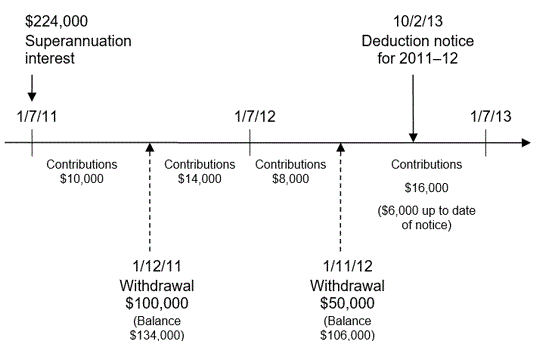
Diagram 1: Timeline of events for Example 10A of this Ruling
Omit the wording of the paragraph; substitute:
On 1 July 2011, Mark has a superannuation interest valued at $224,000, including a tax-free component of $74,000. Mark pays superannuation contributions of $2,000 on the 20th day of each month.
(a) In the heading, omit '1st'; substitute 'First'.
(b) Omit the wording of the paragraph; substitute:
On 1 December 2011, Mark withdraws $100,000. Prior to the withdrawal, Mark's account balance is $234,000, including a tax-free component of $84,000 ($74,000 + $10,000 contributions). The balance after withdrawal is $134,000 including a tax-free component of $48,103.24A
(c) Omit the wording of footnote 24A; substitute 'That is, $100,000 withdrawal × $84,000 (tax-free component) ÷ $234,000 = $35,897 tax-free component withdrawn. Remaining tax-free component is therefore $84,000 - $35,897 = $48,103.'.
Omit the formula; substitute:
Tax-free component of remaining interest × (Contributions ÷ Tax-free component of interest before withdrawal)

= $48,103 × ($10,000 ÷ $84,000)

= $5,727
(a) In the heading, omit '2nd'; substitute 'Second'.
(b) Omit the wording of the paragraph; substitute:
Mark makes a second withdrawal of $50,000 on 1 November 2012. Prior to the withdrawal, Mark's account balance was $156,000 including a tax-free component of $70,103 ($48,103 + $14,000 + $8,000). The balance after withdrawal is $106,000 including a tax-free component of $47,634.24B
(c) Omit the wording of footnote 24B; substitute 'That is, $50,000 withdrawal × $70,103 (tax-free component) ÷ $156,000 = $22,469 tax-free component withdrawn. Remaining tax-free component is therefore $70,103 − $22,469 = $47,634.'.
Omit the wording of the paragraph; substitute:
For the 2011–12 income year, Mark has made contributions of $10,000 prior to the withdrawal on 1 December 2011. As calculated above, only $5,727 of those contributions remain in the fund after the first withdrawal. After the first withdrawal, further contributions of $14,000 are made in the 2011–12 income year. The proportion of the contributions made in the 2011–12 income year that are still in the fund after the second withdrawal and for which Mark could present a valid deduction notice for 2011–12 is:
Tax-free component of remaining interest × (Contributions ÷ Tax-free component of interest before withdrawal)

= $47,634 × (($5,727 + $14,000) ÷ $70,103)

= $13,404
Omit the wording of the paragraph; substitute:
For the 2012–13 income year, Mark makes contributions of $8,000 between 1 July 2012 and the second withdrawal on 1 November 2012. The proportions of these contributions which are still held by the fund after the second withdrawal and for which Mark could give a valid notice for 2012–13 are:
Tax-free component of remaining interest × (Contributions ÷ Tax-free component of interest before withdrawal)

= $47,634 × ($8,000 ÷ $70,103)

= $5,436
(a) After '10 February 2013', insert a comma.
(b) Omit 'presented'; substitute 'presents'.
(c) Omit both instances of 'tax free component'; substitute 'tax-free component'.
After 'only $140,000', insert a comma.
Omit 'Part A of this ruling'; substitute 'Part A of this Ruling'.
Omit 'Part B of this ruling'; substitute 'Part B of this Ruling'.
After 'superannuation contributions', insert '(withdrawn 17 June 2009)'.
Omit the wording of footnote 25; substitute 'Macquarie Dictionary, 3rd edition 1998.'.
Omit 'well established'; substitute 'well-established'.
(a) Omit 'the Commissioner of Taxation v Roche35'; substitute 'Commissioner of Taxation v Roche35,'.
(b) Omit the wording of footnote 35; substitute '[1991] FCA 794 at [24]; 22 ATR 828 at [834]; 91 ATC 5024 at [5029].'.
(a) Omit 'Commissioner of Taxation36'; substitute 'Commissioner of Taxation36,'.
(b) Omit the wording of footnote 36; substitute '[1990] FCA 230 at [16]; 90 ATC 4401 at [4407]; 21 ATR 402 at [409].'.
(c) In the quote, omit 'act of 'setting apart' either'; substitute 'act of "setting apart" either'.
Omit 'the Commissioner considers'; substitute 'we consider'.
(a) In the quote, omit 'context of section 82AA'; substitute 'context of s.82AA'.
(b) In the quote, omit '(NZ)'; substitute '(N.Z.)'.
In the quote, omit 'the term 'contribution in this'; substitute 'the term "contribution" in this'.
Omit the wording of the paragraph; substitute:
An insurance company that pays an amount to a superannuation provider on the occurrence of an insured event under the terms of an insurance policy ordinarily does so under the terms of the insurance contract. The proceeds of the policy will ordinarily be treated as income, profit or gain from the use of the fund's existing capital and not as a superannuation contribution. However, where it is objectively determined that the purpose of the insurance payment is to benefit a member of the fund, the payment may be a treated as a contribution.
After 'A transfer of funds', omit the comma.
In the quote, omit '[t]o see'; substitute '… [t]o see'.
(a) After the paragraph, insert new paragraphs 164A to 164C.
164A. The acquisition of an asset by a superannuation provider is not a contribution referred to in paragraph 18 of this Ruling (an in specie contribution) where the asset is purchased from an entity under a sale contract. However, an in specie contribution may be made in conjunction with the purchase of an asset.47A This may occur, for example, where 50% of the asset is purchased with the remaining 50% of the asset being subject to an in specie contribution.
164B. An in specie contribution is required to be reflected at its market value in the fund's accounts and the member's superannuation interest. That is, the amount of the member's contribution is equal to the market value of the in specie contribution.47B If the relevant asset is recorded at less than market value in the fund's account and the member's superannuation interest, the trustee is required to update the fund's accounts and member's superannuation interests to reflect the appropriate market value.47C Further, the amount of the contribution for the purposes of applying the concessional and non-concessional contributions cap rules is the market value of the asset.
164C. In circumstances where a superannuation provider purchases an asset under a contract at less than market value, the superannuation provider has incurred non-arm's length expenditure under a non-arm's length dealing for the purposes of applying the 'non-arm's length income' provisions in section 295-550. We do not consider that the difference between the consideration paid (if any) and the market value represents an in specie contribution being made as the asset has been acquired under the terms of the contractual agreement and not through an in specie contribution.47D
(b) In new paragraph 164A, after 'purchase of an asset.', insert new footnote 47A:
47A For further guidance on the acquisition of assets by self-managed superannuation funds, refer to SMSFR 2010/1.
(c) In new paragraph 164B, after 'market value of the in specie contribution.', insert new footnote 47B:
47B This is consistent with subsection 66(2) of the SISA under which a superannuation provider is able to acquire certain assets such as business real property and listed securities from a related party at market value.
(d) In new paragraph 164B, after 'appropriate market value.', insert new footnote 47C:
47C See paragraphs 52(2)(a) and (b), 52A(2)(a) and (b), 52B(2)(a) and (b) and subsection 52C(2) of the SISA with respect to relevant covenants by each trustee or director of a corporate trustee.
(e) At the end of new paragraph 164C, insert new footnote 47D:
47D See paragraphs 27 to 30 of LCR 2021/2.
(a) Omit 'contractual right or other'.
(b) At the end of the paragraph, insert:
However, the acquisition of a legal right is not a contribution (an in specie contribution) where the right is purchased under a sale contract.47E
(c) At the end of the new sentence, insert new footnote 47E:
47E See paragraphs 164A to 164C of this Ruling.
63. Paragraphs 168, 190, 191, 203
Omit 'the Commissioner'; substitute 'we'.
(a) After the paragraph, insert new paragraphs 171A and 171B.
171A. Where a contribution is made by way of value shifting to an asset owned by the superannuation provider and the parties to the arrangement are dealing on an arm's length basis, the superannuation provider would record the market value of the increase in capital as a contribution to the relevant member or members of the fund as required under the SISR.47F In these circumstances, the 'non-arm's length income' provisions in section 295-550 will not apply to ordinary or statutory income that is derived with respect to the asset to which the contribution relates.
171B. Where a contribution is made by way of value shifting to an asset owned by the superannuation provider and the parties to the arrangement are not dealing on an arm's length basis, the 'non-arm's length income' provisions in section 295-550 may also apply to ordinary or statutory income that is derived with respect to the asset to which the contribution relates.47G
(b) In new paragraph 171A, after 'required under the SISR.', insert new footnote 47F:
47F See regulation 7.08 of the SISR.
(c) At the end of new paragraph 171B, insert new footnote 47G:
47G See GYBW and Commissioner of Taxation [2019] AATA 4262 at [127], where the Administrative Appeals Tribunal observed that an arrangement that resulted in a contribution being made to a superannuation fund could also result in the superannuation fund deriving non-arm's length income.
Omit 'The Commissioner recognises'; substitute 'We recognise'.
Omit 'The Commissioner's'; substitute 'Our'.
In footnote 49, omit 'subsection 295-190(2) and (3)'; substitute 'subsections 295-190(2) and (3)'.
Omit 'The Commissioner does'; substitute 'We do'.
After 'In Australia', insert a comma.
(a) Omit 'week end'; substitute 'weekend'.
(b) Omit 'print out'; substitute 'printout'.
Omit 'the Commissioner expects'; substitute 'we expect'.
Omit the wording of the quote; substitute:
… [We conclude that], if an intending donor of property has done everything which it is necessary for him to have done to effect a transfer of legal title, then equity will recognize the gift. So long as the donee has been equipped to achieve the transfer of legal ownership, the gift is complete in equity. ""Necessary" used in this sense means necessary to effect a transfer. From the viewpoint of the intending donor, the question is whether what he has done is sufficient to enable the legal transfer to be effected without further action on his part.
… the donee acquires an equitable estate or interest in the subject matter of the gift once the transaction is complete so far as the donor is concerned. So much was acknowledged by the English Court of Appeal in In re Rose. There the Court concluded that the donor had executed and delivered transfers and share certificates to the donee with the intention of transferring title to the shares to him and had placed him in a position to secure the legal title to the shares by registration subject to an exercise by the directors of their discretion to register the transfers. In this situation the donor could not recall the gift or invoke the aid of the court to prevent registration … . The Court held that the donor had parted with his beneficial interest and had become a constructive trustee for the donee.
(a) Omit 'the Commissioner accepts'; substitute 'we accept'.
(b) Omit 'Australian Stock Exchange'; substitute 'Australian Securities Exchange'.
(a) Omit 'Commissioner of Taxation59(Walstern's Case)'; substitute 'Commissioner of Taxation59 (Walstern's Case)'.
(b) Omit the wording of the quote; substitute:
While I do not think it makes any difference in the present case either, I am inclined to the view that 'the purpose' as used in s 82AAE refers to sole rather than dominant or principal purpose. This is the view that was accepted also by Pincus J in Federal Commissioner of Taxation v Roche (1991) 105 ALR 95 at 103. However, I do not think that a deduction would be lost if the directors of a taxpayer/employer took into account in making a contribution, but incidentally, the taxation benefits which the Act makes available where a contribution is made to a fund. The answer may well lie in the fact that the taxation deduction will not, in such a case, be an object of the contribution; rather it will be a consequence of the contribution.
Omit the wording of the quote; substitute:
… It is not necessary that an employer should turn his attention to the particular circumstances of each employee when making a contribution for it is sufficient that the contribution is made for the purpose of benefiting all or identifiable members of the fund … It is not, however, sufficient that the employer has in mind that the moneys in the superannuation fund will ultimately go to the benefit, not of the general members of the fund, but of a remaining employee or employees such as a managing director/principal shareholder. Funds which are managed for such an ultimate end are not funds maintained for the benefit of the employees in respect of whom the contributions have, in the formal sense, been set apart or paid into the fund.
In the quote omit 'section 82AAE'; substitute 's 82AAE'.
Omit the wording of the quote; substitute:
The history of the provisions to which we have referred makes clear that deductions for payments in respect of employee superannuation have been available in a variety of statutory contexts, but always in circumstances where individual personal benefits, pensions or retiring allowances were provided to, that is furnished or supplied to, existing employees of the taxpayer employer with rights to such benefits by the payment. This can be seen from the earliest provisions dealing with the requirement of benefits being secured: Metropolitan Gas Company v Federal Commissioner of Taxation (1932) 47 CLR at 631. The need for the employees to be existing was always present. The payment was from an employer for the benefit of an existing employee. The right to receive the benefit was to be secured.
…
Putting a trustee in funds to make it possible for a wide discretion to be exercised in favour of one or other of existing employees is not the same as a contribution that makes provision for superannuation benefits (involving the right to receive such benefits) for the existing employees
(a) Omit 'The Commissioner accepts'; substitute 'We accept'.
(b) After the paragraph, insert new paragraph 222A:
222A. Where an employer makes insufficient contributions for its employees resulting in the employer being subject to a superannuation guarantee charge, the employer cannot claim a deduction for the amount of the superannuation guarantee charge imposed65A, except for a charge that qualified for the amnesty under section 74 of the SGAA and where the requirements of subsection 26-95(2) are met.
(c) In the new paragraph, after 'superannuation guarantee charge imposed', insert new footnote 65A:
65A Subsection 26-95(1).
In the heading, omit 'four'; substitute '4'.
(a) Omit 'for paragraph 290-85(1)(b)'.
(b) In the quote, after 'payment made following', omit 'the'.
Omit 'covered by section 290-85.The term'; substitute 'covered by section 290-85. The term'.
(a) Omit the paragraph.
(b) After the paragraph, insert new paragraphs 236A to 236C:
236A. A common law employee is engaged in an 'employment' activity if they are engaged in an activity in the income year. The term 'engaged' is not defined and takes its ordinary meaning. One of several meanings given to engaged is 'busy or occupied; involved'. Another meaning is 'under an engagement' where the ordinary meaning of 'engagement' is given as 'under an obligation or agreement'.77A
236B. Consequently, a person need not be physically engaged in the activity. A common law employee is engaged in the activity while they are employed.
236C. An artist, musician or other person paid to perform or present, or to participate in the performance of an activity covered by subsection 12(8) of the SGAA will satisfy the employment activity condition while they participate in the relevant activity.
(c) At the end of new paragraph 236A, insert new footnote 77A:
77A Macquarie Dictionary, 3rd edition 1998.
Omit the wording of the quote; substitute:
Directors have no right to be paid for their services, and cannot pay themselves or each other, or make presents to themselves out of the company's assets, unless authorized so to do by the instrument which regulates the company or by the shareholders at a properly convened meeting. The shareholders, at a meeting duly convened for the purpose, can, if they think proper, remunerate directors for their trouble or make presents to them for their services out of assets properly divisible among the shareholders themselves.
Omit 'case by case basis'; substitute 'case-by-case basis'.
(a) Omit 'Matters affecting the maximum earnings test and the notice of intent to deduct contributions are discussed in paragraphs 246 to 276 of this Ruling.'.
(b) Omit footnote 82.
(a) Omit the wording of the paragraph; substitute:
From 1 July 2017, the maximum earnings test was removed. Prior to 1 July 2017, persons who were engaged in an 'employment' activity in the income year (income years up to and including 2016-17) in which they made a personal superannuation contribution needed to meet the maximum earnings test if they were to deduct their contribution.83A
(b) Omit footnote 83.
(c) After the paragraph, insert new footnote 83A:
83A See former section 290-150 and subsection 290-160(1).
Omit the paragraphs, including footnotes 84 to 91.
After 'Memorandum to', insert 'the'.
Omit 'The Explanatory'; substitute 'This Explanatory'.
(a) Omit 'on page 19'.
(b) Omit 'tax free component'; substitute 'tax-free component'.
(a) Omit 'the Commissioner's view; substitute 'our view'.
(b) Omit 'the Commissioner takes'; substitute 'we take'.
Omit 'tax free'; substitute 'tax-free'.
(a) After 'Examples 10 and 10A', insert 'of this Ruling'.
(b) Omit both instances of 'tax free component'; substitute 'tax-free component'.
(a) After the paragraph, insert new paragraphs 276B to 276E, including headings:
Appendix 2 – Compliance approach
 This Appendix sets out a practical administration approach to assist taxpayers in complying with relevant tax laws. Provided you follow the advice in this appendix in good faith and consistently with the Ruling section, the Commissioner will administer the law in accordance with this approach.
|
276B. As outlined in paragraphs 32B and 171B of this Ruling, where a contribution is made by way of value shifting to an asset owned by the superannuation provider and the parties to the arrangement are not dealing on an arm's length basis, the 'non-arm's length income' provisions in section 295-550 may also apply to ordinary or statutory income that is derived with respect to the asset to which the contribution relates.
276C. In draft Taxation Ruling TR 2010/1DC Income tax: superannuation contributions (now withdrawn), issued on 28 July 2021, the Commissioner proposed a compliance approach, in respect of the circumstances outlined in paragraphs 32B and 171B, where the Commissioner will not allocate compliance resources for the 2018–19 and later income years to determine whether a contribution has been made where:
- •
- a person performs an action or actions that shift value to an asset owned by a superannuation provider;
- •
- the superannuation provider does not recognise the value shift as a contribution to be allocated to a member; and
- •
- the ordinary or statutory income derived by the superannuation provider with respect to the asset is 'non-arm's length income' under section 295-550.
276D. After further consideration, the Commissioner considered that the principles as outlined in GYBW and Commissioner of Taxation [2019] AATA 4262 should apply and that no advantage should be obtained through non-arm's length dealings that have the effect of circumventing the operation of the contribution cap provisions. As such, the Commissioner decided that from the date of the revised draft Ruling, TR 2010/1DC2, which issued on 27 November 2024, no compliance approach would apply.
276E. As such, for arrangements that have occurred:
- •
- from 1 July 2018 to 27 July 2021 – the compliance approach in paragraph 276C of this Ruling applies;
- •
- from 28 July 2021 to 27 November 2024 – the compliance approach in paragraph 276C of this Ruling will be considered on a case-by-case basis on application by a trustee of a fund97; and
- •
- from 28 November 2024 – no compliance approach will apply (for the reasons outlined in paragraph 276D of this Ruling).
(b) In new paragraph 276E, after 'on application by a trustee of a fund', insert new footnote 97:
97 See Law Administration Practice Statement PS LA 2008/1 The Commissioner's discretion to disregard or allocate to another period superannuation contributions for excess contributions purposes which provides guidance to staff on the exercise of the discretion to disregard or reallocate concessional or non-concessional superannuation contributions for excess contributions purposes.
(a) In the heading, omit 'Appendix 2'; substitute 'Appendix 3'.
(b) Omit the wording of the paragraph; substitute:
The following is a detailed contents list for this Ruling:
| Paragraph | |
| What this Ruling is about | 1 |
| Ruling | 4 |
| Part A – General superannuation contributions concepts | 4 |
| Ordinary meaning of contribution | 4 |
| Determining a person's purpose | 6 |
| How and when a contribution is made to a superannuation fund | 10 |
| Transferring funds to the superannuation provider | 12 |
| Roll-over of a superannuation benefit | 17 |
| Transferring an existing asset (in specie contribution) | 18 |
| Creating rights in the superannuation provider (in specie contribution) | 26 |
| Increasing the value of, or shifting value to, an asset owned by the superannuation provider | 29 |
| Indirectly increasing the capital of the fund | 33 |
| Part B – Specific rules about deducting superannuation contributions | 39 |
| Purpose of the contributor | 39 |
| Deducting superannuation contributions for own employees | 42 |
| Treating former employees as employees | 45 |
| Contribution is made on or after 17 November 2010 and within 4 months after the person stops being your employee | 45A |
| Contribution is made on or after 17 November 2010 and more than 4 months after the person stops being your employee; or contribution is made before 17 November 2010 | 46 |
| Deducting superannuation contributions for another's employees | 48 |
| Employment activity conditions | 53 |
| Deducting personal contributions | 62 |
| Maximum earnings test | 62 |
| Notice of intention to claim a deduction | 67 |
| Personal superannuation contributions not deductible | 72A |
| Examples | 73 |
| Example 1 – contribution made by paying a fund's expense | 73 |
| Example 2 – no contribution made by a free service | 75 |
| Example 3 – contribution made by forgiving liability | 77 |
| Example 4 – contribution made by employer's reimbursement | 79 |
| Example 5 – no contribution made by employer sponsor | 81 |
| Example 6 – when in specie contribution of real property is made | 83 |
| Example 7 – when in specie contribution of shares is made | 85 |
| Example 10 – valid notice of intention to deduct – roll-over | 94 |
| Example 10A – valid notice of intention to deduct – multiple withdrawals | 99A |
| First withdrawal | 99C |
| Second withdrawal | 99E |
| Valid deduction for the 2011–12 income year | 99G |
| Valid deduction for the 2012–13 income year | 99H |
| Example 11 – invalid notice of intention to deduct | 100 |
| Date of effect | 103 |
| Appendix 1 – Explanation | 107 |
| Part A – General superannuation contributions concepts | 107 |
| Ordinary meaning of contribution | 107 |
| Statutory context | 108 |
| The nature of a superannuation fund | 112 |
| Trust structure | 115 |
| Purpose of tax treatment of contributions | 117 |
| Earlier statutory contexts and case law on former provisions | 119 |
| Commissioner's interpretation as to meaning of contribution | 124 |
| Determining a person's purpose | 128 |
| How a thing of value increases the fund's capital | 150 |
| Transfer of funds | 152 |
| Roll-over superannuation benefit | 162 |
| Transferring an existing asset | 164 |
| Creating rights in the superannuation provider | 165 |
| Increasing the value of, or shifting value to, a fund asset | 169 |
| Payment of fund expense | 172 |
| Debt forgiveness and payments by guarantors | 175 |
| When a superannuation contribution is made | 181 |
| General rule – a contribution is made when received by the fund | 182 |
| Contributions of funds | 183 |
| Cheques and promissory notes | 188 |
| Transfer of assets or creation of rights | 193 |
| Payment of a fund liability | 208 |
| Debt forgiveness and guarantees | 209 |
| Part B – Specific rules about deducting superannuation contributions | 211 |
| Purpose of the contributor | 211 |
| Deducting superannuation contributions for own employees | 215 |
| Treating former employees as employees | 223 |
| Contribution is made on or after 17 November 2010 and within 4 months after the person stops being your employee | 223A |
| Contribution is made on or after 17 November 2010 and more than 4 months after the person stops being your employee or contribution is made before 17 November 2010 | 224 |
| Deducting superannuation contributions for another's employees | 229 |
| Employment activity conditions | 234 |
| Deducting personal contributions | 245 |
| Maximum earnings test | 246 |
| Notice of intention to claim a deduction | 263 |
| Appendix 2 – Compliance approach | 276B |
| Appendix 3 – Detailed contents list | 277 |
This Addendum applies both before and after date of issue, subject to the date of commencement of the legislation referred to.
Commissioner of Taxation
24 September 2025
© AUSTRALIAN TAXATION OFFICE FOR THE COMMONWEALTH OF AUSTRALIA
You are free to copy, adapt, modify, transmit and distribute this material as you wish (but not in any way that suggests the ATO or the Commonwealth endorses you or any of your services or products).
References
ATO references:
NO 1-134LC6E1