

Income Tax Assessment Act 1997
 View history note
 Hide history note
This Division sets out some items that are included in your assessable income. Remember that the general rules about assessable income in Division 6 apply to these items.
Your assessable income includes the value to you of all allowances, gratuities, compensation, benefits, bonuses and premiums * provided to you in respect of, or for or in relation directly or indirectly to, any employment of or services rendered by you (including any service as a member of the Defence Force).
15-2(2)
This is so whether the things were * provided in money or in any other form.
15-2(3)
However, the value of the following are not included in your assessable income under this section:
(a) a * superannuation lump sum or an * employment termination payment;
(b) an * unused annual leave payment or an * unused long service leave payment;
(c) a * dividend or * non-share dividend;
(d) an amount that is assessable as * ordinary income under section 6-5 ;
(e) * ESS interests to which Subdivision 83A-B or 83A-C (about employee share schemes) applies.
Note:
Section 23L of the Income Tax Assessment Act 1936 provides that fringe benefits are non-assessable non-exempt income.
SECTION 15-3 15-3 Return to work payments
Your assessable income includes an amount you receive under an * arrangement that an entity enters into for a purpose of inducing you to resume working for, or providing services to, any entity.
Your assessable income includes an * accrued leave transfer payment that you receive.
To find out if the payment is deductible to the payer, see section 26-10.
Your assessable income includes a bounty or subsidy that:
(a) you receive in relation to carrying on a * business; and
(b) is not assessable as * ordinary income under section 6-5 .
Your assessable income includes profit arising from the carrying on or carrying out of a profit-making undertaking or plan.
15-15(2)
This section does not apply to a profit that:
(a) is assessable as * ordinary income under section 6-5 ; or
(b) arises in respect of the sale of property acquired on or after 20 September 1985.
Note:
If you sell property you acquired before 20 September 1985 for profit-making by sale, your assessable income includes the profit: see section 25A of the Income Tax Assessment Act 1936 .
Your assessable income includes an amount that you receive as or by way of royalty within the ordinary meaning of " royalty " (disregarding the definition of royalty in subsection 995-1(1) ) if the amount is not assessable as * ordinary income under section 6-5 .
15-20(2)
Subsection (1) does not apply to an amount of a payment to which section 15-22 or 15-23 applies.
SECTION 15-22 Payments made to members of a copyright collecting society 15-22(1)
This section, instead of Division 6 of Part III of the Income Tax Assessment Act 1936 , applies to a payment that a * copyright collecting society, to which section 51-43 applies, makes to you as a * member of the society.
15-22(2)
Your assessable income includes the amount of the payment, except to the extent that the payment represents an amount on which the directors of the society are or have been assessed, and are liable to pay * tax, under section 98 , 99 or 99A of the Income Tax Assessment Act 1936 .
Note:
Section 410-5 of this Act requires a copyright collecting society to give you a notice at the time of payment.
This section, instead of Division 6 of Part III of the Income Tax Assessment Act 1936 , applies to a payment that the * resale royalty collecting society makes to you under section 26 of the Resale Royalty Right for Visual Artists Act 2009 .
15-23(2)
Your assessable income includes the amount of the payment, except to the extent that the payment represents an amount on which the directors of the society are or have been assessed, and are liable to pay * tax, under section 98 , 99 or 99A of the Income Tax Assessment Act 1936 .
Note:
Section 410-50 of this Act requires the resale royalty collecting society to give you a notice at the time of payment.
Your assessable income includes an amount you receive from an entity if:
(a) you receive it as a lessor or former lessor of premises; and
(b) the entity pays you the amount for failing to comply with a lease obligation to make repairs to the premises; and
(c) the entity uses or has used the premises for the * purpose of producing assessable income; and
(d) the amount is not assessable as * ordinary income under section 6-5 .
Note:
The entity can deduct the amount: see section 25-15 .
Your assessable income includes an amount you receive by way of insurance or indemnity for the loss of an amount (the lost amount ) if:
(a) the lost amount would have been included in your assessable income; and
(b) the amount you receive is not assessable as * ordinary income under section 6-5 .
Your assessable income includes interest payable to you under the Taxation (Interest on Overpayments and Early Payments) Act 1983 . The interest becomes assessable when it is paid to you or applied to discharge a liability you have to the Commonwealth.
Your assessable income includes an amount you receive for providing * mining, quarrying or prospecting information to another entity if:
(a) you continue to * hold the information; and
(b) the amount you receive is not assessable as * ordinary income under section 6-5 .
15-40(2)
Your assessable income includes an amount you receive for providing * geothermal exploration information you have to another entity if:
(a) you continue to have the information; and
(b) the information is, and continues to be, relevant to:
(i) * geothermal energy extraction that you carry on or propose to carry on; or
(ii) a * business that you carry on that includes * exploration or prospecting for * geothermal energy resources from which energy can be extracted by geothermal energy extraction; and
(c) the amount you receive is not assessable as * ordinary income under section 6-5 .
It does not matter whether the information is generally available or not.
15-40(3)
Geothermal exploration information
is geological, geophysical or technical information that:
(a) relates to the presence, absence or extent of * geothermal energy resources in an area; or
(b) is likely to help in determining the presence, absence or extent of such resources in an area.
15-40(4)
Geothermal energy extraction
means operations that are for:
(a) the extraction of energy from * geothermal energy resources; and
(b) the * purpose of producing assessable income.
SECTION 15-45 Amounts paid under forestry agreements 15-45(1)
Your assessable income includes an amount you receive under an agreement for the planting and tending of trees for felling if:
(a) you are the manager of the agreement as mentioned in section 82KZMG of the Income Tax Assessment Act 1936 ; and
(b) the amount satisfies, for the entity that paid it, the requirements of that section.
The amount is included for the income year in which the entity can claim a deduction for the amount.
15-45(2)
No part of an amount included under subsection (1) is included in your assessable income for a later income year.
SECTION 15-46 Amounts paid under forestry managed investment schemes 15-46(1)
Your assessable income includes an amount you receive under a * forestry managed investment scheme if:
(a) you are the * forestry manager of the scheme, or an * associate of the forestry manager; and
(b) the entity that paid the amount can deduct or has deducted the amount under section 394-10 in relation to the scheme (disregarding subsection 394-10(5) ).
The amount is included for the income year for which the entity that paid the amount can or has claimed a deduction for it (disregarding subsection 394-10(5) ).
15-46(2)
No part of an amount included under subsection (1) is included in your assessable income for a later income year.
Your assessable income includes a * work in progress amount that you receive.
Note:
To find out whether the amount is deductible to the payer, see section 25-95 .
Your assessable income includes the amount of a benefit provided to you by a * life insurance company under a * funeral policy issued after 31 December 2002 to pay for the funeral of the insured person, reduced by:
(a) the amount of the premium or premiums of the policy that is reasonably related to the benefit; and
(b) the amount of the fees and charges included in the company ' s assessable income for any income year under paragraph 320-15(1)(k) that is reasonably related to the benefit.
15-55(2)
This section does not apply if the benefit is included in your assessable income as:
(a) * ordinary income under section 6-5 ; or
(b) * statutory income under a section of this Act other than this section.
SECTION 15-60 Certain amounts paid under scholarship plan 15-60(1)
Your assessable income includes the amount of a benefit provided to you, or on your behalf, by a * life insurance company under a * scholarship plan covered by subsection (2) or (3), reduced by the amount worked out under subsection (4), if:
(a) the benefit is provided on or after 1 January 2003; and
(b) you are nominated in the plan as a beneficiary whose education is to be helped by the benefit.
15-60(2)
This subsection covers a * scholarship plan issued by the * life insurance company after 31 December 2002.
15-60(3)
This subsection covers a * scholarship plan if:
(a) the plan was issued by the * life insurance company before 1 January 2003; and
(b) no amount received by the company on or after 1 January 2003 and attributable to the plan is * non-assessable non-exempt income of the company under paragraph 320-37(1)(d) .
15-60(4)
The amount of the reduction is the sum of:
(a) the amount of the premium or premiums of the plan that is reasonably related to the benefit; and
(b) the amount of the fees and charges included in the company ' s assessable income for any income year under paragraph 320-15(1)(k) that is reasonably related to the benefit.
15-65 (Repealed) SECTION 15-65 Sugar industry exit grants
(Repealed by No 109 of 2014)
Your assessable income includes a reimbursement mentioned in section 22 of the Fringe Benefits Tax Assessment Act 1986 (about exempt car expense payment benefits) that, but for that section, would be a * fringe benefit * provided to you.
Your assessable income includes any amount you receive as or by way of bonus on a * life insurance policy, other than a reversionary bonus.
Note:
Reversionary bonuses are covered by section 6-5 of this Act if they are ordinary income and, if not, by section 26AH of the Income Tax Assessment Act 1936 .
If section 207-158 would, apart from subsection 207-158(2) , apply to a * franked distribution, then an amount equal to the * foreign income tax deduction referred to in subsection (1) of that section is included in the assessable income of the entity that made the distribution for the income year mentioned in subsection (2) of this section.
15-80(2)
The income year is:
(a) if the * foreign tax period in which the * foreign income tax deduction arises falls wholly within an income year of the entity - that income year; or
(b) if the foreign tax period in which the foreign income tax deduction arises straddles 2 income years of the entity - the later of those income years.
(Repealed by No 96 of 2014)
This Division sets out the effect of the GST in working out assessable income. Generally speaking, GST, input tax credits and adjustments under the GST Act are disregarded.
An amount is not assessable income, and is not * exempt income, to the extent that it includes an amount relating to:
(a) * GST payable on a * taxable supply; or
(b) an * increasing adjustment that relates to a * supply; or
(c) an * increasing adjustment that:
(i) relates to an * acquisition; and
(ii) arises in circumstances that also give rise to a * recoupment that is included in assessable income.
An amount of a * decreasing adjustment that arises under Division 129 or 132 of the * GST Act is assessable income , unless the entity that has the adjustment is an * exempt entity.
17-10(2)
However, the amount is not assessable income to the extent that, because it becomes a component of a * net input tax credit, a reduction is made under section 103-30 (reduction of cost base etc. by net input tax credits).
SECTION 17-15 17-15 Elements in calculation of amounts
In calculating an amount that may be included in assessable income:
(a) an element in the calculation that is an amount received or receivable is treated as not including an amount equal to any * GST payable on a * taxable supply related to the amount received or receivable, or any * increasing adjustment related to that amount; and
(b) an element in the calculation that is an amount paid or payable is treated as not including an amount equal to any * input tax credit for an * acquisition related to the amount paid or payable, or any * decreasing adjustment related to that amount.
A * member of a * GST group is to be treated, for the purposes of this Division, as if Subdivision 48-B of the * GST Act (other than paragraph 48-40(2)(a) and subsection 48-40(3) ) did not apply to that member.
17-20(2)
A * participant in a * GST joint venture is to be treated, for the purposes of this Division, as if Subdivision 51-B of the * GST Act (other than subsections 51-30(2) and (3)) did not apply to that participant.
A special credit under section 19A of the A New Tax System (Goods and Services Tax Transition) Act 1999 is assessable income at the time it is attributed to a * tax period (for a credit under section 19A ).
Sections 17-5 , 17-10 and 17-15 do not apply to assets, or to expenditure, for which you can deduct amounts under Division 40 or Division 328 .
Note:
See instead Subdivision 27-B .
This Division includes amounts in your assessable income to reverse the effect of certain kinds of deductions.
| 20-5 | Other provisions that reverse the effect of deductions |
The table lists other provisions that reverse the effect of certain kinds of deductions.
Provisions of the Income Tax Assessment Act 1997 are identified in normal text. The other provisions, in bold , are provisions of the Income Tax Assessment Act 1936 .
| Provisions that adjust your tax position in respect of deductions | |||
| Item | In this situation: | See: | |
| 1 | A balancing adjustment for a depreciating asset is included in your assessable income. | 40-285(1) and 40-445(2) | |
| . | |||
| 2 | An amount you receive by way of insurance or indemnity for a loss of trading stock is included in your assessable income. | 70-115 | |
| . | |||
| 2A | Limited recourse debt that was used to finance expenditure deductible under a capital allowance (or on property for which you have deducted or can deduct amounts under a capital allowance) terminates: an amount is included in your assessable income. | 243-40 | |
| . | |||
| 3 | Because of: | 40-750(3) | |
| • petroleum resource rent tax; or | |||
| • an instalment of petroleum resource rent tax; | |||
| that you have deducted or can deduct, an amount is refunded, credited, paid or applied: the amount is included in your assessable income. | |||
| . | |||
| 3A | (Repealed by No 77 of 2001) | ||
| . | |||
| 4 | You receive a fringe benefit by way of reimbursement or payment of a loss or outgoing you incurred: your deduction for the loss or outgoing is reduced. | 51AH | |
| . | |||
| 5 | (Repealed by No 93 of 2011) | ||
| . | |||
| 6 | (Repealed by No 93 of 2011) | ||
| . | |||
| 7 | You receive an amount as recoupment for your local governing body election expenses: an amount is included in your assessable income. | 74A(4) | |
| . | |||
| 8 | You receive superannuation benefits as a result of someone ' s deductible contributions: the benefits are included in your assessable income. | 290-100 | |
| . | |||
| 9 | An R & D entity receives or becomes entitled to receive an amount: | 355-410 | |
| • for, or relating to, the results of R & D activities; or | |||
| • attributable to it incurring expenditure on R & D activities or to its use of a depreciating asset for the purpose of conducting R & D activities; | |||
| and the entity is entitled under Division 355 to a tax offset relating to those R
&
D activities.
The amount is included in its assessable income. |
|||
| . | |||
| 10 | An R & D entity: | Subdivision 355-G | |
| • | receives, or becomes entitled to receive, a recoupment from government relating to R & D activities; or | ||
| • | can deduct, under Division 355 , expenditure on goods, materials or energy used during R & D activities to produce marketable products or products applied to the R & D entity ' s own use; | ||
| and the entity is entitled under Division
355
to a tax offset relating to those R
&
D activities.
An amount is included in its assessable income. |
Recoupment of expenses you incurred and can deduct
Your assessable income may include an amount that you receive by way of insurance, indemnity or other recoupment if:
Recoupment of expenses you did not incur but can deduct
Your assessable income may include an amount that another entity receives by way of insurance, indemnity or other recoupment if:
If you incurred the deductible loss or outgoing
20-15(1)
First, read sections 20-20 to 20-30 to work out whether you have received an assessable recoupment. If not, you do not need to read the rest of the Subdivision.
20-15(2)
If you have received one or more assessable recoupments, sections 20-35 to 20-55 tell you how much is included in your assessable income for an income year.
If another entity incurred a loss or outgoing you can deduct
20-15(3)
Sections 20-60 and 20-65 tell you how to apply this Subdivision.
SECTION 20-20 Assessable recoupments
Exclusion
20-20(1)
An amount is not an assessable recoupment to the extent that it is * ordinary income, or it is * statutory income because of a provision outside this Subdivision.
Insurance or indemnity
20-20(2)
An amount you have received as * recoupment of a loss or outgoing is an assessable recoupment if:
(a) you received the amount by way of insurance or indemnity; and
(b) you can deduct an amount for the loss or outgoing for the * current year, or you have deducted or can deduct an amount for it for an earlier income year, under any provision of this Act.
Other recoupment
20-20(3)
An amount you have received as * recoupment of a loss or outgoing ( except by way of insurance or indemnity) is an assessable recoupment if:
(a) you can deduct an amount for the loss or outgoing for the * current year; or
(b) you have deducted or can deduct an amount for the loss or outgoing for an earlier income year;
under a provision listed in section 20-30 .
SECTION 20-25 What is recoupment ?
General
20-25(1)
Recoupment of a loss or outgoing includes:
(a) any kind of recoupment, reimbursement, refund, insurance, indemnity or recovery, however described; and
(b) a grant in respect of the loss or outgoing.
Amount paid for you
20-25(2)
If some other entity pays an amount for you in respect of a loss or outgoing that you incur, you are taken to receive the amount as recoupment of the loss or outgoing.
Remission of general interest charge or shortfall interest charge
20-25(2A)
If:
(a) you have incurred expenditure that consists of * general interest charge or * shortfall interest charge; and
(b) the Commissioner remits any of that charge;
then you are taken to receive the remitted amount as recoupment of that expenditure.
Amount for disposing of right to recoupment
20-25(3)
If you dispose of your right to receive an amount as * recoupment of a loss or outgoing you are taken to receive as recoupment of the loss or outgoing any amount you receive for disposing of that right. (The disposal need not be to another entity.)
Amount received that is recoupment to an unspecified extent
20-25(4)
If you receive an amount that is, to an unspecified extent, * recoupment of a loss or outgoing, the amount is taken to be recoupment of the loss or outgoing to whatever extent is reasonable.
Balancing adjustments not covered
20-25(5)
If a balancing adjustment is required for property on which you incurred a loss or outgoing, no part of the * termination value of the property is an amount you receive as recoupment of the loss or outgoing.
Note:
The termination value is usually the amount you receive because of disposal, loss or destruction of the property.
SECTION 20-30 Tables of deductions for which recoupments are assessable 20-30(1)
This table shows the deductions under the Income Tax Assessment Act 1997 for which recoupments are assessable.
Note:
References are to section numbers except where otherwise indicated.
| Provisions of the Income Tax Assessment Act 1997 | ||
| Item | Provision | Description of expense |
| 1.1 | 8-1 (so far as it allows you to deduct a bad debt, or part of a debt that is bad) | bad debts |
| . | ||
| 1.2 | 8-1 (so far as it allows you to deduct rates or taxes) | rates or taxes |
| . | ||
| 1.3 | 25-5 | tax-related expenses |
| . | ||
| 1.4 | 25-35 | bad debts |
| . | ||
| 1.5 | 25-45 | embezzlement or larceny by an employee |
| . | ||
| 1.5A | 25-47 | misappropriation by an employee or agent |
| . | ||
| 1.6 | 25-60 | election expenses, Commonwealth and State elections |
| 1.6A | 25-65 | election expenses, local governing body |
| . | ||
| 1.7 | 25-75 | rates and land taxes on premises used to produce mutual receipts |
| . | ||
| 1.8 | The former 25-80 | upgrading assets to meet GST obligations etc. |
| . | ||
| 1.8A | 25-95 | work in progress amount |
| . | ||
| 1.8B | item 7 of the table in section 30-15 | contributions relating to fund-raising events |
| . | ||
| 1.8C | item 8 of the table in section 30-15 | contributions relating to fund-raising auctions |
| . | ||
| 1.9 | Division 40 | capital allowances |
| . | ||
| 1.10 | The former Division 42 (as it applied to * software because of the former Subdivision 46-B) | expenditure on software |
| . | ||
| 1.11 | The former Subdivision 46-C | expenditure on software |
| . | ||
| 1.12 | The former Subdivision 46-D | expenditure on software, pooled |
| . | ||
| 1.13 | The former Division 42 (as it applied to * IRUs because of Division 44) | expenditure on IRUs |
| . | ||
| 1.14 | The former 330-15 | exploration or prospecting expenditure |
| . | ||
| 1.15 | The former 330-80 | allowable capital expenditure relating to mining or quarrying |
| . | ||
| 1.16 | The former 330-350 | petroleum resource rent tax |
| . | ||
| 1.17 | The former 330-370 | transport capital expenditure relating to mining or quarrying |
| . | ||
| 1.18 | The former 330-435 | rehabilitation expenditure relating to mining or quarrying |
| . | ||
| 1.19 | The former 330-485 | balancing adjustment deduction for expenditure relating to mining or quarrying |
| . | ||
| 1.19A | Division 355 | R & D |
| . | ||
| 1.20 | The former Subdivisions 380-A and 380-C | capital expenditure incurred in obtaining a spectrum licence |
| . | ||
| 1.21 | The former Subdivision 387-A | landcare operations expenditure |
| . | ||
| 1.22 | The former Subdivision 387-B | expenditure on facilities to conserve or convey water |
| . | ||
| 1.23 | The former Subdivision 387-D | grapevine establishment expenditure |
| . | ||
| 1.24 | The former Subdivision 387-C | horticultural plant establishment expenditure |
| . | ||
| 1.25 | The former Subdivision 387-E | mains electricity connection expenditure |
| . | ||
| 1.26 | The former Subdivision 400-A | expenditure on environmental impact assessment |
| . | ||
| 1.27 | The former Subdivision 400-B | expenditure on environmental protection activities |
| . | ||
| 1.27A | 420-15 | registered emissions unit |
| . | ||
| 1.28 | 775-30 | forex realisation loss |
20-30(2)
This table shows the deductions under the Income Tax Assessment Act 1936 for which recoupments are assessable.
Note:
References are to section numbers except where otherwise indicated.
| Provisions of the Income Tax Assessment Act 1936 | ||
| Item | Provision | Description of expense |
| 2.1 | Former 51(1) (so far as it allowed you to deduct a bad debt, or part of a debt that is bad) | bad debts |
| . | ||
| 2.2 | Former 51(1) (so far as it allowed you to deduct rates or taxes) | rates or taxes |
| . | ||
| 2.3 | 63 | bad debts |
| . | ||
| 2.4 | Former 69 | tax-related expenses |
| . | ||
| 2.5 | Former 70A(3) | mains electricity connection expenditure |
| . | ||
| 2.6 | Former 71 | embezzlement or larceny by an employee |
| . | ||
| 2.7 | Former 72 | rates and land tax |
| . | ||
| 2.7A | Former 72A | a payment of petroleum resource rent tax, or an instalment of petroleum resource rent tax, or a credit under paragraph 99(d) of the Petroleum Resource Rent Tax Assessment Act 1987 in respect of a payment of such an instalment |
| . | ||
| 2.8 | Former 73B, 73BA or 73BH | research and development activity expenditure |
| . | ||
| 2.9 | Former 74 | election expenses, Commonwealth and State elections |
| . | ||
| 2.9A | Former 74A | election expenses, local governing body |
| . | ||
| 2.10 | Former 75AA(1) or (6) | grape vine establishment expenditure |
| . | ||
| 2.11 | Former 75B(2) or (3A) | water conservation or conveyance expenditure |
| . | ||
| 2.12 | Former 75D(2) | land degradation prevention expenditure |
| . | ||
| 2.13 | Former 82AB | development allowance expenditure |
| . | ||
| 2.14 | Former 82BB | environmental impact study expenditure |
| . | ||
| 2.15 | Former 82BK | environmental protection expenditure |
| . | ||
| 2.16 | (Repealed by No 133 of 2003) | |
| . | ||
| 2.17 | Former Division 10 of Part III | mining and quarrying expenditure |
| . | ||
| 2.18 | Former Division 10AAA of Part III | expenditure on transport of minerals and quarry materials |
| . | ||
| 2.19 | Former Division 10AA of Part III | expenditure on prospecting and mining for petroleum |
| . | ||
| 2.20 | Former 124BA | expenditure on rehabilitating mining, quarrying and petroleum sites |
| . | ||
| 2.21 | Former 124ZZF | horticultural plant establishment expenditure (effective life of the plant less than 3 years) |
| . | ||
| 2.22 | Former 124ZZG | horticultural plant establishment expenditure (effective life of the plant more than 3 years) |
| . | ||
| 2.23 | Former 628 | drought mitigation property expenditure by a primary producer |
| . | ||
| 2.24 | Former 636 | drought mitigation property expenditure by a leasing company |
How much is included in your assessable income ?
SECTION 20-35 If the expense is deductible in a single income year 20-35(1)
Your assessable income includes an * assessable recoupment of a loss or outgoing if:
(a) you can deduct the whole of the loss or outgoing for the * current year; or
(b) you have deducted or can deduct the whole of the loss or outgoing for an earlier income year.
Note 1:
The operation of this section may be affected if a balancing charge has been included in your assessable income because of a deduction for the loss or outgoing: see section 20-45 .
Note 2:
Recoupment of a loss or outgoing for which you can deduct amounts over more than one income year is covered by section 20-40 .
Note 3:
Recoupment of a loss or outgoing that is only partially deductible is covered by section 20-50 .
Total assessed not to exceed the loss or outgoing
20-35(2)
The total of all amounts that subsection (1) includes in your assessable income for one or more income years in respect of a loss or outgoing cannot exceed the amount of the loss or outgoing.
Recoupment received before income year of the deduction
20-35(3)
If:
(a) you can deduct the whole of a loss or outgoing for the * current year; and
(b) before the current year you received an * assessable recoupment of the loss or outgoing;
your assessable income for the current year includes so much of the recoupment as subsection (1) would have included if you had instead received the recoupment at the start of the current year.
This section includes an amount in your assessable income if:
(a) you receive in the * current year an * assessable recoupment of a loss or outgoing for which you can deduct amounts over 2 or more income years; or
(b) you received in an earlier income year an * assessable recoupment of a loss or outgoing of that kind (unless all of the recoupment has already been included in your assessable income for one or more earlier income years by this section or a * previous recoupment law).
(This section applies even if the recoupment was received before the first of those income years.)
Note:
Recoupment of a loss or outgoing that is only partially deductible is covered by section 20-50 .
20-40(2)
Work out as follows how much is included in your assessable income for the * current year because of one or more * assessable recoupments of the loss or outgoing.
Note:
The method statement ensures that assessable recoupments are included:
Step 1.
Add up all the * assessable recoupments of the loss or outgoing that you have received (in the * current year or earlier). The result is the total assessable recoupment .
Step 2.
Add up the amounts (if any) included in your assessable income for earlier income years, in respect of the loss or outgoing, by this section or a * previous recoupment law. The result is the recoupment already assessed . (If no amount was included, the recoupment already assessed is nil.)
Step 3.
Subtract the recoupment already assessed from the total assessable recoupment. The result is the unassessed recoupment .
Step 4.
Add up each amount that you can deduct for the loss or outgoing for the * current year, or you have deducted or can deduct for the loss or outgoing for an earlier income year. The result is the total deductions for the loss or outgoing .
Note:
The total deductions may be reduced if an amount has been included in your assessable income because of a balancing adjustment: see section 20-45 .
Step 5.
Subtract the recoupment already assessed from the total deductions for the loss or outgoing. The result is the outstanding deductions .
Step 6.
The unassessed recoupment is included in your assessable income, unless it is greater than the outstanding deductions. In that case, the amount of the outstanding deductions is included instead.
Example:
At the start of the 2002-03 income year, a company incurs $ 100,000 to start to hold a depreciating asset. The company uses the prime cost method, and the effective life is 10 years. $ 10,000 is deductible for the 2002-03 income year and for each of the following 9 income years under section 40-25 .
In the 2002-03 income year, the company receives $ 20,000 as recoupment. How muchis assessable for the 2002-03 income year ?
Applying the method statement:
After step 1: the total assessable recoupment is $ 20,000.
After step 2: the recoupment already assessed is nil.
After step 3: the unassessed recoupment is:
total assessable recoupment minus recoupment already assessed, i.e. $ 20,000 minus 0 = $ 20,000.
After step 4: the total deductions for the loss or outgoing are $ 10,000.
After step 5: the outstanding deductions are:
total deductions for the loss or outgoing minus recoupment already assessed, i.e. $ 10,000 minus 0 = $ 10,000.
After step 6: the unassessed recoupment (step 3) is greater than outstanding deductions (step 5), so the amount of the outstanding deductions is included in assessable income, i.e. $ 10,000.
Applying the method statement to the 2003-04 income year: a further $ 10,000 is included in the company's assessable income.
SECTION 20-45 Effect of balancing charge 20-45(1)
This section may affect the operation of section 20-35 or 20-40 (as appropriate) if:
(a) a balancing adjustment is required for the * current year (or for an earlier income year) because you have deducted or can deduct an amount for an income year for the loss or outgoing; and
(b) an amount (the balancing charge ) is included in your assessable income for the * current year (or for the earlier income year) because of the balancing adjustment.
To find out about balancing adjustments, see Subdivision 40-D .
Effect on section 20-35
20-45(2)
In applying section 20-35 , treat each of the following as reduced by the balancing charge:
(a) the amount of the loss or outgoing;
(b) the total of what you can deduct for the loss or outgoing for the * current year, or have deducted or can deduct for an earlier income year.
Effect on section 20-40
20-45(3)
In applying the method statement in subsection 20-40(2) , reduce the total deductions for the loss or outgoing by the balancing charge.
Example:
Continuing the example in subsection 20-40(2) : at the start of the 2005-06 income year, the company:
• receives a further $ 10,000 as recoupment; and • sells the depreciating asset for $ 75,000. As a result of the sale, a balancing adjustment of $ 5,000 is included under section 40-285 in the company's assessable income for that income year.
How much of the recoupment amount received in the 2005-06 income year is assessable for that income year ?
Applying the method statement in subsection 20-40(2) :
After step 1: the total assessable recoupment is $ 30,000 (received during 2002-03 and 2005-06).
After step 2: the recoupment already assessed is $ 20,000 (for 2002-03 and 2003-04).
After step 3: the unassessed recoupment is:
total assessable recoupment minus recoupment already assessed, i.e. $ 30,000 minus $ 20,000 = $ 10,000.
After step 4: the total deductions for the loss or outgoing are $ 30,000 ( $ 10,000 for each of 2002-03, 2004-04 and 2004-05), reduced by $ 5,000 (the amount included in assessable income for the balancing adjustment), i.e. $ 25,000.
After step 5: the outstanding deductions are:
total deductions for the loss or outgoing minus recoupment already assessed, i.e. $ 25,000 minus $ 20,000 = $ 5,000.
After step 6: the unassessed recoupment (step 3) is greater than outstanding deductions (step 5), so the amount of the outstanding deductions is included in assessable income, i.e. $ 5,000.
SECTION 20-50 If the expense is only partially deductible 20-50(1)
This section extends the operation of section 20-35 or 20-40 (as appropriate) to a case where the total of what you can deduct under a provision (the deduction provision ) for a loss or outgoing is limited to a proportion of the loss or outgoing.
20-50(2)
If you receive an * assessable recoupment of the loss or outgoing, section 20-35 or 20-40 applies as if:
(a) you had incurred only that proportion of the loss or outgoing, but could deduct the whole of that proportion under the deduction provision; and
(b) you had received only that proportion of the recoupment.
Example:
You incur expenditure of $ 500. A provision listed in section 20-30 entitles you to deduct 10% of the expenditure ( $ 50) over 5 years. This means you can deduct $ 10 in each of the 5 years.
You recoup $ 300 of the expenditure. This section treats you as receiving only 10% of the recoupment. Therefore, $ 30 is dealt with by section 20-40 .
SECTION 20-55 Meaning of previous recoupment law 20-55(1)
Previous recoupment law means a provision of the Income Tax Assessment Act 1936 listed in this table.
| Previous recoupment law | ||
| Item | Provision | What kind of expense the provision relates to: |
| 1 | Former 26(j) (so far as it relates to an amount received for or in respect of a loss or outgoing that is a deduction) | a loss or outgoing that is a deduction |
| . | ||
| 2 | Former 26(k) | embezzlement or larceny by an employee |
| . | ||
| 3 | Former 63(3) | bad debts |
| . | ||
| 4 | Former 69(8) | tax-related expenses |
| . | ||
| 5 | Former 70A(5) | mains electricity connection expenditure |
| . | ||
| 6 | Former 72(2) (so far as it relates to a refund of an amount you have deducted or can deduct) | rates or taxes |
| . | ||
| 6A | Former 72A(4)(a) and (aa) | petroleum resource rent tax |
| . | ||
| 7 | Former 74(2) | election expenses, Commonwealth and State elections |
20-55(2)
Former section 330-350 of this Act is also a previous recoupment law .
What if you can deduct a loss or outgoing incurred by another entity ?
SECTION 20-60 20-60 If you are the only entity that can deduct an amount for the loss or outgoing
This Subdivision applies in a different way if:
(a) an entity (other than you) incurs a loss or outgoing; and
(b) you can deduct the whole of the loss or outgoing for an income year, or you can deduct amounts for the loss or outgoing over 2 or more income years; and
(c) no other entity can deduct an amount for the loss or outgoing; and
(d) the entity that incurred the loss or outgoing receives one or more amounts as * recoupment of the loss or outgoing.
This Subdivision (except this section and section 20-65 ) applies as if you had incurred the loss or outgoing and had also received the * recoupment.
Special rules apply if:
(a) an entity (the first entity ) incurs a loss or outgoing; and
(b) 2 or more entities (the deducting entities , which may include the first entity) have deducted or can deduct amounts for the loss or outgoing (whether for the same income year or for different income years); and
(c) the first entity receives one or more amounts as * recoupment of the loss or outgoing.
20-65(2)
This Subdivision (except this section and section 20-60 ) applies as if the first entity and the deducting entities together constituted a single entity (the notional entity ) that had:
(a) incurred the loss or outgoing; and
(b) received the amount or amounts as * recoupment; and
(c) included in its assessable income any amount included in the assessable income of any of the deducting entities under a * previous recoupment law or this Subdivision (except this section).
20-65(3)
If because of subsection (2) the notional entity's assessable income for an income year (the assessment year ) would include an amount under this Subdivision (the assessable amount ), the amount reverses in the assessment year the deductions for the loss or outgoing, in accordance with the rules in subsection (5).
20-65(4)
The assessable income of each deducting entity for the assessment year includes the total amounts (if any) by which that entity's actual deductions for the loss or outgoing are reversed in that income year.
20-65(5)
Deductions for the loss or outgoing are reversed in the assessment year as follows:
(a) the amounts by which deductions are reversed total the assessable amount (unless all the deductions have been reversed);
(b) a deduction for an income year isnot reversed until all deductions for earlier income years have been reversed;
(c) a deduction is not reversed in the assessment year to the extent that it has already been reversed in an earlier year;
(d) if each of 2 or more entities can deduct an amount for the loss or outgoing for the same income year, those deductions are reversed in the assessment year by amounts proportionate to the amounts of the deductions.
Subdivision 20-B - Disposal of a car for which lease payments have been deducted SECTION 20-100 What this Subdivision is about
This Subdivision reverses the effect of deductions for lease payments for a car leased to you (or to your associate), but only if you make a profit by disposing of the car after acquiring it from the lessor. The smallest of these amounts is included in your assessable income:

SECTION 20-110 Disposal of a leased car for profit 20-110(1)
Your assessable income includes the * profit you make on disposing of a * car if:
(a) the car was designed mainly for carrying passengers; and
(b) the car was leased to you and has been leased to no-one else; and
(c) you or another entity can deduct for the income year any of the lease payments paid or payable by you, or have deducted or can deduct any of them for an earlier income year, under this Act; and
(d) you acquired the car from the lessor.
Note 1:
Even if subsection (1) does not apply, an amount may still be included in your assessable income:
Note 2:
In some cases you do not include an amount in your assessable income:
20-110(2)
However, the amount included cannot exceed the smaller of these limits:
(a) the total lease payments for the lease that you or another entity have deducted or can deduct under this Act for an income year;
(b) the amount of * notional depreciation for the lease period.
Note 1:
If, because of more than one lease of the car, there is more than one way to work out the amount to be included, you only include the largest amount: see section 20-130 .
Note 2:
In some cases you reduce the amount to be included:
20-110(3)
You increase those limits if you have previously leased the * car from the same lessor, or from an * associate of that lessor.
You increase the first limit by the total lease payments for each previous lease of that kind that you or another entity have deducted or can deduct under this Act for an income year.
You increase the second limit by the amount of * notional depreciation for the period of each previous lease of that kind.
SECTION 20-115 Working out the profit on the disposal 20-115(1)
The profit on the disposal is the amount by which the * consideration receivable for the disposal exceeds:
plus:
20-115(2)
The consideration receivable is worked out using this table:
| Consideration receivable for the disposal of the car | ||
| Item | In this situation: | the consideration receivable is: |
| 1 | you sell the * car for an amount specific to it | the proceeds of the sale, less the expenses of the sale |
| . | ||
| 2 | you sell the * car with other property without a specific amount being allocated to it | the part of the total proceeds of the sale that is reasonably attributable to the car less the part of the reasonably attributable expenses of the sale |
| . | ||
| 3 | you trade the * car in and buy another car | the value of the trade-in, plus any other consideration you receive |
| . | ||
| 4 | you sell the * car and another entity buys another car | the amount by which the cost of the other car is reduced by the sale, plus any other consideration you receive |
| . | ||
| 5 | you dispose of the * car to an insurer because it is lost or destroyed | the amount or value received or receivable under the insurance policy |
20-115(3)
However, if the disposal of the * car is a * taxable supply, the consideration receivable does not include an amount equal to the * GST payable on the supply.
SECTION 20-120 20-120 Meaning of notional depreciation
This is how to work out the notional depreciation for a lease period: Method statement
Step 1.
Compare:
with:
Step 2.
If the car ' s cost exceeds the car ' s termination value, multiply the excess by:
divided by:
Step 3.
The result is the notional depreciation for the lease period.
Step 4.
If the car ' s cost does not exceed the car ' s termination value, the notional depreciation for the lease period is zero.
Note 1:
The notional depreciation for the lease period represents:
adjusted by:
Note 2:
The car ' s cost to the lessor is worked out differently if the lessor acquired it in the 1996-97 income year or an earlier income year: see section 20-105 of the Income Tax (Transitional Provisions) Act 1997 .
Note 3:
The car ' s termination value is worked out differently if the lessor disposed of it in the 1996-97 income year or an earlier income year: see section 20-110 of the Income Tax (Transitional Provisions) Act 1997 .
SECTION 20-125 Disposal of a leased car for profit 20-125(1)
Your assessable income includes the * profit you make on disposing of a * car if:
(a) section 20-110 does not include an amount in your assessable income because of the disposal; and
(b) the car was designed mainly for carrying passengers; and
(c) the car was leased to you or your * associate; and
(d) you, your associate or another entity can deduct for the income year any of the lease payments paid or payable by the lessee, or have deducted or can deduct any of them for an earlier income year, under this Act; and
(e) either:
(i) you, your associate, or entities including you or your associate, acquired the car from the lessor; or
(ii) another entity acquired the car from the lessor under an * arrangement that enabled you or your associate to acquire the car.
Note 1:
Even if subsection (1) does not apply, an amount may be included in your assessable income if you disposed of an interest in a car (rather than the car itself): see section 20-160 .
Note 2:
In some cases you do not include an amount in your assessable income:
20-125(2)
However, the amount included cannot exceed the smallest of these limits:
(a) the total lease payments for the lease that you, your * associate oranother entity have deducted or can deduct under this Act for an income year;
(b) the amount of * notional depreciation for the lease period;
(c) if an entity other than you, or if entities including you, acquired the * car from the lessor - the amount by which the * consideration receivable for the disposal of the car by you exceeds the total of:
(i) the car ' s cost to that entity, or those entities; and
(ii) any capital expenditure that entity, or any of those entities, incurred on the car after that acquisition and before you acquired it.
Note 1:
If, because of more than one lease of the car, there is more than one way to work out the amount to be included, you only include the largest amount: see section 20-130 .
Note 2:
In some cases you reduce the amount to be included:
Example:
Your associate leases a car for 5 years and then acquires it from the lessor for $ 4,000. Your associate sells it to you for $ 3,000. You sell it for $ 10,000.
Your profit is $ 10,000 (the consideration receivable) less $ 3,000 (the car ' s cost to you) = $ 7,000.
The first 2 limits on the amount to be included in your assessable income are $ 9,000 (total deductible lease payments for the lease) and $ 8,000 (notional depreciation for the lease period).
Since your associate acquired the car from the lessor, the third limit is $ 10,000 (the consideration receivable by you) less $ 4,000 (the car ' s cost to the associate) = $ 6,000.
The amount you include in your assessable income cannot exceed the smallest of the limits. So, you do not include your profit of $ 7,000. Instead, you include $ 6,000 (the smallest of the limits).
20-125(3)
You increase the first 2 limits if you, or your associate, have previously leased the * car from the same lessor, or from an associate of that lessor.
You increase the first limit by the total lease payments for each previous lease of that kind that you, your * associate or another entity have deducted or can deduct under this Act for an income year.
You increase the second limit by the amount of * notional depreciation for the period of each previous lease of that kind.
Successive leases
SECTION 20-130 20-130 Successive leases
If, because of 2 or more leases of the * car, there are different amounts that could be included in your assessable income because of the disposal, only the largest of those amounts is included.
SECTION 20-135 20-135 No amount included if earlier disposal for market value
You do not include an amount in your assessable income because of the disposal if, after the lessor disposed of the * car and before you disposed of it, an entity other than you disposed of the car and:
(a) the * consideration receivable for that disposal was at least the * market value of the car at the time of that disposal; or
(b) because of that disposal, that market value was included, or an amount worked out using that market value was included, in the entity's assessable income under this Act.
Each limit on the amount to be included in your assessable income because of your disposal of the * car is reduced if, after the lease period began and before your disposal, the car, or an interest in it, was disposed of in one of these situations:
| Reducing each limit on the amount to be included | ||
| Item | In this situation: | reduce each limit by: |
| 1 | Section 20-110 or 20-125 included an amount in your assessable income in respect of such an earlier disposal by you | that amount |
| . | ||
| 2 | Section 20-110 or 20-125 included an amount in another entity's assessable income in respect of such an earlier disposal by the other entity | that amount |
| . | ||
| 3 | Section 20-110 or 20-125 would have included an amount in your assessable income in respect of such an earlier disposal by you but for the operation of section 20-145 | that amount |
| . | ||
| 4 | Section 20-110 or 20-125 would have included an amount in another entity's assessable income in respect of such an earlier disposal by the other entity but for the operation of section 20-145 | that amount |
| . | ||
| 5 | Section 20-150 reduced the amount to be included in your assessable income in respect of such an earlier disposal by you | the amount of the reduction |
| . | ||
| 6 | Section 20-150 reduced the amount to be included in another entity's assessable income in respect of such an earlier disposal by the other entity | the amount of the reduction |
Examples:
Your associate leases a car for 5 years and then acquires it. Your associate disposes of it to you and section 20-110 includes $ 500 in your associate's assessable income.
You later dispose of the car.
In working out the amount to include in your assessable income for your disposal, you can reduce each limit in subsection 20-125(2) by $ 500 because the disposal by your associate occurred after the lease period began.
Contrast this case:
You lease a car for 5 years and then acquire it. You dispose of it to another entity and section 20-110 includes $ 1,000 in your assessable income.
You lease the car from that entity for 2 years and then acquire it. You later dispose of it.
In working out the amount to include in your assessable income in respect of the second lease, you cannot reduce each limit in subsection 20-110(2) by $ 1,000 because the first disposal did not occur after the start of that lease.
Note:
If the earlier disposal occurred in the 1996-97 income year oran earlier income year, each limit may be able to be reduced by a further amount: see section 20-115 of the Income Tax (Transitional Provisions) Act 1997 .
SECTION 20-145 20-145 No amount included if you inherited the car
You do not include an amount in your assessable income because of the disposal if you inherited the * car.
The amount to be included in your assessable income because of the disposal is reduced by any amount that another provision of this Act (except sections 40-285 and 40-370 ) requires you to include in your assessable income because of the disposal.
Note:
Sections 40-285 and 40-370 are about including an amount after making a balancing adjustment on the disposal of a car.
This Subdivision does not apply to these kinds of leases:
(a) letting a * car on hire under a * hire purchase agreement; or
(b) letting a * car on hire under an agreement of a kind ordinarily entered into by people who take cars on hire intermittently on an hourly, daily, weekly or monthly basis.
This Subdivision does not apply to you if, at any time in the income year in which you disposed of the * car, it was allocated to a pool of yours under Division 328 .
SECTION 20-160 Disposal of an interest in a car 20-160(1)
This Subdivision applies to the disposal of an interest in a * car in almost the same way as it does to the disposal of the car itself. The differences are set out below.
20-160(2)
Your assessable income includes so much of your * profit on the disposal as is reasonable. The limits in subsections 20-110(2) and 20-125(2) do not apply.
20-160(3)
The cost of the interest to you is taken to be a reasonable amount.
20-160(4)
Sections 20-135 and 20-140 do not apply to the disposal.
Note 1:
Section 20-135 says that you do not include an amount if there has been an earlier disposal of the car for market value.
Note 2:
Section 20-140 allows you to reduce the amount to be included if there has been an earlier disposal of the car.
20-160(5)
Section 20-145 applies to the disposal if you inherited either the interest or the * car itself.
Note:
Section 20-145 says that you do not include an amount if you inherited the car.
(Repealed) Division 22 - Amounts you must repay are not assessable income
This Division sets out some amounts you can deduct. Remember that the general rules about deductions in Division 8 (which is about general deductions) apply to this Division.
You can deduct expenditure you incur to the extent that it is for: (a) managing your * tax affairs; or (b) complying with an obligation imposed on you by a * Commonwealth law, insofar as that obligation relates to the * tax affairs of an entity; or
(c) (Repealed by No 29 of 2025) (ca) a penalty under Subdivision 162-D of the * GST Act; or (cb) levy under the Major Bank Levy Act 2017 ; or (d) obtaining a valuation in accordance with section 30-212 or 31-15 ; or (e) managing your * Australian GloBE tax affairs; or (f) complying with an obligation imposed on you by a * Commonwealth law, insofar as that obligation relates to the Australian GloBE tax affairs of an entity; or (g) managing your affairs relating to charge payable under section 13 of the News Media Bargaining (Administration) Act 2026 ; or (h) complying with an obligation imposed on you by a Commonwealth law, insofar as that obligation relates to affairs of a kind described in paragraph (g) of an entity.
Note 1:
To find out whether a trustee of a deceased estate can deduct expenditure under this section, see subsection 69(7) of the Income Tax Assessment Act 1936 .
Note 2:
If you receive an amount as recoupment of the expenditure, the amount may be included in your assessable income: see Subdivision 20-A .
No deduction for certain expenditure
25-5(2)
You cannot deduct under subsection (1) : (a) * tax; or (b) an amount withheld or payable under Part 2-5 or Part 2-10 in Schedule 1 to the Taxation Administration Act 1953 ; or (c) expenditure for * borrowing money (including payments of interest) to pay an amount covered by paragraph (a) or (b) ; or (d) expenditure for a matter relating to the commission (or possible commission) of an offence against an * Australian law or a * foreign law; or (e) a fee or commission for advice about the operation of a * Commonwealth law relating to taxation, unless that advice is provided by a * recognised tax adviser.
No deduction for expenditure excluded from general deductions
25-5(3)
You cannot deduct expenditure under subsection (1) to the extent that a provision of this Act (except section 8-1 ) expressly prevents or limits your deducting it under section 8-1 (about general deductions). It does not matter whether the provision specifically refers to section 8-1 .
No deduction for capital expenditure
25-5(4)
You cannot deduct capital expenditure under subsection (1) . However, for this purpose, expenditure is not capital expenditure merely because the applicable affairs described in that subsection relate to matters of a capital nature.
Example:
Under this section, you can deduct expenditure you incur in applying for a private ruling on whether you can depreciate an item of property.
Use of property taken to be for income producing purpose
25-5(5)
Under some provisions of this Act it is important to decide whether you used property for the * purpose of producing assessable income. For provisions of that kind, your use of property is taken to be for that purpose insofar as you use the property for: (a) managing your * tax affairs; or (b) complying with an obligation imposed on you by a * Commonwealth law, insofar as that obligation relates to the * tax affairs of another entity.
Example:
You buy a computer to prepare your tax returns. The expenditure you incur in buying the computer is capital expenditure and cannot be deducted under this section.
However, to the extent that you use the computer in preparing your income tax return, you will be able to deduct the decline in value of your computer under Division 40 . That is because, under this subsection, the computer is property that you are taken to use for the purpose of producing assessable income.
25-5(6)
If another provision of this Act expressly provides that a particular use of property is not taken to be for the * purpose of producing assessable income, that provision overrides subsection (5) .
25-5(7)
(Repealed by No 29 of 2025)
Expenditure by trustee of deceased estate
25-5(8)
If: (a) after you die, the trustee of your deceased estate incurs expenditure; and (b) had you incurred the expenditure before you died, you could have deducted it under subsection (1) ;
for the purposes of assessing the trustee for the income year in which you died, the expenditure is a deduction under that subsection.
25-7 (Repealed) SECTION 25-7 Advice about family tax benefit
(Repealed by No 56 of 2010)
You can deduct expenditure you incur for repairs to premises (or part of premises) or a * depreciating asset that you held or used solely for the * purpose of producing assessable income.
Property held or used partly for that purpose
25-10(2)
If you held or used the property only partly for that purpose, you can deduct so much of the expenditure as is reasonable in the circumstances.
No deduction for capital expenditure
25-10(3)
You cannot deduct capital expenditure under this section.
You can deduct an amount that you pay for failing to comply with a lease obligation to make repairs to premises if you use or have used the premises for the * purpose of producing assessable income.
Note:
The amount is assessable income of the entity to which you pay it: either as ordinary income under section 6-5 or because it is included by section 15-25 .
You can deduct expenditure you incur for preparing, registering or stamping:
(a) a lease of property; or
(b) an assignment or surrender of a lease of property;
if you have used or will use the property solely for the * purpose of producing assessable income.
Property used partly for that purpose
25-20(2)
If you have used, or will use, the leased property only partly for that purpose, you can deduct the expenditure to the extent that you have used, or will use, the leased property for that purpose.
You can deduct expenditure you incur for * borrowing money, to the extent that you use the money for the * purpose of producing assessable income. In most cases the deduction is spread over the * period of the loan.
For the cases where the deduction is not spread, see subsection (6).
Note:
Your deductions under this section may be reduced if any of your commercial debts have been forgiven in the income year: see Subdivision 245-E .
Income year when money used solely for the purpose of producing assessable income
25-25(2)
You can deduct for an income year the maximum amount worked out under subsection (4) if you use the * borrowed money during that income year solely for the * purpose of producing assessable income.
Example:
In 1997-98 you borrow $ 100,000 and incur expenditure of $ 1,500 for the borrowing. You use the money to buy a house. Throughout 1998-99 you rent the house to a tenant. You can deduct for the expenditure for 1998-99 the maximum amount worked out under subsection (4).
Income year when borrowed money used partly for that purpose
25-25(3)
If you use the money only partly for that purpose during that income year, you can deduct the proportion of that maximum amount that is appropriate having regard to the extent that you used the * borrowed money for that purpose.
Note:
You cannot deduct anything for that income year if you do not use the money for that purpose at all during that income year.
Maximum deduction for an income year
25-25(4)
You work out as follows the maximum amount that you can deduct for the expenditure for an income year: Method statement
Step 1.
Work out the remaining expenditure as follows:
Step 2.
Work out the remaining loan period as follows:
Step 3.
Divide the remaining expenditure by the number of days in the remaining loan period.
Step 4.
Multiply the result from Step 3 by the number of days in the remaining loan period that are in the income year.
Example:
To continue the example in subsection (2): suppose the original period of the loan is 4 years starting on 1 September 1997. What is the maximum amount you can deduct for the expenditure for 1997-98 ?
Applying the method statement:
After Step 1: the remaining expenditure is $ 1,500 (the amount of the expenditure).
After Step 2: the remaining loan period is 4 years from 1 September 1997 (1,461 days).
After Step 3: the result is $ 1,500 divided by 1,461 = $ 1.03.
After Step 4: the result is $ 1.03 multiplied by 302 days = $ 310.06.
Suppose you repay the loan early, on 31 December 1998. What is the maximum amount you can deduct for the expenditure for 1998-99 ?
Applying the method statement:
After Step 1: the remaining expenditure is $ 1,500 (the amount of the expenditure) reduced by $ 310.06 (the maximum amount you can deduct for 1997-98) = $ 1,189.94.
After Step 2: the remaining loan period is the period from 1 July 1998 to 31 December 1998 (183 days).
After Step 3: the result is $ 1,189.94 divided by 183 days = $ 6.50.
After Step 4: the result is $ 6.50 multiplied by 183 days = $ 1,189.94.
Meaning of period of the loan
25-25(5)
The period of the loan is the shortest of these periods:
(a) the period of the loan as specified in the original loan contract;
(b) the period starting on the first day on which the money was borrowed and ending on the day the loan is repaid;
(c) 5 years starting on the first day on which the money was borrowed.
When deduction not spread
25-25(6)
If the total of the following is $ 100 or less:
(a) each amount of expenditure you incur in an income year for * borrowing money you use during that income year solely for the * purpose of producing assessable income;
(b) for each amount of expenditure you incur in that income year for borrowing money you use during that income year only partly for that purpose - the proportion of that amount that is appropriate having regard to the extent that you use the money during that income year for that purpose;
you can deduct for the income year:
(c) each amount covered by paragraph (a); and
(d) each proportion covered by paragraph (b).
Mortgage for borrowed money
25-30(1)
You can deduct expenditure you incur to discharge a mortgage that you gave as security for the repayment of money that you * borrowed if you used the money solely for the * purpose of producing assessable income.
Mortgage for property bought
25-30(2)
You can deduct expenditure you incur to discharge a mortgage that you gave as security for the payment of the whole or part of the purchase price of property that you bought if you used the property solely for the * purpose of producing assessable income.
Money or property used partly for that purpose
25-30(3)
If you used the money you * borrowed, or the property you bought, only partly for the * purpose of producing assessable income, you can deduct the expenditure to the extent that you used the money or property for that purpose.
No deduction for payments of principal or interest
25-30(4)
You cannot deduct payments of principal or interest under this section.
You can deduct a debt (or part of a debt) that you write off as bad in the income year if:
(a) it was included in your assessable income for the income year or for an earlier income year; or
(b) it is in respect of money that you lent in the ordinary course of your * business of lending money.
Note:
If a bad debt is in respect of a payment that is required to be made under a qualifying security (within the meaning of Division 16E of Part III of the Income Tax Assessment Act 1936 ): see subsection 63(1A) of that Act.
Writing off a debt you have bought
25-35(2)
You can deduct a debt that you write off as bad in the income year if you bought the debt in the ordinary course of your * business of lending money. However, you cannot deduct more than the expenditure you incurred in buying the debt.
Writing off part of a debt you have bought
25-35(3)
You can deduct a part of a debt if:
(a) you write off that part as bad in the income year; and
(b) you bought the debt in the ordinary course of your * business of lending money.
25-35(4)
However, the maximum that you can deduct under subsection (3) for one or more income years is the amount (if any) by which:
exceeds:
Limit on deductions for bad debts under leases of luxury cars
25-35(4A)
There is a limit to how much you can deduct under this section for debts you write off that relate to * luxury car lease payments that have become or will become liable to be made under a lease of a * car to which Division 242 (about luxury car leases) applies.
25-35(4B)
The most you can deduct for an income year is:
reduced by:
25-35(4C)
(Repealed by No 79 of 2010 )
Special rules affecting deductions under this section
25-35(5)
The rules described in the table may affect your entitlement to deductions under this section, or may result in a deduction being reversed.
Provisions of the Income Tax Assessment Act 1997 are identified in normal text. The other provisions, in bold , are provisions of the Income Tax Assessment Act 1936 .
| Rules affecting deductions for bad debts | ||
| Item | For the rules about this situation: | See: |
| 1 | A company cannot deduct a bad debt if there has been a change in ownership or control of the company and the company has not satisfied the business continuity test. | Subdivisions 165-C and 166-C |
| . | ||
| 2 | A company cannot deduct a bad debt in various other cases that may involve trafficking in bad debts. | Subdivision 175-C and section 63D |
| . | ||
| 3 | A deduction under this section is reduced if the debt is forgiven and the debtor and creditor are companies under common ownership and agree for the creditor to forgo the deduction to a specified extent. | section 245-90 |
| . | ||
| 4 | If you receive an amount as recoupment of a bad debt that you can deduct under this section, the amount may be included in your assessable income. | Subdivision 20-A |
| . | ||
| 5 | Certain trusts cannot deduct a bad debt if there has been a change in ownership or control or an abnormal trading in their units | Divisions 266 and 267 in Schedule 2F |
| . | ||
| 6 | An entity that used to be a member of a consolidated group or MEC group can deduct a bad debt that used to be owed to a member of the group only if certain conditions are met | Subdivisions 709-D and 719-I |
Note:
Subsections 230-180(3) , (5) and (6) and 230-195(3) , (5) and (6) provide that in certain circumstances a deduction for a loss in relation to a financial arrangement is to be treated, for the purposes of this Act, as a deduction of a bad debt. The rules referred to in this subsection apply to that deduction.
SECTION 25-40 Loss from profit-making undertaking or plan 25-40(1)
You can deduct a loss arising from the carrying on or carrying out of a profit-making undertaking or plan if any profit from that plan would have been included in your assessable income by section 15-15 (which is about profit-making undertakings and plans).
When section does not apply
25-40(2)
You cannot deduct a loss under subsection (1) if the loss arises in respect of the sale of property acquired on or after 20 September 1985.
Note:
If you sell property you acquired before 20 September 1985 for profit-making by sale, you may be able to deduct a loss on the sale: see section 52 of the Income Tax Assessment Act 1936 .
Notice to Commissioner
25-40(3)
You can deduct a loss under subsection (1), insofar as it arises in respect of property, only if:
(a) you notified the Commissioner that you acquired the property for the purpose of profit-making by sale or for the carrying on or carrying out of any profit-making undertaking or plan (however described); or
(b) the Commissioner is satisfied that you acquired the property for either of those purposes.
When notice must have been given
25-40(4)
The notice must have been given at or before the time you lodged your * income tax return:
(a) for the income year in which you acquired the property; or
(b) if you were not required to lodge an income tax return for that income year - for the first income year after that income year for which you were required to lodge one.
You can deduct a loss in respect of money if:
(a) you discover the loss in the income year; and
(b) the loss was caused by theft, stealing, embezzlement, larceny, defalcation or misappropriation by your employee or * agent (other than an individual you employ solely for private purposes); and
(c) the money was included in your assessable income for the income year, or for an earlier income year.
Note:
If you receive an amount as recoupment of the loss, the amount may be included in your assessable income: see Subdivision 20-A .
You can deduct an amount if:
(a) a * balancing adjustment event occurs for a * depreciating asset you * held; and
(b) your employee or * agent misappropriates (whether by theft, embezzlement, larceny or otherwise) all or part of the amount applicable to you under:
(i) item 8 of the table in subsection 40-300(2) ; or
in relation to the balancing adjustment event.
(ii) item 1, 3, 4 or 6 of the table in subsection 40-305(1) ;
Note 1:
The amount applicable to you under subsection 40-300(2) or 40-305(1) may be the market value of an asset or of a non-cash benefit.
Note 2:
If you receive an amount as recoupment of the amount misappropriated, the amount may be included in your assessable income: see Subdivision 20-A .
25-47(2)
The amount you can deduct is so much of the amount misappropriated as represents an amount applicable to you under item 8 of the table in subsection 40-300(2) or item 1, 3, 4 or 6 of the table in subsection 40-305(1) in relation to the * balancing adjustment event.
25-47(3)
You can deduct the amount for the income year in which the misappropriation happens.
25-47(4)
You must reduce the amount you can deduct under this section if your deductions for the asset have been reduced under section 40-25 because of use for a purpose other than a * taxable purpose. The reduction is by the same proportion you reduce the balancing adjustment amount for the asset under section 40-290 .
25-47(4A)
You must further reduce the amount you can deduct under this section if your deductions for the asset have been reduced under section 40-27 (about second-hand assets in residential property). The reduction is by the same proportion you reduce the balancing adjustment amount for the asset under section 40-291 .
25-47(5)
Section 170 of the Income Tax Assessment Act 1936 does not prevent the amendment of an assessment for the purposes of giving effect to this section for an income year if:
(a) you discover the misappropriation after you lodged your * income tax return for the income year; and
(b) the amendment is made at any time during the period of 4 years starting immediately after you discover the misappropriation.
You can deduct a payment of a pension, gratuity or retiring allowance that you make to:
(a) an employee; or
(b) a former employee; or
(c) a dependant of an employee or a former employee.
25-50(2)
However, you can deduct it only to the extent that it is made in good faith in consideration of the past services of the employee, or former employee, in any * business that you carried on for the purpose of gaining or producing assessable income.
25-50(3)
You cannot deduct a payment under this section if you can deduct it under any other provision of this Act.
SECTION 25-55 Payments to associations 25-55(1)
You can deduct a payment you make for membership of a trade, business or professional association.
Note:
Alternatively, you can deduct the expense under section 8-1 (which is about general deductions) if you satisfy the requirements of that section.
Maximum amount - $ 42
25-55(2)
However, $ 42 is the maximum amount you can deduct under this section for the payments that you make in the income year to any one association.
If you deduct under section 8-1
25-55(3)
If you deduct a payment under section 8-1 (which is about general deductions) instead of this section:
(a) the payment does not count towards the $ 42 limit; and
(b) the amount that you can deduct for the payment is not limited to $ 42.
You can deduct expenditure you incur in contesting an election for membership of:
(a) the Parliament of the Commonwealth; or
(b) the Parliament of a State; or
(c) the Legislative Assembly for the Australian Capital Territory; or
(d) the Legislative Assembly of the Northern Territory of Australia.
Note 1:
Entertainment expenses are excluded: see section 25-70 .
Note 2:
If you receive an amount as recoupment of the expenditure, the amount may be included in your assessable income: see Subdivision 20-A .
25-60(2)
(Repealed by No 47 of 1998)
You can deduct expenditure you incur in contesting an election for membership of a * local governing body, but you cannot deduct more than $ 1,000 per election. You deduct the expenditure for the income year in which you incur it.
25-65(2)
However, you can deduct more than the $ 1,000 limit if:
(a) you have received an amount as * recoupment of the expenditure; and
(b) some or all of that amount is included in your assessable income for an income year; and
(c) the total of your deductions for the election would be less than the $ 1,000 limit if you disregarded so much (the assessed recoupment ) of the expenditure as equals the amount so included in your assessable income.
In that case:
(d) the assessed recoupment is disregarded in applying the $ 1,000 limit; and
(e) the further amount that you can deduct because of paragraph (d) is deducted for the income year referred to in paragraph (b).
Example:
Chris is elected to the Bunyip Shire Council. In the 2007-08 income year he incurs expenditure of $ 1,200 in contesting the election, of which he deducts $ 1,000 (the limit under subsection (1)).
In 2008-09, Chris receives $ 360 as an assessable recoupment of the expenditure. $ 300 of that is included in his assessable income by section 20-35 (as extended by section 20-50 ).
Because of the assessable recoupment, $ 300 of the expenditure is disregarded under paragraph (2)(d) in applying the $ 1,000 limit. As a result, Chris's deductions are treated as being only $ 700, which is less than the limit. This does not affect his original deduction for 2007-2008, but it means he can deduct the previously undeducted $ 200, for 2008-09 (see paragraph (2)(e)).
This triggers a further application of section 20-35 (as extended by section 20-50 ) to include the remaining $ 60 of the assessable recoupment in Chris's assessable income for 2008-09. His total deductions (net of recoupment included in assessable income) come to $ 840, which is the same as his original expenditure (net of recoupment).
Note:
An amount you receive as recoupment of expenditure may be included in your assessable income as an assessable recoupment under Subdivision 20-A , as ordinary income under section 6-5 or as statutory income under some other provision.
To the extent that you incur expenditure in respect of providing * entertainment, you cannot deduct it under section 25-60 or 25-65 .
25-70(2)
However, subsection (1) does not stop you deducting expenditure to the extent that you incur it in respect of:
(a) providing * entertainment that is available to the public generally; or
(b) providing food or drink to yourself, unless it would be concluded that you have a purpose of enabling or facilitating * entertainment to be provided to someone else.
An entity can deduct these amounts it pays for premises:
(a) rates which are annually assessed;
(b) land tax imposed under a * State law or * Territory law.
But only if it uses the premises:
(c) for the purpose of producing mutual receipts; or
(d) in carrying on a * business for the purpose of producing mutual receipts; or
(e) for the purpose of producing amounts to which section 59-35 applies (amounts that would be mutual receipts but for prohibition on distributions to members or issue of MCIs); or
(f) in carrying on a * business for the purpose of producing amounts to which section 59-35 applies.
Note:
If the entity receives an amount as recoupment of the rates or land tax, the amount may be included in its assessable income: see Subdivision 20-A
When premises used only for deductible purposes
25-75(2)
The entity can deduct the whole of the rates or land tax if it uses the premises only in one or more of these ways:
(a) for the purpose of producing mutual receipts;
(b) in carrying on a * business for the purpose of producing mutual receipts;
(c) for the * purpose of producing assessable income.
When premises used partly for deductible purposes
25-75(3)
If the entity uses the premises partly in one or more of the ways referred to in subsection (2) and partly in some other way, it can deduct the rates or land tax to the extent that it uses the premises in one or more of the ways referred to in that subsection.
No deduction under section 8-1
25-75(4)
The entity cannot deduct the rates or land tax under section 8-1 (which is about general deductions).
This section deals with a * return that an entity pays or provides on a * debt interest.
25-85(2)
The * return is not prevented from being a * general deduction for an income year under section 8-1 merely because:
(a) the return is * contingent on aspects of the economic performance (whether past, current or future) of:
(i) the entity or a part of the entity's activities; or
(ii) a * connected entity of the entity or a part of the activities of a connected entity of the entity; or
(b) the return secures a permanent or enduring benefit for the entity or a connected entity of the entity.
25-85(3)
If the * return is a * dividend, the entity can deduct the return to the extent to which it would have been a * general deduction under section 8-1 if:
(a) the payment of the return were the incurring by the entity of a liability to pay the same amount as interest; and
(b) that interest were incurred in respect of the finance raised by the entity and in respect of which the return was paid or provided; and
(c) the * debt interest retained its character as a debt interest for the purposes of subsection (2).
25-85(4)
Subsections (2) and (3) do not apply to a * return to the extent to which it would be a * general deduction under section 8-1 apart from this section.
25-85(4A)
Subsections (2) and (3) do not apply to a * return on a * debt interest that is a * Division 230 financial arrangement.
25-85(5)
Subject to regulations made for the purposes of subsection (6), subsections (2) and (3) do not apply to the return to the extent to which the annually compounded internal rate of return exceeds the * benchmark rate of return for the interest increased by 150 basis points.
25-85(6)
The regulations may provide that subsection (5) applies in the circumstances specified in the regulations as if the reference to 150 basis points were a reference to a greater or lesser number of basis points.
An * Australian entity can deduct an amount of loss or outgoing from its assessable income for an income year if:
(a) the amount is incurred by the entity in deriving income from a foreign source; and
(b) the income is * non-assessable non-exempt income under section 768-5 , or section 23AI or 23AK of the Income Tax Assessment Act 1936 ; and
(c) the amount is a cost in relation to a * debt interest issued by the entity that is covered by paragraph (1)(a) of the definition of debt deduction .
Note:
This section does not apply to a Division 230 financial arrangement.
You can deduct a * work in progress amount that you pay for the income year in which you pay it to the extent that, as at the end of that income year:
(a) a recoverable debt has arisen in respect of the completion or partial completion of the work to which the amount related; or
(b) you reasonably expect a recoverable debt to arise in respect of the completion or partial completion of that work within the period of 12 months after the amount was paid.
25-95(2)
You can deduct the remainder (if any) of the * work in progress amount for the following income year.
25-95(3)
An amount is a work in progress amount to the extent that:
(a) an entity agrees to pay the amount to another entity (the recipient ); and
(b) the amount can be identified as being in respect of work (but not goods) that has been partially performed by the recipient for a third entity but not yet completed to the stage where a recoverable debt has arisen in respect of the completion or partial completion of the work.
25-95(4)
An amount does not stop being a work in progress amount merely because it is paid after a recoverable debt has arisen in respect of the completion or partial completion of the work to which the amount related.
SECTION 25-100 Travel between workplaces
When a deduction is allowed
25-100(1)
If you are an individual, you can deduct a * transport expense to the extent that it is incurred in your * travel between workplaces.
Transport expense
25-100(1A)
A transport expense is a loss or outgoing to do with transport (including the decline in value of a * depreciating asset used in connection with transport) but does not include: (a) a loss or outgoing for accommodation or for food or drink; or (b) expenditure incidental to transport.
Travel between workplaces
25-100(2)
Your travel between workplaces is travel directly between 2 places, to the extent that:
(a) while you were at the first place, you were:
(i) engaged in activities to gain or produce your assessable income; or
(ii) engaged in activities in the course of carrying on a * business for the purpose of gaining or producing your assessable income; and
(b) the purpose of your travel to the second place was to:
(i) engage in activities to gain or produce your assessable income; or
and you engaged in those activities while you were at the second place.
(ii) engage in activities in the course of carrying on a business for the purpose of gaining or producing your assessable income;
25-100(3)
Travel between 2 places is not travel between workplaces if one of the places you are travelling between is a place at which you reside.
25-100(4)
Travel between 2 places is not travel between workplaces if, at the time of your travel to the second place:
(a) the arrangement under which you gained or produced assessable income at the first place has ceased; or
(b) the * business in respect of which you engaged in activities at the first place has ceased.
No deduction for capital expenditure
25-100(5)
You cannot deduct expenditure under subsection (1) to the extent that the expenditure is capital, or of a capital nature.
25-105 (Repealed) SECTION 25-105 Deductions for United Medical Protection Limited support payments
(Repealed by No 105 of 2019)
You can deduct an amount for capital expenditure you incur to terminate a lease or licence (including an authority, permit or quota) that results in the termination of the lease or licence if the expenditure is incurred: (a) in the course of carrying on a * business; or (b) in connection with ceasing to carry on a business.
25-110(2)
The amount you can deduct is 20% of the expenditure: (a) for the income year in which the lease or licence is terminated; and (b) for each of the next 4 income years.
Exceptions
25-110(3)
You cannot deduct any amount for expenditure you incur to terminate a lease that, in accordance with * accounting standards, or statements of accounting concepts made by the Australian Accounting Standards Board, is classified as a finance lease.
[ CCH Note: S 25-110(3) will be amended by No 61 of 2026, s 3 and Sch 1 item 41, by substituting " External Reporting Australia " for " the Australian Accounting Standards Board " , effective 1 December 2026.]
25-110(4)
If you incurred the expenditure under an * arrangement and: (a) there is at least one other party to the arrangement with whom you did not deal at * arm ' s length; and (b) apart from this subsection, the amount of the expenditure would be more than the * market value of what it was for (assuming the termination did not occur and was never proposed to occur);
the amount of expenditure you take into account is that market value.
25-110(5)
You cannot deduct any amount for expenditure you incur to terminate a lease or licence if: (a) after the termination, you or an * associate of yours enters into another lease or licence with the same party or an associate of that party; and (b) the other lease or licence is of the same kind as the original one.
25-110(6)
You cannot deduct any amount for expenditure you incur to terminate a lease or licence to the extent that the expenditure is for the granting or receipt of another lease or licence in relation to the asset that was the subject of the original lease or licence.
SECTION 25-115 Deduction for payment of rent from land investment by operating entity to asset entity in relation to approved economic infrastructure facility 25-115(1)
An entity that is an * operating entity in relation to a * cross staple arrangement can deduct an amount, for an income year, of * rent from land investment if:
(a) another entity derives or receives the amount from the operating entity:
(i) in the income year; and
(ii) on or after 27 March 2018; and
(b) the cross staple arrangement was entered into in relation to:
(i) a facility that is covered by section 12-439 in Schedule 1 to the Taxation Administration Act 1953 at a time in the income year; or
(ii) an improvement to a facility that is covered by that section at a time in the income year; and
(c) the other entity is an * asset entity in relation to the cross staple arrangement; and
(d) apart from this subsection, the operating entity could otherwise deduct the amount under this Act; and
(e) the amount is * excepted MIT CSA income of the asset entity for the income year; and
(f) each entity that is a * stapled entity in relation to the cross staple arrangement has made a choice in accordance with subsection (3).
25-115(2)
If the * asset entity is not a * managed investment trust in relation to the income year, for the purposes of paragraph (1)(e), treat it as a managed investment trust in relation to the income year.
25-115(3)
An entity makes a choice in accordance with this subsection if:
(a) the entity makes the choice in the * approved form; and
(b) the entity makes the choice before:
(i) the start of the income year in which the asset is first put to use; or
(ii) a later time allowed by the Commissioner; and
(c) the entity gives the choice to the Commissioner within 60 days after the entity makes the choice.
25-115(4)
The choice cannot be revoked.
This section applies if the requirements in subsection 12-440(1) or (2) in Schedule 1 to the Taxation Administration Act 1953 are satisfied in relation to a * cross staple arrangement.
25-120(2)
An entity that is an * operating entity in relation to the * cross staple arrangement can deduct, for an income year, an amount of * rent from land investment if:
(a) another entity derives or receives the amount from the operating entity at a time that:
(i) is in the income year; and
(ii) is on or after 27 March 2018; and
(iii) meets the requirements in subsection 12-440(4) of Schedule 1 to the Taxation Administration Act 1953 ; and
(b) the other entity is an * asset entity in relation to the cross staple arrangement; and
(c) apart from this subsection, the operating entity could otherwise deduct the amount under this Act; and
(d) the amount is * excepted MIT CSA income of the asset entity for the income year.
25-120(3)
If the * asset entity is not a * managed investment trust in relation to the income year, for the purposes of paragraph (2)(d), treat it as a managed investment trust in relation to the income year.
You can deduct a loss or outgoing to the extent it is incurred in gaining or producing your assessable income if: (a) you are an individual; and (b) the loss or outgoing is incurred in respect of testing you for the novel coronavirus SARS-CoV-2 that causes COVID-19 using a test covered by subsection (3) ; and (c) the purpose of testing you is to determine whether you may attend or remain at a place where you:
(i) engage in activities to gain or produce your assessable income; or
(ii) engage in activities in the course of carrying on a * business for the purpose of gaining or producing your assessable income.
25-125(2)
However, you cannot deduct a loss or outgoing under this section to the extent that it is a loss or outgoing of capital, or of a capital nature.
25-125(3)
This subsection covers a test that: (a) is a polymerase chain reaction test; or (b) is a therapeutic good (within the meaning of the Therapeutic Goods Act 1989 ) that:
(i) is included in the Australian Register of Therapeutic Goods maintained under section 9A of that Act; and
(ii) has an intended purpose, accepted in relation to that inclusion, that relates to the detection of the novel coronavirus SARS-CoV-2 that causes COVID-19.
You can deduct the amount provided by subsection (2) for an income year if: (a) you are an individual; and (b) you are an Australian resident at any time during the income year; and (c) you derive * assessable labour income in the income year.
25-130(2)
The amount is the lesser of: (a) $ 1,000; and (b) the total amount of your * assessable labour income for the income year;
reduced, but not below zero, by the sum of the following amounts (if any):
(c) subject to subsection (3) , each of your deductions for the income year under section 8-1 (general deductions), to the extent that the loss or outgoing that gives rise to the deduction is incurred in gaining or producing your assessable labour income; (d) each of your deductions for the income year under Division 28 (car expenses), to the extent that the deduction arises in respect of gaining or producing your assessable labour income; (e) each of your deductions for the income year under section 25-100 (travel between workplaces), to the extent that either of the following is satisfied in relation to the deduction:
(i) while you were at the first place mentioned in paragraph 25-100(2)(a) , you were engaged in activities to gain or produce your assessable labour income;
(f) each of your deductions for the income year under any of the following provisions, to the extent that the deduction arises in respect of a * depreciating asset that is used for the purpose of gaining or producing your assessable labour income:
(ii) while you were at the second place mentioned in paragraph 25-100(2)(b) , you were engaged in activities to gain or produce your assessable labour income;
(i) section 25-10 (repairs);
(ii) Subdivision 40-B (deducting amounts for depreciating assets);
(g) each of your deductions under section 25-125 (COVID-19 tests) for the income year.
(iii) Subdivision 40-D (balancing adjustments);
25-130(3)
For the purposes of paragraph (2)(c) , disregard each of your deductions under section 8-1 to the extent that the deduction is in respect of any of the following: (a) an income protection insurance premium; (b) apersonal sickness insurance premium; (c) an accident insurance premium; (d) membership of a trade, business or professional association.
25-130(4)
Your assessable labour income , for an income year, is each amount included in your assessable income for the income year from which an amount must be withheld (even if the amount is not withheld) under any of the following provisions in Schedule 1 to the Taxation Administration Act 1953 : (a) section 12-35 (payment to employee); (b) section 12-40 (payment to company director); (c) section 12-45 (payment to office holder); (d) section 12-47 (payment to religious practitioners); (e) section 12-50 (return to work payment); (f) Subdivision 12-C (payments for retirement or because of termination of employment); (g) paragraph 12-110(1)(ca) (parental leave pay).
This Division sets out some amounts that you cannot deduct, or that you cannot deduct in full.
| Operative provisions | |
| 26-5 | Penalties |
| 26-10 | Leave payments |
| 26-15 | Franchise fees windfall tax |
| 26-17 | Commonwealth places windfall tax |
| 26-18 | (Repealed by No 83 of 2014) |
| 26-19 | Rebatable benefits |
| 26-20 | Assistance to students |
| 26-22 | Political contributions and gifts |
| 26-25 | Interest or royalty |
| 26-25A | Payments to employees - labour mobility programs |
| 26-26 | Non-share distributions and dividends |
| 26-30 | Relative ' s travel expenses |
| 26-31 | Travel related to use of residential premises as residential accommodation |
| 26-35 | Reducing deductions for amounts paid to related entities |
| 26-40 | Maintaining your family |
| 26-45 | Recreational club expenses |
| 26-47 | Non-business boating activities |
| 26-50 | Expenses for a leisure facility |
| 26-52 | Bribes to foreign public officials |
| 26-53 | Bribes to public officials |
| 26-54 | Expenditure relating to illegal activities |
| 26-55 | Limit on deductions |
| 26-60 | Superannuation contributions surcharge |
| 26-65 | (Repealed by No 23 of 2018) |
| 26-68 | Loss from disposal of eligible venture capital investments |
| 26-70 | Loss from disposal of venture capital equity |
| 26-74 | (Repealed by No 45 of 2021) |
| 26-75 | Excess non-concessional contributions tax cannot be deducted |
| 26-80 | Financing costs on loans to pay superannuation contribution |
| 26-85 | Borrowing costs on loans to pay life insurance premiums |
| 26-90 | Superannuation supervisory levy |
| 26-95 | (Repealed by No 57 of 2025) |
| 26-96 | Laminaria and Corallina decommissioning levy cannot be deducted |
| 26-97 | National Disability Insurance Scheme expenditure |
| 26-98 | Division 293 tax cannot be deducted |
| 26-99 | Excess transfer balance tax cannot be deducted |
| 26-99A | Division 296 tax cannot be deducted |
| 26-99B | Build to rent development misuse tax cannot be deducted |
| 26-99C | Australian IIR/UTPR tax and Australian DMT tax cannot be deducted |
| 26-100 | Expenditure attributable to water infrastructure improvement payments |
| 26-102 | Expenses associated with holding vacant land |
| 26-105 | Non-compliant payments for work and services |
| 26-120 | News media bargaining charge cannot be deducted |
| 26-155 | Using or holding residential dwellings |
| 26-160 | Meaning of residential dwelling and new residential dwelling |
You cannot deduct under this Act:
(a) an amount (however described) payable, by way of penalty, under an * Australian law or a * foreign law; or
(b) an amount ordered by a court to be paid on the conviction of an entity for an offence against an * Australian law or a * foreign law.
26-5(1A)
Without limiting paragraph (1)(a) , you cannot deduct under this Act the * general interest charge or the * shortfall interest charge.
26-5(2)
This section does not apply to an amount payable, by way of penalty, under Subdivision 162-D of the * GST Act.
Note:
See paragraph 25-5(1)(ca) for the deductibility of penalties that arise under Subdivision 162-D of the GST Act.
SECTION 26-10 Leave payments 26-10(1)
You cannot deduct under this Act a loss or outgoing for long service leave, annual leave, sick leave or other leave except:
(a) an amount paid in the income year to the individual to whom the leave relates (or, if that individual has died, to that individual's dependant or * legal personal representative); or
(b) an * accrued leave transfer payment that is made in the income year.
26-10(2)
An accrued leave transfer payment is a payment that an entity makes:
(a) in respect of an individual's leave (some or all of which accrued while the entity was required to make payments in respect of the individual's leave, or leave the individual might take); and
(b) when the entity is no longer required (or is about to stop being required) to make payments in respect of such leave; and
(c) to another entity when the other entity has begun (or is about to begin) to be required to make payments in respect of such leave; and
(d) under (or for the purposes of facilitating the provisions of) an * Australian law, or an award, order, determination or industrial agreement under an * Australian law.
It does not matter whether the leave accrues to the individual as an employee or for some other reason.
Example:
Your employee goes to a new employer. You pay the new employer $ 2,000 for the employee's unused long service leave because an industrial agreement requires you to make that payment.
Note:
An accrued leave transfer payment is included in the assessable income of the entity to which it is made: see section 15-5 .
SECTION 26-15 26-15 Franchise fees windfall tax
You cannot deduct under this Act any tax that is imposed by the Franchise Fees Windfall Tax (Imposition) Act 1997 .
You cannot deduct under this Act any tax that is imposed by the Commonwealth Places Windfall Tax (Imposition) Act 1998 .
(Repealed by No 83 of 2014)
You cannot deduct under this Act a loss or outgoing to the extent that the loss or outgoing is incurred in gaining or producing a rebatable benefit (within the meaning of section 160AAA of the Income Tax Assessment Act 1936 ).
26-19(2)
To the extent that you use property in gaining or producing a rebatable benefit, your use of the property is taken not to be for the * purpose of producing assessable income if subsection (1) would stop you deducting a loss or outgoing if you incurred it in the income year in gaining or producing the rebatable benefit.
Note:
Under some provisions of this Act, in order to deduct an amount for your property, you must have used the property for the purpose of producing assessable income.
SECTION 26-20 Assistance to students 26-20(1)
You cannot deduct under this Act:
(a) - (c) (Repealed by No 56 of 2010) (ca) a student contribution amount within the meaning of the Higher Education Support Act 2003 paid to a higher education provider (within the meaning of that Act); or (cb) a payment made to reduce a debt to the Commonwealth under Chapter 4 of that Act; or (cba) a payment made to reduce a debt to the Commonwealth under Part 3A of the VET Student Loans Act 2016 ; or (cc) a payment made to reduce a debt to the Commonwealth under Chapter 2AA of the Social Security Act 1991 or Part 2 of the Student Assistance Act 1973 ; or (cd) a payment made to reduce a debt to the Commonwealth under Chapter 3 of the Australian Apprenticeship Support Loans Act 2014 ; or (ce) a payment made to reduce a liability to overseas debtors repayment levy under the Student Loans (Overseas Debtors Repayment Levy) Act 2015 ; or (d) a payment made to reduce a debt to the Commonwealth, or to a participating corporation, under Chapter 2B of the Social Security Act 1991 or Part 4A of the Student Assistance Act 1973 .
Exception when you provide a fringe benefit
26-20(2)
Subsection (1) does not stop you deducting expenditure you incur in * providing a * fringe benefit.
You cannot deduct political contributions or gifts
26-22(1)
You cannot deduct under this Act (other than Subdivision 30-DA ):
(a) a contribution (including a membership fee) or gift to a political party that is registered under Part XI of the Commonwealth Electoral Act 1918 or under corresponding State or Territory legislation; or
(b) a contribution or gift to an individual when the individual is a candidate in an election for members of:
(i) an * Australian legislature; or
(ii) a * local governing body; or
(c) a contribution or gift to an individual who is a member of:
(i) an Australian legislature; or
(ii) a local governing body.
Exception for employees and office holders
26-22(2)
However, subsection (1) does not apply to a loss or outgoing incurred in gaining or producing assessable income from which an amount is required to be withheld under section 12-35 or 12-45 in Schedule 1 to the Taxation Administration Act 1953 .
Note:
These provisions of the Taxation Administration Act 1953 require amounts to be withheld from income of employees and office holders.
Starting and stopping being a candidate
26-22(3)
For the purposes of this section, an individual:
(a) starts being a candidate when the individual ' s intention to be or to attempt to be a candidate for the election is publicly available; and
(b) stops being a candidate at the earlier of:
(i) the time when the result of the election is declared or otherwise publicly announced by an entity (an electoral official ) authorised under the relevant electoral legislation; and
(ii) the time (if any) when the individual ' s intention to no longer be a candidate for the election is publicly available.
Starting being a member
26-22(4)
An individual who becomes a member as a result of an election (including an election that is later declared void) is taken to start being a member when the individual ' s election as a member is declared or otherwise publicly announced by an electoral official.
You cannot deduct under this Act interest (within the meaning of Division 11A of Part III of the Income Tax Assessment Act 1936 ) or a * royalty if:
(a) Subdivision 12-F in Schedule 1 to the Taxation Administration Act 1953 requires you to withhold an amount from the interest or royalty; and
(b) either:
(i) you fail to withhold the amount; or
(ii) after withholding the amount, you fail to comply with section 16-70 in that Schedule in relation to that amount.
26-25(2)
You cannot deduct under this Act interest (within the meaning of Division 11A of Part III of the Income Tax Assessment Act 1936 ), or a * royalty, that is in the form of a * non-cash benefit if:
(a) section 14-5 or 14-10 in Schedule 1 to the Taxation Administration Act 1953 requires you to pay an amount to the Commissioner before providing the benefit, because of Subdivision 12-F in that Schedule; and
(b) you fail to pay the amount as required by that section.
26-25(3)
If:
(a) apart from subsection (1) or (2), you can deduct interest (within the meaning of Division 11A of Part III of the Income Tax Assessment Act 1936 ) or a * royalty for an income year; and
(b) the * withholding tax payable for theinterest or the royalty is paid;
you can deduct the interest or royalty for that income year.
SECTION 26-25A Payments to employees - labour mobility programs
No deduction to extent amount not withheld
26-25A(1)
You cannot deduct under this Act salary, wages, commission, bonuses or allowances from which Subdivision 12-FC in Schedule 1 to the Taxation Administration Act 1953 (about labour mobility programs) requires you to withhold an amount, to the extent that: (a) you fail to withhold the amount; or (b) after withholding the amount, you fail to comply with section 16-70 in that Schedule in relation to that amount.
Note:
Section 16-70 in that Schedule requires you to pay the amount to the Commissioner.
Deduction to extent amount not withheld but withholding tax paid
26-25A(2)
You can deduct, for an income year, salary, wages, commission, bonuses or allowances to the extent that: (a) you cannot deduct the salary, wages, commission, bonuses or allowances for that income year only because of subsection (1) of this section; and (b) the * labour mobility program withholding tax payable for the salary, wages, commission, bonuses or allowance is paid.
SECTION 26-26 Non-share distributions and dividends 26-26(1)
A company cannot deduct under this Act:
(a) a * non-share distribution; or
(b) a return that has accrued on a * non-share equity interest.
26-26(2)
A company cannot deduct a * dividend paid on an * equity interest in the company as a * general deduction under this Act.
You cannot deduct under this Act a loss or outgoing you incur, insofar as it is attributable to your * relative ' s travel, if:
(a) you travelled in the course of performing your duties as an employee, or in the course of carrying on a * business for the purpose of gaining or producing your assessable income; and
(b) your relative accompanied you while you travelled.
Exception to subsection (1)
26-30(2)
Subsection (1) does not stop you deducting a loss or outgoing if:
(a) your * relative, while accompanying you, performed substantial duties as your employer ' s employee, or as your employee; and
(b) it is reasonable to conclude that your relative would still have accompanied you even if he or she had not had a personal relationship with you.
Exception when you provide a fringe benefit
26-30(3)
Subsection (1) does not stop you deducting expenditure you incur in * providing a * fringe benefit.
This section also applies to individuals who are not employees
26-30(4)
If an individual is not an employee, but receives, or is entitled to receive, * withholding payments covered by subsection (6), this section applies to the individual as if:
(a) he or she were an employee; and
(b) the entity, who pays (or is liable to pay) * withholding payments covered by subsection (6) that result in the individual being in receipt of, or entitled to receive, such payments, were the individual ' s employer; and
(c) any other individual who receives (or is entitled to receive) * withholding payments covered by subsection (6):
(i) that result in that other individual being in receipt of, or entitled to receive,such payments; and
were an employee of the entity.
(ii) that the entity pays (or is liable to pay) to that other individual;
This section also applies to entities who are not employers
26-30(5)
If an entity is not an employer, but pays (or is liable to pay) * withholding payments covered by subsection (6), this section applies to the entity as if:
(a) it were an employer; and
(b) an individual to whom the entity pays (or is liable to pay) such withholding payments were the entity ' s employee.
Withholding payments covered
26-30(6)
This subsection covers:
(a) a * withholding payment covered by any of the provisions in Schedule 1 to the Taxation Administration Act 1953 listed in the table; and
(b) a withholding payment covered by section 12-47 in Schedule 1 to the Taxation Administration Act 1953 where:
(i) the payment is made to a religious practitioner by a religious institution; and
(ii) the activity, or series of activities, for which the payment is made is done by the religious practitioner as a member of the religious institution.
Withholding payments covered Item Provision Subject matter 1 Section 12-40 Payment to company director . 2 Section 12-45 Payment to office holder . 3 Section 12-50 Return to work payment . 4 Subdivision 12-D Benefit, training and compensation payments
SECTION 26-31 Travel related to use of residential premises as residential accommodation 26-31(1)
You cannot deduct under this Act a loss or outgoing you incur, insofar as it is related to travel, if:
(a) it is incurred in gaining or producing your assessable income from the use of * residential premises as residential accommodation; and
(b) it is not necessarily incurred in carrying on a * business for the purpose of gaining or producing your assessable income.
Exception - kind of entity
26-31(2)
Subsection (1) does not stop you deducting a loss or outgoing if, at any time during the income year in which the loss or outgoing is incurred, you are:
(a) a * corporate tax entity; or
(b) a * superannuation plan that is not a * self managed superannuation fund; or
(c) a * managed investment trust; or
(d) a public unit trust (within the meaning of section 102P of the Income Tax Assessment Act 1936 ); or
(e) a unit trust or partnership, if each * member of the trust or partnership is covered by a paragraph of this subsection at that time during the income year.
You can only deduct reasonable amounts paid to related entities
26-35(1)
If, under another provision of this Act, you can deduct an amount for a payment you make, or for a liability you incur, to a * related entity, then you can only deduct so much of the amount as the Commissioner considers reasonable.
Note:
This section has a special operation if the payment is made, or the liability is incurred, by a partnership in which a private company is a partner: see section 65 (Payments to associated persons and relatives) of the Income Tax Assessment Act 1936 .
Meaning of related entity
26-35(2)
A related entity is any of the following:
(a) your * relative; or
(b) a partnership in which your relative is a partner.
26-35(3)
In the case of a partnership, a related entity is any of the following:
(a) a * relative of a partner in the partnership;
(b) an individual who is or has been a director of a company that is a partner in the partnership and is a * private company for the income year;
(c) an entity that is or has been a shareholder in a company of that kind;
(d) a * relative of an individual who is or has been a director or shareholder of a company of that kind;
(e) a beneficiary of a trust if the trustee is a partner in the partnership;
(f) a * relative of a beneficiary of a trust if the trustee is a partner in the partnership;
(g) another partnership, if a partner in the other partnership is a * relative of a partner in the first partnership.
However, a partner in a partnership is not a related entity of the partnership.
If you can ' t deduct, then related entity doesn ' t include amount as income
26-35(4)
To the extent that subsection (1) stops you deducting an amount, the amount is neither assessable income, nor exempt income, of the * related entity.
26-35(5)
(Repealed by No 75 of 2010 )
You cannot deduct under this Act expenditure you incur for maintaining:
(a) your * spouse (except a spouse permanently living separately and apart from you); or
(b) your * child who is under 16 years.
Example:
A farmer cannot deduct an amount for food or lodgings that the farmer provides to his or her child who is under 16 years for the work the child performs on the farm.
You cannot deduct under this Act a loss or outgoing to the extent you incur it to obtain or maintain:
(a) membership of a * recreational club; or
(b) rights to enjoy (otherwise than as a * member) facilities provided by a * recreational club for the use or benefit of its * members;
whether for yourself or someone else.
Meaning of recreational club
26-45(2)
A recreational club is a company that was established or is carried on mainly to provide facilities, for the use or benefit of its * members, for drinking, dining, * recreation or entertainment.
Exception when you provide a fringe benefit
26-45(3)
Subsection (1) does not stop you deducting expenditure you incur in * providing a * fringe benefit.
Object
26-47(1)
The object of this section is to improve the integrity of the taxation system by preventing deductions from boating activities that are not carried on as a * business being offset against other assessable income.
Rule
26-47(2)
This Act applies to you as if so much of the amounts relating to using or * holding boats that you could otherwise deduct for an income year as exceeds your assessable income from using or holding boats for that year:
(a) were not deductible for that income year; and
(b) were an amount (a quarantined amount ) relating to using or holding boats that you can deduct for the next income year.
Note:
A quarantined amount may be reduced under subsection (5) (for boat capital gains), reduced under subsection (7) (where you deduct part of a quarantined amount under subsection (6) for boat business profits), reduced under subsection (8) (about exempt income) or affected by subsection (10) (about bankruptcy).
Example:
Ian does not use his boat in a business. In Year 1, Ian would be able to claim $ 100,000 in deductions for the boat (but for this subsection), including interest, depreciation and running costs. He earns only $ 40,000 of incomefrom the boat. He can only deduct $ 40,000. He carries the remaining $ 60,000 forward to Year 2 (the quarantined amount).
In Year 2, Ian has $ 95,000 of expenses and $ 30,000 of income for the boat. He can deduct $ 30,000. The quarantined amount is now $ 125,000: the quarantined amount from Year 1 plus the excess of expenses over income from Year 2.
In Year 3, Ian has $ 60,000 of expenses and $ 150,000 of income from the boat. The expenses from Year 3 plus the quarantined amount is $ 185,000. Therefore, Ian claims a deduction of $ 150,000 and carries forward $ 35,000 to Year 4.
Exception: business use
26-47(3)
The rule in subsection (2) does not apply to amounts that are attributable to one or more of the following:
(a) * holding a boat as your * trading stock;
(b) using a boat (or holding it) mainly for letting it on hire in the ordinary course of a * business that you carry on;
(c) using a boat (or holding it) mainly for transporting the public or goods for payment in the ordinary course of a business that you carry on;
(d) using a boat for a purpose that is essential to the efficient conduct of a business that you carry on.
Note:
Even if this exception applies to you, you may still have to quarantine losses under Division 35 (deferral of losses from non-commercial business activities).
Exception: fringe benefits
26-47(4)
The rule in subsection (2) does not apply to so much of an amount you incur in * providing a * fringe benefit.
Modification if you have boat capital gains
26-47(5)
You reduce a quarantined amount you have for an income year by so much of that amount as is applied under section 118-80 to reduce a * capital gain you have for the year in relation to a boat. You make this reduction before you deduct an amount under subsection (6).
Deduction if you have boat business profits
26-47(6)
You can deduct all or part of your remaining quarantined amount for an income year if your assessable income for the year from activities of a kind referred to in subsection (3) exceeds your deductions for the year relating to those activities. The amount you can deduct is the lesser of that excess and that remaining quarantined amount.
26-47(7)
You reduce your quarantined amount for the year by the amount you deduct. You make this reduction before a reduction under subsection (8).
Modification if you have exempt income
26-47(8)
You reduce any remaining quarantined amount you have for an income year by your * net exempt income for that year (after * utilising the net exempt income under section 35-15 (about non-commercial business activities) or section 36-10 or 36-15 (about tax losses)).
Modification if you become bankrupt
26-47(9)
The modification in subsection (10) has effect if:
(a) in an income year (the current year ) you become bankrupt or are released from a debt by the operation of an Act relating to bankruptcy; or
(b) you became bankrupt before the current year and:
(i) the bankruptcy is annulled in the current year under section 74 of the Bankruptcy Act 1966 because your creditors have accepted a proposal for a composition or scheme of arrangement; and
(ii) under the composition or scheme of arrangement, you have been, will be or may be released from some or all of the debts from which you would have been released if you had instead been discharged from the bankruptcy.
26-47(10)
This Act applies to you as if any amount that:
(a) is a quarantined amount for you for the current year or was a quarantined amount for you for an earlier year; and
(b) has not been applied under section 118-80 and that you have not yet deducted;
were not an amount relating to using or holding boats that you can deduct for the current year or a later year.
You cannot deduct under this Act a loss or outgoing to the extent you incur it:
(a) to acquire ownership of a * leisure facility; or
(b) to retain ownership of a leisure facility; or
(c) to acquire rights to use a leisure facility; or
(d) to retain rights to use a leisure facility; or
(e) to use, operate, maintain or repair a leisure facility; or
(f) in relation to any obligation associated with your ownership of a leisure facility; or
(g) in relation to any obligation associated with your rights to use a leisure facility.
However, there are exceptions (see subsections (3), (4) and (8)).
What is a leisure facility ?
26-50(2)
A leisure facility is land, a building, or part of a building or other structure, that is used (or held for use) for holidays or * recreation.
Exception - leisure facilities
26-50(3)
Subsection (1) does not stop you deducting a loss or outgoing for a * leisure facility if at all times in the income year:
(a) you hold the leisure facility for sale in the ordinary course of your business of selling leisure facilities; or
(b) you use the leisure facility (or hold it for use) mainly to provide it:
(i) in the ordinary course of your * business of providing leisure facilities for payment; or
(ii) to produce your assessable income in the nature of rents, lease premiums, licence fees or similar charges; or
(iii) for your employees to use; or
(iv) for the care of your employees ' * children.
In the case of a company, subparagraphs (b)(iii) and (iv) do not apply to employees who are * members or directors of the company.
Exception - part year use of leisure facilities
26-50(4)
If you use a * leisure facility (or hold it) as described in subsection (3) at all times during part of the income year, then subsection (1) does not stop you deducting so much of the loss or outgoing as is reasonable in the circumstances.
26-50(5)
(Repealed by No 78 of 2007 )
26-50(6)
(Repealed by No 78 of 2007 )
Anti-avoidance - when exceptions do not apply
26-50(7)
A * leisure facility is taken not to be used (or held) as described in subsection (3) if:
(a) apart from this subsection, the leisure facility would be used (or held) in that way because of a * scheme; and
(b) in the Commissioner's opinion, the scheme would not have been entered into or carried out if this section had not been enacted.
Exception when you provide a fringe benefit
26-50(8)
Subsection (1) does not stop you deducting expenditure you incur in * providing a * fringe benefit.
You cannot deduct under this Act a loss or outgoing you incur that is a * bribe to a foreign public official.
26-52(2)
An amount is a bribe to a foreign public official to the extent that: (a) you incur the amount in, or in connection with:
(i) providing a benefit to another person; or
(ii) causing a benefit to be provided to another person; or
(iii) offering to provide, or promising to provide, a benefit to another person; or
(b) you incur the amount with the intention of improperly influencing a * foreign public official (who may be the other person) in order to obtain or retain business or a business or personal advantage (whether or not for yourself).
(iv) causing an offer of the provision of a benefit, or a promise of the provision of a benefit, to be made to another person; and
The benefit may be any advantage and is not limited to property.
26-52(2A)
For the purposes of subsection (2) , disregard whether business, or a business or personal advantage, was actually obtained or retained.
Payments that written law of foreign public official ' s country requires or permits
26-52(3)
An amount is not a bribe to a foreign public official if, assuming the benefit had been provided, and all related acts had been done, in the * foreign public official ' s country, a written law of that country would have required or permitted the provision of the benefit.
Facilitation payments
26-52(4)
An amount is not a bribe to a foreign public official if: (a) the value of the benefit is of a minor nature; and (b) the amount is incurred for the sole or dominant purpose of expediting or securing the performance of a routine government action of a minor nature.
26-52(5)
For the purposes of this section, a routine government action is an action of a * foreign public official that: (a) is ordinarily and commonly performed by the official; and (b) is covered by any of the following subparagraphs:
(i) granting a permit, licence or other official document that qualifies a person to do business in a foreign country or in a part of a foreign country;
(ii) processing government papers such as a visa or work permit;
(iii) providing police protection or mail collection or delivery;
(iv) scheduling inspections associated with contract performance or related to the transit of goods;
(v) providing telecommunications services, power or water;
(vi) loading and unloading cargo;
(vii) protecting perishable products, or commodities, from deterioration;
(c) does not involve a decision about:
(viii) any other action of a similar nature; and
(i) whether to award new business; or
(ii) whether to continue existing business with a particular person; or
(d) does not involve encouraging a decision about:
(iii) the terms of new business or existing business; and
(i) whether to award new business; or
(ii) whether to continue existing business with a particular person; or
(iii) the terms of new business or existing business.
Improper influence
26-52(6)
In determining whether influence is improper, disregard the following: (a) the fact that the benefit, or the offer or promise to provide the benefit, may be, or be perceived to be, customary, necessary or required in the situation; (b) any official tolerance of the benefit; (c) if particular business or a particular business or personal advantage is relevant to determining whether influence is improper - the following:
(i) if the value of the business or advantage is insignificant - that fact;
(ii) in the case of an advantage - any official tolerance of the advantage;
(iii) in the case of an advantage - the fact that the advantage may be customary, or perceived to be customary, in the situation.
26-52(7)
(Repealed by No 5 of 2024)
Duties of foreign public official
26-52(8)
The duties of a * foreign public official are any authorities, duties, functions or powers that: (a) are conferred on the official; or (b) the official holds himself or herself out as having.
You cannot deduct under this Act a loss or outgoing you incur that is a * bribe to a public official.
26-53(2)
An amount is a bribe to a public official to the extent that:
(a) you incur the amount in, or in connection with:
(i) providing a benefit to another person; or
(ii) causing a benefit to be provided to another person; or
(iii) offering to provide, or promising to provide, a benefit to another person; or
(iv) causing an offer of the provision of a benefit, or a promise of the provision of a benefit, to be made to another person; and
(b) the benefit is not legitimately due to the other person (see subsection (3)); and
(c) you incur the amount with the intention of influencing a * public official (who may or may not be the other person) in the exercise of the official's duties as a public official in order to:
(i) obtain or retain business; or
(ii) obtain or retain an advantage in the conduct of business that is not legitimately due to you, or another person, as the recipient, or intended recipient, of the advantage in the conduct of business (see subsection (4)).
The benefit may be any advantage and is not limited to property.
Benefit not legitimately due
26-53(3)
In working out if a benefit is not legitimately due to another person in a particular situation, disregard the following:
(a) the fact that the benefit may be customary, or perceived to be customary, in the situation;
(b) the value of the benefit;
(c) any official tolerance of the benefit.
Advantage in the conduct of business that is not legitimately due
26-53(4)
In working out if an advantage in the conduct of business is not legitimately due in a particular situation, disregard the following:
(a) the fact that the advantage may be customary, or perceived to be customary, in the situation;
(b) the value of the advantage;
(c) any official tolerance of the advantage.
Duties of public official
26-53(5)
The duties of a * public official are any authorities, duties, functions or powers that:
(a) are conferred on the official; or
(b) the official holds himself or herself out as having.
You cannot deduct under this Act a loss or outgoing to the extent that it was incurred in the furtherance of, or directly in relation to, a physical element of an offence against an * Australian law of which you have been convicted if the offence was, or could have been, prosecuted on indictment.
26-54(2)
Despite section 170 of the Income Tax Assessment Act 1936 , the Commissioner may amend your assessment at any time within 4 years after you are convicted of the relevant offence for the purpose of giving effect to subsection (1) of this section.
SECTION 26-55 Limit on deductions 26-55(1)
There is a limit on the total of the amounts you can deduct for the income year under these provisions:
(a) section 25-50 (which is about payments of pensions, gratuities or retiring allowances) of this Act;
(ba) Division 30 (which is about deductions for gifts or contributions) of this Act;
(bb) Division 31 (which is about deductions for conservation covenants) of this Act;
(b) - (c) (Repealed by No 101 of 2006 )
(d) section 290-150 (which is about deductions for personal superannuation contributions).
(e) (Repealed by No 101 of 2006 )
Do not include in the total an amount that you could also deduct under another provision of this Act, apart from section 8-10 (which prevents double deductions).
26-55(2)
The limit is worked out by subtracting from your assessable income all your deductions except:
(a) * tax losses; and
See Division 36 (which is about tax losses of earlier income years).
(b) (Repealed by No 169 of 1999)
(c) the amount you can deduct for the income year under section 393-5 (which provides for deductions for making * farm management deposits).
SECTION 26-60 26-60 Superannuation contributions surcharge
You cannot deduct under this Act:
(a) a superannuation contributions surcharge within the meaning of the Superannuation Contributions Tax (Assessment and Collection) Act 1997 ; or
(b) a superannuation contributions surcharge within the meaning of the Superannuation Contributions Tax (Members of Constitutionally Protected Superannuation Funds) Assessment and Collection Act 1997 .
(Repealed by No 23 of 2018)
Partners in VCLPs and ESVCLPs
26-68(1)
You cannot deduct under this Act your share of a loss made from the disposal or other realisation of an * eligible venture capital investment if:
(a) it is made by a * VCLP, or an * ESVCLP, that is * unconditionally registered; and
(b) were that disposal or other realisation to be a * disposal of a * CGT asset, your share of any * capital gain or * capital loss would be disregarded under section 118-405 or 118-407 .
Partners in AFOFs
26-68(2)
You cannot deduct under this Act your share of a loss made from the disposal or other realisation of an * eligible venture capital investment if:
(a) it is made by:
(i) an * AFOF that is * unconditionally registered; or
(ii) a * VCLP, or an * ESVCLP, that is unconditionally registered and in which an AFOF that is * unconditionally registered is a partner; and
(b) were that disposal or other realisation to be a * disposal of a * CGT asset, your share of any * capital gain or * capital loss would be disregarded under section 118-410 .
Eligible venture capital investors
26-68(3)
You cannot deduct under this Act a loss made from the disposal or other realisation of an * eligible venture capital investment if:
(a) you are an * eligible venture capital investor; and
(b) were that disposal or other realisation to be a * disposal of a * CGT asset, any * capital gain or * capital loss would be disregarded under section 118-415 .
You cannot deduct under this Act a loss made from the disposal or other realisation of * venture capital equity in a * resident investment vehicle if:
(a) it is made by a * venture capital entity or a * limited partnership referred to in subsection 118-515(2) ; and
(b) if that disposal or other realisation were a * disposal of a * CGT asset, any * capital gain or * capital loss would be disregarded under Subdivision 118-G .
(Repealed by No 45 of 2021)
You cannot deduct under this Act an amount of * excess non-concessional contributions tax that you pay.
You can only deduct under this Act a * financing cost connected with a contribution you make to a * superannuation plan if you can deduct the contribution under Subdivision 290-B .
26-80(2)
A financing cost connected with a contribution is expenditure incurred to the extent that it relates to obtaining finance to make the contribution, including:
(a) interest, and payments in the nature of interest; and
(b) expenses of borrowing.
You can only deduct under this Act interest on, or other expenses associated with, money you borrow to pay a premium for a * life insurance policy if:
(a) the * risk component of the premium received by the insurer is the entire amount of the premium; and
(b) each amount the insurer is liable to pay under the policy would be included in your assessable income if it were paid.
26-85(2)
The risk component of a premium for a * life insurance policy means the amount of the premium worked out on the basis specified in the regulations.
You cannot deduct under this Act so much of a levy imposed by the Superannuation (Self Managed Superannuation Funds) Supervisory Levy Imposition Act 1991 as represents the late lodgment amount (within the meaning of section 6 of that Act).
(Repealed by No 57 of 2025)
You cannot deduct under this Act an amount of * Laminaria and Corallina decommissioning levy that you pay.
A participant (within the meaning of the National Disability Insurance Scheme Act 2013 ) cannot deduct under this Act a loss or outgoing to the extent the loss or outgoing is funded (including funded by way of reimbursement) by an * NDIS amount the participant * derives.
You cannot deduct under this Act any of the following:
(a) an amount of * Division 293 tax that you pay;
(b) an amount of * debt account discharge liability that you pay.
You cannot deduct under this Act an amount of * excess transfer balance tax that you pay.
You cannot deduct under this Act any of the following: (a) an amount of * Division 296 tax that you pay; (b) an amount of * Division 296 debt account discharge liability that you pay.
You cannot deduct under this Act an amount of * build to rent development misuse tax that you pay.
You cannot deduct under this Act an amount of * Australian IIR/UTPR tax or * Australian DMT tax that you pay.
You cannot deduct under this Act * SRWUIP expenditure if the matching * SRWUIP payment is, or is reasonably expected to be, * non-assessable non-exempt income (whether for you or for another entity) under section 59-65.
26-100(2)
SRWUIP expenditure , in respect of a * SRWUIP program, is expenditure that:
(a) you incur that satisfies an obligation under an * arrangement under the program; and
(b) is, or is reasonably expected to be, matched by a * SRWUIP payment in respect of the program.
26-100(3)
However, treat the expenditure as if it had never been SRWUIP expenditure if it is no longer reasonable to expect that the expenditure will be matched by a * SRWUIP payment in respect of the program.
Limit on deduction
26-102(1)
If:
(a) at a particular time, you incur a loss or outgoing relating to holding land (including interest or any other ongoing costs of borrowing to acquire the land); and
(b) at the earlier of the following (the critical time ):
(i) that time;
there is no substantial and permanent structure in use or available for use on the land having a purpose that is independent of, and not incidental to, the purpose of any other structure or proposed structure;
(ii) if you have ceased to hold the land - the time just before you ceased to hold the land;
you can only deduct under this Act the loss or outgoing to the extent that the land is in use, or available for use, in carrying on a business covered by subsection (2) at the time applying under subsection (3).
Note 1:
The ordinary meaning of structure includes a building and anything else built or constructed.
Note 2:
The land need not be all of the land under a land title.
26-102(2)
A * business is covered by this subsection if the business is carried on for the purpose of gaining or producing the assessable income of one or more of the following entities:
(a) you;
(b) your * affiliate, or an entity of which you are an affiliate;
(c) if you are an individual - your * spouse, or any of your * children who is under 18 years of age;
(d) an entity * connected with you.
26-102(3)
The time applying under this subsection is the critical time unless:
(a) the business referred to in subsection (1) ceases before the critical time; and
(b) the loss or outgoing is otherwise deductible because of the use or availability for use of the land at an earlier time or during an earlier period; and
(c) at that earlier time or during that earlier period the land was in use or available for use in carrying on that business;
in which case the time applying under this subsection is that earlier time or the end of that earlier period.
Disregard certain residential premises if not rented etc.
26-102(4)
For the purposes of paragraph (1)(b), treat a building as not being a substantial and permanent structure if it is * residential premises constructed, or * substantially renovated, while you hold the land unless:
(a) the residential premises are lawfully able to be occupied; and
(b) the residential premises are:
(i) leased, hired or licensed; or
(ii) available for lease, hire or licence.
Note:
If all of the structures on the land are disregarded under this subsection, then subsection (1) may deny you a deduction for a loss or outgoing relating to the land.
Exception - kind of entity
26-102(5)
Subsection (1) does not stop you deducting a loss or outgoing if, at any time during the income year in which the loss or outgoing is incurred, you are:
(a) a * corporate tax entity; or
(b) a * superannuation plan that is not a * self managed superannuation fund; or
(c) a * managed investment trust; or
(d) a public unit trust (within the meaning of section 102P of the Income Tax Assessment Act 1936 ); or
(e) a unit trust or partnership, if each * member of the trust or partnership is covered by a paragraph of this subsection at that time during the income year.
Exception - structures affected by natural disasters or other exceptional circumstances
26-102(6)
Subsection (1) does not stop you deducting a loss or outgoing relating to holding land if:
(a) had an earlier time been the critical time (see paragraph (1)(b)), paragraph (1)(b) would not have applied to you for the land because of the existence at that earlier time of a substantial and permanent structure on the land; and
(b) after that earlier time, paragraph (1)(b):
(i) began to apply to you for the land wholly or mainly because of a circumstance affecting that structure; and
(ii) continued to do so at the critical time; and
(c) the circumstance was exceptional and beyond the reasonable control of you, and of all the entities referred to in paragraphs (2)(b), (c) and (d); and
(d) the critical time happened before:
(i) the third anniversary of the time paragraph (1)(b) began to apply to you for the land as described in subparagraph (b)(i) of this subsection; or
(ii) such later time as the Commissioner allows.
26-102(7)
If subsection (6) applies to you and you deduct the loss or outgoing, you must keep written records of:
(a) the circumstance; and
(b) the circumstance ' s effect on the affected structure;
until the fifth anniversary of the end of the income year in which you incurred the loss or outgoing.
Note:
There is an administrative penalty if you fail to keep these records (see section 288-25 in Schedule 1 to the Taxation Administration Act 1953 ).
Exception - land held by primary producers
26-102(8)
Subsection (1) does not stop you deducting a loss or outgoing relating to holding land if, at the critical time (see paragraph (1)(b)):
(a) the land is under lease, hire or licence to another entity; and
(b) you are, or an entity referred to in paragraph (2)(b), (c) or (d) is, carrying on a * primary production business; and
(c) the land does not contain * residential premises; and
(d) residential premises are not being constructed on the land.
Exception - land in use or available for use in carrying on a business
26-102(9)
Subsection (1) does not stop you deducting a loss or outgoing relating to holding land if, at the critical time (see paragraph (1)(b)):
(a) the land is under lease, hire or licence to another entity as a result of a dealing at * arm ' s length; and
(b) the land is in use, or available for use, in carrying on a * business; and
(c) the land does not contain * residential premises; and
(d) residential premises are not being constructed on the land.
No deduction if amount not withheld or Commissioner not notified
26-105(1)
You cannot deduct under this Act a payment if:
(a) any of the following provisions in Schedule 1 to the Taxation Administration Act 1953 require you to withhold an amount from the payment:
(i) section 12-35 (about payments to employees);
(ii) section 12-40 (about payments to directors);
(iii) section 12-47 (about payments to * religious practitioners);
(iv) section 12-60 (about payments under labour hire and certain other arrangements);
(v) in relation to a * supply, other than a supply referred to in subsection (3) of this section - section 12-190 (about quoting of * ABN); and
(b) either:
(i) you fail to withhold an amount (whether or not that amount is the amount required to be withheld as mentioned in paragraph (a)) from the payment; or
(ii) after withholding the amount from the payment, you fail to comply, or purportedly comply, with section 16-150 or 389-5 (as the case requires) in that Schedule, in relation to the amount.
26-105(2)
You cannot deduct under this Act a * non-cash benefit if:
(a) section 14-5 in Schedule 1 to the Taxation Administration Act 1953 requires you to pay an amount to the Commissioner before providing the benefit, because of any of the following provisions in that Schedule:
(i) section 12-35 (about payments to employees);
(ii) section 12-40 (about payments to directors);
(iii) section 12-47 (about payments to * religious practitioners);
(iv) section 12-60 (about payments under labour hire and certain other arrangements);
(v) in relation to a * supply, other than a supply referred to in subsection (3) of this section - section 12-190 (about quoting of * ABN); and
(b) you fail to comply, or purportedly comply, with section 16-150 in that Schedule in relation to the amount.
26-105(3)
For the purposes of subparagraphs (1)(a)(v) and (2)(a)(v), the supplies are supplies that are wholly a * supply of either or both of the following:
(a) a supply of goods (within the meaning of section 195-1 of the * GST Act);
(b) a supply of real property (within the meaning of that section of that Act).
Exception - nil amounts
26-105(4)
Subsection (1) or (2) does not apply if the amount required to be withheld, or the amount required to be paid to the Commissioner, (as the case requires) is a nil amount.
Exception - ABN quoted
26-105(5)
Subsection (1) does not apply in relation to an amount required to be withheld from a payment under section 12-35 in Schedule 1 to the Taxation Administration Act 1953 , if:
(a) when the payment is made, you have been given:
(i) an* invoice or some other document that relates to the payment that * quotes the individual ' s * ABN; or
(ii) if the payment relates to a * supply that has been made through an * agent - an invoice or some other document that relates to the payment that quotes the agent ' s ABN; or
(b) when the payment is made:
(i) you have been given an invoice or some other document that relates to the payment that purports to quote the individual ' s ABN; and
(ii) the individual does not have an ABN, or the invoice or other document does not in fact quote the individual ' s ABN; and
(iii) you have no reasonable grounds to believe that the individual does not have an ABN, or that the invoice or other document does not quote the individual ' s ABN; or
(c) if the payment relates to a supply that has been made through an agent - when the payment is made:
(i) you have been given an invoice or some other document that relates to the payment that purports to quote the agent ' s ABN; and
(ii) the agent does not have an ABN, or the invoice or other document does not in fact quote the agent ' s ABN; and
(iii) you have no reasonable grounds to believe that the agent does not have an ABN, or that the invoice or other document does not quote the agent ' s ABN.
26-105(6)
Subsection (2) does not apply in relation to a * non-cash benefit that requires an amount to be paid to the Commissioner, if:
(a) when the non-cash benefit is provided, you have been given:
(i) an * invoice or some other document that relates to the non-cash benefit that * quotes the individual ' s * ABN; or
(ii) if the non-cash benefit relates to a * supply that has been made through an * agent - an invoice or some other document that relates to the non-cash benefit that quotes the agent ' s ABN; or
(b) when the non-cash benefit is provided:
(i) you have been given an invoice or some other document that relates to the non-cash benefit that purports to quote the individual ' s ABN; and
(ii) the individual does not have an ABN, or the invoice or other document does not in fact quote the individual ' s ABN; and
(iii) you have no reasonable grounds to believe that the individual does not have an ABN, or that the invoice or other document does not quote the individual ' s ABN; or
(c) if the non-cash benefit relates to a supply that has been made through an agent - when the non-cash benefit is provided:
(i) you have been given an invoice or some other document that relates to the non-cash benefit that purports to quote the agent ' s ABN; and
(ii) the agent does not have an ABN, or the invoice or other document does not in fact quote the agent ' s ABN; and
(iii) you have no reasonable grounds to believe that the agent does not have an ABN, or that the invoice or other document does not quote the agent ' s ABN.
Exception - voluntarily tell the Commissioner about a mistake
26-105(7)
Subsection (1) does not apply if, before the Commissioner tells you that an examination is to be made of your affairs relating to a * taxation law for a relevant period, you voluntarily tell the Commissioner, in the * approved form, that you have failed to:
(a) withhold an amount; or
(b) comply with section 16-150 or 389-5 (as the case requires) in Schedule 1 to the Taxation Administration Act 1953 in relation to the amount.
26-105(8)
Subsection (2) does not apply if, before the Commissioner tells you that an examination is to be made of your affairs relating to a * taxation law for a relevant period, you voluntarily tell the Commissioner, in the * approved form, that you have failed to comply with section 16-150 in Schedule 1 to the Taxation Administration Act 1953 in relation to the amount.
You cannot deduct under this Act an amount of * news media bargaining charge that you pay.
General rule
26-155(1)
If the amounts relating to the using or holding of * residential dwellings as residential accommodation that you could otherwise deduct for an income year exceed your assessable income from using or holding residential dwellings as residential accommodation for the income year, this Act applies to the amount of the excess as follows: (a) it is not deductible for that income year; (b) it is an amount (a quarantined amount ) that could be applied in accordance with the method statement in section 102-5 (about working out your net capital gain) for that income year; (c) to the extent any part of it remains after applying that method statement - it is treated as an amount relating to using or holding residential dwellings as residential accommodation for the next income year.
Example:
Henrietta acquires an established residential dwelling in July 2028. For the 2028-29 income year Henrietta has assessable income of $ 50,000 from renting out the residential dwelling as residential accommodation. For that year, Henrietta has (but for this subsection) $ 65,000 in deductions for the residential dwelling, including interest, insurance and strata costs. She can only deduct $ 50,000 and the remaining $ 15,000 is carried forward to the next income year.
For the 2029-30 income year, Henrietta has (but for this subsection) $ 70,000 in deductions and $ 52,000 of assessable income from renting out the residential dwelling as residential accommodation. She can deduct $ 52,000 and $ 33,000 is carried forward to the next income year (comprising the $ 15,000 carried forward from the 2028-29 income year and $ 18,000 from the 2029-30 income year).
For the 2030-31 income year, Henrietta has $ 20,000 in deductions and $ 72,000 of assessable income from renting out the residential dwelling as residential accommodation, having reduced her mortgage following an inheritance. She has net rental income from the residential dwelling of $ 52,000 for this income year and can fully offset the amount of $ 33,000 that has been carried forward from the previous income year.
Exceptions for non-quarantined residential dwellings
26-155(2)
For the purposes of subsection (1) , disregard amounts you could otherwise deduct, and amounts of assessable income, to the extent those amounts relate to the using or holding of the following: (a) an * ownership interest in a * residential dwelling you last * acquired before 7.30 pm, by legal time in the Australian Capital Territory, on 12 May 2026; (b) a residential dwelling that is a * new residential dwelling in relation to you; (c) a residential dwelling for an activity or purpose determined by the Minister by legislative instrument for the purposes of this paragraph.
Note:
If you have a net gain from your non-quarantined residential dwellings for an income year: see subsection (6) .
[ CCH Note: S 26-155(2) will be amended by No 71 of 2026, s 3 and Sch 4 items 1 and 2, by inserting note 1 and substituting " Note 2 " for " Note " in the note, effective 1 October 2026 and applicable in relation to the 2027-28 income year and later income years. Note 1 will read:
]Note 1:
See also sections 26-156 , 26-157 and 26-158 for extensions to these exceptions in certain circumstances.
26-155(3)
Despite subsection 118-130(2) , for the purposes of paragraph (2)(a) of this section, for a * residential dwelling that you * acquire under a contract, you have an * ownership interest in the residential dwelling from the time when you enter into the contract.
[ CCH Note: S 26-155(3AA) and (3AB) will be inserted by No 71 of 2026, s 3 and Sch 4 item 3, effective 1 October 2026 and applicable in relation to the 2027-28 income year and later income years. S 26-155(3AA) and (3AB) will read:
]
26-155(3AA)
For the purposes of paragraph (2)(a) , in determining when an * ownership interest in a * residential dwelling was last * acquired, disregard the effect of subsection 118-192(2) .
26-155(3AB)
For the purposes of paragraph (2)(b) , if a * residential dwelling would cease to be a * new residential dwelling in relation to you because of the operation of subsection 118-192(2) , disregard the effect of that subsection.
26-155(3A)
Before determining an activity or purpose for the purposes of paragraph (2)(c) , the Minister must be satisfied that determining the activity or purpose will assist in achieving one or more of the following objectives: (a) improving availability of social or affordable housing; (b) improving housing outcomes for one or more of the following:
(i) Aboriginal or Torres Strait Islander persons;
(ii) persons with a disability;
(iii) aged persons;
(iv) another class of persons suffering disadvantage.
Exception for certain kinds of entities
26-155(4)
Subsection (1) does not apply to you if you are: (a) a widely held unit trust as defined in section 272-105 in Schedule 2F to the Income Tax Assessment Act 1936 ; or (b) a * complying superannuation entity.
Exception for fringe benefits
26-155(5)
For the purposes of subsection (1) , disregard amounts you could otherwise deduct, and amounts of assessable income, to the extent those amounts relate to * providing a * fringe benefit.
Modification in relation to certain gains
26-155(6)
Reduce the amount of an excess referred to in subsection (1) for an income year (before applying any of paragraphs (1)(a) to (c) ) by the sum of the following: (a) any amount by which your assessable income covered by subsection (2) for the income year exceeds your deductions covered by that subsection for the income year; (b) any gain you * realised for income tax purposes for theincome year from a * realisation event occurring in relation to a * residential dwelling that is a * revenue asset.
Modification in relation to beneficiaries of trusts
26-155(7)
If: (a) you are a beneficiary of a trust estate; and (b) an amount is taken to have been included in your assessable income for an income year under Division 6 of Part III of the Income Tax Assessment Act 1936 in relation to the * net income of the trust estate;
to the extent that the amount is referable (either directly or indirectly through one or more interposed partnerships or trust estates) to using or holding * residential dwellings as residential accommodation, the amount is taken to be included in your assessable income from using or holding residential dwellings as residential accommodation for that year.
Modification if you become bankrupt
26-155(8)
The modification in subsection (9) has effect if: (a) in an income year (the current year ) you become bankrupt or are released from a debt by the operation of an Act relating to bankruptcy; or (b) you became bankrupt before the current year and:
(i) the bankruptcy is annulled in the current year under section 74 of the Bankruptcy Act 1966 because your creditors have accepted a proposal for a composition or scheme of arrangement; and
(ii) under the composition or scheme of arrangement, you have been, will be or may be released from some or all of the debts from which you would have been released if you had instead been discharged from the bankruptcy.
26-155(9)
This Act applies to you as if any amount that: (a) is an amount that you cannot deduct for the current year in accordance with paragraph (1)(a) ; and (b) has not been applied in accordance with the method statement in section 102-5 ;
were not an amount relating to using or holding * residential dwellings as residential accommodation that you can deduct for the current year or a later year.
[
CCH Note:
S 26-156 to 26-159 will be inserted by No 71 of 2026, s 3 and Sch 4 item 4, effective 1 October 2026 and applicable in relation to the 2027-28 income year and later income years. S 26-156 to 26-159 will read:
See also section
26-159
(application of extended new residential dwelling exception for capital gains purposes).
SECTION 26-156 Extension of exceptions for non-quarantined residential dwellings
-
dwelling acquired by surviving spouse
26-156(1)
This section applies if:
(a)
your
*
spouse holds an
*
ownership interest in a
*
residential dwelling; and
(b)
your spouse dies and you
*
acquire the ownership interest (or part of the ownership interest) in the residential dwelling, either as a surviving joint tenant or because the interest
*
passes to you as beneficiary in the estate of your deceased spouse.
Residential dwelling originally acquired before 2026 Budget time
26-156(2)
If your deceased
*
spouse
*
acquired the
*
ownership interest before the time referred to in paragraph
26-155(2)(a)
, then for the purposes of that paragraph you are taken to have acquired the ownership interest (or the part of the interest) before that time.
New residential dwelling
26-156(3)
If the
*
residential dwelling was a
*
new residential dwelling in relation to your
*
spouse just before dying, then for the purposes of paragraph
26-155(2)(b)
, the residential dwelling is taken to be a new residential dwelling in relation to you for the
*
ownership interest you
*
acquire.
Note:
Disregard other timing rules for surviving joint tenants and beneficiaries
26-156(4)
For the purposes of subsections (2) and (3) , disregard the effect of subsection 128-15(2) or 128-50(2) (as applicable) in relation to the timing of the acquisition of the ownership interest.
SECTION 26-157 Extension of exceptions for non-quarantined residential dwellings - co-owner of dwelling dies
26-157(1)
This section applies if:
(a) you and another individual, who is not your spouse, each hold an * ownership interest in the same * residential dwelling as either joint tenants or tenants in common (whether or not there are others who also hold ownership interests in the residential dwelling); and
(b) the other individual dies and you * acquire that deceased individual ' s ownership interest (or part of the ownership interest) in the residential dwelling, either as a surviving joint tenant or because the interest * passes to you as beneficiary in the estate of the deceased individual.
Residential dwelling originally acquired before 2026 Budget time
26-157(2)
If:
(a) you * acquired your existing * ownership interest before the time referred to in paragraph 26-155(2)(a) ; and
(b) the deceased individual had also acquired the deceased individual ' s ownership interest before that time;
then for the purposes of that paragraph you are taken to have acquired the deceased individual ' s ownership interest (or the part of the interest) before that time.
New residential dwelling
26-157(3)
If:
(a) for your existing * ownership interest, the * residential dwelling is a * new residential dwelling in relation to you; and
(b) for the deceased individual ' s ownership interest, the residential dwelling was a new residential dwelling in relation to the deceased individual;
then for the purposes of paragraph 26-155(2)(b) , the residential dwelling is taken to be a new residential dwelling in relation to you for the ownership interest you * acquire from the deceased individual.
Note:
See also section 26-159 (application of extended new residential dwelling exception for capital gains purposes).
Disregard other timing rules for surviving joint tenants and beneficiaries
26-157(4)
For the purposes of subsections (2) and (3) , disregard the effect of subsection 128-15(2) or 128-50(2) (as applicable) in relation to the timing of the acquisition of the ownership interest.
SECTION 26-158 Extension of exceptions for non-quarantined residential dwellings - relationship breakdown
26-158(1)
This section applies if, as a result of an order, agreement or award of a kind mentioned in paragraphs 126-5(1)(a) to (f) involving you and your * spouse (or former spouse), you * acquire an * ownership interest in a * residential dwelling from your spouse (or former spouse) (the transferor ) or a company or trustee (also the transferor ).
Residential dwelling originally acquired before 2026 Budget time
26-158(2)
If the transferor * acquired the * ownership interest in the * residential dwelling before the time referred to in paragraph 26-155(2)(a) , then for the purposes of that paragraph you are taken to have acquired the ownership interest in the residential dwelling before that time.
New residential dwelling
26-158(3)
If the * residential dwelling is a * new residential dwelling in relation to the transferor before you * acquire the * ownership interest in the residential dwelling, then for the purposes of paragraph 26-155(2)(b) the residential dwelling is taken to be a new residential dwelling in relation to you for the ownership interest you acquire.
Note:
See also section 26-159 (application of extended new residential dwelling exception for capital gains purposes).
SECTION 26-159 Application of extended new residential dwelling exception for capital gains purposes
26-159
If you * acquire an * ownership interest in a * residential dwelling that is taken to be a * new residential dwelling in relation to you under subsection 26-156(3) , 26-157(3) or 26-158(3) , then for the purposes of subsection 115-102(2) the residential dwelling is also taken to be a new residential dwelling in relation to you for the ownership interest you acquire. ]
Meaning of residential dwelling
26-160(1)
A residential dwelling means a * dwelling other than any of the following: (a) a caravan, mobile tiny home, or other mobile home; (b) a hotel, motel, inn, hostel or boarding house; (c) a dwelling providing accommodation to students in connection with a school or an education institution that is not a school; (d) a boat or other marine vessel.
26-160(2)
For the purposes of subsection (1) , a residential dwelling is taken to include any of the following things to the extent that the thing is available for use by an occupant of the * dwelling: (a) land adjacent to the dwelling; (b) a garage, storeroom or other structure associated with the dwelling.
Meaning of new residential dwelling
26-160(3)
A * residential dwelling is a new residential dwelling in relation to you if the requirements determined under subsection (4) are met in relation to you and the residential dwelling.
26-160(4)
The Minister must, by legislative instrument, determine requirements for the purposes of subsection (3) . Without limiting this subsection, the requirements may include requirements relating to one or more of the following: (a) the kind of * residential dwelling; (b) the kind of interest you hold in the residential dwelling and the circumstances in which you acquired your interest (such as whether you were the builder or a subsequent purchaser of the residential dwelling); (c) circumstances relating to the creation of the residential dwelling (such as whether the residential dwelling was built on vacant land, was created through substantial renovations of an existing building, or was built to replace a demolished residential dwelling); (d) whether the residential dwelling has a separate title, equitable title or similar legal interest that can be acquired by an entity.
26-160(4A)
Before determining requirements for the purposes of subsection (4) , the Minister must be satisfied that determining the requirements will assist in achieving the objective of genuinely adding to the supply of residential dwellings in Australia.
26-160(5)
To avoid doubt, the Minister may determine requirements under subsection (4) relating to matters or circumstances existing before the commencement of this section.
This Division sets out the effect of the GST in working out deductions. Generally speaking, input tax credits, GST and adjustments under the GST Act are disregarded.
You cannot deduct under this Act a loss or outgoing you incur, to the extent that the loss or outgoing includes an amount relating to an * input tax credit to which you are entitled or a * decreasing adjustment that you have.
You can deduct an amount of an * increasing adjustment that arises under Division 129 of the * GST Act.
27-10(2)
However, you cannot deduct the amount to the extent (if any) that the adjustment arises from an increase in the extent to which the activity giving rise to the adjustment is of a private or domestic nature.
27-10(3)
If:
(a) you have an * increasing adjustment under Division 138 of the * GST Act in respect of an asset as a result of the cancellation of your registration under Part 2-5 of the GST Act; and
(b) immediately after the cancellation, you held the asset for the purpose of gaining or producing assessable income;
you can deduct the amount of the increasing adjustment.
27-10(4)
However, you cannot deduct an amount under subsection (1) or (3) to the extent that, because it becomes a component of a * net input tax credit, a reduction is made under section 103-30 (reduction of cost base etc. by net input tax credits).
SECTION 27-15 GST payments 27-15(1)
You cannot deduct under this Act a loss or outgoing consisting of a payment under Division 33 of the * GST Act.
27-15(2)
This section does not apply to the payment: (a) to the extent (if any) that the * net amount to which the payment relates was increased under section 21-5 of the * Wine Tax Act (which allows for such increases to take account of wine equalisation tax); and (b) to the extent (if any) that the * net amount was increased under section 13-5 of the * Luxury Car Tax Act (which allows for such increases to take account of luxury car tax); and (c) to the extent (if any) that the * net amount was increased under paragraph 13-10(1)(a) of the Luxury Car Tax Act (which allows for such alterations to take account of increasing luxury car tax adjustments under that Act).
27-15(3)
This section does not apply to the payment of * assessed GST (under section 33-15 of the * GST Act) on a * taxable importation that: (a) was not a * creditable importation; or (b) was * partly creditable;
but only to the extent that that payment of assessed GST exceeds the * input tax credit (if any) to which you are entitled for that importation.
27-15(4)
This section does not apply to the payment of an * assessed net amount under section 33-3 or 33-5 of the * GST Act to the extent that the assessed net amount includes * GST on a * taxable supply that: (a) exceeds the * input tax credit (if any) to which you are entitled for a * creditable acquisition that relates to that supply; and (b) is payable by you (and is not payable by the supplier of that supply) because of the operation of Division 83 , 84 or 86 of the GST Act.
SECTION 27-20 27-20 Elements in calculation of amounts
In calculating an amount that you may be able to deduct:
(a) an element in the calculation that is an amount paid or payable is treated as not including an amount equal to any * input tax credit for an * acquisition related to the amount paid or payable, or any * decreasing adjustment related to that amount; and
(b) an element in the calculation that is an amount received or receivable is treated as not including an amount equal to any * GST payable on a * taxable supply related to the amount received or receivable, or any * increasing adjustment related to that amount.
A * member of a * GST group is to be treated, for the purposes of this Division, as if Subdivision 48-B of the * GST Act (other than subsections 48-45(3) and (4)) did not apply to that member.
27-25(2)
A * participant in a * GST joint venture is to be treated, for the purposes of this Division, as if Subdivision 51-B of the * GST Act did not apply to that participant.
SECTION 27-35 27-35 Certain sections not to apply to certain assets or expenditure
Sections 27-5 , 27-10 , 27-15 and 27-20 do not apply to assets, or to expenditure, for which you can deduct amounts under Division 40 or 328 .
Note:
See instead Subdivision 27-B .
A * depreciating asset ' s * cost is reduced if:
(a) an entity ' s acquisition or importation of the asset constitutes a * creditable acquisition or * creditable importation; and
(b) the entity is or becomes entitled to an * input tax credit for the acquisition or importation; and
(c) the entity can deduct amounts for the asset under Division 40 or 328 .
The reduction is the amount of the input tax credit.
27-80(2)
A * depreciating asset ' s * cost is also reduced if:
(a) the entity that * holds the asset incurs expenditure that is included in the second element of the asset ' s cost for the income year in which the asset ' s * start time occurs; and
(b) the entity is or becomes entitled to an * input tax credit for the * creditable acquisition or * creditable importation to which the expenditure relates; and
(c) the entity can deduct amounts for the asset under Division 40 or 328 .
The reduction is the amount of the input tax credit.
27-80(3)
However, subsections (1) and (2) do not apply if the * cost of the * depreciating asset is modified under Division 40 to be its * market value.
27-80(3A)
A * depreciating asset ' s * opening adjustable value for an income year and its * cost is reduced if:
(a) an entity ' s acquisition or importation of the asset constitutes a * creditable acquisition or * creditable importation; and
(b) the entity is or becomes entitled to an * input tax credit in an income year (the credit year ) for the acquisition or importation and the credit year occurs after the income year in which the acquisition or importation occurred; and
(c) the income year is after the one in which the asset ' s * start time occurs; and
(d) the entity can deduct amounts for the asset under Division 40 or 328 .
The reduction is the amount of the input tax credit.
27-80(4)
A * depreciating asset ' s * opening adjustable value for an income year and its * cost is reduced if:
(a) the entity that * holds the asset incurs expenditure that is included in the second element of the asset ' s cost for that income year; and
(b) that income year is after the one in which the asset ' s * start time occurs; and
(c) the entity is or becomes entitled to an * input tax credit for the * creditable acquisition or * creditable importation to which the expenditure relates for the income year in which the expenditure was incurred; and
(d) the entity can deduct amounts for the assetunder Division 40 or 328 .
The reduction is the amount of the input tax credit.
27-80(5)
If the reduction under subsection (2), (3A) or (4) is more than:
(a) for a subsection (2) case - the * depreciating asset ' s * cost; or
(b) for a subsection (3A) or (4) case - the depreciating asset ' s * opening adjustable value;
the excess is included in the entity ' s assessable income unless the entity is an * exempt entity.
Exception: pooling
27-80(6)
This section does not apply to:
(a) a depreciating asset allocated to a low-value pool or a pool under Division 328 for or in the * current year; or
(b) * in-house software if expenditure on the software is allocated to a software development pool for the current year; or
(c) a project pool.
This section applies to an entity if:
(a) the entity can deduct amounts for a * depreciating asset under Division 40 or 328 ; and
(b)the entity has a * decreasing adjustment in an income year that relates directly or indirectly to the asset.
27-85(1A)
However, this section does not apply to a * decreasing adjustment that arises under Division 129 or 132 of the * GST Act.
Note:
See instead section 27-87 .
27-85(2)
The asset ' s * cost is reduced by an amount equal to the * decreasing adjustment if the adjustment arises in the income year in which the asset ' s * start time occurs.
27-85(3)
The asset ' s * opening adjustable value for an income year and its * cost is reduced by an amount equal to the * decreasing adjustment if the adjustment arises in that year and that year is after the one in which the asset ' s * start time occurs.
27-85(4)
If the reduction under subsection (2) or (3) is more than:
(a) for a subsection (2) case - the * depreciating asset ' s * cost; or
(b) for a subsection (3) case - the depreciating asset ' s * opening adjustable value;
the excess is included in the entity ' s assessable income unless the entity is an * exempt entity.
Exception: pooling
27-85(5)
This section does not apply to:
(a) a depreciating asset allocated to a low-value pool or a pool under Division 328 for or in the * current year; or
(b) * in-house software if expenditure on the software is allocated to a software development pool for the current year; or
(c) a project pool.
SECTION 27-87 Certain decreasing adjustments included in assessable income 27-87(1)
This section applies to an entity if:
(a) the entity can deduct amounts for a * depreciating asset under Division 40 or 328 ; and
(b) the entity has a * decreasing adjustment that arises under Division 129 or 132 of the * GST Act in an income year that relates directly or indirectly to the asset; and
(c) section 27-95 does not apply to the entity in relation to the asset.
27-87(2)
The amount of the * decreasing adjustment is included in the entity ' s assessable income for the income year unless the entity is an * exempt entity.
SECTION 27-90 Cost or opening adjustable value of depreciating assets increased: increasing adjustments 27-90(1)
This section applies to an entity if:
(a) the entity can deduct amounts for a * depreciating asset under Division 40 or 328 ; and
(b) the entity has an * increasing adjustment in an income year that relates directly or indirectly to the asset.
27-90(1A)
However, this section does not apply to an * increasing adjustment that arises under Division 129 or 132 of the * GST Act.
Note:
See instead section 27-92 .
27-90(2)
The asset ' s * cost is increased by an amount equal to the * increasing adjustment if the adjustment arises in the income year in which the asset ' s * start time occurs.
27-90(3)
The asset ' s * opening adjustable value for an income year and its * cost is increased by an amount equal to the * increasing adjustment if the adjustment arises in that year and that year is after the one in which the asset ' s * start time occurs.
Exception: pooling
27-90(4)
This section does not apply to:
(a) a depreciating asset allocated to a low-value pool or a pool under Division 328 for or in the * current year; or
(b) * in-house software if expenditure on the software is allocated to a software development pool for the current year; or
(c) a project pool.
SECTION 27-92 Certain increasing adjustments can be deducted 27-92(1)
This section applies to an entity if:
(a) the entity can deduct amounts for a * depreciating asset under Division 40 or 328 ; and
(b) the entity has an * increasing adjustment that arises under Division 129 or 132 of the * GST Act in an income year that relates directly or indirectly to the asset.
27-92(2)
The entity can deduct the amount of the * increasing adjustment for the income year.
27-92(3)
However, the entity cannot deduct the amount to the extent (if any) that the adjustment arises from an increase in the extent to which the activity giving rise to the adjustment is of a private or domestic nature.
SECTION 27-95 Balancing adjustment events 27-95(1)
The * termination value of a * depreciating asset is reduced if the relevant * balancing adjustment event is a * taxable supply. The reduction is an amount equal to the * GST payable on the supply.
27-95(2)
However, subsection (1) does not apply if the * termination value of the * depreciating asset is modified under Division 40 to be its * market value.
27-95(3)
The * termination value of a * depreciating asset is increased if the entity that * held the asset has a * decreasing adjustment that relates directly or indirectly to that * taxable supply in the income year in which the * balancing adjustment event occurred. The increase is the amount of the decreasing adjustment.
27-95(4)
The * termination value of a * depreciating asset is decreased if the entity that * held the asset has an * increasing adjustment that relates directly or indirectly to that * taxable supply in the income year in which the * balancing adjustment event occurred. The decrease is the amount of the increasing adjustment.
27-95(5)
An amount is included in the assessable income of the entity that * held the asset if the entity has a * decreasing adjustment that relates directly or indirectly to that * taxable supply in a later income year. The amount included is the amount of the decreasing adjustment.
27-95(6)
The entity that * held the asset can deduct an amount if the entity has an * increasing adjustment that relates directly or indirectly to that * taxable supply in a later income year. The amount it can deduct is the amount of the increasing adjustment.
SECTION 27-100 Pooling 27-100(1)
This section contains special rules for expenditure (the pooled expenditure ) incurred by an entity:
(a) on a * depreciating asset allocated to a low-value pool; or
(b) on a depreciating asset allocated to a pool under Division 328 for or in an income year; or
(c) on * in-house software if the expenditure on the software is allocated to a software development pool; and
(d) on * project amounts if the amounts are allocated to a project pool.
Reduction to pools etc.
27-100(2)
There is a reduction under subsection (3) or (5) if:
(a) the pooled expenditure relates directly or indirectly to a * creditable acquisition or * creditable importation; and
(b) the entity is or becomes entitled to an * input tax credit in an income year (the credit year ) for the acquisition or importation and the credit year occurs after the income year in which the acquisition or importation occurred.
27-100(2A)
There is a reduction under subsection (4) if:
(a) the pooled expenditure relates directly or indirectly to a * creditable acquisition or * creditable importation; and
(b) the entity is or becomes entitled to an * input tax credit in an income year (the credit year ) for the acquisition or importation.
Reduced cost of assets allocated to a pool
27-100(2B)
A * depreciating asset's * cost is reduced if:
(a) an entity's acquisition or importation of the asset constitutes a * creditable acquisition or * creditable importation; and
(b) the entity is or becomes entitled to an * input tax credit for theacquisition or importation and the income year in which the acquisition or importation occurred is the same as the one in which the input tax credit arose; and
(c) the asset is allocated to a low-value pool or a pool under Division 328 for or in that year.
The reduction is the amount of the input tax credit.
Low-value pools
27-100(3)
For a low-value pool, the * closing pool balance of the pool for:
(a) if the credit year is later than the first income year for which * depreciating assets were allocated to the pool - the income year before the credit year; or
(b) if the credit year is the first income year for which * depreciating assets were allocated to the pool - the credit year;
is reduced by an amount equal to the input tax credit.
Software development pools and project pools
27-100(4)
For a software development pool or a project pool, the expenditure in the pool for the credit year, or the * pool value for the credit year, is reduced by an amount equal to the * input tax credit.
Small business pools
27-100(5)
For a pool under Division 328 , the * opening pool balance of the pool for the credit year is reduced by an amount equal to the input tax credit.
No reduction if market value
27-100(5A)
However, there is no reduction to the * cost of a * depreciating asset if its cost is modified under Division 40 to be its * market value.
Second element of cost
27-100(6)
There is a reduction under subsection (7) if:
(a) the entity incurs expenditure in an income year (also the credit year ) that is included in the second element of the * cost of a * depreciating asset allocated to a low-value pool or a pool under Division 328 for or in the credit year; and
(b) the entity is or becomes entitled, after the credit year, to an * input tax credit for the expenditure.
27-100(7)
An amount equal to the amount of the * input tax credit is applied in reduction of:
(a) for a low-value pool:
(i) if the credit year is later than the first income year for which * depreciating assets were allocated to the pool - the * closing pool balance of the pool for the income year before the credit year; or
(ii) if the credit year is the first income year for which * depreciating assets were allocated to the pool - the * closing pool balance of the pool for the credit year; or
(b) for a pool under Division 328 - the * opening pool balance of the pool for the credit year.
27-100(7A)
There is a reduction to an amount of expenditure included in the second element of the * cost of a * depreciating asset if:
(a) the asset is allocated to a low-value pool or a pool under Division 328 for or in the income year in which the expenditure was incurred; and
(b) the entity that incurred the expenditure is or becomes entitled to an * input tax credit for the expenditure; and
(c) the entitlement arises in the income year in which the expenditure was incurred.
The reduction is the amount of the input tax credit.
Increasing adjustments
27-100(8)
There is an increase under subsection (9) if the entity has an * increasing adjustment (except one that arises under Division 129 or 132 of the * GST Act) in an income year (the adjustment year ) that relates directly or indirectly to a * creditable acquisition or * creditable importation to which the pooled expenditure relates.
Note:
For an increasing adjustment that arises under Division 129 or 132 of the GST Act, see section 27-92 .
27-100(9)
An amount equal to the amount of that * increasing adjustment is added to:
(a) for a low-value pool:
(i) if the adjustment year is later than the first income year for which * depreciating assets were allocated to the pool - the * closing pool balance of the pool for the income year before the adjustment year; or
(ii) if the adjustment year is the first income year for which * depreciating assets were allocated to the pool - the * closing pool balance of the pool for the adjustment year; or
(b) for a pool under Division 328 - the * opening pool balance of the pool for the adjustment year; or
(c) for * in-house software - the amount of expenditure allocated to the software development pool for the adjustment year; or
(d) for a project pool - the * pool value for the adjustment year.
Decreasing adjustments
27-100(10)
There is a decrease under subsection (11) if the entity has a * decreasing adjustment (except one that arises under Division 129 or 132 of the * GST Act) in an income year (also the adjustment year ) that relates directly or indirectly to a * creditable acquisition or * creditable importation to which the pooled expenditure relates.
Note:
For a decreasing adjustment that arises under Division 129 or 132 of the GST Act, see section 27-87 .
27-100(11)
An amount equal to the amount of the * decreasing adjustment is applied in reduction of:
(a) for a low-value pool:
(i) if the adjustment year is later than the first income year for which * depreciating assets were allocated to the pool - the * closing pool balance of the pool for the income year before the adjustment year; or
(ii) if the adjustment year is the first income year for which * depreciating assets were allocated to the pool - the * closing pool balance of the pool for the adjustment year; or
(b) for a pool under Division 328 - the * opening pool balance of the pool for the adjustment year; or
(c) for * in-house software - the amount of expenditure allocated to the software development pool for the adjustment year; or
(d) for a project pool - the * pool value for the adjustment year.
27-100(12)
If the amount available for reduction under subsection (11) is more than the amount referred to in paragraph (11)(a), (b), (c) or (d) (whichever is applicable), the excess is included in the entity's assessable income unless the entity is an * exempt entity.
SECTION 27-105 Other Division 40 expenditure 27-105(1)
This section applies to expenditure for which an entity can deduct amounts under Division 40 (but not under Subdivision 40-B or 40-E , or Subdivision 40-I to the extent that that Subdivision relates to project pools).
27-105(2)
The amount of the expenditure is reduced if the entity is or becomes entitled to an * input tax credit for a * creditable acquisition or * creditable importation to which the expenditure directly or indirectly relates. The reduction is the amount of the input tax credit that relates to that expenditure.
27-105(3)
If the entity has a * decreasing adjustment in an income year that relates directly or indirectly to the expenditure, an amount equal to the decreasing adjustment is included in the entity ' s assessable income for that income year.
27-105(4)
If the entity has an * increasing adjustment in an income year that relates directly or indirectly to the expenditure, the entity can deduct an amount equal to the increasing adjustment for that income year.
27-105(5)
If the entity is a partnership and partners in that partnership can deduct amounts under Division 40 because section 40-570 or 40-665 applies, an amount equal to the * input tax credit, the * decreasing adjustment or the * increasing adjustment is apportioned to each of the partners as set out in subsection 40-570(2) or 40-665(2) .
27-105(6)
However, this section does not apply to an * exempt entity.
SECTION 27-110 27-110 Input tax credit etc. relating to 2 or more things
This Subdivision applies to an * input tax credit, or an * increasing adjustment or * decreasing adjustment, that relates directly or indirectly to 2 or more things of which at least one is a * depreciating asset as if a reasonable proportion of the input tax credit or adjustment related directly or indirectly to each of those depreciating assets and each of those other things.
This Division sets out the rules for working out deductions for car expenses if you own or lease a car or hire a car under a hire purchase agreement.
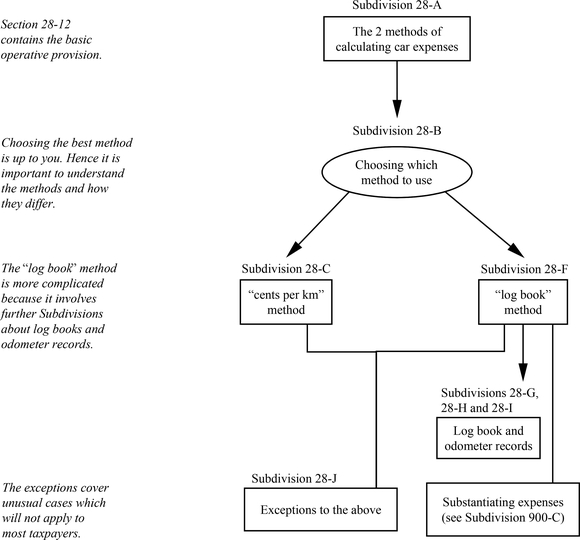
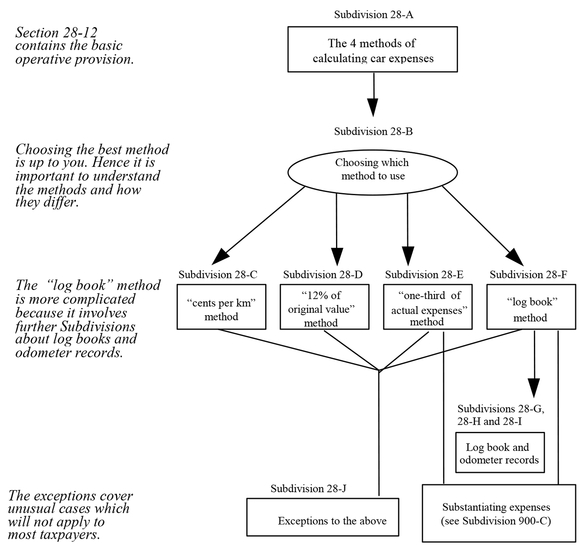
This Division applies to an individual.
28-10(2)
It also applies to a partnership that includes at least one individual, as if the partnership were an individual.
28-10(3)
It does not apply to any other entity.
SECTION 28-12 Car expenses 28-12(1)
If you owned or leased a * car, you can deduct for the car ' s expenses an amount or amounts worked out using one of 2 methods.
Note 1:
For particular types of cars taken on hire you cannot use one of the 2 methods: see section 28-165 .
Note 2:
In certain circumstances the lessee of a luxury car is taken to be its owner (see subsection 242-15(2) ).
Note 3:
In certain circumstances (for example, under a hire purchase agreement) the notional buyer of property is taken to be its owner (see subsection 240-20(2) ).
28-12(2)
You must use one of the 2 methods unless an exception applies. If you can ' t use either of the methods, you can ' t deduct anything for the * car expenses.
A car expense is a loss or outgoing to do with a * car.
28-13(2)
In addition, any of the following is a car expense:
(a) a loss or outgoing to do with operating a * car;
(b) the decline in value of a car.
28-13(3)
None of the following is a car expense:
(a) a loss or outgoing incurred, or a payment made, in respect of travel outside Australia;
(b) a taxi fare or similar loss or outgoing.
Subdivision 28-B - Choosing which method to use SECTION 28-14 What this Subdivision is about
This Subdivision sets out the rules about choosing a method of calculating car expense deductions.
Below is a diagram giving information about the 2 methods of calculating car expense deductions.
28-15(2)
The 2 methods give you the choice of which method best suits your situation and needs. For instance, one method may involve more paperwork than the other, but could give you bigger deductions.

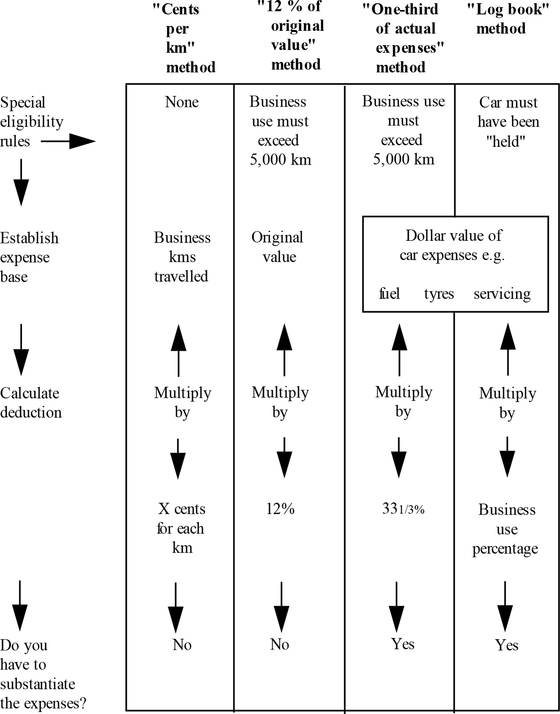
SECTION 28-20 Rules governing choice of method 28-20(1)
You can choose only one method for all the * car expenses for the * car for the income year. Choosing one method precludes the other method.
28-20(2)
However, you can change your choice for the income year.
Example:
You choose the " log book " method and deduct $ 1,000. On audit, the Commissioner finds that your claim is too high and should be reduced to $ 500. You would have been able to deduct $ 700 if you had chosen the " cents per kilometre " method. This rule lets you change your choice and deduct the $ 700.
28-20(3)
You can also choose different methods for the same * car for different income years and different methods for different cars for the same year.
Subdivision 28-C - The " cents per kilometre " method SECTION 28-25 How to calculate your deduction 28-25(1)
To calculate your deduction using the " cents per kilometre " method, use this formula:
| Number of * business kilometres travelled by the * car in the income year | × | Rate of cents/kilometre determined under subsection (4) for the car for the income year |
28-25(2)
But you can use this formula for the first 5,000 * business kilometres only. If the * car travelled more than 5,000 business kilometres, you must discard the kilometres in excess of 5,000.
Example:
If the car travelled 5,085 business kilometres, you could claim for 5,000, and would lose the extra 85.
28-25(3)
Business kilometres are kilometres the * car travelled in the course of:
(a) producing your assessable income; or
(b) your * travel between workplaces.
You calculate the number of business kilometres by making a reasonable estimate.
28-25(4)
For the purposes of subsection (1), the Commissioner may, by legislative instrument, determine rates of cents per kilometre for cars for an income year.
28-25(5)
In determining a rate, the Commissioner must have regard to the average operating costs for the cars to be covered by that rate.
Note:
Examples of operating costs include fixed costs such as registration, insurance and depreciation, and variable costs such as fuel and maintenance.
SECTION 28-30 28-30 Capital allowances
If a * balancing adjustment event occurs for the * car, you will need to refer to the capital allowances rules in Division 40 to find out how using this method affects the operation of those rules. See section 40-370 (about balancing adjustments for some cars).
To use this method, you do not need to substantiate the * car expenses for the * car. (Repealed) Subdivision 28-D - The " 12% of original value " method
(Repealed by No 162 of 2015)
(Repealed by No 162 of 2015)
(Repealed by No 162 of 2015)
(Repealed by No 162 of 2015)
(Repealed by No 162 of 2015)
(Repealed by No 162 of 2015)
(Repealed by No 162 of 2015)
To use the " log book " method, you multiply the amount of each * car expense by the * business use percentage.
The expense
28-90(2)
The expense must qualify as a deduction under some provision of this Act outside this Division (or would qualify if, while you * held the * car, you had used it only in producing your assessable income). If only part of the expense would qualify, you multiply that part by the * business use percentage.
Example:
You borrow money to buy a car. You make repayments of principal and payments of interest.
You cannot deduct the repayments of principal because they are capital expenses.
The interest payments would be deductible in full if, throughout the income year, you had used the car only in producing your assessable income.
Using the " log book " method:
• if you held the car for the whole income year - multiply the interest payments by the business use percentage; • if you held the car for only 6 months of the income year - multiply the interest payments for those 6 months by the business use percentage.
To find out whether an expense qualifies as a deduction under this Act, see Division 8 (Deductions).
The percentage
28-90(3)
The business use percentage is calculated by dividing:
by
and expressing the result as a percentage.
28-90(4)
Business kilometres are kilometres the * car travelled in the course of:
(a) producing your assessable income; or
(b) your * travel between workplaces.
28-90(5)
You calculate the number of business kilometres by making a reasonable estimate. The estimate must take into account all relevant matters, including:
(a) any log books, odometer records or other records you have; and
(b) any variations in the pattern of use of the * car; and
(c) any changes in the number of cars you used in the course of producing your assessable income.
28-90(6)
You hold a * car while you own it, or it is leased to you, for use in the course of producing your assessable income, even if it is also used for some other purpose.
Note 1:
In certain circumstances the lessee of a luxury car is taken to be its owner (see subsection 242-15(2) ).
Note 2:
In certain circumstances the notional buyer of property is taken to be its owner (see subsection 240-20(2) ).
SECTION 28-95 28-95 Eligibility
You can use this method only if you * held the * car for some or all of the income year. SECTION 28-100 Substantiation 28-100(1)
To use this method, you must substantiate the * car expenses under Subdivision 900-C .
28-100(2)
You must also keep a log book. Subdivision 28-G explains:
The log book is relevant to estimating the number of business kilometres the * car travelled in the period when you * held it during the income year.
28-100(3)
You must keep odometer records for the period when you * held the * car during the income year. Subdivision 28-H tells you about odometer records, which document the total number of kilometres the car travelled in that period.
28-100(4)
You must record the following information, in writing, before you lodge your * income tax return:
(a) your estimate of the number of * business kilometres; and
(b) the * business use percentage.
However, the Commissioner may allow you to record the information later.
28-100(5)
You must retain the log book and the odometer records. Subdivision 28-I has the rules about this.
Subdivision 28-G - Keeping a log book SECTION 28-105 What this Subdivision is about
This Subdivision tells you how to keep a log book. A log book is relevant to estimating the number of business kilometres the car travelled in the period when you held it during the income year.
There are 3 steps you need to follow in keeping a log book:
Operative provisions
• identify an income year for which to keep a log book; • choose a period of at least 12 weeks for the log book to cover; • record journeys made in the car during the log book period in the course of producing your assessable income.
SECTION 28-115 Income years for which you need to keep a log book 28-115(1)
You need to keep a log book for the first income year for which you use this method for the * car.
28-115(2)
Having kept a log book for one income year, you don't need to keep a new one for the next 4 or more income years unless subsection (3) or (4) requires it. If you haven't kept a new log book for 4 income years in a row, you must keep one for the next income year.
Example:
If you keep a log book in 1997-98, you would need to keep the next one in 2002-2003, unless subsection (3) or (4) requires one sooner.
28-115(3)
You must keep a log book for an income year if the Commissioner sends you a notice before the year directing you to keep a log book for the * car for that year.
28-115(4)
You must keep a log book for an income year if, during that year, you get one or more additional * cars for which you want to use the ``log book'' method for that year.
28-115(5)
When you replace one * car with another, you might have a period when you * hold both the new car and the old car, or a period when you no longer * hold the old car but do not yet hold the new car. In both these cases, you are treated for the purposes of subsection (4) as if you held the one car continuously.
28-115(6)
You may choose to keep a log book for an income year even if you don't need to; for example, because you want to establish a higher * business use percentage.
SECTION 28-120 Choosing the 12 week period for a log book 28-120(1)
The log book must cover a continuous period of at least 12 weeks throughout which you * held the * car. If you hold the car for less than 12 weeks, the period must be the entire period for which you held the car.
28-120(2)
The period may overlap the start or end of the income year, so long as it includes part of the year.
28-120(3)
If you want to use the ``log book'' method for 2 or more* cars for the same income year, the log books for those cars must cover periods that are concurrent.
SECTION 28-125 How to keep a log book 28-125(1)
It is in your interests to record in the log book any journey made in the * car during the log book period in the course of producing your assessable income. If a journey is not recorded, the log book will indicate a lower * business use percentage than is actually the case.
28-125(2)
A journey is recorded by making in the log book an entry specifying:
(a) the day the journey began and the day it ended;
(b) the * car's odometer readings at the start and end of the journey;
(c) how many kilometres the car travelled on the journey;
(d) why the journey was made.
The record must be made at the end of the journey or as soon as possible afterwards.
28-125(3)
If 2 or more journeys in a row are made in the * car on the same day in the course of producing your assessable income, they can be recorded as a single journey.
28-125(4)
The following must be entered in the log book:
(a) when the log book period begins and ends;
(b) the * car's odometer readings at the start and the end of the period;
(c) the total number of kilometres that the car travelled during the period;
(d) the number of kilometres that the car travelled, in the course of producing your assessable income, on journeys recorded in the log book;
(e) the number of kilometres referred to in paragraph (d), expressed as a percentage of the total number referred to in paragraph (c).
Each of the entries must be made at or as soon as possible after the start or end of the period, as appropriate.
28-125(5)
Each entry in the log book must be in English.
SECTION 28-130 Replacing one car with another 28-130(1)
For the purposes of using the ``log book'' method, you may nominate one * car as having replaced another car with effect from a day specified in the nomination.
28-130(2)
After the nomination takes effect, the replacement * car is treated as the original car, and the original car is treated as a different car. This means that you do not need to repeat for the replacement car the steps you have already taken for the original car under this Subdivision.
28-130(3)
You must record the nomination in writing before you lodge your * income tax return for the income year in which the nomination takes effect. However, the Commissioner may allow you to do it later.
28-130(4)
You must retain the nomination document until the end of the period for which you must retain the last log book that you began to keep for the original * car before the day of effect of the nomination.
28-130(5)
Section 28-150 (which is about retaining log books) applies to the nomination document in the same way as it applies to that last log book.
Subdivision 28-H - Odometer records for a period SECTION 28-135 What this Subdivision is about
This Subdivision tells you how to keep odometer records for a car during a particular period. Odometer records document the total number of kilometres the car travelled during a particular period.
SECTION 28-140 How to keep odometer records for a car for a period 28-140(1)
Odometer records for a period are kept in the form of a document in which the following are entered:
(a) the * car's odometer readings at the start and the end of the period;
(b) if there is a nomination under section 28-130 to replace the car with another * car with effect from a day in that period - the odometer readings, at the end of that day, of both cars affected by the nomination.
28-140(2)
Each entry under subsection (1) must be in English and must be made at or as soon as possible after the start or end of the period, or the end of the specified day, as appropriate.
28-140(3)
The following must also be entered in the document:
(a) the * car's make, model and registration number (if any);
(b) if the car has an internal combustion engine - its engine capacity expressed in cubic centimetres;
(c) if there is a nomination under section 28-130 to replace the car with another * car - the corresponding details for the other car affected by the nomination.
28-140(4)
Each entry under subsection (3) must be made in English and must be made before you lodge your * income tax return.
28-140(5)
The Commissioner may allow you to make an entry under this section after you lodge your * income tax return.
Subdivision 28-I - Retaining the log book and odometer records SECTION 28-150 Retaining the log book for the retention period 28-150(1)
You must retain the log book:
(a) first, until the end of the latest income year for which you rely on the log book to support your calculation of the * business use percentage for the * car; and
(b) then for another 5 years.
The period for which you must retain the log book is called the retention period .
28-150(2)
The 5 years start on the due day for lodging your * income tax return for that latest income year. If you lodge your return later, the 5 years start on the day you lodge it.
28-150(3)
However, the * retention period is extended if, when the 5 years end, you are involved in a dispute with the Commissioner that relates to a deduction worked out using a * business use percentage that you are relying on the log book to support. See section 900-170 .
28-150(4)
If you do not retain the log book for the * retention period, you cannot deduct any amount worked out using a * business use percentage that you are relying on the log book to support. If you have already deducted such an amount, your assessment may be amended to disallow the deduction.
28-150(5)
For the purposes of the rules about retaining and producing records of expenses (see Subdivision 900-G ), the log book is treated as a record of the * car expenses for each year for which you use a * business use percentage that you are relying on the log book to support.
28-150(6)
If you lose the log book, there are rules that might help you in section 900-205. For the purposes of the rules about relief from the effects of failing to substantiate (see Subdivision 900-H), not doing something required by this Division is treated in the same way as not doing something necessary to follow the rules in Division 900 .
SECTION 28-155 Retaining odometer records 28-155(1)
You must retain your odometer records relating to the period when you * held the * car in the income year.
28-155(2)
If you keep a log book for the income year, you must retain the odometer records for the same period as the log book, and section 28-150 applies to them in the same way as it applies to the log book.
28-155(3)
If you don't keep a log book for the income year, you must retain the odometer records for the same period as written evidence of a * car expense for the * car for the income year, and section 900-75 applies to them in the same way as it applies to written evidence of an expense.
Note:
Section 900-75 is about retaining written evidence of a car expense.
Subdivision 28-J - Situations where you cannot use, or do not need to use, one of the 2 methods
This Subdivision sets out the situations where you cannot use, or don ' t need to use, either of the 2 methods. These situations involve either the nature of your car or the way you use it.
SECTION 28-165 Exception for particular cars taken on hire 28-165(1)
For particular types of * cars taken on hire you cannot use one of the 2 methods to calculate your deductions for * car expenses.
28-165(2)
Instead, you must calculate the deductions under the normal principles governing deductions, including the rules for apportioning a loss or outgoing that is only partly attributable to producing assessable income.
28-165(3)
This section applies to a taxi taken on hire.
28-165(4)
It also applies to a * motor vehicle taken on hire under an agreement of a kind ordinarily entered into by people who take motor vehicles on hire intermittently, as the occasion requires, on an hourly, daily, weekly or short term basis, except if the motor vehicle:
(a) has been taken on hire under successive agreements of a kind that result in substantial continuity of the motor vehicle being taken on hire; or
(b) it is reasonable to expect that the motor vehicle will be taken on hire under successive agreements of a kind that will so result.
SECTION 28-170 Exception for particular cars used in particular ways 28-170(1)
For particular types of * cars used in particular ways you don ' t need to use one of the 2 methods to calculate your deductions for * car expenses.
28-170(2)
You may use one of the 2 methods, or you may instead calculate the deductions under the normal principles governing deductions, including the rules for apportioning a loss or outgoing that is only partly attributable to producing assessable income.
28-170(3)
This section applies if, whenever you used the * car in the income year:
(a) the car was covered by the description in column 2 of an item in the table below; and
(b) you used the car as described in column 3 of that item.
| Item |
Column 2
Particular car |
Column 3
Exempt use |
||
| 1. | The * car was: | You used the car only in one or more of the following ways: | ||
| (a) | a panel van or utility truck; or | (a) | in the course of producing your assessable income; | |
| (b) | any other road vehicle designed to carry a load of less than 1 tonne (other than a vehicle designed principally to carry passengers); or | (b) | to go between your residence and a place where you use the car in the course of producing your assessable income; | |
| (c) | a taxi. | (c) | by providing the car to someone else to drive between his or her residence and a place where the car is used in the course of producing your assessable income; | |
| (d) | for the purpose of travel that is incidental to using the car in the course of producing your assessable income; | |||
| (e) | for your own or someone else's private use that was minor, infrequent and irregular. | |||
| . | ||||
| 2. | The * car was part of the * trading stock of a * business of selling cars that you carried on. | You used the car in the course of the business. | ||
| . | ||||
| 3. | The * car was any type of car. | You let the car on lease or hire in the course of a * business of letting cars on lease or hire that you carry on. | ||
| . | ||||
| 4. | The * car was any type of car. | As an employer, you provided the car for the exclusive use of one or more of the following:
(a) your employees; (b) their * relatives; in circumstances where one or more of them was entitled to use the car for private purposes. |
||
| Note: | This Subdivision also applies to entities that are not employers, but pay (or are liable to pay) withholding payments covered by subsection 28-185(3). |
SECTION 28-175 Further miscellaneous exceptions 28-175(1)
This section lists some miscellaneous cases where you don't need to use one of the 2 methods to calculate your deductions for * car expenses.
28-175(2)
You may use one of the 2 methods, or you may instead calculate the deductions under the normal principles governing deductions, including the rules for apportioning a loss or outgoing that is only partly attributable to producing assessable income.
28-175(3)
The cases are as follows:
(a) the * car was unregistered throughout the period when you * held it during the income year, and during that period you used it principally in the course of producing your assessable income; or
(b) at some time during the income year the * car was part of the * trading stock of a * business of selling cars that you carried on, and you didn ' t use the car at any time during that year; or
(c) the expense is to do with repairs to or other work on the * car, and you incurred it in the course of a * business that you carried on of doing repairs or other work on cars.
In applying paragraph (a), the car is taken to be registered in a particular place while it is lawful to drive the car on a public road there.
28-180 (Repealed) SECTION 28-180 Car expenses related to award transport payments
(Repealed by No 49 of 2026)
Application to recipients
28-185(1)
If an individual receives, or is entitled to receive, * withholding payments covered by subsection (3), this Subdivision applies to him or her:
(a) in the same way as it applies to an employee; and
(b) as if an entity (a notional employer ) that makes (or is liable to make) such payments to him or her were his or her employer; and
(c) as if any other individual who receives, or is entitled to receive, such payments from a notional employer were also an employee of the notional employer.
Application to payers
28-185(2)
This Division applies to an entity that makes, or is liable to make, * withholding payments covered by subsection (3):
(a) in the same way as it applies to an employer; and
(b) as if an individual to whom the entity makes (or is liable to make) such payments were the entity's employee.
Withholding payments covered
28-185(3)
This subsection covers a * withholding payment covered by any of the provisions in Schedule 1 to the Taxation Administration Act 1953 listed in the table.
| Withholding payments covered | ||
| Item | Provision | Subject matter |
| 1 | Section 12-35 | Payment to employee |
| . | ||
| 2 | Section 12-40 | Payment to company director |
| . | ||
| 3 | Section 12-45 | Payment to office holder |
| . | ||
| 3A | Section 12-47 | Payment to * religious practitioner |
| . | ||
| 4 | Section 12-50 | Return to work payment |
| . | ||
| 5 | Subdivision 12-C | Payments for retirement or because of termination of employment |
| . | ||
| 6 | Subdivision 12-D | Benefit and compensation payments |
This Division sets out the rules for working out deductions for certain gifts or contributions that you make.
| 30-5 | How to find your way around this Division |
| 30-10 | Index |
You should start at Subdivision 30-A unless you are making a contribution or gift to a political party, independent candidate or member.
Note:
Subdivision 30-DA deals with the deductibility of contributions and gifts to political parties, independent candidates and members.
30-5(2)
Subdivision 30-A contains a table of all the gifts and contributions that you can deduct. You need to look at the table to see whether the type of gift or contribution you are making is covered by it.
30-5(3)
In some cases, the table sends you off to Subdivision 30-B . It has a number of tables that list particular funds, authorities or institutions that deductible gifts can be made to.
30-5(4)
In other cases, the table sends you off to Subdivision 30-C . It contains rules that apply to particular gifts of property.
30-5(4AA)
Subdivision 30-BA provides for the Commissioner to endorse as a deductible gift recipient an entity that is, or operates, a fund, authority or institution. The relevance of the Subdivision to you is that generally you can deduct only a gift you make to a recipient that is endorsed or named in: (a) this Division; or (b) regulations made for the purposes of this Division.
Note:
The fact that gifts to a recipient registered in the Australian Business Register are deductible will be shown in the Register.
30-5(4AB)
Subdivision 30-CA sets out administrative rules which do not directly affect whether you can deduct a gift you make. The rules require: (a) a receipt issued by an entity for a gift to the entity or to a fund, authority or institution operated by the entity to show the entity ' s ABN; and (b) the Australian Business Registrar to enter in the Australian Business Register a statement in relation to an entity entered in the Register if:
(i) gifts to the entity are deductible; or
(ii) gifts to a fund, authority or institution operated by the entity are deductible.
30-5(4B)
Subdivision 30-DB allows you to spread deductions for certain gifts and covenants over up to 5 income years.
30-5(5)
(Repealed by No 40 of 2023)
There is an index to this Division in Subdivision 30-G .
You can deduct a gift or contribution that you make in the situations set out in the following table. It tells you:
30-15(2)
A testamentary gift or contribution is not deductible under this section.
Note:
Subdivision 30-DA deals with the deductibility of contributions and gifts to political parties, independent candidates and members.
| Deductible gifts or contributions | ||||
| Recipient | Type of gift or contribution | How much you can deduct | Special conditions | |
| 1 | A fund, authority or institution covered by an item in any of the tables in Subdivision 30-B. | A gift of:
(a) money; or (b) property (including * trading stock) that you purchased during the 12 months before making the gift; or (c) an item of your trading stock if: • the gift is a disposal of the item outside the ordinary course of your * business; and • no election has been made, or is made, in relation to the item under Subdivision 385-E (about electing to spread or defer profit from the forced disposal or death of * live stock); or (d) property valued by the Commissioner at more than $ 5,000; or (e) * shares that you have acquired in a * listed public company if: • the shares are listed for quotation in the official list of a stock exchange that is listed under the heading " Australia " in regulations made for the purposes of the definition of * approved stock exchange; and • the * market value of the shares on the day you made the gift is $ 5,000 or less; and • you acquire the shares at least 12 months before making the gift. |
(a) if the gift is money
-
the amount you are giving; or
(b) if the gift is property (except trading stock covered by paragraph (c), property covered by paragraph (d) or shares covered by paragraph (e)) - the lesser of the market value of the property on the day you made the gift and the amount you paid for the property; or (c) if the gift is an item of your trading stock: • that you disposed of outside the ordinary course of your business; and • for which no election has been made, or is made, in relation to the item under Subdivision 385-E; the market value of the item on the day you made the gift; or (d) if the gift is property valued by the Commissioner at more than $ 5,000 and you did not purchase the property during the 12 months before making the gift - the value of the property as determined by the Commissioner; or (e) if the gift is shares described in paragraph (e) of the previous column - the market value of the shares on the day you made the gift. |
(a) the fund, authority or institution must be in Australia; and
(aa) the fund, authority or institution must either meet the requirements of section 30-17 or be mentioned by name in the relevant table item in Subdivision 30-B; and (b) (Repealed by No 58 of 2026) (c) any conditions set out in the relevant table item in Subdivision 30-B must be satisfied; and (d) if the property is to be valued by the Commissioner - the requirements of section 30-212 are satisfied. |
| 2 | An
*
ancillary fund established and maintained under a will or instrument of trust solely for:
(a) the purpose of providing money, property or benefits: • to a fund, authority or institution gifts to which are deductible under item 1 of this table; and • for any purposes set out in the item of the table in Subdivision 30-B that covers the fund, authority or institution; or (b) the establishment of such a fund, authority or institution. |
A gift of:
(a) money; or (b) property (including * trading stock) that you purchased during the 12 months before making the gift; or (c) an item of your trading stock if: • the gift is a disposal of the item outside the ordinary course of your * business; and • no election has been made, or is made, in relation to the item under Subdivision 385-E (about electing to spread or defer profit from the forced disposal or death of * live stock); or (d) property valued by the Commissioner at more than $ 5,000; or (e) * shares that you have acquired in a * listed public company if: • the shares are listed for quotation in the official list of a stock exchange that is listed under the heading " Australia " in regulations made for the purposes of the definition of * approved stock exchange; and • the * market value of the shares on the day you made the gift is $ 5,000 or less; and • you acquire the shares at least 12 months before making the gift. |
(a) if the gift is money - the amount you are giving; or (b) if the gift is property (except trading stock covered by paragraph (c), property covered by paragraph (d) or shares covered by paragraph (e)) - the lesser of the market value of the property on the day you made the gift and the amount you paid for the property; or (c) if the gift is an item of your trading stock: • that you disposed of outside the ordinary course of your business; and • for which no election has been made, or is made, in relation to the item under Subdivision 385-E; the market value of the item on the day you made the gift; or (d) if the gift is property valued by the Commissioner at more than $ 5,000 and you did not purchase the property during the 12 months before making the gift - the value of the property as determined by the Commissioner; or (e) if the gift is shares described in paragraph (e) of the previous column - the market value of the shares on the day you made the gift. |
(a) (Repealed by No 58 of 2026)
(b) the terms of the will or trust must allow the trustee to invest money that the ancillary fund receives because of the gift only in a way that an * Australian law allows trustees to invest trust money; and (c) the ancillary fund must meet the requirements of section 30-17; and (d) if the property is to be valued by the Commissioner - the requirements of section 30-212 are satisfied. |
| 3 | (Repealed by No 65 of 2006) | |||
| 4 | (a) the Australiana Fund; or
(b) a public library in Australia; or (c) a public museum in Australia; or (d) a public art gallery in Australia; or (e) an institution in Australia consisting of a public library, a public museum and a public art gallery or any 2 of them. |
A gift of property (except an estate or interest in land or in a building or part of a building). | The general rule is that you can deduct the average of the
*
GST inclusive market values (as reduced under subsection (3) if that subsection applies) specified in the written valuations you get from approved valuers.
Subdivision 30-C sets out: (a) how a person becomes an approved valuer; and (b) the exceptions to the general rule; and (c) the situations when the amount you can deduct is reduced. If the property is jointly owned, see section 30-225 to work out how much of the gift you can deduct. |
(a) the property must be accepted by the recipient for inclusion in a collection it is maintaining or establishing; and
(b) (Repealed by No 58 of 2026) (ba) the institution must meet the requirements of section 30-17, unless it is the Australiana Fund; and (c) you must satisfy the valuation requirements in section 30-200, unless section 30-205 (about the proceeds of the sale being assessable) applies. |
| 5 | The Commonwealth (for the purposes of Artbank). | A gift of property (except an estate or interest in land or in a building or part of a building). | The general rule is that you can deduct the average of the
*
GST inclusive market values (as reduced under subsection (3) if that subsection applies) specified in the written valuations you get from approved valuers.
Subdivision 30-C sets out: (a) how a person becomes an approved valuer; and (b) the exceptions to the general rule; and (c) the situations when the amount you can deduct is reduced. If the property is jointly owned, see section 30-225 to work out how much of the gift you can deduct. |
(a) the property must be accepted by the Commonwealth for inclusion in a collection maintained, or being established, for the purposes of Artbank; and
(b) you must satisfy the valuation requirements in section 30-200, unless section 30-205 (about the proceeds of the sale being assessable) applies. |
| 6 | (a) the National Trust of Australia (New South Wales); or
(b) the National Trust of Australia (Victoria); or (c) National Trust of Australia (Queensland) Limited; or (d) the National Trust of South Australia; or (e) the National Trust of Australia (W.A.); or (f) the National Trust of Australia (Tasmania); or (g) the National Trust of Australia (Northern Territory); or (h) the National Trust of Australia (A.C.T.); or (i) the Australian Council of National Trusts. |
A gift of a place included in:
(a) the National Heritage List, or the Commonwealth Heritage List, under the Environment Protection and Biodiversity Conservation Act 1999 ; or (b) the Register of the National Estate under the Australian Heritage Council Act 2003 . |
The general rule is that you can deduct the average of the
*
GST inclusive market values (as reduced under subsection (3) if that subsection applies) specified in the written valuations you get from approved valuers.
Subdivision 30-C sets out: (a) how a person becomes an approved valuer; and (b) the exceptions to the general rule; and (c) the situations when the amount you can deduct is reduced. If the place is jointly owned, see section 30-225 to work out how much of the gift you can deduct. |
(a) the place must be accepted by the recipient for the purpose of preserving it for the benefit of the public; and
(b) (Repealed by No 58 of 2026) (c) you must satisfy the valuation requirements in section 30-200, unless section 30-205 (about the proceeds of the sale being assessable) applies. |
| 7 | A * deductible gift recipient that is a fund, authority or institution covered by item 1 or 2 of this table. | A contribution of:
(a) money, if the amount is more than $ 150; or (b) property that you purchased during the 12 months before making the contribution, if the lesser of: • the * market value of the property on the day you made the contribution; and • the amount you paid for the property; is more than $ 150; or (c) property valued by the Commissioner at more than $ 5,000, if you did not purchase the property during the 12 months before making the contribution; or (ca) * shares that you have acquired in a * listed public company if: • the shares are listed for quotation in the official list of a stock exchange that is listed under the heading " Australia " in regulations made for the purposes of the definition of * approved stock exchange; and • the market value of the shares on the day you made the contribution is more than $ 150 and less than or equal to $ 5,000; and |
(a) if the contribution is money
-
the amount of the contribution, reduced by the
*
GST inclusive market value, on the day you made the contribution, of the right to attend, or participate in, the fund-raising event; or
(b) if the contribution is property that you purchased during the 12 months before making the contribution - the lesser of: • the market value of the property on the day you made the contribution; and • the amount you paid for the property; reduced by the GST inclusive market value, on the day you made the contribution, of the right to attend, or participate in, the fund-raising event; or (c) if the contribution is property valued by the Commissioner at more than $ 5,000 and you did not purchase the property during the 12 months before making the contribution - the value of the property as determined by the Commissioner, reduced by the GST inclusive market value, on the day you made the contribution, of the right to attend, or participate in, the fund-raising event; or |
(a) if the contribution is money
-
the GST inclusive market value, on the day you made the contribution, of the right to attend, or participate in, the fund-raising event must not exceed the lesser of:
• 20% of the amount of the contribution; and • $ 150; and (b) if the contribution is property that you purchased during the 12 months before making the contribution - the GST inclusive market value, on the day you made the contribution, of the right to attend, or participate in, the fund-raising event must not exceed the lesser of: • 20% of the lesser of the market value of the property on the day you made the contribution and the amount you paid for the property; and • $ 150; and (c) if the contribution is property valued by the Commissioner at more than $ 5,000 and you did not purchase the property during the 12 months before making the contribution - the GST inclusive market value, on the day you made the contribution, of the right to attend, or participate in, the fund-raising event must not exceed $ 150; and |
|
• you acquire the shares at least 12 months before making the contribution; where: (d) the contribution is not a gift; and (e) either: • the contribution is made in return for a right permitting you to attend, or participate in, a particular * fund-raising event in Australia; or • the contribution is made in return for a right permitting an individual (other than you) to attend, or participate in, a particular fund-raising event in Australia. |
(ca) if the contribution is shares described in paragraph (ca) of the previous column - the market value of the shares on the day you made the contribution, reduced by the GST inclusive market value, on the day you made the contribution, of the right to attend, or participate in, the fund-raising event. |
(ca) if the contribution is shares described in paragraph (ca) of the column headed " Type of gift or contribution " - the GST inclusive market value, on the day you made the contribution, of the right to attend, or participate in, the fund-raising event must not exceed the lesser of: • 20% of the market value of the shares on the day you made the contribution; and • $ 150; and (d) if: • instead of making the contribution you had made a gift of money to the fund, authority or institution; and • the gift had been made for the same purpose for which funds were to be raised by the fund-raising event; you could have deducted the gift under item 1 or 2 of this table; and (e) you must be an individual; and (f) you cannot deduct more than 2 contributions in relation to the same fund-raising event; and (g) if the property is to be valued by the Commissioner - the requirements of section 30-212 are satisfied. |
||
| 8 | A * deductible gift recipient that is a fund, authority or institution covered by item 1 or 2 of this table. | A contribution of money, if:
(a) the amount is more than $ 150; and (b) the contribution is not a gift; and (c) you made the contribution by way of consideration for the supply of goods or services; and (d) you made the contribution because you were the successful bidder at an auction that: • was a particular * fund-raising event in Australia; or • was held at a particular fund-raising event in Australia; and (e) the amount of the contribution exceeds the * GST inclusive market value, on the day you made the contribution, of the goods or services. |
The amount of the contribution, reduced by the GST inclusive market value, on the day you made the contribution, of the goods or services. | (a) the GST inclusive market value, on the day you made the contribution, of the goods or services must not exceed the lesser of:
• 20% of the amount of the contribution; and • $ 150; and (b) if: • instead of making the contribution you had made a gift of money to the fund, authority or institution; and • the gift had been made for the same purpose for which funds were to be raised by the fund-raising event; you could have deducted the gift under item 1 or 2 of this table; and (c) you must be an individual. |
30-15(3)
For the purposes of items 4, 5 and 6 of the table in subsection (2), the * GST inclusive market values of the property or place in question are reduced by 1/11 if you would have been entitled to an * input tax credit if:
(a) you had * acquired the property or place at the time you made the gift; and
(b) your acquisition had been for a * creditable purpose.
30-15(4)
For the purposes of item 7 of the table in subsection (2), in working out the * GST inclusive market value of the right in question, disregard anything that would prevent or restrict conversion of the right to money.
30-15(5)
For the purposes of item 8 of the table in subsection (2), in working out the * GST inclusive market value of the goods or services in question, disregard anything that would prevent or restrict conversion of the goods or services to money.
SECTION 30-17 Requirements for certain recipients 30-17(1)
This section sets out requirements to be met for you to be able to deduct a gift you make to a fund, authority or institution described in the column headed " Recipient " of item 1, 2 or 4 of the table in section 30-15 . However, this section does not apply to:
(a) a fund, authority or institution that is mentioned by name in an item of a table in Subdivision 30-B ; or
(b) (Repealed by No 88 of 2009)
(c) the Australiana Fund.
30-17(2)
The fund, authority or institution must:
(a) be an entity or * government entity that is endorsed under Subdivision 30-BA as a * deductible gift recipient; or
(b) in the case of a fund - either:
(i) be owned legally by an entity that is endorsed under Subdivision 30-BA as a * deductible gift recipient for the operation of the fund; or
(ii) be under the control of one or more persons who constitute a * government entity that is endorsed under Subdivision 30-BA as a * deductible gift recipient for the operation of the fund; or
(c) in the case of an authority or institution - be part of an entity or * government entity that is endorsed under Subdivision 30-BA as a * deductible gift recipient for the operation of the authority or institution.
Example:
A public fund that is established and maintained for constructing a building to be used by a State school and is controlled by the principal of the school would be an example of a fund under the control of one or more persons who constitute a government entity that is endorsed as a deductible gift recipient for the operation of the fund, if the school were so endorsed.
SECTION 30-20 Health 30-20(1)
This table sets out general categories of health recipients.
| Health - General | |||||
| Item | Fund, authority or institution | Special conditions - fund, authority or institution | Special conditions - gift | ||
| 1.1.1 | a public hospital | the public hospital must be: | none | ||
| (a) | an * Australian government agency; or | ||||
| (b) | a * registered charity | ||||
| 1.1.2 | a hospital carried on by a society or association | the society or association must be a * registered charity | none | ||
| 1.1.3 | a public fund maintained for: | (a) | the public fund must have been established before 23 October 1963; and | none | |
| (a) | the purpose of providing money for hospitals covered by item 1.1.1 or 1.1.2; or | (b) | the public fund must be, or be operated by, an * Australian government agency or a * registered charity; and | ||
| (b) | the establishment of such hospitals | (c) | the hospitals must satisfy the special conditions set out in item 1.1.1 or 1.1.2 (as applicable) | ||
| 1.1.4 | a public authority engaged in research into the causes, prevention or cure of disease in human beings, animals or plants | the public authority must be: | the gift must be made for such research | ||
| (a) | an * Australian government agency; or | ||||
| (b) | a * registered charity | ||||
| 1.1.5 | a public institution engaged solely in research into the causes, prevention or cure of disease in human beings, animals or plants | the public institution must be: | none | ||
| (a) | an * Australian government agency; or | ||||
| (b) | a * registered charity | ||||
| 1.1.6 | a * registered health promotion charity | none | none | ||
| 1.1.7 | a public ambulance service | the public ambulance service must be: | none | ||
| (a) | an * Australian government agency; or | ||||
| (b) | a * registered charity | ||||
| 1.1.8 | a public fund established and maintained for the purpose of providing money for public ambulance services covered by item 1.1.7 | (a) | the public fund must be, or be operated by, an * Australian government agency or a * registered charity; and | none | |
| (b) | the public ambulance services must satisfy the special conditions set out in item 1.1.7 | ||||
| 1.1.9 | a * community shed | the community shed must be a * registered charity | none |
30-20(2)
This table sets out specific health recipients.
| Health - Specific | ||
| Item | Fund, authority or institution | Special conditions |
| 1.2.1 | The Royal Australian and New Zealand College of Obstetricians and Gynaecologists | none |
| . | ||
| 1.2.2 | (Repealed by No 41 of 2011) | |
| . | ||
| 1.2.3 | (Repealed by No 41 of 2011) | |
| . | ||
| 1.2.4 | The Royal Australian and New Zealand College of Radiologists | the gift must be made for education or research in medical knowledge or science |
| . | ||
| 1.2.5 | the New South Wales College of Nursing | none |
| . | ||
| 1.2.6 | the Royal Australian and New Zealand College of Psychiatrists | none |
| . | ||
| 1.2.7 | the Royal Australian College of General Practitioners | the gift must be made for education or research in medical knowledge or science |
| . | ||
| 1.2.8 | the Royal Australasian College of Physicians | none |
| . | ||
| 1.2.9 | the Royal Australasian College of Surgeons | none |
| . | ||
| 1.2.10 | the Royal College of Pathologists of Australasia | the gift must be made for education or research in medical knowledge or science |
| . | ||
| 1.2.11 | (Repealed by No 41 of 2011) | |
| . | ||
| 1.2.12 | the Royal College of Nursing, Australia | none |
| . | ||
| 1.2.13 | the Australian and New Zealand College of Anaesthetists | none |
| . | ||
| 1.2.14 | (Repealed by No 136 of 2024) | |
| . | ||
| 1.2.15 | (Repealed by No 41 of 2011) | |
| . | ||
| 1.2.16 | (Repealed by No 129 of 2011) | |
| . | ||
| 1.2.17 | (Repealed by No 129 of 2011) | |
| . | ||
| 1.2.18 | The Australasian College for Emergency Medicine | the gift must be made after 2 February 2009 |
| . | ||
| 1.2.19 | Cancer Australia | the gift must be made:
(a) after 8 June 2011; and (b) for improving outcomes for Australians affected by breast cancer |
| . | ||
| 1.2.20 | The Australasian College of Dermatologists | the gift must be made for education or research in medical knowledge or science |
| . | ||
| 1.2.21 | College of Intensive Care Medicine of Australia and New Zealand | the gift must be made for education or research in medical knowledge or science |
| . | ||
| 1.2.22 | The Royal Australian and New Zealand College of Ophthalmologists | the gift must be made for education or research in medical knowledge or science |
Education
SECTION 30-25 Education 30-25(1)
This table sets out general categories of education recipients.
| Education - General | |||
| Item | Fund, authority or institution | Special conditions - fund, authority or institution | Special conditions - gift |
| 2.1.1 | a public university | the public university must be:
(a) an * Australian government agency; or (b) a * registered charity |
none |
| . | |||
| 2.1.2 | a public fund for the establishment of a public university | (a) the public fund must be:
(i) an * Australian government agency; or (ii) a * registered charity; or (iii) operated by an Australian government agency or registered charity; and (b) the public university must satisfy the special conditions set out in item 2.1.1 |
none |
| . | |||
| 2.1.3 | an institution that is a higher education provider within the meaning of the Higher Education Support Act 2003 | the institution must be:
(a) an * Australian government agency; or (b) a * registered charity |
none |
| . | |||
| 2.1.4 | a residential educational institution affiliated under statutory provisions with a public university | (a) the residential educational institution must be a
*
registered charity; and
(b) the public university must satisfy the special conditions set out in item 2.1.1 |
none |
| . | |||
| 2.1.5 | a residential educational institution established by the Commonwealth | none | none |
| . | |||
| 2.1.6 | a residential educational institution that is affiliated with an institution that is a higher education provider within the meaning of the Higher Education Support Act 2003 | (a) the residential educational institution must be:
(i) an * Australian government agency; or (ii) a * registered charity; and (b) the higher education provider must satisfy the special conditions set out in item 2.1.3 |
none |
| . | |||
| 2.1.7 | an institution that the * Student Assistance Minister has determined to be a technical and further education institution under the Student Assistance Act 1973 | the institution must be:
(a) an * Australian government agency; or (b) a * registered charity |
see section 30-30 |
| . | |||
| 2.1.8 | a public fund established and maintained solely for the purpose of providing religious instruction in government schools in Australia | the public fund must be:
(a) an * Australian government agency; or (b) a * registered charity; or (c) operated by an Australian government agency or a registered charity |
none |
| . | |||
| 2.1.9 | a public fund established and maintained by a Roman Catholic archdiocesan or diocesan authority solely for the purpose of providing religious instruction in government schools in Australia | the public fund must be:
(a) an * Australian government agency; or (b) a * registered charity; or (c) operated by an Australian government agency or a registered charity |
none |
| . | |||
| 2.1.9A | a public fund established and maintained solely for the purpose of providing education in ethics:
(a) in government schools in Australia; and (b) as an alternative to religious instruction, in accordance with * State law or * Territory law |
the public fund must be:
(a) a * registered charity; or (b) operated by a registered charity |
none |
| . | |||
| 2.1.10 | a public fund established and maintained solely for providing money for the acquisition, construction or maintenance of a building used, or to be used, as a school or college by:
(a) a government; or (b) a public authority; or (c) a society or association which is carried on otherwise than for the purposes of profit or gain to the individual members of the society or association |
the public fund must be:
(a) an * Australian government agency; or (b) a * registered charity; or (c) operated by an Australian government agency or a registered charity |
none |
| . | |||
| 2.1.11 | a public fund established and maintained solely for providing money for the acquisition, construction or maintenance of a rural school hostel building to which section 30-35 applies | the public fund must be:
(a) an * Australian government agency; or (b) a * registered charity; or (c) operated by an Australian government agency or a registered charity |
none |
| . | |||
| 2.1.12 | a government school that:
(a) provides special education for students each of whom has a disability that is permanent or is likely to be permanent; and (b) does not provide education for other students |
none | none |
| . | |||
| 2.1.13 | a public fund that is established and maintained solely for providing money for scholarships, bursaries or prizes to which section 30-37 applies | the public fund must be:
(a) a * registered charity; or (b) operated by a registered charity |
none |
30-25(2)
This table sets out specific education recipients.
| Education - Specific | |||
| Item | Fund, authority or institution | Special conditions | |
| 2.2.1 | The Academy of the Social Sciences in Australia Incorporated | none | |
| . | |||
| 2.2.2 | the Australian Academy of Science | none | |
| . | |||
| 2.2.3 | the Australian Academy of the Humanities for the Advancement of Scholarship in Language, Literature, History, Philosophy and the Fine Arts | none | |
| . | |||
| 2.2.4 | the Australian Academy of Technological Sciences and Engineering Limited | none | |
| . | |||
| 2.2.5 | Aurora Education Foundation Limited | the gift must be made after 30 June 2013 | |
| . | |||
| 2.2.6 | the Australian and New Zealand Association for the Advancement of Science | none | |
| . | |||
| 2.2.7 | (Repealed by No 49 of 2019) | ||
| . | |||
| 2.2.8 | Life EducationAustralia | none | |
| . | |||
| 2.2.9 | a company that conducts life education programs under the auspices of Life EducationAustralia if the company: | the gift must be for the conduct of such programs | |
| (a) | is not carried on for the purposes of profit or gain to its individual members; and | ||
| (b) | is prohibited by its * constitution from making any distribution of money or property to its members | ||
| . | |||
| 2.2.10 | the Council for Christian Education in Schools | none | |
| . | |||
| 2.2.11 | the Council for Jewish Education in Schools | none | |
| . | |||
| 2.2.12 | (Repealed by No 101 of 2006 ) | ||
| . | |||
| 2.2.13 | the Lionel Murphy Foundation | none | |
| . | |||
| 2.2.14 | the Marcus Oldham Farm Management College | see section 30-30 | |
| . | |||
| 2.2.15 | (Repealed by No 41 of 2011) | ||
| . | |||
| 2.2.16 | the Polly Farmer Foundation (Inc) | none | |
| . | |||
| 2.2.17 | The Australian Council of Christians and Jews | the gift must be made after 6 December 1998 | |
| . | |||
| 2.2.18 | (Repealed by No 136 of 2024) | ||
| . | |||
| 2.2.19 | (Repealed by No 41 of 2011) | ||
| . | |||
| 2.2.20 | Australian Nuffield Farming Scholars Association | the gift must be made after 16 April 2001 | |
| . | |||
| 2.2.21 | Dymocks Children ' s Charities Limited | the gift must be made after 4 January 2001 | |
| . | |||
| 2.2.22 | Australian Primary Principals Association Education Foundation | the gift must be made after 1 October 2001 | |
| . | |||
| 2.2.23 | Commonwealth Study Conferences (Australia) Incorporated | the gift must be made after 19 February 2001 | |
| . | |||
| 2.2.24 | Mt Eliza Graduate School of Business and Government Limited | the gift must be made after 4 April 2000 and before 1 January 2023 | |
| . | |||
| 2.2.25 | Australian Human Rights Education Fund | the gift must be made after 24 September 2001 | |
| . | |||
| 2.2.26 | Aboriginal Education Council (N.S.W.) Incorporated | the gift must be made after 6 May 2002 | |
| . | |||
| 2.2.27 | General Sir John Monash Foundation | the gift must be made after 16 June 2002 | |
| . | |||
| 2.2.28 | Australian-American Educational Foundation | the gift must be made after 30 April 2003 | |
| . | |||
| 2.2.29 | The Australian Literacy and Numeracy Foundation Limited | the gift must be made after 11 October 2002 | |
| . | |||
| 2.2.30 | The Constitution Education Fund | the gift must be made after 20 June 2003 | |
| . | |||
| 2.2.31 | Country Education Foundation of Australia Limited | the gift must be made on or after 20 August 2003 | |
| . | |||
| 2.2.32 | (Repealed by No 12 of 2026) | ||
| . | |||
| 2.2.33 | International Specialised Skills Institute Incorporated | the gift must be made after 11 August 2005 | |
| . | |||
| 2.2.34 | (Repealed by No 127 of 2021) | ||
| . | |||
| 2.2.35 | (Repealed by No 155 of 2008) | ||
| 2.2.36 | The Spirit of Australia Foundation | the gift must be made after 10 September 2007 | |
| 2.2.37 | The Royal Institution of Australia Incorporated | the gift must be made after 16 April 2009 | |
| 2.2.38 | (Repealed by No 127 of 2021) | ||
| 2.2.39 | The Charlie Perkins Scholarship Trust | the gift must be made after 1 August 2010 | |
| 2.2.40 | (Repealed by No 12 of 2026) | ||
| 2.2.41 | Teach for Australia | the gift must be made after 31 December 2012 | |
| 2.2.42 | The Conversation Trust | the gift must be made after 21 November 2012 | |
| 2.2.43 | Australian Schools Plus Ltd | the gift must be made on or after 1 April 2014 | |
| 2.2.44 | Australian Science Innovations Incorporated | the gift must be made on or after 1 January 2016 | |
| 2.2.45 | Smile Like Drake Foundation Limited | the gift must be made after 8 March 2018 and before 9 March 2023 | |
| 2.2.46 | The Q Foundation Trust | the gift must be made after 31 December 2017 and before 1 January 2023 | |
| 2.2.47 | Governor Phillip International Scholarship Trust | the gift must be made after 30 June 2018 and before 1 July 2025 | |
| 2.2.48 | High Resolves | the gift must be made after 30 June 2018 and before 1 July 2025 | |
| 2.2.49 | Australian Academy of Law | the gift must be made after 30 June 2019 and before 1 July 2025 | |
| 2.2.50 | Superannuation Consumers ' Centre Ltd | the gift must be made after 30 June 2019 and before 1 July 2025 | |
| 2.2.51 | The Andy Thomas Space Foundation Limited | the gift must be made after 30 June 2020 | |
| 2.2.52 | The Judith Neilson Institute for Journalism and Ideas | the gift must be made after 30 June 2020 | |
| 2.2.53 | SU Australia Ministries Limited | the gift must be made on or after 1 July 2021 and before 1 July 2023 | |
| 2.2.54 | (Repealed by No 12 of 2026) | ||
| 2.2.55 | The Ramsay Centre for Western Civilisation Limited | the gift must be made after 30 June 2021 | |
| 2.2.56 | Australian Education Research Organisation Limited | the gift must be made after 30 June 2021 | |
| . | |||
| 2.2.57 | Jewish Education Foundation (Vic) Ltd | the gift must be made after 30 June 2021 and before 1 July 2026 | |
| . | |||
| 2.2.58 | Melbourne Business School Limited | the gift must be made after 30 June 2022 | |
| . | |||
| 2.2.59 | Ourschool Ltd | the gift must be made after 30 June 2024 and before 1 July 2029 | |
| . | |||
| 2.2.60 | Tasmanian Leaders Inc. | the gift must be made after 30 June 2024 and before 1 July 2029 |
30-25(3)
(Repealed by No 155 of 2008)
SECTION 30-30 Gifts that must be for certain purposes 30-30(1)
You can deduct a gift that you make to:
(a) a technical and further education institution covered by item 2.1.7 of the table in subsection 30-25(1) ; or
(b) the Marcus Oldham Farm Management College;
only if the gift is for:
(c) purposes of the institution, or of the College, that have been declared by the * Student Assistance Minister to relate solely to tertiary education; or
(d) the provision of facilities for the institution, or the College, if the Student Assistance Minister has declared that he or she is satisfied the facilities are to be used principally for such purposes.
30-30(2)
A declaration under subsection (1) must be in writing, signed by the Minister.
For the purposes of item 2.1.11 of the table in subsection 30-25(1) , a rural school hostel building is one to which this section applies if it meets the conditions in subsections (2), (3) and (4).
30-35(2)
The rural school hostel building must be used, or going to be used, principally as residential accommodation for students:
(a) whose usual place of residence is in a rural area; and
(b) who are undertaking primary or secondary education, or special education programs for children with disabilities, at a school in the same area as the building.
30-35(3)
The costs of the school must be solely or partly funded by the Commonwealth, a State or a Territory.
30-35(4)
The residential accommodation must be provided by:
(a) the Commonwealth, a State or a Territory; or
(b) a public authority; or
(c) a company that:
(i) is not carried on for the purposes of profit or gain to its individual members; and
(ii) is prohibited by its * constitution from making any distribution of money or property to its members.
SECTION 30-37 30-37 Scholarship etc. funds
For the purposes of item 2.1.13 of the table in subsection 30-25(1) , a scholarship, bursary or prize is one to which this section applies if:
(a) it may only be awarded to Australian citizens, or permanent residents of Australia, within the meaning of the Australian Citizenship Act 2007 ; and
(b) it is open to individuals or groups of individuals throughout a region of at least 200,000 people, or throughout at least an entire State or Territory; and
(c) it promotes recipients ' education in either or both of the following:
(i) * pre-school courses, * primary courses, * secondary courses or * tertiary courses;
(ii) educational institutions overseas, by way of study of a component of a course covered by subparagraph (i); and
(d) it is awarded on merit or for reasons of equity.
SECTION 30-40 Research 30-40(1)
This table sets out general categories of research recipients.
| Research - General | |||
| Item | Fund, authority or institution | Special conditions - fund, authority or institution | Special conditions - gift |
| 3.1.1 | a university, college, institute, association or organisation which is an approved research institute for the purposes of section 73A (Expenditure on scientific research) of the Income Tax Assessment Act 1936 | the approved research institute must be:
(a) an * Australian government agency; or (b) a * registered charity; or (c) operated by an Australian government agency or a registered charity |
the gift must be made for purposes of scientific research in the field of natural or applied science |
30-40(2)
This table sets out specific research recipients.
| Research - Specific | ||
| Item | Fund, authority or institution | Special conditions |
| 3.2.1 | the Centre for Independent Studies | none |
| . | ||
| 3.2.2 | (Repealed by No 136 of 2024) | |
| . | ||
| 3.2.3 | (Repealed by No 41 of 2011) | |
| . | ||
| 3.2.4 | The Menzies Research Centre Public Fund | the gift must be made after 2 April 1998 |
| . | ||
| 3.2.5 | The Sir Earl Page Memorial Trust | the gift must be made after 6 May 2001 |
| . | ||
| 3.2.6 | Research Australia Limited | the gift must be made after 26 June 2001 |
| . | ||
| 3.2.7 | The Page Research Centre Limited | the gift must be made after 12 January 2005 |
| . | ||
| 3.2.8 | The Chifley Research Centre Limited | the gift must be made after 19 May 2005 |
| . | ||
| 3.2.9 | (Repealed by No 136 of 2024) | |
| . | ||
| 3.2.10 | (Repealed by No 136 of 2024) | |
| . | ||
| 3.2.11 | (Repealed by No 127 of 2021) | |
| . | ||
| 3.2.12 | The Green Institute Limited | the gift must be made after 23 June 2009 |
| . | ||
| 3.2.13 | United States Studies Centre | the gift must be made after 26 July 2009 |
| . | ||
| 3.2.14 | The Ethics Centre Limited | the gift must be made on or after 24 February 2016 |
| . | ||
| 3.2.15 | Centre For Entrepreneurial Research and Innovation Limited | the gift must be made after 1 January 2017 |
| . | ||
| 3.2.16 | The Samuel Griffith Society Inc. | the gift must be made after 30 June 2019 |
Welfare and rights
SECTION 30-45 Welfare and rights 30-45(1)
This table sets out general categories of welfare and rights recipients.
| Welfare and rights - General | |||
| Item | Fund, authority or institution | Special conditions - fund, authority or institution | Special conditions - gift |
| 4.1.1 | a * registered public benevolent institution | none | none |
| 4.1.2 | a public fund maintained for the purpose of providing money for:
(a) * registered public benevolent institutions; or (b) the establishment of registered public benevolent institutions |
the public fund must:
(a) have been established before 23 October 1963; and (b) be: (i) a * registered charity; or (ii) operated by a registered charity |
none |
| 4.1.3 | a public fund established and maintained for the purpose of relieving the necessitous circumstances of one or more individuals who are in Australia | the public fund must be:
(a) an * Australian government agency; or (b) a * registered charity; or (c) operated by an Australian government agency or a registered charity |
none |
| 4.1.4 | an institution whose principal activity is the promotion of the prevention or the control of * behaviour that is harmful or abusive to human beings | the institution must:
(a) be a * registered charity; and (b) meet the requirements of section 30-130 ; and (c) have a policy of not acting as a mere conduit for the donation of money or property to other organisations, bodies or persons |
the gift must be received by the institution ' s gift fund (mentioned in section 30-130 ) |
| 4.1.5 | a public fund (including a public fund established and maintained by a public benevolent institution) that is established and maintained solely for providing money for the relief (including relief by way of assistance to re-establish a community) of people in Australia in distress as a result of a disaster to which subsection 30-45A(1) or 30-46(1) applies | the public fund must:
(a) be: (i) an * Australian government agency; or (ii) a * registered charity; or (b) be operated by: (i) an Australian government agency; or (ii) a registered charity |
see subsections 30-45A(4) and 30-46(2) |
| 4.1.6 | an institution whose principal activity is one or both of the following:
(a) providing short-term direct care to animals (but not only native wildlife) that have been lost or mistreated or are without owners; (b) rehabilitating orphaned, sick or injured animals (but not only native wildlife) that have been lost or mistreated or are without owners |
the institution must be a * registered charity | none |
| 4.1.7 | an institution that would be a public benevolent institution, but for one or both of the following:
(a) it also promotes the prevention or the control of diseases in human beings (but not as a principal activity); (b) it also promotes the prevention or the control of * behaviour that is harmful or abusive to human beings (but not as a principal activity) |
the institution must be a * registered charity | none |
30-45(2)
This table sets out specific welfare and rights recipients.
| Welfare and rights - Specific | ||
| Item | Fund, authority or institution | Special conditions |
| 4.2.1 | Amnesty International Australia | none |
| 4.2.2 | the Child Accident Prevention Foundation of Australia | none |
| 4.2.3 | the National Foundation for Australian Women Limited | none |
| 4.2.4 | (Repealed by No 12 of 2026) | |
| 4.2.5 | United Way Australia | the gift must be made after 25 April 2013 |
| 4.2.6 | the Royal Society for the Prevention of Cruelty to Animals New South Wales | none |
| 4.2.7 | the Royal Society for the Prevention of Cruelty to Animals (Victoria) Inc. | none |
| 4.2.8 | Australian Neighbourhood Houses & Centres Association (ANHCA) Inc. | the gift must be made after 30 June 2013 |
| 4.2.9 | Royal Society for the Prevention of Cruelty to Animals (South Australia) Limited | none |
| 4.2.10 | the Royal Society for the Prevention of Cruelty to Animals, Western Australia | none |
| 4.2.11 | Royal Society for the Prevention of Cruelty to Animals Tasmania | none |
| 4.2.12 | the Society for the Prevention of Cruelty to Animals (Northern Territory) | none |
| 4.2.13 | the Royal Society for the Prevention of Cruelty to Animals (A.C.T.) Incorporated | none |
| 4.2.14 | RSPCA Australia | none |
| 4.2.15 | the Australian Council of Social Service Incorporated | the gift must be made after 30 June 2013 |
| 4.2.16 | (Repealed by No 101 of 2006 ) | |
| 4.2.17 | (Repealed by No 101 of 2006 ) | |
| 4.2.18 | (Repealed by No 101 of 2006 ) | |
| 4.2.19 | Reconciliation Australia Limited | the gift must be made after 6 December 2000 |
| 4.2.20 | Royal Society for the Prevention of Cruelty to Animals, Queensland Incorporated | the gift must be made after 22 December 1999 |
| 4.2.21 | Crime Stoppers Western Australia Limited | the gift must be made after 31 October 2002 |
| 4.2.22 | New South Wales Crime Stoppers Limited | the gift must be made after 31 October 2002 |
| 4.2.23 | Crime Stoppers Tasmania | the gift must be made after 28 November 2002 |
| 4.2.24 | Crime Stoppers Queensland Limited | the gift must be made after 23 January 2003 |
| 4.2.25 | Crime Stoppers Australia Ltd | the gift must be made after 4 June 2003 |
| 4.2.26 | Foundation for Alcohol Research and Education Limited | the gift must be made after 5 June 2003 |
| 4.2.27 | Crime Stoppers South Australia Limited | the gift must be made on or after 19 September 2003 |
| 4.2.28 | International Social Service - Australian Branch | the gift must be made after 17 March 2004 |
| 4.2.29 | the Victorian Crime Stoppers Program | the gift must be made after 22 April 2004 |
| 4.2.30 | (Repealed by No 101 of 2006) | |
| 4.2.31 | Crime Stoppers Northern Territory Program | the gift must be made after 13 March 2005 |
| 4.2.31A | ACT Region Crime Stoppers Limited | the gift must be made after 12 February 2009 |
| 4.2.32 | Kidsafe ACT (Inc.) | the gift must be made after 2 August 2007 |
| 4.2.33 | Kidsafe New South Wales (Inc.) | the gift must be made after 2 August 2007 |
| 4.2.34 | Kidsafe NT (Inc.) | the gift must be made after 2 August 2007 |
| 4.2.35 | Kidsafe Qld (Inc.) | the gift must be made after 2 August 2007 |
| 4.2.36 | Kidsafe SA Incorporated | the gift must be made after 2 August 2007 |
| 4.2.37 | Kidsafe Tasmania (Inc) | the gift must be made after 2 August 2007 |
| 4.2.38 | Kidsafe Vic (Inc.) | the gift must be made after 2 August 2007 |
| 4.2.39 | Kidsafe Western Australia (Inc) | the gift must be made after 2 August 2007 |
| 4.2.40 | (Repealed by No 136 of 2024) | |
| 4.2.41 | (Repealed by No 118 of 2009) | |
| 4.2.42 | (Repealed by No 136 of 2024) | |
| 4.2.43 | 2017 Bourke Street Fund Trust Account | the gift must be made:
(a) after 20 January 2017; and (b) before 21 January 2022 |
| 4.2.44 | Victorian Pride Centre Ltd | the gift must be made after 8 March 2018 and before 9 March 2028 |
| 4.2.45 | Australian Volunteers Support Trust | the gift must be made after 30 June 2019 |
| 4.2.46 | Community Rebuilding Trust | the gift must be made after 30 June 2019 |
| 4.2.47 | Motherless Daughters Australia Limited | the gift must be made after 30 June 2019 and before 1 July 2025 |
| 4.2.48 | Neighbourhood Watch Australasia Limited | the gift must be made after 30 June 2019 |
| 4.2.49 | Alliance for Journalists ' Freedom Ltd | the gift must be made after 30 June 2020 |
| 4.2.50 | Youthsafe | the gift must be made after 30 June 2020 |
| 4.2.51 | Equality Australia Ltd | the gift must be madeafter 30 June 2025 andbefore 1 July 2030 |
[ CCH Note: Part 1 of Schedule 6 to the Tax Laws Amendment (2009 Measures No 5) Act 2009 (as amended by No 169 of 2012) reads:
]Part 1 - Main provisions
1 Interpretation
1
Expressions used in this Part that are also used in the Income Tax Assessment Act 1997 have the same meaning as in that Act. 2 2009 Victorian Bushfire Appeal Trust Account
2
This Part applies if the 2009 Victorian Bushfire Appeal Trust Account mentioned in item 4.2.41 of the table in subsection 30-45(2) of the Income Tax Assessment Act 1997 is used only for one or more of the following purposes for the benefit of communities and individuals affected by the Victorian bushfires of January and February 2009:
(a) purposes consistent with those described in item 4.1.5 of the table in subsection 30-45(1) of that Act for Australian disaster relief funds covered by that item;
(b) providing broad public benefits that:
(i) are consistent with the purposes of one or more exempt entities; and
(ii) are widely and publicly accessible; and
(iii) are commercial or private only to an incidental and ancillary extent, if at all;
(c) reimbursing payments made by individuals or organisations for purposes covered by paragraph (a) or (b);
(d) providing long-term assistance to orphans who are less than 18 years old;
(e) providing:
(i) assistance to individuals whose main residences were destroyed in the bushfires, if the residences had the characteristics of being the owner-occupied main residences of the individuals (ignoring the actual legal ownership of the residences); or
(ii) assistance to individuals who, because of the bushfires, have lived or are living in transitional housing, up to $ 15,000 for each individual;
(f) providing assistance to individuals who:
(i) carry on primary production businesses; or
(ii) are partners in partnerships that carry on primary production businesses; or
(iii) are beneficiaries of trusts that carry on primary production businesses;up to $ 10,000 for each individual.
3 Australian Red Cross Society
3
For the purposes of a taxation law or the Australian Charities and Not-for-profits Commission Act 2012 , in determining whether the Australian Red Cross Society is a public benevolent institution or a charitable institution, disregard any payments from the Society to the 2009 Victorian Bushfire Appeal Trust Account. 4 Application
4
Item 3 applies in relation to payments made:
(a) after 28 January 2009; and
(b) before 6 February 2014.
For the purposes of item 4.1.5 of the table in subsection 30-45(1) , an event is a disaster to which this subsection applies if the Minister has declared it to be a disaster. The Minister may do so if satisfied that: (a) the event developed rapidly and resulted in:
(i) the death, serious injury or other physical suffering of a large number of people; or
(b) if a national emergency declaration (within the meaning of the National Emergency Declaration Act 2020 ) is in force - the event is the subject of the national emergency declaration.
(ii) widespread damage to property or the natural environment; or
30-45A(2)
The Minister ' s declaration of an event as a disaster:
(a) must be in writing; and
(b) must specify the day (or the first day) of the event; and
(c) must be published on the internet or by another method determined by the Minister.
30-45A(3)
The Minister ' s declaration of an event as a disaster is not a legislative instrument.
30-45A(4)
You can deduct a gift that you make to a public fund covered by item 4.1.5 of the table in subsection 30-45(1) , in relation to a disaster to which subsection (1) of this section applies, only within the 2 years beginning on the day specified in the declaration as the day (or the first day) of the event for which the fund is to provide relief.
Note:
Public funds under item 4.1.5 of the table in subsection 30-45(1) are for disaster relief of people in Australia. Public funds may also be established for disaster relief of people in other countries. See items 9.1.1 (which is not limited to disaster relief) and 9.1.2 of the table in section 30-80 .
For the purposes of item 4.1.5 of the table in subsection 30-45(1) , a disaster is one to which this subsection applies if:
(a) it is declared to be a disaster, or it gives rise to a declaration of a state of emergency, by or with the approval of a Minister of a State or Territory under the law of the State or Territory; and
(b) it developed rapidly; and
(c) it resulted in the death, serious injury or other physical suffering of a large number of people, or in widespread damage to property or the natural environment; and
(d) subsection 30-45A(1) does not apply to it.
30-46(2)
You can deduct a gift that you make to a public fund covered by item 4.1.5 of the table in subsection 30-45(1) , in relation to a disaster to which subsection (1) of this section applies, only within the 2 years beginning:
(a) if the day (or the first day) on which the event occurred is specified in the declaration mentioned in paragraph (1)(a) - on that day; or
(b) otherwise - on the day of the declaration.
Note:
Public funds under item 4.1.5 of the table in subsection 30-45(1) are for disaster relief of people in Australia. Public funds may also be established for disaster relief of people in other countries. See items 9.1.1 (which is not limited to disaster relief) and 9.1.2 of the table in section 30-80 .
Defence
SECTION 30-50 Defence 30-50(1)
This table sets out general categories of defence recipients.
| Defence - General | |||
| Item | Fund, authority or institution | Special conditions - fund, authority or institution | Special conditions - gift |
| 5.1.1 | the Commonwealth or a State | none | the gift must be made for purposes of defence |
| 5.1.2 | a public institution or public fund established and maintained for the comfort, recreation or welfare of members of:
(a) the armed forces of any part of the Sovereign ' s dominions; or (b) any allied or other foreign force serving in association with the Sovereign ' s armed forces |
the public institution or public fund must be:
(a) an * Australian government agency; or (b) a * registered charity; or (c) in the case of a public fund - operated by an Australian government agency or registered charity |
none |
| 5.1.3 | a public fund established and maintained solely for providing money to reconstruct, or make critical repairs to, a particular war memorial that:
(a) is located in Australia; and (b) commemorates events in a conflict in which Australia was involved, or people who are mainly Australians and who participated on Australia ' s behalf in a conflict; and (c) is a focus for public commemoration of the events or people mentioned in paragraph (b); and (d) is solely or mainly used for that public commemoration |
the public fund must be:
(a) an * Australian government agency; or (b) a * registered charity; or (c) operated by an Australian government agency or registered charity |
the gift must be made within the 2 years beginning on the day on which:
(a) the fund; or (b) if the fund is legally owned by an entity that is endorsed for the operation of the fund - the entity; is endorsed as a * deductible gift recipient under Subdivision 30-BA |
30-50(2)
This table sets out specific defence recipients.
| Defence - Specific | ||
| Item | Fund, authority or institution | Special conditions |
| 5.2.1 | (Repealed by No 101 of 2006 ) | |
| 5.2.2 to 5.2.10 | (Repealed by No 101 of 2006 ) | |
| 5.2.11 | The RSL Foundation | the gift must be made after 20 September 2000 |
| 5.2.12 to 5.2.15 | (Repealed by No 101 of 2006 ) | |
| 5.2.16 | (Repealed by No 41 of 2011) | |
| 5.2.17 to 5.2.20 | (Repealed by No 101 of 2006 ) | |
| 5.2.21 | (Repealed by No 101 of 2006) | |
| 5.2.22 | (Repealed by No 101 of 2006) | |
| 5.2.23 | (Repealed by No 101 of 2006 ) | |
| 5.2.24 | (Repealed by No 41 of 2011) | |
| 5.2.25 | (Repealed by No 41 of 2011) | |
| 5.2.26 | (Repealed by No 127 of 2021) | |
| 5.2.27 | (Repealed by No 41 of 2011) | |
| 5.2.28 | (Repealed by No 127 of 2021) | |
| 5.2.29 | (Repealed by No 127 of 2021) | |
| 5.2.30 | (Repealed by No 127 of 2021) | |
| 5.2.31 | (Repealed by No 85 of 2013) | |
| 5.2.32 | (Repealed by No 127 of 2021) | |
| 5.2.33 | (Repealed by No 127 of 2021) | |
| 5.2.34 | Melbourne Korean War Memorial Committee Incorporated | the gift must be made after 31 December 2017 and before 1 January 2020 |
| 5.2.35 | The Headstone Project (Tas) Inc. | the gift must be made after 30 June 2019 and before 1 July 2025 |
| 5.2.36 | Virtual War Memorial Limited | the gift must be made on or after 1 July 2021 and before 1 July 2026 |
| 5.2.37 | Perth Korean War Memorial Committee Incorporated | the gift must be made after 30 June 2021 and before 1 July 2024 |
Environment
SECTION 30-55 The environment 30-55(1)
This table sets out general categories of environment recipients.
| The environment - General | |||
| Item | Fund, authority or institution | Special conditions - fund, authority or institution | Special conditions - gift |
| 6.1.1 | an institution or
*
Australian government agency whose principal purpose is:
(a) the protection and enhancement of the natural environment or of a significant aspect of the natural environment; or (b) the provision of information or education, or the carrying on of research, about the natural environment or a significant aspect of the natural environment |
the institution or Australian government agency must:
(a) if it is not an Australian government agency - be a * registered charity; and (b) meet the requirements of section 30-130 ; and (c) have a policy of not acting as a mere conduit for the donation of money or property to other organisations, bodies or persons |
the gift must be received by the gift fund (mentioned in section 30-130 ) of the institution or Australian government agency |
30-55(2)
This table sets out specific environment recipients.
| The environment - Specific | ||
| Item | Fund, authority or institution | Special conditions |
| 6.2.1 | the Australian Conservation Foundation Incorporated | see section 30-60 |
| . | ||
| 6.2.2 | Greening Australia Limited | see section 30-60 |
| . | ||
| 6.2.3 | Landcare Australia Limited | see section 30-60 |
| . | ||
| 6.2.4 | the National Parks Association of New South Wales | see section 30-60 |
| . | ||
| 6.2.5 | the Victorian National Parks Association Incorporated | see section 30-60 |
| . | ||
| 6.2.6 | Trust for Nature (Victoria) | see section 30-60 |
| . | ||
| 6.2.7 | the National Parks Association of Queensland | see section 30-60 |
| . | ||
| 6.2.8 | The Nature Conservation Society of South Australia Incorporated | see section 30-60 |
| . | ||
| 6.2.9 | Nature Foundation Limited | see section 30-60 |
| . | ||
| 6.2.10 | (Repealed by No 12 of 2026) | |
| . | ||
| 6.2.11 | the Tasmanian Conservation Trust Incorporated | see section 30-60 |
| . | ||
| 6.2.12 | the National Parks Association of the Australian Capital Territory Incorporated | see section 30-60 |
| . | ||
| 6.2.13 | the National Trust of Australia (New South Wales) | none |
| . | ||
| 6.2.14 | the National Trust of Australia (Victoria) | none |
| . | ||
| 6.2.15 | National Trust of Australia (Queensland) Limited | none |
| . | ||
| 6.2.16 | The National Trust of South Australia | none |
| . | ||
| 6.2.17 | The National Trust of Australia (W.A.) | none |
| . | ||
| 6.2.18 | the National Trust of Australia (Tasmania) | none |
| . | ||
| 6.2.19 | The National Trust of Australia (Northern Territory) | none |
| . | ||
| 6.2.20 | the National Trust of Australia (A.C.T.) | none |
| . | ||
| 6.2.21 | the Australian Council of National Trusts | none |
| . | ||
| 6.2.22 | the World Wide Fund for Nature | see section 30-60 |
| . | ||
| 6.2.23 | Mawson ' s Huts Foundation Limited | the gift must be made after 17 March 1997 |
SECTION 30-60 30-60 Gifts to a National Parks body or conservation body must satisfy certain requirements
You can deduct a gift that you make to an environmental institution covered by any of table items 6.2.1 to 6.2.12 or 6.2.22 in subsection 30-55(2) only if, at the time of making the gift, the institution has a policy of not acting as a mere conduit for the donation of money or property to other entities.
(a) (Repealed by No 40 of 2023)
(b) (Repealed by No 40 of 2023)
SECTION 30-65 30-65 Industry, trade and design
This table sets out specific industry, trade and design recipients.
| Industry, trade and design - Specific | ||
| Item | Fund, authority or institution | Special conditions |
| 7.2.1 | (Repealed by No 41 of 2011) | |
| . | ||
| 7.2.2 | (Repealed by No 41 of 2011) | |
| . | ||
| 7.2.3 | WorldSkills Australia | none |
| . | ||
| 7.2.4 | (Repealed by No 41 of 2011) | |
| . | ||
| 7.2.5 | Australian Business Week Limited | the gift must be made after 8 December 2003 |
| . | ||
| 7.2.6 | Ethnic Business Awards Foundation Limited | the gift must be made after 30 June 2024 and before 1 July 2029 |
| . | ||
| 7.2.7 | Social Enterprise Australia Ltd | the gift must be made after 30 June 2025 and before 1 July 2030 |
SECTION 30-70 The family 30-70(1)
This table sets out general categories of family recipients.
| The family - General | |||
| Item | Fund, authority or institution | Special conditions - fund, authority or institution | Special conditions - gift |
| 8.1.1 | a public fund established and maintained:
(a) by a * non-profit company to which section 30-75 applies; and (b) solely for the purpose of providing money to be used in giving or providing marriage education under the Marriage Act 1961 to individuals in Australia |
the public fund must be:
(a) a * registered charity; or (b) operated by a registered charity |
none |
| 8.1.2 | a public fund that is established and maintained:
(a) by a * non-profit company which receives funding from the Commonwealth to provide family counselling or family dispute resolution within the meaning of the Family Law Act 1975 ; and (b) solely for the purpose of providing money to be used in providing family counselling or family dispute resolution within the meaning of the Family Law Act 1975 to individuals in Australia |
the public fund must be:
(a) a * registered charity; or (b) operated by a registered charity |
none |
30-70(2)
This table sets out specific family recipients.
| The family - Specific | ||
| Item | Fund, authority or institution | Special conditions |
| 8.2.1 | (Repealed by No 101 of 2006 ) | |
| . | ||
| 8.2.2 | (Repealed by No 101 of 2006 ) | |
| . | ||
| 8.2.3 | Australian Breastfeeding Association | the gift must be made after 31 July 2001 |
| . | ||
| 8.2.4 | Playgroup NSW (Inc). | the gift must be made after 14 April 2005 |
| . | ||
| 8.2.5 | Playgroup WA (Inc) | the gift must be made after 13 March 2005 |
| . | ||
| 8.2.6 | Playgroup Queensland Ltd | the gift must be made after 14 April 2005 |
| . | ||
| 8.2.7 | Playgroup Tasmania Inc. | the gift must be made after 14 April 2005 |
| . | ||
| 8.2.8 | Playgroup Association Northern Territory Incorporated | the gift must be made after 24 May 2005 |
| . | ||
| 8.2.9 | ACT Playgroups Association Incorporated | the gift must be made after 14 April 2005 |
| 8.2.10 | Playgroup Victoria Inc. | the gift must be made after 23 February 2006 |
| 8.2.11 | Playgroup SA Inc | the gift must be made after 5 August 2006 |
| . | ||
| 8.2.12 | Playgroup Australia Limited | the gift must be made after 2 August 2006 |
SECTION 30-75 30-75 Marriage education organisations must be approved
For the purposes of item 8.1.1 of the table in subsection 30-70(1) , this section applies to a company if the company has been approved by the * Families Minister under section 9C of the Marriage Act 1961 .
SECTION 30-80 International affairs 30-80(1)
This table sets out general categories of international affairs recipients.
| International affairs - General | |||
| Item | Fund, authority or institution | Special conditions - fund, authority or institution | Special conditions - gift |
| 9.1.1 | a public fund, institution or
*
Australian government agency whose principal purpose is delivering development or humanitarian assistance activities (or both):
(a) in a country covered by section 30-85 ; and (b) in partnership with entities in the country, based on principles of cooperation, mutual respect and shared accountability |
the public fund, institution or Australian government agency must:
(a) if it is a public fund - be operated by a * registered charity; and (b) if it is an institution - be a registered charity; and (c) if it is not a public fund - meet the requirements of section 30-130 |
if the gift is made to an institution or Australian government agency - the gift must be received by the gift fund (mentioned in section 30-130 ) of the institution or Australian government agency |
| 9.1.2 | a public fund established and maintained by a
*
registered public benevolent institution solely for providing money for the relief (including relief by way of assistance to re-establish a community) of people in a country other than:
(a) Australia; and (b) a country declared by the * Foreign Affairs Minister to be a developing country; who are in distress as a result of a disaster to which subsection 30-86(1) applies |
none | see subsection 30-86(4) |
30-80(2)
This table sets out specific international affairs recipients.
| International affairs - Specific | ||
| Item | Fund, authority or institution | Special conditions |
| 9.2.1 | the Australian Institute of International Affairs | none |
| . | ||
| 9.2.2 | (Repealed by No 127 of 2021) | |
| . | ||
| 9.2.3 | The Foundation for Development Cooperation Ltd | none |
| . | ||
| 9.2.4 | Australian American Education Leadership Foundation Limited | the gift must be made after 26 January 1998 |
| . | ||
| 9.2.5 | (Repealed by No 12 of 2026) | |
| . | ||
| 9.2.6 | United Israel Appeal Refugee Relief Fund Limited | the gift must be made after 29 January 1998 |
| . | ||
| 9.2.7 | the Asia Society AustralAsia Centre | the gift must be made after 6 December 1998 |
| . | ||
| 9.2.8 | The Global Foundation | the gift must be made after 2 November 1999 |
| . | ||
| 9.2.9 | (Repealed by No 127 of 2021) | |
| . | ||
| 9.2.10 | Australia for UNHCR | the gift must be made after 27 June 2007 |
| . | ||
| 9.2.11 | The Australia Foundation in support of Human Rights Watch Limited | the gift must be made after 30 June 2013 |
| . | ||
| 9.2.12 | Lowy Institute for International Policy | the gift must be made after 13 August 2003 |
| . | ||
| 9.2.13 | (Repealed by No 127 of 2021) | |
| . | ||
| 9.2.14 | Make a Mark Australia Incorporated | the gift must be made after 30 June 2013 |
| 9.2.15 | (Repealed by No 8 of 2022) | |
| 9.2.16 | (Repealed by No 41 of 2011) | |
| 9.2.17 | (Repealed by No 127 of 2021) | |
| 9.2.18 | American Australian Association Limited | the gift must be made after 13 November 2006 |
| 9.2.19 | (Repealed by No 127 of 2021) | |
| 9.2.20 | (Repealed by No 41 of 2011) | |
| 9.2.21 | Diplomacy Training Program Limited | the gift must be made after 16 April 2009 |
| 9.2.22 | (Repealed by No 127 of 2021) | |
| 9.2.23 | (Repealed by No 11 of 2014) | |
| 9.2.24 | (Repealed by No 129 of 2011) | |
| 9.2.25 | Rhodes Trust in Australia | the gift must be made after 21 October 2011 |
| 9.2.26 | International Jewish Relief Limited | the gift must be made on or after 1 January 2015 |
| 9.2.27 | Cambridge Australia Scholarships Limited | the gift must be made on or after 1 July 2021 and before 1 July 2026 |
SECTION 30-85 Developing country relief funds 30-85(1)
For the purposes of item 9.1.1 of the table in subsection 30-80(1) , a country is covered by this section if: (a) it is included in the list of official development assistance recipients published from time to time by the Organisation for Economic Co-operation and Development ' s Development Assistance Committee; or (b) it is specified in a declaration under subsection (2) of this section.
30-85(2)
For the purposes of paragraph (1)(b) , the * Foreign Affairs Minister may, by legislative instrument, make a declaration specifying a country as a developing country.
For the purposes of item 9.1.2 of the table in subsection 30-80(1) , a disaster is one to which this subsection applies if the Minister has recognised it as a disaster. The Minister may do so if satisfied that:
(a) it developed rapidly; and
(b) it resulted in the death, serious injury or other physical suffering of a large number of people, or in widespread damage to property or the natural environment.
30-86(2)
The Minister ' s recognition of an event as a disaster:
(a) must be by notifiable instrument; and
(b) must specify the day (or the first day) of the event.
30-86(3)
(Repealed by No 64 of 2020)
30-86(4)
You can deduct a gift that you make to a public fund covered by item 9.1.2 of the table in subsection 30-80(1) only within the 2 years beginning on the day specified in the recognition as the day (or the first day) of the event for which the fund is to provide relief.
Note:
A public fund may also be established for disaster relief of people in Australia (see item 4.1.5 of the table in section 30-45 ).
Sports and recreation
SECTION 30-90 30-90 Sports and recreation
This table sets out specific sports and recreation recipients.
| Sports and recreation - Specific | ||
| Item | Fund, authority or institution | Special conditions |
| 10.2.1 | the Australian Sports Foundation | none |
| . | ||
| 10.2.2 | Girl Guides Australia | none |
| . | ||
| 10.2.3 | an institution that is known as a State or Territory branch of Girl Guides Australia | none |
| . | ||
| 10.2.4 | the Scout Association of Australia | none |
| . | ||
| 10.2.5 | an institution that is known as a State or Territory branch of the Scout Association of Australia | none |
| . | ||
| 10.2.6 | (Repealed by No 41 of 2011) | |
| . | ||
| 10.2.7 | (Repealed by No 12 of 2026) | |
| . | ||
| 10.2.8 | Amy Gillett Foundation | the gift must be made after 13 September 2007 |
| . | ||
| 10.2.9 | Australian Sports Foundation Charitable Fund | the gift must be made after 30 June 2018 |
SECTION 30-95 30-95 Philanthropic trusts
This table sets out specific philanthropic trusts.
| Philanthropic trusts - Specific | ||
| Item | Fund, authority or institution | Special conditions |
| 11.2.1 | the Connellan Airways Trust | none |
| . | ||
| 11.2.2 | The Friends of the Duke of Edinburgh ' s Award in Australia Incorporated | none |
| . | ||
| 11.2.3 | (Repealed by No 160 of 2005) | |
| . | ||
| 11.2.4 | the Playford Memorial Trust | none |
| . | ||
| 11.2.5 | The Sir Robert Menzies Memorial Foundation Limited | none |
| . | ||
| 11.2.6 | (Repealed by No 101 of 2006 ) | |
| . | ||
| 11.2.7 | the Winston Churchill Memorial Trust | none |
| . | ||
| 11.2.8 | The Foundation for Young Australians | the gift must be made after 6 May 2001 |
| . | ||
| 11.2.9 | Visy Cares | the gift must be made after 19 June 2001 |
| . | ||
| 11.2.10 | Australian Philanthropic Services Limited | the gift must be made after 30 June 2016 |
| . | ||
| 11.2.11 | Australian Women Donors Network | the gift must be made after 8 March 2018 and before 9 March 2028 |
| . | ||
| 11.2.12 | the Australian Ireland Fund Limited | none |
| . | ||
| 11.2.13 | Foundation Broken Hill Limited | the gift must be made after 30 June 2019 and before 1 July 2030 |
[ CCH Note: S 30-95 was amended by No 49 of 2019, s 3 and Sch 4 item 74, by inserting table item 11.2.11 (second occurring). The second occurring table item 11.2.11 has been renumbered to table item 11.2.12, in line with an editorial change made by the Federal Register of Legislation under the Legislation Act 2003 .]
SECTION 30-100 Cultural organisations 30-100(1)
This table sets out general categories of cultural recipients.
| Cultural organisations - General | |||
| Item | Fund, authority or institution | Special conditions - fund, authority or institution | Special conditions - gift |
| 12.1.1 | an institution or * Australian government agency whose principal purpose is the promotion of literature, music, a performing art, a visual art, a craft, design, film, video, television, radio, community arts, arts or languages of * Indigenous persons or movable cultural heritage | the institution or Australian government agency must:
(a) if it is not an Australian government agency - be a * registered charity; and (b) meet the requirements of section 30-130 |
the gift must be received by the gift fund (mentioned in section 30-130 ) of the institution or Australian government agency |
| 12.1.2 | a public library | the public library must:
(a) be: (i) an * Australian government agency; or (ii) a * registered charity; or (b) be operated by: (i) an Australian government agency; or (ii) a registered charity |
none |
| 12.1.3 | a public museum | the public museum must:
(a) be: (i) an * Australian government agency; or (ii) a * registered charity; or (b) be operated by: (i) an Australian government agency; or (ii) a registered charity |
none |
| 12.1.4 | a public art gallery | the public art gallery must:
(a) be: (i) an * Australian government agency; or (ii) a * registered charity; or (b) be operated by: (i) an Australian government agency; or (ii) a registered charity |
none |
| 12.1.5 | an institution consisting of a public library, public museum and public art gallery or of any 2 of them | the institution must:
(a) be: (i) an * Australian government agency; or (ii) a * registered charity; or (b) be operated by: (i) an Australian government agency; or (ii) a registered charity |
none |
30-100(2)
This table sets out specific cultural recipients.
| Cultural organisations - Specific | ||
| Item | Fund, authority or institution | Special conditions |
| 12.2.1 | The Australiana Fund | none |
| . | ||
| 12.2.2 | (Repealed by No 15 of 2023) | |
| . | ||
| 12.2.3 | (Repealed by No 12 of 2026) | |
| . | ||
| 12.2.4 | National Arboretum Canberra Fund | the gift must be made after 30 June 2013 |
| . | ||
| 12.2.5 | Sydney Chevra Kadisha | the gift must be made either:
(a) after 31 December 2017 and before 1 July 2024; or (b) after 30 June 2025 and before 1 July 2030 |
| . | ||
| 12.2.6 | C E W Bean Foundation | the gift must be made after 30 June 2018 and before 1 July 2025 |
Fire and emergency services
SECTION 30-102 30-102 Fire and emergency services
This table sets out general categories of fire and emergency services recipients.
| Fire and emergency services - General | ||
| Item | Fund, authority or institution | Special conditions |
| 12A.1.1 | an * Australian government agency that has statutory responsibility for the coordination of volunteer fire brigades or State Emergency Services | the gift or contribution must be made for the purposes of supporting the coordination of volunteer fire brigades or State Emergency Services |
| 12A.1.2 | a public fund which satisfies all of the following requirements:
(a) the fund is established and maintained by an * Australian government agency covered by item 12A.1.1; (b) the fund is established and maintained solely for the purpose of supporting the volunteer based emergency service activities of non-profit entities or of Australian government agencies; (c) the principal activity of the entities mentioned in paragraph (b) is the provision of volunteer based emergency services that are regulated by a * State law or a * Territory law |
none |
| 12A.1.3 | a public fund which satisfies all of the following requirements:
(a) the fund is established and maintained by a * registered charity or an * Australian government agency; (b) the principal activity of the entity is the provision of volunteer based emergency services that are regulated by a * State law or a * Territory law; (c) the fund is established and maintained solely for the purpose of supporting the volunteer based emergency service activities of the entity |
none |
SECTION 30-105 Other recipients 30-105(1)
This table sets out general categories of other recipients.
| Other recipients - General | |||
| Item | Fund, authority or institution | Special conditions - fund, authority or institution | Special conditions - gift |
| 13.1.1 | a * community charity trust to which section 30-110 applies | the community charity trust must be a * registered charity | none |
| 13.1.2 | a * community charity corporation to which section 30-110 applies | the community charity corporation must be a * registered charity | none |
30-105(2)
This table sets out specific other recipients.
| Other recipients - specific | ||
| Item | Fund, authority or institution | Special conditions |
| 13.2.1 | (Repealed by No 101 of 2006 ) | |
| 13.2.1 | the Council for Jewish Community Security | the gift must be made after 9 August 2007 |
| 13.2.2 | the Foundation for Rural and Regional Renewal Public Fund | the gift must be made after 28 March 2000 |
| 13.2.3 | Young Endeavour Youth Scheme Public Fund | the gift must be made after 24 September 2001 |
| 13.2.3A | Leeuwin Ocean Adventure Foundation Limited | the gift must be made after 16 April 2009 |
| 13.2.4 | (Repealed by No 136 of 2024) | |
| 13.2.5 | Social Traders Ltd | the gift must be made after 30 June 2013 |
| 13.2.6 | (Repealed by No 41 of 2011) | |
| 13.2.7 | Lord Somers Camp and Power House | the gift must be made after 4 March 2004 |
| 13.2.8 | (Repealed by No 127 of 2021) | |
| 13.2.9 | (Repealed by No 101 of 2006) | |
| 13.2.10 | (Repealed by No 101 of 2006) | |
| 13.2.11 | (Repealed by No 41 of 2011) | |
| 13.2.12 | (Repealed by No 41 of 2011) | |
| 13.2.13 | (Repealed by No 41 of 2011) | |
| 13.2.14 | (Repealed by No 41 of 2011) | |
| 13.2.14A | (Repealed by No 127 of 2021) | |
| 13.2.15 | (Repealed by No 85 of 2013) | |
| 13.2.16 | Social Ventures Australia Limited | the gift must be made after 3 May 2007 |
| 13.2.17 | (Repealed by No 127 of 2021) | |
| 13.2.18 | (Repealed by No 127 of 2021) | |
| 13.2.19 | Philanthropy Australia Inc. | the gift must be made after 27 February 2013 |
| 13.2.20 | The King ' s Trust Australia Limited | the gift must be made after 31 December 2013 |
| 13.2.21 | The Minderoo Foundation Trust | the gift must be made on or after 1 January 2014 |
| 13.2.22 | National Apology Foundation Ltd | the gift must be made on or after 1 January 2015 |
| 13.2.23 | Foundation 1901 Limited | the gift must be made on or after 1 September 2021 and before 1 September 2026 |
| 13.2.24 | Paul Ramsay Foundation Limited | the gift must be made either:
(a) after 30 June 2018 and before 1 July 2020; or (b) after 30 June 2025 and before 1 July 2030 |
| 13.2.25 | Friends of Myall Creek Memorial Incorporated | the gift must be made after 30 June 2019 |
| 13.2.26 | Toy Libraries Australia Inc. | the gift must be made after 30 June 2019 |
| 13.2.27 | RAS Foundation Limited | the gift must be made after 30 June 2020 |
| 13.2.28 | The Great Synagogue Foundation | the gift must be made after 30 June 2020 and before 1 July 2030 |
| 13.2.29 | Australian Associated Press Ltd | the gift must be made on or after 1 July 2021 and before 1 July 2026 |
| 13.2.30 | The Greek Orthodox Community Of New South Wales Ltd | the gift must be made on or after 1 July 2019 |
| 13.2.31 | Greek Orthodox Archdiocese of Australia Consolidated Trust Cathedral of the Annunciation of our Lady Restoration Fund | the gift must be made after 30 June 2021 and before 1 July 2024 |
| 13.2.32 | Lord Mayor ' s Charitable Foundation | the gift must be made after 30 June 2021 |
| 13.2.33 | Royal Humane Society of New South Wales Incorporated | the gift must be made after 30 June 2020 |
| 13.2.34 | Australians for Indigenous Constitutional Recognition Ltd | the gift must be made after 30 June 2022 and before 1 July 2025 |
| 13.2.35 | Leaders Institute of South Australia Incorporated | the gift must be made after 30 June 2022 and before 1 July 2027 |
| 13.2.36 | St Patrick ' s Cathedral Melbourne Restoration Fund | the gift must be made after 30 June 2022 and before 1 July 2032 |
| 13.2.37 | Australians for Unity Ltd | the gift must be made after 31 May 2023 and before 1 July 2024 |
| 13.2.38 | Justice Reform Initiative Limited | the gift must be made after 30 June 2023 and before 1 July 2028 |
| 13.2.39 | Transparency International Australia | the gift must be made after 30 June 2023 |
| 13.2.40 | Australian Democracy Network Ltd | the gift must be made after 30 June 2024 and before 1 July 2029 |
| 13.2.41 | Australian Science Media Centre Incorporated | the gift must be made after 30 June 2024 and before 1 July 2029 |
| 13.2.42 | Centre for Australian Progress Ltd | the gift must be made after 30 June 2024 and before 1 July 2029 |
| 13.2.43 | Combatting Antisemitism Fund Limited | the gift must be made after 30 June 2024 and before 1 July 2029 |
| 13.2.44 | International Campaign to Abolish Nuclear Weapons, Australia Inc. | the gift must be made after 30 June 2024 and before 1 July 2029 |
| 13.2.45 | Susan McKinnon Charitable Foundation Ltd | the gift must be made after 30 June 2023 and before 1 July 2028 |
| 13.2.46 | The Hillview Foundation Australia Limited | the gift must be made after 30 June 2024 and before 1 July 2029 |
| 13.2.47 | Skip Foundation Ltd | the gift must be made after 30 June 2024 and before 1 July 2029 |
| 13.2.48 | Coaxial Foundation Ltd | the gift must be made after 30 June 2025 and before 1 July 2030 |
| 13.2.49 | Community Foundations Australia Ltd | the gift must be made after 30 June 2025 and before 1 July 2030 |
| 13.2.50 | Partnerships for Local Action and Community Empowerment Ltd | the gift must be made after 30 June 2025 and before 1 July 2030 |
| 13.2.51 | The Parenthood Project Limited | the gift must be made after 30 June 2025 and before 1 July 2030 |
For the purposes of item 13.1.1 of the table in subsection 30-105(1) , this section applies to a * community charity trust if the trust is established and maintained under a will or instrument of trust: (a) for the purposes covered by:
(i) subsections (3) and (4) of this section; or
(b) for no other purposes.
(ii) subsections (3) , (4) and (5) of this section; and
30-110(2)
For the purposes of item 13.1.2 of the table in subsection 30-105(1) , this section applies to a * community charity corporation if the corporation is operated: (a) for the purposes covered by:
(i) subsections (3) and (4) of this section; or
(b) for no other purposes.
(ii) subsections (3) , (4) and (5) of this section; and
Mandatory purposes
30-110(3)
This subsection covers the purpose of providing money, property or benefits to a fund, authority or institution if: (a) gifts to the fund, authority or institution are deductible under item 1 of the table in section 30-15 ; and (b) the fund, authority or institution is described (whether or not by name) in an item of a table in this Subdivision (other than item 13.1.1 or 13.1.2 of the table in subsection 30-105(1) ); and (c) the money, property or benefits are so provided to the fund, authority or institution for any purposes set out in the item of that table in which the fund, authority or institution is described.
30-110(4)
This subsection covers the purpose of engaging in an activity that: (a) is the principal activity of a fund, authority or institution described (but not by name) in an item of a table in this Subdivision (other than item 13.1.1 or 13.1.2 of the table in subsection 30-105(1) ); or (b) involves pursuing the principal purpose of a fund, authority or institution described (but not by name) in an item of a table in this Subdivision (other than item 13.1.1 or 13.1.2 of the table in subsection 30-105(1) ).
Permitted purpose
30-110(5)
This subsection covers the purpose of establishing a fund, authority or institution described(whether or not by name) in an item of a table in this Subdivision (other than item 13.1.1 or 13.1.2 of the table in subsection 30-105(1) ).
This Subdivision sets out rules about endorsement of entities and government entities as deductible gift recipients. Endorsement of an entity described (except by name) in Subdivision 30-A or 30-B lets you deduct a gift you make to a fund, authority or institution that is, or is operated by, the entity.
SECTION 30-120 30-120 Endorsement by Commissioner
If an entity applies for endorsement in accordance with Division 426 in Schedule 1 to the Taxation Administration Act 1953 , the Commissioner must endorse the entity:
(a) as a * deductible gift recipient, if the entity is entitled to be endorsed as a deductible gift recipient; or
(b) as a * deductible gift recipient for the operation of a fund, authority or institution, if the entity is entitled to be endorsed as a deductible gift recipient for the operation of the fund, authority or institution.
Note:
For procedural rules relating to endorsement, see Division 426 in Schedule 1 to the Taxation Administration Act 1953 .
Endorsement of an entity that is a fund, authority or institution
30-125(1)
An entity is entitled to be endorsed as a * deductible gift recipient if: (a) the entity has an * ABN; and (b) the entity is a fund, authority or institution that:
(i) is described (but not by name) in item 1, 2 or 4 of the table in section 30-15 ; and
(ii) is not described by name in Subdivision 30-B if it is described in item 1 of that table; and
(c) the entity meets the requirements of subsection (6) , unless:
(iii) meets the relevant conditions (if any) identified in the column headed " Special conditions " of the item of that table in which it is described; and
(i) the entity is established by an Act; and
(d) in the case of an * ancillary or community charity trust fund - the fund and all of its trustees comply with the rules in the * applicable trust fund guidelines; and (e) in the case of a * community charity corporation - the corporation and all of its directors comply with the rules in the * community charity corporation guidelines.
(ii) the Act (or another Act) does not provide for the winding up or termination of the entity; and
Endorsement of an entity for operating a fund, authority etc.
30-125(2)
An entity is entitled to be endorsed as a * deductible gift recipient for the operation of a fund, authority or institution that is described (but not by name) in item 1, 2 or 4 of the table in section 30-15 and is not described by name in Subdivision 30-B if: (a) the entity has an * ABN; and (b) the entity:
(i) legally owns the fund; or
(c) the fund, authority or institution meets the relevant conditions (if any) identified in the column headed " Special conditions " of that item; and (d) the entity meets the requirements of subsection (6) , unless:
(ii) includes the authority or institution; and
(i) the entity is established by an Act; and
(e) the entity meets the requirements of section 30-130 , unless the entity is endorsed as a deductible gift recipient under paragraph 30-120(a) .
(ii) the Act (or another Act) does not provide for the winding up or termination of the entity; and
Relevant special conditions in table in section 30-15
30-125(3)
To avoid doubt: (a) a condition requiring the fund, authority or institution to meet the requirements of section 30-17 is not a relevant condition for the purposes of subparagraph (1)(b)(iii) or paragraph (2)(c) of this section; and
Note:
Section 30-17 requires the entity to be endorsed under this Subdivision as a deductible gift recipient.
(b) in the case of a fund, authority or institution that is described in item 1 of the table in section 30-15 - a condition set out in the relevant table item in Subdivision 30-B , including a condition identified in the column headed " Special conditions - fund, authority or institution " of that item (if any), is a relevant condition for the purposes of subparagraph (1)(b)(iii) or paragraph (2)(c) of this section.Note:
Paragraph (c) of the column headed " Special conditions " of item 1 of the table in section 30-15 requires any conditions set out in the relevant table item in Subdivision 30-B to be satisfied.
30-125(4)
(Repealed by No 58 of 2006 )
30-125(4A)
(Repealed by No 58 of 2006 )
30-125(5)
(Repealed by No 58 of 2006 )
Transfer of assets from fund, authority or institution
30-125(6)
A law (outside this Subdivision), a document constituting the entity or rules governing the entity ' s activities must require the entity, at the first occurrence of an event described in subsection (7) , to transfer to a fund, authority or institution gifts to which can be deducted under this Division: (a) any surplus assets of the gift fund (see section 30-130 ); or (b) if the entity is not required by this section to meet the requirements of section 30-130 - any surplus:
(i) gifts of money or property for the principal purpose of the fund, authority or institution; and
(ii) contributions described in item 7 or 8 of the table in section 30-15 in relation to a * fund-raising event held for that purpose; and
(iii) money received by the entity because of such gifts or contributions.
Events requiring transfer
30-125(7)
The events are: (a) the winding up of the fund, authority or institution; and (b) if the entity is endorsed because of a fund, authority or institution - the revocation of the entity ' s endorsement under this Subdivision relating to the fund, authority or institution.
Note 1:
There are 2 ways an entity can be endorsed because of a fund, authority or institution. An entity can be endorsed either because it is a fund, authority or institution or because it operates a fund, authority or institution.
Note 2:
Section 426-55 in Schedule 1 to the Taxation Administration Act 1953 deals with revocation of endorsement.
Note 3:
The entity is also required to keep appropriate records: see section 382-15 of the Taxation Administration Act 1953 .
The entity must maintain for the principal purpose of the fund, authority or institution a fund (the gift fund ):
(a) to which gifts of money or property for that purpose are to be made; and
(b) to which contributions described in item 7 or 8 of the table in section 30-15 in relation to a * fund-raising event held for that purpose are to be made; and
(c) to which any money received by the entity because of such gifts or contributions is to be credited; and
(d) that does not receive any other money or property.
30-130(2)
The entity must use the gift fund only for the principal purpose of the fund, authority or institution.
Exception - only one gift fund required per entity
30-130(3)
An entity that operates 2 or more funds, authorities or institutions also meets the requirements of this section for 2 or more of those funds, authorities or institutions by maintaining a single gift fund if:
(a) the gift fund meets the requirements in paragraphs (1)(a), (b) and (c) in respect of each of the funds, authorities or institutions for which the gift fund is maintained; and
(b) the gift fund does not receive any other money or property.
30-130(4)
The entity must use a gift or contribution made to the fund and any money credited to the fund only for the principal purpose of the fund, authority or institution to which the gift, contribution or money relates.
Note:
The entity is also required to keep appropriate records for each of the funds, authorities or institutions: see section 382-15 of the Taxation Administration Act 1953.
(Repealed by No 95 of 2004)
(Repealed by No 95 of 2004)
(Repealed by No 95 of 2004)
(Repealed by No 95 of 2004)
(Repealed by No 95 of 2004)
(Repealed by No 95 of 2004)
(Repealed by No 95 of 2004)
(Repealed by No 95 of 2004)
(Repealed by No 95 of 2004)
SECTION 30-180 How this Subdivision applies to government entities 30-180(1)
The other sections of this Subdivision apply in relation to a * government entity in the same way as they apply in relation to an entity.
30-180(2)
Subparagraph 30-125(2)(b) (i) (as applied by this section) operates as if it referred to the * government entity consisting of persons, one or more of whom controlled the fund (instead of referring to the entity legally owning the fund).
30-180(3)
(Repealed by No 95 of 2004)
30-180(4)
(Repealed by No 95 of 2004)
Subdivision 30-C - Rules applying to particular gifts of property Valuation requirements
SECTION 30-200 Getting written valuations 30-200(1)
You satisfy the valuation requirements if you get 2 or more written valuations of the gift you made.
Note 1:
In most cases, you need to get these written valuations to be able to deduct a gift of property that you make to a recipient covered by item 4, 5 or 6 of the table in section 30-15 .
Note 2:
You do not need to get written valuations in the circumstances set out in section 30-205 .
30-200(2)
The valuations must be by different individuals, each of whom is an approved valuer of the kind of property you are giving away.
Note:
Section 30-210 deals with how an individual becomes an approved valuer.
30-200(3)
Each valuation must state the amount that, in the opinion of the valuer, was:
(a) the * GST inclusive market value of the property on the day you made the gift; or
(b) the * GST inclusive market value of the property on the day the valuation was made.
30-200(4)
If a valuation states the * GST inclusive market value of the property on the day the valuation was made, it must have been made within 90 days before or after the gift was made. However, the Commissioner may allow a longer period than this.
SECTION 30-205 Proceeds of the sale would have been assessable 30-205(1)
You do not need to get written valuations of the gift you made if:
(a) no amount is included in your assessable income in respect of the gift you made; but
(b) an amount would have been included in your assessable income if you had sold the property instead of making the gift.
30-205(2)
However, this section does not apply if, apart from the operation of subsection 118-60(2) , an amount would have been included in your assessable income in respect of the gift you made.
SECTION 30-210 Approved valuers 30-210(1)
The * Arts Secretary may approve an individual as a valuer of a particular kind of property. The approval must be in writing, signed by the Secretary.
30-210(2)
The Secretary must, in deciding whether to approve an individual, have regard to:
(a) the individual's qualifications, experience and knowledge in valuing that kind of property; and
(b) the individual's knowledge of the current * GST inclusive market value of that kind of property; and
(c) the individual's standing in the professional community.
If you make a gift or contribution that is covered by a provision of this Division that refers to the value of property as determined by the Commissioner, you must seek the valuation from the Commissioner.
30-212(2)
The Commissioner may charge you the amount worked out in accordance with the regulations for making the valuation.
Working out the amount you can deduct for a gift of property
SECTION 30-215 How much you can deduct 30-215(1)
This section contains the rules for working out how much you can deduct for a gift of property that you make to a recipient covered by item 4, 5 or 6 of the table in section 30-15 .
30-215(2)
The general rule is that the amount you can deduct for a gift of this kind is the average of the * GST inclusive market values (as reduced under subsection 30-15(3) if that subsection applies) specified in the written valuations you got from the approved valuers.
Note:
In some situations you must reduce the amount you can deduct: see section 30-220 .
30-215(3)
The exceptions to the general rule are set out in this table:
| Amount you can deduct for a gift of property | ||||
| Item | In this case: | The amount you can deduct is: | ||
| 1 | Section 30-205 (which is about the proceeds of the sale being assessable) applies, and you bought the property | the amount you paid for the property, reduced by the amount of any * input tax credit towhich you are or were entitled for your * acquisition of the property | ||
| . | ||||
| 2 | Section 30-205 (which is about the proceeds of the sale being assessable) applies, and you created or produced the property | so much of the cost of creation or production as you would have been able to deduct if you had sold the property, reduced by the amount of any * input tax credit to which you are or were entitled for your * acquisitions to the extent that they were made for the purpose of creating or producing the property | ||
| . | ||||
| 3 | Neither of cases 1 and 2 applies, and you acquired the property: | the lesser of the amount you paid for the property and: | ||
| (a) | less than one year before making the gift (otherwise than by inheriting it); or | (a) | if the average of the written valuations you got fairly represents the * GST inclusive market value (as reduced under subsection (4) if that subsection applies) of the property on the day you made the gift - that average; or | |
| (b) | for the purpose of giving it away; or | (b) | if it does not - the * GST inclusive market value (as reduced under subsection (4) if that subsection applies) of the property on the day you made the gift | |
| (c) | subject to an * arrangement that the property would be given away | |||
| . | ||||
| 4 | None of cases 1 to 3 applies, and the average of the written valuations you got does not fairly represent the * market value of the property on the day you made the gift | the * GST inclusive market value (as reduced under subsection (4) if that subsection applies) of the property on the day you made the gift |
30-215(4)
For the purposes of items 3 and 4 of the table in subsection (3), the * GST inclusive market values of the property in question are reduced by 1/11 if you would have been entitled to an * input tax credit if:
(a) you had * acquired the property at the time you made the gift; and
(b) your acquisition had been for a * creditable purpose.
SECTION 30-220 Reducing the amount you can deduct 30-220(1)
The amount you can deduct is reduced by a reasonable amount if:
(a)the terms and conditions on which the gift is made are such that the recipient:
(i) does not receive immediate custody and control of the property; or
(ii) does not have the unconditional right to retain custody and control of the property in perpetuity; or
(iii) does not obtain an immediate, indefeasible and unencumbered legal and equitable title to the property; or
(b) the custody, control or use of the property by the recipient is affected by an * arrangement entered into in respect of the making of the gift.
30-220(2)
In deciding what is a reasonable amount, have regard to the effect of those terms and conditions, or that * arrangement, on the * GST inclusive market value of the gift.
Joint ownership of property
SECTION 30-225 30-225 Gift of property by joint owners
If:
(a) you own property jointly with one or more other entities; and
(b) you and the other entities make a gift of the property; and
(c) you would have been able to deduct the gift under section 30-15 because of item 4, 5 or 6 of the table in that section if you had made a gift of the property as sole owner of it;
you can deduct so much of the gift as is reasonable, having regard to your interest in the property.
An entity must ensure certain details must appear on a receipt it issues for a gift that:
If the entity has an ABN, the Australian Business Registrar must state in the Australian Business Register that the entity is a deductible gift recipient.
SECTION 30-227 Entities to which this Subdivision applies 30-227(1)
This Subdivision sets out requirements relating to a * deductible gift recipient.
30-227(2)
A deductible gift recipient is an entity or * government entity that:
(a) is a fund, authority or institution described in item 1, 2, 4, 5 or 6 of the table in section 30-15 and is:
(i) endorsed under Subdivision 30-BA as a deductible gift recipient; or
(ii) mentioned by name in that table or in Subdivision 30-B ; or
(iii) (Repealed by No 88 of 2009)
(b) is endorsed as a deductible gift recipient for the operation of a fund, authority or institution described in item 1, 2 or 4 of the table in section 30-15 .
SECTION 30-228 Content of receipt for gift or contribution 30-228(1)
If a * deductible gift recipient issues a receipt for a gift described in the relevant item of the table in section 30-15 to the fund, authority or institution, the deductible gift recipient must ensure that the receipt states:
(a) the name of the fund, authority or institution; and
(b) the * ABN (if any) of the deductible gift recipient; and
(c) the fact that the receipt is for a gift.
Note:
If the deductible gift recipient is endorsed as a deductible gift recipient and it contravenes this section, the Commissioner may revoke its endorsement: see section 426-55 in Schedule 1 to the Taxation Administration Act 1953 .
30-228(2)
If a * deductible gift recipient issues a receipt for a contribution described in item 7 of the table in section 30-15 , the deductible gift recipient must ensure that the receipt states:
(a) the name of the deductible gift recipient; and
(b) the * ABN (if any) of the deductible gift recipient; and
(c) the fact that the receipt is for a contribution made in return for a right to attend, or participate in, a specified * fund-raising event; and
(d) if the contribution is money - the amount of the contribution; and
(e) the amount of the * GST inclusive market value, on the day the contribution was made, of the right to attend, or participate in, the fund-raising event.
30-228(3)
For the purposes of paragraph (2)(e), in working out the * GST inclusive market value of the right in question, disregard anything that would prevent or restrict conversion of the right to money.
30-228(4)
If a * deductible gift recipient issues a receipt for a contribution described in item 8 of the table in section 30-15 , the deductible gift recipient must ensure that the receipt states:
(a) the name of the deductible gift recipient; and
(b) the * ABN (if any) of the deductible gift recipient; and
(c) the fact that the receipt is for a contribution made by way of consideration for the supply of goods or services; and
(d) the fact that the contribution was made because the contributor was the successful bidder at an auction that:
(i) was a specified * fund-raising event; or
(ii) was held at a specified fund-raising event; and
(e) if the contribution is money - the amount of the contribution; and
(f) the * GST inclusive market value, on the day the contribution was made, of the goods or services.
30-228(5)
For the purposes of paragraph (4)(f), in working out the * GST inclusive market value of the goods or services in question, disregard anything that would prevent or restrict conversion of the goods or services to money.
SECTION 30-229 Australian Business Register must show deductibility of gifts to deductible gift recipient 30-229(1)
If a * deductible gift recipient has an * ABN, the * Australian Business Registrar must enter in the * Australian Business Register in relation to the deductible gift recipient a statement that it is a deductible gift recipient for a specified period.
Note 1:
An entry (or lack of entry) of a statement required by this section does not affect whether you can deduct a gift to the fund, authority or institution.
Note 2:
This section will apply to all entities and government entities that are endorsed as deductible gift recipients under Subdivision 30-BA , because they must have ABNs to be endorsed. It will also apply to other entities described or named in Subdivision 30-A if they have ABNs.
30-229(2)
If the * deductible gift recipient is a deductible gift recipient only because it is endorsed under Subdivision 30-BA as a deductible gift recipient for the operation of a fund, authority or institution, the statement must name the fund, authority or institution.
30-229(2A)
If: (a) the * deductible gift recipient is:
(i) a fund, authority or institution; or
(b) the fund, authority or institution is covered by item 1, 2 or 4 of the table in section 30-15 ;
(ii) a deductible gift recipient only because it is endorsed under Subdivision 30-BA as a deductible gift recipient for the operation of a fund, authority or institution; and
the statement must specify that the fund, authority or institution is covered by that item.
30-229(3)
The * Australian Business Registrar may remove the statement from the * Australian Business Register after the end of the period.
30-229(4)
The * Australian Business Registrar must take reasonable steps to ensure that a statement appearing in the * Australian Business Register under this section is true. For this purpose, the Registrar may: (a) change the statement; or (b) remove the statement from the Register if the statement is not true; or (c) remove the statement from the Register and enter another statement in the Register under this section.
30-229(5)
(Repealed by No 145 of 2010)
SECTION 30-241 What this Subdivision is about
Generally, you can deduct certain contributions and gifts to political parties, independent candidates and members.
Contributions and gifts must be at least $ 2 and there is a limit on the total amount that you can deduct.
| Operative provisions | |
| 30-242 | Deduction for political contributions and gifts |
| 30-243 | Amount of the deduction |
| 30-244 | When an individual is an independent candidate |
| 30-245 | When an individual is an independent member |
SECTION 30-242 Deduction for political contributions and gifts 30-242(1)
You can deduct any of the following for the income year in which they are made:
(a) a contribution or gift to a political party that is registered under Part XI of the Commonwealth Electoral Act 1918 or under corresponding State or Territory legislation;
(b) a contribution or gift to an individual when the individual is an * independent candidate for a Commonwealth, State, Northern Territory or Australian Capital Territory election;
(c) a contribution or gift to an individual who is, or was, an * independent member of the Commonwealth Parliament, a State Parliament, the Legislative Assembly of the Northern Territory or the Legislative Assembly for the Australian Capital Territory.
30-242(2)
The contribution or gift must be of:
(a) money; or
(b) property that you purchased during the 12 months before making the contribution or gift.
30-242(3)
The value of the contribution or gift must be at least $ 2.
30-242(3A)
You can deduct the contribution or gift only if:
(a) you are an individual; and
(b) you do not make the gift or contribution in the course of carrying on a * business.
30-242(4)
You cannot deduct a testamentary contribution or gift under this Subdivision.
30-242(5)
A contribution or gift to an individual who is, or was, an * independent member must be made:
(a) when the individual is an independent member; or
(b) if the individual ceases to be an independent member because:
(i) a Parliament, a House of a Parliament or a Legislative Assembly is dissolved or has reached its maximum duration; or
after the individual ceases to be a member but before candidates for the resulting election are declared or otherwise publicly announced by an entity authorised under the relevant electoral legislation.
(ii) the individual comes up for election;
If the contribution or gift is money, the amount of the deduction is the amount of money.
30-243(2)
If the contribution or gift is property, the amount of the deduction is the lesser of:
(a) the market value of the property on the day that you made the contribution or gift; and
(b) the amount that you paid for the property.
$ 1,500 limit on deductions
30-243(3)
You cannot deduct more than $ 1,500 under this Subdivision for an income year for contributions and gifts to political parties.
30-243(4)
You cannot deduct more than $ 1,500 under this Subdivision for an income year for contributions and gifts to * independent candidates or * independent members.
An individual is an independent candidate if:
(a) the individual is a candidate in an election (including an election thatis later declared void) for members of the Commonwealth Parliament, a State Parliament, the Legislative Assembly of the Northern Territory or the Legislative Assembly for the Australian Capital Territory; and
(b) the individual ' s candidature is not endorsed by a political party that is registered under Part XI of the Commonwealth Electoral Act 1918 or under corresponding State or Territory legislation.
30-244(2)
However, an individual does not start being an * independent candidate until the candidates for the election are declared or otherwise publicly announced by an entity authorised under the relevant electoral legislation.
30-244(3)
An individual stops being an * independent candidate when the result of the election is declared or otherwise publicly announced by an entity authorised under the relevant electoral legislation.
30-244(4)
If:
(a) the election is taken to have wholly failed under the relevant electoral legislation; and
(b) the result of the election has not been declared or otherwise publicly announced by an entity authorised under the relevant electoral legislation;
the individual stops being an * independent candidate in that election when candidates for the replacement election are declared or otherwise publicly announced by an entity authorised under the relevant electoral legislation.
An individual is an independent member of the Commonwealth Parliament, a State Parliament, the Legislative Assembly of the Northern Territory or the Legislative Assembly for the Australian Capital Territory if the individual:
(a) is a member of that Parliament or Legislative Assembly; and
(b) the individual is not a member of a political party that is registered under Part XI of the Commonwealth Electoral Act 1918 or under corresponding State or Territory legislation.
30-245(2)
An individual who becomes a member as a result of an election (including an election that is later declared void) is taken to start being a member of the Parliament or Legislative Assembly when the individual ' s election as a member is declared or otherwise publicly announced by an entity authorised under the relevant electoral legislation.
This Subdivision allows you to elect to spread deductions for certain gifts and covenants over up to 5 income years. There are some different requirements for environmental, heritage and cultural property gifts and conservation covenants.
SECTION 30-247 Gifts and covenants for which elections can be made 30-247(1)
An election under this Subdivision may be made for a gift, made on or after 1 July 2003, that is:
(a) a gift of:
(i) money; or
made to a fund, authority or institution covered by item 1 or 2 of the table in section 30-15 ; or
(ii) property valued by the Commissioner at more than $ 5,000;
(b) a gift that is covered by item 4, 5 or 6 of the table in section 30-15 .
30-247(2)
An election under this Subdivision may also be made for entering into a * conservation covenant, under Division 31 , on or after 1 July 2003.
SECTION 30-248 Making an election 30-248(1)
If you can deduct an amount:
(a) under this Division for a gift covered by subsection 30-247(1) ; or
(b) under Division 31 for entering into a * conservation covenant covered by subsection 30-247(2) ;
you may make a written election to spread that deduction over the current income year and up to 4 of the immediately following income years.
30-248(2)
In the election, you must specify the percentage (if any) of the deduction that you will deduct in each of the income years.
30-248(3)
You must make the election before you lodge your * income tax return for the income year in which you made the gift or entered into the covenant.
30-248(4)
You may vary an election at any time. However, the variation can only change the percentage that you will deduct in respect of income years for which you have not yet lodged an * income tax return.
30-248(5)
Unless section 30-249A or 30-249B applies, the election and any variation must be in the * approved form.
Note:
Sections 30-249A and 30-249B provide for the form of elections and variations for gifts covered by those sections.
In each of the income years you specified in the election, you can deduct the amount corresponding to the percentage you specified for that year.
30-249(2)
You cannot deduct the amount that you otherwise would have been able to deduct for the gift in the income year in which you made the gift or entered into the covenant.
SECTION 30-249A Requirements - environmental property gifts 30-249A(1)
This section applies if you make an election for a gift of property made to a fund, authority or institution covered by section 30-55 .
30-249A(2)
You must give a copy of the election to the * Environment Secretary before you lodge your * income tax return for the income year in which you made the gift.
30-249A(3)
If you vary the election, you must give a copy of the variation to the * Environment Secretary before you lodge your * income tax return for the first income year to which the variation applies.
30-249A(4)
The election and any variation must be in a form approved in writing by the * Environment Secretary.
SECTION 30-249B Requirements - heritage property gifts 30-249B(1)
This section applies if you make an election for a gift of property made to a fund, authority or institution covered by item 6 of the table in section 30-15 .
30-249B(2)
You must give a copy of the election to the * Heritage Secretary before you lodge your * income tax return for the income year in which you made the gift.
30-249B(3)
If you vary the election, you must give a copy of the variation to the * Heritage Secretary before you lodge your * income tax return for the first income year to which the variation applies.
30-249B(4)
The election and any variation must be in a form approved in writing by the * Heritage Secretary.
30-249C (Repealed) SECTION 30-249C Requirements - certain cultural property gifts
(Repealed by No 64 of 2020)
This section applies if you make an election for a * conservation covenant.
30-249D(2)
You must give a copy of the election to the * Environment Secretary before you lodge your * income tax return for the income year in which you entered the covenant.
30-249D(3)
If you vary the election, you must give a copy of the variation to the * Environment Secretary before you lodge your * income tax return for the first income year to which the variation applies.
(Repealed) Subdivision 30-E - Register of environmental organisations
(Repealed by No 40 of 2023)
30-255 (Repealed) SECTION 30-255 Establishing the register
(Repealed by No 40 of 2023)
(Repealed by No 40 of 2023)
(Repealed by No 40 of 2023)
(Repealed by No 40 of 2023)
(Repealed by No 40 of 2023)
(Repealed by No 40 of 2023)
(Repealed by No 40 of 2023)
(Repealed) SECTION 30-286 What this Subdivision is about
(Repealed by No 40 of 2023)
30-287 (Repealed) SECTION 30-287 Establishing the register
(Repealed by No 40 of 2023)
(Repealed by No 40 of 2023)
(Repealed by No 40 of 2023)
(Repealed by No 40 of 2023)
(Repealed by No 40 of 2023)
(Repealed by No 40 of 2023)
(Repealed by No 40 of 2023)
30-295 (Repealed) SECTION 30-295 Establishing the register
(Repealed by No 40 of 2023)
(Repealed by No 40 of 2023)
(Repealed by No 40 of 2023)
(Repealed by No 40 of 2023)
The table in this section gives you an index to this Division.
30-315(2)
It tells you:
Note:
In the last column there are many references in this form: item 2.2.1. These refer to items in the tables in Subdivision 30-B .
| Index | ||
| Topic | Provision | |
| 1A | 2009 Victorian Bushfire Appeal Trust Account | item 4.2.41 |
| 1AAA | 2017 Bourke Street Fund Trust Account | item 4.2.43 |
| 1AA | Aboriginal Education Council (N.S.W.) Incorporated | item 2.2.26 |
| 1 | Academies - professional | section 30-25 |
| 2 | Academy of the Social Sciences in Australia Incorporated | item 2.2.1 |
| 2AA | (Repealed by No 101 of 2006 ) | |
| 2AAA | ACT Playgroups Association Incorporated | item 8.2.9 |
| 2AAB | ACT Region Crime Stoppers Limited | item 4.2.31A |
| 2AAC | (Repealed by No 127 of 2021) | |
| 2AB | (Repealed by No 136 of 2010 ) | |
| 2AC | (Repealed by No 136 of 2010 ) | |
| 2ACA | (Repealed by No 127 of 2021) | |
| 2ACB | Alliance for Journalists ' Freedom Ltd | item 4.2.49 |
| 2AD | American Australian Association Limited | item 9.2.18 |
| 2A | (Repealed by No 101 of 2006 ) | |
| 3 | Amnesty International Australia | item 4.2.1 |
| 3A | Amy Gillett Foundation | item 10.2.8 |
| 4 | Ancillary funds | item 2 of the table in section 30-15 |
| 4AA | Andy Thomas Space Foundation Limited | item 2.2.51 |
| 4A | Animal welfare | item 4.1.6 |
| 5 | (Repealed by No 85 of 2013) | |
| 6 | Approved research institutes | item 3.1.1 |
| 7 | Armed forces, auxiliaries | item 5.1.2 |
| 8 | Artbank | item 5 of the table in section 30-15 |
| 9 | Art galleries | items 12.1.4 and 12.1.5; item 4 of the table in section 30-15 |
| 9AA | Asia Society AustralAsia Centre | item 9.2.7 |
| 9AAA | Aurora Education Foundation Limited | item 2.2.5 |
| 9AB | Australasian College for Emergency Medicine | item 1.2.18 |
| 9AC | Australasian College of Dermatologists | item 1.2.20 |
| 9A | Australia for UNHCR | item 9.2.10 |
| 9B | Australia Foundation in support of Human Rights Watch Limited | item 9.2.11 |
| 9C | Australian Academy of Law | item 2.2.49 |
| 10 | Australian Academy of Science | item 2.2.2 |
| 11 | Australian Academy of Technological Sciences and Engineering Limited | item 2.2.4 |
| 12 | Australian Academy of the Humanities for the Advancement of Scholarship in Language, Literature, History, Philosophy and the Fine Arts | item 2.2.3 |
| 13 | (Repealed by No 57 of 2002) | |
| 13A | Australian American Education Leadership Foundation Limited | item 9.2.4 |
| 14 | Australiana Fund | item 12.2.1; item 4 of the table in section 30-15 |
| 15 | Australian and New Zealand Association for the Advancement of Science | item 2.2.6 |
| 16 | Australian and New Zealand College of Anaesthetists | item 1.2.13 |
| 17 | Australian Antarctic Territory, payment to Commonwealth for research | item 3.2.3 |
| 17AAAA | Australian Associated Press Ltd | item 13.2.29 |
| 17AAA | Australian Breastfeeding Association | item 8.2.3 |
| 17AA | (Repealed by No 127 of 2021) | |
| 17A | Australian Business Register | section 30-229 |
| 17B | Australian Business Week Limited | item 7.2.5 |
| 18 | (Repealed by No 101 of 2006 ) | |
| 19 | (Repealed by No 41 of 2011) | |
| 20 | Australian Conservation Foundation Incorporated | item 6.2.1 |
| 20AA | (Repealed by No 41 of 2011) | |
| 20A | Australian Council of Christians and Jews | item 2.2.17 |
| 20B | (Repealed by No 101 of 2006 ) | |
| 21 | Australian Council of Social Service Incorporated | item 4.2.15 |
| 21AAAA | Australian Democracy Network Ltd | item 13.2.40 |
| 21AAA | Australian Education Research Organisation Limited | item 2.2.56 |
| 21AA | (Repealed by No 12 of 2026) | |
| 21A | Australian Human Rights Education Fund | item 2.2.25 |
| 22 | Australian Institute of International Affairs | item 9.2.1 |
| 23 | Australian Ireland Fund Limited | item 11.2.11 |
| 23A | (Repealed by No 101 of 2006 ) | |
| 24 | Australian Neighbourhood Houses & Centres Association (ANHCA) Inc. | item 4.2.8 |
| 24A | Australian Nuffield Farming Scholars Association | item 2.2.20 |
| 24B | (Repealed by No 127 of 2021) | |
| 24C | Australian Philanthropic Services Limited | item 11.2.10 |
| 25 | (Repealed by No 41 of 2011) | |
| 25A | Australian Primary Principals Association Education Foundation | item 2.2.22 |
| 25B | Australian Schools Plus Ltd | item 2.2.43 |
| 26 | Australian Science Innovations Incorporated | item 2.2.44 |
| 26AA | Australian Science Media Centre Incorporated | item 13.2.41 |
| 26A | Australians for Indigenous Constitutional Recognition Ltd | item 13.2.34 |
| 26B | Australians for Unity Ltd | item 13.2.37 |
| 25C | (Repealed by No 41 of 2011) | |
| 26 | (Repealed by No 41 of 2011) | |
| 27 | Australian Sports Foundation | item 10.2.1 |
| 27AAAA | Australian Sports Foundation Charitable Fund | item 10.2.9 |
| 27AAA | Australian Volunteers Support Trust | item 4.2.45 |
| 27AAB | Australian Women Donors Network | item 11.2.11 |
| 27AAA | (Repealed by No 11 of 2014) | |
| 27AA | (Repealed by No 127 of 2021) | |
| 27A | (Repealed by No 129 of 2011) | |
| 28 | (Repealed by No 101 of 2006 ) | |
| 28AAA | (Repealed by No 41 of 2011) | |
| 28AA | (Repealed by No 12 of 2026) | |
| 28A | (Repealed by No 41 of 2011) | |
| 28ABA | (Repealed by No 127 of 2021) | |
| 28AC | Cambridge Australia Scholarships Limited | item 9.2.27 |
| 28AB | (Repealed by No 41 of 2011) | |
| 28B | (Repealed by No 101 of 2006 ) | |
| 29 | Cancer Australia | item 1.2.19 |
| 29AA | Centre for Australian Progress Ltd | item 13.2.42 |
| 29A | Centre For Entrepreneurial Research and Innovation Limited | item 3.2.15 |
| 30 | Centre for Independent Studies | item 3.2.1 |
| 30AA | C E W Bean Foundation | item 12.2.6 |
| 30A | Charlie Perkins Scholarship Trust | item 2.2.39 |
| 30B | Chifley Research Centre Limited | item 3.2.8 |
| 31 | Child Accident Prevention Foundation of Australia | item 4.2.2 |
| 31AA | (Repealed by No 129 of 2011) | |
| 31A | (Repealed by No 41 of 2011) | |
| 31B | Coaxial Foundation Ltd | item 13.2.48 |
| 32 | (Repealed by No 101 of 2006 ) | |
| 33 | College buildings | item 2.1.10 |
| 34 | College of Intensive Care Medicine of Australia and New Zealand | item 1.2.21 |
| 34 | (Repealed by No 41 of 2011) | |
| 34AAAA | Combatting Antisemitism Fund Limited | item 13.2.43 |
| 34AA | Commonwealth Study Conferences (Australia) Incorporated | item 2.2.23 |
| 34AAA | Community charity corporations | item 13.1.2 |
| 34AAB | Community charity trusts | item 13.1.1 |
| 34AAC | Community Foundations Australia Ltd | item 13.2.49 |
| 34A | Community Rebuilding Trust | item 4.2.46 |
| 34AB | Community sheds | section 30-20 |
| 35 | Conditional gifts | section 30-220 |
| 36 | Connellan Airways Trust | item 11.2.1 |
| 37 | Conservation bodies | section 30-55 |
| 38 | Conversation Trust | item 2.2.42 |
| 38A | (Repealed by No 101 of 2006) | |
| 39 | Council for Christian Education in Schools | item 2.2.10 |
| 39A | Council for Jewish Community Security | item 13.2.1 |
| 40 | Council for Jewish Education in Schools | item 2.2.11 |
| 40A | Country Education Foundation of Australia Limited | item 2.2.31 |
| 40AA | (Repealed by No 15 of 2023) | |
| 40B | Crime Stoppers South Australia Limited | item 4.2.27 |
| 40C | Crime Stoppers Northern Territory Program | item 4.2.31 |
| 41 | (Repealed by No 12 of 2012) | |
| 42 | Cultural organisations | section 30-100 |
| 43 | (Repealed by No 40 of 2023) | |
| 44 | Defence organisations | section 30-50 |
| 44AAAA | (Repealed by No 127 of 2021) | |
| 44AAA | Diplomacy Training Program Limited | item 9.2.21 |
| 44AA | Disaster relief - public fund for relief of people in Australia | item 4.1.5 |
| 44AB | Disaster relief - public fund for relief of people in developing countries | item 9.1.1 |
| 44AC | Disaster relief - public fund for relief of people in developed countries | item 9.1.2 |
| 44A | Diseases - charitable institutions whose principal activity is to promote the prevention or the control of diseases in human beings | items 1.1.6 and 4.1.7 |
| 45 | Diseases - institutions researching causes, prevention or cure | items 1.1.4 and 1.1.5 |
| 45AAA | (Repealed by No 136 of 2024) | |
| 45AA | (Repealed by No 41 of 2011) | |
| 45A | Dymocks Children ' s Charities Limited | item 2.2.21 |
| 45B | (Repealed by No 8 of 2022) | |
| 46 | Education - education bodies | section 30-25 |
| 46AA | Education - public fund for scholarships, bursaries and prizes | item 2.1.13 |
| 46A | Endorsement as a deductible gift recipient | Subdivision 30-BA |
| 47 | Environmental organisations | section 30-55 |
| 48 | (Repealed by No 40 of 2023) | |
| 48AAA | Ethics Centre Limited | item 3.2.14 |
| 48AA | Ethics education | section 30-25 |
| 48AB | Ethnic Business Awards Foundation Limited | item 7.2.6 |
| 48AC | Equality Australia Ltd | item 4.2.51 |
| 48A | Family and child mediation and counselling | item 8.1.1 |
| 49 | Family organisations | section 30-70 |
| 49A | (Repealed by No 41 of 2011) | |
| 49B | Fire and emergency services | section 30-102 |
| 49C | Foundation 1901 Limited | item 13.2.23 |
| 49D | Foundation Broken Hill Limited | item 11.2.13 |
| 49E | Foundation for Alcohol Research and Education Limited | item 4.2.26 |
| 50 | Foundation for Development Cooperation Ltd | item 9.2.3 |
| 50A | (Repealed by No 41 of 2011) | |
| 50B | Foundation for Rural and Regional Renewal Public Fund | item 13.2.2 |
| 50C | Foundation for Young Australians | item 11.2.8 |
| 50D | Friends of Myall Creek Memorial Incorporated | item 13.2.25 |
| 51 | Friends of the Duke of Edinburgh ' s Award in Australia Incorporated | item 11.2.2 |
| 51AA | Fund-raising events - contributions | items 7 and 8 of the table in section 30-15 |
| 51A | General Sir John Monash Foundation | item 2.2.27 |
| 52 | Global Foundation | item 9.2.8 |
| 52AA | Governor Phillip International Scholarship Trust | item 2.2.47 |
| 52A | (Repealed by No 127 of 2021) | |
| 52B | Great Synagogue Foundation | item 13.2.28 |
| 52BA | Greek Orthodox Archdiocese of Australia Consolidated Trust Cathedral of the Annunciation of our Lady Restoration Fund | item 13.2.31 |
| 52C | Greek Orthodox Community Of New South Wales Ltd | item 13.2.30 |
| 53 | Greening Australia Limited | item 6.2.2 |
| 53AA | Green Institute Limited | item 3.2.12 |
| 53A | Girl Guides Australia | items 10.2.2 and 10.2.3 |
| 53B | Harm prevention charities | items 4.1.4 and 4.1.7 |
| 53C | Headstone Project (Tas) Inc. | item 5.2.35 |
| 54 | Health organisations | section 30-20 |
| 55 | (Repealed by No 160 of 2005) | |
| 56 | Heritage properties | item 6 of the table in section 30-15 |
| 56A | High Resolves | item 2.2.48 |
| 57 | Higher education institutions | item 2.1.3 |
| 57A | Hillview Foundation Australia Limited | item 13.2.46 |
| 58 | Hospitals | items 1.1.1, 1.1.2 and 1.1.3 |
| 59 | (Repealed by No 101 of 2006 ) | |
| 60 | (Repealed by No 136 of 2024) | |
| 60A | (Repealed by No 41 of 2011) | |
| 61 | (Repealed by No 41 of 2011) | |
| 62 | Industry, trade and design | section 30-65 |
| 63 | International affairs | section 30-80 |
| 63AAA | International Campaign to Abolish Nuclear Weapons, Australia Inc. | item 13.2.44 |
| 63AA | International Jewish Relief Limited | item 9.2.26 |
| 63A | International Social Service - Australian Branch | item 4.2.28 |
| 63B | International Specialised Skills Institute Incorporated | item 2.2.33 |
| 63C | Jewish Education Foundation (Vic) Ltd | item 2.2.57 |
| 64 | Joint ownership of property | section 30-225 |
| 64AA | Judith Neilson Institute for Journalism and Ideas | item 2.2.52 |
| 64AB | Justice Reform Initiative Limited | item 13.2.38 |
| 64A | Kidsafe | items 4.2.32 to 4.2.39 (inclusive) |
| 64B | King ' s Trust Australia Limited | item 13.2.20 |
| 64A | (Repealed by No 101 of 2006 ) | |
| 65 | Landcare Australia Limited | item 6.2.3 |
| 65AA | (Repealed by No 136 of 2024) | |
| 65AB | Leaders Institute of South Australia Incorporated | item 13.2.35 |
| 65A | Leeuwin Ocean Adventure Foundation Limited | item 13.2.3A |
| 66 | Libraries | items 12.1.2 and 12.1.5; item 4 of the table in section 30-15 |
| 67 | Life Education Australia | items 2.2.8 and 2.2.9 |
| 67A | (Repealed by No 136 of 2024) | |
| 67A | (Repealed by No 101 of 2006 ) | |
| 68 | Lionel Murphy Foundation | item 2.2.13 |
| 68A | Lord Mayor ' s Charitable Foundation | item 13.2.32 |
| 68AA | Lord Somers Camp and Power House | item 13.2.7 |
| 68AB | Lowy Institute for International Policy | item 9.2.12 |
| 68A | (Repealed by No 101 of 2006 ) | |
| 68B | Make a Mark Australia Incorporated | item 9.2.14 |
| 69 | Marcus Oldham Farm Management College | item 2.2.14 |
| 70 | Marriage education organisations | item 8.1.1 |
| 70AA | (Repealed by No 127 of 2021) | |
| 70A | Mawson ' s Huts Foundation Limited | item 6.2.23 |
| 71 | Medical colleges | section 30-20 |
| 72 | Medical research | section 30-20 |
| 72AAAA | Melbourne Business School Limited | item 2.2.58 |
| 72AAA | Melbourne Korean War Memorial Committee Incorporated | item 5.2.34 |
| 72AA | (Repealed by No 127 of 2021) | |
| 72A | Menzies Research Centre Public Fund | item 3.2.4 |
| 72B | Minderoo Foundation Trust | item 13.2.21 |
| 72BA | Motherless Daughters Australia Limited | item 4.2.47 |
| 72BB | (Repealed by No 101 of 2006 ) | |
| 72C | Mt Eliza Graduate School of Business and Government Limited | item 2.2.24 |
| 73 | Museums | items 12.1.3 and 12.1.5; item 4 of the table in section 30-15 |
| 73AAAA | National Apology Foundation Ltd | item 13.2.22 |
| 73AAA | National Arboretum Canberra Fund | item 12.2.4 |
| 73AA | (Repealed by No 127 of 2021) | |
| 73A | (Repealed by No 129 of 2011) | |
| 73B | (Repealed by No 136 of 2024) | |
| 74 | National Foundation for Australian Women Limited | item 4.2.3 |
| 74A | (Repealed by No 101 of 2006 ) | |
| 75 | National Parks associations | section 30-55 |
| 75A | (Repealed by No 101 of 2006) | |
| 76 | (Repealed by No 12 of 2026) | |
| 77 | National Trust bodies | section 30-55 ; item 6 of the table in section 30-15 |
| 77A | Nature Foundation Limited | item 6.2.9 |
| 78 | Nature organisations | section 30-55 |
| 79 | Necessitous circumstances - funds for relief of | item 4.1.3 |
| 79A | Neighbourhood Watch Australasia Limited | item 4.2.48 |
| 80 | New South Wales College of Nursing | item 1.2.5 |
| 81 | Ourschool Ltd | item 2.2.59 |
| 81A | (Repealed by No 127 of 2021) | |
| 82 | Overseas relief funds | item 9.1.1 |
| 82A | Page Research Centre Limited | item 3.2.7 |
| 82B | Partnerships for Local Action and Community Empowerment Ltd | item 13.2.50 |
| 82C | The Parenthood Project Limited | item 13.2.51 |
| 83 | Paul Ramsay Foundation Limited | item 13.2.24 |
| 84 | People in need, fund for | item 4.1.3 |
| 84A | Perth Korean War Memorial Committee Incorporated | item 5.2.37 |
| 85 | Philanthropic trusts | section 30-95 |
| 85A | Philanthropy Australia Inc. | item 13.2.19 |
| 86 | Playford Memorial Trust | item 11.2.4 |
| 86A | Playgroup Association Northern Territory Incorporated | item 8.2.8 |
| 86AA | Playgroup Australia Limited | item 8.2.12 |
| 86B | Playgroup NSW (Inc) | item 8.2.4 |
| 86C | Playgroup Queensland Ltd | item 8.2.6 |
| 86CA | Playgroup SA Inc | item 8.2.11 |
| 86D | Playgroup Tasmania Inc | item 8.2.7 |
| 86DA | Playgroup Victoria Inc. | item 8.2.10 |
| 86E | Playgroup WA (Inc) | item 8.2.5 |
| 86F | (Repealed by No 41 of 2011) | |
| 87 | Political parties and independent candidates and members | Subdivision 30-DA |
| 88 | Polly Farmer Foundation (Inc) | item 2.2.16 |
| 89 | Prevention of cruelty to animals | section 30-45 |
| 89A | (Repealed by No 136 of 2024) | |
| 90 | Productivity | section 30-65 |
| 91 | (Repealed by No 41 of 2011) | |
| 92 | Property, rules for valuing gifts | section 30-15 and Subdivision 30-C |
| 92A | Public ambulance services | items 1.1.7 and 1.1.8 |
| 93 | Public benevolent institutions | items 4.1.1, 4.1.2 and 4.1.7 |
| 94 | (Repealed by No 127 of 2021) | |
| 94AA | Q Foundation Trust | item 2.2.46 |
| 94AAA | Ramsay Centre for Western Civilisation Limited | item 2.2.55 |
| 94AB | (Repealed by No 12 of 2026) | |
| 94AC | RAS Foundation Limited | item 13.2.27 |
| 94A | Receipts for gifts | Subdivision 30-CA |
| 94B | Reconciliation Australia Limited | item 4.2.19 |
| 95 | Religious instruction/education | section 30-25 |
| 95A | Research Australia Limited | item 3.2.6 |
| 96 | Research institutions | items 1.1.4 and 1.1.5 |
| 97 | Residential education institutions | section 30-25 |
| 97AAAA | (Repealed by No 101 of 2006) | |
| 97AAA | Rhodes Trust in Australia | item 9.2.25 |
| 97AA | (Repealed by No 12 of 2026) | |
| 97A | Royal Australian and New Zealand College of Obstetricians and Gynaecologists | item 1.2.1 |
| 97B | Royal Australian and New Zealand College of Ophthalmologists | item 1.2.22 |
| 98 | Royal Australian and New Zealand College of Psychiatrists | item 1.2.6 |
| 98A | Royal Australian and New Zealand College of Radiologists | item 1.2.4 |
| 99 | Royal Australian College of General Practitioners | item 1.2.7 |
| 100 | Royal Australasian College of Physicians | item 1.2.8 |
| 101 | Royal Australasian College of Surgeons | item 1.2.9 |
| 102 | Royal College of Nursing, Australia | item 1.2.12 |
| 103 | Royal College of Pathologists of Australasia | item 1.2.10 |
| 103AA | Royal Humane Society of New South Wales Incorporated | item 13.2.33 |
| 103A | Royal Institution of Australia Incorporated | item 2.2.37 |
| 104 | Royal Societies for the Prevention of Cruelty to Animals | section 30-45 |
| 104A | (Repealed by No 101 of 2006 ) | |
| 104B | RSL Foundation | item 5.2.11 |
| 104C | (Repealed by No 101 of 2006 ) | |
| 105 | Rural school hostel buildings | item 2.1.11 |
| 105A | (Repealed by No 101 of 2006) | |
| 105B | (Repealed by No 41 of 2011) | |
| 106 | Samuel Griffith Society Inc. | item 3.2.16 |
| 107 | School building funds | item 2.1.10 |
| 108 | Schools | section 30-25 |
| 109 | Scouts | items 10.2.4 and 10.2.5 |
| 110 | (Repealed by No 127 of 2021) | |
| 110AA | (Repealed by No 101 of 2006) | |
| 110A | Sir Earl Page Memorial Trust | item 3.2.5 |
| 110B | (Repealed by No 101 of 2006 ) | |
| 111 | Sir Robert Menzies Memorial Trust Foundation Limited | item 11.2.5 |
| 111AA | Skip Foundation Ltd | item 13.2.47 |
| 111AB | Smile Like Drake Foundation Limited | item 2.2.45 |
| 111ABA | Social Enterprise Australia Ltd | item 7.2.7 |
| 111AC | Social Traders Ltd | item 13.2.5 |
| 111A | Social Ventures Australia Limited | item 13.2.16 |
| 111B | (Repealed by No 136 of 2024) | |
| 111C | Spirit of Australia Foundation | item 2.2.36 |
| 112 | Sports and recreation | section 30-90 |
| 112AA | Spreading deductions over income years | Subdivision 30-DB |
| 112AB | St Patrick ' s Cathedral Melbourne Restoration Fund | item 13.2.36 |
| 112AC | (Repealed by No 136 of 2010 ) | |
| 112AD | (Repealed by No 136 of 2010 ) | |
| 112AE | (Repealed by No 136 of 2010 ) | |
| 112AF | (Repealed by No 127 of 2021) | |
| 112AFA | SU Australia Ministries Limited | item 2.2.53 |
| 112AG | Superannuation Consumers ' Centre Ltd | item 2.2.50 |
| 112A | Susan McKinnon Charitable Foundation Ltd | item 13.2.45 |
| 112B | Sydney Chevra Kadisha | item 12.2.5 |
| 112AFA | (Repealed by No 41 of 2011) | |
| 112AG | (Repealed by No 41 of 2011) | |
| 112A | (Repealed by No 101 of 2006 ) | |
| 112B | (Repealed by No 101 of 2006 ) | |
| 112BA | (Repealed by No 41 of 2011) | |
| 112C | (Repealed by No 12 of 2026) | |
| 112D | (Repealed by No 101 of 2006 ) | |
| 112E | (Repealed by No 136 of 2010 ) | |
| 113 | Tasmanian Conservation Trust Incorporated | item 6.2.11 |
| 113A | Tasmanian Leaders Inc. | item 2.2.60 |
| 114 | Taxation incentives for the Arts scheme | items 4 and 5 of the table in section 30-15 |
| 114A | Teach for Australia | item 2.2.41 |
| 115 | Technical and further education institution | item 2.1.7 |
| 116 | Tertiary education/TAFE | section 30-25 |
| 116AA | Toy Libraries Australia Inc. | item 13.2.26 |
| 116AB | Transparency International Australia | item 13.2.39 |
| 116A | Trust for Nature (Victoria) | item 6.2.6 |
| 117 | Trusts - ancillary | item 2 of the table in section 30-15 |
| 118 | Trusts - philanthropic | section 30-95 |
| 118AA | (Repealed by No 101 of 2006 ) | |
| 118A | United Israel Appeal Refugee Relief Fund Limited | item 9.2.6 |
| 118B | United States Studies Centre | item 3.2.13 |
| 118C | United Way Australia | item 4.2.5 |
| 119 | Universities - general | section 30-25 |
| 120 | Universities - research | section 30-40 |
| 120A | Valuations by Commissioner | section 30-212 |
| 121 | Valuers | section 30-210 |
| 121A | Victorian Crime Stoppers Program | item 4.2.29 |
| 121B | Victorian Pride Centre Ltd | item 4.2.44 |
| 121C | Virtual War Memorial Limited | item 5.2.36 |
| 121C | (Repealed by No 41 of 2011) | |
| 122 | Visy Cares | item 11.2.9 |
| 122A | (Repealed by No 78 of 2007 ) | |
| 123 | War Memorials | section 30-50 |
| 123A | (Repealed by No 101 of 2006 ) | |
| 124 | Welfare and rights | section 30-45 |
| 124A | (Repealed by No 127 of 2021) | |
| 125 | Winston Churchill Memorial Trust | item 11.2.7 |
| 126 | WorldSkills Australia | item 7.2.3 |
| 127 | World Wide Fund for Nature Australia | item 6.2.22 |
| 127AA | (Repealed by No 41 of 2011) | |
| 127A | (Repealed by No 127 of 2021) | |
| 127B | (Repealed by No 127 of 2021) | |
| 128 | Young Endeavour Youth Scheme Public Fund | item 13.2.3 |
| 129 | Youthsafe | item 4.2.50 |
This Subdivision is a * Guide.
Note:
In interpreting an operative provision, a Guide may be considered only for limited purposes: see section 950-150 .
You can deduct an amount if you enter into a conservation covenant over land that you own and you satisfy certain conditions.
The amount you can deduct is the difference between the market value of the land just before and after you enter into the covenant.
You can deduct an amount if:
(a) you enter into a * conservation covenant over land you own; and
(b) the conditions set out in subsection (2) are met.
31-5(2)
These conditions must be satisfied:
(a) the covenant must be perpetual;
(b) you must not receive any money, property or other material benefit for entering into the covenant;
(c) the * market value of the land must decrease as a result of your entering into the covenant;
(d) one or both of these must apply:
(i) the change in the market value of the land as a result of entering into the covenant must be more than $ 5,000;
(ii) you must have entered into a contract to acquire the land not more than 12 months before you entered into the covenant;
(e) the covenant must have been entered into with:
(i) a fund, authority or institution that meets the requirements of section 31-10 ; or
(ii) the Commonwealth, a State, a Territory or a * local governing body; or
(iii) an authority of the Commonwealth, a State or a Territory.
Note:
You must seek a valuation of the change in market value from the Commissioner: see section 31-15 .
31-5(3)
The amount you can deduct is the difference between the * market value of the land just before you entered the covenant and its decreased market value just after that time, but only to the extent that the decrease is attributable to your entering into the covenant.
Note:
You can spread the deduction over a 5 year period: see Subdivision 30-DB .
31-5(4)
For the purposes of paragraph (2)(a), a covenant is treated as being perpetual even if a Minister of a State or Territory has a power to rescind it.
31-5(5)
A conservation covenant over land is a covenant that:
(a) restricts or prohibits certain activities on the land that could degrade the environmental value of the land; and
(b) is permanent and registered on the title to the land (if registration is possible); and
(c) is approved in writing by, or is entered into under a program approved in writing by, the * Environment Minister.
SECTION 31-10 Requirements for fund, authority or institution 31-10(1)
The fund, authority or institution:
(a) must be covered by an item in any of the tables in Subdivision 30-B and must meet any conditions set out in the relevant table item; or
(b) must be an * ancillary fund established under a will or instrument of trust solely for:
(i) the purpose of providing money, property or benefits to a fund, authority or institution mentioned in paragraph (a) and for any purposes set out in the item of the table in Subdivision 30-B that covers the fund, authority or institution; or
(ii) the establishment of such a fund, authority or institution.
31-10(2)
If the fund, authority or institution is not listed specifically in Subdivision 30-B , it must also:
(a) be in Australia; and
(b) meet the requirements of section 30-17 (about the endorsement of deductible gift recipients).
SECTION 31-15 Valuations by the Commissioner 31-15(1)
You must seek a valuation of the change in the * market value of the land from the Commissioner for the purposes of this Division.
31-15(2)
The Commissioner may charge you the amount worked out in accordance with the regulations for making the valuation.
Division 32 - Entertainment expenses
You cannot deduct costs of providing entertainment. Nor can you deduct amounts for property that you use for providing entertainment. But there are exceptions.
To the extent that you incur a loss or outgoing in respect of providing * entertainment, you cannot deduct it under section 8-1 . However, there are exceptions, which are set out in Subdivision 32-B .
Note 1:
Under section 8-1 you can deduct a loss or outgoing that you incur for the purpose of producing assessable income.
Note 2:
If you have used your property in providing entertainment, you may not be able to deduct an amount for the property: see section 32-15.
Note 3:
Section 32-75 deals with arrangements to avoid the operation of this section.
Entertainment means:
(a) entertainment by way of food, drink or * recreation; or
(b) accommodation or travel to do with providing entertainment by way of food, drink or * recreation.
32-10(2)
You are taken to provide entertainment even if business discussions or transactions occur.
Note:
These are some examples of what is entertainment:
These are some examples of what is not entertainment:
SECTION 32-15 32-15 No deduction for property used for providing entertainment
To the extent that you use property in providing * entertainment, your use of the property is taken not to be for the * purpose of producing assessable income if section 32-5 would stop you deducting a loss or outgoing if you incurred it in the income year in providing the entertainment.
Note:
Under some provisions of this Act, in order to deduct an amount for your property, you must have used the property for the purpose of producing assessable income.
Section 32-5 does not stop you deducting a loss or outgoing to the extent that you incur it in respect of providing * entertainment by way of * providing a * fringe benefit.
But this exception does not apply to the extent that the taxable value of the * fringe benefit is reduced under section 63A of the Fringe Benefits Tax Assessment Act 1986.
Note 1:
You may be able to deduct losses or outgoings that are fringe benefits under section 51AEA , 51AEB or 51AEC of the Income Tax Assessment Act 1936 . If you do, then you cannot deduct them under section 8-1 (about general deductions) and so this section is not relevant.
Note 2:
There areother exceptions for a loss or outgoing you incur in providing a benefit that would be a fringe benefit if it were not an exempt benefit: see items 1.6 and 1.7 of the table in section 32-30.
Section 32-5 does not stop you deducting a loss or outgoing to the extent that you incur it in respect of providing * entertainment as described in column 2 of an item of a table in this Subdivision.
However, if column 3 of that item applies, the exception in column 2 of that item does not.
| Employer expenses | |||||
| Item | Section 32-5 does not stop you deducting a loss or outgoing for … | But the exception does not apply if … | |||
| 1.1 | providing food or drink to your employees in an * in-house dining facility. | the food or drink is provided at a party, reception or other social function. | |||
| 1.2 | providing food or drink to individuals (other than your employees) in an * in-house dining facility. | (a) | you choose (under section 32-70) not to include in your assessable income $ 30 for each meal you provide in the * in-house dining facility in the income year to an individual (other than your employee); or | ||
| (b) | the food or drink is provided at a party, reception or other social function. | ||||
| 1.3 | providing food or drink in a * dining facility to your employees who perform most of their duties in connection with: | the food or drink is provided at a party, reception or other social function. | |||
| (a) | the dining facility; or | ||||
| (b) | a facility (of which the dining facility forms a part) for providing accommodation, * recreation or travel. | ||||
| 1.4 | providing food or drink to your employee under an * industrial instrument relating to overtime. | ||||
| 1.5 | providing a facility for * recreation on property you occupy, if the facility is mainly operated for your employees to use. | the facility is for: | |||
| (a) | accommodation; or | ||||
| (b) | dining or drinking (unless it is a food or drink vending machine). | ||||
| 1.6 | providing food or drink which would be a * fringe benefit apart from sections 54, 58, 58N, 58S and 58T of the Fringe Benefits Tax Assessment Act 1986 (disregarding section 58P of that Act). | ||||
| 1.7 | providing a meal which would be a * fringe benefit apart from sections 58A, 58F, 58L, 58LA and 58M of the Fringe Benefits Tax Assessment Act 1986 (disregarding section 58P of that Act). | ||||
| 1.8 | giving your employee an allowance that is included in his or her assessable income. | (a) | the employee is a * relative of another employee of yours; and | ||
| (b) | you give the allowance to the relative, as your employee, because: | ||||
| (i) | he or she provides, or facilitates providing, * entertainment to do with the other employee's employment; and | ||||
| (ii) | you expect the relative to do so. |
Note 1:
In the case of a company, items 1.1, 1.2, 1.3, 1.5 and 1.8 cover directors of the company as if they were employees: see section 32-80.
Note 2:
In the case of a company, items 1.1, 1.2, 1.3 and 1.5 cover directors, employees and property of another company that is a member of the same wholly-owned group: see section 32-85.
Note 3:
Item 1.8 has a special operation for partnerships: see section 32-90.
| Seminar expenses | |||
| Item | Section 32-5 does not stop you deducting a loss or outgoing for … | But the exception does not apply if … | |
| 2.1 | providing food, drink, accommodation or travel to an individual (including yourself) that is reasonably incidental to the individual attending a * seminar that * goes for at least 4 hours. | (a) | the seminar is a * business meeting; or |
| (b) | the * seminar's main purpose is to promote or advertise a * business (or prospective * business) or its goods or services; or | ||
| (c) | the * seminar's main purpose is to provide * entertainment at, or in connection with, the seminar. |
| Entertainment industry expenses | ||
| Item | Section 32-5 does not stop you deducting a loss or outgoing for … | But the exception does not apply if … |
| 3.1 | providing * entertainment for payment in the ordinary course of a * business that you carry on. | |
| 3.2 | providing * entertainment in performing your duties to your employer who carries on a * business that includes providing that entertainment for payment. |
| Promotion and advertising expenses | |||
| Item | Section 32-5 does not stop you deducting a loss or outgoing for … | But the exception does not apply if … | |
| 4.1 | providing * entertainment if: | ||
| (a) | you provide it to an individual under a contract to supply him or her with goods or services in the ordinary course of your * business; and | ||
| (b) | you incur the loss or outgoing to promote or advertise to the public your business or its goods or services. | ||
| 4.2 | providing or exhibiting your * business ' s goods or services if you incur the loss or outgoing to promote or advertise those goods or services to the public. | ||
| 4.3 | providing * entertainment to promote or advertise to the public a * business or its goods or services. | some people have a greater opportunity to get the benefits of the entertainment than ordinary members of the public have. |
| Other expenses | ||
| Item | Section 32-5 does not stop you deducting a loss or outgoing for … | But the exception does not apply if … |
| 5.1 | buying food or drink to do with overtime that you work, if you receive an allowance under an * industrial instrument to buy the food or drink. | |
| 5.2 | providing * entertainment free to members of the public who are sick, disabled, poor or otherwise disadvantaged. |
An in-house dining facility is a canteen, dining room or similar facility that:
(a) is on property you occupy; and
(b) is operated mainly for providing food and drink to your employees; and
(c) is not open to the public.
Note 1:
In the case of a company, this definition also covers directors of the company as if they were employees: see section 32-80 .
Note 2:
In the case of a company, this definition also covers directors, employees and property of another company that is a member of the same wholly-owned group: see section 32-85 .
A dining facility is:
(a) a canteen, dining room or similar facility; or
(b) a cafe, restaurant or similar facility;
that is on property you occupy.
Note:
In the case of a company, this definition also covers property of another company that is a member of the same wholly-owned group: see section 32-85 .
Seminar includes a conference, convention, lecture, meeting (including a meeting for the presentation of awards), speech, " question and answer session " , training session or educational course.
32-65(2)
In working out whether a * seminar goes for at least 4 hours the following are taken not to affect the seminar ' s continuity, nor to form part of it:
(a) any part of the seminar that occurs during a meal;
(b) any break during the seminar for the purpose of a meal, rest or * recreation.
32-65(3)
A * seminar is a business meeting if its main purpose is for individuals who are (or will be) associated with the carrying on of a particular * business to give or receive information, or discuss matters, relating to the business.
However, the * seminar is not a business meeting if it:
(a) is organised by (or on behalf of) an employer solely for either or both of these purposes:
(i) training the employer and the employer ' s employees (or just those employees) in matters relevant to the employer ' s * business (or prospective * business);
(ii) enabling the employer and the employer ' s employees (or just those employees) to discuss general policy issues relevant to the internal management of the employer ' s * business; and
(b) is conducted on property that is occupied by a person (other than the employer) whose * business includes organising seminars or making property available for conducting seminars.
Note 1:
In the case of a company, subsection (3) covers directors of the company as if they were employees: see section 32-80 .
Note 2:
In the case of a company, paragraph (3)(b) also covers property of another company that is a member of the same wholly-owned group: see section 32-85 .
Note 3:
Subsection (3) has a special operation for partnerships: see section 32-90.
Subdivision 32-D - In-house dining facilities (employer expenses table item 1.2) SECTION 32-70 $ 30 is assessable for each meal provided to non-employee in an in-house dining facility 32-70(1)
Your assessable income includes $ 30 for a meal you provide in an * in-house dining facility in the income year to an individual other than your employee, but only if:
(a) you incur a loss or outgoing in respect of providing the meal; and
(b) because of item 1.2 of the table in section 32-30 , section 32-5 does not stop you deducting the loss or outgoing under section 8-1 (which deals with general deductions); and
(c) the loss or outgoing is one that you can deduct under section 8-1 for the income year or some other income year.
32-70(2)
However, you can choose not to include in your assessable income $ 30 for each meal you provide in the * in-house dining facility in the income year to an individual other than your employee.
Note:
If you do choose, you cannot rely on item 1.2 of the table in section 32-30 as a basis for deducting a loss or outgoing you incur in respect of providing a meal.
32-70(3)
You must choose by the day you lodge your * income tax return for the income year, or within a further time allowed by the Commissioner.
Subdivision 32-E - Anti-avoidance SECTION 32-75 32-75 Commissioner may treat you as having incurred entertainment expense
If:
(a) you incur a loss or outgoing under an * arrangement; and
(b) someone provides * entertainment under the arrangement to you or someone else; and
(c) section 32-5 would have stopped you deducting the loss or outgoing under section 8-1 (which deals with general deductions) if you had incurred it in respect of providing that entertainment;
this Division applies to you as if you had incurred the loss or outgoing in providing that entertainment, to the extent (if any) that the Commissioner thinks reasonable.
Note:
This means that section 32-5 will prevent you from deducting the loss or outgoing under section 8-1 unless an exception applies.
Example:
A company pays $ 1,000 to sponsor a football game. Under the same arrangement, the company is given a viewing box at the game. To the extent the Commissioner thinks reasonable, he or she can treat the company as having incurred the $ 1,000 in providing entertainment.
In the case of a company, these provisions cover directors of the company as if they were the company's employees:
Employees and directors of group company
32-85(1)
In the case of a company, these provisions cover directors and employees of another company that is a member of the same * wholly-owned group as if they were the company's own directors and employees:
Property occupied by group company
32-85(2)
Those provisions also cover property occupied by that other company as if the company occupied that property.
In the case of a partnership:
apply to a partner in the same way as they apply to an employee of the partnership, but only for the purposes of calculating, in accordance with section 90 of the Income Tax Assessment Act 1936 , the partnership's net income or partnership loss.
This Division is about deductions for the costs of non-compulsory uniforms.
| 34-3 | What you need to read |
Employees
34-3(1)
If you incur expenditure for your non-compulsory uniform, you need to read Subdivision 34-B (which is about deductions for your non-compulsory uniform), starting at section 34-10 .
Employers
34-3(2)
If you have people working for you who want to deduct expenditure of that kind, you need to read:
This Division applies not only to an individual who is an employee. It also applies to an individual who is not an employee, but who receives, or is entitled to receive, * withholding payments covered by subsection (3).
34-5(2)
If an individual is not an employee, but is covered by subsection (1), this Division applies to the individual as if:
(a) he or she were an employee; and
(b) the entity, who pays (or is liable to pay) * withholding payments covered by subsection (3) that result in the individual being in receipt of, or entitled to receive, such payments, were the individual's employer; and
(c) any other individual who receives (or is entitled to receive) * withholding payments covered by subsection (3):
(i) that result in that other individual being in receipt of, or entitled to receive, such payments; and
were an employee of the entity.
(ii) that the entity pays (or is liable to pay) to that other individual;
34-5(3)
This subsection covers a * withholding payment covered by any of the provisions in Schedule 1 to the Taxation Administration Act 1953 listed in the table.
| Withholding payments covered | ||
| Item | Provision | Subject matter |
| 1 | Section 12-40 | Payment to company director |
| . | ||
| 2 | Section 12-45 | Payment to office holder |
| . | ||
| 3 | Section 12-50 | Return to work payment |
| . | ||
| 4 | Subdivision 12-D | Benefit, training and compensation payments |
SECTION 34-7 34-7 This Division applies to employers and others
If an entity is not an employer, but pays (or is liable to pay) * withholding payments covered by subsection 34-5(3), this Division applies to the entity as if:
(a) it were an employer; and
(b) an individual to whom the entity pays (or is liable to pay) such withholding payments were the entity's employee.
If you are an employee, you can deduct expenditure you incur in respect of your * non-compulsory * uniform if:
(a) you can deduct the expenditure under another provision of this Act; and
(b) the * design of the uniform is registered under this Division when you incur the expenditure.
Note 1:
This Division also applies to individuals who are not employees: see Subdivision 34-A .
Note 2:
Employers apply to register designs of uniforms: see Subdivision 34-C .
34-10(2)
You cannot deduct the expenditure under this Act if the * design is not registered at the time you incur the expenditure.
34-10(3)
However, this Division does not stop you deducting expenditure you incur in respect of your * occupation specific clothing or * protective clothing.
SECTION 34-15 What is a non-compulsory uniform ?
What is a uniform ?
34-15(1)
A uniform is one or more items of clothing (including accessories) which, when considered as a set, distinctively identify you as a person associated (directly or indirectly) with:
(a) your employer; or
(b) a group consisting of your employer and one or more of your employer's * associates.
When is a uniform non-compulsory ?
34-15(2)
Your uniform is non-compulsory unless your employer consistently enforces a policy that requires you and the other employees (except temporary or relief employees) who do the same type of work as you:
(a) to wear the uniform when working for your employer; and
(b) not to substitute an item of clothing not included in the uniform for an item of clothing included in the uniform when working for your employer;
except in special circumstances.
Occupation specific clothing is clothing that distinctively identifies you as belonging to a particular profession, trade, vocation, occupation or calling. To determine this, disregard any feature of the clothing that distinctively identifies you as a person associated (directly or indirectly) with:
(a) your employer; or
(b) a group consisting of your employer and one or more of your employer's * associates.
Example:
Occupation specific clothing includes a nurse's uniform, a chef's checked pants and a religious cleric's ceremonial robes.
34-20(2)
Protective clothing is clothing of a kind that you mainly use to protect yourself, or someone else, from risk of:
(a) death; or
(b) * disease (including the contraction, aggravation, acceleration or recurrence of a disease); or
(c) injury (including the aggravation, acceleration or recurrence of an injury); or
(d) damage to clothing; or
(e) damage to an artificial limb or other artificial substitute, or to a medical, surgical or other similar aid or appliance.
Example:
Protective clothing includes overalls, aprons, goggles, hard hats and safety boots, when worn to protect the wearer.
Meaning of disease
34-20(3)
Disease includes any mental or physical ailment, disorder, defect or morbid condition, whether of sudden onset or gradual development and whether of genetic or other origin.
The employer of an employee who has, or will have, a * non-compulsory * uniform can apply to the * Industry Secretary for the * design of the uniform to be registered.
Note:
This Division also applies to entities that are not employers: see Subdivision 34-A .
Meaning of design of a uniform
34-25(2)
The design of a * uniform includes features such as its colouring, construction, durability, ornamentation, pattern and shape.
Form of application
34-25(3)
The application must be:
(a) in writing; and
(b) in a form approved in writing by the * Industry Secretary; and
(c) accompanied by such information as the Industry Secretary requires.
Industry Secretary must decide to grant or refuse application
34-30(1)
After considering the application, the * Industry Secretary must decide to either grant or refuse the application.
Criteria for grant of application
34-30(2)
The * Industry Secretary must not decide to grant an application unless he or she is satisfied that the design meets the criteria set out in the * approved occupational clothing guidelines.
Note:
The approved occupational clothing guidelines are created under section 34-55 .
When Industry Secretary taken to have refused application
34-30(3)
The * Industry Secretary is taken to have refused an application if he or she does not make a decision by the later of the following times (the deadline ):
(a) the end of 90 days (the 90-day period ) after the day the Industry Secretary receives the application;
(b) if the Industry Secretary, by written notice given to the applicant within the 90-day period, requests the applicant to give further information about the application - the end of 90 days after the Industry Secretary receives the further information.
If the * Industry Secretary makes a decision to grant or refuse an application under subsection 34-30(1) before the * deadline, the Industry Secretary must give the applicant written notice of the decision.
Reasons for refusal
34-33(2)
If the notice is a notice of a decision to refuse the application, it must also set out the reasons for the refusal.
Statements to accompany notice of decision
34-33(3)
The notice of the decision is to include the statements set out in subsections (4) and (5) .
34-33(4)
There must be a statement to the effect that, subject to the Administrative Review Tribunal Act 2024 , an application may be made to the * ART, by (or on behalf of) any entity whose interests are affected by the decision, for review of the decision.
34-33(5)
There must also be a statement to the effect that a request may be made under section 268 of that Act by (or on behalf of) such an entity for a statement of reasons.
Failure does not affect validity
34-33(6)
If the * Industry Secretary fails to comply with subsection (4) or (5) , that failure does not affect the validity of his or her decision.
If the * Industry Secretary decides to grant the application, the * design of the * uniform becomes registered on:
(a) the day the decision is made; or
(b) if the applicant requests - such earlier day as the Industry Secretary specifies.
Note:
When the design becomes registered, an entry for the design is made on the Register of Approved Occupational Clothing. Subdivision 34-E is about the Register.
Applications may be made to the * ART for review of a decision made by the * Industry Secretary under subsection 34-30(1) .
The * Industry Secretary must keep the Register of Approved Occupational Clothing, listing the designs that are required to be entered on the Register because of this Division.
Register to be open for inspection
34-45(2)
The * Industry Secretary must arrange for the Register to be available for inspection at any reasonable time by any person on request.
Removal of registration
34-50(1)
The * Industry Secretary must remove an entry for a * design from the Register of Approved Occupational Clothing if requested to do so by the employer who applied for the design to be registered.
Correcting errors and mistakes
34-50(2)
The * Industry Secretary may correct a clerical error or an obvious mistake in an entry for a design in the Register and, if the Industry Secretary does so, the correction takes effect on the day on which the design to which the entry relates was registered.
The Minister must, by legislative instrument, formulate written guidelines (the approved occupational clothing guidelines ) setting out criteria that * designs of uniforms must meet if the designs are to be registered.
Matters to be taken into account in making guidelines
34-55(2)
In making * approved occupational clothing guidelines, the matters to which the Minister is to have regard include:
(a) how distinctively a * uniform ' s * design identifies the wearer as a person associated (directly or indirectly) with:
(i) the applicant for registering the uniform ' s design; or
(ii) a group consisting of the applicant and one or more of the applicant ' s * associates; and
(b) the nature of the * business or activities the applicant carries on.
34-55(3)
(Repealed by No 58 of 2006 )
The * Industry Secretary must give the Commissioner information about entries of * designs on the Register of Approved Occupational Clothing if the Commissioner requests him or her to do so.
The * Industry Secretary may, by writing, delegate any or all of his or her functions and powers under this Division to a person in the * Industry Department:
(a) who holds or performs the duties of a * Senior Executive Service office; or
(b) whose classification level appears in Group 7 or 8 of Schedule 1 to the Classification Rules under the Public Service Act 1999 ; or
(c) who is acting in a position usually occupied by a person with a classification level of the kind mentioned in paragraph (b).
This Division prevents losses of individuals from non-commercial business activities being offset against other assessable income in the year the loss is incurred. The loss is deferred.
It sets out an income requirement and a series of tests to determine whether a business activity is treated as being non-commercial.
The deferred losses may be offset in later years against profits from the activity. They may also be offset against other income if the income requirement and one of the other tests are satisfied, or if the Commissioner exercises a discretion.
The object of this Division is to improve the integrity of the taxation system by:
(a) preventing losses from non-commercial activities that are carried on as * businesses by individuals (alone or in partnership) being offset against other assessable income; and
(b) preventing pre-business capital expenditure and post-business capital expenditure by individuals (alone or in partnership) in relation to non-commercial activities being deductible under section 40-880 (business related costs);
unless certain exceptions apply.
35-5(2)
This Division is not intended to apply to activities that do not constitute carrying on a * business (for example, the receipt of income from passive investments).
SECTION 35-10 Deferral of deductions from non-commercial business activities 35-10(1)
The rule in subsection (2) applies for an income year to each * business activity you carried on in that year if you are an individual, either alone or in partnership (whether or not some other entity is a member of the partnership), unless:
(a) you satisfy subsection (2E) for that year, and one of the tests set out in any of the following provisions is satisfied for the business activity for that year:
(i) section 35-30 (assessable income test);
(ii) section 35-35 (profits test);
(iii) section 35-40 (real property test);
(iv) section 35-45 (other assets test); or
(b) the Commissioner has exercised the discretion set out in section 35-55 for the business activity for that year; or
(c) the exception in subsection (4) applies for that year.
Note:
This section covers individuals carrying on a business activity as partners, but not individuals merely in receipt of income jointly. Compare the definition of partnership in subsection 995-1(1) .
Rules
35-10(2)
If the amounts attributable to the * business activity for that income year that you could otherwise deduct under this Act for that year exceed your assessable income (if any) from the business activity for that year, or your share of it, this Act applies to you as if the excess:
(a) were not incurred in that income year; and
(b) were an amount attributable to the activity that you can deduct from assessable income from the activity for the next income year in which the activity is carried on.
Note 1:
There are modifications of this rule if you have exempt income (see section 35-15 ) or you become bankrupt (see section 35-20 ).
Note 2:
This rule does not apply if your excess is solely due to deductions under Division 41 (see section 35-10 of the Income Tax (Transitional Provisions) Act 1997 ).
Example:
Jennifer has a salaried job, and she also carries on a business activity consisting of selling lingerie.
Jennifer starts that activity on 1 July 2002, and for the 2002-03 income year, the activity produces assessable income of $ 8,000 and deductions of $ 10,000. The activity does not pass any of the tests and the discretion is not exercised so the $ 2,000 excess is carried over to the next income year in which the activity is carried on.
For the 2003-04 income year, the activity produces assessable income of $ 9,000 and deductions of $ 10,000 (excluding the $ 2,000 excess from 2002-03). Again, no tests passed and no exercise of discretion.
$ 3,000 is carried over to the next income year (comprising the $ 1,000 excess for the current year, plus the previous year ' s $ 2,000 excess) when the activity is carried on.
35-10(2A)
You cannot deduct an amount under section 40-880 (business related costs) for expenditure in relation to a * business activity you used to carry on if you are an individual, either alone or in partnership (whether or not some other entity is a member of the partnership) unless:
(a) you satisfied subsection (2E), and one of the tests set out in any of the following provisions was satisfied for the business activity:
(i) section 35-30 (assessable income test);
(ii) section 35-35 (profits test);
(iii) section 35-40 (real property test);
(iv) section 35-45 (other assets test); or
(b) the Commissioner has exercised the discretion set out in section 35-55 for the business activity; or
(c) the exception in subsection (4) applied;
for the income year in which the business activity ceased to be carried on or an earlier income year.
35-10(2B)
If you are an individual, either alone or in partnership (whether or not some other entity is a member of the partnership), you cannot deduct an amount under section 40-880 (business related costs) for expenditure in relation to a * business activity:
(a) you propose to carry on; or
(b) another entity proposes to carry on if the other entity is not an individual, either alone or in partnership;
for an income year before the one in which the business activity starts to be carried on.
35-10(2C)
This section applies to an amount that you could have deducted, apart from paragraph (2B)(a), as if it were an amount attributable to the * business activity that you can deduct from assessable income from the activity for the income year in which the business activity starts to be carried on.
35-10(2D)
You can deduct expenditure covered by paragraph (2B)(b) for the income year in which the * business activity starts to be carried on.
Income requirement
35-10(2E)
You satisfy this subsection for an income year if the sum of the following is less than $ 250,000:
(a) your taxable income for that year, disregarding your * assessable FHSS released amount for that year;
(b) your * reportable fringe benefits total for that year;
(c) your * reportable superannuation contributions for that year;
(d) your * total net investment losses for that year.
For the purposes of paragraph (a), when working out your taxable income, disregard any excess mentioned in subsection (2) for any * business activity for that year that you could otherwise deduct under this Act for that year.
Grouping business activities
35-10(3)
In applying this Division, you may group together * business activities of a similar kind.
Exceptions
35-10(4)
The rule in subsection (2), (2A) or (2B) does not apply to a * business activity for an income year if:
(a) the activity is a * primary production business, or a * professional arts business; and
(b) your assessable income for that year (except any * net capital gain) from other sources that do not relate to that activity is less than $ 40,000.
35-10(5)
A professional arts business is a * business you carry on as:
(a) the author of a literary, dramatic, musical or artistic work; or
Note:
The expression " author " is a technical term from copyright law. In general, the " author " of a musical work is its composer and the " author " of an artistic work is the artist, sculptor or photographer who created it.
(b) a * performing artist; or
(c) a * production associate.
The rule in subsection 35-10(2) may be modified for an income year if you * derived * exempt income in that year.
35-15(2)
Any amount to which paragraph 35-10(2)(b) would otherwise apply for an income year for you is reduced by your * net exempt income for that year (after * utilising the net exempt income under section 36-10 or 36-15 (about tax losses)). This reduction is made before you apply the paragraph 35-10(2)(b) amount against assessable income from the * business activity.
SECTION 35-20 Modification if you become bankrupt 35-20(1)
The rule in subsection 35-10(2) or (2A) is modified as set out in subsection (3) for an income year if in that year (the current year ) you become bankrupt or are released from a debt by the operation of an Act relating to bankruptcy.
35-20(2)
The rule is also modified as set out in subsection (3) if:
(a) you became bankrupt before the current year; and
(b) the bankruptcy is annulled in the current year under section 74 of the Bankruptcy Act 1966 because your creditors have accepted a proposal for a composition or scheme of arrangement; and
(c) under the composition or scheme of arrangement, you have been, will be or may be released from some or all of the debts from which you would have been released if you had instead been discharged from the bankruptcy.
35-20(3)
This Act applies to you as if any amount that:
(a) paragraph 35-10(2)(b) had applied to for an income year before the current year for you; and
(b) you have not yet deducted;
were not an amount attributable to the * business activity that you can deduct for the current year or a later income year.
SECTION 35-25 35-25 Application of Division to certain partnerships
For the purpose of applying the tests in sections 35-30 , 35-40 and 35-45 where you carry on a * business activity in an income year as a partner, ignore:
(a) any part of the assessable income from the business activity for the year that is attributable to the interest of a partner that is not an individual in the partnership net income or partnership loss for the year; and
(b) any part of the assessable income from the business activity for the year that is * derived from the activity by another partner otherwise than as a member of the partnership; and
(c) any part of the * reduced cost bases or other values of assets of the partnership used in carrying on the activity in that year that is attributable to the interest of a partner that is not an individual in those assets; and
(d) any part of the reduced cost bases or other values of assets owned or leased by another partner that are not partnership assets and used in carrying on the activity in that year.
The rules in section 35-10 do not apply to a * business activity for an income year if:
(a) the amount of assessable income from the business activity for the year; or
(b) you started to carry on the business activity, or stopped carrying it on, during the year - a reasonable estimate of what would have been the amount of that assessable income if you had carried on that activity throughout the year;
is at least $ 20,000.
The rules in section 35-10 do not apply to a * business activity (except an activity carried on by one or more individuals as partners, whether or not some other entity is a member of the partnership) for an income year (the current year ) if, for each of at least 3 of the past 5 income years (including the current year) the sum of the deductions attributable to that activity for that year (apart from the operation of subsections 35-10(2) and (2C) ) is less than the assessable income from the activity for that year.
35-35(2)
For a * business activity you carried on with one or more others as partners, the rules in section 35-10 do not apply to you for the current year if, for each of at least 3 of the past 5 income years (including the current year) the sum of your deductions (including your share of the partnership deductions) attributable to that activity for that year (apart from the operation of subsections 35-10(2) and (2C) ) is less than your assessable income (including your share of the partnership ' s assessable income) from the activity for that year.
SECTION 35-40 Real property test 35-40(1)
The rules in section 35-10 do not apply to a * business activity for an income year if the total * reduced cost bases of real property or interests in real property used on a continuing basis in carrying on the activity in that year is at least $ 500,000.
35-40(2)
You may use the * market value of the real property or interest if that value is more than its * reduced cost base.
35-40(3)
The * reduced cost base or * market value is worked out:
(a) as at the end of the income year; or
(b) if you stopped carrying on the * business activity duringthe year:
(i) as at the time you stopped; or
(ii) if you disposed of the asset before that time in the course of stopping carrying on the activity - as at the time you disposed of it.
35-40(4)
However, these assets are not counted for this test:
(a) a * dwelling, and any adjacent land used in association with the dwelling, that is used mainly for private purposes;
(b) fixtures owned by you as a tenant.
SECTION 35-45 Other assets test 35-45(1)
The rules in section 35-10 do not apply to a * business activity for an income year if the total values of assets that are counted for this test (see subsections (2) and (4)) and that are used on a continuing basis in carrying on the activity in that year is at least $ 100,000.
35-45(2)
The assets counted for this test, and their values for this test, are set out in this table:
| Assets counted for this test and their values | ||
| Item | Asset | Value |
| 1 | An asset whose decline in value you can deduct under Division 40 | The asset ' s * written down value |
| . | ||
| 2 | An item of * trading stock | Its value under subsection 70-45(1) |
| . | ||
| 3 | An asset that you lease from another entity | The sum of the amounts of the future lease payments for the asset to which you are irrevocably committed, less an appropriate amount to reflect any interest component for those lease payments |
| . | ||
| 4 | Trade marks, patents, copyrights and similar rights | Their * reduced cost base |
35-45(3)
The value of such an asset is worked out:
(a) as at the end of the income year; or
(b) if you stopped carrying on the * business activity during the year:
(i) as at the time you stopped; or
(ii) if you disposed of the asset before that time in the course of stopping carrying on the activity - as at the time you disposed of it.
35-45(4)
However, these assets are not counted for this test:
(a) assets that are real property or interests in real property that are taken into account for that year under section 35-40 ;
(b) * cars, motor cycles and similar vehicles.
SECTION 35-50 35-50 Apportionment
If an asset that is being taken into account under section 35-40 or 35-45 is used during an income year partly in carrying on the relevant * business activity and partly for other purposes, only that part of its * reduced cost base, * market value or other value that is attributable to its use in carrying on the business activity in that year is taken into account for that section.
The Commissioner may, on application, decide that the rule in subsection 35-10(2) does not apply to a * business activity for one or more income years (the excluded years ) if the Commissioner is satisfied that it would be unreasonable to apply that rule because:
(a) the business activity was or will be affected in the excluded years by special circumstances outside the control of the operators of the business activity, including drought, flood, bushfire or some other natural disaster; or
Note:
This paragraph is intended to provide for a case where a business activity would have satisfied one of the tests if it were not for the special circumstances.
(b) for an applicant who carries on the business activity who satisfies subsection 35-10(2E) (income requirement) for the most recent income year ending before the application is made - the business activity has started to be carried on and, for the excluded years:
(i) because of its nature, it has not satisfied, or will not satisfy, one of the tests set out in section 35-30 , 35-35 , 35-40 or 35-45 ; and
(ii) there is an objective expectation, based on evidence from independent sources (where available) that, within a period that is commercially viable for the industry concerned, the activity will either meet one of those tests or will produce assessable income for an income year greater than the deductions attributable to it for that year (apart from the operation of subsections 35-10(2) and (2C) ); or
(c) for an applicant who carries on the business activity who does not satisfy subsection 35-10(2E) (income requirement) for the most recent income year ending before the application is made - the business activity has started to be carried on and, for the excluded years:
(i) because of its nature, it has not produced, or will not produce, assessable income greater than the deductions attributable to it; and
(ii) there is an objective expectation, based on evidence from independent sources (where available) that, within a period that is commercially viable for the industry concerned, the activity will produce assessable income for an income year greater than the deductions attributable to it for that year (apart from the operation of subsections 35-10(2) and (2C) ).
Note:
Paragraphs (b) and (c) are intended to cover a business activity that has a lead time between the commencement of the activity and the production of any assessable income. For example, an activity involving the planting of hardwood trees for harvest, where many years would pass before the activity could reasonably be expected to produce income.
35-55(2)
The Commissioner may, on application, decide that the rule in subsection 35-10(2B) does not apply to a * business activity for an income year if the Commissioner is satisfied that it would be unreasonable to apply that rule because special circumstances of the kind referred to in paragraph (1)(a) of this section prevented the activity from starting.
Note:
This subsection is intended to provide for a case where a business activity would have begun to be carried on and satisfied one of the tests if it were not for the special circumstances.
35-55(3)
An application for a decision by the Commissioner under this section must be made in the * approved form.
Division 36 - Tax losses of earlier income years SECTION 36-1 What this Division is about
If you have more deductions for an income year than you have income, the difference is a tax loss .
Note:
You may be able to utilise the tax loss in that or a later income year.
Add up the amounts you can deduct foran income year (except * tax losses for earlier income years).
36-10(2)
Subtract your total assessable income.
36-10(3)
If you * derived * exempt income, also subtract your * net exempt income (worked out under section 36-20 ).
36-10(4)
Any amount remaining is your tax loss for the income year, which is called a loss year .
Note 1:
Some deductions are limited so that they cannot contribute to a tax loss. See section 26-55 (Limit on certain deductions).
Note 2:
The meanings of tax loss and loss year are modified by section 36-55 for a corporate tax entity that has an amount of excess franking offsets.
36-10(5)
For subsection (3), if you have * exempt income under section 51-100 (about shipping), disregard 90% of so much of your * net exempt income as directly relates to that exempt income.
SECTION 36-15 How to deduct tax losses of entities other than corporate tax entities 36-15(1)
Your * tax loss for a * loss year is deducted in a later income year as follows if you are not a * corporate tax entity at any time during the later income year.
Note 1:
See section 36-17 for the deduction of a tax loss of an entity that is a corporate tax entity at any time during the later income year.
Note 2:
A tax loss can be deducted only to the extent that it has not already been utilised: see subsection 960-20(1) .
If you have no net exempt income
36-15(2)
If your total assessable income for the later income year exceeds your total deductions (other than * tax losses), you deduct the tax loss from that excess.
If you have net exempt income
36-15(3)
If you have * net exempt income for the later income year and your total assessable income (if any) for the later income year exceeds your total deductions (except * tax losses), you deduct the tax loss:
(a) first, from your net exempt income; and
(b) secondly, from the part of your total assessable income that exceeds those deductions.
36-15(4)
However, if you have * net exempt income for the later income year and those deductions exceed your total assessable income, then:
(a) subtract that excess from your net exempt income; and
(b) deduct the tax loss from any net exempt income that remains.
To work out your net exempt income: see section 36-20 .
General
36-15(5)
If you have 2 or more * tax losses, you deduct them in the order in which you incurred them.
36-15(6)
(Repealed by No 88 of 2013)
36-15(7)
(Repealed by No 88 of 2013)
A * tax loss of an entity for a * loss year is deducted in a later income year as follows if the entity is a * corporate tax entity at any time during the later income year.
Note 1:
A tax loss can be deducted under this section only to the extent that it has not already been utilised: see subsection 960-20(1) .
Note 2:
A corporate tax entity may also, in the 2020-21, 2021-22 or 2022-23 income year, be able to carry a loss back to the 2018-19, 2019-20, 2020-21 or 2021-2022 income year: see Division 160 .
[ CCH Note: S 36-17(1) will be amended by No 71 of 2026, s 3 and Sch 1 item 3, by substituting note 2, effective 1 October 2026 and applicable in relation to assessments for income years starting on or after 1 July 2026. Note 2 will read:
]Note 2:
A corporate tax entity may also be able to carry a loss back to an earlier income year: see Division 160 .
If the entity has no net exempt income
36-17(2)
If the entity ' s total assessable income for the later income year exceeds the entity ' s total deductions (except * tax losses), the entity is to deduct from that excess so much of the tax loss as the entity chooses. The entity may choose a nil amount.
If the entity has net exempt income
36-17(3)
If the entity has * net exempt income for the later income year and the entity ' s total assessable income (if any) for that year exceeds the entity ' s total deductions (except * tax losses), the entity is to: (a) first, deduct the tax loss from the net exempt income; and (b) secondly, deduct from the part of the total assessable income that exceeds those deductions so much of the undeducted amount of the tax loss (if any) as the entity chooses.
The entity may choose a nil amount under paragraph (b) .
Note:
To work out the corporate tax entity ' s net exempt income: see section 36-20 .
36-17(4)
However, if the entity has * net exempt income for the later income year and those deductions exceed the entity ' s total assessable income, the entity is to: (a) subtract that excess from the net exempt income; and (b) deduct the * tax loss from any net exempt income that remains.
Note:
This means there is no choice available under this subsection.
36-17(4A)
For subsection (3) or (4) , if the entity has * exempt income under section 51-100 (about shipping) for the later income year, disregard 90% of so much of the entity ' s * net exempt income for the later income year as directly relates to that exempt income.
Limit to how much the entity can choose
36-17(5)
The choice that the entity has under subsection (2) or (3) for the later income year is subject to both of the following: (a) the entity must choose a nil amount if, disregarding the * tax loss and other tax losses of the entity, the entity would have an amount of * excess franking offsets for that year; (b) if, disregarding the tax loss and other tax losses of the entity, the entity would not have an amount of excess franking offsets for that year - the entity must not choose an amount that would result in the entity having an amount of excess franking offsets for that year.
Example:
For the 2017-18 income year, Company A (which is not a base rate entity) has:
• a tax loss of $ 150 from a previous income year; and • assessable income of $ 200 (franked distribution of $ 70, franking credit of $ 30 and $ 100 of income from other sources); and • no deductions; and • no net exempt income. The tax offset of $ 30 from the franking credit is not stated in Division 67 to be subject to the refundable tax offset rules.
Company A would not have an amount of excess franking offsets for that year if the tax loss were disregarded (see section 36-55 ). This is because the tax offset of $ 30 is less than $ 60, the amount of income tax that Company A would have to pay if it did not have the tax offset and the tax loss. Paragraph (a) therefore does not apply.
If Company A chooses to deduct the full amount of the tax loss, it would have an amount of excess franking offsets of $ 15:

Company A therefore cannot make this choice because of paragraph (b) .
However, if Company A chooses to deduct $ 100 of the tax loss, it would not have an amount of excess franking offsets:

Company A therefore can choose to deduct $ 100 of the tax loss.
36-17(6)
The entity must state its choice under subsection (2) or (3) in its * income tax return for the later income year.
General
36-17(7)
If the entity has 2 or more * tax losses, the entity is to deduct them in the order in which the entity incurred them.
36-17(8)
(Repealed by No 88 of 2013)
36-17(9)
(Repealed by No 88 of 2013)
Recalculation of amounts resulting in a choice or a change of a choice
36-17(10)
Subsection (11) or (12) applies if at least one of the following amounts is recalculated after an entity has lodged its * income tax return for an income year: (a) the amount of a * tax loss that the entity can * utilise in that year; (b) the amount of the difference between the entity ' s total assessable income for that year and the entity ' s total deductions (other than * tax losses) for that year; (c) the amount of the entity ' s * net exempt income for that year;
whether or not the amount is recalculated in an amendment of the entity ' s assessment for that year, and whether or not the amount was a nil amount before the recalculation (or has become a nil amount after the recalculation).
36-17(11)
If: (a) before the recalculation, a choice under subsection (2) or (3) for the income year was not available to the entity; but (b) as a result of the recalculation, the choice has (apart from subsection (6) ) become available to the entity;
the entity can make that choice by written notice given to the Commissioner.
36-17(12)
If: (a) the entity made a choice under subsection (2) or (3) for the income year; but (b) as a result of the recalculation, the entity wishes to change that choice;
the entity can do so by written notice given to the Commissioner.
36-17(13)
Subsections (10) to (12) have effect subject to section 170 of the Income Tax Assessment Act 1936 (about amendment of assessments).
If you are an Australian resident, your net exempt income is the amount by which your total * exempt income from all sources exceeds the total of:
(a) the losses and outgoings (except capital losses and outgoings) you incurred in deriving that exempt income; and
(b) any taxes payable outside Australia on that exempt income.
36-20(2)
If you are a foreign resident, your net exempt income is the amount (if any) by which the total of:
(a) your * exempt income * derived from sources in Australia; and
(b) your exempt income to which section 26AG (Certain film proceeds included in assessable income) of the Income Tax Assessment Act 1936 applies;
exceeds the total of:
(c) the losses and outgoings (except capital losses and outgoings) you incurred in deriving exempt income covered by paragraph (a) or (b); and
(d) any taxes payable outside Australia on income covered by paragraph (b).
36-20(3)
(Repealed by No 66 of 2003)
36-20(3A)
(Repealed by No 66 of 2003)
36-20(4)
(Repealed by No 66 of 2003)
SECTION 36-25 36-25 Special rules about tax losses
Tax losses of individuals
| Item | For the special rules about this situation … | See: |
| 1. | You go bankrupt, or you are released from debts under a bankruptcy law: your right to deduct tax losses of an earlier income year may be affected. | Subdivision 36-B |
Tax losses of companies
| Item | For the special rules about this situation … | See: | |
| 1. | A company has had a change of ownership or control during the income year, and has not satisfied the business continuity test: it works out its taxable income and its tax loss in a special way. | Subdivision 165-B | |
| 2. | A company wants to deduct a tax loss. It cannot do so unless: | Subdivision 165-A | |
| • | the same people owned the company during the loss year, the income year and any intervening year; and | ||
| • | no person controlled the company ' s voting power at any time during the income year who did not also control it during the whole of the loss year and any intervening year; | ||
| or the company has satisfied the business continuity test. | |||
| 3. | One or more of these things happen: | Division 175 | |
| • | income is injected into a company; | ||
| • | a tax benefit is obtained from available losses or deductions; | ||
| • | a deduction is injected into a company; | ||
| • | a tax benefit is obtained because of available income. | ||
| The Commissioner can disallow tax losses or current year deductions. | |||
| 4. | A company can transfer a surplus amount of its tax loss to another company so that the other company can deduct the amount in the income year of the transfer. (Both companies must be members of the same wholly-owned group.) | Subdivision 170-A | |
| See also: Tax losses of pooled development funds (PDFs) below | |||
| 5. | A life insurance company | Subdivision 320-D | |
| 6. | A company is a designated infrastructure project entity. | Subdivision 415-B |
Tax losses of corporate tax entities
| Item | For the special rules about this situation … | See: |
| 1. | A corporate tax entity that has an amount of excess franking offsets for an income year: it works out its tax loss in a special way. | Subdivision 36-C |
| See also Division 160 (loss carry back tax offset for 2020-21, 2021-22 or 2022-23 for businesses with turnover under $ 5 billion) |
Tax losses of entities generally
| Item | For the special rules about this situation … | See: |
| 1. | (Repealed by No 143 of 2007 ) | |
| 2. | (Repealed by No 143 of 2007 ) | |
| 3. | You have deductions in relation to deriving income under section 26AG of the Income Tax Assessment Act 1936 from the proceeds of a film: your tax loss may have a film component, which is deductible from your film income only. | Former Subdivision 375-G |
Tax losses of pooled development funds (PDFs)
| Item | For the special rules about this situation … | See: |
| 1. | A company is a pooled development fund (PDF) at the end of an income year for which it has a tax loss: it can only:
(a) deduct the loss while it is a PDF; or (b) carry back the loss to an income year in which it was a PDF. |
Sections 195-5 and 195-37 |
| 2. | A company becomes a PDF during an income year: special rules affect how it works out a tax loss and how the loss is utilised. | Section 195-15 |
Tax losses of VCLPs, ESVCLPs, AFOFs and VCMPs
| Item | For the special rules about this situation … | See: |
| 1. | A limited partnership that has a tax loss becomes a VCLP, an ESVCLP, an AFOF or a VCMP: it cannot:
(a) deduct the loss while it is a VCLP, an ESVCLP, an AFOF or a VCMP; or (b) carry back the loss to an income year in which it was not a VCLP, an ESVCLP, an AFOF or a VCMP. |
Subdivision 195-B |
Tax losses of entities that become foreign hybrids
| Item | For the special rules about this situation … | See: |
| 1. | An entity that has a tax loss becomes a foreign hybrid: it cannot deduct the loss while it is a foreign hybrid. | Section 830-115 |
Tax losses of trusts
| Item | For the special rules about this subsection … | See: | |
| 1. | A trust has had a change of ownership or control or there has been an abnormal trading in its units: | Divisions 266 , 267and 268 in Schedule 2F to the Income Tax Assessment Act 1936 | |
| • | if this happens in the income year, it works out its net income and tax loss in a special way; or | ||
| • | if this happens at any time from the start of a loss year until the end of the income year, it cannot deduct a tax loss from the loss year. | ||
| This will not be the case if the trust is an excepted trust. However, if it became one by making a family trust election, a special tax may be payable on certain distributions and other amounts. | |||
| 2. | A trust is involved in a scheme to take advantage of deductions. The trust may be prevented from making full use of them. | Division 270 in Schedule 2F to the Income Tax Assessment Act 1936 | |
| 3. | A trust is a designated infrastructure project entity. | Subdivision 415-B |
Tax losses of greenfields minerals explorers
| Item | For the special rules about this situation … | See: |
| 1. | A greenfields minerals explorer creates exploration credits. | Section 418-95 |
[ CCH Note: S 36-25 will be amended by No 71 of 2026, s 3 and Sch 1 item 4, by substituting " loss carry back tax offset for entities that are not significant global entities " for " loss carry back tax offset for 2020-21, 2021-22 or 2022-23 for businesses with turnover under $ 5 billion " , effective 1 October 2026 and applicable in relation to assessments for income years starting on or after 1 July 2026.]
After you become bankrupt, you cannot deduct a tax loss that you incurred beforehand. However, you may be able to deduct repayments of debts you incurred in the loss year.
SECTION 36-35 No deduction for tax loss incurred before bankruptcy 36-35(1)
If:
(a) you became bankrupt; or
(b) you were released from a debt by the operation of an Act relating to bankruptcy;
before the income year, you cannot deduct a * tax loss that you incurred before the day on which you either became bankrupt or were released.
36-35(2)
If:
(a) you became bankrupt before the income year; and
(b) the bankruptcy is later annulled under section 74 of the Bankruptcy Act 1966 because your creditors have accepted your proposal for a composition or scheme of arrangement; and
(c) under the composition or scheme of arrangement, you have been, will be or may be released from some or all of the debts from which you would have been released if you had instead been discharged from the bankruptcy;
you cannot deduct a * tax loss that you incurred before the day on which you became bankrupt.
SECTION 36-40 Deduction for amounts paid for debts incurred before bankruptcy
Tax losses generally
36-40(1)
If:
(a) you pay an amount in the income year for a debt that you incurred in an earlier income year; and
(b) you have a * tax loss covered by section 36-35 for that earlier income year;
you can deduct the amount paid, but only to the extent that it does not exceed so much of the debt as the Commissioner is satisfied was taken into account in calculating the amount of the tax loss.
Film losses
36-40(2)
If:
(a) you pay an amount in the income year for a debt that you incurred in an earlier income year; and
(b) you incurred the debt in the course of deriving or gaining * assessable film income or * exempt film income; and
(c) you also incurred a * film loss covered by section 36-35 in that earlier income year;
you can deduct the amount paid, but only to the extent that it does not exceed so much of the debt as the Commissioner is satisfied was taken into account in calculating the amount of the film loss.
36-40(3)
A film loss is the * film component (if any) of a * tax loss.
36-40(4)
Your * tax loss for an income year has a film component if your * film deductions for the year exceed the sum of:
(a) your * assessable film income for the year; and
(b) your * net exempt film income for the year.
The amount of the film component is the excess or the tax loss, whichever is lesser.
36-40(5)
However, if your * tax loss worked out under a provision listed in the table, the film component is what that tax loss would have been if:
(a) your * film deductions for the * loss year had been your only deductions; and
(b) your * assessable film income for the loss year had been your only assessable income; and
(c) your * net exempt film income for the loss year had been your only * net exempt income.
However, the film component cannot exceed the actual tax loss.
| Working out film component of tax loss | ||
| Item | Provision | Type of entity |
| 1 | 165-70 | Company - income year when ownership or control changed |
| 2 | 175-35 | Company - deductions that have been used to obtain a tax benefit disallowed |
| 3 | 268-60 in Schedule 2F to the Income Tax Assessment Act 1936 | Trust - income year when ownership or control changed |
SECTION 36-45 Limit on deductions for amounts paid
Tax losses generally
36-45(1)
The total of your deductions under subsection 36-40(1) for amounts paid in the income year for debts incurred in the * loss year cannot exceed the amount of the * tax loss reduced by the sum of:
(a) your deductions under that subsection for amounts paid in earlier income years for debts incurred in the loss year; and
(b) any amounts of the tax loss * utilised in earlier income years; and
(c) any amounts of the tax loss that, apart from section 36-35, would have been deductible from your * net exempt income for the income year or earlier income years.
Film losses
36-45(2)
The total of your deductions under subsection 36-40(2) for amounts paid in the income year for debts incurred in the * loss year cannot exceed the amount of the * film loss reduced by the sum of:
(a) your deductions under that subsection for amounts paid in earlier income years for debts incurred in the loss year; and
(b) any amounts of the film loss deducted in earlier income years; and
(c) any amounts of the film loss that, apart from section 36-35, would have been deductible from your * net exempt film income for the income year or earlier income years.
Subdivision 36-C - Excess franking offsets
Amounts of tax offsets to which a corporate tax entity is entitled under Division 207 and Subdivision 210-H may in some circumstances be converted into an amount of a tax loss for the entity.
SECTION 36-55 Converting excess franking offsets into tax loss
Excess franking offsets
36-55(1)
An entity that is a * corporate tax entity at any time during an income year has an amount of excess franking offsets for that year if:
(a) the total amount of * tax offsets to which the entity is entitled for that year under Division 207 and Subdivision 210-H (except those that are subject to the refundable tax offset rules because of section 67-25 );
exceeds:
(b) the amount of income tax that the entity would have to pay on its taxable income for that year if:
(i) it did not have those tax offsets; and
(ii) it did not have any tax offsets that are subject to the tax offset carry forward rules or the refundable tax offset rules; and
but had all its other tax offsets.
(iii) it did not have any tax offset under section 205-70 ;
The excess is the amount of excess franking offsets .
Note:
Division 65 sets out the tax offset carry forward rules. Division 67 sets out which tax offsets are subject to the refundable tax offset rules.
Example:
For the 2017-18 income year, Company E (which is not a base rate entity) has:
• assessable income of $ 200 (franked distribution of $ 140 and franking credit of $ 60); and • $ 100 of deductions that are allowable. The tax offset of $ 60 from the franking credit is not stated in Division 67 to be subject to the refundable tax offset rules.
Disregarding the tax offset of $ 60 from the franking credit, the amount of income tax that Company E would have to pay is $ 30:

This amount is $ 30 less than the tax offset of $ 60. Company E therefore has an amount of excess franking offsets of $ 30 for that year.
How to work out the amount of the tax loss
36-55(2)
For the purposes of this Act, if:
(a) an entity has an amount of * excess franking offsets for an income year; and
(b) the result of applying the following method statement is a positive amount;
then:
(c) the entity is taken to have a * tax loss for that year equal to that positive amount (instead of an amount of tax loss worked out under section 36-10 , 165-70 , 175-35 or 701-30 ); and
(d) that year is taken to be a * loss year for the entity if the entity would not otherwise have a tax loss for that year. Method statement
Step 1.
Work out the amount (if any) that would have been the entity
'
s
*
tax loss for that year under section
36-10
,
165-70
,
175-35
or
701-30
if the entity
'
s
*
net exempt income for that year (if any) were disregarded.
Note:
See section 36-20 for the calculation of net exempt income.
Step 2.
Divide the amount of * excess franking offsets by the entity ' s * corporate tax rate for imputation purposes for that year.
Step 3.
Add the results of steps 1 and 2.
Step 4.
Reduce the result of step 3 by the entity ' s * net exempt income for that year (if any).
The result of this step is taken to be the entity ' s * tax loss for that year. However, if the result of this step is nil or a negative amount, the company does not have any tax loss for that year.
Example:
Assume that company E did not derive any exempt income for the 2017-2018 income year and that it would not otherwise have any tax loss for that year under section 36-10 , 165-70 , 175-35 or 701-30 .
Applying the method statement, the amount of excess franking offsets of $ 30 generates a tax loss of $ 100 for that year, which can be deducted in a later income year under section 36-15 or 36-17 .
You can deduct an amount equal to the decline in value of a depreciating asset (an asset that has a limited effective life and that is reasonably expected to decline in value over the time it is used) that you hold.
That decline is generally measured by reference to the effective life of the asset.
You can also deduct amounts for certain other capital expenditure.
The key concepts about depreciating assets and certain other capital expenditure are outlined below (in bold italics ).
| Simplified outline of this Division | |||
| Item |
Major topic
Subordinate topics Rules |
Provisions | |
| 1 | Rules about depreciating assets | ||
| 1.1 | Core provisions | Subdivision 40-B | |
| Depreciating assets are assets with a limited effective life that are reasonably expected to decline in value. | |||
| Broadly, the effective life of a depreciating asset is the period it can be used to produce income. | |||
| The decline in value is based on the cost and effective life of the depreciating asset, not its actual change in value. It begins at start time , when you begin to use the asset (or when you have it installed ready for use). It continues while you use the asset (or have it installed). | |||
| Usually, the owner of a depreciating asset holds the asset and can therefore claim deductions for its decline in value. Sometimes the economic owner will be different to the legal owner and the economic owner will be the holder. | |||
| . | |||
| 1.2 | Cost | Subdivision 40-C | |
| The cost of a depreciating asset includes both: | |||
| • | expenses you incur to start holding the asset; and | ||
| • | additional expenses that contribute to its present condition and location (eg. improvements). | ||
| . | |||
| 1.3 | Balancing adjustments | Subdivision 40-D | |
| When you stop holding a depreciating asset you may have to include an amount in your assessable income, or deduct an amount under a balancing adjustment . The adjustment reconciles the decline with the actual change in value. | |||
| . | |||
| 1.4 | Low-value and software development pools | Subdivision 40-E | |
| Low-cost assets and assets depreciated to a low value may be placed in a low value pool , which is treated as a single depreciating asset. You can also pool in-house software expenditure in a software development pool . | |||
| . | |||
| 1.5 | Primary production depreciating assets | Subdivision 40-F | |
| You can deduct amounts for capital expenditure on: | |||
| • | water facilities immediately; or | ||
| • | horticultural plants over a period that relates to the effective life of the plant; or | ||
| • | fodder storage assets immediately; or | ||
| • | fencing assets immediately. | ||
| 2 | Rules about other capital expenditure | ||
| 2.1 | Capital expenditure of primary producers and other landholders | Subdivision 40-G | |
| You can deduct amounts for capital expenditure on: | |||
| • | landcare operations immediately; or | ||
| • | electricity and telephone lines over 10 income years. | ||
| . | |||
| 2.2 | Capital expenditure that is immediately deductible | Subdivision 40-H | |
| You can get an immediate deduction for certain capital expenditure on: | |||
| • | exploration or prospecting ; and | ||
| • | rehabilitation of mine and quarry sites ; and | ||
| • | paying petroleum taxes ; and | ||
| • | environmental protection activities . | ||
| . | |||
| 2.3 | Capital expenditure that is deductible over time | Subdivision 40-I | |
| You can deduct amounts for certain capital expenditure associated with projects you carry on. You deduct the amount over the life of the project using a project pool . | |||
| You can also deduct amounts for certain business related costs over 5 years where the amounts are not otherwise taken into account and are not denied a deduction. | |||
| . | |||
| 2.4 | Capital expenditure for establishing trees in carbon sink forests | Subdivision 40-J | |
| You can deduct amounts for capital expenditure for the establishment of trees in carbon sink forests. |
The objects of this Division are:
(a) to allow you to deduct the * cost of a * depreciating asset; and
(b) to spread the deduction over a period that reflects the time for which the asset can be used to obtain benefits; and
(c) to provide deductions for certain other capital expenditure that is not otherwise deductible.
Note 1:
This Division does not apply to some depreciating assets: see section 40-45 .
Note 2:
The application of this Division to a life insurance company is affected by sections 320-200 and 320-255 .
The rules that apply to most depreciating assets are in this Subdivision. It explains:
It also contains rules for splitting and merging depreciating assets.
SECTION 40-25 Deducting amounts for depreciating assets
You deduct the decline in value
40-25(1)
You can deduct an amount equal to the decline in value for an income year (as worked out under this Division) of a * depreciating asset that you * held for any time during the year.
Note 1:
Sections 40-70 , 40-72 and 40-75 show you how to work out the decline for most depreciating assets. There is a limit on the decline: see subsections 40-70(3) , 40-72(3) and 40-75(7) .
Note 2:
Small business entities can choose to both deduct and work out the amount they can deduct under Division 328 .
Note 3:
Generally, only one taxpayer can deduct amounts for a depreciating asset. However, if you and another taxpayer jointly hold the asset, each of you deduct amounts for it: see section 40-35 .
Reduction of deduction
40-25(2)
You must reduce your deduction by the part of the asset ' s decline in value that is attributable to your use of the asset, or your having it * installed ready for use, for a purpose other than a * taxable purpose.
Example:
Ben holds a depreciating asset that he uses for private purposes for 30% of his total use in the income year.
If the asset declines by $ 1,000 for the year, Ben would have to reduce his deduction by $ 300 (30% of $ 1,000).
Note:
You may have to make a further reduction under subsections (3) and (4) or section 40-27 .
Further reduction: leisure facilities
40-25(3)
You may have to make a further reduction for a * depreciating asset that is a * leisure facility attributable to your use of it, or your having it * installed ready for use, for a * taxable purpose.
40-25(4)
That reduction is the part of the * leisure facility ' s decline in value that is attributable to your use of it, or your having it * installed ready for use, at a time when:
(a) its use did not constitute a * fringe benefit; or
(b) you did not use it or * hold it for use as mentioned in paragraph 26-50(3)(b) (about using it in the course of your business or for your employees).
Exception: low-value pools
40-25(5)
Subsections (2), (3) and (4) do not apply to * depreciating assets allocated to a low-value pool.
Despite subsection (1), you can continue to deduct an amount equal to the decline in value for an income year (as worked out under this Division) of such an asset even though you do not continue to * hold that asset.
Note:
See Subdivision 40-E for low-value pools.
40-25(6)
(Repealed by No 162 of 2015)
Meaning of taxable purpose
40-25(7)
Subject to subsection (8), a taxable purpose is:
(a) the * purpose of producing assessable income; or
(b) the purpose of * exploration or prospecting; or
(c) the purpose of * mining site rehabilitation; or
(d) * environmental protection activities.
Note 1:
Where you have had a deduction under this Division an amount may be included in your assessable income if the expenditure was financed by limited recourse debt that has terminated: see Division 243 .
Note 2:
When this Division notionally applies under section 355-310 (about depreciating assets used for R & D activities), the taxable purpose is sometimes only the purpose of conducting R & D activities.
40-25(8)
If Division 250 applies to you and an asset that is a * depreciating asset:
(a) if section 250-150 applies - you are taken not to be using the asset for a * taxable purpose to the extent of the * disallowed capital allowance percentage; or
(b) otherwise - you are taken not to be using the asset for such a purpose.
SECTION 40-27 Further reduction of deduction for second-hand assets in residential property 40-27(1)
In addition to subsections 40-25(2) to (4) , you may have to further reduce your deduction for a * depreciating asset for the income year.
40-27(2)
Reduce your deduction by any part of the asset ' s decline in value that is attributable to your use of it, or your having it * installed ready for use, for the * purpose of producing assessable income:
(a) from the use of * residential premises to provide residential accommodation; but
(b) not in the course of carrying on a * business;
if:
(c) you did not * hold the asset when it was first used, or first installed ready for use, (other than as trading stock) by any entity; or
(d) at any time during the income year or an earlier income year, the asset was used, or installed ready for use, either:
(i) in residential premises that were one of your residences at that time; or
(ii) for a purpose that was not a * taxable purpose, and in a way that was not occasional.
Note:
Your deduction could be reduced to nil if the purpose to which paragraphs (a) and (b) relate is your only taxable purpose for using the asset or having the asset installed ready for use.
Exception - kind of entity
40-27(3)
Subsection (2) does not apply to you for the asset if, at any time during the income year, you are:
(a) a * corporate tax entity; or
(b) a * superannuation plan that is not a * self managed superannuation fund; or
(c) a * managed investment trust; or
(d) a public unit trust (within the meaning of section 102P of the Income Tax Assessment Act 1936 ); or
(e) a unit trust or partnership, if each * member of the trust or partnership is covered by a paragraph of this subsection at that time during the income year.
Exception - certain assets in new residential premises
40-27(4)
Paragraph (2)(c) does not apply to you for the asset if:
(a) the * residential premises referred to in paragraph (2)(a) (the current premises ) are supplied to you as new residential premises on a particular day (the current supply day ); and
(b) the asset is supplied to you as part of that supply of the current premises; and
(c) at the time you first * hold the asset as a result of that supply, the asset is used, or * installed ready for use, in:
(i) the current premises; or
(ii) any other real property in which an interest was supplied to you as part of that supply of the current premises; and
(d) at any earlier time, no entity was residing in any residential premises in which the asset was used, or installed ready for use, at that earlier time; and
(e) no amount can be deducted under this Division, or under Subdivision 328-D , for the asset for any income year by any previous holder of the asset.
Note:
An entity residing at an earlier time in other residential premises in the same complex will not cause paragraph (d) to prevent this subsection from applying.
40-27(5)
However, disregard paragraph (4)(d) for an earlier time if:
(a) the asset was used, or installed ready for use, in the current premises at that time; and
(b) both that time, and the current supply, happen during the 6-month period starting on the day the current premises became new residential premises.
Exception - low-value pools
40-27(6)
Subsection (2) does not apply to * depreciating assets allocated to a low-value pool.
Note:
See Subdivision 40-E for low-value pools.
A depreciating asset is an asset that has a limited * effective life and can reasonably be expected to decline in value over the time it is used, except: (a) land; or (b) an item of * trading stock; or (c) an intangible asset, unless it is mentioned in subsection (2) .
40-30(2)
These intangible assets are depreciating assets if they are not * trading stock: (a) * mining, quarrying or prospecting rights; (b) * mining, quarrying or prospecting information;
(ba) (Repealed by No 96 of 2014)
(bb) (Repealed by No 96 of 2014) (c) items of * intellectual property; (d) * in-house software; (e) * IRUs; (f) * spectrum licences;
(g) (Repealed by No 151 of 2020) (h) * telecommunications site access rights.
40-30(3)
This Division applies to an improvement to land, or a fixture on land, whether the improvement or fixture is removable or not, as if it were an asset separate from the land.
Note 1:
Whether such an asset is a depreciating asset depends on whether it falls within the definition in subsection (1) .
Note 2:
This Division does not apply to capital works for which you can deduct amounts under Division 43 : see subsection 40-45(2) .
40-30(4)
Whether a particular composite item is itself a depreciating asset or whether its components are separate depreciating assets is a question of fact and degree which can only be determined in the light of all the circumstances of the particular case.
Example 1:
A car is made up of many separate components, but usually the car is a depreciating asset rather than each component.
Example 2:
A floating restaurant consists of many separate components (like the ship itself, stoves, fridges, furniture, crockery and cutlery), but usually these components are treated as separate depreciating assets.
40-30(5)
This Division applies to a renewal or extension of a * depreciating asset that is a right as if the renewal or extension were a continuation of the original right.
40-30(6)
This Division applies to a * mining, quarrying or prospecting right (the new right ) as if it were a continuation of another mining, quarrying or prospecting right you * held if: (a) the other right ends; and (b) any of the following conditions are satisfied:
(i) the new right and the other right relate to the same area, or any difference in area is not significant;
(ii) the new right relates to an area that is a part of the area that the other right relates to.
Note:
If the other right does not end, it may be taken to be split into 2 assets: see section 40-122 .
40-30(7)
For the purposes of subsection (6) , it does not matter whether the new right begins immediately after the other right ends or later (including in a later income year).
This Division and the provisions referred to in subsection (3) apply to a * depreciating asset (the underlying asset ) that you * hold, and that is also held by one or more other entities, as if your interest in the underlying asset were itself the underlying asset.
Note:
Partners do not hold partnership assets: see section 40-40 .
40-35(2)
As a result, the decline in value of the underlying asset is not itself taken into account.
Example:
Buford Corp owns an office block that it leases to 2 companies, Smokey Pty Ltd and Bandit Pty Ltd. Smokey and Bandit decide to install a fountain in front of the building.
They discuss it with Buford who agrees to pay half the cost (because the fountain won't be removable at the end of the lease). Smokey and Bandit split the rest of the cost between them.
Smokey and Bandit would each hold the asset under item 3 of the table in section 40-40 and Buford would hold it under item 10. They would be joint holders, so each would write-off its interest in the fountain.
40-35(3)
The provisions are:
(a) Divisions 41 , 328 and 775 of this Act; and
(b) Divisions 40 and 328 of the Income Tax (Transitional Provisions) Act 1997 .
Use this table to work out who holds a * depreciating asset. An entity identified in column 3 of an item in the table as not holding a depreciating asset cannot hold the asset under another item.
| Identifying the holder of a depreciating asset | |||
| Item | This kind of depreciating asset: | Is held by this entity: | |
| 1 | A * car in respect of which a lease has been granted that was a * luxury car when the lessor first leased it | The lessee (while the lessee has the * right to use the car) and not the lessor | |
| . | |||
| 2 | A * depreciating asset that is fixed to land subject to a * quasi-ownership right (including any extension or renewal of such a right) where the owner of the right has a right to remove the asset | The owner of the quasi-ownership right (while the right to remove exists) | |
| . | |||
| 3 | An improvement to land (whether a fixture or not) subject to a * quasi-ownership right (including any extension or renewal of such a right) made, or itself improved, by any owner of the right for the owner ' s own use where the owner of the right has no right to remove the asset | The owner of the quasi-ownership right (while it exists) | |
| . | |||
| 4 | A * depreciating asset that is subject to a lease where the asset is fixed to land and the lessor has the right to recover the asset | The lessor (while the right to recover exists) | |
| . | |||
| 5 | A right that an entity legally owns but which another entity (the economic owner ) exercises or has a right to exercise immediately, where the economic owner has a right to become its legal owner and it is reasonable to expect that: | The economic owner and not the legal owner | |
| (a) | the economic owner will become its legal owner; or | ||
| (b) | it will be disposed of at the direction and for the benefit of the economic owner | ||
| . | |||
| 6 | A * depreciatingasset that an entity (the former holder ) would, apart from this item, hold under this table (including by another application of this item) where a second entity (also the economic owner ): | The economic owner and not the former holder | |
| (a) | possesses the asset, or has a right as against the former holder to possess the asset immediately; and | ||
| (b) | has a right as against the former holder the exercise of which would make the economic owner the holder under any item of this table; | ||
| and it is reasonable to expect that the economic owner will become its holder by exercising the right, or that the asset will be disposed of at the direction and for the benefit of the economic owner | |||
| . | |||
| 7 | A * depreciating asset that is a partnership asset | The partnership and not any particular partner | |
| . | |||
| 8 | * Mining, quarrying or prospecting information that an entity has and that is relevant to: | The entity | |
| (a) | * mining and quarrying operations carried on, or proposed to be carried on by the entity; or | ||
| (b) | a * business carried on by the entity that includes * exploration or prospecting for * minerals or quarry materials obtainable by such operations; | ||
| whether or not it is generally available | |||
| . | |||
| 9 | Other * mining quarrying or prospecting information that an entity has and that is not generally available | The entity | |
| . | |||
| 9A | (Repealed by No 96 of 2014) | ||
| . | |||
| 10 | Any * depreciating asset | The owner, or the legal owner if there is both a legal and equitable owner |
Example 1:
Power Finance leases a luxury car to Kris who subleases it to Rachael. As lessee, item 1 makes Rachael the holder of the car. Power, as the legal owner, would normally hold the car under item 10.
However, item 1 makes it clear that Power, as lessor, does not hold the car. As the lessee, item 1 would normally mean that Kris held the car but, again, she is also a lessor and so is not the holder (she also doesn ' t have the right to use the car during the sublease).
Example 2:
Sandra sells a packing machine to Jenny under a hire purchase agreement. Jenny holds the machine under item 6 because, although she is not the legal owner until she exercises her option to purchase, she possesses the machine now and can exercise an option to become its legal owner.
Jenny is reasonably expected to exercise that option because the final payment will be well below the expected market value of the machine at the end of the agreement. Sandra, as the machine ' s legal owner, would normally be its holder under item 10 but item 6 makes it clear that the legal owner is not the holder.
Note 1:
Some assets may have holders under more than one item in the table.
Note 2:
As well as hire purchase agreements, items 5 and 6 cover cases like assets subject to chattel mortgages, sales subject to retention of title clauses and assets subject to bare trusts.
This Division and Subdivision 328-D (capital allowances for small business entities) apply to a * depreciating asset you * hold that is a * mining, quarrying or prospecting right as if a reference to using the asset were a reference to engaging in activity that involves exercising rights conferred on you by the asset.
40-42(2)
If the asset is an interest covered by paragraph (c) of the definition of mining, quarrying or prospecting right in subsection 995-1(1) , the reference in subsection (1) of this section to rights conferred on you by the asset is taken to be a reference to rights conferred on you by the authority, licence, permit, right or lease referred to in paragraph (c) of that definition.
Eligible work related items
40-45(1)
This Division does not apply to an asset that is an eligible work related item for the purposes of section 58X of the Fringe Benefits Tax Assessment Act 1986 where the relevant benefit provided by the employer is an expense payment benefit or a property benefit (within the meaning of that Act).
Capital works
40-45(2)
This Division does not apply to capital works for which you can deduct amounts under Division 43 , or for which you could deduct amounts under that Division:
(a) but for expenditure being incurred, or capital works being started, before a particular day; or
(b) had you used the capital works for a purpose relevant to those capital works under section 43-140 .
Note:
Section 43-20 lists the capital works to which that Division applies.
40-45(3)
(Repealed by No 78 of 2005)
40-45(4)
(Repealed by No 78 of 2005)
Films
40-45(5)
This Division does not apply to a * depreciating asset if you or another taxpayer has deducted or can deduct amounts for it under:
(a) former Division 10BA of Part III of the Income Tax Assessment Act 1936 (about Australian films); or
(b) former Division 10B of Part III of that Act if the depreciating asset relates to a copyright in an Australian film within the meaning of that Division.
40-45(6)
This Division applies to a * depreciating asset that is copyright in a * film where a company is entitled to a * tax offset under section 376-55 in respect of the film as if the asset ' s * cost were reduced by the amount of that offset.
SECTION 40-50 Assets for which you deduct under another Subdivision 40-50(1)
You cannot deduct an amount, or work out a decline in value, for a * depreciating asset under this Subdivision if you or another taxpayer has deducted or can deduct amounts for it under Subdivision 40-F (about primary production depreciating assets), 40-G (about capital expenditure of primary producers and other landholders) or 40-J (about capital expenditure for the establishment of trees in carbon sink forests).
40-50(2)
You cannot deduct an amount, or work out a decline in value, for * in-house software under this Subdivision if you have allocated expenditure on the software to a software development pool under Subdivision 40-E .
SECTION 40-53 Alterations etc. to certain depreciating assets 40-53(1)
These things are not the same * depreciating asset for the purposes of section 40-50 and Subdivision 40-F :
(a) a depreciating asset; and
(b) a repair of a capital nature, or an alteration, addition or extension, to that asset that would, if it were a separate depreciating asset, be a * water facility, * fodder storage asset or * fencing asset.
40-53(2)
These things are not the same * depreciating asset for the purposes of section 40-50 and Subdivision 40-G :
(a) a depreciating asset; and
(b) a repair of a capital nature, or an alteration, addition or extension, to that asset that would, if it were a separate depreciating asset, be a * landcare operation.
You cannot deduct any amount for the decline in value of a * car for an income year if you use the " cents per kilometre " method for the car for that year.
Note:
See Subdivision 28-C for that method.
A * depreciating asset you * hold starts to decline in value from when its * start time occurs.
40-60(2)
The start time of a * depreciating asset is when you first use it, or have it * installed ready for use, for any purpose.
Note:
Previous use by a transition entity is ignored: see section 58-70 .
40-60(3)
However, there is another start time for a * depreciating asset you * hold if a * balancing adjustment event referred to in paragraph 40-295(1)(b) occurs for the asset and you start to use the asset again. Its second start time is when you start using it again.
SECTION 40-65 Choice of methods to work out the decline in value 40-65(1)
You have a choice of 2 methods to work out the decline in value of a * depreciating asset. You must choose to use either the * diminishing value method or the * prime cost method.
Note 1:
Once you make the choice for an asset, you cannot change it: see section 40-130 .
Note 2:
For the diminishing value method, see sections 40-70 and 40-72 . For the prime cost method, see section 40-75 .
Note 3:
In some cases you do not have to make the choice because you can deduct the asset ' s cost: see sections 40-80 and 40-82 .
Note 4:
Subdivisions 40-BA and 40-BB of the Income Tax (Transitional Provisions) Act 1997 may affect the operation of this section.
Exception: asset acquired from associate
40-65(2)
For a * depreciating asset that you acquire from an * associate of yours where the associate has deducted or can deduct an amount for the asset under this Division, you must use the same method that the associate was using.
Note:
You can require the associate to tell you which method the associate was using: see section 40-140 .
Exception: holder changes but user same or associate of former user
40-65(3)
For a * depreciating asset that you acquire from a former * holder of the asset, you must use the same method that the former holder was using for the asset if:
(a) the former holder or another entity (each of which is the former user ) was using the asset at a time before you became the holder; and
(b) while you hold the asset, the former user or an * associate of the former user uses the asset.
40-65(4)
However, you must use the * diminishing value method if:
(a) you do not know, and cannot readily find out, which method the former holder was using; or
(b) the former holder did not use a method.
Exception: low-value pools
40-65(5)
You work out the decline in value of a * depreciating asset in a low-value pool under Subdivision 40-E rather than under this Subdivision.
Exception: also notionally deductible under R & D provisions
40-65(6)
If:
(a) only one of the following events has happened:
(i) you have deducted one or more amounts under this Division for an asset;
(ii) you have been entitled under section 355-100 (about R & D) to one or more * tax offsets because you can deduct one or more amounts under section 355-305 for an asset; but
(b) later, the other event happens for the asset;
then, for the purposes of working out the deduction for the later event, you must choose the same method that you chose for the first event.
Note 1:
Deductions under section 355-305 (about decline in value of tangible depreciating assets used for R & D activities) are worked out using a notional application of this Division.
Note 2:
This subsection applies with changes if you have or could have deducted an amount under former section 73BA of the Income Tax Assessment Act 1936 for the asset (see section 40-67 of the Income Tax (Transitional Provisions) Act 1997 ).
40-65(7)
If:
(a) the events in paragraph (6)(a) could both arise for the same period for an asset; and
(b) neither event has already arisen for the asset;
then you must choose the same method for the purposes of working out the deduction for each event.
SECTION 40-70 Diminishing value method 40-70(1)
You work out the decline in value of a * depreciating asset for an income year using the diminishing value method in this way:
| Base value | × |
Days held
365 |
× |
150%
Asset ' s * effective life |
where:
base value is:
(a) for the income year in which the asset ' s * start time occurs - its * cost; or (b) for a later year - the sum of its * opening adjustable value for that year and any amount included in the second element of its cost for that year.days held is the number of days you * held the asset in the income year from its * start time, ignoring any days in that year when you did not use the asset, or have it * installed ready for use, for any purpose.
Note 1:
If you recalculate the effective life of a depreciating asset, you use that recalculated life in working out your deduction.
You can choose to recalculate effective life because of changed circumstances: see section 40-110 . That section also requires you to recalculate effective life in some cases.
Note 2:
The effective life of a vessel can change in some cases: see subsection 40-103(2) .
Exception: intangibles
40-70(2)
You cannot use the * diminishing value method to work out the decline in value of: (a) * in-house software; or (b) an item of * intellectual property (except copyright in a * film); or (c) a * spectrum licence; or
(d) (Repealed by No 151 of 2020) (e) a * telecommunications site access right.
Limit on decline
40-70(3)
The decline in value of a * depreciating asset under this section for an income year cannot be more than the amount that is the asset ' s * base value for that income year.
You work out the decline in value of a * depreciating asset for an income year using the diminishing value method in this way if you started to * hold the asset on or after 10 May 2006:
| * Base value | × | Days held | × | 200% | ||
| 365 | Asset ' s * effective life |
where:
days held
has the same meaning as in subsection
40-70(1)
.
Note:
If you recalculate the effective life of a depreciating asset, you use that recalculated life in working out your deduction.
You can choose to recalculate effective life because of changed circumstances: see section 40-110 . That section also requires you to recalculate effective life in some cases.
Exception: intangibles
40-72(2)
You cannot use the * diminishing value method to work out the decline in value of: (a) * in-house software; or (b) an item of * intellectual property (except copyright in a * film); or (c) a * spectrum licence; or
(d) (Repealed by No 151 of 2020) (e) a * telecommunications site access right.
Limit on decline
40-72(3)
The decline in value of a * depreciating asset under this section for an income year cannot be more than the amount that is the asset ' s * base value for that income year.
You work out the decline in value of a * depreciating asset for an income year using the prime cost method in this way:
where:
| Asset ' s * cost | × |
Days held
365 |
× |
100%
Asset ' s * effective life |
where:
days held has the same meaning as in subsection 40-70(1) .
Example:
Greg acquires an asset for $ 3,500 and first uses it on the 26th day of the income year. If the effective life of the asset is 3 ⅓ years, the asset would decline in value in that year by:
$ 3,500 × [365 − 25]
365× 100%
3 ⅓= $ 978 The asset ' s adjustable value at the end of the income year is:
$ 3,500 − $ 978 = $ 2,522
40-75(2)
However, you must adjust the formula in subsection (1) for an income year (the change year ):
(a) for which you recalculate the * depreciating asset ' s * effective life; or
(b) after the year in which the asset ' s start time occurs and in which an amount is included in the second element of the asset ' s * cost; or
(c) for which the asset ' s * opening adjustable value is reduced under section 40-90 (about debt forgiveness); or
(d) in which the * remaining effective life of the asset is calculated under section 40-103 ; or
(e) for which there is a reduction to the asset ' s opening adjustable value under paragraph 40-365(5)(b) (about involuntary disposals) where you are using the prime cost method; or
(f) for which the opening adjustable value of the asset is modified under subsection 27-80(3A) or (4) , 27-85(3) or 27-90(3) ; or
(g) for which there is a reduction in the asset ' s opening adjustable value under section 775-70 ; or
(h) for which there is an increase in the asset ' s opening adjustable value under section 775-75 .
The adjustments apply for the change year and later years.
Note 1:
For recalculating a depreciating asset ' s effective life: see section 40-110 .
Note 2:
You may also adjust the formula for an income year if you had undeducted core technology expenditure for the asset at the end of your last income year commencing before 1 July 2011 (see section 355-605 of the Income Tax (Transitional Provisions) Act 1997 ).
Note 3:
Subdivision 40-BA or 40-BB of the Income Tax (Transitional Provisions) Act 1997 may also require you to adjust the formula: see subsections 40-135(3) and 40-180(2) of that Act.
40-75(3)
The adjustments are:
(a) instead of the asset ' s * cost, you use its * opening adjustable value for the change year plus the amounts (if any) included in the second element of its cost for that year; and
(b) instead of the asset ' s * effective life, you use its * remaining effective life.
40-75(4)
The remaining effective life of a * depreciating asset is any period of its * effective life that is yet to elapse as at:
(a) the start of the change year; or
(b) in the case of a roll-over under section 40-340 - the time when the * balancing adjustment event occurs for the transferor.
Note:
Effective life is worked out in years and fractions of years.
40-75(5)
You must also adjust the formula in subsection (1) for an intangible * depreciating asset that:
(a) is mentioned in an item in the table in subsection 40-95(7) (except item 5, 7 or 8); and
(b) you acquire from a former * holder of the asset.
The adjustment applies for the income year in which you acquire the asset and later income years.
40-75(6)
Instead of the asset ' s * effective life under the table in subsection 40-95(7) , you use the number of years remaining in that effective life as at the start of the income year in which you acquire the asset.
Limit on decline
40-75(7)
The decline in value of a * depreciating asset under this section for an income year cannot be more than:
(a) for the income year in which the asset ' s * start time occurs - its * cost; or
(b) for a later year - the sum of its * opening adjustable value for that year and any amount included in the second element of its cost for that year.
Exploration or prospecting
40-80(1)
The decline in value of a * depreciating asset you * hold is the asset ' s * cost if:
(a) you first use the asset for * exploration or prospecting for * minerals, or quarry materials, obtainable by * mining and quarrying operations; and
(b) when you first use the asset, you do not use it for:
(i) development drilling for * petroleum; or
(ii) operations in the course of working a mining property, quarrying property or petroleum field; and
(c) you satisfy one or more of these subparagraphs at the asset ' s * start time:
(i) you carry on mining and quarrying operations;
(ii) it would be reasonable to conclude you proposed to carry on such operations;
(iii) you carry on a * business of, or a business that included, exploration or prospecting for minerals or quarry materials obtainable by such operations, and expenditure on the asset was necessarily incurred in carrying on that business; and
(d) in a case where the asset is a * mining, quarrying or prospecting right - you acquired the asset from an * Australian government agency or a * government entity; and
(e) in a case where the asset is * mining, quarrying or prospecting information:
(i) you acquired the asset from an Australian government agency or a government entity; or
(ii) the asset is a geophysical or geological data package you acquired from an entity to which subsection (1AA) applies; or
(iii) you created the asset, or contributed to the cost of its creation; or
(iv) you caused the asset to be created, or contributed to the cost of it being created, by an entity to which subsection (1AA) applies.
40-80(1A)
(Repealed by No 96 of 2014)
40-80(1AA)
This subsection applies to an entity if, at the time of the acquisition referred to in subparagraph (1)(e)(ii) or the creation referred to in subparagraph (1)(e)(iv), the entity predominantly carries on a * business of providing * mining, quarrying or prospecting information to other entities that:
(a) carry on * mining and quarrying operations; or
(b) it would be reasonable to conclude propose to carry on such operations; or
(c) carry on a business of, or a business that included, * exploration or prospecting for * minerals or quarry materials obtainable by such operations.
40-80(1AB)
If an amount is included in the second element of the * cost of a * depreciating asset, subsection (1) applies in relation to that amount only if:
(a) your first use of the asset, after the inclusion of the amount in the second element, is for * exploration or prospecting for * minerals, or quarry materials, obtainable by * mining and quarrying operations; and
(b) at the time of that first use:
(i) you satisfy paragraph (1)(b) as if that first use was your first use of the asset; and
(ii) you satisfy paragraph (1)(c) as if the time of that first use was the asset ' s * start time; and
(c) if the amount relates to a * mining, quarrying or prospecting right - after the inclusion of the amount in the second element, you satisfy paragraph (1)(d) in relation to the right; and
(d) if the amount relates to * mining, quarrying or prospecting information - after the inclusion of the amount in the second element:
(i) you satisfy paragraph (1)(e) in relation to the information; or
(ii) you would satisfy that paragraph, in relation to the economic benefit that resulted in the inclusion of the amount in the second element, if that economic benefit were the asset referred to in that paragraph.
40-80(1AC)
If subsection (1) does not apply to a * depreciating asset:
(a) the fact that subsection (1) does not apply to the asset does not prevent the application of subsection (1AB) to an amount included in the second element of the * cost of the asset; but
(b) subsection (1) only affects the asset ' s decline in value to the extent that the asset ' s cost consists of that amount.
Depreciating assets used for certain purposes
40-80(2)
The decline in value of a * depreciating asset you start to * hold in an income year is the asset ' s * cost if:
(a) that cost does not exceed $ 300; and
(b) you use the asset predominantly for the * purpose of producing assessable income that is not income from carrying on a * business; and
(c) the asset is not one that is part of a set of assets that you started to hold in that income year where the total cost of the set of assets exceeds $ 300; and
(d) the total cost of the asset and any other identical, or substantially identical, asset that you start to hold in that income year does not exceed $ 300.
Year in which asset first used, or installed ready for use, for a taxable purpose
40-82(1)
The decline in value of a * depreciating asset you * hold for the income year (the current year ) in which you start to use the asset, or have it * installed ready for use, for a * taxable purpose is the amount worked out under subsection (2) if:
(a) you are an entity covered by subsection (4) (about medium sized businesses) for:
(i) the current year; and
(ii) the income year in which you started to hold the asset; and
(b) you first acquired the asset:
(i) at or after 7.30 pm, by legal time in the Australian Capital Territory, on 2 April 2019; and
(ii) before 12 March 2020; and
(c) the current year ends on or after 2 April 2019; and
(d) you start to use the asset, or have it installed ready for use, for a taxable purpose before 12 March 2020; and
(e) the asset is a depreciating asset whose * cost as at the end of the current year is less than $ 30,000.
Note:
The amount you can deduct may be reduced by other provisions, such as subsection 40-25(2) (about taxable purpose) and section 40-215 (about double deductions).
40-82(2)
The amount is:
(a) unless paragraph (b) applies - the asset ' s * cost as at the end of the current year; or
(b) if the asset ' s * start time occurred in an earlier income year - the sum of the asset ' s * opening adjustable value for the current year and any amount included in the second element of its cost for the current year.
40-82(2A)
The decline in value of a * depreciating asset you * hold for the income year (the current year ) in which you start to use the asset, or have it * installed ready for use, for a * taxable purpose is the amount worked out under subsection (2B) if:
(a) you are an entity covered by subsection (4) (about medium sized businesses), or by subsection (4A) (about medium sized businesses and certain assets) in relation to the asset, for:
(i) the current year; and
(ii) the income year in which you started to hold the asset; and
(b) you first acquired the asset:
(i) at or after 7.30 pm, by legal time in the Australian Capital Territory, on 2 April 2019; and
(ii) on or before 31 December 2020; and
(c) the current year ends on or after 12 March 2020; and
(d) you start to use the asset, or have it installed ready for use, for a taxable purpose:
(i) on or after 12 March 2020; and
(ii) on or before 30 June 2021; and
(e) the asset is a depreciating asset whose * cost as at the end of the earlier of:
(i) the end of the current year; and
is less than $ 150,000.
(ii) 31 December 2020;
Note 1:
The amount you can deduct may be reduced by other provisions, such as subsection 40-25(2) (about taxable purpose) and section 40-215 (about double deductions).
Note 2:
This subsection does not apply if Subdivision 40-BB of the Income Tax (Transitional Provisions) Act 1997 applies: see section 40-145 of that Act.
40-82(2B)
The amount is:
(a) unless paragraph (b) applies - the asset ' s * cost as at the earlier of:
(i) the end of the current year; and
(ii) 31 December 2020; or
(b) if the asset ' s * start time occurred in an earlier income year - the sum of:
(i) the asset ' s * opening adjustable value for the current year; and
(ii) any amount included in the second element of the asset ' s cost for the current year, other than an amount included after 31 December 2020.
Later year
40-82(3)
The decline in value of a * depreciating asset you * hold for an income year (the later year ) is the first amount included in the second element of the asset ' s * cost for the later year if:
(a) you are an entity covered by subsection (4) (about medium sized businesses) for the later year; and
(aa) the amount is included before 12 March 2020; and
(b) the amount included is less than $ 30,000; and
(c) you worked out the decline in value of the asset for an earlier income year under subsection (1); and
(d) the later year ends on or after 2 April 2019.
Note:
The amount you can deduct may be reduced by other provisions, such as subsection 40-25(2) (about taxable purpose) and section 40-215 (about double deductions).
40-82(3A)
The decline in value of a * depreciating asset you * hold for an income year (the later year ) is the first amount included in the second element of the asset ' s * cost for the later year if:
(a) you are an entity covered by subsection (4) (about medium sized businesses), or by subsection (4B) (about medium sized businesses and certain amounts) in relation to the amount, for the later year; and
(b) the amount is included:
(i) on or after 12 March 2020; and
(ii) on or before 31 December 2020; and
(c) the amount included is less than $ 150,000; and
(d) you worked out the decline in value of the asset for an earlier income year under subsection (1) or (2A); and
(e) the later year ends on or after 12 March 2020.
Note 1:
The amount you can deduct may be reduced by other provisions, such as subsection 40-25(2) (about taxable purpose) and section 40-215 (about double deductions).
Note 2:
This subsection does not apply if Subdivision40-BB of the Income Tax (Transitional Provisions) Act 1997 applies: see section 40-145 of that Act.
Medium sized business
40-82(4)
An entity is covered by this subsection for an income year if:
(a) the entity is not a * small business entity for the income year; and
(b) the entity would be a small business entity for the income year if:
(i) each reference in Subdivision 328-C (about what is a small business entity) to $ 10 million were instead a reference to $ 50 million; and
(ii) the reference in paragraph 328-110(5)(b) to a small business entity were instead a reference to an entity covered by this subsection.
40-82(4A)
An entity is covered by this subsection for an income year in relation to an asset mentioned in subsection (2A) if:
(a) the entity starts to use the asset, or has the asset * installed ready for use, for a * taxable purpose in the period beginning on 12 March 2020 and ending on 30 June 2021; and
(b) the entity is not a * small business entity for the income year; and
(c) the entity would be a small business entity for the income year if:
(i) each reference in Subdivision 328-C (about what is a small business entity) to $ 10 million were instead a reference to $ 500 million; and
(ii) the reference in paragraph 328-110(5)(b) to a small business entity were instead a reference to an entity covered by this subsection in relation to the asset.
40-82(4B)
An entity is covered by this subsection for an income year in relation to an amount included as mentioned in subsection (3A) if:
(a) the amount is so included in the period beginning on 12 March 2020 and ending on 31 December 2020; and
(b) the entity is not a * small business entity for the income year; and
(c) the entity would be a small business entity for the income year if:
(i) each reference in Subdivision 328-C (about what is a small business entity) to $ 10 million were instead a reference to $ 500 million; and
(ii) the reference in paragraph 328-110(5)(b) to a small business entity were instead a reference to an entity covered by this subsection in relation to the amount.
Assets you start to use, or have installed ready for use, after 30 June 2021
40-82(5)
The decline in value of a * depreciating asset you start to use, or have * installed ready for use, for a * taxable purpose after 30 June 2021 is worked out under the other provisions of this Division.
Amounts included in second element of cost after 31 December 2020
40-82(6)
The effect on the value of a * depreciating asset of an amount included in the second element of the asset ' s * cost after 31 December 2020 is worked out under the other provisions of this Division.
The adjustable value of a * depreciating asset at a particular time is:
(a) if you have not yet used it or had it * installed ready for use for any purpose - its * cost; or
(b) for a time in the income year in which you first use it, or have it installed ready for use, for any purpose - its cost less its decline in value up to that time; or
(c) for a time in a later income year - the sum of its * opening adjustable value for that year and any amount included in the second element of its cost for that year up to that time, less its decline in value for that year up to that time.
Note:
The adjustable value of a depreciating asset may be modified by section 250-285 .
40-85(2)
The opening adjustable value of a * depreciating asset for an income year is its * adjustable value to you at the end of the previous income year.
Note:
The opening adjustable value of a depreciating asset may be modified by one of these provisions:
SECTION 40-90 Debt forgiveness 40-90(1)
This section applies if an amount (the debt forgiveness amount ) is applied in reduction of expenditure for a * depreciating asset in an income year under section 245-155 or 245-157 .
40-90(2)
The asset ' s * cost is reduced for that income year by the debt forgiveness amount.
40-90(3)
The asset ' s * opening adjustable value for that income year is reduced by the debt forgiveness amount if that income year is later than the one in which its * start time occurs.
SECTION 40-95 Choice of determining effective life 40-95(1)
You must choose either: (a) to use an * effective life determined by the Commissioner for a * depreciating asset under section 40-100 ; or (b) to work out the effective life of the asset yourself under section 40-105 .
Note:
If you choose to use an effective life determined by the Commissioner for a depreciating asset, a capped life may apply to the asset under section 40-102 .
40-95(2)
Your choice of an * effective life determined by the Commissioner for a * depreciating asset is limited to one in force as at: (a) the time when you entered into a contract to acquire the asset, you otherwise acquired it or you started to construct it if its * start time occurs within 5 years of that time; or (b) for * plant that you entered into a contract to acquire, you otherwise acquired or you started to construct before 11.45 am, by legal time in the Australian Capital Territory, on 21 September 1999 - the time when you entered into the contract to acquire it, otherwise acquired it or started to construct it; or (c) otherwise - its * start time.
40-95(3)
You must make the choice for the income year in which the asset ' s * start time occurs.
Note:
For rules about choices: see section 40-130 .
Exception: asset acquired from associate
40-95(4)
For a * depreciating asset that you start to * hold where the former holder is an * associate of yours and the associate has deducted or can deduct an amount for the asset under this Division, you must use: (a) if the associate was using the * diminishing value method for the asset - the same * effective life that the associate was using; or (b) if the associate was using the * prime cost method - an effective life equal to any period of the asset ' s effective life the associate was using that is yet to elapse at the time you started to hold it.
Note:
You can require the associate to tell you which effective life the associate was using: see section 40-140 .
40-95(4A)
Subsection (4) does not apply to a * depreciating asset if subsection (4B) or (4C) applies to the asset.
40-95(4B)
For a * depreciating asset that you start to * hold if: (a) the former holder is an * associate of yours; and (b) the associate has deducted or can deduct an amount for the asset under this Division; and (c) section 40-102 applied to the asset immediately before you started to hold it because an item in the tables in subsections 40-102(4) and (5) applied to it at the relevant time (the relevant time for the associate ) that applied to the associate under subsection 40-102(3) ; and (d) a different item in the tables in subsections 40-102(4) and (5) applies to the asset when you start to hold it; and (e) the item referred to in paragraph (d) would have applied to the asset at the relevant time for the associate if the use to which the asset were put at that time were the use (the new use ) to which it is put when you start to hold it;
you must use:
(f) if the associate was using the * diminishing value method for the asset - an * effective life equal to the * capped life that would have applied to the asset under subsection 40-102(4) or (5) at the relevant time for the associate if the use to which the asset were put at that time were the new use; or (g) if the associate was using the * prime cost method - an effective life equal to the capped life that:
(i) would have applied to the asset under subsection 40-102(4) or (5) at the relevant time for the associate if the use to which the asset were put at that time were the new use; and
(ii) is yet to elapse at the time you start to hold it.
Note 1:
If paragraph (e) is not satisfied, subsection (4C) may apply to the depreciating asset.
Note 2:
You can require the associate to tell you the relevant time that applied to the associate under subsection 40-102(3) : see section 40-140 .
40-95(4C)
For a * depreciating asset that you start to * hold if: (a) the former holder is an * associate of yours; and (b) the associate has deducted or can deduct an amount for the asset under this Division; and (c) section 40-102 applied to the asset immediately before you started to hold it; and (d) one of the following applies:
(i) no item in the tables in subsections 40-102(4) and (5) applies to the asset when you start to hold it;
(ii) subsection (4B) would apply to the asset but for paragraph (e) of that subsection not being satisfied;
you must use:
(e) if the associate was using the * diminishing value method for the asset - the * effective life determined by the Commissioner for the asset under section 40-100 that the associate would have used if section 40-102 had not applied to the asset; or (f) if the associate was using the * prime cost method - an effective life equal to any period of the effective life determined by the Commissioner for the asset under section 40-100 that:
(i) the associate would have used if section 40-102 had not applied to the asset; and
(ii) is yet to elapse at the time you start to hold it.
Note:
You can require the associate to tell you which effective life the associate would have used if section 40-102 had not applied to the asset: see section 40-140 .
Exception: holder changes but user same or associate of former user
40-95(5)
For a * depreciating asset that you start to * hold where: (a) the former holder or another entity (each of which is the former user ) was using the asset at a time before you became the holder; and (b) while you hold the asset, the former user or an * associate of the former user uses the asset;
you must use:
(c) if the former holder was using the * diminishing value method for the asset - the same * effective life that the former holder was using; or (d) if the former holder was using the * prime cost method - an effective life equal to any period of the asset ' s effective life the former holder was using that is yet to elapse at the time you started to hold it.40-95(5A)
Subsection (5) does not apply to a * depreciating asset if subsection (5B) or (5C) applies to the asset.
40-95(5B)
For a * depreciating asset that you start to * hold if: (a) paragraphs (5)(a) and (b) apply; and (b) section 40-102 applied to the asset immediately before you started to hold it because an item in the tables in subsections 40-102(4) and (5) applied to it at the relevant time (the relevant time for the former holder ) that applied to the former holder under subsection 40-102(3) ; and (c) a different item in the tables in subsections 40-102(4) and (5) applies to the asset when you start to hold it; and (d) the item referred to in paragraph (c) would have applied to the asset at the relevant time for the former holder if the use to which the asset were put at that time were the use (the new use ) to which it is put when you start to hold it;
you must use:
(e) if the former holder was using the * diminishing value method for the asset - an * effective life equal to the * capped life that would have applied to the asset under subsection 40-102(4) or (5) at the relevant time for the former holder if the use to which the asset were put at that time were the new use; or (f) if the former holder was using the * prime cost method - an effective life equal to the capped life that:
(i) would have applied to the asset under subsection 40-102(4) or (5) at the relevant time for the former holder if the use to which the asset were put at that time were the new use; and
(ii) is yet to elapse at the time you start to hold it.
Note:
If paragraph (d) is not satisfied, subsection (5C) may apply to the depreciating asset.
40-95(5C)
For a * depreciating asset that you start to * hold if: (a) paragraphs (5)(a) and (b) apply; and (b) section 40-102 applied to the asset immediately before you started to hold it; and (c) one of the following applies:
(i) no item in the tables in subsections 40-102(4) and (5) applies to the asset when you start to hold it;
(ii) subsection (5B) would apply to the asset but for paragraph (d) of that subsection not being satisfied;
you must use:
(d) if the former holder was using the * diminishing value method for the asset - the * effective life determined by the Commissioner for the asset under section 40-100 that the former holder would have used if section 40-102 had not applied to the asset; or (e) if the former holder was using the * prime cost method - an effective life equal to any period of the effective life determined by the Commissioner for the asset under section 40-100 that:
(i) the former holder would have used if section 40-102 had not applied to the asset; and
(ii) is yet to elapse at the time you start to hold it.
40-95(6)
However, you must use an * effective life determined by the Commissioner if: (a) you do not know, and cannot readily find out, which effective life the former holder was using and, if subsection (5B) or (5C) applied to the asset, either of the following matters:
(i) the effective life the former holder would have used if section 40-102 had not applied to the asset;
(b) the former holder did not use an effective life.
(ii) the relevant time that applied to the former holder under subsection 40-102(3) ; or
Exception: intangible depreciating assets
40-95(7)
The effective life of an intangible * depreciating asset mentioned in this table is the period applicable to that asset under the table.
| Effective life of certain intangible depreciating assets | ||
| Item | For this asset: | The effective life is: |
| 1 | Standard patent | 20 years |
| . | ||
| 2 | Innovation patent | 8 years |
| . | ||
| 3 | Petty patent | 6 years |
| . | ||
| 4 | Registered design | 15 years |
| . | ||
| 5 | Copyright (except copyright in a * film) | The shorter of:
(a) 25 years from when you acquire the copyright; or (b) the period until the copyright ends |
| . | ||
| 6 | A licence (except one relating to a copyright or * in-house software) | The term of the licence |
| . | ||
| 7 | A licence relating to a copyright (except copyright in a * film) | The shorter of:
(a) 25 years from when you become the licensee; or (b) the period until the licence ends |
| . | ||
| 8 | * In-house software | 5 years |
| . | ||
| 9 | * Spectrum licence | The term of the licence |
| . | ||
| 10 | (Repealed by No 151 of 2020) | |
| . | ||
| 11 | (Repealed by No 78 of 2007 ) | |
| . | ||
| 12 | (Repealed by No 78 of 2007 ) | |
| . | ||
| 13 | (Repealed by No 78 of 2007 ) | |
| . | ||
| 14 | * Telecommunications site access right | The term of the right |
40-95(8)
The effective life of an intangible * depreciating asset that is not mentioned in the table in subsection (7) and is not an * IRU or a * mining, quarrying or prospecting right cannot be longer than the term of the asset as extended by any reasonably assured extension or renewal of that term.
40-95(9)
The effective life of an * IRU is the * effective life of the telecommunications cable over which the IRU is granted.
Exceptions: mining, quarrying or prospecting rights and mining, quarrying or prospecting information
40-95(10)
Subject to subsection (12) , the effective life of: (a) a * mining, quarrying or prospecting right; or (b) * mining, quarrying or prospecting information;
is the period you work out yourself by estimating the period (in years, including fractions of years) set out in column 2 of this table:
| Effective life of certain mining, quarrying or prospecting rights and mining, quarrying or prospecting information | ||
| Item |
Column 1
For this asset: |
Column 2
Estimate the period until the end of: |
| 1 | A * mining, quarrying or prospecting right, or * mining, quarrying or prospecting information, relating to * mining and quarrying operations (except obtaining * petroleum or quarry materials) | The life of the mine or proposed mine to which the right or information relates or, if there is more than one, the life of the mine that has the longest estimated life |
| 2 | A * mining, quarrying or prospecting right, or * mining, quarrying or prospecting information, relating to * mining and quarrying operations to obtain * petroleum | The life of the petroleum field or proposed petroleum field to which the right or information relates or, if there is more than one, the life of the petroleum field that has the longest estimated life |
| 3 | A * mining, quarrying or prospecting right, or * mining, quarrying or prospecting information, relating to * mining and quarrying operations to obtain quarry materials | The life of the quarry or proposed quarry to which the right or information relates or, if there is more than one, the life of the quarry that has the longest estimated life |
40-95(10A)
However, if the only reason that subsection 40-80(1) does not apply to the * mining, quarrying or prospecting right, or * mining, quarrying or prospecting information, is that the right or information does not meet the requirements of paragraph 40-80(1)(d) or (e) , the effective life of the right or information is the shorter of: (a) the period that would, apart from this subsection, be the effective life of the information or right under subsection (10); and (b) 15 years.
40-95(11)
You work out the period in subsection (10): (a) as from the * start time of the * mining, quarrying or prospecting right or * mining, quarrying or prospecting information; and (b) by reference only to the period of time over which the reserves, reasonably estimated using an appropriate accepted industry practice, are expected to be extracted from the mine, * petroleum field or quarry.
40-95(12)
The effective life of a * mining, quarrying or prospecting right, or * mining, quarrying or prospecting information, is 15 years if the right or information does not relate to: (a) a mine or proposed mine; or (b) a petroleum field or proposed petroleum field; or (c) a quarry or proposed quarry.
SECTION 40-100 Commissioner ' s determination of effective life 40-100(1)
The Commissioner may make a written determination specifying the effective life of * depreciating assets. The determination may specify conditions for particular depreciating assets.
40-100(2)
A determination may specify a day from which it takes effect for * depreciating assets specified in the determination.
40-100(3)
A determination may operate retrospectively to a day specified in the determination if:
(a) there was no applicable determination at that day for the * depreciating asset covered by the determination; or
(b) the determination specifies a shorter * effective life for the depreciating asset covered by the determination than was previously applicable.
Criteria for making a determination
40-100(4)
The Commissioner is to make a determination of the effective life of a * depreciating asset in accordance with subsections (5) and (6).
40-100(5)
Firstly, estimate the period (in years, including fractions of years) the asset can be used by any entity for one or more of the following purposes:
(a) a * taxable purpose;
(b) the purpose of producing * exempt income or * non-assessable non-exempt income;
(c) the purpose of conducting * R & D activities, assuming that this is reasonably likely.
40-100(6)
Secondly, if relevant for the asset:
(a) assume the asset will be subject to wear and tear at a rate that is reasonable for the Commissioner to assume; and
(b) assume the asset will be maintained in reasonably good order and condition; and
(c) have regard to the period within which the asset is likely to be scrapped, sold for no more than scrap value or abandoned.
However, for paragraph (c), disregard reasons attributable to the technical risk in conducting * R & D activities if it is reasonably likely that the asset will be used for such activities.
SECTION 40-102 Capped life of certain depreciating assets 40-102(1)
If this section applies to a * depreciating asset, the effective life of the asset is the period (the capped life ) that applies to the asset under subsection (4) or (5) at the relevant time (which is worked out using subsection (3)).
Working out if this section applies
40-102(2)
This section applies to a * depreciating asset if:
(a) you choose, under paragraph 40-95(1)(a) , to use an * effective life determined by the Commissioner for the asset under section 40-100 ; and
(b) your choice is limited to a determination in force at the time mentioned in paragraph 40-95(2)(a) or (c); and
(c) a * capped life applies to the asset under subsection (4) or (5) at the relevant time (which is worked out using subsection (3)); and
(d) the capped life is shorter than the effective life mentioned in paragraph (a).
40-102(3)
For the purposes of this section, the relevant time is:
(a) the * start time of the * depreciating asset if:
(i) paragraph 40-95(2)(c) applies to you; or
(ii) paragraph 40-95(2)(a) applies to you and a * capped life does not apply to the asset under subsection (4) or (5) at the time mentioned in that paragraph; or
(iii) paragraph 40-95(2)(a) applies to you and the capped life that applies to the asset under subsection (4) or (5) at the time mentioned in that paragraph is longer than the capped life that applies to the asset at its start time; or
(b) if paragraph (a) does not apply - the time mentioned in paragraph 40-95(2)(a) .
Capped life
40-102(4)
If the * depreciating asset corresponds exactly to the description in column 2 of the table, the capped life of the asset is the period specified in column 3 of the table.
| Capped life of certain depreciating assets | ||
| Item | Kind of depreciating asset | Period |
| 1 | Aeroplane used predominantly for agricultural spraying or agricultural dusting | 8 years |
| 2 | Aeroplane to which item 1 does not apply | 10 years |
| 3 | Helicopter used predominantly for mustering, agricultural spraying or agricultural dusting | 8 years |
| 4 | Helicopter to which item 3 does not apply | 10 years |
| 5 | Bus with a * gross vehicle mass of more than 3.5 tonnes | 7.5 years |
| 6 | Light commercial vehicle with a * gross vehicle mass of 3.5 tonnes or less and designed to carry a load of 1 tonne or more | 7.5 years |
| 7 | Minibus with a * gross vehicle mass of 3.5 tonnes or less and designed to carry 9 or more passengers | 7.5 years |
| 8 | Trailer with a * gross vehicle mass of more than 4.5 tonnes | 10 years |
| 9 | Truck with a * gross vehicle mass of more than 3.5 tonnes (other than a truck that is used in * mining and quarrying operations and that is not of a kind that can be registered to be driven on a public road in the place in which the truck is operated) | 7.5 years |
| 10 | Vessel for which you have a certificate under Part 2 of the Shipping Reform (Tax Incentives) Act 2012 | 10 years |
40-102(4A)
Item 10 of the table in subsection 40-102(4) does not apply to a vessel if:
(a) * ordinary income that you * derive, or your * statutory income, in relation to the vessel; or
(b) ordinary income that your * associate derives, or your associate ' s statutory income, in relation to the vessel;
is exempt from income tax under section 51-100 for the income year for which you are working out the vessel ' s decline in value.
40-102(5)
If the * depreciating asset is of a kind described in column 2 of the table and is used in the industry specified in column 3 of the table for the asset, the capped life of the asset is the period specified in column 4 of the table.
| Capped life of certain depreciating assets used in specified industries | |||
| Item | Kind of depreciating asset | Industry in which the asset is used | Period |
| 1 | Gas transmission asset | Gas supply | 20 years |
| 2 | Gas distribution asset | Gas supply | 20 years |
| 3 | Oil production asset (other than an electricity generation asset or an offshore platform) | Oil and gas extraction | 15 years |
| 4 | Gas production asset (other than an electricity generation asset or an offshore platform) | Oil and gas extraction | 15 years |
| Offshore platform | Oil and gas extraction | 20 years | |
| 6 | Asset (other than an electricity generation asset) used to manufacture condensate, crude oil, domestic gas, liquid natural gas or liquid petroleum gas but not if the manufacture occurs in an oil refinery | Petroleum refining | 15 years |
| 7 | Harvester | Primary production sector | 6 ⅔ years |
| 8 | Tractor | Primary production sector | 6 ⅔ years |
SECTION 40-103 Effective life and remaining effective life of certain vessels 40-103(1)
If, at a particular time, item 10 of the table in subsection 40-102(4):
(a) starts to apply to a vessel (whether or not that item has previously applied to the vessel); or
(b) ceases to apply to a vessel (whether or not that item subsequently applies to the vessel);
at that time the effective life of the vessel changes accordingly.
40-103(2)
If subsection (1) applies and the decline in value of the vessel is worked out using the * prime cost method, the remaining effective life of the vessel just after that time is:
| Unadjusted remaining effective life | × | Alternative effective life |
| Unadjusted effective life |
where:
alternative effective life
is:
(a) if that item starts to apply to the vessel at that time - what would have been the * effective life of the vessel just before that time if that item had applied to the vessel; or
(b) if that item ceases to apply to the vessel at that time - what would have been the effective life of the vessel just before that time if that item had not applied to the vessel.
unadjusted effective life
is what was the
*
effective life of the vessel just before that time.
unadjusted remaining effective life
is what was the
*
remaining effective life of the vessel just before that time.
Example:
Assume that item 10 of the table in subsection 40-102(4) ceases to apply to a vessel after having applied to the vessel for 7 years, and again starts to apply after another 4 years. Assume further that the effective life of a vessel of that kind has been determined under section 40-100 to be 20 years.
The remaining effective life of the vessel just before that item ceases to apply to the vessel is 3 years. Its alternative effective life is 20 years, and its unadjusted effective life is 10 years. Its remaining effective life just after that time is therefore 6 years.
The remaining effective life of the vessel just before that item again starts to apply to the vessel is 2 years. Its alternative effective life is 10 years, and its unadjusted effective life is 20 years. Its remaining effective life just after that time is therefore 1 year.
SECTION 40-105 Self-assessing effective life 40-105(1)
You work out the effective life of a * depreciating asset yourself in accordance with this section.
40-105(1A)
Firstly, estimate the period (in years, including fractions of years) the asset can be used by any entity for one or more of the following purposes:
(a) a * taxable purpose;
(b) the purpose of producing * exempt income or * non-assessable non-exempt income;
(c) the purpose of conducting * R & D activities, assuming that this is reasonably likely.
40-105(1B)
Secondly, if relevant for the asset:
(a) have regard to the wear and tear you reasonably expect from your expected circumstances of use; and
(b) assume that the asset will be maintained in reasonably good order and condition.
40-105(2)
If, in working out that period, you decide that the asset would be likely to be:
(a) scrapped; or
(b) sold for no more than scrap value or abandoned;
before the end of that period, its effective life ends at the earlier time. However, when making your decision, disregard reasons attributable to the technical risk in conducting * R & D activities if it is reasonably likely that the asset will be used for such activities.
40-105(3)
You work out the period mentioned in subsection (1A) or (2) beginning at the * start time of the * depreciating asset.
Exception: intangibles
40-105(4)
This section does not apply to the following intangible * depreciating assets:
(a) assets to which an item in the table in subsection 40-95(7) applies;
(b) * mining, quarrying or prospecting rights;
(c) * mining, quarrying or prospecting information.
SECTION 40-110 Recalculating effective life 40-110(1)
You may choose to recalculate the * effective life of a * depreciating asset from a later income year if the effective life you have been using is no longer accurate because of changed circumstances relating to the nature of the use of the asset.
Example:
Some examples of changes in circumstances that may result in your recalculating the effective life of a depreciating asset are:
• your use of the asset turns out to be more or less rigorous than you expected (or was anticipated by the Commissioner ' s determination); • there is a downturn in demand for the goods or services the asset is used to produce that will result in the asset being scrapped; • legislation prevents the asset ' s continued use; • changes in technology make the asset redundant; • there is an unexpected demand, or lack of success, for a film.
40-110(2)
You must recalculate a * depreciating asset ' s * effective life from a later income year if:
(a) you:
(i) self-assessed its effective life; or
(ii) are using an effective life worked out under section 40-100 (about the Commissioner ' s determination), or 40-102 (about the capped life of certain depreciating assets), and the * prime cost method; or
(iii) are using an effective life because of subsection 40-95(4), (4B), (4C), (5), (5B) or (5C) ; and
(b) its * cost is increased in that year by at least 10%.
Note 1:
You may conclude that the effective life is the same.
Note 2:
For the elements of the cost of a depreciating asset, see Subdivision 40-C .
Example 1:
Paul purchases a photocopier and self-assesses its effective life at 6 years. In a later year he incurs expenditure to increase the quality of the reproductions it makes. He recalculates its effective life, but concludes that it remains the same.
Example 2:
Fiona also purchases a photocopier and self-assesses its effective life at 6 years. In a later year she incurs expenditure to incorporate a more robust paper handling system. She recalculates its effective life, and concludes that it is increased to 7 years.
40-110(3)
You must recalculate a * depreciating asset ' s * effective life for the income year in which you started to * hold it if:
(a) you are using an effective life because of subsection 40-95(4) , (4B), (4C), (5), (5B) or (5C); and
(b) the asset ' s * cost is increased after you started to hold it in that year by at least 10%.
40-110(3A)
Subsections (1), (2) and (3) do not apply to a * depreciating asset that is a * mining, quarrying or prospecting right or * mining, quarrying or prospecting information.
40-110(3B)
You may choose to recalculate the * effective life of a * mining, quarrying or prospecting right, or * mining, quarrying or prospecting information, from a later income year if the effective life you have been using is no longer accurate:
(a) because of changed circumstances relating to an existing or proposed mine, petroleum field or quarry to which that right or information relates; or
(b) because that right or information now relates to an existing or proposed mine, petroleum field or quarry; or
(c) because that right or information no longer relates to an existing or proposed mine, petroleum field or quarry.
40-110(4)
A recalculation under this section must be done using:
(a) if paragraph (b) does not apply - section 40-105 (about self-assessing effective life); or
(b) if the * depreciating asset is a * mining, quarrying or prospecting right or * mining, quarrying or prospecting information:
(i) subsections 40-95(10) and (11) (if the right or information relates to an existing or proposed mine, petroleum field or quarry); or
(ii) subsection 40-95(12) (if the right or information no longer relates to an existing or proposed mine, petroleum field or quarry).
Exception: intangibles
40-110(5)
This section does not apply to an intangible * depreciating asset to which an item in the table in subsection 40-95(7) applies.
If a * depreciating asset you * hold is split into 2 or more assets, this Division applies as if you had stopped holding the original asset and started holding the assets into which it is split.
Note 1:
For the cost of the split assets, see section 40-205 .
Note 2:
A balancing adjustment event does not occur just because you split a depreciating asset: see section 40-295 .
40-115(2)
If you stop * holding part of a * depreciating asset, this Division applies as if, just before you stopped holding that part, you had split the original asset into the part you stopped holding and the rest of the original asset. (The rest of the original asset is then taken to be a different asset from the original asset.)
Example:
Bronwyn sells Tim a part interest in a depreciating asset she owns. They become joint holders under section 40-35 . She is taken to have split the underlying asset into the interest she retains and the interest Tim buys. She now holds an interest (a new depreciating asset) in the underlying asset and is taken to have stopped holding the interest sold.
40-115(3)
If you grant or assign an interest in an item of * intellectual property, subsection (2) applies to you as if you had stopped * holding part of the item.
SECTION 40-120 Replacement spectrum licences 40-120(1)
If: (a) some (but not all) of a * spectrum licence you * hold is assigned or resumed; and (b) your original licence is replaced by one or more other spectrum licences (possibly including a modified version of your original licence); and (c) the replacement licences together cover exactly the same rights as were covered by your original licence just after the assignment or resumption;
this Division applies as if your original licence (as it existed just after the assignment or resumption) had been split into the replacement licences.
Example:
MGP Communications Ltd buys a spectrum licence on 1 July 2003 for $ 5 million. The licence specifies areas A, B, C and D. The company assigns the spectrum relating to area C. Area C represents 20% of the market value of the overall licence. $ 1m of the adjustable value is allocated to it and $ 4m is allocated to the remaining licence.
The Australian Communications and Media Authority adjusts the licence to specify only areas A and B, and issues a new licence specifying area D.
Area D represents 25% of the market value of the spectrum remaining in the licence. The adjustable value of the new licence is therefore $ 1m and the adjustable value of the original (modified) licence is $ 3m.
40-120(2)
If a * spectrum licence you * hold is replaced by 2 or more spectrum licences (possibly including a modified version of your original licence) that together cover exactly the same rights as your original licence, this Division applies as if the original licence had been split into the replacement licences.
SECTION 40-122 Partial conversions of mining, quarrying or prospecting rights 40-122(1)
This section applies if: (a) a * depreciating asset you * hold is a * mining, quarrying or prospecting right (the old right ) that relates to an area; and (b) you begin to hold another depreciating asset (the partial new right ) that:
(i) is a mining, quarrying or prospecting right; and
(c) the old right does not end when you begin to hold the partial new right.
(ii) relates to an area that is a part of the area that the old right relates to; and
40-122(2)
This Division applies as if: (a) when you begin to hold the partial new right, the old right is split into:
(i) an asset that is the partial new right; and
(b) the assets mentioned in subparagraphs (a)(i) and (ii) are both continuations of the old right.
(ii) an asset that is the old right; and
Note:
For the cost of the split assets, see section 40-205 .
If a * depreciating asset or assets that you * hold is or are merged into another depreciating asset, this Division applies as if you had stopped holding the original asset or assets and started holding the merged asset.
Note 1:
For the cost of the merged asset, see section 40-210 .
Note 2:
A balancing adjustment event does not occur just because you merge depreciating assets: see section 40-295 .
A choice you can make under this Division about a * depreciating asset must be made:
(a) by the day you lodge your * income tax return for the income year to which the choice relates; or
(b) within a further time allowed by the Commissioner.
40-130(2)
Your choice, once made, applies to that income year and all later income years.
Exception: recalculating effective life
40-130(3)
However, subsection (2) does not apply to a choice to recalculate the * effective life of a * depreciating asset under section 40-110 .
These anti-avoidance provisions:
(a) section 51AD (Deductions not allowable in respect of property under certain leveraged arrangements) of the Income Tax Assessment Act 1936 ;
(b) Division 16D (Certain arrangements relating to the use of property) of Part III of that Act;
apply to your deductions under this Division for a * depreciating asset you * hold as if you were the owner of the asset instead of any other person.
If you acquire a * depreciating asset from an * associate of yours where the associate has deducted or can deduct an amount for the asset under this Division, you may give the associate a written notice requiring the associate to tell you:
(a) the method the associate was using to work out the decline in value of the asset; and
(b) the * effective life the associate was using; and
(c) if section 40-102 applied to the asset at any time:
(i) the effective life that the associate would have used if section 40-102 had not applied to the asset; and
(ii) the relevant time that applied to the associate under subsection 40-102(3) .
40-140(2)
The notice must:
(a) be given within 60 days of your acquiring the asset; and
(b) specify a period of at least 60 days within which the information must be given; and
(c) set out the effect of subsection (3).
Note:
Subsections (4) and (5) explain how this subsection operates if the associate is a partnership.
Requirement to comply with notice
40-140(3)
The * associate must not intentionally refuse or fail to comply with the notice.
Penalty: 10 penalty units.
Giving the notice to a partnership
40-140(4)
If the * associate is a partnership:
(a) you may give it to the partnership by giving it to any of the partners (this does not limit how else you can give it); and
(b) the obligation to comply with the notice is imposed on each of the partners (not on the partnership), but may be discharged by any of them.
40-140(5)
A partner must not intentionally refuse or fail to comply with that obligation, unless another partner has already complied with it.
Penalty: 10 penalty units.
Limits on giving a notice
40-140(6)
Only one notice can be given in relation to the same * depreciating asset.
(Repealed by No 4 of 2007 )
Your cost of a depreciating asset is a component in working out the amounts you can deduct for it.
There are 2 elements of the cost of a depreciating asset. This Subdivision shows you how to work out those elements.
SECTION 40-175 40-175 Cost
The cost of a * depreciating asset you * hold consists of 2 elements.
Note:
The cost of a depreciating asset may be modified by one of these provisions:
The first element is worked out as at the time when you began to * hold the * depreciating asset (except for a case to which item 3, 4 or 14 of the table in subsection (2) applies). It is:
(a) if an item in that table applies - the amount specified in that item; or
(b) otherwise - the amount you are taken to have paid to hold the asset under section 40-185 .
Note 1:
The first element of the cost may be modified by a later provision in this Subdivision.
Note 2:
Section 230-505 provides special rules for working out the amount of consideration for an asset if the asset is a Division 230 financial arrangement or a Division 230 financial arrangement is involved in that consideration.
40-180(2)
If more than one item in this table covers the asset, apply the last item that covers it.
| First element of the cost of a depreciating asset | |||
| Item | In this case: | The cost is: | |
| 1 | A * depreciating asset you * hold is split into 2 or more assets | For each of the assets into which it is split, the amount worked out under section 40-205 | |
| . | |||
| 2 | A * depreciating asset or assets that you * hold is or are merged into another depreciating asset | For the other asset, the amount worked out under section 40-210 | |
| . | |||
| 3 | A * balancing adjustment event happens to a * depreciating asset you * hold because you stop using it for any purpose expecting never to use it again, and you continue to hold it | The * termination value of the asset at the time of the event | |
| . | |||
| 4 | A * balancing adjustment event happens to a * depreciating asset you * hold but have not used because you expect never to use it, and you continue to hold it | The * termination value of the asset at the time of the event | |
| . | |||
| 5 | A partnership asset that was * held, just before it became a partnership asset, by one or more partners (whether or not any other entity was a joint holder) or a partnership asset to which subsection 40-295(2) applies | The * market value of the asset when the partnership started to hold it or when the change referred to in subsection 40-295(2) occurred | |
| . | |||
| 6 | There is roll-over relief under section 40-340 for a * balancing adjustment event happening to a * depreciating asset | The * adjustable value of the asset to the transferor just before the balancing adjustment event occurred | |
| . | |||
| 7 | You are the legal owner of a * depreciating asset that is hired under a * hire purchase agreement and you start * holding it because the entity to whom it is hired does not become the legal owner | The * market value of the asset when you started to hold it | |
| . | |||
| 8 | You started to * hold the asset under an * arrangement and: | The market value of the asset when you started to hold it | |
| (a) | there is at least one other party to the arrangement with whom you did not deal at * arm ' s length; and | ||
| (b) | apart from this item, the first element of the asset ' s cost would exceed its * market value | ||
| . | |||
| 9 | You started to * hold the asset under an * arrangement that was private or domestic in nature to you (for example, a gift) | The * market value of the asset when you started to hold it | |
| . | |||
| 10 | The * Finance Minister has determined a cost for you under section 49A, 49B, 50A, 50B, 51A or 51B of the Airports (Transitional) Act 1996 | The cost so determined | |
| . | |||
| 11 | To which Division 58 (which deals with assets previously owned by an * exempt entity) applies | The amount applicable undersubsections 58-70(3) and (5) | |
| . | |||
| 12 | A * balancing adjustment event happens to a * depreciating asset because a person dies and the asset devolves to you as the person ' s * legal personal representative | The asset ' s * adjustable value on the day the person died or, if the asset is allocated to a low-value pool, so much of the * closing pool balance for the income year in which the person died as is reasonably attributable to the asset | |
| . | |||
| 13 | You started to * hold a * depreciating asset because it * passed to you as the beneficiary or a joint tenant | The * market value of the asset when you started to hold it reduced by any * capital gain that was disregarded under section 128-10 or subsection 128-15(3), whether by the deceased or by the * legal personal representative | |
| . | |||
| 14 | A * balancing adjustment event happens to a * depreciating asset you * hold because of subsection 40-295(1B) | What would, apart from subsection 40-285(3), be the asset ' s * adjustable value on the day the * balancing adjustment event occurs |
40-180(3)
The first element of * cost includes an amount you paid or are taken to have paid in relation to starting to * hold the * depreciating asset if that amount is directly connected with holding the asset.
40-180(4)
The first element of * cost of a * depreciating asset does not include an amount that forms part of the second element of cost of another depreciating asset.
Note:
The first element of cost may be reduced under section 40-1130 to account for exploration benefits received under farm-in farm-out arrangements.
SECTION 40-185 Amount you are taken to have paid to hold a depreciating asset or to receive a benefit 40-185(1)
This Division applies to you as if you had paid, to * hold a * depreciating asset or for an economic benefit for such an asset, the greater of these amounts:
(a) the sum of the amounts that would have been included in your assessable income because you started to hold the asset or received the benefit, or because you gave something to start holding the asset or receive the benefit, if you ignored the value of anything you gave that reduced the amount actually included; or
(b) the sum of the applicable amounts set out in this table in relation to holding the asset or receiving the benefit.
Example 1:
Gold Medals Ltd manufactures some medals for a local sporting association ' s annual meeting in return for a die cut stamping machine. The medals have a market value of $ 20,000. The machine has an arm ' s length value of $ 100,000 but Gold Medals has to contribute $ 75,000 towards acquiring it from the association. Gold Medals will have to include:
( $ 100,000 − $ 75,000) = $ 25,000 in its assessable income because of section 21A of the Income Tax Assessment Act 1936 .
The first element of the machine ' s cost will be the greater of:
• the amount it paid ( $ 75,000) plus the market value of the non-cash benefits it provided ( $ 20,000), which comes to $ 95,000; and • the amount that was assessable income from receiving the machine ( $ 25,000) plus the amount by which that assessable income was reduced because of the payment Gold Medals made ( $ 75,000), which comes to $ 100,000. So, in this case, the first element of the machine ' s cost to Gold Medals is $ 100,000.
Example 2:
Laura travels overseas to purchase a purpose-built vehicle for use in her trade. The purchase of the vehicle is the sole reason for the trip. Laura incurs expenses for airfares and accommodation. These expenses are included in the cost of the vehicle because they are " in relation to starting to hold " the vehicle.
| Amount you are taken to have paid to hold a depreciating asset or to receive a benefit | ||
| Item | In this case: | The amount is: |
| 1 | You pay an amount | The amount |
| . | ||
| 2 | You incur or increase a liability to pay an amount | The amount of the liability or increase when you incurred or increased it |
| . | ||
| 3 | All or part of a liability to pay an amount owed to you by another entity is terminated | The amount of the liability or part when it is terminated |
| . | ||
| 4 | You provide a * non-cash benefit | The * market value of the non-cash benefit when it is provided |
| . | ||
| 5 | You incur or increase a liability to provide a * non-cash benefit | The * market value of the non-cash benefit or the increase when you incurred or increased the liability |
| . | ||
| 6 | All or part of a liability to provide a * non-cash benefit (except the * depreciating asset) owed to you by another entity is terminated | The * market value of the non-cash benefit when the liability is terminated |
Note 1:
Item 1 includes not only amounts actually paid but also amounts taken to have been paid. Examples include the price of the notional purchase made when trading stock is converted to a depreciating asset under section 70-110 , the cost of an asset held under a hire purchase arrangement under section 240-25 and a lessor ' s deemed purchase price when a luxury car lease ends under subsection 242-90(3) .
Note 2:
Section 230-505 provides special rules for working out the amount of consideration for an asset if the asset is a Division 230 financial arrangement or a Division 230 financial arrangement is involved in that consideration.
40-185(2)
In applying the table in subsection (1) to a liability of yours to pay an amount or provide a * non-cash benefit, don ' t count any part of the liability you have already satisfied.
The second element is worked out after you start to * hold the * depreciating asset.
40-190(2)
The second element is:
(a) the amount you are taken to have paid under section 40-185 for each economic benefit that has contributed to bringing the asset to its present condition and location from time to time since you started to * hold the asset; and
(b) expenditure you incur that is reasonably attributable to a * balancing adjustment event occurring for the asset.
Example 1:
Andrew adds a new tray and canopy to his ute. The materials and labour that go into the addition are economic benefits that Andrew received and that contribute to the ute ' s present condition.
The payments he makes for those economic benefits are included in the second element of the ute ' s cost.
Example 2:
Leonie needed to replace one of her old depreciating assets that was fixed to her land with a new, more efficient one. Leonie paid a contractor a fee to demolish and remove the old asset. This resulted in a balancing adjustment event occurring for the old asset, and the fee forms part of the second element of the cost of the old asset that was demolished.
Note:
The second element of the cost may be modified by a later provision in this Subdivision.
40-190(2A)
Paragraph (2)(b) does not apply to a * balancing adjustment event referred to in item 6 or 11 of the table in subsection 40-300(2) .
40-190(3)
However, the second element is worked out using this table if an item in it applies. Use the last applicable item.
| Second element of the cost of a depreciating asset | |||
| Item | In this case: | The second element of cost is: | |
| 1 | You received the benefit under an * arrangement and: | The market value of the benefit when you received it | |
| (a) | there is at least one other party to the arrangement with whom you did not deal at * arm ' s length; and | ||
| (b) | apart from this item, the second element of cost for the benefit would exceed its * market value | ||
| . | |||
| 2 | You received the benefit under an * arrangement that was private or domestic in nature to you | The * market value of the benefit when you received it |
SECTION 40-195 40-195 Apportionment of cost
If you pay an amount for 2 or more things that include at least one * depreciating asset, or that include a contribution to bringing a depreciating asset to its present condition and location, you take into account as part of its * cost only that part of what you paid that is reasonably attributable to the asset.
Example:
Ian buys 3 assets (one depreciating asset and 2 other assets) under the one transaction. He pays $ 30,000 for the 3 assets. $ 25,000 of that amount is reasonably attributable to the depreciating asset.
The first element of the depreciating asset's cost is $ 25,000.
The * cost of a * depreciating asset that is not * plant does not include any amount that was incurred:
(a) before 1 July 2001; or
(b) under a contract entered into before that day.
If you split a * depreciating asset into separate assets as mentioned in section 40-115 , the first element of the cost of each of the separate assets is a reasonable proportion of the sum of these amounts:
(a) the * adjustable value of the original asset just before it was split; and
(b) the amount you are taken to have paid under section 40-185 for any economic benefit involved in splitting the original asset.
Example:
Barry owns a spectrum licence that covers 3 areas: Area A, area B and area C. The licence has an adjustable value of $ 160,000. He sells area A to Chris, and his costs of splitting are $ 10,000. Barry is taken to have split the licence into 2 assets.
On the basis of their relative market values, Barry apportions $ 170,000 to area A (that he disposed of) and to the licence he still holds for areas B and C.
If a * depreciating asset or assets that you * hold is or are merged into another depreciating asset as mentioned in section 40-125 , the first element of the cost of the merged asset is a reasonable proportion of the sum of:
(a) the * adjustable value or adjustable values of the original asset or assets just before the merger; and
(b) the amount you are taken to have paid under section 40-185 for any economic benefit involved in merging the original asset or assets.
Each element of the * cost of a * depreciating asset is reduced by any portion of that element of cost that you have deducted or can deduct, or that has been or will be taken into account in working out an amount you can deduct, other than under this Division, Division 41 or Division 328 .
Note:
This section does not apply to notional deductions under section 355-305 or 355-520 (about R & D) because those provisions are about deducting the asset ' s decline in value, not its cost.
(Repealed by No 93 of 2011)
SECTION 40-217 40-217 Cost of partial continuations of mining, quarrying or prospecting rights
If: (a) because of subsection 40-30(6) , this Division applies to a * mining, quarrying or prospecting right (the new right ) as if it were a continuation of another mining, quarrying or prospecting right you * held; and (b) the new right satisfies the condition in subparagraph (b)(ii) of that subsection because it relates to an area that is a part of the area that the other right relates to;
the first element of the cost of the new right is a reasonable proportion of the * adjustable value of other right at the time just before the other right ends.
The * cost of a * depreciating asset is reduced by any portion of it that consists of an amount that is not of a capital nature.
The * cost of a * depreciating asset is reduced by any portion of it that consists of expenditure that you cannot deduct because of section 26-100 .
You must increase the first element of the cost of a * car designed mainly for carrying passengers you acquire at a discount if:
(a) it is reasonable to conclude that any portion (the discount portion ) of the discount is referable to you or another entity selling another asset for less than its * market value; and
(b) you, or another entity, has deducted or can deduct an amount for the other asset for any income year; and
(c) the sum of the cost of the car and the discount portion exceeds the * car limit for the * financial year in which you first use the car for any purpose.
40-225(2)
The first element of the cost of the * car is increased by the discount portion.
40-225(3)
This section does not apply to a * car that is excluded from the * car limit by subsection 40-230(2) .
SECTION 40-230 Adjustment: car limit 40-230(1)
The first element of the cost of a * car designed mainly for carrying passengers (after applying section 40-225 and Subdivision 27-B ) is reduced to the * car limit for the * financial year in which you started to * hold it if its cost exceeds that limit.
40-230(2)
However, the * car limit does not apply to a * car:
(a) fitted out for transporting disabled people in wheelchairs for profit; or
(b) whose first element of * cost exceeds that limit only because of modifications made to enable an individual with a disability to use it for a * taxable purpose.
40-230(3)
The car limit for the 2000-01 * financial year is $ 55,134. The limit is indexed annually.
Note:
Subdivision 960-M shows you how to index amounts.
40-230(4)
If you * hold a * car that is also held by one or more other entities, subsection (1) applies to the * cost of the car despite section 40-35 . Then section 40-35 applies to the cost of the car as reduced under subsection (1).
SECTION 40-235 40-235 Adjustment: National Disability Insurance Scheme costs
The * cost of a * depreciating asset does not include an amount to the extent that section 26-97 prevents the amount from being deducted (even if some other provision also prevents it being deducted).
Note:
Section 26-97 denies deductions for National Disability Insurance Scheme expenditure.
You may have to make an adjustment to your taxable income if you stop holding a depreciating asset.
The adjustment is generally based on the difference between the actual value of the asset when you stop holding it and its adjustable value.
SECTION 40-285 Balancing adjustments 40-285(1)
An amount is included in your assessable income if:
(a) a * balancing adjustment event occurs for a * depreciating asset you * held and:
(i) whose decline in value you worked out under Subdivision 40-B ; or
(ii) whose decline in value you would have worked out under that Subdivision if you had used the asset; and
(b) the asset ' s * termination value is more than its * adjustable value just before the event occurred.
The amount included is the difference between those amounts, and it is included for the income year in which the balancing adjustment event occurred.
Note 1:
The most common balancing adjustment event is where you sell the depreciating asset.
Note 2:
There is a different calculation if you had used different car expense methods for a car: see section 40-370 .
Note 3:
There is a modification to the calculation in the case of misappropriation by your employee or agent: see section 25-47 .
40-285(2)
You can deduct an amount if:
(a) a * balancing adjustment event occurs for a * depreciating asset you * held and:
(i) whose decline in value you worked out under Subdivision 40-B ; or
(ii) whose decline in value you would have worked out under that Subdivision if you had used the asset; and
(b) the asset ' s * termination value is less than its * adjustable value just before the event occurred.
The amount you can deduct is the difference between those amounts, and you can deduct it for the income year in which the balancing adjustment event occurred.
Note 1:
There is a different calculation if you had used different car expense methods for a car: see section 40-370 .
Note 2:
The timing of a deduction allowed under this subsection is determined under Subdivision 170-D where that Subdivision applies to the balancing adjustment event.
Note 3:
There is a modification to the calculation in the case of misappropriation by your employee or agent: see section 25-47 .
40-285(3)
The * adjustable value of a * depreciating asset you * hold after this section applies to it is then zero.
40-285(4)
However, subsection (3) does not apply to a * depreciating asset for which you have a * cost under item 3, 4 or 14 of the table in subsection 40-180(2) . Instead, the asset ' s * opening adjustable value for the income year (the later year ) after the one in which the * balancing adjustment event occurred is that cost plus any amounts included in the second element of that cost after the event occurred and before the start of the later year.
Note:
Those items deal with a case where a balancing adjustment event happens even though you still hold the asset in question.
40-285(5)
Despite subsection (1), an amount included in your assessable income under that subsection is included for the second income year after the income year in which the * balancing adjustment event occurs if:
(a) the * depreciating asset is a vessel; and
(b) you have a certificate for the vessel under Part 2 of the Shipping Reform (Tax Incentives) Act 2012 that:
(i) applies to the day that the balancing adjustment event occurs; and
(ii) is not a * shipping exempt income certificate.
Note:
An amount will not be included in your assessable income in relation to the balancing adjustment event if you choose roll-over relief under section 40-362 .
You must reduce the amount (the balancing adjustment amount ) included in your assessable income, or the amount you can deduct, under section 40-285 for a * depreciating asset if your deductions for the asset have been reduced under section 40-25 .
Note:
You may instead choose a fixed reduction for certain depreciating assets that have been used to produce your assessable labour income: see section 40-291A .
40-290(2)
The reduction is:
|
Sum of reductions
Total decline |
× | Balancing adjustment amount |
where:
sum of reductions
is the sum of:
(a) the reductions in your deductions for the asset under section 40-25 ; and
(b) if there has been roll-over relief for the asset under section 40-340 - the reductions in deductions for the asset for the transferor or an earlier successive transferor under section 40-25 ; and
(c) if you * hold the asset as the * legal personal representative of an individual - the reductions in deductions for the asset for the individual under section 40-25 .
(a) the decline in value of the * depreciating asset since you started to * hold it; and
(b) if there has been roll-over relief for the asset under section 40-340 - the decline in value of the asset for the transferor or an earlier successive transferor; and
(c) if you * hold the asset as the * legal personal representative of an individual - the decline in value of the asset for the individual.
40-290(3)
You must further reduce the amount included in your assessable income, or the amount you can deduct, under section 40-285 for a * depreciating asset (the current asset ) if:
(a) the asset ' s * cost (for you) was worked out under section 40-205 (Cost of a split depreciating asset) or 40-210 (Cost of merged depreciating assets); and
(b) you used the depreciating asset from which the current asset was split, or a depreciating asset that was merged into the current asset, or had it * installed ready for use, for a purpose other than a * taxable purpose.
40-290(4)
The further reduction is such amount as is reasonable having regard to the extent of the use referred to in paragraph (3)(b).
Exception: mining, quarrying or prospecting information
40-290(5)
This section does not apply to * mining, quarrying or prospecting information.
In addition to section 40-290 , you must reduce the amount (the balancing adjustment amount ) included in your assessable income, or that you can deduct, under section 40-285 for a * depreciating asset if your deductions for the asset have been reduced under section 40-27 .
Note:
You may instead choose a fixed reduction for certain depreciating assets that have been used to produce your assessable labour income: see section 40-291A .
40-291(2)
The reduction is the following, as increased under subsection (3) if applicable:
|
Sum of section 40-27 reductions
Total decline |
× | Balancing adjustment amount |
where:
sum of section 40-27 reductions
is the sum of:
(a) the reductions in your deductions for the asset under section 40-27 ; and
(b) if there has been roll-over relief for the asset under section 40-340 - the reductions in deductions for the asset for the transferor or an earlier successive transferor under section 40-27 ; and
(c) if you * hold the asset as the * legal personal representative of an individual - the reductions in deductions for the asset for the individual under section 40-27 .
(a) the decline in value of the * depreciating asset since you started to * hold it; and
(b) if there has been roll-over relief for the asset under section 40-340 - the decline in value of the asset for the transferor or an earlier successive transferor; and
(c) if you hold the asset as the * legal personal representative of an individual - the decline in value of the asset for the individual.
40-291(3)
If:
(a) the * cost (for you) of the asset (the current asset ) was worked out under section 40-205 (Cost of a split depreciating asset) or 40-210 (Cost of merged depreciating assets); and
(b) you used the * depreciating asset from which the current asset was split, or a depreciating asset that was merged into the current asset, or had it * installed ready for use, for the purpose to which paragraphs 40-27(2)(a) and (b) relate;
the reduction includes an increase equal to such amount as is reasonable having regard to the extent of the use referred to in paragraph (b) of this subsection.
Instead of a reduction under section 40-290 or 40-291 , you may reduce, by a fixed amount, the amount (the balancing adjustment amount ) included in your assessable income, or the amount you can deduct, under section 40-285 for a * depreciating asset if: (a) the depreciating asset has been used at any time for the purpose of gaining or producing your * assessable labour income; and (b) you have deducted an amount under section 25-130 for an income year (whether the income year in which the * balancing adjustment event that gave rise to the balancing adjustment amount occurred or another income year); and (c) the * effective life of the depreciating asset overlaps, wholly or partly, with that income year.
40-291A(2)
The amount of the reduction is 50% of the balancing adjustment amount.
This section applies if:
(a) a * balancing adjustment event happens in an income year (the event year ) for an asset you * held and for which:
(i) you can deduct, for an income year, an amount under section 40-25 , as that section applies apart from Division 355 and former section 73BC of the Income Tax Assessment Act 1936 ; or
(ii) you could have deducted, for an income year, an amount as described in subparagraph (i) if you had used the asset; and
(b) you are entitled under section 355-100 to * tax offsets for one or more income years for deductions (the R & D deductions ) under section 355-305 for the asset.
Note 1:
This section applies in a modified way if you have deductions for the asset under former section 73BA or 73BH of the Income Tax Assessment Act 1936 (see section 40-292 of the Income Tax (Transitional Provisions) Act 1997 ).
Note 2:
To the extent that any amount is included in your assessable income under section 40-285 in relation toR & D activities, you may have an additional amount included in your assessable income (see section 355-447 ).
Note 3:
To the extent any amount that you are entitled to as a deduction under section 40-285 relates to R & D activities, you may have an additional amount you can deduct (see section 355-466 ).
Section 40-290 to be applied as if use for conducting R & D activities were use for a taxable purpose
40-292(2)
In applying section 40-290 (including references in that section to the reduction of deductions under section 40-25 ) in relation to the asset, assume that using the asset for a * taxable purpose includes using it for the purpose of conducting the * R & D activities to which the R & D deductions relate.
40-292(3)
(Repealed by No 92 of 2020)
40-292(4)
(Repealed by No 92 of 2020)
40-292(5)
(Repealed by No 92 of 2020)
This section applies to an * R & D partnership if:
(a) a * balancing adjustment event happens in an income year (the event year ) for a * depreciating asset * held by the R & D partnership and for which:
(i) the R & D partnership can deduct, for an income year, an amount under section 40-25 , as that section applies apart from Division 355 and former section 73BC of the Income Tax Assessment Act 1936 ; or
(ii) the R & D partnership could have deducted, for an income year, an amount as described in subparagraph (i) if it had used the asset; and
(b) one or more partners of the R & D partnership are entitled under section 355-100 to * tax offsets for one or more income years for deductions (the R & D deductions ) under section 355-520 for the asset.
Note 1:
This section applies in a modified way if the partners have deductions for the asset under former section 73BA or 73BH of the Income Tax Assessment Act 1936 (see section 40-293 of the Income Tax (Transitional Provisions) Act 1997 ).
Note 2:
To the extent any amount that is included in the R & D partnership ' s assessable income under section 40-285 relates to R & D activities, a partner may have an additional amount included in the partner ' s assessable income (see section 355-449 ).
Note 3:
To the extent any amount that the R & D partnership is entitled to as a deduction under section 40-285 relates to R & D activities, a partner may have an additional amount the partner can deduct (see section 355-468 ).
Section 40-290 to be applied as if use for conducting R & D activities were use for a taxable purpose
40-293(2)
In applying section 40-290 (including references in that section to the reduction of deductions under section 40-25 ) in relation to the asset, assume that using the asset for a * taxable purpose includes using it for the purpose of conducting the * R & D activities to which the R & D deductions relate.
40-293(3)
(Repealed by No 92 of 2020)
A balancing adjustment event occurs for a * depreciating asset if:
(a) you stop * holding the asset; or
(b) you stop using it, or having it * installed ready for use, for any purpose and you expect never to use it, or have it installed ready for use, again; or
(c) you have not used it and:
(i) if you have had it installed ready for use - you stop having it so installed; and
(ii) you decide never to use it.
Note:
A balancing adjustment event occurs under paragraph 40-295(1)(a) when you start holding a depreciating asset as trading stock.
40-295(1A)
A balancing adjustment event occurs for a * depreciating asset you * hold that is a * mining, quarrying or prospecting right, or * mining, quarrying or prospecting information, if:
(a) the only reason that subsection 40-80(1) does not apply to the right or information is that the right or information does not meet the requirements of paragraph 40-80(1)(d) or (e) ; and
(b) you have neither budgeted nor planned for further expenditure that:
(i) will relate to the tenement to which the right or information relates; and
(ii) will exceed the minimum expenditure required to maintain the tenement; and
(c) you choose to apply this subsection to the right or information.
40-295(1B)
A balancing adjustment event occurs for a * depreciating asset you * hold that is a * mining, quarrying or prospecting right, or * mining, quarrying or prospecting information, if:
(a) since the last time you commenced to hold the right or information, a * balancing adjustment event occurred, because of subsection (1A), to the right or information; and
(b) paragraph (1A)(b) no longer applies.
40-295(2)
A balancing adjustment event occurs for a * depreciating asset if:
(a) for any reason, a change occurs in the * holding of, or in the interests of entities in, the asset; and
(b) the entity or one of the entities that had an interest in the asset before the change has an interest in it after the change; and
(c) the asset was a partnership asset before the change or becomes one as a result of the change.
40-295(3)
However, a balancing adjustment event does not occur for a * depreciating asset merely because you split it into 2 or more depreciating assets or you merge it with one or more other depreciating assets.
Note:
A balancing adjustment event will occur if you stop holding part of a depreciating asset.
SECTION 40-300 Meaning of termination value 40-300(1)
The termination value of a * depreciating asset is worked out as at the time when the * balancing adjustment event occurs. It is:
(a) if an item in the table in subsection (2) applies - the amount specified in that item; or
(b) otherwise - the amount you are taken to have received under section 40-305 for the asset.
Note:
Section 230-505 provides special rules for working out the amount of consideration for an asset if the asset is a Division 230 financial arrangement or a Division 230 financial arrangement is involved in that consideration.
40-300(2)
If more than one item applies, use the value under the last applicable item.
| Termination value table | |||
| Item | For this balancing adjustment event: | The termination value is: | |
| 1 | You stop using a * depreciating asset, or having it * installed ready for use, for any purpose and you expect never to use it again even though you still * hold it | The * market value of the asset when you stopped using it or having it * installed ready for use | |
| . | |||
| 2 | You decide never to use a * depreciating asset that you have not used even though you still * hold it | The * market value of the asset when you make the decision | |
| . | |||
| 3 | You stop using * in-house software for any purpose and you expect never to use it again even though you still * hold it | Zero | |
| . | |||
| 4 | You decide never to use * in-house software that you have not used even though you still * hold it | Zero | |
| . | |||
| 5 | One or more partners stop holding a * depreciating asset when it becomes a partnership asset or a * balancing adjustment event referred to in subsection 40-295(2) occurs | The * market value of the asset when the partnership started to * hold it or when the balancing adjustment event occurred | |
| . | |||
| 6 | You stop * holding a * depreciating asset under an * arrangement and: | The market value of the asset just before you stopped holding it | |
| (a) | there is at least one other party to the arrangement with whom you did not deal at * arm ' s length; and | ||
| (b) | apart from this item, the * termination value would be less than its * market value | ||
| . | |||
| 7 | You stop * holding a * depreciating asset under an * arrangement that was private or domestic in nature to you (for example, a gift) | The * market value of the asset just before you stopped * holding it | |
| . | |||
| 8 | A * depreciating asset is lost or destroyed | The amount or value received or receivable under an insurance policy or otherwise for the loss or destruction | |
| . | |||
| 9 | You stop * holding a * depreciating asset because you die and the asset starts being held by the * legal personal representative | The asset ' s * adjustable value on the day you died or, if the asset is allocated to a low-value pool, so much of the * closing pool balance for the income year in which you died as is reasonably attributable to the asset | |
| . | |||
| 10 | You stop * holding a * depreciating asset because it * passes directly to a beneficiary or joint tenant when you die | The * market value of the asset on the day you die | |
| . | |||
| 11 | A * depreciating asset for which the * Finance Minister has determined an amount for you under section 52A of the Airports (Transitional) Act 1996 | The amount so determined | |
| . | |||
| 12 | (Repealed by No 96 of 2014) | ||
| 13 | The * balancing adjustment event occurs under subsection 40-295(1A) | Zero | |
| 14 | The * balancing adjustment event occurs under subsection 40-295(1B) | What would, apart from subsection 40-285(3), be the asset ' s * adjustable value on the day the * balancing adjustment event occurs |
40-300(3)
The termination value of a * depreciating asset does not include an amount that is included in assessable income as * ordinary income under section 6-5 or as * statutory income under section 6-10 (except an amount that is statutory income under this Division).
Note 1:
Termination value may be adjusted under Subdivision 27-B so that any GST consequences are accounted for.
Note 2:
Termination value may be reduced under section 40-1105 to account for exploration benefits received under farm-in farm-out arrangements.
This Division applies to you as if you had received, under a * balancing adjustment event, the greater of these amounts:
(a) the sum of the amounts you have deducted or can deduct, or has been or will be taken into account in working out an amount you can deduct because of the balancing adjustment event and any amount by which the amount so deductible was reduced because of a case described in the table in this subsection; and
(b) the sum of the applicable amounts set out in that table:
| Amount you are taken to have received under a balancing adjustment event | ||
| Item | In this case: | The amount is: |
| 1 | You receive an amount | The amount |
| . | ||
| 2 | You terminate all or part of a liability to pay an amount | The amount of the liability or part when you terminate it |
| . | ||
| 3 | You are granted a right to receive an amount or an amount to which you are entitled is increased | The amount of the right or increase when it is granted or increased |
| . | ||
| 4 | You receive a * non-cash benefit | The * market value of the non-cash benefit when it is received |
| . | ||
| 5 | You terminate all or part of a liability to provide a * non-cash benefit | The * market value of the non-cash benefit or reduction in the non-cash benefit when the liability or part is terminated |
| . | ||
| 6 | You are granted a right to receive a * non-cash benefit or you become entitled to an increased non-cash benefit | The * market value of the non-cash benefit, or the increase, when it is granted or increased |
Note 1:
Item 1 includes not only amounts actually received but also amounts taken to have been received. Examples include the price of the notional sale made when a depreciating asset is converted to trading stock under section 70-30 , the consideration for an asset held under a hire purchase arrangement under section 240-25 and a lessee ' s deemed consideration when a luxury car lease ends under subsection 242-90(3) .
Note 2:
Section 230-505 provides special rules for working out the amount of consideration for an asset if the asset is a Division 230 financial arrangement or a Division 230 financial arrangement is involved in that consideration.
40-305(2)
In applying the table in subsection (1) to a right you have to receive an amount or a * non-cash benefit, don ' t count any part of the right that has already been satisfied.
If you receive an amount for 2 or more things that include a * balancing adjustment event occurring for a * depreciating asset, you take into account as its * termination value only that part of what you received that is reasonably attributable to the asset.
(Repealed by No 32 of 2006)
You must increase the * termination value of a * car the * cost of which was increased under section 40-225 by the discount portion for the car referred to in that section.
The termination value of a * car the * cost of which was worked out by applying section 40-230 (Car limit) is the amount worked out under subsection 40-300(1) multiplied by the fraction:
|
CL
+
Amounts included in the second element of the
*
car
'
s
*
cost
Total cost of the car (ignoring the * car limit) after applying Subdivision 27-B |
where:
CL is the * car limit for the * car for the * financial year in which you first used it for any purpose.
You can deduct expenditure you incurred on * in-house software if:
(a) you incurred the expenditure with the intention of using the software for a * taxable purpose; and
(b) the expenditure relates to a unit of software that you have not used or had * installed ready for use; and
(c) the expenditure is not allocated to a software development pool (see Subdivision 40-E ); and
(d) in the * current year, you have decided that you will never use the software, or have it installed ready for use.
40-335(2)
The amount that you can deduct in the * current year is:
(a) the total of your expenditure on the * in-house software in the current year and any previous income year; less
(b) any amount of consideration you * derive in relation to the software or any part of it (but no more than the total in paragraph (a));
but only to the extent that, when you incurred the expenditure, you intended to use the software, or have it * installed ready for use, for a * taxable purpose.
Example:
Shannon has abandoned a software project that she was working on. She could not deduct expenditure on the project for the current year or any previous income year under any other provision. Shannon can deduct it under this section, to the extent that she intended to use it, or have it installed ready for use, for a taxable purpose.
Note:
If an amount of the expenditure is recouped, the amount may be included in her assessable income: see Subdivision 20-A .
SECTION 40-340 Roll-over relief
Automatic roll-over relief
40-340(1)
There is roll-over relief if:
(a) there is a * balancing adjustment event because an entity (the transferor ) disposes of a * depreciating asset in an income year to another entity (the transferee ); and
(b) the disposal involves a * CGT event; and
(c) the conditions in an item in this table are satisfied.
| CGT roll-overs that qualify transferor for relief | ||
| Item | Type of CGT roll-over | Conditions |
| 1 | Disposal of asset to wholly-owned company | The transferor is able to choose a roll-over under Subdivision 122-A for the * CGT event. |
| . | ||
| 2 | Disposal of asset by partnership to wholly-owned company | The transferor is a partnership, the property is partnership property and the partners are able to choose a roll-over under Subdivision 122-B for the disposal by the partners of the * CGT assets consisting of their interests in the property. |
| . | ||
| 2A | Transfer of a * CGT asset of a trust to a company under a trust restructure | The transferor and transferee are able to choose a roll-over under Subdivision 124-N for the * CGT event. |
| . | ||
| 3 | Marriage or relationship breakdown | There is a roll-over under Subdivision 126-A for the * CGT event. |
| . | ||
| 4 | Disposal of asset to another member of the same wholly-owned group | The transferor is able to choose a roll-over under Subdivision 126-B for the * CGT event. |
| . | ||
| 5 | * Disposal of asset between certain trusts | The trustees of the trusts choose to obtain a roll-over under Subdivision 126-G in relation to the disposal. |
| . | ||
| 6 | Disposal of asset as part of merger of superannuation funds | The transferor chooses a roll-over under Subdivision 310-D in relation to the disposal. |
| . | ||
| 7 | (Repealed by No 89 of 2013) | |
| . | ||
| 8 | Transfer of asset under a small business restructure roll-over | A roll-over under Subdivision 328-G would be available in relation to the asset if the asset were not a * depreciating asset. |
Note 1:
Section 40-345 sets out what the relief is.
Note 2:
This Act also applies as if there were roll-over relief under this subsection in the circumstances set out in section 620-30 (which is about a body incorporated under one law ceasing to exist and disposing of its assets to a company incorporated under another law that has not significantly different ownership).
40-340(2)
In applying an item in the table in subsection (1), disregard the following so far as they relate to the * depreciating asset you disposed of:
(a) an exemption in Division 118 (which contains the general exemptions from CGT); and
(b) subsection 122-25(3) (which excludes certain assets from some kinds of CGT roll-over); and
(c) subsection 124-870(5) (which excludes certain assets from roll-over relief under Subdivision 124-N ).
Choosing roll-over relief
40-340(3)
There is also roll-over relief if:
(a) there is a * balancing adjustment event for a * depreciating asset because of subsection 40-295(2) (about a change in the holding of, or in interests in, the asset); and
(b) the entity or entities that had an interest in the asset before the change (also the transferor ) and the entity or entities that have an interest in the asset after the change (also the transferee ) jointly choose the roll-over relief.
Example:
The change could be a variation in the constitution of a partnership or in the interests of the partners.
Note 1:
Section 40-345 sets out what the relief is.
Note 2:
Subdivision 328-D sets out what the relief is for small business entities that calculate deductions for their depreciating assets under that Subdivision.
40-340(4)
The choice must:
(a) be in writing; and
(b) contain enough information about the transferor ' s holding of the property for the transferee to work out how this Division or Subdivision 328-D applies to the transferee ' s holding of the * depreciating asset; and
(c) be made within 6 months after the end of the transferee ' s income year in which the * balancing adjustment event occurred, or within a longer period allowed by the Commissioner.
40-340(5)
If you die before the end of the time allowed for jointly choosing roll-over relief, the trustee of your estate may be a party to the choice.
40-340(6)
The transferor must keep the choice or a copy of it for 5 years after the * balancing adjustment event occurred.
Penalty: 30 penalty units.
40-340(7)
The transferee must keep the choice or a copy of it until the end of 5 years after the next * balancing adjustment event occurs for the * depreciating asset.
Penalty: 30 penalty units.
Exception: Subdivision 170-D applies
40-340(8)
There can be no roll-over relief if Subdivision 170-D (about transactions by a company that is a member of a linked group) applies to the disposal of the * depreciating asset or the change in interests in it.
Note: A Commissioner ' s Remedial Power (CRP 2017/2) is relevant to this part of the tax law. Taxation Administration (Remedial Power - Small Business Restructure Roll-over) Determination 2017 (F2017L01687) modifies the operation of s 40-340 of the Income Tax Assessment Act 1997 and any other provisions of a taxation law whose operation is affected by the modified operation of s 40-340 in relation to an asset transferred under a small business restructure roll-over (item 8 of the table in s 40-340(1) ).
The operation of the relevant provisions is modified as follows:
If s 40-340 of ITAA 1997 provides for rollover relief in relation to a disposal of a depreciating asset because the condition in item 8 of the table in s 40-340(1) of ITAA 1997 is satisfied in relation to the asset, that section has effect as if it also provided that the disposal of the asset has no direct consequences under the income tax law (other than Div 40 of ITAA 1997).
The modification applies in respect of transfers on or after 8 May 2018.
An entity must treat a modification as not applying to it or any other entity if the modification would produce a less favourable result for it. The Commissioner is empowered by s 370-5 of Sch 1 to the Taxation Administration Act 1953 to make modifications, by legislative instrument, to ensure the law is administered to achieve its intended purpose or object.
Section 40-285 does not apply to the * balancing adjustment event for the transferor.
40-345(2)
The transferee can deduct the decline in value of the * depreciating asset using the same method and * effective life (or * remaining effective life if that method is the * prime cost method) that the transferor was using.
SECTION 40-350 Additional consequences 40-350(1)
For the purposes of Division 45 :
(a) if the transferor, or a partnership of which the transferor was a member, leased the * depreciating asset to another entity for most of the time that the transferor or partnership * held the asset, the transferee is taken also to have done so; and
(b) if the transferor, or a partnership of which the transferor was a member, leased the asset to another entity for a period on or after 22 February 1999, the transferee is taken also to have done so; and
(c) if the main * business of the transferor, or a partnership of which the transferor was a member, was to lease assets, the main business of the transferee is taken also to have been to lease assets.
40-350(2)
However, subsection (1) does not apply to roll-over relief under subsection 40-340(3) if the sum of the amounts specified in paragraph 45-5(1)(e) or 45-10(1)(f), or subsection 45-5(4) or 45-10(4) , is at least equal to the * market value of the * plant or interest concerned.
SECTION 40-360 Notice to allow transferee to work out how this Division applies 40-360(1)
This section applies if there is roll-over relief because of subsection 40-340(1) .
40-360(2)
The transferor must give the transferee a notice containing enough information about the transferor's * holding of the property for the transferee to work out how this Division applies to the transferee's holding of the * depreciating asset.
40-360(3)
The transferor must give the notice within 6 months after the end of the transferee's income year in which the * balancing adjustment event occurred, or within a longer period allowed by the Commissioner.
40-360(4)
The transferee must keep the notice until the end of 5 years after the earlier of these events:
(a) the transferee disposes of the property;
(b) the property is lost or destroyed.
Penalty: 30 penalty units.
SECTION 40-362 Roll-over relief for holders of vessels covered by certificates under the Shipping Reform (Tax Incentives) Act 2012
Circumstances giving rise to roll-over relief
40-362(1)
There is roll-over relief if:
(a) there is a * balancing adjustment event under section 40-295 because you cease to * hold a * depreciating asset that is a vessel (the original vessel ); and
(b) on the day that the balancing adjustment event occurs, you have a certificate for the vessel under Part 2 of the Shipping Reform (Tax Incentives) Act 2012 that:
(i) applies to that day; and
(ii) is not a * shipping exempt income certificate; and
(c) there is no roll-over relief under section 40-340 relating to the original vessel; and
(d) on the day occurring 2 years after the day you cease to hold the original vessel, you are the holder of another depreciating asset that is a vessel (the other vessel ):
(i) for which you choose to apply roll-over relief in relation to the original vessel; and
(ii) for which you have a certificate under Part 2 of the Shipping Reform (Tax Incentives) Act 2012 (other than a shipping exempt income certificate) that applies to the day of that choice; and
(e) you became the holder of the other vessel during the period starting 1 year before the day you cease to hold the original vessel and ending 2 years after that day.
Choosing to apply roll-over relief
40-362(2)
The choice must:
(a) be in writing; and
(b) be made within 6 months after the end of the second income year after the income year in which the * balancing adjustment event occurs, or within a longer period allowed by the Commissioner.
The effect of roll-over relief
40-362(3)
If there is roll-over relief under this section:
(a) subsection 40-285(1) does not apply to the * balancing adjustment event in relation to the original vessel; and
(b) an amount is included in your assessable income if the original vessel ' s * termination value exceeds the sum of:
(i) the original vessel ' s * adjustable value just before the balancing adjustment event occurred; and
(ii) the * cost of the other vessel (disregarding paragraph (3)(c)); and
(c) for the purpose of applying this Act to the other vessel, its cost is reduced (but not below zero) by the difference between:
(i) the original vessel ' s termination value; and
(ii) the original vessel ' s adjustable value just before the balancing adjustment event occurred.
40-362(4)
The amount included in your assessable income under paragraph (3)(b) is the amount of the excess mentioned in that paragraph. It is included in the second income year after the income year in which the * balancing adjustment event occurs.
SECTION 40-363 Roll-over relief for interest realignment arrangements
Circumstances giving rise to roll-over relief
40-363(1)
There is roll-over relief if:
(a) there is a * balancing adjustment event under section 40-295 because, in an income year, you dispose of a * depreciating asset to another entity; and
(b) the asset is a * mining, quarrying or prospecting right; and
(c) the disposal occurs under an * interest realignment arrangement; and
(d) you choose to apply roll-over relief in relation to the asset.
Choosing to apply roll-over relief
40-363(2)
The choice must:
(a) be in writing; and
(b) be made at or before the time you lodge your * income tax return for the income year in which the * balancing adjustment event occurs, or within a longer period allowed by the Commissioner.
The effect of roll-over relief
40-363(3)
If there is roll-over relief under this section:
(a) section 40-285 does not apply to the * balancing adjustment event in relation to the asset; and
(b) an amount is included in your assessable income if such an amount (the non-realignment amount ) would have been included under subsection 40-285(1) if:
(i) paragraph (a) of this subsection did not apply; and
(ii) the * adjustable value of the * mining, quarrying or prospecting rights that you disposed of under the arrangement were taken to be the market value of the mining, quarrying or prospecting rights that you received under the arrangement; and
(c) in working out the * cost of a mining, quarrying or prospecting right that you receive under the arrangement, if:
(i) some or all of the cost consists of a * non-cash benefit that you provide; and
the market value of the benefit is taken to be the adjustable value of the benefit.
(ii) that benefit is a mining, quarrying or prospecting right that you disposed of under the arrangement;
40-363(4)
The amount included in your assessable income under paragraph (3)(b) is the non-realignment amount, and it is included for the income year in which the balancing adjustment event occurred.
Meaning of interest realignment arrangement etc.
40-363(5)
An interest realignment arrangement is an * arrangement:
(a) that is entered into between entities:
(i) that are undertaking jointly, or propose to undertake jointly, a project for carrying out * mining and quarrying operations; and
(ii) that each * holds one or more * mining, quarrying or prospecting rights relating to the project; and
(b) under which those entities exchange (or agree to exchange), with the effect set out in subsection (6), parts of those rights; and
(c) that does not provide for any transfer, of a mining, quarrying or prospecting right, that does not give rise to the effect referred to in subsection (6).
Note:
The parts referred to in paragraph (b) are themselves mining, quarrying or prospecting rights (see paragraph (c) of the definition of mining, quarrying or prospecting right in subsection 995-1(1) ), and are therefore not referred to elsewhere in this Act as parts of such rights.
The effect referred to in paragraphs (5)(b) and (c) must be that, for each of those entities, the following are equal:
(a) the entity ' s percentage interest in the project;
(b) the reserves and resources represented by the * mining, quarrying or prospecting rights that the entity * holds relating to the project, expressed as a percentage of the reserves and resources represented by all mining, quarrying or prospecting rights that any of the entities hold relating to the project.
40-363(7)
For the purposes of subsection (6):
(a) the reserves represented by a * mining, quarrying or prospecting right are taken to be the reserves, reasonably estimated using an appropriate accepted industry practice, that are expected to be extracted from the mine, * petroleum field or quarry to which the right relates; and
(b) the resources represented by a mining, quarrying or prospecting right are taken to be the resources, reasonably estimated using an appropriate accepted industry practice, that are expected to be situated in the area to which the right relates (other than those resources that are reserves referred to in paragraph (a)).
Effect of receiving interest realignment adjustment on assessable income
40-364(1)
If you receive an * interest realignment adjustment in an income year, include in your assessable income for the year an amount (the adjustment amount ) equal to:
(a) the amount of the adjustment; or
(b) if the adjustment is not an amount - the * market value of the adjustment.
Effect of providing interest realignment adjustment on cost, or cost base and reduced cost base
40-364(2)
If an * interest realignment adjustment is provided by you or on your behalf:
(a) include the adjustment amount in the second element of the * cost of a * mining, quarrying or prospecting right that you acquired under the * interest realignment arrangement to which the adjustment amount relates; or
(b) if this Division does not apply to that right - include the adjustment amount in the * cost base and * reduced cost base of that right.
However, if you acquired more than one such right under the arrangement, apportion the adjustment amount between the costs, or cost bases and reduced cost bases, of those rights on a reasonable basis.
Note:
Subsections 40-77(1D) and (1E) of the Income Tax (Transitional Provisions) Act 1997 set out when this Division does not apply to the right.
Tax effects of the right to an interest realignment adjustment
40-364(3)
In calculating the * termination value of a * mining, quarrying or prospecting right that you provide under an * interest realignment arrangement, assume to be zero the * market value of any contractual right conferred by the arrangement to an * interest realignment adjustment to be received by you.
40-364(4)
In calculating the * cost of a * mining, quarrying or prospecting right that you receive under an * interest realignment arrangement, assume to be zero the * market value of any contractual right conferred by the arrangement to an * interest realignment adjustment to be provided by you.
40-364(5)
The creation of a right to an * interest realignment adjustment does not cause * CGT event D1 or CGT event D3 to happen.
40-364(6)
Your receipt of an * interest realignment adjustment does not cause * CGT event C2 to happen in relation to the right to receive the adjustment.
Meaning of interest realignment adjustment
40-364(7)
An interest realignment adjustment is an amount, or an asset (other than a * mining, quarrying or prospecting right), that:
(a) is provided under an * interest realignment arrangement to a party to the arrangement by or on behalf of another party to the arrangement; and
(b) is provided as an adjustment, to the parties ' contributions of value to the project to which the arrangement relates, that arises because information that has become available since the time the arrangement took effect indicates that the other party did not make an appropriate contribution at that time.
You may exclude some or all of an amount that has been included in your assessable income for a * depreciating asset (the original asset ) as a result of a * balancing adjustment event to the extent that you choose to treat it as an amount to be applied under subsection (5) for one or more replacement assets.
40-365(2)
You can only make this choice if you stop * holding the asset because:
(a) the original asset is lost or destroyed; or
(b) the original asset is compulsorily acquired by an * Australian government agency; or
(c) the original asset is acquired by an entity (other than an Australian government agency or a * foreign government agency) under a power of compulsory acquisition conferred by a law covered under subsection (2A); or
(d) you dispose of the original asset to an entity (other than a foreign government agency) in circumstances meeting all of these conditions:
(i) the disposal takes place after a notice was served on you by or on behalf of the entity;
(ii) the notice invited you to negotiate with the entity with a view to the entity acquiring the asset by agreement;
(iii) the notice informed you that if the negotiations were unsuccessful, the asset would be compulsorily acquired by the entity;
(iv) the compulsory acquisition would have been under a power of compulsory acquisition conferred by a law covered under subsection (2A); or
(e) you dispose of land onto which the original asset was fixed to an entity (other than a foreign government agency) in circumstances meeting all of these conditions:
(i) a mining lease was compulsorily granted over the land;
(ii) the lease significantly affected your use of the land;
(iii) the lease was in force just before the disposal;
(iv) the entity to which you dispose of the land was the lessee under the lease; or
(f) you dispose of land onto which the original asset was fixed to an entity (other than a foreign government agency) in circumstances meeting all of these conditions:
(i) a mining lease would have been compulsorily granted over the land if you had not disposed of it;
(ii) that lease would have significantly affected your use of the land;
(iii) the entity to which you dispose of the land would have been the lessee under the lease.
40-365(2A)
A law is covered under this subsection if it is:
(a) an * Australian law (other than Chapter 6A of the Corporations Act 2001 ); or
(b) a * foreign law (other than a foreign law corresponding to Chapter 6A of the Corporations Act 2001 ).
40-365(3)
You can only make this choice for a replacement asset if you incur the expenditure on the replacement asset, or you start to * hold it:
(a) no earlier than one year, or within a further period the Commissioner allows, before the * balancing adjustment event occurred; and
(b) no later than one year, or within a further period the Commissioner allows, after the end of the income year in which the balancing adjustment event occurred.
40-365(4)
You can only make this choice for a replacement asset if:
(a) at the end of the income year in which you incurred the expenditure on the asset, or you started to * hold it, you used it, or had it * installed ready for use, wholly for a * taxable purpose; and
(b) you can deduct an amount for it.
40-365(5)
For the purposes of applying this Act to the replacement asset:
(a) its * cost is reduced by the amount covered by the choice for the income year in which the asset ' s * start time occurs; and
(b) if the income year is later than the one in which the asset ' s * start time occurs - the sum of its * opening adjustable value for that later year and any amount included in the second element of the asset ' s cost for that later year is reduced by the amount covered by the choice.
40-365(6)
If you are making the choice for 2 or more replacement assets, you apportion the amount covered by the choice between those items in proportion to their * cost.
An amount is included in your assessable income or you can deduct an amount under this section instead of section 40-285 if:
(a) a * balancing adjustment event occurs for a * car you * held; and
(b) you have deducted or can deduct an amount for the decline in value of the car for an income year under this Division; and
(c) you chose the " cents per kilometre " method in Subdivision 28-C for deducting your car expenses for the car for one or more other income years.
Note 1:
This means if you have only used the " log book " method since you began using the car, you calculate the assessable amount or deductible amount under section 40-285 .
Note 2:
Also, if you have only used the " cents per kilometre " method since you began using the car, no amount is assessable or deductible under this section or section 40-285 .
40-370(2)
Work out the amount you include in your assessable income or the amount you can deduct in this way: Method statement
Step 1.
Subtract the * car ' s * adjustable value just before the * balancing adjustment event occurred from the car ' s * termination value.
Step 2.
Reduce the step 1 amount by the part of the * car ' s decline in value that is attributable to your using the car, or having it * installed ready for use, for purposes other than * taxable purposes. You do this by applying the formula in subsection 40-290(2) .
Step 3.
Multiply the step 2 amount by the total number of days for which you deducted the decline in value of the * car under this Division.
Step 4.
Divide the step 3 amount by the total number of days you * held the * car.
Step 5.
The step 4 amount is a deduction if it is negative or it is included in your assessable income if it is positive.
40-370(3)
In working out the * adjustable value for the income years for which you chose the " cents per kilometre method " , assume the decline in value was calculated under this Division on the same basis as those income years when that method did not apply.
40-370(4)
In working out the reduction in step 2 for the income years for which you chose the " cents per kilometre method " , assume that:
(a) you had not chosen that method for the * car; and
(b) Division 28 (about car expenses) had not applied to the car; and
(c) 20% was the extent of your use of the car for * taxable purposes.
You may choose to work out the decline in value of low-cost assets (assets costing less than $ 1,000) and certain other depreciating assets through a low-value pool.
You may also choose to deduct amounts for expenditure you incur on in-house software through a software development pool.
SECTION 40-425 Allocating assets to a low-value pool 40-425(1)
You may choose to allocate a * low cost asset you * hold to a low-value pool for the income year in which you start to use it, or have it * installed ready for use, for a * taxable purpose.
40-425(2)
A low-cost asset is a * depreciating asset (except a * horticultural plant) whose * cost as at the end of the income year in which you start to use it, or have it * installed ready for use, for a * taxable purpose is less than $ 1,000.
40-425(3)
You may also choose to allocate a * low-value asset to a low-value pool.
40-425(4)
You cannot allocate a * depreciating asset to a low-value pool if: (a) its * cost does not exceed $ 300; and (b) you use the asset predominantly for the * purpose of producing assessable income that is not income from carrying on a * business; and (c) the asset is not part of a set of assets that you started to hold in that income year where the total cost of the set of assets exceeds $ 300; and (d) the total cost of the asset and any other identical, or substantially identical, asset that you start to hold in that income year does not exceed $ 300.
40-425(5)
A low-value asset is a * depreciating asset, except a * horticultural plant, you * hold: (a) if you have deducted or can deduct amounts for it under this Division for a previous income year - for which you used the * diminishing value method; and (b) that has an * opening adjustable value for the current year of less than $ 1,000 (worked out using the diminishing value method); and (c) that is not a * low-cost asset.
40-425(6)
A * depreciating asset: (a) to which Division 58 (about assets previously owned by an exempt entity) applied for an entity sale situation; and (b) for which you used the * diminishing value method; and (c) whose * adjustable value as at the end of the income year before the * current year is less than $ 1,000;
is also a low-value asset .
Exception: small business entities
40-425(7)
You cannot allocate a * depreciating asset to a low-value pool if you deduct amounts for it under Subdivision 328-D (about capital allowances for small business entities).
Exception: medium sized businesses
40-425(7A)
You cannot allocate a * depreciating asset to a low-value pool if the decline in value of the asset for any income year is determined by section 40-82 (about assets costing below a threshold).
Exception: R & D
40-425(8)
You cannot allocate a * depreciating asset to a low-value pool if you are entitled under section 355-100 to a * tax offset for a deduction under section 355-305 for the asset for an income year starting before, or at the same time as, the allocation has effect.
Note:
A similar rule applies if you deducted or could have deducted amounts under former 73BA of the Income Tax Assessment Act 1936 (see section 40-430 of the Income Tax (Transitional Provisions) Act 1997 ).
Exception: assessable labour income
40-425(9)
You cannot allocate a * depreciating asset to a low-value pool if, at the time you: (a) started to use it; or (b) had it * installed ready for use;
you reasonably expected to use it mainly for the purpose of gaining or producing your * assessable labour income.
SECTION 40-430 Rules for assets in low-value pools 40-430(1)
Once you have made a choice to allocate a * low-cost asset to a low-value pool for an income year, you must allocate all low-cost assets you start to * hold in that income year or a later one to the pool.
Note 1:
This rule does not apply to low-value assets.
Note 2:
If you are a small business entity for the income year and you calculate your deductions for your depreciating assets under Subdivision 328-D , you must deduct amounts for your depreciating assets under that Subdivision unless deductions for particular assets are specifically excluded by that Subdivision.
40-430(2)
Once you allocate any * depreciating asset to a low-value pool, it must remain in the pool.
SECTION 40-435 Private or exempt use of assets 40-435(1)
When you allocate a * depreciating asset to a low-value pool, you must make a reasonable estimate of the percentage (the taxable use percentage ) of your use of the asset (including any past use) that will be for a * taxable purpose over:
(a) for a * low-cost asset - its * effective life; or
(b) for a * low-value asset - any period of its effective life that is yet to elapse at the start of the income year for which you allocate it to the pool.
40-435(2)
For the purposes of subsection (1), disregard a * taxable purpose that is the * purpose of producing assessable income:
(a) from the use of * residential premises to provide residential accommodation; but
(b) not in the course of carrying on a * business;
if, apart from subsections 40-25(5) and 40-27(6) , section 40-27 would reduce your deductions under subsection 40-25(1) for the asset.
You work out the decline in value of * depreciating assets in a low-value pool for an income year in this way:
Step 1.
Work out the amount obtained by taking 18 ¾ % of the taxable use percentage of the * cost of each * low-cost asset you allocated to the pool for that year. Add those amounts.
Step 2.
Add to the step 1 amount 18 ¾ % of the taxable use percentage of any amounts included in the second element of the * cost for that year of:
Step 3.
Add to the step 2 amount 37 ½ % of the sum of:
Step 4.
The result is the decline in value of the * depreciating assets in the pool.
40-440(2)
The closing pool balance of a low-value pool for an income year is the sum of:
(a) the * closing pool balance of the pool for the previous income year; and
(b) the taxable use percentage of the * costs of * low-cost assets you allocated to the pool for that year; and
(c) the taxable use percentage of the * opening adjustable values of any * low-value assets you allocated to the pool for that year as at the start of that year; and
(d) the taxable use percentage of any amounts included in the second element of the cost for the income year of:
(i) assets allocated to the pool for an earlier income year; and
(ii) low-value assets allocated to the pool for the * current year;
less the decline in value of the * depreciating assets in the pool worked out under subsection (1).
Note:
The closing pool balance may be reduced under section 40-445 if a balancing adjustment event happens.
SECTION 40-445 Balancing adjustment events 40-445(1)
If a * balancing adjustment event happens to a * depreciating asset in a low-value pool in an income year, the * closing pool balance for that year is reduced (but not below zero) by the taxable use percentage of the asset's * termination value.
40-445(2)
If the sum of the * termination values, or the part of it, applicable under subsection (1) exceeds the * closing pool balance of the pool for that year, the excess is included in your assessable income.
SECTION 40-450 Software development pools 40-450(1)
You may choose to allocate amounts of expenditure you incur on * in-house software in an income year to a software development pool if it is expenditure on developing, or having another entity develop, computer software.
Note:
You cannot allocate expenditure on in-house software to a software development pool if it is expenditure on acquiring computer software or a right to use computer software.
40-450(2)
Onceyou choose to create a software development pool for an income year, any amounts of the kind referred to in subsection (1) you incur after the pool is created (whether in that income year or a later one) must be allocated to a software development pool.
40-450(3)
However, an amount of expenditure on * in-house software can only be allocated to a software development pool if you intend to use the software solely for a * taxable purpose.
40-450(4)
You must create a separate software development pool for each income year for which you incur amounts of the kind referred to in subsection (1).
SECTION 40-455 40-455 How to work out your deduction
For all the expenditure on * in-house software in a software development pool that was incurred in a particular income year ( Year 1 ), you get deductions in successive income years as follows:
| Deductions allowed for software development pool | ||
| Column 1 | Column 2 | |
| Item | Income year | Amount of expenditure you can deduct for that year |
| 1 | Year 1 | Nil |
| 2 | Year 2 | 30% |
| 3 | Year 3 | 30% |
| 4 | Year 4 | 30% |
| 5 | Year 5 | 10% |
If expenditure on * in-house software is (or was) in your software development pool, your assessable income includes any amount you * derive as consideration in relation to the software.
40-460(2)
However, subsection (1) does not apply if subsection 40-340(3) (roll-over relief) applies to the change.
Subdivision 40-F - Primary production depreciating assets
You can deduct amounts for capital expenditure on depreciating assets that are water facilities, horticultural plants, fodder storage assets or fencing assets.
The amount you can deduct is equal to the asset ' s decline in value during an income year (as measured under this Subdivision).
SECTION 40-515 Water facilities, horticultural plants, fodder storage assets and fencing assets 40-515(1)
You can deduct an amount equal to the decline in value for an income year (as worked out under this Subdivision) of a * depreciating asset that is one of these:
(a) a * water facility;
(b) a * horticultural plant;
(c) a * fodder storage asset;
(d) a * fencing asset.
Note 1:
Sections 40-540 , 40-545 , 40-548 and 40-551 show you how to work out the decline.
Note 2:
Generally, only one taxpayer can deduct amounts for a depreciating asset. However, if you and another taxpayer jointly hold the asset, each of you deduct amounts for it: see section 40-35 .
Conditions
40-515(2)
However, the applicable condition in section 40-525 must be satisfied for the * depreciating asset.
Limit on deduction
40-515(3)
You cannot deduct more in total than:
(a) for a * water facility - the amount of capital expenditure (disregarding expenditure that you cannot deduct because of section 26-100 (about water infrastructure improvement expenditure)) incurred on the facility; or
(b) for a * horticultural plant - the amount of capital expenditure incurred on the plant; or
(c) for a * fodder storage asset - the amount of capital expenditure incurred on the asset; or
(d) for a * fencing asset - the amount of capital expenditure incurred on the asset.
Reduction of deduction: water facilities, fodder storage assets and fencing assets
40-515(4)
You must reduce your deduction for a * water facility, * fodder storage asset or * fencing asset for an income year by the part of the decline in value of the facility or asset that is attributable to the period (if any) in the income year when it was:
(a) not wholly used in carrying on a * primary production business on land in Australia; or
(b) not wholly used for a * taxable purpose.
40-515(5)
Paragraph (4)(a) does not apply to a * water facility if the expenditure incurred on the construction, manufacture, installation or acquisition of the water facility was incurred by an * irrigation water provider.
Meaning of irrigation water provider
40-515(6)
An irrigation water provider is an entity whose * business is primarily and principally the supply (otherwise than by using a * motor vehicle) of water to entities for use in * primary production businesses on land in Australia.
SECTION 40-520 Meaning of water facility , horticultural plant , fodder storage asset and fencing asset 40-520(1)
A water facility is:
(a) * plant or a structural improvement, or a repair of a capital nature, or an alteration, addition or extension, to plant or a structural improvement, that is primarily and principally for the purpose of conserving or conveying water; or
(b) a structural improvement, or a repair of a capital nature, or an alteration, addition or extension, to a structural improvement, that is reasonably incidental to conserving or conveying water.
Example:
Examples of a water facility include a dam, tank, tank stand, bore, well, irrigation channel, pipe, pump, water tower and windmill. Examples of things reasonably incidental to conserving or conveying water include a culvert, a fence to prevent live stock entering an irrigation channel and a bridge over an irrigation channel.
40-520(2)
A horticultural plant is a live plant or fungus that is cultivated or propagated for any of its products or parts.
40-520(3)
A fodder storage asset is an asset or a structural improvement, or a repair of a capital nature, or an alteration, addition or extension, to an asset or a structural improvement, that is primarily and principally for the purpose of storing fodder.
40-520(4)
A fencing asset is:
(a) an asset or a structural improvement that is a fence; or
(b) a repair of a capital nature, or an alteration, addition or extension, to a fence.
Water facilities
40-525(1)
The capital expenditure you incurred on the construction, manufacture, installation or acquisition of the * water facility must have been incurred:
(a) primarily and principally for the purpose of conserving or conveying water for use in a * primary production business that you conduct on land in Australia; or
(b) for expenditure incurred by an * irrigation water provider - primarily and principally for the purpose of conserving or conveying water for use in primary production businesses conducted by other entities on land in Australia, being entities supplied with water by the irrigation water provider.
Note:
If Division 250 applies to you and an asset that is a water facility:
Horticultural plants
40-525(2)
One of the conditions in this table must be satisfied:
| Conditions relating to horticultural plants | ||
| Item | Condition | |
| 1 | You own the * horticultural plant and any holder of a lease, lesser interest or licence relating to the land does not carry on a * business of * horticulture on the land | |
| . | ||
| 2 | The * horticultural plant is attached to land you hold under a lease, or a * quasi-ownership right granted by an * exempt Australian government agency or an * exempt foreign government agency, and: | |
| (a) | the lease or quasi-ownership right enables you to carry on a * business of * horticulture on the land; and | |
| (b) | any holder of a lesser interest or licence relating to the land does not carry on a * business of * horticulture on the land. | |
| . | ||
| 3 | You: | |
| (a) | hold a licence relating to the land to which the * horticultural plant is attached; and | |
| (b) | carry on a * business of * horticulture on the land as a result of holding the licence. |
Note:
If Division 250 applies to you and an asset that is a horticultural plant:
Fodder storage assets
40-525(3)
The capital expenditure you incurred on the construction, manufacture, installation or acquisition of the * fodder storage asset must have been incurred primarily and principally for use in a * primary production business that you conduct on land in Australia.
Note:
If Division 250 applies to you and an asset that is a fodder storage asset:
Fencing assets
40-525(4)
The capital expenditure you incurred on the construction, manufacture, installation or acquisition of the * fencing asset must have been incurred primarily and principally for use in a * primary production business that you conduct on land in Australia.
Note:
If Division 250 applies to you and an asset that is a fencing asset:
A * water facility, * fodder storage asset or * fencing asset starts to decline in value in the income year in which you first incur expenditure on the facility or asset.
40-530(2)
A * horticultural plant starts to decline in value in:
(a) if you are the first entity to satisfy a condition in subsection 40-525(2) for the plant - the income year in which the first commercial season starts; or
(b) if not - the later of the income year in which you first satisfied that condition and the income year in which the first commercial season starts.
Horticulture includes:
(a) propagation and cultivation of a * horticultural plant in any environment (whether natural or artificial); and
(b) propagation and cultivation of seeds, bulbs, spores and similar things; and
(c) propagation and cultivation of fungi.
40-535(2)
Use for commercial horticulture means use for the * purpose of producing assessable income in a * business of * horticulture.
SECTION 40-540 How you work out the decline in value for water facilities 40-540(1)
The decline in value of a * water facility for the income year in which you incurred the expenditure is the amount of capital expenditure you incurred on the construction, manufacture, installation or acquisition of the water facility.
40-540(2)
However, disregard expenditure that you cannot deduct because of section 26-100 (about water infrastructure improvement expenditure).
SECTION 40-545 How you work out the decline in value for horticultural plants 40-545(1)
The decline in value of a * horticultural plant for the income year in which it starts to decline in value is all of the capital expenditure attributable to the establishment of the plant if its * effective life is less than 3 years.
40-545(2)
You work out the decline in value for an income year of a * horticultural plant whose * effective life is 3 years or more in this way:
| Establishment
expenditure |
× |
Write-off days in income year
365 |
× | Write-off rate |
where:
establishment expenditure is the amount of capital expenditure incurred that is attributable to the establishment of the * horticultural plant.
write-off days in income year is the number of days in the income year on which you satisfied a condition in subsection 40-525(2) for the plant and either used it for * commercial horticulture or held it ready for that use.
write-off rate is the rate shown in this table for the * horticultural plant according to its * effective life.
| Write-off rate for horticultural plant | ||
| Item | Effective life of: | The write-off rate is: |
| 1 | 3 to fewer than 5 years | 40% |
| . | ||
| 2 | 5 to fewer than 6 ⅔ years | 27% |
| . | ||
| 3 | 6 ⅔ to fewer than 10 years | 20% |
| . | ||
| 4 | 10 to fewer than 13 years | 17% |
| . | ||
| 5 | 13 to fewer than 30 years | 13% |
| . | ||
| 6 | 30 years or more | 7% |
Limit on write-off days
40-545(3)
Disregard your use of the * horticultural plant on a day outside the period that:
(a) starts when the plant can first be used for * commercial horticulture; and
(b) extends for the time shown in this table (depending on the plant's * effective life).
| Period after which you cannot count use of horticultural plant | ||
| Item | Effective life: | Time limit: |
| 1 | 3 to fewer than 5 years | 2 years and 183 days |
| . | ||
| 2 | 5 to fewer than 6 ⅔ years | 3 years and 257 days |
| . | ||
| 3 | 6 ⅔ to fewer than 10 years | 5 years |
| . | ||
| 4 | 10 to fewer than 13 years | 5 years and 323 days |
| . | ||
| 5 | 13 to fewer than 30 years | 7 years and 253 days |
| . | ||
| 6 | 30 years or more | 14 years and 105 days |
The decline in value of a * fodder storage asset for the income year in which you incurred the expenditure is the amount of capital expenditure you incurred on the construction, manufacture, installation or acquisition of the fodder storage asset.
(Repealed by No 129 of 2004)
The decline in value of a * fencing asset for the income year in which you incurred the expenditure is the amount of capital expenditure you incurred on the construction, manufacture, installation or acquisition of the fencing asset.
Water facilities
40-555(1)
You cannot deduct an amount for any income year for capital expenditure on the acquisition of a * water facility if any entity has deducted or can deduct an amount under this Subdivision for any income year for earlier capital expenditure on:
(a) the construction or manufacture of the facility; or
(b) a previous acquisition of the facility.
Note:
A depreciating asset and a repair of a capital nature or an alteration, addition or extension to that asset that is a water facility are not the same depreciating asset for the purposes of section 40-50 and this Subdivision: see section 40-53 .
40-555(2)
(Repealed by No 23 of 2005)
Horticultural plants
40-555(3)
In working out your deduction under this Subdivision for a * horticultural plant, disregard expenditure incurred:
(a) in draining swamp or low-lying land; or
(b) in clearing land.
Fodder storage assets
40-555(4)
You cannot deduct an amount for any income year for capital expenditure on the acquisition of a * fodder storage asset if any entity has deducted or can deduct an amount under this Subdivision for any income year for earlier capital expenditure on:
(a) the construction or manufacture of the asset; or
(b) a previous acquisition of the asset.
Note:
A depreciating asset and a repair of a capital nature or an alteration, addition or extension to that asset that is a fodder storage asset are not the same depreciating asset for the purposes of section 40-50 and this Subdivision: see section 40-53 .
Fencing assets
40-555(5)
You cannot deduct an amount for any income year for capital expenditure on the acquisition of a * fencing asset if any entity has deducted or can deduct an amount under this Subdivision for any income year for earlier capital expenditure on:
(a) the construction or manufacture of the fencing asset; or
(b) a previous acquisition of the fencing asset.
Note:
A depreciating asset and a repair of a capital nature or an alteration, addition or extension to that asset that is a fencing asset are not the same depreciating asset for the purposes of section 40-50 and this Subdivision: see section 40-53 .
40-555(6)
You cannot deduct an amount for any income year for capital expenditure on a * fencing asset to the extent that any entity has deducted or can deduct the amount under subsection 40-630(1) (about landcare operations).
40-555(7)
You cannot deduct an amount for any income year for capital expenditure on a * fencing asset if the fencing asset is (or is a repair, alteration, addition or extension to):
(a) a stockyard or pen; or
(b) a portable fence.
If you incurred capital expenditure under an * arrangement and:
(a) there is at least one other party to the arrangement with whom you did not deal at * arm's length; and
(b) apart from this section, the amount of the expenditure would be more than the * market value of what it was for;
the amount of expenditure you take into account under this Subdivision is that market value.
You can deduct the amount worked out under subsection (2) for a * horticultural plant for an income year if its * effective life is 3 years or more and it is destroyed during the income year while you own it and use it for * commercial horticulture.
40-565(2)
Work out your deduction as follows: Method statement
Step 1.
Work out the total of the amounts you could have deducted under this Subdivision for the * horticultural plant for the period:
assuming that, during that period, you satisfied a condition in section 40-525 for the plant and used it for commercial horticulture.
Step 2.
Subtract from the capital expenditure that is attributable to the establishment of the * horticultural plant:
The remaining amount (if any) is your deduction under subsection (1).
40-565(3)
This deduction is in addition to any deduction for the income year under section 40-545 .
SECTION 40-570 How this Subdivision applies to partners and partnerships 40-570(1)
This section applies to allocate expenditure to you for the purposes of this Subdivision if you were a partner in a partnership when it incurred capital expenditure during an income year.
40-570(2)
For the purposes of this Subdivision, you are taken to have incurred during that income year:
(a) the amount of the expenditure that the partners agreed you should bear; or
(b) if there was no such agreement - the proportion of the expenditure equal to the proportion of your individual interest in the net income or partnership loss of the partnership for that income year.
40-570(3)
Disregard this Subdivision when working out the net income or partnership loss of the partnership under section 90 of the Income Tax Assessment Act 1936 .
SECTION 40-575 Getting tax information if you acquire a horticultural plant 40-575(1)
If you begin to satisfy a condition in section 40-525 for a * horticultural plant, you may give the last entity (if any) that satisfied such a condition for the plant a written notice requiring the entity to give you any or all of the following information:
(a) the amount of establishment expenditure for the plant;
(b) if the entity used the plant ' s * effective life to work out the decline in value of the plant - its effective life and the day on which it could first be used for * commercial horticulture.
40-575(2)
The notice must:
(a) be given within 60 days of your beginning to satisfy that condition; and
(b) specify a period of at least 60 days within which the information must be given; and
(c) set out the effect of subsection (3).
Note:
Subsections (4) and (5) explain how this subsection operates if the last owner is a partnership.
Requirement to comply with notice
40-575(3)
The entity to whom the notice is given must not intentionally refuse or fail to comply with the notice.
Penalty: 10 penalty units.
Giving the notice to a partnership
40-575(4)
If the entity to whom the notice is given is a partnership:
(a) you may give it to the partnership by giving it to any of the partners (this does not limit how else you can give it); and
(b) the obligation to comply with the notice is imposed on each of the partners (not on the partnership), but may be discharged by any of them.
40-575(5)
A partner must not intentionally refuse or fail to comply with that obligation, unless another partner has already complied with it.
Penalty: 10 penalty units.
Limits on giving a notice
40-575(6)
Only one notice can be given in relation to the same * horticultural plant.
You can deduct amounts for capital expenditure you incur:
SECTION 40-630 Landcare operations 40-630(1)
You can deduct capital expenditure you incur at a time in an income year on a * landcare operation for:
(a) land in Australia you use at the time for carrying on a * primary production business; or
(b) rural land in Australia you use at the time for carrying on a * business for a * taxable purpose from the use of that land (except a business of * mining and quarrying operations).
Note:
If Division 250 applies to you and an asset that is land:
40-630(1A)
A * rural land irrigation water provider can deduct capital expenditure it incurs at a time in an income year on a * landcare operation for:
(a) land in Australia that other entities use at the time for carrying on * primary production businesses; or
(b) rural land in Australia that other entities use at the time for carrying on * businesses for a * taxable purpose from the use of that land (except a business of * mining and quarrying operations);
being entities supplied with water by the rural land irrigation water provider.
40-630(1B)
A rural land irrigation water provider is:
(a) an * irrigation water provider; or
(b) an entity whose * business is primarily and principally the supply (otherwise than by using a * motor vehicle) of water to entities for use in carrying on * businesses (except businesses of * mining and quarrying operations) using rural land in Australia.
Exception: plant
40-630(2)
However, you cannot deduct an amount under this Subdivision for capital expenditure on * plant, except:
(a) a fence erected for a purpose described in paragraph 40-635(1)(a) or (b); or
(b) a dam or structural improvement (except a fence) covered by paragraph (1)(c), (d), (e) or (f) of the definition of plant in section 45-40 .
40-630(2A)
In applying paragraph (2)(b) to capital expenditure incurred by a * rural land irrigation water provider on a dam or structural improvement, the requirement in paragraph 45-40(1) (c) that the land on which the dam or structural improvement is situated be used for agricultural or pastoral operations is to be disregarded.
Exception: deduction available under Subdivision 40-F
40-630(2B)
A * rural land irrigation water provider cannot deduct an amount under this Subdivision for capital expenditure if the entity can deduct an amount for that expenditure under Subdivision 40-F .
Exception: deduction available under Subdivision 40-J
40-630(2C)
You cannot deduct an amount under this Subdivision for capital expenditure if any entity can deduct an amount for that expenditure for any income year under Subdivision 40-J .
Reduction of deduction
40-630(3)
You must reduce your deduction by a reasonable amount to reflect your use of the land in the income year after the time when you incurred the expenditure for a purpose other than the purpose of carrying on:
(a) a * primary production business; or
(b) a * business for the * purpose of producing assessable income from the use of rural land (except a business of * mining and quarrying operations).
40-630(4)
Subsection (3) does not apply to expenditure incurred by a * rural land irrigation water provider. Instead, a rural land irrigation water provider must reduce its deduction in relation to particular land by a reasonable amount to reflect an entity ' s use of the land in the income year after the rural land irrigation water provider incurred the expenditure for a purpose other than a * taxable purpose.
Landcare operation for land means:
(a) erecting a fence to separate different land classes on the land in accordance with an * approved management plan for the land; or
(b) erecting a fence on the land primarily and principally for the purpose of excluding animals from an area affected by land degradation:
(i) to prevent or limit extension or worsening of land degradation in the area; and
(ii) to help reclaim the area; or
(c) constructing a levee or a similar improvement on the land; or
(d) constructing drainage works on the land primarily and principally for the purpose of controlling salinity or assisting in drainage control; or
(e) an operation primarily and principally for the purpose of:
(i) eradicating or exterminating from the land animals that are pests; or
(ii) eradicating, exterminating or destroying plant growth detrimental to the land; or
(iii) preventing or fighting land degradation (except by erecting fences on the land); or
(f) a repair of a capital nature, or an alteration, addition or extension, to an asset described in paragraph (a), (b), (c) or (d) or an extension of an operation described in paragraph (e); or
(g) constructing a structural improvement, or a repair of a capital nature, or an alteration, addition or extension, to a structural improvement, that is reasonably incidental to an asset described in paragraph (c) or (d).
Note:
A depreciating asset and a repair of a capital nature or an alteration, addition or extension to that asset are not the same asset for the purposes of section 40-50 and this Subdivision: see section 40-53 .
40-635(2)
Paragraph (1)(d) does not apply to an operation draining swamp or low-lying land.
SECTION 40-640 40-640 Meaning of approved management plan
An approved management plan for * land is a plan that:
(a) shows the different classes within the land and the location of any fencing needed to separate any of the land classes to prevent land degradation; and
(b) describes the kind of fencing and how it will prevent land degradation; and
(c) has been prepared by, or approved in writing as a suitable plan for the land by:
(i) an officer of an * Australian government agency responsible for land conservation who has authority to do so; or
(ii) an individual who was at the time approved as a farm consultant under this Subdivision.
You can deduct amounts for capital expenditure you incur on * connecting power to land or upgrading the connection if, when you incur the expenditure:
(a) you have an interest in the land or are a share-farmer carrying on a * business on the land; and
(b) you or another entity intends to use some or all of the electricity to be supplied as a result of the expenditure in carrying on a business on the land for a * taxable purpose at a time when you have an interest in the land or are a share-farmer carrying on a business on the land.
40-645(2)
You can also deduct amounts for capital expenditure you incur on a telephone line on or extending to land if, when you incurred the expenditure:
(a) a * primary production business was carried on the land; and
(b) you had an interest in the land or you were a share-farmer carrying on a primary production business on the land.
40-645(3)
The amount you can deduct is 10% of the expenditure:
(a) for the income year in which you incur it; and
(b) for each of the next 9 income years.
Note 1:
Various provisions may reduce the amount you can deduct or stop you deducting. For example, see:
Note 2:
If you recoup an amount of the expenditure, the amount will be included in your assessable income. See Subdivision 20-A .
SECTION 40-650 Amounts you cannot deduct under this Subdivision 40-650(1)
You cannot deduct amounts for capital expenditure you incur on * connecting power to land or upgrading the connection if, during the 12 months after electricity is first supplied to the land as a result of the expenditure, no electricity supplied as a result of the expenditure is used in carrying on a * business on the land for a * taxable purpose.
40-650(2)
If you deducted an amount for any income year under this Subdivision for the expenditure, your assessment for that income year may be amended under section 170 of the Income Tax Assessment Act 1936 to disallow the deduction.
40-650(3)
You cannot deduct an amount for capital expenditure you incur on * connecting power to land or upgrading the connection for:
(a) expenditure in providing water, light or power for use on, access to or communication with the site of * mining and quarrying operations; or
(b) a contribution to the cost of providing water, light or power for those operations.
40-650(4)
You cannot deduct an amount for any income year for your capital expenditure on a part of a telephone line if:
(a) any entity has deducted, or can deduct, an amount for any income year for the cost of that part under a provision of this Act (except this Subdivision); or
(b) the cost of that part has been, or must be, taken into account in working out:
(i) the amount of any entity ' s deduction (including a deduction for a * depreciating asset) for any income year under a provision of this Act (except this Subdivision); or
(ii) the net income, or partnership loss, of a partnership under section 90 of the Income Tax Assessment Act 1936 .
40-650(5)
However, you can deduct an amount under this Subdivision for your expenditure on a part of a telephone line even if:
(a) an entity that worked on installing that part has deducted, or can deduct, an amount relating to that part for any income year under this Act (except this Subdivision); or
(b) the cost of that part has been, or must be, taken into account:
(i) in working out the amount of such an entity ' s deduction for any income year under a provision of this Act (except this Subdivision); or
(ii) under section 90 of the Income Tax Assessment Act 1936 in working out the net income, or partnership loss, of a partnership that worked on installing that part.
40-650(6)
Subsection (5) has effect whether the entity did the work itself or through one or more employees or * agents.
40-650(7)
If you can deduct, or have deducted, an amount for any income year under section 40-645 for your expenditure:
(a) an entity cannot deduct an amount for any income year under a provision of this Act (except this Subdivision) for the expenditure; and
(b) the expenditure cannot be taken into account to work out the amount of an entity ' s deduction for any income year under a provision of this Act (except this Subdivision).
40-650(8)
Subsection (7) also applies in working out the net income, or partnership loss, of a partnership under section 90 of the Income Tax Assessment Act 1936 .
SECTION 40-655 Meaning of connecting power to land or upgrading the connection and metering point 40-655(1)
Each of these operations is connecting power to land or upgrading the connection :
(a) connecting a mains electricity cable to a * metering point on the land (whether or not the point from which the cable is connected is on the land);
(b) providing or installing equipment designed to measure the amount of electricity supplied through a mains electricity cable to a metering point on the land;
(c) providing or installing equipment for use directly in connection with the supply of electricity through a mains electricity cable to a metering point on the land;
(d) work to increase the amount of electricity that can be supplied through a mains electricity cable to a metering point on the land;
(e) work to modify or replace equipment designed to measure the amount of electricity supplied through a mains electricity cable to a metering point on the land, if the modification or replacement results from increasing the amount of electricity supplied to the land;
(f) work to modify or replace equipment for use directly in connection with the supply of electricity through a mains electricity cable to the land, if the modification or replacement results from increasing the amount of electricity supplied to the land;
(g) work carried out as a result of a contribution to the cost of a project consisting of the connection of mains electricity facilities to that land and other land.
40-655(2)
However, an operation described in subsection (1) done in the course of replacing or relocating mains electricity cable or equipment is connecting power to land or upgrading the connection only if done to increase the amount of electricity that can be supplied to a * metering point on the land.
40-655(3)
A metering point on land is a point where consumption of electricity supplied to the land through a mains electricity cable is measured.
SECTION 40-660 40-660 Non-arm's length transactions
If you incurred capital expenditure under an * arrangement and:
(a) there is at least one other party to the arrangement with whom you did not deal at * arm's length; and
(b) apart from this section, the amount of the expenditure would be more than the * market value of what it was for;
the amount of expenditure you take into account under this Subdivision is that market value.
This section applies to allocate expenditure to you for the purposes of this Subdivision if you were a partner in a partnership when it incurred capital expenditure during an income year.
40-665(2)
For the purposes of this Subdivision, you are taken to have incurred during that income year:
(a) the amount of the expenditure that the partners agreed you should bear; or
(b) if there was no such agreement - the proportion of the expenditure equal to the proportion of your individual interest in the net income or partnership loss of the partnership for that income year.
40-665(3)
Disregard this Subdivision when working out the net income or partnership loss of the partnership under section 90 of the Income Tax Assessment Act 1936 .
SECTION 40-670 Approval of persons as farm consultants 40-670(1)
A person may be approved in writing as a farm consultant by:
(a) the * Agriculture Secretary; or
(b) an officer of the * Agriculture Department who has been authorised in writing by the Agriculture Secretary to approve persons as farm consultants.
Note:
This subsection also allows the approval of an individual as a farm consultant to be revoked. See subsection 33(3) of the Acts Interpretation Act 1901 .
40-670(2)
The following matters must be taken into account when deciding whether to approve a person as a farm consultant:
(a) the person ' s qualifications, experience and knowledge relating to * land conservation and farm management;
(b) the person ' s standing in the professional community;
(c) any other relevant matters.
A person may apply to the * ART for review of a decision (as defined in the Administrative Review Tribunal Act 2024 ): (a) to refuse to approve the person as a farm consultant; or (b) to revoke the approval of the person as a farm consultant.
You get an immediate deduction for certain capital expenditure on:
SECTION 40-730 Deduction for expenditure on exploration or prospecting 40-730(1)
You can deduct expenditure you incur in an income year on * exploration or prospecting for * minerals, or quarry materials, obtainable by * mining and quarrying operations if, for that expenditure, you satisfy one or more of these paragraphs:
(a) you carried on mining and quarrying operations;
(b) it would be reasonable to conclude you proposed to carry on such operations;
(c) you carried on a * business of, or a business that included, exploration or prospecting for minerals or quarry materials obtainable by such operations, and the expenditure was necessarily incurred in carrying on that business.
Note:
If Division 250 applies to you and an asset that is land:
40-730(2)
However, you cannot deduct expenditure under subsection (1) if it is expenditure on:
(a) development drilling for * petroleum; or
(b) operations in the course of working a mining property, quarrying property or petroleum field.
40-730(2A)
(Repealed by No 96 of 2014)
40-730(2B)
(Repealed by No 96 of 2014)
40-730(3)
Also, you cannot deduct expenditure under subsection (1) to the extent that it forms part of the * cost of a * depreciating asset.
Definitions
40-730(4)
Exploration or prospecting includes:
(a) for mining in general, and quarrying:
(i) geological mapping, geophysical surveys, systematic search for areas containing * minerals (except * petroleum) or quarry materials, and search by drilling or other means for such minerals or materials within those areas; and
(ii) search for ore within, or near, an ore-body or search for quarry materials by drives, shafts, cross-cuts, winzes, rises and drilling; and
(b) for petroleum mining:
(i) geological, geophysical and geochemical surveys; and
(ii) exploration drilling and appraisal drilling; and
(c) feasibility studies to evaluate the economic feasibility of mining minerals or quarry materials once they have been discovered; and
(d) obtaining * mining, quarrying or prospecting information associated with the search for, and evaluation of, areas containing minerals or quarry materials.
(e) (Repealed by No 96 of 2014)
40-730(5)
Minerals includes * petroleum.
40-730(6)
Petroleum means:
(a) any naturally occurring hydrocarbon or naturally occurring mixture of hydrocarbons, whether in a gaseous, liquid or solid state; or
(b) any naturally occurring mixture of:
(i) one or more hydrocarbons, whether in a gaseous, liquid or solid state; and
(ii) one or more of the following: hydrogen sulphide, nitrogen, helium or carbon dioxide;
whether or not that substance has been returned to a natural reservoir.
40-730(7)
Mining and quarrying operations means:
(a) mining operations on a mining property for extracting * minerals (except * petroleum) from their natural site; or
(b) mining operations for the purpose of obtaining petroleum; or
(c) quarrying operations on a quarrying property for extracting quarry materials from their natural site;
for the * purpose of producing assessable income.
40-730(7A)
(Repealed by No 96 of 2014)
40-730(7B)
(Repealed by No 96 of 2014)
40-730(8)
Mining, quarrying or prospecting information is geological, geophysical or technical information that:
(a) relates to the presence, absence or extent of deposits of * minerals or quarry materials in an area; or
(b) is likely to help in determining the presence, absence or extent of such deposits in an area.
40-730(9)
(Repealed by No 96 of 2014)
You can deduct for an income year expenditure you incur in that year to the extent it is on * mining site rehabilitation of:
(a) a site on which you:
(i) carried on * mining and quarrying operations; or
(ii) conducted * exploration or prospecting; or
(iii) conducted * ancillary mining activities; or
(b) a * mining building site.
Note 1:
If an amount of the expenditure is recouped, the amount may be included in your assessable income: see Subdivision 20-A .
Note 2:
If Division 250 applies to you and an asset that is land:
40-735(2)
However, a provision of this Act (except Division 8 (which is about deductions)) that expressly prevents or restricts the operation of that Division applies in the same way to this section.
40-735(3)
However, you cannot deduct expenditure under subsection (1) to the extent that it forms part of the * cost of a * depreciating asset.
40-735(4)
Mining site rehabilitation is an act of restoring or rehabilitating a site or part of a site to, or to a reasonable approximation of, the condition it was in before * mining and quarrying operations, * exploration or prospecting or * ancillary mining activities were first started on the site, whether by you or by someone else.
40-735(5)
Partly restoring or rehabilitating such a site counts as mining site rehabilitation (even if you had no intention of completing the work).
40-735(6)
For a * mining building site, the time when * ancillary mining activities were first started on the site is the earliest time when the buildings, improvements or * depreciating assets concerned were located on the site.
SECTION 40-740 Meaning of ancillary mining activities and mining building site 40-740(1)
Any of the following are ancillary mining activities :
(a) preparing a site for you to carry on * mining and quarrying operations;
(b) providing water, light or power for, access to, or communications with, a site on which you carry on, or will carry on, mining and quarrying operations;
(c) * minerals treatment of * minerals or minerals treatment of quarry materials, obtained by you in carrying on mining and quarrying operations;
(d) storing (whether before or after minerals treatment) such minerals, * petroleum or quarry materials in relation to the operation of a * depreciating asset for use primarily and principally in treating such minerals or quarry materials;
(e) liquefying natural gas obtained from mining and quarrying operations you carry on.
40-740(2)
A mining building site is a site, or a part of a site, where there are * depreciating assets that are or were necessary for you to carry on * mining and quarrying operations. However, a mining building site does not include anything covered by the definition of housing and welfare .
Expenditure on these things is not deductible under section 40-735 :
(a) acquiring land or an interest in land or a right, power or privilege to do with land;
(b) a bond or security, however described, for performing * mining site rehabilitation;
(c) * housing and welfare.
You can deduct a payment of * petroleum resource rent tax, or an * instalment of petroleum resource rent tax, that you make in an income year.
Note 1:
If an amount of the expenditure is recouped, the amount may be included in your assessable income: see Subdivision 20-A .
Note 2:
If Division 250 applies to you and an asset:
40-750(2)
You cannot deduct under subsection (1) a payment that you make under paragraph 99(c) of the Petroleum Resource Rent Tax Assessment Act 1987 .
40-750(3)
These amounts are included in your assessable income for the income year in which they are refunded, credited, paid or applied:
(a) an amount the Commissioner pays you in total or partial discharge of a debt of the kind referred to in subsection 47(1) of the Petroleum Resource Rent Tax Assessment Act 1987 ; or
(b) an amount the Commissioner applies under subsection 47(2) of the Petroleum Resource Rent Tax Assessment Act 1987 in total or partial discharge of a liability you have.
40-751 (Repealed) SECTION 40-751 Deduction for payments of minerals resource rent tax
(Repealed by No 96 of 2014)
You can deduct expenditure you incur in an income year for the sole or dominant purpose of carrying on * environmental protection activities.
Note:
If Division 250 applies to you and an asset that is land:
40-755(2)
Environmental protection activities are any of the following activities that are carried on by or for you:
(a) preventing, fighting or remedying:
(i) pollution resulting, or likely to result, from * your earning activity; or
(ii) pollution of or from the site of your earning activity; or
(iii) pollution of or from a site where an entity was carrying on any * business that you have acquired and carry on substantially unchanged as your earning activity;
(b) treating, cleaning up, removing or storing:
(i) waste resulting, or likely to result, from your earning activity; or
(ii) waste that is on or from the site of * your earning activity; or
(iii) waste that is on or from a site where an entity was carrying on any business that you have acquired and carry on substantially unchanged as your earning activity.
No other activities are environmental protection activities.
40-755(3)
Your earning activity is an activity you carried on, carry on, or propose to carry on:
(a) for the * purpose of producing assessable income for an income year (except a * net capital gain); or
(b) for the purpose of * exploration or prospecting; or
(c) for the purpose of * mining site rehabilitation; or
(d) for purposes that include one or more of those purposes.
40-755(4)
If * your earning activity is:
(a) leasing a site you own; or
(b) granting a * right to use a site you own or control; or
(c) a similar activity involving a site;
that site is taken to be the site of your earning activity.
Note:
This means you can deduct your expenditure on environmental protection activities relating to the site, even if the pollution or waste is caused by another entity that uses the site.
Expenditure you cannot deduct
40-760(1)
You cannot deduct an amount under section 40-755 for an income year for:
(a) expenditure for acquiring land; or
(b) capital expenditure for constructing a building, structure or structural improvement; or
(c) capital expenditure for constructing an extension, alteration or improvement to a building, structure or structural improvement; or
(d) a bond or security (however described) for performing * environmental protection activities; or
(e) expenditure to the extent that you can deduct an amount for it under a provision of this Act outside this Subdivision.
Note:
You may be able to deduct expenditure described in paragraph (1)(b) or (c) under Division 43 (which deals with capital works).
40-760(2)
In particular, you cannot deduct under section 40-755 expenditure to the extent that you incur it on carrying out an activity for environmental impact assessment of your project.
40-760(3)
However, a provision of this Act (except Division 8 (which is about deductions)) that expressly prevents or restricts the operation of that Division applies in the same way to section 40-755 .
If you incurred capital expenditure under an * arrangement and:
(a) there is at least one other party to the arrangement with whom you did not deal at * arm's length; and
(b) apart from this section, the amount of the expenditure would be more than the * market value of what it was for;
the amount of expenditure you take into account under this Subdivision is that market value.
You can deduct amounts for certain capital expenditure associated with projects you carry on. You deduct the amounts over the life of the project using a pool.
You can also deduct amounts for certain business related costs. You deduct these amounts over 5 years (or immediately in the case of some start-up expenses for small businesses) if the amounts are not otherwise taken into account and are not denied a deduction.
SECTION 40-830 Project pools 40-830(1)
You can allocate * project amounts to a project pool.
40-830(2)
You can deduct amounts for * project amounts that are allocated to the project pool.
40-830(3)
You calculate your deduction for an income year for a project pool in this way:
|
Pool value
×
150%
DV project pool life |
where:
(a) the * project life of the project; or
(b) if its project life has been recalculated - its most recently recalculated project life.
(a) for the first income year that a * project amount is allocated to the pool - the sum of the project amounts allocated to the pool for that year; or
(b) for a later income year - the sum of the pool ' s * closing pool value for the previous income year and any project amounts allocated to the pool for the later year.
Note:
The calculation is made under subsection 40-832(3) for project amounts incurred on or after 10 May 2006 for projects that start to operate on or after that day.
40-830(4)
If, in an income year, you abandon, sell or otherwise dispose of a project for which you have a project pool, you can deduct for that year the sum of the pool ' s * closing pool value for the previous income year and any * project amounts allocated to the pool for the income year.
40-830(5)
Your assessable income for that income year includes any amount you receive for the abandonment, sale or other disposal.
40-830(6)
Your assessable income for an income year includes other capital amounts that you * derive in that year in relation to a * project amount allocated to your project pool or in relation to something on which the project amount is expended.
40-830(7)
The closing pool value of a project pool for an income year is:
(a) for the first income year that a * project amount is allocated to the pool - the sum of the project amounts allocated to the pool for that year less the amount you could deduct for the pool for that year (apart from section 40-835 ); or
(b) for a later income year - the sum of the pool ' s * closing pool value for the previous income year and any project amounts allocated to the pool for the later year less the amount you could deduct for the pool for the later year (apart from section 40-835 ).
40-830(8)
Your deduction for an income year cannot be more than the amount of the component " pool value " in the formula in subsection (3) for that year.
SECTION 40-832 Project pools for post-9 May 2006 projects 40-832(1)
You calculate your deduction for an income year for a project pool in this way if the project pool contains only * project amounts incurred on or after 10 May 2006 for projects that start to operate on or after that day:
|
Pool value
×
200%
DV project pool life |
where:
DV project pool life
has the same meaning as in subsection
40-830(3).
pool value
has the same meaning as in subsection
40-830(3).
40-832(2)
If, in an income year, you abandon, sell or otherwise dispose of a project for which you have a project pool, you can deduct for that year the sum of the pool ' s * closing pool value for the previous income year and any * project amounts allocated to the pool for the income year.
40-832(3)
Your assessable income for that income year includes any amount you receive for the abandonment, sale or other disposal.
40-832(4)
Your assessable income for an income year includes other capital amounts that you * derive in that year in relation to a * project amount allocated to your project pool or in relation to something on which the project amount is expended.
40-832(5)
Your deduction for an income year cannot be more than the amount of the component " pool value " in the formula in subsection (1) for that year.
You must reduce your deduction under section 40-830 or 40-832 for an income year by a reasonable amount for the extent (if any) to which the project operates in the year for purposes other than * taxable purposes.
Note:
If Division 250 applies to you and an asset:
An amount of * mining capital expenditure or * transport capital expenditure you incur is a project amount if:
(a) it does not form part of the * cost of a * depreciating asset you * hold or held; and
(b) you cannot deduct it under a provision of this Act outside this Subdivision; and
(c) it is directly connected with:
(i) for mining capital expenditure - carrying on the * mining and quarrying operations in relation to which the expenditure is incurred; or
(ii) for transport capital expenditure - carrying on the * business in relation to which the expenditure is incurred.
40-840(2)
Another amount of capital expenditure you incur is also a project amount so far as:
(a) it does not form part of the * cost of a * depreciating asset you * hold or held; and
(b) you cannot deduct it under a provision of this Act outside this Subdivision; and
(c) it is directly connected with a project you carry on or propose to carry on for a * taxable purpose; and
(d) it is one of these:
(i) an amount paid to create or upgrade community infrastructure for a community associated with the project; or
(ii) an amount incurred for site preparation costs for depreciating assets (except, for * horticultural plants, in draining swamp or low-lying land or in clearing land); or
(iii) an amount incurred for feasibility studies for the project; or
(iv) an amount incurred for environmental assessments for the project; or
(v) an amount incurred to obtain information associated with the project; or
(vi) an amount incurred in seeking to obtain a right to * intellectual property; or
(vii) an amount incurred for ornamental trees or shrubs.
SECTION 40-845 40-845 Project life
You work out the project life of a project by estimating how long (in years, including fractions of years) it will be from when the project starts to operate until it stops operating.
You start to deduct amounts for a project pool for the first income year when the project starts to operate.
Mining capital expenditure is capital expenditure you incur:
(a) in carrying on * mining and quarrying operations; or
(b) in preparing a site for those operations; or
(c) on buildings or other improvements necessary for you to carry on those operations; or
(d) in providing, or in contributing to the cost of providing:
(i) water, light or power for use on the site of those operations; or
(ii) access to, or communications with, the site of those operations; or
(e) on buildings for use directly in connection with operating or maintaining * plant that is primarily and principally for * treating * minerals, or quarry materials, that you obtain by carrying on such operations; or
(f) on buildings or other improvements for use directly in connection with storing minerals or quarry materials or to facilitate * minerals treatment of them (whether the storage happens before or after the treatment).
40-860(2)
Capital expenditure you incur on * housing and welfare in carrying on * mining and quarrying operations (except quarrying operations) is also mining capital expenditure , but only if:
(a) for residential accommodation - the accommodation is provided by you, on or adjacent to a site where you carry on those operations, for the use of:
(i) your employees, or someone else's employees, who are employed or engaged in those operations, or in operations of yours that are connected with those operations; or
(ii) dependants of such employees; or
(b) for health, education, recreation or other similar facilities, or facilities for meals - the facilities:
(i) are on or adjacent to a site where you carry on those operations, and are principally for the benefit of the employees or dependants covered by paragraph (a); and
(ii) are not run for profit by any person, except in the case of facilities for meals (which may be run for profit); or
(c) in the case of works, including works for providing water, light, power, access or communications - the works are carried out directly in connection with the accommodation or facilities covered by this section.
40-860(3)
However, expenditure on these is not mining capital expenditure :
(a) railway lines, roads, pipelines or other facilities, for use wholly or partly for transporting * minerals or quarry materials, or their products, other than facilities used for transport wholly within the site of * mining and quarrying operations you carry on;
(b) works carried out in connection with, or buildings or other improvements constructed or acquired for use in connection with, establishing, operating or using a port facility or other facility for ships;
(c) an office building that is not at or adjacent to the site of mining and quarrying operations you carry on;
(d) * housing and welfare in relation to quarrying operations.
Transport capital expenditure is capital expenditure you incur, in carrying on a * business for a * taxable purpose, on:
(a) a * transport facility; or
(b) obtaining a right to construct or install a transport facility, or part of one, on land owned or leased by another entity or in an area referred to in subsection 960-505(2) (about offshore areas and installations); or
(c) paying compensation for any damage or loss caused by constructing or installing a transport facility or part of one; or
(d) earthworks, bridges, tunnels or cuttings that are necessary for a transport facility.
40-865(2)
Transport capital expenditure also includes capital expenditure you incur, in carrying on a * business for a * taxable purpose, by way of contribution to:
(a) someone else ' s capital expenditure on a * transport facility or on anything else covered by a paragraph of subsection (1); or
(b) an * exempt Australian government agency ' s capital expenditure on railway rolling-stock.
40-865(3)
Transport capital expenditure does not include expenditure on:
(a) road vehicles or ships; or
(b) railway rolling-stock; or
(c) a thing covered by the definition of housing and welfare ; or
(d) works for providing water, light or power, in connection with a port facility or other facility for ships;
and does not include expenditure by way of contribution to that expenditure (except expenditure by way of contribution to an * exempt Australian government agency ' s capital expenditure on railway rolling-stock).
SECTION 40-870 Meaning of transport facility 40-870(1)
A transport facility is a railway, a road, a pipe-line, a port facility or other facility for ships, or another facility, that is used primarily and principally for transport of:
(a) * minerals or quarry materials obtained by any entity in carrying on * mining and quarrying operations; or
(b) * processed minerals produced from minerals or quarry materials.
40-870(2)
However, a facility used for these is not a transport facility :
(a) transport wholly within the site of * mining and quarrying operations;
(b) transport of * petroleum:
(i) that has been treated at a refinery; or
(ii) that forms part of a system of reticulation to consumers; or
(iii) to a particular consumer or consumers.
Processed minerals are any of the following:
(a) materials resulting from * minerals treatment of * minerals or quarry materials (except * petroleum);
(b) materials resulting from sintering or calcining;
(c) pellets or other agglomerated forms of iron;
(d) alumina and blister copper.
40-875(2)
Minerals treatment means:
(a) cleaning, leaching, crushing, grinding, breaking, screening, grading or sizing; or
(b) concentration by a gravity, magnetic, electrostatic or flotation process; or
(c) any other treatment:
(i) that is applied to * minerals, or to quarry materials, before that concentration; or
(ii) for a mineral or materials not requiring that concentration, that would, if the mineral or materials had required concentration, have been applied before the concentration;
but does not include:
(d) sintering or calcining; or
(e) producing alumina, or pellets or other agglomerated forms of iron, or processing connected with such production.
SECTION 40-880 Business related costs
Object
40-880(1)
The object of this section is to make certain * business capital expenditure deductible over 5 years, or immediately in the case of some start-up expenses for small businesses, if:
(a) the expenditure is not otherwise taken into account; and
(b) a deduction is not denied by some other provision; and
(c) the business is, was or is proposed to be carried on for a * taxable purpose.
Note:
If Division 250 applies to you and an asset:
Deduction
40-880(2)
You can deduct, in equal proportions over a period of 5 income years starting in the year in which you incur it, capital expenditure you incur:
(a) in relation to your * business; or
(b) in relation to a business that used to be carried on; or
(c) in relation to a business proposed to be carried on; or
(d) to liquidate or deregister a company of which you were a * member, to wind up a partnership of which you were a partner or to wind up a trust of which you were a beneficiary, that carried on a business.
40-880(2A)
However, you can deduct the capital expenditure in the income year in which you incur it if:
(a) the expenditure is incurred in relation to a business that is proposed to be carried on; and
(b) the expenditure is incurred:
(i) in obtaining advice or services relating to the proposed structure, or proposed operation of the business; or
(ii) in payment to an * Australian government agency of fees, taxes or charges relating to establishing the business or its operating structure; and
(c) you are a * small business entity, or an entity covered by subsection (2B), for the income year, or both of the following apply:
(i) you are not carrying on a * business in the income year;
(ii) you are not *connected with, or an * affiliate of, another entity that carries on a business in the income year and that is neither a small business entity, nor an entity covered by subsection (2B), for the income year.
40-880(2B)
An entity is covered by this subsection for an income year if: (a) the entity is not a * small business entity for the income year; and (b) the entity would be a small business entity for the income year if:
(i) each reference in Subdivision 328-C (about what is a small business entity) to $ 10 million were instead a reference to $ 50 million; and
(ii) the reference in paragraph 328-110(5)(b) to a small business entity were instead a reference to an entity covered by this subsection.
Limitations and exceptions
40-880(3)
You can only deduct the expenditure, for a * business that you carry on, used to carry on or propose to carry on, to the extent that the business is carried on, was carried on or is proposed to be carried on for a * taxable purpose.
40-880(4)
You can only deduct the expenditure, for a * business that another entity used to carry on or proposes to carry on, to the extent that:
(a) the business was carried on or is proposed to be carried on for a * taxable purpose; and
(b) the expenditure is in connection with:
(i) your deriving assessable income from the business; and
(ii) the business that was carried on or is proposed to be carried on.
40-880(5)
You cannot deduct anything under this section for an amount of expenditure you incur to the extent that:
(a) it forms part of the * cost of a * depreciating asset that you * hold, used to hold or will hold; or
(b) you can deduct an amount for it under a provision of this Act other than this section; or
(c) it forms part of the cost of land; or
(d) it is in relation to a lease or other legal or equitable right; or
(e) it would, apart from this section, be taken into account in working out:
(i) a profit that is included in your assessable income (for example, under section 6-5 or 15-15 ); or
(ii) a loss that you can deduct (for example, under section 8-1 or 25-40 ); or
(f) it could, apart from this section, be taken into account in working out the amount of a * capital gain or * capital loss from a * CGT event; or
(g) a provision of this Act other than this section would expressly make the expenditure non-deductible if it were not of a capital nature; or
(h) a provision of this Act other than this section expressly prevents the expenditure being taken into account as described in paragraphs (a) to (f) for a reason other than the expenditure being of a capital nature; or
(i) it is expenditure of a private or domestic nature; or
(j) it is incurred in relation to gaining or producing * exempt income or * non-assessable non-exempt income.
40-880(6)
The exceptions in paragraphs (5)(d) and (f) do not apply to expenditure you incur to preserve (but not enhance) the value of goodwill if the expenditure you incur is in relation to a legal or equitable right and the value to you of the right is solely attributable to the effect that the right has on goodwill.
40-880(7)
You cannot deduct an amount under paragraph (2)(c) in relation to a * business proposed to be carried on unless, having regard to any relevant circumstances, it is reasonable to conclude that the business is proposed to be carried on within a reasonable time.
40-880(8)
You cannot deduct anything under this section for an amount of expenditure that, because of a market value substitution rule, was excluded from the * cost of a * depreciating asset or the * cost base or * reduced cost base of a * CGT asset.
Note:
Some examples of market value substitution rules are subsection 40-180(2) (table item 8), subsection 40-190(3) (table item 1) and sections 40-765 and 112-20 .
40-880(9)
You cannot deduct anything under this section for an amount of expenditure you incur:
(a) by way of returning an amount you have received (except to the extent that the amount was included in your assessable income or taken into account in working out an amount so included); or
(b) to the extent that, for another entity, the amount is a * return on or of:
(i) an * equity interest; or
(ii) a * debt interest that is an obligation of yours.
If you incurred capital expenditure, or received an amount, under an * arrangement and:
(a) there is at least one other party to the arrangement with whom you did not deal at * arm's length; and
(b) apart from this section:
(i) the amount of the expenditure would be more than the * market value of what it was for; or
(ii) the amount you received would be less than the market value of what it was for;
the amount of expenditure, or the amount received, you take into account under this Subdivision is that market value.
SECTION 40-1000 40-1000 What this Subdivision is about
You can deduct amounts for capital expenditure incurred for establishing trees that meet the requirements for constituting a carbon sink forest.
| Operative provisions | |
| 40-1005 | Deduction for expenditure for establishing trees in carbon sink forests |
| 40-1010 | Expenditure for establishing trees in carbon sink forests |
| 40-1015 | Carbon sequestration by trees |
| 40-1020 | Certain expenditure disregarded |
| 40-1025 | Non-arm ' s length transactions |
| 40-1030 | Extra deduction for destruction of trees in carbon sink forest |
| 40-1035 | Getting information if you acquire a carbon sink forest |
SECTION 40-1005 Deduction for expenditure for establishing trees in carbon sink forests 40-1005(1)
You can deduct an amount for an income year if:
(a) you or another entity incurred capital expenditure that is covered under section 40-1010 in relation to particular trees; and
(b) you satisfy a condition in subsection (5) for the trees for at least part of the income year; and
(c) you are carrying on a * business in the income year; and
(d) you use the land occupied by the trees for the primary and principal purpose of * carbon sequestration by the trees (see section 40-1015 ); and
(e) your purposes in using the land occupied by the trees do not include any of the following:
(i) felling the trees;
(ii) using the trees for * commercial horticulture; and
(f) you do not use the land in connection with:
(i) a * managed investment scheme; or
(ii) a * forestry managed investment scheme.
40-1005(2)
The amount of the deduction is worked out under this formula:
| Establishment
expenditure |
× | Write-off
days in income year 365 |
× | Write-off
rate |
establishment expenditure
is the amount of expenditure mentioned in subsection
(1)
.
write-off days in income year
is the number of days in the income year:
(a) that occur within the period:
(i) starting on the first day of the income year in which the trees are established; and
(ii) ending 14 years and 105 days after that day; and
(b) on which you use the land occupied by the trees for the primary and principal purpose of * carbon sequestration by the trees; and
(c) on which you satisfy a condition in subsection (5) for the trees.
40-1005(3)
You cannot deduct more in total than the amount of capital expenditure incurred for establishing the trees up to the time at which they are established.
40-1005(4)
(Repealed by No 38 of 2008 )
40-1005(5)
The conditions are as follows:
| Conditions for deduction for establishing trees in carbon sink forest | |
| Item | Condition |
| 1 | You own the trees and any holder of a lease, lesser interest or licence relating to the land occupied by the trees does not use the land for the primary and principal purpose of * carbon sequestration by the trees. |
| 2 | The trees occupy land you hold under a lease, or a
*
quasi-ownership right granted by an
*
exempt Australian government agency or an
*
exempt foreign government agency, and:
(a) the lease or quasi-ownership right enables you to use the land for the primary and principal purpose of * carbon sequestration by the trees; and (b) any holder of a lesser interest or licence relating to the land does not use the land for the primary and principal purpose of carbon sequestration by the trees. |
| 3 | You:
(a) hold a licence relating to the land occupied by the trees; and (b) use the land for the primary and principal purpose of * carbon sequestration by the trees, as a result of holding the licence. |
Expenditure is covered under this section in relation to particular trees if: (a) the trees are established in an income year; and (b) you incur or another entity incurs the expenditure in the income year or an earlier income year for establishing the trees; and (c) the entity incurring the expenditure (the establishing entity ) is carrying on a * business in the income year; and (d) the establishing entity ' s primary and principal purpose for establishing the trees is * carbon sequestration by the trees (see section 40-1015 ); and (e) the establishing entity ' s purposes for establishing the trees do not include any of the following:
(i) felling the trees;
(f) the establishing entity does not incur the expenditure under:
(ii) using the trees for * commercial horticulture; and
(i) a * managed investment scheme; or
(g) all of the conditions in subsection (2) are satisfied for the trees; and (h) the establishing entity gives the Commissioner, in accordance with subsection (4) , a statement that:
(ii) a * forestry managed investment scheme; and
(i) sets out all information necessary to determine whether all of the conditions in subsection (2) are satisfied for the trees; and
(ii) is in the * approved form.
40-1010(2)
The conditions are as follows: (a) at the end of the income year, the trees occupy a continuous land area in Australia of 0.2 hectares or more; (b) at the time the trees are established, it is more likely than not that they will:
(i) attain a crown cover of 20% or more; and
(c) on 1 January 1990, the area occupied by the trees was clear of other trees that:
(ii) reach a height of at least 2 metres;
(i) attained, or were more likely than not to attain, a crown cover of 20% or more; and
(d) the establishment of the trees meets the requirements of the guidelines mentioned in subsection (3) .
(ii) reached, or were more likely than not to reach, a height of at least 2 metres;
40-1010(3)
The * Climate Change Minister must, by legislative instrument, make guidelines about environmental and natural resource management in relation to the establishment of trees for the purposes of * carbon sequestration.
40-1010(4)
The statement mentioned in paragraph (1)(h) is to be given to the Commissioner no later than: (a) if the establishing entity lodges its * income tax return for the income year within 5 months after the end of the income year - the day the establishing entity lodges that income tax return; or (b) otherwise - 5 months after the end of the income year.
40-1010(5)
However, expenditure is not covered under this section if the * Climate Change Secretary gives the Commissioner a notice under subsection (6) in relation to the trees.
40-1010(6)
The * Climate Change Secretary must give the Commissioner a notice in writing under this subsection if the Climate Change Secretary is satisfied that one or more of the conditions in subsection (2) have not been satisfied for the trees.
40-1010(7)
A person may apply to the * ART for review of a decision (as defined in the Administrative Review Tribunal Act 2024 ) of the * Climate Change Secretary to give a notice under subsection (6) .
40-1010(8)
The Commissioner may give the * Climate Change Secretary a copy of the statement mentioned in paragraph (1)(h) , for the purposes of subsections (5) , (6) and (7) .
Carbon sequestration by trees means the process by which trees absorb carbon dioxide from the atmosphere.
In working out a deduction under this Subdivision in relation to the establishment of trees, disregard expenditure incurred:
(a) in draining swamp or low-lying land; or
(b) in clearing land.
If an entity incurred capital expenditure under an * arrangement and:
(a) there is at least one other party to the arrangement with whom the entity did not deal at * arm ' s length; and
(b) apart from this section, the amount of the expenditure would be more than the * market value of what it was for;
the amount of expenditure taken into account under this Subdivision is that market value.
You can deduct the amount worked out under subsection (2) for an income year if:
(a) you or another entity incurred capital expenditure that is covered under section 40-1010 in relation to particular trees; and
(b) you use the land occupied by the trees for the primary and principal purpose of * carbon sequestration by the trees; and
(c) the trees are destroyed during the income year; and
(d) you satisfy a condition in subsection 40-1005(5) for the trees just before they are destroyed.
40-1030(2)
Work out the amount of the deduction as follows: Method statement
Step 1.
Work out the total of the amounts you could have deducted under this Subdivision in relation to the trees for the period:
assuming that, during that period, you satisfied a condition in the table in subsection 40-1005(5) .
Step 2.
Subtract from the expenditure that is covered under section 40-1010 in relation to the trees:
The remaining amount (if positive) is your deduction under subsection (1).
40-1030(3)
This deduction is in addition to any deduction for the income year under section 40-1005 .
This section applies if:
(a) you or another entity incurred capital expenditure; and
(b) the expenditure is covered under section 40-1010 in relation to particular trees; and
(c) you begin to satisfy a condition in the table in subsection 40-1005(5) for the trees.
40-1035(2)
You may give the last entity (if any) that satisfied a condition mentioned in subsection 40-1005(5) for the trees a written notice requiring the entity to give you any or all of the following information:
(a) the amount of the expenditure covered under section 40-1010 in relation to the trees;
(b) the income year in which the trees were established.
40-1035(3)
The notice must:
(a) be given within 60 days of your beginning to satisfy the condition mentioned in paragraph (1)(c); and
(b) specify a period of at least 60 days within which the information must be given; and
(c) set out the effect of subsection (4).
Note:
Subsections (5), (6) and (7) explain how this subsection operates if the entity to which the notice is to be given is a partnership.
Requirement to comply with notice
40-1035(4)
The entity to whom the notice is given must not intentionally refuse or fail to comply with the notice.
Penalty: 10 penalty units.
Giving the notice to a partnership
40-1035(5)
If the entity to whom the notice is given is a partnership:
(a) you may give it to the partnership by giving it to any of the partners (this does not limit how else you can give it); and
(b) the obligation to comply with the notice is imposed on each of the partners (not on the partnership), but may be discharged by any of them.
40-1035(6)
A partner must not intentionally refuse or fail tocomply with that obligation.
Penalty: 10 penalty units.
40-1035(7)
Subsection (6) does not apply if another partner has already complied with that obligation.
Note:
A defendant bears an evidential burden in relation to the matters in subsection (7), see subsection 13.3(3) of the Criminal Code .
Limits on giving a notice
40-1035(8)
Only one notice can be given in relation to the same trees.
SECTION 40-1095 What this Subdivision is about
The costs and termination values of parts of interests in mining, quarrying or prospecting rights that are transferred under farm-in farm-out arrangements are reduced by the market value of the exploration benefits conferred under the arrangements.
| Farm-in farm-out arrangements and exploration benefits | |
| 40-1100 | Meaning of farm-in farm-out arrangement and exploration benefit |
| Consequences for transferors | |
| 40-1105 | Treatment of certain exploration benefits received under farm-in farm-out arrangements |
| 40-1110 | Cost ofsplit interests resulting from farm-in farm-out arrangements |
| 40-1115 | Deductions relating to receipt of exploration benefits |
| 40-1120 | Cost base and reduced cost base of exploration benefits etc. |
| 40-1125 | Effect of exploration benefits on the cost of mining, quarrying or prospecting information |
| Consequences for transferees | |
| 40-1130 | Consequences of certain exploration benefits provided under farm-in farm-out arrangements |
SECTION 40-1100 Meaning of farm-in farm-out arrangement and exploration benefit 40-1100(1)
A farm-in farm-out arrangement is an * arrangement under which:
(a) an entity (the transferor ) transfers, or agrees to transfer, part of the entity ' s interest in a * mining, quarrying or prospecting right to another entity (the transferee ); and
(b) in exchange for the transfer, the transferee provides to the transferor one or more * exploration benefits.
40-1100(2)
The transferee provides an exploration benefit to the transferor if:
(a) the transferee:
(i) conducts * exploration or prospecting for * minerals, or quarry materials, obtainable by * mining and quarrying operations; or
(ii) undertakes to conduct exploration or prospecting for minerals, or quarry materials, obtainable by mining and quarrying operations; or
(iii) funds, on the transferor ' s behalf, expenditure that the transferor incurs in relation to exploration or prospecting by the transferor or another entity (other than the transferee); or
(iv) undertakes to fund, on the transferor ' s behalf, expenditure that the transferor incurs in relation to exploration or prospecting by the transferor or another entity (other than the transferee); and
(b) the exploration or prospecting relates to the part of the transferor ' s interest in the * mining, quarrying or prospecting right that the transferor does not transfer, or agree to transfer, under the arrangement; and
(c) in a case where the transferor conducts the exploration or prospecting - expenditure incurred by the transferor relating to the exploration or prospecting is:
(i) included in the * cost of * mining, quarrying or prospecting information * held by the transferor; or
(ii) included in any other * depreciating asset, held by the transferor, for which the decline in value is provided under section 40-80 ; or
(iii) expenditure, of a kind referred to in subsection 40-730(1) , that meets the requirements of subsection (3) of this section; and
(d) in a case where the transferor does not conduct the exploration or prospecting - were the transferor to conduct the exploration or prospecting, expenditure incurred by the transferor relating to the exploration or prospecting would:
(i) be included in the cost of mining, quarrying or prospecting information held by the transferor; or
(ii) be included in any other depreciating asset, held by the transferor, for which the decline in value is provided under section 40-80 ; or
(iii) be expenditure, of a kind referred to in subsection 40-730(1) , that meets the requirements of subsection (3) of this section.
40-1100(3)
Expenditure meets the requirements of this subsection if:
(a) for that expenditure, the transferor satisfies, or would satisfy, one or more of paragraphs 40-730(1)(a) to (c); and
(b) the expenditure is not of a kind referred to in subsection 40-730(2) or (3) ; and
(c) the expenditure is not of a kind that another provision of this Act provides is not deductible.
SECTION 40-1105 40-1105 Treatment of certain exploration benefits received under farm-in farm-out arrangements
If, under a * farm-in farm-out arrangement, you receive an * exploration benefit in relation to the transfer of part of your interest in a * mining, quarrying or prospecting right, the * termination value of the part of the interest is reduced by the * market value of the exploration benefit.
Despite section 40-205 , if:
(a) under a * farm-in farm-out arrangement, you provide a part of your interest in a * mining, quarrying or prospecting right; and
(b) because of subsection 40-115(2) , this Division applies as if you had split your interest into the part you stopped * holding and the rest of your interest;
then:
(c) the first element of the * cost of the asset that consists of the part you stopped holding is a reasonable proportion of the amount you are taken to have paid under section 40-185 for any economic benefit involved in splitting your interest; and
(d) the first element of the cost of the asset that consists of the rest of your interest is the sum of:
(i) the * adjustable value of your interest just before it was split; and
(ii) a reasonable proportion of the amount you are taken to have paid under section 40-185 for any economic benefit involved in splitting your interest.
If:
(a) under a * farm-in farm-out arrangement, you receive an * exploration benefit in exchange for providing a part of your interest in a * mining, quarrying or prospecting right; and
(b) because of section 40-1105 , the * termination value of the interest you provide is reduced (including reduced to nil);
you are not entitled to a deduction under a provision of this Act in relation to your expenditure consisting of the provision of that part.
40-1115(2)
If:
(a) under a * farm-in farm-out arrangement, you receive an * exploration benefit in exchange for providing a part of your interest in a * mining, quarrying or prospecting right; and
(b) because of section 40-1105 , the * termination value of the interest you provide is reduced (including reduced to nil); and
(c) the exploration benefit consists of another party to the arrangement funding on your behalf, or undertaking to fund on your behalf, expenditure that you incur in relation to exploration or prospecting;
your entitlement (if any) to a deduction under a provision of this Act in relation to that expenditure is reduced to the same extent as the extent to which the expenditure is reasonably attributable to the exploration benefit.
If:
(a) under a * farm-in farm-out arrangement, you receive an * exploration benefit; and
(b) the benefit involves one or more undertakings of the kinds referred to in subparagraphs 40-1100(2)(a)(ii) and (iv);
the first element of the * cost base and the * reduced cost base of the benefit are reduced by the * market value of the undertakings.
If:
(a) you * hold a * depreciating asset that is * mining, quarrying or prospecting information; and
(b) under a * farm-in farm-out arrangement, you receive an * exploration benefit; and
(c) an amount or expenditure would, apart from this section, be included in the second element of the * cost of the asset;
do not include that amount or expenditure in the second element to the extent (if any) that it is reasonably attributable to the exploration benefit.
SECTION 40-1130 Consequences of certain exploration benefits provided under farm-in farm-out arrangements 40-1130(1)
If, under a * farm-in farm-out arrangement, you provide an * exploration benefit in relation to the transfer to you of part of another entity ' s interest in a * mining, quarrying or prospecting right:
(a) the first element of the * cost of the part of the interest is reduced by the * market value of the exploration benefit; and
(b) if, for providing the exploration benefit, you receive a reward as a result of which an amount would, apart from this paragraph, be included in your assessable income - the entire amount of the reward is not assessable income and is not * exempt income; and
(c) subsection 40-730(3) does not apply in relation to expenditure that you incur under the arrangement if the reduction in market value under paragraph (a) took into account your liability to incur that expenditure.
40-1130(2)
A reduction under paragraph(1)(a) may be a reduction to nil.
You may be able to deduct an amount in relation to a depreciating asset for the 2008-09, 2009-10, 2010-11 or 2011-12 income year if:
| TABLE OF SECTIONS | |
| Operative provisions | |
| 41-5 | Object of Division |
| 41-10 | Entitlement to deduction for investment |
| 41-15 | Amount of deduction |
| 41-20 | Recognised new investment amount |
| 41-25 | Investment commitment time |
| 41-30 | First use time |
| 41-35 | New investment threshold |
The object of this Division is to provide a temporary business tax break for Australian businesses using assets in Australia, with a view to encouraging business investment and economic activity.
You can deduct an amount for an income year in relation to an asset if:
(a) the asset is a * depreciating asset, other than an intangible asset; and
(b) you can deduct an amount under section 40-25 in relation to the asset for the income year; and
(c) the income year is the 2008-09, 2009-10, 2010-11 or 2011-12 income year; and
(d) the total of the * recognised new investment amounts for the income year in relation to the asset equals or exceeds the * new investment threshold for the income year in relation to the asset.
41-10(2)
Subsection 355-715(2) (tax offset for assets used for R & D activities) does not apply to a deduction under subsection (1).
41-10(3)
For the purposes of paragraph (1)(b), in determining whether you can deduct the amount in relation to the asset under section 40-25 for the income year:
(a) (Repealed by No 162 of 2015)
(aa) disregard section 40-90 (reduction in cost where debt is forgiven); and
(ab) disregard subsection 40-365(5) (reduction in cost for replacement asset where involuntary disposal); and
(b) disregard Subdivision 328-D (capital allowances for small business entities); and
(c) disregard subsection 355-715(2) (tax offset for assets used for R & D activities).
Counting additional recognised new investment amounts for the purposes of meeting the threshold
41-10(4)
For the purposes of paragraph (1)(d), treat each of the following as a * recognised new investment amount for the income year in relation to the asset (the relevant asset ):
(a) a recognised new investment amount for a previous income year in relation to the relevant asset;
(b) a recognised new investment amount for the income year or a previous income year in relation to another asset, if:
(i) the other asset is part of a set of assets including the relevant asset; or
(ii) the other asset is identical, or substantially identical, to the relevant asset;
(c) a recognised new investment amount for the income year or a previous income year in relation to an asset * held by another entity, if:
(i) subsection 40-35(1) (jointly held depreciating assets) applies in relation to the relevant asset because it is your interest in an asset (the underlying asset ); and
(ii) the asset held by the other entity is the other entity's interest in the underlying asset.
The amount that you can deduct is:
(a) if the * new investment threshold for the income year in relation to the asset is $ 1000 (small business entities) - 50% of the total of the * recognised new investment amounts for the income year in relation to the asset; or
(b) if paragraph (a) does not apply but subsection (3), (4) or (5) applies - 10% of that total; or
(c) otherwise - the sum of:
(i) 30% of the total of the * recognised new investment amounts for the income year in relation to the asset that meet the condition in subsection (2); and
(ii) 10% of the total of the other recognised new investment amounts for the income year in relation to the asset.
41-15(2)
A * recognised new investment amount meets the condition in this subsection if:
(a) the * investment commitment time for the amount occurred before 1 July 2009; and
(b) the * first use time for the amount occurred before 1 July 2010.
41-15(3)
This subsection applies if the income year is the 2011-12 income year.
41-15(4)
This subsection applies if:
(a) you can deduct the amount because of paragraph 41-10(4)(a) ; and
(b) the * new investment threshold for the income year in relation to the asset exceeds the total of the * recognised new investment amounts for the income year in relation to the asset that meet the condition in subsection (2).
41-15(5)
This subsection applies if:
(a) you can deduct the amount because of paragraph 41-10(4)(b) or (c) ; and
(b) the * new investment threshold for the income year in relation to the asset exceeds the sum of:
(i) the total of the * recognised new investment amounts for the income year in relation to the asset that meet the condition in subsection (2); and
(ii) the total of the amounts treated under paragraph 41-10(4)(b) or (c) (as the case requires) as recognised new investment amounts for the income year in relation to the asset that meet the condition in subsection (2).
An amount is a recognised new investment amount for the income year in relation to the asset if:
(a) either:
(i) the amount is included in the first element of the asset ' s * cost (worked out in accordance with Subdivision 40-C ); or
(ii) the amount is included in the second element of the asset ' s cost under paragraph 40-190(2)(a) ; and
(b) the * investment commitment time for the amount occurs in the period:
(i) starting at 12.01 am, by legal time in the Australian Capital Territory, on 13 December 2008; and
(ii) ending on 31 December 2009; and
(c) the * first use time for the amount occurs:
(i) no later than the end of the income year; and
(ii) no later than 31 December 2010; and
(d) at the first use time for the amount, it is reasonable to conclude that you will use the asset principally in Australia for the principal purpose of carrying on a * business; and
(e) if the amount is included in the first element of the asset ' s cost - the first use time for the amount is the first time you or any other entity have used the asset, or have it installed ready for use, for any purpose; and
(f) you have not been entitled to a deduction under this Division for any previous income year in relation to the amount.
41-20(2)
Treat the requirements in paragraph (1)(d) as not being met if, at the first use time for the amount, it is reasonable to conclude that the asset will never be located in Australia.
41-20(3)
For the purposes of paragraph (1)(e), disregard any previous use of the asset that was merely for the purposes of reasonable testing or trialling.
41-20(4)
Treat the requirements in paragraph (1)(e) as not being met if the amount becomes included in the first element of the asset ' s * cost at a time because of paragraph 40-205(a) (splitting depreciating assets) or 40-210(a) (merging depreciating assets).
41-20(5)
In determining the amount of a * recognised new investment amount, disregard:
(a) subsection 40-90(2) (reduction in cost where debt is forgiven); and
(b) paragraph 40-365(5)(a) (reduction in cost for replacement asset where involuntary disposal).
The investment commitment time for the amount is:
(a) if the amount is included in the first element of the asset's * cost - the time at which you:
(i) enter into a contract under which you * hold the asset at that time, or will hold the asset at a later time; or
(ii) start to construct the asset; or
(iii) start to hold the asset in some other way; or
(b) if the amount is included in the second element of the asset's cost - the time at which you enter into a contract, or start construction, for the economic benefit in relation to which the amount becomes, or will become, included in that element under paragraph 40-190(2)(a) .
Integrity rule
41-25(2)
Subsection (3) applies in relation to an amount if:
(a) at a time, you:
(i) enter into a contract under which you * hold an asset at that time, or will hold the asset at a later time; or
(ii) start to construct an asset; or
(iii) start to hold an asset in some other way; and
(b) at a later time, you engage in conduct that results in you:
(i) entering into a contract under which you hold the asset mentioned in paragraph (a) (or an identical or substantially similar asset) at that later time, or will hold that asset (or an identical or substantially similar asset) at an even later time; or
(ii) starting to construct an asset that is identical or substantially similar to the asset mentioned in paragraph (a); or
(iii) starting to hold the asset mentioned in paragraph (a) (or an identical or substantially similar asset) in some other way; and
(c) you engage in that conduct for the purpose, or for purposes that include the purpose, of becoming entitled to a deduction under this Division.
41-25(3)
Despite paragraph (1)(a), the investment commitment time for an amount to which that paragraph would otherwise apply is the time mentioned in paragraph (2)(a).
41-25(3A)
For the purposes of paragraph (1)(a) and subsection (2), treat yourself as having started to construct an asset at a time if you first incur expenditure in respect of the construction of the asset at that time.
41-25(3B)
For the purposes of paragraph (1)(b), treat yourself as having started construction for an economic benefit at a time if you first incur expenditure in respect of the construction for the benefit at that time.
Options
41-25(4)
To avoid doubt, for the purposes of this section, you do not enter into a contract under which you * hold an asset merely because you acquire an option to enter into such a contract.
The first use time for the amount is:
(a) if the amount is included in the first element of the asset's * cost - the time at which you start to use the asset, or have it * installed ready for use; or
(b) if the amount is included in the second element of the asset's cost - the later of:
(i) the time at which it becomes included in that element under paragraph 40-190(2)(a) ; or
(ii) the time mentioned in paragraph (a).
The new investment threshold for an income year (the relevant income year ) in relation to an asset means:
(a) $ 1000 if you are a * small business entity during any of the following income years:
(i) the income year in which occurs the * investment commitment time for any * recognised new investment amount for the asset in relation to the relevant income year;
(ii) the income year in which occurs the * first use time for any such amount;
(iii) the relevant income year; or
(b) otherwise - $ 10,000.
You can deduct certain capital expenditure on assessable income producing buildings and other capital works. This Division sets out the rules for working out those deductions.
The following graphic introduces the key concepts used in this Division and shows the relationships between them.
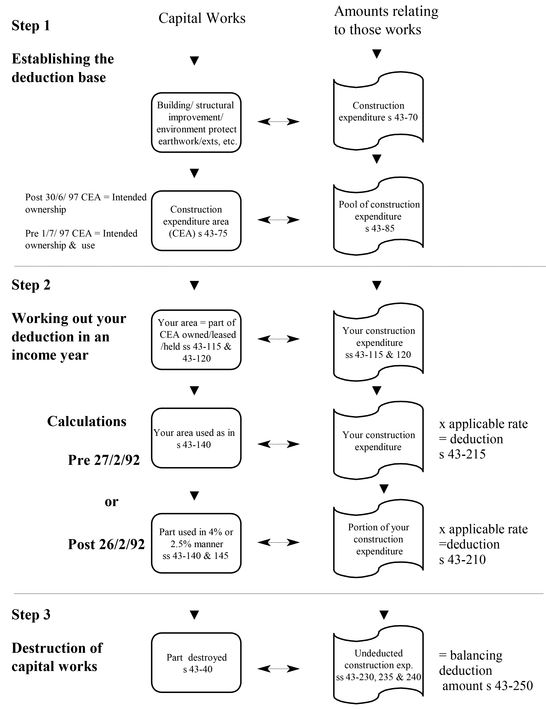
Subdivision 43-A - Key operative provisions SECTION 43-5 What this Subdivision is about
This Subdivision contains the key operative provisions for this Division, including all of the deduction entitlement provisions. You should read all of this Subdivision to understand how this Division works.
SECTION 43-10 Deductions for capital works 43-10(1)
You can deduct an amount forcapital works for an income year.
43-10(2)
You can only deduct the amount if:
(a) the capital works have a * construction expenditure area; and
(b) there is a * pool of construction expenditure for that area; and
(c) you use * your area in the income year in the way set out in Table 43-140 (Current year use).
Note 1:
The deduction is limited to capital works to which this Division applies, see section 43-20 .
Note 2:
Amongst other things, the definition of your area ensures that only owners and certain lessees of capital works, and certain holders of quasi-ownership rights over land on which capital works are constructed, can deduct an amount under this Division.
SECTION 43-15 Amount you can deduct 43-15(1)
The amount you can deduct is a portion of * your construction expenditure. However, it cannot exceed the amount of * undeducted construction expenditure for * your area.
Note:
The limit in this subsection has 2 effects:
43-15(2)
Your deduction is calculated under section 43-210 or 43-215 .
SECTION 43-20 Capital works to which this Division applies
Buildings
43-20(1)
This Division applies to capital works being a building, or an extension, alteration or improvement to a building:
(a) begun in Australia after 21 August 1979; or
(b) begun outside Australia after 21 August 1990.
Note:
Section 43-80 explains when capital works begin.
Structural improvements
43-20(2)
This Division also applies to capital works (other than capital works referred to in subsection (1)) begun after 26 February 1992 that are structural improvements, or extensions, alterations or improvements to structural improvements, whether they are in or outside Australia.
43-20(3)
Some examples of structural improvements are:
(a) sealed roads, sealed driveways, sealed car parks, sealed airport runways, bridges, pipelines, lined road tunnels, retaining walls, fences, concrete or rock dams and artificial sports fields; and
(b) earthworks that are integral to the construction of a structural improvement (other than a structural improvement described in subsection (4)), for example, embankments, culverts and tunnels associated with a runway, road or railway.
43-20(4)
This Division does not apply to structural improvements being:
(a) earthworks that:
(i) are not integral to the installation or construction of a structure; and
(ii) are permanent (assuming they are maintained in reasonably good order and condition); and
for example, unlined channels, unlined basins, earth tanks and dirt tracks; or
(iii) can be economically maintained in reasonably good order and condition for an indefinite period;
(b) earthworks that merely create artificial landscapes, for example, grass golf course fairways and greens, gardens, and grass sports fields.
Environment protection earthworks
43-20(5)
This Division also applies to capital works being earthworks, or extensions, alterations or improvements to earthworks, if:
(a) they are constructed as a result of carrying out of * environmental protection activities; and
(b) they can be economically maintained in reasonably good order and condition for an indefinite period; and
(c) they are not integral to the construction of capital works; and
(d) the expenditure on the capital works was incurred after 18 August 1992.
Note:
This subsection allows you to deduct an amount for some earthworks that are excluded by paragraph (4)(a) if the earthworks are constructed in carrying out an environmental protection activity.
SECTION 43-25 Rate of deduction 43-25(1)
For capital works begun after 26 February 1992, there is a basic entitlement to a rate of 2.5% for parts used as described in Table 43-140 (Current year use). The rate increases to 4% for parts used as described in Table 43-145 (Use in the 4% manner).
43-25(2)
For capital works begun before 27 February 1992 and used as described in Table 43-140, the rate is:
(a) 4% if the capital works were begun after 21 August 1984 and before 16 September 1987; or
(b) 2.5% in any other case.
Note:
Section 43-80 explains when capital works begin.
SECTION 43-30 43-30 No deduction until construction is complete
You cannot deduct an amount for any period before the completion of construction of the capital works even though you used them, or part of them, before completion. SECTION 43-35 43-35 Requirement for registration under the Industry Research and Development Act
You may deduct an amount under this Division on the basis of using capital works for the purpose of conducting * R & D activities only if:
(a) you are registered under section 27A (registering R & D activities) of the Industry Research and Development Act 1986 for the R & D activities for an income year; or
(b) if you are an * R & D partnership - an * R & D entity, who was a partner of the R & D partnership at some time while the R & D activities were conducted, is registered under that section for the R & D activities for an income year.
Note 1:
R & D activities must be conducted in connection with a business carried on for the purpose of producing assessable income, see section 43-195 .
Note 2:
You may still deduct an amount under this Division if you were registered for the R & D activities under former section 39J (Registration of eligible companies) of the Industry Research and Development Act 1986 (see section 355-200 of the Income Tax (Transitional Provisions) Act 1997 ).
You can deduct an amount if all or a part of * your area is destroyed in an income year and:
(a) you have been allowed, or can claim, a deduction under this Division, or former Division 10C or 10D of Part III of the Income Tax Assessment Act 1936 , for your area; and
(b) there is an amount of * undeducted construction expenditure for your area; and
(c) you were using your area in the way that applies to it under Table 43-140 (Current year use) immediately before the destruction or, if not, neither you nor any other entity used your area for any purpose since it was last used by you in that way.
43-40(2)
The deduction is allowable in the income year in which the destruction occurs, and is calculated under section 43-250 .
Note:
The effect of this provision is to allow you to deduct an amount in the income year in which the capital works are destroyed for all of your construction expenditure that has not yet been deducted. However, you must reduce the deduction by any insurance and salvage receipts.
SECTION 43-45 43-45 Certain anti-avoidance provisions
These anti-avoidance provisions:
(a) section 51AD (Deductions not allowable in respect of property under certain leveraged arrangements) of the Income Tax Assessment Act 1936 ;
(b) Division 16D (Certain arrangements relating to the use of property) of Part III of that Act;
apply to your deductions under this Division for an asset as if you were the owner of the asset instead of any other person.
Links
43-50(1)
No part of a * pool of construction expenditure can be a deduction, or taken into account in working out the amount of a deduction, under a provision of this Act other than this Division.
43-50(2)
No part of an amount incurred by an entity in acquiring capital works for which there is a * pool of construction expenditure can be a deduction, or taken into account in working out the amount of a deduction, under a provision of this Act other than this Division.
43-50(3)
You will be taken not to be the owner of any part of capital works that are the subject of a lease to which you have chosen to apply section 104-115 (CGT event F2). The lessee or sublessee will be taken to be the owner of that part.
Note 1:
Choosing to apply section 104-115 results in the lease being treated for CGT purposes more like an outright disposal.
Note 2:
See subsection 43-180(3) for the effect of the rule in subsection (3) of this section on the need to own 10 apartments, units or flats in an apartment building.
43-50(4)
(Repealed by No 46 of 1998)
43-50(5)
(Repealed by No 46 of 1998)
Signposts
43-50(6)
There are special record-keeping rules that apply to this Division in subsection 262A(4AJA) of the Income Tax Assessment Act 1936 .
43-50(7)
Your deductions under this Division may be reduced if any of your commercial debts have been forgiven in the income year: see Subdivision 245-E .
43-50(8)
Where you have had a deduction under this Division an amount may be included in your assessable income if the expenditure was financed by limited recourse debt that has terminated: see Division 243 .
SECTION 43-55 Anti-avoidance - arrangement etc. with tax-exempt entity 43-55(1)
You will not be allowed a deduction under this Division for an income year if the Commissioner is satisfied that:
(a) you entered into an * arrangement with:
(i) an entity to which section 50-5 , 50-10 , 50-15 , 50-25 , 50-30 , 50-40 or 50-45 (dealing with * exempt income) applies; or
under which you were to pay an amount, or transfer property, directly or indirectly, to the entity; and
(ii) an STB (within the meaning of Division 1AB of Part III of the Income Tax Assessment Act 1936 ) whose * ordinary income and * statutory income is exempt from income tax;
(b) the amount of the payment or the value of the property is calculated by reference to the amount of a deduction allowable to you under this Division; and
(c) a purpose of the arrangement that is not a merely incidental purpose is to ensure that the benefit of the deduction would pass wholly or substantially to the entity, whether directly or indirectly.
43-55(2)
Subsection (1) applies to * arrangements entered into with an entity referred to in subparagraph (1)(a)(i) after 1 May 1980 that relate to deductions for * hotel buildings or * apartment buildings begun before 1 July 1997.
43-55(3)
Subsection (1) also applies to * arrangements entered into with an entity referred to in subparagraph (1)(a)(ii) after 30 June 1994 that relate to deductions for * hotel buildings or * apartment buildings begun before 1 July 1997.
Subdivision 43-B - Establishing the deduction base SECTION 43-60 What this Subdivision is about
This Subdivision explains the meaning of the terms construction expenditure , construction expenditure area and pool of construction expenditure .
Expenditure in respect of the construction of capital works is only eligible for a deduction under this Division if there is a construction expenditure area for the capital works. The area defined as the construction expenditure area may comprise the whole of the capital works or only part of them.
Whether there is a construction expenditure area for capital works and how it is identified depends on the following factors:
A pool of construction expenditure is that part of an amount of construction expenditure that is attributable to a particular construction expenditure area.
Operative provisionsSECTION 43-70 What is construction expenditure ? 43-70(1)
Construction expenditure is capital expenditure incurred in respect of the construction of capital works.
43-70(2)
Construction expenditure does not include:
(a) expenditure on acquiring land; or
(b) expenditure on demolishing existing structures; or
(c) expenditure on clearing, levelling, filling, draining or otherwise preparing the construction site prior to carrying out excavation works; or
(d) expenditure on landscaping; or
(e) expenditure on * plant; or
(f) expenditure on property for which a deduction is allowable, or would be allowable if the property were for use for the * purpose of producing assessable income, under:
(i) Subdivision 40-F (about primary production depreciating assets), Subdivision 40-G (about capital expenditure of primary producers and other landholders), Subdivision 40-H (about capital expenditure that is immediately deductible) or Subdivision 40-I (about capital expenditure that is deductible over time); or
(ii) the former Division 330 of this Act or the former Division 10 , 10AAA or 10AAof Part III of the Income Tax Assessment Act 1936 (all of which dealt with mining and/or quarrying); or
(iii) section 73A of the Income Tax Assessment Act 1936 (about expenditure on scientific research); or
(iv) the former Subdivision 387-A of this Act or the former section 75D of the Income Tax Assessment Act 1936 (both of which allowed deductions for capital expenditure to prevent land degradation); or
(v) the former Subdivision 387-B of this Act or the former section 75B of the Income Tax Assessment Act 1936 (both of which allowed deductions for capital expenditure on facilities to conserve or convey water); or
(vi) the former Subdivision 387-G of this Act or the former section 124F or 124JA of the Income Tax Assessment Act 1936 (all of which allowed deductions for capital expenditure on forestry roads and/or timber mill buildings); or
(fa) any of these kinds of expenditure if a deduction is allowable for the expenditure, or would be allowable if property had been used for the purpose of producing assessable income:
(i) * mining capital expenditure or * transport capital expenditure;
(ii) expenditure on a * forestry road in connection with carrying on a * timber operation for a * taxable purpose;
(iii) expenditure for the construction or acquisition of a * timber mill building;
(iv) expenditure on a * depreciating asset you can deduct under subsection 40-80(1) (about exploration and prospecting); or
(g) expenditure on property for which a deduction under section 355-305 or 355-520 is allowable for the property, or would be allowable if the property were for use for conducting * R & D activities; or
(h) eligible heritage conservation expenditure within the meaning of the former Subdivision AAD of Division 17 of Part III of the Income Tax Assessment Act 1936 ; or
(i) expenditure that you cannot deduct because of section 26-100 (about water infrastructure improvement expenditure).
SECTION 43-72 Meaning of forestry road, timber operation and timber mill building 43-72(1)
A forestry road is a road constructed primarily and principally for the purpose of providing access to an area to enable:
(a) trees to be planted or tended in the area; or
(b) timber felled in the area to be removed.
For this purpose, a road includes any bridge, culvert or similar work forming part of the road.
43-72(2)
A timber operation is:
(a) planting or tending trees for felling; or
(b) felling standing timber; or
(c) removing felled timber; or
(d) milling felled timber or processing it in another way.
43-72(3)
A timber mill building is a building:
(a) for use primarily and principally:
(i) in carrying on your * business of milling timber for a * taxable purpose; or
(ii) as residential accommodation for your employees engaged in connection with the business, or for their dependants; and
(b) located in a forest, and in or adjacent to the area where timber milled in the business is, or is to be, felled.
SECTION 43-75 Construction expenditure area 43-75(1)
The construction expenditure area of capital works begun after 30 June 1997 is the part of the capital works on which the * construction expenditure was incurred that, at the time when it was incurred by an entity, was to be owned or leased by the entity or held by the entity under a * quasi-ownership right over land granted by an * exempt Australian government agency or an * exempt foreign government agency.
Note:
Section 43-80 explains when capital works begin.
43-75(2)
The construction expenditure area of capital works begun before 1 July 1997 is the part of the capital works on which the * construction expenditure was incurred that:
(a) at the time when it was incurred by an entity, was to be owned or leased by the entity or held by the entity under a * quasi-ownership right over land granted by an * exempt Australian government agency or an * exempt foreign government agency; and
(b) at the time of completion of construction, was to be used in the way described in Column 3 of Table 43-90 (intended use at completion) for the time period when the capital works began as set out in Column 1.
43-75(3)
There is taken to be a construction expenditure area for capital works purchased by an entity from another entity if:
(a) the capital works would have had a construction expenditure area but for the fact that the other entity did not incur capital expenditure in constructing the capital works; and
(b) the other entity is not an * associate of the entity; and
(c) the other entity constructed the capital works on land that it owned or leased in the course of a business that included the construction and sale of capital works of that kind.
Note:
Subsection (3) makes capital works purchased from a speculative builder eligible for deduction in the hands of the first and subsequent purchasers.
[ CCH Note: S 43-75(3) does not apply to capital works being a hotel building or an apartment building begun before 1 July 1997.]
43-75(4)
The construction of the capital works must be complete before the * construction expenditure area is determined.
43-75(5)
Only one * construction expenditure area is created each time an entity constructs capital works.
Example:
An entity undertakes the construction of a building. During the course of construction, the entity makes 3 progress payments to the builder. There is still only one construction expenditure area.
43-75(6)
A separate * construction expenditure area will be created each time an entity undertakes the construction of capital works.
Example:
In the diagram below, area 1 relates to the original construction of a building which gives rise to one construction expenditure area . Area 2 is a subsequent extension of the same building which gives rise to another, while area 3 is a later renovation of the entire building which gives rise to another.
SECTION 43-80 43-80 When capital works begin
Capital works are taken to begin when the first step in the construction phase starts. For example, the pouring of foundations or sinking of pilings for a building.
Note 1:
Capital works begun after 15 September 1987 are taken to have begun before 16 September 1987 in certain circumstances. See section 43-220 .
Note 2:
The time when capital works begin is relevant for determining whether the capital works qualify for deduction, the use to which those works must be put, the rate of deduction and the calculation mechanism used. However, the time when capital works begin does not limit what qualifies as construction expenditure.
SECTION 43-85 Pools of construction expenditure 43-85(1)A pool of construction expenditure is so much of the * construction expenditure incurred by an entity on capital works as is attributable to the * construction expenditure area.
43-85(2)
In applying subsection (1) in a case to which subsection 43-75(3) (dealing with purchases from speculative builders) applies, assume that the expenditure incurred by the other entity was capital expenditure, but that the limitations in subsection 43-70(2) (which sets out types of expenditure that are not * construction expenditure) still apply to the other entity's expenditure.
Note:
The builder's profit margin does not form part of the construction expenditure of the purchaser.
SECTION 43-90 Table of intended use at time of completion of construction
| Column 1 | Column 2 | Column 3 | |
| Date capital works begin | Type of capital works | Intended use on completion | |
| Time period 1: 22/8/79 to 19/7/82 (inclusive) | Hotel building | For use by any entity wholly or mainly to operate a hotel, motel or guest house that has at least 10 bedrooms that are for use wholly or mainly to provide short-term accommodation for travellers. | |
| Apartment building | The building consisted of: | ||
| (a) | at least 10 apartments, units or flats each of which was for use wholly or mainly to provide short-term accommodation for travellers; or | ||
| (b) | at least 10 apartments, units or flats each of which was for use for that purpose and facilities that are wholly or mainly for use in association with providing short-term accommodation for travellers in those apartments, units or flats. | ||
| Time period 2: 20/7/82 to 17/7/85 (inclusive) | Hotel building | As for time period 1. | |
| Apartment building | As for time period 1. | ||
| Non-residential building | For: | ||
| (a) | use by the entity that incurred the expenditure for the * purpose of producing assessable income or exempt income; or | ||
| (b) | disposal by that entity to another entity for use by the other entity for the purpose of producing assessable income or exempt income. | ||
| Time period 3: 18/7/85 to 20/11/87 (inclusive) | Any building | For: | |
| (a) | use by the entity that incurred the expenditure for the * purpose of producing assessable income or exempt income; or | ||
| (b) | disposal by that entity to another entity for use by the other entity for the purpose of producing assessable income or exempt income; or | ||
| (c) | use by an entity wholly or mainly for, or in association with, residential accommodation. | ||
| Time period 4: 21/11/87 to 26/2/92 (inclusive) | Any building | For: | |
| (a) | use by the entity that incurred the expenditure for the * purpose of producing assessable income or exempt income; or | ||
| (b) | disposal by that entity to another entity for use by the other entity for the purpose of producing assessable income or exempt income; or | ||
| (c) | use by an entity wholly or mainly for, or in association with, residential accommodation; or | ||
| (d) | use by the entity that incurred the expenditure to carry on research and development activities (within the meaning of former section 73B of the Income Tax Assessment Act 1936 ) by or for that entity, or for disposal by that entity to another entity for use by the other entity for carrying on research and development activities (within the meaning of that former section) by or for the other entity. | ||
| Time period 5: 27/2/92 to 18/8/92 (inclusive) | Hotel building | As for time period 1. | |
| Apartment building | As for time period 1. | ||
| Other buildings | As for any building in time period 4. | ||
| Structural improvements | As for any building in time period 4. | ||
| Time period 6: 19/8/92 to 30/6/97 (inclusive) | Hotel building | As for time period 1. | |
| Apartment building | As for time period 1. | ||
| Other buildings | As for any building in time period 4. | ||
| Structural improvements | As for any building in time period 4. | ||
| Environment protection earthworks | As for any building in time period 4. |
Note:
There are special rules that explain or qualify the uses described in Column 3 of this Table. These rules are set out in Subdivision 43-E (sections 43-155 to 43-195 ). For example, certain facilities that are not commonly provided in a hotel, motel or guest house in Australia are taken not to be used or for use to operate a hotel, motel or guest house, see subsection 43-180(6) .
A hotel building is:
(a) a building begun after 21 August 1979 and before 18 July 1985, or after 26 February 1992 and before 1 July 1997, that, at the time of completion of its construction, was intended to be used in the way referred to in Column 3 of Table 43-90 (intended use at completion) for a hotel building; or
(b) a building begun after 30 June 1997 and that, in the income year, is used in the way referred to in Column 3 (time period 2) of Table 43-145 (use in the 4% manner) for a hotel building.
43-95(2)
An apartment building is:
(a) a building begun after 21 August 1979 and before 18 July 1985, or after 26 February 1992 and before 1 July 1997, that, at the time of completion of its construction, was intended to be used in the way referred to in Column 3 of Table 43-90 for an apartment building; or
(b) a building begun after 30 June 1997 and that, in the income year, is used in the way referred to in Column 3 (time period 2) of Table 43-145 for an apartment building.
SECTION 43-100 43-100 Certificates by Industry Innovation and Science Australia
A certificate by * Industry Innovation and Science Australia stating that activities carried on by or for an entity were or were not * core R & D activities or * supporting R & D activities is conclusive for the purposes of this Division.
Note:
Core R & D activities and supporting R & D activities are kinds of R & D activities.
This Subdivision explains your area and your construction expenditure .
You can only get a deduction under this Division for an income year if you own, lease or hold part of a construction expenditure area of capital works. The area you own, lease or hold is called your area .
In working out your deductions, you must identify your area for each construction expenditure area of the capital works.
Your area may comprise the whole of the construction expenditure area or part of it.
Note:
In certain circumstances the notional buyer of property is taken to be its owner (see subsection 240-20(2) ).
SECTION 43-115 Your area and your construction expenditure - owners 43-115(1)
Your area is the part of the * construction expenditure area that you own.
43-115(2)
Your construction expenditure is the portion of the * pool of construction expenditure that is attributable to your area.
SECTION 43-120 Your area and your construction expenditure - lessees and quasi-ownership right holders
Own expenditure
43-120(1)
Your area is the part of the * construction expenditure area that you lease, or hold under a * quasi-ownership right over land granted by an * exempt Australian government agency or an * exempt foreign government agency, and that:
(a) is attributable to a * pool of construction expenditure that you incurred; and
(b) you have continuously leased or held since the construction was completed.
Earlier lessees' or holders' expenditure
43-120(2)
Your area is the part of the * construction expenditure area that you lease, or hold under a * quasi-ownership right over land granted by an * exempt Australian government agency or an * exempt foreign government agency, and that:
(a) is attributable to a * pool of construction expenditure incurred by another lessee or holder of a quasi-ownership right over land; and
(b) has been continuously leased or held since the construction was completed by the lessee or holder who incurred the expenditure or an assignee of that lessee's lease or that holder's quasi-ownership right over land.
43-120(3)
Your construction expenditure is the portion of the * pool of construction expenditure that is attributable to your area.
SECTION 43-125 Lessees' or right holders' pools can revert to owner 43-125(1)
An amount that relates to a * pool of construction expenditure that arises as a result of expenditure incurred by a lessee or a holder of a * quasi-ownership right over land:
(a) can only be deducted by a lessee or a holder of a quasi-ownership right over land who satisfies subsection 43-120(1) or (2); and
(b) cannot be deducted by the owner of the capital works while there is a lessee or a holder of a quasi-ownership right over land who satisfies that subsection.
43-125(2)
The owner of the capital works may deduct an amount that relates to that pool if there is no longer a lessee or a holder of a * quasi-ownership right over land who satisfies subsection 43-120(1) or (2).
SECTION 43-130 43-130 Identifying your area on acquisition or disposal
There will be a separate * your area at each time in an income year when you:
(a) acquire an additional part of a * construction expenditure area; or
(b) dispose of some but not all of a construction expenditure area.
Example:
You own half of a building (part A) throughout the income year, and you acquire the other half (part B) on 1 January. This section ensures that part A is your area for the entire year and that part B is your area for the second 6 months of the year.
Note:
This ensures that the same area is not counted twice in calculating your deduction. You will have to make separate deduction calculations if you have identified more than one area as your area of the capital works.
Subdivision 43-D - Deductible uses of capital works SECTION 43-135 What this Subdivision is aboutYou can only get a deduction under this Division if you use your area in a way described in Table 43-140 or 43-145 of this Subdivision.
SECTION 43-140 Using your area in a deductible way 43-140(1)
The following table sets out the way you must use * your area in an income year for a deduction to be allowed under section 43-10 (the main deduction provision). The relevant use depends on the time when the capital works began (Column 1) and the type of capital works (Column 2). Column 3 sets out the use.
TABLE 43-140 - Current year use
| Column 1 | Column 2 | Column 3 | |
| Date capital works begin | Type of capital works | Use of your area at some time in the income year | |
| Time period 1: After 30/6/97 | Any capital works | You use * your area for the purpose of: | |
| (a) | producing assessable income; or | ||
| (b) | conducting * R & D activities. | ||
| Time period 2: 27/2/92 to 30/6/97 (inclusive) | * Hotel building | You use * your area for the * purpose of producing assessable income. | |
| * Apartment building | You use * your area for the * purpose of producing assessable income. | ||
| Other capital works | You use * your area for the purpose of: | ||
| (a) | producing assessable income; or | ||
| (b) | conducting * R & D activities. | ||
| Time period 3: Before 27/2/92 | * Hotel building | You use * your area for the * purpose of producing assessable income and: | |
| (a) | all or part of that area is used by any entity wholly or mainly to operate a hotel, motel or guest house; and | ||
| (b) | that hotel, motel or guest house has at least 10 bedrooms that are used or available for use wholly to provide short-term accommodation for travellers. | ||
| * Apartment building | You use * your area for the * purpose of producing assessable income and: | ||
| (a) | that area is, is part of or contains an apartment, unit or flat that is used or available for use by any entity wholly to provide short-term accommodation for travellers, and you own or lease at least 9 other apartments, units or flats in the building that are used or available for use by any entity wholly to provide short-term accommodation for travellers; or | ||
| (b) | that area is, is part of or contains a facility that is used or available for use by any entity wholly or mainly in association with providing short-term accommodation for travellers in apartments, units or flats in the building that are used in the way described in paragraph (a). | ||
| Other capital works | You use * your area for the purpose of: | ||
| (a) | producing assessable income; or | ||
| (b) | conducting * R & D activities. |
Note 1:
There are special rules that explain or qualify the uses described in Column 3 of this Table. These rules are set out in Subdivision 43-E (sections 43-155 to 43-195 ). For example:
Note 2:
If Division 250 applies to you and an asset that is a capital work:
43-140(2)
This Division applies to an entity as if the entity used property for the * purpose of producing assessable income if the entity uses the property for:
(a) * environmental protection activities; or
(b) the environmental impact assessment of a project;
unless a provision of this Act expressly provides that that use is not for the purpose of producing assessable income.
SECTION 43-145 Using your area in the 4% manner 43-145(1)
You use a part of * your area in the 4% manner if you use it as described in the following Table. The relevant use depends on the time when the capital works began (Column 1) and the type of capital works (Column 2). Column 3 sets out the use.
TABLE 43-145 - Use in the 4% manner
| Column 1 | Column 2 | Column 3 | ||
| Date capital works begin | Type of capital works | Use of a part of * your area at some time in the income year | ||
| Time period 1: After 30/6/97 | Capital works that are buildings | You use the part of * your area for the * purpose of producing assessable income and: | ||
| (a) | that part is used by any entity wholly or mainly to operate a hotel, motel or guest house; and | |||
| (b) | that hotel, motel or guest house has at least 10 bedrooms that are used or available for use wholly to provide short-term accommodation for travellers. | |||
| You use the part of * your area for the * purpose of producing assessable income and: | ||||
| (a) | that part is, is part of or contains an apartment, unit or flat that is used or available for use by any entity wholly to provide short-term accommodation for travellers, and you own or lease at least 9 other apartments, units or flats in the building that are used or available for use by any entity wholly to provide short-term accommodation for travellers; or | |||
| (b) | that part is, is part of or contains a facility that is used or available for use by any entity wholly or mainly in association with providing short-term accommodation for travellers in apartments, units or flats in the building that are used in the way described in paragraph (a). | |||
| You use the part of * your area for the * purpose of producing assessable income, and that part is used by any entity: | ||||
| (a) | wholly or mainly for * industrial activities; or | |||
| (b) | to provide meal rooms, rest rooms, first aid rooms, change rooms or similar facilities that are wholly or mainly for use by: | |||
| (i) | workers employed wholly or mainly to undertake the work directly involved in carrying out industrial activities; or | |||
| (ii) | the immediate supervisors of those workers; or | |||
| (c) | wholly or mainly as office accommodation for the immediate supervisors of those workers. | |||
| You use the part of * your area in the * 4% build to rent manner. | ||||
| Time period 2: 27/2/92 to 30/6/97 (inclusive) | * Hotel building | You use the part of * your area for the * purpose of producing assessable income and: | ||
| (a) | that part is used by any entity wholly or mainly to operate a hotel, motel or guest house; and | |||
| (b) | that hotel, motel or guest house has at least 10 bedrooms that are used or available for use wholly to provide short-term accommodation for travellers. | |||
| * Apartment building | You use the part of * your area for the * purpose of producing assessable income and: | |||
| (a) | that part is, is part of or contains an apartment, unit or flat that is used or available for use by any entity wholly to provide short-term accommodation for travellers, and you own or lease at least 9 other apartments, units or flats in the building that are used or available for use by any entity wholly to provide short-term accommodation for travellers; or | |||
| (b) | that part is, is part of or contains a facility that is used or available for use by any entity wholly or mainly in association with providing short-term accommodation for travellers in apartments, units or flats in the building that are used in the way described in paragraph (a). | |||
| Other buildings | You use the part of * your area for the * purpose of producing assessable income, and that part is used by any entity: | |||
| (a) | wholly or mainly for * industrial activities; or | |||
| (b) | to provide meal rooms, rest rooms, first aid rooms, change rooms or similar facilities that are wholly or mainly for use by: | |||
| (i) | workers employed wholly or mainly to undertake the work directly involved in carrying out industrial activities; or | |||
| (ii) | the immediate supervisors of those workers; or | |||
| (c) | wholly or mainly as office accommodation for the immediate supervisors of those workers. |
Note:
There are special rules that explain or qualify the uses described in Column 3 of this Table. These rules are set out in Subdivision 43-E (sections 43-155 to 43-195). For example:
43-145(2)
You use a part of * your area in the 4% build to rent manner if: (a) you use the part of your area for the * purpose of producing assessable income; and (b) that part is, or is part of, an * active build to rent development area (the eligible development ); and (c) if the * build to rent compliance period for each of the * dwellings in the eligible development has ended:
(i) no other entity is using the eligible development, or any part of the eligible development, for the purpose of producing assessable income; and
(ii) at each earlier time (if any) at which you or another entity used the eligible development, or any part of the eligible development, for the purpose of producing assessable income and at which the eligible development was an * active build to rent development, no other entity was using the eligible development, or any part of the eligible development, for the purpose of producing assessable income.
43-145(3)
For the purposes of paragraph (2)(c) , disregard use of the eligible development, or any part of the eligible development, for the * purpose of producing assessable income by providing management services.
Industrial activities
SECTION 43-150 43-150 Meaning of industrial activities
Industrial activities means:
(a) any of the following activities ( core activities ):
(i) operations where manufactured items are derived from other goods even if those manufactured items are themselves used as parts or materials in the manufacture of other items;
(ii) operations (other than packing, placing in containers or labelling) by which manufactured items are brought into or maintained in the form or condition in which they are sold or used, even if they are for sale or use as parts or materials in the manufacture of other items;
(iii) the separation of a metal or a compound of a metal from its ore (not including crushing, grinding, breaking, screening or sizing to facilitate that separation) or the treatment or processing of a metal or a compound of a metal after its separation;
(iv) for a metal or a compound of a metal not requiring separation - applying to the metal or compound a treatment or process which, if the metal or compound had required separation, would not have been applied until after the separation;
(v) refining * petroleum;
(vi) scouring or carbonising wool;
(vii) milling timber;
(viii) freezing primary products;
(ix) printing, lithographing or engraving, or a similar process, in the course of carrying on a business as a publisher, printer, lithographer or engraver;
(x) curing meat or fish;
(xi) producing chilled or frozen meat;
(xii) pasteurising milk;
(xiii) canning or bottling foodstuffs;
(xiv) producing electric current, hydraulic power, steam, compressed air or gases (other than natural gas) for the purpose of sale, or use wholly or mainly in carrying on another activity mentioned in this paragraph; or
(b) any of the following activities:
(i) the packing, placing in containers or labelling of any goods resulting from the carrying on of core activities;
(ii) the disposal of waste substances resulting from the carrying on of core activities;
(iii) the cleansing or sterilising of bottles, vats or other containers used by the entity to store goods to be used in carrying on core activities or goods resulting from the carrying on of core activities;
(iv) the assembly, maintenance, cleansing, sterilising or repair of property used in carrying on core activities;
(v) the storage, within premises in which core activities are carried on, or premises contiguous to those premises, of goods in carrying on core activities, goods in relation to which core activities have commenced but not finally been completed or goods resulting from core activities;
but does not include the preparation of food or drink (whether for consumption on the premises where it is prepared or elsewhere) in, or in premises occupied in connection with, a hotel, motel, boarding house, catering establishment, restaurant, cafe, milk-bar, coffee shop, retail shop or similar establishment.
SECTION 43-151 Meaning of active build to rent development area 43-151(1)
An active build to rent development area is a part of a building comprising any of the following: (a) the * dwellings of an * active build to rent development; (b) any * common areas for those dwellings.
43-151(2)
An active build to rent development is a * build to rent development that has: (a) * commenced to be an active build to rent development (see subsections 43-152(1) and (2) ); and (b) not * ceased to be an active build to rent development (see subsection 43-152(4) ).
43-151(3)
A common area for * dwellings of a * build to rent development is an area, facility or amenity: (a) intended for use for the purposes of those dwellings; or (b) intended for use for the purposes of those dwellings and any other dwellings in the same building.
Commencement
43-152(1)
On and after the first day on which a building has 50 or more * dwellings: (a) that satisfy subsection 43-153(1) ; and (b) that the owner of the dwellings chooses to form a * build to rent development in accordance with subsection (6) of this section;
those dwellings are a build to rent development , of the building, that commences to be an * active build to rent development on that day.
43-152(2)
Also, on and after the first day (if any): (a) after the most recent instance of a * build to rent development of a building * commencing to be an * active build to rent development; and (b) on which the building has 50 or more * dwellings:
(i) that satisfy subsection 43-153(1) ; and
(ii)that were not part of a build to rent development just before that day; and
(iii) that the owner of the dwellings chooses to form a build to rent development in accordance with subsection (6) of this section;
those dwellings are a build to rent development , of the building, that commences to be an active build to rent development on that day unless an active build to rent development * expands under subsection (3) on that day to include the dwellings.
Expansion
43-152(3)
If a building has a * build to rent development (the existing development ) that has * commenced to be an * active build to rent development, on the first day (if any) on which the building has * dwellings (the new dwellings ): (a) that taken together with the dwellings of the existing development for which the * build to rent compliance period has not ended, satisfy subsection 43-153(1) ; and (b) that are not already a part of a build to rent development; and (c) that the owner of the dwellings chooses to form part of the existing development in accordance with subsection (6) of this section;
the existing development expands to comprise:
(d) the dwellings of the existing development; and (e) the new dwellings.Cessation
43-152(4)
A * build to rent development ceases to be an * active build to rent development if the dwellings of the active build to rent development for which the * build to rent compliance period has not ended cease to satisfy subsection 43-153(1) .
Build to rent compliance period
43-152(5)
The build to rent compliance period for a * dwelling of an * active build to rent development is the 15 years beginning on the day after the day on which: (a) unless paragraph (b) applies - the development * commences to be an active build to rent development; or (b) if:
(i) the dwelling is not part of the development when it commences to be an active build to rent development; but
(ii) the development * expands to include the dwelling;
the development expands to include the dwelling.
43-152(6)
To make a choice for the purposes of paragraph (1)(b) , subparagraph (2)(b)(iii) or paragraph (3)(c) in respect of * dwellings, the owner of the dwellings must: (a) make the choice in the * approved form; and (b) give it to the Commissioner.
43-152(7)
The choice is taken to be made on the following day: (a) if:
(i) the owner nominates a day in the choice; and
the nominated day; or (b) otherwise - the day the Commissioner receives the choice.
(ii) the Commissioner receives the choice before the nominated day;
For the purposes of section 43-152 , * dwellings of a building satisfy this subsection at a particular time if, at that time: (a) each of the dwellings is:
(i) available to the public to be tenanted by way of lease for a period of 5 years or more in accordance with any requirements determined under subsection (1A) ; or
(b) all of the dwellings are:
(ii) being tenanted by way of lease as a result of being made available to the public to be tenanted by way of lease for a period of 5 years or more in accordance with any requirements determined under subsection (1A) ; and
(i) * residential premises; and
(ii) * taxable Australian real property; and
(c) all of the dwellings and * common areas for the dwellings are owned by a single entity; and (d) the number of the dwellings that are * affordable dwellings is equal to or greater than:
(iii) not * commercial residential premises; and
(i) 10% of the number of the dwellings; or
(e) subsection (5) applies to each of the affordable dwellings.
(ii) if the number of dwellings worked out under subparagraph (i) is not a whole number - that number rounded down to the nearest whole number of dwellings; and
Note:
For the purposes of paragraph (a) , a lease is still offered to the public for a period of 5 years or more even if a prospective tenant subsequently requests and the lessor accepts a shorter lease.
43-153(1A)
For the purposes of subparagraphs (1)(a)(i) and (ii) , the Minister may, by legislative instrument, determine requirements relating to the terms of the lease.
43-153(1B)
For the purposes of subparagraphs (1)(a)(i) and (ii) , disregard a requirement determined under subsection (1A) if complying with that requirement would contravene a law of a State or Territory.
Affordable dwellings
43-153(2)
A * dwelling is an affordable dwelling if the requirements determined under subsection (3) in relation to the dwelling are met.
43-153(3)
For the purposes of subsection (2) , the Minister must, by legislative instrument, determine requirements relating to a dwelling. Without limiting this subsection, the requirements may include requirements relating to: (a) the rent payable under the lease for the dwelling; or (b) the income of the tenant or prospective tenant.
43-153(4)
A reference in paragraph (1)(a) to the public in relation to a lease of a * dwelling is taken to be a reference to a segment of the public if: (a) the dwelling is an * affordable dwelling; and (b) requirements determined under subsection (3) require that the dwelling be tenanted, or be available to be tenanted, only to that segment of the public.
43-153(5)
For the purposes of paragraph (1)(e) , this subsection applies in relation to an affordable dwelling (the test dwelling ) if:
| Number of comparable
non-affordable dwellings |
≥ | Number of comparable
affordable dwellings |
number of comparable affordable dwellings
means the number of the dwellings (including the test dwelling) that:
(a) are * affordable dwellings; and
(b) have the same number of bedrooms as the test dwelling; and
(c) have a floor area that is at least equal to the floor area of the test dwelling, but does not exceed 110% of that floor area.
number of comparable non-affordable dwellings
means the number of the dwellings that:
(a) are not * affordable dwellings; and
(b) have the same number of bedrooms as the test dwelling; and
(c) have a floor area that is at least equal to the floor area of the test dwelling, but does not exceed 110% of that floor area.
Eligibility during construction
43-153(6)
Dwellings of a building are taken to satisfy subsection (1) at a particular time if: (a) one or more of the dwellings is not tenanted, and not available to be tenanted, at that time as mentioned in paragraph (1)(a) because of:
(i) construction of an extension, alteration or improvement to any of the dwellings or the building; or
(b) the dwellings satisfied subsection (1) just before paragraph (a) of this subsection began to apply; and (c) it is reasonable to expect that the dwellings will satisfy subsection (1) when the construction or repairs are completed.
(ii) the making of repairs to any of the dwellings or the building; and
Commissioner ' s discretion
43-153(7)
The Commissioner may determine that * dwellings of a building are taken to satisfy one or more of paragraphs (1)(a) , (d) and (e) (the eligibility criteria ) at all times during a particular period, if: (a) the entity that owns the dwellings applies to the Commissioner in the * approved form; and (b) the Commissioner is satisfied of the following:
(i) the dwellings did not otherwise satisfy the eligibility criteria at all times during the period due to events outside the control of the entity;
(ii) the entity took all reasonable steps to ensure that the dwellings would satisfy the eligibility criteria as soon as practicable;
(iii) at the time of the determination, the dwellings satisfy the eligibility criteria;
(iv) at the time of the determination, the entity intends that each dwelling will satisfy subsection (1) for the remainder of its * build to rent compliance period.
43-153(8)
A determination made under subsection (7) has effect according to its terms.
If any of the following events happen in relation to a * build to rent development, each entity to which subsection (3) applies must notify the Commissioner of the event: (a) the development * commences to be an * active build to rent development; (b) the development * expands; (c) the * ownership interest in the development is acquired by another entity; (d) the development * ceases to be an active build to rent development.
43-154(2)
The notice must be: (a) in the * approved form; and (b) given no later than 28 days after the event.
43-154(3)
This subsection applies to the following entities: (a) the owner of the development at the time just before the event happens; (b) if in the income year in which the event happens, an entity is required to notify the Commissioner under subsection 16-150(4) in Schedule 1 to the Taxation Administration Act 1953 of an amount to which subsection 12-450(5) in that Schedule applies, to any extent, because of a * dwelling of the development - the entity; (c) if the event is the event mentioned in paragraph (1)(c) of this section - the entity that acquires the * ownership interest in the development.
A reference in sections 43-151 to 43-153 to a building includes a reference to any other buildings that are on the same or adjacent land.
This Subdivision contains special rules about uses of capital works. It is relevant to whether you can get a deduction for capital works and also to the rate of that deduction. The rules in this Subdivision affect the uses of capital works described in Tables 43-90, 43-140 and 43-145.
SECTION 43-160 43-160 Your area is used for a purpose if it is maintained ready for use for the purpose
A part of * your area is taken to be used, for use or available for use for a particular purpose or in a particular manner at a time if, at that time:
(a) it was maintained ready for use for that purpose or in that manner; and
(b) it was not used or for use for any other purpose or in any other manner; and
(c) its use or intended use for that purpose or in that manner had not been abandoned.
Note 1:
Construction must be complete before you can deduct an amount, see section 43-30 .
Note 2:
This section affects Tables 43-140 and 43-145 .
SECTION 43-165 43-165 Temporary cessation of useA part of * your area is taken to be used, for use or available for use for a particular purpose or in a particular manner if its use for that purpose or in that manner temporarily ceases because of:
(a) the construction of an extension, alteration or improvement, or the making of repairs; or
(b) seasonal or climatic factors.
Note:
This section affects Tables 43-140 and 43-145 .
SECTION 43-170 Own use - capital works other than hotel and apartment buildings 43-170(1)A part of capital works, other than a * hotel building or an * apartment building, is taken not to be used for the * purpose of producing assessable income if that part is for use mainly for, or in association with, residential accommodation by you or an * associate.
Note:
This subsection affects Tables 43-140 and 43-145 .
43-170(2)
Subsection (1) does not apply to use by an * associate under an * arrangement:
(a) to which you and the associate are parties; and
(b) that is of a kind that the parties could reasonably be expected to have entered into if they had been dealing with each other at * arm's length; and
(c) that was not entered into for the purpose of obtaining a deduction under this Division.
43-170(3)
If property that constitutes the whole or part of capital works, other than a * hotel building or an * apartment building, is part of an individual's home, the property is taken to be used, or for use, wholly or mainly for or in association with residential accommodation.
Note:
This subsection affects Tables 43-90 and 43-140 .
SECTION 43-175 Own use - hotel and apartment buildings 43-175(1)
An entity is taken not to have used a bedroom in a * hotel building, or an apartment, unit or flat in an * apartment building, for the * purpose of producing assessable income at a time if, at that time, the bedroom, apartment, unit or flat is used, or reserved for use, by:
(a) the entity; or
(b) if the entity is a partnership - any of the partners in the partnership.
Note:
This subsection affects Tables 43-140 and 43-145 .
43-175(2)
Also, an entity is taken not to use a bedroom in a * hotel building, or an apartment, unit or flat in an * apartment building for any purpose at a time if:
(a) at that time, a * right to use or a right to occupy the bedroom, apartment, unit or flat was vested in the entity; and
(b) that right was vested in the entity because the entity was, at that time, a member of a company, a beneficiary of a trust estate or a partner in a partnership.
Note:
This subsection affects Tables 43-90 , 43-140 and 43-145 .
SECTION 43-180 Special rules for hotel and apartment buildings
Rules about counting rooms or apartments etc.
43-180(1)
A bedroom in a * hotel building, or an apartment, unit or flat in an * apartment building, is taken to be used or available for use wholly for short-term accommodation for travellers in a period if it is used or available for use mainly for short-term accommodation for travellers in that period.
Note:
This subsection ensures that a limited period of non-short-term traveller accommodation use will be disregarded in counting the number of rooms provided the bedroom, apartment, unit or flat is used mainly for short-term traveller accommodation.
43-180(2)
For the purpose of counting the number of bedrooms in a * hotel building, if 2 or more rooms that are bedrooms or include a bedroom are for use together as a suite of rooms, the suite is taken to constitute one bedroom.
43-180(3)
Despite subsection 43-50(3) (which treats you as not being the owner of certain capital works), you can still count an apartment, unit or flat in relation to which CGT event F2 has happened in working out whether you own or lease at least 10 apartments, units or flats in an * apartment building if you own or lease at least one other apartment, unit or flat in the building.
Note 1:
CGT event F2 results in a lease with a term of 50 years or more being treated for CGT purposes more like an outright disposal.
Note 2:
Subsection 43-50(3) treats you as not being the owner of capital works that are the subject of such a lease.
Rules about hotel or apartment complexes
43-180(4)
A group of buildings that constitutes a complex of buildings is taken to be one * hotel building or * apartment building, and none of the buildings in the group is taken to be a separate building.
43-180(5)
The construction of a * hotel building or * apartment building is taken to be an extension of another building if, after completion of the construction, those buildings are taken to be one building under subsection (4).
Note:
Subsections (4) and (5) ensure that a hotel or apartment building that provides short-term traveller accommodation in detached buildings will be treated as a single building so that the 10 hotel room/apartment test is applied to the complex as a whole. It also has the effect that the complex as a whole must be completed before there can be a construction expenditure area.
Rules about facilities not commonly provided in Australia
43-180(6)
If a * hotel building contains a facility of a kind that is not commonly provided in a hotel, motel or guest house in Australia, the facility is taken not to be used or for use to operate a hotel, motel or guest house.
43-180(7)
If an * apartment building contains a facility of a kind that is not commonly provided in a hotel, motel or guest house in Australia, the facility is taken not to be a facility for use in association with providing short-term accommodation for travellers in apartments, units or flats.
Note:
Subsections (6) and (7) exclude areas such as casinos from the construction expenditure area of a hotel building or apartment building.
SECTION 43-185 Residential or display use 43-185(1)
A building, other than a * hotel building or an * apartment building, or an extension, alteration or improvement to such a building, begun after 19 July 1982 and before 18 July 1985 is taken not to be used for the * purpose of producing assessable income or exempt income if it is used or for use wholly or mainly for exhibition or display in connection with:
(a) the sale of all or part of any building; or
(b) the lease of all or part of any building for use wholly or mainly for or in association with residential accommodation.
Note:
Subsection (1) affects time period 2 in Table 43-90 and time period 3 in Table 43-140 .
43-185(2)
A building, other than a * hotel building or an * apartment building, begun after 19 July 1982 and before 18 July 1985 is taken not to be used for the * purpose of producing assessable income if it is used or available for use wholly or mainly for or in association with residential accommodation.
Note:
Subsection (2) affects time period 2 in Table 43-90 and time period 3 in Table 43-140 .
43-185(3)
A building, other than a * hotel building or an * apartment building, begun after 17 July 1985 and before 1 July 1997 is taken not to be used for the * purpose of producing assessable income if it is used or for use wholly or mainly for exhibition or display in connection with the sale of all or part of any building.
Note:
Subsection (3) affects time periods 2 and 3 in Table 43-140 .
SECTION 43-190 Use of facilities not commonly provided, and of certain buildings used to operate a hotel, motel or guest house 43-190(1)
A facility in a * hotel building or an * apartment building that is not commonly provided in a hotel, motel or guest house in Australia is taken not to be used, or for use, for or in association with residential accommodation if the facility is part of a building begun after 19 July 1982 and before 18 July 1985.
Note:
This subsection means that, for time period 2 in Table 43-90, a facility referred to in subsection 43-180(6) or (7) (dealing with facilities not commonly provided in Australia) is taken to be a non-residential building if it satisfies the use test in Column 3 of that table for a building of that kind, and is therefore eligible for deduction even though it would ordinarily be taken to be used for residential accommodation.
43-190(2)
A building, other than a * hotel building or an * apartment building, begun after 19 July 1982 and before 18 July 1985 that is used, or for use, wholly or mainly for the purpose of operating a hotel, motel or guest house is taken to be used or for use wholly or mainly for, or in association with, residential accommodation.
Note:
This subsection ensures that hotels, motels and guest houses begun in the specified time period that do not satisfy the tests for hotel and apartment buildings (for example, because they had fewer than 10 bedrooms or apartments) do not qualify for a deduction under this Division.
SECTION 43-195 43-195 Use for R & D activities must be in connection with a business
You are taken not to use capital works for * R & D activities unless you do so in connection with a business that you carry on for the * purpose of producing assessable income.
Note:
This section affects Tables 43-90 and 43-140 .
This Subdivision shows you how to calculate the amount of a deduction under section 43-10 . The calculations must be made separately for each area that is identified as your area.
There are 2 separate calculation provisions: One for capital works begun before 27 February 1992; and the other for capital works begun after 26 February 1992.
Capital works begun before 27 February 1992
The calculation for these works is based on * your construction expenditure and the applicable rate of deduction. There can be only one rate of deduction that applies to * your area. However, reductions of deductions may apply.
You must reduce your deduction for any period in the income year that you did not own * your area and use it in the way described in Table 43-140 (Current year use). Because there are 2 use tests in Table 43-140 for *hotel buildings and * apartment buildings (a general income producing test and a more specific hotel and short-term traveller accommodation use test), there are 2 reduction steps.
The first step reduces your deduction if part of * your area was not used as a * hotel building or * apartment building. The second step reduces the deduction to the extent that your area is used only partly for the * purpose of producing assessable income. This occurs, for example, if you * derive both assessable and exempt income, or if part of your area is not used to produce assessable income for all or part of the period it was used as a hotel building or apartment building.
Capital works begun after 26 February 1992
The calculation for these works is based on a portion of * your construction expenditure and the applicable rate of deduction. There can be 2 rates of deduction for your area depending on the way you use it.
If 2 rates apply, there will be a separate calculation for the part of * your area used in the way described in Table 43-140 and for the part of * your area used in the way described in Table 43-145 (Use in the 4% manner). A gross deduction and subsequent reduction is calculated for each.
The reduction is the same as the second reduction for capital works begun before 27 February 1992.
Operative provisionsSECTION 43-210 Deduction for capital works begun after 26 February 1992
Step 1
Calculate the amount worked out using the formula:
|
Portion of your CE
×
Days used
×
0.04
365 |
where:
portion of your CE is the portion of * your construction expenditure that is attributable to the part of * your area that you used in the * 4% manner.
days used is the number of days in the income year that:
Step 2
Reduce the Step 1 amount by the extent to which the part referred to in Step 1 was used only partly for the
*
purpose of producing assessable income.
Note:
This Step applies if:
Step 3
Calculate the amount worked out using the formula:
|
Portion of your CE
×
Days used
×
0.025
365 |
where:
portion of your CE is the portion of * your construction expenditure that is attributable to the part of * your area that you did not use in the * 4% manner but was used as described in Table 43-140 (Current year use).
days used is the number of days in the income year that:
Step 4
Reduce the Step 3 amount by the extent to which the part referred to in Step 3:
Note:
This Step applies if:
Step 5
Add the Step 2 and Step 4amounts.
Step 6
The amount of your deduction is the lesser of your Step 5 amount or the * undeducted construction expenditure for * your area.
Step 1
Calculate the amount worked out using the formula:
|
Your CE
×
Days used
×
Applicable rate
365 |
where:
your CE is * your construction expenditure.
days used is the number of days in the income year that you owned or were the lessee of * your area and used it in the way that applies to the capital works under Table 43-140 (Current year use).
applicable rate is:
Note:
For the purpose of working out the applicable rate, capital works begun after 15 September 1987 are taken to have begun before 16 September 1987 in certain circumstances. See section 43-220 .
Step 2
This step applies only to * hotel buildings and * apartment buildings. Reduce the Step 1 amount by the extent to which:
Step 3
Reduce the Step 1 or 2 amount by the extent to which:
Note:
This Step applies if:
Step 4
The amount of your deduction is the lesser of your Step 3 amount or the * undeducted construction expenditure for * your area.
A building, other than a * hotel building or an * apartment building, or an extension, alteration or improvement to such a building, begun after 15 September 1987 is taken to have begun before 16 September 1987 if:
(a) the construction was under a contract that was entered into before 16 September 1987, or was under 2 or more contracts any of which was entered into before that date; or
(b) money was borrowed for a purpose that included the purpose of financing the construction under a contract or contracts entered into before 16 September 1987 by an entity that was, or by entities each of which was, a * qualifying investor, and that money was used to finance the construction.
43-220(2)
An entity is a qualifying investor for the construction of a building if:
(a) at the end of 15 September 1987, the entity was the owner or lessee of the land on which the building was constructed; or
(b) the entity became the owner or lessee of the land under a contract entered into before 16 September 1987.
43-220(3)
An entity is a qualifying investor for the construction of an extension, alteration or improvement to a building if:
(a) at the end of 15 September 1987, the entity was the owner or lessee of the building, or the part of the building to which the extension, alteration or improvement was made; or
(b) the entity became the owner or lessee of the building or that part under a contract entered into before 16 September 1987.
Subdivision 43-G - Undeducted construction expenditure SECTION 43-225 What this Subdivision is about
The undeducted construction expenditure for your area is the part of your construction expenditure you have left to write off. It is used to work out:
SECTION 43-230 Calculating undeducted construction expenditure - common step 43-230(1)
Identify the date when the capital works began.
Note 1:
The date determines whether your calculation is to be made under section 43-235 (for post-26/2/92 expenditure) or 43-240 (for pre-27/2/92 expenditure).
Note 2:
Section 43-80 explains when capital works begin.
43-230(2)
If you are calculating a deduction under Subdivision 43-F , identify the period ( use period ) that:
(a) started when * your area, or a part of it, was first used by any entity for any purpose after completion of the relevant construction; and
(b) ended at the end of the preceding income year or, if you acquired your area during the income year, at the end of the day before the time of the acquisition.
43-230(3)
If you are calculating a deduction under Subdivision 43-H , identify the period ( use period ) that started at the time described in paragraph (2)(a) and ended at the time of the destruction.
SECTION 43-235 Post-26 February 1992 undeducted construction expenditure
Step 1
Calculate for each day in the use period the amount worked out using the formula:
|
Portion of your CE
×
0.04
365 |
where:
portion of your CE is the portion of * your construction expenditure that is attributable to the part of * your area that you used in the * 4% manner.
Step 2
Calculate for each day in the use period the amount worked out using the formula:
|
Portion of your CE
×
0.025
365 |
where:
portion of your CE is the portion of * your construction expenditure that is attributable to the part of * your area that you did not use in the * 4% manner.
Step 3
Add the aggregate of the amounts calculated under Steps 1 and 2.
Step 4
Deduct the sum of those amounts from * your construction expenditure. The result is the undeducted construction expenditure for * your area.
This section applies if: (a) a part of * your area was an * active build to rent development area; and (b) on a day (the cessation day ) in the income year or a prior income year, the * active build to rent development of the active build to rent development area * ceases to be an active build to rent development.
43-237(2)
Section 43-235 applies to the part as if for each day in the use period: (a) before the cessation day; and (b) that the part was an * active build to rent development;
you did not use the part in the * 4% manner.
Step 1
Calculate for each day in the use period the amount worked out using the formula:
|
Your CE
×
Applicable rate
365 |
where:
your CE is * your construction expenditure.
applicable rate is:
Note:
For the purpose of working out the applicable rate, capital works begun after 15 September 1987 are taken to have begun before 16 September 1987 in certain circumstances. See section 43-220 .
Step 2
Deduct the sum of the amounts calculated under Step 1 from * your construction expenditure. The result is the undeducted construction expenditure for * your area.
You may deduct an amount for the undeducted construction expenditure for your area if your area or part of it is destroyed in the circumstances described in section 43-40 .
This Subdivision shows you how to work out that deduction.
The calculations in this Subdivision are made separately for each part of the capital works that is identified as your area.
SECTION 43-250 The amount of the balancing deduction
Method statement
Step 1.
Calculate the amount (if any) by which the * undeducted construction expenditure for the part of * your area that was destroyed exceeds the amounts you have received or have a right to receive for the destruction of that part.
Step 2.
Reduce the amount at Step 1 if one or more of these happened to that part of * your area:
The reduction under this step must be reasonable.
The amounts you have received or have a right to receive for the destruction of that part of * your area include:
(a) an amount received under an insurance policy or otherwise for the destruction of that part; and
(b) an amount received for disposing of property that was included in that part of your area, less any demolition expenditure incurred on the property. SECTION 43-260 43-260 Apportioning amounts received for destruction
If an amount received or receivable in respect of the destruction of property relates to both the part of * your area for which you are claiming the balancing deduction and to property:
(a) the cost of which did not form part of * your construction expenditure; or
(b) that is capital works that was not part of your area;
you must apportion the amount received or receivable to the amount that is attributable to the part of your area that was destroyed. The apportionment must be reasonable.
Division 44 - Build to rent development misuse taxThis Division removes certain tax concessions for build to rent developments when they cease to be active build to rent developments.
SECTION 44-5 44-5 Object of this Division
The object of this Division is to remove certain tax concessions for * build to rent developments when they * cease to be * active build to rent developments.
You are liable to pay a tax if a build to rent development you own ceases to be an active build to rent development. The tax is on an amount (called a build to rent misuse amount) related to past capital works deductions and withholding amounts (if any) for the active build to rent development.
SECTION 44-15 44-15 Liability for tax
You are liable to pay * build to rent development misuse tax for an income year if you have a * build to rent misuse amount for the income year.
Note:
The amount of tax is set out in the Capital Works (Build to Rent Misuse Tax) Act 2024 .
SECTION 44-20 Build to rent misuse amounts 44-20(1)
You have a build to rent misuse amount for an income year, equal to the amount worked under subsection (2) , if the amount worked out under that subsection is greater than nil.
44-20(2)
For the purposes of subsection (1) , the amount is the sum of: (a) the amount that is the sum of your * build to rent capital works deduction amounts, worked out under section 44-25 , for each * build to rent development to which subsection (3) of this section applies for the income year (if any); and (b) the amount that is 10 times the sum of your * build to rent withholding amounts, worked out under section 44-30 , for each build to rent development to which subsection (3) of this section applies for the income year (if any).
44-20(3)
For the purposes of paragraphs (2)(a) and (b) , this subsection applies to a * build to rent development for an income year if: (a) the build to rent development * ceases to be an * active build to rent development during the income year; and (b) you owned the * dwellings of the build to rent development immediately before that cessation.
Your build to rent capital works deduction amount , for a * build to rent development that * ceases to be an * active build to rent development, is the amount worked out as follows: Method statement
Step 1.
Identify each income year in which, at any time during the year, the * build to rent development was an * active build to rent development.
Step 2.
For each of those years:
| Portion of construction expenditure × Days used |
| 365 |
where:
active build to rent part , of the * construction expenditure area, is the part of the area that was the * active build to rent development area, or part of the active build to rent development area at any time during the year.
days used is the number of days in the income year that:
portion of construction expenditure is the portion of * construction expenditure that is attributable to the * active build to rent part.
Step 3.
Reduce the Step 2 amount for each
*
construction expenditure area, for each year, by the extent to which the
*
active build to rent part was used only partly for the
*
purpose of producing assessable income in the year.
Note:
This step applies if:
Step 4.
For each year, add up the amounts worked out under Step 3 for each * construction expenditure area.
Step 5.
Add up the Step 4 amounts for each year.
Step 6.
Multiply the Step 5 amount by:
Step 7.
Your build to rent capital works deduction amount is the Step 6 amount multiplied by 1.08.
Note:
You can have more than one build to rent capital works deduction amount because there can be more than one build to rent development for which you have a build to rent capital works deduction amount.
Your build to rent withholding amount , for a * build to rent development that * ceases to be an * active build to rent development, is the amount worked out as follows: Method statement
Step 1.
Identify each income year in which, at any time during the year, the * build to rent development was an * active build to rent development.
Step 2.
For each of those years, identify each * fund payment made by the owner of the * active build to rent development, or each part of such a fund payment, (if any) that is referable to any of the following:
Note:
For the purposes of this step, it does not matter whether an amount must be withheld from a fund payment under Part 2-5 in Schedule 1 to the Taxation Administration Act 1953 .
Step 3.
For each year add up the amounts of payments, or parts of payments, identified under Step 2.
Step 4.
Add up the Step 3 amounts for each year.
Step 5.
Your build to rent withholding amount is the Step 4 amount multiplied by 1.08.
This Subdivision has rules about payment of build to rent development misuse tax.
Your * assessed build to rent development misuse tax is due and payable at the end of 21 days after the Commissioner gives you notice of the assessment of the amount of the * build to rent development misuse tax.
Note:
For assessments of build to rent development misuse tax, see Division 155 in Schedule 1 to the Taxation Administration Act 1953 .
If the Commissioner amends your assessment, any extra * assessed build to rent development misuse tax resulting from the amendment is due and payable 21 days after the day the Commissioner gives you notice of the amended assessment.
If an amount of * assessed build to rent development misuse tax that you are liable to pay remains unpaid after the time by which it is due to be paid, you are liable to pay the * general interest charge on the unpaid amount for each day in the period that: (a) begins on the day on which the amount was due to be paid; and (b) ends on the last day on which, at the end of the day, any of the following remains unpaid:
(i) the assessed build to rent development misuse tax;
(ii) general interest charge on any of the assessed build to rent development misuse tax.
Note:
The general interest charge is worked out under Part IIA of the Taxation Administration Act 1953 .
This Division is designed to prevent tax being avoided through:
where amounts have been deducted for the decline in value of the plant.
It includes amounts in assessable income. Any benefit received, and any reduction in a liability, is taken into account in calculating the amounts included.
Where the disposal of shares in a 100% subsidiary is involved, the companies in the former wholly-owned group may be made jointly and severally liable for tax that the former subsidiary does not pay.
An amount is included in your assessable income if:
(a) you have deducted or can deduct an amount for the decline in value of * plant; and
(b) for most of the time when you * held the plant, you leased it to another entity; and
(c) all or part of the lease period occurred on or after 22 February 1999; and
(d) on or after that day, you dispose of the plant or an interest in the plant, and that disposal constitutes a * balancing adjustment event; and
(e) the sum of the following amounts is more than the plant ' s * written down value or of that part of it that is attributable to that interest:
(i) the money you receive or are entitled to receive for the disposal;
(ii) the amount of any reduction in a liability of yours as a result of the disposal;
(iii) the * market value of any other benefit you receive or are entitled to receive as a result of the disposal.
45-5(2)
The amount included is the excess referred to in paragraph (1)(e). It is included for the income year in which the disposal occurred.
Example:
Sean owns a leased asset. The asset has a written down value of $ 20,000. He has an outstanding loan for the asset of $ 60,000.
Sean sells a 50% interest in the asset to Leprechaun Pty Ltd for $ 40,000. Leprechaun agrees to take over 50% of Sean ' s obligation to make debt service payments.
The excess referred to in paragraph 45-5(1)(e) is:
[ $ 40,000 + $ 30,000 = $ 70,000] − $ 10,000 = $ 60,000 That amount is included in Sean ' s assessable income.
This amount would be reduced if part of it is included in Sean ' s assessable income under another provision (see subsection 45-5(5) ).
Note 1:
There is a reduction of the amount included for certain plant acquired before 21 September 1999: see section 45-30 .
Note 2:
There is a limit on the amount included for plant for which there is a CGT exemption: see section 45-35 .
45-5(3)
An amount is also included in your assessable income if:
(a) you have deducted or can deduct an amount for the * plant ' s decline in value; and
(b) for most of the time when you * held the plant, you leased it to another entity; and
(c) all or part of the lease period occurred on or after 22 February 1999; and
(d) on or after that day, you dispose of:
(i) your interest in the plant, or part of it; or
and that disposal does not constitute a * balancing adjustment event.
(ii) a right under, or an interest in, the lease;
45-5(4)
The amount included is the sum of the following amounts:
(a) the money you receive or are entitled to receive for the disposal;
(b) the amount of any reduction in a liability of yours as a result of the disposal;
(c) the * market value of any other benefit you receive or are entitled to receive as a result of the disposal;
It is included for the income year in which the disposal occurred.
45-5(5)
However, an amount is not included in your assessable income under this section to the extent that:
(a) it is included in that assessable income under a provision of this Act outside this Division; or
(b) you apply it under section 40-365 (about offsetting balancing adjustments); or
(c) roll-over relief is available for the disposal under section 40-340 .
Note:
There are special rules for disposals between 22 February 1999 and 21 September 1999: see Division 45 of the Income Tax (Transitional Provisions) Act 1997 .
SECTION 45-10 Disposal of interest in partnership 45-10(1)
An amount is included in your assessable income if:
(a) a partnership of which you are (or were) a member has deducted or can deduct an amount for the decline in value of * plant; and
(b) the deductions have been or would be reflected in your interest in the partnership net income or partnership loss; and
(c) for most of the time when the partnership * held the plant, it leased it to another entity; and
(d) all or part of the lease period occurred on or after 22 February 1999; and
(e) on or after that day, you dispose of your interest in the plant, or part of it, and that disposal constitutes a * balancing adjustment event; and
(f) the sum of the following amounts is more than that part of the plant ' s * written down value that is attributable to that interest:
(i) the money you receive or are entitled to receive for the disposal;
(ii) the amount of any reduction in a liability of yours as a result of the disposal;
(iii) the * market value of any other benefit you receive or are entitled to receive as a result of the disposal.
45-10(2)
The amount included is the excess referred to in paragraph (1)(f). It is included for the income year in which the disposal occurred.
Example:
Chris has a 50% share in a partnership formed to lease an asset. The asset has a written down value of $ 124,000 (of which Chris ' share is $ 62,000).
Chris assigns his partnership share to another entity for $ 34,000 plus the other entity agreeing to take over Chris ' obligations to service his share of the partnership debt (which is $ 165,000). The total consideration is:
$ 34,000 + $ 165,000 = $ 199,000 The amount assessable under section 45-10 is the excess referred to in paragraph 45-10(1)(f) , which is:
$ 199,000 − $ 62,000 = $ 137,000 This amount would be reduced if part of it is included in Chris ' assessable income under another provision (see subsection 45-10(5) ).
Note 1:
There is a reduction of the amount included for certain plant acquired before 21 September 1999: see section 45-30 .
Note 2:
There is a limit on the amount included for plant for which there is a CGT exemption: see section 45-35 .
45-10(3)
An amount is also included in your assessable income if:
(a) a partnership of which you are (or were) a member has deducted or can deduct an amount for the decline in value of * plant; and
(b) the deductions have been or would be reflected in your interest in the partnership net income or partnership loss; and
(c) for most of the time when the partnership * held the plant, it leased it to another entity; and
(d) all or part of the lease period occurred on or after 22 February 1999; and
(e) on or after that day, you dispose of:
(i) your interest in the plant, or part of it; or
and that disposal does not constitute a * balancing adjustment event.
(ii) a right under, or an interest in, the lease;
45-10(4)
The amount included is the sum of the following amounts:
(a) the money you receive or are entitled to receive for the disposal;
(b) the amount of any reduction in a liability of yours as a result of the disposal;
(c) the * market value of any other benefit you receive or are entitled to receive as a result of the disposal.
It is included for the income year in which the disposal occurred.
45-10(5)
However, an amount is not included in your assessable income under this section to the extent that:
(a) it is included in that assessable income under a provision of this Act outside this Division; or
(b) you apply it under section 40-365 (about offsetting balancing adjustments).
Note:
There are special rules for disposals between 22 February 1999 and 21 September 1999: see Division 45 of the Income Tax (Transitional Provisions) Act 1997 .
SECTION 45-15 Disposal of shares in 100% subsidiary that leases plant 45-15(1)
A company (the former subsidiary ) is treated as if it had disposed of * plant, received its * market value for that disposal and immediately reacquired it for the same amount if:
(a) the former subsidiary has deducted or can deduct an amount for the decline in value of the plant; and
(b) the former subsidiary was a * 100% subsidiary of another company in a * wholly-owned group at a time when it * held the plant; and
(c) for most of the time when the former subsidiary held the plant, the plant was leased to another entity; and
(d) the main * business of the former subsidiary was to lease assets; and
(e) all or part of the lease period occurred on or after 22 February 1999; and
(f) on or after that day, the direct or indirect beneficial ownership of more than 50% of the * shares in the former subsidiary is acquired by an entity or entities none of which is a member of the wholly-owned group; and
(g) the plant ' s * written down value at the time of that acquisition is less than its market value at that time.
45-15(2)
However, the former subsidiary is not treated as if it had disposed of * plant and reacquired it if the main business of each of the entities that acquired the direct or indirect beneficial ownership of * shares in the former subsidiary is the same as the main business of the * wholly-owned group of which the former subsidiary was a member.
45-15(3)
The disposal and reacquisition of the * plant:
(a) is taken to have occurred when that direct or indirect beneficial ownership was acquired; and
(b) is taken not to have affected any lease of the plant.
45-15(4)
(Repealed by No 77 of 2001)
SECTION 45-20 Disposal of shares in 100% subsidiary that leases plant in partnership 45-20(1)
A company (also the former subsidiary ) is treated as if it had disposed of its interest in * plant, received its * market value for that disposal and immediately reacquired it for the same amount if:
(a) a partnership of which the former subsidiary is (or was) a member has deducted or can deduct an amount for the decline in value of the plant; and
(b) the former subsidiary was a * 100% subsidiary of another company in a * wholly-owned group at a time when:
(i) it was a member of that partnership; and
(ii) the partnership * held the plant; and
(c) for most of the time when the partnership held the plant, the plant was leased to another entity; and
(d) the main * business of the partnership was to lease assets; and
(e) all or part of the lease period occurred on or after 22 February 1999; and
(f) on or after that day, the direct or indirect beneficial ownership of more than 50% of the * shares in the former subsidiary is acquired by an entity or entities none of which is a member of the wholly-owned group; and
(g) the plant ' s * written down value at the time of that acquisition is less than its market value at that time.
45-20(2)
However, the former subsidiary is not treated as if it had disposed of the interest and reacquired it if the main business of each of the entities that acquired the direct or indirect beneficial ownership of * shares in the former subsidiary is the same as the main business of the * wholly-owned group of which the former subsidiary was a member.
45-20(3)
The disposal and reacquisition of the interest:
(a) is taken to have occurred when that direct or indirect beneficial ownership was acquired; and
(b) is taken not to have affected any lease of the plant.
45-20(4)
(Repealed by No 77 of 2001)
SECTION 45-25 Group members liable to pay outstanding tax 45-25(1)
The consequences specified in subsection (2) apply if:
(a) an amount is included in the former subsidiary's assessable income for an income year because of section 45-15 or 45-20 ; and
(b) the former subsidiary is liable to pay an amount of income tax for that income year; and
(c) the former subsidiary does not pay all of that income tax within 6 months after it became payable.
45-25(2)
The consequences are that:
(a) the former subsidiary remains liable to pay the outstanding amount of income tax (reduced by any payments of tax imposed by the New Business Tax System (Former Subsidiary Tax Imposition) Act 1999 ); and
(b) each company that was, just before the time when the direct or indirect beneficial ownership referred to in paragraph 45-15(1)(f) or 45-20(1)(f) was acquired, a member of the former subsidiary's former * wholly-owned group, is jointly and severally liable to pay tax imposed by the New Business Tax System (Former Subsidiary Tax Imposition) Act 1999 .
SECTION 45-30 Reduction for certain plant acquired before 21.9.99 45-30(1)
The amount included in your assessable income under subsection 45-5(2) or 45-10(2) is reduced if:
(a) you acquired the * plant at or before 11.45 am, by legal time in the Australian Capital Territory, on 21 September 1999 and you disposed of the plant or an interest in it after that time; and
(b) the sum of the amounts (your proceeds ) referred to in paragraph 45-5(1)(e) or 45-10(1)(f) is more than the plant's * cost, or that part of it that is attributable to the interest you disposed of.
45-30(2)
The amount included is reduced by the lesser of:
(a) the amount (if any) by which the * plant's * cost base exceeds its * cost, or that part of the excess that is attributable to the interest you disposed of; and
(b) the difference between your proceeds and the plant's cost, or that part of its cost that is attributable to the interest you disposed of.
45-30(3)
However, the amount is not reduced under this section if:
(a) the * plant was a * pre-CGT asset at the time of the * balancing adjustment event; or
(b) a * capital gain or * capital loss from the plant or interest would be disregarded because of a provision listed in the table in this subsection if:
(i) you had made the gain or loss from * CGT event A1; and
(ii) that CGT event had happened at the time of the balancing adjustment event.
Plant for which a reduction is not made under this section Item Provision Subject matter 1 section 118-5 cars, motor cycles and valour decorations . 2 section 118-10 collectables and personal use assets . 3 section 118-12 plant used to produce exempt income
SECTION 45-35 Limit on amount included for plant for which there is a CGT exemption 45-35(1)
For * plant to which subsection 45-30(3) applies there is a limit on the amount that can be included in your assessable income under subsection 45-5(2) or 45-10(2) .
45-35(2)
The limit for subsection 45-5(2) is the lesser of:
(a) the excess referred to in paragraph 45-5(1)(e) ; and
(b) the amounts you have deducted or can deduct for the decline in value of the * plant or, if you disposed of an interest in the plant, so much of those amounts as is attributable to that interest.
45-35(3)
The limit for subsection 45-10(2) is the lesser of:
(a) the excess referred to in paragraph 45-10(1)(f) ; and
(b) that part of the amounts the partnership has deducted or can deduct for the decline in value of the * plant that has been or would be reflected in your interest in the partnership net income or partnership loss (your partnership amount ) or, if you disposed of part of your interest in the plant, so much of your partnership amount as is attributable to that part of that interest.
SECTION 45-40 Meaning of plant and written down value 45-40(1)
Plant includes:
(a) articles, machinery, tools and rolling stock; and
(b) animals used as beasts of burden or working beasts in a * business, other than a * primary production business; and
(c) fences, dams and other structural improvements, other than those used for domestic or residential purposes, on land that is used for agricultural or pastoral operations; and
(d) structural improvements, other than a * forestry road or structural improvements used for domestic or residential purposes, on land used in a business involving:
(i) planting or tending trees in a plantation or forest that are intended to be felled; or
(ii) felling trees in a plantation or forest; or
(iii) transporting trees, or parts of trees, that you felled in a plantation or forest to the place where they are first to be milled or processed, or from which they are to be transported to the place where they are first to be milled or processed; and
(e) structural improvements, other than those used for domestic or residential purposes, that are used wholly for operations (carried out in the course of a business) relating directly to:
(i) taking or culturing pearls or pearl shell; or
and that are situated at or near a port or harbour from which the business is conducted; and
(ii) taking or catching trochus, b ê che-de-mer or green snails;
(f) structural improvements that are excluded from paragraph (c), (d) or (e) because they are used for domestic or residential purposes if they are provided for the accommodation of employees, tenants or sharefarmers who are engaged in or in connection with the activities referred to in that paragraph.
45-40(2)
Plant also includes plumbing fixtures and fittings (including wall and floor tiles) provided by an entity mainly for:
(a) either or both:
(i) employees in a * business carried on by the entity for the * purpose of producing assessable income; or
(ii) employees in a business carried on for that purpose by a company that is a member of the same * wholly-owned group of which the entity is a member; or
(b) * children of any of those employees.
45-40(3)
The written down value of a * depreciating asset is its * cost less the sum of:
(a) the amounts you have deducted or can deduct for its decline in value; and
(b) if section 40-340 applied to your acquisition of it - the amounts the transferor, and earlier successive transferors, deducted or can deduct for its decline in value.
(Repealed) Division 46 - Software
The total * ordinary income and * statutory income of the entities covered by the following tables is exempt from income tax. In some cases, the exemption is subject to special conditions.
Note 1:
Ordinary and statutory income that is exempt from income tax is called exempt income: see section 6-20 . The note to subsection 6-15(2) describes some of the other consequences of it being exempt income.
Note 2:
Even if you are an exempt entity, the Commissioner can still require you to lodge an income tax return or information under section 161 of the Income Tax Assessment Act 1936 .
Note 3:
In all cases the exemption is subject to the special condition in section 50-47 (about an entity that is an ACNC type of entity).
| Charity, education, science and religion | ||
| Item | Exempt entity | Special conditions |
| 1.1 | registered charity | see sections 50-50 and 50-52 |
| . | ||
| 1.2 | (Repealed by No 169 of 2012) | |
| . | ||
| 1.3 | scientific institution | see section 50-55 |
| . | ||
| 1.4 | public educational institution | see section 50-55 |
| . | ||
| 1.5 | (Repealed by No 169 of 2012) | |
| . | ||
| 1.5A | (Repealed by No 169 of 2012) | |
| . | ||
| 1.5B | (Repealed by No 169 of 2012) | |
| . | ||
| 1.6 | fund established to enable scientific research to be conducted by or in conjunction with a public university or public hospital | see section 50-65 |
| . | ||
| 1.7 | society, association or club established for the encouragement of science | see section 50-70 |
| . | ||
| 1.8 | (Repealed by No 75 of 2010 ) |
Note 1:
Section 50-52 has the effect that certain charities are exempt from income tax only if they are endorsed under Subdivision 50-B .
Note 2:
Section 50-80 may affect which item a trust is covered by.
| Community service | ||
| Item | Exempt entity | Special conditions |
| 2.1 | society, association or club established for community service purposes (except political or lobbying purposes) | see section 50-70 |
| Employees and employers | ||||
| Item | Exempt entity | Special conditions | ||
| 3.1 | (a) | employee association; or | the association: | |
| (b) | employer association | (a) | is registered or recognised under the Fair Work (Registered Organisations) Act 2009 or an * Australian law relating to the settlement of industrial disputes; and | |
| (b) | is located in Australia, and incurs its expenditure and pursues its objectives principally in Australia; and | |||
| (c) | complies with all the substantive requirements in its governing rules; and | |||
| (d) | applies its income and assets solely for the purpose for which the association is established | |||
| . | ||||
| 3.2 | trade union | the trade union: | ||
| (a) | is located in Australia, and incurs its expenditure and pursues its objectives principally in Australia; and | |||
| (b) | complies with all the substantive requirements in its governing rules; and | |||
| (c) | applies its income and assets solely for the purpose for which the trade union is established |
(Repealed by No 96 of 2013)
| Government | ||
| Item | Exempt entity | Special conditions |
| 5.1 | (a) a municipal corporation; or | none |
| (b) a * local governing body | ||
| 5.2 | a public authority constituted under an * Australian law | none |
| 5.3 | a * constitutionally protected fund | none |
| 5.4 | a * 100% subsidiary of the * Future Fund Board that is incorporated under an * Australian law | the 100% subsidiary only undertakes investment activities that the Future Fund Board is able to undertake |
Note:
The ordinary and statutory income of a State or Territory body is exempt: see Division 1AB of Part III of the Income Tax Assessment Act 1936 .
| Health | ||
| Item | Exempt entity | Special conditions |
| 6.1 | public hospital | see section 50-55 |
| 6.2 | hospital carried on by a society or association | not carried on for the profit or gain of its individual members, see also section 50-55 |
| 6.3 | private health insurer within the meaning of the Private Health Insurance (Prudential Supervision) Act 2015 | not carried on for the profit or gain of its individual members |
| Mining | ||
| Item | Exempt entity | Special conditions |
| 7.1 | (Repealed by No 41 of 2011) | |
| 7.2 | the British Phosphate Commissioners Banaba Contingency Fund (established on 1 June 1981) | none |
| Primary and secondary resources, and tourism | ||
| Item | Exempt entity | Special conditions |
| 8.1 | a society or association established for the purpose of promoting the development of: | not carried on for the profit or gain of its individual members |
| (a) aviation; or | ||
| (b) tourism | ||
| 8.2 | a society or association established for the purpose of promoting the development of any of the following Australian resources: | not carried on for the profit or gain of its individual members |
| (a) agricultural resources; | ||
| (b) horticultural resources; | ||
| (c) industrial resources; | ||
| (d) manufacturing resources; | ||
| (e) pastoral resources; | ||
| (f) viticultural resources; | ||
| (g) aquacultural resources; | ||
| (h) fishing resources | ||
| 8.3 | a society or association established for the purpose of promoting the development of Australian information and communications technology resources | not carried on for the profit or gain of its individual members |
| 8.4 | (Repealed by No 70 of 2015) |
| Sports, culture, film and recreation | ||||
| Item | Exempt entity | Special conditions | ||
| 9.1 | a society, association or club established for the encouragement of: | see section 50-70 | ||
| (a) animal racing; or | ||||
| (b) art; or | ||||
| (c) a game or sport; or | ||||
| (d) literature; or | ||||
| (e) music | ||||
| . | ||||
| 9.2 | a society, association or club established for musical purposes | see section 50-70 | ||
| . | ||||
| 9.3 | ICC Business Corporation FZ-LLC | both of the following: | ||
| (a) the entity is a * wholly-owned subsidiary of International Cricket Council Limited; | ||||
| (b) only amounts included as * ordinary income or * statutory income: | ||||
| (i) on or after 1 July 2018; and | ||||
| (ii) before 1 July 2023 | ||||
| 9.4 | F é d é ration Internationale de Football Association | both of the following: | ||
| (a) only amounts included as * ordinary income or * statutory income: | ||||
| (i) on or after 1 July 2020; and | ||||
| (ii) before 1 January 2029; | ||||
| (b) the ordinary income is * derived from, or the statutory income is from, activities relating to the F é d é ration Internationale de Football Association (FIFA) Women ' s World Cup Australia New Zealand 2023 | ||||
| 9.5 | FWWC2023 Pty Ltd | all of the following: | ||
| (a) the entity is a * wholly-owned subsidiary of the F é d é ration Internationale de Football Association; | ||||
| (b) only amounts included as * ordinary income or * statutory income: | ||||
| (i) on or after 1 July 2020; and | ||||
| (ii) before 1 January 2029; | ||||
| (c) the ordinary income is * derived from, or the statutory income is from, activities relating to the F é d é ration Internationale de Football Association (FIFA) Women ' s World Cup Australia New Zealand 2023 | ||||
| 9.6 | Rugby Australia Ltd | both of the following: | ||
| (a) | only amounts included as * ordinary income or * statutory income: | |||
| (i) on or after 1 July 2023; and | ||||
| (ii) before 1 July 2031; | ||||
| (b) | the ordinary income is * derived from, or the statutory income is from, activities relating to the men ' s Rugby World Cup 2027 or the women ' s Rugby World Cup 2029 | |||
| 9.7 | Rugby World Cup (Australia) Pty Ltd | both of the following: | ||
| (a) | only amounts included as * ordinary income or * statutory income: | |||
| (i) on or after 1 July 2023; and | ||||
| (ii) before 1 July 2031; | ||||
| (b) | the ordinary income is * derived from, or the statutory income is from, activities relating to the men ' s Rugby World Cup 2027 or the women ' s Rugby World Cup 2029 | |||
| 9.8 | Rugbypass Limited | all of the following: | ||
| (a) | the entity is a * wholly-owned subsidiary of World Rugby; | |||
| (b) | only amounts included as * ordinary income or * statutory income: | |||
| (i) on or after 1 July 2023; and | ||||
| (ii) before 1 July 2031; | ||||
| (c) | the ordinary income is * derived from, or the statutory income is from, activities relating to the men ' s Rugby World Cup 2027 or the women ' s Rugby World Cup 2029 | |||
| 9.9 | RWC2003 Limited | all of the following: | ||
| (a) | the entity is a * wholly-owned subsidiary of World Rugby; | |||
| (b) | only amounts included as * ordinary income or * statutory income: | |||
| (i) on or after 1 July 2023; and | ||||
| (ii) before 1 July 2031; | ||||
| (c) | the ordinary income is * derived from, or the statutory income is from, activities relating to the men ' s Rugby World Cup 2027 or the women ' s Rugby World Cup 2029 | |||
| 9.10 | World Rugby | both of the following: | ||
| (a) | only amounts included as * ordinary income or * statutory income: | |||
| (i) on or after 1 July 2023; and | ||||
| (ii) before 1 July 2031; | ||||
| (b) | the ordinary income is * derived from, or the statutory income is from, activities relating to the men ' s Rugby World Cup 2027 or the women ' s Rugby World Cup 2029 | |||
| 9.11 | World Rugby Events Designated Activity Company | all of the following: | ||
| (a) | the entity is a * wholly-owned subsidiary of World Rugby; | |||
| (b) | only amounts included as * ordinary income or * statutory income: | |||
| (i) on or after 1 July 2023; and | ||||
| (ii) before 1 July 2031; | ||||
| (c) | the ordinary income is * derived from, or the statutory income is from, activities relating to the men ' s Rugby World Cup 2027 or the women ' s Rugby World Cup 2029 | |||
| 9.12 | World Rugby Limited | all of the following: | ||
| (a) | the entity is a * wholly-owned subsidiary of World Rugby; | |||
| (b) | only amounts included as * ordinary income or * statutory income: | |||
| (i) on or after 1 July 2023; and | ||||
| (ii) before 1 July 2031; | ||||
| (c) | the ordinary income is * derived from, or the statutory income is from, activities relating to the men ' s Rugby World Cup 2027 or the women ' s Rugby World Cup 2029 | |||
| 9.13 | World Rugby Tournaments Limited | all of the following: | ||
| (a) | the entity is a * wholly-owned subsidiary of World Rugby; | |||
| (b) | only amounts included as * ordinary income or * statutory income: | |||
| (i) on or after 1 July 2023; and | ||||
| (ii) before 1 July 2031; | ||||
| (c) | the ordinary income is * derived from, or the statutory income is from, activities relating to the men ' s Rugby World Cup 2027 or the women ' s Rugby World Cup 2029 |
An entity that:
(a) is covered by any item; and
(b) is an * ACNC type of entity;
is not exempt from income tax unless the entity is registered under the Australian Charities and Not-for-profits Commission Act 2012 .
An entity covered by item 1.1 is not exempt from income tax unless the entity:
(a) has a physical presence in Australia and, to that extent, incurs its expenditure and pursues its objectives principally in Australia; or
(b) is an institution that meets the description and requirements in item 1 of the table in section 30-15 ; or
(c) is a prescribed institution which is located outside Australia and is exempt from income tax in the country in which it is resident; or
(d) is a prescribed institution that has a physical presence in Australia but which incurs its expenditure and pursues its objectives principally outside Australia;
and the entity satisfies the conditions in subsection (2).
Note 1:
Certain distributions may be disregarded: see section 50-75 .
Note 2:
The entity must also meet other conditions to be exempt from income tax: see section 50-52 .
50-50(2)
The entity must:
(a) comply with all the substantive requirements in its governing rules; and
(b) apply its income and assets solely for the purpose for which the entity is established.
SECTION 50-52 Special condition for item 1.1 50-52(1)
An entity covered by item 1.1 is not exempt from income tax unless the entity is endorsed as exempt from income tax under Subdivision 50-B .
[ CCH Note: There is no subsection 50-52(2).]
This section has effect despite all the other sections of this Subdivision.
SECTION 50-55 Special conditions for items 1.3, 1.4, 6.1 and 6.2 50-55(1)
An entity covered by item 1.3, 1.4, 6.1 or 6.2 is not exempt from income tax unless the entity:
(a) has a physical presence in Australia and, to that extent, incurs its expenditure and pursues its objectives principally in Australia; or
(b) is an institution that meets the description and requirements in item 1 of the table in section 30-15 ; or
(c) is a prescribed institution which is located outside Australia and is exempt from income tax in the country in which it is resident;
and the entity satisfies the conditions in subsection (2).
Note:
Certain distributions may be disregarded: see section 50-75 .
50-55(2)
The entity must:
(a) comply with all the substantive requirements in its governing rules; and
(b) apply its income and assets solely for the purpose for which the entity is established.
50-57 (Repealed) SECTION 50-57 Special condition for item 1.5
(Repealed by No 169 of 2012)
(Repealed by No 169 of 2012)
A fund covered by item 1.6 is not exempt from tax unless the fund is applied for the purposes for which it was established and is:
(a) a fund that is located in, and which incurs its expenditure principally in, Australia and that is established for the purpose of enabling scientific research to be conducted principally in Australia by or in conjunction with a public university or public hospital; or
(b) a scientific research fund that meets the description and requirements in item 1 or 2 of the table in section 30-15 ;
and the fund satisfies the conditions in subsection (2).
Note:
Certain distributions may be disregarded: see section 50-75 .
50-65(2)
The fund must:
(a) comply with all the substantive requirements in its governing rules; and
(b) apply its income and assets solely for the purpose for which the fund is established.
SECTION 50-70 Special conditions for items 1.7, 2.1, 9.1 and 9.2 50-70(1)
An entity covered by item 1.7, 2.1, 9.1 or 9.2 is not exempt from tax unless the entity is a society, association or club that is not carried on for the purpose of profit or gain of its individual members and that:
(a) has a physical presence in Australia and, to that extent, incurs its expenditure and pursues its objectives principally in Australia; or
(b) is a society, association or club that meets the description and requirements in item 1 of the table in section 30-15 ; or
(c) is a prescribed society, association or club which is located outside Australia and is exempt from income tax in the country in which it is resident;
and the entity satisfies the conditions in subsection (2).
Note:
Certain distributions may be disregarded: see section 50-75 .
50-70(2)
The entity must:
(a) comply with all the substantive requirements in its governing rules; and
(b) apply its income and assets solely for the purpose for which the entity is established.
SECTION 50-72 Special condition for item 4.1 50-72(1)
A fund covered by item 4.1 is not exempt from income tax unless the fund:
(a) is applied for the purposes for which it is established; and
(b) distributes solely, and has at all times since the time mentioned in subsection (2) distributed solely, to a fund, authority or institution that:
(i) meets the description and requirements in item 1 of the table in section 30-15 ; and
(ii) is an * exempt entity; and
(c) complies with all the substantive requirements in its governing rules; and
(d) applies its income and assets solely for the purpose for which the fund is established.
50-72(2)
The time is the start of the income year after the income year in which the Tax Laws Amendment (2005 Measures No. 3) Act 2005 receives the Royal Assent.
SECTION 50-75 Certain distributions may be made overseas 50-75(1)
In determining for the purposes of this Subdivision whether an institution, fund or other body incurs its expenditure or pursues its objectives principally in Australia, distributions of any amount received by the institution, fund or other body as a gift (whether of money or other property) or by way of government grant are to be disregarded.
50-75(2)
In determining for the purposes of this Subdivision whether an institution, fund orother body incurs its expenditure or pursues its objectives principally in Australia, distributions of any amount from a fund that is referred to in a table in Subdivision 30-B and operated by the institution, fund or other body are to be disregarded.
50-75(3)
(Repealed by No 169 of 2012)
50-80 (Repealed) SECTION 50-80 Testamentary trusts may be treated as 2 trusts
(Repealed by No 169 of 2012)
This Subdivision sets out rules about endorsement of charities as exempt from income tax. Such entities are only exempt from income tax if they are endorsed.
SECTION 50-105 50-105 Endorsement by Commissioner
The Commissioner must endorse an entity as exempt from income tax if the entity:
(a) is entitled to be endorsed as exempt from income tax; and
(b) has applied for that endorsement in accordance with Division 426 in Schedule 1 to the Taxation Administration Act 1953 .
Note:
For procedural rules relating to endorsement, see Division 426 in Schedule 1 to the Taxation Administration Act 1953 .
General rule
50-110(1)
An entity is entitled to be endorsed as exempt from income tax if the entity meets all the relevant requirements of this section.
Which entities are entitled to be endorsed ?
50-110(2)
To be entitled, the entity must be an entity covered by item 1.1 of the table in section 50-5 .
Requirement for ABN
50-110(3)
To be entitled, the entity must have an * ABN.
50-110(4)
(Repealed by No 169 of 2012)
Requirement to meet special conditions
50-110(5)
To be entitled:
(a) the entity must meet the relevant conditions referred to in the column headed " Special conditions " of item 1.1 of the table in section 50-5 ; or
(b) both of the following conditions must be met:
(i) the entity must not have carried on any activities as a charity;
(ii) there must be reasonable grounds for believing that the entity will meet the relevant conditions referred to in the column headed " Special conditions " of item 1.1 of the table.
(c) (Repealed byNo 96 of 2013)
The entity must also satisfy section 50-47 , if the entity is an * ACNC type of entity.
50-110(6)
To avoid doubt, the condition set out in section 50-52 (requiring the entity to be endorsed under this Subdivision) is not a relevant condition for the purposes of subsection (5).
(Repealed by No 95 of 2004)
(Repealed by No 95 of 2004)
(Repealed by No 95 of 2004)
(Repealed by No 95 of 2004)
(Repealed by No 95 of 2004)
(Repealed by No 95 of 2004)
(Repealed by No 95 of 2004)
(Repealed by No 95 of 2004)
(Repealed by No 95 of 2004)
(Repealed by No 95 of 2004)
The amounts of * ordinary income and * statutory income covered by the following tables are exempt from income tax. In some cases, the exemption is subject to exceptions or special conditions, or both.
Note 1:
Ordinary and statutory income that is exempt from income tax is called exempt income: see section 6-20 . The note to subsection 6-15(2) describes some of the other consequences of it being exempt income.
Note 2:
Even if an exempt payment is made to you, the Commissioner can still require you to lodge an income tax return or information under section 161 of the Income Tax Assessment Act 1936 .
| Defence | |||||
| Item | If you are: | … the following amounts are exempt from income tax: | … subject to these exceptions and special conditions: | ||
| 1.1 | a member of the Defence Force | (a) | payments of allowances or bounty of a kind prescribed in the regulations; and | none | |
| (b) | the * market value of rations and quarters supplied to you without charge | ||||
| . | |||||
| 1.1A | a member of the Defence Force | compensation payments for loss of deployment allowance for warlike service | see section 51-32 | ||
| . | |||||
| 1.2 | a recipient of a payment in respect of a member of the Defence Force | payments of allowances or bounty of a kind prescribed in the regulations | none | ||
| . | |||||
| 1.4 | a member of: | pay and allowances as a member | except pay and allowances for continuous full time service | ||
| (a) | the Naval Reserve; or | ||||
| (b) | the Army Reserve; or | ||||
| (c) | the Air Force Reserve | ||||
| . | |||||
| 1.5 | a former member of: | compensation payments for loss of pay and/or allowances as a member | see section 51-33 | ||
| (a) | the Naval Reserve; or | ||||
| (b) | the Army Reserve; or | ||||
| (c) | the Air Force Reserve | ||||
| . | |||||
| 1.6 | a recipient of an ex-gratia payment from the Commonwealth known as the F-111 Deseal/Reseal Ex-gratia Lump Sum Payment | the ex-gratia payment | none | ||
| . | |||||
| 1.7 | a recipient of a reparation payment or an additional payment from the Commonwealth in relation to a recommendation by the Defence Force Ombudsman performing a function conferred by a prescribed provision of regulations made under the Ombudsman Act 1976 | the reparation payment or additional payment | none |
Note:
Reparation payments referred to in item 1.7 relate to abuse in the Defence Force.
| Education and training | |||||
| Item | If you are: | … the following amounts are exempt from income tax: | … subject to these exceptions and special conditions: | ||
| 2.1A | a full-time student at a school, college or university | a scholarship, bursary, educational allowance or educational assistance | see section 51-35 | ||
| . | |||||
| 2.1B | (a) | a student; or | a payment under a Commonwealth scheme for assistance of: | see section 51-40 | |
| (b) | a recipient of a payment in respect of a student | (a) | secondary education; or | ||
| (b) | the education of isolated children | ||||
| . | |||||
| 2.1 | a recipient of a grant made by the Australian-American Educational Foundation | the grant | the grant is from funds made available to the Foundation under the agreement establishing it | ||
| . | |||||
| 2.2 | an employer | payments under the CRAFT Scheme (the Commonwealth Rebate for Apprentice Full-Time Training Scheme) | each payment is for an apprentice who most recently started work with you before 1 January 1998 | ||
| . | |||||
| 2.3 | a recipient of a scholarship known as a Commonwealth Trade Learning Scholarship | the scholarship | none | ||
| . | |||||
| 2.4 | a recipient of a payment known as the Apprenticeship Wage Top-Up | the payment | none | ||
| . | |||||
| 2.5 | a recipient of:
(a) a research fellowship under the Endeavour Awards; or (b) an Endeavour Executive Award |
the fellowship or award | none | ||
| . | |||||
| 2.6 | a recipient of a bonus for early completion of an apprenticeship | so much of the bonus as does not exceed $ 1,000 | see section 51-42 | ||
| . | |||||
| 2.7 | a recipient of a payment under the program known as Skills for Sustainability for Australian Apprentices | the payment | none | ||
| . | |||||
| 2.8 | a recipient of a payment under the program known as Tools for Your Trade (within the program known as the Australian Apprenticeships Incentives Program) | the payment | none | ||
| . | |||||
| 2.9 | (Repealed by No 55 of 2016) |
(Repealed by No 57 of 2001)
(Repealed by No 66 of 2003)
| Welfare | |||
| Item | If you are: | … the following amounts are exempt from income tax: | … subject to these exceptions and special conditions: |
| 5.1 | an individual in receipt of periodic payments in the nature of maintenance | the payments | see section 51-50 |
| 5.1A | (Repealed by No31 of 2011) | ||
| 5.1B | (Repealed by No 31 of 2011) | ||
| 5.1C | (Repealed by No 85 of 2013) | ||
| 5.2 | an individual in receipt of an ex-gratia payment from the Commonwealth known as disaster recovery payment for special category visa (subclass 444) holders for a disaster:
(a) that occurred in Australia during the 2014-15 * financial year or a later financial year; and (b) for which a determination under section 1061L of the Social Security Act 1991 has been made |
the payment | |
| 5.3 | (Repealed by No 85 of 2013) | ||
| 5.4 | (Repealed by No 85 of 2013) | ||
| 5.5 | an individual in receipt of a payment under the program established by the Commonwealth and known as the Support for Australia ' s Thalidomide Survivors program | the payment | none |
| 5.6 | an individual in receipt of a payment from the Thalidomide Australia Fixed Trust | the payment | the payment must be:
(a) made to you, or applied for your benefit, as a beneficiary of the Trust; or (b) made to you in respect of a beneficiary of the Trust |
A compensation payment for the loss of pay or an allowance for your warlike service is exempt from income tax if:
(a) the compensation payment is made under the Safety, Rehabilitation and Compensation (Defence-related Claims) Act 1988 in respect of an injury (as defined in that Act) you suffered; and
(b) you suffered your injury while covered by a certificate in force under paragraph 23AD(1)(a) of the Income Tax Assessment Act 1936 ; and
(c) your injury or disease caused the loss of your pay or allowance; and
(d) your pay or allowance was payable under the Defence Act 1903 or under a determination under that Act.
51-32(2)
A compensation payment for the loss of pay or an allowance for your warlike service is exempt from income tax if:
(a) the compensation payment is made under the Military Rehabilitation and Compensation Act 2004 in respect of a service injury or disease (as defined in that Act); and
(b) you sustained your service injury or contracted your service disease, or your service injury or disease was aggravated or materially contributed to, while covered by a certificate in force under paragraph 23AD(1)(a) of the Income Tax Assessment Act 1936 ; and
(c) your injury or disease caused the loss of your pay or allowance; and
(d) your pay or allowance was payable under the Defence Act 1903 or under a determination under that Act.
51-32(3)
Subsections (4) and (5) apply to:
(a) a deployment allowance; or
(b) some other allowance that is exempt from income tax specified in writing by the * Defence Minister for the purposes of this subsection;
that is payable under a determination under the Defence Act 1903 for your non-warlike service.
51-32(4)
A compensation payment for the loss of the allowance is exempt from income tax if:
(a) the compensation payment is made under the Safety, Rehabilitation and Compensation (Defence-related Claims) Act 1988 in respect of an injury (as defined in that Act) you suffered; and
(b) your injury caused the loss of your allowance.
51-32(5)
A compensation payment for the loss of the allowance is exempt from income tax if:
(a) the compensation payment is made under the Military Rehabilitation and Compensation Act 2004 in respect of a service injury or disease (as defined in that Act); and
(b) your injury or disease caused the loss of your allowance.
SECTION 51-33 Compensation payments for loss of pay and/or allowances as a Defence reservist 51-33(1)
A compensation payment for the loss of your pay or an allowance is exempt from income tax if:
(a) the compensation payment is made under the Safety, Rehabilitation and Compensation (Defence-related Claims) Act 1988 in respect of an injury (as defined in that Act) you suffered; and
(b) you suffered your injury while serving as a member of the Naval Reserve, Army Reserve or Air Force Reserve (but not while on continuous full time service); and
(c) your pay or allowance was payable for service of a kind described in paragraph (b).
51-33(2)
A compensation payment for the loss of your pay or an allowance is exempt from income tax if:
(a) the compensation payment is made under the Military Rehabilitation and Compensation Act 2004 in respect of a service injury or disease (as defined in that Act); and
(b) you sustained your service injury or contracted your service disease, or your service injury or disease was aggravated or materially contributed to, while serving as a member of the Naval Reserve, Army Reserve or Air Force Reserve; and
(c) your pay or allowance was payable for service of a kind described in paragraph (b); and
(d) the compensation payment is worked out by reference to your normal earnings (as defined in that Act) as a part-time Reservist (as defined in that Act).
SECTION 51-35 51-35 Payments to a full-time student at a school, college or university
The following payments made to or on behalf of a full-time student at a school, college or university are not exempt from income tax under item 2.1A of the table in section 51-10:
(a) a payment by the Commonwealth for assistance for secondary education or in connection with education of isolated children;
(b) a * Commonwealth education or training payment;
(c) a payment by an entity or authority on the condition that the student will (or will if required) become, or continue to be, an employee of the entity or authority;
(d) a payment by an entity or authority on the condition that the student will (or will if required) enter into, or continue to be a party to, a contract with the entity or authority that is wholly or principally for the labour of the student;
(e) a payment under a scholarship where the scholarship is not provided principally for educational purposes;
(f) an education entry payment under Part 2.13A of the Social Security Act 1991 .
Note:
The whole or part of a Commonwealth education or training payment may be exempt under Subdivision 52-E or 52-F .
The following payments made to or on behalf of a student are not exempt from income tax under item 2.1B of the table in section 51-10 :
(a) a * Commonwealth education or training payment;
(b) an education entry payment under Part 2.13A of the Social Security Act 1991 .
Note:
The whole or part of a Commonwealth education or training payment may be exempt under Subdivision 52-E or 52-F .
The bonus must be provided under a scheme provided by a State or Territory, and the scheme must be specified in the regulations for the purposes of this section.
51-42(2)
The apprenticeship:
(a) must be for an occupation of a kind specified in the regulations; and
(b) must be completed within a time frame specified in the regulations for apprenticeships of that kind.
This section applies to a * copyright collecting society if Division 6 of Part III of the Income Tax Assessment Act 1936 applies to the income of the society.
51-43(2)
The following are exempt from income tax:
(a) * royalties, and interest on royalties, collected or * derived by the society in an income year;
(b) any other amounts, relating to copyright, that are:
(i) derived by the society in an income year; and
(ii) prescribed by the regulations for the purposes of this paragraph;
(c) other * ordinary income and * statutory income derived by the society in an income year, to the extent that it does not exceed the lesser of:
(i) 5% of the total amount of the * ordinary income and * statutory income collected and derived by the society in the income year; and
(ii) $ 5 million or such other amount as is prescribed by the regulations for the purposes of this subparagraph.
This section applies to the * resale royalty collecting society if Division 6 of Part III of the Income Tax Assessment Act 1936 applies to the income of the society.
51-45(2)
The following are exempt from income tax:
(a) * resale royalties, and interest on resale royalties, collected or * derived by the society in an income year;
(b) any other amounts, relating to * resale royalty rights, that are:
(i) derived by the society in an income year; and
(ii) prescribed by the regulations for the purposes of this paragraph;
(c) other * ordinary incomeand * statutory income derived by the society in an income year, to the extent that it does not exceed the lesser of:
(i) 5% of the total amount of the ordinary income and statutory income collected and derived by the society in the income year; and
(ii) $ 5 million or such other amount as is prescribed by the regulations for the purposes of this subparagraph.
(Repealed by No 66 of 2003)
(Repealed by No 66 of 2003)
This section sets out the conditions on which a periodic payment, in the nature of maintenance, that:
(a) is made by an individual (the maintenance payer ); or
(b) is attributable to a payment made by an individual (also the maintenance payer );
is exempt from income tax under item 5.1 of the table in section 51-30.
51-50(2)
The maintenance payment is exempt from income tax only if it is made:
(a) to an individual who is or has been the maintenance payer's * spouse; or
(b) to or for the benefit of an individual who is or has been:
(i) a * child of the maintenance payer; or
(ii) a child who is or has been a child of an individual who is or has been a * spouse of the maintenance payer.
51-50(3)
The maintenance payment is not exempt if, in order to make it or a payment to which it is attributable, the maintenance payer:
(a) divested any income-producing assets; or
(b) diverted * ordinary income or * statutory income upon which the maintenance payer would otherwise have been liable to income tax.
SECTION 51-52 Income derived from eligible venture capital investments by ESVCLPs
General
51-52(1)
An entity's share of income derived from an * eligible venture capital investment is exempt from income tax if:
(a) the entity is a partner in a * limited partnership; and
(b) the partnership made the investment; and
(c) the investment meets all of the * additional investment requirements for ESVCLPs for the investment; and
(d) when the partnership made the investment, the partnership was an * early stage venture capital limited partnership that was * unconditionally registered; and
(e) when the income was derived, the partnership:
(i) owned the investment; and
(ii) was an early stage venture capital limited partnership that was unconditionally registered.
Partners in AFOFs
51-52(2)
An entity's share of income derived from an * eligible venture capital investment is exempt from income tax if:
(a) the entity is a partner in an * AFOF; and
(b) the AFOF is a partner in a partnership that made the investment; and
(c) when the partnership made the investment, the partnership was an * early stage venture capital limited partnership that was * unconditionally registered; and
(d) the investment meets all of the * additional investment requirements for ESVCLPs for the investment; and
(e) when the income was derived, the partnership:
(i) owned the investment; and
(ii) was an early stage venture capital limited partnership that was unconditionally registered.
Residency requirements for general partners
51-52(3)
However, if the entity is a * general partner in the partnership, this section does not apply to the entity unless the entity is:
(a) an Australian resident; or
(b) a resident of a foreign country in respect of which a double tax agreement (as defined in Part X of the Income Tax Assessment Act 1936 ) is in force that is an agreement of a kind referred to in subparagraph (b)(i), (ia), (ii), (iii), (iv) or (v) of that definition.
51-52(4)
For the purposes of this section, the place of residence of a * general partner in a * limited partnership:
(a) that is a company or limited partnership; and
(b) that is not an Australian resident;
is the place in which the general partner has its central management and control.
Beneficiaries ' shares of capital gains made by unit trusts
51-52(5)
For the purposes of this section, an entity's share of income derived from an * eligible venture capital investment that is an investment in a unit trust includes any present entitlement of the entity, as a beneficiary, to a share of an amount included in the assessable income of the unit trust under section 102-5 .
Carried interests
51-52(6)
This section does not apply to an entity's share of income derived from an * eligible venture capital investment to the extent that the income is a payment of a * carried interest of a * general partner in an * ESVCLP or an * AFOF.
Partners in VCLPs and ESVCLPs
51-54(1)
An entity ' s share of any gain or profit made from the disposal or other realisation of an * eligible venture capital investment is exempt from income tax if:
(a) it is made by a * VCLP, or an * ESVCLP, that is * unconditionally registered; and
(b) were that disposal or other realisation to be a * disposal of a * CGT asset, the entity ' s share of any * capital gain or * capital loss would be disregarded under section 118-405 or 118-407 .
51-54(1A)
An entity ' s share of any gain or profit made:
(a) by an * ESVCLP that is * unconditionally registered; and
(b) from the disposal or other realisation of an * eligible venture capital investment;
is exempt from income tax to the extent that, were that disposal or other realisation to be a * disposal of a * CGT asset, the equivalent * capital gain arising from the * CGT event would be disregarded because of a partial exemption from the CGT event under section 118-408 .
Partners in AFOFs
51-54(2)
An entity ' s share of any gain or profit made from the disposal or other realisation of an * eligible venture capital investment is exempt from income tax if:
(a) it is made by:
(i) an * AFOF that is * unconditionally registered; or
(ii) a * VCLP, or an * ESVCLP, that is unconditionally registered and in which an AFOF that is * unconditionally registered is a partner; and
(b) were that disposal or other realisation to be a * disposal of a * CGT asset, the entity ' s share of any * capital gain or * capital loss would be disregarded under section 118-410 .
Eligible venture capital investors
51-54(3)
Any gain or profit made from the disposal or other realisation of an * eligible venture capital investment is exempt from income tax if:
(a) you are an * eligible venture capital investor; and
(b) were that disposal or other realisation to be a * disposal of a * CGT asset, any * capital gain or * capital loss would be disregarded under section 118-415 .
Any gain or profit made from the disposal or other realisation of * venture capital equity in a * resident investment vehicle is exempt from income tax if:
(a) it is made by a * venture capital entity or a * limited partnership referred to in subsection 118-515(2) ; and
(b) if that disposal or other realisation were a * disposal of a * CGT asset, any * capital gain or * capital loss would be disregarded under Subdivision 118-G .
An amount paid by way of interest on a judgment debt, whether payable under an * Australian law, or otherwise, is exempt from income tax if:
(a) the judgment debt arose from a judgment (the original judgment ) given by, or entered in, a court for an award of damages for personal injury; and
(b) the amount is in respect of the whole or any part of the period:
(i) beginning at the time of the original judgment, or, if the judgment debt is taken to have arisen at an earlier time, at that earlier time; and
(ii) ending when the original judgment is finalised.
51-57(2)
For the purposes of subsection (1), an original judgment is finalised at whichever of the following times is applicable:
(a) if the period for lodging an appeal against either the original judgment or a subsequent related judgment ends without an appeal being lodged - the end of the period;
(b) if an appeal from either the original judgment or a subsequent related judgment is lodged and final judgment on the appeal is given by, or entered in, a court - when the final judgment takes effect;
(c) if an appeal from either the original judgment or a subsequent related judgment is lodged but is settled or discontinued - when the settlement or discontinuance takes effect.
51-57(3)
For the purposes of paragraph (2)(b), a judgment is a final judgment if:
(a) no appeal lies against the judgment; or
(b) leave to appeal against the judgment has been refused.
To the extent that the Prime Minister ' s Prize for Australian History would otherwise be assessable income, it is exempt from income tax.
51-60(2)
To the extent that the Prime Minister ' s Prize for Science would otherwise be assessable income, it is exempt from income tax.
51-60(3)
To the extent that a Prime Minister ' s Literary Award would otherwise be assessable income, it is exempt from income tax.
51-65 (Repealed) SECTION 51-65 Government co-contribution towards low income earner ' s superannuation
(Repealed by No 15 of 2007)
An entity ' s * ordinary income * derived during an income year (the present year), or * statutory income for the present year, is exempt from income tax to the extent that it is from * shipping activities that:
(a) relate to a vessel for which the entity has a * shipping exempt income certificate for the present year; and
(b) take place on a day (a certified day ) to which the certificate applies.
Note:
For the days to which the certificate applies, see subsection 8(5) of the Shipping Reform (Tax Incentives) Act 2012.
51-100(2)
Subsection (1) does not apply to * ordinary income * derived from, or * statutory income from, * incidental shipping activities relating to the vessel if:
Total incidental shipping income > 0.25% of total core shipping income
where:
total core shipping income
means the sum of the entity
'
s:
(a) * ordinary income * derived from * core shipping activities relating to the vessel on the certified days (see paragraph (1)(b)); and
(b) * statutory income from those activities on those days.
total incidental shipping income
means the sum of the entity
'
s:
(a) * ordinary income * derived from * incidental shipping activities relating to the vessel on the certified days (see paragraph (1)(b)); and
(b) * statutory income from those activities on those days.
SECTION 51-105 51-105 Shipping activities
Shipping activities are * core shipping activities or * incidental shipping activities.
Core shipping activities are activities directly involved in operating a vessel to carry * shipping cargo or * shipping passengers for consideration.
51-110(2)
Without limiting subsection (1), core shipping activities include the following:
(a) carrying the * shipping cargo or * shipping passengers on the vessel;
(b) crewing the vessel;
(c) carrying goods on board for the operation of the vessel (including for the enjoyment of shipping passengers);
(d) providing the containers that carry shipping cargo on the vessel;
(e) loading shipping cargo onto, and unloading it from, the vessel;
(f) repacking shipping cargo to be carried on the vessel;
(g) providing temporary storage for shipping cargo just before or after its carriage on the vessel;
(h) providing space on board the vessel for carrying shipping cargo or shipping passengers;
(i) activities generating onboard income from shipping passengers of the vessel;
(j) providing shore excursions to shipping passengers of the vessel;
(k) transporting shipping cargo, or shipping passengers, between the vessel and the shore;
(l) providing administration and insurance services that are directly related to carrying shipping cargo or shipping passengers on the vessel;
(m) onboard selling of tickets on behalf of other entities to shipping passengers of the vessel;
(n) onboard advertising to shipping passengers of the vessel;
(o) providing quay-side services to shipping passengers that:
(i) are similar to those provided on the vessel; and
(ii) are provided from a floor area that does not exceed that from which similar services are provided on the vessel;
(p) providing car parking to individuals while they are shipping passengers on the vessel;
(q) making contracts solely to reduce the risk of financial loss from currency exchange rate fluctuations that directly relate to the operation of the vessel;
(r) an activity specified in regulations made for the purposes of this paragraph.
51-110(3)
Despite subsections (1) and (2), core shipping activities do not include an activity specified in regulations made for the purposes of this subsection.
SECTION 51-115 51-115 Incidental shipping activities
Incidental shipping activities are activities incidental to * core shipping activities.
The following amounts are exempt from income tax:
(a) an amount of interest paid under paragraph 69(7AA)(b) of the Banking Act 1959 ;
Note:
An amount of interest paid under paragraph 69(7AA)(a) of the Banking Act 1959 is not ordinary income or statutory income.
(b) an amount of interest paid under subsection 1341(3A) of the Corporations Act 2001 ;
(c) - (d) (Repealed by No 70 of 2015)
(e) an amount of interest paid under paragraph 216(7A)(b) of the Life Insurance Act 1995 .
Note:
An amount of interest paid under paragraph 216(7A)(a) of the Life Insurance Act 1995 is not ordinary income or statutory income.
Note:
For interest paid under the Superannuation (Unclaimed Money and Lost Members) Act 1999 , see subsections 307-142(3B) and (3C) .
A payment is exempt from income tax if the payment: (a) is made to a primary producer for the purposes of an agreement covered by subsection (2) ; and (b) relates to storm damage sustained by the primary producer on or around 25 October 2018.
51-125(2)
An agreement is covered by this subsection if: (a) the parties to the agreement are the Commonwealth and the Foundation for Rural and Regional Renewal; and (b) the objective of the agreement is principally to assist primary producers affected by storms that occurred on or around 25 October 2018.
Note:
Payments may be made to primary producers by the Foundation for Rural and Regional Renewal, or by other entities on behalf of the Foundation.
[
CCH Note:
S 51-130 will be inserted by No 71 of 2026, s 3 and Sch 3 item 2, effective 1 October 2026 and applicable in relation to assessments for the 2025-26 income year and the next 9 income years. S 51-130 will read:
PNG Chiefs Limited
SECTION 51-130 PNG Chiefs Limited employment
51-130(1)
An amount of your
*
ordinary income or
*
statutory income is exempt from income tax if the amount is included in your ordinary income or statutory income for the 2025-26 income year or any of the next 9 income years and:
(a)
if the amount is ordinary income
-
the amount is derived from PNG Chiefs Limited in respect of your employment, or former employment, with PNG Chiefs Limited; or
(b)
if the amount is statutory income
-
the amount is from PNG Chiefs Limited in respect of your employment, or former employment, with PNG Chiefs Limited.
51-130(2)
Without limiting subsection
(1)
, an amount may be exempt under that subsection whether the amount is in the form of salary or wages, match fees, allowances, bonuses, benefits, or another form of remuneration.
51-130(3)
In this section:
means PNG CHIEFS LIMITED, a company:
(a)
incorporated under the
Companies Act 1997
of Papua New Guinea; and
(b)
with the registration number 1-122199282.
]
Certain payments made under various Acts are wholly or partly exempt from income tax. This Division tells you if a payment is exempt and how much is exempt.
This Subdivision tells you:
SECTION 52-10 How much of a social security payment is exempt ? 52-10(1)
The table in this section tells you about the income tax treatment of social security payments, other than payments of: (a) pension bonus and pension bonus bereavement payment; or (aa) child disability assistance; or (ab) carer supplement; or (ac) one-off energy assistance payment under the Social Security Act 1991 ; or (ad) first 2020 economic support payment under the Social Security Act 1991 ; or (ae) second 2020 economic support payment under the Social Security Act 1991 ; or (af) additional economic support payment 2020 under the Social Security Act 1991 ; or (ag) additional economic support payment 2021 under the Social Security Act 1991 ; or (b) (Repealed by No 12 of 2012) (ba) (Repealed by No 107 of 2020) (baa) (Repealed by No 107 of 2020) (bab) (Repealed by No 107 of 2020) (bb) payments under a scheme referred to in subsection (1CB) ; or (c) one-off payment to carers (carer payment related); or (d) one-off payment to carers (carer allowance related); or (e) 2005 one-off payment to carers (carer payment related); or (f) 2005 one-off payment to carers (carer service pension related); or (g) 2005 one-off payment to carers (carer allowance related); or (h) 2006 one-off payment to carers (carer payment related); or (i) 2006 one-off payment to carers (wife pension related); or (j) 2006 one-off payment to carers (partner service pension related); or (k) 2006 one-off payment to carers (carer service pension related); or (l) 2006 one-off payment to carers (carer allowance related); or (m) 2007 one-off payment to carers (carer payment related); or (n) 2007 one-off payment to carers (wife pension related); or (o) 2007 one-off payment to carers (partner service pension related); or (p) 2007 one-off payment to carers (carer service pension related); or (q) 2007 one-off payment to carers (carer allowance related); or (r) 2008 one-off payment to carers (carer payment related); or (s) 2008 one-off payment to carers (wife pension related); or (t) 2008 one-off payment to carers (partner service pension related); or (u) 2008 one-off payment to carers (carer service pension related); or (v) 2008 one-off payment to carers (carer allowance related); or (w) payments under a scheme referred to in subsection (1E) ; or (wa) payments under the Social Security Act 1991 referred to in subsection (1EA) ; or
(wb) (Repealed by No 55 of 2016) (x) economic security strategy payment under the Social Security Act 1991 ; or (y) training and learning bonus under the Social Security Act 1991 ; or
(z) (Repealed by No 13 of 2014) (za) education entry payment supplement under the Social Security Act 1991 ; or (zb) clean energy payments under the Social Security Act 1991 ; or
(zc) 2022 cost of living payment under the Social Security Act 1991 .
Note:
Section 52-40 sets out the provisions of the Social Security Act 1991 under which the payments are made.
52-10(1A)
Payments of pension bonus and pension bonus bereavement payment under Part 2.2A of the Social Security Act 1991 are exempt from income tax.
52-10(1AA)
Child disability assistance under Part 2.19AA of the Social Security Act 1991 is exempt from income tax.
52-10(1AB)
Carer supplement under Part 2.19B of the Social Security Act 1991 is exempt from income tax.
52-10(1AC)
One-off energy assistance payments under Part 2.6 of the Social Security Act 1991 are exempt from income tax.
52-10(1AD)
One-off energy assistance payments under Part 2.6A of the Social Security Act 1991 are exempt from income tax.
52-10(1B)
The following payments are exempt from income tax: (a) first 2020 economic support payments under Division 1 of Part 2.6B of the Social Security Act 1991 ; (b) second 2020 economic support payments under Division 2 of Part 2.6B of the Social Security Act 1991 .
52-10(1C)
The following payments are exempt from income tax: (a) additional economic support payment 2020 under Division 1 of Part 2.6C of the Social Security Act 1991 ; (b) additional economic support payment 2021 under Division 2 of Part 2.6C of the Social Security Act 1991.
52-10(1CA)
2022 cost of living payment under Division 1 of Part 2.6D of the Social Security Act 1991 is exempt from income tax.
52-10(1CAA)
(Repealed by No 19 of 2008)
52-10(1CB)
Payments to older Australians under the following schemes are exempt from income tax: (a) a scheme determined under item 1 of Schedule 2 to the Social Security and Veterans ' Entitlements Legislation Amendment (One-off Payments to Increase Assistance for Older Australians and Carers and Other Measures) Act 2006 ; (b) a scheme determined under item 1 of Schedule 2 to the Social Security and Veterans ' Affairs Legislation Amendment (One-off Payments and Other 2007 Budget Measures) Act 2007 ; (c) a scheme determined under item 1 of Schedule 2 to the Social Security and Veterans ' Entitlements Legislation Amendment (One-off Payments and Other Budget Measures) Act 2008 .
52-10(1D)
The following payments under the Social Security Act 1991 are exempt from income tax: (a) one-off payment to carers (carer payment related) (see Division 1 of Part 2.5A of that Act); (b) one-off payment to carers (carer allowance related) (see Division 1 of Part 2.19A of that Act); (c) 2005 one-off payment to carers (carer payment related) (see Division 2 of Part 2.5A of that Act); (d) 2005 one-off payment to carers (carer service pension related) (see Division 3 of Part 2.5A of that Act); (e) 2005 one-off payment to carers (carer allowance related) (see Division 2 of Part 2.19A of that Act); (f) 2006 one-off payment to carers (carer payment related) (see Division 4 of Part 2.5A of that Act); (g) 2006 one-off payment to carers (wife pension related) (see Division 5 of Part 2.5A of that Act); (h) 2006 one-off payment to carers (partner service pension related) (see Division 6 of Part 2.5A of that Act); (i) 2006 one-off payment to carers (carer service pension related) (see Division 7 of Part 2.5A of that Act); or (j) 2006 one-off payment to carers (carer allowance related) (see Division 3 of Part 2.19A of that Act); (k) 2007 one-off payment to carers (carer payment related) (see Division 8 of Part 2.5A of that Act); (l) 2007 one-off payment to carers (wife pension related) (see Division 9 of Part 2.5A of that Act); (m) 2007 one-off payment to carers (partner service pension related) (see Division 10 of Part 2.5A of that Act); (n) 2007 one-off payment to carers (carer service pension related) (see Division 11 of Part 2.5A of that Act); (o) 2007 one-off payment to carers (carer allowance related) (see Division 4 of Part 2.19A of that Act); (p) 2008 one-off payment to carers (carer payment related) (see Division 12 of Part 2.5A of that Act); (q) 2008 one-off payment to carers (wife pension related) (see Division 13 of Part 2.5A of that Act); (r) 2008 one-off payment to carers (partner service pension related) (see Division 14 of Part 2.5A of that Act); (s) 2008 one-off payment to carers (carer service pension related) (see Division 15 of Part 2.5A of that Act); (t) 2008 one-off payment to carers (carer allowance related) (see Division 5 of Part 2.19A of that Act).
52-10(1E)
Payments to carers under the following schemes are exempt from income tax: (a) a scheme determined under Schedule 3 to the Family Assistance Legislation Amendment (More Help for Families - One-off Payments) Act 2004 ; (b) a scheme determined under Schedule 2 to the Social Security Legislation Amendment (One-off Payments for Carers) Act 2005 ; (c) a scheme determined under Schedule 4 to the Social Security and Veterans ' Entitlements Legislation Amendment (One-off Payments to Increase Assistance for Older Australians and Carers and Other Measures) Act 2006 ; (d) a scheme determined under Schedule 4 to the Social Security and Veterans ' Affairs Legislation Amendment (One-off Payments and Other 2007 Budget Measures) Act 2007 ; (e)
52-10(1EA)
(Repealed by No 128 of 2015)
52-10(1EB)
(Repealed by No 55 of 2016)
52-10(1F)
Economic security strategy payment under the Social Security Act 1991 is exempt from income tax.
52-10(1G)
Training and learning bonus under the Social Security Act 1991 is exempt from income tax.
52-10(1H)
(Repealed by No 13 of 2014)
52-10(1J)
Education entry payment supplement under the Social Security Act 1991 is exempt from income tax.
52-10(1K)
Australian Victim of Terrorism Overseas Payment under Part 2.24AA the Social Security Act 1991 is exempt from income tax.
52-10(1L)
Clean energy payments under the Social Security Act 1991 are exempt from income tax.
52-10(1M)
(Repealed by No 96 of 2014)
52-10(2)
Expressions used in this Subdivision that are also used in the Social Security Act 1991 have the same meaning as in that Act.
52-10(3)
Ordinary payment means a payment other than a payment made because of a person ' s death.
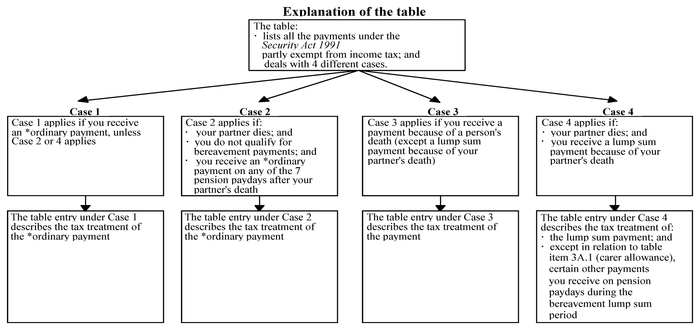
| Income tax treatment of social security payments | |||||
| Item | Payment | Case 1 | Case 2 | Case 3 | Case 4 |
| 1.1 | Advance pharmaceutical supplement | Exempt | Exempt | Not applicable | Not applicable |
| 2.1 | Age pension | Supplementary amount is exempt (see section 52-15 ) | Supplementary amount, and tax-free amount, are exempt (see sections 52-15 and 52-20 ) | Exempt | Exempt up to the tax-free amount (see section 52-25 ) |
| 2AA.1 | Australian Government Disaster Recovery Payment | Exempt | Exempt | Not applicable | Not applicable |
| 2A.1 | Austudy payment | Supplementary amount is exempt (see section 52-15 ) | Supplementary amount, and tax-free amount, are exempt (see sections 52-15 and 52-20 ) | Exempt | Exempt up to the tax-free amount (see section 52-30 ) |
| 3.1 | (Repealed by No 26 of 2018) | ||||
| 3A.1 | Carer allowance | Exempt | Exempt | Exempt | Exempt |
| 4.1 | Carer payment: you are pension age or over | Supplementary amount is exempt (see section 52-15 ) | Supplementary amount, and tax-free amount, are exempt (see sections 52-15 and 52-20 ) | Exempt, but if it is made under section 236A of the Social Security Act 1991 , exempt only up to the tax-free amount (see section 52-35 ) | Exempt up to the tax-free amount if it is made under section 239 of the Social Security Act 1991 (see section 52-25 ) |
| 4.2 | Carer payment: the care receiver or any of the care receivers is pension age or over | Supplementary amount is exempt (see section 52-15 ) | Supplementary amount, and tax-free amount, are exempt (see sections 52-15 and 52-20 ) | Exempt, but if it is made under section 236A of the Social Security Act 1991 , exempt only up to the tax-free amount (see section 52-35 ) | Exempt up to the tax-free amount if it is made under section 239 of the Social Security Act 1991 (see section 52-25 ) |
| 4.3 | Carer payment: both you and the care receiver or all of the care receivers are under pension age | Exempt | Exempt | Exempt, but if it is made under section 236A of the Social Security Act 1991 , exempt only up to the tax-free amount (see section 52-35 ) | Exempt up to the tax-free amount if it is made under section 239 of the Social Security Act 1991 (see section 52-25 ) |
| 4.4 | Carer payment: you are under pension age and any of the care receivers has died | Exempt | Exempt | Exempt, but if it is made under section 236A of the Social Security Act 1991 , exempt only up to the tax-free amount (see section 52-35 ) | Exempt up to the tax-free amount if it is made under section 239 of the Social Security Act 1991 (see section 52-25 ) |
| 5.1 | Crisis payment | Exempt | Exempt | Not applicable | Not applicable |
| 6.1 | Disability support pension: you are pension age or over | Supplementary amount is exempt (see section 52-15 ) | Supplementary amount, and tax-free amount, are exempt (see sections 52-15 and 52-20 ) | Exempt | Exempt up to the tax-free amount (see section 52-25 ) |
| 6.2 | Disability support pension: you are under pension age | Exempt | Exempt | Exempt | Exempt up to the tax-free amount (see section 52-25 ) |
| 7.1 | (Repealed by No 97 of 2008 ) | ||||
| 7.2 | (Repealed by No 97 of 2008 ) | ||||
| 8.1 | (Repealed by No 82 of 2006) | ||||
| 9.1 | Double orphan pension | Exempt | Exempt | Exempt | Not applicable |
| 10.1 | (Repealed by No 64 of 2008) | ||||
| 11.1 | (Omitted by No 83 of 1999) | ||||
| 12.1 | (Omitted by No 83 of 1999) | ||||
| 13.1 | (Omitted by No 83 of 1999) | ||||
| 13A.1 | Fares allowance | Exempt | Exempt | Not applicable | Not applicable |
| 14.1 | Jobseeker payment | Supplementary amount is exempt (see section 52-15 ) | Supplementary amount, and tax-free amount, are exempt (see sections 52-15 and 52-20 ) | Exempt | Exempt up to the tax-free amount (see section 52-30 ) |
| 14.2 | (Omitted by No 83 of 1999) | ||||
| 15.1 | (Repealed by No 107 of 2020) | ||||
| 16.1 | (Repealed by No 107 of 2020) | ||||
| 17.1 | (Repealed by No 107 of 2020) | ||||
| 18.1 | Mobility allowance | Exempt | Exempt | Not applicable | Not applicable |
| 19.1 | (Repealed by No 26 of 2018) | ||||
| 20.1 | (Omitted by No 197 of 1997) | ||||
| 21.1 | (Omitted by No 197 of 1997) | ||||
| 21A.1 | Parenting payment (benefit PP (partnered)) | Supplementary amount is exempt (see section 52-15 ) | Supplementary amount is exempt (see section 52-15 ) | Exempt | Exempt up to the tax-free amount (see section 52-30 ) |
| 21A.2 | (Omitted by No 83 of 1999) | ||||
| 21A.3 | Parenting payment (pension PP (single)) | Supplementary amount is exempt (see section 52-15 ) | Supplementary amount is exempt (see section 52-15 ) | Exempt | Not applicable |
| 22.1 | (Repealed by No 26 of 2018) | ||||
| 22A.1 | Pensioner education supplement | Exempt | Exempt | Not applicable | Not applicable |
| 22B.1 | Energy supplement under Part 2.25B of the Social Security Act 1991 | Exempt | Exempt | Not applicable | Not applicable |
| 22C.1 | Quarterly pension supplement | Exempt | Exempt | Not applicable | Not applicable |
| 23.1 | (Repealed by No 26 of 2018) | ||||
| 24.1 | (Omitted by No 197 of 1997) | ||||
| 25.1 | Special benefit | Supplementary amount is exempt (see section 52-15 ) | Supplementary amount, and tax-free amount, are exempt (see sections 52-15 and 52-20 ) | Exempt | Exempt up to the tax-free amount (see section 52-30 ) |
| 26.1 | Special needs age pension | Supplementary amount is exempt (see section 52-15 ) | Supplementary amount, and tax-free amount, are exempt (see sections 52-15 and 52-20 ) | Exempt | Exempt up to the tax-free amount (see section 52-25 ) |
| 27.1 | Special needs disability support pension: you are pension age or over | Supplementary amount is exempt (see section 52-15 ) | Supplementary amount, and tax-free amount, are exempt (see sections 52-15 and 52-20 ) | Exempt | Exempt up to the tax-free amount (see section 52-25 ) |
| 27.2 | Special needs disability support pension: you are under pension age | Exempt | Exempt | Exempt | Exempt up to the tax-free amount (see section 52-25 ) |
| 28.1 | (Omitted by No 197 of 1997) | ||||
| 29.1 | (Repealed by No 26 of 2018) | ||||
| 30.1 | Special needs wife pension: you are pension age or over | Supplementary amount is exempt (see section 52-15 ) | Supplementary amount, and tax-free amount, are exempt (see sections 52-15 and 52-20 ) | Exempt | Exempt up to the tax-free amount (see section 52-25 ) |
| 30.2 | Special needs wife pension: your partner is pension age or over | Supplementary amount is exempt (see section 52-15 ) | Supplementary amount, and tax-free amount, are exempt (see sections 52-15 and 52-20 ) | Exempt | Exempt up to the tax-free amount (see section 52-25 ) |
| 30.3 | Special needs wife pension: both you and your partner are under pension age | Exempt | Exempt | Exempt | Exempt up to the tax-free amount (see section 52-25 ) |
| 30.4 | Special needswife pension: you are under pension age and your partner has died | Exempt | Exempt | Exempt | Exempt up to the tax-free amount (see section 52-25 ) |
| 31.1 | Telephone allowance | Exempt | Exempt | Not applicable | Not applicable |
| 31A.1 | Utilities allowance | Exempt | Exempt | Not applicable | Not applicable |
| 32.1 | (Repealed by No 26 of 2018) | ||||
| 33.1 | (Repealed by No 26 of 2018) | ||||
| 34.1 | (Repealed by No 26 of 2018) | ||||
| 34.2 | (Repealed by No 26 of 2018) | ||||
| 34.3 | (Repealed by No 26 of 2018) | ||||
| 34.4 | (Repealed by No 26 of 2018) | ||||
| 35.1 | Youth allowance | Supplementary amount is exempt (see section 52-15 ) | Supplementary amount, and tax-free amount, are exempt (see sections 52-15 and 52-20 ) | Exempt | Exempt up to the tax-free amount (see section 52-30 ) |
Note:
A reference in this table to jobseeker payment or youth allowance includes a reference to farm household allowance under the Farm Household Support Act 2014 (see Part 5 of that Act). Other payments referred to in this table (such as advance pharmaceutical supplement) might also be payable to a person who is receiving farm household allowance.
You work out the supplementary amount of a social security payment using the following table:
| Supplementary amount of a social security payment | ||
| Item | For this category of social security payment: | the supplementary amount is the total of: |
| 1 | Age pension
Carer payment Special benefit Special needs age pension Special needs disability support pension Special needs wife pension |
(a) so much of the payment as is included by way of rent assistance; and
(b) so much of the payment as is included by way of remote area allowance; and (c) so much of the payment as is included by way of pharmaceutical allowance; and (d) so much of the payment as is included by way of tax-exempt pension supplement; and (e) so much of the payment as is included by way of energy supplement |
| . | ||
| 2 | Disability support pension | (a) so much of the payment as is included by way of rent assistance; and
(b) so much of the payment as is included by way of remote area allowance; and (c) so much of the payment as is included by way of pharmaceutical allowance; and (d) so much of the payment as is included by way of incentive allowance; and (e) so much of the payment as is included by way of language, literacy and numeracy supplement; and (f) so much of the payment as is included by way of tax-exempt pension supplement; and (g) so much of the payment as is included by way of energy supplement |
| . | ||
| 3 | Jobseeker payment
Parenting payment (benefit (PP partnered)) Parenting payment (pension (PP single)) Youth allowance |
(a) so much of the payment as is included by way of rent assistance; and
(b) so much of the payment as is included by way of remote area allowance; and (c) so much of the payment as is included by way of pharmaceutical allowance; and (d) so much of the payment as is included by way of language, literacy and numeracy supplement; and (e) so much of the payment as is included by way of tax-exempt pension supplement; and (f) so much of the payment as is included by way of energy supplement |
| . | ||
| 4 | Austudy payment | (a) so much of the payment as is included by way of rent assistance; and
(b) so much of the payment as is included by way of remote area allowance; and (c) so much of the payment as is included by way of pharmaceutical allowance; and (d) so much of the payment as is included by way of tax-exempt pension supplement; and (e) so much of the payment as is included by way of energy supplement |
Note:
A reference in this table to jobseeker payment or youth allowance includes a reference to farm household allowance under the Farm Household Support Act 2014 (see Part 5 of that Act).
You work out under this section the * tax-free amount of an * ordinary payment made under the Social Security Act 1991 after the death of your partner if:
(a) you do not qualify for payments under a * bereavement Subdivision; and
(b) the ordinary payment became due to you during the bereavement period.
Note:
For the provisions of the Social Security Act 1991 that tell you if you qualify for payments under a bereavement Subdivision: see subsection (3).
52-20(2)
This is how to work out the tax-free amount : Method statement
Step 1.
Work out the * supplementary amount of the payment.
Note: The supplementary amount is also exempt and is worked out under section 52-15.
Step 2.
Subtract the * supplementary amount from the amount of the payment.
Step 3.
Work out what would have been the amount of the payment if your partner had not died.
Step 4.
Work out what would have been the * supplementary amount of the payment if your partner had not died.
Step 5.
Subtract the amount at Step 4 from the amount at Step 3.
Step 6.
Subtract the amount at Step 5 from the amount at Step 2: the result is the tax-free amount .
52-20(3)
This table sets out:
(a) the Subdivisions of the Social Security Act 1991 that are bereavement Subdivisions ; and
(b) the provision of that Act that tells you if you qualify for payments under the relevant bereavement Subdivision.
| Bereavement Subdivisions | ||
| Item | For this bereavement Subdivision: | This provision tells you if you qualify for payments under it: |
| 1 | Subdivision A of Division 9 of Part 2.2 | paragraph 82(1)(e) |
| . | ||
| 2 | Subdivision A of Division 10 of Part 2.3 | paragraph 146F(1)(e) |
| . | ||
| 3 | Subdivision B of Division 9 of Part 2.5 | paragraph 237(1)(e) |
| . | ||
| 4 | (Omitted by No 197 of 1997) | |
| . | ||
| 5 | (Repealed by No 26 of 2018) | |
| . | ||
| 5A | Division 10 of Part 2.11 | subsection 567(1) or section 567FA |
| . | ||
| 5B | Division 10 of Part 2.11A | paragraph 592(1)(f) |
| . | ||
| 6 | Division 9 of Part 2.12 | subsection 660LA(1) or section 660LH |
| . | ||
| 7 | (Repealed by No 107 of 2020) | |
| . | ||
| 8 | (Repealed by No 107 of 2020) | |
| . | ||
| 9 | (Repealed by No 26 of 2018) | |
| . | ||
| 10 | Subdivision AA of Division 9 of Part 2.15 | paragraph 768A(1)(f) |
| . | ||
| 11 | Subdivision A of Division 10 of Part 2.16 | paragraph 822(1)(e) |
This section applies if a lump sum of any of these categories of social security payments becomes due to you because of your partner ' s death.
| Category of social security payment |
| Age pension |
| Carer payment |
| Disability support pension |
| Special needs age pension |
| Special needs disability support pension |
| Special needs wife pension |
52-25(2)
The total of the following are exempt up to the * tax-free amount: (a) the lump sum payment; (b) all other payments that become due to you under the Social Security Act 1991 during the bereavement lump sum period.
52-25(3)
This is how to work out the tax-free amount : Method statement
Step 1.
Work out the payments under the Social Security Act 1991 that would have become due to you during the bereavement lump sum period if:
Step 2.
Work out how much of those payments would have been exempt in those circumstances.
Step 3.
Work out the payments under the Social Security Act 1991 or Part III of the Veterans ' Entitlements Act 1986 that would have become due to your partner during the bereavement lump sum period if:
even if the payments would not have been exempt.
Step 4.
Total the payments worked out at Steps 2 and 3: the result is the tax-free amount .
Example:
You are receiving a disability support pension of $ 300 a fortnight and a pharmaceutical allowance of $ 5 a fortnight. You are over pension age. Your partner is receiving a jobseeker payment of $ 250 a fortnight and rent assistance of $ 75 a fortnight.
Your partner dies. Seven instalments are due to you during the bereavement lump sum period. You work out the tax-free amount as follows:
Step 1: The instalments that would have become due to you during the bereavement lump sum period are:
$ 300 + $ 5 = $ 305
The total for the period is $ 2,135.
Step 2: The exempt component of each instalment is $ 5. The total for the 7 instalments is $ 35.
Step 3: The instalments that would have become due to your partner during the same period are:
$ 250 + $ 75 = $ 325
The total for the period is $ 2,275.
Step 4: The tax-free amount is:
$ 35 + $ 2,275 = $ 2,310
SECTION 52-30 Tax-free amount of certain other bereavement lump sum payments 52-30(1)
This section applies if a lump sum of any of these categories of social security payments becomes due to you because of your partner ' s death.
| Category of social security payment |
| Austudy payment |
| Jobseeker payment |
| Parenting payment (benefit PP (partnered)) |
| Special benefit |
| Youth allowance |
Note:
A reference in this table to jobseeker payment or youth allowance includes a reference to farm household allowance under the Farm Household Support Act 2014 (see Part 5 of that Act).
52-30(2)
The total of the following are exempt up to the * tax-free amount: (a) the lump sum payment; (b) all other payments that become due to you under the Social Security Act 1991 during the bereavement lump sum period.
52-30(3)
This is how to work out the tax-free amount : Method statement
Step 1.
Work out the payments under the Social Security Act 1991 that would have become due to you during the bereavement lump sum period if:
Step 2.
Work out how much of those payments would have been exempt in those circumstances.
Step 3.
Work out the payments under the Social Security Act 1991 that would have become due to your partner during the bereavement lump sum period if your partner had not died, even if the payments would not have been exempt.
Step 4.
Total the payments worked out at Steps 2 and 3: the result is the tax-free amount .
SECTION 52-35 Tax-free amount of a lump sum payment made because of the death of a person you are caring for 52-35(1)
This section applies if a lump sum payment becomes due to you under section 236A of the Social Security Act 1991 because of the death of the care receiver or any of the care receivers.
52-35(2)
The total of the following are exempt up to the * tax-free amount:
(a) the lump sum payment;
(b) all other payments that become due to you under the Social Security Act 1991 during the bereavement lump sum period.
52-35(3)
This is how to work out the tax-free amount : Method statement
Step 1.
Work out the payments under the Social Security Act 1991 that would have become due to you during the bereavement lump sum period if:
Step 2.
Work out how much of those payments would have been exempt in those circumstances.
Step 3.
Work out the payments under the Social Security Act 1991 that would have become due to the care receiver during the bereavement lump sum period if the care receiver had not died, even if the payments would not have been exempt.
Step 4.
Total the payments worked out at Steps 2 and 3: the result is the tax-free amount .
SECTION 52-40 52-40 Provisions of the Social Security Act 1991 under which payments are made
This table lists the provisions of the Social Security Act 1991 under which social security payments are made that are wholly or partly exempt from income tax under this Subdivision.
| Provisions under which social security payments are made | ||||
| Item | Category of social security payment | Ordinary payment | Payment made because of a person ' s death (unless covered by next column) | Lump sum payment made because of your partner ' s death |
| 1A | 2020 economic support payment | Part 2.6B | Not applicable | Not applicable |
| 1AA | 2022 cost of living payment | Part 2.6D | Not applicable | Not applicable |
| 1B | Additional economic support payment 2020 or additional economic support payment 2021 | Part 2.6C | Not applicable | Not applicable |
| 1 | Advance pharmaceutical supplement | Part 2.23 | Not applicable | Not applicable |
| 2 | Age pension | Part 2.2 | Sections 83 , 86 and 91 | Section 84 |
| 2AA | Australian Government Disaster Recovery Payment | Part 2.24 | Not applicable | Not applicable |
| 2AB | Australian Victim of Terrorism Overseas Payment | Part 2.24AA | Not applicable | Not applicable |
| 2A | Austudy payment | Part 2.11A | Section 592A | Section 592B |
| 3 | (Repealed by No 26 of 2018) | |||
| 3A | Carer allowance | Part 2.19 | Sections 992K and 992M | Not applicable |
| 4 | Carer payment | Part 2.5 | Sections 236A , 238 , 241 and 246 | Section 239 |
| 4A | Clean energy payment | Part 2.18A | Not applicable | Not applicable |
| 5 | Crisis payment | Part 2.23A | Not applicable | Not applicable |
| 6 | Disability support pension | Part 2.3 | Sections 146G , 146K and 146Q | Section 146H |
| 7 | (Repealed by No 97 of 2008 ) | |||
| 8 | (Repealed by No 82 of 2006) | |||
| 9 | Double orphan pension | Part 2.20 | Sections 1034 and 1034A | Not applicable |
| 10 | (Repealed by No 64 of 2008) | |||
| 11 - 13 | (Omitted by No 83 of 1999) | |||
| 13A | Fares allowance | Part 2.26 | Not applicable | Not applicable |
| 14 | Jobseeker payment | Part 2.12 | Section 660LB | Sections 660LC and 660LH |
| 14.1 - 14.2 | (Omitted by No 83 of 1999) | |||
| 15 | (Repealed by No 107 of 2020) | |||
| 16 | (Repealed by No 107 of 2020) | |||
| 17 | (Repealed by No 107 of 2020) | |||
| 18 | Mobility allowance | Part 2.21 | Not applicable | Not applicable |
| 19 | (Repealed by No 26 of 2018) | |||
| 20 | One-off energy assistance payment | Part 2.6 or 2.6A | Not applicable | Not applicable |
| 21 | (Omitted by No 197 of 1997) | |||
| 21A | Parenting payment (benefit PP (partnered)) | Part 2.10 | Sections 513A and 514B | Section 514C |
| 21B | (Omitted by No 83 of 1999) | |||
| 21C | Parenting payment (pension PP (single)) | Part 2.10 | Section 513 | Not applicable |
| 22 | (Repealed by No 26 of 2018) | |||
| . | ||||
| 22A | Pensioner education supplement | Part 2.24A | Not applicable | Not applicable |
| 22B | Energy supplement | Part 2.25B | Not applicable | Not applicable |
| 22C | Quarterly pension supplement | Part 2.25C | Not applicable | Not applicable |
| 23 | (Repealed by No 26 of 2018) | |||
| 24 | (Omitted by No 197 of 1997) | |||
| 25 | Special benefit | Part 2.15 | Section 768B | Section 768C |
| 26 | Special needs age pension | Section 772 | Sections 823 , 826 and 830 | Section 824 |
| 27 | Special needs disability support pension | Section 773 | Sections 823 , 826 and 830 | Section 824 |
| 28 | (Omitted by No 197 of 1997) | |||
| 29 | (Repealed by No 26 of 2018) | |||
| 30 | Special needs wife pension | Section 774 | Sections 823 , 826 and 830 | Section 824 |
| 31 | Telephone allowance | Part 2.25 | Not applicable | Not applicable |
| 31A | Utilities allowance | Part 2.25A | Not applicable | Not applicable |
| 32 | (Repealed by No 26 of 2018) | |||
| 33 | (Repealed by No 26 of 2018) | |||
| 34 | (Repealed by No 26 of 2018) | |||
| 35 | Youth allowance | Part 2.11 | Section 567A | Sections 567B and 567FA |
SECTION 52-60 What this Subdivision is about
This Subdivision tells you:
| Operative provisions | |
| 52-65 | How much of a veterans ' affairs payment is exempt ? |
| 52-70 | Supplementary amounts of payments |
| 52-75 | Provisions of the Veterans ' Entitlements Act 1986 under which payments are made |
SECTION 52-65 How much of a veterans ' affairs payment is exempt ? 52-65(1)
The table in this section tells you about the income tax treatment of veterans ' affairs payments, other than: (a) payments of pension bonus or pension bonus bereavement payment; or (b) clean energy payments; or (ba) (Repealed by No 17 of 2025) (bb) (Repealed by No 12 of 2012) (c) one-off energy assistance payments under the Veterans ' Entitlements Act 1986 ; or (d) first 2020 economic support payments under the Veterans ' Entitlements Act 1986 ; or (da) second 2020 economic support payments under the Veterans ' Entitlements Act 1986 ; or (db) payments of additional economic support payment 2020 under the Veterans ' Entitlements Act 1986 ; or (dc) payments of additional economic support payment 2021 under the Veterans ' Entitlements Act 1986 ; or (e) (Repealed by No 17 of 2025) (f) a 2022 cost of living payment under the Veterans ' Entitlements Act 1986 .
Note:
Section 52-75 sets out the provisions of the Veterans ' Entitlements Act 1986 under which the payments are made.
52-65(1A)
Payments of pension bonus and pension bonus bereavement payment under Part IIIAB of the Veterans ' Entitlements Act 1986 are exempt from income tax.
52-65(1B)
(Repealed by No 12 of 2012)
52-65(1BA)
(Repealed by No 19 of 2008)
52-65(1C)
(Repealed by No 12 of 2012)
52-65(1D)
(Repealed by No 128 of 2017)
52-65(1E)
A lump sum payment under section 198N of the Veterans ' Entitlements Act 1986 is exempt from income tax.
52-65(1F)
(Repealed by No 17 of 2025)
52-65(1G)
Clean energy payments under the Veterans ' Entitlements Act 1986 are exempt from income tax.
[ CCH Note: Despite amendments made by No 128 of 2017 related to the removal of spent veterans ' affairs payments, subsection 52-65(1G) , as in force immediately before 1 December 2017, continues to apply on and after 1 December 2017 in relation to a payment of clean energy advance under the Veterans ' Entitlements Act 1986 made before, on or after 1 December 2017.]
52-65(1GA)
One-off energy assistance payments under Part IIIF of the Veterans ' Entitlements Act 1986 are exempt from income tax.
52-65(1H)
One-off energy assistance payments under Part IIIG of the Veterans ' Entitlements Act 1986 are exempt from income tax.
[ CCH Note: Despite amendments made by No 128 of 2017 related to the removal of spent veterans ' affairs payments, subsection 52-65(1H), as in force immediately before 1 December 2017, continues to apply on and after 1 December 2017 in relation to an ETR payment made before, on or after 1 December 2017.]
52-65(1J)
The following payments are exempt from income tax: (a) first 2020 economic support payments under Division 1 of Part IIIH of the Veterans ' Entitlements Act 1986 ; (b) second 2020 economic support payments under Division 2 of Part IIIH of the Veterans ' Entitlements Act 1986
52-65(1K)
The following payments are exempt from income tax: (a) additional economic support payment 2020 under Division 1 of Part IIIJ of the Veterans ' Entitlements Act 1986 ; (b) additional economic support payment 2021 under Division 2 of Part IIIJ of the Veterans ' Entitlements Act 1986 .
52-65(1L)
2022 cost of living payment under Division 1 of Part IIIK of the Veterans ' Entitlements Act 1986 is exempt from income tax.
52-65(2)
Expressions (except " pension age " ) used in this Subdivision that are also used in the Veterans ' Entitlements Act 1986 have the same meaning as in that Act.
Note:
Pension age has the meaning given by subsection 23(1) of the Social Security Act 1991 : see subsection 995-1(1) .
52-65(3)
(Repealed by No 94 of 2019)
52-65(4)
Ordinary payment means a payment other than a payment made because of a person ' s death.
| Income tax treatment of veterans ' affairs payments | |||
| Item | Category of veterans ' affairs payment | Ordinary payment | Payment made because of a person ' s death |
| 1.1 | Age service pension | Supplementary amount is exempt (see section 52-70 ) | Exempt |
| 2.1 | Attendant allowance | Exempt | Not applicable |
| 3.1 | Carer service pension: unless covered by item 3.2 or 3.3 | Supplementary amount is exempt (see section 52-70 ) | Exempt |
| 3.2 | Carer service pension: both you and your partner are under pension age and your partner is receiving an invalidity service pension | Exempt | Exempt |
| 3.3 | Carer service pension: you are under pension age, your partner has died and was receiving an invalidity service pension at death | Exempt | Exempt |
| 4.1 | Clothing allowance | Exempt | Not applicable |
| 5.1 | (Repealed by No 17 of 2025) | ||
| 5A.1 | (Repealed by No 142 of 2021) | ||
| 6.1 | Income support supplement: unless covered by item 6.2, 6.3, 6.4 or 6.5 | Supplementary amount is exempt (see section 52-70 ) | Exempt |
| 6.2 | Income support supplement: you are under pension age and receiving the supplement on the grounds of permanent incapacity | Exempt | Exempt |
| 6.3 | Income support supplement: both you and the severely handicapped person you are caring for are under pension age and you are receiving the supplement for providing constant care for that person | Exempt | Exempt |
| 6.4 | Income support supplement: both you and your partner are under pension age and your partner is an invalidity service pensioner or a disability support pensioner | Exempt | Exempt |
| 6.5 | Income support supplement: both you and your partner are under pension age and your partner is receiving the supplement on the grounds of permanent incapacity | Exempt | Exempt |
| 7.1 | Invalidity service pension: you are pension age or over | Supplementary amount is exempt (see section 52-70 ) | Exempt |
| 7.2 | Invalidity service pension: you are under pension age | Exempt | Exempt |
| 8.1 | Loss of earnings allowance | Exempt | Not applicable |
| 9.1 | Partner service pension: unless covered by item 9.2 or 9.3 | Supplementary amount is exempt (see section 52-70 ) | Exempt |
| 9.2 | Partner service pension: both you and your partner are under pension age and your partner is receiving an invalidity service pension | Exempt | Exempt |
| 9.3 | Partner service pension: you are under pension age, your partner has died and was receiving an invalidity service pension at death | Exempt | Exempt |
| 10.1 | Pension for defence-caused death or incapacity | Exempt | Not applicable |
| 11.1 | Pension for war-caused death or incapacity | Exempt | Not applicable |
| 12.1 | Quarterly pension supplement | Exempt | Not applicable |
| 13.1 | Recreation transport allowance | Exempt | Not applicable |
| 14.1 | Section 98A Bereavement payment | Not applicable | Exempt |
| 14.2 | Section 98AA Bereavement payment | Not applicable | Exempt |
| 15.1 | (Repealed by No 17 of 2025) | ||
| 16.1 | (Repealed by No 17 of 2025) | ||
| 16A.1 | Energy supplement under Part VIIAD of the Veterans ' Entitlements Act 1986 | Exempt | Not applicable |
| 17.1 | Special assistance | Exempt | Not applicable |
| 18.1 | (Repealed by No 81 of 2009) | ||
| 19.1 | (Repealed by No 95 of 2011) | ||
| 20.1 | (Repealed by No 17 of 2025) | ||
| 20A.1 | (Repealed by No 81 of 2009) | ||
| 21.1 | Vehicle Assistance Scheme | Exempt | Not applicable |
| 21AA.1 | Veteran payment | Supplementary amount is exempt (see section 52-70 ) | Exempt |
| 21A.1 | Veterans supplement | Exempt | Not applicable |
| 22.1 | (Repealed by No 17 of 2025) |
SECTION 52-70 52-70 Supplementary amounts of payments
The supplementary amount of a veterans ' affairs payment is the total of:
(a) so much of the payment as is included by way of rent assistance; and
(b) so much of the payment as is included by way of an additional amount for each of your dependent * children; and
(c) so much of the payment as is included by way of remote area allowance; and
(d) so much of the payment as is equal to the tax-exempt pension supplement for the payment; and
(e) so much of the payment as is included by way of energy supplement.
This table lists the provisions of the Veterans ' Entitlements Act 1986 under which veterans ' affairs payments are made that are wholly or partly exempt from income tax under this Subdivision.
| Provisions under which veterans ' affairs payments are made | |||
| Item | Category of veterans ' affairs payment | Ordinary payment | Payment made because of a person ' s death |
| 1A | 2020 economic support payment | Part IIIH | Not applicable |
| 1AA | 2022 cost of living payment | Part IIIK | Not applicable |
| 1B | Additional economic support payment 2020 or additional economic support payment 2021 | Part IIIJ | Not applicable |
| 1C | (Repealed by No 12 of 2012) | ||
| 1 | Age service pension | Division 3 of Part III | Division 12A of Part IIIB |
| 2 | Attendant allowance | Section 98 | Not applicable |
| 3 | Carer service pension | Division 6 of Part III | Division 12A of Part IIIB |
| 3A | Clean energy payment | Part IIIE | Not applicable |
| 3B | (Repealed by No 17 of 2025) | ||
| 4 | Clothing allowance | Section 97 | Not applicable |
| 5 | (Repealed by No 17 of 2025) | ||
| 5A | (Repealed by No 142 of 2021) | ||
| 5B - 5C | (Repealed by 128 of 2017) | ||
| 5D | (Repealed by No 96 of 2014) | ||
| 6 | Income support supplement | Part IIIA | Division 12A of Part IIIB |
| 7 | Invalidity service pension | Division 4 of Part III | Division 12A of Part IIIB |
| 8 | Loss of earnings allowance | Section 108 | Not applicable |
| 8A | One-off energy assistance payment | Part IIIF or IIIG | Not applicable |
| 9 | Partner service pension | Division 5 of Part III | Division 12A of Part IIIB |
| 10 | Pension for defence-caused death or incapacity | Part IV | Not applicable |
| 11 | Pension for war-caused death or incapacity | Part II | Not applicable |
| 12 | Quarterly pension supplement | Part IIID | Not applicable |
| 12A | (Repealed by No 17 of 2025) | ||
| 13 | Recreation transport allowance | Section 104 | Not applicable |
| 14 | Section 98A Bereavement payment | Not applicable | Section 98A |
| 14A | Section 98AA Bereavement payment | Not applicable | Section 98AA |
| 15 | (Repealed by No 17 of 2025) | ||
| 16 | (Repealed by No 17 of 2025) | ||
| 16A | Energy supplement | Part VIIAD | Not applicable |
| 17 | Special assistance | Section 106 | Not applicable |
| 18 | (Repealed by No 81 of 2009) | ||
| 19 | (Repealed by No 95 of 2011) | ||
| 20 | (Repealed by No 17 of 2025) | ||
| 20A | (Repealed by No 81 of 2009) | ||
| 21 | Vehicle Assistance Scheme | Section 105 | Not applicable |
| 21AA | Veteran payment | Section 45SB | Section 45SB |
| 21A | Veterans supplement | Part VIIA | Not applicable |
| 22 | (Repealed by No 17 of 2025) |
This Subdivision tells you:
SECTION 52-105 Supplementary amount of a payment made under the Repatriation Act 1920 is exempt 52-105(1)
The * supplementary amount of a payment made to you is exempt from income tax if:
(a) you are a * parent of a * member of the Forces who has died (but you are neither a widow nor a woman divorced or deserted by her husband) and you are of * pension age or over; or
(b) you are the mother of a * member of the Forces who has died and you are also a widow, or divorced or deserted by your husband;
and the payment is covered by subsection (2).
52-105(2)
The payment must be made in circumstances that are a prescribed case under:
(a) Table A in Schedule 3 to the Repatriation Act 1920 ; or
(b) that Table as applying because of the Repatriation (Far East Strategic Reserve) Act 1956 ; or
(c) that Table as applying because of the Repatriation (Special Overseas Service) Act 1962 ; or
(d) that Table as applying because of the Interim Forces Benefits Act 1947 ;
as in force because of subsection 4(6) of the Veterans ' Entitlements (Transitional Provisions and Consequential Amendments) Act 1986 .
52-105(3)
The supplementary amount is the total of:
(a) so much of the payment as is included by way of rental assistance; and
(b) so much of the payment as is included by way of an additional amount for each of your dependent * children; and
(c) so much of the payment as is included by way of remote area allowance.
52-105(4)
Member of the Forces has the same meaning as in the Act referred to in the relevant paragraph of subsection (2).
52-105(5)
Expressions (except pension age ) used in this Subdivision that are also used in the Veterans ' Entitlements Act 1986 have the same meaning as in that Act.
Note:
Pension age has the meaning given by subsection 23(1) of the Social Security Act 1991 : see subsection 995-1(1) .
52-105(6)
(Repealed by No 94 of 2019)
Payments (except those covered by section 52-105) made because of subsection 4(6) of the Veterans' Entitlements (Transitional Provisions and Consequential Amendments) Act 1986 are exempt from income tax.
This Subdivision tells you:
SECTION 52-114 How much of a payment under the Military Rehabilitation and Compensation Act is exempt ? 52-114(1)
The table in this section tells you about the income tax treatment of payments under the Military Rehabilitation and Compensation Act 2004 . References in the table to provisions are to provisions of that Act.
52-114(2)
Expressions used in this Subdivision that are also used in the Military Rehabilitation and Compensation Act 2004 have the same meanings as in that Act.
52-114(3)
Ordinary payment means a payment other than a payment made because of a person ' s death.
| Income tax treatment of Military Rehabilitation and Compensation Act payments | |||
| Item | Category of payment and provision under which it is paid | Ordinary payment | Payment because of a person ' s death |
| 1 | Alterations to aids and appliances relating to rehabilitation (section 57) | Exempt | Not applicable |
| 2 | Compensation for journey and accommodation costs (sections 47, 290, 291, 291A and 297 and subsection 328(4)) | Exempt | Not applicable |
| 3 | Compensation for permanent impairment (sections 68, 71, 75 and 80) | Exempt | Exempt |
| 4 | Compensation for financial advice or legal advice (sections 81, 205 and 239) | Exempt | Not applicable |
| 5 | Compensation for incapacity for Permanent Forces member or continuous full-time Reservist (section 85) | See section 51-32 | Exempt |
| 6 | Compensation for incapacity for part-time Reservists (section 86) | See section 51-33 | Exempt |
| 7 | Compensation by way of Special Rate Disability Pension (section 200) | Exempt | Not applicable |
| 8 | Compensation under the Motor Vehicle Compensation Scheme (section 212) | Exempt | Not applicable |
| 9 | Compensation for household services and attendant care services (sections 214 and 217) | Exempt | Not applicable |
| 9A | Additional Disablement Amount (section 220A) | Exempt | Not applicable |
| 10 | MRCA supplement (sections 221, 245 and 300) | Exempt | Not applicable |
| 11 | Compensation for loss or damage to medical aids (section 226) | Exempt | Not applicable |
| 11A | Victoria Cross allowance (section 230A) | Exempt | Not applicable |
| 11B | Decoration allowance (section 230C) | Exempt | Not applicable |
| 12 | Compensation for a wholly dependent partner for a member ' s death (section 233) | Not applicable | Exempt |
| 13 | Continuing permanent impairment and incapacity etc. compensation for a wholly dependent partner (subparagraphs 242(1)(a)(i), (iii) and (iv)) | Not applicable | Exempt |
| 14 | Compensation for eligible young persons who were dependent on deceased member (section 253) | Not applicable | Exempt |
| 15 | Continuing permanent impairment and incapacity etc. compensation for eligible young persons (subparagraphs 255(1)(c)(i), (iii) and (iv)) | Not applicable | Exempt |
| 16 | Education and training, or a payment, under the education scheme for certain eligible young persons (section 258) | Exempt if:
(a) provided for or made to a person under 16; or (b) a clean energy payment |
Exempt |
| 16A | (Repealed by No 96 of 2014) | ||
| 17 | Compensation for other persons who were dependent on deceased member (section 262) | Not applicable | Exempt |
| 18 | Compensation for cost of a funeral (sections 266, 268AA, 268AB and 268AC) | Not applicable | Exempt |
| 18A | Compensation relating to prisoners of war (sections 268AJ and 268AM) | Exempt | Not applicable |
| 19 | Compensation for treatment costs (sections 288A, 288B and 288C) | Exempt | Not applicable |
| 20 | (Repealed by No 81 of 2009) | ||
| 21 | Special assistance (section 424) | Exempt | Exempt |
| 22 | Clean energy payment (sections 83A, 209A, 220D and 238A) | Exempt | Not applicable |
Note:
The supplementary amount of a payment covered by item 16 of the table made to a person aged 16 or over is also exempt from income tax (see section 52-140 ).
Subdivision 52-CB - Exempt payments under the Australian Participants in British Nuclear Tests and British Commonwealth Occupation Force (Treatment) Act 2006
A payment made to you under Part 3 (travelling expenses) of the Australian Participants in British Nuclear Tests and British Commonwealth Occupation Force (Treatment) Act 2006 is exempt from income tax.
52-117(2)
A payment of pharmaceutical supplement made to you under Part 3A of the Australian Participants in British Nuclear Tests and British Commonwealth Occupation Force (Treatment) Act 2006 is exempt from income tax.
A payment made to you under Part 3 (travelling expenses) of the Treatment Benefits (Special Access) Act 2019 is exempt from income tax.
52-120(2)
A payment of pharmaceutical supplement made to you under Part 4 of the Treatment Benefits (Special Access) Act 2019 is exempt from income tax.
(Repealed by No 83 of 1999)
(Repealed by No 105 of 2013)
SECTION 52-130 52-130 What this Subdivision is about
This Subdivision tells you:
| Operative provisions | |
| 52-131 | Payments under ABSTUDY scheme |
| 52-132 | Supplementary amount of payment |
| 52-133 | Tax free amount of ordinary payment on death of partner if no bereavement payment payable |
| 52-134 | Tax-free amount if you receive a bereavement lump sum payment |
SECTION 52-131 Payments under ABSTUDY scheme 52-131(1)
This section tells you about the income tax treatment of a payment under the ABSTUDY scheme made in respect of a period commencing at a time when you were at least 16 years old.
Note:
The whole of a payment made under the ABSTUDY scheme in respect of a period commencing at a time when you are under 16 years old may be exempt under section 51-10 .
52-131(2)
The following payments made to you under the ABSTUDY scheme are exempt from income tax: (a) a crisis payment; (b) a clean energy payment; (c) a first 2020 economic support payment; (d) a second 2020 economic support payment; (e) a 2022 cost of living payment.
52-131(3)
If: (a) an * ordinary payment becomes due to you; and (b) the payment is not covered by subsection (4) or (6) ;
the * supplementary amount of the ordinary payment is exempt from income tax.
Note:
To work out the supplementary amount of the ordinary payment, see section 52-132 .
52-131(4)
If: (a) your partner dies; and (b) you do not qualify for a payment under the ABSTUDY scheme in respect of that death; and (c) an * ordinary payment becomes due to you during the bereavement period;
the * supplementary amount and the * tax-free amount of the ordinary payment are exempt from income tax.
Note 1:
To work out the supplementary amount of the ordinary payment, see section 52-132 .
Note 2:
To work out the tax-free amount of the ordinary payment, see section 52-133 .
52-131(5)
If a payment becomes due to you under the ABSTUDY scheme because of a person ' s death (except a lump sum payment because of your partner ' s death), the payment is exempt from income tax.
52-131(6)
If: (a) your partner dies; and (b) a lump sum payment under the ABSTUDY scheme becomes due to you because of your partner ' s death;
the total of the following are exempt from income tax up to the * tax free amount:
(c) the lump sum payment; and (d) all other payments that become due to you under the ABSTUDY scheme during the bereavement lump sum period.Note:
To work out the tax-free amount, see section 52-134 .
52-131(7)
ABSTUDY scheme means the scheme known as ABSTUDY.
52-131(8)
Ordinary payment means a payment under the ABSTUDY scheme, other than: (a) a crisis payment; or (aa) a clean energy payment; or (ab) a first 2020 economic support payment; or (ac) a second 2020 economic support payment; or (ad) a 2022 cost of living payment; or (b) a payment made because of a person ' s death.
52-131(9)
The following expressions used in this Subdivision have the same meaning as in the ABSTUDY Policy Manual: (a) bereavement lump sum period; (b) bereavement period; (c) illness separated couple; (d) lump sum payment; (e) partner; (f) pension age; (g) respite care couple.
Note:
In 2009, the ABSTUDY Policy Manual was accessible through the website of the Department administered by the Student Assistance Minister.
The * supplementary amount of a payment is the total of:
(a) so much of the payment as is included to assist you with, or to reimburse you for, the costs of any one or more of the following:
(i) rent;
(ii) living in a remote area;
(iii) commencing employment;
(iv) travel to, or participation in, courses, interviews, education or training;
(v) a child or children wholly or substantially dependent on you;
(vi) telephone bills;
(vii) living away from your usual residence;
(viii) maintaining your usual residence while living away from that residence;
(ix) accommodation, books or equipment;
(x) (Repealed by No 56 of 2010)
(xi) discharging a compulsory repayment amount (within the meaning of the Higher Education Support Act 2003 );
(xia) discharging a compulsory VETSL repayment amount (within the meaning of the VET Student Loans Act 2016 );
(xii) transport in travelling to undertake education or training, or to visit your usual residence when undertaking education or training away from that residence;
(xiii) if you are disabled - acquiring any special equipment, services or transport as a result of the disability;
(xiv) anything that would otherwise prevent you from beginning, continuing or completing any education or training; and
(b) so much of the payment as is included by way of pharmaceutical allowance; and
(c) so much of the payment as is included by way of energy supplement.
This is how to work out the tax-free amount of an * ordinary payment for the purposes of subsection 52-131(4) : Method statement
Step 1.
Work out the
*
supplementary amount of the payment.
Note:
The supplementary amount is also exempt and is worked out under section 52-132 .
Step 2.
Subtract the * supplementary amount from the amount of the payment.
Step 3.
Work out what would have been the amount of the payment if your partner had not died.
Step 4.
Work out what would have been the * supplementary amount of the payment if your partner had not died.
Step 5.
Subtract the amount at Step 4 from the amount at Step 3.
Step 6.
Subtract the amount at Step 5 from the amount at Step 2: the result is the tax-free amount .
This is how to work out the tax-free amount for the purposes of subsection 52-131(6) : Method statement
Step 1.
Work out the payments under the ABSTUDY scheme that would have become due to you during the bereavement lump sum period if:
Step 2.
Work out how much of those payments would have been exempt in those circumstances.
Step 3.
Work out the payments under the ABSTUDY scheme or the Social Security Act 1991 that would have become due to your partner during the bereavement lump sum period if your partner had not died, even if the payments would not have been exempt.
Step 4.
Total the payments worked out at Steps 2 and 3: the result is the tax-free amount .
This section tells you about the income tax treatment of a * Commonwealth education or training payment (other than a payment to or on behalf of a student under the scheme known as ABSTUDY).
Note:
The income tax treatment of payments under the scheme known as ABSTUDY is dealt with in Subdivision 52-E .
52-140(2)
The * supplementary amount of the payment is exempt from income tax.
52-140(3)
The supplementary amount is the total of:
(a) so much of the payment as is included to assist you with, or to reimburse you for, the costs of any one or more of the following:
(i) rent;
(ii) living in a remote area;
(iii) commencing employment;
(iv) travel to, or participation in, courses, interviews, education or training;
(v) a child or children wholly or substantially dependent on you;
(vi) telephone bills;
(vii) living away from your usual residence;
(viii) maintaining your usual residence while living away from that residence;
(ix) accommodation, books or equipment;
(x) (Repealed by No 56 of 2010)
(xa) discharging a compulsory repayment amount (within the meaning of the Higher Education Support Act 2003 );
(xb) discharging a compulsory VETSL repayment amount (within the meaning of the VET Student Loans Act 2016 );
(xi) transport in travelling to undertake education or training, or to visit your usual residence when undertaking education or training away from that residence;
(xii) if you are disabled - acquiring any special equipment, services or transport as a result of the disability;
(xiii) anything that would otherwise prevent you from beginning, continuing or completing any education or training; and
(b) so much of the payment as is included by way of pharmaceutical allowance; and
(c) so much of the payment as is included by way of energy supplement.
SECTION 52-145 Meaning of Commonwealth education or training payment 52-145(1)
A Commonwealth education or training payment is a payment by the Commonwealth, or in connection with a payment by the Commonwealth, of an allowance or reimbursement: (a) to or on behalf of a participant in a * Commonwealth labour market program; or (b) to or on behalf of a student under:
(i) the scheme known as ABSTUDY; or
(ii) the scheme known as the Assistance for Isolated Children Scheme; or
(iii) (Repealed by No 17 of 2025)
(iiia) the scheme under section 258 of the Military Rehabilitation and Compensation Act 2004 to provide education and training; or
(iv) the scheme known as youth allowance; or
in respect of a period commencing at a time when the student was at least 16 years old.
(v) the scheme known as austudy payment;
52-145(2)
A Commonwealth labour market program is a program administered by the Commonwealth under which: (a) unemployed persons are given training in skills to improve their employment prospects; or (b) unemployed persons are assisted in obtaining employment or to become self-employed; or (c) employed persons are given training in skills and other assistance to aid them in continuing to be employed by their current employer or in obtaining other employment.
Subdivision 52-G - Exempt payments under the A New Tax System (Family Assistance) (Administration) Act 1999
A payment of child care subsidy, additional child care subsidy, family tax benefit, stillborn baby payment, economic security strategy payment to families, back to school bonus, single income family bonus, clean energy advance, single income family supplement, ETR payment, first 2020 economic support payment, second 2020 economic support payment, additional economic support payment 2020 or additional economic support payment 2021 made to you under the A New Tax System (Family Assistance) (Administration) Act 1999 is exempt from income tax.
(Repealed by No 12 of 2012)
Payments under the scheme determined under Schedule 4 to the Social Security and Other Legislation Amendment (Economic Security Strategy) Act 2008 are exempt from income tax.
Payments under the scheme determined under Part 2 of Schedule 1 to the Family Assistance and Other Legislation Amendment (Schoolkids Bonus Budget Measures) Act 2012 are exempt from income tax.
Payments under the scheme determined under Schedule 4 to the Household Stimulus Package Act (No 2) 2009 are exempt from income tax.
Payments known as Outer Regional and Remote payments under the Helping Children with Autism package are exempt from income tax.
Payments known as Outer Regional and Remote payments under the Better Start for Children with Disability initiative are exempt from income tax.
Payments under the scheme known as the Continence Aids Payment Scheme are exempt from income tax.
An * NDIS amount * derived by a participant (within the meaning of the National Disability Insurance Scheme Act 2013 ) is exempt from income tax.
Payments under an instrument made under any of the following are exempt from income tax: (a) section 268B of the Military Rehabilitation and Compensation Act 2004 ; (b) section 41B of the Safety, Rehabilitation and Compensation (Defence-related Claims) Act 1988 ; (c) section 115S of the Veterans ' Entitlements Act 1986 .
This Division tells you:
| Operative provisions | |
| 53-10 | Exemption of various types of payments |
| 53-15 | (Repealed by No 13 of 2014) |
| 53-20 | Exemption of similar Australian and United Kingdom veterans ' payments |
| 53-25 | Coronavirus economic response payment |
| 53-30 | Territories Stolen Generations Redress Scheme payments are exempt |
This table tells you about the income tax treatment of various types of payments.
| Exemption of various payments | ||||
| Item | This type of payment: | … made under: | … is exempt subject to these exceptions and special conditions: | |
| 1 | Carer adjustment payment | The power of the Commonwealth to make ex-gratia payments | None | |
| . | ||||
| 1A | (Repealed by No 13 of 2014) | |||
| . | ||||
| 2 | Disability services payment | Part III of the former Disability Services Act 1986 | None | |
| . | ||||
| 3 - 4 | (Repealed by No 13 of 2014) | |||
| . | ||||
| 4A | (Repealed by No 97 of 2008) | |||
| . | ||||
| 4B | (Repealed by No 109 of 2014) | |||
| . | ||||
| 4C | Tobacco industry exit grant | The program known as the Tobacco Growers Adjustment Assistance Programme 2006 | As a condition of receiving the grant, you entered into an undertaking not to become the owner or operator of any agricultural * enterprise within 5 years after receiving the grant | |
| . | ||||
| 4D | (Repealed by No 13 of 2014) | |||
| . | ||||
| 5 | Wounds and disability pension | Not applicable | The payment must be: | |
| (a) | of a kind specified in section 641 of the Income Tax (Earnings and Pensions) Act 2003 of the United Kingdom; and | |||
| (b) | similar in nature to payments that are exempt under Division 52 or this Division |
(Repealed by No 13 of 2014)
The following payments made by the Government of Australia, or the Government of the United Kingdom, are exempt from income tax:
(a) payments similar to payments under the Veterans' Entitlements Act 1986 that are exempt under Subdivision 52-B ;
(b) payments similar to payments that are made because of the Veterans' Entitlements (Transitional Provisions and Consequential Amendments) Act 1986 and are exempt under Subdivision 52-C .
A payment is exempt from income tax if:
(a) the payment is paid in accordance with rules made under the Coronavirus Economic Response Package (Payments and Benefits) Act 2020 ; and
(b) those rules state that the payment is exempt from income tax.
Payments under the scheme known as the Territories Stolen Generations Redress Scheme are exempt from income tax.
Certain annuities and lump sums provided under structured settlements and structured orders are exempt from income tax. This Division tells you what a structured settlement is and what a structured order is, and when such an annuity or lump sum is exempt.
SECTION 54-5 54-5 Definitions
In this Division:
date of the settlement or order
:
(a) for a * structured settlement, means:
(i) the date on which the agreement that is the structured settlement was entered into; or
(ii) if that agreement depends, for its effectiveness, on being approved (however described) by an order of a court, or on being embodied in a consent order made by a court, the date on which that order was made; and
(b) for a * structured order, means the date on which the order was made.
personal injury annuity
means an
*
annuity:
(a) that is purchased under the terms of a * structured settlement as mentioned in paragraph 54-10(1)(e) ; or
(b) that is purchased under the terms of a * structured order as mentioned in paragraph 54-10(1A)(e) .
personal injury lump sum
means a lump sum:
(a) that is purchased under the terms of a * structured settlement as mentioned in paragraph 54-10(1)(e) ; or
(b) that is purchased under the terms of a * structured order as mentioned in paragraph 54-10(1A)(e) .
A structured settlement is a settlement of a claim that satisfies the following conditions:
(a) the claim:
(i) is for compensation or damages for, or in respect of, personal injury suffered by a person (the injured person ); and
(ii) is made by the injured person or by his or her * legal personal representative;
(b) the claim is based on the commission of a wrong, or on a right created by statute;
(c) the claim is made against a person (the defendant ) and satisfies the following conditions:
(i) the claim is not made against the defendant in his or her capacity as an employer, or * associate of an employer, of the injured person;
(ii) the claim is not made under a * workers ' compensation law, and is not made as an alternative to a claim under such a law;
(d) the settlement takes the form of a written agreement between the parties to the claim (whether or not that agreement is approved by an order of a court, or is embodied in a consent order made by a court);
(e) under the terms of the settlement, some or all of the compensation or damages is to be used by the defendant (or by a person with whom the defendant has insurance against the liability to which the claim relates) to purchase from one or more * life insurance companies or * State insurers:
(i) an * annuity or annuities to be paid to the injured person, or to a trustee for the benefit of the injured person; or
(ii) such an annuity or annuities, together with one or more lump sums that are also to be paid to the injured person, or to a trustee for the benefit of the injured person.
54-10(1A)
A structured order is an order of a court that satisfies the following conditions:
(a) the order is made in respect of a claim that:
(i) is for compensation or damages for, or in respect of, personal injury suffered by a person (the injured person ); and
(ii) is made by the injured person or by his or her * legal personal representative;
(b) the order is not an order approving or endorsing an agreement as mentioned in paragraph (1)(d);
(c) the claim is based on the commission of a wrong, or on a right created by statute;
(d) the claim is made against a person (the defendant ) and satisfies the following conditions:
(i) the claim is not made against the defendant in his or her capacity as an * employer, or * associate of an employer, of the injured person;
(ii) the claim is not made under a * workers ' compensation law, and is not made as an alternative to a claim under such a law;
(e) under the terms of the order, some or all of the compensation or damages is to be used by the defendant (or by a person with whom the defendant has insurance against the liability to which the claim relates) to purchase from one or more * life insurance companies or * State insurers:
(i) an * annuity or annuities to be paid to the injured person, or to a trustee for the benefit of the injured person; or
(ii) such an annuity or annuities, together with one or more lump sums that are also to be paid to the injured person, or to a trustee for the benefit of the injured person.
54-10(2)
(Repealed by No 88 of 2009)
54-10(3)
If a claim is both:
(a) for compensation or damages for personal injury suffered by a person; and
(b) for some other remedy (for example, compensation or damages for loss of, or damage to, property);
this section applies to the claim, but only to the extent that it relates to the compensation or damages referred to in paragraph (a), and only to annuities or lump sums that, in the settlement agreement, or in the order, are identified as being solely in payment of that compensation or those damages.
SECTION 54-15 54-15 Personal injury annuity exemption for injured person
A payment of a * personal injury annuity that is made to the * injured person is exempt from income tax if the conditions in this Subdivision are satisfied.
Note:
Section 54-70 provides a tax exemption if the payment is instead made to the trustee of a trust.
If the compensation or damages that were used to purchase the * annuity had instead been paid to the * injured person in a single lump sum on the * date of the settlement or order, the compensation or damages would not have been assessable income.
Note:
Paragraph 118-37(1)(b) disregards a capital gain or capital loss that arises from compensation or damages the injured person receives for any wrong he or she suffers personally.
The * annuity instrument must:
(a) identify the * structured settlement or * structured order under which the * annuity is provided; and
(b) only allow for payments of the annuity to be made to:
(i) the injured person; or
(ii) a trustee of a trust of which the injured person is the beneficiary; or
(iii) a reversionary beneficiary, or the injured person ' s estate, in accordance with section 54-35; and
(c) contain a statement to the effect that the annuity cannot be assigned, and cannot be commuted except as mentioned in section 54-35.
Note:
Division 2A of Part 10 of the Life Insurance Act 1995 makes a purported assignment or commutation that is contrary to paragraph (c) ineffective.
The * annuity instrument must provide that payments of the * annuity are to be made at least annually:
(a) over a period of at least 10 years during the life of the * injured person; or
(b) for the life of the injured person.
54-30(2)
The * annuity instrument must specify:
(a) the date of the first payment of the * annuity; and
(b) if the annuity instrument specifies a period of years - the date of the last payment in that period; and
(c) the amount of each periodic payment of the annuity.
54-30(3)
The * annuity instrument may only allow the amount of a payment to be varied by increasing the amount:
(a) in order to maintain its real value:
(i) by indexation by reference to increases in the * All Groups Consumer Price Index number; or
(ii) by indexation by reference to increases in the full-time adult average weekly ordinary time earnings, published by the Australian Statistician; or
(b) by a percentage specified in the annuity instrument.
54-30(4)
The * annuity instrument may only allow the amount of a particular payment to be varied:
(a) by only one of the methods referred to in subsection (3); or
(b) by whichever of 2 or more of those methods would result in the biggest or smallest increase.
54-30(5)
A reference in this section to specifying a date or percentage requires an actual date or figure to be specified, not merely a method of determining a date or figure.
Example:
Under subsection (2), " 13 September 2002 " would be allowed, but " The date on which the annuitant finishes university " would not be allowed.
SECTION 54-35 Payments during the guarantee period on the death of the injured person 54-35(1)
This section applies if the * annuity instrument provides for payments to be made to the * injured person during any part of the period ending 10 years after the * date of the settlement or order (whether the * annuity is expressed to be for the life of the person or for a period of years).
54-35(2)
The * annuity instrument may specify a period (the guarantee period ) of up to 10 years after the * date of the settlement or order, during which, if the * injured person dies, the payments (the remaining payments ) for the remainder of the guarantee period that would have been paid to the injured person are to be paid instead to:
(a) the injured person ' s estate; or
(b) a reversionary beneficiary.
Note:
For tax exemptions in this situation, see sections 54-65 and 54-70.
54-35(3)
If the * annuity instrument provides for the remaining payments to be made to a reversionary beneficiary, the instrument must:
(a) name the beneficiary; and
(b) allow the beneficiary to choose either:
(i) to be paid the amounts of the remaining payments when the injured person would have received them; or
(ii) to commute those payments into a lump sum worked out under subsection (5).
54-35(4)
The * injured person ' s estate may only be paid the lump sum worked out under subsection (5) (and not the periodic payments).
54-35(5)
The amount of the lump sum under subparagraph (3)(b)(ii) or subsection (4) is the * policy termination value of the * life insurance policy that is the * annuity instrument, as calculated by an * actuary as at the date of the injured person ' s death. In making this calculation, the following are to be disregarded:
(a) any payments of the annuity due to be made after the end of the guarantee period;
(b) any * structured settlement lump sums that are also provided for by that policy.
54-35(6)
In this section:
pay to a person
includes pay to the trustee of a trust of which the person is the beneficiary.
pay to the injured person
'
s estate
includes pay to the trustee of a trust established by the
*
injured person
'
s will.
SECTION 54-40 Requirement for minimum monthly level of support 54-40(1)
Either:
(a) the * annuity instrument must provide; or
(b) if there is more than one * annuity provided under the * structured settlement or * structured order - the annuity instruments for all of those annuities that satisfy the other conditions in this Subdivision, taken as a whole, must provide;
that at least once a month for the life of the * injured person, he or she is to be paid an amount that equals or exceeds the minimum monthly level of support.
54-40(2)
The minimum monthly level of support means:
(a) for the year starting on the * date of the settlement or order - one twelfth of the amount that is, on that date, the sum of:
(i) the maximum basic rate of age pension payable to a person in accordance with item 1 of Table B in point 1064-B1 of Pension Rate Calculator A in section 1064 of the Social Security Act 1991 ; and
(ii) the amount of a person ' s pension supplement, worked out (using that maximum basic rate) in accordance with Module BA of that Pension Rate Calculator; and
(b) for any subsequent year starting on an anniversary of the date of the settlement or order:
(i) if the indexation factor for the year (see subsection (3)) is greater than 1 - the amount worked out under subsection (4); or
(ii) otherwise - the minimum monthly level of support for the previous year.
Note:
In working out the rate and amount that count for the purposes of paragraph (a), the effect of the indexation provisions in sections 1191 to 1195 of the Social Security Act 1991 must be taken into account. The indexed figures are available from the Department administered by the Minister administering the Human Services (Centrelink) Act 1997 .
54-40(3)
The indexation factor for a year is to be worked out on the anniversary of the * date of the settlement or order in accordance with the formula:
| Most recently published
*
All Groups
Consumer Price Index number for a * quarter * All Groups Consumer Price Index number for the same * quarter in the base year |
where:
(a) if there have been one or more previous years for which the indexation factor was greater than 1 - the year ending immediately before the most recent year for which the indexation factor was greater than 1; or
(b) otherwise - the year ending immediately before the * date of the settlement or order.
Note:
This has effect subject to subsection (6).
54-40(4)
If the indexation factor for a year is greater than 1, then the minimum monthly level of support for the yearis the amount worked out in accordance with the following formula:
| Indexation factor
for the year |
× | Minimum monthly level of support
for the previous year |
54-40(5)
The results under subsections (3) and (4) must be rounded to 3 decimal places (rounding up if the fourth decimal place is 5 or more).
54-40(6)
The indexation factor for a year must be worked out by reference to figures for the same * quarter (for example, the March quarter) as has been used in previous years, even if, on the anniversary of the * date of the settlement or order, the * All Groups Consumer Price Index number for that quarter has not yet been published. If this happens, the calculation must be made as soon as practicable after the number for that quarter is published.
54-40(7)
In this section:
pay to a person
includes pay to the trustee of a trust of which the person is the beneficiary.
Subdivision 54-C - Tax exemption for personal injury lump sums
SECTION 54-45 54-45 Personal injury lump sum exemption for injured person
A payment of a * personal injury lump sum that is made to the * injured person is exempt from income tax if:
(a) there is at least one * personal injury annuity (provided under the same * structured settlement or * structured order) that satisfies the conditions in Subdivision 54-B ; and
(b) the other conditions in this Subdivision are satisfied.
Note:
Section 54-70 provides a tax exemption if the payment is instead made to the trustee of a trust.
If the compensation or damages that were used to purchase the * personal injury lump sum had instead been paid to the * injured person on the * date of the settlement or order, the compensation or damages would not have been assessable income.
Note:
Paragraph 118-37(1)(b) disregards a capital gain or capital loss that arises from compensation or damages the injured person receives for any wrong he or she suffers personally.
The instrument under which the * personal injury lump sum is paid must:
(a) identify the * structured settlement or * structured order under which the lump sum is provided; and
(b) only allow for the payment of the lump sum to be made to:
(i) the * injured person; or
(ii) a trustee of a trust of which the injured person is the beneficiary; and
(c) contain a statement to the effect that the right to receive the lump sum cannot be assigned, and cannot be commuted or otherwise cashed-out early.
Note:
Division 2A of Part 10 of the Life Insurance Act 1995 makes a purported assignment or commutation (or cashing-out) that is contrary to paragraph (c) ineffective.
The instrument under which the * personal injury lump sum is paid must specify the date and amount of the payment of the lump sum.
54-60(2)
The instrument may only allow the amount of the payment to be varied by increasing the amount:
(a) in order to maintain its real value:
(i) by indexation by reference to increases in the * All Groups Consumer Price Index number; or
(ii) by indexation by reference to increases in the full-time adult average weekly ordinary time earnings, published by the Australian Statistician; or
(b) by a percentage specified in the instrument.
54-60(3)
The instrument may only allow the amount of the payment to be varied:
(a)by only one of the methods referred to in subsection (2); or
(b) by whichever of 2 or more of those methods would result in the biggest or smallest increase.
54-60(4)
A reference in this section to specifying a date or percentage requires an actual date or figure to be specified, not merely a method of determining a date or figure.
Example:
Under subsection (1), " 13 September 2002 " would be allowed, but " The date on which the annuitant finishes university " would not be allowed.
Subdivision 54-D - Miscellaneous
SECTION 54-65 54-65 Exemption for certain payments to reversionary beneficiaries
A payment that is made to the reversionary beneficiary of a * personal injury annuity for which there is a * guarantee period is exempt from income tax if:
(a) the payment is a periodic or lump sum payment made in accordance with subsection 54-35(3) ; and
(b) either:
(i) if subparagraph 54-35(3)(b) (i) applies - the payment; or
would be exempt from income tax under this Division if the * injured person were still alive and the payment, or each of the payments, were instead made to the injured person.
(ii) if subparagraph 54-35(3)(b) (ii) applies - each of the payments taken into account in working out the amount of the lump sum under subsection 54-35(5) ;
A payment of a * personal injury annuity or a * personal injury lump sum to the trustee of a trust is exempt from income tax for the trustee if:
(a) the beneficiary of the trust is the * injured person; and
(b) because of Subdivision 54-B or 54-C , the payment would have been exempt from income tax if it had been made directly to the beneficiary.
54-70(2)
A payment made in accordance with paragraph 54-35(3)(b) to the trustee of a trust is exempt from income tax for the trustee if:
(a) the beneficiary of the trust is the reversionary beneficiary; and
(b) because of section 54-65 , the payment would have been exempt from income tax if it had been made directly to the beneficiary.
54-70(3)
A payment of a lump sum in accordance with subsection 54-35(4) to the trustee of a trust is exempt from income tax for the trustee.
54-70(4)
If a payment is exempt from income tax for a trustee because of this section, the payment is also exempt from income tax for a beneficiary, or the beneficiary, of the trust, even if the trustee:
(a) pays all or part of the payment to the beneficiary; or
(b) applies all or part of the payment for the benefit of the beneficiary.
SECTION 54-75 Minister to arrange for review and report 54-75(1)
The Minister must cause a person to review, and to report to the Minister in writing about, the operation of the following provisions (the structured settlements and orders provisions ):
(a) the other provisions of this Division;
(b) Division 2A of Part 10 of the Life Insurance Act 1995 .
54-75(2)
The person must be someone who, in the Minister ' s opinion, is suitably qualified and appropriate to conduct the review.
54-75(3)
The review and report must relate to the period beginning when this Division commences and ending after 4 years and 6 months.
54-75(4)
The person must give the report to the Minister as soon as practicable, and in any event within 6 months, after the end of that period.
54-75(5)
The report may include suggestions for changes to the structured settlements and orders provisions that, in the person ' s opinion, are needed to overcome, or would help overcome, problems identified during the review and set out in the report.
54-75(6)
The person must provide a reasonable opportunity for members of the public to make submissions to him or her about matters to which the review relates.
54-75(7)
The Minister must cause a copy of the report to be laid before each House of the Parliament within 15 sitting days of that House after the Minister receives the report.
Division 55 - Payments that are not exempt from income tax
A variety of payments are not exempt from income tax even though they are similar in nature to payments that are wholly or partly exempt under this Part.
This Part does not exempt from income tax any amount or pension paid under the following provisions or Acts, or under schemes established under any of them:
(a) Defence Force Retirement and Death Benefits Act 1973 ;
(b) Defence Forces Retirement Benefits Act 1948 ;
(c) Military Superannuation and Benefits Act 1991 ;
(ca) Australian Defence Force Superannuation Act 2015 ;
(cb) Australian Defence Force Cover Act 2015 ;
(d) Papua New Guinea (Staffing Assistance) Act 1973 ;
(e) Parliamentary Contributory Superannuation Act 1948 ;
(f) section 10 of the Superannuation (Pension Increases) Act 1971 ;
(g) section 9 or 14 of the Superannuation Act (No 2) 1956 ;
(h) subsection 8(1) of the Superannuation Act 1948 ;
(i) Superannuation Act 1922 ;
(j) Superannuation Act 1976 ;
(k) Superannuation Act 1990 ;
(l) Superannuation Act 2005 .
55-5(2)
This section operates despite anything contained in any other provision of this Part.
SECTION 55-10 55-10 Education entry payments
This Part does not exempt from income tax an education entry payment under Part 2.13A of the Social Security Act 1991 .
This Division sets out special rules that apply in calculating deductions for the decline in value of depreciating assets and balancing adjustments for assets previously owned by an exempt entity if the assets:
There is a choice of 2 methods for each depreciating asset:
This Division applies in 2 situations.
Entity sale
58-5(2)
The first (an entity sale situation ) is where:
(a) at a particular time on or after 1 July 2001, an entity is an * exempt entity; and
(b) just after that time, the entity's * ordinary income or * statutory income becomes to any extent assessable income.
58-5(3)
In an entity sale situation:
(a) the entity is a transition entity ; and
(b) the time when the entity's * ordinary income or * statutory income becomes to that extent assessable is the transition time ; and
(c) the income year in which the * transition time occurs is the transition year for the entity; and
(d) the * depreciating assets the * transition entity * held just before the transition time are privatised assets .
Asset sale
58-5(4)
The second (an asset sale situation ) is where:
(a) at a particular time on or after 1 July 2001, an entity (the purchaser ) whose * ordinary income or statutory income is to any extent assessable acquires a * depreciating asset from the Commonwealth, a State, a Territory or an * exempt entity; and
(b) the asset is acquired in connection with the acquisition of a * business from the Commonwealth, the State, the Territory or the exempt entity.
58-5(5)
In an asset sale situation:
(a) the Commonwealth, the State, the Territory or the * exempt entity is the tax exempt vendor ; and
(b) the time when the * depreciating asset is acquired is the acquisition time ; and
(c) the income year in which the * acquisition time occurs is the acquisition year ; and
(d) each * depreciating asset the purchaser acquires from the * tax exempt vendor at the acquisition time is a privatised asset .
A * depreciating asset is taken to be acquired in connection with the acquisition of a * business from the Commonwealth, the State, the Territory or the * exempt entity if and only if:
(a) the asset was used by the Commonwealth, the State, the Territory or the exempt entity in carrying on a business and the purchaser or another entity uses the asset in carrying on the business; or
(b) subsection (2) applies.
58-10(2)
This subsection applies if:
(a) the asset was used by the Commonwealth, the State, the Territory or the * exempt entity in performing functions, or engaging in activities, that did not constitute the carrying on of a * business by the Commonwealth, the State, the Territory or the exempt entity and the asset is used by the purchaser or another entity in performing those functions or engaging in those activities as part of carrying on a business; or
(b) all of these subparagraphs apply:
(i) the acquisition by the purchaser of the asset was connected with the acquisition of another asset by the purchaser or another entity from the Commonwealth, the State, the Territory or the exempt entity or from an * associate of the Commonwealth, the State, the Territory or the exempt entity;
(ii) ownership of the other asset gives the purchaser or other entity a right, or imposes on the purchaser or other entity an obligation, to perform functions or engage in activities as part of the carrying on of a business or confers on the purchaser or other entity a commercial advantage or opportunity in connection with performing functions or engaging in activities as part of the carrying on of a business;
(iii) the asset is used by the purchaser or other entity in performing those functions or engaging in those activities under the right or obligation or in taking the benefit of the advantage or opportunity; or
(c) the asset was acquired by the purchaser under an * arrangement under which the purchaser or another entity acquired another asset from the Commonwealth, the State, the Territory or the exempt entity or from an associate of the Commonwealth, the State, the Territory or the exempt entity and:
(i) the other asset is taken by paragraph (1)(a), or by paragraph (a) or (b) of this subsection; or
to be acquired in connection with the acquisition of a business from the Commonwealth, the State, the Territory or the exempt entity.
(ii) where the other asset is not a depreciating asset, it would, if it were a depreciating asset, be taken byparagraph (1)(a), or by paragraph (a) or (b) of this subsection;
58-10(3)
Paragraphs (2)(a), (b) and (c) do not apply if the asset is used by the purchaser solely to * derive assessable income from the provision of office or residential accommodation.
Subdivision 58-B - Calculating decline in value of privatised assets under Division 40
This Subdivision sets out rules that affect the way in which the * transition entity or the purchaser work out the decline in value of, and balancing adjustments for, * privatised assets under Division 40 after the * transition time or the * acquisition time.
The * transition entity or the purchaser has a choice to work out the first element of the * cost of each * privatised asset.
58-65(2)
The choice is to use either:
(a) the * notional written down value of the asset; or
(b) the * undeducted pre-existing audited book value (if any) of the asset.
58-65(3)
The choice must be made:
(a) for the * transition entity - by the day on which the transition entity lodges its * income tax return for the * transition year; or
(b) for the purchaser - by the day on which the purchaser lodges the purchaser's income tax return for the * acquisition year;
or within a further period allowed by the Commissioner.
58-65(4)
The choice, once made, cannot be changed.
SECTION 58-70 Application of Division 40
Application of Division 40
58-70(1)
The * transition entity and the purchaser work out the decline in value of, and the effect of a * balancing adjustment event occurring for, each * privatised asset using Division 40 (Capital allowances) as if the asset had been acquired under a contract entered into on or after 1 July 2001.
Entity sale situation
58-70(2)
Division 40 applies to a * privatised asset * held by the * transition entity as if the asset had not been used, or * installed ready for use, for any purpose before the * transition time.
58-70(3)
The first element of the * cost to the * transition entity at the * transition time is the * notional written down value of the asset or the * undeducted pre-existing audited book value of the asset (depending on the choice made for the asset).
58-70(4)
No amount incurred before the * transition time is included in the second element of the * cost of a * privatised asset.
Asset sale situation
58-70(5)
The first element of the * cost of a * privatised asset to the purchaser at the * acquisition time is the sum of:
(a) the * notional written down value of the asset or the * undeducted pre-existing audited book value of the asset (depending on the choice made for the asset); and
(b) the amount of any incidental costs to the purchaser in acquiring the asset.
The notional written down value of a * privatised asset is its * adjustable value in the hands of:
(a) the * transition entity just before the * transition time; or
(b) the * tax exempt vendor just before the * acquisition time;
worked out using the assumptions in this section.
Application of Division 40
58-75(2)
Assume that Division 40 had always applied to work out the decline in value of the * privatised asset.
Use for taxable purposes
58-75(3)
Assume that, in applying Division 40 to the * privatised asset, it had always been used by the * transition entity or the * tax exempt vendor wholly for * taxable purposes.
Cost and acquisition time: exempt Australian government agency
58-75(4)
If the * transition entity or the * tax exempt vendor was an * exempt Australian government agency just before the * transition time and had acquired the * privatised asset from another exempt Australian government agency:
(a) assume that the transition entity or tax exempt vendor acquired it at the time when it was acquired or constructed by the other exempt Australian government agency and that the first element of its * cost to the transition entity or tax exempt vendor is the amount that was its cost to the other exempt Australian government agency; or
(b) if it had, before its acquisition by the transition entity or tax exempt vendor, been successively * held by 2 or more exempt Australian government agencies - assume that:
(i) the transition entity or tax exempt vendor acquired it at the time when it was acquired or constructed by the first of those exempt Australian government agencies that owned it; and
(ii) the first element of its cost to the transition entity or tax exempt vendor is the sum of the amount that was the first element of its cost to the first of those exempt Australian government agencies that owned it and any amount included in the second element of its cost for that first agency or a later successive agency.
Effective life
58-75(5)
Assume that:
(a) the * transition entity or the * tax exempt vendor had chosen to use an * effective life determined by the Commissioner for the * privatised asset as in force at the * transition time or the * acquisition time; and
(b) subsection 40-95(2) did not apply.
58-75(5A)
Assume that section 40-102 did not apply to a * privatised asset unless all of the following are satisfied:
(a) it is an entity sale situation within the meaning of section 58-5 ;
(b) a * capped life applies to the asset under subsection 40-102(4) or (5) at both the asset ' s * start time and the * transition time;
(c) the * transition entity chooses, for the purposes of this section, to have section 40-102 apply to the asset.
If section 40-102 is to be applied to the asset, disregard paragraphs 40-102(2)(a) and (b) and assume that the relevant time for the purposes of the application of that section to the asset were the transition time.
58-75(6)
Assume also that section 40-110 (about recalculating effective life) did not apply.
SECTION 58-80 Meaning of undeducted pre-existing audited book value 58-80(1)
The undeducted pre-existing audited book value of a * privatised asset is its * adjustable value in the hands of:
(a) the * transition entity just before the * transition time; or
(b) the * tax exempt vendor just before the * acquisition time;
worked out using the assumptions in this section.
Application of Division 40
58-80(2)
Assume that Division 40 had always applied to work out the decline in value of the * privatised asset.
Use for taxable purposes
58-80(3)
Assume that, in applying Division 40 to the * privatised asset, it had always been used by the * transition entity or the * tax exempt vendor wholly for * taxable purposes.
Cost
58-80(4)
Assume that:
(a) the first element of the * privatised asset's * cost to the * transition entity or the * tax exempt vendor is its * pre-existing audited book value as at the latest time (the test time ) at which it had a pre-existing audited book value; and
(b) no amount was included in the second element of the asset's cost before the test time; and
(c) any amount included in the second element of the asset's cost after the test time had been incurred by the transition entity or the tax exempt vendor.
Acquisition time
58-80(5)
Assume that the * transition entity or the * tax exempt vendor had acquired the * privatised asset at the test time.
Effective life
58-80(6)
Assume that:
(a) the * transition entity or the * tax exempt vendor had chosen to use an * effective life determined by the Commissioner for the * privatised asset as in force at the * transition time or the * acquisition time; and
(b) subsection 40-95(2) did not apply.
Note:
Section 40-102 does not apply to a privatised asset for the purposes of this section.
58-80(7)
Assume also that section 40-110 (about recalculating effective life) did not apply.
A * privatised asset has a pre-existing audited book value if:
(a) a balance sheet, as at the end of an annual accounting period (the balance date ), that was prepared as part of the final accounts of the Commonwealth, a State, a Territory or an * exempt entity for that period showed the asset as an asset of the relevant entity and specified a value for it; and
(b) a qualified independent auditor who was engaged, or was required by law, to undertake an audit of those accounts had prepared and signed, before 4 August 1997, a final audit report on those accounts; and
(c) the report did not state that the auditor was not satisfied that the specified value fairly represented the value of the asset.
The asset is taken to have had a pre-existing audited book value at the balance date of an amount equal to the specified value.
58-85(2)
If a balance sheet did not specify a value for the asset but specified a total value for 2 or more assets including the asset, the balance sheet is taken to have specified as the value of the asset so much of that total value as is reasonably attributable to the asset.
SECTION 58-90 Method and effective life for transition entity 58-90(1)
The * transition entity must, in working out the decline in value of a * privatised asset, use the * diminishing value method or the * prime cost method for the asset that it used to work out the * notional written down value, or the * undeducted pre-existing audited book value, of the asset.
58-90(2)
In working out the decline in value of a * privatised asset held by a * transition entity:
(a) if section 40-102 applied to the asset for the purposes of subsection 58-75(5A) - section 40-102 applies to the asset and applies as if the relevant time for the asset for the purposes of that section were the * transition time; or
(b) if section 40-102 did not apply to the asset for the purposes of subsection 58-75(5A) or section 58-80 - section 40-102 does not apply to the asset.
Division 59 - Particular amounts of non-assessable non-exempt income
This Division details particular amounts that are non-assessable non-exempt income.
(Repealed by No 145 of 2010)
A payment made to you by way of compensation under * firearms surrender arrangements for any loss of business is not assessable income and is not * exempt income.
These are not assessable income and are not * exempt income:
(a) a * mining payment made to a * distributing body;
(b) a mining payment made to one or more * Indigenous persons, or applied for their benefit.
59-15(2)
A payment:
(a) made to a * distributing body; or
(b) made to one or more * Indigenous persons, or applied for their benefit;
is not assessable income and is not * exempt income if the payment is made by a * distributing body out of a * mining payment that it has received.
59-15(3)
A payment made to a * distributing body by another distributing body, out of a * mining payment received by the other distributing body, is taken to be a mining payment for the purposes of:
(a) any further applications of subsection (2); and
(b) any further applications of this subsection.
59-15(4)
Subsection (2) does not apply to a payment by a * distributing body for the purposes of meeting its administrative costs.
59-15(5)
This section does not apply to an amount paid to or applied for the benefit of a person if it is remuneration or consideration for goods or services provided by that person.
SECTION 59-20 59-20 Taxable amounts relating to franchise fees windfall tax
Taxable amounts on which tax is imposed by the Franchise Fees Windfall Tax (Imposition) Act 1997 are not assessable income and are not * exempt income.
Taxable amounts on which tax is imposed by the Commonwealth Places Windfall Tax (Imposition) Act 1998 are not assessable income and are not * exempt income.
An amount you receive is not assessable income and is not * exempt income for an income year if:
(a) you must repay it; and
(b) you repay it in a later income year; and
(c) you cannot deduct the repayment for any income year.
59-30(2)
It does not matter if:
(a) you received the amount as part of a larger amount; or
(b) the obligation to repay existed when you received the amount or it came into existence later.
59-30(3)
This section does not apply to an amount you must repay because you received a lump sum as compensation or damages for a wrong or injury you suffered in your occupation.
SECTION 59-35 59-35 Amounts that would be mutual receipts but for prohibition on distributions to members or issue of MCIs
An amount of * ordinary income of an entity is not assessable income and not * exempt income if:
(a) the amount would be a mutual receipt, but for:
(i) the entity ' s constituent document preventing the entity from making any * distribution, whether in money, property or otherwise, to its members; or
(ii) the entity ' s constituent document providing for the entity to issue MCIs (within the meaning of the Corporations Act 2001 ) or to pay * dividends in respect of MCIs; or
(iii) the entity having issued one or more MCIs (within the meaning of the Corporations Act 2001 ) or having paid dividends in respect of one or more MCIs; and
(b) apart from this section, the amount would be assessable income only because of section 6-5 .
The * market value, as at the time of issue (the issue time ), of rights issued to you:
(a) by a company to * acquire * shares in that company; or
(b) by a trustee of a unit trust to acquire units in that trust;
is not assessable income and is not * exempt income as at the issue time if the conditions in subsection (2) are satisfied.
59-40(2)
The conditions are as follows:
(a) at the issue time, you must already own * shares in the company or units in the unit trust (the original interests );
(b) the rights must be issued to you because of your ownership of the original interests;
(c) the original interests and the rights must not be * revenue assets or * trading stock at the issue time;
(d) if you acquired a beneficial interest in the rights under an * employee share scheme - neither Subdivision 83A-B nor 83A-C (about employee share schemes) applies to the beneficial interest;
(e) the original interests and the rights must not be * traditional securities;
(f) the original interests must not be * convertible interests.
59-45 (Repealed) SECTION 59-45 Tax bonus for the 2007-08 income year
(Repealed by No 32 of 2014)
To the extent that a * native title benefit would otherwise be included in your assessable income, it is not assessable income and is not * exempt income if you are an * Indigenous person or an * Indigenous holding entity.
59-50(2)
To the extent that an amount, or other benefit, arising directly or indirectly from a * native title benefit would otherwise be included in your assessable income, it is not assessable income and is not * exempt income if you are an * Indigenous person or an * Indigenous holding entity.
59-50(3)
Neither subsection (1) nor (2) applies to an amount, or benefit, to the extent that it:
(a) is for the purposes of meeting the provider ' s administrative costs; or
(b) is remuneration or consideration for the provision of goods or services.
59-50(4)
Subsection (2) does not apply to an amount, or benefit, to the extent that it arises directly or indirectly:
(a) from so much of:
(i) the * native title benefit; or
as is not * non-assessable non-exempt income of an entity because of this section; or
(ii) an amount, or benefit, arising directly or indirectly from the native title benefit;
(b) from an entity investing any or all of:
(i) the native title benefit; or
(ii) an amount, or benefit, arising directly or indirectly from the native title benefit.
59-50(5)
A native title benefit is an amount, or * non-cash benefit, that:
(a) arises under:
(i) an agreement made under an Act of the Commonwealth, a State or a Territory, or under an instrument made under such an Act; or
to the extent that the amount or benefit relates to an act that would extinguish * native title or that would otherwise be wholly or partly inconsistent with the continued existence, enjoyment or exercise of native title; or
(ii) an ancillary agreement to such an agreement;
(b) is compensation determined in accordance with Division 5 of Part 2 of the Native Title Act 1993 .
Note 1:
Agreements that can be covered by paragraph (a) include:
Note 2:
Paragraph (a) does not require a determination of native title under the Native Title Act 1993 .
59-50(6)
An Indigenous holding entity is:
(a) a * distributing body; or
(b) a trust, if the beneficiaries of the trust can only be * Indigenous persons or Indigenous holding entities; or
(c) a * registered charity.
A payment to an individual is not assessable income and is not * exempt income if:
(a) the purpose of the payment is to compensate the individual for the loss of income as a result of the individual performing volunteer work with a fire service (however described) of a State or Territory; and
(b) the work is performed during the 2019-20 income year; and
(c) the payment is made by a State or Territory and is covered by an agreement between the Commonwealth and that State or Territory; and
(d) the payment is made on or after 1 January 2020.
59-55(2)
However, this section does not apply to:
(a) a payment received in the individual ' s capacity as an employee or contractor (including a payment of an entitlement to paid leave); or
(b) a workers ' compensation payment.
A payment made to an entity, or a * non-cash benefit provided to an entity, to the extent it would otherwise be assessable income of the entity, is not assessable income and is not * exempt income if:
(a) the payment has been made or the benefit provided directly as a result of the bushfires commencing in Australia in the 2019-20 financial year; and
(b) the purpose of the payment or benefit is to provide the entity with relief from, or assist the entity in recovering from, the effects of the bushfires; and
(c) the payment is made, or the benefit is provided, by:
(i) the Commonwealth; or
(ii) a State or Territory; or
(iii) a municipal corporation; or
(iv) a * local governing body.
Note:
Payments covered by this subsection would include Disaster Recovery Allowance paid under the Social Security Act 1991 and payments made under disaster recovery funding arrangements made by or on behalf of the Commonwealth.
59-60(2)
A payment made to an entity, or a * non-cash benefit provided to an entity, to the extent it would otherwise be assessable income of the entity, is also not assessable income and is not * exempt income if:
(a) the payment or benefit relates to the bushfires commencing in Australia in the 2019-20 financial year; and
(b) the payment or benefit is of a kind prescribed by the regulations for the purposes of this subsection.
59-60(3)
However, this section does not apply to:
(a) a payment or benefit received in an individual ' s capacity as an employee or contractor (including a payment of an entitlement to paid leave); or
(b) a workers ' compensation payment; or
(c) a payment of compensation or damages made to an entity as a result of an order of a court or tribunal or settlement of a claim.
A * SRWUIP payment, in respect of a * SRWUIP program, to an entity that is a participant in the program is not assessable income and is not * exempt income if:
(a) the entity has made a choice under subsection (2) for the program; and
(b) if the payment is an * indirect SRWUIP payment - the entity * derives the payment because it owns an asset (otherwise than under a * financial arrangement) to which the program relates.
Note:
One of the requirements for a SRWUIP payment is for the SRWUIP program to be on the published list of SRWUIP programs for the day the payment is made (see subsection 59-67(5) ).
59-65(2)
An entity may make a choice for a * SRWUIP program under this subsection if, in an income year:
(a) the entity * derives a * SRWUIP payment in respect of the program but has not , in an earlier income year:
(i) derived a SRWUIP payment in respect of the program; or
(ii) incurred * SRWUIP expenditure in respect of the program; or
(b) the entity incurs SRWUIP expenditure in respect of the program but has not , in an earlier income year:
(i) derived a SRWUIP payment in respect of the program; or
(ii) incurred SRWUIP expenditure in respect of the program.
Disregard subsection 26-100(3) (about expenditure that is never SRWUIP expenditure) for the purposes of this subsection.
59-65(3)
The choice must be:
(a) made in the * approved form; and
(b) made:
(i) unless subparagraph (ii) or (iii) applies - on or before the day the entity lodges its * income tax return for the income year; or
(ii) if the Commissioner makes an assessment of the entity ' s taxable income for the income year before the entity lodges its income tax return for the income year, and subparagraph (iii) does not apply - on or before the day the Commissioner makes that assessment; or
(iii) within such further time as the Commissioner allows.
The choice cannot be revoked.
Integrity rule
59-65(4)
Subsection (1) does not apply if, at the time the entity * derives the * SRWUIP payment in respect of a * SRWUIP program, it is reasonable to conclude that:
(a) the entity will not incur expenditure at least equal to the payment on works required by the program; and
(b) despite not incurring such expenditure, the entity will comply with the program because an * associate of the entity will incur expenditure on those works; and
(c) the associate has not made, and will not make, a choice under subsection (2) for the program.
A SRWUIP program is a program under the program administered by the Commonwealth known as the Sustainable Rural Water Use and Infrastructure program.
59-67(2)
A SRWUIP payment , in respect of a * SRWUIP program, is:
(a) a * direct SRWUIP payment in respect of the program; or
(b) an * indirect SRWUIP payment in respect of the program.
59-67(3)
A direct SRWUIP payment is a payment by the Commonwealth to a participant in a * SRWUIP program to the extent that it is made under that program.
59-67(4)
An indirect SRWUIP payment is a payment to a participant in a * SRWUIP program to the extent that it is reasonably attributable to a payment by the Commonwealth under that program.
59-67(5)
For the purposes of subsections (3) and (4), treat a payment as being made under a * SRWUIP program only if that SRWUIP program is on the published list of SRWUIP programs (see section 59-70 ) for the day the payment is made.
59-67(6)
However, treat a payment as if it had never been made under a * SRWUIP program to the extent that the Commonwealth seeks to recover the payment.
Example:
The Commonwealth seeks to recover half of a payment made under a SRWUIP program. The remaining half is still a payment made under the SRWUIP program.
The * Water Secretary must keep a list of * SRWUIP programs. The list must:
(a) specify the days for which each program is on the list; and
(b) be published on the * Water Department ' s website.
Example:
A program could be listed for each day on or after 1 July 2011.
Entering SRWUIP programs on the list
59-70(2)
The * Water Secretary must enter on the list each * SRWUIP program (and its days) in accordance with a direction under subsection (3).
59-70(3)
The Minister and the * Water Minister may jointly direct the * Water Secretary to enter a program (and its days) on the list only if the Water Minister has notified the Minister in writing that the Water Minister is satisfied that the program:
(a) is a * SRWUIP program; and
(b) will generate efficiencies in water use through infrastructure improvements.
59-70(4)
A direction under subsection (3) must be in writing and specify the days for which the * SRWUIP program is to be on the list. Some or all of those days may be before the day the direction is given.
Changing the days for which a SRWUIP program is listed
59-70(5)
The Minister and the * Water Minister may jointly direct the * Water Secretary to change the list to specify:
(a) additional days (including days before the day the direction is given) for which a * SRWUIP program is on the list; or
(b) the final day (which must be after the day the direction is given) for which a SRWUIP program is on the list.
The * Water Secretary must change the list accordingly.
59-70(6)
A direction under subsection (5) must be in writing.
Giving directions
59-70(7)
The Minister and the * Water Minister must have regard to the policies and budgetary priorities of the Commonwealth Government in deciding whether to give a direction under subsection (3) or (5).
The * Water Secretary must notify the Commissioner about each payment described in subsection 59-67(6) that the Commonwealth seeks to recover.
Section 170 of the Income Tax Assessment Act 1936 does not prevent the amendment of an assessment for the purpose of giving effect to an outcome that is consequential on any or all of the following events:
(a) the inclusion of a * SRWUIP program on the published list of SRWUIP programs (see section 59-70 );
(b) the publication of a change to a SRWUIP program ' s listing on the published list of SRWUIP programs;
(c) the Commonwealth seeking to recover a payment described in subsection 59-67(6) ;
(d) the making of a choice under subsection 59-65(2) ;
(e) the event that causes subsection 26-100(3) to treat expenditure as if it had never been * SRWUIP expenditure;
if the amendment is made at any time during the period of 2 years starting immediately after that event.
Note:
Section 170 of the Income Tax Assessment Act 1936 specifies the usual period within which assessments may be amended.
A payment is not assessable income and is not * exempt income if:
(a) for the purposes of the Disaster Recovery Funding Arrangements 2018 (set out in a determination made by the Minister for Law Enforcement and Cyber Security on 5 June 2018), the payment is a recovery grant made to a small business, primary producer or non-profit organisation as part of a Category C or Category D measure; and
(b) the payment relates to floods commencing in Australia in the period between 25 January 2019 and 28 February 2019.
A payment is not assessable income and is not * exempt income if:
(a) for the purposes of an agreement covered by subsection (2), the payment is a grant made to a primary producer; and
(b) the grant is for replacing or repairing farm infrastructure, restocking, replanting, or a similar purpose.
59-86(2)
An agreement is covered by this subsection if:
(a) the agreement is entered into in the period between 1 February 2019 and 1 July 2019; and
(b) the parties to the agreement are the Commonwealth and a State or Territory; and
(c) the objective of the agreement is principally to assist primary producers impacted by floods commencing in Australia in the period between 25 January 2019 and 28 February 2019.
A cash flow boost paid in accordance with the Boosting Cash Flow for Employers (Coronavirus Economic Response Package) Act 2020 is not assessable income and is not * exempt income.
A payment is not assessable income and is not * exempt income if:
(a) the payment is paid in accordance with rules made under the Coronavirus Economic Response Package (Payments and Benefits) Act 2020 ; and
(b) those rules state that the payment is not assessable income and is not exempt income.
A payment an individual receives is not assessable income and is not * exempt income if it is a COVID-19 disaster payment (within the meaning of the COVID-19 Disaster Payment (Funding Arrangements) Act 2021 ).
A payment an entity receives is not assessable income and is not * exempt income if: (a) the entity receives the payment under a grant program administered by:
(i) a State or a Territory; or
(b) the grant program is declared under subsection (3) to be an eligible program (whether this declaration is made before, on or after the day the entity receives the payment); and (c) the entity receives the payment in the 2020-21 or 2021-22 * financial year; and (d) the entity is a * small business entity, or an entity covered by subsection (2) , for the income year in which the entity receives the payment.
(ii) an authority of a State or a Territory; and
59-97(2)
An entity is covered by this subsection for an income year if: (a) the entity is not a * small business entity for the income year; and (b) the entity would be a small business entity for the income year if:
(i) each reference in Subdivision 328-C (about what is a small business entity) to $ 10 million were instead a reference to $ 50 million; and
(ii) the reference in paragraph 328-110(5)(b) to a small business entity were instead a reference to an entity covered by this subsection.
59-97(3)
The Minister must, by legislative instrument, declare a grant program to be an eligible program if the Minister is satisfied that: (a) the program was first publicly announced on or after 13 September 2020 by the State, Territory or authority that is administering it; and (b) the program is, in effect, responding to economic impacts of the coronavirus known as COVID-19; and (c) the program is, in effect, directed at supporting businesses:
(i) who are the subject of a public health directive applying to a geographical area in which the businesses operate; and
(d) the State, Territory or authority has requested the program to be declared to be an eligible program under this subsection.
(ii) whose operations have been significantly disrupted as a result of the public health directive; and
A payment an entity receives is not assessable income and is not * exempt income if: (a) the entity receives the payment under a program administered by the Commonwealth or an authority of the Commonwealth; and (b) the program is declared under subsection (2) to be an eligible program (whether this declaration is made before, on or after the day the entity receives the payment); and (c) the entity receives the payment in the 2021-22 * financial year; and (d) the entity is a * small business entity, or an entity covered by subsection 59-97(2) , for the income year in which the entity receives the payment.
59-98(2)
For the purposes of paragraph (1)(b) , the Minister may, by legislative instrument, declare a program to be an eligible program if the Minister is satisfied that the program is, in effect: (a) responding to economic impacts of the coronavirus known as COVID-19; and (b) directed at supporting * businesses the operations of which have been significantly disrupted as a result of a public health directive.
A payment is not assessable income and is not * exempt income if: (a) for the purposes of the Disaster Recovery Funding Arrangements 2018 (set out in a determination made by the Minister for Law Enforcement and Cyber Security on 5 June 2018), the payment is a recovery grant made to a small business or primary producer as part of a Category D measure; and (b) the payment relates to:
(i) floods commencing in Australia as a consequence of rainfall events occurring in the period between 19 February 2021 and 31 March 2021; or
(ii) storms occurring in Australia in that period.
A payment to an entity under section 98 of the Renewable Energy (Electricity) Act 2000 is not assessable income and is not * exempt income.
59-100(2)
Disregard subsection (1) for the purposes of determining whether an entity can deduct expenditure that it incurs in relation to large-scale generation certificates (within the meaning of the Renewable Energy (Electricity) Act 2000) .
A payment is not assessable income and is not * exempt income if: (a) for the purposes of the Disaster Recovery Funding Arrangements 2018 (set out in a determination made by the Minister for Law Enforcement and Cyber Security on 5 June 2018), the payment is a recovery grant made to a small business or primary producer as part of a Category C measure; and (b) the payment relates to Cyclone Seroja.
A payment made by the Commissioner of an amount mentioned in subsection 139-160(1) in Schedule 1 to the Taxation Administration Act 1953 is not assessable income and is not * exempt income.
SECTION 61-1 61-1 What this Subdivision is about
You are entitled to a tax offset for an income year if you maintain certain dependants who are unable to work.
| Object of this Subdivision | |
| 61-5 | Object of this Subdivision |
| Entitlement to the dependant (invalid and carer) tax offset | |
| 61-10 | Who is entitled to the tax offset |
| 61-15 | Cases involving more than one spouse |
| 61-20 | Exceeding the income limit for family tax benefit (Part B) |
| 61-25 | Eligibility for family tax benefit (Part B) without shared care |
| Amount of the dependant (invalid and carer) tax offset | |
| 61-30 | Amount of the dependant (invalid and carer) tax offset |
| 61-35 | Families with shared care percentages |
| 61-40 | Reduced amounts of dependant (invalid and carer) tax offset |
| 61-45 | Reductions to take account of the other individual ' s income |
SECTION 61-5 61-5 Object of this Subdivision
The object of this Subdivision is to provide a * tax offset to assist with the maintenance of certain types of dependants who are genuinely unable to work because of invalidity, or because of their care obligations.
SECTION 61-10 Who is entitled to the tax offset 61-10(1)
You are entitled to a * tax offset for an income year if:
(a) during the year you contribute to the maintenance of another individual who:
(i) is your * spouse; or
(ii) is your * parent or your spouse ' s parent; or
(iii) is aged 16 years or over, and is your * child, brother or sister or a brother or sister of your spouse; and
(b) during the year, the other individual meets the requirements of one or more of subsections (2), (3) and (4); and
(c) during the year:
(i) the other individual is an Australian resident; or
(ii) if the other individual is your spouse or your child - you had a domicile in Australia.
(d) - (e) (Repealed by No 70 of 2015)
61-10(2)
The other individual meets the requirements of this subsection if he or she is being paid:
(a) a disability support pension or a special needs disability support pension under the Social Security Act 1991 ; or
(b) an invalidity service pension under the Veterans ' Entitlements Act 1986 .
61-10(3)
The other individual meets the requirements of this subsection if he or she:
(a) is your * spouse or parent, or your spouse ' s parent; and
(b) is being paid a carer allowance or carer payment under the Social Security Act 1991 in relation to provision of care to a person who:
(i) is your * child, brother or sister, or the brother or sister of your spouse; and
(ii) is aged 16 years or over.
61-10(4)
The other individual meets the requirements of this subsection if he or she is your * spouse or parent, or your spouse ' s parent, and is wholly engaged in providing care to an individual who:
(a) is your * child, brother or sister, or the brother or sister of your spouse; and
(b) is aged 16 years or over; and
(c) is being paid:
(i) a disability support pension or a special needs disability support pension under the Social Security Act 1991 ; or
(ii) an invalidity service pension under the Veterans ' Entitlements Act 1986 .
61-10(5)
You may be entitled to more than one * tax offset for the year under subsection (1) if:
(a) you contributed to the maintenance of more than one other individual (none of whom are your * spouse) during the year; or
(b) you had different * spouses at different times during the year.
Note 1:
If paragraph (b) applies, the amount of the tax offset in relation to each spouse would be only part of the full amount: see section 61-40 .
Note 2:
Section 960-255 may be relevant to determining relationships for the purposes of this section.
SECTION 61-15 Cases involving more than one spouse 61-15(1)
Despite paragraph 61-10(1)(a) , if, during a period comprising some or all of the year, there are 2 or more individuals who are your * spouse, you are taken, for the purposes of section 61-10 , only to contribute to the maintenance of the spouse with whom you reside during that period.
61-15(2)
Despite paragraph 61-10(1)(a) and subsection (1) of this section, if, during a period comprising some or all of the year:
(a) you reside with 2 or more individuals who are your * spouse; or
(b) 2 or more individuals are your * spouse but you reside with none of them;
you are taken, forthe purposes of section 61-10 , only to contribute to the maintenance of whichever of those individuals in relation to whom you are entitled to the smaller, or smallest, amount (including a nil amount) of tax offset under this Subdivision in relation to that period.
61-15(3)
(Repealed by No 70 of 2015)
SECTION 61-20 Exceeding the income limit for family tax benefit (Part B) 61-20(1)
Despite section 61-10 , you are not entitled to a * tax offset for an income year if the sum of: (a) your * adjusted taxable income for offsets for the year; and (b) if you had a * spouse for the whole or part of the year, and your spouse was not the other individual referred to in subsection 61-10(1) - the spouse ' s adjusted taxable income for offsets for the year;
is more than the amount specified in subclause 28B(1) of Schedule 1 to the A New Tax System (Family Assistance) Act 1999 , as indexed under Part 2 of Schedule 4 to that Act.
[ CCH Note: The Dependant (Invalid and Carer) Tax Offset (DICTO) is not available to a taxpayer whose adjusted taxable income (ATI) exceeds the income limit for family assistance purposes. The ATI threshold for 2025/26 is $ 120,007. The ATI thresholds for previous years are:
| 2014/15 | 150,000 |
| 2015/16 | 100,000 |
| 2016/17 | 100,000 |
| 2017/18 | 100,000 |
| 2018/19 | 100,000 |
| 2019/20 | 100,000 |
| 2020/21 | 100,000 |
| 2021/22 | 100,900 |
| 2022/23 | 104,432 |
| 2023/24 | 112,578 |
| 2024/25 | 117,194] |
61-20(2)
However, if you had a * spouse for only part of the year, the spouse ' s * adjusted taxable income for offsets for the year is taken, for the purposes of paragraph (1)(b) , to be this amount:
| Spouse
'
s adjusted taxable
income for offsets |
× | Number of days on which you
had a spouse during the year Number of days in the year |
61-20(3)
If you had a different * spouse during different parts of the year, include the * adjusted taxable income for offsets of each spouse under paragraph (1)(b) and subsection (2) .
SECTION 61-25 61-25 Eligibility for family tax benefit (Part B) without shared care
Despite section 61-10 , you are not entitled to a * tax offset in relation to another individual for an income year if:
(a) your entitlement to the tax offset would, apart from this section, be based on the other individual being your spouse during the year; and
(b) during the whole of the year:
(i) you, or your * spouse while being your partner (within the meaning of the A New Tax System (Family Assistance) Act 1999 ), is eligible for family tax benefit at the Part B rate (within the meaning of that Act); and
(ii) clause 31 of Schedule 1 to that Act does not apply in respect of the Part B rate.
Note:
Clause 31 of Schedule 1 to the A New Tax System (Family Assistance) Act 1999 reduces the standard rate for the family tax benefit to take account of shared care percentages.
SECTION 61-30 61-30 Amount of the dependant (invalid and carer) tax offset
The amount of the * tax offset to which you are entitled in relation to another individual under section 61-10 for an income year is $ 2,423. The amount is indexed annually.
Note 1:
Subdivision 960-M shows you how to index amounts.
Note 2:
The amount of the tax offset may be reduced by the application, in order, of sections 61-35 to 61-45 .
[ CCH Note: The Dependant (Invalid and Carer) Tax Offset (DICTO) is $ 3,396 for the 2025/26 income year and is indexed annually. The offset reduces by $ 1 for every $ 4 by which the dependant ' s adjusted taxable income (ATI) exceeds $ 282.
The amounts of DICTO for previous years are:
| 2012/13 | 2,423 |
| 2013/14 | 2,471 |
| 2014/15 | 2,535 |
| 2015/16 | 2,588 |
| 2016/17 | 2,627 |
| 2017/18 | 2,666 |
| 2018/19 | 2,717 |
| 2019/20 | 2,766 |
| 2021/22 | 2,833 |
| 2022/23 | 2,943 |
| 2023/24 | 3,152 |
| 2024/25 | 3,300] |
The amount of the * tax offset under section 61-30 in relation to the other individual for the year is reduced by the amount worked out under subsection (2) of this section if:
(a) your entitlement to the tax offset is based on the other individual being your spouse during the year; and
(b) during a period (the shared care period ) comprising the whole or part of the year:
(i) you, or your * spouse while being your partner (within the meaning of the A New Tax System (Family Assistance) Act 1999 ), was eligible for family tax benefit at the Part B rate within the meaning of that Act; and
(ii) clause 31 of Schedule 1 to that Act applied in respect of that Part B rate because you, or your spouse, had a shared care percentage for an FTB child (within the meaning of that Act).
61-35(2)
The reduction is worked out as follows:
|
Shared care rate
Non-shared care rate |
× | Unaltered offset amount | × | Number of days in
the shared care period Number of days in the year |
where:
non-shared care rate
is the rate that would be the standard rate in relation to you or your
*
spouse under clause
30
of Schedule
1
to the
A New Tax System (Family Assistance) Act 1999
if:
(a) clause 31 of that Schedule did not apply; and
(b) the FTB child in relation to whom the standard rate was determined under clause 31 of that Schedule was the only FTB child of you or your spouse, as the case requires.
shared care rate
is the standard rate in relation to you or your
*
spouse worked out under clause
31
of Schedule
1
to the
A New Tax System (Family Assistance) Act 1999
.
unaltered offset amount
is what would, but for this section, be the amount of your
*
tax offset in relation to the other individual under section
61-10
for the year.
SECTION 61-40 Reduced amounts of dependant (invalid and carer) tax offset 61-40(1)
The amount of the * tax offset under sections 61-30 and 61-35 in relation to the other individual for the year is reduced by the amount in accordance with subsection (2) of this section if one or more of the following applies:
(a) you contribute to the maintenance of the other individual during part only of the year;
(b) during the whole or part of the year, 2 or more individuals contribute to the maintenance of the other individual;
(c) the other individual is an individual of a kind referred to in subparagraph 61-10(1)(a)(i) , (ii) or (iii) during part only of the year;
(d) paragraph 61-10(1)(b) applies to the other individual during part only of the year;
(e) paragraph 61-10(1)(c) applies during part only of the year;
(f) the other individual is your spouse, and, during part of the year:
(i) you, or your * spouse while being your partner (within the meaning of the A New Tax System (Family Assistance) Act 1999 ), is eligible for family tax benefit at the Part B rate (within the meaning of that Act); and
(ii) clause 31 of Schedule 1 to that Act does not apply in respect of the Part B rate;
(g) the other individual is your spouse, and, during part of the year, parental leave pay is payable under the Paid Parental Leave Act 2010 to you, or to your spouse while being your partner (within the meaning of that Act).
61-40(2)
The amount of the tax offset under sections 61-30 and 61-35 is reduced to an amount that, in the Commissioner ' s opinion, is a reasonable apportionment in the circumstances, having regard to the applicable matters referred to in paragraphs (1)(a) to (g).
61-40(3)
If paragraph (1)(f) or (g) applies, the Commissioner is not to consider the part of the year covered by that paragraph.
SECTION 61-45 61-45 Reductions to take account of the other individual ' s income
The amount of the * tax offset under sections 61-30 to 61-40 in relation to the other individual for the year is reduced by $ 1 for every $ 4 by which the following exceeds $ 282:
(a) if you contribute to the maintenance of the other individual for the whole of the year - the other individual ' s * adjusted taxable income for offsets for the year;
(b) if paragraph (a) does not apply - the other individual ' s * adjusted taxable income for offsets for that part of the year during which you contribute to the maintenance of the other individual.
SECTION 61-100 What this Subdivision is about
You may be entitled to a tax offset if you:
| Operative provisions | |
| 61-105 | (Repealed by No 92 of 2020) |
| 61-107 | (Repealed by No 92 of 2020) |
| 61-110 | Entitlement to the Low Income tax offset |
| 61-115 | Amount of the Low Income tax offset |
61-105 (Repealed) SECTION 61-105 Entitlement to the Low and Middle Income tax offset
(Repealed by No 92 of 2020)
(Repealed by No 92 of 2020)
You are entitled to a * tax offset for the 2020-21 income year or a later income year if:
(a) you are an individual who is an Australian resident at any time during the income year; and
(b) your taxable income for the income year does not exceed $ 66,667.
61-110(2)
You are entitled to a * tax offset for the 2020-21 income year or a later income year if:
(a) for the income year, you are a trustee who is liable to be assessed under section 98 of the Income Tax Assessment Act 1936 in respect of a share of the * net income of a trust; and
(b) the beneficiary who is presently entitled to that share is an individual who is an Australian resident at any time during the income year; and
(c) that share does not exceed $ 66,667.
[ CCH Note: S 61-110(2) will be amended by No 47 of 2018, s 3 and Sch 1 item 19, by substituting " an income year " for " the 2022-23 income year or a later income year " , effective 1 July 2024 and applicable in relation to assessments for the 2022-23 income year or a later income year.]
61-110(3)
If you are entitled to a * tax offset under subsection (2), you are entitled to a separate tax offset for each beneficiary who is presently entitled to a share for which subsection (2) is satisfied.
General rule
61-115(1)
The amount of your * tax offset is set out in the following table in respect of the following income (your relevant income ):
(a) if you are an individual - your taxable income for the income year;
(b) if you are a trustee - the amount of the share of * net income referred to in subsection 61-110(2) .
| Amount of your tax offset | ||
| Item | If your relevant income: | The amount of your tax offset is: |
| 1 | does not exceed $ 37,500 | $ 700 |
| 2 | exceeds $ 37,500 but is not more than $ 45,000 | $ 700, less an amount equal to 5% of the excess |
| 3 | exceeds $ 45,000 but is not more than $ 66,667 | $ 325, less an amount equal to 1.5% of the excess |
If you are less than 18 years of age
61-115(2)
Despite subsection (1), the amount of your * tax offset for the income year cannot exceed a cap if:
(a) you are an individual who is a prescribed person in relation to the income year for the purposes of Division 6AA of Part III of the Income Tax Assessment Act 1936 ; and
(b) part (the excluded part ) of your basic income tax liability for the income year is attributable to your eligible taxable income (within the meaning of section 102AD of that Act).
The cap is an amount equal to the remaining part of your basic income tax liability for the income year.
Note:
Division 6AA (including section 102AD ) is about income that particular kinds of children derive from particular sources.
61-115(3)
When working out the remaining part of your basic income tax liability, if you are also entitled to a * tax offset under section 160AAA of the Income Tax Assessment Act 1936 , treat that tax offset as having been applied, to the extent possible, against the excluded part of your basic income tax liability.
Note:
That tax offset is for individuals eligible for certain benefits.
If you are a trustee and the beneficiary is less than 18 years of age
61-115(4)
Despite subsection (1), the amount of your * tax offset for the income year cannot exceed a cap if:
(a) you are a trustee; and
(b) the beneficiary who is presently entitled to the share of * net income to which the tax offset relates is a prescribed person in relation to the income year for the purposes of Division 6AA of Part III of the Income Tax Assessment Act 1936 ; and
(c) part of your basic income tax liability for the income year is attributable to the portion of that share to which that Division applies.
The cap is an amount equal to the part of your basic income tax liability attributable to the remaining portion of that share.
Note 1:
Division 6AA is about income that particular kinds of children derive from particular sources.
Note 2:
To work out the portion of that share to which Division 6AA applies, see section 102AG of the Income Tax Assessment Act 1936 .
SECTION 61-150 What this Subdivision is about
You may be entitled to a tax offset if you earn certain labour income.
| Operative provisions | |
| 61-155 | Entitlement to the working Australians tax offset |
| 61-160 | Amount of the working Australians tax offset |
SECTION 61-155 Entitlement to the working Australians tax offset 61-155(1)
You are entitled to a * tax offset for an income year if: (a) you are an individual who is an Australian resident at any time during the income year; and (b) in the income year, the amount worked out for you under subsection (2) (about your net labour income) exceeds the tax-free threshold (within the meaning of the Income Tax Rates Act 1986 ).
Net labour income
61-155(2)
Work out the amount for an income year using the formula:
Labour amounts − Labour deductions
where:
labour amounts
means the sum of the following amounts included in your assessable income for the income year:
(a) an amount of * assessable labour income;
(b) an amount you * derive from carrying on a * business as an individual (not including assessable income you derive from a business carried on by a partnership or trust);
(c) an amount of * personal services income;
(d) an amount included in your assessable income under section 83A-25 (about discounts given in relation to an * ESS interest included in assessable income);
(e) an amount that is a payment from which an amount must be withheld (even if the amount is not withheld) under section 12-60 in Schedule 1 to the Taxation AdministrationAct 1953 (about payments under labour hire and certain other arrangements).
labour deductions
means the sum of the following amounts you can deduct in relation to the income year:
(a) an amount of a loss or outgoing that you incurred in gaining or producing an amount mentioned in paragraph (a) or (c) of the definition of labour amounts ;
(b) an amount of a loss or outgoing that you necessarily incurred in carrying on a * business as an individual (not including a loss or outgoing necessarily incurred by a business carried on by a partnership or trust);
(c) an amount you can deduct under section 25-130 ;
(d) an amount you can deduct under section 40-25 (other than an amount equal to the decline in value of a * depreciating asset that you allocate to a low-value pool under section 40-425 ), to the extent that the deduction arises for a depreciating asset that you use to:
(i) derive an amount mentioned in paragraph (b) of the definition of labour amounts ; or
(ii) gain or produce an amount mentioned in paragraph (c) of the definition of labour amounts ;
(e) an amount of a deduction mentioned in paragraphs 25-130(2)(d) to (g) (standard deduction for work-related expenses);
(f) an amount you can deduct under Subdivision 328-D , to the extent that the deduction arises for a depreciating asset that you use to derive an amount mentioned in paragraph (b) of the definition of labour amounts .
61-155(3)
If more than one paragraph in the definition of labour amounts or labour deductions covers an amount, include the amount only once.
The amount of your * tax offset for an income year is the lesser of: (a) $ 250; and (b) the amount that would be the amount of your basic income tax liability for the income year if your taxable income was comprised only of your net labour income worked out under subsection 61-155(2) for the income year.
SECTION 61-200 61-200 What this Subdivision is about
You can choose to claim a tax offset for a premium, or an amount in respect of a premium, paid under a private health insurance policy instead of having the premium reduced under Division 23 of the Private Health Insurance Act 2007 .
| Operative provisions | |
| 61-205 | Entitlement to the private health insurance tax offset |
| 61-210 | Amount of the private health insurance tax offset |
| 61-215 | Reallocation of the private health insurance tax offset between spouses |
| 61-220 | (Repealed by No 26 of 2012) |
SECTION 61-205 Entitlement to the private health insurance tax offset 61-205(1)
You are entitled to a * tax offset for the 2012-13 income year or a later income year if:
(a) a premium, or an amount in respect of a premium, was paid by you or another entity during the income year under a * complying health insurance policy in respect of a period (the premium period ); and
(b) you are a * PHIIB in respect of the premium or amount; and
(c) each person insured under the policy during the premium period is, for the whole of the time that he or she is insured under the policy during the premium period:
(i) an eligible person (within the meaning of section 3 of the Health Insurance Act 1973 ); or
(ii) treated as such because of section 6, 6A or 7 of that Act.
61-205(2)
You are also entitled to the * tax offset if:
(a) you are a trustee who is liable to be assessed under section 98 of the Income Tax Assessment Act 1936 in respect of a share of the net income of a trust estate; and
(b) the beneficiary who is presently entitled to the share of the income of the trust estate would be entitled to the tax offset because of subsection (1).
61-205(3)
(Repealed by No 26 of 2012)
The amount of the * tax offset is your * share of the PHII benefit in respect of the premium or amount.
Reduction because PHII benefit received in another form
61-210(2)
Subsections (3), (4) and (5) apply if the amount of the premium was reduced because of the operation or purported operation of Division 23 of the Private Health Insurance Act 2007 .
61-210(3)
Divide the total of the reduction by the number of persons who are * PHIIBs in respect of the premium or amount.
61-210(4)
Reduce your * tax offset under subsection (1) to nil if the amount worked out under subsection (3) equals or exceeds your * share of the PHII benefit in respect of the premium or amount.
Note:
If the amount worked out under subsection (3) exceeds your share of the PHII benefit, you are liable to pay the excess to the Commonwealth. See section 282-18 of the Private Health Insurance Act 2007 (Liability for excess private health insurance premium reduction or refund).
61-210(5)
Otherwise, reduce your * tax offset under subsection (1) by the amount worked out under subsection (3).
You can make a choice under this section in relation to the income year if:
(a) you are a * PHIIB in respect of the premium or amount; and
(b) on the last day of the income year, you are married (within the meaning of the A New Tax System (Medicare Levy Surcharge - Fringe Benefits) Act 1999 ; and
(c) the individual to whom you are married is also a PHIIB in respect of the premium or amount; and
(d) the individual to whom you are married has not made a choice under this section in relation to the income year.
Note:
If you make a choice under this section, you might be liable to pay an amount under section 282-18 of the Private Health Insurance Act 2007 (Liability for excess private health insurance premium reduction or refund).
61-215(2)
If you make a choice under this section in relation to the income year:
(a) the amount (if any) of the * tax offset for the income year under section 61-205 in respect of the premium or amount of the individual to whom you are married is reduced to nil; and
(b) your tax offset for the income year under that section in respect of the premium or amount is increased by that amount.
61-215(3)
A choice under this section in relation to the income year can only be made in your * income tax return for the income year.
61-215(4)
A choice under this section in relation to an income year has effect for all premiums, or amounts in respect of premiums, paid during the income year.
(Repealed by No 26 of 2012)
(Repealed by No 32 of 2007)
61-335 (Repealed) SECTION 61-335 Entitlement to the private health insurance tax offset
(Repealed by No 32 of 2007)
(Repealed by No 32 of 2007)
(Repealed by No 32 of 2007)
(Repealed by No 32 of 2007)
(Repealed by No 49 of 2019)
61-355 (Repealed) SECTION 61-355 Who is entitled to a tax offset under this section
(Repealed by No 49 of 2019)
(Repealed by No 49 of 2019)
(Repealed by No 49 of 2019)
(Repealed by No 49 of 2019)
(Repealed by No 49 of 2019)
(Repealed by No 49 of 2019)
61-385 (Repealed) SECTION 61-385 You may transfer your entitlement to a tax offset
(Repealed by No 49 of 2019)
(Repealed by No 49 of 2019)
(Repealed by No 49 of 2019)
(Repealed by No 49 of 2019)
61-405 (Repealed) SECTION 61-405 How to claim a tax offset for a child
(Repealed by No 49 of 2019)
(Repealed by No 49 of 2019)
61-415 (Repealed) SECTION 61-415 Formula for working out amount of tax offset
(Repealed by No 49 of 2019)
(Repealed by No 49 of 2019)

(Repealed by No 49 of 2019)
(Repealed by No 49 of 2019)
61-440 (Repealed) SECTION 61-440 Additional tax offset if a child is in your care before you legally adopt the child
(Repealed by No 49 of 2019)
(Repealed by No 49 of 2019)
(Repealed by No 49 of 2019)
(Repealed by No 49 of 2019)
(Repealed by No 49 of 2019)
61-465 (Repealed) SECTION 61-465 Object of this Subdivision
(Repealed by No 49 of 2019)
61-470 (Repealed) SECTION 61-470 Who is entitled to the tax offset
(Repealed by No 49 of 2019)
(Repealed by No 49 of 2019)
(Repealed by No 49 of 2019)
61-485 (Repealed) SECTION 61-485 Amount of the child care tax offset
(Repealed by No 49 of 2019)
(Repealed by No 49 of 2019)
(Repealed by No 49 of 2019)
61-496 (Repealed) SECTION 61-496 Entitlement to transfer
(Repealed by No 49 of 2019)
(Repealed by No 49 of 2019)
(Repealed by No 20 of 2015)
61-555 (Repealed) SECTION 61-555 Object of this Subdivision
(Repealed by No 20 of 2015)
(Repealed by No 20 of 2015)
(Repealed by No 20 of 2015)

(Repealed by No 20 of 2015)
SECTION 61-575 61-575 What this Subdivision is about
You may get a tax offset under this Subdivision if:
The amount of the offset is the amount of additional Medicare levy surcharge payable by you for the current year because of your lump sums and your spouse ' s lump sums.
Alternatively, you may get a tax offset under this Subdivision if your spouse gets a tax offset under this Subdivision. The amount of the offset is the amount of additional Medicare levy surcharge payable by you for the current year because of your spouse ' s lump sums.
| Operative provisions | |
| 61-580 | Entitlement to a tax offset |
| 61-585 | The amount of a tax offset |
| 61-590 | Definition of MLS lump sums |
SECTION 61-580 Entitlement to a tax offset
Tax offset for MLS lump sums paid to you
61-580(1)
You are entitled to a * tax offset for the * current year if:
(a) you are an individual; and
(b) * Medicare levy surcharge is payable by you for the current year because of:
(i) section 8B , 8C or 8D of the Medicare Levy Act 1986 ; or
(ii) the A New Tax System (Medicare Levy Surcharge - Fringe Benefits) Act 1999 ; and
(c) your assessable income or * exempt foreign employment income for the current year includes one or more * MLS lump sums paid to you; and
(d) the total of the MLS lump sums paid to you is greater than or equal to one-eleventh of the total of the following amounts:
(i) your normal taxable income (within the meaning of section 159ZR of the Income Tax Assessment Act 1936 ) for the current year, disregarding your * assessable FHSS released amount for the current year;
(ii) your exempt foreign employment income for the current year;
(iii) your * reportable fringe benefits total for the current year;
(iv) the amounts that would be included in your assessable income for the current year if, and only if, subsection 271-105(1) (family trust distribution tax) in Schedule 2F to the Income Tax Assessment Act 1936 were ignored;
(v) your * reportable superannuation contributions for the current year;
(vi) your * total net investment loss for the current year.
Note:
The test in paragraph (d) is similar to the 10% test in paragraph 159ZRA(1)(b) of the Income Tax Assessment Act 1936 , which also deals with a tax offset for lump sum payments in arrears.
Tax offset for MLS lump sums paid to your spouse
61-580(2)
You are also entitled to a * tax offset for the * current year if:
(a) during all or part of the current year, you were married to an individual (within the meaning of section 3 of the Medicare Levy Act 1986 or section 7 of the A New Tax System (Medicare Levy Surcharge - Fringe Benefits) Act 1999 ); and
(b) the individual is entitled to a tax offset for the current year under subsection (1); and
(c) * Medicare levy surcharge is payable by you for the current year because of:
(i) section 8D of the Medicare Levy Act 1986 ; or
(which are about Medicare Levy surcharge for individuals who are married); and
(ii) Division 4 of Part 3 of the A New Tax System (Medicare Levy Surcharge - Fringe Benefits) Act 1999 ;
(d) you are not entitled to a tax offset for the current year under subsection (1); and
(e) less of the Medicare levy surcharge referred to in paragraph (c) would be payable by you for the current year if the * MLS lump sums paid to the individual referred to in paragraph (a) were disregarded.
The amount of a * tax offset under subsection 61-580(1) is the amount worked out using the following formula:
| Total Medicare levy surcharge | − | Total non-arrears Medicare levy surcharge |
where:
total Medicare levy surcharge
means the total of the
*
Medicare levy surcharge referred to in paragraph
61-580(1)(b)
that is payable by you for the
*
current year.
total non-arrears Medicare levy surcharge
means the amount that would be the total Medicare levy surcharge if the
*
MLS lump sums paid to you (and the MLS lump sumps paid to the individual referred to in paragraph
61-580(2)(a)
) were disregarded.
61-585(2)
The amount of a * tax offset under subsection 61-580(2) is the amount worked out using the following formula:
| Total family Medicare levy surcharge | − | Total non-arrears family Medicare levy surcharge |
where:
total family Medicare levy surcharge
means the total of the
*
Medicare levy surcharge referred to in paragraph
61-580(2)(c)
that is payable by you for the
*
current year.
total non-arrears family Medicare levy surcharge
means the amount that would be the total family Medicare levy surcharge if the
*
MLS lump sums referred to in paragraph
61-580(2)(e)
were disregarded.
Both of the following are MLS lump sums paid to an individual:
(a) a lump sum payment of eligible income (within the meaning of section 159ZR of the Income Tax Assessment Act 1936 ) that is included in the individual ' s assessable income for the * current year (but only to the extent that it accrued in an earlier income year);
(b) a lump sum payment that is included in the individual ' s * exempt foreign employment income for the current year (but only to the extent that it accrued during a period ending more than 12 months before the date on which it was paid).
61-600 (Repealed) SECTION 61-600 What this Subdivision is about
(Repealed by No 109 of 2014)
61-610 (Repealed) SECTION 61-610 Entitlement to education expenses tax offset
(Repealed by No 109 of 2014)
(Repealed by No 109 of 2014)
(Repealed by No 109 of 2014)
(Repealed by No 109 of 2014)
61-650 (Repealed) SECTION 61-650 Amount of education expenses tax offset
(Repealed by No 109 of 2014)
(Repealed by No 109 of 2014)
(Repealed by No 109 of 2014)
(Repealed by No 109 of 2014)
SECTION 61-695 61-695 What this Subdivision is about
A company may get a refundable tax offset for withholding payments made to Australian seafarers for overseas voyages if:
| Operative provisions | |
| 61-700 | Object of this Subdivision |
| 61-705 | Who is entitled to the seafarer tax offset |
| 61-710 | Amount of the seafarer tax offset |
SECTION 61-700 61-700 Object of this Subdivision
The object of this Subdivision is to stimulate opportunities for Australian seafarers to:
(a) be employed or engaged on overseas voyages; and
(b) acquire maritime skills.
A company is entitled to a * tax offset for an income year if:
(a) the company is a corporation to which paragraph 51(xx) of the Constitution applies; and
(b) there is at least one individual in respect of whom the company has 91 days or more in the income year that qualify for the tax offset as mentioned in subsection (2).
61-705(2)
A particular day qualifies for the * tax offset under this Subdivision for a company for an individual if:
(a) on the day, the individual is an Australian resident who:
(i) is employed by the company; or
(ii) performs work or services under an * arrangement under which the company makes, at any time, a payment that is a * withholding payment covered by subsection 12-60(1) in Schedule 1 to the Taxation Administration Act 1953 (about labour hire arrangements); and
(b) on the day, the individual is so employed, or performs the work or services, on a voyage of a vessel as master, deck officer, integrated rating, steward or engineer; and
(c) the company, or another entity, has a certificate for the vessel that applies to the day under Part 2 of the Shipping Reform (Tax Incentives) Act 2012 ; and
(d) in the course of the voyage, the vessel travels between:
(i) a port in Australia and a port outside Australia; or
(ii) a port in Australia and a place in the waters of the sea above the continental shelf of a country other than Australia; or
(iii) a port outside Australia and a place in the waters of the sea above the continental shelf of Australia; or
(iv) a place in the waters of the sea above the continental shelf of Australia and a place in the waters of the sea above the continental shelf of a country other than Australia; or
(v) ports outside Australia; or
whether or not the ship travels between 2 or more ports in Australia in the course of the voyage.
(vi) places beyond the continental shelf of Australia;
Note 1:
An entity may be entitled to a certificate for a vessel under Part 2 of the Shipping Reform (Tax Incentives) Act 2012 if it meets the requirements (relating to such things as tonnage, registration and usage) in that Act.
Note 2:
An entity cannot be entitled to a certificate for a vessel under Part 2 of that Act for a day before 1 July 2012: see paragraph 8(4)(b) of that Act.
61-705(3)
For the purposes of paragraph (2)(b), the voyage of a vessel is taken to:
(a) start on the earliest day on which one or more of the following occurs:
(i) * shipping cargo to be carried on the voyage, or any part of the voyage, is first loaded into the vessel;
(ii) * shipping passengers to be carried on the voyage, or any part of the voyage, first board the vessel;
(iii) the voyage begins; and
(b) end on the latest day on which any of the following occurs:
(i) all shipping cargo carried on the voyage, or any part of the voyage, is completely unloaded from the vessel;
(ii) all shipping passengers carried on the voyage, or any part of the voyage, finally disembark from the vessel;
(iii) the voyage ends.
SECTION 61-710 61-710 Amount of the seafarer tax offset
The amount of the company ' s * tax offset for the income year is the amount (rounded up to the nearest whole dollar) worked out using the formula:
Gross payment amounts × 30%
where:
gross payment amounts
means the total amount of
*
withholding payments covered by section
12-35
or subsection
12-60(1)
in Schedule
1
to the
Taxation Administration Act 1953
payable by the company in the income year:
(a) to individuals in respect of whom the company has 91 days or more in the income year that qualify for the offset as mentioned in subsection 61-705(2) ; and
(b) in respect of any of the following:
(i) the employment of, or the work or services performed by, such individuals in relation to which the company so qualifies for the offset;
(ii) leave accrued by such individuals during such employment, work or services;
(iii) training of such individuals that relates to such employment, work or services.
SECTION 61-750 What this Subdivision is about
A limited partner in an ESVCLP may be entitled to a tax offset for investing in the ESVCLP.
| Operative provisions | |
| 61-755 | Object of this Subdivision |
| 61-760 | Who is entitled to the ESVCLP tax offset |
| 61-765 | Amount of the ESVCLP tax offset - general case |
| 61-770 | Amount of the ESVCLP tax offset - members of trusts or partnerships |
| 61-775 | Amount of the ESVCLP tax offset - trustees |
SECTION 61-755 61-755 Object of this Subdivision
The object of this Subdivision is to encourage new investment in early stage venture capital by providing investors with a * tax offset to reduce the effective cost of such investments.
General case
61-760(1)
A * limited partner of an * ESVCLP is entitled to a * tax offset for an income year if:
(a) the partner contributes to the ESVCLP during the income year; and
(b) the partner is not a trust or partnership.
Members of trusts or partnerships
61-760(2)
A * member of a trust or partnership is entitled to a * tax offset for an income year if the trust or partnership would be entitled to a tax offset, under this section, for the income year if itwere an individual.
Trustees
61-760(3)
A trustee of a trust is entitled to a * tax offset for an income year if:
(a) the trust would be entitled to a tax offset, under this section, for the income year if it were an individual; and
(b) in a case where the trustee has determined percentages under subsection 61-770(2) in relation to the * members of the trust - the sum of those percentages is not 100%; and
(c) the trustee is liable to be assessed or has been assessed, and is liable to pay * tax, on a share of, or all or a part of, the trust ' s * net income under section 98 , 99 or 99A of the Income Tax Assessment Act 1936 for that income year.
If subsection 61-760(1) applies, the amount of the * tax offset for the income year is 10% of the lesser of:
(a) the sum of the amounts the partner contributes to the * ESVCLP during the income year, reduced by any amounts excluded under subsection (2); and
(b) the amount (the investment related amount ) worked out under subsection (3).
61-765(2)
The following amounts are excluded for the purposes of paragraph (1)(a) in relation to the income year:
(a) any parts of a contribution the partner made to the * ESVCLP that the ESVCLP is, or will become, obliged to repay to the partner, whether or not:
(i) the obligation arises during the income year; or
(ii) the obligation arises only when the partner requests repayment;
(b) any parts of a contribution the partner made to the ESVCLP that, during the income year, are repaid to the partner within 12 months after the contribution was made;
(c) any parts of a contribution the partner made to the ESVCLP to the extent that they comprise a commitment to provide money or property in the future.
61-765(3)
Work out the investment related amount as follows:
Partner ' s share × Sum of eligible venture capital investments
where:
partner
'
s share
is the partner
'
s share of the capital of the
*
ESVCLP at the end of the income year, expressed as a percentage of the entire capital of the ESVCLP.
sum of eligible venture capital investments
is the sum of:
(a) all the amounts of the * eligible venture capital investments made by the * ESVCLP during the period starting at the start of the income year and ending 2 months after the end of the income year; and
(b) all the incidental costs, incurred during that period, of making those investments; and
(c) all the administrative expenses, incurred during that period, associated with those investments.
61-765(4)
For the purposes of paragraph (a) of the definition of sum of eligible venture capital investments in subsection (3), disregard the amounts of any * eligible venture capital investments that were taken into account in working out the amount of a * tax offset under this Subdivision for a preceding income year.
If subsection 61-760(2) applies, the amount of the * member ' s * tax offset for the income year is as follows:
Determined share of notional tax offset × Notional tax offset amount
where:
determined share of notional tax offset
is the percentage determined under subsection (2) for the
*
member.
notional tax offset amount
is what would, under section
61-765
, have been the amount of the trust
'
s or partnership
'
s
*
tax offset (the
notional tax offset
) if the trust or partnership had been an individual.
61-770(2)
The trustee or partnership may determine the percentage of the notional tax offset that is the * member ' s share of the notional tax offset.
61-770(3)
If, under the terms and conditions under which the trust or partnership operates, the * member would be entitled to a fixed proportion of any * capital gain from a * disposal:
(a) relating to the trust or partnership; and
(b) of investments made as a result of the contributions that gave rise to the notional tax offset; and
(c) happening at the end of the income year to which the notional tax offset relates;
the percentage determined under subsection (2) must be equivalent to that fixed proportion, and a determination of any other percentage has no effect.
61-770(4)
The trustee or partnership must give the * member written notice of the determination. The notice:
(a) must enable the member to work out the amount of the member ' s * tax offset by including enough information to enable the member to work out the member ' s share of the notional tax offset; and
(b) must be given to the member within 3 months after the end of the income year, or within such further time as the Commissioner allows.
61-770(5)
The sum of all the percentages determined under subsection (2) in relation to the * members of the trust or partnership must not exceed 100%.
If subsection 61-760(3) applies, the amount of the * tax offset for the income year is the difference between:
(a) what would, under section 61-765 , have been the amount of the tax offset to which the trust would have been entitled if it had been an individual; and
(b) if * members of the trust are entitled to tax offsets under subsection 61-760(2) arising from the same contributions from which the trustee ' s entitlement arises under subsection 61-760(3) - the sum of the amounts, under section 61-770 , of those tax offsets.
This Division sets out some rules that are common to all tax offsets.
| 63-10 | Priority rules |
If you have one or more * tax offsets for an income year, apply them against your basic income tax liability in the order shown in the table. To the extent that an amount of a tax offset remains, the table tells you what happens to it.
| Order of applying tax offsets | ||
| Item | Tax offset | What happens to any excess |
| 3 | * Tax offset under Subdivision 61-E (working Australians tax offset) | You cannot get a refund of it, you cannot transfer it and you cannot carry it forward to a later income year |
| 5 | * Tax offset under section 160AAAA of the Income Tax Assessment Act 1936 (tax offset for low income aged persons and pensioners) | Your entitlement to it is transferred in accordance with regulations made under that Act |
| 10 | * Tax offset under section 160AAAB of the Income Tax Assessment Act 1936 (tax offset for low income aged persons and pensioners - trustee assessed under section 98) | Your entitlement to it is transferred in accordance with regulations made under that Act |
| 15 | * Tax offset under section 160AAA of the Income Tax Assessment Act 1936 (tax offset in respect of certain benefits) | Your entitlement to it is transferred in accordance with regulations made under that Act |
| 17 | (Repealed by No 92 of 2020) | |
| 20 | Any * tax offset not covered by another item in this table | You cannot get a refund of it, you cannot transfer it and you cannot carry it forward to a later income year |
| 21 | * Tax offset under Subdivision 301-F (veterans ' superannuation (invalidity pension) tax offset) | Apply it against your liability (if any) to pay
*
Medicare levy for the income year.
To the extent that an amount of it remains, apply it against your liability (if any) to pay * Medicare levy (fringe benefits) surcharge for the income year. To the extent that an amount of it remains, you cannot get a refund of it, you cannot transfer it and you cannot carry it forward to a later income year |
| 22 | * Tax offset for * foreign income tax under Division 770 | Apply it against your liability (if any) to pay
*
Medicare levy for the income year.
To the extent that an amount of it remains, apply it against your liability (if any) to pay * Medicare levy (fringe benefits) surcharge for the income year. To the extent that an amount of it remains, you cannot get a refund of it, you cannot transfer it and you cannot carry it forward to a later income year |
| 25 | (Repealed by No 49 of 2019) | |
| 30 | Landcare and water facility * tax offset under the former Subdivision 388-A | You may carry it forward to a later income year (under Division 65) |
| 32 | ESVCLP * tax offset under Subdivision 61-P | You may carry it forward to a later income year (under Division 65) |
| 33 | * Tax offset under Subdivision 360-A (about early stage investors in innovation companies) | You may carry it forward to a later income year (under Division 65) |
| 35 | A * tax offset under Division 355 (about R & D) that is not covered by section 67-30 | You may carry it forward to a later income year (under Division 65) |
| 40 | * Tax offset that is subject to the refundable tax offset rules (see Division 67) | You can get a refund of the remaining amount |
| 45 | * Tax offset arising from payment of * franking deficit tax (see section 205-70) | You may carry it forward to a later income year (under section 205-70) |
Note 1:
Section 13-1 lists tax offsets.
Note 2:
Former Division 388 was repealed by the New Business Tax System (Capital Allowances - Transitional and Consequential) Act 2001 .
Note 3:
(Repealed by No 143 of 2007 )
Note 4:
The remaining amount of a carry forward tax offset may be reduced by section 65-30 or 65-35 to take account of net exempt income.
Note 5:
Tax offsets mentioned in items 5 and 10 are more commonly referred to as the Senior Australians Tax Offset.
63-10(2)
Within each item, apply the tax offsets in the order in which they arose.
Note:
This would be relevant if you have carry forward tax offsets of the same category for different income years.
This Division sets out the rules about carrying forward excess tax offsets to later income years.
You can only carry forward certain tax offsets.
Before you can apply a tax offset to reduce the amount of income tax that you will pay in a later year, you must apply it to reduce certain amounts of net exempt income.
The same rules that prevent companies from utilising certain losses of earlier income years prevent companies from applying tax offsets that they have carried forward.
(Repealed by No 58 of 2006 )
(Repealed by No 58 of 2006 )
The amount of the * tax offset that is carried forward is the amount of the excess worked out under Division 63 .
65-30(2)
However, reduce the * tax offset by the amount worked out by multiplying your * net exempt income by:
(a) if you are a base rate entity (within the meaning of the Income Tax Rates Act 1986 ) for the income year - 0.25; or
(b) otherwise - 0.3;
if you have a taxable income for the income year.
A * tax offset that you have carried forward decreases the amount of income tax that you would otherwise have to pay under section 4-10 in a later income year.
65-35(2)
You apply a * tax offset that is carried forward to a later year in accordance with the priorities set out in Division 63 as if it were a tax offset for that later year.
65-35(3)
Before you apply a * tax offset to reduce the amount of income tax that you pay in a later income year in which you have a taxable income, you must apply it to reduce to nil any * net exempt income for:
(a) that later income year; or
(b) any income year after the year in which the tax offset arose and before the later income year in which you had a taxable income but did not apply the tax offset to reduce the amount of income tax you had to pay.
Note:
Paragraph (b) would apply to cases such as where your taxable income was below your tax-free threshold or where you had other tax offsets that reduced your income tax to nil.
65-35(3A)
In reducing * net exempt income for an income year under subsection (3):
(a) if you were a base rate entity (within the meaning of the Income Tax Rates Act 1986 ) for the year - each 25 cents of * tax offset reduces the net exempt income by $ 1; or
(b) otherwise - each 30 cents of tax offset reduces the net exempt income by $ 1.
65-35(4)
You can only apply a * tax offset that you have carried forward to the extent that it has not already been applied.
Note:
Section 65-40 contains special restrictions on applying carried forward tax offsets.
In working out its * tax offset for the * current year, a company cannot apply a * tax offset it has carried forward if, assuming:
(a) the tax offset were a * tax loss of the company for the income year in which it became entitled to the tax offset; and
(b) section 165-20 (deducting part of a tax loss) were disregarded;
Subdivision 165-A would prevent the company from deducting it for the current year.
Note:
Subdivision 165-A deals with the deductibility of a company's tax loss for an earlier income year if there has been a change in the ownership or control of the company in the loss year or the income year.
65-40(2)
If subsection (1) prevents the company from applying the * tax offset, it can apply the part of the tax offset that it is reasonable to consider relates to a part of the income year in which it became entitled to the tax offset, but only if, assuming that part of that income year had been treated as the whole of it, the company would have been entitled to apply the tax offset.
SECTION 65-50 Effect of bankruptcy 65-50(1)
If during the * current year:
(a) you became bankrupt; or
(b) you were released from debts under a law relating to bankruptcy;
you cannot apply a * tax offset that you have carried forward from an earlier income year in working out the tax offset for the current year or a later income year.
65-50(2)
Subsection (1) applies even though your bankruptcy is annulled if:
(a) the annulment happens under section 74 of the Bankruptcy Act 1966 because your creditors have accepted your proposal for a composition or scheme of arrangement; and
(b) under the composition or scheme of arrangement concerned, you were, will be or may be released from debts from which you would have been released if instead you had been discharged from the bankruptcy.
SECTION 65-55 Deduction for amounts paid for debts incurred before bankruptcy 65-55(1)
If:
(a) you pay an amount in the * current year for a debt that you incurred in an earlier income year; and
(b) you have a * tax offset referred to in section 65-50 for that earlier income year;
you can deduct the amount paid, but only to the extent that it does not exceed so much of the debt as the Commissioner is satisfied was taken into account in calculating the amount of the tax offset.
65-55(2)
The total of the following amounts cannot exceed the total of the expenditure that the Commissioner is satisfied was taken into account in calculating the amount of the * tax offset that you are unable to apply because of section 66-50 :
(a) your deductions under subsection (1) for amounts paid in the * current year or an earlier income year for debts incurred in the income year for which you have the tax offset; and
(b) the expenditure that the Commissioner is satisfied was taken into account in calculating any amounts of the tax offset that, apart from section 65-50, would have been applied in reducing your * net exempt income for the current year or earlier income years.
Division 67 - Refundable tax offset rules
If your total tax offsets exceed your basic income tax liability, and some of those offsets are subject to the refundable tax offset rules, you may get a refund instead of paying income tax (see section 63-10 ). This Division tells you which tax offsets are subject to the refundable tax offset rules.
This Division only applies to a * tax offset if it is stated to be subject to the refundable tax offset rules.
The following * tax offsets are subject to the refundable tax offset rules:
| Refundable tax offsets | ||
| Item | Subject matter | Tax offset |
| 3 | * principal beneficiary of a * special disability trust | the * tax offset available under subsection 95AB(5) of the Income Tax Assessment Act 1936 |
| 5 | private health insurance | private health insurance tax offsets under Subdivision 61-G , other than those arising under subsection 61-205(2) |
| 10 | (Repealed by No 49 of 2019) | |
| 12 | (Repealed by No 109 of 2014) | |
| 13 | seafarers | the * tax offset available under Subdivision 61-N |
| 13A | (Repealed by No 96 of 2014) | |
| 14 | corporate losses | * loss carry back tax offset under Division 160 |
| 14A | attribution managed investment trusts - foreign resident member | the * tax offset available under section 276-110 |
| 15 | no-TFN contributions income | the * tax offset available under Subdivision 295-J |
| 20 | films | the * tax offsets available under Division 376 |
| 21 | * digital games | the * tax offsets available under Division 378 |
| 23 | National Rental Affordability Scheme | the * tax offsets available under Division 380 |
| 24 | (Repealed by No 83 of 2014) | |
| 25 | (Repealed by No 84 of 2013) | |
| 27 | junior minerals exploration incentive | the * tax offset available under Subdivision 418-B |
| 28 | critical minerals production incentive | the * CMPTI tax offset (see Division 419 ) |
| 29 | hydrogen production incentive | the * tax offset available under Division 421 |
| 30 | life insurance company ' s subsidiary joining consolidated group | the * tax offset available under subsection 713-545(5) |
| 35 | (Repealed by No 93 of 2011) |
Note 1:
Subsection 61-205(2) of this Act deals with tax offsets for trustees who are assessed and liable to pay tax under section 98 of the Income Tax Assessment Act 1936 .
Note 2:
For the tax offsets available under Division 207 and Subdivision 210-H (franked distributions), see section 67-25 .
Note 3:
For the tax offsets available under Division 355 (about R & D), see section 67-30 .
* Tax offsets available under Division 207 (which sets out the effects of receiving a * franked distribution) or Subdivision 210-H (which sets out the effects of receiving a * distribution * franked with a venture capital credit) are subject to the refundable tax offset rules, unless otherwise stated in this section.
67-25(1A)
Where the trustee of a * non-complying superannuation fund or a * non-complying approved deposit fund is entitled to a * tax offset under Division 207 because a * franked distribution is made to, or * flows indirectly to, the trustee, the tax offset is not subject to the refundable tax offset rules.
67-25(1B)
If:
(a) the trustee of a trust to whom a * franked distribution * flows indirectly under subsection 207-50(4) is entitled to a * tax offset under Division 207 for an income year because of the distribution; and
(b) the trustee is liable to be assessed under section 98 or 99A of the Income Tax Assessment Act 1936 on a share of, or all or a part of, the trust ' s * net income for that income year;
the tax offset is not subject to the refundable tax offset rules.
67-25(1C)
Where a * corporate tax entity is entitled to a * tax offset under Division 207 because a * franked distribution is made to the entity, the tax offset is not subject to the refundable tax offset rules unless:
(a) the entity is an * exempt institution that is eligible for a refund; or
(b) the entity is a * life insurance company and the * membership interest on which the distribution was made was not held by the company on behalf of its shareholders at any time during the period:
(i) starting at the beginning of the income year of the company in which the distribution is made; and
(ii) ending when the distribution is made.
67-25(1D)
Where a * corporate tax entity is entitled to a * tax offset under Division 207 because a * franked distribution * flows indirectly to the entity, the tax offset is not subject to the refundable tax offset rules unless:
(a) the entity is an * exempt institution that is eligible for a refund; or
(b) the entity is a * life insurance company and the company ' s interest in the * membership interest on which the distribution was made was not held by the company on behalf of its shareholders at any time during the period:
(i) starting at the beginning of the income year of the company in which the distribution is made; and
(ii) ending when the distribution is made.
67-25(1DA)
A * tax offset is not subject to the refundable tax offset rules if:
(a) an entity is entitled to the tax offset under Division 207 because a * franked distribution is made, or * flows indirectly, to the entity; and
(b) the entity is a foreign resident and carries on business in Australia at or through a permanent establishment of the entity in Australia, being a permanent establishment within the meaning of:
(i) a double tax agreement (as defined in Part X of the Income Tax Assessment Act 1936 ) that relates to a foreign country and affects the entity; or
(ii) subsection 6(1) of that Act, if there is no such agreement; and
(c) the distribution is attributable to the permanent establishment.
67-25(1E)
Where a * corporate tax entity is entitled to a * tax offset under Subdivision 210-H because a * distribution * franked with a venture capital credit is made to the entity, the tax offset is not subject to the refundable tax offset rules unless:
(a) the entity is a * life insurance company; and
(b) the * membership interest on which the distribution was made was not held by the company on behalf of its shareholders at any time during the period:
(i) starting at the beginning of the income year of the company in which the distribution is made; and
(ii) ending when the distribution is made.
67-25(2)
(Repealed by No 42 of 2009)
67-25(2A)
(Repealed by No 42 of 2009)
67-25(2B)
(Repealed by No 42 of 2009)
67-25(3)
(Repealed by No 42 of 2009)
67-25(4)
(Repealed by No 42 of 2009)
67-25(5)
(Repealed by No 42 of 2009)
67-25(6)
(Repealed by No 42 of 2009)
67-25(7)
(Repealed by No 56 of 2010)
SECTION 67-30 Refundable tax offsets - R & D 67-30(1)
A * tax offset to which an * R & D entity is entitled under section 355-100 (about R & D) for an income year is subject to the refundable tax offset rules if the amount of the tax offset is worked out in accordance with item 1 of the table in subsection 355-100(1) (disregarding subsection 355-100(3) ).
Note:
Otherwise, the tax offset will be a non-refundable tax offset (see item 35 of the table in subsection 63-10(1) ).
67-30(2)
Without limiting its effect apart from this subsection, subsection (1) also has the effect it would have if:
(a) subsection (3) had not been enacted; and
(b) the reference in subsection (1) to an * R & D entity were, by express provision, confined to an R & D entity that:
(i) is a * constitutional corporation; or
(ii) has its registered office (within the meaning of the Corporations Act 2001 ) or principal place of business (within the meaning of that Act) located in a Territory.
67-30(3)
Without limiting its effect apart from this subsection, subsection (1) also has the effect it would have if:
(a) subsection (2) had not been enacted; and
(b) this Act applied so that * tax offsets under section 355-100 could only be worked out in respect of * R & D activities conducted or to be conducted:
(i) solely in a Territory; or
(ii) solely outside of Australia; or
(iii) solely in a Territory and outside of Australia; or
(iv) for the dominant purpose of supporting * core R & D activities conducted, or to be conducted, solely in a Territory.
(Repealed by No 58 of 2006 )
This Division deals with amounts you can deduct, and amounts included in your assessable income, because of these situations:
The purpose of income tax accounting for trading stock is to produce an overall result that (apart from concessions) properly reflects your activities with your trading stock during the income year.
There are 3 key features:
(1) You bring your gross outgoings and earnings to account, not your net profits and losses on disposal of trading stock.
(2) Those outgoings and earnings are on revenue account, not capital account. As a result:
(a) the gross outgoings are usually deductible as general deductions under section 8-1 (when the trading stock becomes trading stock on hand); and
(b) the gross earnings are usually assessable as ordinary income under section 6-5 (when the trading stock stops being trading stock on hand).
(3) You must bring to account any difference between the value of your trading stock on hand at the start and at the end of the income year. This is done in such a way that, in effect:
(a) you account for the value of your trading stock as assessable income; and
(b) you carry that value over as a corresponding deduction for the next income year.
Note:
You may not have to bring to account that difference if you are a small business entity: see Division 328 .
Trading stock includes:
(a) anything produced, manufactured or acquired that is held for purposes of manufacture, sale or exchange in the ordinary course of a * business; and
(b) * live stock.
70-10(2)
Trading stock does not include:
(a) a * Division 230 financial arrangement; or
(b) a * CGT asset covered by section 275-105 that:
(i) is owned by a * complying superannuation entity; or
(ii) is a * complying superannuation asset of a * life insurance company.
Note 1:
Shares in a PDF are not trading stock. See section 124ZO of the Income Tax Assessment Act 1936 .
Note 2:
If a company becomes a PDF, its shares are taken not to have been trading stock before it became a PDF. See section 124ZQ of the Income Tax Assessment Act 1936 .
A * registered emissions unit is not * trading stock.
This section tells you in which income year to deduct under section 8-1 (about general deductions) an outgoing incurred in connection with acquiring an item of * trading stock. (The outgoing must be deductible under that section.)
70-15(2)
If the item becomes part of your * trading stock on hand before or during the income year in which you incur the outgoing, deduct it in that income year.
70-15(3)
Otherwise, deduct the outgoing in the first income year:
(a) during which the item becomes part of your * trading stock on hand; or
(b) for which an amount is included in your assessable income in connection with the disposal of that item.
Note:
You can deduct your capital costs of acquiring land carrying trees or of acquiring a right to fell trees, to the extent that the trees are felled for sale, or for use in manufacture, by you. (This is because the trees will then usually become your trading stock.) See section 70-120 .
SECTION 70-20 70-20 Non-arm ' s length transactions
If:
(a) you incur an outgoing that is directly attributable to your buying or obtaining delivery of an item of your * trading stock; and
(b) you and the seller of the item did not deal with each other at * arm ' s length; and
(c) the amount of the outgoing is greater than the * market value of what the outgoing is for;
the amount of the outgoing is instead taken to be that market value. This has effect for the purposes of applying this Act to you and also to the seller.
Note:
This section also affects the value of the item of trading stock at the end of an income year if you value it at its cost under section 70-45 (Value of trading stock at end of income year).
An outgoing you incur in connection with acquiring an item of * trading stock is not an outgoing of capital or of a capital nature.
Note:
This means that paragraph 8-1(2)(a) does not prevent the outgoing from being a general deduction under section 8-1 .
If you start holding as * trading stock an item you already own, but do not hold as trading stock, you are treated as if:
(a) just before it became trading stock, you had sold the item to someone else (at * arm ' s length) for whichever of these amounts you elect:
(b) you had immediately bought it back for the same amount.
Example:
You start holding a depreciating asset as part of your trading stock. You are treated as having sold it just before that time, and immediately bought it back, for its cost or market value, whichever you elect. (Subdivision 40-D provides for the consequences of selling depreciating assets.)
The same amount is normally a general deduction under section 8-1 as an outgoing in connection with acquiring trading stock. The amount is also taken into account in working out the item ' s cost for the purposes of section 70-45 (about valuing trading stock at the end of the income year).
Note:
Depending on how you elect under paragraph (1)(a), the sale may or may not give rise to a capital gain or a capital loss for the purposes of Parts 3-1 and 3-3 (about CGT). It does not if you elect to be treated as having sold the item for what would have been its cost: see subsection 118-25(2) . However, it can if you elect market value.
When you must make the election
70-30(2)
You must make the election by the time you lodge your * income tax return for the income year in which you start holding the item as * trading stock. (If you do not make the election by then because you do not realise until later that you started to hold the item as trading stock, you must make the election as soon as is reasonable after realising that.)
However, the Commissioner can allow you to make it later (in either case).
How to work out the item ' s cost
70-30(3)
The item ' s cost is what would have been its cost for the purposes of section 70-45 (about valuing trading stock at the end of the income year) if it had been your * trading stock ever since you last acquired it. In working that out, disregard section 70-55 (about acquiring live stock by natural increase).
70-30(4)
However, if you last acquired the item for no consideration, its cost is worked out using this table:
| Cost of item acquired for no consideration | ||
| Item | In this case: | The cost is: |
| 1 | you acquired the item during or after the 1998 - 99 income year, and the acquisition involved a * CGT event | the item ' s * market value when you last acquired it |
| . | ||
| 2 | you acquired the item before or during the 1997 - 98 income year, and the acquisition involved a disposal of the item to you within the meaning of former Part IIIA (Capital gains and capital losses) of the Income Tax Assessment Act 1936 | the item ' s * market value when you last acquired it |
| . | ||
| 3 | your acquisition of the item involved the item:
(a) devolving to you as someone ' s * legal personal representative; or (b) * passing to you as a beneficiary in someone ' s estate; and, if a * CGT event had happened in relation to the item just before you started holding it as * trading stock, a * capital gain or * capital loss could have resulted that would have been taken into account in working out your * net capital gain or * net capital loss for the income year of the event |
(a) if the person died during or after his or her 1998
-
99 income year
-
the dead person
'
s
*
cost base for the item just before his or her death; or
(b) if the person died before or during his or her 1997 - 98 income year - the dead person ' s indexed cost base (within the meaning of former Part IIIA (Capital gains and capital losses) of the Income Tax Assessment Act 1936 ) for the item just before his or her death (but worked out disregarding former section 160ZG (which affects the indexed cost base for a non-listed personal use asset) of that Act) |
| . | ||
| 4 | any other case where you last acquired the item for no consideration | a nil amount |
Exceptions
70-30(5)
Subsection (1) does not apply if you start holding any of the following as * trading stock because they are severed from land:
(a) standing or growing crops;
(b) crop-stools;
(c) trees planted and tended for sale.
(This does not prevent subsection (1) from applying to a severed item that you later start holding as trading stock.)
70-30(6)
Subsection (1) does not apply if:
(a) you start holding an item as * trading stock; and
(b) immediately before you started holding the item as trading stock, you * held the item as a * registered emissions unit.
Note:
A transaction that this section treats as having occurred is disregarded for the purposes of these provisions of the Income Tax Assessment Act 1936 :
SECTION 70-35 You include the value of your trading stock in working out your assessable income and deductions 70-35(1)
If you carry on a * business, you compare:
(a) the * value of all your * trading stock on hand at the start of the income year; and
(b) the * value of all your trading stock on hand at the end of the income year.
Note:
You may not need to do this stocktaking if you are a small business entity: see Division 328 .
70-35(2)
Your assessable income includes any excess of the * value at the end of the income year over the value at the start of the income year.
70-35(3)
On the other hand, you can deduct any excess of the * value at the start of the income year over the value at the end of the income year.
SECTION 70-40 Value of trading stock at start of income year 70-40(1)
The value of an item of * trading stock on hand at the start of an income year is the same amount at which it was taken into account under this Division or Subdivision 328-E (about trading stock for small business entities) at the end of the last income year.
70-40(2)
The value of the item is a nil amount if the item was not taken into account under this Division or Subdivision 328-E (about trading stock for small business entities) at the end of the last income year.
SECTION 70-45 Value of trading stock at end of income year 70-45(1)
You must elect to value each item of * trading stock on hand at the end of an income year at:
(a) its * cost; or
(b) its market selling value; or
(c) its replacement value.
Note:
An item ' s market selling value at a particular time may not be the same as its market value.
70-45(1A)
In working out the * cost, market selling value or replacement value of an item of * trading stock (other than an item the * supply of which cannot be a * taxable supply) at the end of an income year, disregard an amount equal to the amount of the * input tax credit (if any) to which you would be entitled if:
(a) you had * acquired the item at that time; and
(b) the acquisition had been solely for a * creditable purpose; and
Note:
Some assets, such as shares, cannot be the subject of a taxable supply.
70-45(2)
The rest of this Subdivision deals with cases where the normal operation of this section is modified, or where a different valuation method may or must be used. The table sets out other cases where that happens because of provisions outside this Subdivision.
| Rules about the value of trading stock | ||
| Item | For this situation: | See: |
| 1 | (Repealed by No 23 of 2005) | |
| . | ||
| 2 | In working out the attributable income of a non-resident trust estate, trading stock is taken to be valued at cost. | Section 102AAY of the Income Tax Assessment Act 1936 |
| . | ||
| 3 | In working out the attributable income of a controlled foreign corporation, the corporation must value at cost. | Section 397 of the Income Tax Assessment Act 1936 |
| . | ||
| 4 | Some anti-avoidance provisions reduce the amount that is taken to be the cost of an item of trading stock. | Subsections 52A(7), 82KH(1N), 82KL(6) and 100A(6B) of the Income Tax Assessment Act 1936 |
| . | ||
| 5 | The value of the item at the end of an income year may be the same as at the start of the year for a small business entity | Subdivision 328-E of this Act |
| . | ||
| 6 | The hybrid mismatch rules disallow an amount of a deduction for an outgoing incurred in connection with acquiring an item of * trading stock | Section 832-60 of this Act |
Special valuation rules
SECTION 70-50 70-50 Valuation if trading stock obsolete etc.
You may elect to value an item of your * trading stock below all the values in section 70-45 if:
(a) that is warranted because of obsolescence or any other special circumstances relating to that item; and
(b) the value you elect is reasonable.
The cost of an animal you hold as * live stock that you acquired by natural increase is whichever of these you elect:
(a) the actual cost of the animal;
(b) the cost prescribed by the regulations for each animal in the applicable class of live stock.
70-55(2)
However, if you incur a service fee for insemination and, as a result, acquire a horse by natural increase, its cost is the greater of:
(a) the amount worked out under subsection (1); and
(b) the part of the service fee that is attributable to your acquiring the horse.
70-55(3)
An election under this section must be made by the time you lodge your * income tax return for the income year in which you acquired the animal. However, the Commissioner can allow you to make it later.
SECTION 70-60 Valuation of horse breeding stock 70-60(1)
For a horse at least 3 years old that you acquired under a contract and hold for breeding, you can elect a value other than the values in section 70-45 .
70-60(2)
The value you can elect for the horse at the end of the income year is worked out using the table:
| Value of horse breeding stock | |
| If the horse is: | … you can value it at this amount: |
| female 12 years or over | $ 1 |
| . | |
| any other horse | the * horse opening value less the * horse reduction amount (see section 70-65) |
70-60(3)
However, if the value worked out under subsection (2) would be less than $ 1, you must elect the value of $ 1.
70-60(4)
A horse's age is to be measured in whole years as at the end of the relevant income year. The age of a horse not born on 1 August is determined as if the horse had been born on the last 1 August before it was actually born.
SECTION 70-65 Working out the horse opening value and the horse reduction amount 70-65(1)
The horse opening value is:
(a) if the horse has been your * live stock ever since the start of the income year - its * value as * trading stock at the start of the income year; or
(b) otherwise - the horse's base amount (see subsection (3)).
70-65(2)
The horse reduction amount is worked out as follows:
(a) for female horses under 12 years of age:
|
Base amount
Reduction factor |
× |
Breeding days
Days in income year |
(b) for any male horse:
| Base amount | × | Nominated
percentage |
× |
Breeding days
Days in income year |
70-65(3)
In this section:
(a) the horse's * cost; and
(b) the horse's * adjustable value when it most recently became your * live stock.
breeding days
is the number of whole days in the income year since you most recently began to hold the horse for breeding.
nominated percentage
is any percentage, up to 25%, you nominate when you make the election in section
70-60
.
reduction factor
is the greater of:
(a) 3; and
(b) the difference between 12 and the horse's age when you most recently began to hold it for breeding.
70-70 (Repealed) SECTION 70-70 Valuing interests in FIFs
(Repealed by No 114 of 2010)
Your assessable income includes the market value of an item of trading stock if you dispose of it outside the ordinary course of business or it ceases to be trading stock in certain other circumstances.
This Subdivision treats certain other assets in the same way as trading stock.
When you dispose of an item of your trading stock in the ordinary course of business, what you get for it is included in your assessable income (under section 6-5 ) as ordinary income.
Note:
An incorporated body is treated as disposing of an item of its trading stock in the ordinary course of business if the body ceases to exist and disposes of the asset to a company that has not significantly different ownership: see Division 620 .
70-80(2)
If an item stops being your trading stock for certain other reasons, an amount is generally included in your assessable income to balance the reduction in trading stock on hand, which is a transaction on revenue account.
70-80(3)
The other reasons for an item to stop being your trading stock are:
(a) you dispose of it outside the ordinary course of business; or
(b) interests in it change; or
(c) you die; or
(d) you stop holding it as trading stock.
SECTION 70-85 70-85 Application of this Subdivision to certain other assets
This Subdivision (except section 70-115 ) applies to certain assets of a * business as if they were * trading stock on hand of the entity that carries on that business. The assets are:
(a) standing or growing crops; and
(b) crop-stools; and
(c) trees planted and tended for sale.
Note:
Section 70-115 assesses insurance or indemnity amounts for lost trading stock.
If you dispose of an item of your * trading stock outside the ordinary course of a * business:
(a) that you are carrying on; and
(b) of which the item is an asset;
your assessable income includes the * market value of the item on the day of the disposal.
70-90(1A)
If the disposal is the giving of a gift of property by you for which a valuation under section 30-212 is obtained, you may choose that the * market value is replaced with the value of the property as determined under the valuation. You can only make this choice if the valuation was made no more than 90 days before or after the disposal.
70-90(2)
Any amount that you actually receive for the disposal is not included in your assessable income (nor is it * exempt income).
Note 1:
In the case of an asset covered by section 70-85 (which applies this Subdivision to certain other assets), the disposal will usually involve disposing of the land of which the asset forms part.
Note 2:
For certain disposals of live stock by primary producers, special rules apply: see Subdivision 385-E .
Note 3:
If the disposal is by way of gift, you may be able to deduct the gift: see Division 30 (Gifts).
Note 4:
If the disposal is of trees, you can deduct the relevant portion of your capital costs of acquiring the land carrying the trees or of acquiring a right to fell the trees: see section 70-120 .
Note 5:
This section and section 70-95 also apply to disposals of certain items on hand at the end of 1996-97 that are not trading stock but were trading stock as defined in the Income Tax Assessment Act 1936 : see section 70-10 of the Income Tax (Transitional Provisions) Act 1997 .
SECTION 70-95 70-95 Purchase price is taken to be market value
If an entity disposes of an item of the entity ' s * trading stock outside the ordinary course of * business, the entity acquiring the item is treated as having bought it for the amount included in the disposing entity ' s assessable income under section 70-90 .
An item of * trading stock is treated as having been disposed of outside the ordinary course of * business if it stops being trading stock on hand of an entity (the transferor ) and, immediately afterwards:
(a) the transferor is not the item ' s sole owner; but
(b) an entity that owned the item (alone or with others) immediately beforehand still has an interest in the item.
Example:
A grocer decides to take her daughters into partnership with her. Her trading stock becomes part of the partnership assets, owned by the partners equally. As a result, it becomes trading stock on hand of the partnership instead of the grocer. This section treats the grocer as having disposed of the trading stock to the partnership outside the ordinary course of her business.
Note:
If the transferor is the item ' s sole owner after it stops being trading stock on hand of the transferor, section 70-110 applies instead of this section.
70-100(2)
As a result, the transferor ' s assessable income includes the * market value of the item on the day it stops being * trading stock on hand of the transferor.
70-100(3)
The entity or entities (the transferee ) that own the item immediately after it stops being * trading stock on hand of the transferor are treated as having bought the item for the same value on that day.
Election to treat item as disposed of at closing value
70-100(4)
However, an election can be made to treat the item as having been disposed of for what would have been its * value as * trading stock of the transferor on hand at the end of an income year ending on that day.
70-100(5)
If this election is made, this * value is included in the transferor ' s assessable income for the income year that includes that day. The transferee is treated as having bought the item for the same value on that day.
70-100(6)
This election can only be made if:
(a) immediately after the item stops being * trading stock on hand of the transferor, it is an asset of a * business carried on by the transferee; and
(b) immediately after the item stops being trading stock on hand of the transferor, the entities that owned it immediately beforehand have (between them) interests in the item whose total value is at least 25% of the item ' s * market value on that day; and
(c) the * value elected is less than that market value; and
(d) the item is not a thing in action.
70-100(7)
Also, the election can only be made before 1 September following the end of the * financial year in which the item stops being * trading stock on hand of the transferor. However, the Commissioner can allow the election to be made later.
70-100(8)
An election must be in writing and signed by or on behalf of each of:
(a) the entities that own the item immediately before it stops being * trading stock on hand of the transferor; and
(b) the entities that own it immediately afterwards.
70-100(9)
If a person whose signature is required for the election has died, the * legal personal representative of that person ' s estate may sign instead.
When election has no effect
70-100(10)
An election has no effect if:
(a) the item stops being * trading stock on hand of the transferor outside the course of ordinary family or commercial dealing; and
(b) the * consideration receivable by the transferor (or by any of the entities constituting the transferor) substantially exceeds what would reasonably be expected to be the consideration receivable by the entity concerned if the * market value of the item immediately before it stops being trading stock on hand of the transferor were the * value elected under subsection (4).
Note:
Section 960-255 may be relevant to determining family relationships for the purposes of paragraph (10)(a).
70-100(11)
Consideration receivable by an entity means so much of the value of any benefit as it is reasonable to expect that the entity will obtain in connection with the item ceasing to be * trading stock on hand of the transferor.
When you die, your assessable income up to the time of your death includes the * market value at that time of the * trading stock of your * business (if any).
Note:
In the case of trees, you can deduct the relevant portion of your capital costs of acquiring the land carrying the trees or of acquiring a right to fell the trees: see section 70-120 .
70-105(2)
The entity on which the * trading stock devolves is treated as having bought it for its * market value at that time.
70-105(3)
However, your * legal personal representative can elect to have included in your assessable income (instead of the * market value) the amount that would have been the * value of the * trading stock at the end of an income year ending on the day of your death.
70-105(4)
In the case of an asset covered by section 70-85 (which applies this Subdivision to certain other assets), your * legal personal representative can elect to have a nil amount included in your assessable income (instead of the * market value).
70-105(5)
Your * legal personal representative can make an election only if:
(a) the * business is carried on after your death; and
(b) the * trading stock continues to be held as trading stock of that business, or the asset continues to be held as an asset of that business, as appropriate.
70-105(6)
If an election is made, the entity on which the * trading stock devolves is treated as having bought it for the amount referred to in subsection (3) or (4).
70-105(7)
An election can only be made on or before the day when your * legal personal representative lodges your * income tax return for the period up to your death. However, the Commissioner can allow it to be made later.
SECTION 70-110 You stop holding an item as trading stock but still own it 70-110(1)
If you stop holding an item as * trading stock, but still own it, you are treated as if:
(a) just before it stopped being trading stock, you had sold it to someone else (at * arm ' s length and in the ordinary course of business) for its * cost; and
(b) you had immediately bought it back for the same amount.
Example 1:
You are a sheep grazier and take a sheep from your stock to slaughter for personal consumption. You are treated as having sold it for its cost. This amount is assessable income, just like the proceeds of sale of any of your trading stock.
Although you are also treated as having bought the sheep for the same amount, it would not be deductible because the sheep is for personal consumption.
Example 2:
You stop holding an item as trading stock and begin to use it as a depreciating asset for the purpose of producing your assessable income. You are treated as having sold it for its cost. This amount is assessable income, just like the proceeds of sale of any of your trading stock.
You are also treated as having bought the item for the same amount, which is relevant to working out the item ' s cost for capital allowance purposes (see Subdivision 40-C ) and the item ' s cost base for CGT purposes (see Division 110 ).
70-110(2)
This section does not apply if:
(a) you stop holding an item as * trading stock; and
(b) immediately after you stopped holding the item as trading stock, you start to * hold the item as a * registered emissions unit.
Note:
A transaction that this section treats as having occurred is disregarded for the purposes of these provisions of the Income Tax Assessment Act 1936 :
Your assessable income includes an amount that:
(a) you receive by way of insurance or indemnity for a loss of * trading stock; and
(b) is not assessable as * ordinary income under section 6-5.
This section gives you deductions for your capital costs of acquiring land carrying trees or of acquiring a right to fell trees.
Note:
This section is included in this Division because:
Land carrying trees
70-120(2)
You can deduct the amount you paid to acquire land carrying trees if:
(a) some or all of the trees are felled during the income year for sale, or for use in manufacture, by you for the * purpose of producing assessable income; or
(b) some or all of the trees are felled during the income year under a right you granted to another entity in consideration of payments as or by way of * royalty; or
(c) the * market value of some or all of the trees is included in your assessable income for the income year by section 70-90 (because you disposed of the trees outside the ordinary course of * business) or section 70-105 (because of your death).
(It does not matter when you acquired the land.)
Note:
The market value of trees is not included in your assessable income for the income year by section 70-105 (because of your death) if your legal personal representative elects under subsection 70-105(4) to have a nil amount included instead.
Right to fell trees
70-120(3)
You can deduct the amount you paid to acquire a right to fell trees if:
(a) some or all of the trees are felled during the income year for sale, or for use in manufacture, by you for the * purpose of producing assessable income; or
(b) some or all of the trees are felled during the income year under a right you granted to another entity in consideration of payments as or by way of * royalty.
(It does not matter when you acquired the right.)
How much you can deduct for costs of acquiring land or right
70-120(4)
You can deduct for the income year so much of the amount you paid as is attributable to the trees covered by a paragraph of subsection (2) or (3).
70-120(5)
If you can deduct an amount because of paragraph (2)(c), you can also deduct for the income year so much of any other capital expenditure you incurred as is attributable to acquiring the trees covered by that paragraph (except so far as you have deducted it, or can deduct it, for any income year under a provision of this Act outside this section).
No deduction for carbon sink forests
70-120(5A)
You cannot deduct under this section so much of an amount you paid or incurred as is attributable to the establishment of trees for which any entity has deducted, or can deduct, an amount for any income year under Subdivision 40-J .
Non-arm's length transactions
70-120(6)
If:
(a) you can deduct an amount under this section for expenditure incurred in connection with a transaction; and
(b) the parties to the transaction did not deal with each other at * arm's length; and
(c) the amount of the expenditure is greater than the * market value of what the expenditure is for;
the amount of the expenditure is instead taken to be that market value. This has effect for the purposes of working out what you can deduct under this section.
This Division sets out rules that apply throughout the Part. The rules are about holding an office, the termination of employment, the transfer of property and receiving and making payments.
If a person holds (or has held) an office, this Part applies to the person in the same way as it would apply if the person were (or had been) employed.
For the purposes of this Part, treat the termination of employment as including:
(a) retirement from employment; and
(b) the cessation of employment because of death.
Any of the following payments covered by this Part (but no others covered by this Part) can be or include a transfer of property:
(a) an * employment termination payment;
(b) a * genuine redundancy payment;
(c) an * early retirement scheme payment;
(d) a payment covered by Subdivision 83-D (Foreign termination payments);
(e) a payment that would be an employment termination payment but for paragraph 82-130(1)(b) (see Subdivision 83-E ).
Note:
An unused annual leave payment or an unused long service leave payment cannot include a transfer of property.
80-15(2)
The amount of the payment is or includes the * market value of the property.
80-15(3)
The * market value is reduced by the value of any consideration given for the transfer of the property.
This section applies for the purposes of:
(a) determining whether Division 82 or 83 applies to a payment; and
(b) determining whether a payment mentioned in Division 82 or 83 is made to you, or received by you.
80-20(2)
A payment is treated as being made to you, or received by you, if it is made:
(a) for your benefit; or
(b) to another person or to an entity at your direction or request.
This Division tells you how employment termination payments are treated for the purpose of income tax.
SECTION 82-5 82-5 What this Subdivision is about
If you receive a life benefit termination payment, part of the payment may be tax free (the tax free component).
You are entitled to a tax offset on the remaining part of the payment (the taxable component), subject to limitations.
The extent of your entitlement to the offset depends on your age in the year you receive the offset, on the total amount of payments you receive in the same year, and on the total amount of payments you receive in consequence of the same employment termination.
| Operative provisions | |
| 82-10 | Taxation of life benefit termination payments |
SECTION 82-10 Taxation of life benefit termination payments
Tax free component
82-10(1)
The * tax free component of a * life benefit termination payment you receive is not assessable income and is not * exempt income.
Taxable component
82-10(2)
The * taxable component of the payment is assessable income.
82-10(3)
You are entitled to a * tax offset that ensures that the rate of income tax on the amount mentioned in subsection (4) does not exceed:
(a) if you are your * preservation age or older on the last day of the income year in which you receive the payment - 15%; or
(b) otherwise - 30%.
Note:
The remainder of the taxable component is taxed at the top marginal rate in accordance with the Income Tax Rates Act 1986 .
82-10(4)
The amount is so much of the * taxable component of the payment as does not exceed the smallest of the following:
(a) the * ETP cap amount reduced (but not below zero) by:
(i) if the payment is a payment of a kind referred to in subsection (6) (an excluded payment ) - the amount worked out under this subsection for each * life benefit termination payment you have received earlier in the income year to the extent that it is an excluded payment; or
(ii) if the payment is not an excluded payment - the amount worked out under this subsection for each life benefit termination payment you have received earlier in the income year;
(b) the ETP cap amount reduced (but not below zero) by:
(i) if the payment is an excluded payment - the amount worked out under this subsection for each life benefit termination payment you have received earlier in consequence of the same employment termination (whether in the income year or an earlier income year) to the extent that it is an excluded payment; or
(ii) if the payment is not an excluded payment - the amount worked out under this subsection for each life benefit termination payment you have received earlier in consequence of the same employment termination (whether in the income year or an earlier income year);
(c) if the payment is not an excluded payment - $ 180,000, reduced (but not below zero) by your taxable income for the income year in which the payment is made.
Note 1:
For the ETP cap amount , see section 82-160 .
Note 2:
If you have also received a death benefit termination payment in the same income year, your entitlement to a tax offset under this section is not affected by your entitlement (if any) to a tax concession for the death benefit termination payment (under section 82-65 or 82-70 ).
Note 3:
Certain other life benefit termination payments made before 1 July 2012 may be treated as earlier payments under paragraph (4)(b): see section 82-10H of the Income Tax (Transitional Provisions) Act 1997 .
82-10(5)
In working out, for the purposes of paragraph (4)(c), your taxable income for the income year, disregard:
(a) the taxable component of the payment; and
(b) the taxable component of each * life benefit termination payment you receive later in the income year.
82-10(6)
Paragraph (4)(c) does not apply in relation to * life benefit termination payments:
(a) that are * genuine redundancy payments, or that would be genuine redundancy payments but for paragraph 83-175(2)(a) ; or
(b) that are * early retirement scheme payments; or
(c) that include * invalidity segments, or what would be invalidity segments included in such payments but for paragraph 82-150(1)(c) ; or
(d) that:
(i) are paid in connection with a genuine dispute; and
(ii) are principally compensation for personal injury, unfair dismissal, harassment, discrimination or a matter prescribed by the regulations; and
(iii) exceed the amount that could, at the time of the termination of your employment, reasonably be expected to be received by you in consequence of the voluntary termination of your employment.
82-10(7)
If the payment is partly an excluded payment:
(a) subsection (4) applies as if the payment were 2 payments as follows:
(i) first, a payment consisting only of the part of the payment that is an excluded payment;
(ii) second, another payment, made immediately after the first payment, consisting only of the part of the payment that is not an excluded payment; and
(b) subsection (4) applies tothe second payment as if a reference in subsection (5) to the taxable component of a payment were a reference to so much of the taxable component as relates to the part of the payment that is not an excluded payment.
82-10(8)
Despite subsections (4) and (7), the amount mentioned in subsection (4) in relation to the payment must not exceed either of the following:
(a) the * ETP cap amount reduced (but not below zero) by the amount worked out under subsection (4) for each * life benefit termination payment you have received earlier in the income year;
(b) the ETP cap amount reduced (but not below zero) by the amount worked out under subsection (4) for each life benefit termination payment you have received earlier in consequence of the same employment termination (whether in the income year or an earlier income year).
SECTION 82-60 82-60 What this Subdivision is about
If you receive a death benefit termination payment after the death of a person, part of the payment may be tax free (the tax free component).
You are entitled to a tax offset on the remaining part of the payment (the taxable component), subject to limitations.
The extent of your entitlement to the offset depends on whether or not you were a death benefits dependant of the deceased, and on the total amount of payments you receive in consequence of the same employment termination.
If a death benefit termination payment is payable to the trustee of the estate of the deceased for the benefit of another person, the payment is taxed in the hands of the trustee in the same way as it would be taxed if it had been paid directly to the other person.
| Operative provisions | |
| 82-65 | Death benefits for dependants |
| 82-70 | Death benefits for non-dependants |
| 82-75 | Death benefits paid to trustee of deceased estate |
SECTION 82-65 Death benefits for dependants
Tax free component
82-65(1)
The * tax free component of a * death benefit termination payment that you receive after the death of a person of whom you are a * death benefits dependant is not assessable income and is not * exempt income.
Taxable component
82-65(2)
If you receive a * death benefit termination payment after the death of a person of whom you are a * death benefits dependant:
(a) the part of the * taxable component of the payment mentioned in subsection (3) is not assessable income and is not * exempt income; and
(b) the remainder of the taxable component (if any) of the payment is assessable income.
Note:
The remainder of the taxable component is taxed at the top marginal rate in accordance with the Income Tax Rates Act 1986 .
82-65(3)
The amount is so much of the * taxable component of the payment as does not exceed the * ETP cap amount.
Note:
For the ETP cap amount, see section 82-160 .
82-65(4)
The * ETP cap amount is reduced (but not below zero) by the amount worked out under subsection (3) for each * death benefit termination payment (if any) you have received earlier in consequence of the same employment termination, whether in the income year or an earlier income year.
Note 1:
See subsection 82-75(2) for the tax treatment of any amount by which you may have benefited from an employment termination payment to the trustee of the estate of the deceased.
Note 2:
If you have also received a life benefit termination payment in the same income year, your entitlement to a tax concession under this section is not affected by your entitlement (if any) to an offset for the life benefit termination payment (under section 82-10 ).
Tax free component
82-70(1)
The * tax free component of a * death benefit termination payment that you receive after the death of a person of whom you are not a * death benefits dependant is not assessable income and is not * exempt income.
Taxable component
82-70(2)
If you receive a * death benefit termination payment after the death of a person of whom you are not a * death benefits dependant, the * taxable component of the payment is assessable income.
82-70(3)
You are entitled to a * tax offset that ensures that the rate of income tax on the amount mentioned in subsection (4) does not exceed 30%.
Note:
The remainder of the taxable component is taxed at the top marginal rate in accordance with the Income Tax Rates Act 1986 .
82-70(4)
The amount is so much of the * taxable component of the payment as does not exceed the * ETP cap amount.
Note:
For the ETP cap amount, see section 82-160 .
82-70(5)
The * ETP cap amount is reduced (but not below zero) by the amount worked out under subsection (4) for each * death benefit termination payment (if any) you have received earlier in consequence of the same employment termination, whether in the income year or an earlier income year.
Note 1:
See subsection 82-75(3) for the tax treatment of any amount by which you may have benefited from an employment termination payment to the trustee of the estate of the deceased.
Note 2:
If you have also received a life benefit termination payment in the same income year, your entitlement to a tax offset under this section is not affected by your entitlement (if any) to an offset for the life benefit termination payment (under section 82-10 ).
This section applies to you if:
(a) you are the trustee of a deceased estate; and
(b) a * death benefit termination payment is made to you in your capacity as trustee.
Note:
See also subsection 101A(3) of the Income Tax Assessment Act 1936 .
Dependants of deceased benefit from payment
82-75(2)
To the extent that 1 or more beneficiaries of the estate who were * death benefits dependants of the deceased have benefited, or may be expected to benefit, from the payment:
(a)the payment is treated as if it had been made to you as a person who was a death benefits dependant of the deceased; and
(b) the payment is taken to be income to which no beneficiary is presently entitled.
Note:
Section 82-65 deals with the taxation of employment termination payments made to persons who are death benefits dependants of deceased persons.
Non-dependants of deceased benefit from payment
82-75(3)
To the extent that 1 or more beneficiaries of the estate who were not * death benefits dependants of the deceased have benefited, or may be expected to benefit, from the payment:
(a) the payment is treated as if it had been made to you as a person who was not a death benefits dependant of the deceased; and
(b) the payment is taken to be income to which no beneficiary is presently entitled.
Note:
Section 82-70 deals with the taxation of employment termination payments made to persons who are not death benefits dependants of deceased persons.
SECTION 82-125 What this Subdivision is about
This Subdivision defines an employment termination payment as a payment made in consequence of the termination of a person ' s employment that is received no later than 12 months after the termination (though the 12 month restriction is relaxed in some circumstances).
An employment termination payment can be a life benefit termination payment (received by the person whose employment is terminated) or a death benefit termination payment (received by another person after the death of a person whose employment is terminated).
Certain types of payments are declared not to be employment termination payments.
Various other terms used in describing the taxation treatment of employment termination payments are defined in the Subdivision.
| Operative provisions | |
| 82-130 | What is an employment termination payment ? |
| 82-135 | Payments that are not employment termination payments |
| 82-140 | Tax free component of an employment termination payment |
| 82-145 | Taxable component of an employment termination payment |
| 82-150 | What is an invalidity segment of an employment termination payment ? |
| 82-155 | What is a pre-July 83 segment of an employment termination payment ? |
| 82-160 | What is the ETP cap amount ? |
SECTION 82-130 What is an employment termination payment ? 82-130(1)
A payment is an employment termination payment if:
(a) it is received by you:
(i) in consequence of the termination of your employment; or
(ii) after another person ' s death, in consequence of the termination of the other person ' s employment; and
(b) it is received no later than 12 months after that termination (but see subsection (4)); and
(c) it is not a payment mentioned in section 82-135 .
Note 1:
If a payment would be an employment termination payment but for paragraph (b), see subsection (4) and section 83-295 .
Note 2:
The holding of an office is treated as employment for this Part: see section 80-5 . Also, the termination of employment is treated as including the termination of employment by retirement or by death: see section 80-10 .
Types of employment termination payment
82-130(2)
A life benefit termination payment is an * employment termination payment to which subparagraph (1)(a)(i) applies.
82-130(3)
A death benefit termination payment is an * employment termination payment to which subparagraph (1)(a)(ii) applies.
Exemption from 12 month rule
82-130(4)
Paragraph (1)(b) does not apply to you if:
(a) you are covered by a determination under subsection (5) or (7); or
(b) the payment is a * genuine redundancy payment or an * early retirement scheme payment.
Note:
The part of a genuine redundancy payment or an early retirement scheme payment worked out under section 83-170 is not an employment termination payment: see section 82-135 .
82-130(5)
The Commissioner may determine, in writing, that paragraph (1)(b) does not apply to you if the Commissioner considers the time between the employment termination and the payment to be reasonable, having regard to the following:
(a) the circumstances of the employment termination, including any dispute in relation to the termination;
(b) the circumstances of the payment;
(c) the circumstances of the person making the payment;
(d) any other relevant circumstances.
82-130(6)
A determination under subsection (5) is not a legislative instrument.
82-130(7)
The Commissioner may, by legislative instrument, determine that paragraph (1)(b) does not apply to either or both of the following, as specified in the determination:
(a) a class of payments;
(b) a class of recipients of payments.
[
CCH Note 1:
The Commissioner has made
"
Employment Termination Payments Redundancy Trusts (12 month rule) Determination 2009
"
, effective 13 March 2009, which reads:
'redundancy trust'
3. Application
This determination applies to a payment received after 30 June 2007 by a person if the payment is received from a redundancy trust:
(a)
either
(i)
in consequence of the termination of that person
'
s employment, or
(ii)
after another person
'
s death, in consequence of the termination of that other person
'
s employment; and
(b)
more than 12 months after that termination; and
(c)
is not a payment under section
82-135
of the
Income Tax Assessment Act 1997
.
In this determination, such a payment is called a
late termination payment
.
4. Determination
Paragraph
82-130(1)(b)
of the
Income Tax Assessment Act 1997
does not apply to a late termination payment if:
(a)
the person whose employment was terminated was a member of a redundancy trust and an application for the payment was lodged with the trustee of the redundancy trust within 12 months of the person becoming entitled to the payment under the terms of the trust deed of the redundancy trust; and
(b)
the payment was made by the trustee of the redundancy trust:
(i)
as soon as practicable after receipt of the application for payment; or
whichever occurs earlier; or
(ii)
no later than 2 years after the termination of the person's employment that led to the entitlement;
(c)
immediately before 1 July 2007 the member of the redundancy trust had an existing entitlement to a payment from the redundancy trust as a consequence of a termination of employment of the person before 1 July 2007 and the payment of the benefit was made by the trustee of the redundancy trust prior to 1 July 2010.
5. Definitions
In this Determination:
means:
(a)
a workers entitlement fund that was established prior to 1 April 2003; or
(b)
is a prescribed workers entitlement fund listed in Schedule
3
to the Fringe Benefits Tax Regulations 1992.
'member of a redundancy trust'
means a person who is entitled to a payment/s under the terms of the redundancy trust
'
s deed due to termination of employment.
[
CCH Note 2:
The Commissioner has made
"
Employment Termination Payments (12 month rule) Legislative Instrument 2007
"
, effective 16 November 2007, which reads:
This determination applies to a payment received after 30 June 2007 by a person if the payment is received: In this determination, such a payment is called a
late termination payment
. Paragraph 82-130(1)(b) of the
Income Tax Assessment Act 1997
does not apply to a late termination payment if the payment is received more than 12 months after the termination of a person
'
s employment because: In this Determination:
'liquidator'
'receiver'
'trustee in bankruptcy'
3. Application
]
(a)
either
i)
in consequence of the termination of that person
'
s employment, or
ii)
after another person
'
s death, in consequence of the termination of that other person
'
s employment; and
(b)
more than 12 months after that termination; and
(c)
is not a payment under section 82-135 of the
Income Tax Assessment Act 1997
.
(a)
legal action was commenced within 12 months of the termination of employment, of which the subject is either or both:
i)
the person
'
s entitlement to the payment;
ii)
the amount of the person
'
s entitlement; or
(b)
the payment was made by a liquidator, receiver or trustee in bankruptcy of an entity that is otherwise liable to make the payment, where that liquidator, receiver or trustee is appointed no later than 12 months after the termination of employment.
5. Definitions
means a person who becomes a liquidator of a company and who has given the Commissioner of Taxation notice of that fact under subsection 260-45(2) of Schedule 1 to the
Taxation Administration Act 1953
.
means a person who, in the capacity of receiver, or of receiver and manager, takes possession of a company
'
s assets for the company
'
s debenture holders and who has given the Commissioner of Taxation notice of that fact under subsection 260-75(2) of Schedule 1 to the
Taxation Administration Act 1953
.
means a person who, in the capacity of
'
the trustee
'
as defined in section 5 of the
Bankruptcy Act 1966
, notifies the Commissioner of Taxation of the bankruptcy.
82-130(8)
A determination under subsection (7) may provide for paragraph (1)(b) not to apply in circumstances relating to any (or all) of the following, as specified in the determination:
(a) a class of employment termination (including a class described by reference to disputes of a specified type);
(b) a class of payments;
(c) a class of persons making payments;
(d) the period after the employment termination until payment is received;
(e) any other relevant circumstances.
The following payments you receive are not employment termination payments :
(a) a * superannuation benefit (see Divisions 301 to 307 );
(b) a payment of a pension or an * annuity (whether or not the payment is a superannuation benefit); and
(c) an * unused annual leave payment (see Subdivision 83-A );
(d) an * unused long service leave payment (see Subdivision 83-B );
(e) the part of a * genuine redundancy payment or an * early retirement scheme payment worked out under section 83-170 (see Subdivision 83-C );
(f) a payment to which Subdivision 83-D (Foreign termination payments) applies;
(fa) a payment (or part of one) made by a company or trust as mentioned in subsection 152-310(2) ;
(g) a payment that is an advance or a loan to you on terms and conditions that would apply if you and the payer were dealing at * arm ' s length;
(h) a payment that is deemed to be a * dividend under this Act;
(i) a capital payment for, or in respect of, personal injury to you so far as the payment is reasonable having regard to the nature of the personal injury and its likely effect on your capacity to * derive income from personal exertion (within the meaning of the definition of income derived from personal exertion in subsection 6(1) of the Income Tax Assessment Act 1936 );
(j) a capital payment for, or in respect of, a legally enforceable contract in restraint of trade by you so far as the payment is reasonable having regard to the nature and extent of the restraint;
(k) a payment:
(i) received by you, or to which you are entitled, as the result of the commutation of a pension payable from a * constitutionally protected fund; and
(ii) wholly applied in paying any superannuation contributions surcharge (as defined in section 37 of the Superannuation Contributions Tax (Members of Constitutionally Protected Superannuation Funds) Assessment and Collection Act 1997 );
(l) a payment:
(i) received by you, or to which you are entitled, as the result of the commutation of a pension payable by a superannuation provider (within the meaning of the Superannuation Contributions Tax (Assessment and Collection) Act 1997 ); and
(ii) wholly applied in paying any superannuation contributions surcharge (as defined in section 43 of that Act);
(m) an amount included in your assessable income under Division 83A of this Act (which deals with employee share schemes).
Note:
For paragraph (e) - the remaining part of a genuine redundancy payment or an early retirement scheme payment (apart from the amount mentioned in the paragraph) is an employment termination payment if section 82-130 applies to that part.
The tax free component of an * employment termination payment is so much of the payment as consists of the following:
(a) the * invalidity segment of the payment;
(b) the * pre-July 83 segment of the payment.
The taxable component of an * employment termination payment is the amount of the payment less the * tax free component of the payment (see section 82-140 ).
An * employment termination payment includes an invalidity segment if:
(a) the payment was made to a person because he or she stops being * gainfully employed; and
(b) the person stopped being gainfully employed because he or she suffered from ill-health (whether physical or mental); and
(c) the gainful employment stopped before the person's * last retirement day; and
(d) 2 legally qualified medical practitioners have certified that, because of the ill-health, it is unlikely that the person can ever be gainfully employed in capacity for which he or she is reasonably qualified because of education, experience or training.
82-150(2)
Work out the amount of the invalidity segment by applying the following formula:
| Amount of * employment termination payment | × |
Days to retirement
Employment days + Days to retirement |
where:
days to retirement
is the number of days from the day on which the person's employment was terminated to the
*
last retirement day.
employment days
is the number of days of employment to which the payment relates.
An * employment termination payment includes a pre-July 83 segment if any of the employment to which the payment relates occurred before 1 July 1983.
82-155(2)
Work out the amount of the pre-July 83 segment as follows:
Step 1.
Subtract the * invalidity segment (if any) from the * employment termination payment.
Step 2.
Multiply the amount at step 1 by the fraction:
| Number of days of employment to which the payment relates that occurred before 1 July 1983 | ||
| Total number of days of employment to which the payment relates |
The ETP cap amount for the 2007-2008 income year is $ 140,000. This amount is indexed annually.
Note 1:
Subdivision 960-M shows how to index amounts. However, annual indexation does not necessarily increase the ETP cap amount: see section 960-285 .
Note 2:
The ETP cap amount may be reduced for the purpose of working out tax offsets for individual employment termination payments.
[ CCH Note: The indexed ETP cap amounts are:
| 2008/09 | $ 145,000 |
| 2009/10 | $ 150,000 |
| 2010/11 | $ 160,000 |
| 2011/12 | $ 165,000 |
| 2012/13 | $ 175,000 |
| 2013/14 | $ 180,000 |
| 2014/15 | $ 185,000 |
| 2015/16 | $ 195,000 |
| 2016/17 | $ 195,000 |
| 2017/18 | $ 200,000 |
| 2018/19 | $ 205,000 |
| 2019/20 | $ 210,000 |
| 2020/21 | $ 215,000 |
| 2021/22 | $ 225,000 |
| 2022/23 | $ 230,000 |
| 2023/24 | $ 235,000 |
| 2024/25 | $ 245,000 |
| 2025/26 | $ 260,000 |
| 2026/27 | $ 270,000] |
This Division sets out the taxation treatment for a variety of payments, other than employment termination payments, that are made in consequence of the termination of employment.
SECTION 83-5 83-5 What this Subdivision is about
You are entitled to a tax offset for a payment that you receive in consequence of the termination of your employment that is for unused annual leave.
| Operative provisions | |
| 83-10 | Unused annual leave payment is assessable |
| 83-15 | Entitlement to tax offset |
SECTION 83-10 Unused annual leave payment is assessable
Application - annual leave
83-10(1)
This section applies to leave ( annual leave ) of the following types (whether it is made available as an entitlement or as a privilege):
(a) leave ordinarily known as annual leave, including recreational leave and annual holidays;
(b) any other leave made available in circumstances similar to those in which the leave mentioned in paragraph (a) is ordinarily made available.
Unused annual leave payments
83-10(2)
Your assessable income includes an * unused annual leave payment that you receive.
83-10(3)
A payment that you receive in consequence of the termination of your employment is an unused annual leave payment if:
(a) it is for annual leave you have not used; or
(b) it is a bonus or other additional payment for annual leave you have not used; or
(c) it is for annual leave, or is a bonus or other additional payment for annual leave, to which you were not entitled just before the employment termination, but that would have been made available to you at a later time if it were not for the employment termination.
You are entitled to a * tax offset to ensure that the rate of tax on an * unused annual leave payment does not exceed 30%, to the extent that:
(a) the payment was made in connection with a payment that includes, or consists of, any of the following:
(i) a * genuine redundancy payment;
(ii) an * early retirement scheme payment;
(iii) the * invalidity segment of an * employment termination payment or * superannuation benefit; or
(b) the payment was made in respect of employment before 18 August 1993.
SECTION 83-65 What this Subdivision is about
You are entitled to a tax offset for a payment that you receive in consequence of the termination of your employment that is for unused long service leave.
| TABLE OF SECTIONS | ||
| General | ||
| 83-70 | Application - long service leave | |
| 83-75 | Meaning of unused long service leave payment | |
| 83-80 | Taxation of unused long service leave payments | |
| 83-85 | Entitlement to tax offset | |
| 83-90 | Meaning of pre-16/8/78 period , pre-18/8/93 period , post-17/8/93 period and long service leave employment period | |
| Employment wholly full-time or wholly part-time | ||
| 83-95 | How to work out amount of payment attributable to each period | |
| 83-100 | How to work out unused days of long service leave for each period | |
| 83-105 | How to work out long service leave accrued in each period | |
| Employment partly full-time and partly part-time | ||
| 83-110 | Leave accrued in pre-16/8/78, pre-18/8/93 and post-17/8/93 periods - employment full-time and part-time | |
| Long service leave taken at less than full pay | ||
| 83-115 | Working out used days of long service leave if leave taken at less than full pay |
SECTION 83-70 83-70 Application - long service leave
This Subdivision applies to leave ( long service leave ) of the following types (whether it is made available as an entitlement or as a privilege), other than annual leave to which section 83-10 applies:
(a) leave ordinarily known as long service leave, including long leave, furlough and extended leave;
(b) any other leave made available in circumstances similar to those in which the leave mentioned in paragraph (a) is ordinarily made available;
(c) if your employer has entered into a * scheme or * arrangement for leave and, because of the existence and nature of the scheme or arrangement, the employer does not have to comply with the requirements of a law of the Commonwealth, or of a State or Territory, relating to leave mentioned in paragraph (a) or (b) - leave made available under the scheme or arrangement.
A payment that you receive in consequence of the termination of your employment is an unused long service leave payment if:
(a) it is for long service leave you have not used; or
(b) it is for long service leave to which you were not entitled just before the employment termination, but that would have been made available to you at a later time if it were not for the employment termination.
Assessable and tax-free parts of unused long service leave payments
83-80(1)
If you receive an * unused long service leave payment, your assessable income includes the part of the payment shown in this table:
| * Unused long service leave payments | ||
| Item | To the extent the payment is attributable to the … | Your assessable income includes this part of it … |
| 1 | * pre-16/8/78 period | 5% |
| 2 | * pre-18/8/93 period | 100% |
| 3 | * post-17/8/93 period | 100% |
83-80(2)
The remainder of that part (if any) of an * unused long service leave payment that is attributable to the * pre-16/8/78 period is not assessable income and is not * exempt income.
Note 1:
If your employment was wholly full-time or wholly part-time during a period, see sections 83-95 , 83-100 and 83-105 to work out the amount of an unused long service leave payment that is attributable to the period.
Note 2:
If your employment was partly full-time and partly part-time during a period, see section 83-110 to work out the amount of an unused long service leave payment that is attributable to the period.
You are entitled to a * tax offset on an * unused long service leave payment that ensures that the rate of income tax on the amount of the payment mentioned in subsection (2) does not exceed 30%.
83-85(2)
The amount is the part of the * unused long service leave payment included in your assessable income under subsection 83-80(1) :
(a) to the extent that it is attributable to the * pre-18/8/93 period; and
(b) to the extent that it is attributable to the * post-17/8/93 period, if the payment was made in connection with a payment that includes, or consists of, any of the following:
(i) a * genuine redundancy payment; or
(ii) an * early retirement scheme payment; or
(iii) an * invalidity segment of an * employment termination payment or a * superannuation benefit.
The pre-16/8/78 period consists of each day (if any) in your * long service leave employment period that occurred before 16 August 1978.
83-90(2)
The pre-18/8/93 period consists of each day (if any) in your * long service leave employment period to which the payment relates that occurred after 15 August 1978 and before 18 August 1993.
83-90(3)
The post-17/8/93 period consists of each day (if any) in your * long service leave employment period to which the payment relates that occurred after 17 August 1993.
83-90(4)
Your long service leave employment period , for a period of long service leave, is:
(a) the period of employment to which the long service leave relates; or
(b) if your entitlement to long service leave changes so that it accrues over a shorter period - the period that would apply under paragraph (a) assuming the change had not happened.
SECTION 83-95 How to work out amount of payment attributable to each period 83-95(1)
Work out how much of an * unused long service leave payment is attributable to a period as follows:
(a) for the * pre-18/8/93 period or to the * post-17/8/93 period - use the formula in subsection (2);
(b) for the * pre-16/8/78 period - subtract the sum of the amounts (if any) worked out for paragraph (a) for the other 2 periods from the total amount of the payment.
83-95(2)
For the * pre-18/8/93 period or the * post-17/8/93 period, the formula is:
| Amount of payment | × | Unused long service leave days in the relevant period | ||
| Total unused long service leave days |
where:
total unused long service leave days
means the total number of unused days of long service leave in the
*
long service leave employment period for the payment.
unused long service leave days in the relevant period
means the number of unused days of long service leave in the
*
pre-18/8/93 period or the
*
post-17/8/93 period (as applicable), worked out under section
83-100
.
Note 1:
For the meaning of unused days of long service leave , see section 83-100 .
Note 2:
Section 83-110 explains how to work out the period of unused long service leave if your employment was partly full-time and partly part-time during the period.
The number of unused days of long service leave for each of the * pre-16/8/78 period, the * pre-18/8/93 period and the * post-17/8/93 period is the number of days of long service leave that accrued to you during that period less the number of days of long service leave that you used in the period.
Exception if days used exceed days accrued in the pre-18/8/93 period and the post-17/8/93 period
83-100(2)
To the extent that the number of days of long service leave that you used during the * pre-18/8/93 period or the * post-17/8/93 period exceeds the number of days of long service leave that accrued to you during the period, apply the excess days as shown in this table:
| How to apply excess days | |||
| Item | If there are excess days in this period: | Apply the excess days as follows: | If, after you apply the excess days as shown in column 2, excess days remain, apply the remaining days as follows: |
| 1 | * pre-18/8/93 period | Subtract the excess days from the unused days in the * post-17/8/93 period | Subtract the excess days from the unused days in the * pre-16/8/78 period |
| 2 | * post-17/8/93 period | Subtract the excess days from the unused days in the * pre-18/8/93 period | Subtract the excess days from the unused days in the * pre-16/8/78 period |
83-100(3)
The number of unused days of long service leave in each period is the number of days after applying the table.
Note:
Section 83-115 explains how to work out the number of days of long service leave you are taken to have used if you took long service leave at less than the full pay rate.
Work out the number of days of long service leave that accrued to you during each part of your * long service leave employment period as follows:
(a) for the * pre-18/8/93 period or the * post-17/8/93 period - use the formula in subsection (2);
(b) for the * pre-16/8/78 period - subtract the sum of the number of days (if any) worked out under paragraph (a) for the other 2 periods from the total number of days of long service leave accrued to you during the long service leave employment period.
83-105(2)
For the * pre-18/8/93 period or the * post-17/8/93 period, the formula is:
| Days of long service leave accrued during * long service leave employment period | × | Days in relevant period | |
| Days in * long service leave employment period |
relevant period
means the
*
pre-18/8/93 period or the
*
post-17/8/93 period (as applicable).
How to treat fraction of day
83-105(3)
If long service leave accrued to you during the * pre-18/8/93 period and the * post-17/8/93 period but not during the * pre-16/8/78 period, and the number of days worked out under subsection (2) for the post-17/8/93 period includes a fraction, treat the fraction as having accrued during the pre-18/8/93 period.
83-105(4)
If long service leave accrued to you during all 3 periods and the number of days worked out under subsection (2) for the * post-17/8/93 period or the * pre-18/8/93 period includes a fraction, treat the fraction as having accrued during the * pre-16/8/78 period.
SECTION 83-110 Leave accrued in pre-16/8/78, pre-18/8/93 and post-17/8/93 periods - employment full-time and part-time 83-110(1)
This section applies if the * long service leave employment period for an * unused long service leave payment includes:
(a) 1 or more periods when you were employed on a full-time basis; and
(b) 1 or more periods when you were employed on a part-time basis.
83-110(2)
Work out how much of the payment is attributable to the period or periods when you were employed on a full-time basis (the full-time payment ) and how much to the period or periods when you were employed on a part-time basis (the part-time payment ).
83-110(3)
The amount of the payment that is attributable to each of the * pre-16/8/78 period, the * pre-18/8/93 period and the * post-17/8/93 period is the sum of the amounts worked out in accordance with sections 83-95 , 83-100 and 83-105 that would be attributable to those periods if the full-time payment and the part-time payment were each * unused long service leave payments.
SECTION 83-115 83-115 Working out used days of long service leave if leave taken at less than full pay
If you used days of long service leave at a rate of pay that is less than the rate to which you are entitled, the number of days of long service leave you are taken to have used (disregarding fractions of days) is as follows:
| Actual days of long service leave | × | Rate of pay at which leave was actually taken | |
| Rate of pay to which you were entitled when taking leave |
Example:
If you took 100 actual days of long service leave at a rate of pay of $ 30 per hour, while the rate of pay to which you were entitled when taking leave is $ 40 per hour, you are taken to have used 75 days of long service leave, worked out as follows:
100 actual days of long service leave × 30
40= 75 days of long service leave you are taken to have used
SECTION 83-165 What this Subdivision is about
This Subdivision defines what are genuine redundancy payments and early retirement scheme payments.
If you receive a genuine redundancy payment or an early retirement scheme payment, you do not have to pay income tax on the payment so far as it does not exceed a certain amount worked out under this Subdivision.
A part of a genuine redundancy payment or an early retirement scheme payment that is not tax free under this Subdivision will normally be an employment termination payment.
| Operative provisions | |
| 83-170 | Tax-free treatment of genuine redundancy payments and early retirement scheme payments |
| 83-175 | What is a genuine redundancy payment ? |
| 83-180 | What is an early retirement scheme payment ? |
SECTION 83-170 Tax-free treatment of genuine redundancy payments and early retirement scheme payments 83-170(1)
This section applies if you receive a * genuine redundancy payment or an * early retirement scheme payment.
Note:
A payment cannot be both a genuine redundancy payment and an early retirement scheme payment, because of the nature of each of these types of payment: see sections 83-175 and 83-180 .
83-170(2)
So much of the relevant payment as does not exceed the amount worked out under subsection (3) is not assessable income and is not * exempt income.
83-170(3)
Work out the amount using the formula:
| Base amount + (Service amount × Years of service) |
(a) for the income year 2006-2007 - $ 6,783; and
(b) for a later income year - the amount mentioned in paragraph (a) indexed annually.
Note:
Subdivision 960-M shows you how to index the base amount.
(a) for the income year 2006-2007 - $ 3,392; and
(b) for a later income year - the amount mentioned in paragraph (a) indexed annually.
Note:
Subdivision 960-M shows you how to index the service amount.
years of service
means the number of whole years in the period, or sum of periods, of employment to which the payment relates.
Note:
The remaining part of a genuine redundancy payment or an early retirement scheme payment (apart from the amount mentioned in subsection (3) ) is an employment termination payment if section 82-130 applies to that part.
[ CCH Note: The indexed base amount and service amount for the 2007/08 and later years are:
| Year | Base amount | Service amount |
| 2007/08 | $ 7,020 | $ 3,511 |
| 2008/09 | $ 7,350 | $ 3,676 |
| 2009/10 | $ 7,732 | $ 3,867 |
| 2010/11 | $ 8,126 | $ 4,064 |
| 2011/12 | $ 8,435 | $ 4,218 |
| 2012/13 | $ 8,806 | $ 4,404 |
| 2013/14 | $ 9,246 | $ 4,624 |
| 2014/15 | $ 9,514 | $ 4,758 |
| 2015/16 | $ 9,780 | $ 4,891 |
| 2016/17 | $ 9,936 | $ 4,969 |
| 2017/18 | $ 10,155 | $ 5,078 |
| 2018/19 | $ 10,399 | $ 5,200 |
| 2019/20 | $ 10,638 | $ 5,320 |
| 2020/21 | $ 10,989 | $ 5,496 |
| 2021/22 | $ 11,341 | $ 5,672 |
| 2022/23 | $ 11,591 | $ 5,797 |
| 2023/24 | $ 11,985 | $ 5,994 |
| 2024/25 | $ 12,524 | $ 6,264 |
| 2025/26 | $ 13,100 | $ 6,552 |
| 2026/27 | $ 13,598 | $ 6,801] |
A genuine redundancy payment is so much of a payment received by an employee who is dismissed from employment because the employee ' s position is genuinely redundant as exceeds the amount that could reasonably be expected to be received by the employee in consequence of the voluntary termination of his or her employment at the time of the dismissal.
83-175(2)
A genuine redundancy payment must satisfy the following conditions:
(a) the employee is dismissed before the earlier of the following:
(i) the day the employee reached * pension age;
(ii) if the employee ' s employment would have terminated when he or she reached a particular age or completed a particular period of service - the day he or she would reach the age or complete the period of service (as the case may be);
(b) if the dismissal was not at * arm ' s length - the payment does not exceed the amount that could reasonably be expected to be made if the dismissal were at arm ' s length;
(c) at the time of the dismissal, there was no * arrangement between the employee and the employer, or between the employer and another person, to employ the employee after the dismissal.
83-175(3)
However, a genuine redundancy payment does not include any part of a payment that was received by the employee in lieu of * superannuation benefits to which the employee may have become entitled at the time the payment was received or at a later time.
Payments not covered
83-175(4)
A payment is not a genuine redundancy payment if it is a payment mentioned in section 82-135 (apart from paragraph 82-135(e) ).
Note:
Paragraph 82-135(e) provides that the part of a genuine redundancy payment or an early retirement scheme payment worked outunder section 83-170 is not an employment termination payment.
An early retirement scheme payment is so much of a payment received by an employee because the employee retires under an * early retirement scheme as exceeds the amount that could reasonably be expected to be received by the employee in consequence of the voluntary termination of his or her employment at the time of the retirement.
83-180(2)
An early retirement scheme payment must satisfy the following conditions:
(a) the employee retires before the earlier of the following:
(i) the day the employee reached * pension age;
(ii) if the employee ' s employment would have terminated when he or she reached a particular age or completed a particular period of service - the day he or she would reach the age or complete the period of service (as the case may be);
(b) if the retirement is not at * arm ' s length - the payment does not exceed the amount that could reasonably be expected to be made if the retirement were at arm ' s length;
(c) at the time of the retirement, there was no * arrangement between the employee and the employer, or between the employer and another person, to employ the employee after the retirement.
83-180(3)
A scheme is an early retirement scheme if:
(a) all the employer ' s employees who comprise such a class of employees as the Commissioner approves may participate in the scheme; and
(b) the employer ' s purpose in implementing the scheme is to rationalise or re-organise the employer ' s operations by making any change to the employer ' s operations, or the nature of the work force, that the Commissioner approves; and
(c) before the scheme is implemented, the Commissioner, by written instrument, approves the scheme as an early retirement scheme for the purposes of this section.
83-180(4)
A scheme is also an early retirement scheme if:
(a) paragraph (3)(a) or (b) does not apply; and
(b) the Commissioner is satisfied that special circumstances exist in relation to the scheme that make it reasonable to approve the scheme; and
(c) before the scheme is implemented, the Commissioner, by written instrument, approves the scheme as an early retirement scheme for the purposes of this section.
83-180(5)
However, an early retirement scheme payment does not include any part of the payment that was paid to the employee in lieu of * superannuation benefits to which the employee may have become entitled at the time the payment was made or at a later time.
Payments not covered
83-180(6)
A payment is not an early retirement scheme payment if it is a payment mentioned in section 82-135 (apart from paragraph 82-135(e) ).
Note:
Paragraph 82-135(e) provides that the part of a genuine redundancy payment or an early retirement scheme payment worked out under section 83-170 is not an employment termination payment.
SECTION 83-230 What this Subdivision is about
This Subdivision deals with termination payments that arise out of foreign employment.
These payments are not employment termination payments, and are tax free (except for amounts worked out under this Subdivision).
| Operative provisions | |
| 83-235 | Termination payments tax free - foreign resident period |
| 83-240 | Termination payments tax free - Australian resident period |
SECTION 83-235 83-235 Termination payments tax free - foreign resident period
A payment received by you is not assessable income and is not * exempt income if:
(a) it was received in consequence of the termination of your employment in a foreign country; and
(b) it is not a * superannuation benefit; and
(c) it is not a payment of a pension or an * annuity (whether or not the payment is a superannuation benefit); and
(d) it relates only to a period of employment when you were not an Australian resident.
A payment received by you is not assessable income and is not * exempt income if:
(a) it was received in consequence of:
(i) the termination of your employment in a foreign country; or
(ii) the termination of your engagement on qualifying service on an approved project (within the meaning of section 23AF of the Income Tax Assessment Act 1936 ), in relation to a foreign country; and
(b) it relates only to the period of that employment or engagement; and
(c) it is not a * superannuation benefit; and
(d) it is not a payment of a pension or an * annuity (whether or not the payment is a superannuation benefit); and
(e) you were an Australian resident during the period of the employment or engagement; and
(f) the payment is not exempt from income tax under the law of the foreign country; and
(g) for a period of employment - your foreign earnings from the employment are exempt from income tax under section 23AG of the Income Tax Assessment Act 1936 ; and
(h) for a period of engagement - your * eligible foreign remuneration from the service is exempt from income tax under section 23AF of that Act.
83-240(2)
For the purposes of subparagraph (1)(a)(ii), treat the termination of engagement on qualifying service on an approved project as including:
(a) retirement from the engagement; and
(b) cessation of the engagement because of the person's death.
Note:
The termination of a person's employment is treated in the same way: see section 80-10 .
SECTION 83-290 What this Subdivision is about
If a payment you receive in consequence of the termination of your employment is made more than 12 months after the termination of your employment, it does not qualify as an employment termination payment, subject to certain exceptions (see section 82-130 ).
The payment is treated as assessable income and no tax concession is allowed under Division 82 .
| Operative provisions | |
| 83-295 | Termination payments made more than 12 months after termination etc. |
SECTION 83-295 83-295 Termination payments made more than 12 months after termination etc.
A payment received by you that would be an * employment termination payment but for paragraph 82-130(1)(b) is assessable income.
Your assessable income includes discounts on shares, rights and stapled securities you (or your associate) acquire under an employee share scheme.
You may be entitled:
The objects of this Division are:
(a) to ensure that benefits provided to employees under * employee share schemes are subject to income tax at the employees ' marginal rates under * income tax law (instead of being subject to * fringe benefits tax law); and
(b) to increase the extent to which the interests of employees are aligned with those of their employers, by providing a tax concession to encourage lower and middle income earners to acquire * shares under such schemes; and
(c) to increase the number of new entrepreneurial companies in Australia by assisting them to attract and retain employees by providing those employees with a tax concession for acquiring shares under such schemes.
An ESS interest , in a company, is a beneficial interest in:
(a) a * share in the company; or
(b) a right to acquire a beneficial interest in a share in the company.
83A-10(2)
An employee share scheme is a * scheme under which * ESS interests in a company are provided to employees, or * associates of employees, (including past or prospective employees) of:
(a) the company; or
(b) * subsidiaries of the company;
in relation to the employees ' employment.
Note:
See section 83A-325 for relationships similar to employment.
SECTION 83A-15 What this Subdivision is about
Generally, a discount you receive on shares, rights or stapled securities you acquire under an employee share scheme is included in your assessable income when you acquire the beneficial interest in those shares, rights or securities.
You may be entitled to reduce the amount included in your assessable income if you meet one of 2 sets of conditions.
If you are a foreign resident, only the part of the discount that relates to your employment in Australia is included in your assessable income.
| Operative provisions | |
| 83A-20 | Application of Subdivision |
| 83A-25 | Discount to be included in assessable income |
| 83A-30 | Amount for which discounted ESS interest acquired |
| 83A-33 | Reducing amounts included in assessable income - start ups |
| 83A-35 | Reducing amounts included in assessable income - other cases |
| 83A-45 | Further conditions for reducing amounts included in assessable income |
SECTION 83A-20 Application of Subdivision 83A-20(1)
This Subdivision applies to an * ESS interest if you acquire the interest under an * employee share scheme at a discount.
Note 1:
This Subdivision does not apply if Subdivision 83A-C applies: see section 83A-105 .
Note 2:
If an associate of yours acquires an interest in relation to your employment, this Division applies as if you, rather than your associate, acquired the interest: see section 83A-305 .
83A-20(2)
However, this Subdivision does not apply if the * ESS interest is a beneficial interest in a * share that you acquire as a result of exercising a right, if you acquired a beneficial interest in the right under an * employee share scheme.
Your assessable income for the income year in which you acquire the * ESS interest includes the discount given in relation to the interest.
Note:
Regulations made for section 83A-315 may be relevant to working out whether you acquire the ESS interest at a discount.
83A-25(2)
Treat an amount included in your assessable income under subsection (1) as being from a source other than an * Australian source to the extent that it relates to your employment outside Australia.
Note:
For the CGT treatment of employee share schemes, see Subdivision 130-D .
For the purposes of this Act (other than this Division), the * ESS interest (and the * share or right of which it forms part) is taken to have been acquired for its * market value (rather than for its discounted value).
Note:
Regulations made for the purposes of section 83A-315 may substitute a different amount for the market value of the ESS interest.
83A-30(2)
Subsection (1) does not apply to an * ESS interest that is a beneficial interest in a right (or to the right of which it forms part), if section 83A-33 (about start ups) reduces the amount to be included in your assessable income in relation to the interest.
Reduce the total amount included in your assessable income under subsection 83A-25(1) for an income year by the total of the amounts included in your assessable income under that subsection, for the income year, for * ESS interests to which all of the following provisions apply:
(a) subsections (2) to (6) of this section;
(b) section 83A-45 (about further conditions);
(c) for ESS interests that are beneficial interests in * shares - subsection 83A-105(2) (about broad availability of schemes).
No equity interests listed on a stock exchange
83A-33(2)
This subsection applies to an * ESS interest in a company (the first company ) if no * equity interests in any of the following companies are listed for quotation in the official list of any * approved stock exchange at the end of the first company ' s most recent income year before you acquired the interest:
(a) the first company;
(b) any * subsidiary of the first company at the end of that income year;
(c) any holding company (within the meaning of the Corporations Act 2001 ) of the first company at the end of that income year;
(d) any subsidiary of a holding company (within the meaning of that Act) of the first company at the end of that income year.
Note:
For identifying any holding company, see also subsection (7).
Incorporated for less than 10 years
83A-33(3)
This subsection applies to an * ESS interest in a company if:
(a) the company (the first company ); and
(b) each of the other companies referred to in subsection (2);
was incorporated by or under an * Australian law or * foreign law less than 10 years before the end of the first company ' s most recent income year before you acquired the interest.
Company has aggregated turnover not exceeding $ 50 million
83A-33(4)
This subsection applies to an * ESS interest in a company if the company has an * aggregated turnover not exceeding $ 50 million for the company ' s most recent income year before the income year in which you acquire the ESS interest.
Note:
For working out aggregated turnover, see also subsection (7).
Conditions relating to market value
83A-33(5)
This subsection applies to an * ESS interest in a company if:
(a) in the case of an ESS interest that is a beneficial interest in a * share - the discount on the ESS interest is no more than 15% of its * market value when you acquire it; or
(b) in the case of an ESS interest that is a beneficial interest in a right - the amount that must be paid to exercise the right is greater than or equal to the market value of an ordinary share in the company when you acquire the ESS interest.
Employer to be an Australian resident company
83A-33(6)
This subsection applies to an * ESS interest you acquire under an * employee share scheme if, when you acquire the interest, your employer is an Australian resident.
Disregard certain investments
83A-33(7)
For the purposes of subsections (2) and (4), disregard:
(a) * eligible venture capital investments by a * VCLP, * ESVCLP or * AFOF; and
(b) investments by an * exempt entity that is a * deductible gift recipient;
when identifying any holding company (within the meaning of the Corporations Act 2001 ) or working out * aggregated turnover.
Reduction and income test
83A-35(1)
Reduce the total amount included in your assessable income under subsection 83A-25(1) for an income year by the total of the amounts included in your assessable income under that subsection, for the income year, for * ESS interests to which all of the following provisions apply:
(a) subsections (6) and (7) of this section;
(b) section 83A-45 (about further conditions).
83A-35(2)
However:
(a) do not reduce the total amount by more than $ 1,000; and
(b) only make the reduction if the sum of the following does not exceed $ 180,000:
(i) your taxable income for the income year (including any amount that would be included in your taxable income if you disregarded this section, but not including your * assessable FHSS released amount for the income year);
(ii) your * reportable fringe benefits total for the income year;
(iii) your * reportable superannuation contributions (if any) for the income year;
(iv) your * total net investment loss for the income year; and
(c) subsection (1) does not apply if section 83A-33 (about start ups) reduces the amount to be included in your assessable income for the income year for the * ESS interests.
83A-35(3)
(Repealed by No 105 of 2015)
83A-35(4)
(Repealed by No 105 of 2015)
83A-35(5)
(Repealed by No 105 of 2015)
Scheme must be non-discriminatory
83A-35(6)
This subsection applies to an * ESS interest you acquire under an * employee share scheme if, when you acquire the interest, both:
(a) the employee share scheme; and
(b) any scheme for the provision of financial assistance in respect of acquisitions of ESS interests under the employee share scheme;
are operated on a non-discriminatory basis in relation to at least 75% of the permanent employees of your employer who have completed at least 3 years of service (whether continuous or non-continuous) with your employer and who are Australian residents.
No risk of losing interest or share under the conditions of the scheme
83A-35(7)
This subsection applies to an * ESS interest you acquire under an * employee share scheme if, when you acquire the interest:
(a) if the ESS interest is a beneficial interest in a * share - there is no real risk that, under the conditions of the scheme, you will forfeit or lose the ESS interest (other than by disposing of it); or
(b) if the ESS interest is a beneficial interest in a right to acquire a beneficial interest in a * share:
(i) there is no real risk that, under the conditions of the scheme, you will forfeit or lose the ESS interest (other than by disposing of it, exercising the right or letting the right lapse); and
(ii) there is no real risk that, under the conditions of the scheme, if you exercise the right, you will forfeit or lose the beneficial interest in the share (other than by disposing of it).
83A-35(8)
(Repealed by No 105 of 2015)
83A-35(9)
(Repealed by No 105 of 2015)
Employment
83A-45(1)
This subsection applies to an * ESS interest in a company if, when you acquire the interest, you are employed by:
(a) the company; or
(b) a * subsidiary of the company.
Employee share scheme relates only to ordinary shares
83A-45(2)
This subsection applies to an * ESS interest you acquire under an * employee share scheme if, when you acquire the interest, all the ESS interests available for acquisition under the scheme relate to ordinary * shares.
Integrity rule about share trading and investment companies.
83A-45(3)
This subsection applies to an * ESS interest in a company unless, when you acquire the interest:
(a) the predominant business of the company (whether or not stated in its constituent documents) is the acquisition, sale or holding of * shares, securities or other investments (whether directly or indirectly through one or more companies, partnerships or trusts); and
(b) you are employed by the company; and
(c) you are also employed by any other company that is:
(i) a * subsidiary of the first company; or
(ii) a holding company (within the meaning of the Corporations Act 2001 ) of the first company; or
(iii) a subsidiary of a holding company (within the meaning of the Corporations Act 2001 ) of the first company.
Minimum holding period
83A-45(4)
This subsection applies to an * ESS interest you acquire under an * employee share scheme if, at all times during the interest ' s * minimum holding period, the scheme is operated so that every acquirer of an ESS interest (the scheme interest ) under the scheme is not permitted to dispose of:
(a) the scheme interest; or
(b) a beneficial interest in a * share acquired as a result of the scheme interest;
during the scheme interest ' s minimum holding period.
Note:
This subsection is taken to apply in the case of a takeover or restructure: see subsection 83A-130(3) .
83A-45(5)
An * ESS interest ' s minimum holding period is the period starting when the interest is acquired under the * employee share scheme and ending at the earlier of:
(a) 3 years later, or such earlier time as the Commissioner allows if the Commissioner is satisfied that:
(i) the operators of the scheme intended for subsection (4) to apply to the interest during the 3 years after that acquisition of the interest; and
(ii) at the earlier time that the Commissioner allows, all * membership interests in the relevant company were disposed of under a particular * scheme; and
(b) when the acquirer of the interest ceases being employed by the relevant employer.
10% limit on shareholding and voting power
83A-45(6)
This subsection applies to an * ESS interest in a company if, immediately after you acquire the interest:
(a) you do not hold a beneficial interest in more than 10% of the * shares in the company; and
(b) you are not in a position to cast, or to control the casting of, more than 10% of the maximum number of votes that might be cast at a general meeting of the company.
83A-45(7)
For the purposes of subsection (6), you are taken to:
(a) hold a beneficial interest in any * shares in the company that you can acquire under an * ESS interest that is a beneficial interest in a right to acquire a beneficial interest in such shares; and
(b) be in a position to cast votes as a result of holding that interest in those shares.
SECTION 83A-100 What this Subdivision is about
If there is a real risk you might forfeit the share, right or stapled security you acquired under an employee share scheme, you don ' t include the discount in your assessable income when you acquired it. Instead, in the first income year you are able to dispose of the share, right or security, your assessable income will include any gain you have made to that time. If 15 years pass, the gain is included in that income year instead.
This deferred taxing point can also apply to:
| Main provisions | |
| 83A-105 | Application of Subdivision |
| 83A-110 | Amount to be included in assessable income |
| 83A-115 | ESS deferred taxing point - shares |
| 83A-120 | ESS deferred taxing point - rights to acquire shares |
| 83A-125 | Tax treatment of ESS interests held after ESS deferred taxing points |
| Takeovers and restructures | |
| 83A-130 | Takeovers and restructures |
SECTION 83A-105 Application of Subdivision
Scope of Subdivision
83A-105(1)
This Subdivision applies, and Subdivision 83A-B does not apply, to an * ESS interest in a company if:
(a) Subdivision 83A-B would, apart from this section, apply to the interest (see section 83A-20 ); and
(aa) after applying section 83A-315 , there is still a discount given in relation to the interest; and
(ab) section 83A-33 (about start ups) does not reduce the amount to be included in your assessable income in relation to the interest; and
(b) subsections 83A-45(1) , (2) , (3) and (6) apply to the interest; and
(c) if the interest is a beneficial interest in a * share:
(i) subsection (2) of this section applies to the interest; and
(ii) subsection (3) or (4) applies to the interest; and
(d) if the interest is a beneficial interest in a right to acquire a beneficial interest in a share - subsection (3) or (6) applies to the interest.
Note:
Subsections 83A-45(1) , (2) , (3) and (6) contain conditions relating to the following:
Broad availability of schemes
83A-105(2)
This subsection applies to an * ESS interest you acquire under an * employee share scheme if, when you acquire the interest, at least 75% of the permanent employees of your employer who have completed at least 3 years of service (whether continuous or non-continuous) with your employer and who are Australian residents are, or at some earlier time had been, entitled to acquire:
(a) ESS interests under the scheme; or
(b) ESS interests in:
(i) your employer; or
under another employee share scheme.
(ii) a holding company (within the meaning of the Corporations Act 2001 ) of your employer;
Real risk of losing interest or share under the conditions of the scheme
83A-105(3)
This subsection applies to an * ESS interest you acquire under an * employee share scheme if, when you acquire the interest:
(a) if the ESS interest is a beneficial interest in a * share - there is a real risk that, under the conditions of the scheme, you will forfeit or lose the ESS interest (other than by disposing of it); or
(b) if the ESS interest is a beneficial interest in a right to acquire a beneficial interest in a share:
(i) there is a real risk that, under the conditions of the scheme, you will forfeit or lose the ESS interest (other than by disposing of it, exercising the right or letting the right lapse); or
(ii) there is a real risk that, under the conditions of the scheme, if you exercise the right, you will forfeit or lose the beneficial interest in the share (other than by disposing of it).
Salary sacrifice arrangement
83A-105(4)
This subsection applies to an * ESS interest you acquire under an * employee share scheme during an income year at a discount if:
(a) the interest is provided:
(i) because you agreed to acquire the interest in return for a reduction in your salary or wages that would not have happened apart from the agreement; or
(ii) as part of yourremuneration package, in circumstances where it is reasonable to conclude that your salary or wages would be greater if the interest was not made part of that package; and
(b) at the time you acquire the interest:
(i) the discount equals the * market value of the ESS interest; and
(ii) all of the ESS interests available for acquisition under the scheme are ESS interests to which subsection (3) applies, beneficial interests in * shares, or both; and
(iii) the governing rules of the scheme expressly state that this Subdivision applies to the scheme (subject to the requirements of this Act); and
(c) the total * market value of the * ESS interests in your employer and any holding company (within the meaning of the Corporations Act 2001 ) of your employer:
(i) that you acquire during the year under any employee share scheme or schemes; and
does not exceed $ 5,000.
(ii) to which both this Subdivision and this subsection apply;
83A-105(5)
For the purposes of paragraph (4)(c), work out the * market value of each * ESS interest as at the time you acquire it.
Note:
Regulations made for the purposes of section 83A-315 may substitute a different amount for the market value of the ESS interest.
Scheme ' s rules state that this Subdivision applies
83A-105(6)
This subsection applies to an * ESS interest you acquire under an * employee share scheme during an income year at a discount if:
(a) the interest is a beneficial interest in a right; and
(b) at the time you acquired the interest:
(i) the scheme genuinely restricted you immediately disposing of the right; and
(ii) the governing rules of the scheme expressly stated that this Subdivision applies to the scheme (subject to the requirements of this Act).
Your assessable income for the income year in which the * ESS deferred taxing point for the * ESS interest occurs includes the * market value of the interest at the ESS deferred taxing point, reduced by the * cost base of the interest.
Note:
Regulations made for the purposes of section 83A-315 may substitute a different amount for the market value of the ESS interest.
83A-110(2)
Treat an amount included in your assessable income under subsection (1) as being from a source other than an * Australian source to the extent that it relates to your employment outside Australia.
Note:
For the CGT treatment of employee share schemes, see Subdivision 130-D .
Scope
83A-115(1)
This section applies if the * ESS interest is a beneficial interest in a * share.
Meaning of ESS deferred taxing point
83A-115(2)
The ESS deferred taxing point for the * ESS interest is the earlier of the times mentioned in subsections (4) and (6) .
83A-115(3)
However, the ESS deferred taxing point for the * ESS interest is instead the time you dispose of the interest, if that time occurs within 30 days after the time worked out under subsection (2) .
No restrictions on disposing of share
83A-115(4)
The first possible taxing point is the earliest time when: (a) there is no real risk that, under the conditions of the * employee share scheme, you will forfeit or lose the * ESS interest (other than by disposing of it); and (b) if, at the time you acquired the interest, the scheme genuinely restricted you immediately disposing of the interest - the scheme no longer so restricts you.
83A-115(5)
(Repealed by No 8 of 2022)
Maximum time period for deferral
83A-115(6)
The 2nd possible taxing point is the end of the 15 year period starting when you acquired the interest.
Scope
83A-120(1)
This section applies if the * ESS interest is a beneficial interest in a right to acquire a beneficial interest in a * share.
Meaning of ESS deferred taxing point
83A-120(2)
The ESS deferred taxing point for the * ESS interest is the earliest of the times mentioned in subsections (4) , (6) and (7) .
83A-120(3)
However, the ESS deferred taxing point for the * ESS interest is: (a) the time you dispose of the ESS interest (other than by exercising the right); or (b) if you exercise the right - the time you dispose of the beneficial interest in the * share;
if that time occurs within 30 days after the time worked out under subsection (2) .
No restrictions on disposing of right
83A-120(4)
The first possible taxing point is the earliest time when: (a) you have not exercised the right; and (b) there is no real risk that, under the conditions of the * employee share scheme, you will forfeit or lose the * ESS interest (other than by disposing of it, exercising the right or letting the right lapse); and (c) if, at the time you acquired the ESS interest, the scheme genuinely restricted you immediately disposing of the ESS interest - the scheme no longer so restricts you.
83A-120(5)
(Repealed by No 8 of 2022)
Maximum time period for deferral
83A-120(6)
The 2nd possible taxing point is the end of the 15 year period starting when you acquired the interest.
No restrictions on disposing of a share after exercising the right
83A-120(7)
The 3rd possible taxing point is the earliest time when: (a) you exercise the right; and
(b) (Repealed by No 105 of 2015) (c) there is no real risk that, under the conditions of the scheme, after exercising the right, you will forfeit or lose the beneficial interest in the * share (other than by disposing of it); and (d) if, at the time you acquired the ESS interest, the scheme genuinely restricted you immediately disposing of the beneficial interest in the share if you exercised the right - the scheme no longer so restricts you.
For the purposes of this Act (other than this Division), the * ESS interest (and the * share or right of which it forms part) is taken to have been acquired immediately after the * ESS deferred taxing point for the interest for its * market value, unless the ESS deferred taxing point occurs at the time the interest is disposed of.
Note:
Regulations made for the purposes of section 83A-315 may substitute a different amount for the market value of the ESS interest.
SECTION 83A-130 Takeovers and restructures
Object and scope
83A-130(1)
The object of this section is to allow this Division to continue to apply if:
(a) at least one of the following applies:
(i) an * arrangement (the takeover ) is entered into that is intended to result in a company (the old company ) becoming a * 100% subsidiary of another company;
(ii) * ESS interests in a company (the old company ) acquired under * employee share schemes can reasonably be regarded as having been replaced, wholly or partly, by ESS interests in one or more other companies as a result of a change (the restructure ) in the ownership (including the structure of the ownership) of the old company or a * demerger subsidiary of the old company; and
(b) just before the takeover or restructure, you held ESS interests (the old interests ) in the old company that you acquired under an employee share scheme.
Treat new interests as continuations of old interests
83A-130(2)
For the purposes of this Division, treat any * ESS interests (the new interests ) in a company (the new company ) that you acquire in connection with the takeover or restructure as a continuation of the old interests, to the extent that:
(a) as a result of the arrangement or change, you stop holding the old interests; and
(b) the new interests can reasonably be regarded as matching any of the old interests.
Note:
In determining to what extent something can reasonably be regarded as matching any of the old interests, one of the factors to consider is the respective market values of that thing and of the old interests.
83A-130(3)
Subsection 83A-45(4) (about the minimum holding period) is taken to apply to the * ESS interests.
83A-130(4)
Subsections (2) and (3) only apply if the new interests relate to ordinary * shares.
Old interest not matched by new interests
83A-130(5)
For the purposes of this Division, treat yourself as having disposed of the old interests to the extent that, in connection with the takeover or restructure, you acquire anything that:
(a) can reasonably be regarded as matching any of the old interests; but
(b) is not treated by subsection (2) as a continuation of those interests.
Continuation of your employment
83A-130(6)
For the purposes of this Division, treat your employment by:
(a) the new company; or
(b) a * subsidiary of the new company; or
(c) a holding company (within the meaning of the Corporations Act 2001 ) of the new company; or
(d) a subsidiary of a holding company (within the meaning of the Corporations Act 2001 ) of the new company;
as a continuation of the employment in respect of which you acquired the old interests.
Apportionment of cost base of old interests
83A-130(7)
Treat yourself as having given, as consideration for the assets mentioned in subsection (8), the amount worked out by apportioning among those assets, according to their respective * market values immediately after the takeover or restructure, the total of:
(a) the * cost bases of the old interests when you stop holding them; and
(b) the cost bases of the assets mentioned in paragraph (8)(b) immediately after the takeover or restructure (ignoring the effect of this subsection).
83A-130(8)
The assets are:
(a) the things that:
(i) you acquired in connection with the takeover or restructure; and
(including all of the new interests); and
(ii) can reasonably be regarded as matching the old interests;
(b) in a case covered by subparagraph (1)(a)(ii) - any * ESS interests in the old company that:
(i) you held just before, and continue to hold just after, the restructure; and
(ii) that can reasonably be regarded as matching the old interests.
Exceptions
83A-130(9)
This section only applies if:
(a) at or about the time you acquire the new interests, you are employed as mentioned in subsection (6); and
(b) at the time you acquire the new interests:
(i) you do not hold a beneficial interest in more than 10% of the * shares in the new company; and
(ii) you are not in a position to cast, or to control the casting of, more than 10% of the maximum number of votes that might be cast at a general meeting of the new company.
83A-130(10)
For the purposes of paragraph (9)(b), you are taken to:
(a) hold a beneficial interest in any * shares in the new company that you can acquire under an * ESS interest that is a beneficial interest in a right to acquire a beneficial interest in such shares; and
(b) be in a position to cast votes as a result of holding that interest in those shares.
SECTION 83A-200 What this Subdivision is about
You can deduct an amount for shares, rights or stapled securities you provide to your employees under an employee share scheme if they are eligible for a reduction in their assessable income under section 83A-35 . The amount you can deduct is equal to that reduction.
You must defer any deduction you are entitled to for amounts you provide to finance your employees acquiring interests in shares, rights or stapled securities under an employee share scheme until the employees have actually acquired those interests.
| Operative provisions | |
| 83A-205 | Deduction for employer |
| 83A-210 | Timing of general deductions |
SECTION 83A-205 Deduction for employer 83A-205(1)
You can deduct an amount for an income year if:
(a) during the year you provided one or more * ESS interests to an individual under an * employee share scheme; and
(b) you did so as:
(i) the employer of the individual; or
(ii) a holding company (within the meaning of the Corporations Act 2001 ) of the employer of the individual; and
(c) section 83A-35 applies to reduce the amount included in the individual ' s assessable income under subsection 83A-25(1) in relation to some or all of the interests.
83A-205(2)
Disregard paragraph 83A-35(2)(b) (income test) for the purposes of paragraph (1)(c) of this section.
83A-205(3)
The amount of the deduction is the amount of the reduction mentioned in paragraph (1)(c).
Deduction to be apportioned if interest provided by multiple entities
83A-205(4)
The amount of the deduction worked out under subsection (3) must be apportioned between 2 or more entities on a reasonable basis if the entities jointly provide an * ESS interest for which an amount can be deducted under subsection (1).
If:
(a) at a particular time, you provide another entity with money or other property:
(i) under an * arrangement; and
(ii) for the purpose of enabling an individual (the ultimate beneficiary ) to acquire, directly or indirectly, an * ESS interest under an * employee share scheme in relation to the ultimate beneficiary ' s employment (including past or prospective employment); and
(b) that particular time occurs before the time (the acquisition time ) the ultimate beneficiary acquires the * ESS interest;
then, for the purpose of determining the income year (if any) in which you can deduct an amount in respect of the provision of the money or other property, you are taken to have provided the money or other property at the acquisition time.
If an * associate (other than an * employee share trust) of an individual acquires an * ESS interest in relation to the individual ' s employment (including past or prospective employment), then, for the purposes of this Division:
(a) treat the interest as having being acquired by the individual (instead of the associate); and
(b) treat any circumstance, right or obligation existing or not existing in relation to the interest in relation to the associate as existing or not existing in relation to the individual; and
(c) treat anything done or not done by or in relation to the associate in relation to the interest as being done or not done by or in relation to the individual.
Example 1:
The following are attributed to the employee, rather than to the associate:
(a) the associate ' s voting rights; (b) the associate ' s ability or inability to dispose of the ESS interest; (c) whether there is a real risk that the associate may lose the ESS interest; (d) the associate ' s cost base for the ESS interest.
Example 2:
If the associate disposes of the ESS interest, the employee is taken to have disposed of the ESS interest instead.
83A-305(2)
For the purposes of subsections 83A-45(6) and (7) , subsection (1) of this section also applies if the * associate acquired the * ESS interest otherwise than in relation to the individual ' s employment.
This Division (apart from this Subdivision) is taken never to have applied in relation to an * ESS interest acquired by an individual under an * employee share scheme if:
(a) disregarding this section, an amount is included in the individual ' s assessable income under this Division in relation to the interest; and
(b) either:
(i) the individual forfeits the interest; or
(ii) in the case of an ESS interest that is a beneficial interest in a right - the individual forfeits or loses the interest (without having disposed of the interest or exercised the right); and
(c) the forfeiture or loss is not the result of:
(i) a choice made by the individual (other than a choice to which subsection (2) applies); or
(ii) a condition of the scheme that has the direct effect of protecting (wholly or partly) the individual against a fall in the * market value of the interest.
83A-310(2)
This subsection applies to the following choices by the individual:
(a) a choice to cease particular employment;
(b) in the case of an * ESS interest that is a beneficial interest in a right:
(i) a choice not to exercise the right before it lapsed; or
(ii) a choice to allow the right to be cancelled.
Whenever this Division (other than section 83A-20 ) uses the * market value of an * ESS interest, instead use the amount specified in the regulations for the purposes of this section in relation to the interest, if the regulations specify such an amount.
83A-315(2)
To avoid doubt, apply the rule in subsection (1) to the * market value component of any calculation for the purposes of this Division that involves market value.
Example:
If the regulations specify an amount in relation to an ESS interest, use that amount instead of the market value of the interest in working out:
(a) whether there is a discount given in relation to interest; and (b) if so - the amount of the discount.
This section applies if, at a time:
(a) you hold an interest in a trust whose assets include * shares; and
(b) that interest corresponds to a particular number of the shares (even if the interest does not correspond to particular shares).
83A-320(2)
For the purposes of this Division, treat yourself as holding at that time a beneficial interest in each of a number of the * shares included in the assets of the trust equal to the number mentioned in paragraph (1)(b).
83A-320(3)
If there are 2 or more classes of * shares included in the assets of the trust, this section operates separately in relation to each class as if the shares in that class were all the shares included in the assets of the trust.
83A-320(4)
This section applies to rights to acquire beneficial interests in * shares in the same way it applies to shares.
Note:
For the CGT treatment of employee share schemes, see Subdivision 130-D .
This Division applies to an individual covered by column 1 of an item in the table as if:
(a) he or she were employed by the entity referred to in column 2 of that item; and
(b) the thing referred to column 3 of that item constituted that employment.
| Application of Division to relationships similar to employment | |||
| Item |
Column 1
This Division applies to an individual who: |
Column 2
as if he or she were employed by: |
Column 3
and this constituted that employment: |
| 1 | receives, or is entitled to receive, * work and income support withholding payments (otherwise than as an employee) | the entity that pays or provides the work and income support withholding payments (or is liable to do so) | the relationship because of which the entity pays or provides the work and income support withholding payments to the individual (or is liable to do so). |
| 2 | is engaged in service in a foreign country as the holder of an office | the entity by whom the individual is so engaged | the holding of the office. |
| 3 | provides services to an entity (other than services covered by a previous item in this table and services provided as an employee) | the entity | the * arrangement between the individual and the entity under which those services are provided. |
For the purposes of this Division, you are treated as ceasing employment when you are no longer employed by any of the following:
(a) your employer in that employment;
(b) a holding company (within the meaning of the Corporations Act 2001 ) of your employer;
(c) a * subsidiary of your employer;
(d) a * subsidiary of a holding company (within the meaning of the Corporations Act 2001 ) of your employer.
This Division applies in relation to a stapled security in the same way as it applies in relation to a * share in a company, if at least one of the * ownership interests that are stapled together to form the stapled security is a share in the company.
Note:
This means the Division also applies to rights to acquire such a stapled security in the same way it applies to rights to acquire a share.
83A-335(2)
This Division applies in relation to a stapled security in the same way as it applies in relation to an ordinary * share in a company, if at least one of the * ownership interests that are stapled together to form the stapled security is an ordinary share in the company.
83A-335(3)
For the purposes of this Division, in relation to a stapled security or right to acquire a beneficial interest in a stapled security, a company is taken to include (as part of the company) each * stapled entity for the stapled security, if at least one of the * ownership interests that are stapled together to form the stapled security is a * share in the company.
This section applies if:
(a) you acquire a beneficial interest in a right; and
(b) the right later becomes a right to acquire a beneficial interest in a * share.
Example 1:
You acquire a right to acquire, at a future time:
(a) shares with a specified total value, rather than a specified number of shares; or (b) an indeterminate number of shares.
Example 2:
You acquire a right under which the provider must provide you with either ESS interests or cash, whichever the provider chooses.
83A-340(2)
This Division applies as if the right had always been a right to acquire the beneficial interest in the * share.
This Part is about 2 issues relating to personal services income.
Division 85 limits the entitlements of individuals to deductions relating to their personal services income.
Division 86 sets out the tax consequences of individuals' personal services income being diverted to other entities (often called alienation of the income).
These Divisions do not affect individuals or other entities that conduct personal services businesses. Division 87 defines personal services businesses.
Note:
This Part may not apply until the 2002-03 income year to participants in the prescribed payments system on 13 April 2000: see item 26 of Schedule 1 to the New Business Tax System (Alienation of Personal Services Income) Act 2000 .
| Operative provisions | |
| 84-5 | Meaning of personal services income |
| 84-10 | This Part does not imply that individuals are employees |
Your * ordinary income or * statutory income, or the ordinary income or statutory income of any other entity, is your personal services income if the income is mainly a reward for your personal efforts or skills (or would mainly be such a reward if it was your income). EXAMPLES
Example 1:
NewIT Pty. Ltd. provides computer programming services, but Ron does all the work involved in providing those services. Ron uses the clients' equipment and software to do the work. NewIT's ordinary income from providing the services is Ron's personal services income because it is a reward for his personal efforts or skills.
Example 2:
Trux Pty. Ltd. owns one semi-trailer, and Tom is the only person who drives it. Trux's ordinary income from transporting goods is not Tom's personal services income because it is produced mainly by use of the semi-trailer, and not mainly as a reward for Tom's personal efforts or skills.
Example 3:
Jim works as an accountant for a large accounting firm that employs many accountants. None of the firm's ordinary income or statutory income is Jim's personal services income because it is produced mainly by the firm's business structure, and not mainly as a reward for Jim's personal efforts or skills.
84-5(2)
Only individuals can have personal services income.
84-5(3)
This section applies whether the income is for doing work or is for producing a result.
84-5(4)
The fact that the income is payable under a contract does not stop the income being mainly a reward for your personal efforts or skills.
SECTION 84-10 84-10 This Part does not imply that individuals are employees
The application of this Part to an individual does not imply, for the purposes of any * Australian law or any instrument made under an Australian law, that the individual is an employee.
This Division sets out amounts, relating to personal services income, that an individual cannot deduct. In particular, deductions that are unavailable to an employee are similarly unavailable to an individual who has personal services income and who is not an employee.
However, this Division does not apply if the individual is conducting a personal services business or receives the income as an employee or office holder.
The object of this Division is to ensure that individuals who are not conducting * personal services businesses cannot deduct certain amounts (such as amounts that employees cannot deduct).
Note:
This Division also affects the extent to which a personal services entity is entitled to deductions relating to gaining or producing an individual's personal services income: see section 86-60 .
You cannot deduct under this Act an amount to the extent that it relates to gaining or producing that part of your * ordinary income or * statutory income that is your * personal services income if:
(a) the income is not payable to you as an employee; and
(b) you would not be able to deduct the amount under this Act if the income were payable to you as an employee.
Example:
Ruth is an architect who works as an independent contractor for one firm. She is not conducting a personal services business. On most days she travels from her home to the business premises of the firm, where she does her work. She also has a home office, where she does some of her work.
This section confirms that Ruth cannot deduct her expenses of travelling between her home and the firm ' s premises because she could not deduct them if she were an employee.
85-10(2)
Subsection (1) does not stop you deducting an amount to the extent that it relates to:
(a) gaining work; or
Examples:
Advertising, tendering and quoting for work.
(b) insuring against loss of your income or your income earning capacity; or
Examples:
Sickness, accident and disability insurance.
(c) insuring against liability arising from your acts or omissions in the course of earning income; or
Examples:
Public liability insurance and professional indemnity insurance.
(d) engaging an entity that is not your * associate to perform work; or
(e) engaging your * associate to perform work that forms part of the principal work for which you gain or produce your * personal services income; or
(f) contributing to a fund in order to obtain * superannuation benefits for yourself or for your * SIS dependants in the event of your death; or
Note:
For deductions for superannuation contributions: see Subdivision 290-C .
(g) meeting your obligations under a * workers ' compensation law to pay premiums, contributions or similar payments or to make payments to an employee in respect of * compensable work-related trauma; or
(h) meeting your obligations, or exercising your rights, under the * GST law.
SECTION 85-15 85-15 Deductions for rent, mortgage interest, rates and land tax
You cannot deduct under this Act an amount of rent, mortgage interest, rates or land tax:
(a) for some or all of your residence; or
(b) for some or all of your * associate's residence;
to the extent that the amount relates to gaining or producing your * personal services income.
You cannot deduct under this Act:
(a) any payment you make to your * associate; or
(b) any amount you incur arising from an obligation you have to your associate;
to the extent that the payment or amount relates to gaining or producing your * personal services income.
85-20(2)
Subsection (1) does not stop you deducting a payment or amount to the extent that it relates to engaging your * associate to perform work that forms part of the principal work for which you gain or produce your * personal services income.
85-20(3)
An amount or payment that you cannot deduct because of this section is neither assessable income nor * exempt income of your * associate.
SECTION 85-25 Deductions for superannuation for associates 85-25(1)
You cannot deduct under this Act a contribution you make to a fund or an f * RSA to provide for * superannuation benefits payable for your * associate, to the extent that the associate ' s work for you relates to gaining or producing your * personal services income.
85-25(2)
Subsection (1) does not stop you deducting a contribution to the extent that your * associate ' s performance of work forms part of the principal work for which you gain or produce your * personal services income.
85-25(3)
However, if subsection (2) applies, your deduction cannot exceed the amount you would have to contribute, for the benefit of the * associate, to a * complying superannuation fund or an * RSA in order to ensure that you did not have any * individual final superannuation guarantee shortfalls for the associate and any * QE days in the income year.
85-25(4)
To work out the amount you would have to contribute under subsection (3) , assume under the Superannuation Guarantee (Administration) Act 1992 that your payments of qualifying earnings (within the meaning of that Act) to the associate do not include any amounts that section 85-10 or 85-20 of this Act would prevent you from deducting.
Note:
See paragraph 85-10(2)(e) for deductions relating to employment of associates.
SECTION 85-30 85-30 Exception: personal services businesses
This Division does not apply to an amount, payment or contribution to the extent that the amount, payment or contribution relates to income from you conducting a * personal services business.
This Division does not apply to an amount, payment or contribution to the extent that the amount, payment or contribution relates to * personal services income that you receive as:
(a) an employee; or
(b) an individual referred to in paragraph 12-45(1)(a) , (b), (c), (d) or (e) (about payments to office holders) in Schedule 1 to the Taxation Administration Act 1953 .
85-35(2)
This Division does not apply to an amount, payment or contribution to the extent that the amount, payment or contribution relates to a payment referred to in section 12-47 in Schedule 1 to the Taxation Administration Act 1953 (payments to * religious practitioners).
SECTION 85-40 85-40 Application of Subdivision 900-B to individuals who are not employees
This Division does not have the effect of applying Subdivision 900-B (about substantiating work expenses) to an individual who is not an employee.
Income from the rendering of your personal services is treated as your assessable income if it is the income of another entity and is not promptly paid to you as salary.
However, this does not apply if the other entity is conducting a personal services business.
There are limits to the other entity's entitlement to deductions to offset against the amount treated as your income.
This diagram shows an example of a simple arrangement for the alienation of personal services income.

Note 1:
Solid lines indicate actual payments between the parties. Dotted lines indicate other interactions between the parties.
Note 2:
This Division also applies to different and more complex arrangements.
86-5(2)
This Division has the effect of attributing the personal services entity's income from the personal services to the individual who performed them (unless the income is promptly paid to the individual as salary). Certain deduction entitlements of the personal services entity can reduce the amount of the attribution.
Subdivision 86-A - General SECTION 86-10 86-10 Object of this Division
The object of this Division is to ensure that individuals cannot reduce or defer their income tax (and other liabilities) by alienating their * personal services income through companies, partnerships or trusts that are not conducting * personal services businesses.
Note:
The general anti-avoidance provisions of Part IVA of the Income Tax Assessment Act 1936 may still apply to cases of alienation of personal services income that fall outside this Division.
Amounts included in your assessable income
86-15(1)
Your assessable income includes an amount of * ordinary income or * statutory income of a * personal services entity that is your * personal services income.
Example:
Continuing example 1 in section 84-5 : Assume that NewIT only provides services to one client. Ron ' s assessable income includes ordinary income of NewIT from providing the computer programming services, because the income is Ron ' s personal services income.
Note:
The amount included in your assessable income can be reduced by certain deductions to which the personal services entity is entitled: see section 86-20 .
86-15(2)
A personal services entity is a company, partnership or trust whose * ordinary income or * statutory income includes the * personal services income of one or more individuals.
Exception: personal services businesses
86-15(3)
This section does not apply if that amount is income from the * personal services entity conducting a * personal services business.
Note:
Even if the entity is conducting a personal services business, it is possible that some of its income is not income from conducting that business.
Exception: amounts promptly paid to you as salary or wages
86-15(4)
This section does not apply to the extent that:
(a) the * personal services entity pays that amount to you, as an employee, as salary or wages; and
(b) the payment is made before the end of the 14th day after the * PAYG payment period during which the amount became * ordinary income or * statutory income of the entity.
Note:
The entity is obliged to withhold amounts from salary or wages paid before the end of that day: see section 12-35 in Schedule 1 to the Taxation Administration Act 1953 .
Exception: exempt income etc.
86-15(5)
This section only applies to the extent that that amount would be assessable income of the personal services entity if this Division did not apply.
Example:
If the entity ' s income includes an amount that is your personal services income for a service on which GST is payable, the amount included in your assessable income will not include the GST, because the GST is neither assessable income nor exempt income of the entity: see section 17-5 .
The amount of your * personal services income included in your assessable income under section 86-15 may be reduced (but not below nil) by the amount of certain deductions to which the * personal services entity is entitled.
Note 1:
Subdivision 86-B limits a personal services entity ' s entitlement todeductions.
Note 2:
If the amount of the deductions exceeds the amount of the personal services income, a deduction for the excess is available to you under section 86-27 . The personal services entity cannot deduct the amount of the excess: see section 86-87 .
86-20(2)
Use this method statement to work out whether, and by how much, the amount is reduced: Method statement
Step 1.
Work out, for the income year, the amount of any deductions (other than * entity maintenance deductions or deductions for amounts of salary or wages paid to you) to which the * personal services entity is entitled that are deductions relating to your * personal services income.
Step 2.
Work out, for the income year, the amount of any * entity maintenance deductions to which the * personal services entity is entitled.
Step 3.
Work out the * personal services entity ' s assessable income for that income year, disregarding any income it receives that is your * personal services income or the personal services income of anyone else.
Step 4.
Subtract the amount under step 3 from the amount under step 2.
Note 1:
Step 4 ensures that, before entity maintenance deductions can contribute to the reduction, they are first exhausted against any income of the entity that is not personal services income.
Note 2:
If the personal services entity receives another individual ' s personal services income, see section 86-25 .
Step 5.
If the amount under step 4 is greater than zero, the amount of the reduction under subsection (1) is the sum of the amounts under steps 1 and 4.
Step 6.
If the amount under step 4 is not greater than zero, the amount of the reduction under subsection (1) is the amount under step 1.
Example 1:
Continuing example 1 in section 84-5 : Assume these additional facts:
• $ 120,000 of NewIT ' s income is Ron ' s personal services income; • NewIT has deductions (including superannuation contributions) of $ 50,000 relating to Ron ' s personal services income (step 1); • NewIT has entity maintenance deductions of $ 8,000 (step 2); • NewIT has investments that produce income. NewIT ' s assessable income, disregarding Ron ' s or anyone else ' s personal services income, is $ 20,000 (step 3). Because the step 4 amount is less than zero ( − $ 12,000), step 5 does not apply and, under step 6, the amount of the reduction is $ 50,000. Therefore the amount included in Ron ' s assessable income is:
$ 120,000 − $ 50,000 = $ 70,000
Example 2:
Assume, as an alternative set of facts, that NewIT ' s assessable income under step 3 was only $ 2,000.
The step 4 amount would have been $ 6,000, and, under step 5, the amount of the reduction would have been $ 56,000 (adding the amounts under steps 1 and 4). The amount included in Ron ' s assessable income would then have been:
$ 120,000 − $ 56,000 = $ 64,000
Note:
The personal services entity ' s deductions that do not relate to your personal services income and that are not entity maintenance deductions cannot reduce the amount included in your assessable income under section 86-15 .
SECTION 86-25 86-25 Apportionment of entity maintenance deductions among several individuals
If, in the income year:
(a) the amount worked out under step 4 of the method statement in section 86-20 is greater than zero; and
Note:
This happens if the entity has entity maintenance deductions that form some or all of the reduction under section 86-20 .
(b) the * ordinary income or * statutory income of the * personal services entity includes another individual's * personal services income (as well as your personal services income); and
(c) the other individual's personal services income is included in the other individual's assessable income under section 86-15 ;
the amount worked out under step 4 is taken to be:
| Original step 4 amount | × |
Your personal services income
Total personal services income |
where:
original step 4 amount
is the amount that would be the amount worked out under step 4 if this section did not apply.
total personal services income
is the sum of all the amounts of personal services income (whether your personal services income or someone else's) that are included in the personal services entity's ordinary income or statutory income for the income year.
your personal services income
is the sum of all the amounts of your personal services income that are included in the personal services entity's ordinary income or statutory income for the income year.
Example:
Continuing example 2 in section 86-20 : Assume that Robyn, another computer consultant, joined NewIT, and NewIT's ordinary income from providing the services also includes Robyn's personal services income of $ 168,000.
Because NewIT now receives the personal services income of someone else, Ron's step 4 amount is reduced as follows:
$ 6,000 × $ 120,000
$ 288,000= $ 2,500 Under step 5 of the method statement in section 86-20 , the amount of the reduction under that section is therefore $ 52,500, and the amount included in Ron's assessable income is $ 67,500.
If your personal services deduction amount exceeds your unreduced personal services income, then you can deduct the excess amount. For this purpose:
(a) your personal services deduction amount is the amount of deductions relating to your * personal services income worked out under step 1 of the method statement in section 86-20 , increased by the amount (if greater than zero) worked out under step 4 of the method statement; and
(b) your unreduced personal services income is the personal services income that would have been included in your assessable income for the income year if there had not been any reduction under section 86-20 .
* Ordinary income or * statutory income of the * personal services entity is neither assessable income nor * exempt income of the entity, to the extent that it is * personal services income included in your assessable income under section 86-15 .
Note:
Subsection 118-20(4) prevents this income being treated as a capital gain.
To the extent that a payment by the * personal services entity, or by your * associate, is a payment to you or any of your associates of:
(a) * personal services income included in your assessable income under section 86-15 ; or
(b) any other amount that is attributable to that income;
the payment:
(c) is neither assessable income nor * exempt income of the entity receiving it; and
Note:
Subsection 118-20(4) prevents this income being treated as a capital gain.
(d) is not an amount that the entity making it can deduct.
Note:
Section 118-65 prevents this amount being treated as a capital loss.
Example:
Continuing example 2 in section 86-20 : Assume that NewIT had paid Jill, Ron's wife, an amount for work that is not the principal work of NewIT. The payment is made from money already included in Ron's assessable income under section 86-15 .
The amount is neither assessable income nor exempt income of Jill, and NewIT cannot deduct the amount.
86-35(2)
To the extent that you are entitled, or any of your * associates are entitled, to a share of the net income of the * personal services entity, or of any of your associates, and that income is:
(a) * personal services income included in your assessable income under section 86-15 ; or
(b) any other amount that is attributable to that income;
that share is neither assessable income nor * exempt income of the entity receiving it or entitled to receive it.
SECTION 86-40 Salary payments shortly after an income year 86-40(1)
If:
(a) before the end of 14 July in a particular income year, you receive, as salary or wages, * personal services income of yours from the * personal services entity; and
(b) failure to make the payment before the end of 14 July would have resulted in an amount of income being included in your assessable income under section 86-15 for the preceding income year;
you are taken to have received the payment on 30 June of that preceding income year.
Example:
Continuing example 2 in section 86-20 : Assume that NewIT is a small withholder for PAYG withholding purposes, and its PAYG payment period covering April 2001 to June 2001 is the quarter ending on 30 June 2001. NewIT ' s income for that period (after taking into account any reductions under sections 86-20 and 86-25 ) includes $ 20,000 that is Ron ' s personal services income, and NewIT pays this to Ron on 12 July 2001.
The $ 20,000 that Ron receives is assessable income for the income year ended on 30 June 2001.
86-40(2)
However, this section does not affect the time at which the * personal services entity is treated as having paid the salary or wages.
Note 1:
Therefore neither the timing of the entity ' s deduction for the payment, nor the timing of the obligation to withhold amounts under section 12-35 in Schedule 1 to the Taxation Administration Act 1953 , is affected.
Note 2:
However, these payments are treated as relating to the preceding income year for the purposes of the rules relating to payment summaries, PAYG credits and PAYG withholding non-compliance tax (see Subdivisions 16-C , 18-A and 18-D in Schedule 1 to the Taxation Administration Act 1953 ).
Subdivision 86-B - Entitlement to deductions SECTION 86-60 86-60 General rule for deduction entitlements of personal services entities
A * personal services entity cannot deduct under this Act an amount to the extent that it relates to gaining or producing an individual's * personal services income, unless:
(a) the individual could have deducted the amount under this Act if the circumstances giving rise to the entity's entitlement to deduct the amount had applied instead to the individual; or
Note:
In particular, Division 85 specifies limits on an individual's entitlements to deductions relating to the individual's personal services income.
(b) the entity receives the individual's * personal services income in the course of conducting a * personal services business.
Section 86-60 does not stop a * personal services entity deducting an amount to the extent that it is an * entity maintenance deduction.
Note:
See section 86-25 for how entity maintenance deductions are offset against a personal services entity's income.
86-65(2)
Each of these is an entity maintenance deduction :
(a) any fee or charge payable by the entity for opening, operating or closing an account with an * ADI;
(b) any deduction under section 25-5 (about tax-related expenses);
(c) any loss or outgoing incurred in relation to preparation or lodgment of any document the entity is required to lodge under the Corporations Act 2001 ;
(d) any fee or charge payable by the entity to an * Australian government agency for any licence, permission, approval, authorisation, registration or certification (however described) that is granted or given under an * Australian law.
86-65(3)
However, paragraph (2)(c) does not include any payment that the entity makes to an * associate.
SECTION 86-70 Car expenses
Cars used solely for business
86-70(1)
Section 86-60 does not stop a * personal services entity deducting a * car expense for a * car of which there is no * private use.
Other cars
86-70(2)
Section 86-60 does not stop a * personal services entity deducting:
(a) a * car expense; or
(b) an amount of tax payable under the Fringe Benefits Tax Assessment Act 1986 for a * car fringe benefit;
for a * car of which there is * private use. However, there cannot be, at the same time, more than one car for which such deductions can arise in relation to gaining or producing the same individual's * personal services income.
86-70(3)
If there is more than one * car to which subsection (2) could apply at the same time, the entity must choose the car to which subsection (2) applies at that time. The choice remains in effect until the entity ceases to * hold that car.
Example:
Continuing example 2 in section 86-20 : Assume that NewIT provides 3 cars to Ron. Car 1 is used solely for business purposes and cars 2 and 3 are used for private purposes.
NewIT can deduct all the car expenses it incurs for car 1. It can also deduct all the car expenses it incurs for its choice of either car 2 or car 3, as well as the fringe benefits tax it pays for that car. However, it cannot deduct any car expenses or fringe benefits tax for the car that it does not choose.
Note:
If car expenses for a car are not deductible because of section 86-60 , the car benefit being provided is an exempt benefit for the purposes of fringe benefits tax: see subsection 8(4) of the Fringe Benefits Tax Assessment Act 1986 .
Section 86-60 does not stop a * personal services entity deducting a contribution the entity makes to a fund or an * RSA for the purpose of making provision for * superannuation benefits payable for an individual whose * personal services income is included in the entity ' s * ordinary income or * statutory income.
86-75(2)
However, if: (a) the individual performs less than 20% (by * market value) of the entity ' s principal work; and (b) the individual is an * associate of another individual whose * personal services income is included in the entity ' s * ordinary income or * statutory income;
the entity ' s deduction cannot exceed the amount it would have to contribute, for the benefit of the individual, to a * complying superannuation fund or an * RSA in order to ensure that it did not have any * individual final superannuation guarantee shortfalls for the individual and any * QE days in the income year.
86-75(3)
To work out the amount the entity would have to contribute under subsection (2) , assume under the Superannuation Guarantee (Administration) Act 1992 that the entity ' s payments of qualifying earnings (within the meaning of that Act) to the individual do not include any amounts that section 86-60 of this Act would prevent the entity from deducting.
Note:
Section 86-60 will apply the limitations under sections 85-10 and 85-20 on an individual ' s entitlement to deductions (but see paragraph 85-10(2)(e) on employment of associates).
Section 86-60 does not stop a * personal services entity deducting an amount for salary or wages it pays to the individual referred to in that section before the end of the 14th day after the * PAYG payment period during which the amount became * ordinary income or * statutory income of the entity.
The fact that a * personal services entity:
(a) incurs an amount in gaining or producing an individual's assessable income; or
(b) uses a * depreciating asset, or has it installed ready for use, for the * purpose of producing assessable income of an individual;
does not stop the entity deducting the loss or outgoing, or deducting an amount for the decline in value of the asset, under this Act if:
(c) the entity incurs the amount in gaining or producing, or uses or installs the depreciating asset for the purpose of producing, its * ordinary income or * statutory income; and
(d) the income is included in the individual's assessable income under section 86-15 .
The total amount of the deductions to which a * personal services entity is entitled for an income year is reduced by the amount of any deduction that an individual, whose * personal services income is ordinary or statutory income of the entity for that income year, is entitled to under section 86-27 .
This Division does not have the effect of applying Division 28 (about car expenses) or Division 900 (about substantiation rules) to a * personal services entity.
Note:
Divisions 28 and 900 can still apply to a personal services entity that is a partnership: see subsections 28-10(2) and 900-5(2) .
Divisions 85 and 86 do not apply to personal services income that is income from conducting a personal services business.
It is not intended that the Divisions apply to independent contractors.
A personal services business exists if there is a personal services business determination or if one or more of 4 tests for what is a personal services business are met.
Regardless of how much of your personal services income is paid from one source, you can self-assess against the results test to determine whether you are an independent contractor. The results test is based on the traditional tests for determining independent contractors and it is intended that it apply accordingly.
However, you cannot ``self-assess'' whether you meet any of the other 3 tests if 80% or more of your personal services income is from one source. In these cases, you need a personal services business determination in order to be treated as conducting a personal services business.
This diagram shows how this Division operates to ascertain whether personal services income is income from conducting a personal services business.

The object of this Division is to define * personal services businesses in a way that ensures that it covers genuine businesses but not situations that are merely arrangements for dealing with the * personal services income of individuals.
An individual or * personal services entity conducts a personal services business if:
(a) for an individual - a * personal services business determination is in force relating to the individual ' s * personal services income; or
(b) for a personal services entity - a personal services business determination is in force relating to an individual whose personal services income is included in the entity ' s * ordinary income or * statutory income; or
(c) in any case - the individual or entity meets at least one of the 4 * personal services business tests in the income year for which the question whether the individual or entity is conducting a personal services business is in issue.
Note 1:
For personal services business determinations, see Subdivision 87-B .
Note 2:
Under subsection (3), the personal services business tests, apart from the results test under section 87-18 , do not apply if 80% or more of your personal services income is from one source (but they can still be used in deciding whether to make a personal services business determination).
87-15(2)
The 4 personal services business tests are:
(a) the results test under section 87-18 ; and
(b) the unrelated clients test under section 87-20 ; and
(c) the employment test under section 87-25 ; and
(d) the business premises test under section 87-30 .
87-15(3)
However, if 80% or more of an individual ' s * personal services income (not including income referred to in subsection (4)) during an income year is income from the same entity (or one entity and its * associates), and:
(a) the individual ' s personal services income is not included in a * personal services entity ' s * ordinary income or * statutory income during an income year, and the individual does not meet the results test under section 87-18 in that income year; or
(b) the individual ' s personal services income is included in a personal services entity ' s ordinary income or statutory income during an income year, and the entity does not, in relation to the individual, meet the results test under section 87-18 in that income year;
the individual ' s personal services income is not taken to be from conducting a * personal services business unless:
(c) when the personal services income is gained or produced, a * personal services business determination is in force relating to the individual ' s personal services income; and
(d) if the determination was made on the application of a personal services entity - the individual ' s personal services income is income from the entity conducting the personal services business.
Note:
Sections 87-35 and 87-40 affect the operation of subsection (3) in relation to Australian government agencies and certain agents.
87-15(4)
Subsection (3) does not apply to income:
(a) that the individual receives as an employee; or
(b) that the individual receives as an individual referred to in paragraph 12-45(1)(a) , (b), (c), (d) or (e) (payments to office holders) in Schedule 1 to the Taxation Administration Act 1953 ; or
(c) to the extent that it is a payment referred to in section 12-47 (payments to * religious practitioners) in that Schedule.
SECTION 87-18 The results test for a personal services business 87-18(1)
An individual meets the results test in an income year if, in relation to at least 75% of the individual ' s * personal services income (not including income referred to in subsection (2)) during the income year:
(a) the income is for producing a result; and
(b) the individual is required to supply the * plant and equipment, or tools of trade, needed to perform the work from which the individual produces the result; and
(c) the individual is, or would be, liable for the cost of rectifying any defect in the work performed.
87-18(2)
Paragraph (1)(a) does not apply to income:
(a) that the individual receives as an employee; or
(b) that the individual receives as an individual referred to in paragraph 12-45(1)(a) , (b), (c), (d) or (e) (payments to office holders) in Schedule 1 to the Taxation Administration Act 1953 ; or
(c) to the extent that it is a payment referred to in section 12-47 (payments to * religious practitioners) in that Schedule.
87-18(3)
A * personal services entity meets the results test in an income year if, in relation to at least 75% of the * personal services income of one or more individuals that is included in the personal services entity ' s * ordinary income or * statutory income during the income year:
(a) the income is for producing a result; and
(b) the personal services entity is required to supply the * plant and equipment, or tools of trade, needed to perform the work from which the personal services entity produces the result; and
(c) the personal services entity is, or would be, liable for the cost of rectifying any defect in the work performed.
87-18(4)
For the purposes of paragraph (1)(a), (b) or (c) or (3)(a), (b) or (c), regard is to be had to whether it is the custom or practice, when work of the kind in question is performed by an entity other than an employee:
(a) for the * personal services income from the work to be for producing a result; and
(b) for the entity to be required to supply the * plant and equipment, or tools of trade, needed to perform the work; and
(c) for the entity to be liable for the cost of rectifying any defect in the work performed;
as the case requires.
SECTION 87-20 The unrelated clients test for a personal services business 87-20(1)
An individual or a * personal services entity meets the unrelated clients test in an income year if:
(a) during the year, the individual or personal services entity gains or produces income from providing services to 2 or more entities that are not * associates of each other, and are not associates of the individual or of the personal services entity; and
(b) the services are provided as a direct result of the individual or personal services entity making offers or invitations (for example, by advertising), to the public at large or to a section of the public, to provide the services.
Note:
Sections 87-35 and 87-40 affect the operation of paragraph (1)(a) in relation to Australian government agencies and certain agents.
87-20(2)
The individual or * personal services entity is not treated, for the purposes of paragraph (1)(b), as having made offers or invitations to provide services merely by being available to provide the services through an entity that conducts a * business of arranging for persons to provide services directly for clients of the entity.
SECTION 87-25 The employment test for a personal services business 87-25(1)
An individual meets the employment test in an income year if:
(a) the individual engages one or more entities (other than * associates of the individual that are not individuals) to perform work; and
(b) that entity performs, or those entities together perform, at least 20% (by * market value) of the individual's principal work for that year.
87-25(2)
A * personal services entity meets the employment test in an income year if:
(a) the entity engages one or more other entities to perform work, other than:
(i) individuals whose * personal services income is included in the entity's * ordinary income or * statutory income; or
(ii) * associates of the entity that are not individuals; and
(b) that other entity performs, or those other entities together perform, at least 20% (by * market value) of the entity's principal work for that year.
87-25(2A)
If the * personal services entity is a partnership, work that a partner performs is taken, for the purposes of subsection (2), to be work that the personal services entity engages another entity to perform.
87-25(3)
An individual or a * personal services entity also meets the employment test in an income year if, for at least half the income year, the individual or entity has one or more apprentices.
SECTION 87-30 The business premises test for a personal services business 87-30(1)
An individual or a * personal services entity meets the business premises test in an income year if, at all times during the income year, the individual or entity maintains and uses business premises:
(a) at which the individual or entity mainly conducts activities from which * personal services income is gained or produced; and
(b) of which the individual or entity has exclusive use; and
(c) that are physically separate from any premises that the individual or entity, or any * associate of the individual or entity, uses for private purposes; and
(d) that are physically separate from the premises of the entity to which the individual or entity provides services and from the premises of any associate of the entity to which the individual or entity provides services.
87-30(2)
The individual or entity need not maintain and use the same business premises throughout the income year.
SECTION 87-35 Personal services income from Australian government agencies 87-35(1)
* Australian government agencies are not treated as * associates of each other for the purposes of subsection 87-15(3) and paragraph 87-20(1)(a) .
Example:
You receive 60% of your personal services income from a Department of a State government and 40% of your personal services income from a corporation in which that State has a majority shareholding.
You are not treated as if 80% or more of your personal services income is income from the same entity and that entity's associates, and therefore you will not need a personal services business determination to satisfy subsection 87-15(3) .
In addition, you satisfy the first limb (but not necessarily the second limb) of the unrelated clients test in subsection 87-20(1) , because you receive your personal services income from 2 entities that are not treated as associates of each other.
87-35(2)
Each Agency within the meaning of the Public Service Act 1999 :
(a) is treated as a separate entity; and
(b) is not treated as an * associate of any other such Agency, or of any * Australian government agency;
for the purposes of subsection 87-15(3) and paragraph 87-20(1)(a) .
Example:
You receive 70% of your personal services income from the Commonwealth Department of Treasury and 30% of your personal services income from the Australian Taxation Office (neither body has a legal identity separate from the Commonwealth Government).
You are not treated as if 80% or more of your personal services income is income from the same entity, or from the same entity and that entity's associates, and therefore you will not need a personal services business determination to satisfy subsection 87-15(3) .
In addition, you satisfy the first limb (but not necessarily the second limb) of the unrelated clients test in subsection 87-20(1) , because you receive your personal services income from 2 bodies that are treated as separate entities and that are not treated as associates of each other.
87-35(3)
Each part of the government of a State or Territory, and each part of an authority of the State or Territory, that has, under a law of the State or Territory, a status corresponding to an Agency within the meaning of the Public Service Act 1999 :
(a) is treated as a separate entity; and
(b) is not treated as an * associate of any other part of such a government or authority, or of any * Australian government agency;
for the purposes of subsection 87-15(3) and paragraph 87-20(1)(a) .
SECTION 87-40 Application of this Division to certain agents
Object of this section
87-40(1)
The object of this section is to modify the operation of this Division for * agents who bear entrepreneurial risk in the way they provide services.
Agent rules do not apply
87-40(1A)
The rules in section 960-105 (Certain entities treated as agents) do not apply to this section.
Agents covered by this section
87-40(2)
Subsection 87-15(3) and section 87-20 apply, in the manner specified in this section, to an individual or * personal services entity if:
(a) the individual or personal services entity is an * agent of another entity (the principal ) but not the principal ' s employee; and
(b) the agent receives income from the principal that is for services that the agent provides to other entities ( customers ) on the principal ' s behalf; and
(c) at least 75% of that income is commissions, or fees, based on the agent ' s performance in providing services to the customers on the principal ' s behalf; and
(d) the agent actively seeks other entities to whom the agent could provide services on the principal ' s behalf; and
(e) the agent does not provide any services to the customers, on the principal ' s behalf, using premises:
(i) that the principal or an * associate of the principal owns; or
unless the agent uses the premises under an arrangement entered into at * arm ' s length.
(ii) in which the principal or an associate of the principal has a leasehold interest;
Whether personal services income is from one source
87-40(3)
If the * agent is an individual, in applying subsection 87-15(3) to the * personal services income of the agent during an income year, any part of the agent ' s personal services income from the principal that:
(a) the agent gains or produces during the income year; and
(b) is for services that the agent provided to a customer on the principal ' s behalf in the income year or an earlier income year;
is treated as if it were personal services income from the customer, and not personal services income from the principal.
87-40(4)
If the * agent is a * personal services entity, in applying subsection 87-15(3) to an individual ' s * personal services income that is included in the entity ' s * ordinary income or * statutory income during an income year, any part of the individual ' s personal services income from the principal that:
(a) the agent gains or produces during the income year; and
(b) is for services that the individual or the agent provided to a customer on the principal ' s behalf in the income year or an earlier income year;
is treated as if it were personal services income from the customer, and not personal services income from the principal.
The unrelated clients test for a personal services business
87-40(5)
In determining whether, during an income year, the * agent meets the unrelated clients test under section 87-20 , any services the agent provided in the income year or an earlier income year:
(a) for which the agent gains or produces, during the income year, personal services income from the principal; and
(b) that were provided to a customer on the principal ' s behalf;
are treated for the purposes of paragraph 87-20(1)(a) as if the agent, and not the principal, provided them to the customer.
(Repealed by No 169 of 2001)
Making etc. personal services business determinations
87-60(1)
The Commissioner may, by giving written notice to an individual:
(a) make a personal services business determination relating to the individual; or
(b) vary such a determination.
87-60(2)
The Commissioner may, in the notice, specify:
(a) the day on which the determination or variation takes effect, or took effect;
(b) the period for which the determination has effect;
(c) conditions to which the determination is subject.
Matters about which the Commissioner must be satisfied
87-60(3)
The Commissioner must not make the determination unless satisfied that, in the income year during which the determination first has effect, or is taken to have first had effect, the conditions in one or more of subsections (3A), (3B), (5) and (6) are met.
First alternative - results, employment or business premises test met or reasonably expected to be met
87-60(3A)
The conditions in this subsection are that:
(a) the individual could reasonably be expected to meet, or met, the results test under section 87-18 , the employment test under section 87-25 , the business premises test under section 87-30 or more than one of those tests; and
(b) the individual's * personal services income could reasonably be expected to be, or was, from the individual conducting activities that met one or more of those tests.
Second alternative - unusual circumstances prevented the results, employment or business premises test from being met
87-60(3B)
The conditions in this subsection are that:
(a) but for unusual circumstances applying to the individual in that year, the individual could reasonably have been expected to meet, or would have met, the results test under section 87-18 , the employment test under section 87-25 , the business premises test under section 87-30 or more than one of those tests; and
(b) the individual's * personal services income could reasonably be expected to be, or was, from the individual conducting activities that met one or more of those tests.
87-60(4)
For the purposes of paragraph (3B)(a) but without limiting the scope of that paragraph, unusual circumstances include providing services to an insufficient number of entities to meet the unrelated clients test under section 87-20 if:
(a) the individual starts a * business during the income year, and can reasonably be expected to meet the test in subsequent income years; or
(b) the individual provides services to only one entity during the income year, but met the test in one or more preceding income years and can reasonably be expected to meet the test in subsequent income years.
Third alternative - unrelated clients test was met but 80% or more of income from same source because of unusual circumstances
87-60(5)
The conditions in this subsection are that:
(a) the individual could reasonably be expected to meet, or met, the unrelated clients test under section 87-20 ; and
(b) because of unusual circumstances applying to the individual in the income year, 80% or more of the individual's * personal services income (not including income mentioned in subsection 87-15(4) ) could reasonably have been expected to be, or would have been, income from the same entity (or one entity and its * associates); and
(c) the individual's personal services income could reasonably be expected to be, or was, from the individual conducting activities that met the unrelated clients test under section 87-20 .
Fourth alternative - unrelated clients test not met because of unusual circumstances
87-60(6)
The conditions in this subsection are that:
(a) but for unusual circumstances applying to the individual in that year, the individual could reasonably have been expected to meet, or would have met, the unrelated clients test under section 87-20 ; and
(b) if 80% or more of the individual's * personal services income (not including income mentioned in subsection 87-15(4) ) could reasonably have been expected to be, or would have been, income from the same entity (or one entity and its * associates) - that is the case only because of unusual circumstances applying to the individual in the income year; and
(c) the individual's personal services income could reasonably be expected to be, or was, from the individual conducting activities that met the unrelated clients test under section 87-20 .
87-60(7)
(Repealed by No 169 of 2001)
Making etc. personal services business determinations
87-65(1)
The Commissioner may, by giving written notice to a * personal services entity whose * ordinary income or * statutory income includes some or all of an individual ' s * personal services income:
(a) make a personal services business determination relating to the individual ' s personal services income included in the entity ' s ordinary income or statutory income; or
(b) vary such a determination.
87-65(2)
The Commissioner may, in the notice, specify:
(a) the day on which the determination or variation takes effect, or took effect;
(b) the period for which the determination has effect;
(c) conditions to which the determination is subject.
Matters about which the Commissioner must be satisfied
87-65(3)
The Commissioner must not make the determination unless satisfied that, in the income year during which the determination first has effect, or is taken to have first had effect, the conditions in one or more of subsections (3A), (3B), (5) and (6) are met.
First alternative - results, employment or business premises test met or reasonably expected to be met
87-65(3A)
The conditions in this subsection are that:
(a) the entity could reasonably be expected to meet, or met, the results test under section 87-18 , the employment test under section 87-25 , the business premises test under section 87-30 or more than one of those tests; and
(b) the individual ' s * personal services income included in the entity ' s * ordinary income or * statutory income could reasonably be expected to be, or was, from the entity conducting activities that met one or more of those tests.
Second alternative - unusual circumstances prevented the results, employment or business premises test from being met
87-65(3B)
The conditions in this subsection are that:
(a) but for unusual circumstances applying to the entity in that year, the entity could reasonably have been expected to meet, or would have met, the results test under section 87-18 , the employment test under section 87-25 , the business premises test under section 87-30 or more than one of those tests; and
(b) the individual ' s * personal services income included in the entity ' s * ordinary income or * statutory income could reasonably be expected to be, or was, from the entity conducting activities that met one or more of those tests.
87-65(4)
For the purposes of paragraph (3B)(a) but without limiting the scope of that paragraph, unusual circumstances include providing services to an insufficient number of entities to meet the unrelated clients test under section 87-20 if:
(a) the * personal services entity starts a * business during the income year, and can reasonably be expected to meet that test in subsequent income years; or
(b) the personal services entity provides services to only one entity during the income year, but met the test in one or more preceding income years and can reasonably be expected to meet the test in subsequent income years.
Third alternative - unrelated clients test was met but 80% or more of income from same source because of unusual circumstances
87-65(5)
The conditions in this subsection are that:
(a) the entity could reasonably be expected to meet, or met, the unrelated clients test under section 87-20 ; and
(b) because of unusual circumstances applying to the entity in the income year, 80% or more of the individual ' s * personal services income (not including income mentioned in subsection 87-15(4) ) included in the entity ' s * ordinary income or * statutory income could reasonably have been expected to be, or would have been, income from the same entity (or one entity and its * associates); and
(c) the individual ' s personal services income included in the entity ' s ordinary income or statutory income could reasonably be expected to be, or was, from the entity conducting activities that met the unrelated clients test under section 87-20 .
Fourth alternative - unrelated clients test not met because of unusual circumstances
87-65(6)
The conditions in this subsection are that:
(a) but for unusual circumstances applying to the entity in that year, the entity could reasonably have been expected to meet, or would have met, the unrelated clients test under section 87-20 ; and
(b) if 80% or more of the individual ' s * personal services income (not including income mentioned in subsection 87-15(4) ) included in the entity ' s * ordinary income or * statutory income could reasonably have been expected to be, or would have been, income from the same entity (or one entity and its * associates) - that is the case only because of unusual circumstances applying to the entity in the income year; and
(c) the individual ' s personal services income included in the entity ' s ordinary income or statutory income could reasonably be expected to be, or was, from the entity conducting activities that met the unrelated clients test under section 87-20 .
87-65(7)
(Repealed by No 169 of 2001)
An individual or a * personal services entity may apply to the Commissioner, in the * approved form:
(a) for a * personal services business determination; or
(b) for a variation of a personal services business determination.
87-70(2)
The Commissioner may request the applicant to give the Commissioner specified information, or a specified document, that the Commissioner needs to decide the application.
87-70(3)
If the Commissioner has not decided the application within 60 days after it is made, the applicant may, at any time, give the Commissioner written notice that the applicant wishes to treat the application as having been refused.
87-70(4)
If the applicant gives notice under subsection (3), the Commissioner is taken, for the purposes of section 87-85 , to have refused the application on the day on which the notice is given.
87-70(5)
For the purposes of measuring the 60 days mentioned in subsection (3), disregard each period (if any):
(a) starting on the day when the Commissioner requests the applicant under subsection (2) to give the Commissioner specified information or a specified document; and
(b) ending at the end of the day the applicant gives the Commissioner the specified information or document.
SECTION 87-75 When personal services business determinations have effect 87-75(1)
The determination, or a variation of the determination, has effect, or is taken to have had effect, on and from:
(a) the day specified in the notice as the day on which the determination or variation takes effect, or took effect; or
(b) if a day is not specified - the day on which the notice is given.
87-75(2)
The determination ceases to have effect at the end of the earliest day on which one or more of these occurs:
(a) one or more conditions to which the determination is subject are not met;
(b) the Commissioner revokes the determination;
(c) the period for which the determination has effect comes to an end.
SECTION 87-80 87-80 Revoking personal services business determinations
The Commissioner must, by giving written notice to the individual or * personal services entity on whose application a * personal services business determination was made, revoke the determination if the Commissioner is no longer satisfied that there are grounds on which the determination could be made.
A person who is dissatisfied with;
(a) a decision of the Commissioner to make, vary or revoke a * personal services business determination; or
(b) the Commissioner's refusal of an application for a personal services business determination or for a variation of a personal services business determination;
may object against the decision in the manner set out in Part IVC of the TaxationAdministration Act 1953 .