

Law Companion Ruling
LCR 2026/D2
Payday Super: eligible contributions
-
Please note that the PDF version is the authorised consolidated version of this ruling and amending notices.This document has been finalised by LCR 2026/2.
| Table of Contents | Paragraph |
|---|---|
| What this draft Ruling is about | |
| Date of effect | |
| Specific issues for guidance | |
| What are eligible contributions? | |
| Criteria for actual contributions | |
| 'Made to a complying superannuation fund' - presumption of complying status | |
| 'Able to be allocated' | |
| On-time' and 'late' contributions | |
| On-time contributions | |
| Late contributions | |
| On-time and late contributions are applied automatically under the law, in an order | |
| Example 1 – eligible contributions applied in order | |
| Example 2 – eligible contributions applied in order – contribution amount calculation error discovered | |
| When on-time contributions are received | |
| 12-month period before QE day | |
| Example 3 – accumulated, unapplied contributions carried forward | |
| Allowable longer periods | |
| New worker engagement and change in employee's superannuation fund or retirement savings account | |
| Example 4 – allowable longer period for new employee | |
| Out-of-cycle payments of qualifying earnings | |
| Example 5 – allowable longer period for out-of-cycle payment | |
| Exceptional circumstances determination | |
| Example 6 – allowable longer period for exceptional circumstances determination - determination made before QE day | |
| Example 7 allowable longer period for exceptional circumstances determination – determination made after QE day | |
| The bunching rule | |
| Example 8 – allowable longer period because of the bunching rule - new employee | |
| Example 9 – multiple allowable longer periods – out-of-cycle payment and exceptional circumstances determination made before QE day | |
| When late contributions are received | |
| Example 10 – when late contributions are received | |
| Appendix - Your comments |
 Relying on this draft Ruling
This publication is a draft for public comment. It represents the Commissioner's preliminary view on how a relevant provision could apply. If this draft Ruling applies to you and you rely on it reasonably and in good faith, the fact that you acted in accordance with this draft Ruling would be a relevant factor in your favour in the Commissioner's exercise of any discretion in regard to the imposition of penalties or interest. |
What this draft Ruling is about
1. This draft Ruling[1] is part of a suite of law companion rulings relating to the reforms to the superannuation guarantee (SG) framework made by the Treasury Laws Amendment (Payday Superannuation) Act 2025 and the Superannuation Guarantee Charge Amendment Act 2025.
2. These reforms, referred to as 'Payday Super' or the 'Payday Super reforms' apply from 1 July 2026. For an overview of the Payday Super reforms, see paragraphs 8 to 12 of draft Law Companion Ruling LCR 2026/D3 Payday Super: calculation and assessment of the superannuation guarantee charge.
3. This Ruling is about eligible contributions, which are superannuation contributions an employer can make to reduce or avoid the SG charge. This Ruling explains the:
- •
- criteria the contributions must satisfy to be eligible contributions
- •
- time periods within which the contributions must be received.
4. LCR 2026/D3 outlines how the SG charge is calculated and how eligible contributions are accounted for in that calculation.
5. All further legislative references in this Ruling are to the Superannuation Guarantee (Administration) Act 1992 (SGAA) unless otherwise indicated.
Date of effect
6. When the final Ruling is issued, it is proposed to apply from 1 July 2026.
Specific issues for guidance
What are eligible contributions?
7. An eligible contribution made by an employer for an employee can reduce the employer's:
- •
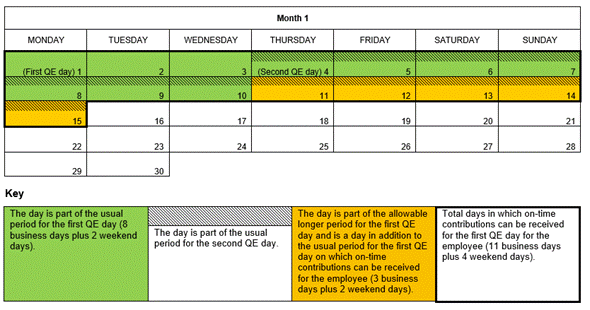
- individual base SG shortfall for the employee for a QE day[2], or
- •
- individual final SG shortfall for a QE day.[3]
8. An eligible contribution can be any of the 3 following amounts:
- •
- a contribution (an 'actual contribution')
- •
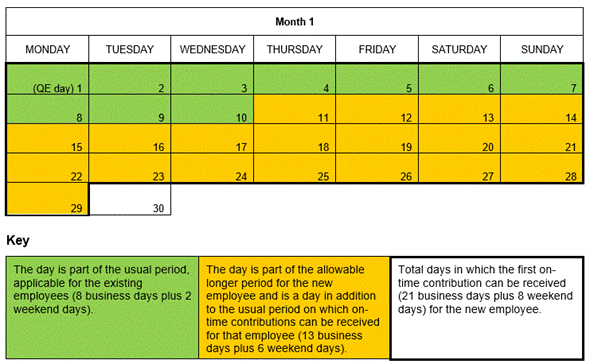
- a payment to the legal personal representative of the employee if they have died, or
- •
- a notional contribution for defined benefit members of defined benefit superannuation schemes.[4]
9. To be an eligible contribution, the amount must satisfy several criteria. There are different criteria for each of the 3 amounts. Paragraphs 10 to 22 of this Ruling explain the criteria for actual contributions, which is the most common type of eligible contribution.
Criteria for actual contributions
10. A contribution[5] (other than a sacrificed contribution) made by the employer for the benefit of the employee is an eligible contribution if it is:
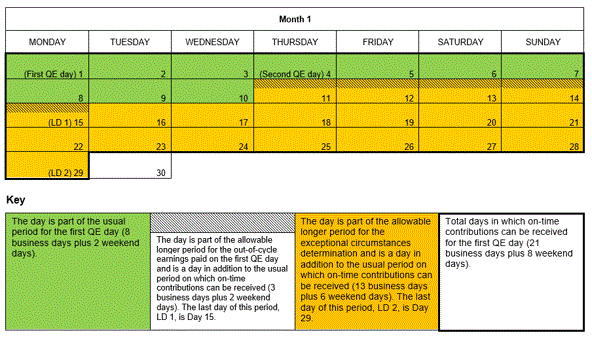
- •
- made to a
- –
- complying superannuation fund, or
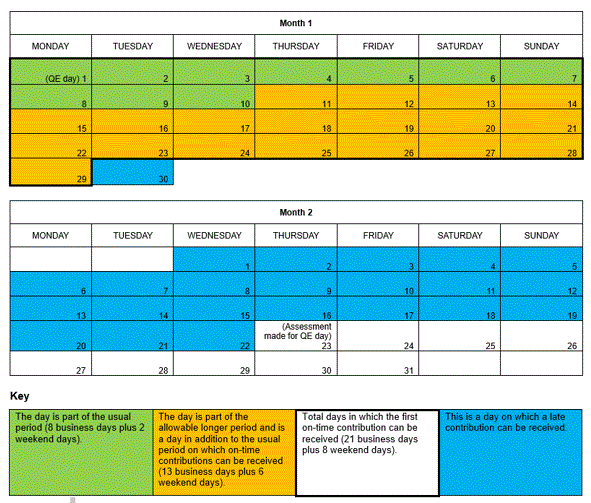
- –
- retirement savings account (RSA)[6], and
- •
- able to be allocated within the fund or RSA for the benefit of the employee.[7]
11. However, a contribution to a complying superannuation fund is not an eligible contribution if[8]:
- •
- it is made for the benefit of an employee as a defined benefit member of a defined benefit superannuation scheme, or
- •
- it is made at a time when a conversion notice has effect in relation to the fund.
'Made to a complying superannuation fund' – presumption of complying status
12. A superannuation fund is a complying superannuation fund in relation to a year of income only if criteria in the Superannuation Industry (Supervision) Act 1993 (SISA) are met.[9] The criteria generally involve the Regulator giving a notice of complying fund status to the superannuation fund for a year of income.
13. Because employers are not involved in this process, a contribution made by the employer for the benefit of an employee to a superannuation fund is conclusively presumed to have been made to a complying superannuation fund if the employer has obtained a written statement of complying fund status.
14. For the employer to rely on the presumption, the statement must[10]:
- •
- be obtained by the employer at or before the time the contribution is made
- •
- be provided by or on behalf of the trustee of the fund, and
- •
- say that the fund is
- –
- a resident regulated superannuation fund, and
- –
- not subject to a direction that it must not accept contributions from an employer-sponsor.
15. The presumption is not available if, when a contribution is made or at the time the statement is provided[11]:
- •
- either
- –
- the employer is the trustee or manager of the fund, or an associate of the trustee or manager of the fund, or
- –
- the trustee or manager of the fund is an associate of the employer, and
- •
- the employer reasonably believes the fund is either not a resident regulated superannuation fund or is operating in contravention of a SISA regulatory provision.
16. Subsequent references in this Ruling to 'superannuation fund' or 'fund' are references to a complying superannuation fund.
17. A contribution made to a superannuation fund by the employer for the benefit of the employee is 'able to be allocated' when:
- •
- the fund can identify that:
- –
- the employee to whom the contribution relates is a member, and
- –
- the contribution is for that employee[12], and
- •
- there is nothing in the fund rules, or any legislative provision, that would prevent the fund from accepting and allocating the contribution.
18. The identification process relies on information about the contribution that is provided by the employer to the fund. When the fund that receives the contribution has this information and is not prevented from accepting or allocating the contribution, the contribution is able to be allocated. If the fund cannot perform the identification process because the information provided by the employer contains errors or omissions (or the information is not provided at all), the contribution is not 'able to be allocated' by the fund. Examples of such errors or omissions include:
- •
- incorrect TFN for the employee
- •
- incorrect employee details, such as their name.
19. A contribution can be 'able to be allocated' before allocation occurs. This means the contribution can meet this criterion as soon as it is received, rather than only after the contribution is allocated.
20. A contribution may not be 'able to be allocated' when it is first received by the superannuation fund because of an error. However, it may be 'able to be allocated' sometime after that if it has not been rejected. This may occur, for example, where the information first provided to the fund is incorrect, but the employer subsequently provides the correct information.
21. If a contribution will never be allocated because it has been rejected by the fund (even by mistake), it is not an eligible contribution, the amount ultimately is not a 'contribution' for the purposes of the SGAA because there has been no increase to the capital of the fund for the benefit of the employee.
22. The guidance discussed in paragraphs 17 to 21 of this Ruling applies equally to the criteria that a contribution to an RSA must be 'able to be allocated' to be an eligible contribution.
'On-time' and 'late' contributions
23. The employer's individual base SG shortfall for the employee and a QE day is[13]:

24. By making eligible contributions relevant for the QE day (on-time contributions) the individual base SG shortfall can be reduced, including to nil. An on-time contribution for a QE day is so much of an eligible contribution that:
- •
- is received by the employee's fund[14] within prescribed periods[15] (received 'on-time')
- •
- is applied as an on-time contribution for the QE day in the order it is received by the employee's fund
- •
- is applied as an on-time contribution for the QE day, and has not been applied as an on-time contribution or a late contribution (discussed in paragraphs 25 to 28 of this Ruling) for an earlier QE day, and
- •
- does not reduce the individual SG amount below nil.[16]
25. If the individual base SG shortfall is greater than nil, the employer's individual final SG shortfall for the employee for an employee for a QE day is[17]:

26. By making eligible contributions relevant for the late period for the QE day (late contributions) the individual final SG shortfall can be reduced, including to nil. This reduces the amount of the SG shortfall, on which the SG charge is imposed.[18]
27. A late contribution is so much of an eligible contribution that:
- •
- is received by the employee's fund[19] within the 'late period'[20] for the QE day
- •
- is applied as a late contribution for the QE day in the order it is received by the employee's fund
- •
- is applied as a late contribution for the QE day and has not been applied as a late contribution for an earlier QE day, and
- •
- does not reduce the individual final SG shortfall amount below nil.[21]
28. The main difference between an on-time and a late contribution is the period in which it is received. These periods are described further in paragraphs 36 to 69 of this Ruling.
On-time and late contributions are applied automatically under the law, in an order
29. On-time and late contributions for an employee are applied automatically under the law.
30. The contributions are applied in a specific order:
- •
- First, contributions are applied to the earliest QE day for which there is an individual base or final SG shortfall (assuming no assessment of SG charge has been made for that QE day). They are applied in the calculation of the individual base or final SG shortfall for that QE day in the order in which they are received by the employee's fund.[22]
- •
- Then, contributions are applied to the next QE day in the same manner, and so on.[23]
Example 1 – eligible contributions applied in order
31. An employer pays $1,000 of qualifying earnings to an employee on 2 separate occasions, for which there are 2 associated QE days. The employer then makes 2 separate eligible contributions for the employee: a $100 contribution and a $140 contribution.
| Day | Event | Outcome for SG purposes |
| Day 1 | Payment of $1,000 qualifying earnings to the employee. | Employer has an individual SG amount of $120 for QE Day 1. |
| Day 2 | Payment of $1,000 qualifying earnings to the employee. | Employer has an individual SG amount of $120 for QE Day 2. |
| Day 3 | $100 eligible contribution for the employee made by the employer is received by the employee's fund and is allocable to the employee's account. | The entire $100 eligible contribution received on Day 3 is on-time for QE Day 1 and is applied in the calculation of the individual base SG shortfall for QE Day 1, leaving $20 remaining. |
| Day 4 | $140 eligible contribution for the employee made by the employer is received by the employee's fund and is allocable to the employee's account. | First, $20 of the $140 eligible contribution received on Day 4 is on-time for QE Day 1 and applied to reduce the individual base SG shortfall for QE Day 1 to nil.
Second, the remaining $120 of the $140 eligible contribution received on Day 4 is on-time for QE Day 2 and is applied to that QE day to result in an individual base SG shortfall for QE Day 2 of nil. |
Example 2 – eligible contributions applied in order – contribution amount calculation error discovered
32. An employer pays $2,000 of qualifying earnings to an employee on Day 1 (QE Day 1), which includes a $1,000 bonus. The employer then makes an eligible contribution of $120 for the employee, which is received by the employee's superannuation fund and is allocable to their account on Day 3.
33. The employer pays $1,000 of qualifying earnings to the employee on Day 8 (QE Day 2), and an eligible contribution of $120 is received by the employee's superannuation fund and is allocable to their account on the same day.
34. After these events, it is discovered that, because of an error in the employer's payroll system, the superannuation contributions for QE Day 1 were not increased to reflect the payment of the bonus. Table 2 of this Ruling shows how the eligible contributions are applied.
| Day | Event | Outcome for SG purposes |
| Day 1 (QE Day 1) | Payment of $2,000 qualifying earnings to the employee (including $1000 bonus, on which, in error, no contributions are paid). | Employer has an individual SG amount of $240 for QE Day 1. |
| Day 3 | $120 eligible contribution for the employee made by the employer is received by the employee's fund and is allocable to the employee's account. | The entire $120 eligible contribution received on Day 3 is on-time for QE Day 1 and is applied in the calculation of the individual base SG shortfall for QE Day 1 (leaving $120 remaining). |
| Day 8 (QE Day 2) | Payment of $1,000 qualifying earnings to the employee. | Employer has an individual SG amount of $120 for QE Day 2. |
| Day 8 | $120 eligible contribution for the employee made by the employer is received by the employee's fund and is allocable to the employee's account. | The entire $120 eligible contribution received on Day 8 is on-time for QE Day 1 and applied to reduce the individual base SG shortfall for QE Day 1 to nil.
Assuming no further contributions are received by the employee's fund from the employer on-time, the employer will have an individual base SG shortfall of $120 for the employee for QE Day 2. |
35. As the QE Day 1 contribution calculation error is discovered after the employer was able to make on-time contributions for QE Day 2 and there are no other on-time contributions for QE Day 2, the employer has an individual base SG shortfall greater than nil for QE Day 2. If the employer wants to make a voluntary disclosure statement[24] about the error, they will need to make the statement in relation to the individual base SG shortfall that results for QE Day 2, not for QE Day 1 when the error occurred, due to how the contributions are applied.
When on-time contributions are received
36. A contribution for a QE day is on-time if it is received by the employee's superannuation fund[25] within any of the following periods[26]:
- •
- the 12-month period ending on the day before the QE day
- •
- the period starting on the QE day and ending on the seventh business day after the QE day (usual period)
- •
- the longest 'allowable longer period' applicable for the employee and the QE day (if any).
37. Diagram 1 of this Ruling illustrates the temporal relationship between these periods.
Diagram 1: Temporal relationship between periods for on-time contributions

38. Some of the periods within which on-time contributions are received are measured in 'business days'. A 'business day' is a weekday other than a public holiday for the whole of any state or territory.[27] This means that if a weekday is a public holiday for the whole of at least one state or territory, it is not a business day. This is the case even if the employer is not located in that state or territory.
39. Contributions received in the 12-month period ending before the QE day are on-time for that QE day if they have not been applied for an earlier QE day (and meet all other criteria for being an eligible contribution). Usually, these contributions exist because they remain unapplied and any individual base and final SG shortfalls for QE days in the period have been reduced to nil by other earlier contributions.
40. In effect, the contributions are more than what the employer needed to avoid those shortfalls. Such contributions are made for a variety of reasons, the most common being that the employee is entitled to the payment of superannuation contributions at a rate above that of the charge percentage under an employment or industrial agreement.
Example 3 – accumulated, unapplied contributions carried forward
41. An employee is entitled under an enterprise bargaining agreement to have superannuation contributions paid by their employer at a rate of 15% of their salary, which is $120,000 per annum. The employee commences work on 1 January 2028 and is paid $10,000 of qualifying earnings on the first day of each month beginning on that day. $1,500 of superannuation (15% of $10,000) is paid on the same day as the qualifying earnings but is received by the fund the next day. For each QE day the employer has an individual SG amount of $1,200 (12% of $10,000). Between the period beginning 1 January and ending on 30 April 2028, the employer pays a total of $6,000 in contributions, $4,800 of which is sufficient to ensure that all individual base SG shortfalls for the employee for QE days in that period are nil. $1,200 of contributed amounts received by the fund during the period are not applied as either an on-time or late contribution for a QE day.
42. On 1 May 2028, the employer pays $10,000 of qualifying earnings to the employee but due to an administrative error does not pay any superannuation contributions. Despite the error, the $1,200 in unapplied contributions received prior to the QE day reduces the individual base SG shortfall for the 1 May 2028 QE day to nil.
| QE day | Individual SG amount | Contribution made by the employer (received and allocable on second day of the month) | Amount the individual base SG shortfall for the QE day is reduced by and from which contribution | Unapplied contribution amounts remaining at the end of the month that includes the QE day |
| 1 January 2028 | $1,200 | $1,500 | $1,200 from January | $300 from January |
| 1 February 2028 | $1,200 | $1,500 | $300 from January
$900 from February |
$600 from February |
| 1 March 2028 | $1,200 | $1,500 | $600 from February
$600 from March |
$900 from March |
| 1 April 2028 | $1,200 | $1,500 | $900 from March
$300 from April |
$1,200 from April
(Total $1,200 unapplied) |
| 1 May 2028 | $1,200 | $1,500 | $1,200 from April | None |
43. Previous accumulated, unapplied contributions may therefore reduce a potential shortfall when contributions are not made at the same time or soon after a later QE day. This could mean that further contributions are not required to avoid liability to the SG charge. However, despite any accumulated, unapplied contributions for SG purposes, the employer may still have to continue to pay additional contributions under employment or industrial agreements.
44. There is an allowable longer period for contributions to be made in respect of an employee for a QE day in 4 specific situations[28]:
- •
- a new worker engagement
- •
- the employee's superannuation fund or RSA changes
- •
- an out-of-cycle payment of qualifying earnings
- •
- where an exceptional circumstances determination has been made that applies to the employer and the QE day.
45. The allowable longer period for each situation is outlined in Table 4 of this Ruling. Table 4: Allowable longer periods
| Situation | Allowable longer period |
| New worker engagement | The period starting on the QE day and ending on the 20th business day after the QE day (extended usual period[29]). |
| Change of superannuation fund or RSA | The extended usual period for the QE day. |
| Out-of-cycle payment of qualifying earnings | The period starting on the QE day and ending at the same time as the end of the usual period for the next QE day that does not involve an out-of-cycle payment. |
| Exceptional circumstances determination | The period starting on the QE day and ending at the end of the later of the following periods:
|
46. In addition, there is an allowable longer period for later QE days that have usual periods ending before the end of allowable longer periods of earlier QE days. This is discussed in paragraphs 64 to 67 of this Ruling.
47. The allowable longer periods discussed in paragraphs 44 to 46 of this Ruling apply in respect of individual employees.[30] This means that an employer may have employees who are paid on the same day but for whom there are different periods in which on-time contributions can be made.
48. There may also be more than one allowable longer period that applies in respect of an employee and QE day. In this case, the period for the employer to make on-time contributions in respect of that employee and QE day will be the end of the last day of any applicable allowable longer period.
New worker engagement and change in employee's superannuation fund or retirement savings account
49. There is an allowable longer period for a QE day in 2 situations where the employer has just begun to contribute to a superannuation fund or RSA for the employee. The allowable longer period is for the first contribution made:
- •
- for the employee after either they commence or recommence employment with the employer, or
- •
- to a superannuation fund or RSA for the employee after the employer ceases contributing to another superannuation fund or RSA.
50. The allowable longer period is the period starting on the QE day and ending on the 20th business day after the QE day (the 'extended usual period). Only one contribution (the first) has the allowable longer period in each situation. If the first contribution does not reduce the individual base SG shortfall for the QE day to nil, other contributions will only be on-time if they are made in the usual period or another allowable longer period (if any).
Example 4 – allowable longer period for new employee
51. A new employee commences work with an employer. The first payment of qualifying earnings to the new employee occurs on the first day of the month, which is a Monday. Other, existing employees get paid on the same day. The usual period, applicable for the existing employees, is the period starting on the QE day (Day 1) and ending on the seventh business day after Day 1.[31] But there is also a 20-business day allowable longer period for the new employee, in which the first contribution made by the employer can be received by the employee's fund (commencing on Day 1 and ending on the 20th business day after Day 1). This provides an allowable longer period beyond the usual period in which on-time contributions can be received for the new employee. The last day of that allowable longer period is Day 29. Note that the allowable longer period does not apply for the other employees for the QE day. Diagram 2 of this Ruling illustrates these periods.
Diagram 2: Allowable longer period for the new employee

Note: this and subsequent calendar diagrams do not illustrate the 12-month period ending the day before the QE day in which on-time contributions can be received.
Out-of-cycle payments of qualifying earnings
52. There is an allowable longer period for an employee for a QE day if:
- •
- it relates to a kind of out-of-cycle qualifying earnings determined by the Commissioner, and
- •
- there is a subsequent QE day for the employee that relates to qualifying earnings that are not a kind of out-of-cycle qualifying earnings.
53. The allowable longer period is the period starting on the QE day and ending at the same time that the usual period for the subsequent QE day ends. It is important to note that the allowable longer period is not extended by any allowable longer period that may apply to the subsequent QE day. For example, if applicable out-of-cycle qualifying earnings are paid on QE Day 1, the allowable longer period ends at the same time as the usual period for QE Day 2 (which does not include any out-of-cycle qualifying earnings). If QE Day 2 has its own allowable longer period for another reason, that period does not extend the allowable longer period for QE Day 1.
54. The Commissioner may determine[32] by legislative instrument, the:
- •
- kinds of out-of-cycle qualifying earnings, and
- •
- circumstances that must exist for the qualifying earnings to be one of those kinds.
Example 5 – allowable longer period for out-of-cycle payment
55. An employee is paid qualifying earnings on the first day of the month (the 'first QE day'), which is a Monday. The qualifying earnings are earnings of a kind of out-of-cycle qualifying earnings covered by a legislative instrument made by the Commissioner. The employee is paid qualifying earnings that are not covered by the legislative instrument on the next Thursday (Day 4, the 'second QE day'). The usual period is the period starting on the QE day (Day 1) and ending on the seventh business day after day 1 (Day 10). But there is an allowable longer period for the first QE day, for the out-of-cycle qualifying earnings, beginning on the first QE day and ending at the same time as the usual period for the second QE day (Day 15). Diagram 3 of this Ruling illustrates these periods.
Diagram 3: Allowable longer period for out-of-cycle payment
Exceptional circumstances determination
56. There is an allowable longer period for a QE day if the QE day and the employer are covered by an exceptional circumstances determination made by the Commissioner. The end of the allowable longer period is the later of the end of the:
- •
- extended usual period for the QE day
- •
- period of 20 business days starting the day after the determination is made.
57. Where the determination is made prior to the QE day, the later period will be the end of the extended usual period for the QE day (that is, the period starting on the QE day and ending on the 20th business day after the QE day). Where the determination is made after the QE day, the later period will be the end of the period of 20 business days starting the day after the determination is made.
58. The Commissioner makes an exceptional circumstances determination by legislative instrument[33], which may determine:
- •
- one or more kinds of employers that are affected by exceptional circumstances of a kind prescribed by the regulations that affect the ability of the employers to make eligible contributions, and
- •
- the period during which any QE days for payments of qualifying earnings by those employers are affected by those exceptional circumstances.
59. By covering 'kinds' of employers, the determination operates on a class basis. Determinations are not made in respect of individual employers.
60. The period specified in the determination may start before the day the determination is made.
61. The following kinds of exceptional circumstances are prescribed by regulations[34]:
- •
- natural disasters
- •
- widespread outages of
- –
- information and communication technology services, or
- –
- other technology services or platforms that facilitate or support employers to make contributions.
Example 6 – allowable longer period for exceptional circumstances determination – determination made before QE day
62. An employee is paid qualifying earnings on the first day of the month, which is a Monday. The QE day and the employer are both covered by an exceptional circumstances determination, which was made by the Commissioner before the QE day. The usual period is the period starting on the QE day (Day 1) and ending on the seventh business day after day 1 (Day 10). But there is an allowable longer period for the QE day, beginning on the QE day and ending on the 20th business day after the QE day (Day 29).[35] Diagram 4 of this Ruling illustrates these periods.
Diagram 4: Allowable longer period for exceptional circumstances determination – determination made before QE day
Example 7 – allowable longer period for exceptional circumstances determination – determination made after QE day
63. An employee is paid qualifying earnings on the first day of the month, which is a Monday. The QE day and the employer are both covered by an exceptional circumstances determination, which was made by the Commissioner on the second day of the month (which is after the QE day). The usual period is the period starting on the QE day (Day 1) and ending on the seventh business day after day 1 (Day 10). But there is an allowable longer period for the QE day beginning on the day the after the determination is made and ending 20 business days later (Day 30).[36] Diagram 5 of this Ruling illustrates these periods.
Diagram 5: Allowable longer period for exceptional circumstances determination – determination made after QE day

64. If a QE day has any of the allowable longer periods discussed in paragraphs 44 to 61 of this Ruling applicable for the QE day and employee, there can also be an allowable longer period for another QE day that follows it. This happens where the usual period for this later QE day ends before the end of the allowable longer period for the earlier one. When this occurs, the period for making on-time contributions for the later QE day is aligned with the longest allowable period for the earlier QE day.[37] More than one QE day can have an allowable longer period under this 'bunching rule'.
Diagram 6: Bunching rule

Example 8 – allowable longer period because of the bunching rule – new employee
65. An employee commences work with an employer. The first payment of qualifying earnings (QE Day 1) to the employee occurs on the first day of the month, which is a Monday. There is a 20-business day allowable longer period, in which the first contribution made by the employer can be received by the employee's fund (commencing on QE Day 1 and ending on the 20th business day after QE day 1 – Day 29).
66. A second payment of qualifying earnings to the employee occurs on the eighth day of the month (a Monday – QE Day 2). The usual period for QE Day 2 ends on the seventh business day after the QE Day (Day 17), which is before the end of the allowable longer period for QE Day 1. As a result of the bunching rule, there is an allowable longer period for QE Day 2 that ends on the same day as the allowable longer period for QE Day 1.
67. Diagram 7 of this Ruling illustrates these periods.
Diagram 7: Allowable longer period due to the bunching rule

Example 9 – multiple allowable longer periods – out-of-cycle payment and exceptional circumstances determination made before QE day
68. An employee is paid qualifying earnings on the first day of the month (first QE day), which is a Monday. The qualifying earnings are earnings of a kind of out-of-cycle qualifying earnings covered by a legislative instrument made by the Commissioner. The employee is paid qualifying earnings that is not covered by the legislative instrument on the next Thursday (Day 4, the second QE day). The usual period for the first QE day is the period starting on the QE day (Day 1) and ending on the seventh business day after Day 1 (Day 10). But there is an allowable longer period for the first QE day, for the out-of-cycle qualifying earnings, beginning on the first QE day and ending at the same time as the usual period for the second QE day (Day 15, labelled LD 1 in Diagram 8 of this Ruling).
69. However, the first and second QE days and the employer are all covered by an exceptional circumstances determination, which was made by the Commissioner before the first QE day. There is, therefore, another allowable longer period for the first QE day, beginning on the first QE day and ending on the 20th business day after the first QE day (Day 29, labelled LD 2 in Diagram 8 of this Ruling). The employer has until the end of the last day of any applicable allowable longer period for the employee and the first QE day to make on-time contributions for the first QE day. The latest day of the 2 allowable longer periods is the last day of the allowable longer period for the exceptional circumstances determination (Day 29, labelled LD 2 in Diagram 8 of this Ruling). Diagram 8 of this Ruling illustrates these periods and days for the first QE day.[38]
Diagram 8: Multiple allowable longer periods: out-of-cycle payment and exceptional circumstances determination made before QE day
When late contributions are received
70. A late contribution for a QE day is received by the employee's superannuation fund[39] within the period:
- •
- starting the day after the last day a contribution can be an on-time contribution, and
- •
- ending on the day before an assessment of the employer's SG shortfall for the QE day is made.
71. Diagram 9 of this Ruling illustrates the temporal relationship between the periods in which on-time and late contributions are received.
Diagram 9: Temporal relationship between the periods in which on-time and late contributions are received

Example 10 – when late contributions are received
72. Continuing with the facts of Example 4 of this Ruling, the Commissioner makes an assessment of the employer's SG shortfall for the QE day on the 23rd of Month 2. The period in which late contributions can be received for the new employee begins the day after the allowable longer period for the QE day ends and ends on the day before the assessment is made. Diagram 10 of this Ruling shows this period.
Diagram 10: When late contributions can be received
Commissioner of Taxation
18 March 2026
Appendix – Your comments
73. You are invited to comment on this draft Ruling. Forward your comments to the contact officer by the due date.
74. A compendium of comments is prepared as part of the finalisation of this Ruling. An edited version of the compendium (with names and identifying information removed) is published to the ATO Legal database on ato.gov.au.
75. Advise the contact officer if you do not wish for your comments to be included in the edited compendium.
| Due date: | 1 May 2026 |
| Contact officer details have been removed as the comments period has ended. | |
© AUSTRALIAN TAXATION OFFICE FOR THE COMMONWEALTH OF AUSTRALIA
You are free to copy, adapt, modify, transmit and distribute this material as you wish (but not in any way that suggests the ATO or the Commonwealth endorses you or any of your services or products).
Footnotes
For readability, all further references to 'this Ruling' refer to the Ruling as it will read when finalised. Note that this Ruling will not take effect until finalised.
A QE day is a day on which a payment of qualifying earnings is made to or for an employee: subsection 17A(1). Draft Law Companion Ruling LCR 2026/D1 Payday Super: qualifying earnings outlines what are qualifying earnings.
Sections 18C and 18D.
Subsection 18A(1).
Taxation Ruling TR 2010/1 Income tax: superannuation contributions explains the Commissioner's views on the ordinary meaning of the word 'contribution' in so far as 'contribution' is used in relation to a superannuation fund, approved deposit fund or retirement savings account in the Income Tax Assessment Act 1997 (ITAA 1997).
Within the meaning of the Retirement Savings Accounts Act 1997. This Ruling explains when contributions are made to a complying superannuation fund but indicates where the guidance is also applicable to contributions made to an RSA.
Subparagraphs 18A(1)(a)(i) and (ii) for a complying superannuation fund; subparagraphs 18A(1)(b)(i) and (ii) for an RSA.
Subparagraphs 18A(1)(a)(iii) and (iv).
Section 7, subsection 995-1(1) of the ITAA 1997 (definition of 'complying superannuation fund'), section 45 of the SISA.
Subsection 18A(2). Such directions are made under section 63 of the SISA.
See subsections 18B(1) and (2).
See paragraph 1.49 of the Explanatory Memorandum to the Treasury Laws Amendment (Payday Superannuation) Bill 2025 and the Superannuation Guarantee Charge Amendment Bill 2025.
Subsection 18C(1).
Or RSA, legal personal representative or defined benefit superannuation scheme.
See paragraphs 36 to 69 of this Ruling.
See the definition of 'eligible contributions relevant for the QE day' in subsection 18C(1).
Subsections 18D(1) and (2).
See sections 16A and 16B.
Or RSA, legal personal representative or defined benefit superannuation scheme.
Subsection 6(1) (definition of 'late period').
See the definition of 'eligible contributions relevant for the late period for the QE day' in subsection 18D(2).
Or RSA, legal personal representative or defined benefit superannuation scheme.
This order is the product of the statutory criteria for on-time and late contributions. The criteria require eligible contributions be: (1) applied in the order they are received to reduce an individual base or final SG shortfall for a QE day: paragraph 18C(1)(b) for on-time contributions and paragraph 18D(2)(b) for late contributions, and (2) not be applied again for a subsequent QE day: paragraph 18C(1)(a) for on-time contributions and paragraph 18D(2)(a) for late contributions. Where an eligible contribution (or a part of it) is received in time to be either an on-time or a late contribution for different QE days, it is applied as a late contribution because the late period relates to the earlier of the QE days: paragraph 18D(2)(a) (and paragraph 18C(1)(a), which then prevents the contribution from also being allocated as an on-time contribution for a later QE day).
See paragraphs 86 to 90 and 129 to 132 of LCR 2026/D3.
Or RSA, legal personal representative or defined benefit superannuation scheme.
Paragraph 18C(1)(c). In this Ruling, if the period is described as starting or ending on a day, the period includes that day.
Subsection 6(1) (definition of business day).
Paragraph 18C(1)(c) and subsection 18C(2).
Subsection 6(1) (definition of 'extended usual period').
While allowable longer periods apply in respect of individual employees, more than one employee may have the same extended allowable longer period. For example, where the QE day for multiple employees is covered by the same exceptional circumstances determination.
This and subsequent examples assume 30-day months with no public holidays for simplicity.
Subsection 18C(3).
Subsection 18C(4).
Section 13 of the Superannuation Guarantee (Administration) Regulations 2018.
Because this period is the later of the periods mentioned in paragraph 56 of this Ruling.
Because this period is the later of the periods mentioned in paragraph 56 of this Ruling.
Item 4 of the table in subsection 18C(2).
For completeness, there is an allowable longer period for the second QE day beginning on the second QE day and ending on the 20th business day after the second QE day. However, this does not further extend the allowable longer period for the out-of-cycle qualifying earnings paid on the first QE day, as that allowable longer period only extends to the usual period for the subsequent QE day that does not include out-of-cycle qualifying earnings.
Or RSA, legal personal representative or defined benefit superannuation scheme.
Not previously issued as a draft
References
ATO references:
NO 1-18C058KV
Related Rulings/Determinations:
LCR 2026/D1
LCR 2026/D3
LCR 2026/D4
TR 2010/1
Legislative References:
ITAA 1997 995-1(1)
SGAA 1992 6(1)
SGAA 1992 7
SGAA 1992 16A
SGAA 1992 16B
SGAA 1992 17A(1)
SGAA 1992 18A(1)
SGAA 1992 18A(1)(a)(i)
SGAA 1992 18A(1)(a)(ii)
SGAA 1992 18A(1)(a)(iii)
SGAA 1992 18A(1)(a)(iv)
SGAA 1992 18A(1)(b)(i)
SGAA 1992 18A(1)(b)(ii)
SGAA 1992 18A(2)
SGAA 1992 18B(1)
SGAA 1992 18B(2)
SGAA 1992 18C
SGAA 1992 18C(1)
SGAA 1992 18C(2)
SGAA 1992 18C(3)
SGAA 1992 18C(4)
SGAA 1992 18D
SGAA 1992 18D(1)
SGAA 1992 18D(2)
SISA 1993 45
SISA 1993 63
Retirement Savings Accounts Act 1997
Superannuation Guarantee (Administration) Regulations 2018 Section 13
Superannuation Guarantee Charge Amendment Act 2025
Treasury Laws Amendment (Payday Superannuation) Act 2025
Other References:
Explanatory Memorandum to the Treasury Laws Amendment (Payday Superannuation) Bill 2025 and the Superannuation Guarantee Charge Amendment Bill 2025