

Draft Practical Compliance Guideline
PCG 2019/1DC (Finalised)
Transfer pricing issues related to inbound distribution arrangements
-
There is a Compendium for this document: PCG 2019/1EC1 .This document has been finalised by PCG 2019/1.
| Table of Contents | Paragraph |
|---|---|
| What this draft Guideline is about | |
| Structure of this Guideline | |
| Date of effect | |
| Inbound distributors | |
| Our compliance approach | |
| How we risk assess your inbound distribution arrangements | |
| Profit markers | |
| Activities that incrementally generate value | |
| Risk assessment framework | |
| Increasing certainty through the advance pricing arrangement program | |
| Who to contact | |
| SCHEDULE 1 – GENERAL DISTRIBUTORS | |
| SCHEDULE 2 – LIFE SCIENCE | |
| SCHEDULE 3 – INFORMATION AND COMMUNICATION TECHNOLOGY | |
| SCHEDULE 4 – MOTOR VEHICLES | |
| Your comments |
|
Relying on this draft Guideline
This is a draft consolidation for comment outlining proposed changes to PCG 2019/1 to ensure profit markers for assessing transfer pricing risk remain relevant and up to date. The draft update also clarifies the scope of the application of the Guideline and reportable tax position schedule by introducing a 'white zone' for certain taxpayers. The following preamble will apply to this Guideline once the update is finalised: This Practical Compliance Guideline sets out a practical administration approach to assist taxpayers in complying with relevant tax laws. Provided you follow this Guideline in good faith, the Commissioner will administer the law in accordance with this approach. |
What this draft Guideline is about
1. This draft Guideline[1] outlines our compliance approach to the transfer pricing outcomes for inbound distributors within the meaning of paragraphs 16 to 26 of this Guideline.
2. Arrangements to conduct any of the activities covered in paragraphs 16 to 26 of this Guideline, together with any related activities involving the provision of ancillary services, are referred to in this Guideline as 'inbound distribution arrangements'.
3. This Guideline applies to inbound distribution arrangements of any scale. However, this Guideline will not apply where you are an inbound distributor and you:
- •
- are eligible, and
- •
- choose to adopt the distributor simplified transfer pricing record keeping option in Practical Compliance Guideline PCG 2017/2 Simplified transfer pricing record-keeping options.
Instead, we will follow the compliance approach set out in PCG 2017/2.
4. We use the framework in this Guideline to assess the transfer pricing risk of inbound distribution arrangements and tailor our engagement with you. Where this Guideline applies, we rate the transfer pricing risk of your inbound distribution arrangements having regard to a combination of quantitative and qualitative factors.
5. If we rate your inbound distribution arrangements as having a low transfer pricing risk, you can expect that we will generally not apply compliance resources to review the transfer pricing outcomes of your arrangements. However, if your inbound distribution arrangements fall outside the low transfer pricing risk category, you can expect us to monitor, test or verify the transfer pricing outcomes of your arrangements. The higher the risk rating, the more likely we are to review your arrangements as a matter of priority.
6. This Guideline is limited to the transfer pricing risks posed by the profit outcomes associated with inbound distribution arrangements. It does not affect our compliance approach to other tax issues that might arise in connection with your inbound distribution arrangements (for example, the deductibility of an expense, the existence of withholding tax obligations or the application of the general anti-avoidance rule in Part IVA of the Income Tax Assessment Act 1936). If we consider that your inbound distribution arrangements pose a risk under other tax provisions, we will have cause to apply compliance resources to review your arrangements.
7. This Guideline does not affect the principles determining taxable income attributable to business operations carried on, at, or through an Australian permanent establishment of a foreign resident.
8. This Guideline does not limit the operation of the law.[2] The information provided in this Guideline does not replace, alter or affect our interpretation of the law in any way. It does not relieve you of your legal obligation to comply with all relevant tax laws, or create any safe harbour administrative concessions.
9. Having a low risk rating under this Guideline does not necessarily mean that your transfer pricing outcomes are correct or that you have a reasonably arguable position. Equally, having a high risk rating under this Guideline does not necessarily mean that your inbound distribution arrangements fail to comply with Australia's transfer pricing rules. Having regard to your particular circumstances, we may accept that your transfer pricing outcomes are reasonable.
10. You should not rely on the profit markers to determine arm's length conditions. This Guideline does not replace an appropriate comparability analysis and proper application of the transfer pricing obligations under the law, including an accurate delineation of the transaction and selection of the most appropriate transfer pricing method.
11. You can use the framework set out in this Guideline to:
- •
- assess the transfer pricing risk of your inbound distribution arrangements
- •
- understand the compliance approach we are likely to adopt given the transfer pricing risk profile of your inbound distribution arrangements
- •
- work with us to mitigate the transfer pricing risk of your inbound distribution arrangements and be confident you have reduced your risk exposure, and
- •
- understand the type of analysis we use when assessing the transfer pricing risk of your inbound distribution arrangements.
12. This Guideline is structured as follows:
- •
- The main body sets out general principles relevant to our framework for assessing transfer pricing risk and applying compliance resources to inbound distribution arrangements to which the Guideline applies.
- •
- The Schedules set out quantitative and qualitative indicators relevant to distributors generally or based on their industry sector, including those that operate in the life science, information and communication technology (ICT) and motor vehicle industries.
13. This Guideline does not provide advice or guidance on the technical interpretation or application of Australia's transfer pricing rules or other tax provisions.
14. When finalised, this Guideline is proposed to apply to income years finishing after the date it is published and will apply to existing and new inbound distribution arrangements.
15. The use and application of this Guideline will be under continuous review over the next 3 years. Any revisions to improve the Guideline will be made at the end of the review period or on an 'as necessary' basis. We will undertake consultation in relation to proposed material changes.
16. For the purposes of the risk assessment framework set out in this Guideline, inbound distributors are intermediaries in the distribution channel or supply chain that resell products to retailers, merchants, contractors or industrial, institutional or commercial users. Their focus is on selling business to business, rather than to household consumers. An inbound distributor may have some retail operation, but their primary sales channel is not their own retail activity.
17. In relation to tangible goods, we consider you to be an inbound distributor for the purposes of this Guideline if:
- •
- your business comprises the distribution of goods purchased from related foreign entities for resale to third parties, and
- •
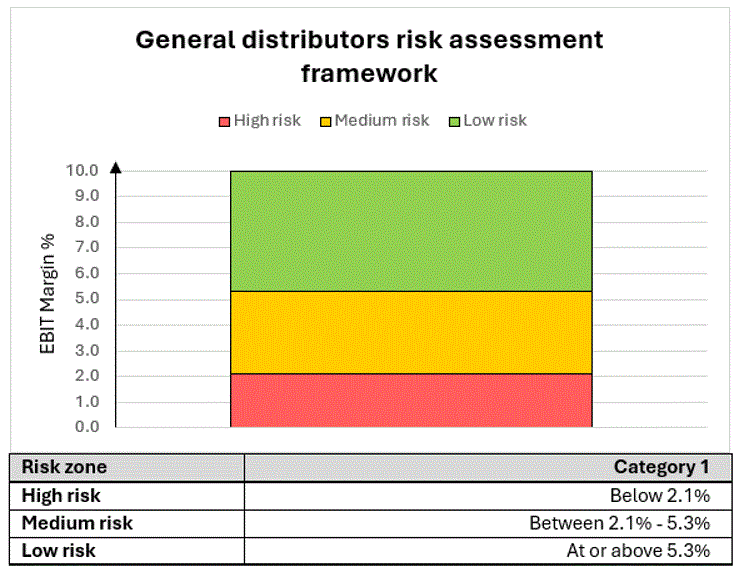
- you or your related entities don't significantly contribute to the creation (including manufacture or alteration) of the goods in Australia.
18. In relation to digital products or services, we consider you to be an inbound distributor for the purposes of this Guideline if:
- •
- your business comprises selling on your own behalf digital products or services to third parties, and any intellectual property relating to those products or services is substantially held by related foreign entities, and
- •
- you or your related entities don't significantly contribute to the creation (including alteration) of the digital products or services, or the intellectual property in the digital products or services, in Australia. For example, you significantly contribute to the creation of digital products or services if you or your related entities own or operate significant equipment in Australia used to host or provide the products or services you are selling or distributing.
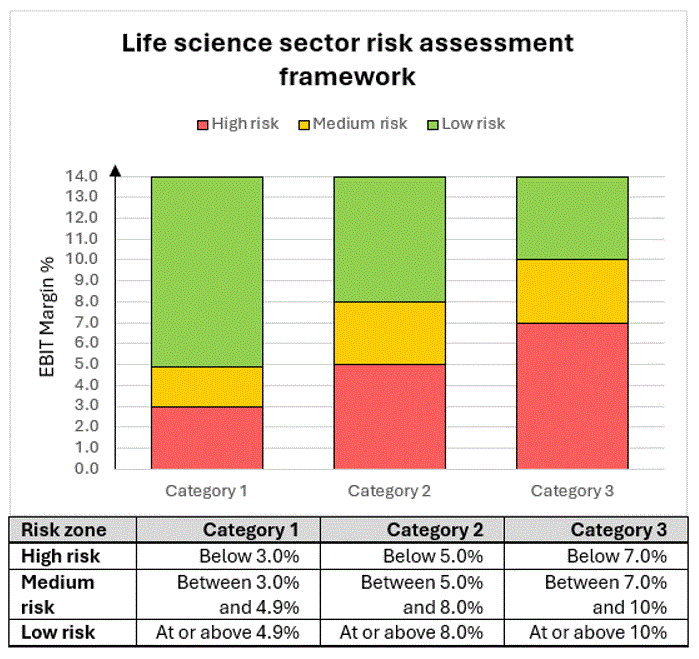
19. A distributor earns a gross profit from the difference between the price at which they sell the good, and the price which they pay. A distributor will typically incur various selling and administrative costs that must be covered by this gross profit in order for it to make a net profit.
20. Inbound distributors play an important role as a value-adding link between foreign entity suppliers and customers. Inbound distributors seek to find and match suppliers' capabilities with customers' buying preferences. In the case of goods, an inbound distributor will commonly purchase in mass quantity and then on-sell the goods in smaller orders to its customers. The inbound distributor may also acquire goods from more than one supplier, and match its sales to the specifications and volumes requested by customers. In the case of digital products and services, an inbound distributor may seek to identify the most appropriate digital products or services for the end-user by understanding the end-user's business, technical needs and specifications. This may involve the inbound distributor offering bespoke or customised digital products or services to the end-user.
21. Inbound distributors may pass important information in both directions. This may include information from suppliers regarding product benefits, changes to the product line-up, expected pricing and technical support. It may also include information from customers about their preferences, demand expectations and competitors.
22. The role of an inbound distributor can include a range of functions that support the primary activity of distribution. Many of these functions will be associated with sales, after sales support, procurement and administration. An inbound distributor may also undertake functions involving transportation, warehousing, inventory management and regulatory matters. The specific nature and combination of these functions will be unique to the inbound distributor's business.
23. The nature of an inbound distributor's sales function will vary depending on a range of matters including the nature of the product, the nature of the customers and the business strategies adopted by the inbound distributor. The sales function may include activities such as support for promotional efforts, product information, technical support, relationship building and order processing. It is usually important for an inbound distributor to have a good understanding of its customers and to be able to predict their needs.
24. As the concept of an inbound distributor is broad and can involve a variety of functions and transactions, we rely on a range of factors to help assess whether an entity is an inbound distributor. No individual factor is determinative, or has a 'bright-line' metric that differentiates inbound distributors from other entities. The factors we consider include the:
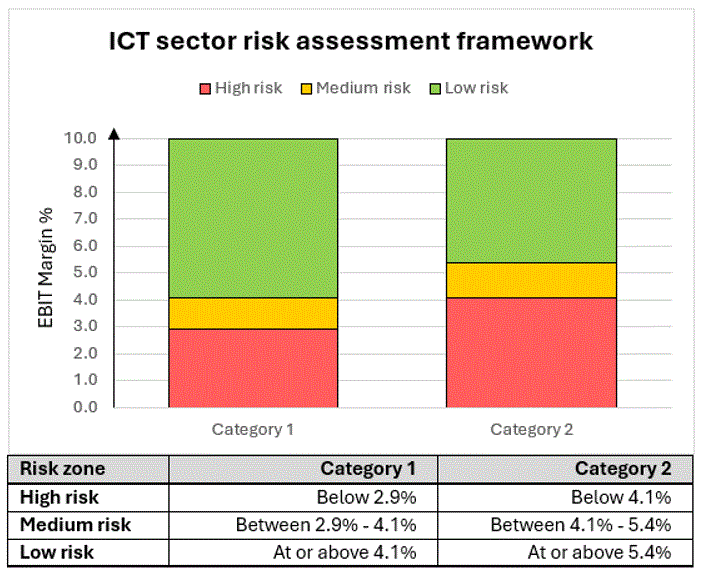
- •
- main business activity disclosed on your tax return
- •
- proportion of tangible property expenditure of a revenue nature relative to cost of goods sold
- •
- proportion of tangible property expenditure of a revenue nature relative to total income
- •
- proportion of income from the sale of goods or digital products or services relative to other income
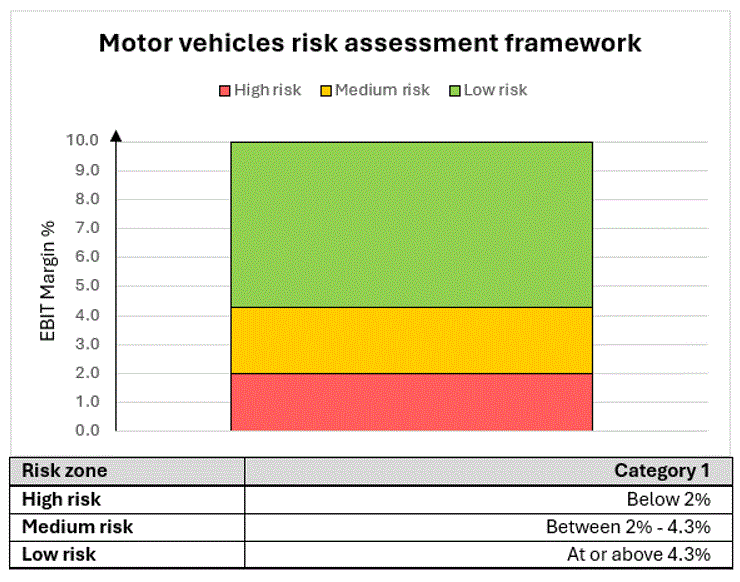
- •
- extent to which you undertake activities other than distribution activities, for example, the extent of contract research and development services provided, and
- •
- operating practice of your specific industry in relation to distribution activities.
25. We do not consider insurance activities or financial arrangements, including those linked to sales activities, to be part of your inbound distribution arrangements. The transfer pricing risk associated with financial arrangements and insurance activities should be assessed separately.
26. No matter how you describe yourself, for example, as a routine distributor, a limited risk distributor or a marketer–distributor, the principles in this Guideline will apply if we consider you to be an inbound distributor to which this Guideline applies. However, your functional profile will be relevant when we consider the qualitative factors important to transfer pricing risk in your industry.
27. We concentrate our efforts on inbound distribution arrangements that pose the highest risk of not complying with Australia's transfer pricing rules.
28. This Guideline highlights inbound distribution arrangements where we see risk of non-compliance.
29. The transfer pricing methodology used in the risk framework in this Guideline is for risk assessment purposes only.
30. Consistent with the OECD Transfer Pricing Guidelines for Multinational Enterprises and Tax Administrations and other documents covered by section 815-135 of the Income Tax Assessment Act 1997, you should use the transfer pricing methodology (or combination of methodologies) that is most appropriate and reliable for your circumstances when pricing your inbound distribution arrangements.
31. Where the most appropriate transfer pricing methodology for your circumstances is a multi-sided method such as the profit split, this Guideline may not be relevant for your inbound distribution arrangement.
32. The quantitative and qualitative indicators set out in this Guideline are based on work we have undertaken in relation to Australian distribution activities. Accordingly, this Guideline sets out our compliance approach to the transfer pricing risk associated solely with inbound distribution arrangements.
33. Where this Guideline applies, you can expect the following compliance approach depending on your risk zone.[3]
| Risk zone | Our approach |
|---|---|
| White zone | We will not have cause to apply compliance resources to further review the transfer pricing outcomes of your inbound distribution arrangements, other than to confirm ongoing consistency with the agreed approach. |
| Low risk | We will generally not have cause to allocate compliance resources to assess your transfer pricing outcomes in relation to your inbound distribution arrangements other than to confirm your characterisation as an inbound distributor, and the extent of the activities you undertake.
We will be open to entering into early engagement advance pricing arrangement (APA) discussions with you. |
| Medium risk | We will monitor your arrangements using available data and may contact you to seek a better understanding of your circumstances before deciding to allocate further compliance resources.
We will be open to entering into early engagement APA discussions with you and may invite you to make a formal APA application. |
| High risk | We will consider appropriate treatment options and recommend that you review your transfer pricing policy. This may involve us:
When selecting our compliance activity, we will take into account various factors in addition to the framework in this Guideline. These factors include consideration of your global supply chain, the tax profile of your related parties and the amount of tax at risk. We consider that entities with inbound distribution arrangements that consistently suffer losses pose a very high transfer pricing risk. We will ordinarily prioritise a review of you where you have been in an overall loss position for the aggregate of your current and previous 2 income years. You may seek to enter into early engagement APA discussions with us. |
How we risk assess your inbound distribution arrangements
34. We assess the transfer pricing risk of your inbound distribution arrangements by comparing the profit outcome of your arrangements against our profit markers for inbound distributors. The profit markers relevant to you are based on the industry sector in which you operate and the extent to which your distribution arrangements involve activities that we see as generally adding incremental value in Australia.[4]
35. We analyse the profit outcome of your inbound distribution arrangements using Earnings Before Interest and Tax (EBIT) relative to sales. The EBIT margin earned by an inbound distributor can be affected by a range of commercial factors. However, we consider the EBIT margin provides a reasonable basis for us to identify transfer pricing risks for inbound distribution arrangements.
36. Due to the circumstances of inbound distributors, in particular the predominance of spot or short term sales and their typical asset profile, we would expect to find similarity between their EBIT and profit before tax. We do not generally expect inbound distributors to enter into substantial debt arrangements.
37. Our approach to assessing the transfer pricing risk of your inbound distribution arrangements has similarities with the OECD transactional net margin method. However, this does not necessarily mean that we view this method as being the most appropriate transfer pricing method to price your inbound distribution arrangements.
38. We have undertaken a benchmarking exercise to understand the EBIT margins earned by distributors operating independently that we believe are relevant to the Australian economy. The exercise looked at distributors generally, and also focused on distributors in certain industry sectors.
39. These specific industry sectors were chosen due to the potential level of transfer pricing risk we see in those sectors based on the total value of the goods imported into Australia and previous case work we have undertaken.
40. From this benchmarking exercise, we have developed a set of profit markers that we use for assessing transfer pricing risk based on the industry sector in which the inbound distributor operates. The profit markers also take into account activities undertaken by the inbound distributor that we consider incrementally generate value in the industry sector, and which are therefore relevant to transfer pricing risk.[5]
41. We analyse the profit performance of your inbound distribution arrangements against these profit markers in order to assess your transfer pricing risk. As a measure of profit performance, we calculate a 5-year weighted average EBIT margin.
42. In calculating the 5-year weighted average EBIT margin, where possible, we use financial information which reliably isolates the revenues and costs of your inbound distribution arrangements from the revenues and costs of any other business activities you carry on. This information may include statutory or management accounts that we have obtained in the course of our general compliance activity. However, in instances where this information is not available, we will assess whether, based on the information we do have, there are revenues or costs in the EBIT margin which make it inappropriate to assess your transfer pricing risk in this way. This will generally be the case where the revenues or costs unrelated to your inbound distribution activities are material. Determining the significance of unrelated revenues and costs to the risk assessment process is a matter of judgment.
43. The profit markers are set out in the Schedules at paragraphs 62 to 85 of this Guideline. We will update the profit markers based on future benchmarking work as required.
Activities that incrementally generate value
44. The characterisation of an entity as an inbound distributor largely reflects its economically significant activities in the context of its industry and its business strategies.
45. Where inbound distributors undertake more economically significant activities relative to the generation of overall value, we would generally expect them to earn a relatively higher profit. As a result, in determining the relevant profit marker to assess your transfer pricing risk, we have regard to the extent to which you undertake activities that incrementally generate value. In assessing risk, we expect entities that undertake more activities which incrementally generate value to earn higher profit margins overall.
46. In certain industry sectors, we have identified activities that we consider incrementally generate value from inbound distribution arrangements. We see these activities as making a significant contribution to an overall value chain, and hence they have the potential to create increased value in Australia relative to other distributors that do not undertake such activities. Where relevant, the value-generating activities that we consider for risk assessment are specified as different categories of inbound distributors within the Schedules of this Guideline. Where we have identified categories of inbound distributors in an industry sector, we have developed profit markers for each category for that industry sector.
47. In addition to industry factors, when assessing risk we have regard to factors such as:
- •
- whether inbound distributors are significantly developing, enhancing, maintaining, protecting or exploiting intangibles, and
- •
- whether the arrangement exhibits economically relevant characteristics such that a multi-sided method, for example, a profit split, would be the most appropriate transfer pricing method.
48. As this information becomes available to us, it may influence our view of the arm's length outcome from the overall activities such that we perceive a higher level of transfer pricing risk than indicated by the profit markers.
49. Our risk assessment framework for inbound distributors is made up of 4 transfer pricing risk zones – a white zone and low, medium and high risk zones.
50. With the exception of the white zone, the Schedules of this Guideline set out the profit markers we use to determine your risk zone based on your industry sector and your category of activities that incrementally generate value. For each category, there are 2 profit markers, A and B. Your risk zone is determined by your profit outcome relative to the markers for your category.
| Risk zone | Your profit outcome, relative to the profit markers |
|---|---|
| Low | At or above profit marker A |
| Medium | Below profit marker A, but at or above profit marker B |
| High | Below profit marker B |
51. You are deemed to be in the white zone where both of these conditions apply:
- (a)
- any of the following cover your inbound distribution arrangements for the current income year
- •
- a signed APA
- •
- a settlement agreement between you and us
- •
- a court or tribunal[6] decision that applies to you as a party to the proceeding and to income years no more than 3 income years ago, or
- •
- we have conducted a review of your inbound distribution arrangements within the last 3 years and provided you with a low risk or high assurance rating for those arrangements, and
- (b)
- there has not been a material change in the comparability factors or pricing of the inbound distribution arrangement since the applicable income years of the agreement, decision or review noted in subparagraph (a).
52. You may be required to disclose whether you have self-assessed the risk rating of your inbound distribution arrangement. If we request in writing, or if you meet the criteria to complete a Reportable tax position schedule, you will be asked to disclose your self-assessed risk zone rating for certain distribution arrangements. Where you are deemed to be in the white zone in accordance with paragraph 51 of this Guideline, your reporting disclosure for that inbound distribution arrangement is the white zone.
53. If you fall outside the white zone and low risk zone, we do not presume that your inbound distribution arrangements are uncommercial or that they fail to comply with Australia's transfer pricing rules. Falling outside the white zone and low risk zone means we consider your inbound distribution arrangements may give rise to an inappropriate transfer pricing outcome. Therefore, we will generally conduct some form of compliance activity in relation to your inbound distribution arrangements.
54. Schedule 1 of this Guideline sets out the profit markers that we use for determining the transfer pricing risk for inbound distributors generally (general distributors). Further schedules apply to inbound distributors operating in the life science sector, the ICT sector and the motor vehicles sector. We apply Schedule 1 unless a more specific Schedule applies.
55. If more than one Schedule applies to your inbound distribution arrangements, we will use the industry schedule that we consider best fits your circumstances.
56. The profit markers in the Schedules are provided to give you transparency in relation to our compliance and risk assessment approach. You should not use the profit markers as a safe harbour to adjust your arrangements so that you sit lower within a particular zone merely because it does not change your overall risk zone. We will monitor outcomes for inbound distribution arrangements over time to ensure there is no unexplained 'drift' within a risk zone.
57. We may ask you to tell us in writing whether you have reviewed the compliance risk of your inbound distribution arrangements and which risk zone you believe your arrangements fall within. You may be required to inform us which risk zone you believe you fall within via the Reportable tax position schedule.
Increasing certainty through the advance pricing arrangement program
58. Our APA program provides you with the opportunity to engage with us in a constructive way to reach agreement on the transfer pricing of your inbound distribution arrangements for a fixed period of time. An APA may assist you with managing and mitigating your transfer pricing risk and provide you with greater certainty on a prospective basis. Our practice and procedures for entering an APA are set out in Law Administration Practice Statement PS LA 2015/4 Advance pricing arrangements.
59. No matter what risk zone your inbound distribution arrangements are in, you are able to seek to enter into discussions with us as part of the early engagement stage of the APA process.
60. If you wish to discuss your inbound distribution arrangements with us, you may contact ISCStrategy@ato.gov.au.
61. Alternatively, if you have a dedicated relationship manager, you may approach them directly for assistance with your case.
Commissioner of Taxation
10 December 2025
SCHEDULE 1 – GENERAL DISTRIBUTORS
62. We apply this Schedule if you are an inbound distributor and no other specific industry schedule applies.
63. The fundamental characteristics of an inbound distributor are set out in the main body of this Guideline.[7]
64. As the general distributors category is a broad category that covers a wide range of industries and circumstances, we do not specifically identify categories of activities that we consider incrementally generate value. Accordingly, we assess transfer pricing risk for general distributors as a single category based on one set of profit markers. As set out in the main body of this Guideline, we would generally expect inbound distributors that perform more economically significant activities to have a relatively higher profit.
65. We use the following profit markers for assessing transfer pricing risk for general distributors.
Diagram 1: Risk assessment framework for general distributors
66. We apply this Schedule if you are an inbound distributor in the life science industry sector.
67. The fundamental characteristics of an inbound distributor are set out in the main body of this Guideline.[8]
68. The life science industry consists of entities involved in the discovery, development, production and sales, and marketing of medicine. For the purposes of this Guideline, the industry comprises 5 sub-sectors:
- •
- innovative or patented
- •
- medical equipment and devices
- •
- generic or biosimilar
- •
- over-the-counter, and
- •
- animal health.
69. In assessing transfer pricing risk for inbound distributors in the life science industry sector, we assess entities under categories based on the extent to which they undertake activities that incrementally generate value. We do this by having regard to the facts and circumstances of a business, which may include considering revenue or operating expenses associated with an activity, and interactions between activities in different categories.
70. We use the following categories for the life science industry sector.
| Category | Activities that incrementally generate value |
|---|---|
| 1 | Entity is engaged in the
distribution
of life science products. This may include performing any of the following activities in relation to your inbound distribution arrangements:
|
| 2 | Entity is engaged in
activities specified in Category 1,
and any of the following:
|
| 3 | Entity is engaged in
activities specified in Category 1 and Category 2,
and:
|
71. Based on the categories at paragraph 70 of this Guideline, we use the following profit markers for assessing transfer pricing risk so as to take into account the activities that we consider incrementally generate value in the life science industry sector. As set out in the main body of this Guideline, we would generally expect inbound distributors that perform more economically significant activities to have a relatively higher profit.
Diagram 2: Life science sector risk assessment framework
SCHEDULE 3 – INFORMATION AND COMMUNICATION TECHNOLOGY
72. We apply this Schedule if you are an inbound distributor in the ICT industry sector.
73. The fundamental characteristics of an inbound distributor are set out in the main body of this Guideline.[9]
74. The ICT industry sector includes all types of consumer and enterprise computer hardware and software products, digital communication devices, applications, IT solutions and ancillary services that enable interaction through technology.
75. In assessing transfer pricing risk for inbound distributors in the ICT industry sector, we assess entities under categories based on the extent to which they undertake activities that incrementally generate value. We do this by having regard to the facts and circumstances of a business, which may include considering revenue or operating expenses associated with an activity, and interactions between activities in different categories.
76. We use the following categories for the ICT industry sector.
| Category | Activities that incrementally generate value |
|---|---|
| 1 | Entity is engaged in the
distribution
of ICT products. This may include performing any of the following activities in relation to your inbound distribution arrangements:
|
| 2 | Entity is engaged in any of
the activities specified in Category 1
and any of the following:
|
77. Based on the categories at paragraph 76 of this Guideline, we use the following profit markers for assessing transfer pricing risk so as to take into account the activities that we consider incrementally generate value in the ICT industry sector. As set out in the main body of this Guideline, we would generally expect inbound distributors that perform more economically significant activities to have a relatively higher profit.
Diagram 3: ICT sector risk assessment framework
78. We apply this Schedule if you are an inbound distributor in the motor vehicles industry sector.
79. The fundamental characteristics of an inbound distributor are set out in the main body of this Guideline.[10]
80. We consider you to be in the motor vehicles industry sector if your business trades in passenger vehicles, trucks, buses, motorcycles or other recreational motorised vehicles or their associated parts.
81. The motor vehicles industry is diverse and encompasses upstream and downstream activities. Upstream activities relate to the development and construction of motor vehicles and include activities involved in the design, testing, engineering, manufacturing and assembling of motor vehicles and their associated components. Downstream activities relate to the distribution and use of motor vehicles and include sales, servicing and repairs, provision of fuels, recycling and disposal, and aftermarket activities.
82. The role of a motor vehicle distributor includes a range of functions that support the activity of distribution. These functions include marketing and sales, after sales support, procurement and administration, as well as functions involving transportation, warehousing and inventory management.
83. Motor vehicle distributors generally sell through an independent dealership network, which they support to maintain a strong relationship. While motor vehicle distributors may have some retail operation, their primary sales channel is not their own retail activity.
84. We do not identify categories of specific activities that we consider incrementally generate value for motor vehicle distributors. Accordingly, we assess transfer pricing risk for motor vehicle distributors as a single category based on one set of profit markers.
85. We use the following profit markers for assessing transfer pricing risk for motor vehicle distributors. As set out in the main body of this Guideline, we would generally expect inbound distributors that perform more economically significant activities to have a relatively higher profit.
Diagram 4: Motor vehicle risk assessment framework
Your comments
86. You are invited to comment on this draft Guideline. Please forward your comments to the contact officers by the due date.
87. A compendium of comments is prepared when finalising this Guideline, and an edited version (names and identifying information removed) may be published to the Legal database on ato.gov.au.
88. Please advise if you do not want your comments included in the edited version of the compendium.
| Due date: | 13 February 2026 |
| Contact officer details have been removed following publication of the final guideline. | |
© AUSTRALIAN TAXATION OFFICE FOR THE COMMONWEALTH OF AUSTRALIA
You are free to copy, adapt, modify, transmit and distribute this material as you wish (but not in any way that suggests the ATO or the Commonwealth endorses you or any of your services or products).
For readability, all further references to 'this Guideline' refer to the Guideline as it will read when finalised. Note that this Guideline will not take effect until it is finalised.
For example, this Guideline does not limit the operation of Subdivision 284-E of Schedule 1 to the Taxation Administration Act 1953 which sets out special rules about unarguable positions for cross-border transfer pricing.
Refer to paragraph 49 of this Guideline.
Refer to paragraphs 38 to 43 of this Guideline.
Refer to paragraphs 44 to 47 of this Guideline.
Administrative Appeals Tribunal or Administrative Review Tribunal.
Refer to paragraphs 16 to 26 of this Guideline.
Refer to paragraphs 16 to 26 of this Guideline.
Refer to paragraphs 16 to 26 of this Guideline.
Refer to paragraphs 16 to 26 of this Guideline.
Legislative References:
ITAA 1936
ITAA 1936 Pt IVA
TAA 1953
TAA 1953 Subdiv 284-E
ITAA 1997
ITAA 1997 815-135
Other References:
PCG 2017/2
PCG 2017/4
OECD (2022) OECD Transfer Pricing Guidelines for Multinational Enterprises and Tax Administrations, OECD Publishing, Paris