

Draft Practical Compliance Guideline
PCG 2026/D2
Application of Part IVA to property development arrangements involving long-term construction contracts - ATO compliance approach
-
For information about the status of this draft Practical Compliance Guideline, see item 4252 on our Advice under development program.
| Table of Contents | Paragraph |
|---|---|
| What this draft Guideline is about | |
| How to use this Guideline | |
| Date of effect | |
| What is not a compliance concern | |
| Risk assessment framework | |
| Examples | |
| Green zone (low risk) | |
| Example 1 – progress payments made and basic approach or estimated profits basis applied | |
| Example 2 – no progress payments made but income recognised progressively in accordance with TR 2018/3 | |
| Example 3 – landowner engages builder directly and applies trading stock provisions | |
| Example 4 – landowner and developer in partnership apply trading stock provisions | |
| Example 5 – no progress payments made but landowner applies trading stock provisions using either market selling value or replacement value | |
| Red zone (high risk) | |
| Example 6 – no invoicing or progress payments where property development agreement does not preclude it | |
| Example 7 – losses made by the developer are utilised and indicia of partnership exist | |
| Example 8 – arrangement replicated across multiple property development projects in the same economic group | |
| Appendix – Evidence requirements | |
| Your comments |
|
Relying on this draft Guideline
This Practical Compliance Guideline is a draft for consultation purposes only. When the final Guideline issues, it will have the following preamble: This Practical Compliance Guideline sets out a practical administration approach to assist taxpayers in complying with relevant tax laws. Provided you follow this Guideline in good faith, the Commissioner will administer the law in accordance with this approach. |
What this draft Guideline is about
1. This draft Guideline[1] explains when we will be more likely to have cause to apply compliance resources to consider the potential application of anti-avoidance provisions in the tax law, with specific emphasis on Part IVA of the Income Tax Assessment Act 1936 (the general anti-avoidance provisions of the income tax law), to property development arrangements involving long-term construction contracts.
2. This Guideline considers property development arrangements where a landowner engages another party to develop its land under a property development agreement (PDA) using a long-term construction contract. Typically (but not always) the developer engages a builder to undertake the construction work. In some arrangements, the landowner may also grant security over its land, or otherwise provide guarantees, to support financing obtained by the developer for the purposes of undertaking the development.
Diagram 1: Typical property development arrangement
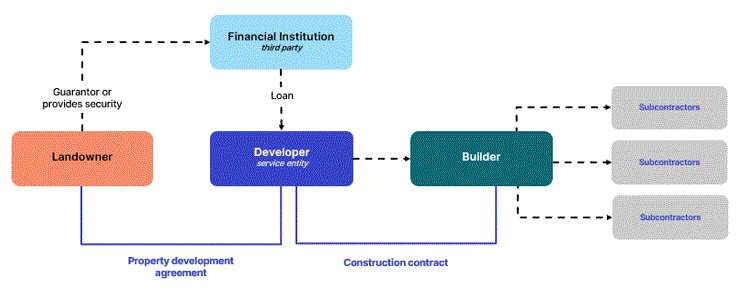
3. A PDA (or a similar agreement, however it may be described) is a contract between a developer and a landowner, outlining the terms and conditions for developing land and construction works, as well as the respective responsibilities of the parties and the financing arrangements for the project. A long-term construction contract refers to a contract under which construction work extends beyond one year of income. While long-term construction contracts can be separate from PDAs (and vice versa), they are often one and the same or together form part of the contractual framework underpinning the broader property development arrangement. This Guideline will primarily refer to the PDA, rather than differentiating between the PDA and the long-term construction contract in each instance.
4. The use of PDAs is common in Australia's property and construction sector. Generally, we do not have a concern with this operating model.
5. We are concerned where certain taxpayers are using PDAs between entities that are under common ownership or control, or are not dealing with each other at arms' length, to obtain a tax benefit. Specifically, our compliance focus is on entities that are in substance undertaking a single economic activity of property development but separate the land ownership and development activities in an attempt to defer the recognition of income and circumvent the trading stock provisions.[2]
6. This Guideline provides a risk assessment framework on the application of the general anti-avoidance rules in Part IVA of the Income Tax Assessment Act 1936, in the context of property development arrangements involving PDAs. The risk assessment framework sets out factors that we will take into account in deciding whether or not we will devote our compliance resources to further examine these property development arrangements. It does not mean that the general anti-avoidance rules will necessarily apply.
7. This Guideline does not replace, alter or affect our interpretation of the law in any way.
8. All further legislative references in this Guideline are to the Income Tax Assessment Act 1936, unless otherwise indicated.
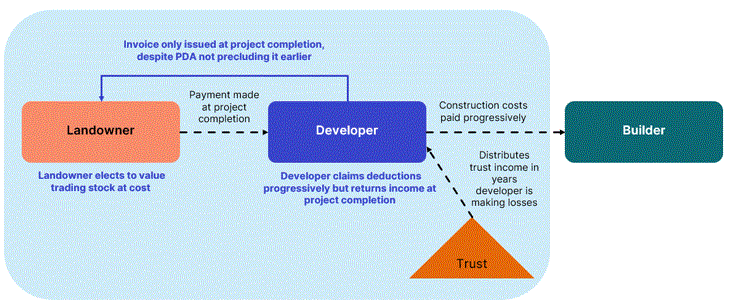
9. You can use the risk assessment framework set out in this Guideline to understand and assess the level of risk associated with your property development arrangements. By following this Guideline, you can understand the compliance risks associated with particular property development arrangements under contemplation or already entered into.
10. If your property development arrangement is low risk (that is, it is in the green risk zone of the risk assessment framework set out at paragraph 18 of this Guideline), we will generally not have cause to allocate resources for intensive examination beyond verifying your self-assessment.
11. If your property development arrangement falls within the high risk zone (that is, the red risk zone of the risk assessment framework set out at paragraph 19 of this Guideline), we are likely to allocate compliance resources to undertake further scrutiny. This may include commencing a review or audit to examine the arrangement in detail and to assess the potential application of Part IVA to the arrangement.
12. The Appendix to this Guideline provides the types of evidence we are likely to ask you to provide in relation to any review of property development arrangements.
13. When finalised, this Guideline is proposed to apply to arrangements entered into before and after its date of issue.
What is not a compliance concern
14. The mere existence of deferred payment terms or the fact that the parties to the arrangement are related does not, in itself, give rise to compliance concerns.
15. Arm's-length arrangements or 'one-off' property developments undertaken pursuant to a PDA, which do not involve the exploitation of project losses, are unlikely to attract compliance scrutiny.
16. The risk assessment framework categorises risk into 2 zones, green (low risk) and red (high risk), based on the features of the arrangement and your approach to income recognition.
17. You can expect the following engagement from us in relation to your property development arrangement, depending on the risk zone your arrangement falls into.
| Risk zone | Risk level | Our compliance approach |
|---|---|---|
| Green | Low risk | We will generally not have cause to apply compliance resources to review the arrangement except to confirm you meet the requirements to be in the green zone. |
| Red | High risk | We are likely to apply compliance resources and commence a review or audit. |
18. Arrangements that fall within the green zone generally exhibit one of the following features:
- •
- The PDA is structured so that amounts are payable progressively by the landowner to the developer and income is recognised progressively by the developer throughout the project.
- OR
- •
- Even where the PDA provides for payment only on completion, income is nevertheless recognised progressively by the developer over the life of the project in accordance with Taxation Ruling TR 2018/3 Income tax: tax treatment of long term construction contracts.[3]
- OR
- •
- Annual increases in the value of the land arising from development activities are recognised as assessable income in accordance with the trading stock provisions by the landowner, or the landowner and developer in partnership (where applicable).
19. Arrangements falling within the red zone typically involve all of the following features:
- •
- The landowner and developer are under common ownership or control, or are not dealing with each other at arm's length.
- AND
- •
- A developer is interposed between the landowner and the builder or subcontractors.
- AND
- •
- The developer claims deductions for construction costs paid to the builder and other development costs as they are incurred, while recognising income from the landowner only on completion. Sometimes this is because the PDA does not allow the developer to invoice the landowner until project completion and other times the developer chooses not to invoice until completion. This creates a timing mismatch between income recognition and deductions claimed, resulting in the developer reporting losses during the life of the project.
- AND
- •
- The landowner does not recognise an annual increase in the value of trading stock arising from the development activities and construction works undertaken on the land as assessable income.
- AND
- •
- The purported project losses are then used across the broader economic group or used to offset other income derived by the developer, which may indicate that the arrangement is being used in a deliberate manner to ensure reduced tax or no tax is paid.
20. This Guideline does not cover every potential factual scenario that may arise. For arrangements falling outside the zones outlined in this Guideline, we may engage with you to better understand the nature of your arrangement.
21. When examining and analysing the application of Part IVA to arrangements considered high risk under this Guideline, generally we will consider the application of the relevant substantive provisions of the law that may be applicable to the arrangement first. For example, whether income has been recognised correctly by the developer or whether the trading stock provisions have been applied correctly by the landowner or landowner and developer in partnership (where applicable).
22. Relying on this Guideline does not preclude us from considering other compliance issues relevant to the taxpayer group.
23. The following examples illustrate how the risk assessment framework for the potential application of Part IVA applies in this Guideline will apply in different scenarios.
Example 1 – progress payments made and basic approach or estimated profits basis applied
24. The landowner engages the developer, which is a related entity, and the landowner makes progress payments to the developer during the development phase. The developer returns income progressively over the life of the project, consistent with the economic activity undertaken.
25. The landowner elects to apply the cost method under paragraph 70-45(1)(a) of the Income Tax Assessment Act 1997 (ITAA 1997) for trading stock purposes (that is, no income is returned by the landowner).
Diagram 2: Progress payments made and basic approach or estimated profits basis applied
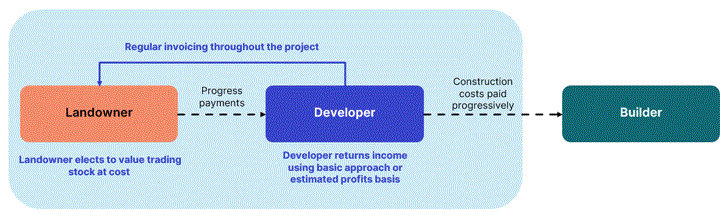
26. Whether the developer applies the basic approach or the estimated profits basis as outlined in TR 2018/3, the key factor is that income is recognised progressively in line with the work performed. These methods of income recognition are regarded as low risk from a compliance perspective. Generally, we would not have cause to apply compliance resources to these arrangements, other than to confirm that they fall within the parameters of the green zone.
Example 2 – no progress payments made but income recognised progressively in accordance with TR 2018/3
27. The landowner engages the developer, which is a related entity, but the landowner does not make progress payments to the developer during the development phase. Despite this, the developer recognises income progressively for tax purposes by applying the estimated profits basis or the basic approach.
28. The landowner elects to apply the cost method under paragraph 70-45(1)(a) of the ITAA 1997 for trading stock purposes (that is, no income is returned by the landowner).
Diagram 3: No progress payments made but income recognised progressively in accordance with TR 2018/3
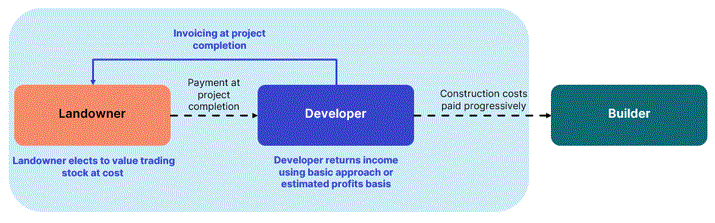
29. This approach accords with the principles outlined in TR 2018/3. As income is returned progressively in line with the economic activity, the arrangement is considered low risk. Generally, we would not have cause to apply compliance resources to these arrangements, other than to confirm that they fall within the parameters of the green zone.
Example 3 – landowner engages builder directly and applies trading stock provisions
30. The landowner contracts directly with the builder, which is a related entity, and pays for the construction costs progressively to the builder. The landowner applies the trading stock provisions (either at cost price, market selling value or replacement value under subsection 70-45(1) of the ITAA 1997), thus progressively recognising income over the duration of the development. While this arrangement does not involve a PDA between a landowner and developer (as there is no developer entity), it still falls within the scope of an arrangement involving a long-term construction contract.
Diagram 4: Landowner engages builder directly and applies trading stock provisions
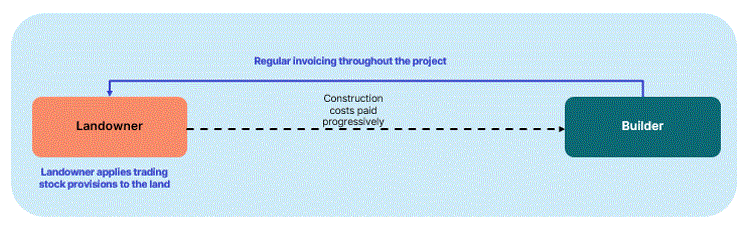
31. Provided the trading stock provisions are correctly applied, and income is recognised in accordance with the increase in value of the land or development, this approach is considered low risk. Generally, we would not have cause to apply compliance resources to these arrangements, other than to confirm that they fall within the parameters of the green zone.
Example 4 – landowner and developer in partnership apply trading stock provisions
32. The landowner and developer, which are related entities, operate as a general law partnership and jointly contract with the builder. The partnership pays construction costs progressively to the builder. The partnership applies the trading stock provisions (either at cost price, market selling value or replacement value under subsection 70-45(1) of the ITAA 1997), thus progressively recognising income over the duration of the development.
Diagram 5: Landowner and developer in partnership applies trading stock provisions

33. Where the landowner and developer have characterised their arrangement as a general law partnership and applied the trading stock provisions accordingly, we consider this a low-risk approach. Generally, we would not have cause to apply compliance resources to these arrangements, other than to confirm that they fall within the parameters of the green zone.
Example 5 – no progress payments made but landowner applies trading stock provisions using either market selling value or replacement value
34. The landowner engages the developer, which is a related entity, but the landowner does not make progress payments to the developer during the development phase. The developer does not recognise income progressively during the development phase but claims deductions for construction costs progressively.
35. Despite this, the landowner does not elect to value its land at cost, but rather recognises income for tax purposes based on the increase in the value of trading stock using either the market selling value or replacement value under subsection 70-45(1) of the ITAA 1997.
36. This means deductions claimed by the developer progressively are offset by income recognised by the landowner.
Diagram 6: No progress payments made but landowner applies trading stock provisions using either market selling value or replacement value

37. This approach recognises income for tax purposes on a progressive basis and is considered low risk. Generally, we would not have cause to apply compliance resources to these arrangements, other than to confirm that they fall within the parameters of the green zone.
Example 6 – no invoicing or progress payments where the property development agreement does not preclude it
38. The landowner interposes a developer entity, which is a related party (and a member of the same family group for tax purposes), between the landowner and builder. The developer does not have any assets or other resources of its own. The developer cannot carry out the development work itself without outsourcing the construction work, and without the landowner providing the land as security for the developer to obtain finance. The developer enters into a contract with the builder to undertake the construction work and is required to pay for construction costs progressively. The PDA between the landowner and developer allows for the developer to invoice the landowner progressively as costs are incurred and seek payment of the invoice within 30 days.
39. The developer chooses not to invoice the landowner until project completion. As a result, the landowner does not make progress payments, and the developer does not return income progressively, but claims deductions for costs incurred. This results in the developer being in a tax loss position for that project during the years prior to completion.
40. Losses made by the developer in the years before the project's completion are applied against trust income injected into the developer entity from a related trust (within the same family group for tax purposes).
41. Although the landowner elects to use the cost method under paragraph 70-45(1)(a) of the ITAA 1997, no income is returned by the landowner under the trading stock provisions because, under the scheme, the relevant costs are treated as not having been incurred, and therefore not brought to account, until the project is completed.
Diagram 7: No invoicing or progress payments when property development agreement does not preclude it
42. Based on the terms of the contract between the landowner and developer it is likely that income has been derived by the developer progressively.
43. In such cases, we will apply compliance resources to the arrangement and may consider the potential application of Part IVA.
44. Our approach will be the same regardless of whether this outcome arises because the developer elects not to issue invoices progressively despite being permitted to do so, or because the PDA prohibits the issuing of invoices until project completion. In either scenario, consideration may be given to the potential application of Part IVA.
Example 7 – losses made by the developer are utilised and indicia of partnership exist
45. The landowner engages the developer, which is a related entity, to develop its land. The landowner does not make progress payments during the development phase. The developer does not return income progressively for tax purposes, but claims deductions for costs incurred progressively, meaning the developer is in a tax loss position in respect of that project in the years before the project's completion.
46. The losses generated by the developer on this project prior to its completion are offset against income derived from other projects that have been completed by the same developer.
47. Although the landowner elects to use the cost method under paragraph 70-45(1)(a) of the ITAA 1997, no income is returned by the landowner under the trading stock provisions because, under the scheme, the relevant costs are treated as not having been incurred, and therefore not brought to account, until the project is completed.
48. The parties do not consider that they are in a general law partnership, however the terms of the contract and the conduct of the parties indicate that there are some indicia of a partnership that exist.
Diagram 8: Losses made by the developer are utilised and indicia of partnership exist

49. In such cases, we will apply compliance resources to the arrangement. Where the structure or conduct of the arrangement raises concerns about tax avoidance, we may consider the potential application of Part IVA.
50. In the course of conducting our Part IVA analysis, our review of the arrangement may extend to considering whether or not the landowner and developer are operating as a general law partnership, for the purposes of determining the correct application of the trading stock provisions under the tax law.
Example 8 – arrangement replicated across multiple property development projects in the same economic group
51. The landowner engages the developer, which is a related party, under an arrangement that replicates the features of Examples 6 or 7 of this Guideline and is implemented across multiple projects. Under this arrangement, the landowner does not make progress payments during the development phase, and the developer does not return income progressively. The developer claims deductions for costs incurred progressively, and as a result is in a tax loss position in the years before completion of the respective projects. Additionally, the landowner does not return income in respect of the increase in value of trading stock.
52. This structure enables the developer's tax losses to be consistently utilised to offset income generated elsewhere in the group. This is typically achieved through either the formation of a tax consolidated group that the developer but not the landowner is a member of, or the developer receiving trust distributions from a trust within the economic group or a combination of both.
Diagram 9: Arrangement replicated across multiple property development projects in the same economic group

53. What distinguishes this scenario is the replication of the arrangement across a broader portfolio of developments, resulting in the continuous deferral of income tax.
54. In these circumstances, we will apply compliance resources to examine the arrangements in detail, and where appropriate, consider the application of Part IVA.
Commissioner of Taxation
1 April 2026
Appendix – Evidence requirements
55. This Appendix outlines the types of evidence we are likely to consider when reviewing your property development arrangements. We generally expect taxpayers to be able to provide this evidence to support their arrangements.
56. As part of our business-as-usual process, we typically begin by requesting foundational information such as financial statements and information about the taxpayer's group structure. This helps us understand the taxpayer's overall financial position and activities. If we identify a potential risk involving a property development project, we may seek further evidence to determine whether that risk is real and whether it is material.
57. As explained in this Guideline and in our compliance approach, the level of evidence we seek depends on whether your arrangement falls within the green or red zone. For arrangements that fall within the green zone, our focus is typically on verifying that your self-assessment is appropriate. In contrast, arrangements that fall within the red zone will generally require more extensive evidence, not only to substantiate the arrangement itself, but also to demonstrate how it is practically implemented and operated.
58. The evidence listed in this Appendix is intended as a general guide and is not exhaustive. This Guideline is only to provide transparency as to the types of evidence you should already hold and what we may request.
59. We may ask for the following types of evidence:
- •
- contracts and agreements between parties to the property development project, including
- –
- agreements between the landowner and developer
- –
- building contracts involving the developer and builder, or other relevant parties
- –
- any other contracts involving the landowner, developer, builder, or other stakeholders
- •
- financing information, such as
- –
- bank documents (for example, loan applications, borrower details, guarantees, and security arrangements)
- –
- internal financing records (for example, loan contracts, guarantees provided)
- •
- financial information of the group, including
- –
- statements of financial position and profit and loss
- –
- tax reconciliation statements
- –
- relevant general ledgers.
Your comments
60. You are invited to comment on this draft Guideline. Forward your comments to the contact officer by the due date.
61. A compendium of comments is prepared as part of the finalisation of this Guideline. An edited version of the compendium (names and identifying information removed) is published to the ATO Legal database on ato.gov.au.
62. Advise the contact officer if you do not wish for your comments to be included in the edited compendium.
| Due date: | 15 May 2026 |
| Contact officer details have been removed as the comments period has ended. | |
© AUSTRALIAN TAXATION OFFICE FOR THE COMMONWEALTH OF AUSTRALIA
You are free to copy, adapt, modify, transmit and distribute this material as you wish (but not in any way that suggests the ATO or the Commonwealth endorses you or any of your services or products).
For readability, all further references to 'this Guideline' refer to the Guideline as it will read when finalised. Note that this Guideline will not take effect until finalised.
See Taxpayer Alert TA 2026/1 Contrived property development arrangements between related parties that defer recognition of income and exploit tax losses.
TR 2018/3 sets out the basic approach (discussed at paragraphs 7 to 9) or the estimated profits basis (discussed at paragraphs 17 to 20) to recognise income derived and expenses incurred under arrangements using long-term construction contracts. TR 2018/3 also sets out the Commissioner's views on methodologies which the Commissioner considers are not appropriate to recognise income derived and expenses incurred under long-term construction contracts.
NO 1-18CUZ7S0
Related Rulings/Determinations:
TR 94/8
TR 98/1
TR 2018/3
Legislative References:
ITAA 1936 Pt IVA
ITAA 1997 70-45(1)
ITAA 1997 70-45(1)(a)