

Draft Practical Compliance Guideline
PCG 2026/D5
Back-to-back CGT rollovers and Part IVA of the Income Tax Assessment Act 1936
-
For information about the status of this draft Guideline, see item 3953 on our Advice under development program
| Table of Contents | Paragraph |
|---|---|
| What this draft Guideline is about | |
| Background | |
| Scope of this Guideline | |
| Date of effect | |
| Our concerns in relation to back-to-back CGT rollovers | |
| Higher risk arrangements | |
| Interdependent rollovers | |
| Higher risk indicators | |
| Lower risk arrangements | |
| Independent transactions | |
| Commercial or practical utility of each step | |
| Our compliance approach | |
| Higher risk arrangements | |
| Lower risk arrangements | |
| Examples | |
| Example 1 - low risk - independent back-to-back CGT rollovers that do not result in a reduced capital gain | |
| Example 2 - higher risk - back-to-back CGT rollovers facilitate the deferral of a capital gain that would otherwise arise if the transactions were undertaken in a more direct manner | |
| Example 3 - higher risk - back-to-back CGT rollovers facilitate an uplift in cost base | |
| Example 4 - higher risk - back-to-back CGT rollovers resulting in increased deductions | |
| Evidence and record keeping | |
| Your comments |
|
Relying on this draft Guideline
This Practical Compliance Guideline is a draft for consultation purposes only. When the final Guideline issues, it will have the following preamble: This Practical Compliance Guideline sets out a practical administration approach to assist taxpayers in complying with relevant tax laws. Provided you follow this Guideline in good faith, the Commissioner will administer the law in accordance with this approach. |
What this draft Guideline is about
1. This draft Guideline[1] provides practical guidance on what we consider to be 'lower risk' or 'higher risk' arrangements involving back-to-back capital gains tax (CGT) rollovers and when we will be more likely to have cause to apply our compliance resources to consider whether Part IVA of the Income Tax Assessment Act 1936[2] (Part IVA) applies to such arrangements.
2. For the purposes of this Guideline, back-to-back CGT rollovers are arrangements involving successive CGT events affecting the same asset (or its replacement asset), where a CGT rollover is chosen in relation to 2 or more of these events. Under these arrangements, a capital gain or capital loss arising from an initial CGT event is disregarded due to the application of a CGT rollover. A further CGT event subsequently occurs in relation to that asset, and a second CGT rollover is chosen, with the result (save for the application of Part IVA) that any capital gain or capital loss arising from the later event is also disregarded.
3. The income tax legislation provides for CGT rollovers in a range of circumstances, subject to the satisfaction of specified eligibility conditions that apply to the relevant CGT event and rollover provision.
4. There is no provision that requires a capital gain or capital loss disregarded under one CGT rollover to be brought to account before a further CGT rollover may apply to a subsequent CGT event. The availability of any particular CGT rollover depends on whether its eligibility conditions are satisfied, and those conditions may not be met in some arrangements involving back-to-back rollovers.
5. The absence of an express provision in the income tax law dealing with back-to-back CGT rollovers does not preclude the application of Part IVA in appropriate cases.
6. This Guideline provides a risk assessment framework for considering the potential application of the general anti-avoidance provisions to arrangements involving back-to-back CGT rollovers. The framework sets out factors that will be taken into account in deciding whether the ATO will have cause to devote compliance resources to further examining such arrangements. A higher risk rating does not mean that the general anti-avoidance rules will necessarily be applied.
7. This Guideline applies to arrangements which involve back-to-back CGT rollovers. It does not apply to a series of steps or transactions that only results in a single CGT rollover being applied.
- •
- specify when the eligibility requirements for each of the CGT rollovers comprising a back-to-back CGT rollover are satisfied
- •
- provide guidance on CGT calculations, including how to work out the cost base of assets
- •
- replace, alter or affect our interpretation of the law in any way.
9. All further legislative references in this Guideline are to the Income Tax Assessment Act 1997 (ITAA 1997), unless otherwise indicated.
10. When finalised, this Guideline is proposed to apply to arrangements entered into before and after its date of issue.
Our concerns in relation to back-to-back CGT rollovers
11. We are concerned about arrangements involving back-to-back CGT rollovers where the initial CGT rollover forms an intermediate step that appears to have a purpose of creating the circumstances in which a subsequent CGT rollover can be accessed.
12. In broad terms, we are concerned with back-to-back CGT rollovers used in a way that interpose steps with little commercial substance in order to defer, reduce or eliminate capital gains in circumstances where the tax law does not expressly provide specific rollover relief.
13. For example, an arrangement may involve units in a unit trust being exchanged for shares in a newly established private company with CGT rollover relief under Subdivision 124-N (trust restructure) being chosen. This is immediately followed by an exchange of the shares in the private company for shares in a widely held company, with CGT rollover relief under Subdivision 124-M being chosen.
14. In this example, in the absence of any commercial purpose for the intermediate step under the arrangement, the exchange of units for shares in the newly established private company appears to have little utility beyond creating the conditions in which CGT rollover relief under Subdivision 124-M can be chosen.
15. Arrangements of this kind raise questions about whether the intermediate step forms part of a broader scheme designed to obtain a tax benefit.
16. The application of Part IVA depends upon a broad survey of the circumstances in each case.
17. The fact that a back-to-back CGT rollover arrangement has features which bring the application of Part IVA into question, does not mean that Part IVA will necessarily apply. It does, however, indicate an increased likelihood of review activity by us, which will include a deeper consideration of whether Part IVA should apply and whether the eligibility conditions of the CGT rollovers have been met.
18. Arrangements which bring Part IVA into question are referred to in this Guideline as 'higher risk' because they carry this increased compliance risk.
19. While not determinative, the interdependence between the transactions is relevant in assessing the level of risk.
20. Whether back-to-back CGT rollovers are interdependent is determined by consideration of the facts and circumstances and objective evidence.
21. We consider that back-to-back CGT rollovers are interdependent where:
- •
- the relevant transactions and rollovers were executed as part of a single agreement, overarching strategy or coordinated undertaking, or
- •
- the undertaking of one transaction is conditional upon the execution of another transaction.
22. Interdependent back-to-back CGT rollovers could indicate that the intermediate CGT rollover is a step of limited utility beyond enabling the second CGT rollover to be chosen.
23. Interdependent back-to-back CGT rollovers are considered 'higher risk' where they include an intermediate step that serves no or limited apparent purpose beyond enabling a further rollover to be applied, and one or more of the following features are present:
- •
- a capital gain is disregarded, or the preservation of pre-CGT asset status, that would not have been available if the relevant transactions had been undertaken in a more direct manner, or
- •
- aside from changes attributable to external economic or market forces, any future capital gain is reduced, or any future capital loss is increased, compared to what it would have been in the absence of one or more of the CGT rollovers – for example, the back-to-back CGT rollovers facilitate an increase in what would otherwise be the cost base of the relevant assets if they had been disposed of directly, or
- •
- there is an increase in available capital allowance deductions in what would otherwise have been the case because the back-to-back CGT rollovers facilitate an increase in the cost of depreciating assets that would not otherwise occur if the assets had been disposed of directly.
24. Interdependent back-to-back CGT rollovers that include an intermediate step that serves no or limited apparent purpose beyond enabling a further rollover and one or more of these higher risk indicators will be considered higher risk regardless of whether the transactions giving rise to each CGT rollover occur contemporaneously, or over an extended period of time.
25. The presence of any of these higher risk indicators in a back-to-back CGT rollover arrangement does not necessarily mean that Part IVA applies. In reviewing the arrangement, we will consider whether it was entered into for the dominant purpose of obtaining a tax benefit. This includes considering whether the arrangement was structured to create the conditions necessary to access one or more CGT rollovers.
26. Examples illustrating higher risk arrangements are set out at paragraphs 54 to 84 of this Guideline.
27. Some arrangements involving back-to-back CGT rollovers may present a lower risk for the application of Part IVA, having regard to the particular facts and circumstances.
28. For the purposes of this Guideline, arrangements are more likely to be considered lower risk where the back-to-back CGT rollovers are not interdependent and the overall arrangement does not involve an intermediate step of limited commercial or practical utility.
29. Factors that indicate a lower level of risk include those set out at paragraphs 30 to 33 of this Guideline.
30. Independent transactions are those where the transactions giving rise to each CGT rollover are not interdependent. This may be the case where:
- •
- the transactions are not entered into as part of a single agreement, overarching strategy or coordinated undertaking, and
- •
- the undertaking of one transaction is not conditional upon the execution of another transaction.
31. In these circumstances, each transaction may reflect a separate commercial decision, and the availability of any CGT rollover may not depend upon the prior completion of another transaction.
Commercial or practical utility of each step
32. In considering whether Part IVA may apply to an arrangement, we will have regard to the arrangement as a whole, including its overall objective and commercial purpose. This involves identifying the substantive commercial outcome sought to be achieved (for example, the exchange of units in a unit trust for shares in a widely held company) and examining the steps taken as part of the overall arrangement to achieve that outcome.
33. An arrangement where all of the individual steps demonstrably contribute to the commercial objective sought, beyond any tax outcomes achieved, is a key feature of lower risk arrangements.
34. The feature of a lower risk arrangement described in paragraph 33 of this Guideline can be contrasted with arrangements where one or more steps in the arrangement do not appear to contribute to the commercial objective and appear to only be explicable by reference to the tax consequences achieved.
35. Arrangements that exhibit the features outlined in paragraphs 28 to 33 of this Guideline are less likely to attract compliance attention under this Guideline. However, the presence of lower risk features does not, of itself, mean that the Commissioner will not determine that Part IVA applies if the Commissioner has cause to further examine the arrangement.
36. Whether Part IVA applies to any arrangement depends on a consideration of all the relevant facts and circumstances, including whether the arrangement is entered into for the dominant purpose of obtaining a tax benefit.
37. You can expect engagement from us as detailed in paragraphs 38 to 40 of this Guideline depending on the risk category your back-to-back CGT rollover arrangement falls into.
38. If your back-to-back CGT rollover is in the higher risk category (paragraphs 16 to 25 of this Guideline), we will prioritise our resources to review your arrangement. This may involve commencing a review or audit to confirm that the relevant rollovers meet the eligibility conditions of the CGT rollover provisions and consider whether Part IVA applies to the arrangement.
39. If your back-to-back CGT rollover is in the lower risk category (paragraphs 27 to 33 of this Guideline), we are less likely to have cause to apply resources to review your arrangement, and any review may be limited to confirming that your back-to-back CGT rollover is within the lower risk category and that there are no other relevant risk factors that should be considered.
40. However, you should keep records that document and explain your back-to-back CGT rollover and the relevant circumstances that make the arrangement lower risk – see paragraphs 85 and 86 of this Guideline.
41. The following examples illustrate the lower risk and higher risk categories of back-to-back CGT rollovers only. They are not a guide on how to calculate CGT, including how to work out the cost base of assets. CGT and cost base outcomes depend on the application of the legislative rules to your specific facts and choices.
Example 1 – lower risk – independent back-to-back CGT rollovers that do not result in a reduced capital gain
Diagram 1: Independent back-to-back CGT rollovers that do not result in a reduced capital gain
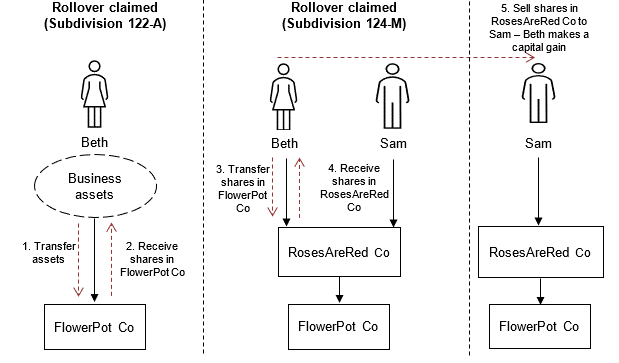
42. Beth is a sole trader who runs a successful retail business.
43. As her business continues to grow rapidly, Beth decides to change the business structure to better encourage and manage that business growth. She has no intention of selling her business at that time but does recognise the benefits of restructuring should that opportunity arise in the future. Beth intends to establish a new private company, FlowerPot Co, for which she is the sole director and shareholder.
Subdivision 122-A rollover claimed
44. Beth continues with her plans to incorporate FlowerPot Co.
45. Beth transfers all the business assets to FlowerPot Co in exchange for its shares. All of the business assets have been acquired by Beth on or after 20 September 1985. Beth claims the Subdivision 122-A rollover relief with respect to the disposal of those assets to FlowerPot Co.
46. By claiming the Subdivision 122-A rollover relief, the cost base of Beth's shares in FlowerPot Co takes into account the cost bases and costs of the business assets just before the transfer increased by the market value of the precluded assets and reduced by the amount of any liabilities assumed by FlowerPot Co in relation to the assets at the time of transfer.
Approach by an independent potential purchaser
47. Six months after Beth's change to her business structure, Sam (an unrelated party) approaches Beth expressing his desire to acquire her business. However, as part of doing his due diligence, he is keen to see Beth's financial reports and to understand the true profitability of the business. Beth is also uncertain about what consideration appropriately reflects the market value of her business and its future growth.
48. To address this, Beth and Sam enter into a non-binding agreement to allow Sam to do due diligence, while at the same time Beth is able to obtain an independent market valuation. Both parties can terminate the agreement at any time.
Subdivision 124-M rollover claimed
49. During the course of sale negotiations, Beth and Sam realise that merging their businesses suits both of their preferences at this time better than a sale. To merge their businesses, Beth agrees to an exchange of shares in FlowerPot Co for an agreed number of shares in RosesAreRed Co. Beth claims Subdivision 124-M rollover relief to disregard the capital gains arising on the disposal of her shares.
50. By claiming the Subdivision 124-M rollover relief, Beth works out the cost base of her new shares in RosesAreRed Co, which works out to be substantially the same as the cost base of the shares she had in FlowerPot Co.
51. Sometime later, Beth decides to sell her shares to allow her to travel and explore other business opportunities. She approaches Sam, who acquires her shares in RosesAreRed Co for an arm's length price. Beth makes a capital gain calculated using the sale price and the cost base of the shares just before the disposal, and determined by reference to the amount determined by the rollover under Subdivision 124-M.
52. The timing and substance of the negotiations between Beth and Sam which culminated in the non-binding agreement with Sam indicate that the agreement was only relevant to due diligence and negotiations and was not interdependent with her previous rollover to FlowerPot Co.
53. In these circumstances, we accept that there is no connection between the 2 CGT rollovers (noting the documents and materials prepared by Beth in support of that conclusion). Therefore, this is a lower risk arrangement for the purposes of this Guideline.
Example 2 – higher risk – back-to-back CGT rollovers facilitate the deferral of a capital gain that would otherwise arise if the transactions were undertaken in a more direct manner
Diagram 2: Back-to-back CGT rollovers facilitate the deferral of a capital gain
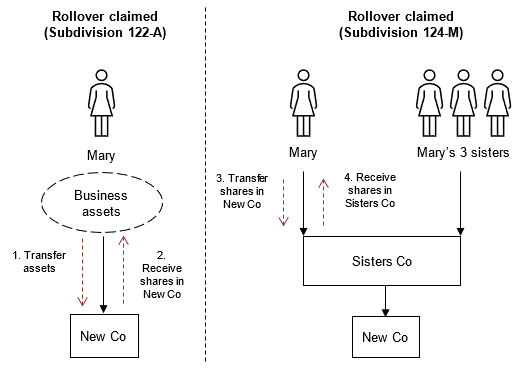
54. As part of plans to expand her sole trader business, Mary has convinced her 3 sisters to join her working in her business, on the understanding that they will get to share ownership and control of the business and its assets. Mary and her sisters already own and operate another business through an existing company, Sisters Co. So, to facilitate this, they agree to merge the businesses.
55. If Mary were to transfer her business assets directly to Sisters Co, she would realise a capital gain and be liable to pay CGT, as no CGT rollover is available in these circumstances.
Subdivision 122-A rollover claimed
56. Mary does not want to realise an immediate capital gain, so she avails herself of 2 CGT rollovers to achieve that outcome without a CGT liability. First, Mary transfers her assets to a newly registered company (wholly owned by her), New Co, and relies on Subdivision 122-A for CGT rollover relief. However, the transfer of the business assets to New Co is intended by Mary as an intermediate step, to enable the second CGT rollover. New Co does not otherwise have any commercial or practical function in relation to the operation of the business or the merging of the businesses.
Subdivision 124-M rollover claimed
57. Secondly, Mary chooses the scrip for scrip rollover relief under Subdivision 124-M when Sisters Co acquires the shares in New Co and Mary receives shares in Sisters Co in exchange. This has the effect of deferring any capital gain arising from Mary's disposal of the business assets, upon the indirect acquisition of those assets by the 4 sisters.
58. In these circumstances, the transfer of assets to New Co served no commercial or practical function but to act as an intermediate step to put Mary into a position to choose the Subdivision 124-M CGT rollover and thereby defer the capital gain she would have otherwise realised on transferring her business asset directly to Sisters Co.
59. Disregarding a capital gain can be a tax benefit to which Part IVA may apply where the taxpayer's assessable income is less than what it otherwise would have been had the capital gain been included.
60. The Commissioner may determine that Part IVA applies where a taxpayer structures their affairs or implements a scheme for the dominant purpose of obtaining one or more tax benefits, such as where a capital gain is disregarded. This is evident in this example, where Mary's objective dominant purpose, in undertaking the back-to-back CGT rollovers, was to defer the capital gain that would have otherwise been included in her assessable income.
61. We consider this to be a higher risk arrangement for the purposes of this Guideline and would apply compliance resources to determine whether Part IVA applies if the eligibility conditions of the CGT rollover have been met.
Example 3 – higher risk – back-to-back CGT rollovers facilitate an uplift in cost base
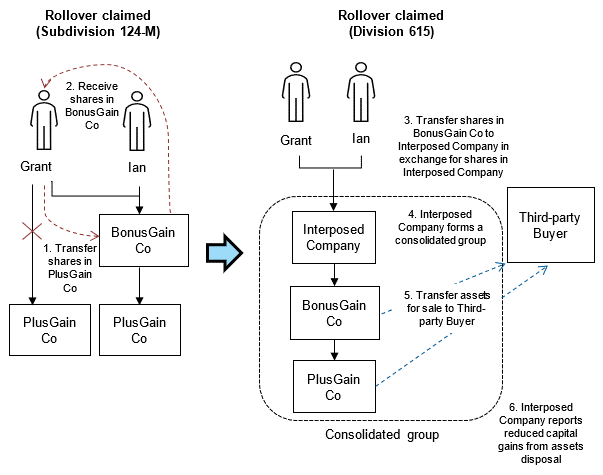
Diagram 3: Back-to-back CGT rollovers that facilitate an uplift in cost base
62. Grant runs a business through PlusGain Co. All its assets were acquired on or after 20 September 1985.
63. Grant's colleague, Ian, runs a business through BonusGain Co, which is a supplier for PlusGain Co. All its assets were acquired on or after 20 September 1985.
64. Grant and Ian have been considering merging their businesses to achieve business synergies. Upon merging, they plan to consolidate the group for tax purposes. They have discussed the advantages of establishing a new entity to interpose as the head company of the group for the purposes of consolidation under Part 3-90.
65. Both PlusGain Co and BonusGain Co have assets which are no longer required by the business and that have significantly increased in value (high-value assets). Ian and Grant recognise that there may be significant tax advantages if they dispose of those assets after consolidation.
Subdivision 124-M rollover claimed
66. Ian and Grant decide to merge their businesses with a view to forming a consolidated group. Grant transfers all his shares in PlusGain Co to Ian's company, BonusGain Co in exchange for shares in BonusGain Co, which results in Grant owning 25% of BonusGain Co.
67. Grant claims the Subdivision 124-M rollover relief with respect to the exchange of shares.
68. By claiming the Subdivision 124-M rollover relief, the cost base of Grant's shares in BonusGain Co, in this case, is approximately the cost base of his shares in PlusGain Co (that is, there has been no cost base uplift).
69. BonusGain Co claims a cost base uplift, as it calculates that the cost base of its shares in PlusGain Co is the market value of its shares issued to Grant at the time of exchange.
70. To prepare for the formation of a consolidated group, Grant and Ian then transfer their shares in BonusGain Co to a newly incorporated company, Interposed Company, in exchange for shares in Interposed Company. Grant claims the Division 615 rollover relief for this exchange.
71. By claiming the Division 615 rollover relief, the cost base of the shares in Interposed Company received by Grant is approximately the cost base of the shares he had in BonusGain Co (that is, there has been no cost base uplift).
72. Interposed Company calculates the cost base of its shares in BonusGain Co as the total of the cost bases of BonusGain Co's assets (which would include the cost base of its shares in PlusGain Co that have been reset with a higher cost base) reduced by BonusGain Co's liabilities in respect of those assets.
73. Interposed Company then forms a consolidated group, with itself as the head company and BonusGain Co and PlusGain Co as its subsidiaries, and resets the tax cost of assets in BonusGain Co and in PlusGain Co.
Reduced capital gain
74. BonusGain Co and PlusGain Co sell their high-value assets to an unrelated third-party buyer.
75. In this example, the transactions which rely on the 2 CGT rollovers are interdependent as they are necessary steps in a plan to consolidate the businesses of Grant and Ian. Furthermore, the amount of the capital gain on the sale of the high-value assets would have been significantly higher if PlusGain Co had directly sold the assets without choosing to apply the back-to-back CGT rollovers and making the choice to consolidate.
76. This is considered a higher risk arrangement for the purposes of this Guideline, because the steps which rely on CGT rollover relief are necessary to put PlusGain Co in a position to form a consolidated group and enable the tax cost setting process that produces a significant uplift in the tax costs of the high-value assets. As a result, the capital gain recognised on the eventual disposal of those assets is substantially reduced.
Example 4 – higher risk – back-to-back CGT rollovers resulting in increased deductions
Diagram 4: Back-to-back CGT rollovers resulting in increased deductions
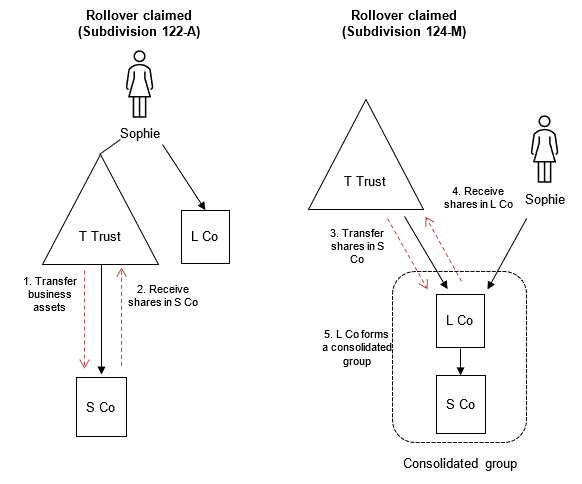
77. Sophie, in her capacity as trustee for the T Trust, operates the trust's business. All the business assets held by T Trust were acquired on or after 20 September 1985. Sophie also owns all the shares in L Co. L Co owns business assets that are leased to Sophie in her capacity as trustee and used in the business carried on by the T Trust. Sophie decides she wants to reorganise her business structure so that the operating business and the business assets are held in a tax consolidated group.
Subdivision 122-A rollover claimed
78. To restructure her business, Sophie transfers the business assets of T Trust to newly established S Co, in exchange for shares in S Co. Sophie claims the Subdivision 122-A rollover relief with respect to the transfer.
79. By claiming the Subdivision 122-A rollover relief, the cost base of T Trust's shares in S Co takes into account the cost bases and costs of the business assets just before the transfer, increased by the market value of the precluded assets and reduced by the amount of any liabilities assumed by S Co in relation to the assets at the time of transfer.
Subdivision 124-M rollover claimed
80. T Trust then exchanges its shares in S Co for shares in L Co. Sophie, as the trustee, claims the Subdivision 124-M rollover relief with respect to the exchange of shares.
81. By claiming the Subdivision 124-M rollover relief, Sophie determines that the cost base of the shares in L Co received by the T Trust is approximately the same as the cost base of the shares it had in S Co.
82. L Co then forms a consolidated group with itself as the head company and S Co as a subsidiary, and resets the tax cost of assets in S Co. Sophies claims that this results in an increase in the tax costs of the depreciating assets and, as a result, the capital allowances deductions claimed by L Co.
83. Sophie is the controller of T Trust, L Co and S Co, and the transactions where CGT rollover relief is applied are interdependent as they are part of the steps in her plan. The steps which rely on the back-to-back CGT rollovers are necessary to put L Co and S Co in a position to choose to form a consolidated group and enable the tax cost setting process to increase the tax costs of assets and consequently, to increase the amount of deductions.
84. We consider this to be a higher risk arrangement for the purposes of this Guideline and would apply compliance resources to determine whether Part IVA applies if the eligibility conditions of the CGT rollovers have been met.
85. You are required to keep records of matters that affect the capital gains and losses you make, and records that explain all relevant transactions.[3]
86. The type and range of evidence that we expect you to have will be influenced by the complexity of your business and your circumstances. Types of documentation and evidence that we will consider include:
- •
- documents evidencing your consideration of commercial or practical factors or drivers
- •
- your, or your adviser's, planned steps to implement restructures, mergers and acquisitions, or to dispose of assets
- •
- contemporaneous evidence of, or evidence recorded before the carrying out of transactions indicating, the reasons for
- –
- entering the transactions, such as proposals presented to the affected owners of original interests, internal deliberations by members or directors, minutes of members' or directors' meetings; statements by directors or influential members to the affected members, announcements to any relevant securities exchange, and proposals and discussions with financial institutions
- –
- the transactions to be done, or not to be done, in a certain way, such as notes and contemporaneous documents and records of discussions or meetings explaining the transactions including any explanations on the considerations of carrying out the transaction in a certain way and the effect of the transactions
- –
- contemporaneous independent market valuations of the business assets.
- –
- the terms and conditions of the transactions, such as the sale of shares contracts and sale of assets agreements and deeds, and discussions and negotiations in concluding the details of contracts and agreements such as relevant letters or emails
- –
- the relationship of the entities involved.
Commissioner of Taxation
11 November 2026
Your comments
87. You are invited to comment on this draft Guideline. Forward your comments to the contact officer by the due date.
88. A compendium of comments is prepared when finalising this Guideline, and an edited version of the compendium (names and identifying information removed) may be published to the Legal database on ato.gov.au.
89. Advise if you do not wish for your comments included in the edited version of the compendium.
| Due date: | 11 December 2026 |
| Contact officer: | PW and FCB Public Advice and Guidance Unit |
| Email: | PAGPWandFCB@ato.gov.au |
© AUSTRALIAN TAXATION OFFICE FOR THE COMMONWEALTH OF AUSTRALIA
You are free to copy, adapt, modify, transmit and distribute this material as you wish (but not in any way that suggests the ATO or the Commonwealth endorses you or any of your services or products).
For readability, all further references to 'this Guideline' refer to the Guideline as it will read when finalised. Note that this Guideline will not take effect until finalised.
The general anti-avoidance provisions of the income tax law.
Section 121-20 of the ITAA 1997, and section 262A of the ITAA 1936.
NO 1-1191ZQZO
Legislative References:
ITAA 1936 Pt IVA
ITAA 1997 SubDiv 122-A
ITAA 1997 SubDiv 124-M
ITAA 1997 SubDiv 124-N
ITAA 1997 Div 615
ITAA 1997 Pt 3-90