

Goods and Services Tax Determination
GSTD 2026/1
Goods and services tax: supplies of formula products
-
Please note that the PDF version is the authorised version of this ruling.There is a Compendium for this document: GSTD 2026/1EC .
| Table of Contents | Paragraph |
|---|---|
| What this Determination is about | |
| Legislative context | |
| Background | |
| Ruling | |
| Meaning of 'infants' | |
| Meaning of 'beverages and ingredients for beverages' | |
| Meaning of 'of a kind' | |
| Meaning of 'marketed principally' | |
| Formula products of a kind marketed principally as food for infants | |
| Table items 1 and 2 (milk products) | |
| Table item 1 | |
| Table item 2 | |
| Date of effect | |
| Appendix – Transitional compliance approach | |
| Application of transitional compliance approach | |
| When this transitional compliance approach will not apply | |
| Changes to GST treatment for past periods |
 Relying on this Determination
This publication (excluding appendix) is a public ruling for the purposes of the Tax Administration Act 1953. If this Determination applies to you, and you correctly rely on it, we will apply the law to you in the way set out in this Determination. That is, you will not pay any more tax penalties or interest in respect of the matters covered by this Determination. |
What this Determination is about
1. This Determination explains our view on when the supply of a formula product is GST-free under section 38-2 of the A New Tax System (Goods and Services Tax) Act 1999 (GST Act).
2. Formula products consist of a powdered preparation that, when mixed with water, becomes a drinkable, nourishing liquid. Some formula products are also sold in liquid ready-to-drink form.
3. Paragraph 38-3(1)(d) of the GST Act provides that the supply of a beverage (or an ingredient for a beverage) is not GST-free, unless it is of a beverage (or ingredient) of a kind specified in the third column of the table in clause 1 of Schedule 2 to the GST Act.
4. The third column of table item 13 in clause 1 of Schedule 2 to the GST Act (table item 13) specifies:
Extract 1: Table item 13 in clause 1 of Schedule 2 to the GST Act

5. This Determination explains our view on which formula products are GST-free under table item 13 as beverages, or ingredients for beverages, of a kind marketed principally as food for infants. This Determination does not cover supplies of beverages, and ingredients for beverages, of a kind marketed principally as food for invalids.
6. This Determination does not cover products that are precursor ingredients used to make formula products (formula product ingredient) as distinct from formula products in their final form (whether powdered or ready-to-drink). However, our view on the meaning of 'infants' (see paragraphs 26 to 33 of this Determination) may assist in determining whether a formula product ingredient is GST-free under table item 13. This will only apply where the formula product ingredient is of a kind marketed principally for use in making formula products for infants.
7. The third column of table items 1 and 2 in clause 1 of Schedule 2 to the GST Act (table items 1 and 2) specifies:
Extract 2: Table items 1 and 2 in clause 1 of Schedule 2 to the GST Act
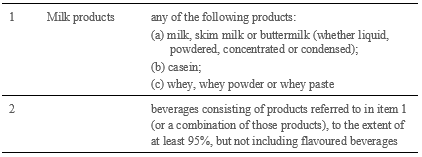
8. This Determination also explains our view on whether supplies of formula products are GST-free under table item 1 or table item 2.
9. The Appendix to this Determination outlines our transitional compliance approach to formula products marketed principally for children aged from 12 months.
10. All further legislative references in this Determination are to the GST Act, unless otherwise indicated.
11. A supply of food is GST-free.[1]
12. However, a supply is not GST-free if it is a supply of, among other things:
- •
- food of a kind specified in the third column of the table in clause 1 of Schedule 1[2], or
- •
- a beverage (or an ingredient for a beverage), other than a beverage (or ingredient) of a kind specified in the third column of the table in clause 1 of Schedule 2.[3]
13. This means there is a different GST treatment for 'food' as compared with 'beverages' and 'ingredients for beverages'.
14. 'Food' is defined by a list of inclusions and a list of exclusions. Relevantly, food is defined to include not only 'food for human consumption' but also 'beverages' and 'ingredients for beverages' for human consumption.[4]
15. 'Beverage' is not defined, other than to confirm that it 'includes water'.[5]
16. Formula products marketed and sold in Australia are typically identified by 'stages' referenced by age:
- •
- Stage 1 – 'infant formula' suitable from birth, or from 0 to 6 months
- •
- Stage 2 – 'follow-on formula' suitable from 6 to 12 months
- •
- Stage 3 – 'toddler formula' suitable from 12 months (sometimes 1 to 3 years)
- •
- Stage 4 – 'junior formula' suitable from 2 years.
17. In Australia, formula products are regulated by the Australia New Zealand Food Standards Code (Food Standards Code). Under the Food Standards Code, an 'infant' is defined to mean 'a person under the age of 12 months'.[6]
18. Infant formula products are regulated under Standard 2.9.1 of the Food Standards Code and include 'infant formula' and 'follow-on formula'. These are defined as follows[7]:
infant formula product means a product based on milk or other edible food constituents of animal or plant origin which is represented as nutritionally adequate to serve by itself either as the sole or principal liquid source of nourishment for infants, depending on the age of the infant.
infant formula means an infant formula product that is represented as:
- (a)
- a breast milk substitute for infants; and
- (b)
- satisfying by itself the nutritional requirements of infants under the age of 6 months.
follow-on formula means an infant formula product that: is represented as:
- (a)
- either a breast milk substitute or replacement for infant formula; and
- (b)
- being suitable to constitute the principal liquid source of nourishment in a progressively diversified diet for infants from the age of 6 months.
19. In contrast, formula products for children aged from 12 months are regulated under Standard 2.9.3, which contains the following definitions[8]:
formulated supplementary food means a food specifically formulated as, and sold on the basis that it is, a supplement to a normal diet to address situations where intakes of energy and nutrients may not be adequate to meet an individual's requirements.
formulated supplementary food for young children means a formulated supplementary food for children aged 1 to 3 years.
20. The Food Standards Code imposes different marketing restrictions, labelling requirements, and compositional requirements on formula products based on their categorisation under these definitions.[9]
Ruling
21. A supply of a product is GST-free if it is a beverage, or an ingredient for a beverage, 'of a kind marketed principally as food for infants'.[10]
22. In the context of formula products, it is necessary to determine the meaning of the term 'infants' in table item 13 and the age range of the children covered by the term. It is also necessary to determine the meaning of the phrases 'beverages, and ingredients for beverages', 'of a kind', and 'marketed principally'.
23. Our view is that only supplies of formula products for children aged up to 12 months are GST-free under table item 13 because these products are of a kind marketed principally as food for infants.
24. Supplies of formula products for children aged from 12 months are not GST-free under table item 13 because these products are not of a kind marketed principally as food for infants.
25. Supplies of formula products are not GST-free under table item 1 or table item 2. They are not of a kind specified (relevantly, milk or powdered milk), nor are they beverages that consist of at least 95% of these kinds of products.
26. The term 'infants' is not defined in the GST Act and takes its ordinary meaning in context.[11]
27. The ordinary meaning of words in statutes is to be determined by reference to context, on the basis of '… local knowledge, experience of the world and common sense …'[12], and with '… the assistance of dictionaries and other books …'.[13] However, care must be taken to consider context and to not 'make a fortress out of the dictionary'.[14]
28. The meaning of 'infants' was considered in Cascade Brewery Company Pty Limited v Commissioner of Taxation [2006] FCA 821 (Cascade Brewery) where Sundberg J held[15]:
In my view "infants" in item 13 bears the primary meaning given by the dictionaries referred to: "a child during the earliest period of its life"; "a child during the earliest period of life …; now most usually applied to a child in arms, a babe"; "a child in the first period of life". The Macquarie meaning is to the same effect as the primary meaning given by the Oxford Dictionary:"1. a child during the earliest period of its life, or a baby."
29. In Cascade Brewery, the extended meaning found in some dictionaries, which can include children up to 7 years of age, was rejected in the context of table item 13. This was because it is derived from expressions such as 'infants school', which operate in a distinct context and involve an extension beyond the term's primary meaning.[16] However, it was not necessary in that case for the judge to identify a specific age limit at which 'the earliest period of life' ends.
30. The term 'infant' is consistently used in general authoritative sources in health, feeding and childhood development contexts to refer to a child aged up to 12 months.[17] These sources reflect the ordinary experience of raising and feeding children in Australia. They form the basis of a general understanding of the term 'infant'. From 12 months, children are generally considered to have moved into the next stage or period of life and are usually referred to as 'toddlers'.
31. While the Food Standards Code is not determinative of the meaning of the term 'infants' in table item 13, the use of the term 'infant' in the Food Standards Code reflects the general understanding that an infant is a child aged up to 12 months (see paragraphs 17 to 22 of this Determination).
32. In some circumstances, it is necessary to distinguish between the ordinary meaning of a word and a specialised trade meaning to determine the relevant context in which the word is used in a statute.[18] However, this is not necessary in this case as the Food Standards Code does not establish a trade meaning and, in any event, the ordinary meaning aligns with use of the term in the Food Standards Code.
33. In summary, the meaning of 'infants' in the context of table item 13 is its ordinary meaning: a child aged up to 12 months.
Meaning of 'beverages and ingredients for beverages'
34. The meaning of 'beverage' in the sales tax legislation was considered in Bristol-Myers Company Pty Ltd v Commissioner of Taxation [1990] FCA 318 (Bristol-Myers).
35. In Bristol-Myers, Lockhart J held that the meaning of 'beverage' in that context was 'a drink of any kind'.[19] The judge further held that a 'drink' was 'any liquid which is swallowed to quench thirst or for nourishment'.[20] In concluding that the nutritional supplement 'Sustagen Gold' was a 'beverage', Lockhart J explained that the fact that the product contained added nutrients, and could be consumed as a meal replacement, did not alter its characterisation as a beverage.[21]
36. Formula products generally consist of a powdered preparation supplied with instructions for mixing with water to produce a drinkable, nourishing liquid. Consistent with the observations in Bristol-Myers, that drinkable, nourishing liquid is a beverage.
37. Powdered formula products are therefore 'ingredients for beverages'.
38. Some formula products are also sold pre-mixed and ready-to-drink. These liquid products are 'beverages'.
39. The phrase 'of a kind' is not defined in the GST Act. However, the phrase has been considered by the courts in the context of food classification under the GST Act.[22] In these cases, 'of a kind' has been interpreted as an operative phrase that adds further generality to the description of the item specified.[23] The degree of generality added by the phrase 'of a kind' may vary depending on the requirements in the relevant provision and the nature of the products involved.
40. The words 'of a kind' have the effect that the statutory question is not whether the product is specified in column 3 of the tables in Schedules 1 or 2, but whether the product is a member of a class or genus of food identified by the item specified.[24]
41. Answering the statutory question requires considering what is meant by 'beverages, or ingredients for beverages, of a kind marketed principally as food for infants', followed by an assessment of whether the product in question falls within that identified class or genus.
42. The question is not whether the product itself is marketed principally as food for infants, but whether the product is a member of a class or genus of beverages, or ingredients for beverages, that are marketed principally as food for infants.[25] This means it is necessary to consider the kinds of beverages, or ingredients for beverages, that are marketed principally as food for infants. This requires an understanding of how formula products are marketed, including how this marketing is impacted by the relevant regulatory environment (see paragraphs 16 to 20 and 49 to 50 of this Determination).
43. While it is not determinative, how a particular product is in fact marketed remains relevant to its classification.[26] Where a beverage, or ingredient for beverage, is marketed principally as food for infants, this is a strong indicator that it is of a kind marketed principally as food for infants.
Meaning of 'marketed principally'
44. The marketing of a product involves the end-to-end process where products are put onto the market.[27] This includes promotional and sales activities. The content of the marketing is what those activities objectively convey to the market. Marketing includes labelling (including the name), packaging, display circumstances, product placement, promotion, and advertising.[28]
45. Marketing does not include internal activities of the seller, nor is it determined by the subjective intention or motivation of the seller. These things do not convey any message to the market.[29] Further, the actual or intended use by the consumer is not relevant to determining how a product is marketed.[30]
46. The activities of all suppliers in a supply chain are relevant, including those of a manufacturer, importer, wholesaler, or retailer. The marketing activities carried out by competitors in the market are also relevant in identifying the class or genus of formula products marketed principally as food for infants.[31]
47. The marketing test in table item 13 is a 'marketed principally' test. Whether a product falls within a class or genus of beverages, or ingredients for beverages, marketed principally as food for infants is a matter of 'overall impression'.[32]
48. The marketing test is not satisfied if products of that kind have only some marketing that is directed towards them being used as food for infants. The product must be of a kind marketed 'mainly, chiefly, predominantly or preponderantly' as food for infants.[33] Where there is no clear principal use discernible from the marketing, the product is not of a kind marketed principally as food for infants.
Formula products of a kind marketed principally as food for infants
49. Due to the regulatory environment in which formula products are marketed and sold in Australia, there is a clear distinction between the kinds of formula products that are marketed principally as food for infants (children aged up to 12 months) and the kinds of formula products that are not. The distinguishing features of the kinds of formula products that are marketed principally as food for infants, and the kinds that are not, are outlined in Table 1 of this Determination.
| Distinguishing features of formula products that are of a kind marketed principally as food for infants | Distinguishing features of formula products that are not of a kind marketed principally as food for infants |
|---|---|
|
|
|
50. While formula products marketed principally as being for children aged from 12 months have some features similar to those marketed principally as being for children aged up to 12 months, they do not possess the relevant distinguishing features to be products of the same kind.
Table items 1 and 2 (milk products)
51. Supplies of products are also GST-free if they are of a kind specified in table item 1 or table item 2.
52. Table item 1 provides a list of milk products as follows:
(a) milk, skim milk or buttermilk (whether liquid, powdered, concentrated or condensed);
(b) casein;
(c) whey, whey powder or whey paste.
53. The term 'milk' in table item 1 is an ordinary English word in common usage.[34] Its meaning is to be determined on the basis of '… local knowledge, experience of the world and common sense …'.[35]
54. The Macquarie Dictionary relevantly gives the following definitions[36]:
milk
noun 1. an opaque white or bluish white liquid secreted by the mammary glands of female mammals, serving for the nourishment of their young, and, in the case of the cow and some other animals, used by humans for food or as a source of dairy products.
2. any liquid resembling this, as the liquid within a coconut, the juice or sap (latex) of certain plants, the liquid obtained by crushing parts of plants as beans or nuts or tubers, or various pharmaceutical preparations.
…
powdered milk
noun dehydrated milk.
55. As commonly understood, milk is a whitish opaque liquid that includes milk derived from animal or plant sources.
56. The class or genus identified in table item 1 comprises various products that either:
- •
- are a kind of milk (milk, skim milk or buttermilk) in various forms (liquid, powdered, concentrated or condensed), or
- •
- can be extracted from milk (casein, whey, whey powder or whey paste).
57. Formula products are not of a kind specified in table item 1. Most relevantly, they are not a kind of milk or powdered milk. This is because, while formula products contain a high proportion of milk solids (but below 95%), they also contain additional ingredients including sweeteners and oils.
58. Beverages, and ingredients for beverages, are not of a kind specified in table item 1 simply because they contain one of the listed products as an ingredient. To read table item 1 as including products that are comprised of less than 95% of the listed products in table item 1 would make table item 2 redundant.
59. Supplies of formula products are therefore not GST-free under table item 1.
60. The class or genus identified in table item 2 comprises beverages, other than flavoured beverages, consisting of at least 95% of the products listed in table item 1. The class or genus is limited to 'beverages' only and does not also include 'ingredients for beverages'.
61. Powdered formula products are not of a kind specified in table item 2 as they are not beverages. That is, they are not drinks (refer to paragraphs 34 to 38 of this Determination).
62. When sold pre-mixed and ready-to-drink, formula products are beverages. However, based on a review of products currently sold in Australia, ready-to-drink formula products do not consist of at least 95% of the listed product specified in table item 1. Accordingly, they are not of a kind specified in table item 2.
63. Supplies of formula products are therefore not GST-free under table item 2.
64. This Determination applies both before and after its date of issue.
65. We will continue to act in accordance with Law Administration Practice Statement PS LA 2011/27 Determining whether the ATO's views of the law should be applied prospectively only and Law Administration Practice Statement PS LA 2012/2 (GA) GST classification of food and beverage items.
Commissioner of Taxation
25 February 2026
Appendix – Transitional compliance approach
|
This Appendix sets out a practical administration approach to assist taxpayers in complying with relevant tax laws. Provided you follow the advice in this appendix in good faith and consistently with the Ruling section, the Commissioner will administer the law in accordance with this approach.
|
Application of transitional compliance approach
66. Our past advice and practice, including our review of this issue, has contributed to some uncertainty about the GST classification of formula products for children aged from 12 months.
67. We are applying a transitional compliance approach to the views expressed in this Determination. This transitional compliance approach covers:
- •
- formula products marketed principally for children aged from 12 months, and
- •
- products that are marketed principally as an ingredient for formula products for children aged from 12 months.
68. If you have treated your supply of these products as GST-free in good faith, we will not have cause to devote compliance resources to reviewing this GST treatment for tax periods ending on or before 30 June 2026 (subject to paragraphs 69 to 70 of this Determination).
When this transitional compliance approach will not apply
69. This transitional compliance approach will not apply if:
- •
- you take action to change your prior treatment of these products by now claiming input tax credits for acquisitions of the products that, at the time, you understood were supplied to you GST-free (see paragraph 70 of this Determination for further information)
- •
- there is evidence of avoidance, fraud or evasion, or
- •
- you otherwise take inappropriate advantage of this transitional compliance approach.
70. If you take action to now claim input tax credits on your acquisitions of the products, not only will the transitional compliance approach not apply to you, you will also need to review your on-supply of the products and remit the GST payable on those taxable supplies.
Changes to GST treatment for past periods
71. If you intend to make changes to your GST treatment of supplies or acquisitions of for formula products in past periods, you should also consider:
- •
- the potential effect of Division 142 (refer to Goods and Services Tax Ruling GSTR 2015/1 Goods and services tax: the meaning of the terms 'passed on' and 'reimburse' for the purposes of Division 142 of the A New Tax System (Goods and Services Tax) Act 1999), and
- •
- the requirement to hold, and information requirements of, a valid tax invoice (refer to Goods and Services Tax Ruling GSTR 2013/1 Goods and services tax: tax invoices).
© AUSTRALIAN TAXATION OFFICE FOR THE COMMONWEALTH OF AUSTRALIA
You are free to copy, adapt, modify, transmit and distribute this material as you wish (but not in any way that suggests the ATO or the Commonwealth endorses you or any of your services or products).
Footnotes
Section 38-2.
Paragraph 38-3(1)(c), noting this paragraph also includes 'food that is a combination of one or more foods at least one of which is food of such a kind'.
Paragraph 38-3(1)(d).
Paragraphs 38-4(1)(c) and (d).
Subsection 38-4(2).
Standard 1.1.2–2 (Definitions – general) of the Food Standards Code.
Standard 2.9.1–3 of the Food Standards Code. Standard 2.9.1 of the Food Standards Code also regulates infant formula products that meet the definition of 'special medical purpose product for infants'.
Standard 2.9.3–2 of the Food Standards Code.
The requirements for infant formula products (including compositional requirements, labelling and packaging requirements) are set out in Standard 2.9.1 of the Food Standards Code, while the requirements for formulated supplementary foods for young children (including compositional and labelling requirements) are contained in Standard 2.9.3 of the Food Standards Code.
Section 38-2, paragraph 38-3(1)(d) and table item 13.
Cascade Brewery Company Pty Limited v Commissioner of Taxation [2006] FCA 821 at [40].
Lansell House Pty Ltd v Commissioner of Taxation [2010] FCA 329 (Lansell House FCA) at [57], citing Seay v Eastwood [1976] 1 WLR 1117 at [1121].
Cascade Brewery at [27], citing Telstra Corp Ltd v The Commissioner of Taxation of the Commonwealth of Australia [1996] FCA 705. See also Lansell House FCA at [60], citing Australian Gas Light Co v Valuer-General (1940) 40 SR (NSW) 126 at [137].
See Thiess v Collector of Customs [2014] HCA 12 at [23]; Sea Shepherd Australia Limited v Commissioner of Taxation [2013] FCAFC 68 at [36].
Cascade Brewery at [34].
Cascade Brewery at [34–40], [48].
For example, World Health Organisation, UN High Commissioner for Refugees, Centres for Disease Control and Prevention, Australian Institute of Health, and the Medical Research Council.
For example, Collector of Customs v Agfa Gevaert Ltd [1996] HCA 36; 186 CLR 389 at [398–402].
Bristol-Myers 23 FCR 126 at [130].
Bristol-Myers 23 FCR 126 at [130].
Bristol-Myers 23 FCR 126 at [131].
See Lansell House FCA; Lansell House Pty Ltd v Commissioner of Taxation [2011] FCAFC 6 (Lansell House FCAFC); Cascade Brewery; Simplot Australia Pty Limited v Commissioner of Taxation [2023] FCA 1115 (Simplot).
Lansell House FCA at [19]; Lansell House FCAFC at [30]; Simplot at [98].
Simplot at [98–99], applying Cascade Brewery at [16] and Lansell House FCAFC at [30].
Simplot at [99], [103] and [108].
Cascade Brewery at [22].
Cascade Brewery at [24].
Cascade Brewery at [23].
Simplot at [108].
Simplot at [105].
Simplot at [106]; Cascade Brewery at [11].
Lansell House FCA at [108–109].
Cascade Brewery at [61].
Similar to the terms used in table item 32 in clause 1 of Schedule 1 to the GST Act 'biscuits, cookies, crackers, pretzels, cones or wafers', see Lansell House FCA at [51].
Lansell House FCA at [57].
Pan Macmillan Australia (2026) Macquarie Dictionary Online, www.macquariedictionary.com.au, accessed 17 February 2026.
References
ATO references:
NO 1-12UID3GK
Related Rulings/Determinations:
GSTR 2013/1
GSTR 2015/1
Legislative References:
ANTS(GST)A 1999 38-2
ANTS(GST)A 1999 38-3(1)(c)
ANTS(GST)A 1999 38-3(1)(d)
ANTS(GST)A 1999 38-4(1)(c)
ANTS(GST)A 1999 38-4(1)(d)
ANTS(GST)A 1999 38-4(2)
ANTS(GST)A 1999 Div 142
ANTS(GST)A 1999 195-1
ANTS(GST)A 1999 Sch 1
ANTS(GST)A 1999 Sch 2
Cases relied on:
Australian Gas Light Co v Valuer-General
(1940) 40 SR (NSW) 126
57 WN (NSW) 53
14 LGR (NSW) 149
Bristol-Myer Company Pty Ltd v Commissioner of Taxation
[1990] FCA 318
23 FCR 126
90 ATC 4553
21 ATR 417
Cascade Brewery Company Pty Limited v Commissioner of Taxation
[2006] FCA 821
153 FCR 11
2006 ATC 4339
64 ATR 28
Collector of Customs v Agfa-Gevaert Ltd
[1996] HCA 36
186 CLR 389
96 ATC 5240
35 ATR 249
71 ALJR 123
Lansell House Pty Ltd v Commissioner of Taxation
[2010] FCA 329
2010 ATC 20-173
76 ATR 19
[2011] ALMD 1538
Lansell House Pty Ltd v Commissioner of Taxation
[2011] FCAFC 6
190 FCR 354
2011 ATC 20-239
79 ATR 22
Sea Shepherd Australia Limited v Commissioner of Taxation
[2013] FCAFC 68
212 FCR 252
92 ATR 836
Seay v Eastwood
[1976] 3 All ER 153
[1976] 1 WLR 1117
(1976) 120 Sol J 734
Simplot Australia Pty Limited v Commissioner of Taxation
[2023] FCA 1115
2023 ATC 20-881
117 ATR 298
2024 ALMD 1119
Thiess v Collector of Customs
[2014] HCA 12
250 CLR 664
92 ATR 28
(2014) 306 ALR 594
Telstra Corp Ltd v The Commissioner of Taxation of the Commonwealth of Australia
[1996] FCA 705
68 FCR 566
96 ATC 4805
33 ATR 290
Other References:
Australia New Zealand Food Standards Code 1.1.2—2
Australia New Zealand Food Standards Code 2.9.1
Australia New Zealand Food Standards Code 2.9.1—3
Australia New Zealand Food Standards Code 2.9.3
Australia New Zealand Food Standards Code 2.9.3-2
Pan Macmillan Australia (2026) Macquarie Dictionary Online, www.macquariedictionary.com.au
PS LA 2011/27
PS LA 2012/2 (GA)