

Law Companion Ruling
LCR 2026/D5
The standard deduction for work-related expenses
-
Please note that the PDF version is the authorised version of this draft ruling.
| Table of Contents | Paragraph |
|---|---|
| What this draft Ruling is about | |
| Date of effect | |
| Part A: Operation of the standard deduction for individuals | |
| Overview of the standard deduction | |
| Eligibility for the standard deduction | |
| Assessable labour income | |
| The standard deduction amount | |
| Deductions that reduce the standard deduction amount | |
| Example 1 - calculation of the standard deduction amount | |
| Deductions that do not reduce the standard deduction | |
| Example 2 - payment made for membership of a trade, business or professional association | |
| How the standard deduction works in practice | |
| Example 3 - claimed deductions that are later disallowed | |
| Example 4 - choosing not to claim work-related expenses covered by the standard deduction where expenses are less than the standard deduction amount | |
| Example 5 - choosing between the standard deduction amount and claiming deductions where work-related expenses that are covered by the standard deduction exceed the standard deduction amount | |
| Changes in substantiation rules | |
| Part B: Interaction of the standard deduction with capital allowance rules in Division 40 | |
| Overview of the application of Part B of this Ruling | |
| Depreciating assets used in gaining or producing assessable labour income | |
| Decline in value | |
| Example 6 - depreciating asset not used for the purpose of gaining or producing assessable labour income | |
| Balancing adjustments | |
| Example 7 - depreciating asset used for the purpose of gaining or producing assessable labour income - standard deduction amount reduced | |
| Depreciating asset used to gain or produce your assessable labour income and for non-taxable purposes | |
| Example 8 - reduction of decline to value deduction for private use | |
| Fixed reduction for certain assets used for the purpose of gaining or producing assessable labour income | |
| Example 9 - depreciating asset used partly for private purposes - balancing adjustment to be included in assessable income | |
| Example 10 - depreciating asset used partly for private purposes - balancing adjustment deduction | |
| Capital gain or loss for a depreciating asset that is used for purposes other than a taxable purpose (CGT event K7) | |
| Low-value pool | |
| Example 11 - low-cost and low-value depreciating assets used mainly to earn assessable labour income | |
| Part C: Interaction of the standard deduction with the fringe benefits tax rules for employers | |
| Overview of the application of Part C of this Ruling | |
| Changes to the Fringe Benefits Tax Assessment Act 1986 | |
| Expense payment fringe benefits and the otherwise deductible rule | |
| Salary packaging arrangements | |
| Example 12 - the otherwise deductible rule and expense payment fringe benefits | |
| The standard deduction and expense payment benefits | |
| Example 13 - otherwise deductible rule, salary packaging and expense payment fringe benefits | |
| The provision of certain work-related items exemption | |
| Example 14 - eligible work-related item and FBT exemption does not apply | |
| Appendix 1 - Guide to the application of this Ruling | |
| Applying Parts A and B of this Ruling | |
| Applying Part C of this Ruling | |
| Appendix 2 - Compliance approach | |
| Laundry expenses claimed from 1 July 2026 | |
| Who is covered by this compliance approach | |
| Date of effect | |
| Our compliance approach | |
| Record-keeping | |
| Example 15 - claiming laundry expenses using the methodology provided in this compliance approach | |
| Appendix 3 - Your comments |
 Relying on this draft Ruling
This publication is a draft for public comment and represents the Commissioner's preliminary view only on how a relevant provision could apply. If this draft Ruling applies to you and you rely on it reasonably and in good faith, you will not have to pay any interest or penalties in respect of the matters covered, if this draft Ruling turns out to be incorrect and you underpay your tax as a result. However, you may still have to pay the correct amount of tax. |
What this draft Ruling is about
1. This draft Ruling[1] explains how the 'standard deduction for work-related expenses' under section 25-130 of the Income Tax Assessment Act 1997 (ITAA 1997) operates.[2] It explains:
- •
- who is eligible to receive the standard deduction
- •
- how the amount of the standard deduction is worked out
- •
- which specific deductions reduce the standard deduction
- •
- which deductions can still be claimed separately
- •
- how it interacts with the capital allowance rules and fringe benefits tax (FBT).
2. Broadly, section 25-130 of the ITAA 1997 provides for a standard deduction of up to $1,000 for an income year for work-related expenses for individuals who are Australian tax residents and derive assessable labour income. The standard deduction is intended to operate as a compliance saving measure so that taxpayers can rely on receiving a standard amount without requiring substantiation. Taxpayers with more than $1,000 in genuine work-related expenses may continue to claim them and substantiate their expenses. If they do, their standard deduction is reduced to zero.[3]
3. This Ruling is divided into 3 parts:
- •
- Part A – outlines how the standard deduction applies to individuals, including eligibility, calculation and substantiation consequences
- •
- Part B – explains the interaction of the standard deduction with the capital allowance rules in Division 40
- •
- Part C – explains the interaction of the standard deduction with the FBT rules in the Fringe Benefits Tax Assessment Act 1986 (FBTAA) for employers.
4. Appendix 1 to this Ruling provides a guide to the operation of this Ruling.
5. Appendix 2 to this Ruling provides a compliance approach in relation to laundry expenses.
6. All further legislative references in this Ruling are to the ITAA 1997, unless otherwise indicated.
7. It is proposed that this Ruling, when finalised, will be effective from 1 July 2026.
Part A: Operation of the standard deduction for individuals
Overview of the standard deduction
8. Eligible individuals[4] are entitled to a standard deduction of up to $1,000 against their total assessable labour income[5] in an income year when they lodge their tax return.
9. You do not need to incur or substantiate expenses to be entitled to the standard deduction – you only need to record your assessable income at the correct labels when you lodge your tax return.
10. You may decide not to claim deductions for work-related expenses that are covered by the standard deduction.[6] If you do this, we will work out the standard deduction amount you are entitled to without requiring you to substantiate those expenses.
11. If you claim deductions for work-related expenses that are covered by the standard deduction[7], your maximum standard deduction is reduced dollar-by-dollar by the amount of those claims, possibly to nil. This prevents you from receiving a double deduction for the same expense.
12. Some work-related expenses do not reduce the amount of your standard deduction. These are expenses that can be claimed in addition to the standard deduction. You can continue to claim these expenses separately if you are otherwise entitled to deduct them. You must keep records to substantiate the additional expenses you claim.[8]
Eligibility for the standard deduction
13. To be eligible for the standard deduction, you must:
- •
- be an individual
- •
- be an Australian tax resident[9] at any time during the income year, and
- •
- derive assessable labour income in the income year.[10]
14. Generally, you derive your assessable income in the income year you receive the amount or once it is applied or dealt with in any way on your behalf or as you direct.[11]
15. Assessable labour income[12] is defined exhaustively as the following assessable amounts to which pay as you go (PAYG) withholding applies, regardless of whether any amount was in fact withheld:
- •
- payments to an employee[13]
- •
- payments to a company director[14]
- •
- payments to office holders in service of the Commonwealth, a state or a territory[15]
- •
- payments to religious practitioners in pursuit of their vocation as a member of a religious institution[16]
- •
- return to work payments[17]
- •
- payments for retirement or because of termination of employment (including superannuation income streams and annuities), as well as superannuation lump sums and payments that are an employment termination payment[18]
- •
- payments for parental leave pay.[19]
16. The standard deduction amount you are entitled to deduct for an income year is the lesser of $1,000 and your total assessable labour income for the income year.
17. If your total assessable labour income for the income year is less than $1,000, the standard deduction amount you are entitled to deduct is limited to the total amount of your assessable labour income.
Deductions that reduce the standard deduction amount
18. To ensure that the standard deduction for an income year only covers the same work-related expenses once, the standard deduction amount you are entitled to deduct may be reduced by the sum of work-related expenses listed in paragraphs 25-130(2)(c) to (g) that you claim in your tax return for the income year.
19. Your standard deduction amount is reduced by the following outgoings you incur in gaining or producing your assessable labour income[20]:
- •
- each of your deductions under section 8-1, unless they are specifically excluded by subsection 25-130(3)[21], including
- •
- car expenses you claim as deductions under Division 28[27]
- •
- your deductions (for travel between workplaces) under section 25-100, to the extent that you were engaged in activities to gain or produce your assessable labour income at one or more of those workplaces[28]
- •
- amounts you claim under section 25-10 or Subdivisions 40-B or 40-D for a depreciating asset that is used for the purpose of gaining or producing your assessable labour income[29]
- •
- your deductions for COVID-19 test expenses under section 25-125.
20. If you claim work-related expenses other than as a standard deduction, you must keep written evidence[30] to substantiate these expenses under the ordinary substantiation rules. If you are not claiming those expenses in your tax return, you do not need to substantiate those expenses because you are not claiming them as a deduction.
Example 1 – calculation of the standard deduction amount
21. Edilyn earns $650 in assessable labour income and claims $400 in work-related expenses in her 2026–27 tax return. Edilyn's standard deduction is calculated as follows.
Step 1: work out the standard deduction amount
Edilyn is entitled to a standard deduction amount of $650 (the lesser of $1,000 and her total assessable labour income of $650).
Step 2: reduce the standard deduction amount
Edilyn is entitled to a reduced standard deduction amount of $250 in her 2026–27 tax return – her entitlement to the full $650 standard deduction amount is reduced by the $400 of claimed work-related expenses that are covered by paragraphs 25-130(2)(c) to (g). Edilyn's total deductions for the 2026–27 income year will be $650.
Deductions that do not reduce the standard deduction
22. The following deductions that relate to gaining or producing your assessable labour income do not reduce the standard deduction[31]:
- •
- income protection insurance premiums
- •
- personal sickness insurance premiums
- •
- accident insurance premiums
- •
- any payment made for membership of a trade, business or professional association (see Example 2 of this Ruling).
23. If you claim these expenses, you must keep written evidence[32] to substantiate these expenses under the ordinary substantiation rules.
24. Deductions that do not relate to gaining or producing your assessable labour income also do not reduce the standard deduction. This includes but is not limited to:
- •
- deductions related to the gaining of investment income (such as interest income, dividends or income from rental properties)
- •
- specific deductions, such as those related to management of your tax affairs and charitable donations.
Example 2 – payment made for membership of a trade, business or professional association
25. Paul is employed as a factory worker and is a member of the Factory Workers Union, to which he pays an annual membership fee of $200. Paul is eligible for the standard deduction, has earned over $1,000 in assessable labour income and is entitled to a standard deduction of $1,000.
26. The membership fee is not a work-related expense that is covered by paragraphs 25-130(2)(c) to (g), so Paul can claim it as a separate deduction. His total deductions are $1,200, being the standard deduction of $1,000 plus $200 for union membership fees. The union membership costs must be substantiated.
How the standard deduction works in practice
27. If you are eligible for the standard deduction, we will work out your standard deduction amount when you lodge your tax return, based on the information in your return. It applies without you having to incur expenses or provide substantiation or written evidence for expenses you do not claim as deductions.[33]
28. If your work-related expenses covered by paragraphs 25-130(2)(c) to (g) are less than or equal to the standard deduction amount that you are otherwise entitled to deduct, you can decide not to claim these expenses in your tax return. If you do this, you do not need to incur or substantiate the expenses covered by the standard deduction.
29. If your work-related expenses covered by paragraphs 25-130(2)(c) to (g) are greater than the standard deduction amount that you are otherwise entitled to, you may decide on one of the following options:
- •
- Option 1: do not claim those work-related expenses in your tax return and allow us to work out the standard deduction amount you are entitled to deduct.
- •
- Option 2: claim those work-related expenses in your tax return. Your standard deduction amount will be reduced by the amount of these claims, possibly to nil.
30. Under Option 1, if you claim separate amounts in addition to the standard deduction (such as deductions that do not reduce the standard deduction), you must keep records to substantiate those separate deductions consistent with the ordinary substantiation rules.
31. Under Option 2, you must have incurred the work-related expenses and will be required to substantiate the full amount claimed under the ordinary rules[34], not just the amount above your standard deduction amount for the income year.
32. If you claim your work-related expenses covered by paragraphs 25-130(2)(c) to (g) and any of those expenses are later found not to be deductible, we may increase your standard deduction amount (as part of making or amending the assessment for that income year) up to the standard deduction amount you would otherwise be entitled to deduct for that income year.[35]
Example 3 – claimed deductions that are later disallowed
33. Following from Example 1 of this Ruling, Edilyn is audited after lodging her tax return. Her claimed expenses of $400 are found not to be deductible and are disallowed. Because the disallowed expenses no longer reduce her standard deduction amount, we increase her standard deduction amount to $650 for the 2026–27 income year. This is the standard deduction amount she would otherwise have been entitled to for that income year.
Example 4 – choosing not to claim work-related expenses covered by the standard deduction where expenses are less than the standard deduction amount
34. Nadia is a teacher who is entitled to a standard deduction amount of $1,000. Nadia has incurred the following expenses and is deciding whether to claim them as deductions in her tax return:
- •
- $50 stationery
- •
- $400 subscription to work journals
- •
- $250 travelling between workplaces, and
- •
- $100 tax agent fee to complete her tax return.
35. Nadia's work-related expenses total $700 (being $50 for stationery, $400 for subscriptions to work journals and $250 for travelling between workplaces). The $100 tax agent fee is not a work-related expense covered by paragraphs 25-130(2)(c) to (g) and may be claimed as a separate deduction by Nadia.
36. Nadia's incurred work-related expenses of $700 are less than her standard deduction amount of $1,000. Nadia decides not to claim the $700 of deductions and does not include them in her tax return. Nadia records her assessable income at the correct labels when she lodges her tax return. Based on the information in her tax return, we will work out her standard deduction amount, which is $1,000.
37. Nadia does not need to substantiate the $700 of expenses because she is not claiming those expenses as a deduction in her tax return. If Nadia claims the $100 tax agent fee in addition to the standard deduction in her tax return, she must keep records to substantiate that as a separate deduction.
Example 5 – choosing between the standard deduction amount and claiming deductions where work-related expenses that are covered by the standard deduction exceed the standard deduction amount
38. George is a teacher who is entitled to a standard deduction amount of $1,000. George has incurred the following work-related expenses and is deciding whether to claim them as deductions in his tax return:
- •
- $50 stationery
- •
- $800 subscription to work journals, and
- •
- $250 travelling between workplaces.
39. George's work-related expenses covered by paragraphs 25-130(2)(c) to (g) total $1,100 (being $50 for stationery, $800 for subscriptions to work journals and $250 for travelling between workplaces). Because those expenses are greater than his standard deduction amount, George may choose either of the following options:
- •
- Option 1: George may decide to not claim the $1,100 of expenses and simply allow us to work out his standard deduction amount when he lodges his tax return. Under this option, he does not need to substantiate those expenses.
- •
- Option 2: George may decide to claim the $1,100 as work-related deductions. Under this option, his standard deduction amount is reduced to nil and he must incur and substantiate the full $1,100 claimed.
40. Because you may not know until the end of an income year whether your expenses that are covered by paragraphs 25-130(2)(c) to (g) are greater than the standard deduction amount you are entitled to deduct, you should consider keeping written records of all your expenses during the income year.
Changes in substantiation rules
41. From the 2026–27 income year, several substantiation exceptions for work-related expenses no longer apply. These include the former exceptions for:
- •
- work expenses of $300 or less[36]
- •
- laundry expenses of $150 or less[37]
- •
- certain transport expenses related to an allowance or reimbursement paid or payable under an industrial instrument that was in force on 29 October 1986.[38]
42. Subsection 995-1(1) has also been amended to remove the definition of:
- •
- award transport payment
- •
- transport payment, and
- •
- laundry expense.
43. Due to the introduction of the standard deduction, which allows you to choose to receive the standard deduction and not keep written evidence of your work-related expenses that are covered by the standard deduction, there is no longer any need for the exception in section 900-35. Former section 900-35 provided an exception from the requirement to obtain written evidence for work expenses where the total of those expenses you have claimed a deduction for is $300 or less.
44. If you claim more than $1,000 of expenses that are covered by paragraphs 25-130(2)(c) to (g) as a deduction, you need to fully substantiate them.
Part B: Interaction of the standard deduction with capital allowance rules in Division 40
Overview of the application of Part B of this Ruling
45. Part B of this Ruling explains when deductions for depreciating assets[39] reduce the standard deduction amount and when they can be claimed separately. These rules are relevant because capital allowance deductions may relate wholly or partly to earning assessable labour income, private use or another taxable purpose.
Depreciating assets used in gaining or producing assessable labour income
46. If you do not claim deductions for the decline in value of depreciating assets in an income year and have not had a balancing adjustment happen in respect of a depreciating asset for that year, Part B of this Ruling does not apply to you.
47. Part B of this Ruling outlines specific rules that you may need to apply if you use, or have used, a depreciating asset for the purpose of gaining or producing your assessable labour income.
48. Under Subdivision 40-B, you can deduct an amount equal to the decline in value[40] for an income year of a depreciating asset that you held at any time during the income year.[41] However, this deduction is reduced by the part of the asset's decline in value that is attributable to your use of the asset, or having it installed ready for use, for a purpose other than a taxable purpose.[42] The main kind of taxable purpose is the purpose of producing assessable income.[43]
49. An amount you deduct for the decline in value of a depreciating asset used for the purpose of gaining or producing your assessable labour income will reduce your standard deduction. The reduction will be to the extent the asset is used to gain or produce assessable labour income. You should have records that substantiate the decline in value claim.
50. You can claim decline in value deductions in addition to the standard deduction to the extent that they relate to depreciating assets you use for a taxable purpose other than gaining or producing your assessable labour income. This could include deductions such as the decline in value of depreciating assets that are used to produce business income. You will need to keep relevant records to substantiate these claims.
Example 6 – depreciating asset not used for the purpose of gaining or producing assessable labour income
51. Priya buys an air conditioner for her rental property. She also earns assessable labour income from her job as an engineer. She incurs $600 of deductible work expenses as an employee engineer and decides not to claim those expenses in her tax return. Priya is entitled to a standard deduction of $1,000 against her assessable labour income, which we will work out when she lodges her tax return.
52. Priya can claim a decline in value deduction for the air conditioner under Subdivision 40-B. The decline in value deduction will not reduce the amount of her standard deduction, as the air conditioner is not used for the purpose of gaining or producing her assessable labour income. She will have to keep relevant records to substantiate her claim.
53. A balancing adjustment event occurs for a depreciating asset you hold if you[44]:
- •
- stop holding the asset, or
- •
- stop using it, or having it installed ready for use, for any purpose and expect never to use it, or have it installed ready for use, again, or
- •
- have not used it, and
- –
- if you have had it installed ready for use – you stop having it so installed, and
- –
- you decide never to use it.
54. Commonly, a balancing adjustment occurs when a depreciating asset is sold.
55. When a balancing adjustment event occurs and Subdivision 40-B has been used (or would have been used, for unused assets) to work out its decline in value, then a balancing adjustment amount needs to be calculated.[45] The balancing adjustment amount can either be an amount that is included in assessable income or an amount claimed as a deduction. This depends on whether the asset's termination value (for example, the money received) is more or less than its adjustable value (the asset's cost less its decline in value to the date of the balancing adjustment event) just before the event occurred.[46]
56. A balancing adjustment deduction will reduce the standard deduction amount to the extent that the depreciating asset has been used for the purpose of gaining or producing assessable labour income. However, if the balancing adjustment calculation results in an amount of assessable income, then this must be included in your assessable income regardless of whether you are entitled to a standard deduction amount.
Example 7 – depreciating asset used for the purpose of gaining or producing assessable labour income – standard deduction amount reduced
57. In October 2026, Mei purchases an office chair for her home office. She is an accountant and works some days from home. She uses Subdivision 40-B to work out the chair's decline in value. Mei sells the chair in September 2028. Her balancing adjustment calculation results in a deduction of $100. Mei is entitled to deduct a standard deduction amount for the 2028–29 income year. Her standard deduction amount will be reduced by $100. She will also need to keep records to substantiate the balancing adjustment deduction.
58. If the balancing adjustment event occurs in relation to a depreciating asset that is not used for the purpose of gaining or producing assessable labour income but for another taxable purpose, then it can be claimed in addition to the standard deduction.
59. If the depreciating asset is used partly for the purpose of gaining or producing assessable labour income and partly for another taxable purpose, then the proportion of the decline in value deduction which relates to use for that other taxable purpose will not reduce the standard deduction amount.
Depreciating asset used to gain or produce your assessable labour income and for non-taxable purposes
60. If you use a depreciating asset partly for non-taxable purposes, such as private use, you must reduce the amount of the decline in value deduction by the amount of the non-taxable use.[47]
Example 8 – reduction of decline to value deduction for private use
61. Arjun holds a depreciating asset that he uses for private purposes for 40% of the total time he uses the asset during the income year. If the asset declines in value by $1,000 for the year, Arjun will have to reduce his decline in value deduction by $400.
62. If, over the effective life of the asset, you have had to reduce the decline in value deduction due to its private use or other non-taxable use, this will affect the calculation of the balancing adjustment amount.
63. Generally, you will be required to reduce the balancing adjustment amount that is included in assessable income or the amount you can deduct by reference to the extent of your non-taxable use of an asset in accordance with the calculation in section 40-290. In some cases involving second-hand depreciating assets used in rental properties, a further reduction will also be required under section 40-291.
Fixed reduction for certain assets used for the purpose of gaining or producing assessable labour income
64. Since you are not required to substantiate your work-related expenses to be entitled to deduct a standard deduction amount, you may not retain detailed records to determine the degree to which depreciating assets were used for a taxable purpose. This can make the balancing adjustment calculation difficult. To make it easier, from 1 July 2026, a new way of calculating a balancing adjustment can be used for certain assets that have been used for gaining or producing assessable labour income.
65. Instead of using the formulas in sections 40-290 and 40-291[48], you may choose to use a fixed rate reduction under section 40-291A to calculate the balancing adjustment amount included in your assessable income or the deduction you can claim.
66. To be able to choose this method for a depreciating asset[49]:
- •
- you must have used the asset at any time for the purpose of gaining or producing your assessable labour income
- •
- you must have deducted an amount under section 25-130 (standard deduction) for an income year (whether the income year in which the balancing adjustment event that gave rise to the balancing adjustment amount occurred or another income year), and
- •
- the effective life of the depreciating asset must overlap, wholly or partly, with that income year.
67. If the requirements are met, the amount of the reduction is 50% of the balancing adjustment amount.[50]
Example 9 – depreciating asset used partly for private purposes – balancing adjustment to be included in assessable income
68. On 1 July 2025, Cindy acquires a computer for use in her home office. She uses the computer to earn her assessable labour income from her job as an employee at a government department. The computer is acquired for $2,000.
69. Throughout the period of ownership, Cindy uses the computer 20% of the time for private use. Cindy uses the diminishing value method to claim decline in value for the computer, using an effective life of 4 years.
70. In the 2025–26 income year, the computer declines in value by $1,000. Under subsection 40-25(2), Cindy must reduce her deduction by $200 for private use and can claim a deduction of $800.
71. Cindy deducts standard deduction amounts for the 2026–27 and 2027–28 income years. In that time, the computer declines in value by $750.68[51] but Cindy does not claim deductions for this. The computer's adjustable value on 30 June 2028 is $249.32.[52]
72. On 30 June 2028, Cindy sells the computer for $450. This amount is the computer's termination value. The sale is a balancing adjustment event.
73. Because the termination value is more than the adjustable value, an amount is included in Cindy's assessable income. The amount of the excess is the balancing adjustment amount.[53]
74. If there were no adjustments for use for a non-taxable purpose, the balancing adjustment amount of $200 will be included in Cindy's assessable income. However, as Cindy used the computer partially for a private purpose, she needs to reduce the balancing adjustment amount. Since standard deduction amounts were deducted for income years during the time she used the asset, there are 2 options to calculate the balancing adjustment reduction.
First option – calculating the reduction under section 40-290
75. Under the first option, the reduction of the balancing adjustment amount is calculated using the following formula[54]:
Sum of reductions ÷ Total decline × Balancing adjustment amount
Where
- •
- Sum of reductions is the sum of your reductions for a private purpose or non-taxable use under section 40-25
- •
- Total decline is the decline in value of the depreciating asset since you started to hold it. The decline must be calculated for all years, including those in which a standard deduction amount was deducted.
76. The sum of reductions includes reductions for private use in all years, including those where a standard deduction amount was deducted. To calculate the sum of her reductions, Cindy will need to work out the deduction she was entitled to in respect of the computer in each year and what the reduction of that deduction would have been for use of the asset for a private purpose. Cindy has records that show her private use was 20% in every year she held the computer.
- •
- the sum of the reductions is $350.14 (comprising $200 in 2025–26, $100 in 2026–27 and $50.14 in 2027–28), and
- •
- the total decline in value is $1,750.68.
The reduction of the balancing adjustment amount, calculated using the formula in subsection 40-290(2), is:
$350.14 ÷ $1,750.68 × $200 = $40
78. Using this option, Cindy's balancing adjustment income amount is $160 ($200 reduced by $40).
Second option – calculating the fixed reduction under section 40-291A
79. Under section 40-291A, Cindy can claim a fixed rate reduction of 50%, meaning her balancing adjustment income amount is $100 ($200 reduced by $100).
Cindy's choice
80. Cindy chooses to calculate her reduction using the fixed rate method in section 40-291A. Cindy includes $100 in her assessable income.
Example 10 – depreciating asset used partly for private purposes – balancing adjustment deduction
81. In this Example, the facts are the same as Example 9 of this Ruling, except:
- •
- In the 2027–28 income year, Cindy claims her work-related expenses and her standard deduction amount is reduced to nil. In the 2027–28 income year, the computer declined in value by $250.68. Cindy reduced her deduction by $50.13 for private use.
- •
- When Cindy sells the computer, she receives $150.
82. Because the adjustable value ($250.68) is now higher than the termination value ($150), Cindy has a balancing adjustment deduction of $100 ($100.68, truncated). Cindy deducted a standard deduction amount in a year that overlaps with the computer's effective life and has used the computer for the purpose of gaining or producing her assessable labour income. She therefore has 2 choices to calculate the reduction of that deduction.
First option – calculating the reduction under section 40-290
83. The formula in subsection 40-290(2) applies a 20% reduction to Cindy's balancing adjustment amount:
$350.14 ÷ $1,750.68 × $100 = $20
84. Under this option, Cindy's balancing adjustment deduction is $80 ($100 reduced by $20).
Second option – calculating the fixed reduction under section 40-291A
85. Applying the fixed rate of 50% under section 40-291A, Cindy's balancing adjustment deduction is $50.
Cindy's choice
86. Cindy chooses to use the calculation in subsection 40-290(2) and claims a balancing adjustment deduction of $80 in her 2027–28 tax return. This will reduce her standard deduction amount for the income year.
Capital gain or loss for a depreciating asset that is used for purposes other than a taxable purpose (CGT event K7)
87. CGT event K7 happens when a balancing adjustment event occurs for a depreciating asset held partly for a taxable purpose and partly for a private purpose or non-taxable use.[55] If a depreciating asset is used to produce assessable labour income and partly for a non-taxable purpose (for example, for private use), ordinarily an individual would be required to maintain a record of the reductions under section 40-25 to calculate the capital gain or capital loss under section 104-240.
88. If an individual has chosen the fixed reduction under section 40-291A for the balancing adjustment event, the same amount is used to calculate the sum of reductions in the capital gain or capital loss formula in subsection 104-240(1).
89. Although deductions calculated under Subdivision 40-B for the decline in value of depreciating assets used to gain or produce assessable labour income reduce the amount of the standard deduction, the decline in value calculated under Subdivision 40-E for depreciating assets allocated to your low-value pool can be deducted in addition to the standard deduction.
90. Low-value pools may contain certain assets with costs of $1,000 or less in the year in which they were first used for a taxable purpose (low-cost assets) or which you have claimed deductions for using the diminishing value method and which have opening adjustable values of less than $1,000 for an income year (low-value assets).[56] The decline in value of assets in these pools is worked out collectively.[57]
91. Depreciating assets cannot be allocated to a low-value pool in the 2026–27 or a later income year if you reasonably expected to use it mainly[58] for the purpose of gaining or producing your assessable labour income at the time you[59]:
- •
- started to use it, or
- •
- first had it installed ready for use.
Example 11 – low-cost and low-value depreciating assets used mainly to earn assessable labour income
92. Merinda is employed as a plumber. He uses tools he has purchased himself to earn his assessable labour income of more than $1,000. Merinda also owns a rental property and has purchased new depreciating assets for that property over the period he has owned it and rented it out.
93. Merinda has a low-value pool which contains his plumbing tools and rental property depreciating assets. The plumbing tools were added to the low-value pool in income years preceding the 2026–27 income year.
94. During the 2026–27 income year, Merinda purchases a heavy-duty tube bender for $325 and a pipe expander kit for $339, which he uses solely for his plumbing work. Merinda does not incur any other work-related expenses.
95. Although the depreciating assets Merinda purchases are low-cost assets, Merinda cannot allocate them to his low-value pool. The decline in value deduction for the tools Merinda purchases during the year is $122. As the deduction is less than $1,000, he does not claim the deduction in his tax return. Accordingly, Merinda is entitled to a standard deduction of $1,000, which we work out when he lodges his tax return.
96. The written down value of Merinda's low-value pool on 30 June 2026 is $2,654. No additional items are added to the pool in the 2026–27 income year, so Merinda calculates his deduction for the decline in value of his low-value pool for that income year as:
closing balance for 2025–26 × 37.5%
$2,654 × 37.5% = $995.25
When the amount is truncated, it equals $995.
97. Even though Merinda's low-value pool contains depreciating assets used solely to earn his labour income, the decline in value of his low-value pool can be claimed in addition to the standard deduction of $1,000. This is because those assets were allocated to the low-value pool before 1 July 2026 and the decline in value of those assets is not a standard deduction expense.
Part C: Interaction of the standard deduction with the fringe benefits tax rules for employers
Overview of the application of Part C of this Ruling
98. Part C of this Ruling is directed to employers. It explains how the standard deduction affects certain FBT rules, where work-related expenses are reimbursed or provided under salary packaging arrangements.
Changes to the Fringe Benefits Tax Assessment Act 1986
99. Two sections of the FBTAA have been amended[60] as a result of the introduction of the standard deduction:
- •
- section 24 – the 'otherwise deductible rule' for expense payment fringe benefits
- •
- section 58X – the provision of certain work-related items exemption.
100. The FBT amendments apply in relation to the FBT years starting on or after 1 April 2027. The amendments ensure the standard deduction cannot be combined with salary packaging arrangements entered into by an employee with you as their employer that could result in a double tax benefit being received.[61]
Expense payment fringe benefits and the otherwise deductible rule
101. Subsection 24(1A) of the FBTAA[62] prevents the otherwise deductible rule from applying to reduce the taxable value of a fringe benefit for the FBT year starting on or after 1 April 2027 where all of the following conditions are met:
- •
- the benefit provided is an 'expense payment fringe benefit'[63]
- •
- the expense is a work-related expense covered by paragraphs 25-130(2)(c) to (g) (being general deductions, deductions for travelling between a workplace or car expenses, repairs, deductions for depreciating assets, balancing adjustments or COVID-19 tests)[64], and
- •
- the expense payment fringe benefit is provided under a salary packaging arrangement.[65]
102. An expense payment benefit[66] is a benefit provided to your employee where you[67] either:
- •
- make a payment in discharge, in whole or in part, of an obligation of the employee to pay an amount to a third person in respect of expenditure incurred by the employee, or
- •
- reimburse[68] the employee, in whole or in part, in respect of an amount of expenditure.
103. Where the expense payment benefit is provided in respect of the employment of your employee and qualifies as an 'expense payment fringe benefit', the taxable value is generally the amount of the relevant payment or reimbursement.
104. However, the taxable value may be reduced by the 'otherwise deductible rule' under section 24 of the FBTAA.
105. The otherwise deductible rule applies to reduce the taxable value of an expense payment fringe benefit broadly, by the amount your employee would have been entitled to claim as a once-only income tax deduction for the expense if they had paid for it themselves.[69]
106. The changes to the otherwise deductible rule only affect certain benefits provided by you to your employees under a salary packaging arrangement. Other types of benefits that are part of normal pay arrangements between you and your employee are not affected by the changes.
107. A 'salary packaging arrangement' is defined in subsection 136(1) of the FBTAA as an arrangement under which a benefit is provided to an employee, or an associate of an employee, if:
- •
- the benefit is provided in return for the employee agreeing to a reduction in the employee's salary or wages that would not have happened apart from the arrangement, or
- •
- the arrangement is part of the employee's remuneration package and the benefit is provided in circumstances where it is reasonable to conclude that the employee's salary or wages would be greater if the benefit were not provided.
108. Taxation Ruling TR 2001/10 Income tax: fringe benefits tax and superannuation guarantee: salary sacrifice arrangements considers the income tax, FBT and superannuation implications of salary sacrifice arrangements.
Example 12 – the otherwise deductible rule and expense payment fringe benefits
109. In July 2027, your employee Josie purchases corporate uniforms totalling $350 and you reimburse her for the cost. You keep the required records to enable the otherwise deductible rule to apply.
110. You have provided an expense payment fringe benefit to Josie. The otherwise deductible rule applies to reduce the taxable value of the expense payment fringe benefit to nil, because if Josie had paid for the uniform she would be entitled to an income tax deduction for the expense. The expense payment fringe benefit was not provided under a salary packaging arrangement and so the limitation in subsection 24(1A) of the FBTAA does not apply.
111. If eligible, Josie may receive the standard deduction, which is not reduced by the reimbursed expense for the corporate uniform because Josie cannot claim it as an income tax deduction.
The standard deduction and expense payment benefits
112. Work-related expenses which are reimbursed by you and are expense payment benefits do not reduce the standard deduction your employees are entitled to. This is regardless of whether the benefit is a fringe benefit or an exempt benefit.
113. This is because section 51AH of the Income Tax Assessment Act 1936 (ITAA 1936) prevents your employees from claiming an income tax deduction for an expense that you have reimbursed. Your employee's standard deduction will not be reduced by reimbursed work-related expenses as your employee is not entitled to claim an income tax deduction for those expenses.
Example 13 – otherwise deductible rule, salary packaging and expense payment fringe benefits
114. Bec is a pharmacist and an employee of ABC Co. She agrees to attend a one-day pharmaceutical conference in Sydney in November 2027. The conference will be paid for under a salary packaging arrangement. On 1 April 2027, Bec books (in her name):
- •
- a return flight to Sydney costing $300
- •
- return taxi travel from the airport to the conference venue, with a total fixed fare costing $150, and
- •
- conference registration costing $250.
115. Under the salary sacrifice arrangement, ABC Co pays for Bec's flights, taxi travel and conference registration.
116. ABC Co pays FBT on the provision of the expense payment fringe benefits. ABC Co cannot apply the otherwise deductible rule to reduce the taxable value of the expense payment fringe benefits because they are provided under a salary packaging arrangement.
117. Additionally, Bec cannot include the travel or conference costs as an income tax deduction in her tax return because the amounts have been reimbursed by ABC Co.[70] Bec's standard deduction is not reduced by these amounts.
118. If the expense payment fringe benefits were not provided under a salary packaging arrangement, ABC Co could apply the 'otherwise deductible rule' to reduce the taxable value of the expense payment fringe benefits to nil, provided the appropriate records were kept. Bec's standard deduction is not reduced by these amounts given the costs were reimbursed.
The provision of certain work-related items exemption
119. The provision of an expense payment benefit, a property benefit or a residual benefit to your employee in respect of an 'eligible work-related item' is an exempt benefit.[71]
120. From 1 April 2027, the following items provided primarily for use in your employee's employment will not be 'eligible work-related items' if they are provided to that employee under a salary packaging arrangement[72]:
- •
- portable electronic device
- •
- an item of computer software
- •
- an item of protective clothing
- •
- a briefcase
- •
- a tool of trade.
121. Therefore, from 1 April 2027[73], if these items are provided to your employees primarily for use in employment under a salary packaging arrangement, they will not be an exempt benefit under section 58X of the FBTAA.[74] You will be assessed on the taxable value of the benefit provided to your employees where no other exemption or reduction in taxable value applies.
122. Eligible work-related items provided primarily for use in your employee's employment, but not under a salary packaging arrangement, will continue to be eligible for the exemption.
123. Your employee's standard deduction amount will not be reduced by the decline in value of items that are eligible work-related items for the purposes of section 58X of the FBTAA, where the benefit you provided to them is a property or expense payment benefit.[75]
124. Additionally, the limitation on the exemption where multiple similar items are provided is removed with effect from 1 April 2027, with the repeal of subsection 58X(3) of the FBTAA. That subsection limits the exemption for these items where[76]:
… earlier in the FBT year, an expense payment benefit or a property benefit of your employee has arisen in relation to another item that has substantially identical functions to the later item.
125. With effect from 1 April 2027, the exemption will be available even where you have provided your employee with multiple items of the same type in a FBT year.
Example 14 – eligible work-related item and FBT exemption does not apply
126. Francis is an engineer and employee of your engineering company. On 1 April 2027, he enters into a salary sacrifice agreement for the purchase of a 3D printer. You purchase the printer and give it to Francis, who uses the printer mainly for his engineering job.
127. You have provided Francis with a property fringe benefit. You cannot apply the exemption under section 58X of the FBTAA because the printer was provided under a salary packaging arrangement.
128. Francis cannot claim the decline in value of the printer as a deduction in his tax return. Francis' standard deduction is not reduced by the decline in value of the printer.
Commissioner of Taxation
26 August 2026
Appendix 1 – Guide to the application of this Ruling
|
This Appendix is provided as information to help you understand how to apply the principles in this Ruling. It does not form part of the proposed binding public ruling.
|
Applying Parts A and B of this Ruling
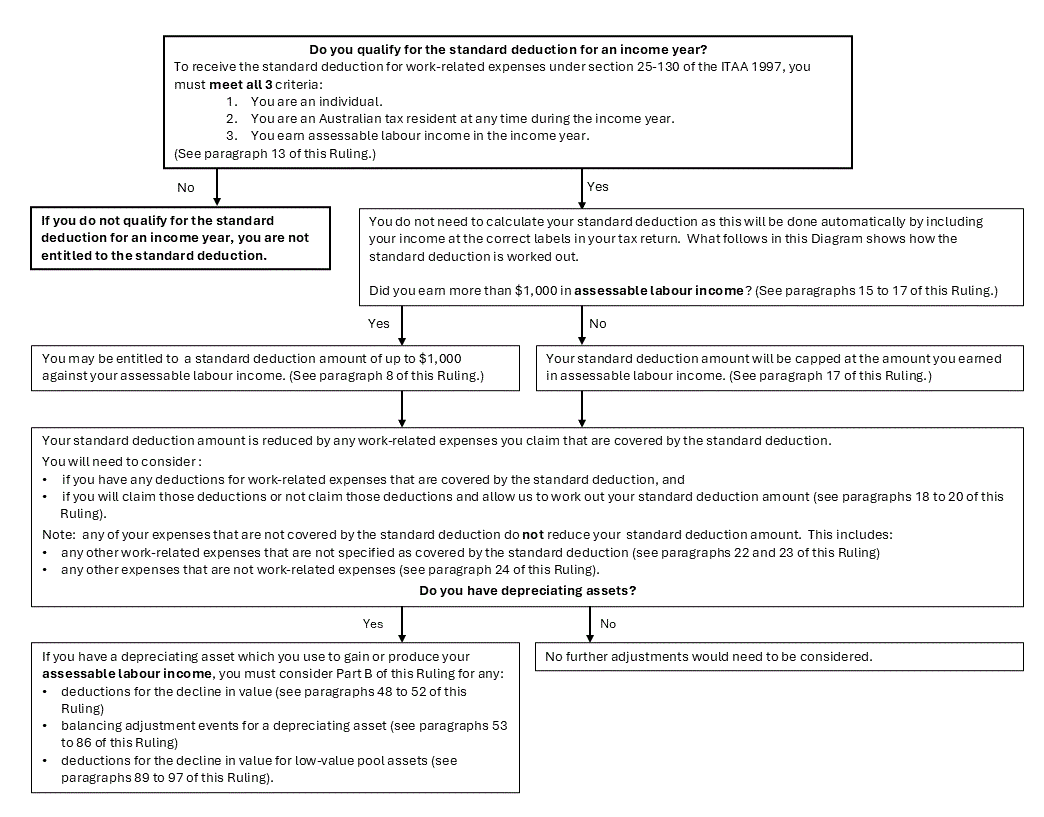
129. Diagram 1 of this Ruling shows how to apply the principles in Parts A and B of this Ruling.
Diagram 1: Guide to the application of Parts A and B of this Ruling
Applying Part C of this Ruling
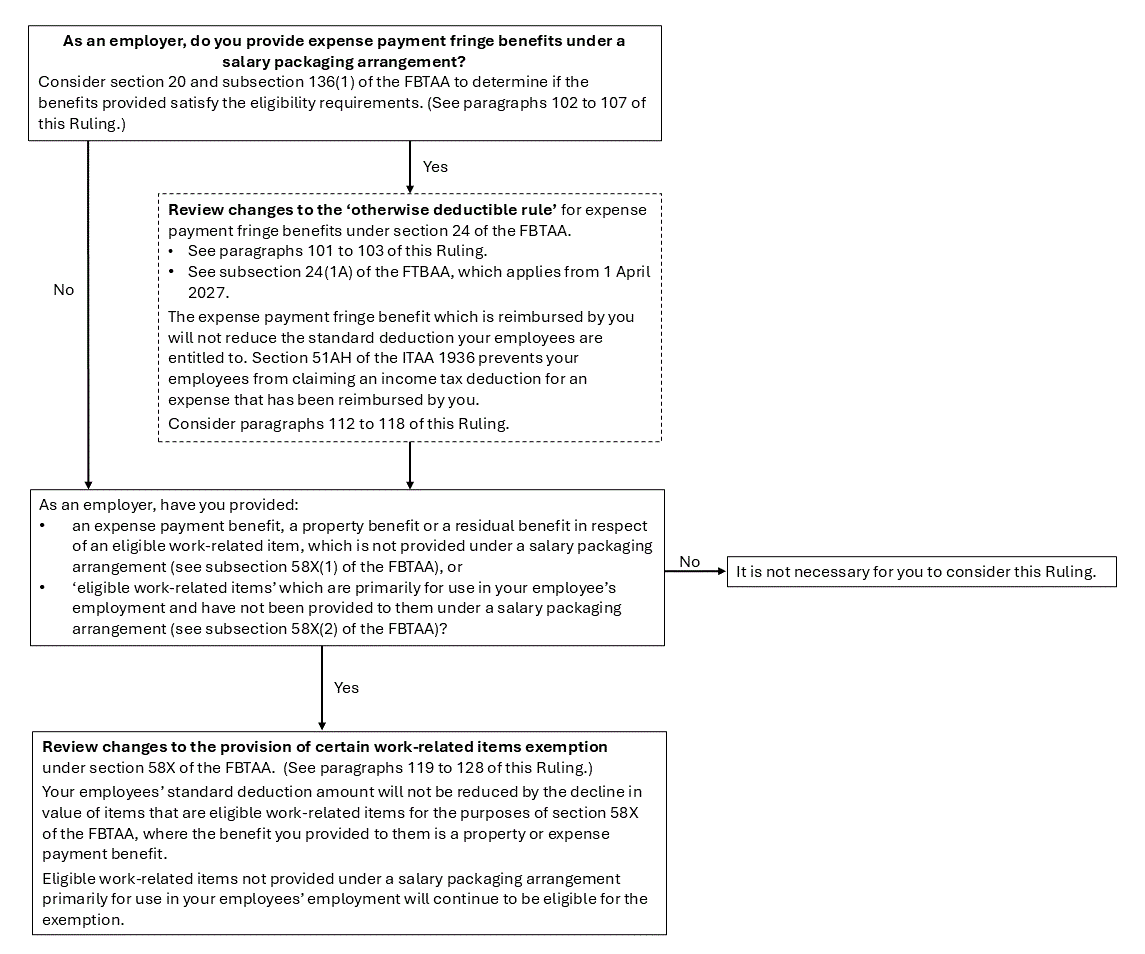
130. Diagram 2 shows how to apply the principles in Part C of this Ruling.
Diagram 2: Guide to the application of Part C of this Ruling
Appendix 2 – Compliance approach
|
This Appendix sets out a proposed practical administration approach to assist taxpayers in complying with relevant tax laws. When this Ruling is finalised, provided you follow the advice in this appendix in good faith and consistently with the Ruling section, the Commissioner will administer the law in accordance with this approach.
|
Laundry expenses claimed from 1 July 2026
131. The introduction of the standard deduction for work-related expenses replaced the need for subsection 900-40(1) that provided an exception to substantiation requirements for laundry expenses claimed up to $150.[77]
132. This compliance approach sets out the methodology[78] the Commissioner will accept, from 1 July 2026, to calculate your deduction for expenses incurred in relation to washing, drying or ironing clothes (but not dry cleaning) in producing your salary and wages. These expenses are referred to in this compliance approach as your 'laundry expenses'.[79]
133. If you are eligible to use this approach, the Commissioner will not have cause to apply compliance resources to investigate your claim for laundry expenses. You will be required to keep records to support your position that the compliance approach applies to you, including how you made your laundry expenses calculation. The substantiation requirements in Subdivision 900-B apply in relation to your claims for laundry expenses.[80]
Who is covered by this compliance approach
134. This compliance approach applies to individual taxpayers who:
- •
- have deductible laundry expenses
- •
- keep appropriate records of those expenses
- •
- have claimed all their work-related expenses for the income year.
135. Taxation Ruling TR 98/5 Income tax: calculating and claiming a deduction for laundry expenses details what sort of laundry expenses will be deductible.[81]
136. It is proposed that this compliance approach will apply for the 2026–27 income year and later income years.
137. The Commissioner will not have cause to apply compliance resources to review your deduction for laundry expenses for an income year if:
- •
- you have deductible laundry expenses of a type detailed in TR 98/5
- •
- you use the methodology outlined in paragraph 138 of this Ruling to calculate your laundry expenses deduction
- •
- the methodology is applied on a reasonable basis regarding your circumstances
- •
- you keep the records detailed in paragraphs 142 and 143 of this Ruling.
138. The Commissioner will accept the following methodology to calculate your laundry expense deduction for the income year:
- •
- $1 for a full load[82] of work-related laundry
- •
- 50c for a mixed load[83] of work-related and other laundry.
139. You must keep adequate records for the income year to demonstrate you incurred the laundry outgoings you are claiming and how the income-producing portion of the outgoings were calculated. If you are found not to have satisfied the requirements referred to in paragraph 142 of this Ruling, you may be required to provide these records.
140. This compliance approach does not alter or affect our interpretation of the law in any way, including the operation of the standard deduction for work-related expenses.
141. You are not required to apply the compliance approach to calculate your laundry expenses. Instead, you may choose to claim the standard deduction or your actual laundry expenses.
142. If you claim a deduction for laundry expenses and you want to rely on the methodology in paragraph 138 of this Ruling to calculate your deduction, you will need to keep sufficient records to demonstrate:
- •
- you have incurred eligible laundry expenses
- •
- how you have applied the methodology in paragraph 138 of this Ruling to estimate your deduction.
143. The records required include:
- •
- an explanation of why the laundry expenses are deductible
- •
- details of the number of washes undertaken during the income year, including details of whether the washes were full loads or mixed loads
- •
- evidence that laundry outgoings were incurred, and
- •
- supporting records of those outgoings, such as electricity, washing detergent and water bills.
144. When relying on this compliance approach, you should maintain records in accordance with paragraphs 142 and 143 of this Ruling. If, however, you are not eligible to use the compliance approach, you will only be able to claim laundry expenses with full substantiation.[84]
Example 15 – claiming laundry expenses using the methodology provided in this compliance approach
145. Richard works as a chef and is eligible for a standard deduction amount of $1,000 in the 2026–27 income year. Richard's employer requires him to wear a chef's uniform and protective clothing while performing his duties. These are deductible work-related clothing. During the income year, Richard washes these items separately from his private clothing in 100 full loads consisting solely of work-related clothing. Adopting the methodology in paragraph 138 of this Ruling, Richard calculates his laundry expenses as $100.[85]
146. During the income year Richard also incurs, and keeps records to substantiate, other deductible work-related expenses that are covered by the standard deduction, including food-handling certification costs and kitchen equipment expenses, totalling $2,700.
147. Richard decides to claim deductions for his work-related expenses totalling $2,800, as this provides a better outcome for him than the standard deduction. By claiming these deductions, his standard deduction amount is reduced to nil.
148. To support his claim for laundry expenses, Richard adopts the methodology in paragraph 138 of this Ruling and maintains records demonstrating the basis of his laundry expenses claim, including records of the number of work-related loads undertaken and evidence that he incurred expenses. Richard also retains appropriate substantiation for his other deductible expenses.
Appendix 3 – Your comments
149. You are invited to provide comments on this draft Ruling. Forward your comments to the contact officer by the due date.
150. A compendium of comments is prepared as part of the finalisation of this Ruling. An edited version of the compendium (names and identifying information removed) is published to the ATO Legal database on ato.gov.au.
151. Advise the contact officer if you do not wish for your comments to be included in the edited compendium.
| Due date: | 9 October 2026 |
| Contact officer: | Shaun Thomas |
| Email address: | IAIPAG@ato.gov.au |
| Phone: | 03 6235 6799 |
© AUSTRALIAN TAXATION OFFICE FOR THE COMMONWEALTH OF AUSTRALIA
You are free to copy, adapt, modify, transmit and distribute this material as you wish (but not in any way that suggests the ATO or the Commonwealth endorses you or any of your services or products).
Footnotes
For readability, all further references to 'this Ruling' refer to the Ruling as it will read when finalised. Note that this Ruling will not take effect until finalised.
Inserted by the Treasury Laws Amendment (Tax Reform No. 1) Act 2026.
Paragraph 4.5 of the Explanatory Memorandum to the Treasury Laws Amendment (Tax Reform No. 1) Bill 2026 (EM).
See paragraph 13 of this Ruling.
See paragraph 15 of this Ruling.
Paragraph 4.16 of the EM.
See paragraphs 18 and 19 of this Ruling.
See paragraphs 24 to 26 of this Ruling.
Taxation Ruling TR 2023/1 Income tax: residency tests for individuals.
Subsection 25-130(1).
Subsection 6-5(4).
Subsection 25-130(4).
Section 12-35 of Schedule 1 to the Taxation Administration Act 1953 (TAA).
Section 12-40 of Schedule 1 to the TAA.
Section 12-45 of Schedule 1 to the TAA.
Section 12-47 of Schedule 1 to the TAA.
Section 12-50 of Schedule 1 to the TAA.
Subdivision 12-C of Schedule 1 to the TAA.
Paragraph 12-110(1)(ca) of Schedule 1 to the TAA.
Paragraphs 25-130(2)(c) to (g).
Subsection 25-130(3) provides that some specific work-related expenses which are deductible under section 8-1 do not reduce the amount of the standard deduction. See paragraph 24 of this Ruling.
Refer to Taxation Ruling TR 2024/3 Income tax: deductibility of self-education expenses incurred by an individual.
Refer to Taxation Ruling TR 97/12 Income tax and fringe benefits tax: work related expenses: deductibility of expenses on clothing, uniform and footwear.
Refer to Taxation Ruling TR 93/30 Income tax: deductions for home office expenses.
Refer to Taxation Ruling TR 2021/4 Income tax and fringe benefits tax: employees: accommodation and food and drink expenses, travel allowances, and living-away-from-home allowances.
Refer to Taxation Ruling TR 2020/1 Income tax: employees: deductions for work expenses under section 8-1 of the Income Tax Assessment Act 1997.
Refer to Taxation Ruling TR 2021/1 Income tax: when are deductions allowed for employees' transport expenses?
Refer to TR 2021/1.
Paragraph 25-130(2)(f).
What is appropriate written evidence is described in sections 900-115 and 900-120. See also Law Administration Practice Statement PS LA 2005/7 Substantiating an individual's work-related expenses.
Subsection 25-130(3).
What is appropriate written evidence is described in sections 900-115 and 900-120. See also PS LA 2005/7.
Subsection 25-130(1) and paragraph 4.11 of the EM.
Unless another substantiation exception applies, such as the exception for domestic travel allowance expenses in section 900-50.
Under the general application of subsection 25-130.
Former section 900-35.
Former section 900-40.
Former section 900-45 and former Subdivision 900-I
Defined in section 40-30.
More information about decline in value deductions can be found in each year's Guide to depreciating assets.
Subsection 40-25(1).
Subsection 40-25(2).
Subsection 40-25(7). Other taxable purposes are mining exploration or prospecting, mine site rehabilitation and certain environmental protection activities.
Subsection 40-295(1).
Sections 40-285 and 40-370.
Subsections 40-285(1) and (2).
Subsection 40-25(2).
This section relates only to secondhand assets used in residential property.
Subsection 40-291A(1).
Subsection 40-291A(2).
For the 2026–27 income year, the decline in value is calculated as $1,000 × 365 days ÷ 365 days × 200% ÷ 4 years = $500. For the 2027–28 income year (which is a leap year), the decline in value is calculated as $500 × 366 ÷ 365 × 200% + 4 years = $250.68.
$500 - $250.68 = $249.32.
$450 - $249.32 = $200.68. When the amount is truncated, this equals $200.
Subsection 40-290(2).
Section 104-235.
Section 40-425. More information about what assets can be allocated to low-value pools and how the decline in value of those assets can be worked out can be found in each year's Guide to depreciating assets.
Section 40-440.
'Mainly' is not defined and so takes its ordinary meaning as 'chiefly; principally; for the most part' - refer to Pan Macmillan Australia (2026) Macquarie Dictionary Online, www.macquariedictionary.com.au, accessed 28 July 2026.
Subsection 40-425(9); item 17 of Part 1 of Schedule 4 of the Treasury Laws Amendment (Tax Reform No 1) Act 2026.
See Schedule 4, Part 2, Item 20 of the Treasury Laws Amendment (Tax Reform No 1) Act 2026.
Paragraph 4.9 of the EM.
Inserted by Schedule 4, Part 2, Item 18 of the Treasury Laws Amendment (Tax Reform No. 1) Act 2026.
As defined in subsection 136(1) of the FBTAA.
See paragraph 19 of this Ruling.
As defined in subsection 136(1) of the FBTAA.
A benefit referred to in section 20 of the FBTAA (see subsection 136(1) of the FBTAA).
A fringe benefit may also be provided by an associate of the employer or under an arrangement between a third party and the employer. See definition of 'fringe benefit' in subsection 136(1) of the FBTAA.
The meaning of 'reimburses' in section 20 was considered by the Federal Court in The Roads and Traffic Authority of New South Wales v Commissioner of Taxation [1993] FCA 445. Although not needing to decide the point, Hill J thought the payment amounting to the reimbursement would need to be referable to the actual expenditure said to have been reimbursed, '... that is to say there would need to be some correspondence between the payment and the expenditure incurred, even if the reimbursement were to be but part reimbursement'.
Section 24 of the FBTAA.
Section 51AH of the Income Tax Assessment Act 1936.
Subsection 58X(1) of the FBTAA.
Subsection 58X(2) of the FBTAA.
Schedule 4, Part 2, items 19 and 20 of the Treasury Laws Amendment (Tax Reform No. 1) Act 2026.
Subsection 58X(2) of the FBTAA.
Subsection 40-45(1).
Noting that subsection 58X(4) of the FBTAA, repealed with effect from 1 April 2027, provides that the test does not apply to portable electronic devices provided by an employer that meets the definition of 'small business entity' in subsection 136(1) of the FBTAA for the income year starting after the start of the FBT year or the income year ending after the start of the FBT year.
Paragraph 4.43 of the EM.
The methodology is based on the 'Commissioner's estimate' for calculating and claiming a deduction for laundry expenses (refer to paragraph 21 of Taxation Ruling TR 98/5 Income tax: calculating and claiming a deduction for laundry expenses).
Note the definition of laundry expense in subsection 995-1(1) was repealed (with effect from the 2026–27 income year) as a result of repealing sections in Division 900. See paragraph 4.43 of the EM.
Table item 1 of section 900-10.
See paragraphs 9 to 18 of TR 98/5.
A full load is where only work-related clothing is being laundered. See also paragraph 21 of TR 98/5.
A mixed load is where both private and work-related clothing is being laundered at the same time. See also paragraph 21 of TR 98/5.
See Example 4 in TR 98/5.
100 full loads × $1 per load = $100.
Not previously issued as a draft
References
ATO references:
NO 1-1BP41XFO
Legislative References:
FBTAA 20
FBTAA 24
FBTAA 24(1A)
FBTAA 58X
FBTAA 58X(1)
FBTAA 58X(2)
FBTAA 58X(3)
FBTAA 58X(4)
FBTAA 136(1)
ITAA 1936 51AH
ITAA 1997 8-1
ITAA 1997 25-10
ITAA 1997 25-100
ITAA 1997 25-125
ITAA 1997 25-130
ITAA 1997 25-130(1)
ITAA 1997 25-130(2)(c)
ITAA 1997 25-130 (2)(d)
ITAA 1997 25-130 (2)(e)
ITAA 1997 25-130(2)(f)
ITAA 1997 25-130(2)(g)
ITAA 1997 25-130(3)
ITAA 1997 25-130(4)
ITAA 1997 Div 28
ITAA 1997 28-180
ITAA 1997 SubDiv 40-B
ITAA 1997 40-25(1)
ITAA 1997 40-25(2)
ITAA 1997 40-45(1)
ITAA 1997 SubDiv 40-D
ITAA 1997 40-285
ITAA 1997 40-285(1)
ITAA 1997 40-285(2)
ITAA 1997 40-290
ITAA 1997 40-290(2)
ITAA 1997 40-291
ITAA 1997 40-291A(1)
ITAA 1997 40-291A(2)
ITAA 1997 40-295(1)
ITAA 1997 40-370
ITAA 1997 40-425
ITAA 1997 40-425(2)
ITAA 1997 40-425(5)
ITAA 1997 40-425(4)
ITAA 1997 40-425(8)
ITAA 1997 40-425(9)
ITAA 1997 104-235
ITAA 1997 104-240
ITAA 1997 104-240(1)
ITAA 1997 Subdiv 328-D
ITAA 1997 Div 355
ITAA 1997 900-35
ITAA 1997 900-40
ITAA 1997 900-45
ITAA 1997 900-50
ITAA 1997 900-115
ITAA 1997 900-120
ITAA 1997 Subdiv 900-I
ITAA 1997 995-1(1)
TAA 1953 Sch 1 12-35
TAA 1953 Sch 1 12-40
TAA 1953 Sch 1 12-45
TAA 1953 Sch 1 12-47
TAA 1953 Sch 1 12-50
TAA 1953 Sch 1 Subdiv 12-C
TAA 1953 Sch 1 12-110(1)(ca)
Treasury Laws Amendment (Tax Reform No.1) Act 2026
Case References:
The Roads and Traffic Authority of New South Wales v Commissioner of Taxation
[1993] FCA 445
43 FCR 223
93 ATC 4508
26 ATR 76
116 ALR 482
Other References:
PS LA 2005/7
Explanatory Memorandum to the Treasury Laws Amendment (Tax Reform No. 1) Bill 2026
Pan Macmillan Australia (2026) Macquarie Dictionary Online www.macquariedictionary.com.au