

Draft Law Companion Ruling
LCR 2026/D6
Total superannuation balance value
-
Please note that the PDF version is the authorised version of this draft ruling.For information about the status of this draft Ruling, see item 4181 on our Advice under development program
| Table of Contents | Paragraph |
|---|---|
| What this draft Ruling is about | |
| Date of effect | |
| Background | |
| Terms used in this Ruling | |
| Specific issues for guidance | |
| Part 1 – Total superannuation balance value of a superannuation interest | |
| Withdrawal benefit | |
| Interests that use the withdrawal benefit – just before 1 July 2026 | |
| Interests that use the withdrawal benefit – from 1 July 2026 | |
| Total superannuation balance value determined under the regulations | |
| Total superannuation balance value just before 1 July 2026 – transitional rule for defined benefit income streams | |
| How to apply the transitional rule | |
| Total superannuation balance value from 1 July 2026 | |
| Family Law Value | |
| Valuation methods from 1 July 2026 | |
| Item 1 in Table 1 of this Ruling – defined benefit interests not in the retirement phase | |
| Items 2 and 3 in Table 1 of this Ruling – defined benefit income streams | |
| Items 4 and 5 in Table 1of this Ruling – retirement phase interests with no Family Law Value and certain innovative income streams | |
| Item 6 in Table 1 of this Ruling – other innovative income streams | |
| Valuation methods – defined benefit interests and defined benefit income streams | |
| Family Law Value Method | |
| Alternative Valuation Method | |
| Issuing alternative valuation certificates | |
| Withdrawing alternative valuation certificates | |
| Vested Benefits Method | |
| Eligibility for the Vested Benefits Method | |
| Applying the Vested Benefits Method just before 1 July 2027 | |
| Examples | |
| Example 1 – interests not in the retirement phase – just before 1 July 2026 | |
| Example 2 – interests not in the retirement phase – just before 1 July 2027 | |
| Example 3 – interests in the retirement phase – just before 1 July 2026 | |
| Example 4 – interests in the retirement phase – just before 1 July 2027 | |
| Part 2 – Total superannuation balance value modifications for superannuation interests subject to a payment split | |
| Notional interest of a non-member spouse | |
| Total superannuation balance value of a notional interest | |
| Base amount payment splits | |
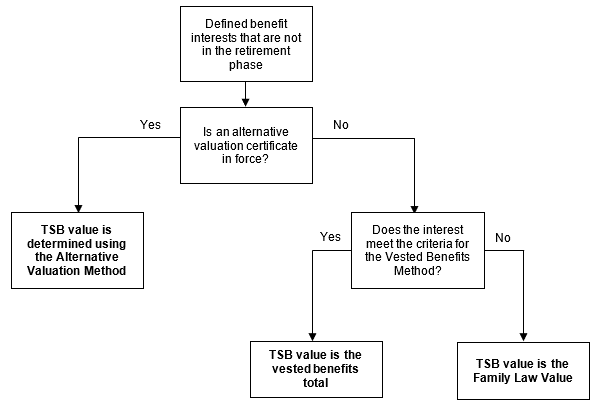
| Base amount payment splits – interests not in the retirement phase | |
| Base amount payment splits – interests in the retirement phase | |
| Percentage payment splits | |
| Percentage payment splits – general rule | |
| Total superannuation balance value of member spouse's interest | |
| Modifications to total superannuation balance value of the member spouse's interest | |
| Examples | |
| Example 5 – total superannuation balance values where there is a notional interest | |
| Example 6 – total superannuation balance values where an interest has more than one notional interest | |
| Appendix 1 – Changes in valuation of interests for total superannuation balance purposes | |
| Appendix 2 – Your comments |
 Relying on this draft Ruling This publication is a draft for public comment and represents the Commissioner's preliminary view only on how a relevant provision could apply. If this draft Ruling applies to you and you rely on it reasonably and in good faith, you will not have to pay any interest or penalties in respect of the matters covered, if this draft Ruling turns out to be incorrect and you underpay your tax as a result. However, you may still have to pay the correct amount of tax. When finalised, this Ruling will be legally binding on the Commissioner, except to the extent that it makes statements regarding the operation of Division 296 of the Income Tax Assessment Act 1997 and associated regulations. |
What this draft Ruling is about
1. This draft Ruling[1] outlines how to calculate the total superannuation balance value (TSB value) of a superannuation interest.
2. The Ruling is divided into 2 parts:
- •
- Part 1 (paragraphs 11 to 115 of this Ruling) explains how to determine the TSB value of a superannuation interest
- •
-
Part 2
(paragraphs 116 to 170 of this Ruling) explains how to determine the TSB value of
- –
- a superannuation interest subject to a payment split where the non-member spouse cannot become a member of the plan, and
- –
- the associated notional interest of the non-member spouse.
3. All legislative references in this Ruling are to the Income Tax Assessment Act 1997 (ITAA 1997), unless otherwise indicated.
4. When the final Ruling is issued, it is proposed to apply from 30 June 2026.
Background
5. An individual's total superannuation balance[2] is relevant for determining the application of certain provisions within the ITAA 1997.[3] The way an individual's total superannuation balance is determined changed from just before 1 July 2026, alongside the introduction of Division 296.[4]
6. An individual's total superannuation balance, at a particular time, includes the sum of the values of their superannuation interests. It also includes the value of certain interests they are receiving (or may receive) a superannuation benefit from.[5]
7. The value of each relevant interest included in an individual's total superannuation balance is determined using a new concept – the TSB value.
8. In addition to being included in an individual's total superannuation balance, the TSB value of certain superannuation interests is used to determine an individual's relevant superannuation earnings, which is used to determine liability to Division 296 tax.[6]
9. A summary of how these changes will impact the amount included in an individual's total superannuation balance in respect of specific types of superannuation interest is provided at Appendix 1 to this Ruling.
10. This Ruling uses the following terms:
- •
-
Account-based income stream
means any of the following superannuation income streams[7]
- •
- Alternative Valuation Method means the method described in paragraphs 62 to 64 of this Ruling.
- •
- Defined benefit interest has the meaning given by section 291-175.
- •
- Defined benefit income stream means a superannuation income stream that is not an account-based income stream. These income streams are generally not supported by an account balance and include innovative income streams.
- •
- Family Law Value of an interest is described in paragraph 35 of this Ruling. An interest will only have a Family Law Value where it meets the conditions in paragraph 35 of this Ruling. The Family Law Value is calculated using the Family Law Value Method.
- •
- Family Law Value Method means the method described in paragraphs 57 to 61 of this Ruling.
- •
- Innovative income stream means a superannuation income stream provided under a contract or rules that meet the standards of subregulation 1.06A(2) of the Superannuation Industry (Supervision) Regulations 1994.
- •
- ITAR (1997 Act) 2021 means the Income Tax Assessment (1997 Act) Regulations 2021.
- •
- Notional interest means the interest a non-member spouse is taken to have when the conditions in paragraph 123 of this Ruling are met.
- •
-
Withdrawal benefit
means the amount payable if[14]
- –
- the individual to whom a superannuation interest relates had the right to cause the interest to cease at that time, and
- –
- the individual voluntarily caused the superannuation interest to cease at that time.
- •
- RSA Regulations means the Retirement Savings Account Regulations 1997.
- •
- SISR means the Superannuation Industry (Supervision) Regulations 1994.
- •
- SISA means the Superannuation Industry (Supervision) Act 1993.
- •
- SMSF means a self managed superannuation fund.[15]
- •
- Vested Benefits Method means the method described in paragraphs 74 to 77 of this Ruling.
Specific issues for guidance
Part 1 – Total superannuation balance value of a superannuation interest
11. There are 2 different ways of determining the TSB value of a superannuation interest[16]:
- •
- if the ITAR (1997 Act) 2021 specifies a value or method for determining a value, its TSB value is that value or the value determined in accordance with the specified method, or
- •
- if no value or method for determining a value is specified in the regulations for the interest, its TSB value is its withdrawal benefit.
12. Most superannuation interests will be valued using their withdrawal benefit.
13. The ITAR (1997 Act) 2021 specifies the TSB value or a method to determine it for superannuation interests that would not be accurately valued using their withdrawal benefit. The value or method prescribed is different depending on whether the time for the TSB value of the interest to be determined is:
- •
- just before 1 July 2026, or
- •
- on or after 1 July 2026.
14. Part 1 of this Ruling explains:
- •
- how the TSB value of a superannuation interest is determined using the withdrawal benefit and which superannuation interests it applies to at a particular time
- •
- how the TSB value of a superannuation interest is determined using the ITAR (1997 Act) 2021 and which interests it applies to at a particular time, and
- •
- the valuation methods contained in the regulations that apply to determine the TSB value of defined benefit interests and defined benefit income streams.
15. In addition to the rules outlined in Part 1 of this Ruling, there are also specific rules that apply where the relevant superannuation interest is subject to a payment split, but the non-member spouse is unable to become a member of the superannuation plan. Those rules outline how to determine the TSB value of the member spouse's interest and non-member spouse's notional interest. Further guidance on those rules can be found in Part 2 of this Ruling.
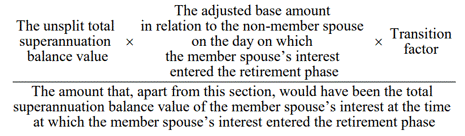
16. Where an interest is supported by an account balance, its TSB value will generally be the withdrawal benefit. It is the default method used where the ITAR (1997 Act) 2021 does not specify another way to determine the TSB value for the interest.
17. In practice, the TSB value of most interests will be the withdrawal benefit, whether or not they are in the retirement phase.
18. The provisions in the ITAR (1997 Act) 2021 that specify how to determine the TSB value of superannuation interests apply from 1 July 2026, with a transitional rule applying to some interests just before 1 July 2026. This means the TSB value of the same interest may be determined differently depending on whether the calculation relates to just before 1 July 2026 or after that time.
Interests that use the withdrawal benefit – just before 1 July 2026
19. The only provisions in the ITAR (1997 Act) 2021 that prescribe a method for determining the TSB value of an interest just before 1 July 2026 apply to interests that support defined benefit income streams in the retirement phase.
20. This means the withdrawal benefit is used to determine the TSB value of all other interests at that time.
21. The TSB value of the following superannuation interests will be its withdrawal benefit just before 1 July 2026[17]:
- •
- all superannuation interests that are not in the retirement phase, and
- •
- all superannuation interests that are in the retirement phase and support an account-based income stream.
Interests that use the withdrawal benefit – from 1 July 2026
22. The ITAR (1997 Act) 2021 includes provisions that prescribe how to determine the TSB value of various interests from 1 July 2026. The withdrawal benefit is used to determine the TSB value of all other interests, which are generally ones that are supported by an account balance.
23. The TSB value on or after 1 July 2026 of the following superannuation interests is its withdrawal benefit:
- •
- Interests that are not in the retirement phase, other than where they are
- –
- a defined benefit interest that has a Family Law Value[18]
- –
- an interest supporting an income stream payable under sections 16 or 26 of the Australian Defence Force Cover Act 2015[19]
- –
- an interest supporting an income stream payable under section 123 of the Federal Circuit and Family Court of Australia Act 2021[20], or
- –
- an interest supporting a deferred superannuation income stream.[21]
- •
- Interests that are in the retirement phase[22] and support an account-based income stream.
Total superannuation balance value determined under the regulations
24. The ITAR (1997 Act) 2021 contains methods used to determine the TSB value of an interest:
- •
- A transitional rule applies to determine the TSB value of interests supporting a defined benefit income stream just before 1 July 2026.
- •
- Other methods are prescribed to work out the TSB value of defined benefit interests, and interests supporting a defined benefit income stream, from 1 July 2026.
Total superannuation balance value just before 1 July 2026 – transitional rule for defined benefit income streams
25. The new method for determining an individual's total superannuation balance, including using the TSB value of an interest, applies from just before 1 July 2026. However, the new methods for determining the TSB value of an interest in the ITAR (1997 Act) 2021 only commenced on 1 July 2026.[23]
26. Without a specific provision in the regulations setting out how to determine TSB value just before 1 July 2026, all superannuation interests would be valued using their withdrawal benefit. Using the withdrawal benefit may have caused a significant change in the amount included in an individual's total superannuation balance in respect of some retirement phase superannuation interests.[24]
27. The ITAR (1997 Act) 2021 contains a transitional rule[25] for determining the TSB value of superannuation interests that are supporting defined benefit income streams just before 1 July 2026. While the method is different to that which applies before 30 June 2026, it ensures the individual's total superannuation balance will be the same as if it was determined using the method that was in place before 30 June 2026.[26]
How to apply the transitional rule
28. The transitional rule applies to determine the TSB value just before 1 July 2026 for the following interests in respect of an individual:
- •
- their superannuation interests in the retirement phase that support a defined benefit income stream
- •
- superannuation interests they are receiving a death benefit income stream from that is a defined benefit income stream in the retirement phase, and
- •
- notional interests they have, where the member interest connected to it is supporting a defined benefit income stream that is in the retirement phase (whether the recipient of the income stream is the member or the member's dependant after their death).
29. The transitional rule operates as follows for each individual with one of the interests listed at paragraph 28 of this Ruling:
- •
-
Step 1:
Determine the adjusted transfer balance account balance of the individual. This is the transfer balance of their transfer balance account, less the following transfer balance credits and transfer balance debits that relate to account-based income streams
- •
- Step 2: Determine how many superannuation interests will have their TSB value determined using the transitional rule for the individual (transitional rule interests).
- •
- Step 3: The TSB value of each transitional rule interest of the individual is the amount determined under the following formula (unless it produces a negative value, in which case it is nil)

30. The ATO will determine the TSB value of any interests that use the transitional rule based on existing transfer balance account reporting.
Total superannuation balance value from 1 July 2026
31. The ITAR (1997 Act) 2021 sets out different methods for determining TSB value from 1 July 2026, depending on the characteristics of the interest and any income stream it is supporting.
32. From 1 July 2026, the TSB value of the following interests is determined using the relevant method specified in the ITAR (1997 Act) 2021 for that type of interest:
- •
- defined benefit interests that are not in the retirement phase and have a Family Law Value
- •
- interests in the retirement phase that are supporting defined benefit income streams
- •
- interests that support the following products, whether they are in the retirement phase or not
- –
- innovative income streams
- –
- invalidity pensions paid under sections 16 or 26 of the Australian Defence Force Cover Act 2015
- –
- invalidity pensions paid under section 123 of the Federal Circuit and Family Court of Australia Act 2021.
33. These valuation methods will be used for determining TSB value for various purposes, including:
- •
- calculation of relevant superannuation earnings from 1 July 2026 for an interest that meets the conditions of subsection 296-65(2)[29], and
- •
- annual total superannuation balance calculations just before 1 July 2027 and for later income years.
34. A key concept for determining how, or if, the TSB value methods in the ITAR (1997 Act) 2021 apply is the Family Law Value. Certain valuation methods only apply where the interest has a Family Law Value.
35. An interest will have a Family Law Value where at that time[30]:
- •
- a method or factor has been approved to be used to determine the gross value of the interest under sections 62 or 70 of the Family Law (Superannuation) Regulations 2025[31]
- •
- Schedule 3, 5, 7 or 8[32] to the Family Law (Superannuation) Regulations 2025 sets out a method for determining the gross value of the interest on that day, or
- •
- Schedule 6 or 9[33] to the Family Law (Superannuation) Regulations 2025 sets out a method for determining the value of the interest on that day.
36. Interests in SMSFs may have a Family Law Value even though they are generally prevented from using the valuation methods in the Family Law (Superannuation) Regulations 2025 for family law splits.[34]
37. If the interest cannot be valued using a method set out in paragraph 35 of this Ruling, it will not have a Family Law Value. This is the case even if it can be valued using a different method set out in the Family Law (Superannuation) Regulations 2025.
Valuation methods from 1 July 2026
38. Table 1 of this Ruling provides a directional reference to the paragraphs in this Ruling which set out the regulation methods used for determining the TSB value of different types of interests. Further detail on each item listed in Table 1 of this Ruling can be found at paragraphs 40 to 55 of this Ruling.
| Item | Interest types | Paragraph references in this Ruling |
| 1 | Defined benefit interests that:
|
Paragraphs 40 to 43 and Diagram 1 at paragraph 44.
An explanation of each method and when they apply is at paragraphs 56 to 82. |
| 2 | Interests that are:
|
Paragraphs 45 to 47.
An explanation of each method and when they apply is at paragraphs 56 to 82. |
| 3 | Interests that support the following income streams (whether in retirement phase or not):
|
Paragraphs 45 to 47.
An explanation of each method is at paragraphs 56 to 82. |
| 4 | Interests that:
|
Paragraphs 48 to 53. |
| 5 | Interests that support innovative income streams covered by one of the following sections within the ITAR (1997 Act) 2021, whether they are in the retirement phase or not:
|
Paragraphs 48 to 53. |
| 6 | Interests that support innovative income streams other than those mentioned in table item 5 of subsection 294-25(1), whether they are in the retirement phase or not. | Paragraphs 54 to 55. |
39. Due to the way the valuation methods operate, the same interest may change valuation methods by moving in or out of retirement phase. For instance, where a defined benefit interest that is not in the retirement phase starts supporting a lifetime pension, the method used to value it may change. This can cause an increase or decrease in TSB value depending on the nature of the interest and superannuation income stream that commences.
Item 1 in Table 1 of this Ruling – defined benefit interests not in the retirement phase
40. The ITAR (1997 Act) 2021 sets out several methods used to determine the TSB value of a superannuation interest that:
- •
- is a defined benefit superannuation interest
- •
- is not in the retirement phase, and
- •
- has a Family Law Value.[35]
41. Which method applies depends on the nature of the interest and whether other criteria are met. The methods are the:
- •
- Family Law Value Method (see paragraphs 57 to 61 of this Ruling)
- •
- Alternative Valuation Method (see paragraphs 62 to 73 of this Ruling)
- •
- Vested Benefits Method (see paragraphs 74 to 82 of this Ruling).
42. The Family Law Value Method is the default valuation method. It will apply unless there is an alternative valuation certificate in force for the interest or the interest meets the criteria to apply the Vested Benefits Method.
43. The following steps determine which method is used to work out the TSB value of the interest[36]:
- •
- Step 1: Determine if there is an alternative valuation certificate in force. If there is, the TSB value will be determined using the method in the certificate (the Alternative Valuation Method, as described in paragraphs 62 to 73 of this Ruling). If there is not an alternative valuation certificate in force, go to Step 2.
- •
- Step 2: Determine if the interest meets the criteria for the Vested Benefits Method (as described in paragraphs 78 to 79 of this Ruling). If it does, the TSB value will be the vested benefits total. If the interest does not meet the Vested Benefits Method criteria, go to Step 3.
- •
- Step 3: The TSB value will be the Family Law Value, determined using the Family Law Value Method (as described in paragraphs 57 to 61 of this Ruling).
44. Diagram 1 of this Ruling illustrates which method is used to work out the TSB value of defined benefit interests that are not in the retirement phase and have a Family Law Value.[37]
Diagram 1: Defined benefit interests not in the retirement phase
Items 2 and 3 in Table 1 of this Ruling – defined benefit income streams
45. The ITAR (1997 Act) 2021 sets out 2 methods used to determine the TSB value of the superannuation interests set out in items 2 and 3 in Table 1 of this Ruling. Those items refer to an interest:
- •
- in the retirement phase that
- –
- has a Family Law Value, and
- –
- is supporting a defined benefit income stream that is not an innovative income stream, or
- •
- that supports a pension payable under sections 16 or 26 of the Australian Defence Force Cover Act 2015, or
- •
- that supports a pension payable under section 123 of the Federal Circuit and Family Court of Australia Act 2021.
46. Which method applies depends on the nature of the interest and whether other criteria are met. The methods are the:
- •
- Alternative Valuation Method (see paragraphs 62 to 73 of this Ruling), or
- •
- Family Law Value Method (see paragraphs 57 to 61 of this Ruling).
47. The TSB value of the interest is determined as follows[38]:
- •
- where there is an alternative valuation certificate in force for the interest, the TSB value is determined using the Alternative Valuation Method.
- •
- if there is no alternative valuation certificate in force for the interest, the TSB value is the Family Law Value, determined using the Family Law Value Method.
Items 4 and 5 in Table 1 of this Ruling – retirement phase interests with no Family Law Value and certain innovative income streams
48. The TSB value for interests listed in items 4 and 5 in Table 1 of this Ruling are determined using section 307-205, which provides the general method for determining the value of an interest in the ITAA 1997.[39]
49. The TSB value of a superannuation interest will be determined under section 307-205 where it:
- •
- is in the retirement phase, supports a defined benefit income stream and does not have a Family Law Value[40], or
- •
- supports an innovative income stream (whether in the retirement phase or not) that meets the conditions of one of the following sections of the ITAR (1997 Act) 2021[41]
50. Section 307-205 states the value of an interest at a particular time is:
- •
- if the regulations specify a method for determining the value – that value, or
- •
- otherwise – the total amount of all the superannuation lump sums that could be payable from the interest at that time.
51. Regulations have been made for the purposes of paragraph 307-205(1)(a)[45], which provide methods for valuing interests depending on the characteristics of the interest and the type of any superannuation income stream it is supporting.
52. The TSB value of an innovative income stream mentioned in paragraph 49 of this Ruling is determined as follows:
- •
- where the interest supports a deferred superannuation income stream that meets the requirements of subsection 307-205.02C(1) of the ITAR (1997 Act) 2021, the TSB value is the amount determined under section 307-205.02C
- •
- where the interest supports a pooled investment pension, the TSB value is the amount determined under section 307-205.02D of the ITAR (1997 Act) 2021
- •
- where the interest supports a pooled investment annuity, the TSB value is the amount determined under section 307-205.02E of the ITAR (1997 Act) 2021.
53. The TSB value of defined benefit income streams relevant to item 4 in Table 1 of this Ruling will be determined under the relevant regulation made for section 307-205 that applies to the interest. This is:
- •
- section 307-205.02 of the ITAR (1997 Act) 2021
- •
- section 307-205.02A of the ITAR (1997 Act) 2021, or
- •
- section 307-205.02B of the ITAR (1997 Act) 2021.
Item 6 in Table 1 of this Ruling – other innovative income streams
54. The TSB value for interests described in item 6 in Table 1 of this Ruling is the maximum commutation amount.[46] These are superannuation interests that support an innovative income stream that is not listed in item 5 of Table 1 of this Ruling.
55. The maximum commutation amount of the interest is the value determined under paragraph 1.06B(1)(c) of the SISR. It is the maximum amount that can be paid on commutation in order to meet the requirements of an innovative income stream set out in regulation 1.06A of the SISR.[47]
Valuation methods – defined benefit interests and defined benefit income streams
56. As outlined in paragraphs 40 to 47 of this Ruling, there are several methods that may be used to determine the TSB value of interests listed in items 1 to 3 in Table 1 of this Ruling. Paragraphs 57 to 82 of this Ruling provide further details regarding these methods and how to use them to determine the TSB value of a superannuation interest.
57. Where the TSB value is determined using the Family Law Value Method, it is valued based on one of the methods in the Family Law (Superannuation) Regulations 2025.
58. The Family Law (Superannuation) Regulations 2025 provide default valuation methods and values for various types of superannuation interests for the purpose of dividing assets in a family law separation. A superannuation fund trustee may also apply for a specific method or factor to be approved under the Family Law (Superannuation) Regulations 2025 which applies to value interests in the fund.[48]
59. Paragraph 35 of this Ruling outlines when a superannuation interest has a Family Law Value. Where an interest has a Family Law Value, the TSB value is determined as follows[49]:
- (a)
- If a specific method or factor has been approved to determine the gross value of the interest under section 62 or 70 of the Family Law (Superannuation) Regulations 2025 – the Family Law Value is the gross value determined under that method or factor.
- (b)
- If subparagraph 59(a) of this Ruling does not apply and Schedule 3, 5, 7, or 8 to the Family Law (Superannuation) Regulations 2025 sets out a method for determining the gross value of the interest on that day – the Family Law Value is the gross value determined under that method.
- (c)
- If subparagraphs 59(a) and (b) of this Ruling do not apply and Schedule 6 or 9 to the Family Law (Superannuation) Regulations 2025 sets out a method for determining the value of the interest on that day – the Family Law Value is the value determined under that method.
60. There are also modifications that apply when determining the TSB value using the Family Law Value Method.[50] Most of these modifications allow the wording in the Family Law (Superannuation) Regulations 2025 and the ITAR (1997 Act) 2021 to have a consistent meaning and apply properly.[51] However, the following specific modifications also apply:
- •
- The valuation rules can apply for the purposes of working out the TSB value of an interest in an SMSF, even though the Family Law (Superannuation) Regulations 2025 cannot normally be used for these interests.[52]
- •
- If any provision in the Family Law (Superannuation) Regulations 2025 applies differently depending on the member's gender, the member is to be treated as being male.[53]
- •
- If any method or factor in paragraph 59 of this Ruling applies differently depending on whether there is a reversionary beneficiary, the member is to be treated as though there is not, and will not be, a reversionary beneficiary.[54]
61. The Family Law (Superannuation) Regulations 2025, and approved methods and factors, set out different methods for valuing superannuation interests depending on whether the interest is in the retirement phase[55] and which type of superannuation income stream it is supporting. As such, if a member commences a superannuation income stream, it may cause a change in TSB value even if the Family Law Value Method is used both before and after the income stream is commenced.
62. The Alternative Valuation Method[56] allows a superannuation actuary to certify a valuation method can be used to determine the TSB value of an interest. It can be used where an existing valuation method would provide a similar value to the Family Law Value, to reduce potential costs to superannuation providers.[57]
63. To be eligible for this method:
- •
- the interest must be in a defined benefit fund
- •
- the interest must have a Family Law Value, and
- •
- a certificate issued under section 307-230A.06 of the ITAR (1997 Act) 2021 must be in force in relation to the interest (in this Ruling, this certificate is referred to as an 'alternative valuation certificate').
64. The Alternative Valuation Method is the method specified in the alternative valuation certificate.
Issuing alternative valuation certificates
65. A superannuation actuary can issue an alternative valuation certificate in relation to specified superannuation interests in a particular defined benefit fund if requested by the superannuation fund's trustee and the actuary is of the opinion that the following criteria are met at a specified time[58]:
- •
- all the specified interests have Family Law Values
- •
- if the value of all specified interests, at the specified time, were determined using the specified method, the value determined for at least 95% of those interests would be
- –
- not less than 90% of the Family Law Value of the interest, and
- –
- not greater than 110% of the Family Law Value of the interest.
66. The method specified in the certificate must[59]:
- •
- be used by the trustee to determine the value of the interests just before 1 July 2026, or
- •
- treat the vested benefits total as being the value of the interest, if no method was used to determine the value just before 1 July 2026.
67. The interests specified in the alternative valuation certificate must either be all the superannuation interests in the fund or all the interests of members who belong to a specified benefit category.[60]
68. A valid alternative valuation certificate must be in writing and include the[61]:
- •
- fund's name
- •
- superannuation actuary's name, and
- •
- superannuation actuary's opinion that the specified Alternative Valuation Method meets the criteria listed in paragraph 65 of this Ruling.
69. The alternative valuation certificate will come into force at the time specified in the certificate, even if that time is before it was issued.[62] It ceases to be in force at the earliest of the following times[63]:
- •
- the end of 3 years from when the certificate comes into force
- •
- when it is withdrawn in accordance with paragraph 72 of this Ruling, and
- •
- when another alternative valuation certificate comes into force that relates to any of the superannuation interests in the current certificate.
70. However, a certificate is not in force at a particular time if[64]:
- •
- before the certificate is issued, the trustee of the fund has given the Commissioner a statement under subsection 390-5(1) of Schedule 1 to the Taxation Administration Act 1953 in relation to an individual who holds any of the interests specified in the certificate, and
- •
- the statement contains the TSB value at that time of any of the specified interests.
71. This ensures that a retrospectively issued certificate cannot override previously reported values.
Withdrawing alternative valuation certificates
72. An alternative valuation certificate can be withdrawn by the fund's trustee in writing at any time while the certificate is in force.[65] However, it must be withdrawn by a superannuation actuary if they form the opinion while performing their functions under the ITAA 1997, the ITAR (1997 Act) 2021, the SISA or the SISR that the Alternative Valuation Method specified in the certificate does not meet requirements outlined in paragraph 65 of this Ruling.[66] If a superannuation actuary withdraws an alternative valuation certificate, the withdrawal must be in writing and given to the trustee of the defined benefit fund.[67]
73. However, any TSB value determined using the Alternative Valuation Method before the certificate is withdrawn remains valid and accurate.
74. The Vested Benefits Method[68] provides a simplified method that can be used by funds where it is unlikely to result in an undervaluation compared to the Family Law Value Method.
75. Where the criteria to use the Vested Benefits Method are met, the TSB value of the interest will be the vested benefits total. The vested benefits total for an interest is the total value of the superannuation benefits an individual would be entitled to if, at that time, the individual[69]:
- •
- had the right to cause the interest to cease and voluntarily caused it to cease, or
- •
- became eligible to receive a SIS pension or RSA pension supported by the interest[70] or to a deferred benefit of the superannuation interest.
76. In this context, a deferred benefit is a right or interest that was part of a defined benefit interest and became deferred after the member ceased contributing to the scheme. It will remain a deferred benefit until the member becomes eligible to receive the benefit.
77. The vested benefits total must be calculated in accordance with the accounting standards in force at that time (even if the standard does not otherwise apply to the superannuation fund).[71]
Eligibility for the Vested Benefits Method
78. The Vested Benefits Method can only apply in relation to an interest at a time (the application time) where all the following conditions apply[72]:
- •
- There is a Family Law Value for the interest.
- •
- The interest can never support a superannuation income stream.
- •
- The interest cannot cease in order to commence another superannuation interest in the fund that supports a superannuation income stream.
- •
- Twelve months before the application time (the test time), one of the following applied
- –
- the Vested Benefits Method applied in relation to the interest and the vested benefits total of the interest was 50% or less of the large superannuation balance threshold at the test time
- –
- if the interest arose in the 12 months before the application time as a direct result of a successor fund transfer[73], the member's interest in the original fund did not exist, or
- –
- if the interest did not arise as a direct result of a successor fund transfer, the interest did not exist.
- •
- The interest does not support and can never support either of the following
- –
- a military invalidity income stream[74]
- –
- a pension to which any of the paragraphs of subsection 307-70.02(1A) of the ITAR (1997 Act) 2021 applies. These are specific pensions payable to the spouse or child of a member who was receiving certain types of military invalidity income streams.
79. However, a reference in paragraph 78 of this Ruling to a superannuation income stream does not include a superannuation income stream that is payable to a person because of the person's[75]:
- •
- temporary inability to engage in gainful employment, or
- •
- permanent inability to engage in gainful employment for which the person is reasonably qualified by education, training or experience.
Applying the Vested Benefit Method just before 1 July 2027
80. The Vested Benefits Method only applies from just before 1 July 2027. As the criteria to use the method requires the consideration of circumstances 12 months prior, a transitional rule is in place to ensure it can operate correctly.
81. The transitional rule[76] operates in working out whether the criteria for the Vested Benefits Method have been met prior to the end of 30 June 2028. This includes any day before 30 June 2028, including for the determination of TSB value just before 1 July 2027.
82. The transitional rule contains the following modifications to the criteria outlined in paragraph 78 of this Ruling:
- •
- disregard the reference to the Vested Benefits Method being applied in relation to the interest 12 months before the application time, and
- •
- the value (rather than the vested benefits total) of the interest must have been 50% or less of the large superannuation balance threshold at the test time.
Example 1 – interests not in the retirement phase – just before 1 July 2026
83. Kaori has 2 different superannuation interests:
- •
- a defined benefit interest in the Solister Superannuation Fund
- •
- an interest in the Atropa Superannuation Fund that is not a defined benefit interest.
84. At the end of 30 June 2026, Kaori is 50 years old and her superannuation interests are not in the retirement phase.
85. As neither superannuation interest is in the retirement phase, the TSB value of both interests just before 1 July 2026 is their withdrawal benefit. Kaori's superannuation funds determine that the withdrawal benefit of the interests at that time are as follows:
- •
- The TSB value of Kaori's interest in Solister Superannuation Fund is $1,000,000.
- •
- The TSB value of Kaori's interest in Atropa Superannuation Fund is $500,000.
Example 2 – interests not in the retirement phase – just before 1 July 2027
86. Following on from Example 1 of this Ruling, Kaori's superannuation funds are required to determine the TSB value of their members' interests just before 1 July 2027. At that time, Kaori is 51 years old and neither of her superannuation interests are in the retirement phase.
87. Kaori's interest in Solister Superannuation Fund:
- •
- has a Family Law Value
- •
- has an alternative valuation certificate that is in force in relation to the interest, and
- •
- meets the criteria for the Vested Benefits Method.
88. Kaori's interest in Solister Superannuation Fund will be valued using the Alternative Valuation Method, as that is the first method that applies to the interest under the steps outlined in paragraph 43 of this Ruling. Since the steps are applied in order, it does not matter that the interest may meet the criteria for other methods. Solister Superannuation Fund determines that the TSB value of Kaori's interest under that method is $1,100,000.
89. Kaori's interest in Atropa Superannuation Fund is not a defined benefit interest. The TSB value is therefore the withdrawal benefit. Atropa Superannuation Fund determines that the withdrawal benefit of the interest is $510,000.
90. Just before 1 July 2027, Kaori's interests are valued as follows:
- •
- The TSB value of Kaori's interest in Solister Superannuation Fund is $1,100,000.
- •
- The TSB value of Kaori's interest in Atropa Superannuation Fund is $510,000.
Example 3 – interests in the retirement phase – just before 1 July 2026
91. Brodi is 60 years old and is a member of 3 different superannuation funds. Brodi retires in March 2026 and, from April 2026, begins receiving a separate superannuation income stream from his interest in each of the 3 funds.
92. Brodi did not previously have a transfer balance account. On the commencement of the superannuation income streams, Brodi's transfer balance account had the following transfer balance credits applied:
- •
- a $500,000 transfer balance credit for an account-based pension[77] paid from the Rouen Superannuation Fund (Pension 1)
- •
- a $1,000,000 transfer balance credit for a lifetime pension[78] from the Aylesbury Superannuation Fund (Pension 2)
- •
- a $300,000 transfer balance credit for a lifetime pension from the Orpington Superannuation Fund (Pension 3).
93. The TSB value of each of Brodi's interests must be determined just before 1 July 2026.
Pension 1 – account-based pension from the Rouen Superannuation Fund
94. As Pension 1 is an account-based pension, the TSB value of the interest that supports it is determined using the withdrawal benefit.
95. At the end of 30 June 2026, Brodi would have been entitled to receive $490,000 if he voluntarily chose to cease the interest at that time.
96. The TSB value of the interest in the Rouen Superannuation Fund is therefore $490,000 just before 1 July 2026.
Pensions 2 and 3 – lifetime pensions from the Aylesbury Superannuation Fund and Orpington Superannuation Fund
97. Pensions 2 and 3 are lifetime pensions, which are defined benefit income streams. The TSB values of the interests that support these pensions are therefore determined using the transitional rule.
98. Brodi's transfer balance in his transfer balance account at the end of 30 June 2026 is $1,800,000. The transitional rule first requires Brodi's transfer balance to be adjusted to disregard the transfer balance credit that arose when his account-based pension commenced ($500,000).
99. Brodi's adjusted transfer balance account balance for the purposes of the transitional rule is therefore:
$1,800,000 − $500,000 = $1,300,000
100. The TSB value for the 2 interests supporting lifetime pensions is determined as:
Adjusted transfer balance account balance ÷ the number of transitional rules interests
= $1,300,000 ÷ 2 = $650,000
101. Since the figure in paragraph 100 of this Ruling is greater than nil, the TSB value of the interests in the Aylesbury Superannuation Fund and the Orpington Superannuation Fund are both $650,000.
102. The TSB values of Brodi's superannuation interests just before 1 July 2026 are therefore:
- •
- $490,000 for Brodi's interest in the Rouen Superannuation Fund
- •
- $650,000 for Brodi's interest in the Aylesbury Superannuation Fund, and
- •
- $650,000 for Brodi's interest in the Orpington Superannuation Fund.
Example 4 – interests in the retirement phase – just before 1 July 2027
103. Following on from Example 3 of this Ruling, a year has passed and the TSB values of Brodi's superannuation interests must be determined just before 1 July 2027.
Pension 1 – account-based pension from the Rouen Superannuation Fund
104. As Pension 1 is an account-based income stream, the TSB value of the interest that supports it is determined using the withdrawal benefit.
105. At the end of 30 June 2027, Brodi would have been entitled to receive $475,000 if he voluntarily chose to cease the interest at that time.
106. The TSB value of Brodi's interest in the Rouen Superannuation Fund is therefore $475,000 just before 1 July 2027.
Pension 2 – lifetime pension from the Aylesbury Superannuation Fund
107. As Pension 2 is a defined benefit income stream, the TSB value of the interest that supports it is determined using section 307-230A.02 of the ITAR (1997 Act) 2021.
- •
- has a Family Law Value, as set out in a specific method approved for the fund under section 70 of the Family Law (Superannuation) Regulations 2025, and
- •
- does not have an Alternative Valuation Method approved.
109. The TSB value is therefore the Family Law Value determined using the Family Law Value Method.
110. The trustee of the Aylesbury Superannuation Fund uses the specific method approved for the fund and determines the TSB value of Brodi's superannuation interest is $1,100,000 just before 1 July 2027.
Pension 3 – lifetime pension from the Orpington Superannuation Fund
111. As Pension 3 is a defined benefit income stream, the TSB value of the interest that supports it is determined using section 307-230A.02 of the ITAR (1997 Act) 2021.
- •
- a Family Law Value, as set out in a specific method approved for the fund under section 70 of the Family Law (Superannuation) Regulations 2025, and
- •
- an alternative valuation certificate that is in force in relation to the interest under section 307-230A.05 of the ITAR (1997 Act) 2021.
113. The TSB value is determined using the Alternative Valuation Method.
114. The trustee of the Orpington Superannuation Fund uses the Alternative Valuation Method approved for the interest and determines the TSB value of Brodi's superannuation interest is $275,000 just before 1 July 2027.
115. The TSB values of Brodi's superannuation interests just before 1 July 2027 are therefore:
- •
- $475,000 for Brodi's interest in the Rouen Superannuation Fund
- •
- $1,100,000 for Brodi's interest in the Aylesbury Superannuation Fund, and
- •
- $275,000 for Brodi's interest in the Orpington Superannuation Fund.
Part 2 – Total superannuation balance value modifications for superannuation interests subject to a payment split
116. The Family Law Act 1975 allows the superannuation of couples who have separated or divorced to be divided.[79] When this occurs, a payment split may be made in relation to a superannuation interest, which sets out how any 'splittable payments'[80] from the interest are to be divided between the couple.
117. Where a superannuation interest is subject to a payment split[81]:
- •
- the SISR and RSA Regulations allow a new superannuation interest to be created for the non-member spouse, and
- •
- an amount may be rolled over or transferred to the new superannuation interest from the member spouse's interest.
118. After this rollover or transfer occurs, the TSB value of the member spouse's interest and non-member spouse's interest will reflect the amount they are each entitled to receive.
119. However, the governing rules of some superannuation funds do not allow the non-member spouse to become a member of that fund where the interest is subject to a payment split. In these cases, when a member spouse becomes entitled to receive a superannuation benefit from the superannuation interest, a portion will be payable to the non-member spouse.[82] The superannuation interest remains that of the member spouse, even though the member spouse will not receive the full amount of any superannuation benefit paid from the interest.
120. Where this occurs, special rules apply to ensure that the total superannuation balance of the member and non-member spouse respectively includes the value of the part of the member spouse's interest that they are likely to receive.
121. Part 2 of this Ruling covers:
- •
- when the special rules for non-member interests will apply to create a notional interest for the non-member spouse
- •
- how the TSB value for that notional interest is determined, which depends on whether the payment split is
- –
- a base interest split, or
- –
- a percentage interest split, and
- •
- how the TSB value for the member spouse's interest is determined where a payment split in relation to that interest creates a notional interest for the non-member spouse.
122. However, these rules do not apply to determine the TSB value of a notional interest or a member interest connected to it just before 1 July 2026 where the member interest is in the retirement phase and supports a defined benefit income stream. In that case, the TSB value of the member spouse's interest and the notional interest will be determined using the transitional rule outlined in paragraphs 28 to 30 of this Ruling.
Notional interest of non-member spouse
123. A non-member spouse is taken to have an interest in a superannuation fund where[83]:
- •
- they are the non-member spouse in relation to a defined benefit superannuation interest
- •
- the interest is subject to a payment split but remains an interest of the member spouse
- •
- the interest is either not in the retirement phase or is in the retirement phase and supports a superannuation income stream
- •
- the governing rules of the superannuation plan do not allow the non-member spouse to become a member of the plan in relation to that interest, and
- •
- at least part of the amount the non-member spouse is entitled to has not been rolled over, transferred or allotted to another interest.
124. In this Ruling, the non-member spouse will be referred to as having a 'notional interest' in a superannuation plan where the circumstances listed in paragraph 123 of this Ruling are met.
125. The notional interest is treated as being a defined benefit interest for the purposes of determining its TSB value.[84]
Total superannuation balance value of a notional interest
126. Where a non-member spouse has a notional interest, the method used to determine its TSB value will vary depending on the terms of the payment split the member's superannuation interest is subject to.
127. There are different types of splitting orders and agreements, which set out different methods for splitting any payments made from the interest between a member and non-member spouse. The ITAR (1997 Act) 2021 sets out different methods to determine the TSB value of a notional interest for the following types of payment splits:
- •
- base amount payment splits[85] – a payment split under which an amount is allocated to the non-member spouse under Part VIIIB or VIIIC of the Family Law Act 1975
- •
- percentage payment splits[86] – a payment split under a superannuation agreement, flag lifting agreement or splitting order that specifies a percentage of all splitable payments in respect of the interest that is to be paid to the non-member spouse.
128. Some of the methods used to calculate the TSB value of the notional interest of the non-member spouse use the term 'unsplit total superannuation balance value'. In this Ruling, 'unsplit total superannuation balance value' in relation to a notional interest means:
- •
- where the non-member spouse's notional interest is the only notional interest for the member's superannuation interest – the TSB value of the member spouse's interest at that time (disregarding the payment split)[87], or
- •
- where there is more than one notional interest connected to the member's superannuation interests – the TSB value of the member spouse's interest at that time, disregarding the payment split connected to that non-member spouse, and any payment split that has a later operative time.[88]
129. The different methods used to calculate the TSB value for each of these types of payment splits are outlined at paragraphs 131 to 141 of this Ruling.
130. However, in circumstances where an effective waiver notice is given to a fund trustee by a non-member spouse under sections 90XZA or 90YZQ of the Family Law Act 1975, the TSB value of the non-member spouse's notional interest will be nil.[89] This is because the effective waiver notice removes the non-member spouse's entitlement to any payments from the superannuation interest.[90] This rule overrides the TSB value rules for notional interests set out at paragraphs 131 to 141 of this Ruling.
131. A base amount payment split states a specific amount that a non-member spouse is allocated to receive from the member spouse's superannuation interest. This is known as the base amount.
132. The base amount is increased each year after the first year, as provided for under the Family Law (Superannuation) Regulations 2025. Where this occurs, the increased amount is known as the adjusted base amount.[91]
133. The TSB value of the notional interest is determined differently depending on whether an adjusted base amount applies to the non-member spouse and if the member spouse's interest is in the retirement phase.
Base amount payment splits – interests not in the retirement phase
134. The TSB value of the notional interest is the base amount allocated to the non-member spouse (within the meaning of section 72 of the Family Law (Superannuation) Regulations 2025) if[92]:
- •
- the member spouse's interest is not in the retirement phase, and
- •
- an adjusted base amount does not apply to the non-member spouse at that time.
135. The TSB value of the notional interest is the adjusted base amount applicable to the non-member spouse on the day on which the application time occurs if[93]:
- •
- the member spouse's interest is not in the retirement phase, and
- •
- an adjusted base amount does apply to the non-member spouse at that time.
Base amount splits – interests in the retirement phase
136. The TSB value of a notional interest is determined using a specific formula if:
- •
- the member spouse's interest is in the retirement phase, and
- •
- paragraph 85(1)(a) of the Family Law (Superannuation) Regulations 2025[94] applies in relation to the member spouse's interest.
137. The formula converts the adjusted base amount owing to the non-member spouse at the time the member spouse enters retirement phase into a percentage of the unsplit total superannuation balance value of the superannuation interest at that time. The formula used to determine the TSB value of the non-member spouse's notional interest in these circumstances is[95]:
138. In the formula in paragraph 137 of this Ruling, 'transition factor' has the same meaning as in subsection 85(2) of the Family Law (Superannuation) Regulations 2025.
139. A percentage payment split sets out a percentage of each splittable payment, made in respect of the member spouse's interest, that is to be paid to the non-member spouse. The TSB value is determined differently depending on whether the superannuation interest is a percentage-only interest or not.[96]
Percentage payment splits – general rule
140. The formula in paragraph 141 of this Ruling is used to work out the TSB value of a notional interest where the member spouse's interest is subject to a percentage payment split and the member spouse's superannuation interest is:
- •
- not a percentage-only interest; in these circumstances, the formula at paragraph 141 of this Ruling will apply whether the member's interest is in the retirement phase or not[97], or
- •
- a percentage-only interest and an interest in a superannuation annuity.[98]
141. The formula for determining the TSB value of the notional interest in these circumstances is[99]:

Total superannuation balance value of the member spouse's interest
142. The TSB value of the member spouse's interest is adjusted where:
- •
- the interest is subject to a payment split, and
- •
- there is a notional interest for a non-member spouse in relation to it.
143. In these circumstances, the TSB value of the member spouse's interest is determined by reducing the unadjusted TSB value by the value of the notional interest connected to their interest. This essentially ensures the TSB value of the member spouse's interest does not include any amount already reflected in the notional interest.
144. The TSB value of the member spouse's interest is determined as follows[100]:

145. However, if this results in a value that is less than nil, the TSB value for the member spouse for the superannuation interest is nil.[101]
Modifications to the total superannuation balance value of the member spouse's interest
146. The formula in paragraph 144 of this Ruling is modified in some circumstances to ensure it provides an appropriate value.
147. Where an effective waiver notice has been given in respect of the interest by a non-member spouse, the 'total superannuation balance value of the non-member spouse's interest at that time' is determined as though that notice had not been given.[102]
148. Where there is more than one notional interest relating to the superannuation interest, the formula in paragraph 144 of this Ruling is applied as follows[103]:
- •
- All payment splits are disregarded when determining the 'unsplit total superannuation balance value'.
- •
- The 'total superannuation balance value of the non-member spouse's interest' means the sum of the TSB values of all the notional interests relating to the superannuation interest.
Example 5 – total superannuation balance values where there is a notional interest
149. Kate and Bob divorce in 2026. On 1 March 2026, Bob's defined benefit superannuation interest in the Aconitum Superannuation Fund became subject to a payment split. The payment split was a percentage split and entitled Kate to 25% of each splittable payment paid from the superannuation interest.
150. Bob's superannuation interest in the Aconitum Superannuation Fund is not a percentage-only interest and is not in the retirement phase.
151. The governing rules of the Aconitum Superannuation Fund do not allow Kate to become a member and the other criteria outlined in paragraph 123 of this Ruling apply. Kate is therefore treated as having a superannuation interest in a superannuation plan (the notional interest).
152. Just before 1 July 2026, the unsplit TSB value of Bob's superannuation interest is $2,000,000.
153. The TSB value just before 1 July 2026 of Kate's notional superannuation interest is determined as follows:
Unsplit total superannuation balance value × percentage in payment split
$2,000,000 × 0.25 = $500,000
154. The TSB value just before 1 July 2026 of Bob's superannuation interest in Aconitum is determined as follows:
Unsplit total superannuation balance value − TSB value of notional interest
$2,000,000 − $500,000 = $1,500,000
Example 6 – total superannuation balance values where an interest has more than one notional interest
155. Marty has a defined benefit superannuation interest in the Crotchet Superannuation Fund. The rules of the Crotchet Superannuation Fund do not allow a non-member spouse to become a member of the plan where an interest is subject to a payment split.
156. Marty's superannuation interest in the Crotchet Superannuation Fund is not a percentage-only interest and is not in the retirement phase.
157. Just before 1 July 2027, Marty's superannuation interest has an unsplit total superannuation balance value of $3,000,000. It is subject to 2 payment splits:
- •
- The first payment split came into effect in July 2018. It is for a percentage split and states that Zoe is entitled to 50% of any splittable payments paid from the superannuation interest.
- •
- The second payment split came into effect in March 2027. It is for a base interest split and states that Elise is entitled to a sum of $500,000 from the superannuation interest.
158. The other criteria outlined in paragraph 123 of this Ruling apply to Zoe and Elise. They are each treated as having a superannuation interest in a superannuation plan (the notional interests).
159. The TSB values of Marty's superannuation interest and the notional interests of Zoe and Elise are determined in paragraphs 160 to 170 of this Ruling.
Total superannuation balance value of Zoe's notional interest
160. As the payment split relating to Zoe came into effect first, the TSB value of Zoe's notional interest is determined first.
161. The TSB value just before 1 July 2027 of Zoe's notional superannuation interest is determined as:
Unsplit total superannuation balance value × percentage in payment split
$3,000,000 × 0.5 = $1,500,000
162. The TSB value of Zoe's notional interest is therefore $1.5 million just before 1 July 2027.
Total superannuation balance value of Elise's notional interest
163. As the payment split relating to Elise came into effect after Zoe's, the TSB value of Elise's notional interest is determined after Zoe's.
164. As the splitting order relating to Elise came into effect in 2027 and is a base amount split, the TSB value of her notional interest is the base amount allocated to her in the splitting order.
165. The TSB value of Elise's notional interest is therefore $500,000 just before 1 July 2027.
Total superannuation balance value of Marty's superannuation interest
166. The TSB value of Marty's superannuation interest is determined last.
167. The TSB value just before 1 July 2027 of Marty's superannuation interest is determined as:
Unsplit total superannuation balance value − TSB value of notional interest of non-member spouse
168. However, as the superannuation interest is subject to 2 payment split orders, the formula is adjusted so that the 'total superannuation balance value of notional interest of non-member spouse' includes the TSB value of both notional interests. Marty's TSB value is therefore determined as:
$3,000,000 − ($1,500,000 + $500,000) = $1,000,000
169. The TSB value of Marty's interest is therefore $1,000,000 just before 1 July 2027.
170. The TSB values of Marty's interest and the notional interests just before 1 July 2027 are:
- •
- Zoe's notional interest has a TSB value of $1,500,000
- •
- Elise's notional interest has a TSB value of $500,000
- •
- Marty's interest has a TSB value of $1,000,000.
Commissioner of Taxation
4 November 2026
Appendix 1 – Changes in valuation of interests for total superannuation balance purposes
|
This Appendix is provided as information to help you understand the change in the valuation of different types of superannuation interests for total superannuation balance purposes. It does not form part of the proposed binding public ruling.
|
171. Tables 2 and 3 of this Ruling are intended to show the change in the valuation methods for various types of superannuation interests for the purposes of determining an individual's total superannuation balance.
172. Tables 2 and 3 of this Ruling are divided as follows:
- •
- Table 2 covers interests that are not supporting superannuation income streams. These interests will never be in the retirement phase.
- •
- Table 3 covers interests that are supporting superannuation income streams. These interests may, or may not, be in the retirement phase.
173. Tables 2 and 3 of this Ruling outline the following for each interest:
- •
- the value included in the recipient's total superannuation balance in respect of the interest before 30 June 2026[104], and
- •
- the TSB value for the interest that applies on or after 1 July 2026.
174. The tables do not cover the valuation methods used to determine TSB value just before 1 July 2026. For information on how to determine TSB value of a superannuation interest at that time, see paragraphs 19 to 21 and 25 to 30 of this Ruling.
175. The meaning of the term 'capped defined benefit income stream' (CDBIS) is outlined in section 294-130. Whether a particular superannuation income stream is a CDBIS depends on the type of pension (or annuity) being paid and when it commenced:
- •
- Lifetime pensions (as defined in subregulation 1.06(2) of the SISR) will always be a CDBIS, no matter when they commenced.
- •
- The pension and annuity types listed in table items 2 to 7 of subsection 294-130(1) will only be CDBIS where they were in the retirement phase just before 1 July 2017 (noting some of these pensions may also be a CDBIS if they arise as the direct result of a successor fund transfer).
- •
- Other types of superannuation income streams may be a CDBIS where they are prescribed under section 294-130.01 of the ITAR (1997 Act) 2021.[105] The circumstances outlined in that section must be met for these products to be a CDBIS.
176. The items in Tables 2 and 3 of this Ruling that explain the operation of CDBIS refer to superannuation income streams that arose as the result of a successor fund transfer. In this context, this means superannuation income streams that meet the requirements of section 294-25.03 of the ITAR (1997 Act) 2021.
177. Some superannuation interests that have a Family Law Value may have their TSB value instead determined using either the Vested Benefits Method or the Alternative Valuation Method in certain circumstances. However, both methods have various requirements that must be met. For the requirements of the:
- •
- Alternative Valuation Method, see paragraphs 62 to 73 of this Ruling
- •
- Vested Benefits Method, see paragraphs 74 to 82 of this Ruling.
178. Tables 2 and 3 of this Ruling do not cover the situation where there is a payment split for a superannuation interest and the non-member spouse cannot become a member of the plan. Part 2 of this Ruling explains how, in this situation, to determine the TSB value of the member spouse's interest and TSB value of the notional interest of the non-member spouse.
| Item | Type of superannuation interest | Value included in total superannuation balance for the interest prior to 30 June 2026 | TSB value of the interest from 1 July 2026 |
| 1 | Superannuation interest that is not a defined benefit interest and is not supporting a superannuation income stream. | Withdrawal benefit | Withdrawal benefit |
| 2 | Superannuation interest that is an insurance-only interest, before any insurance proceeds are paid into the interest.
This is an interest where the only contributions are applied to pay premiums to an insurer rather than being accumulated. |
Nil | Nil |
| 3 | Superannuation interest that is a defined benefit interest and is not in the retirement phase (other than those covered in the next item). | Withdrawal benefit | Where there is a Family Law Value, the TSB value will be determined under the regulations as follows:
Where there is not a Family Law Value, the TSB value will be the withdrawal benefit. |
| 4 | Superannuation interest supporting one of the following pensions that commenced on or after 20 September 2007:
|
Withdrawal benefit | The TSB value will be determined under the ITAR (1997 Act) 2021 as follows:
|
| Item | Type of superannuation income stream supported by the superannuation interest | Value included in total superannuation balance for the interest prior to 30 June 2026 | TSB value of the interest from 1 July 2026 |
| 1 | Any of the following account-based income streams in retirement phase:
|
Withdrawal benefit | Withdrawal benefit |
| 2 | Transition to retirement income stream, whether in the retirement phase or not.
This is a product that meets the definition of 'transitional to retirement income stream' in subregulation 6.01(2) of the SISR. |
Withdrawal benefit | Withdrawal benefit |
| 3 | Lifetime pension that is in the retirement phase, other than where it commenced as the result of a successor fund transfer.
This is a pension that meets the requirements in subregulation 1.06(2) of the SISR. |
The amount of the transfer balance account attributable to the interest supporting the income stream. This is the transfer balance credit that arises on commencement of the income stream (if not commuted).
For a lifetime pension, this is the special value of the superannuation interest when the pension commenced (or just before 1 July 2017 if commenced before that date). It is determined under subsection 294-135(2) as: annual entitlement × 16 |
The amount determined under the ITAR (1997 Act) 2021:
|
| 4 | Lifetime annuity that is a CDBIS and is in the retirement phase, other than where it commenced as the result of a successor fund transfer.
This is an annuity that meets the requirements of subregulation 1.05(2) of the SISR. |
The amount of the transfer balance account attributable to the interest supporting the income stream. This is the transfer balance credit that arises on commencement of the income stream (if not commuted).
For a lifetime annuity that is a CDBIS, this is the special value of the superannuation interest just before 1 July 2017. It is determined under subsection 294-135(2) as: annual entitlement × 16 |
The amount determined under the ITAR (1997 Act) 2021:
|
| 5 | Lifetime annuity that is not a CDBIS and is in the retirement phase.
This is an annuity that meets the requirements of subregulation 1.05(2) of the SISR. |
The amount of the transfer balance account attributable to the interest supporting the income stream. This is the transfer balance credit that arises on commencement of the income stream (if not commuted).
This is the value of the superannuation interest when the income stream commenced. It is determined using the regulations which specify the value of an interest for the purposes of paragraph 307-205(1)(a) (that is, sections 307-205.02 to 307-205.02E of the ITAR (1997 Act) 2021). |
The amount determined under the ITAR (1997 Act) 2021:
|
| 6 | The following types of life expectancy products that are CDBIS and in the retirement phase, other than where it commenced as the result of a successor fund transfer:
|
The amount of the transfer balance account attributable to the interest supporting the income stream. This is the transfer balance credit that arises on commencement of the income stream (if not commuted).
For a life expectancy product that is a CDBIS, this is the special value of the superannuation interest just before 1 July 2017. It is determined under subsection 294-135(3) as: annual entitlement × remaining term |
The amount determined under the ITAR (1997 Act) 2021:
|
| 7 | The following types of life expectancy products that are not CDBIS and in the retirement phase:
|
The amount of the transfer balance account attributable to the interest supporting the income stream. This is the transfer balance credit that arises on commencement of the income stream (if not commuted).
This is the value of the superannuation interest when the pension or annuity commenced. It is determined using the regulations which specify the value of an interest for the purposes of paragraph 307-205(1)(a) (that is, sections 307-205.02 to 307-205.02E of the ITAR (1997 Act) 2021). |
The amount determined under the ITAR (1997 Act) 2021:
|
| 8 | Superannuation income streams that are CDBIS under section 294-130.01 of the ITAR (1997 Act) 2021, other than ones that arose as the result of a successor fund transfer. | The amount of the transfer balance account attributable to the interest supporting the income stream. This is the transfer balance credit that arises on commencement of the income stream (if not commuted).
For these income streams it is the special value of the interest that supports the superannuation income stream, as determined using the relevant method in section 294-135.01 of the ITAR (1997 Act) 2021. |
The amount determined under the ITAR (1997 Act) 2021:
|
| 9 | Superannuation income streams that are CDBIS under section 294-130.01 of the ITAR (1997 Act) 2021 and arose as the result of a successor fund transfer.
These are superannuation income streams that meet the terms of section 294-25.03 of the ITAR (1997 Act) 2021. |
The amount of the transfer balance account attributable to the interest supporting the income stream. This is the transfer balance credit that arises on commencement of the income stream (if not commuted).
For these income streams, this will be the transfer balance debit that arose when the old superannuation income stream ceased (due to the successor fund transfer). |
The amount determined under the ITAR (1997 Act) 2021:
|
| 10 | The following pensions that are not in the retirement phase:
|
Withdrawal benefit | The amount determined under the ITAR (1997 Act) 2021:
|
| 11 | Innovative income streams (whether they are in the retirement phase or not). | Where the innovative income stream is not in the retirement phase (for instance, some deferred superannuation income streams), the withdrawal benefit for the interest.
Where the innovative income stream is in the retirement phase, the amount of the transfer balance account attributable to the interest supporting the income stream. This is the transfer balance credit that arises on commencement of the income stream (if not commuted). This is the value of the superannuation interest when you became the retirement phase recipient of the innovative income stream. The value is determined using the regulations which specify the value of an interest for the purposes of paragraph 307-205(1)(a) (that is, sections 307-205.02 to 307-205.02E of the ITAR (1997 Act) 2021). |
Where the innovative income stream meets the requirements of the following sections, the TSB value will be the amount determined under those sections:
If it does not meet the conditions in one of the sections listed above, the TSB value is the maximum commutation amount (as determined using paragraph 1.06B(1)(c) of the SISR). These methods are used whether the interest is in the retirement phase or not. |
| 12 | Pension and annuity types in the retirement phase that are not listed in another section of this Table.
This includes:
|
The amount of the transfer balance account attributable to the interest supporting the income stream. This is the transfer balance credit that arises on commencement of the income stream (if not commuted).
This is the value of the superannuation interest when the income stream commenced (or just before 1 July 2017 if commenced before that date). It is determined using the regulations which specify the value of an interest for the purposes of paragraph 307-205(1)(a) (that is, sections 307-205.02 to 307-205.02E of the ITAR (1997 Act) 2021). |
The amount determined as follows under the ITAR (1997 Act) 2021:
|
Appendix 2 – Your comments
179. You are invited to provide comments on this draft Ruling. Forward your comments to the contact officer by the due date.
180. A compendium of comments is prepared as part of the finalisation of this Ruling. An edited version of the compendium (with names and identifying information removed) is published to the ATO Legal database on ato.gov.au.
181. Advise if you do not wish for your comments included in the edited compendium.
| Due date: | 18 December 2026 |
| Contact officer: | Sharon Russell |
| Email: | BTSCPAG@ato.gov.au |
© AUSTRALIAN TAXATION OFFICE FOR THE COMMONWEALTH OF AUSTRALIA
You are free to copy, adapt, modify, transmit and distribute this material as you wish (but not in any way that suggests the ATO or the Commonwealth endorses you or any of your services or products).
Footnotes
For readability, all further references to 'this Ruling' refer to the Ruling as it will read when finalised. Note that this Ruling will not take effect until finalised.
Defined in section 307-230. See draft Taxation Ruling TR 2026/D3 Total superannuation balance for further information on how an individual's total superannuation balance is determined.
See paragraphs 2 and 3 and Appendix 1 to TR 2026/D3 for details on the provisions that use total superannuation balance to determine eligibility or tax liability of an individual.
The changes occurred due to amendments made by the Treasury Laws Amendment (Building a Stronger and Fairer Super System) Act 2026 and the Income Tax Assessment (1997 Act) Amendment (Building a Stronger and Fairer Super System and Other Measures) Regulations 2026.
In some circumstances, it may also include or exclude other amounts. See TR 2026/D3.
Division 296 tax is the tax imposed by the Superannuation (Building a Stronger and Fairer Super System) Imposition Act 2026, under Division 296. TSB value is used for determining the relevant superannuation earnings of defined benefit interests that are not in the retirement phase and interests prescribed in the regulations for the purposes of paragraph 296-65(2)(b). See subsection 296-65(2) and section 296-70.
Superannuation income streams listed in subsection 307-230A.02(5) of the ITAR (1997 Act) 2021.
Defined in subsection 995-1(1) as an immediate annuity that satisfies the requirements of subregulation 1.05(4) of the Superannuation Industry (Supervision) Regulations 1994 (SISR).
Includes current pensions that satisfy the requirements of subregulation 1.06(4) of the SISR (definition in section 995-1(1)) and those within the meaning of the RSA Regulations.
Defined in subsection 995-1(1) as having the meaning given by the SISR.
Within the meaning of the SISR or the RSA Regulations.
Within the meaning of the SISR.
Within the meaning of the SISR and the RSA Regulations.
Paragraph 307-230A(1)(b). See also paragraph 1.49 of the Explanatory Memorandum to the Treasury Laws Amendment (Building a Stronger and Fairer Super System) Bill 2026 and the Superannuation (Building a Stronger and Fairer Super System) Imposition Bill 2026.
'Self managed superannuation fund' is defined in subsection 995-1(1) as having the same meaning as in the SISA. It is defined in subsection 10(1) of the SISA as having the meaning given by sections 17A and 17B of the SISA.
Subsection 307-230A(1).
As there are no relevant regulations made to determine TSB value for these interests just before 1 July 2026.
Section 307-230A.01 of the ITAR (1997 Act) 2021 specifies how to determine the TSB value of these interests. Paragraph 35 of this Ruling explains when an interest has a Family Law Value.
Subsection 307-230A.03(2) of the ITAR (1997 Act) 2021 specifies how to determine the TSB value of these interests (see subsection 307-230A.03(1) of the ITAR (1997 Act) 2021).
Subsection 307-230A.03(2) of the ITAR (1997 Act) 2021 specifies how to determine the TSB value of these interests (see subsection 307-230A.03(1) of the ITAR (1997 Act) 2021).
Paragraph 307-230A.03(4) of the ITAR (1997 Act) 2021 specifies how to determine the TSB value of these interests. Subsection 307-80(2) explains when a deferred superannuation income stream is in the retirement phase.
Some superannuation income streams may not be in the retirement phase, including transition to retirement income streams. See subsection 307-80(3) and paragraph 15 of Law Companion Ruling LCR 2016/9 Superannuation reform: transfer balance cap.
That is, TSB values as determined under sections 307-230A.01 to 307-230A.03 of the ITAR (1997 Act) 2021, which are described further in paragraphs 31 to 55 of this Ruling.
Defined benefit income streams in the retirement phase would have previously been included in a recipient's total superannuation balance using the transfer balance in their transfer balance account, which may be different to the withdrawal benefit for the interest.
Section 1000-8.03 of the ITAR (1997 Act) 2021.
Where an individual has 2 or more interests that support defined benefit income streams included in their total superannuation balance, the sum of the TSB values of those interests will be the same amount as the value included before 30 June 2026.
These transfer balance credits arise on the commencement of the income stream or on 1 July 2017 if the income stream was payable just before that date. Table item 1 of subsection 294-25(1) applies where the superannuation income stream was payable at 1 July 2017 and table item 2 of subsection 294-25(1) applies where it commenced on or after 1 July 2017.
With reference to the table in subsection 294-25(1), these transfer balance debits arise as follows: table item 1 - where the commutation of a superannuation income stream occurs; table item 3 - where an event occurs that results in reduced superannuation; table item 4 - where the interest becomes subject to a payment split and meets other criteria; table item 5 - where a commutation authority is not complied with causing an income stream to stop being in the retirement phase; table item 6 - where an income stream ceases to be a superannuation income stream in retirement phase for a reason other than those listed in table items 1 and 5.
This includes amounts in 'your contributions total' and 'your withdrawals total' that require determination of the TSB value of an interest at a particular time. See sections 296-70.02 and 296-70.03 of the ITAR (1997 Act) 2021.
Subsection 307-230A.04(1) of the ITAR (1997 Act) 2021.
The Family Law (Superannuation) Methods and Factors for Valuing Particular Superannuation Interests) Approval 2025 provides specific methods and factors for valuing the superannuation interests of over 30 defined benefits funds.
Each of these listed Schedules to the Family Law (Superannuation) Regulations 2025 provides a method for valuing different types of superannuation interests, as follows: Schedule 3 defined benefit interests that are in the growth phase, Schedule 5 interest payable as a life pension, Schedule 7 interest payable as a life pension due to invalidity and Schedule 8 interest payable as a fixed term pension.
Each of these listed Schedules to the Family Law (Superannuation) Regulations 2025 provide a method for valuing different superannuation interests, as follows: Schedule 6: interest in a lifetime annuity and Schedule 9: interest in a fixed-term annuity.
Paragraph 44(2)(b) of the Family Law (Superannuation) Regulations 2025 prevents SMSFs from using the methods in those regulations. However, paragraph 307-230A.04(3)(f) of the ITAR (1997 Act) 2021 states that rule is disregarded for the purposes of section 307-230A.04 of the ITAR (1997 Act) 2021.
If you have a defined benefit interest that is not in the retirement phase and does not have a Family Law Value, the TSB value of the interest will be the withdrawal benefit value as there is no valuation method specified in the regulations.
Section 307-230A.01 of the ITAR (1997 Act) 2021.
Adapted from page 31 of the Explanatory Statement to the Income Tax Assessment (1997 Act) Amendment (Building a Stronger and Fairer Super System and Other Measures) Regulations 2026.
Section 307-230A.02 and subsection 307-230A.03(2) of the ITAR (1997 Act) 2021.
That is, it is used for provisions such as section 307-125 that require the value of a superannuation interest to be determined at a particular time.
Subsections 307-230A.02(3) and (4) of the ITAR (1997 Act) 2021.
Paragraph 307-230A.03(4)(b) and section 307-230A.09 of the ITAR (1997 Act) 2021.
The term 'deferred superannuation income stream' is defined in subsection 995-1(1) as having the meaning given by the SISR.
As defined in subsection 307-205.02D(2) of the ITAR (1997 Act) 2021.
As defined in subsection 307-205.02E(2) of the ITAR (1997 Act) 2021.
Sections 307-205.02 to 307-205.02E of the ITAR (1997 Act) 2021.
Paragraph 307-230A.03(4)(a) of the ITAR (1997 Act) 2021. 'Maximum commutation amount' has the meaning given by subsection 307-230A.09(2) of the ITAR (1997 Act) 2021.
As required in paragraph 1.06A(3)(d) of the SISR.
Approved under sections 62 or 70 of the Family Law (Superannuation) Regulations 2025.
Subsection 307-230A.04(2) of the ITAR (1997 Act) 2021.
The modifications are within subsection 307-230A.04(3) of the ITAR (1997 Act) 2021. The Income Tax Assessment (1997 Act) Amendment (Building a Stronger and Fairer Super System and Other Measures) Regulations 2026 do not alter the operation of the Family Law (Superannuation) Regulations 2025 when it is used for other purposes (for example, family law valuations and splitting agreements).
For instance, those modifications in paragraphs 307-230A.04(3)(a) to (e) of the ITAR (1997 Act) 2021.
Paragraph 307-230A.04(3)(f) of the ITAR (1997 Act) 2021.
Paragraph 307-230A.04(3)(g) of the ITAR (1997 Act) 2021.
Paragraph 307-230A.04(3)(h) of the ITAR (1997 Act) 2021. The term 'reversionary beneficiary' is within the meaning of Part VIIIB or VIIIC of the Family Law Act 1975.
However, different terminology is used in the Family Law (Superannuation) Regulations 2025. A superannuation interest supporting a pension will be in 'payment phase' rather than 'retirement phase' under those Regulations.
As outlined in sections 307-230A.05, 307-230A.06 and 307-230A.07 of the ITAR (1997 Act) 2021.
Page 34 of the Explanatory Statement to the Income Tax Assessment (1997 Act) Amendment (Building a Stronger and Fairer Super System and Other Measures Regulations) 2026.
Subssection 307-230A.06(3) of the ITAR (1997 Act) 2021.
Paragraph 307-230A.06(1)(c) of the ITAR (1997 Act) 2021.
Subsection 307-230A.06(2) of the ITAR (1997 Act) 2021.
Subsection 307-230A.06(4) of the ITAR (1997 Act) 2021.
Paragraph 307-230A.06(5)(a) of the ITAR (1997 Act) 2021.
Paragraph 307-230A.06(5)(b) of the ITAR (1997 Act) 2021.
Subsection 307-230A.06(6) of the ITAR (1997 Act) 2021.
Subsections 307-230A.07(3) and (4) of the ITAR (1997 Act) 2021.
Subsection 307-230A.07(1) of the ITAR (1997 Act) 2021.
Subsection 307-230A.07(2) of the ITAR (1997 Act) 2021.
Section 307-230A.08 of the ITAR (1997 Act) 2021.
Subsection 307-230A.08(3) of the ITAR (1997 Act) 2021.
The terms 'SIS pension' and 'RSA pension' are defined in section 995-1.01 of the ITAR (1997 Act) 2021. However, it should be noted these interests do not carry pension entitlements.
Subsection 307-230A.08(4) of the ITAR (1997 Act) 2021.
Sections 307-230A.01 and 307-230A.08.
That is, the payment arose as the direct result of the payment by a fund (the original fund) of an involuntary roll-over superannuation benefit, relating to the cessation of an interest in the original fund to a successor fund.
As defined in section 995-1.01 of the ITAR (1997 Act) 2021.
Subsection 307-230A.08(2) of the ITAR (1997 Act) 2021.
Section 1000-8.04 of the ITAR (1997 Act) 2021.
The account-based pension meets the requirements of paragraph 1.06(9A)(a) of the SISR. It is therefore an account-based income stream.
Both lifetime pensions in this example meet the requirements of subregulation 1.06(2) of the SISR. They are therefore defined benefit income streams.
This can be made by agreement between the parties or by court order. See sections 90XT and 90XJ of the Family Law Act 1975.
Defined in section 90XE of the Family Law Act 1975.
Part 7A of the SISR and Part 4A of the RSA Regulations.
However, there may be exceptions to this general rule for some superannuation benefits under the Family Law Act 1975 and the Family Law (Superannuation) Regulations 2025.
Section 307-230.01 of the ITAR (1997 Act) 2021 and subsection 307-230(3). Subsection 307-230(5) lists the provisions the non-member spouse it taken to have a notional interest for. These are subsection 307-230(1) (used for determining their total superannuation balance), section 307-230A (used to determine the TSB value of an interest) and the Division 296 tax law as defined in subsection 995-1(1).
Subsection 307-230.01(3) of the ITAR (1997 Act) 2021.
Section 995-1.01 of the ITAR (1997 Act) 2021 defines 'base amount payment split' as having the meaning given by the SISR. It is defined in subsection 1.03(1) of the SISR.
Section 995-1.01 of the ITAR (1997 Act) 2021 defines 'percentage payment split' as having the meaning given by the SISR. It is defined in subsection 1.03(1) of the SISR.
Subsection 307-230A.10(2) of the ITAR (1997 Act) 2021.
Subsection 307-230A.10(2) of the ITAR (1997 Act) 2021, as modified by subsection 307-230A.10(11) of that Act where the circumstances in subsection 307-230A.10(10) of that Act apply.
Subsection 307-230A.10(9) of the ITAR (1997 Act) 2021.
The non-member spouse may serve a waiver notice in exchange for a lump sum payment made by the trustee of the member's spouse's superannuation fund to another fund for the benefit of the non-member spouse.
Section 995-1.01 of the ITAR (1997 Act) 2021 states an adjusted base amount has the same meaning as in the SISR. It is defined in subregulation 1.03(1) of the SISR as the amount applicable to the non-member spouse (within the meaning of the Family Law (Superannuation) Regulations 2025) at that date. Section 73 of the Family Law (Superannuation) Regulations 2025 defines the term 'adjusted base amount' and provides more information about how this adjustment occurs.
Subsection 307-230A.10(4) of the ITAR (1997 Act) 2021.
Subsection 307-230A.10(3) of the ITAR (1997 Act) 2021.
Paragraph 85(1)(a) of the Family Law (Superannuation) Regulations 2025 requires benefits in respect of the interest to not be payable as an allocated pension or a market linked pension.
Subsection 307-230A.10(5) of the ITAR (1997 Act) 2021.
In the context of subsection 307-230A.10 of the ITAR (1997 Act) 2021, a percentage-only interest is one where either Division 2 of Part 4 or Division 3 of Part 5 of the Family Law (Superannuation) Regulations 2025 applies to the payment split. The term 'percentage-only interest' is defined in subregulation 1.03(1) of the SISR as meaning percentage-only interest within the meaning of Parts VIIIB or VIIIC of the Family Law Act 1975. Section 11 of the Family Law (Superannuation) Regulations 2025 provides the definition for the Family Law Act 1975 and states percentage-only interests are ones within certain superannuation schemes and interests in superannuation annuities.
Subsection 307-230A.10(6) of the ITAR (1997 Act) 2021.
That is, sections 42 or 49 of the Family Law (Superannuation) Regulations 2025 apply to the interest. See subsection 307-230A.10(8) of the ITAR (1997 Act) 2021.
Subsections 307-230A.10(6) and (8) of the ITAR (1997 Act) 2021.
Subsection 307-230A.11(3) of the ITAR (1997 Act) 2021.
Subsection 307-230A.11(4) of the ITAR (1997 Act) 2021.
Subsection 307-230A.11(5) of the ITAR (1997 Act) 2021. While the non-member spouse's TSB value is reduced to nil in these circumstances (as their entitlement no longer exists), the member is only entitled to the amount they would have received if the payment split was still in place.
Subsection 307-230A.11(6) of the ITAR (1997 Act) 2021.
Tables 2 and 3 of this Ruling outline the amount of the transfer balance attributable to each interest. Where the superannuation income stream has not been partly or fully commuted, this will be the transfer balance credit that arose in respect of the superannuation income stream. For more information, see LCR 2016/9.
Subsection 294-130(2) states a superannuation income stream will be a CDBIS when prescribed by the ITAR (1997 Act) 2021. Sections 294-130.01(2) to (7) of the ITAR (1997 Act) 2021 prescribe certain superannuation income streams to be CDBIS; each of these subsections apply in different circumstances.
Not previously issued as a draft
References
ATO references:
NO 1-13FM7710
Related Rulings/Determinations:
LCR 2016/9
Legislative References:
Australian Defence Force Cover Act 2015 16
Australian Defence Force Cover Act 2015 26
ITAA 1997 291-175
ITAA 1997 294-25(1)
ITAA 1997 294-80(1)
ITAA 1997 294-130
ITAA 1997 294-130(1)
ITAA 1997 294-135(2)
ITAA 1997 294-135(3)
ITAA 1997 296-65(2)
ITAA 1997 296-65(2)(b)
ITAA 1997 296-70
ITAA 1997 307-80(2)
ITAA 1997 307-80(3)
ITAA 1997 307-125
ITAA 1997 307-205
ITAA 1997 307-205(1)(a)
ITAA 1997 307-230
ITAA 1997 307-230(3)
ITAA 1997 307-230(5)
ITAA 1997 307-230A(1)(b)
ITAA 1997 995-1(1)
ITAR (1997 Act) 2021 296-70.02
ITAR (1997 Act) 2021 296-70.03
ITAR (1997 Act) 2021 307-70.02(1A)
ITAR (1997 Act) 2021 307-205.02
ITAR (1997 Act) 2021 307-205.02(3)
ITAR (1997 Act) 2021 307-205.02A
ITAR (1997 Act) 2021 307-205.02B
ITAR (1997 Act) 2021 307-205.02C
ITAR (1997 Act) 2021 307-205.02C(1)
ITAR (1997 Act) 2021 307-205.02D
ITAR (1997 Act) 2021 307-205.02D(2)
ITAR (1997 Act) 2021 307-205.02E
ITAR (1997 Act) 2021 307-205.02E(2)
ITAR (1997 Act) 2021 307-230.01
ITAR (1997 Act) 2021 307-230.01(3)
ITAR (1997 Act) 2021 307-230A.01
ITAR (1997 Act) 2021 307-230A.02
ITAR (1997 Act) 2021 307-230A.02(3)
ITAR (1997 Act) 2021 307-230A.02(4)
ITAR (1997 Act) 2021 307-230A.03
ITAR (1997 Act) 2021 307-230A.03(1)
ITAR (1997 Act) 2021 307-230A.03(2)
ITAR (1997 Act) 2021 307-230A.03(4)
ITAR (1997 Act) 2021 307-230A.03(4)(a)
ITAR (1997 Act) 2021 307-230A.03(4)(b)
ITAR (1997 Act) 2021 307-230A.04
ITAR (1997 Act) 2021 307-230A.04(1)
ITAR (1997 Act) 2021 307-230A.04(3)
ITAR (1997 Act) 2021 307-230A.04(3)(a)
ITAR (1997 Act) 2021 307-230A.04(3)(b)
ITAR (1997 Act) 2021 307-230A.04(3)(c)
ITAR (1997 Act) 2021 307-230A.04(3)(d)
ITAR (1997 Act) 2021 307-230A.04(3)(e)
ITAR (1997 Act) 2021 307-230A.04(3)(f)
ITAR (1997 Act) 2021 307-230A.04(3)(g)
ITAR (1997 Act) 2021 307-230A.04(3)(h)
ITAR (1997 Act) 2021 307-230A.05
ITAR (1997 Act) 2021 307-230A.06
ITAR (1997 Act) 2021 307-230A.06(1)(c)
ITAR (1997 Act) 2021 307-230A.06(2)
ITAR (1997 Act) 2021 307-230A.06(3)
ITAR (1997 Act) 2021 307-230A.06(4)
ITAR (1997 Act) 2021 307-230A.06(5)(a)
ITAR (1997 Act) 2021 307-230A.06(5)(b)
ITAR (1997 Act) 2021 307-230A.06(6)
ITAR (1997 Act) 2021 307-230A.07
ITAR (1997 Act) 2021 307-230A.07(1)
ITAR (1997 Act) 2021 307-230A.07(2)
ITAR (1997 Act) 2021 307-230A.07(3)
ITAR (1997 Act) 2021 307-230A.07(4)
ITAR (1997 Act) 2021 307-230A.08
ITAR (1997 Act) 2021 307-230A.08(2)
ITAR (1997 Act) 2021 307-230A.08(3)
ITAR (1997 Act) 2021 307-230A.08(4)
ITAR (1997 Act) 2021 307-230A.09
ITAR (1997 Act) 2021 307-230A.09(2)
ITAR (1997 Act) 2021 307-230A.10
ITAR (1997 Act) 2021 307-230A.10(2)
ITAR (1997 Act) 2021 307-230A.10(3)
ITAR (1997 Act) 2021 307-230A.10(4)
ITAR (1997 Act) 2021 307-230A.10(5)
ITAR (1997 Act) 2021 307-230A.10(6)
ITAR (1997 Act) 2021 307-230A.10(8)
ITAR (1997 Act) 2021 307-230A.10(9)
ITAR (1997 Act) 2021 307-230A.10(10)
ITAR (1997 Act) 2021 307-230A.10(11)
ITAR (1997 Act) 2021 307-230A.11(3)
ITAR (1997 Act) 2021 307-230A.11(4)
ITAR (1997 Act) 2021 307-230A.11(5)
ITAR (1997 Act) 2021 307-230A.11(6)
ITAR (1997 Act) 2021 995-1.01
ITAR (1997 Act) 2021 1000-8.03
ITAR (1997 Act) 2021 1000-8.04
RSA Regulations 1.07(2)
RSA Regulations 1.07(3A)
RSA Regulations 1.07(3D)
RSA Regulations Pt 4A
SISA 10(1)
SISA 17A
SISA 17B
SISR 1.03(1)
SISR 1.05(2)
SISR 1.05(4)
SISR 1.05(9)
SISR 1.05(10)
SISR 1.05(11A)
SISR 1.05(11A)(a)
SISR 1.06(2)
SISR 1.06(4)
SISR 1.06(6)
SISR 1.06(7)
SISR 1.06(8)
SISR 1.06(9A)
SISR 1.06(9A)(a)
SISR 1.06(9A)(b)(i)
SISR 1.06(9A)(b)(ii)
SISR 1.06A
SISR 1.06A(2)
SISR 1.06A(3)(d)
SISR 1.06B(1)(c)
SISR 6.01(2)
SISR Pt 7A
Family Law Act 1975 90XE
Family Law Act 1975 90XJ
Family Law Act 1975 90XT
Family Law Act 1975 90XZA
Family Law Act 1975 90YZQ
Family Law Act 1975 Pt VIIIB
Family Law Act 1975 Pt VIIIC
Family Law (Superannuation) Regulations 2025 42
Family Law (Superannuation) Regulations 2025 44(2)(b)
Family Law (Superannuation) Regulations 2025 49
Family Law (Superannuation) Regulations 2025 62
Family Law (Superannuation) Regulations 2025 70
Family Law (Superannuation) Regulations 2025 72
Family Law (Superannuation) Regulations 2025 73
Family Law (Superannuation) Regulations 2025 85(1)(a)
Family Law (Superannuation) Regulations 2025 85(2)
Family Law (Superannuation) Regulations 2025 Schedule 3
Family Law (Superannuation) Regulations 2025 Schedule 5
Family Law (Superannuation) Regulations 2025 Schedule 6
Family Law (Superannuation) Regulations 2025 Schedule 7
Family Law (Superannuation) Regulations 2025 Schedule 8
Family Law (Superannuation) Regulations 2025 Schedule 9
Family Law (Superannuation) Regulations 2025 Pt 4 Div 2
Family Law (Superannuation) Regulations 2025 Pt 5 Div 4
Family Law (Superannuation) (Methods and Factors for Valuing Particular Superannuation Interests) Approval 2025
Federal Circuit and Family Court of Australia 2021 123
TAA 1953 Sch 1 390-5(1)
Other References:
Explanatory Memorandum to the Treasury Laws Amendment (Building a Stronger and Fairer Super System) Bill 2026 and the Superannuation (Building a Stronger and Fairer Super System) Imposition Bill 2026
Explanatory Statement to the Income Tax Assessment (1997 Act) Amendment (Building a Stronger and Fairer Super System and Other Measures) Regulations 2026
Income Tax Assessment (1997 Act) Amendment (Building a Stronger and Fairer Super System and Other Measures) Regulations 2026
Treasury Laws Amendment (Building a Stronger and Fairer Super System) Act 2026