

Treasury Laws Amendment (Building a Stronger and Fairer Super System) Act 2026 (8 of 2026)
Schedule 1 Better targeted superannuation concessions
Income Tax Assessment Act 1997
14 After Division 295
Insert:
Division 296 - Better targeted superannuation concessions
Table of Subdivisions
Guide to Division 296
296-A Object of this Division
296-B Better targeted superannuation concessions
296-C When tax is payable
296-D Modifications for temporary residents who depart Australia
296-E Other provisions
Guide to Division 296
296-1 What this Division is about
This Division reduces the concessional tax treatment of superannuation earnings for individuals with total superannuation balances that, just before the start of an income year or at the end of the year, are greater than the large superannuation balance threshold for the year.
There are special rules for foreign superannuation funds, constitutionally protected State higher level office holders, certain justices of the Commonwealth, the Australian Capital Territory and the Northern Territory, non-complying superannuation plans and temporary residents who depart Australia.
Note: Part 3-20 in Schedule 1 to the Taxation Administration Act 1953 contains rules about the administration of the Division 296 tax.
Subdivision 296-A - Object of this Division
Table of sections
Operative provisions
296-5 Object of this Division
Operative provisions
296-5 Object of this Division
The object of this Division is to reduce the concessional tax treatment of superannuation earnings for individuals with *total superannuation balances that, just before the start of an income year or at the end of the year, are greater than the *large superannuation balance threshold for the year.
Subdivision 296-B - Better targeted superannuation concessions
Guide to Subdivision 296-B
296-10 What this Subdivision is about
Subject to certain exceptions, a tax is payable on a proportion of your earnings in relation to superannuation interests if your total superannuation balance just before the start of the year or at the end of the year exceeds the large superannuation balance threshold for the year. A higher amount of tax is payable to the extent that the total superannuation balance exceeds the very large superannuation balance threshold for the year.
Table of sections
Liability for tax
296-15 Liability for tax
296-20 Exception - child recipients of superannuation income streams
296-25 Exception - structured settlement contributions
Large superannuation balance threshold and very large superannuation balance threshold
296-30 Large superannuation balance threshold
296-35 Very large superannuation balance threshold
Taxable superannuation earnings and related concepts
296-40 Your taxable superannuation earnings
296-45 Your very large superannuation balance earnings component
296-50 Total superannuation balance taken to be nil after death
296-55 Your total superannuation earnings
296-60 Division 296 fund earnings
296-65 Your relevant superannuation earnings for a superannuation interest - general rule
296-70 Your relevant superannuation earnings for a superannuation interest - certain defined benefit and other interests
296-75 Modifications
Liability for tax
296-15 Liability for tax
Subject to sections 296-20 and 296-25, you are liable to pay *Division 296 tax for an income year if you have *taxable superannuation earnings for the year.
Note: The amount of the tax is set out in the Superannuation (Building a Stronger and Fairer Super System) Imposition Act 2026.
296-20 Exception - child recipients of superannuation income streams
You are not liable to pay *Division 296 tax for an income year if you are a *child recipient of a *superannuation income stream at any time in the year.
296-25 Exception - structured settlement contributions
You are not liable to pay *Division 296 tax for an income year if a *structured settlement contribution is made in respect of you in that year or in any earlier income year.
Large superannuation balance threshold and very large superannuation balance threshold
296-30 Large superannuation balance threshold
The large superannuation balance threshold is:
(a) for the 2026-27 income year - $3,000,000; or
(b) for the 2027-28 income year or a later income year - the amount worked out by indexing annually the amount mentioned in paragraph (a).
Note: Subdivision 960-M shows how to index amounts. However, annual indexation does not necessarily increase the amount of the threshold: see section 960-285.
296-35 Very large superannuation balance threshold
The very large superannuation balance threshold is:
(a) for the 2026-27 income year - $10,000,000; or
(b) for the 2027-28 income year or a later income year - the amount worked out by indexing annually the amount mentioned in paragraph (a).
Note: Subdivision 960-M shows how to index amounts. However, annual indexation does not necessarily increase the amount of the threshold: see section 960-285.
Taxable superannuation earnings and related concepts
296-40 Your taxable superannuation earnings
(1) You have taxable superannuation earnings for an income year of the amount worked out using the following formula if:
(a) your *total superannuation balance just before the start of the year, or at the end of the year, is greater than the *large superannuation balance threshold for the year; and
(b) the amount of your *total superannuation earnings for the year is greater than nil:

(2) For the purposes of the formula in subsection (1), the percentage is the amount (expressed as a percentage) worked out using the following formula:

where:
your total superannuation balance reference amount is the greater of:
(a) your *total superannuation balance (if any) just before the start of the year; and
(b) your total superannuation balance (if any) at the end of the year.
(3) The result of the formula in subsection (2) must be rounded to 2 decimal places (rounding up if the third decimal place is 5 or more).
296-45 Your very large superannuation balance earnings component
(1) You have a very large superannuation balance earnings component for an income year of the amount worked out using the following formula if your *total superannuation balance just before the start of the year, or at the end of the year, is greater than the *very large superannuation balance threshold for the year:

(2) For the purposes of the formula in subsection (1), the percentage is the amount (expressed as a percentage) worked out using the following formula:

where:
your total superannuation balance reference amount is the greater of:
(a) your *total superannuation balance (if any) just before the start of the year; and
(b) your total superannuation balance (if any) at the end of the year.
(3) The result of the formula in subsection (2) must be rounded to 2 decimal places (rounding up if the third decimal place is 5 or more).
296-50 Total superannuation balance taken to be nil after death
For the purposes of sections 296-40 and 296-45, your *total superannuation balance at a particular time is taken to be nil if, as at that time, you have died.
296-55 Your total superannuation earnings
(1) The amount of your total superannuation earnings for an income year is the total of your *relevant superannuation earnings for the year for:
(a) each *superannuation interest of yours that you have at any time in the year; and
(b) each superannuation interest that supports a *superannuation income stream of which you are a *retirement phase recipient at any time in the year because of the death of another person.
(2) For the purposes of working out that total, the following are taken to be nil:
(a) your *relevant superannuation earnings for a *superannuation interest in a *superannuation plan that is a *foreign superannuation fund for the year;
(b) your relevant superannuation earnings for a superannuation interest that is a *Division 296 excluded interest in relation to the year;
(c) an amount prescribed by the regulations for the purposes of this paragraph.
(3) A *superannuation interest mentioned in paragraph (1)(a) or (b) is a Division 296 excluded interest in relation to the year if:
(a) column 1 of an item of the following table applies to you for the year; and
(b) the interest is specified in column 2 of the item.
|
Excluded superannuation interests |
||
|---|---|---|
|
Item |
Column 1
Individual to which item applies for a year |
Column 2
Superannuation interest |
|
1 |
at any time in the year, you are declared by the regulations to be an individual to whom this item applies |
a *superannuation interest in a *constitutionally protected fund |
|
2 |
at any time before or in the year, you were or are: (a) a Justice of the High Court; or (b) a justice or judge of a court created by the Parliament |
a *superannuation interest in the *superannuation fund established under the Judges' Pensions Act 1968 |
|
3 |
at any time before or in the year, you were or are the Chief Justice or a Judge of the Supreme Court of the Australian Capital Territory |
a *superannuation interest in the *superannuation fund established under the Judges' Pensions Act 1968, as it applies under the Supreme Court Act 1933 (ACT) |
|
4 |
at any time before or in the year, you were or are the Chief Justice or a Judge of the Supreme Court of the Northern Territory |
a *superannuation interest in the *superannuation fund established under the Supreme Court (Judges Pensions) Act 1980 (NT) |
|
5 |
both: (a) at any time in the year, you are a *retirement phase recipient of a *superannuation income stream because of the death of another person; and (b) item 1, 2, 3 or 4 applies to that other person for the year, or would have applied to that other person for the year but for the person's death |
a *superannuation interest that: (a) supports the income stream; and (b) is of a kind specified in column 2 of that item |
|
6 |
both: (a) at any time in the year: (i) you have a *superannuation interest in a *superannuation plan; or (ii) you are a *retirement phase recipient of a *superannuation income stream, supported by a superannuation interest in a superannuation plan, because of the death of another person; and (b) the superannuation plan: (i) is not a *complying superannuation plan for the year; and (ii) is not a *foreign superannuation fund for the year |
the superannuation interest |
(4) Nothing in subsection (2) or (3) limits section 6 of the Superannuation (Building a Stronger and Fairer Super System) Imposition Act 2026.
Note: Section 6 of the Superannuation (Building a Stronger and Fairer Super System) Imposition Act 2026 provides that Division 296 tax is not imposed in relation to a person if the imposition would exceed the legislative power of the Commonwealth.
296-60 Division 296 fund earnings
Superannuation entities (not including RSA providers or pooled superannuation trusts)
(1) The Division 296 fund earnings for an income year for an entityto which Division 295 (about taxation of superannuation entities) applies is the amount worked out using the following formula:

where:
assessable contributions is the total of the contributions that are included in the entity's assessable income under Subdivision 295-C for the year.
net exempt current pension income is the result of:
(a) working out the total amount of the entity's *exempt income under sections 295-385 and 295-390 for the year; and
(b) subtracting the total deductions the entity could make if the exempt income were assessable income, to the extent attributable to the exempt income.
Note 1: Sections 295-385 and 295-390 are about income from assets set aside or otherwise used to meet current pension liabilities.
Note 2: Sections 296-50, 296-60 and 296-65 of the Income Tax (Transitional Provisions) Act 1997, which provide for certain adjustments relating to CGT for the purposes of working out Division 296 fund earnings, may be relevant to working out net exempt current pension income under this subsection in some circumstances.
pooled superannuation trust component is the total of any amounts for the year the entity has under subsection (2).
relevant taxable income or loss is:
(a) the entity's taxable income for the year; or
(b) for an income year that is a *loss year - the amount of the entity's *tax loss for the year, expressed as a negative amount.
Note 1: Adjustments may apply in relation to the cost base or reduced cost base of a CGT asset that is an asset of a small superannuation fund at the end of 30 June 2026: see section 296-50 of the Income Tax (Transitional Provisions) Act 1997.
Note 2: Adjustments apply in relation to net capital gains of complying superannuation funds if relevant to working out a person's relevant superannuation earnings for a superannuation interest for the 2026-27 income year to the 2029-30 income year: see section 296-60 of the Income Tax (Transitional Provisions) Act 1997.
Note 3: Deferred notional gains are disregarded for the purposes of working out the entity's relevant taxable income or loss under this subsection: see subsection 296-65(1) of the Income Tax (Transitional Provisions) Act 1997.
Note 4: Certain matters are to be disregarded in working out the entity's relevant taxable income or loss: see subsection (3) of this section.
(2) For the purposes of the definition of pooled superannuation trust component in subsection (1), the entity has an amount under this subsection equal to the amount worked out using the following formula if it holds any units in a *pooled superannuation trust at any time during the trust's income year (the relevant year ):
(a) that is the same period as the entity's income year mentioned in subsection (1); or
(b) that, of the trust's income years, covers the most of the entity's income year:

where:
entity's average units is the average number of units in the trust during the relevant year as attributable to the holdings of the entity.
total average units is the average number of units in the trust during the relevant year.
(3) In working out the entity's relevant taxable income or loss in relation to an income year for the purposes of subsection (1):
(a) disregard paragraph 295-100(2)(c); and
(b) disregard paragraph 70B(2A)(b) of the Income Tax Assessment Act 1936; and
(c) in determining any *net capital gain or *net capital loss for the year, or any deductions to the extent they are attributable to a net capital gain for the year, disregard the following (except in determining any previously unapplied net capital losses from earlier income years):
(i) section 118-12 (about assets used to produce exempt income or non-assessable non-exempt income) of this Act, to the extent it applies to a *capital gain or *capital loss that a *complying superannuation entity makes from a *segregated current pension asset;
(ii) section 118-320 (about segregated current pension assets of a complying superannuation entity).
Note 1: Paragraph 295-100(2)(c) is about deductions for fees and charges for units in a pooled superannuation trust that are segregated current pension assets.
Note 2: Paragraph 70B(2A)(b) of the Income Tax Assessment Act 1936 is about deductions for a loss on the disposal or redemption of certain securities that are segregated current pension assets.
Note 3: The provisions mentioned in paragraph (c) of this subsection still apply for the purposes of working out the entity's net exempt current pension income under subsection (1) of this section.
Pooled superannuation trusts
(4) Despite subsection (1), the Division 296 fund earnings for an income year for a *pooled superannuation trust is the amount worked out using the following formula:

where:
assessable transferred contributions is the total of the amounts included in the assessable income of the trust under item 1 of the table in section 295-320 (about certain amounts included in assessable income) for the year.
net exempt current pension income is the result of:
(a) working out the total amount of the trust's *exempt income under section 295-400 for the year; and
(b) subtracting the total deductions the entity could make if the exempt income were assessable income, to the extent attributable to the exempt income.
Note 1: Section 295-400 is about income of a pooled superannuation trust attributable to current pension liabilities.
Note 2: Sections 296-50, 296-60 and 296-65 of the Income Tax (Transitional Provisions) Act 1997, which provide for certain adjustments relating to CGT for the purposes of working out Division 296 fund earnings, may be relevant to working out net exempt current pension income under this subsection in some circumstances.
relevant taxable income or loss is:
(a) the trust's taxable income for the year; or
(b) for an income year that is a *loss year - the amount of the trust's *tax loss for the year, expressed as a negative amount.
Note 1: A person will not have relevant superannuation earnings in relation to a pooled superannuation trust. However, Division 296 fund earnings of pooled superannuation trusts are included in the Division 296 fund earnings of certain entities under subsection (1) of this section.
Note 2: Adjustments apply in relation to net capital gains of pooled superannuation trusts if relevant to working out a person's relevant superannuation earnings for a superannuation interest for the 2026-27 income year to the 2029-30 income year: see section 296-60 of the Income Tax (Transitional Provisions) Act 1997.
Note 3: Deferred notional gains are disregarded for the purposes of working out the trust's relevant taxable income or loss under this subsection: see subsection 296-65(2) of the Income Tax (Transitional Provisions) Act 1997.
RSA providers that are not life insurance companies
(5) Despite subsection (1) of this section, the Division 296 fund earnings for an income year for an *RSA provider that is not a *life insurance company is the amount worked out using the following formula:

where:
assessable contributions is the total of the contributions that are included in the *RSA provider's assessable income under Subdivision 295-C for the year.
relevant exempt income is the total amount of the *RSA provider's *exempt income under items 2 and 3 of the table in section 295-405 (about other exempt income) for the year.
RSA providers that are life insurance companies
(6) The Division 296 fund earnings for an income year for an *RSA provider that is a *life insurance company is the amount worked out using the following formula:

where:
relevant annuity income is the total of the amounts of the *RSA provider's assessable income mentioned in paragraphs 320-137(3)(d) and (e) (about amounts credited to *RSAs from which *annuities are paid) for the year.
relevant taxable income is the total of the amounts included in the assessable income of the *RSA provider under paragraph 320-137(2)(f) (about amounts credited and debited to *RSAs) for the year.
Other matters
(7) The Division 296 fund earnings for an income year for an entity is nil if, apart from this subsection, it would be negative.
296-65 Your relevant superannuation earnings for a superannuation interest - general rule
(1) Your relevant superannuation earnings for an income year ( your year ) for a *superannuation interest is the amount attributable to the interest under this section, of the *Division 296 fund earnings for:
(a) the entity that is:
(i) for an interest in a *superannuation fund - the superannuation fund; or
(ii) for an interest in an *approved deposit fund - the approved deposit fund; or
(iii) for an *RSA - the *RSA provider; and
(b) the income year of that entity that is the same period as your year (or that, of the income years of the entity, covers the most of your year).
(2) Subsection (1) does not apply in relation to:
(a) a *superannuation interest that, at any time in your year:
(i) is or includes a *defined benefit interest; and
(ii) is not in the *retirement phase; or
(b) a superannuation interest that is prescribed by the regulations for the purposes of this paragraph.
Note: See section 296-70 in relation to superannuation interests mentioned in paragraphs (a) and (b) of this subsection.
General attribution requirement
(3) The amount attributable to the *superannuation interest must be determined on a fair and reasonable basis, having regard to the matters prescribed by the regulations for the purposes of this subsection.
Specific requirements for interests in small superannuation funds and prescribed interests
(4) Subsection (3) does not apply if the *superannuation interest is:
(a) a superannuation interest in a *small superannuation fund; or
(b) a superannuation interest prescribed by the regulations for the purposes of this paragraph.
(5) The amount attributable to such a *superannuation interest must instead be determined in accordance with the regulations.
(6) Regulations made for the purposes of subsection (5):
(a) may provide for the amount attributable to the interest to be determined wholly or partly by reference to an *actuary's certificate; and
(b) may specify circumstances in which a nil amount is attributable to the interest.
296-70 Your relevant superannuation earnings for a superannuation interest - certain defined benefit and other interests
(1) Your relevant superannuation earnings for an income year for a *superannuation interest mentioned in subsection 296-65(2) is the amount worked out using the following formula:
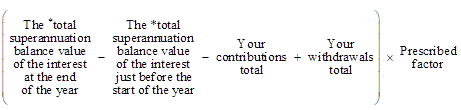
where:
prescribed factor is the value prescribed by the regulations for the purposes of this definition.
your contributions total is the amount (which may be a nil amount) determined in accordance with regulations made for the purposes of this definition.
your withdrawals total is the amount (which may be a nil amount) determined in accordance with regulations made for the purposes of this definition.
(2) For the purposes of subsection (1), if the interest does not exist at the end of the year, or just before the start of the year, the *total superannuation balance value of the interest at that time is taken to be nil.
296-75 Modifications
(1) Section 296-65 or 296-70 has effect in relation to an individual subject to any modifications prescribed by the regulations for the purposes of this subsection.
(2) Without limiting subsection (1), regulations made for the purposes of that subsection may modify section 296-65 or 296-70 in relation to an individual in different ways depending on any of the following matters:
(a) the individual to whom the modification relates;
(b) whether a *superannuation interest of the individual is in the *retirement phase;
(c) whether a superannuation interest of the individual is or includes a *defined benefit interest;
(d) a *superannuation income stream (if any) of which the individual is a *retirement phase recipient;
(e) the rules of a *superannuation fund or *approved deposit fund, or the terms and conditions of an *RSA, of which the individual is a member;
(f) the *superannuation provider in relation to a *superannuation plan of which the individual is a member;
(g) whether a superannuation interest of the individual is subject to a *payment split;
(h) whether the individual is treated as having a superannuation interest under subsection 307-230(3);
(i) whether the individual dies during an income year;
(j) any other matter.
(3) Without limiting subsection (1), in modifying section 296-65 or 296-70 in relation to an individual's *relevant superannuation earnings for an income year, the regulations may deal with income or other amounts relating to that income year or to any earlier or later period.
Subdivision 296-C - When tax is payable
Guide to Subdivision 296-C
296-125 What this Subdivision is about
This Subdivision has rules about payment of Division 296 tax.
Table of sections
Operative provisions
296-130 When tax is payable - original assessments
296-135 When tax is payable - amended assessments
296-140 General interest charge
Operative provisions
296-130 When tax is payable - original assessments
(1) Your *assessed Division 296 tax for an income year is due and payable at the end of 84 days after the Commissioner gives you notice of the assessment of the amount of the *Division 296 tax.
Exception for tax deferred to a Division 296 debt account
(2) However, subsection (1) does not apply to an amount of *assessed Division 296 tax that is *deferred to a Division 296 debt account for a *superannuation interest.
Note 1: For assessments of Division 296 tax, see Division 155 in Schedule 1 to the Taxation Administration Act 1953.
Note 2: For deferred to a Division 296 debt account , see Division 134 in that Schedule.
Note 3: For release of money from a superannuation plan to pay these amounts, see Division 131 in that Schedule.
296-135 When tax is payable - amended assessments
(1) If the Commissioner amends your assessment, any extra *assessed Division 296 tax resulting from the amendment is due and payable 84 days after the day the Commissioner gives you notice of the amended assessment.
Exception for tax deferred to a Division 296 debt account
(2) However, subsection (1) does not apply to an amount of extra *assessed Division 296 tax that is *deferred to a Division 296 debt account for a *superannuation interest.
Note 1: For deferred to a Division 296 debt account , see Division 134 in Schedule 1 to the Taxation Administration Act 1953.
Note 2: For release of money from a superannuation plan to pay these amounts, see Division 131 in that Schedule.
296-140 General interest charge
If an amount of *assessed Division 296 tax or *shortfall interest charge on assessed Division 296 tax that you are liable to pay remains unpaid after the time by which it is due to be paid, you are liable to pay the *general interest charge on the unpaid amount for each day in the period that:
(a) begins on the day on which the amount was due to be paid; and
(b) ends on the last day on which, at the end of the day, any of the following remains unpaid:
(i) the assessed Division 296 tax or the shortfall interest charge;
(ii) general interest charge on any of the assessed Division 296 tax or the shortfall interest charge.
Note 1: The general interest charge is worked out under Part IIA of the Taxation Administration Act 1953. For the rate of general interest charge payable under this section, see subsection 8AAC(2A) of that Act.
Note 2: Shortfall interest charge is worked out under Division 280 in Schedule 1 to that Act.
Note 3: See section 5-10 of this Act for when the amount of shortfall interest charge becomes due and payable.
Subdivision 296-E - Modifications for temporary residents who depart Australia
Guide to Subdivision 296-E
296-190 What this Subdivision is about
If you receive a departing Australia superannuation payment, you are entitled to a refund of any Division 296 tax you have paid.
Table of sections
Operative provisions
296-195 Who is entitled to a refund
296-200 Amount of the refund
296-205 Entitlement to refund stops all Division 296 tax liabilities
Operative provisions
296-195 Who is entitled to a refund
You are entitled to a refund if:
(a) you have made payments of any of the following:
(i) *assessed Division 296 tax;
(ii) a voluntary payment made under section 134-70 in Schedule 1 to the Taxation Administration Act 1953 for the purpose of reducing the amount by which a *Division 296 debt account for a *superannuation interest is in debit;
(iii) *Division 296 debt account discharge liability; and
(b) you receive a *departing Australia superannuation payment; and
(c) you apply to the Commissioner in the *approved form for the refund.
Note: How the refund is applied is set out in Part IIB of the Taxation Administration Act 1953.
296-200 Amount of the refund
(1) The amount of the refund to which you are entitled is the sum of the payments mentioned in paragraph 296-195(a) that you have made.
(2) However, the amount of the refund is reduced by the amount of any refunds to which you are entitled under a previous application of this Subdivision.
Exception - Division 296 tax attributable to period when you are an Australian resident
(3) Despite subsection (1), if:
(a) at any time in your 2026-27 income year, or a later income year, you are an Australian resident (but not a *temporary resident); and
(b) a payment mentioned in paragraph 296-195(a) that you have made relates, or is reasonably attributable, to that income year;
the payment is to be disregarded in working out under subsection (1) of this section the amount of the refund to which you are entitled.
296-205 Entitlement to refund stops all Division 296 tax liabilities
(1) The Commissioner may decide to release you from any existing or future liability to pay *Division 296 tax or *Division 296 debt account discharge liability if:
(a) you become entitled to a refund under section 296-195; or
(b) you would become entitled to such a refund, if you were to pay the liability and paragraph 296-195(c) were disregarded.
(2) The Commissioner may take such action as is necessary to give effect to a decision under subsection (1).
Subdivision 296-G - Other provisions
Guide to Subdivision 296-G
296-255 What this Subdivision is about
Disregard LRBA amounts in working out your total superannuation balance for the purposes of this Division.
This Division has effect despite subsection 73(3A) of the Australian Capital Territory (Self-Government) Act 1988.
Table of sections
Operative provisions
296-260 Disregard LRBA amounts in working out total superannuation balance
296-265 Interaction with the Australian Capital Territory (Self-Government) Act 1988
Operative provisions
296-260 Disregard LRBA amounts in working out total superannuation balance
For the purposes of this Division, disregard paragraph 307-230(1)(d).
Note: If you have an LRBA amount under section 307-231 (about limited recourse borrowing arrangements), paragraph 307-230(1)(d) includes the amount in your total superannuation balance.
296-265 Interaction with the Australian Capital Territory (Self-Government) Act 1988
This Division has effect despite subsection 73(3A) of the Australian Capital Territory (Self-Government) Act 1988.
Note: That subsection relates to the remuneration of judges and magistrates of the Australian Capital Territory.