

Income Tax Assessment Act 1936
 View history note
 Hide history note
Section 79A
PART II Zone B
1. All that portion of the mainland of Australia lying south of the southern boundary of Zone A and north of a line commencing at the northeastern corner of the shire of Broadsound in the State of Queensland thence generally westerly and southerly by the boundaries dividing the Shires of Broadsound Belyando Jericho Bauhinia Booringa and Balonne from the Shires of Sarina Nebo Wangaratta Dalrymple Aramac Barcaldine Blackall Tambo Murweh and Paroo to the boundary dividing the States of Queensland and New South Wales thence east by that boundary to its junction with the Barwon River at the northeastern corner of the Western Division in the State of New South Wales thence generally southwesterly by part of the boundary dividing the Central and Western Divisions of the State of New South Wales to the northernmost corner of the County of Mouramba and by the boundaries dividing the Counties of Mouramba Mossgiel Waljeers Kilfera Taila Wentworth and Tara from the Counties of Robinson Booroondarra Woore Manara Perry and Windeyer to the boundary dividing the States of New South Wales and South Australia thence south by that boundary to the northeast corner of the County of Hamley in the State of South Australia thence by the north boundaries of the Counties of Hamley and Young part of the north boundary of the County of Burra part of the east boundary of the District Council District of Hallett the east and a north boundary of the District Council District of Peterborough east and north boundaries of the District Council District of Carrieton to the southeast corner of the District Council District of Hawker the eastern north and west boundaries of that District Council District a western boundary of the District Council District of Kanyaka to the north boundary of the County of Frome thence west by part of that boundary and its prolongation west to the west boundary of the County of Manchester thence by the boundaries dividing the Counties of Manchester York and Buxton from the County of Hore-Ruthven part of the west boundary of the County of Buxton and part of the western boundary of the District Council District of Kimba to the easternmost corner of the District Council District of Le Hunte thence generally northwesterly by the east and north boundaries of the District Council Districts of Le Hunte and Streaky Bay and the east north and west boundaries of the District Council District of Murat Bay to the southern coastline thence by that coastline westerly to the southwestern corner of the Road District of Phillips River in the State of Western Australia thence generally northwesterly by the boundaries dividing the Road Districts of Gnowangerup Kent Lake Grace Kulin Kondinin Narembeen Merredin and Nungarin from the Road Districts of Phillips River Yilgarn and Westonia to the northeast corner of the Road District of Nungarin thence westerly and northwesterly by the boundaries dividing the Road Districts of Nungarin Kununoppin-Trayning Wyalkatchem Dowerin and Wongan-Ballidu from the Road Districts of Mukinbudin Mt Marshall Koorda and Dalwallinu to the No. 2 rabbit proof fence by that fence to the north boundary of the Road District of Perenjori and thence by the boundaries dividing the Road Districts of Perenjori Morawa Mingenew Irwin Greenough and Geraldton from the Road Districts of Yalgoo Mullewa and Upper Chapman to the western coastline.
2. All that portion of Tasmania lying south and west of a line commencing on the west coast at the southwest corner of the County of Wellington and thence generally easterly and southerly by the boundaries dividing the counties of Wellington Devon and Westmorland from the counties of Russell Lincoln and Cumberland to the point on the River Shannon where the hydro-electric transmission line from Waddamana to Launceston crosses that river thence in a straight line in a general southwesterly direction to the trigonometrical station known as Fishers Sugar Loaf thence by a straight line in a general southwesterly direction to the point where the Lyell Highway crosses the Dee River thence by a straight line in a general southwesterly direction to the confluence of the Derwent and Florentine Rivers thence by a straight line in a general southerly direction passing through the trigonometrical station on South East Cape to the southern coastline.
3. All the islands forming part of Australia lying adjacent to the coastline of either of the portions of Australia described in paragraphs 1 and 2.
4. King Island, Tasmania.
5. All the islands in the group of islands known as the Furneaux Group, Tasmania.
(Repealed by No 79 of 2010)
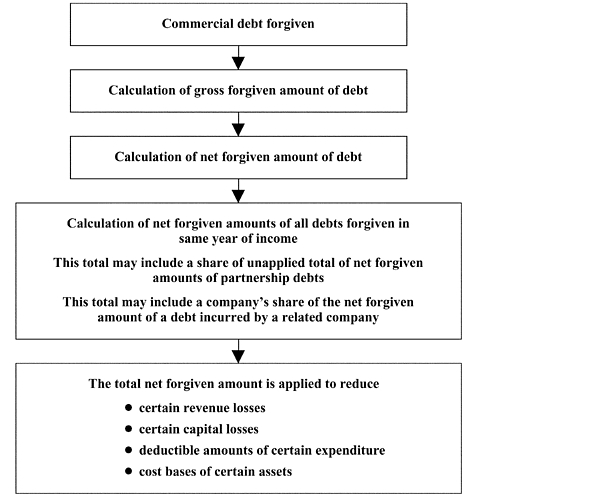
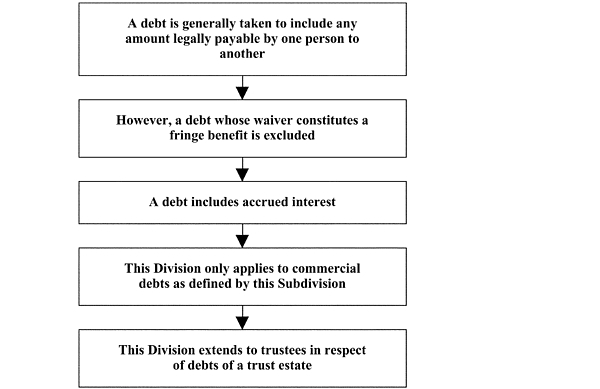
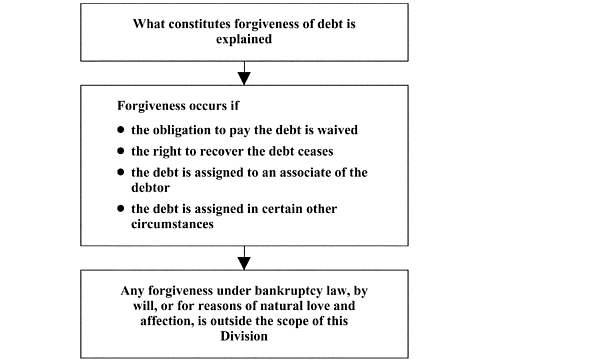
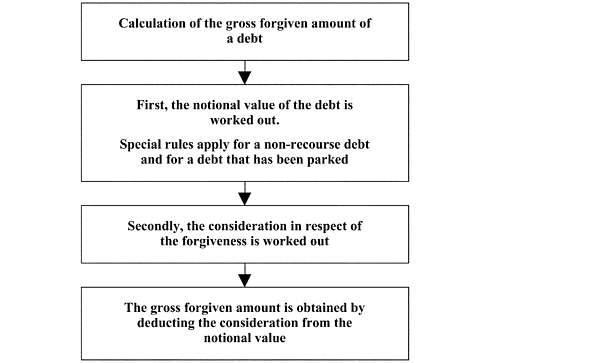
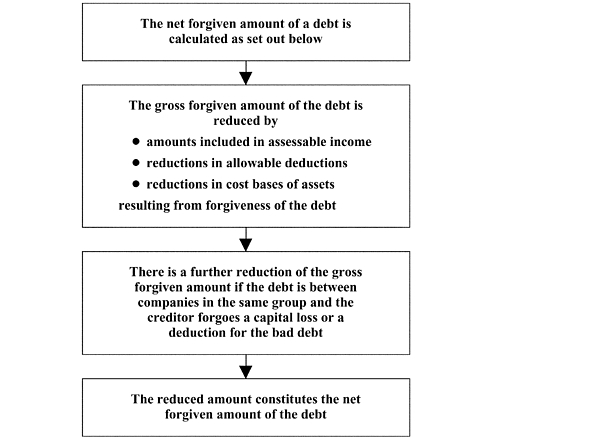
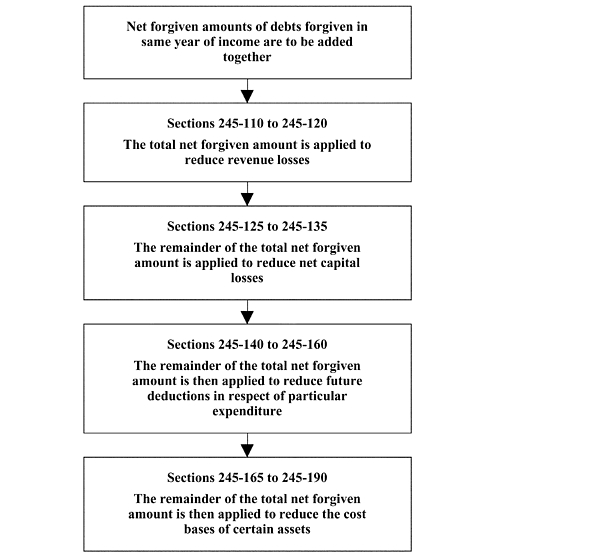
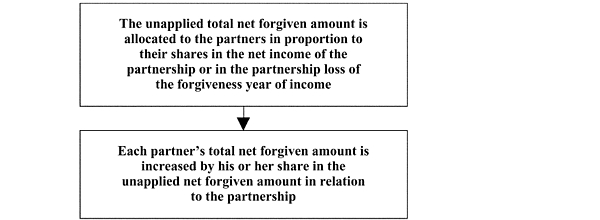
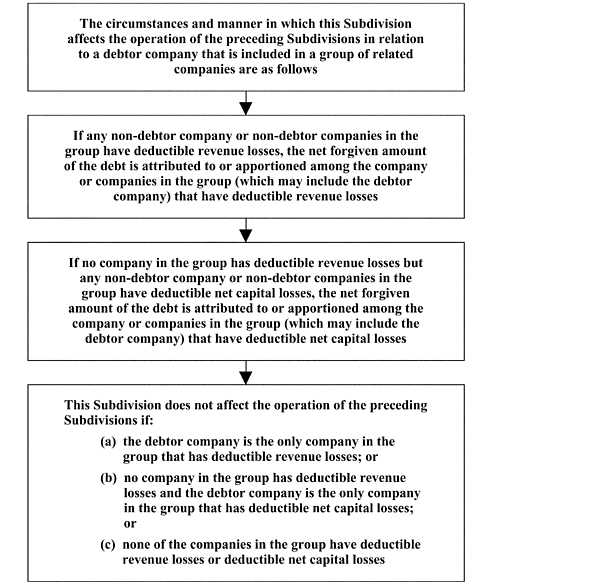
This Division is about the income tax treatment of a taxpayer whose income ceases to be wholly exempt. Broadly, income, outgoings, gains and losses are attributed to the periods before and after the loss of full exemption.
If:
(a) at a particular time, all of the income of a taxpayer is wholly exempt from income tax; and
(b) immediately after that time, the taxpayer ' s income becomes to any extent assessable income;
then:
(c) the taxpayer is a transition taxpayer ; and
(d) the time when the taxpayer ' s income becomes to that extent assessable is the transition time ; and
(e) the year of income in which the transition time occurs is the transition year for the taxpayer.
If:
(a) at the transition time, the transition taxpayer performs particular functions or carries on particular activities; and
(b) during any period before the transition taxpayer first began to perform the functions or carry on the activities, an exempt government entity performed those same functions or carried on those same activities; and
(c) at the end of the period, responsibility for performing the functions or carrying on the activities was transferred, either directly or through one or more other exempt government entities, to the transition taxpayer;
this Division applies as if, during that period, anything done by or to the exempt government entity in performing those functions or carrying on those activities had instead been done by or to the transition taxpayer.
Note:
As a result of this provision, the transition taxpayer may for example be able to deduct after the transition time, under Division 40 of the Income Tax Assessment Act 1997 as modified by Subdivision 57-J of this Schedule, a portion of allowable capital expenditure incurred before the transition time by an exempt government entity whose functions were transferred to the transition taxpayer.
57-10(2)
An exempt government entity is:
(a) the Commonwealth, a State or a Territory; or
(b) an STB, within the meaning of Division 1AB of Part III , that is exempt from tax under that Division.
To the extent that income derived by the transition taxpayer before the transition time is in respect of:
(a) services rendered; or
(b) goods provided; or
(c) the doing of any other thing;
at or after the transition time, the income is treated for the purposes of this Act as having been derived at the time the services were rendered, the goods were provided or the thing was done, as the case requires.
57-15(2)
To the extent that income derived by the transition taxpayer at or after the transition time is in respect of:
(a) services rendered; or
(b) goods provided; or
(c) the doing of any other thing;
before the transition time, the income is treated for the purposes of this Act as having been derived before that time.
To the extent that a loss or outgoing (within the meaning of section 51 of this Act or section 8-1 of the Income Tax Assessment Act 1997 , as appropriate) incurred by the transition taxpayer before the transition time is in respect of:
(a) services rendered; or
(b) goods provided; or
(c) the doing of any other thing;
at or after the transition time, the loss or outgoing is treated for the purposes of this Act as having been incurred at the time the services were rendered, the goods were provided or the thing was done, as the case requires.
57-20(2)
To the extent that a loss or outgoing (within the meaning of section 51 of this Act or section 8-1 of the Income Tax Assessment Act 1997 , as appropriate) incurred by the transition taxpayer at or after the transition time is in respect of:
(a) services rendered; or
(b) goods provided; or
(c) the doing of any other thing;
before the transition time, the loss or outgoing is treated for the purposes of this Act as having been incurred before that time.
Subdivision 57-E - Assets and liabilities
This section applies to:
(a) the disposal of an asset by the transition taxpayer after the transition time; and
(b) a CGT event that happens after the transition time in relation to an asset owned by the transition taxpayer;
where the transition taxpayer owned the asset at all times from the transition time until the disposal or the CGT event.
57-25(2) Deemed disposal and re-purchase.
Subject to subsection (5), in determining for the purposes of this Act (other than the excluded provisions mentioned in subsection (4)) whether an amount is included in, or allowable as a deduction from, the assessable income of the transition taxpayer in respect of the disposal, the transition taxpayer is taken:
(a) to have sold, immediately before the transition time, each of its assets; and
(b) to have purchased each of its assets again at the transition time for consideration equal to the asset ' s adjusted market value at the transition time.
For the purposes of Parts 3-1 and 3-3 of the Income Tax Assessment Act 1997 (about CGT), in determining whether the transition taxpayer makes a capital gain or capital loss from a CGT event that happens after the transition time in relation to an asset referred to in subsection (1), the cost base and reduced cost base of the asset (at the transition time) is its adjusted market value at that time.
57-25(3)
An asset ' s adjusted market value at the transition time is the asset ' s market value at that time:
(a) reduced by any amount of income received or receivable by the transition taxpayer in respect of the asset at or after the transition time that:
(i) because of subsection 57-15(2) ; or
is not included in the transition taxpayer ' s assessable income; and
(ii) because all of the income of the transition taxpayer was wholly exempt from income tax before the transition time;
(b) increased by any amount of income received or receivable by the transition taxpayer in respect of the asset before the transition time that:
(i) because of subsection 57-15(1) ; or
is included in the transition taxpayer ' s assessable income.
(ii) because the transition taxpayer ' s income ceased to be exempt from income tax at the transition time;
Note:
If the asset is, or is part of, a Division 230 financial arrangement, section 57-32 may affect how the market value of the asset is worked out.
57-25(4) Excluded provisions.
For the purposes of subsection (2), the excluded provisions are:
(a) - (d) (Repealed by No 101 of 2006 )
(e) former Division 10B of Part III of this Act (about industrial property); and
(f) former Division 10BA of Part III of this Act (about Australian films); and
(g) (Repealed by No 101 of 2006 )
(ga) Division 40 of the Income Tax Assessment Act 1997 (about capital allowances); and
(h) (Repealed by No 101 of 2006 )
(i) Division 43 of the Income Tax Assessment Act 1997 (about deductions for capital works); and
(j) section 70-120 of the Income Tax Assessment Act 1997 (about deducting capital costs of acquiring trees);
(k) (Repealed by No 101 of 2006 )
(la) Division 373 of the Income Tax Assessment Act 1997 (about intellectual property).
(l) (Repealed by No 101 of 2006 )
(a) acquired an asset (whether before the transition time or otherwise) before the commencement of a provision listed in subsection (6); and
(b) after acquiring the asset, owned the asset at all times before the transition time;
the deemed acquisition of the asset under subsection (2) does not affect the operation of the listed provision.
57-25(6) Listed provisions.The provisions are listed in the table below. Provisions of the Income Tax Assessment Act 1997 are identified in normal text. The other provisions, in bold , are provisions of the Income Tax Assessment Act 1936 .
| Listed provisions | |
| Item | Provision |
| 1 | section 26BB |
| 2 | (Repealed by No 47 of 2016) |
| 3 | section 70B |
| 4 | the former Division 3B of Part III |
| 5 | Division 16E of Part III |
| 6 | Subdivision 20-A, so far as it applies to an amount that may be an assessable recoupment because a deduction has been allowed or is allowable under the former subsection 82Z(1) . |
| 6A | Division 230 |
| 7 | Division 775 |
| 8 | Subdivision 20-A, so far as it applies to an amount that may be an assessable recoupment because a deduction has been allowed or is allowable under section 775-30. |
For the purposes of the application of subsection (5) to the transition taxpayer, a provision covered by item 7 or 8 of the table in subsection (6) is taken to have commenced at the start of the taxpayer ' s applicable commencement date (within the meaning of Division 775 of the Income Tax Assessment Act 1997 ).
Note:
For applicable commencement date , see section 775-155 of the Income Tax Assessment Act 1997 .
57-25(6B)
The rule in subsection (5) does not apply, and is taken never to have applied, to the transition taxpayer in relation to a provision covered by item 7 or 8 of the table in subsection (6) if the taxpayer makes an election under section 775-150 of the Income Tax Assessment Act 1997 .
57-25(7) Avoidance of doubt - debt write-off.
To avoid doubt, an effect of subsection (2) is that the sum of all allowable deductions (if any) in respect of the writing off as bad of the whole or part of a debt to which that subsection applies will not exceed the market value of the debt at the transition time.
57-25(8) Avoidance of doubt - disposal need not involve an alienation.To avoid doubt, an asset may be disposed of for the purposes of this section whether or not the disposal involves alienating the asset.
Subject to subsection (3), for the purposes of determining a deduction allowable to, or an amount included in the assessable income of, the transition taxpayer after the transition time in respect of the satisfaction of a liability owed by the transition taxpayer immediately before the transition time, the transition taxpayer is taken:
(a) to have ceased immediately before the transition time to have any liabilities; and
(b) to have assumed each of its liabilities again at the transitiontime in return for consideration equal to the adjusted market value (see subsection (2)) at that time of the right or other asset, corresponding to the liability, that was held by the person to whom the liability was owed.
57-30(2)
The adjusted market value of the corresponding right or other asset is the market value of that right or asset at the transition time:
(a) reduced by any amount paid or that becomes payable by the transition taxpayer in respect of the liability at or after the transition time, where:
(i) because of subsection 57-20(2) ; or
the amount is not an allowable deduction; and
(ii) because all of the transition taxpayer ' s income was wholly exempt from income tax before the transition time;
(b) increased by any amount paid or that became payable by the transition taxpayer in respect of the liability before the transition time, where:
(i) because of subsection 57-20(1) ; or
the amount is an allowable deduction.
(ii) because the transition taxpayer ' s income ceased to be exempt from income tax at the transition time;
Note:
If the liability is, or is part of, a Division 230 financial arrangement, section 57-32 may affect how the market value of the corresponding right or other asset is worked out.
57-30(3)
A provision listed in subsection (4) only applies to a liability of the transition taxpayer at the transition time if the liability first came into existence after the day on which Division 3B of Part III commenced.
57-30(4)
The provisions are listed in the table below. Provisions of the Income Tax Assessment Act 1997 are identified in normal text. The other provisions, in bold , are provisions of the Income Tax Assessment Act 1936 .
| Listed provisions | |
| Item | Provision |
| 1 | the former Division 3B of Part III |
| 2 | Subdivision 20-A, so far as it applies to an amount that may be an assessable recoupment because a deduction has been allowed or is allowable under the former subsection 82Z(1) . |
57-30(5)
A provision listed in subsection (6) only applies to a liability of the transition taxpayer at the transition time if the taxpayer first assumed the liability on or after the taxpayer ' s applicable commencement date (within the meaning of Division 775 of the Income Tax Assessment Act 1997 ).
Note:
For applicable commencement date , see section 775-155 of the Income Tax Assessment Act 1997 .
57-30(6)
The provisions are listed in the table below. Provisions of the Income Tax Assessment Act 1997 are identified in normal text.
| Listed provisions | |
| Item | Provision |
| 1 | Division 775 |
| 2 | Subdivision 20-A, so far as it applies to an amount that may be an assessable recoupment because a deduction has been allowed or is allowable under section 775-30. |
57-30(7)
The rule in subsection (5) does not apply, and is taken never to have applied, to the transition taxpayer if the taxpayer makes an election under section 775-150 of the Income Tax Assessment Act 1997 .
SECTION 57-32 DIVISION 230 FINANCIAL ARRANGEMENTS - MARKET VALUE OF ASSETS AND RIGHTS 57-32(1)
This section applies in relation to an asset (the subject asset ) held by an entity (the holder ) if:
(a) the subject asset is:
(i) covered by subsection 57-25(1) ; or
(ii) a right, or other asset, corresponding to a liability covered by subsection 57-30(1) ; and
(b) the subject asset, or the corresponding liability for the subject asset, is or is part of a Division 230 financial arrangement at the transition time; and
(c) when the arrangement was entered into:
(i) the parties to the arrangement were not dealing at arm ' s length (within the meaning of the Income Tax Assessment Act 1997 ) in relation to the subject asset; or
(ii) if the subject asset gives rise to an interest that is not an equity interest in an entity - the return on the interest would reasonably be expected to be less than the benchmark rate of return (within the meaning of that Act) for the interest.
57-32(2)
For the purposes mentioned in subsection (3), assume at the transition time that the market value of the subject asset is the total amount (the initial amount ) of the financial benefits (within the meaning of the Income Tax Assessment Act 1997 ) that the holder provided in relation to the subject asset before the transition time:
(a) reduced by:
(i) repayments of principal made in relation to the subject asset before the transition time; and
(ii) the amount of any impairment (within the meaning of the accounting principles (within the meaning of that Act)) of the subject asset at the transition time; and
(b) increased by the amount of the cumulative amortisation (worked out using the effective interest method recognised by the accounting principles (within the meaning of that Act)) of any difference at the transition time between:
(i) the initial amount; and
(ii) the amount payable on the maturity of the subject asset.
57-32(3)
Subsection (2) has effect for the purposes of working out the subject asset ' s adjusted market value under section 57-25 or 57-30 for use when applying Division 230 of the Income Tax Assessment Act 1997 to the subject asset or the corresponding liability for the subject asset.
This section applies in relation to the following:
(a) an asset covered by subsection 57-25(1) to which section 57-32 applies;
(b) the corresponding liability for a right, or other asset, covered by subsection 57-30(1) to which section 57-32 applies.
Note:
Section 57-32 applies if the asset or liability is or is part of a Division 230 financial arrangement.
57-33(2)
For the purposes of section 230-60 of the Income Tax Assessment Act 1997 , assume the following:
(a) in the case of an asset - that the transition taxpayer acquired the asset at the transition time in return for the transition taxpayer starting to have an obligation to provide one or more financial benefits in relation to the Division 230 financial arrangement;
(b) in the case of a liability - that the transition taxpayer started to have the liability at the transition time in return for the transition taxpayer starting to have a right to receive one or more financial benefits under the Division 230 financial arrangement.
In this Subdivision:
asset
means property, or a right, of any kind, and includes:
(a) any legal or equitable estate or interest (whether present or future, vested or contingent, tangible or intangible, in real or personal property) of any kind; and
(b) any chose in action; and
(c) any right, interest or claim of any kind including rights, interests or claims in or in relation to property (whether arising under an instrument or otherwise, and whether liquidated or unliquidated, certain or contingent, accrued or accruing); and
(d) (Repealed by No 101 of 2006 )
(e) a CGT asset;
but does not include trading stock.
liability
includes a duty or obligation of any kind (whether arising under an instrument or otherwise, and whether actual, contingent or prospective).
This section applies to a deduction allowable apart from this Subdivision to the transition taxpayer under section 290-60 of the Income Tax Assessment Act 1997 for a contribution made to a fund in relation to a person if:
(a) the person was an employee of the transition taxpayer at any time before or after the transition time; and
(b) the contribution was made under a defined benefit superannuation scheme (within the meaning of section 6A of the Superannuation Guarantee (Administration) Act 1992 ).
57-40(2) Deduction allowable only if sum of all deductions exceeds defined benefit threshold amount.
The deduction is not allowable for a year of income if the sum of all deductions of the transition taxpayer to which this section applies for the year of income is less than or equal to the defined benefit threshold amount (see subsection (4)) for the year of income.
57-40(3) Amount of deduction not allowable.If the sum is greater than that amount, so much of the deduction as is worked out using the following formula is not allowable:
|
Amount of deduction
Sum of all deductions of the transition taxpayer to which this section applies for the year of income |
×
|
Defined benefit threshold
amount for the year of income |
The defined benefit threshold amount for a year of income is:
(a) if the year of income is the transition year - the unfunded liability amount (see subsection (5)); or
(b) in any other case - that amount as reduced by the total amount of deductions to which this section applies, that, because of subsection (2) or (3), have not (disregarding section 57-55 ) been allowable to the transition taxpayer for all previous years of income. 57-40(5) Meaning of unfunded liability amount .
The unfunded liability amount is the value, worked out as at the transition time in accordance with actuarial principles, of the liabilities of the transition taxpayer to provide superannuation benefits for, or for dependants of, employees of the transition taxpayer, where the liabilities:
(a) had accrued as at the transition time; and
(b) were, according to actuarial principles, unfunded at that time; and
(c) were liabilities only under defined benefit superannuation schemes.
If:
(a) at the transition time, according to a particular defined benefit superannuation scheme ' s accounts, an amount is available to meet liabilities of the transition taxpayer under the scheme to provide superannuation benefits for, or for dependants of, employees of the transition taxpayer; and
(b) the amount exceeds the total value (as worked out according to actuarial principles) of the liabilities of that kind that have accrued as at the transition time; and
(c) before the transition time, the transition taxpayer makes a written election that the excess is to be used solely to meet liabilities of that kind accruing after the transition time, and the excess is later used solely to meet such liabilities;
the excess is an allowable deduction of the transition taxpayer for the transition year.
This section applies to a deduction allowable apart from this Subdivision to the transition taxpayer under section 290-60 of the Income Tax Assessment Act 1997 for a contribution made to a fund in relation to a person if the person was an employee of the transition taxpayer at any time before or after the transition time.
57-50(2) Deduction allowable only if sum of all deductions exceeds general superannuation threshold amount.
The deduction is not allowable for a year of income if the sum of all deductions of the transition taxpayer to which this section applies for the year of income is less than or equal to the general superannuation threshold amount (see subsection (4)) for the year of income.
57-50(3) Amount of deduction not allowable.If the sum is greater than the general superannuation threshold amount, so much of the deduction as is worked out using the following formula is not allowable:
| Amount of deduction | × | General superannuation threshold amount | ||
| Sum of all deductions of the transition taxpayer to which this section applies for the year of income | ||||
The general superannuation threshold amount for a year of income is:
(a) if the year of income is the transition year - the undischarged superannuation liability amount (see subsection (5)); or
(b) in any other case - the amount applicable under paragraph (a), reduced by the total amount of deductions to which this section applies that, because of subsection (2) or (3), have not (disregarding section 57-55 ) been allowable to the transition taxpayer for all previous years of income. 57-50(5) Meaning of undischarged superannuation liability amount .
This is how to work out the transition taxpayer ' s undischarged superannuation liability amount :
Step 1.
For each person who was an employee of the transition taxpayer at any time before the transition time, take the sum of:
Step 2.
Reduce the sum from Step 1 by the sum of amounts that the transition taxpayer actually contributed before the start of the transition year:
in respect of any period of employment of the employee with the transition taxpayer before the transition time.
Step 3.
If the result after applying Step 2 for a particular employee is less than nil, it is nil instead.
Step 4.
Add up the results for all of the employees. This final sum is the transition taxpayer ' s undischarged superannuation liability amount .
The superannuation guarantee period is the period beginning on 1 July 1992 and ending at the transition time.
A required award etc. contribution amount is an amount required to be contributed to a superannuation fund by an employer for the benefit of an employee:
(a) by an industrial award; or
(b) by an occupational superannuation arrangement; or
(c) by a law of the Commonwealth, a State or a Territory; or
(d) otherwise. 57-50(8) Meaning of required superannuation guarantee contribution amount.
A required superannuation guarantee contribution amount is an amount that an employer would need to contribute in respect of a period so as not to have a superannuation guarantee shortfall under the Superannuation Guarantee (Administration) Act 1992 in respect of that period.
Section 57-50 does not apply to a deduction of the kind mentioned in subsection 57-50(1) if:
(a) at the transition time, according to the accounts of the fund concerned, an amount is available to meet liabilities of the transition taxpayer in relation to the fund to provide superannuation benefits for, or for dependants of, employees of the transition taxpayer; and
(b) the amount exceeds the value (as worked out according to actuarial principles) of the liabilities of that kind that have accrued as at the transition time.
If the amount of a deduction otherwise allowable to the transition taxpayer in respect of a contribution to a fund is required to be reduced under both sections 57-40 and 57-50 :
(a) if the reduction is of a different amount - the amount is reduced only under that section that requires the greater reduction; or
(b) if the reduction is of the same amount - the amount is reduced only under section 57-40 .
This section applies to a deduction otherwise allowable to the transition taxpayer for a year of income under subsection 51(1) of this Act or section 8-1 (about general deductions) of the Income Tax Assessment Act 1997 in respect of long service leave payments or annual leave payments to a person who was an employee of the transition taxpayer at any time before or after the transition time.
Note:
Subsection 51(3) of this Act or section 26-10 of the Income Tax Assessment Act 1997 (as appropriate) contains additional requirements for certain leave payments to be deductible.
57-60(2) Deduction allowable only if sum of all deductions exceeds leave threshold amount.
The deduction is not allowable if the sum of all deductions of the transition taxpayer to which this section applies for the year of income is less than or equal to the leave threshold amount (see subsection (4)) for the year of income.
57-60(3) Amount of deduction not allowable.If the sum is greater than the leave threshold amount, so much of the deduction as is worked out using the following formula is not allowable:
| Amount of deduction | × | Leave threshold amount for the year of income | ||
| Sum of all deductions of the transition taxpayer to which this section applies for the year of income | ||||
The leave threshold amount for a year of income is:
(a) if the year of income is the transition year - the (pre-transition time service) leave amount (see subsection (5)) of the transition taxpayer; or
(b) in any other case - that amount as reduced by the total amount of deductions to which this section applies that, because of subsection (2) or (3), have not been allowable to the transition taxpayer for all previous years of income. 57-60(5) Meaning of (pre-transition time service) leave amount.
The (pre-transition time service) leave amount of the transition taxpayer is the sum of the following amounts:
(a) the amount that would be payable by the transition taxpayer in respect of annual leave and long service leave if, at the transition time, all employees of the transition taxpayer began to take all leave of that kind that they were eligible to take; and
(b) if the transition taxpayer elects, in accordance with subsection (6), that this paragraph applies - the amount that, according to actuarial principles, would need to be set aside at the transition time to meet all obligations of the transition taxpayer that might reasonably be expected to arise after that time to make annual leave payments and long service leave payments (other than in respect of leave taken into account under paragraph (a)) for periods of service of employees occurring before the transition time; and
(c) if paragraph (b) does not apply - the present value, at the transition time, of all annual leave payments and long service leave payments (other than in respect of leave taken into account under paragraph (a)) that the transition taxpayer would become liable to make after that time in respect of periods of service of employees occurring before that time if all such leave became eligible to be taken. 57-60(6) Election.
The election mentioned in paragraph (5)(b) must be made in writing before:
(a) the day by which the transition taxpayer ' s return of income for the transition year is due to be lodged; or
(b) such later day as the Commissioner allows.
This section applies to a deduction otherwise allowable to the transition taxpayer for a year of income under this Act for the writing off as bad of the whole or part of a debt owing to the transition taxpayer.
57-65(2) Deduction allowable only if sum of all deductions exceeds doubtful debt provision limit.
The deduction is not allowable if the sum of all deductions of the transition taxpayer to which this section applies for the year of income is less than or equal to the doubtful debt provision limit (see subsection (4)) for the year of income.
57-65(3) Amount of deduction not allowable.If the sum is greater than that limit, so much of the deduction as is worked out using the following formula is not allowable:
| Amount of deduction | × | Doubtful debt provision limit for the year of income | ||
| Sum of all deductions of the transition taxpayer to which this section applies for the year of income | ||||
The doubtful debt provision limit for a year of income is:
(a) if the year of income is the transition year - the pre-transition doubtful debt limit (see subsection (5)); or
(b) in any other case - that limit as reduced by the total amount of deductions to which this section applies that, because of subsection (2) or (3), have not been allowable to the transition taxpayer for all previous years of income. 57-65(5) Meaning of pre-transition doubtful debt limit.
The pre-transition doubtful debt limit is the total of the amounts that, under generally accepted accounting principles, would be the appropriate doubtful debt provisions in relation to all debts owed to the transition taxpayer as at the transition time.
57-65(6) Reduction of limit for excess recovery.(a) at the transition time, a debt is owed to the transition taxpayer; and
(b) the sum of:
(i) the amount (if any) that, under generally accepted accounting principles, would be the appropriate doubtful debt provision in relation to the debt as at the transition time; and
exceeds the amount of the debt;
(ii) any amounts later recovered in respect of the debt;
the pre-transition doubtful debt limit is reduced by the amount of the excess.
57-65(7) Reduction of limit if debt later disposed of.(a) at the transition time, a debt is owed to the transition taxpayer; and
(b) there is an amount (the debt provision amount ) greater than nil that, under generally accepted accounting principles, would be the appropriate doubtful debt provision in relation to the debt as at the transition time; and
(c) after the transition time, the transition taxpayer disposes of the debt to another person;
the pre-transition doubtful debt limit is reduced by:
(d) if, after the transition time, the transition taxpayer wrote off part of the debt as bad - the excess (if any) of the debt provision amount over the amount or amounts so written off; or
(e) in any other case - the debt provision amount.
This section applies to a deduction otherwise allowable to the transition taxpayer for a year of income under section 8-1 (about general deductions) or 25-50 (about pensions, gratuities or retiring allowances) of the Income Tax Assessment Act 1997 for a superannuation lump sum or an employment termination payment for a person who was an employee of the transition taxpayer at any time before the transition time (regardless of whether the person was an employee at or after the transition time).
57-70(2)
So much (if any) of the deduction as relates to a period of service of the employee before the transition time is not allowable.
57-70(3)
This section does not apply to an early retirement scheme payment (within the meaning of the Income Tax Assessment Act 1997 ), or a genuine redundancy payment (within the meaning of that Act).
57-70(4)
(Repealed by No 15 of 2007)
Subdivision 57-H - Domestic losses
In applying section 36-15 or 36-17 of the Income Tax Assessment Act 1997 (about how to deduct tax losses) to the transition taxpayer:
(a) only exempt income derived at or after the transition time is taken into account as exempt income of the transition taxpayer; and
(b) the transition taxpayer ' s deductions are taken into account only so far as they are in respect of:
(i) services rendered; or
(ii) goods provided; or
at or after the transition time.
(iii) the doing of any other thing;
A modified deduction rule is a provision listed in column 3 of an item in the table in subsection (3). Provisions of the Income Tax Assessment Act 1997 are identified in normal text, while provisions of the Income Tax Assessment Act 1936 are in bold .
57-85(2)
The corresponding deduction provision (if any) for a modified deduction rule listed in column 3 of an item in the table in subsection (3) is the provision of the Income Tax Assessment Act 1936 listed in column 4 of the item.
57-85(3)
The table is as follows:
| Modified deduction rules and corresponding deduction provisions | |||
| Column 1 | Column 2 | Column 3 | Column 4 |
| Item | Description | Modified deduction rule | Corresponding deduction provision |
| 1 | Borrowing expenses | Section 25-25 | Former section 67 |
| 2 - 4 | (Repealed by No 101 of 2006 ) | ||
| 5 | Films, Australian | Former Division 10BA of Part III | |
| 6 | (Repealed by No 101 of 2006 ) | ||
| 7 | Industrial property (copyright in Australian film) | Former Division 10B of Part III | |
| 7A - 8 | (Repealed by No 101 of 2006 ) | ||
| 9 | Gifts | Section 25-50 and Division 30 | Former section 78 |
| 10 - 12 | (Repealed by No 101 of 2006 ) | ||
| 13 | R & D | Division 355 | |
| 14 | Scientific research | Section 73A | |
| 14A - 17 | (Repealed by No 101 of 2006 ) | ||
| 18 | Cost of acquiring trees | Section 70-120 | Former section 124J |
| 19 | Capital allowances | Division 40 |
SECTION 57-90 57-90 POST-TRANSITION DEDUCTIONS - ASSUME THAT THE TRANSITION TAXPAYER HAD NEVER BEEN EXEMPT
In working out the transition taxpayer ' s allowable deductions under a modified deduction rule for the transition year or a later year of income, assume that the modified deduction rule had applied at all times before the transition time as if the transition taxpayer ' s income had never been exempt from income tax.
If, apart from this section, an amount would be an allowable deduction under a modified deduction rule for the transition year in respect of expenditure incurred before the transition time (whether or not during the transition year), only so much of the amount as is worked out using the following formula is so allowable:
| Number of whole days in transition year after transition time | |||
| × | Amount of deduction | ||
| Post-expenditure part |
where:
post-expenditure part means:
(a) if the expenditure was incurred before the transition year - the number of days in the transition year; or
(b) otherwise - the number of days in the period from the beginning of the day on which the expenditure is incurred until the end of the transition year.
57-95(2)
This section does not apply to an amount to which paragraph 57-110(1)(b) (which deals with balancing adjustments) applies.
In working out the transition taxpayer ' s allowable deductions under a modified deduction rule:
(a) assume that the transition taxpayer did not, at any time, make any election or declaration, or give any notice, under the rule in relation to a year of income before the transition year; and
(b) any election or declaration (other than one under former subsection 124ZADA(1) ) the transition taxpayer makes, or any notice the transition taxpayer gives, under the rule in relation to the transition year has no effect in so far as it relates to expenditure incurred before the transition time.
In working out the transition taxpayer ' s allowable deductions under the former Subdivision 330-A or 330-C or Division 40 of the Income Tax AssessmentAct 1997 , assume that the transition taxpayer incurred no expenditure on exploration and prospecting before the transition time.
In working out the transition taxpayer
'
s allowable deductions under the former Subdivision
330-A
or
330-C
of the
Income Tax Assessment Act 1997
, assume that, for each year of income before the transition year, the transition taxpayer
'
s assessable income would have exceeded the total of the transition taxpayer
'
s deductions for the year.
Note:
This means that the transition taxpayer can have no excess deductions remaining from years of income before the transition year.
If, apart from this subsection, a balancing adjustment provision (see subsection (2)) would:
(a) require an amount to be included in the transition taxpayer ' s assessable income for the transition year or a later year of income in respect of particular expenditure; or
(b) allow an amount as a deduction from the transition taxpayer ' s assessable income for the transition year or a later year of income in respect of particular expenditure;
then only so much of the amount as is worked out using the following formula is so included or allowable:
| Actual deductions | × Amount concerned | |
| Actual deductions + Notional deductions |
where:
actual deductions is the sum of all deductions actually allowed or allowable to the transition taxpayer for theexpenditure under the deduction rule to which the balancing adjustment provision relates (see subsection (2)).
notional deductions is the sum of all deductions for the expenditure that would have been allowable to the transition taxpayer under the deduction rule to which the balancing adjustment provision relates, if the transition taxpayer had never been wholly exempt from income tax.
57-110(2)
Each balancing adjustment provision and its related deduction rule are shown in an item of the table. Provisions of the Income Tax Assessment Act 1997 are shown in ordinary text, and provisions of the Income Tax Assessment Act 1936 are shown in bold .
| Balancing adjustment provisions and related deduction rules | |||
| Item | Topic | Balancing adjustment provision | Deduction rule to which the balancing adjustment provision relates |
| 1 | Capital works: buildings, structural improvements, environment protection earthworks and extensions, alterations or improvements | Section 43-40 | Division 43 and whichever of former Divisions 10C and 10D of Part III is appropriate |
| 2 | (Repealed by No 101 of 2006 ) | ||
| 2A | Capital allowances | Section 40-285 | Division 40 |
| 3 - 4 | (Repealed by No 101 of 2006 ) | ||
| 5 | Industrial property (copyright in Australian film) | Former sections 124N and 124P | Former Division 10B of Part III |
| 5A - 6 | (Repealed by No 101 of 2006 ) | ||
| 7 | R & D | Sections 40-292, 40-293, 355-315 and 355-525 | Section 40-25, 355-305 or 355-520 |
| 8 | Scientific research | Subsection 73A(4) | Section 73A |
| 8A - 9 | (Repealed by No 101 of 2006 ) |
Note:
Item 7 of the table is expanded by section 355-340 of the Income Tax (Transitional Provisions) Act 1997 .
57-110(3)
(Repealed by No 16 of 1998)
For the purposes of applying Division 70 of the Income Tax Assessment Act 1997 in relation to the transition year, the only trading stock of the transition taxpayer that is to be taken into account under section 70-35 of that Act as being on hand at the beginning of the transition year is such trading stock as was on hand at the transition time.
57-115(2)
For the purpose of working out the value at which the trading stock is to be taken into account, the year of income preceding the transition year is taken to have ended immediately before the transition time.
Note:
The value of trading stock on hand at the beginning of the transition year will, under section 70-40 of the Income Tax Assessment Act 1997, be the same as at the end of the preceding year of income.
57-115(3)
If:
(a) the basis of valuation of the trading stock at the end of the transition year is cost; and
(b) the basis of valuation at the beginning of the transition year is different;
then, for the purposes of the valuation at the end of the transition year, the cost of the trading stock for the purposes of Division 70 of the Income Tax Assessment Act 1997 is taken to be equal to the value at which it was taken into account at the beginning of the transition year.
Subdivision 57-M - Imputation
Subject to subsections (3) and (4), if, immediately before the transition time, the transition taxpayer or a subsidiary (see section 57-125 ) of the transition taxpayer has a franking surplus, then the surplus is reduced to nil at the transition time.
Subject to subsections (3) and (4), if:
(a) at any time after the transition time, there arises a franking credit or a franking debit of the transition taxpayer or of a subsidiary of the transition taxpayer; and
(b) the franking credit or franking debit is to any extent attributable to a period, or to an event taking place, before the transition time;
the franking credit or franking debit is to that extent taken not to have arisen.
57-120(3) Cases where subsections (1) and (2) do not apply to the transition taxpayer.(a) one or more franking debits of the transition taxpayer arise after the transition time; and
(b) any of the debits is to an extent (the amount of which is the pre-transition time component of the debit) attributable to the period, or to an event taking place, before the transition time; and
(c) immediately before the transition time:
(i) there was a franking surplus of the transition taxpayer that was less than the total of the pre-transition time components of all of the debits; or
(ii) there was no franking surplus of the transition taxpayer;
then:
(d) in a case covered by subparagraph (c)(i) - subsection (1) does not apply to the surplus; and
(e) in any case - subsection (2) does not apply to the debits.
(a) one or more franking debits of a subsidiary of the transition taxpayer arise after the transition time; and
(b) any of the debits is to an extent (the amount of which is the pre-transition time component of the debit) attributable to the period, or to an event taking place, before the transition time; and
(c) immediately before the transition time:
(i) there was a franking surplus of the subsidiary that was less than the total of the pre-transition time components of all of the debits; or
(ii) there was no franking surplus of the subsidiary;
then:
(d) in a case covered by subparagraph (c)(i) - subsection (1) does not apply to the surplus; and
(e) in any case - subsection (2) does not apply to the debits.
(Repealed by No 23 of 2005)
SECTION 57-125 SUBSIDIARY 57-125(1)
A company (the subsidiary company ) is a subsidiary of another company (the holding company ) if all the shares in the subsidiary company are beneficially owned by:
(a) the holding company; or
(b) one or more subsidiaries of the holding company; or
(c) the holding company and one or more subsidiaries of the holding company.
57-125(2)
A company (other than the subsidiary company) is a subsidiary of the holding company if, and only if:
(a) it is a subsidiary of the holding company; or
(b) it is a subsidiary of a subsidiary of the holding company;
because of any other application or applications of this section.
Subdivision 57-N - Division not applicable in respect of certain plant
Subdivision 57-J , and Subdivision 57-K in so far as it applies to balancing adjustments for plant or depreciating assets, do not apply in respect of an asset to which Subdivision 58-B of the Income Tax Assessment Act 1997 applies.
57-130(2)
Despite subsection (1), Subdivision 57-J applies for the purposes of section 40-35 of the Income Tax (Transitional Provisions) Act 1997 to capital expenditure incurred by a transition taxpayer before 1 July 2001 that relates to property that is not a depreciating asset.
Subdivision 57-P - Balancing adjustment on ceasing to have a Division 230 financial arrangement
This section applies if:
(a) section 57-32 was applied to work out the market value of an asset (the subject asset ); and
(b) the transition taxpayer is a party to the Division 230 financial arrangement (the financial arrangement ) to which the subject asset, or the corresponding liability for the subject asset, is or is part of; and
(c) a balancing adjustment is made under Subdivision 230-G of the Income Tax Assessment Act 1997 , after the transition time, in relation to the financial arrangement.
57-135(2)
For the purposes of making the balancing adjustment under Subdivision 230-G of the Income Tax Assessment Act 1997 in relation to the financial arrangement, adjust the amount worked out using the method statement (the method statement ) in subsection 230-445(1) of that Act by:
(a) if the transition taxpayer is the holder of the subject asset - increasing any gain or reducing any loss by the amount worked out under subsection (4) of this section; or
(b) if the transition taxpayer is the holder of the corresponding liability for the subject asset - reducing any gain or increasing any loss by the amount worked out under subsection (4) of this section.
57-135(3)
Despite subsection (2):
(a) if the amount worked out under subsection (4) exceeds the amount of the loss to be reduced under paragraph (2)(a) - the transition taxpayer is taken, for the purposes of making the balancing adjustment, to have made a gain equal to the amount of the excess; or
(b) if the amount worked out under subsection (4) exceeds the amount of the gain to be reduced under paragraph (2)(b) - the transition taxpayer is taken, for the purposes of making the balancing adjustment, to have made a loss equal to the amount of the excess; or
(c) if when applying the method statement no balancing adjustment is made in relation to the financial arrangement - the transition taxpayer is taken, for the purposes of making the balancing adjustment, to have:
(i) if the transition taxpayer is the holder of the subject asset - made a gain equal to the amount worked out under subsection (4); or
(ii) if the transition taxpayer is the holder of the corresponding liability for the subject asset - made a loss equal to the amount worked out under subsection (4).
57-135(4)
For the purposes of subsections (2) and (3), the amount is the difference between:
(a) the amount that the transition taxpayer would need to receive or pay under the financial arrangement without an amount being assessable income of, or deductible to, the transition taxpayer if the subject asset, or the corresponding liability for the subject asset, were disposed of at the time the balancing adjustment is made; and
(b) the amount that the transition taxpayer would need to receive or pay under the financial arrangement without an amount being assessable income of, or deductible to, the transition taxpayer if:
(i) the subject asset, or the corresponding liability for the subject asset, were disposed of at the time the balancing adjustment is made; and
(ii) the assumptions in subsection (5) were made.
57-135(5)
The assumptions referred to in subparagraph (4)(b)(ii) are that, when the financial arrangement was entered into:
(a) the parties to the arrangement were dealing with each other at arm ' s length (within the meaning of the Income Tax Assessment Act 1997 ) in relation to the arrangement; and
(b) if the arrangement gives rise to an interest that is not an equity interest in an entity - the return on the interest would reasonably be expected to be equal to the benchmark rate of return (within the meaning of the Income Tax Assessment Act 1997 ) for the interest.
57-135(6)
This section applies despite section 230-510 of the Income Tax Assessment Act 1997 .
(Repealed by No 79 of 2010 )
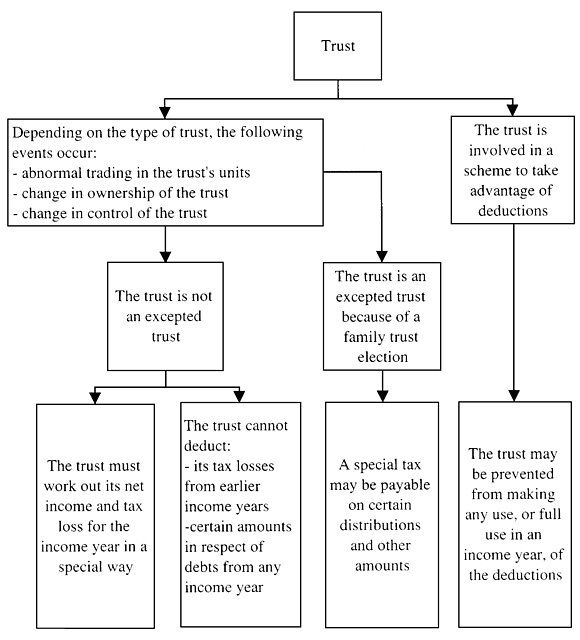
If there is a change in ownership or control of a trust or an abnormal trading in its units, it:
This will not be the case if the trust is an excepted trust. However, if it became one by making a family trust election, a special tax may be payable on certain distributions and other amounts.
If a trust is involved in a scheme to take advantage of deductions, it may be prevented from making full use of them.
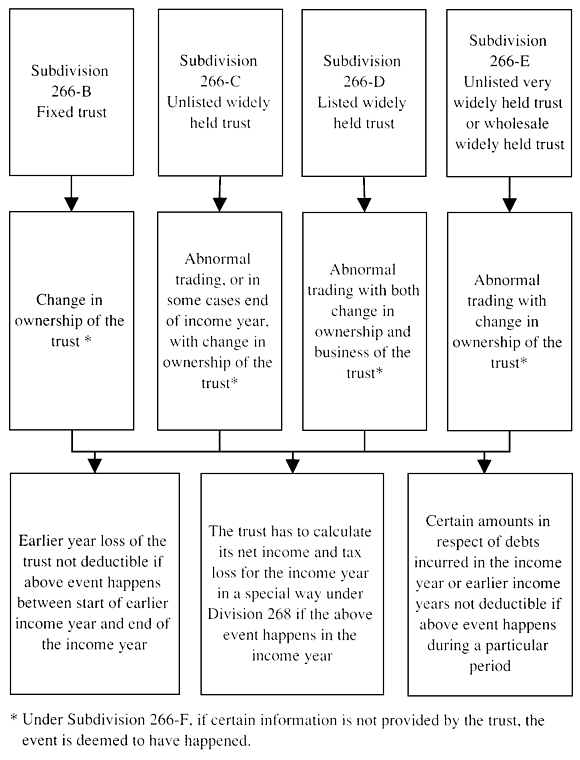
This Division is about the income tax consequences, for various kinds of fixed trusts, of certain events:
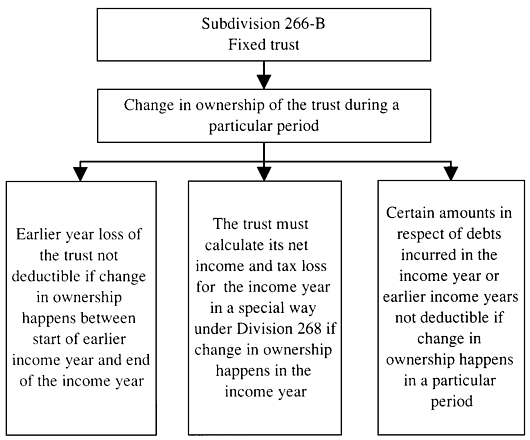
An ordinary fixed trust:
unless there has been continuity of ownership throughout a particular period or an exception relating to holdings by non-fixed trusts applies.
Note:
The exceptions mentioned in this section apply differently in relation to designated infrastructure project entities: see sections 415-25 and 415-30 of the Income Tax Assessment Act 1997 .
Type of trust to which this section applies
266-25(1)
This section applies to a trust that:
(a) can deduct in the income year a tax loss from a loss year; and
(b) was a fixed trust at all times in the period (the test period ) from the beginning of the loss year until the end of the income year; and
(c) was not a widely held unit trust at all times in the test period; and
(d) was not an excepted trust at all times in the test period.
To find out the meaning of fixed trust : see section 272-65 .
To find out the meaning of widely held unit trust : see section 272-105 .
To find out the meaning of excepted trust : see section 272-100 .
Condition for deducting tax loss
266-25(2)
The trust cannot deduct the tax loss unless it meets either:
A trust that:
(a) was a fixed trust at all times in the income year (the test period ); and
(b) was not a widely held unit trust at all times in the test period; and
(c) was not an excepted trust at all times in the test period;
must work out its net income and tax loss for the income year under Division 268 (How to work out a trust ' s net income and tax loss for the income year), unless it meets either:
Note:
See section 415-25 of the Income Tax Assessment Act 1997 if the trust was a designated infrastructure project entity during part, but not the whole, of the test period.
Type of trust to which this section applies
266-35(1)
This section applies to a trust that:
(a) can deduct in the income year an amount:
(i) under section 51 or 63 , or under section 8-1 or 25-35 of the Income Tax Assessment Act 1997 , in respect of the writing off of the whole or part of a debt as bad; or
(ii) under subsection 63E(3) or (4) in respect of a debt/equity swap relating to the whole or part of a debt; and
(b) was a fixed trust at all times in the period (the test period ):
(i) if the debt was incurred in an earlier income year - beginning on the day the debt was incurred and ending at the end of the income year; or
(ii) if the debt was incurred in the income year - consisting of the income year; and
(c) was not a widely held unit trust at all times in the test period; and
(d) was not an excepted trust at all times in the test period.
Note:
Subdivisions 709-D and 719-I of the Income Tax Assessment Act 1997 also affect when a trust that used to be a member of a consolidated group or MEC group may deduct a debt that used to be owed to a member of the group and that the trust writes off as bad.
Condition for deducting amount
266-35(2)
The trust cannot deduct the amount unless it meets either:
The fixed trust must pass the 50% stake test for the test period.
To find out whether the trust passes the 50% stake test for the period: see Subdivision 269-C .
If the condition in section 266-40 is not met, the trust must satisfy the conditions in this section.
First condition
266-45(2)
At all times during the test period:
(a) non-fixed trusts (other than family trusts) must have held fixed entitlements to a 50% or greater share of the income or a 50% or greater share of the capital of the trust; or
(b) both:
(i) a fixed trust or a company (which trust or company is the holding entity ) must have held, directly or indirectly, all of the fixed entitlements to income and capital of the trust; and
(ii) non-fixed trusts (other than family trusts) must have held fixed entitlements to a 50% or greater share of the income or a 50% or greater share of the capital of the holding entity.
Second condition
266-45(3)
The persons holding fixed entitlements to shares of the income, and the persons holding fixed entitlements to shares of the capital, of:
(a) in a paragraph (2)(a) case - the trust; or
(b) in a paragraph (2)(b) case - the holding entity;
at the beginning of the test period must have held those entitlements to those shares at all times during the test period.
Third condition
266-45(4)
At the beginning of the test period:
(a) individuals must not have had more than a 50% stake in the income of the trust; or
(b) individuals must not have had more than a 50% stake in the capital of the trust.
Fourth condition
266-45(5)
It must be the case that, for each non-fixed trust (other than an excepted trust) that, at any time in the test period, held directly or indirectly a fixed entitlement to a share of the income or capital of the trust:
(a) if this section is being applied for the purposes of section 266-25 - section 267-20 would not have prevented the non-fixed trust from deducting the tax loss concerned if it, rather than the fixed trust, had incurred the loss; or
(b) if this section is being applied for the purposes of section 266-30 - section 267-60 does not require the non-fixed trust to work out its net income and tax loss for the income year under Division 268 ; or
(c) if this section is being applied for the purposes of section 266-35 - section 267-25 , or section 267-65 , as the case requires, would not have prevented the non-fixed trust from deducting the amount concerned if it, rather than the fixed trust, would otherwise be entitled to deduct the amount.
If section 266-25 prevents the fixed trust from deducting a tax loss, it can deduct the part of the tax loss that is attributable to a part of the loss year.
266-50(2)
However, the trust can do this only if, assuming that that part of the loss year had been treated as the whole of the loss year for the purposes of sections 266-40 and 266-45 , the trust would have been entitled to deduct the tax loss.
Notice about non-resident non-fixed trust
266-55(1)
The Commissioner may give the trustee of a fixed trust a notice in accordance with section 266-60 if the requirements of subsections (2) to (5) of this section are met.
First requirement
266-55(2)
In its return of income for an income year, the fixed trust:
(a) must have deducted a tax loss from an earlier income year; or
(b) must not have worked out its net income and tax loss for the income year under Division 268 ; or
(c) must have deducted an amount in relation to a debt;
where it would not be allowed to deduct the tax loss or amount in respect of the debt, or would be required to work out its net income and tax loss under that Division, unless it met the conditions in section 266-45 .
Second requirement
266-55(3)
In order to determine whether it meets the conditions in section 266-45 , the Commissioner must need information about a non-fixed trust mentioned in subsection 266-45(5) .
Third requirement
266-55(4)
When the Commissioner gives the notice:
(a) a trustee of the non-fixed trust must be a non-resident; or
(b) the central management and control of the non-fixed trust must be outside Australia.
Fourth requirement
266-55(5)
The Commissioner must give the notice before the later of:
(a) 5 years after the end of the income year mentioned in subsection (2); and
(b) the end of the period during which the trustee of the fixed trust is required by section 262A to retain records in relation to that income year.
Information required
266-60(1)
The notice that the Commissioner may give if the requirements of subsections 266-55(2) to (5) are met must require the trustee to give the Commissioner specified information that is relevant to determining whether the requirements of subsection 266-45(5) are satisfied in relation to the non-fixed trust mentioned in subsections 266-55(3) and (4) .
Trustee knowledge
266-60(2)
The information need not be within the knowledge of the trustee at the time the notice is given.
Period for giving information
266-60(3)
The notice must specify a period within which the trustee is to give the information. The period must not end earlier than 21 days after the day on which the Commissioner gives the notice.
Consequence of not giving the information
266-60(4)
If the trustee does not give the information within the period or within such further period as the Commissioner allows, the fixed trust is taken not to meet, and never to have met, the conditions in section 266-45 .
Application of Division 268
266-60(5)
If, because of subsection (4), the fixed trust is required to work out under Division 268 its net income and tax loss for the income year mentioned in subsection 266-55(2) , that Division is to be applied as if Subdivision 268-B required the income year to be divided into such periods as would result in the highest possible net income for the income year.
No offences or penalties
266-60(6)
To avoid doubt, subsections (4) and (5) do not cause the trustee of the fixed trust to commit any offence or be liable to any penalty under Part 4-25 in Schedule 1 to the Taxation Administration Act 1953 for deducting the amount concerned, or for not working out the trust ' s net income and tax loss under Division 268 , in its return.
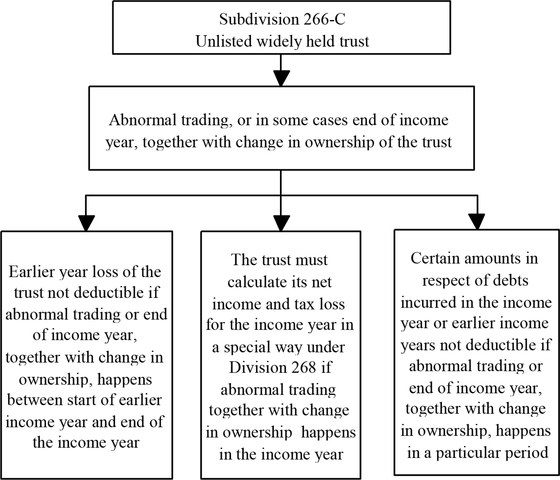
An unlisted widely held trust:
unless its ownership has been the same after any abnormal trading in its units and at the end of income years, during a certain period.
Note:
The exception mentioned in this section applies differently in relation to designated infrastructure project entities: see sections 415-25 and 415-30 of the Income Tax Assessment Act 1997 .
Type of trust to which this section applies - case 1
266-75(1)
This section applies to a trust that:
(a) can in the income year deduct a tax loss from a loss year; and
(b) was an unlisted widely held trust at all times in the period (the test period ) from the beginning of the loss year until the end of the income year; and
(c) was not a wholesale widely held trust at all times in the test period; and
(d) was not an unlisted very widely held trust at all times in the test period; and
(e) was not an excepted trust at all times in the test period.
To find out the meaning of unlisted widely held trust : see section 272-110 .
To find out the meaning of wholesale widely held trust : see section 272-125 .
To find out the meaning of unlisted very widely held trust : see section 272-120 .
To find out the meaning of excepted trust : see section 272-100 .
Type of trust to which this section applies - case 2
266-75(2)
This section also applies to a trust that:
(a) can in the income year deduct a tax loss from a loss year; and
(b) was an unlisted widely held trust, other than an unlisted very widely held trust or a wholesale widely held trust, at some time in the period (the test period ) from the beginning of the loss year until the end of the income year; and
(c) was a listed widely held trust at all other times in the test period; and
(d) was not an excepted trust at all times in the test period.
To find out the meaning of listed widely held trust : see section 272-115 .
Condition for deducting tax loss
266-75(3)
The trust cannot deduct the tax loss unless it meets the condition in section 266-90 .
Type of trust to which this section applies - case 1
266-80(1)
A trust that:
(a) was an unlisted widely held trust at all times in the income year (the test period ); and
(b) was not a wholesale widely held trust at all times in the test period; and
(c) was not an unlisted very widely held trust at all times in the test period; and
(d) was not an excepted trust at all times in the test period;
must work out its net income and tax loss for the income year under Division 268 (How to work out a trust ' s net income and tax loss for the income year), unless it meets the condition in section 266-90 .
Type of trust to which this section applies - case 2
266-80(2)
A trust that:
(a) was an unlisted widely held trust, other than an unlisted very widely held trust or a wholesale widely held trust, at some time in the income year (the test period ); and
(b) was a listed widely held trust at all other times in the test period; and
(c) was not an excepted trust at all times in the test period;
must work out its net income and tax loss for the income year under Division 268 (How to work out a trust ' s net income and tax loss for the income year), unless it meets the condition in section 266-90 .
Note:
See section 415-25 of the Income Tax Assessment Act 1997 if the trust was a designated infrastructure project entity during part, but not the whole, of the test period.
Type of trust to which this section applies - case 1
266-85(1)
This section applies to a trust that:
(a) can deduct in the income year an amount:
(i) under section 51 or 63 , or under section 8-1 or 25-35 of the Income Tax Assessment Act 1997 , in respect of the writing off of the whole or part of a debt as bad; or
(ii) under subsection 63E(3) or (4) in respect of a debt/equity swap relating to the whole or part of a debt; and
(b) was an unlisted widely held trust at all times in the period (the test period ):
(i) if the debt was incurred in an earlier income year - beginning on the day the debt was incurred and ending at the end of the income year; or
(ii) if the debt was incurred in the income year - consisting of the income year; and
(c) was not a wholesale widely held trust at all times in the test period; and
(d) was not an unlisted very widely held unit trust at all times in the test period; and
(e) was not an excepted trust at all times in the test period.
Type of trust to which this section applies - case 2
266-85(2)
This section also applies to a trust that:
(a) can deduct in the income year an amount:
(i) under section 51 or 63 , or under section 8-1 or 25-35 of the Income Tax Assessment Act 1997 , in respect of the writing off of the whole or part of a debt as bad; or
(ii) under subsection 63E(3) or (4) in respect of a debt/equity swap relating to the whole or part of a debt; and
(b) was an unlisted widely held trust, other than an unlisted very widely held trust or a wholesale widely held trust, at some time in the period (the test period ):
(i) if the debt was incurred in an earlier income year - beginning on the day the debt was incurred and ending at the end of the income year; or
(ii) if the debt was incurred in the income year - consisting of the income year; and
(c) was a listed widely held trust at all other times in the test period; and
(d) was not an excepted trust at all times in the test period.
Condition for deducting amount
266-85(3)
The trust cannot deduct the amount unless it meets the condition in section 266-90 .
Note:
Subdivisions 709-D and 719-I of the Income Tax Assessment Act 1997 also affect when a trust that used to be a member of a consolidated group or MEC group may deduct a debt that used to be owed to a member of the group and that the trust writes off as bad.
If this section is being applied for the purposes of section 266-75 or 266-85 , on each occasion when either of the following events occurs:
(a) an abnormal trading in the trust ' s units occurs during the test period;
(b) an income year of the trust ends during the test period (including at the end of the test period);
the trust must pass the 50% stake test in respect of the following times:
(c) the beginning of the test period;
(d) immediately after the event occurs.
To find out whether the trust passes the 50% stake test: see Subdivision 269-C .
266-90(2)
If this section is being applied for the purposes of section 266-80 , on each occasion when an abnormal trading in the trust ' s units occurs during the test period, the trust must pass the 50% stake test in respect of the following times:
(a) the beginning of the test period; and
(b) immediately after the abnormal trading occurs.
If section 266-75 prevents the trust from deducting a tax loss, it can deduct the part of the tax loss that is attributable to a part of the loss year.
266-95(2)
However, the trust can do this only if, assuming that that part of the loss year had been treated as the whole of the loss year for the purposes of section 266-90 , the trust would have been entitled to deduct the tax loss.
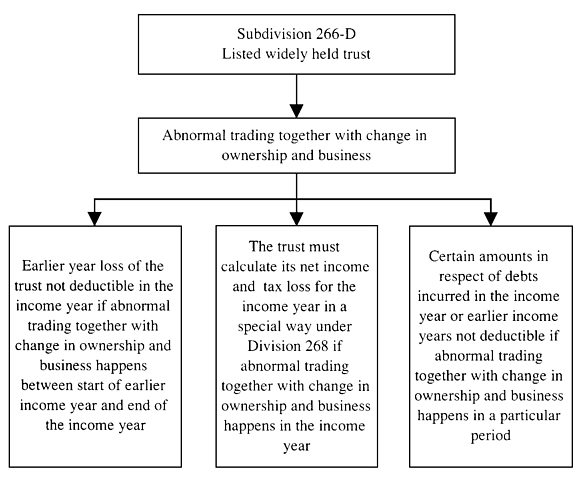
A listed widely held trust:
unless either:
Also, it may still be prevented from deducting the tax loss to the extent that it is attributable to certain debt deductions.
Note:
The exceptions mentioned in this section apply differently in relation to designated infrastructure project entities: see sections 415-25 and 415-30 of the Income Tax Assessment Act 1997 .
Type of trust to which this section applies
266-110(1)
This section applies to a trust that:
(a) can in the income year deduct a tax loss from a loss year; and
(b) was a listed widely held trust at all times in the period (the test period ) from the beginning of the loss year until the end of the income year; and
(c) was not an excepted trust at all times in the test period.
To find out the meaning of listed widely held trust : see section 272-115 .
To find out the meaning of excepted trust : see section 272-100 .
Condition for deducting tax loss
266-110(2)
The trust cannot deduct the tax loss unless it meets either:
Additional restriction on deducting tax loss
266-110(3)
Even if it meets either of the conditions, it still cannot deduct the tax loss, or part of the tax loss, if section 266-135 (which deals with certain debt deductions) prevents it from doing so.
A trust that:
(a) was a listed widely held trust at all times in the income year (the test period ); and
(b) was not an excepted trust at all times in the test period;
must work out its net income and tax loss for the income year under Division 268 (How to work out a trust ' s net income and tax loss for the income year), unless it meets either:
Note:
See section 415-25 of the Income Tax Assessment Act 1997 if the trust was a designated infrastructure project entity during part, but not the whole, of the test period.
Type of trust to which this section applies
266-120(1)
This section applies to a trust that:
(a) can deduct in the income year an amount:
(i) under section 51 or 63 , or under section 8-1 or 25-35 of the Income Tax Assessment Act 1997 , in respect of the writing off of the whole or part of a debt as bad; or
(ii) under subsection 63E(3) or (4) in respect of a debt/equity swap relating to the whole or part of a debt; and
(b) was a listed widely held trust at all times in the period (the test period ):
(i) if the debt was incurred in an earlier income year - beginning on the day the debt was incurred and ending at the end of the income year; or
(ii) if the debt was incurred in the income year - consisting of the income year; and
(c) was not an excepted trust at all times in the test period.
Note:
Subdivisions 709-D and 719-I of the Income Tax Assessment Act 1997 also affect when a trust that used to be a member of a consolidated group or MEC group may deduct a debt that used to be owed to a member of the group and that the trust writes off as bad.
Condition for deducting amount
266-120(2)
The trust cannot deduct the amount unless it meets either:
There must be no abnormal trading in the trust ' s units during the test period.
To find out the meaning of abnormal trading : see Subdivision 269-B .
266-125(2)
If there is abnormal trading on one or more occasions, then either:
(a) for each abnormal trading, the trust must pass the 50% stake test in respect of the following times:
(i) the beginning of the test period;
(ii) immediately after the abnormal trading; or
(b) if it does not, at all times after the first or only abnormal trading in respect of which the requirement in paragraph (a) is not satisfied and before the end of the test period, the trust must pass the business continuity test in relation to the time immediately before that abnormal trading.
To find out whether the trust passes the 50% stake test: see Subdivision 269-C .
To find out whether the trust passes the business continuity test: see Subdivision 269-F .
If section 266-110 prevents the trust from deducting a tax loss, it can deduct the part of the tax loss that is attributable to a part of the loss year.
266-130(2)
However, the trust can do this only if, assuming that that part of the loss year had been treated as the whole of the loss year for the purposes of section 266-125 , the trust would have been entitled to deduct the tax loss.
266-130(3)
Also, the trust cannot deduct the part of the tax loss, or some of it, if section 266-135 (which deals with certain debt deductions) prevents it from doing so.
Section applies after sections 266-110 and 266-130
266-135(1)
This section applies if, after applying sections 266-110 and 266-130 , a trust can deduct in the income year the whole or part (the otherwise-deductible loss ) of a tax loss from a loss year.
Trust must satisfy condition if debt deduction etc.
266-135(2)
If:
(a) there would have been no otherwise-deductible loss, or its amount would have been smaller, if the trust had not (after applying section 266-120 ) been able to deduct in the loss year an amount:
(i) under section 51 or 63 , or under section 8-1 or 25-35 of the Income Tax Assessment Act 1997 , in respect of the writing off of the whole or part of a debt as bad; or
(ii) under subsection 63E(3) or (4) in respect of a debt/equity swap relating to the whole or part of a debt; and
(b) the trust could only deduct the amount in respect of the debt because it passed the business continuity test as mentioned in paragraph 266-125(2)(b) ; and
(c) the Commissioner considers that the trust passed the business continuity test as mentioned in that paragraph for the purpose, or for purposes including the purpose, of being able to deduct the amount because of that paragraph;
the trust cannot deduct the otherwise-deductible loss, or can only deduct the smaller amount mentioned in paragraph (a) of this section, unless it meets the condition in subsection (3).
Condition
266-135(3)
The condition is that, at all times after the abnormal trading mentioned in paragraph 266-125(2)(b) and before the end of the income year, the trust must pass the business continuity test in relation to the time immediately before the abnormal trading.
An unlisted very widely held trust or a wholesale widely held trust:
unless either:
Note:
The exceptions mentioned in this section apply differently in relation to designated infrastructure project entities: see sections 415-25 and 415-30 of the Income Tax Assessment Act 1997 .
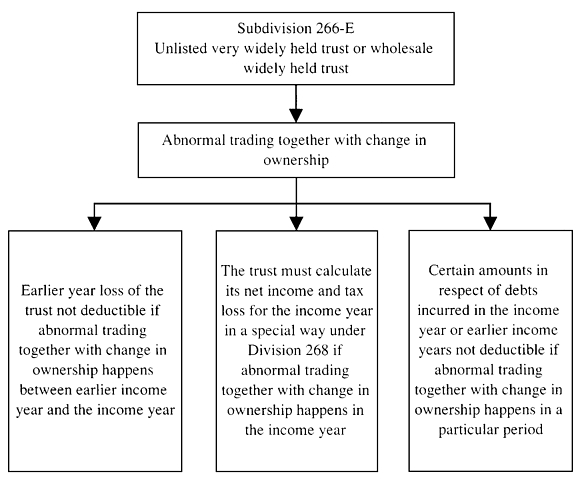
If a trust is covered by subsection (2), it cannot deduct in the income year a tax loss from a loss year unless it meets either:
266-150(2)
A trust is covered by this subsection if:
(a) in the period (the test period ) from the later of:
(i) the beginning of the loss year; and
until the end of the income year, the trust:
(ii) the end of any start-up period (within the meaning of subsection 272-120 (3));
(iii) was at all times an unlisted very widely held trust; or
(iv) was at all times a wholesale widely held trust; or
(v) was at some time an unlisted very widely held trust and, at any time when it was not, was a wholesale widely held trust or a listed widely held trust; or
(vi) was at some time a wholesale widely held trust and, at any time when it was not, was an unlisted very widely held trust or a listed widely held trust; and
(b) in the test period, the trust was not at all times an excepted trust.
To find out the meaning of unlisted very widely held trust : see section 272-120 .
To find out the meaning of wholesale widely held trust : see section 272-125 .
To find out the meaning of excepted trust : see section 272-100 .
To find out the meaning of listed widely held trust : see section 272-115 .
If a trust is covered by subsection (2), it must work out its net income and tax loss for the income year under Division 268 (How to work out a trust ' s net income and tax loss for the income year), unless it meets either:
266-155(2)
A trust is covered by this subsection if:
(a) in the period (the test period ) consisting of so much of the income year as occurs after the end of any start-up period (within the meaning of subsection 272-120 (3)), the trust:
(i) was at all times an unlisted very widely held trust; or
(ii) was at all times a wholesale widely held trust; or
(iii) was at some time an unlisted very widely held trust and, at any time when it was not, was a wholesale widely held trust or a listed widely held trust; or
(iv) was at some time a wholesale widely held trust and, at any time when it was not, was an unlisted very widely held trust or a listed widely held trust; and
(b) in the test period, the trust was not at all times an excepted trust.
Note:
See section 415-25 of the Income Tax Assessment Act 1997 if the trust was a designated infrastructure project entity during part, but not the whole, of the test period.
If a trust is covered by subsection (2), it cannot deduct in the income year an amount:
(a) under section 51 or 63 , or under section 8-1 or 25-35 of the Income Tax Assessment Act 1997 , in respect of the writing off of the whole or part of a debt as bad; or
(b) under subsection 63E(3) or (4) in respect of a debt/equity swap relating to the whole or part of a debt;
unless it meets either:
266-160(2)
A trust is covered by this subsection if:
(a) in the period (the test period ) from the later of the end of any start-up period (within the meaning of subsection 272-120 (3)) and the beginning of:
(i) if the debt was incurred in an earlier income year - the day on which the debt was incurred; or
until the end of the income year, the trust:
(ii) if the debt was incurred in the income year - the income year;
(iii) was at all times an unlisted very widely held trust; or
(iv) was at all times a wholesale widely held trust; or
(v) was at some time an unlisted very widely held trust and, at any time when it was not, was a wholesale widely held trust or a listed widely held trust; or
(vi) was at some time a wholesale widely held trust and, at any time when it was not, was an unlisted very widely held trust or a listed widely held trust; and
(b) in the test period, the trust was not at all times an excepted trust.
Note:
Subdivisions 709-D and 719-I of the Income Tax Assessment Act 1997 also affect when a trust that used to be a member of a consolidated group or MEC group may deduct a debt that used to be owed to a member of the group and that the trust writes off as bad.
There must be no abnormal trading in the units of the trust during the test period.
To find out the meaning of abnormal trading : see Subdivision 269-B .
266-165(2)
If there is abnormal trading on one or more occasions, then for each abnormal trading the trust must pass the 50% stake test in respect of the following times:
(a) the beginning of the test period;
(b) immediately after the abnormal trading.
To find out whether the trust passes the 50% stake test: see Subdivision 269-C .
If section 266-150 prevents the trust from deducting a tax loss, it can deduct the part of the tax loss that is attributable to a part of the loss year.
266-170(2)
However, the trust can do this only if, assuming that that part of the loss year had been treated as the whole of the loss year for the purposes of section 266-165 , the trust would have been entitled to deduct the tax loss.
If a trust would only avoid the tax consequences of this Division because of interests held by a non-resident family trust, the Commissioner may require the trust to give certain information about the non-resident family trust. If it is not given, the trust does not avoid the tax consequences of this Division.
Notice about family trust
266-180(1)
The Commissioner may give the trustee of a trust (the primary trust ) a notice in accordance with section 266-185 if the requirements of subsections (2) to (5) of this section are met.
First requirement
266-180(2)
In its return of income for an income year, the primary trust:
(a) must have deducted a tax loss from an earlier income year; or
(b) must not have worked out its net income and tax loss for the income year under Division 268 ; or
(c) must have deducted an amount in relation to a debt;
where it would not be allowed to deduct the tax loss or amount in respect of the debt, or would be required to work out its net income and tax loss under that Division, if it did not meet a condition or conditions as mentioned in section 266-40 , 266-45 , 266-90 , 266-125 or 266-165 (the conditions provision ).
Second requirement
266-180(3)
The Commissioner must be satisfied that the primary trust would not meet the condition or conditions if one or more trusts were not family trusts.
Third requirement
266-180(4)
When the Commissioner gives the notice, for at least one of the family trusts:
(a) a trustee of the trust must be a non-resident; or
(b) the central management and control of the trust must be outside Australia.
Fourth requirement
266-180(5)
The Commissioner must give the notice before the later of:
(a) 5 years after the end of the income year to which the return relates; and
(b) the end of the period during which the trustee of the primary trust is required by section 262A to retain records in relation to that income year.
Information required
266-185(1)
The notice that the Commissioner may give if the requirements of subsections 266-180(2) to (5) are met must require the trustee of the primary trust to give the Commissioner specified information about conferrals of present entitlements to, and distributions of, income and capital, since the beginning of the test period mentioned in the conditions provision, by all of the family trusts meeting the requirements of paragraph 266-180(4)(a) or (b) .
Trustee knowledge
266-185(2)
The information need not be within the knowledge of the trustee at the time the notice is given.
Period for giving information
266-185(3)
The notice must specify a period within which the trustee is to give the information. The period must not end earlier than 21 days after the day on which the Commissioner gives the notice.
Consequence of not giving the information
266-185(4)
If the trustee does not give the information within the period or within such further period as the Commissioner allows, the primary trust is taken not to meet, and never to have met, the condition or conditions in the conditions provision.
266-185(5)
If, because of subsection (4), the fixed trust is required to work out under Division 268 its net income and tax loss for the income year mentioned in subsection 266-180(2) , that Division is to be applied as if Subdivision 268-B required the income year to be divided into such periods as would result in the highest possible net income for the income year.
No offences or penalties
266-185(6)
To avoid doubt, subsections (4) and (5) do not cause the trustee of the primary trust to commit any offence or be liable to any penalty under Part 4-25 in Schedule 1 to the Taxation Administration Act 1953 for deducting the amount concerned, or for not working out the trust ' s net income and tax loss under Division 268 , in the trust ' s return.
This Division is about the income tax consequences for a non-fixed trust if its ownership or control changes.
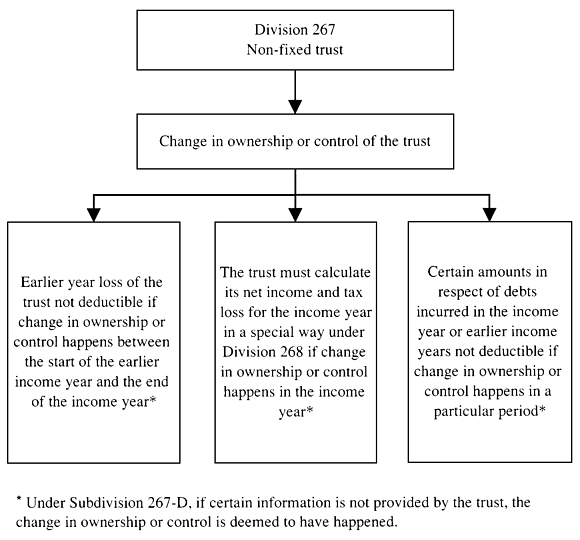
A non-fixed trust cannot deduct:
unless:
Note:
The exceptions mentioned in this section apply differently in relation to designated infrastructure project entities: see sections 415-25 and 415-30 of the Income Tax Assessment Act 1997 .
Type of trust to which this Subdivision applies
267-20(1)
This section applies to a trust that:
(a) can deduct in the income year a tax loss from a loss year; and
(b) was a non-fixed trust at any time in the period (the test period ) from the beginning of the loss year until the end of the income year; and
(c) was not an excepted trust at all times in the test period.
To find out the meaning of non-fixed trust : see section 272-70 .
To find out the meaning of excepted trust : see section 272-100 .
Conditions for deducting tax loss
267-20(2)
The trust cannot deduct the tax loss unless it meets:
Type of trust to which this section applies
267-25(1)
This section applies to a trust that:
(a) can deduct in the income year an amount:
(i) under section 51 or 63 , or under section 8-1 or 25-35 of the Income Tax Assessment Act 1997 , in respect of the writing off of the whole or part of a debt, incurred in an earlier income year, as bad; or
(ii) under subsection 63E(3) or (4) in respect of a debt/equity swap relating to the whole or part of a debt incurred in an earlier income year; and
(b) was a non-fixed trust at any time in the period (the test period ) beginning on the day the debt was incurred and ending at the end of the income year; and
(c) was not an excepted trust at all times in the test period.
Note:
Subdivisions 709-D and 719-I of the Income Tax Assessment Act 1997 also affect when a trust that used to be a member of a consolidated group or MEC group may deduct a debt that used to be owed to a member of the group and that the trust writes off as bad.
Condition for deducting amount
267-25(2)
The trust cannot deduct the amount unless it meets:
When trust must meet the condition
267-30(1)
If either or both of the following happened, the trust must meet the condition in subsection (2):
(a) the trust distributed income:
(i) in the income year or within 2 months after its end; and
(ii) in at least one of the 6 earlier income years; or
(b) the trust distributed capital:
(i) in the income year or within 2 months after its end; and
(ii) in at least one of the 6 earlier income years.
The condition
267-30(2)
The condition is that the trust must pass the pattern of distributions test for the income year.
To find out whether the trust passes the pattern of distributions test for the income year: see Subdivision 269-D .
The trust must not have been prevented from deducting the tax loss in an earlier income year because of a failure to meet the condition in subsection 267-30(2) or conditions that included that condition.
When trust must meet condition
267-40(1)
If at any time (the test time ) in the test period, individuals (the threshold group ) have more than a 50% stake in the income or capital of the trust, the trust must meet the condition in subsection (2).
To find out whether individuals have more than a 50% stake in the income or capital of the trust: see Subdivision 269-C .
Condition
267-40(2)
The condition is that, during the period beginning at the test time and finishing at the end of the test period, the same individuals (who must be some or all of the threshold group) must have had more than a 50% stake in the income or the capital, respectively, of the trust.
Commissioner discretion
267-40(3)
If:
(a) after the test time, some or all of the threshold group cease to have a 50% stake in the income or capital of the trust at a particular time; and
(b) having regard to the likely manner of exercise of any discretion of the trustee to distribute income or capital of the trust after the particular time and to any other relevant matter, the Commissioner considers it fair and reasonable that the individuals should be taken to have the stake at the particular time and at all later times in the test period;
the individuals are taken to have that stake at the particular time and at all later times in the test period.
A group must not, during the test period, begin to control the trust directly or indirectly.
To find out what it means for a group to control the trust: see Subdivision 269-E .
If section 267-20 prevents a trust from deducting a tax loss because the trust does not meet the condition in section 267-40 or 267-45 or both conditions, it can deduct the part of the tax loss that is attributable to a part of the loss year.
267-50(2)
However, the trust can do this only if, assuming that that part of the loss year had been treated as the whole of the loss year for the purposes of sections 267-40 and 267-45 , the trust would have been entitled to deduct the tax loss.
A non-fixed trust:
unless:
Note:
The exceptions mentioned in this section apply differently in relation to designated infrastructure project entities: see sections 415-25 and 415-30 of the Income Tax Assessment Act 1997 .
A trust that:
(a) was a non-fixed trust at any time in the income year (the test period ); and
(b) was not an excepted trust at all times in the test period;
must work out its net income and tax loss for the income year under Division 268 (How to work out a trust ' s net income and tax loss for the income year), unless it meets:
To find out the meaning of excepted trust : see section 272-100 .
Note:
See section 415-25 of the Income Tax Assessment Act 1997 if the trust was a designated infrastructure project entity during part, but not the whole, of the test period.
Type of trust to which this section applies
267-65(1)
This section applies to a trust that:
(a) can deduct in the income year (the test period ) an amount:
(i) under section 51 or 63 in respect of the writing off of the whole or part of a debt, incurred in the income year, as bad; or
(ii) under subsection 63E(3) or (4) in respect of a debt/equity swap relating to the whole or part of a debt incurred in the income year; and
(b) was a non-fixed trust at any time in the test period; and
(c) was not an excepted trust at all times in the test period.
Note:
Subdivisions 709-D and 719-I of the Income Tax Assessment Act 1997 also affect when a trust that used to be a member of a consolidated group or MEC group may deduct a debt that used to be owed to a member of the group and that the trust writes off as bad.
Condition for deducting amount
267-65(2)
The trust cannot deduct the amount unless it meets:
When trust must meet condition
267-70(1)
If at any time (the test time ) in the test period, individuals (the threshold group ) have more than a 50% stake in the income or capital of the trust, the trust must meet the condition in subsection (2).
To find out whether individuals have more than a 50% stake in the income or capital of the trust: see Subdivision 268-C .
Condition
267-70(2)
The condition is that, during the period beginning at the test time and finishing at the end of the test period, the same individuals (who must be some or all of the threshold group) must have more than a 50% stake in the income or the capital, respectively, of the trust.
Commissioner discretion
267-70(3)
If:
(a) after the test time, some or all of the threshold group cease to have a 50% stake in the income or capital of the trust at a particular time; and
(b) having regard to the likely manner of exercise of any discretion of the trustee to distribute income or capital of the trust after the particular time and to any other relevant matter, the Commissioner considers it fair and reasonable that the individuals should be taken to have the stake at the particular time and at all later times in the test period;
the individuals are taken to have that stake at the particular time and at all later times in the test period.
A group must not, during the test period, begin to control the trust directly or indirectly.
To find out what it means for a group to control the trust: see Subdivision 269-E .
If a trust would only avoid the tax consequences of this Division because of interests held by a non-resident family trust, the Commissioner may require the trust to give certain information about the non-resident family trust. If it is not given, the trust does not avoid the tax consequences of this Division.
Notice about family trust
267-85(1)
The Commissioner may give the trustee of a trust (the primary trust ) a notice in accordance with section 267-90 if the requirements of subsections (2) to (5) of this section are met.
First requirement
267-85(2)
In its return of income for an income year, the primary trust:
(a) must have deducted a tax loss from an earlier income year; or
(b) must not have worked out its net income and tax loss for the income year under Division 268 ; or
(c) must have deducted an amount in relation to a debt;
where it would not be allowed to deduct the tax loss or amount in respect of the debt, or would be required to work out its net income and loss under that Division, if it did not meet a condition or conditions as mentioned in section 267-40 or 267-70 (theconditions provision ).
Second requirement
267-85(3)
The Commissioner must be satisfied that the primary trust would not meet the condition or conditions if one or more trusts were not family trusts.
Third requirement
267-85(4)
When the Commissioner gives the notice, for at least one of the family trusts:
(a) a trustee of the trust must be a non-resident; or
(b) the central management and control of the trust must be outside Australia.
Fourth requirement
267-85(5)
The Commissioner must give the notice before the later of:
(a) 5 years after the end of the income year to which the return relates; and
(b) the end of the period during which the trustee of the primary trust is required by section 262A to retain records in relation to that income year.
Information required
267-90(1)
The notice that the Commissioner may give if the requirements of subsections 267-85(2) to (5) are met must require the trustee to give the Commissioner specified information about conferrals of present entitlements to, and distributions of, income and capital, since the beginning of the test period mentioned in the conditions provision, by all of the family trusts meeting the requirements of paragraph 267-85(4)(a) or (b) .
Trustee knowledge
267-90(2)
The information need not be within the knowledge of the trustee at the time the notice is given.
Period for giving information
267-90(3)
The notice must specify a period within which the trustee is to give the information. The period must not end earlier than 21 days after the day on which the Commissioner gives the notice.
Consequence of not giving the information
267-90(4)
If the trustee does not give the information within the period or within such further period as the Commissioner allows, the primary trust is taken not to meet, and never to have met, the condition or conditions in the conditions provision.
Application of Division 268
267-90(5)
If, because of subsection (4), the fixed trust is required to work out under Division 268 its net income and tax loss for the income year mentioned in subsection 267-85(2) , that Division is to be applied as if Subdivision 268-B required the income year to be divided into such periods as would result in the highest possible net income for the income year.
No offences or penalties
267-90(6)
To avoid doubt, subsections (4) and (5) do not cause the trustee of the primary trust to commit any offence or be liable to any penalty under Part VII for deducting the amount concerned, or for not working out the trust ' s net income and tax loss under Division 268 , in the trust ' s return.
This Division requires a trust ' s net income and tax loss to be worked out in a special way. The income year is divided into periods as the basis for the calculation.
If:
(a) a trust ' s net income and tax loss for the income year are required by section 266-30 to be worked out under this Division; and
(b) the trust did not meet the requirements of subsections 266-45(2) and (4) ;
the income year is divided into periods as follows.
268-10(2)
The first period begins at the beginning of the income year. Each later period begins immediately after the end of the previous period.
268-10(3)
The last period ends at the end of the income year. Each period (except the last) ends at the latest time that would result in the trust passing the 50% stake test for the whole of the period.
If:
(a) a trust ' s net income and tax loss for the income year are required by section 266-30 to be worked out under this Division; and
(b) the trust met the requirements of subsections 266-45(2) and (4) ;
the income year is divided into periods as follows.
268-15(2)
The first period begins at the beginning of the income year. Each later period begins immediately after the end of the previous period.
268-15(3)
The last period ends at the end of the income year. Each period (except the last) ends at the earliest of:
(a) the latest time that would result in the persons holding fixed entitlements to shares of the income or shares of the capital of:
(i) if the trust met the requirements of paragraph 266-45(2)(a) - the trust; or
and the percentages of the shares that they hold, remaining the same during the whole of the period; and
(ii) if the trust met the requirements of paragraph 266-45(2)(b) - the holding entity mentioned in that paragraph;
(b) the times that, for all of the non-fixed trusts (other than excepted trusts) holding directly or indirectly a fixed entitlement to a share of the income or capital of the trust at any time during the income year, are the latest times that would result in individuals having more than a 50% stake in their income or capital; and
(c) the earliest time in the period when a group begins to control a non-fixed trust (other than an excepted trust) that holds directly or indirectly a fixed entitlement to a share of the income or capital of the trust at any time during the income year.
To find out when a group begins to control a trust: see Subdivision 269-E .
If a trust ' s net income and tax loss for the income year are required by section 266-80 , 266-115 or 266-155 to be worked out under this Division, the income year is divided into periods as follows.
268-20(2)
The first period begins at the beginning of the income year. Each later period begins immediately after the end of the previous period.
268-20(3)
The last period ends at the end of the income year. Each period (except the last) ends at the earliest time at which there is an abnormal trading in the trust ' s units, where the trust does not pass the 50% stake test in respect of the following times:
(a) the beginning of the period;
(b) immediately after the abnormal trading.
268-20(4)
However, what would, apart from this subsection, be 2 or more successive periods are treated as a single period if:
(a) the trust is a listed widely held trust; and
(b) during all of the periods the trust passed the business continuity test in relation to the time immediately before the end of the first of the successive periods.
If a trust ' s net income and tax loss for the income year are required by section 267-60 to be worked out under this Division, the income year is divided into periods as follows.
268-25(2)
The first period begins at the beginning of the income year. Each later period begins immediately after the end of the previous period.
268-25(3)
The last period ends at the end of the income year.
268-25(4)
If the condition in subsection 267-70(2) applies but the trust does not meet the condition, each period (except the last) ends at the earlier of:
(a) the latest time, after the test time mentioned in that section, that would result in the same individuals having more than a 50% stake in the income or the capital, as the case requires, of the trust during the whole of the period; or
(b) the earliest time when a group begins to control the trust directly or indirectly.
268-25(5)
If the condition in subsection 267-70(2) does not apply, or does apply and the trust meets the condition, each period (except the last) ends at the earliest time when a group begins to control the trust directly or indirectly.
A notional loss or notional net income of the trust must be worked out for each period into which the income year has been divided in accordance with Subdivision 268-B .
268-30(2)
The trust has a notional loss for a period if the deductions attributed to the period under section 268-35 exceed the assessable income attributed to the period under section 268-40 . The notional loss is the amount of the excess.
For a period during which the trust was in partnership, the notional loss is worked out under Subdivision 268-D .
268-30(3)
On the other hand, if that assessable income exceeds those deductions, the trust has a notional net income for the period, equal to the excess.
For a period during which the trust was in partnership, the notional net income is worked out under Subdivision 268-D .
268-30(4)
If the trust has a notional loss for none of the periods in the income year, this Subdivision has no further application, and the trust ' s net income for the income year is calculated in the usual way.
The usual way of working out net income is set out in section 95.
The trust ' s deductions for the income year are attributed to periods in the income year as follows.
268-35(2)
The following deductions are attributed to each period in proportion to the length of the period:
(a) (Repealed by No 101 of 2006 )
(aa) deductions for the decline in value of a depreciating asset;
See Division 40 of the Income Tax Assessment Act 1997 .
(b) (Repealed by No 101 of 2006 )
(c) deductions for expenditure, deductions for which are spread over 2 or more years, but not full year deductions (see subsection (5));
(d) deductions for expenditure of capital monies in connection with an Australian film.
See former section 124ZAFA .
268-35(3)
All other deductions (except full year deductions) are attributed to periods as if each period were an income year.
268-35(4)
Full year deductions are not attributed to any of the periods. They are brought in at a later stage of the process of calculating the trust ' s net income for the income year.
268-35(5)
These are full year deductions :
(a) deductions for bad debts under section 8-1 (about general deductions) of the Income Tax Assessment Act 1997 ;
(b) deductions for bad debts under section 25-35 (about bad debts) of the Income Tax Assessment Act 1997 , or for losses on debt/equity swaps under section 63E ;
(c) deductions, so far as they are allowable under Division 8 (which is about deductions) of the Income Tax Assessment Act 1997 , because Subdivision H (Period of deductibility of certain advance expenditure) of Division 3 of Part III applies to the trust in relation to the income year;
(d) deductions allowable under Division 30 of the Income Tax Assessment Act 1997 ;
(e) deductions for payments of pensions, gratuities or retiring allowances under section 25-50 of the Income Tax Assessment Act 1997 ;
(f) deductions for tax losses of earlier income years;
See Division 36 of the Income Tax Assessment Act 1997 .
(g) - (h) (Omitted by No 169 of 1999)
(i) (Repealed by No 101 of 2006 )
(j) deductions for farm management deposits.
Note:
See Division 393 of the Income Tax Assessment Act 1997 .
268-35(6)
However, a deduction for the balance of capital expenditure is not a full year deduction if the deduction results from the disposal, loss, lapse, termination of use or destruction of the property.
See Subdivision 40-D of the Income Tax Assessment Act 1997 .
The trust ' s assessable income for the income year is attributed to periods in the income year as follows.
268-40(2)
The following amounts are attributed to periods so far as they are reasonably attributable to those periods:
(a) amounts included in the trust ' s assessable income under section 97 (Beneficiary of a trust estate not under a legal disability); or
(b) amounts included in the trust ' s assessable income under section 98A (Non-resident beneficiaries assessable in respect of certain income).
268-40(3)
The following items of assessable income are attributed to each period in proportion to the length of the period:
(a) insurance recoveries for loss of livestock or trees;
See section 385-130 of the Income Tax Assessment Act 1997 .
(b) amounts included in assessable income as a result of elections relating to the forced disposal of livestock;
See Subdivision 385-E and section 385-160 of the Income Tax Assessment Act 1997 .
(c) recoupment of mains electricity connection expenditure.
See item 1.25 in section 20-30 , which lists deductions for which recoupments are assessable under Subdivision 20-A , of the Income Tax Assessment Act 1997 .
268-40(4)
An amount included in the trust ' s assessable income under section 385-185 (Election to defer including profit on second wool clip) of the Income Tax Assessment Act 1997 is attributed to the period when the wool would ordinarily have been shorn.
268-40(5)
An amount included in the trust ' s assessable income that is a dividend under:
(a) section 65 (Payments to associated persons); or
(b) (Repealed by No 79 of 2007 )
(c) section 109 (Excessive payments to shareholders and associates); or
(d) Division 7A of Part III (Distributions to entities connected with a private company);
is attributed to the period when the amount was paid or credited, whichever occurred first.
268-40(6)
All other items of assessable income (except full year amounts) are attributed to periods as if each period were an income year.
268-40(7)
Full year amounts are amounts referred to in paragraphs (2)(a) and (b), so far as they are not reasonably attributable to a period. They are brought in at a later stage of the process of calculating the trust ' s net income for the income year.
The trust ' s net income for the income year is worked out as follows.
268-45(2)
Add up the notional net incomes (if any) worked out under section 268-30 or 268-70.
Note:
A notional loss for a period is not taken into account, but counts towards the trust ' s tax loss for the income year.
268-45(3)
Add the full year amounts referred to in subsection 268-40 (7) (if any).
268-45(4)
Subtract the trust ' s full-year deductions of these kinds:
(a) deductions for bad debts under section 8-1 (about general deductions) of the Income Tax Assessment Act 1997 ;
(b) deductions for bad debts under section 25-35 (about bad debts) of the Income Tax Assessment Act 1997 ;
(c) deductions, so far as they are allowable under Division 8 (which is about deductions) of the Income Tax Assessment Act 1997 because Subdivision H (Period of deductibility of certain advance expenditure) of Division 3 of Part III applies to the trust in relation to the income year;
unless they exceed the total of the notional net incomes and the full year amounts. (If they equal or exceed that total, the trust does not have a net income for the income year.)
268-45(5)
If an amount remains, subtract from it the trust ' s other full year deductions, in the order shown in subsection 268-35 (5), unless they exceed the amount remaining. (If they equal or exceed that amount, the trust does not have a net income for the income year.)
268-45(6)
The amount (if any) remaining is the trust ' s net income for the income year.
For the purposes of Division 36 (Tax losses of earlier income years) of the Income Tax Assessment Act 1997 , instead of working out the trust ' s tax loss for the year under section 36-10 of that Act, it is worked out as follows.
268-60(2)
Total the notional losses.
268-60(3)
Add the amount (if any) by which the trust ' s full year deductions of these kinds:
(a) deductions for bad debts under section 8-1 (about general deductions) of the Income Tax Assessment Act 1997 ;
(b) deductions for bad debts under section 25-35 (about bad debts) of the Income Tax Assessment Act 1997 ;
(c) deductions, so far as they are allowable under Division 8 (which is about deductions) of the Income Tax Assessment Act 1997 because Subdivision H (Period of deductibility of certain advance expenditure) of Division 3 of Part III applies to the trust in relation to the income year;
exceed the total of:
(d) the notional net incomes (if any); and
To work out the notional net income: see sections 268-30 and 268-70 .
(e) the full year amounts referred to in section 268-40 (if any).
268-60(4)
If the trust derived exempt income, subtract its net exempt income as defined in section 36-20 of the Income Tax Assessment Act 1997 .
268-60(5)
Any amount remaining is the trust ' s tax loss for the income year.
To find out how much of the tax loss can be deducted in later income years, see Division 266 or 267 .
To find out how to deduct it, see section 36-15 or 36-17 of the Income Tax Assessment Act 1997 .
(Repealed by No 41 of 1998) Subdivision 268-D - Rules that supplement Subdivision 268-C if the trust is in partnership
This section applies if at any time during a period the trust was a partner in one or more partnerships.
268-70(2)
The trust has a notional loss for the period if the total (the loss total ) of:
(a) the deductions attributed to the period under section 268-35 ; and
(b) the trust ' s share of each notional loss (if any) of a partnership for the period;
exceeds the total (the income total ) of:
(c) the assessable income attributed to the period under section 268-40 ; and
(d) the trust ' s share of each notional net income (if any) of a partnership for the period.
The notional loss is the amount of the excess.
Note:
A notional loss is taken into account in working out the trust ' s tax loss under section 268-60 .
268-70(3)
On the other hand, if the income total exceeds the loss total, the trust has a notional net income for the period, equal to the excess.
Note:
A notional net income is taken into account in working out the trust ' s net income under section 268-45 .
268-70(4)
If the trust has a notional net income for all periods in the income year, this Subdivision has no further application, and the trust ' s net income for the income year is worked out in the usual way.
The usual way of working out net income is set out in section 95.
This section applies if at any time during a period the trust is a partner in a partnership that has an income year that begins and ends when the trust ' s income year begins and ends.
268-75(2)
The partnership ' s notional loss or notional net income for the period is worked out in the same way as the notional loss or notional net income of a trust.
268-75(3)
The trust ' s share is calculated by dividing:
(a) the trust ' s interest in the partnership ' s net income or partnership loss of the income year;
by:
(b) the amount of that net income or partnership loss;
and expressing the result as a percentage.
268-75(4)
However, if the partnership had neither a net income nor a partnership loss, the trust ' s share is a percentage that is fair and reasonable having regard to the extent of the trust ' s interest in the partnership.
This section applies if at any time during a period the trust is a partner in a partnership that has an income year that begins and ends at a different time from when the trust ' s income year begins and ends.
268-80(2)
So much of the partnership ' s net income or partnership loss of an income year as was derived during the period is a notional net income or notional loss of the partnership for the period. (For the purposes of this subsection, the partnership ' s net income or partnership loss is calculated without taking account of the partnership ' s full year deductions for that income year.)
Note:
The partnership ' s full year deductions are dealt with in section 268-85 .
268-80(3)
The trust ' s share is calculated by dividing:
(a) the trust ' s interest in the partnership ' s net income or partnership loss of the income year;
by:
(b) the amount of that net income or partnership loss;
and expressing the result as a percentage.
This section applies if at any time during the income year the trust is a partner in a partnership that has one or more full year deductions for the income year of the partnership that corresponds to the income year of the trust.
268-85(2)
The partnership ' s full year deductions are treated as full year deductions of the trust, but only to the extent of the trust ' s share.
268-85(3)
If the partnership ' s income year is the same as the trust ' s, the trust ' s share is calculated by dividing:
(a) the trust ' s interest in the partnership ' s net income or partnership loss of the income year;
by:
(b) the amount of that net income or partnership loss;
and expressing the result as a percentage.
268-85(4)
However, if the partnership had neither a net income nor a partnership loss, the trust ' s share is a percentage that is fair and reasonable having regard to the extent of the trust ' s interest in the partnership.
268-85(5)
If the partnership ' s income year does not begin and end at the same time as the trust ' s income year, the trust ' s share is a percentage that is fair and reasonable having regard to all relevant circumstances.
This Division explains the following concepts or tests that are used in preceding Divisions of this Schedule:
A trading in units in a unit trust occurs if there is an issue, redemption or transfer of, or other dealing in, the units.
There is an abnormal trading in units in a unit trust if there is a trading in the units that is abnormal having regard to all relevant factors, including:
(a) the timing of the trading, when compared to the normal timing for trading in its units; and
(b) the number of units traded, when compared to the normal number of units traded; and
(c) any connection between the trading and any other trading in units in the trust; and
(d) any connection between the trading and a tax loss or other deduction of the trust.
269-15(2)
There may also be an abnormal trading under any of the following provisions.
There is an abnormal trading in units in a unit trust if a trading occurs in its units that the trustee knows or reasonably suspects is part of an acquisition of the trust or merger of the trust with another trust.
There is an abnormal trading in units in a unit trust (other than a wholesale widely held trust) if 5% or more of the units are traded in one transaction.
There is an abnormal trading in units in a unit trust (other than a wholesale widely held trust) if the trustee knows or reasonably suspects that a person, or a person and one or more associates of the person, have acquired or redeemed 5% or more of the units in 2 or more transactions and would not have done so if the trust did not have a tax loss or other deduction.
269-30(2)
For the purposes of other provisions of this Schedule, the abnormal trading occurs at the time of the particular transaction that causes the 5% figure to be exceeded.
There is an abnormal trading in units in a unit trust (other than a wholesale widely held trust) if more than 20% of the units on issue at the end of any 60 day period were traded during the period.
269-35(2)
For the purposes of other provisions of this Schedule, the abnormal trading occurs at the end of the 60 day period.
There is an abnormal trading in units in a wholesale widely held trust during a period if the trustee knows or reasonably suspects that the same persons did not hold more than 50% of its units at the beginning and end of the period.
269-40(2)
For the purposes of other provisions of this Schedule, the abnormal trading occurs immediately before the end of the period.
For the purposes of section 269-20 , 269-30 or 269-40 , the trustee must have the knowledge or reasonable suspicion mentioned in that section:
(a) if the section is being applied in determining for the purposes of section 268-20 whether an abnormal trading occurred - at some time during the income year mentioned in that section; or
(b) if it is being applied in determining for the purposes of any other provision whether an abnormal trading occurred during a period - at some time during the period.
Holding trust and subsidiary trust
269-47(1)
If a unit trust has fixed entitlements directly or indirectly to all of the income and capital of another unit trust:
(a) the first trust is a holding trust of the second; and
(b) the second is a subsidiary trust of the first.
Abnormal trading causing or ending holding-subsidiary relationship
269-47(2)
The transaction that causes a trust to become, or to cease to be, a holding trust of a subsidiary trust (the bottom subsidiary trust) is an abnormal trading in units in the bottom subsidiary trust unless:
(a) the holding trust is itself a subsidiary trust of one or more holding trusts (each of which is a higher holding trust ); and
(b) immediately before and after the transaction, the bottom subsidiary trust is a subsidiary trust of one or more of the higher holding trusts.
Abnormal trading while holding-subsidiary relationship exists
269-47(3)
While one or more trusts are holding trusts of the same subsidiary trust, there is an abnormal trading in units in the subsidiary trust if and only if, and at the time at which, there is an abnormal trading in units in the holding trust that is not itself a subsidiary trust of another holding trust.
If the issue of units in a unit trust to existing unit holders does not cause each unit holder ' s proportion of the total fixed entitlements to shares of the income and capital of the trust to change, then, except for the purposes of section 269-20 , the issue is disregarded in determining whether there has been an abnormal trading in units in the unit trust.
More than a 50% stake in income
269-50(1)
If there are individuals who have (between them), directly or indirectly, and for their own benefit, fixed entitlements to a greater than 50% share of the income of a trust, those individuals have more than a 50% stake in the income of the trust.
More than a 50% stake in capital
269-50(2)
If there are individuals who have (between them), directly or indirectly, and for their own benefit, fixed entitlements to a greater than 50% share of the capital of the trust, those individuals have more than a 50% stake in the capital of the trust.
If, at all times during a period, or at 2 times:
(a) the same individuals have more than a 50% stake in the income of a trust; and
(b) the same individuals (who may be different from those in paragraph (a)) have more than a 50% stake in the capital of the trust;
the trust passes the 50% stake test for the period or in respect of the 2 times.
269-55(2)
If a trust is a widely held unit trust it is taken to pass the 50% stake test for a period or in respect of 2 times if it is reasonable to assume that the requirements of paragraphs (1)(a) and (b) are satisfied in respect of the period or the 2 times.
A trust passes the pattern of distributions test for an income year if, before the end of 2 months after the end of the income year:
(a) the trust distributed directly or indirectly to the same individuals, for their own benefit, a greater than 50% share of all test year distributions of income (see subsection 269-65 (1)); and
(b) the trust distributed directly or indirectly to the same individuals (who may be different from those in paragraph (a)), for their own benefit, a greater than 50% share of all test year distributions of capital (see subsection 269-65 (3)).
Test year distribution of income
269-65(1)
A test year distribution of income is the total of all distributions of income made by the trust in any of the following periods, provided the period does not begin more than 6 years before the beginning of the income year:
(a) the period from the beginning of the income year until 2 months after its end;
(b) if the trust distributed income before the trigger year (see subsection (2)) - the income year, before the trigger year, that is closest to the trigger year;
(c) if paragraph (b) does not apply and the trust distributed income in the trigger year - the trigger year;
(d) if neither paragraph (b) nor paragraph (c) applies - the income year, closest to the trigger year, in which the trust distributed income;
(e) each intervening income year (if any) between the one in paragraph (a) and the one in paragraph (b), (c) or (d).
Trigger year
269-65(2)
If this Subdivision is being applied for the purposes of section 267-20 , the trigger year is the loss year mentioned in that section. If it is being applied for the purposes of section 267-25 , the trigger year is the year in which the debt mentioned in that section was incurred.
Test year distribution of capital
269-65(3)
Subsection (1) applies in the same way to distributions of capital made by the trust, to determine what is a test year distribution of capital .
For the purposes of section 269-60 , if the trust does not distribute to an individual the same percentage of income or capital for every test year distribution, the trust is taken to have distributed to the individual, for every test year distribution, the smallest percentage that it distributed to the individual for any of the test year distributions.
For the purposes of section 269-60 , if, before the end of 2 months after the end of the income year:
(a) the trust has distributed directly or indirectly the whole or part of a test year distribution of income or test year distribution of capital to a company, partnership or trust (the entity ); and
(b) an amount (the undistributed amount ) consisting of the whole or part of the income or capital so distributed to the entity satisfies the following requirements:
(i) the amount has not been distributed by the entity; and
(ii) an individual, directly or indirectly, and for his or her own benefit, has a fixed entitlement to a share of the amount;
the entity is taken to have distributed the share of the undistributed amount to the individual immediately before the end of 2 months after the end of the income year.
For the purposes of section 269-60 , if:
(a) the trust distributes, directly or indirectly to an individual as mentioned in that section, income or capital that is included in a test year distribution; and
(b) a later distribution of income or capital is made that is included in the same or a different test year distribution; and
(c) either the individual dies before the later distribution is made or:
(i) before it is made, there is a breakdown in the marriage or relationship (see section 272-140) of the individual; and
(ii) after the breakdown, no distribution of income or capital of the trust, that is included in a test year distribution, is made directly or indirectly to the individual; and
(iii) it is reasonable to assume that the breakdown in the marriage or relationship is the reason for no such distribution being made;
then subsections (2) and (3) apply.
269-80(2)
No income or capital distributed to the individual by the trust, directly or indirectly as mentioned in section 269-60 , is to be included in any test year distribution.
269-80(3)
If:
(a) the requirements of subsection (1) are met because the individual has died; and
(b) immediately before his or her death, the individual had directly or indirectly, and for his or her own benefit, a fixed entitlement to a share of the income or capital of the trust; and
(c) after the individual ' s death, the fixed entitlement is held by a person as trustee of the individual ' s estate or by a person who received it as a beneficiary of the estate;
no income or capital distributed to the person as such a trustee or beneficiary, directly or indirectly as mentioned in section 269-60 , is to be included in any test year distribution.
The trust is taken for the purposes of section 269-60 not to have distributed, directly or indirectly to an individual, and for the individual ' s own benefit, a share of a test year distribution of income or capital of the trust if the condition in subsection (2) is met.
269-85(2)
The condition is that an arrangement was entered into where:
(a) the arrangement in some way (directly or indirectly) related to, affected or depended for its operation on the share or its value; and
(b) the purpose, or one of the purposes, of the arrangement was to ensure that the trust would meet the condition in subsection 267-30(2) .
Basic meaning
269-95(1)
Subject to this section, a group (see subsection (5)) controls a non-fixed trust if:
(a) the group has the power, by means of the exercise of a power of appointment or revocation or otherwise, to obtain beneficial enjoyment (directly or indirectly) of the capital or income of the trust; or
(b) the group is able (directly or indirectly) to control the application of the capital or income of the trust; or
(c) the group is capable, under a scheme, of gaining the beneficial enjoyment in paragraph (a) or the control in paragraph (b); or
(d) the trustee is accustomed, under an obligation or might reasonably be expected, to act in accordance with the directions, instructions or wishes of the group; or
(e) the group is able to remove or appoint the trustee; or
(f) the group acquires more than a 50% stake in the income or capital of the trust.
Replacement group after death etc.
269-95(2)
The consequences set out in subsection (3) apply if:
(a) a group (the original group ) ceases to control a non-fixed trust only because of the death, incapacitation or breakdown in the marriage or relationship of the individual comprising, or an individual included in, the group; and
(b) another group (the replacement group ) begins to control the trust within the following period (whether or not any other group controlled the trust in the interim):
(i) one year after the death, incapacitation or breakdown in the marriage or relationship; or
(ii) such longer period as the Commissioner determines in relation to the death, incapacitation or breakdown in the marriage or relationship; and
(c) the replacement group consists of:
(i) if the individual who died or became incapacitated or whose marriage or relationship broke down comprised the original group - one or more individuals who are members of the individual ' s family (see section 272-95 ); or
(ii) in any other case - one or more such individuals together with all of the persons who were members of the original group, other than any individual who has died or become incapacitated or whose marriage or relationship has broken down; and
(d) the replacement group began to control the trust only because of the death, incapacitation or breakdown in the marriage or relationship of the individual; and
(e) disregarding any individual who died or became incapacitated or whose marriage or relationship broke down and the one or more individuals covered by paragraph (c) - the beneficiaries of the trust immediately before the original group ceased to control the trust are the beneficiaries of the trust immediately after the replacement group begins to control the trust.
Consequences of subsection (2)
269-95(3)
For the purposes of subsection (2), the consequences are that:
(a) the replacement group is taken to have controlled the trust from the time when the original group began to control it until the time when the replacement group actually began to control it; and
(b) the original group is taken not to have controlled the trust; and
(c) if:
(i) a person or persons (other than a replacement group) began to control the trust at some time during the period from the time the original group ceased to control the trust until the replacement group began to do so; and
(ii) the person or persons began to control the trust only because of the death, incapacitation or breakdown in the marriage or relationship of the individual; and
the person or persons are taken not to have controlled the trust.
(iii) the control did not continue after the replacement group began to control the trust;
Deemed absence of control
269-95(4)
If:
(a) at a particular time, a group controls a non-fixed trust; and
(b) the Commissioner, having regard to:
(i) the identity of the beneficiaries of the trust at any time before and at any time after the group began to control the trust; and
considers that it is reasonable that the group be taken not to control the trust at the particular time;
(ii) all other relevant circumstances;
the group is taken not to control the trust at the particular time.
Group
269-95(5)
A group is:
(a) a person; or
(b) a person and one or more associates; or
(c) 2 or more associates of a person.
Basic meaning
269-100(1)
A listed widely held trust passes the business continuity test during a period (the business continuity test period ) in relation to a time (the test time ) if throughout the business continuity test period it carries on the same business as it carried on immediately before the test time.
Relevance of being a trust
269-100(2)
The mere fact of being a trust does not mean that the trust cannot carry on a business.
First exception
269-100(3)
However, the trust does not pass the business continuity test under this section if, at any time during the business continuity test period, it derives assessable income from:
(a) a business of a kind that it did not carry on before the test time; or
(b) a transaction of a kind that it had not entered into in the course of its business operations before the test time.
Second exception
269-100(4)
The trust also does not pass the business continuity test under this section if, before the test time, it:
(a) began to carry on a business it had not previously carried on; or
(b) in the course of its business operations, entered into a transaction of a kind that it had not previously entered into;
and did so for the purpose, or for purposes including the purpose, of being taken to have carried on throughout the business continuity test period the same business as it carried on immediately before the test time.
Third exception
269-100(5)
So far as the test is applied for the purpose of section 266-115 (Listed widely held trust may be required to work out its net income and tax loss in a special way) and section 268-20 (Widely held unit trust ' s income year to be divided into periods), the trust also does not pass the business continuity test under this section if, at any time during the business continuity test period, it incurs expenditure:
(a) in carrying on a business of a kind that it did not carry on before the test time; or
(b) as a result of a transaction of a kind that it had not entered into in the course of its business operations before the test time.
Cases in which businesses need only be similar
269-105(1)
A listed widely held trust also passes the business continuity test during a period (the business continuity test period ) in relation to a time (the test time ) and in relation to:
(a) a tax loss for a loss year starting on or after 1 July 2015; or
(b) net income for an income year starting on or after 1 July 2015; or
(c) a debt, incurred in an income year starting on or after 1 July 2015, that the trust writes off as bad; or
(d) a debt, incurred in an income year starting on or after 1 July 2015, in relation to which a debt/equity swap (within the meaning of section 63E ) occurs;
if throughout the business continuity test period it carries on a business (its current business ) that is similar to the business it carried on immediately before the test time (its former business ).
Relevance of being a trust
269-105(2)
The mere fact of being a trust does not mean that the trust cannot carry on a business.
Matters to be considered
269-105(3)
Without limiting the matters that may be taken into account in ascertaining whether the trust ' s current business is similar to its former business, the following must be taken into account:
(a) the extent to which the assets (including goodwill) that are used in its current business to generate assessable income throughout the business continuity test period were also used in its former business to generate assessable income;
(b) the extent to which the activities and operations from which its current business generated assessable income throughout the business continuity test period were also the activities and operations from which its former business generated assessable income;
(c) the identity of its current business and the identity of its former business;
(d) the extent to which any changes to its former business result from development or commercialisation of assets, products, processes, services or marketing or organisational methods of the former business.
Exception
269-105(4)
However, the trust does not pass the business continuity test under this section if, before the test time, it:
(a) began to carry on a business it had not previously carried on; or
(b) in the course of its business operations, entered into a transaction of a kind that it had not previously entered into;
and did so for the purpose, or for purposes including the purpose, of being taken to have carried on throughout the business continuity test period a business that is similar to the business it carried on immediately before the test time.
A trust may be prevented from making any use of deductions, or full use of deductions in an income year, if a scheme to take advantage of the deductions exists.
Basic case
270-10(1)
The consequences set out in section 270-15 result if:
(a) a deduction is allowable to a trust for the income year; and
(b) under a scheme, the following happen (in any order):
(i) the trust derives an amount of assessable income (the scheme assessable income ) in the income year; and
(ii) an outsider to the trust (see section 270-25 ) directly or indirectly provides a benefit (see section 270-20 ) to the trustee, to a beneficiary in the trust or to an associate of the trustee or of a beneficiary; and
Note:
The benefit may constitute all or any of the scheme assessable income.
(iii) the trustee, a beneficiary in the trust or an associate of the trustee or of a beneficiary, directly or indirectly provides a benefit to the outsider to the trust or to an associate of the outsider (other than an associate covered by any of paragraphs 270-25(1)(a) to (f)); and
Note:
The benefit may constitute all or any of the deduction.
(c) it is reasonable to conclude that:
(i) the trust derived the scheme assessable income; or
(ii) the outsider provided the benefit as mentioned in subparagraph (b)(ii); or
wholly or partly, but not merely incidentally, because the deduction would be allowable; and
(iii) the trustee, beneficiary or associate provided the benefit as mentioned in subparagraph (b)(iii);
(d) the trust is not an excepted trust under paragraph 272-100(b), (c) or (d) .
Special case
270-10(2)
If:
(a) under a scheme, a person who, before the scheme was entered into, was an outsider to a trust becomes:
(i) the trustee of the trust; or
(ii) a person with a fixed entitlement to a share of the income or capital of the trust; and
(b) if the person had not ceased to be an outsider to the trust, the requirements of subsection (1) would have been satisfied in relation to the scheme;
the requirements of subsection (1) are taken to have been satisfied in relation to the scheme.
If the requirements of subsection 270-10 (1) are satisfied, the consequences are that:
(a) to the extent (if any) that the deduction mentioned in paragraph 270-10(1)(a) relates exclusively, or may appropriately be related, to the scheme assessable income, the deduction is not allowable; and
(b) if the net income of the trust is less than the scheme assessable income or there is no net income - the trust has a net income equal to, or the net income is increased so that it equals, the scheme assessable income; and
(c) paragraph (b) and the scheme assessable income are disregarded in working out any tax loss incurred by the trust in the income year; and
(d) if paragraph (b) applies and the deduction mentioned in paragraph 270-10(1)(a) is for a tax loss - paragraph (b) and the scheme assessable income are disregarded in working out any deduction in respect of the tax loss allowable after the income year.
A benefit is:
(a) money, a dividend or property (whether tangible or intangible); or
(b) a right or entitlement (whether or not property); or
(c) services; or
(d) the extinguishment, forgiveness, release or waiver of a debt or other liability; or
(e) the doing of anything that results in the derivation of assessable income; or
(f) anything that, disregarding the preceding paragraphs, is a benefit or advantage.
Outsider to family trust
270-25(1)
If the trust mentioned in paragraph 270-10(1)(a) is a family trust, an outsider to the trust is a person other than:
(a) the trustee of the trust; or
(b) a person with a fixed entitlement to a share of the income or capital of the trust; or
(c) the individual specified in the trust ' s family trust election; or
(d) a member of the individual ' s family; or
(da) a trust with the same individual specified in its family trust election; or
(e) a company, partnership or trust that made an interposed entity election to be included in the individual ' s family group, where the election was in force (including before it was made) when the scheme mentioned in paragraph 270-10(1)(b) commenced; or
(f) a fixed trust, company or partnership (an entity ) where, at all times while the scheme mentioned in paragraph 270-10(1)(b) was being carried out:
(i) the individual specified in the trust ' s family trust election; or
(ii) one or more members of the individual ' s family; or
or any combination of the above, had fixed entitlements, directly or indirectly, and for their own benefit, to all of the income and capital of the entity.
(iii) the trustees of one or more family trusts, provided the individual is specified in the family trust election of each of those family trusts;
Outsider to non-family trust
270-25(2)
If the trust mentioned in paragraph 270-10(1)(a) is not a family trust, an outsider to the trust is a person other than:
(a) the trustee of the trust; or
(b) a person with a fixed entitlement to a share of the income or capital of the trust.
Basically, if:
and the company, partnership or trust concerned confers a present entitlement to, or distributes, income or capital other than upon or to a specified individual or members of his or her family group, a special tax is payable on the conferral or distribution.
If certain persons do not provide information about conferrals of present entitlements or distributions by non-residents connected with them, the persons may become liable to the special tax on their own conferrals or distributions.
If certain non-residents do not pay the special tax by the due date, other persons connected with them may also become liable to pay a special tax equal to the unpaid amount.
This Division provides for tax to be payable in specified circumstances. The tax is called family trust distribution tax .
This section applies if:
(a) a trustee makes a family trust election in relation to a trust; and
(b) at any time while the election is in force (including a time before it was made), the trust confers a present entitlement to, or distributes, income or capital of the trust:
(i) upon or to a person who is neither the individual specified in the family trust election nor a member of the individual ' s family group in relation to the conferral or distribution; or
(ii) upon or to the individual specified in the election or a member of the individual ' s family group, where the individual or member is the trustee of a trust, or the member is a trust, that is not included in the individual ' s family group in relation to the conferral or distribution.
271-15(2)
If this section applies:
(a) if the trustee is an individual - the trustee is liable to pay tax, as imposed by the Family Trust Distribution Tax (Primary Liability) Act 1998 , on the amount or value of the income or capital to which the entitlement relates, or that is distributed; or
(b) if the trustee is a company - the trustee, together with each person who was a director of the company at the time of the conferral or distribution, is jointly and severally liable to pay tax, as imposed by the Family Trust Distribution Tax (Primary Liability) Act 1998 , on the amount or value of the income or capital to which the entitlement relates, or that is distributed.
This section applies if:
(a) the trustee of a trust makes an interposed entity election for the trust to be included in the family group of the individual specified in a family trust election; and
(b) at any time while the election is in force (including a time before it was made), the trust confers a present entitlement to, or distributes, income or capital of the trust:
(i) upon or to a person who is neither the individual specified in the family trust election nor a member of the individual ' s family group in relation to the conferral or distribution; or
(ii) upon or to the individual specified in the election or a member of the individual ' s family group, where the individual or member is the trustee of a trust, or the member is a trust, that is not included in the individual ' s family group in relation to the conferral or distribution.
271-20(2)
If this section applies:
(a) if the trustee is an individual - the trustee is liable to pay tax, as imposed by the Family Trust Distribution Tax (Primary Liability) Act 1998 , on the amount or value of the income or capital to which the entitlement relates, or that is distributed; or
(b) if the trustee is a company - the trustee, together with each person who was a director of the company at the time of the conferral or distribution, is jointly and severally liable to pay tax, as imposed by the Family Trust Distribution Tax (Primary Liability) Act 1998 , on the amount or value of the income or capital to which the entitlement relates, or that is distributed.
S 271-20 inserted by No 17 of 1998.
This section applies if:
(a) the partners in a partnership make an interposed entity election for the partnership to be included in the family group of the individual specified in a family trust election; and
(b) at any time while the interposed entity election is in force (including a time before it was made), the partnership confers a present entitlement to, or distributes, income or capital:
(i) upon or to a person who is neither the individual specified in the family trust election nor a member of the individual ' s family group in relation to the conferral or distribution; or
(ii) upon or to the individual specified in the election or a member of the individual ' s family group, where the individual or member is the trustee of a trust, or the member is a trust, that is not included in the individual ' s family group in relation to the conferral or distribution.
271-25(2)
If this section applies, the partners, together with each person who at the time of the conferral or distribution was a director of any partner that was a company, are jointly and severally liable to pay tax, as imposed by the Family Trust Distribution Tax (Primary Liability) Act 1998 , on the amount or value of the income or capital to which the entitlement relates, or that is distributed.
This section applies if:
(a) a company makes an interposed entity election for the company to be included in the family group of the individual specified in a family trust election; and
(b) at any time while the interposed entity election is in force (including a time before it was made), the company confers a present entitlement to, or distributes, income or capital of the company:
(i) upon or to a person who is neither the individual specified in the family trust election nor a member of the individual ' s family group in relation to the conferral or distribution; or
(ii) upon or to the individual specified in the election or a member of the individual ' s family group, where the individual or member is the trustee of a trust, or the member is a trust, that is not included in the individual ' s family group in relation to the conferral or distribution.
271-30(2)
If this section applies, the company, together with each person who was a director of the company at the time of the conferral or distribution, is jointly and severally liable to pay tax, as imposed by the Family Trust Distribution Tax (Primary Liability) Act 1998 , on the amount or value of the income or capital to which the entitlement relates, or that is distributed.
If, after conferring a present entitlement to income or capital as mentioned in paragraph 271-15(1)(b) , 271-20(1)(b) , 271-25(1)(b) or 271-30(1)(b) , the trust, partnership or company concerned distributes the income or capital in satisfaction of the entitlement, the distribution is disregarded for the purposes of that paragraph.
This section applies to a director of a company who is included among persons who are jointly and severally liable to pay family trust distribution tax under section 271-15 , 271-20 , 271-25 or 271-30 .
Director not taking part in distribution decision
271-40(2)
If:
(a) the director did not take part in any decision to confer the entitlement or make the distribution concerned; and
(b) if the director was aware of the proposal to make the decision or of the fact that it was made - the director took reasonable steps to prevent the making, or the implementation, of the decision;
the director is not included among the persons jointly and severally liable.
Director taking part in distribution decision
271-40(3)
If:
(a) the director took part in any decision to confer the entitlement or make the distribution; and
(b) the director voted against, or otherwise disagreed with the decision; and
(c) the director took reasonable steps to prevent the implementation of the decision;
the director is not included among the persons jointly and severally liable.
Notice about non-resident distributions
271-45(1)
The Commissioner may give a notice in accordance with section 271-55 (which deals with information about distributions etc. by certain non-residents) to the trustee of a trust (the primary entity ) who has made a family trust election, provided the requirements of subsections (2) to (4) of this section are met.
First requirement
271-45(2)
At a time (the test time ) while the election is in force (including a time before it was made), the primary entity must have conferred a present entitlement to, or distributed, income or capital upon or to a company, partnership or trust (the secondary entity ) that at the time was, because of an interposed entity election, a member of the family group of the individual (the primary individual ) specified in the family trust election.
Second requirement
271-45(3)
When the Commissioner gives the notice:
(a) if the secondary entity is a partnership - a partner must be a non-resident; and
(b) if the secondary entity is a company - the company must be a non-resident; and
(c) if the secondary entity is a trust - either:
(i) a trustee must be a non-resident; or
(ii) the central management and control of the trust must be outside Australia.
Third requirement
271-45(4)
The Commissioner must give the notice before the later of:
(a) 5 years after the conferral or distribution mentioned in subsection (2); and
(b) the end of the period during which the primary entity is required by section 262A to retain records in relation to the income year in which the conferral or distribution took place.
Notice about non-resident distributions
271-50(1)
If:
(a) a company, the trustee of a trust or the partners in a partnership (which company, trust or partnership is the primary entity ) makes an interposed entity election to be included in the family group of an individual specified in a family trust election; and
(b) the requirements of subsections (2) to (4) are met;
the Commissioner may give the company, trustee or partners a notice in accordance with section 271-55 (which deals with information about distributions etc. by certain non-residents).
First requirement
271-50(2)
At a time (the test time ) while the election was in force (including a time before it was made), the primary entity must have conferred a present entitlement to, or distributed, income or capital upon or to a company, partnership or trust (a secondary entity ), where the secondary entity:
(a) was the family trust whose trustee made the family trust election; or
(b) was, because of an interposed entity election that was in force at the time, included in the family group of the individual (the primary individual ) specified in the family trust election.
Second requirement
271-50(3)
When the Commissioner gives the notice:
(a) if the secondary entity is a partnership - a partner must be a non-resident; and
(b) if the secondary entity is a company - the company must be a non-resident; and
(c) if the secondary entity is a trust - either:
(i) a trustee must be a non-resident; or
(ii) the central management and control of the trust must be outside Australia.
Third requirement
271-50(4)
The Commissioner must give the notice before the later of:
(a) 5 years after the conferral or distribution mentioned in subsection (2); and
(b) the end of the period during which the primary entity is required by section 262A to retain records in relation to the income year in which the conferral or distribution took place.
Information required
271-55(1)
The notice that the Commissioner may give the company, partnership or trustee if the requirements of subsections 271-45(2) to (4) or 271-50(2) to (4) are met must require the company, partners or trustee to give the Commissioner specified information about conferrals of present entitlements to, or distributions of, income or capital since the test time by any company, partnership or trust covered by subsection (2) of this section.
Entities covered
271-55(2)
The following are covered by this subsection:
(a) the secondary entity; and
(b) any company in respect of which an interposed entity election had been made to be included in the family group of the primary individual, where the company was a non-resident, and the election was in force, when the conferral or distribution took place; and
(c) any partnership in respect of which an interposed entity election had been made to be included in the family group of the primary individual, where any of the partners was a non-resident, and the election was in force, when the conferral or distribution took place; and
(d) any trust in respect of which a family trust election specifying the primary individual had been made or in respect of which an interposed entity election had been made to be included in the family group of the primary individual, where, when the conferral or distribution took place, either a trustee was a non-resident or the trust ' s central management and control were outside Australia.
Information not within knowledge
271-55(3)
The information need not be within the knowledge of the company, partners or trustee at the time the notice is given.
Period for giving information
271-55(4)
The notice must specify a period within which the company, partners or trustee is to give the information. The period must not end earlier than 21 days after the day on which the Commissioner gives the notice.
Company ' s liability
271-55(5)
If the company does not give the information within the period or within such further period as the Commissioner allows, it, together with each person who was a director of the company at the test time, is jointly and severally liable to pay tax, as imposed by the Family Trust Distribution Tax (Primary Liability) Act 1998 , on the amount or value of the income or capital mentioned in subsection 271-50 (2).
Partners ' liability
271-55(6)
If the partners do not give the information within the period or within such further period as the Commissioner allows, they, together with each person who at the test time was a director of any partner that was a company, are jointly and severally liable to pay tax, as imposed by the Family Trust Distribution Tax (Primary Liability) Act 1998 , on the amount or value of the income or capital mentioned in subsection 271-50 (2).
Trustee ' s liability
271-55(7)
If the trustee does not give the information within the period or within such further period as the Commissioner allows:
(a) if the trustee is an individual - the trustee is liable to pay tax, as imposed by the Family Trust Distribution Tax (Primary Liability) Act 1998 , on the amount or value of the income or capital mentioned in subsection 271-45 (2) or 271-50(2); or
(b) if the trustee is a company - the trustee, together with each person who was a director of the company at the test time, is jointly and severally liable to pay tax, as imposed by the Family Trust Distribution Tax (Primary Liability) Act 1998 , on the amount or value of the income or capital mentioned in subsection 271-45 (2) or 271-50(2).
Conditions for tax liability
271-60(1)
If:
(a) tax under section 271-15 on the amount or value of income or capital of a family trust becomes due and payable; and
(b) the Commissioner determines, in writing, at or after the time when the tax became due and payable, that it is unlikely that the whole or part (the unpaid amount ) of the tax will be paid; and
(c) when the Commissioner makes the determination:
(i) a trustee of the family trust is a non-resident; or
(ii) the central management and control of the family trust is outside Australia.
then the consequences set out in subsection (2) result.
Tax liability
271-60(2)
The consequences are:
(a) if there is only one person covered by subsection (3) - that person is liable to pay tax, as imposed by the Family Trust Distribution Tax (Secondary Liability) Act 1998 , on the unpaid amount; and
(b) if there are 2 or more persons covered by subsection (3) - those persons are jointly and severally liable to pay tax, as imposed by the Family Trust Distribution Tax (Secondary Liability) Act 1998 , on the unpaid amount.
Persons liable under subsection (2)
271-60(3)
The persons covered by this subsection are:
(a) the trustee of any trust to which subsection (4) applies; and
(b) if the trustee of any such trust is a company - any person who is a director of the company when the determination is made; and
(c) any company to which subsection (5) applies; and
(d) any person who is a director of such a company when the determination is made.
Trust mentioned in paragraph (3)(a)
271-60(4)
This subsection applies to a trust if the trust would be:
(a) prevented by Division 266 or 267 from deducting a tax loss or amount in respect of a debt; or
(b) required by Division 266 or 267 to work out its net income and tax loss under Division 268 ;
in the income year in which the determination is made, or an earlier income year, if the family trust had not been a family trust.
Company mentioned in paragraph (3)(c)
271-60(5)
This subsection applies to a company if, in its return of income for the income year in which the determination is made or an earlier income year:
(a) the company deducted an amount in respect of a debt, where it was allowed to do so but, because of former section 63B or 63C , or Subdivision 165-C , 709-D or 719-I of the Income Tax Assessment Act 1997 , it would not have been if the family trust had not been a family trust; or
(b) the company deducted a tax loss (within the meaning of the Income Tax Assessment Act 1997 ) where it was allowed to do so but, because of Subdivision 165-A of that Act, it would not have been if the family trust had not been a family trust; or
(c) the company applied a net capital loss (within the meaning of former Part IIIA of this Act) where it was allowed to do so but, because of former subsection 160ZC(5), it would not have been if the family trust had not been a family trust; or
(d) the company applied a net capital loss (within the meaning of the Income Tax Assessment Act 1997 ) where it was allowed to do so but, because of Subdivision 165-CA of that Act, it would not have been if the family trust had not been a family trust;
(e) the company did not calculate its taxable income in accordance with former section 50C of this Act where it was not required to do so but would have been if the family trust had not been a family trust; or
(f) the company calculated its taxable income in accordance with former section 50C and took into account an amount, by reason of former subsection 50D(2), in ascertaining the eligible notional loss of the company under former section 50D, where it was required to calculate its taxable income in accordance with former section 50C and entitled to take the amount into account but would not have been so entitled if the family trust had not been a family trust; or
(g) the company did not calculate its taxable income and tax loss under Subdivision 165-B of the Income Tax Assessment Act 1997 where it was not required to do so but would have been if the family trust had not been a family trust; or
(h) the company did not calculate its net capital gain and net capital loss under Subdivision 165-CB of the Income Tax Assessment Act 1997 where it was not required to do so but would have been if the family trust had not been a family trust.
When section applies
271-65(1)
This section applies if:
(a) a company, the partners in a partnership or the trustee of a trust makes an interposed entity election to be included in the family group of an individual (the primary individual ); and
(b) while the interposed entity election is in force, the company, partnership or trust (the primary interposed entity ) confers a present entitlement to, or distributes, income or capital; and
(c) family trust distribution tax becomes due and payable on the amount or value of the income or capital.
Determination about unpaid tax
271-65(2)
If:
(a) the Commissioner determines, in writing, at or after the time when the tax became due and payable, that it is unlikely that the whole or part (the unpaid amount ) of the tax will be paid; and
(b) at the time:
(i) if the primary interposed entity is a company - the company is a non-resident; and
(ii) if the primary interposed entity is a partnership - a partner is a non-resident; and
(iii) if the primary interposed entity is a trust - either a trustee is a non-resident or the central management and control of the trust is outside Australia;
then the consequences in subsection (3) result.
Consequences
271-65(3)
The consequences are:
(a) if there is only one person covered by subsection (4) - that person is liable to pay tax, as imposed by the Family Trust Distribution Tax (Secondary Liability) Act 1998 , on the unpaid amount; and
(b) if there are 2 or more persons covered by subsection (4) - those persons are jointly and severally liable to pay tax, as imposed by the Family Trust Distribution Tax (Secondary Liability) Act 1998 , on the unpaid amount.
Persons covered
271-65(4)
The persons covered by this subsection are:
(a) any company to which subsection (5) applies; and
(b) any person who is a director of such a company when the determination is made; and
(c) any partner in a partnership to which subsection (5) applies; and
(d) if any partner in any such partnership is a company - any person who is a director of the company when the determination is made; and
(e) the trustee of any trust to which subsection (5) applies; and
(f) if the trustee of any such trust is a company - any person who is a director of the company when the determination is made.
Entities making election and distribution etc.
271-65(5)
This subsection applies to any company, partnership or trust (an entity ), other than the primary interposed entity, meeting the following conditions:
(a) the company, the partners in the partnership or the trustee of the trust made:
(i) an interposed entity election to be included in the family group of the primary individual; or
(ii) a family trust election specifying the primary individual; and
(b) while that election and the interposed entity election made in respect of the primary interposed entity were in force, and before the Commissioner made the determination mentioned in paragraph (2)(a), the entity conferred a present entitlement to, or distributed, income or capital upon or to an eligible entity (see subsection (6)).
Eligible entities
271-65(6)
Each of the following is an eligible entity :
(a) the primary interposed entity;
(b) a company in respect of which an interposed entity election had been made to be included in the family group of the primary individual, where the company was a non-resident, and the election was in force, when the conferral or distribution took place;
(c) a partnership in respect of which an interposed entity election had been made to be included in the family group of the primary individual, where any of the partners was a non-resident, and the election was in force, when the conferral or distribution took place;
(d) a trust:
(i) in respect of which an interposed entity election had been made to be included in the family group of the primary individual; or
where, when the conferral or distribution took place, the election was in force and either a trustee was a non-resident or the trust ' s central management and control were outside Australia.
(ii) in respect of which a family trust election had been made specifying the primary individual;
If family trust distribution tax (the secondary tax ) becomes payable under section 271-60 or 271-65 on an amount of family trust distribution tax (the primary tax ) that the Commissioner determined was unlikely to be paid:
(a) if any of the primary tax is later paid - any liability to the secondary tax existing at the time of the payment is reduced by the amount of the payment; and
(b) if any of the secondary tax is later paid - any liability to the primary tax existing at the time of the payment is reduced by the amount of the payment.
Tax under sections 271-15 to 271-30
271-75(1)
Family trust distribution tax under any of sections 271-15 to 271-30 is due and payable:
(a) in a case where the conferral or distribution on whose amount or value the tax is payable was made before the day on which the election was made - at the end of 21 days after the day on which the election was made; or
(b) in any other case - at the end of 21 days after the day on which the conferral or distribution, on whose amount or value the tax is payable, was made;
or by the end of such later day as the Commissioner, in special circumstances, allows.
Tax under section 271-55
271-75(2)
Family trust distribution tax under section 271-55 is due and payable at the end of 21 days after the end of the period or further period mentioned in subsection (5), (6) or (7), as the case requires, of that section.
Tax under section 271-60 or 271-65
271-75(3)
Family trust distribution tax under section 271-60 or 271-65 is due and payable at the end of 21 days after the day, or the last day, on which the notice mentioned in subsection 271-90 (2) is given.
Debt due
271-75(4)
Family trust distribution tax, when it becomes due and payable, is a debt due to the Commonwealth and payable to the Commissioner.
Application
271-75(5)
Subsection (4) does not apply in relation to any family trust distribution tax that becomes due and payable on or after 1 July 2000.
Note:
For provisions about collection and recovery of family trust distribution tax and other amounts on or after 1 July 2000, see Part 4-15 in Schedule 1 to the Taxation Administration Act 1953 .
If any of the family trust distribution tax which a person is liable to pay remains unpaid 60 days after the day by which it is due to be paid, the person is liable to pay the general interest charge on the unpaid amount for each day in the period that:
(a) began at the beginning of the 60th day after the day by which the family trust distribution tax was due to be paid; and
(b) finishes at the end of the last day on which, at the end of the day, any of the following remains unpaid:
(i) the family trust distribution tax;
(ii) general interest charge on any of the family trust distribution tax.
Note:
The general interest charge is worked out under Part IIA of the Taxation Administration Act 1953 .
Notice for purposes of section 271-15 etc.
271-90(1)
The Commissioner may give a person or persons, by post or otherwise, a notice specifying:
(a) the amount of any family trust distribution tax that the Commissioner has ascertained is payable under any of sections 271-15 to 271-30 and 271-55 by the person or persons; and
(b) the day on which that tax became or will become due and payable.
Notice for purposes of section 271-60 or 271-65
271-90(2)
The Commissioner must give persons, by post or otherwise, a notice specifying the amount of any family trust distribution tax that the Commissioner has ascertained is payable under section 271-60 or 271-65 by the persons.
Effect of notice on liability etc.
271-90(3)
The liability of a person or persons to family trust distribution tax on the amount or value of a distribution, and (except in the case of a notice under subsection (2)) the due date for payment of the tax, are not dependent on, or in any way affected by, the giving of a notice in respect of the amount.
Amendment of notice
271-90(4)
The Commissioner may at any time amend a notice. An amended notice is a notice for the purposes of this section.
Inconsistency between notices
271-90(5)
If there is an inconsistency between notices that relate to the same subject matter, the later notice prevails to the extent of the inconsistency.
Objections
271-90(6)
A person who is or persons who are dissatisfied with a notice made in relation to the person or persons may object against it in the manner set out in Part IVC of the Taxation Administration Act 1953 .
A person or persons may make a written request to the Commissioner to be given a notice under subsection 271-90 (1) or (2) in respect of specified circumstances in which family trust distribution tax may be payable.
Compliance with request for subsection 271-90 (1) notice
271-95(2)
In the case of a notice under subsection 271-90 (1), the Commissioner must, subject to subsection (4) of this section, comply with the request if it is lodged with the Commissioner before the end of the 21 days mentioned in subsection 271-75 (1) or (2), or before the end of such later day as the Commissioner allows.
Compliance with request for subsection 271-90(2) notice
271-95(3)
In the case of a notice under subsection 271-90 (2), the Commissioner must, subject to subsection (4) of this section, comply with the request regardless of when it is lodged.
Further information
271-95(4)
If the Commissioner considers that the notice cannot be given unless the person making the request gives the Commissioner further information about the circumstances in which the family trust distribution tax may be payable, the Commissioner must request the person to give the Commissioner the information.
Failure to give information
271-95(5)
If the person does not give the information, the Commissioner is not required to comply with the request to give the notice.
(Repealed by No 15 of 2017)
If:
(a) family trust distribution tax (the tax payable ) becomes payable under any of sections 271-15 to 271-30 and 271-55 on the amount or value of income or capital of a company, partnership or trust; and
(b) a payment (the tax payment amount ) of the whole or part of the tax payable is made, or a reduction (also the tax payment amount ) in the whole or part of the tax payable takes place under paragraph 271-70(b) ; and
(c) taking into account any previous application of this subsection, the whole or part of the amount or value of the income or capital is included in the assessable income of the company, partnership or trust or of any other person;
the amount included in the assessable income is reduced by the amount worked out using the formula in subsection (2).
271-105(2)
The formula is:
|
Tax payment amount
Tax payable |
× Original assessable amount |
The original assessable amount is so much of the amount or value of the income or capital as, disregarding any previous reductions under this section, is included in the assessable income of the company, partnership or trust or of any other person.
271-105(3)
The amount of the reduction is not assessable income and is not exempt income.
If, under a trust instrument, a beneficiary has a vested and indefeasible interest in a share of income of the trust that the trust derives from time to time, or of the capital of the trust, the beneficiary has a fixed entitlement to that share of the income or capital.
Case where interest not defeasible
272-5(2)
If:
(a) a person holds units in a unit trust; and
(b) the units are redeemable or further units are able to be issued; and
(c) if units in the unit trust are listed for quotation in the official list of an approved stock exchange - the units held by the person will be redeemed, or any further units will be issued, for the price at which other units of the same kind in the unit trust are offered for sale on the approved stock exchange at the time of the redemption or issue; and
(d) if the units are not listed as mentioned in paragraph (c) - the units held by the person will be redeemed, or any further units will be issued, for a price determined on the basis of the net asset value, according to Australian accounting principles, of the unit trust at the time of the redemption or issue;
then the mere fact that the units are redeemable, or that the further units are able to be issued, does not mean that the person ' s interest, as a unit holder, in the income or capital of the unit trust is defeasible.
Deemed fixed entitlement
272-5(3)
If:
(a) a beneficiary with an interest in a share of income that the trust derives from time to time, or of the capital of a trust, does not have a fixed entitlement to the share; and
(b) the Commissioner considers that the beneficiary should be treated as having the fixed entitlement, having regard to:
(i) the circumstances in which the entitlement is capable of not vesting or the defeasance can happen; and
(ii) the likelihood of the entitlement not vesting or the defeasance happening; and
(iii) the nature of the trust;
the beneficiary has the fixed entitlement.
If a shareholder in a company holds shares carrying the right to receive some or all of the dividends that may be paid by the company, the shareholder has a fixed entitlement to a share of the income of the company equal to the percentage of the total dividends represented by the dividends that the shareholder has a right to receive.
272-10(2)
If a shareholder in a company holds shares carrying the right to receive the whole or part of any distribution of the paid-up share capital of the company in the event of any return of capital to shareholders, the shareholder has a fixed entitlement to a share of the capital of the company equal to the percentage of the total distribution represented by the amount that the shareholder has a right to receive.
If, under a partnership agreement:
(a) a partner is entitled to a share of income that the partnership derives from time to time, or of the capital of the partnership; and
(b) the share is not able to be varied;
the partner has a fixed entitlement to that share of the income or capital.
Deemed fixed entitlement
272-15(2)
If:
(a) a partner does not have a fixed entitlement to a share of income that the partnership derives from time to time, or of the capital of a partnership, only because the partner ' s share of the income or capital is able to be varied; and
(b) the Commissioner considers that the partner should be treated as having the fixed entitlement, having regard to:
(i) the circumstances in which the share is able to be varied; and
(ii) the likelihood of the variation happening; and
(iii) the nature of the partnership;
the partner has the fixed entitlement.
A person holds a fixed entitlement to a share of the income or capital of a company, partnership or trust indirectly if the person holds the entitlement indirectly through fixed entitlements to shares of the income or capital, respectively, of interposed companies, partnerships or trusts.
Coverage of section
272-25(1)
This section affects references in this Schedule (other than in subparagraph 269-75(b)(ii) and section 272-30 ) to a person or individual having, directly or indirectly , a fixed entitlement to a share of the income or capital of a company, partnership or trust (the main entity ) at a particular time (the test time ).
Note:
This section will not affect a reference to a person or individual having a fixed entitlement where the phrase " directly or indirectly " is not used.
Certain interposed government bodies and special companies
272-25(2)
If at the test time a government body or a special company has, directly or indirectly, a fixed entitlement to a share of the income or capital of the main entity, subsection (4) or (5) applies.
To find out the meaning of government body and special company : see section 272-140 .
Certain interposed funds
272-25(3)
If:
(a) a fund is:
(i) a complying superannuation fund or complying approved deposit fund in relation to the income year in which the test time occurs; or
(ii) a superannuation fund for foreign residents at the test time; and
(b) at the test time the fund has, directly or indirectly, a fixed entitlement to a share of the income or capital of the main entity;
subsection (4) or (5) applies.
Note:
See subsection 6(1) for the meaning of complying superannuation fund, complying approved deposit fund and superannuation fund for foreign residents .
Government bodies, and funds or companies with more than 50 members
272-25(4)
In the case of a government body, or a fund or company that has more than 50 members:
(a) except where paragraph (b) applies - the body, fund or company is treated as if it had the fixed entitlement as an individual and for the individual ' s own benefit; and
(b) if the reference is in subsection 272-105 (2) - the fixed entitlement is treated as if it were held instead by more than 20 individuals and for their own benefit.
Funds or companies with 50 members or fewer
272-25(5)
In the case of a fund or company that has 50 members or fewer, the fund or company is treated as if it did not have the entitlement, but the members are treated as if they had the entitlement in equal proportions.
Mixed application of subsections (4) and (5) in certain provisions
272-25(6)
If, apart from this subsection:
(a) the following apply:
(i) for the purposes of section 266-40 or subsection 267-40(2) , 267-70(2) , 268-10(3) , 268-15(3) or 268-25(4) , it is necessary to determine whether individuals had fixed entitlements during a period; and
(ii) the consequences in subsection (4) would apply to a fund or company for part of the period and the consequences in subsection (5) would apply for the remainder of the period; or
(b) the following apply:
(i) for the purposes of subsection 266-90(1) or (2) , 266-125(2) , 266-165(2) or 268-20(3) , it is necessary to determine whether individuals had fixed entitlements at 2 times; and
(ii) the consequences in subsection (4) would apply to a fund or company at one of the times and the consequences in subsection (5) would apply at the other time;
the consequences in subsection (5) instead apply to the fund or company for the whole of the period, or at both of the times, as the case may be.
Entities ceasing to be special companies
272-25(7)
If:
(a) subsection (4) or (5) applies in relation to a special company during a period (the special company period ); and
(b) the special company period ends when the special company ceases to be a special company without ceasing to exist; and
(c) having regard to the matters set out in subsection (8), the Commissioner considers it fair and reasonable to treat one or more of the persons who were members of the special company immediately after it ceased to be a special company as having held the fixed entitlement mentioned in subsection (2) during the whole or part of the special company period;
then:
(d) subsection (4) or (5) does not apply in relation to the special company during the whole or the part of the special company period; and
(e) the one or more persons are, as mentioned in paragraph (c), treated as having the fixed entitlement instead of the company.
Matters for the purposes of paragraph (7)(c)
272-25(8)
For the purposes of paragraph (7)(c), the matters are:
(a) the identity of its members before and after the special company ceases to be a special company; and
(b) the circumstances in which it ceases to be a special company; and
(c) the nature of the rights in the special company held by its members before and after it ceases to be a special company; and
(d) any other matter that the Commissioner considers relevant.
Coverage of section
272-30(1)
This section also affects references in this Schedule (other than in subparagraph 269-75(b)(ii) and section 272-25 ) to a person or individual having, directly or indirectly , a fixed entitlement to a share of the income or capital of a company, partnership or trust (the main entity ) at a particular time (the test time ).
Note:
This section will not affect a reference to a person or individual having a fixed entitlement where the phrase " directly or indirectly " is not used.
Interposed family trusts
272-30(2)
If at the test time a family trust has, directly or indirectly, a fixed entitlement to a share of the income or capital of the main entity, it is treated as if it had the fixed entitlement as an individual and for the individual ' s own benefit.
Interposed listed public companies and widely held unit trusts
272-30(3)
If:
(a) at the test time a listed public company or widely held unit trust has, directly or indirectly, a fixed entitlement to a share of the income or capital of the main entity; and
To find out the meaning of listed public company : see section 272-135 .
(b) having regard to the matters set out in subsection (4), the Commissioner considers it fair and reasonable to treat the company or trust as holding, at the test time, the whole or part of its fixed entitlement as an individual and for the individual ' s own benefit;
the company or trust is treated as so holding the whole or the part of its fixed entitlement.
Matters for the purposes of paragraph (3)(b)
272-30(4)
For the purposes of paragraph (3)(b), the matters are:
(a) the practicability of identifying any individuals who at the test time have fixed entitlements to a share of the income or capital of the main entity indirectly through the company or trust and for their own benefit; and
(b) any change before or after the test time in the individuals who can be identified as having fixed entitlements of the kind mentioned in paragraph (a); and
(c) any other matter that the Commissioner considers relevant.
If the operation of a provision of this Schedule depends on or is in any way affected by an individual having a fixed entitlement directly or indirectly, and for the individual ' s own benefit, to a share of the income or capital of a company, partnership or trust, an individual who would otherwise have that fixed entitlement is taken not to have it for the purposes of the operation of the provision if the condition in subsection (2) is met.
272-35(2)
The condition is that an arrangement was entered into where:
(a) the arrangement in some way (directly or indirectly) related to, affected or depended for its operation on the fixed entitlement or its value; and
(b) the purpose, or one of the purposes, of the arrangement was to ensure that, for the purposes of the operation of the provision, the individual would have the fixed entitlement.
If, immediately before an individual dies, he or she has a fixed entitlement to a share of the income or capital of a trust, partnership or company directly or indirectly, and for his or her own benefit, the individual is taken to continue to have the entitlement for so long as:
(a) it is held by someone as trustee of the individual ' s estate; or
(b) it is held by someone who received it as a beneficiary of the estate.
A trust distributes income or capital of the trust to a person if it:
(a) pays or credits the income or capital in the form of money to the person; or
(b) transfers the income or capital in the form of property to the person; or
(c) reinvests or otherwise deals with the income or capital on behalf of the person or in accordance with the directions of the person; or
(d) applies the income or capital for the benefit of the person;
in the person ' s capacity as a beneficiary of the trust.
Distribution of income
272-50(1)
A company distributes income of the company to a person if the company pays a dividend or non-share dividend to the person.
Distribution of capital
272-50(2)
A company distributes capital of the company to a person if:
(a) it pays or credits money, or transfers property, of the company to the person, where the amount paid or credited, or the amount or value of the property, is debited against an amount standing to the credit of the share capital account of the company; and
(b) the payment, crediting or transfer is not the payment of a dividend.
272-50(3)
A company distributes capital of the company to a person if the company makes a non-share capital return to the person.
A partnership distributes income or capital of the partnership to a person if it:
(a) pays or credits the income or capital in the form of money to the person; or
(b) transfers the income or capital in the form of property to the person; or
(c) reinvests or otherwise deals with the income or capital on behalf of the person or in accordance with the directions of the person; or
(d) applies the income or capital for the benefit of the person;
in the person ' s capacity as a partner in the partnership.
A company, partnership or trust (an entity ) also distributes income or capital to a person in circumstances not covered by section 272-45 , 272-50 or 272-55 if it:
(a) pays (including by way of a loan) or credits money of the entity to the person, or reinvests such money for the person; or
(b) transfers property of the entity to, or allows use of property of the entity by, the person; or
(c) deals with money or property of the entity for or on behalf of the person or as the person directs; or
(d) applies money or property of the entity for the benefit of the person; or
(e) extinguishes, forgives, releases or waives a debt or other liability owed by the person to the entity.
Limit on distributions
272-60(2)
However, subsection (1) only applies if, and to the extent that:
(a) the amount paid, credited, reinvested or applied, the value of the property transferred, or the value of the other thing done;
exceeds:
(b) the amount or value of any consideration given in return.
Character of distributions
272-60(3)
Each thing that is a distribution because of subsection (1) is a distribution of income unless it is clear that the money or property concerned was capital, or that the debt or liability was attributable to capital, of the entity.
A trust distributes income or capital indirectly to an individual if it distributes the income or capital to a company, partnership or trust (the first interposed entity ) interposed between the trust and the individual and:
(a) the first interposed entity distributes to the individual an amount or property attributable to the income or capital; or
(b) another company, partnership or trust (the final interposed entity ) distributes to the individual an amount or property that is attributable to the income or capital as a result of:
(i) the distribution of an amount or property attributable to the income or capital to the final interposed entity by the first interposed entity; or
(ii) successive distributions of amounts or property attributable to the income or capital to and by any companies, partnerships or trusts interposed between the first interposed entity and the final interposed entity.
A trust is a fixed trust if persons have fixed entitlements to all of the income and capital of the trust.
A trust is a non-fixed trust if it is not a fixed trust.
A trust is a family trust at any time when a family trust election (see subsection 272-80 (1)) in respect of the trust is in force.
Nature of election
272-80(1)
Subject to this section, the trustee of the trust may make an election (the family trust election ) in accordance with this section that the trust is a family trust for the purposes of this Schedule at all times after the beginning of a specified income year.
How election made
272-80(2)
The election must be in writing and in the approved form.
Election to specify individual and certain information
272-80(3)
The election must also specify an individual as the individual whose family group is to be taken into account in relation to the election, and must contain such other information as the Commissioner requires.
Trust must pass family control test
272-80(4)
If the trust does not pass the family control test (see section 272-87 ) at the end of the specified income year, the trustee must not make the election.
Earlier year may be the specified year
272-80(4A)
The specified income year may be a year before the one in which the election is made if:
(a) at all times in the period from the beginning of the specified income year until 30 June in the income year before the one during which the election is made, the trust passes the family control test (see section 272-87 ); and
(b) either:
(i) any conferrals of present entitlement to income or capital of the trust made by the trustee during that period have been made on; or
the individual specified in the election or members of that individual ' s family group.
(ii) any distributions of income or capital of the trust made by the trustee during that period have been made to;
Election generally cannot be varied or revoked
272-80(5)
Subject to subsections (5A), (5B), (5C), (6) and (6A), the election cannot be varied or revoked.
Variation cases
272-80(5A)
The trustee of a trust may, in respect of an income year during the period specified in subsection (6B), vary an election so that a different individual (the new individual ) is specified for the purposes of subsection (3) as the individual whose family group is to be taken into account in relation to the election if:
(a) the new individual was a member of the family of the individual originally specified in the election at the election commencement time; and
(b) any conferrals of present entitlement to income or capital of:
(i) the trust; and
during the period in which the election has been in force have been made on the new individual or on persons who would have been members of the new individual ' s family group at the time of the conferral; and
(ii) an entity for which an interposed entity election has been made in relation to the trust;
(c) any distributions of income or capital of:
(i) the trust; and
during the period in which the election has been in force have been made to the new individual or to persons who would have been members of the new individual ' s family group at the time of the distribution.
(ii) an entity for which an interposed entity election has been made in relation to the trust;
272-80(5B)
A variation of an election under subsection (5A) in relation to a trust can only be made once.
272-80(5C)
The trustee of a trust may vary an election so that a different individual (the new individual ) is specified for the purposes of subsection (3) as the individual whose family group is to be taken into account in relation to the election if:
(a) an order; or
(b) an agreement; or
(c) an award;
of a kind mentioned in paragraphs 126-5(1)(a) to (f) of the Income Tax Assessment Act 1997 results in the new individual, or a group comprising the new individual and members of the new individual ' s family, having control of the trust under subsection (5D).
272-80(5D)
The new individual, or a group comprising the new individual and members of the new individual ' s family, have control of the trust for the purposes of subsection (5C) if any of paragraphs 272-87(2)(a) to (g) are satisfied in relation to a group consisting of:
(a) the new individual; or
(b) the new individual and members of the new individual ' s family.
Revocation cases
272-80(6)
The trustee of a fixed trust may revoke the election if:
(a) at the beginning of the specified income year:
(i) the individual specified in the election; or
(ii) one or more members of the individual ' s family; or
or any combination of the above, had the fixed entitlements, directly or indirectly, and for their own benefit, to all of the income and capital of the trust; and
(iii) the trustee of another trust that is a family trust, provided the individual is specified in that trust ' s family trust election;
(b) at a later time (whether before or after the return is furnished, but while the trust is still a fixed trust), an individual, other than one of a kind mentioned in subparagraph (a)(i), (ii) or (iii), holds a fixed entitlement, directly or indirectly, and for his or her own benefit, to any of the income or capital of the trust.
272-80(6A)
The trustee of a trust may, in respect of an income year during the period specified in subsection (6B), revoke the election unless:
(a) the trust, or another entity, has incurred a tax loss and had its assessable income reduced by part or all of the loss in an income year or years during the period:
(i) beginning at the beginning of the income year specified in the election; and
and the trust, or the other entity, could not have had its assessable income so reduced had the election not been in force; or
(ii) finishing at the end of the income year immediately prior to the income year from which the revocation is to be effective (see subsection (8));
(b) the trust, or another entity, has claimed a deduction for bad debts in an income year or years during the period specified in paragraph (a) and the trust, or the other entity, could not have claimed the deduction had the election not been in force; or
(c) a beneficiary of the trust in an income year during the period specified in paragraph (a) received a franked distribution indirectly through the trust and paragraph 207-150(1)(a) of the Income Tax Assessment Act 1997 would have applied in relation to the distribution had the election not been in force.
Period to vary or revoke the election
272-80(6B)
The trustee of a trust cannot vary or revoke the election under subsections (5A) or (6A) unless the variation or revocation is in respect of an income year that occurs during the period:
(a) beginning at the beginning of the income year specified in the election and finishing at the end of the fourth income year after the income year specified in the election; or
(b) beginning at the beginning of the income year in which Schedule 8 to the Tax Laws Amendment (2007 Measures No 4) Act 2007 commenced and finishing at the end of the subsequent income year.
How to vary or revoke the election
272-80(7)
To revoke an election under subsection (6), the revocation must be made in the trust ' s return of income for the income year in which the later time occurs. If the trustee is not required to give a return for the income year, the revocation must:
(a) be in writing and in the approved form; and
(b) specify the later time; and
(c) be given to the Commissioner before the end of:
(i) 2 months after the end of the income year in which the later time occurs; or
(ii) such later day as the Commissioner allows.
272-80(8)
To vary or revoke an election under subsection (5A), (5C) or (6A), the variation or revocation must be made in the trust ' s return of income for the income year from which the variation or revocation is to be effective. If the trustee is not required to give a return for the income year, the variation or revocation must:
(a) be in writing and in the approved form; and
(b) specify the income year from which the variation or revocation is to be effective; and
(c) be given to the Commissioner on or before:
(i) 2 months after the end of that income year; or
(ii) such later day as the Commissioner allows.
When election is in force
272-80(9)
The election is in force:
(a) if it is not revoked - at all times after the election commencement time (see subsection (10)); or
(b) if it is revoked under subsection (6) - at all times from the election commencement time until the later time specified in the revocation; or
(c) if it is revoked under subsection (6A) - at all times from the election commencement time until the end of the income year immediately prior to the income year from which the revocation is to be effective (see subsection (8)).
Election commencement time
272-80(10)
The election commencement time is:
(a) if the trust does not pass the family control test (see section 272-87 ) at all times in the income year specified - the earliest time from which the trust does pass the family control test for the remainder of that income year; or
(b) in any other case - the beginning of the income year specified.
Only one election
272-80(11)
The trustee must not make more than one election under this section in relation to the trust.
Nature of election
272-85(1)
Subject to this section, if the trustee makes a family trust election, a company, the partners in any partnership or the trustee of any other trust may make an election (an interposed entity election ) in accordance with this section that the company, partnership or trust is to be included, at all times after a specified day in a specified income year, in the family group of the individual specified in the family trust election.
How election made
272-85(2)
The election must be in writing and in the approved form.
Election to contain information
272-85(3)
The election must contain such information as the Commissioner requires.
Family control test must be passed
272-85(4)
The company, partnership or trust must pass the family control test (see section 272-87 ) at the end of the income year.
Earlier year may be the specified year
272-85(4A)
The specified income year may be a year before the one in which the election is made if:
(a) at all times in the period from the beginning of the specified income year until 30 June in the income year before the one during which the election is made, the company, partnership or trust passes the family control test (see section 272-87 ); and
(b) either:
(i) any conferrals of present entitlement to income or capital of the trust made by the trustee during that period have been made on; or
the individual specified in the family trust election or members of that individual ' s family group.
(ii) any distributions of income or capital of the trust made by the trustee during that period have been made to;
Election generally cannot be revoked
272-85(5)
Subject to subsections (5A) and (5B), the election cannot be revoked.
Revocation cases
272-85(5A)
A company, the partners in any partnership or the trustee of a trust may, in respect of an income year during the period specified in subsection (5C), revoke the election if at the election commencement time, or at a later time, the entity was, or becomes, a member of the family group (within the meaning of subsection 272-90(3A) or (5) ) of the individual specified in the family trust election.
272-85(5B)
The election is taken to be revoked if the family trust election to which it relates is revoked.
Period to revoke the election
272-85(5C)
A company, the partners in any partnership or the trustee of a trust cannot revoke an election under subsection (5A) unless the revocation is in respect of an income year that occurs during the period:
(a) beginning at the later of:
(i) the beginning of the income year specified in the election; and
and finishing at the end of the fourth income year after the income year referred to in subparagraph (i) or (ii); or
(ii) the beginning of the income year in which the entity became a member of the family group;
(b) beginning at the beginning of the income year in which Schedule 8 to the Tax Laws Amendment (2007 Measures No 4) Act 2007 commenced and finishing at the end of the subsequent income year.
How revocation is made
272-85(6)
A revocation must be made in the entity ' s return of income for the income year from which the revocation is to be effective. If the entity is not required to give a return for the income year, the revocation must:
(a) be in writing and in the approved form; and
(b) specify the income year from which the revocation is to be effective; and
(c) be given to the Commissioner on or before:
(i) 2 months after the end of that income year; or
(ii) such later day as the Commissioner allows.
When election is in force
272-85(6A)
The election is in force:
(a) if it is not revoked - at all times after the election commencement time (see subsection (6B)); or
(b) if it is revoked under subsection (5A) - at all times from the election commencement time to the end of the income year immediately prior to the income year from which the revocation is to be effective (see subsection (6)); or
(c) if the family trust election to which it relates is revoked under subsection 272-80(6) - at all times from the election commencement time until the later time specified in that revocation; or
(d) if the family trust election to which it relates is revoked under subsection 272-80(6A) - at all times from the election commencement time to the end of the income year immediately prior to the income year from which the family trust revocation is to be effective (see subsection 272-80(8) ).
Election commencement time
272-85(6B)
The election commencement time is:
(a) if the company, partnership or trust does not pass the family control test at all times in the specified income year - the later of:
(i) the beginning of the specified day; and
(ii) the earliest time from which the company, partnership or trust does pass the family control test for the remainder of the specified income year; or
(b) in any other case - the beginning of the specified day.
Restriction on multiple elections
272-85(7)
The company, partners or trustee must not make an election under this section that the company, partnership or trust is to be included in the family group of the individual specified in the family trust election in respect of more than one trust, unless the individual specified in each of the family trust elections is the same.
272-85(8)
For the purposes of subsection (7) disregard an election that has been revoked under subsection (5A) or (5B).
Trusts
272-87(1)
A trust in respect of which a family trust election or an interposed entity election is proposed to be made passes the family control test if:
(a) the requirement in any of the paragraphs of subsection (2) is satisfied in relation to a group consisting of:
(i) the individual (the primary individual ) who is to be specified in the family trust election or, in the case of an interposed entity election, who is specified in the family trust election to which the interposed entity election will relate; or
(ii) one or more members of the primary individual ' s family (see section 272-95 ); or
(iii) the primary individual and one or more members of the primary individual ' s family; or
(b) the requirement in any of paragraphs (a) to (e) of subsection (2) is satisfied in relation to a group consisting of a person or persons covered by subparagraph (a)(i), (ii) or (iii) of this subsection and one or more legal or financial advisers to the primary individual or to a member of the primary individual ' s family; or
(c) the requirement in paragraph (f) of subsection (2) is satisfied in relation to a group consisting of:
(i) the trustees of one or more family trusts, provided the primary individual is specified in the family trust election of each of those family trusts; or
(ii) such trustees and a person or persons covered by subparagraph (a)(i), (ii) or (iii).
Requirement for purposes of subsection (1)
272-87(2)
The requirement for the purposes of subsection (1) is that:
(a) the group has the power, by means of the exercise of a power of appointment or revocation or otherwise, to obtain beneficial enjoyment (directly or indirectly) of the capital or income of the trust; or
(b) the group is able (directly or indirectly) to control the application of the capital or income of the trust; or
(c) the group is capable, under a scheme, of gaining the beneficial enjoyment in paragraph (a) or the control in paragraph (b); or
(d) the trustee of the trust is accustomed, under an obligation or might reasonably be expected, to act in accordance with the directions, instructions or wishes of the group; or
(e) the group is able to remove or appoint the trustee of the trust; or
(f) the group has more than a 50% stake in the income or capital of the trust; or
(g) persons in the group are the only persons who, under the terms of the trust, can obtain the beneficial enjoyment of the income and capital of the trust.
Companies and partnerships
272-87(3)
A company or partnership in respect of which an interposed entity election is proposed to be made passes the family control test if a group consisting of:
(a) the individual who is specified in the family trust election mentioned in subsection 272-85 (1) in relation to the interposed entity election; or
(b) one or more members of the individual ' s family (see section 272-95 ); or
(c) the trustees of one or more family trusts, provided the individual is specified in the family trust election of each of those family trusts; or
(d) any persons covered by any combination of the above paragraphs;
have (between them), directly or indirectly, and for their own benefit, fixed entitlements to a greater than 50% share of the income or a greater than 50% share of the capital of the company or partnership.
This section states whether a person is a member of the family group of the individual (the primary individual ) specified in the family trust election in relation to a conferral of a present entitlement to, or a distribution of, income or capital of a company, partnership or trust, upon or to the person.
Family member
272-90(2)
A member of the primary individual ' s family (see section 272-95 ) is a member of the primary individual ' s family group in relation to the conferral or distribution.
Certain former family members
272-90(2A)
The following persons are members of the primary individual ' s family group in relation to the conferral or distribution:
(a) a person who was a spouse of either the primary individual or of a member of the primary individual ' s family before a breakdown in the marriage or relationship; and
(b) a person:
(i) who was the spouse of either the primary individual or of a member of the primary individual ' s family immediately before the death of the primary individual or member of the primary individual ' s family; and
(ii) who is now the spouse of a person who is not a member of the primary individual ' s family; and
(c) a person who was a child of the spouse of either the primary individual or of a member of the primary individual ' s family before a breakdown in the marriage or relationship of the primary individual or the member of the primary individual ' s family.
Note:
The fact that a person is a member of the family group of an individual under this subsection does not mean that the person is a member of the individual ' s family under section 272-95 .
Trust covered by family trust election
272-90(3)
The trust in respect of which the family trust election was made is a member of the primary individual 's family group in relation to the conferral or distribution.
Trust with same primary individual
272-90(3A)
A trust with the same primary individual specified in its family trust election is a member of the primary individual ' s family group in relation to the conferral or distribution.
Entity covered by interposed entity election
272-90(4)
A company, partnership or trust is a member of the primary individual ' s family group in relation to the conferral or distribution if:
(a) the company, partners or trustee has made an interposed entity election to that effect; and
(b) the election is in force when the conferral takes place or the distribution is made.
Entity owned by family
272-90(5)
A company, partnership or trust is a member of the primary individual ' s family group in relation to the conferral or distribution if, when the conferral takes place or the distribution is made:
(a) the primary individual; or
(b) one or more members of the primary individual ' s family; or
(c) the trustees of one or more family trusts, provided the primary individual is specified in the family trust election of each of those family trusts;
or any combination of the above, have fixed entitlements directly or indirectly, and for their own benefit, to all of the income and capital of the company, partnership or trust.
Funds
272-90(6)
A fund, authority or institution in Australia that is mentioned in item 1 or 2 of the table in section 30-15 of the Income Tax Assessment Act 1997 is a member of the primary individual ' s family group in relation to the conferral or distribution if, assuming that a deduction were allowable under Division 30 of that Act in respect of the conferral or distribution, section 78A of this Act would not prevent any of the deduction being allowable.
Certain tax exempt bodies
272-90(7)
An institution, hospital, trustee, society, association, club, or fund, all of whose income is exempt under:
(a) section 50-5 or 50-10 of the Income Tax Assessment Act 1997 ; or
(b) item 6.1 or 6.2 of the table in section 50-30 , or item 9.1 or 9.2 of the table in section 50-45 , of the Income Tax Assessment Act 1997 ;
is a member of the primary individual ' s family group in relation to the conferral or distribution if, assuming that a deduction were allowable under Division 30 of that Act in respect of the conferral or distribution, section 78A would not prevent any of the deduction being allowable.
Institutions etc. where no living beneficiaries
272-90(8)
Either:
(a) an institution all of whose income is exempt under item 1.1, 1.3 or 1.4 of the table in section 50-5 of the Income Tax Assessment Act 1997 ; or
(b) a fund, authority or institution in Australia that is mentioned in item 1 or 2 of the table in section 30-15 of the Income Tax Assessment Act 1997 ;
is a member of the primary individual ' s family group in relation to the conferral or distribution if, when the conferral takes place or the distribution is made, all of the beneficiaries of the trust, in respect of which the family trust election was made, who were individuals have died.
Estate of deceased family
272-90(9)
If the primary individual and all of the members of his or her family are dead when the conferral takes place or the distribution is made, the estates of the individual and of the members are members of the primary individual ' s family group in relation to the conferral or distribution.
272-90(10)
(Repealed by No 23 of 2018)
The family of an individual (the test individual ) consists of the test individual and all of the following (if applicable):
(a) any parent, grandparent, brother or sister of the test individual or the test individual ' s spouse;
(b) any nephew, niece or child of the test individual or the test individual ' s spouse;
(c) any lineal descendant of a nephew, niece or child referred to in paragraph (b);
(d) the spouse of the test individual or of anyone who is a member of the test individual ' s family because of paragraphs (a), (b) and (c).
Note 1:
Child , parent and spouse are defined in subsection 6(1) .
Note 2:
Section 960-255 may be relevant to determining relationships for the purposes of paragraph (1)(a).
272-95(2)
A person does not cease to be a family member merely because of the death of any other family member.
272-95(3)
In this section, an adopted child, step-child or ex-nuptial child of a person is taken to be a lineal descendant of that person for the purposes of determining the lineal descendants of that person or any other person.
Note:
A person who is no longer a member of an individual ' s family under this section may still be a member of the individual ' s family group under subsection 272-90(2A) .
A trust is an excepted trust at a particular time if:
(a) it is a family trust at the particular time; or
(b) it is a complying superannuation fund, a complying approved deposit fund or a pooled superannuation trust in relation to the income year in which the particular time occurs; or
(c) it is the trust of a deceased estate, where the particular time occurs during the period from the death of the individual until the end of the year of income in which the 5th anniversary of the death occurs; or
(d) at the particular time it is a fixed trust that is a unit trust, and exempt entities have fixed entitlements, directly or indirectly, and for their own benefit, to all of the income and capital of the trust; or
(e) (Repealed by No 70 of 2015)
(f) it is a designated infrastructure project entity at the particular time.
Basic meaning
272-105(1)
A trust is a widely held unit trust if:
(a) it is a fixed trust that is a unit trust; and
(b) it is not closely held (see subsection (2)).
A trust is also a widely held unit trust if it is an AMIT (including an AMIT arising from the operation of section 276-20 (Trust with classes of interests - each class treated as separate AMIT)).
Closely held - income test
272-105(2)
A trust is closely held if:
(a) an individual has, or up to 20 individuals have between them; or
(b) no individual has, or no individuals have between them;
directly or indirectly and for their own benefit, fixed entitlements to a 75% or greater share of the income of the trust.
Closely held - capital test
272-105(2A)
A trust is also closely held if:
(a) an individual has, or up to 20 individuals have between them; or
(b) no individual has, or no individuals have between them;
directly or indirectly and for their own benefit, fixed entitlements to a 75% or greater share of the capital of the trust.
Single individual
272-105(3)
For the purposes of subsection (2) or (2A), all of the following are taken to be a single individual:
(a) an individual, whether or not the individual holds units in the unit trust; and
(b) the individual ' s relatives; and
(c) in relation to any units in respect of which other individuals are nominees of the individual or of the individual ' s relatives - those other individuals.
Exception
272-105(4)
A unit trust is not a widely held unit trust if, because of:
(a) any provision in the trust instrument, or in any contract, agreement or instrument:
(i) authorising the variation or abrogation of rights attaching to any of the units; or
(ii) relating to the conversion, cancellation, extinguishment or redemption of any of the units; or
(b) any contract, agreement, arrangement, optionor instrument under which a person has power to acquire any of the units; or
(c) any power, authority or discretion in a person in relation to the rights attaching to any of the units;
it is reasonable to conclude that the rights attaching to any of the units are capable of being varied or abrogated in such a way (even if they are not in fact varied or abrogated in that way) that directly or indirectly the requirement in paragraph (1)(b) would not be satisfied.
Subject to Subdivision 272-J , a unit trust is an unlisted widely held trust if it is a widely held unit trust whose units are not listed for quotation in the official list of an approved stock exchange.
A unit trust is a listed widely held trust if it is a widely held unit trust whose units are listed for quotation in the official list of an approved stock exchange.
Subject to Subdivision 272-J , a unit trust is an unlisted very widely held trust if:
(a) it is an unlisted widely held trust; and
(b) it has at least 1,000 unit holders; and
(c) all of its units carry the same rights; and
(d) if its units are redeemable, they are redeemable for a price determined on the basis of its net asset value, according to Australian accounting principles; and
(e) it engages only in qualifying activities (see subsection (2)).
Qualifying activity
272-120(2)
A qualifying activity is an activity that:
(a) is an investment or business activity; and
(b) is conducted in accordance with the trust instrument or deed, and any prospectus, of the trust; and
(c) is conducted at arm ' s length.
Extended status
272-120(3)
If:
(a) at a particular time (the first qualifying time ), a trust for the first time becomes an unlisted very widely held trust; and
(b) at a time (the first unit issue time ) that is not more than 2 years earlier, units in the trust were first issued; and
(c) at no time during the period (the start-up period ) between the first unit issue time and the first qualifying time was there any abnormal trading, of a kind covered by subsection 269-15 (1) or section 269-20 , in the trust ' s units; and
(d) at all times in the part (if any) of the start-up period that occurred more than 90 days after it began, the trust was a widely held unit trust;
the trust is taken to have been an unlisted very widely held trust at all times from the formation of the trust until the end of the start-up period.
Subject to Subdivision 272-J , a unit trust is a wholesale widely held trust at a particular time (the test time ) if:
(a) it is an unlisted widely held trust at the test time; and
(b) it is not an unlisted very widely held trust at the test time; and
(c) at least 75% of its units are held at the test time by one or more qualifying holders (see subsection (2)); and
(d) at the test time, all of its units carry the same rights; and
(e) if at the test time its units are redeemable, they are redeemable for a price determined on the basis of its net asset value, according to Australian accounting principles; and
(f) the amount subscribed for units in the trust by each person to whom units have been issued was at least $ 500,000; and
(g) at the test time, the unit trust engages only in qualifying activities (see subsection (3)).
Qualifying holder
272-125(2)
Each of the following is a qualifying holder :
(a) a listed widely held trust;
(b) an unlisted very widely held trust;
(c) a life assurance company;
(d) (Repealed by No 101 of 2004)
(e) a fund that is a complying approved deposit fund in relation to the year of income in which the test time occurs;
(f) a fund that is a complying superannuation fund in relation to the year of income in which the test time occurs;
(g) a trust that is a pooled superannuation trust in relation to the year of income in which the test time occurs.
Qualifying activity
272-125(3)
A qualifying activity is an activity that:
(a) is an investment or business activity; and
(b) is conducted in accordance with the trust instrument or deed, and any prospectus, of the trust; and
(c) is conducted at arm ' s length.
If:
(a) apart from this Subdivision, a trust is an unlisted widely held trust, an unlisted very widely held trust or a wholesale widely held trust; and
(b) each of one or more trusts of a higher level (see subsection (3)) has, directly or indirectly, fixed entitlements to all of the income and capital of the trust;
the trust is instead a trust of the same kind (see subsection (2)) as the trust of the highest level.
272-127(2)
For the purposes of this Subdivision, trusts are of the following kinds:
(a) unlisted widely held trust;
(b) unlisted very widely held trust;
(c) wholesale widely held trust;
(d) listed widely held trust.
272-127(3)
The kinds of trust are allocated levels in the following order (from lowest to highest): unlisted widely held trust, unlisted very widely held trust, wholesale widely held trust and listed widely held trust.
If:
(a) under any provision of this Schedule, a trust is required to meet a condition at one or more times or at all times during a period; and
(b) the trust does not exist during a part of the period;
the period does not include that part.
Basic meaning
272-135(1)
A listed public company is a company whose shares (except those that carry a right to a fixed rate of dividend) are listed for quotation in the official list of an approved stock exchange.
Exceptions
272-135(2)
However, a company is not a listed public company if:
(a) a person (who is not a company) controls, or is able to control, or up to 20 persons (none of them companies) between them control, or are able to control, 75% or more of the voting power in the company (whether directly, or indirectly through one or more interposed companies, partnerships or trusts); or
(b) a person (who is not a company) has, or up to 20 persons (none of them companies) have between them, the right to receive for their own benefit (whether directly, or indirectly through one or more interposed companies, partnerships or trusts) 75% or more of any dividends that the company may pay; or
(c) a person (who is not a company) has, or up to 20 persons (none of them companies) have between them, the right to receive for their own benefit (whether directly, or indirectly through one or more interposed companies, partnerships or trusts) 75% or more of any distribution of capital of the company.
Meaning of right to receive dividends or distribution of capital indirectly
272-135(3)
For the purposes of subsection (2), persons have the right to receive dividends or a distribution of capital of a company indirectly for their own benefit if they would receive the dividends or capital for their own benefit if:
(a) the company were to pay the dividends or distribute the capital; and
(b) the dividends or capital were then successively paid or distributed by each company, partnership or trust interposed between the company and those persons.
Meaning of distribute
272-135(4)
Section 272-50 is disregarded in determining the meaning of distribute in paragraphs (3)(a) and (b).
In this Schedule:
abnormal trading
has the meaning given by Subdivision
269-B
.
approved stock exchange
(Repealed by No 114 of 2010)
arrangement
means any arrangement, agreement, understanding, promise or undertaking, whether express or implied, and whether or not enforceable (or intended to be enforceable) by legal proceedings.
associate
has the same meaning as in section
318
.
benefit
, in Division
270
, has the meaning given by section
270-20
.
breakdown in the marriage
(Repealed by No 144 of 2008)
breakdown in the marriage or relationship
of an individual: this occurs if the individual is living with another individual on a genuine domestic basis in a relationship as a couple (whether the individuals are the same sex or different sexes and whether legally married or not) and ceases to do so.
complying approved deposit fund
means a complying approved deposit fund within the meaning of section
47
of the
Superannuation Industry (Supervision) Act 1993
.
complying superannuation fund
means a complying superannuation fund within the meaning of section
45
of the
Superannuation Industry (Supervision) Act 1993
.
control a non-fixed trust
has the meaning given by Subdivision
269-E
.
designated infrastructure project entity
has the meaning given by the
Income Tax Assessment Act 1997
.
directly or indirectly
has a meaning affected by sections
272-25
and
272-30
.
distribute
income or capital has a meaning affected by sections
272-45
,
272-50
, 272-55 and
272-60
.
excepted trust
has the meaning given by section
272-100
.
family
has the meaning given by section
272-95
.
family group
has the meaning given by section
272-90
.
family trust
has the meaning given by section
272-75
.
family trust distribution tax
has the meaning given by section
271-10
.
family trust election
has the meaning given by section
272-80
.
fixed entitlement
has the meaning given by Subdivision
272-A
.
fixed trust
has the meaning given by section
272-65
.
(a) the Commonwealth, a State or a Territory; or
(b) a municipal corporation or other local governing body; or
(c) a foreign state.
group
has the meaning given by subsection
269-95
(5).
income year
includes a year of income.
indirectly
has a meaning affected by sections
272-20
and
272-63
.
interposed entity election
has the meaning given by section
272-85
.
listed public company
has the meaning given by section
272-135
.
listed widely held trust
has the meaning given by section
272-115
.
loss year
means the income year in which a tax loss was incurred.
member of a company
includes a shareholder, stockholder or holder of a life insurance policy of the company.
more than a 50% stake
has the meaning given by section
269-50
.
mutual affiliate company
has the meaning given by section
121AC
.
mutual insurance company
has the meaning given by section
121AB
.
non-fixed trust
has the meaning given by section
272-70
.
pass the 50% stake test
has the meaning given by section
269-55
.
pass the business continuity test
has the meaning given by Subdivision
269-F
.
pass the family control test
has the meaning given by section
272-87
.
pass the pattern of distributions test
has the meaning given by section
269-60
.
pass the same business test
(Repealed by No 7 of 2019)
pooled superannuation trust
means a pooled superannuation trust within the meaning of section
48
of the
Superannuation Industry (Supervision) Act 1993
.
scheme
has the same meaning as in subsection
177A(1)
.
(a) a mutual affiliate company; or
(b) a mutual insurance company; or
(c) a company whose constituent document prevents it from distributing both income and capital (within the meaning of section 272-50 ) to any member of the company; or
(d) a credit union, within the meaning of section 3 of the Financial Institutions Codes (as defined in section 111AZC of the Corporations Act 2001 ), whose constituent documents prevent it from paying dividends to its members; or
(e) a company that is prescribed by the regulations.
specified individual
in relation to a family trust election has the meaning given by subsection (2).
(a) a loss within the meaning of former section 79E , 80 or 80AA ; or
(b) a film loss within the meaning of former section 79F or 80AAA ; or
(c) a tax loss worked out under section 36-10 of the Income Tax Assessment Act 1997 (including such a tax loss as increased under section 415-15 of that Act).
trading
in units in a unit trust has the meaning given by section
269-10
.
unlisted very widely held trust
has the meaning given by section
272-120
.
unlisted widely held trust
has the meaning given by section
272-110
.
wholesale widely held trust
has the meaning given by section
272-125
.
widely held unit trust
has the meaning given by section
272-105
.
272-140(2)
A reference in this Schedule to a person specified in a family trust election is a reference to:
(a) if the family trust election has not been varied - the person specified for the purposes of subsection 272-80(3) ; or
(b) if the family trust election has been varied - the person most recently specified under subsection 272-80(5A) or (5C) .
(Repealed by No 79 of 2010 )
This Division sets out the taxation consequences of the demutualisation of mutual entities other than insurance companies and health insurers.
This Division applies to the demutualisation of a mutual entity referred to in section 326-10 if, and only if:
(a) where the demutualisation resolution day was 14 March 2002 or was or is a later day - the members of the entity have passed a resolution, in accordance with the entity ' s constitution, that this Division is to apply to the demutualisation; and
(b) the entity was a resident immediately before the demutualisation resolution day; and
(c) the demutualisation has been or is implemented as mentioned in section 326-40 ; and
(d) the continuity of beneficial interest test in section 326-60 is satisfied in relation to the demutualisation; and
(e) the demutualisation of the entity was or is completed on or after 12 May 1998.
326-5(2)
For the purposes of paragraph (1)(e), the demutualisation of an entity is taken to have been or to be completed:
(a) if the demutualisation is implemented in accordance with the direct method or the distributing trust method of demutualisation - on the day on which all the shares in the company that the entity became or becomes that were or are to be issued in connection with the demutualisation have been issued; or
(b) if the demutualisation is implemented in accordance with the holding company method of demutualisation - on the day on which all the shares in the holding company that were or are to be issued in connection with the demutualisation have been issued; or
(c) if the demutualisation is implemented in accordance with the combined direct and holding company method of demutualisation - on the later of the following days:
(i) the day on which all the shares in the company that the entity became or becomes that were or are to be issued in connection with the demutualisation have been issued;
(ii) the day on which all the shares in the holding company that were or are to be issued in connection with the demutualisation have been issued.
326-5(3)
If this Division applies to the demutualisation of a mutual entity as mentioned in subsection (1), Subdivisions 326-C to 326-N provide for modifications of this Act and the Income Tax Assessment Act 1997 as those Acts have effect in respect of the entity.
326-5(4)
For the purposes of this Division, the giving of consideration (other than the payment of an amount) for the acquisition of shares or an interest in shares is taken to constitute the payment of an amount equal to the value of the consideration.
An entity is a mutual entity if, and only if, immediately before the demutualisation resolution day, it is a body corporate that:
(a) is not an insurance company within the meaning of subsection 121AB(2) ; and
(b) is not a mutual affiliate company within the meaning of section 121AC ; and
(ba) is not an entity to which item 6.3 of the table in section 50-30 of the Income Tax Assessment Act 1997 (about private health insurers) applies; and
(bb) is not an entity in relation to whose demutualisation Division 316 (Demutualisation of friendly society health or life insurers) of that Act applies; and
(c) is not carried on for the object of securing a profit or pecuniary gain for its members; and
(d) does not have capital divided into shares held by its members; and
(e) does not hold property in which any of its members has a disposable interest (whether directly or indirectly) except in the event of the winding up of the entity.
326-10(1A)
If the entity is a mutual entity (within the meaning of the Corporations Act 2001 ), then, for the purposes of subsection (1), disregard the following:
(a) any MCIs (within the meaning of that Act) issued by the entity;
(b) any dividends or profits paid or payable in respect of such MCIs;
(c) any members of the entity who are members by virtue of holding such MCIs.
326-10(2)
A mutual entity that has passed a demutualisation resolution is called a demutualising entity .
326-10(3)
A mutual entity is demutualised if it ceases to be a mutual entity otherwise than by ceasing to be a body corporate. Such an entity is called a demutualised entity .
326-10(4)
A reference to a demutualising entity includes a reference to a demutualised entity.
A share is listed if it is listed for quotation in the official list of ASX Limited.
326-15(2)
The expression " listed public company " has the same meaning as in the Income Tax Assessment Act 1997 .
326-15(3)
A listing resolution , in relation to the demutualisation of a mutual entity, is a resolution passed by the members of the entity requiring the entity, or a holding company of the entity, to become a listed public company.
326-15(4)
The day on which demutualisation shares are first listed is the demutualisation listing day .
The demutualisation resolution , in relation to the demutualisation of a mutual entity, is a resolution passed by the members of the entity to proceed with the demutualisation of the entity.
326-20(2)
The demutualisation resolution day , in relation to the demutualisation of a mutual entity, is the day on which the demutualisation resolution was or is passed.
326-20(3)
The limitation period , in relation to the demutualisation of a mutual entity, is the period of 2 years beginning on the demutualisation resolution day or such further period as the Commissioner allows.
The demutualisation shares , in relation to a demutualised entity, are:
(a) the ordinary shares in the entity that are issued as mentioned in paragraphs 326-45(1)(c) and (d); and
(b) the ordinary shares in the holding company that are issued as mentioned in paragraphs 326-50(1)(d) and (e); and
(ba) the ordinary shares in the entity that are issued as mentioned in paragraphs 326-52(1)(c) and (e); and
(bb) the ordinary shares in the holding company that are issued as mentioned in paragraphs 326-52(1)(f) and (g); and
(c) the ordinary shares in the entity that are issued as mentioned in paragraphs 326-55(1)(f) and (g); and
(d) the special shares in the entity that are issued as mentioned in paragraph 326-55(1)(c) .
An existing member of a mutual entity that demutualises is:
(a) a person who was a member of the entity on the earlier of the following days:
(i) the demutualisation resolution day;
(ii) the share allocation cut-off day; or
(b) a person who became entitled to an allocation of demutualisation shares because of the death of a person referred to in paragraph (a).
326-30(2)
If the members of a mutual entity that is being demutualised have passed or pass a resolution to the effect that any person who became or becomes a member after a specified day is not entitled to an allocation of demutualisation shares, that day is the share allocation cut-off day in relation to the demutualisation of the entity.
326-30(3)
A new member of a mutual entity that demutualises is a person who is a member of the entity other than an existing member.
326-30(4)
A reference to a member of a mutual entity that demutualises is taken, unless the contrary intention appears, to be a reference to a person who is an existing member or a new member of the entity.
A person is a pre-CGT member of a demutualising entity if:
(a) the person ' s membership rights in the entity are a pre-CGT asset within the meaning of the Income Tax Assessment Act 1997 ; or
(b) both of the following apply:
(i) the person acquired membership rights in the entity by disposing of membership rights in another mutual entity; and
(ii) the person acquired membership rights in the other entity before 20 September 1985.
326-35(2)
A person is a post-CGT member of a demutualising entity if the person is not a pre-CGT member.
A demutualisation of a mutual entity is to be implemented in accordance with one of the methods set out in sections 326-45 , 326-50 , 326-52 and 326-55 .
The direct method of demutualisation is as follows:
(a) all membership rights in the entity are extinguished;
(b) the entity becomes a company with a share capital;
(c) shares ( ordinary shares ) of only one class in the entity are issued within the limitation period to existing members in exchange for the membership rights referred to in paragraph (a);
(d) shares (also ordinary shares ) of the same class in the entity may be issued within the limitation period to new members;
(e) if a listing resolution was passed by the members of the entity - the ordinary shares are listed within the limitation period.
Note:
Other things may happen in connection with the implementation of the demutualisation.
326-45(2)
The following diagram shows, where this demutualisation method is used, the issue of shares to members of the entity.
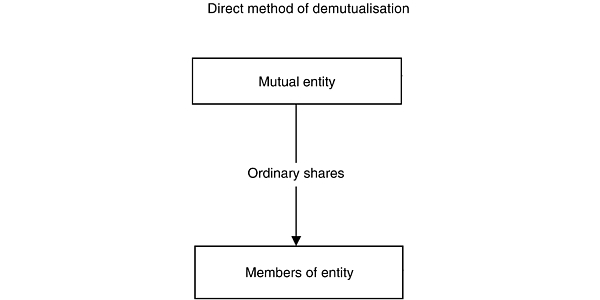
The holding company method of demutualisation is as follows:
(a) all membership rights in the entity are extinguished;
(b) the entity becomes acompany with a share capital;
(c) shares of only one class in the entity are issued to a company (the holding company ) within the limitation period;
(d) shares ( ordinary shares ) of only one class in the holding company are issued within the limitation period to existing members in exchange for the membership rights referred to in paragraph (a);
(e) shares (also ordinary shares ) in the holding company of the same class may be issued within the limitation period to new members;
(f) if a listing resolution was passed by the entity - the ordinary shares are listed within the limitation period.
Note:
Other things may happen in connection with the implementation of the demutualisation.
326-50(2)
The following diagram shows the main events that occur where this demutualisation method is used.
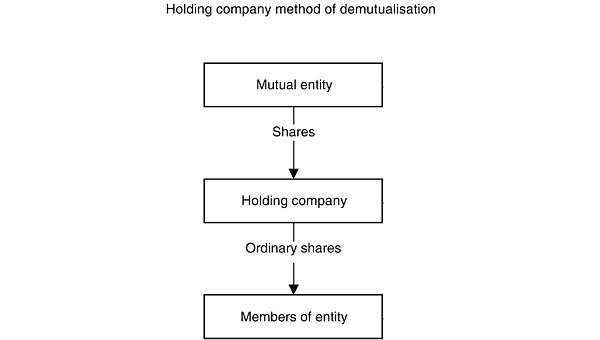
The combined direct and holding company method of demutualisation is as follows:
(a) all membership rights in the entity are extinguished;
(b) the entity becomes a company with a share capital;
(c) shares ( ordinary shares ) of only one class in the entity are issued within the limitation period to existing members in exchange for the membership rights referred to in paragraph (a);
(d) shares (also ordinary shares ) of the same class in the entity are also issued to a company (the holding company ) within the limitation period;
(e) shares (also ordinary shares ) of the same class in the entity may be issued within the limitation period to new members;
(f) shares (also ordinary shares ) of only one class in the holding company are issued within the limitation period to existing members as a result of the extinguishment of the membership rights referred to in paragraph (a);
(g) shares (also ordinary shares ) of the same class in the holding company may be issued within the limitation period to new members;
(h) the total number of ordinary shares issued to members under paragraphs (f) and (g) is the same as the total number of ordinary shares issued to the holding company under paragraph (d);
(i) if a listing resolution was passed by the members of the entity - the ordinary shares in the entity are listed within the limitation period.
Note:
Other things may happen in connection with the implementation of the demutualisation.
326-52(2)
The following diagram shows the main events that occur where this demutualisation method is used.
Combined direct and holding company method of demutualisation
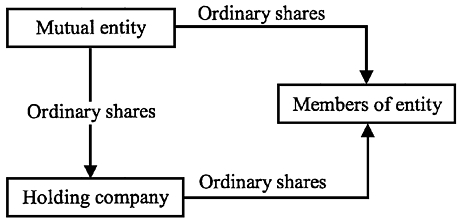
SECTION 326-55 DISTRIBUTING TRUST METHOD 326-55(1)
The distributing trust method of demutualisation is as follows:
(a) all membership rights in the mutual entity are extinguished;
(b) the entity becomes a company with a share capital;
(c) shares ( special shares ) carrying only voting rights in respect of the demutualised entity are issued within the limitation period to a trustee to hold for the benefit of the members;
(d) the issue takes place before the issue of the ordinary shares mentioned in paragraphs (f) and (g);
(e) after the issue of all the ordinary shares, the rights attaching to the special shares become the same as those attaching to the ordinary shares and the special shares are dealt with in accordance with paragraph (h) as if they were ordinary shares;
(f) shares ( ordinary shares ) of only one class in the entity are, within the limitation period, issued to the trustee to hold on behalf of existing members in exchange for the membership rights referred to in paragraph (a) and, in accordance with the choice of each existing member, to transfer to the member the shares held on behalf of the member or to dispose of those shares on behalf of the member;
(g) shares (also ordinary shares ) of the same class in the entity may, within the limitation period, be issued to the trustee on behalf of new members and, in accordance with the choice of each new member, to transfer to the member the shares held on behalf of the member or to dispose of those shares on behalf of the member;
(h) within the limitation period the trustee:
(i) sells the ordinary shares issued to the trustee and distributes the proceeds to the member; or
(ii) transfers the ordinary shares to the member;
(i) if a listing resolution was passed by the entity - the ordinary shares are listed within the limitation period.
Note:
Other things may happen in connection with the implementation of the demutualisation.
326-55(2)
The trustee must be the trustee of a trust established solely for the purposes of performing functions under subsection (1).
326-55(3)
The following diagram shows the main events that occur where this demutualisation method is used.
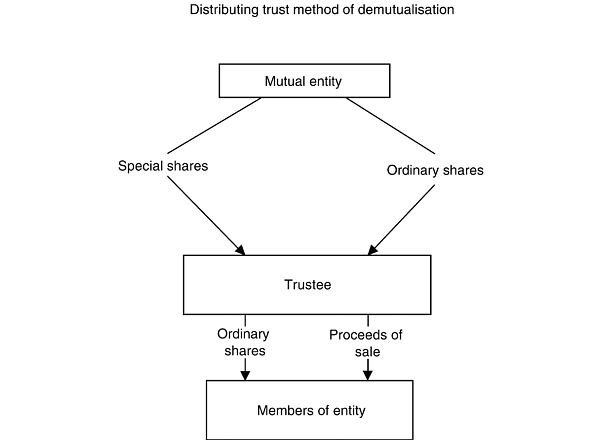
This section sets out a test (the continuity of beneficial interest test ) that must be satisfied before this Division applies to the demutualisation of a mutual entity.
326-60(2)
The continuity of beneficial interest test is satisfied if:
(a) an opportunity is given to each existing member of the mutual entity:
(i) to take up shares in the demutualised entity or in a holding company to which shares in the demutualised entity are issued; or
(ii) to have shares in the demutualised entity issued to a trustee on behalf of the member; and
(b) where the demutualisation is implemented by the method set out in section 326-45 , 326-50 or 326-55 - of the ordinary shares in the demutualised entity or holding company that are issued in connection with the demutualisation (the issued shares ), the total number that are issued to existing members or to a trustee on behalf of existing members constitutes at least 90% of the issued shares; and
(ba) where the demutualisation is implemented by the method set out in section 326-52 :
(i) of the ordinary shares in the demutualised entity that are issued to members other than the holding company in connection with the demutualisation (the issued entity shares ), the total number that are issued to existing members constitutes at least 90% of the issued entity shares; and
(ii) of the ordinary shares in the holding company that are issued in connection with the demutualisation (the issued holding company shares ), the total number that are issued to existing members constitutes at least 90% of the issued holding company shares; and
(c) the accumulated surplus of the mutual entity is allocated or distributed in the form of shares, or cash from the sale of shares, to existing members in proportions that broadly accord with any one or more of the following:
(i) the respective amounts contributed by the members to the entity;
(ii) the respective values of the membership rights of the members;
(iii) the respective rights of the members on the winding up of the entity.
326-60(3)
In this section:
accumulated surplus
, in relation to a demutualised entity, means the net assets of the entity on the demutualisation resolution day.
Application
326-65(1)
This section applies where membership rights are extinguished as mentioned in paragraph 326-45(1)(a) , 326-50(1)(a) , 326-52(1)(a) or 326-55(1)(a) .
Modification
326-65(2)
A capital gain or capital loss arising from the extinguishment of the membership rights of a member is to be disregarded.
This Subdivision applies where a member (the disposer ) of a mutual entity which, or a holding company of which, becomes a listed public company disposes of an asset consisting of:
(a) a demutualisation share in the listed public company or an interest in such a share; or
(b) other shares ( non-demutualisation bonus shares ) in the same company, or an interest in such shares, where the shares are bonus equities mentioned in Subdivision 130-A of the Income Tax Assessment Act 1997 and any of the demutualisation shares (whether or not disposed of at the time) are the original equities mentioned in that Subdivision.
326-70(2)
For the purposes of this Subdivision, if any of the original equities mentioned in Subdivision 130-A of the Income Tax Assessment Act 1997 is a demutualisation share, it is called a demutualisation original share .
SECTION 326-75 326-75 CAPITAL LOSSES MADE FROM CERTAIN DISPOSALS TO BE DISREGARDED
A capital loss that the disposer makes from a disposal to which section 326-80 or 326-100 applies is to be disregarded.
If:
(a) the disposal is a disposal of a demutualisation share (other than a demutualisation original share) or an interest in such a share; and
(b) the disposer did not acquire membership rights in the demutualising entity by disposing of membership rights in another mutual entity; and
(c) the disposer is a pre-CGT member; and
(d) the disposal occurs before the demutualisation listing day;
then, for the purpose of working out whether the disposer made a capital gain or capital loss from the disposal, the disposer is taken to have done the following:
(e) to have paid for the acquisition of the share or interest the amount worked out by using the formula:
| Adjusted market value × |
Share or interest disposed of
Total number of shares |
(f) to have paid that amount on the demutualisation resolution day;
(g) to have acquired the share or interest on the demutualisation resolution day.
326-80(2)
In the formula in paragraph (1)(e):
total number of shares
means the total number of demutualisation shares issued.
If:
(a) the disposal is a disposal of a demutualisation share (other than a demutualisation original share) or an interest in such a share; and
(b) the disposer did not acquire membership rights in the demutualising entity by disposing of membership rights in another mutual entity; and
(c) the disposer is a pre-CGT member; and
(d) the disposal occurs on or after the demutualisation listing day;
then, for the purpose of working out whether the disposer made a capital gain or capital loss from the disposal, the disposer is taken to have done the following:
(e) to have paid for the acquisition of the share or interest the lesser of the following amounts:
(i) the amount worked out by using the formula:
Adjusted market value × Share or interest disposed of
Total number of shares
(ii) the amount worked out by using the formula:
Adjusted first day
trading price of the
demutualisation
shares× Share or interest
disposed of
(f) to have paid the amount referred to in paragraph (e) on the demutualisation resolution day;
(g) to have acquired the share or interest on the demutualisation resolution day.
326-85(2)
In the formula in subparagraph (1)(e)(i):
total number of shares
means the total number of demutualisation shares issued.
If:
(a) the disposal is a disposal of a demutualisation share (other than a demutualisation original share) or an interest in such a share; and
(b) the disposer acquired membership rights in the demutualising entity by disposing of membership rights in another mutual entity; and
(c) the disposer is a pre-CGT member;
then, for the purpose of working out whether the disposer made a capital gain or capital loss from the disposal, the disposer is taken to have done the following:
(d) to have paid for the acquisition of the share or interest both of the following amounts:
(i) the amount worked out by using the formula:
(ii) any amount actually paid for the acquisition;
(e) to have paid the amount referred to in subparagraph (d)(i) on the demutualisation resolution day;
(f) to have paid any amount referred to in subparagraph (d)(ii) when it was actually paid;
(g) to have acquired the share or interest on the demutualisation resolution day.
326-90(2)
In the formula in subparagraph (1)(d)(i):
number of disposer
'
s shares
means the number of demutualisation shares issued to the disposer or in which the disposer had an interest.
number of members
means the total number of members of the other mutual entity at the time of the disposal of the membership rights in that entity.
If:
(a) the disposal is a disposal of a demutualisation share (other than a demutualisation original share) or an interest in such a share; and
(b) the disposer is a post-CGT member;
then, for the purpose of working out whether the disposer made a capital gain or capital loss from the disposal, the disposer is taken to have done the following:
(c) to have paid for the acquisition of the share or interest both of the following amounts:
(i) the amount worked out by using the formula:
Undeducted membership
costs× Share or interest
disposed of
Number of
disposer ' s shares
(ii) any amount actually paid for the acquisition;
(d) to have paid the amount referred to in subparagraph (c)(i) on the demutualisation resolution day;
(e) to have paid any amount referred to in subparagraph (c)(ii) when it was actually paid;
(f) to have acquired the share or interest on the demutualisation resolution day.
326-95(2)
In the formula in subparagraph (1)(c)(i):
number of disposer
'
s shares
means the number of demutualisation shares issued to the disposer or in which the disposer had an interest.
If:
(a) the disposal is a disposal of either:
(i) a demutualisation original share or an interest in such a share; or
(ii) a non-demutualisation bonus share or an interest in such a share; and
(b) the disposer did not acquire membership rights in the demutualising entity by disposing of membership rights in another mutual entity; and
(c) the disposer is a pre-CGT member; and
(d) the disposal occurs before the demutualisation listing day;
then, for the purpose of working out whether the disposer made a capital gain or capital loss from the disposal, the following paragraphs have effect:
(e) for the purpose of applying Subdivision 130-A of the Income Tax Assessment Act 1997 , the amount paid for the acquisition of all the demutualisation original shares that is to be taken into account under that Division or Subdivision, as the case may be, is taken to be the amount worked out by using the formula:
|
Adjusted market
value |
× |
Number of disposer
'
s shares
Total number of shares |
(f) if the disposal is a disposal of a demutualisation original share or an interest in such a share, the disposer is taken:
(i) to have paid the amount referred to in paragraph (e) on the demutualisation resolution day; and
(ii) to have acquired the share or interest on the demutualisation resolution day.
326-100(2)
In the formula in paragraph (1)(e):
number of disposer
'
s shares
means the number of demutualisation original shares issued to the disposer or in which the disposer had an interest.
total number of shares
means the total number of demutualisation shares issued.
If:
(a) the disposal is a disposal of either:
(i) a demutualisation original share or an interest in such a share; or
(ii) a non-demutualisation bonus share or an interest in such a share; and
(b) the disposer did not acquire membership rights in the demutualising entity by disposing of membership rights in another mutual entity; and
(c) the disposer is a pre-CGT member; and
(d) the disposal occurs on or after the demutualisation listing day;
then, for the purpose of working out whether the disposer made a capital gain or capital loss from the disposal, the following paragraphs have effect:
(e) for the purpose of applying Subdivision 130-A of the Income Tax Assessment Act 1997 , the amount paid for the acquisition of all the demutualisation original shares that is to be taken into account under that Division or Subdivision, as the case may be, is taken to be the lesser of the following amounts:
(i) the amount worked out by using the formula:
Adjusted market
value× Number of disposer ' s shares
Total number of shares
(ii) the amount worked out by using the formula:
Adjusted first day
trading price of the
demutualisation
shares× Number of disposer ' s shares
(f) if the disposal is a disposal of a demutualisation original share or an interest in such a share, the disposer is taken:
(i) to have paid the amount referred to in paragraph (e) on the demutualisation resolution day; and
(ii) to have acquired the share or interest on the demutualisation resolution day.
326-105(2)
In the formulas in subparagraphs 1(e)(i) and (ii):
number of disposer
'
s shares
means the number of demutualisation original shares issued to the disposer or in which the disposer had an interest.
total number of shares
means the total number of demutualisation shares issued.
If:
(a) the disposal is a disposal of either:
(i) a demutualisation original share or an interest in such a share; or
(ii) a non-demutualisation bonus share or an interest in such a share; and
(b) the disposer acquired membership rights in the demutualising entity by disposing of membership rights in another mutual entity; and
(c) the disposer is a pre-CGT member;
then, for the purpose of working out whether the disposer made a capital gain or capital loss from the disposal, the following paragraphs have effect:
(d) for the purpose of applying Subdivision 130-A of the Income Tax Assessment Act 1997 , the amount paid for the acquisition of all the demutualisation original shares that is to be taken into account under that Division or Subdivision, as the case may be, is taken to be the sum of the following amounts:
(i) the amount worked out by using the formula:
Undeducted membership
costs+ Adjusted market value
Number of members
(ii) any amount actually paid for the acquisition;
(e) if the disposal is a disposal of a demutualisation original share or an interest in such a share, the disposer is taken:
(i) to have paid the amount referred to in subparagraph (d)(i) on the demutualisation resolution day; and
(ii) to have paid any amount referred to in subparagraph (d)(ii) when it was actually paid; and
(iii) to have acquired the share or interest on the demutualisation resolution day.
326-110(2)
In the formula in subparagraph (1)(d)(i):
number of members
means the total number of members of the other entity at the time of the disposal of the membership rights in that entity.
If:
(a) the disposal is a disposal of either:
(i) a demutualisation original share or an interest in such a share; or
(ii) a non-demutualisation bonus share or an interest in such a share; and
(b) the disposer is a post-CGT member;
then, for the purpose of working out whether the disposer made a capital gain or capital loss from the disposal, the following paragraphs have effect:
(c) for the purpose of applying Subdivision 130-A of the Income Tax Assessment Act 1997 , the amount paid for the acquisition of all the demutualisation original shares that is to be taken into account under that Division or Subdivision, as the case may be, is taken to be the sum of:
(i) an amount equal to the undeducted membership costs; and
(ii) any amount actually paid for the acquisition;
(d) if the disposal is a disposal of a demutualisation original share or an interest in such a share, the disposer is taken:
(i) to have paid the amount referred to in subparagraph (c)(i) on the demutualisation resolution day; and
(ii) to have paid any amount referred to in subparagraph (c)(ii) when it was actually paid; and
(iii) to have acquired the share or interest on the demutualisation resolution day.
Where membership rights not acquired by disposal of rights in another entity
326-120(1)
For the purposes of this Subdivision, the adjusted market value , when the expression is used in relation to a disposer who did not acquire membership rights in the demutualising entity by disposing of membership rights in another mutual entity, is the market value, as determined by a qualified valuer, of the demutualising entity on the demutualisation resolution day. However, in making the determination the valuer is to disregard the franking surplus of that entity on that day.
Where membership rights acquired by disposal of rights in another entity
326-120(2)
For the purposes of this Subdivision but subject to subsection (3), the adjusted market value , when the expression is used in relation to a disposer who acquired membership rights in the demutualising entity by disposing of membership rights in another mutual entity, is the market value, as determined by a qualified valuer, of the other entity at the time immediately before the disposer disposed of membership rights in the other entity. However, in making the determination the valuer is to disregard the franking surplus of the other entity at that time.
Indexation of amount mentioned in subsection (2)
326-120(3)
If the indexation factor (see section 326-235 ) of the amount worked out under subsection (2) is more than one, that amount is taken to be replaced by that amount as indexed under Subdivision 326-M .
For the purposes of this Subdivision, the undeducted membership costs , when the expression is used in relation to a disposer who did not acquire membership rights in the demutualising entity by the disposal of membership rights in another mutual entity, are the sum of the undeducted amounts of the costs that were incurred by the disposer in acquiring and maintaining membership in the demutualising entity less any distributions that:
(a) were made by the demutualising entity to the disposer before any shares in the demutualised entity were issued; and
(b) were not included in the disposer ' s assessable income of any year of income.
326-125(2)
For the purposes of this Subdivision, the undeducted membership costs , when the expression is used in relation to a disposer who acquired membership rights in the demutualising entity by the disposal of membership rights in another mutual entity, are:
(a) if the disposer was a pre-CGT member - the sum of the undeducted amounts of the costs that were incurred by the disposer in maintaining membership in the demutualising entity less any distributions that:
(i) were made by the demutualising entity to the disposer before any shares in the demutualised entity were issued; and
(ii) were not included in the disposer ' s assessable income of any year of income; or
(b) if the disposer is a post-CGT member, the sum of:
(i) the undeducted amounts of the costs that were incurred by the disposer in acquiring and maintaining membership in the other entity; and
less any distributions that:
(ii) the undeducted amounts of the costs that were incurred by the disposer in maintaining membership in the demutualising entity;
(iii) were made by the demutualising entity or the other entity to the disposer before any shares in the demutualised entity were issued; and
(iv) were not included in the disposer ' s assessable income of any year of income.
326-125(3)
If at any time 2 or more persons were joint members of a mutual entity, any costs incurred by any one or more of them in acquiring or maintaining the joint membership are taken to have been incurred by each of them.
326-125(4)
Subject to subsection (5), the undeducted amount of a cost is the amount of the cost to the extent to which a deduction has not been allowed, and is not allowable, in respect of it.
326-125(5)
If:
(a) an amount of a cost referred to in subsection (1) or (2) was incurred before the demutualisation resolution day; and
(b) the indexation factor (see section 326-235 ) of the amount is more than one;
a reference in this section to the undeducted amount of that cost is a reference to the undeducted amount as indexed under Subdivision 326-M .
For the purposes of this Subdivision, the adjusted first day trading price of demutualisation shares is the amount worked out using the formula:
|
First day trading price of
demutualisation shares |
− |
Value of franking surplus
Total number of demutualisation shares issued |
326-130(2)
In this section:
first day trading price of demutualisation shares
means the price per share, as published by ASX Limited, at which the demutualisation shares were last traded, on the stock market operated by ASX Limited, on the demutualisation listing day.
value of franking surplus
means the value, as determined by a qualified valuer, of the franking surplus of the demutualised entity on the demutualisation listing day.
Subdivision 326-E - CGT consequences of disposal of demutualisation shares or interests in such shares by a member of a mutual entity where the entity or a holding company of the entity becomes a company that is not a listed public company
This Subdivision applies where a member (the disposer ) of a mutual entity which, or a holding company of which, becomes a company that is not a listed public company disposes of an asset consisting of:
(a) a demutualisation share in that company that is not a listed public company or an interest in such a share; or
(b) other shares ( non-demutualisation bonus shares ) in the same company, or an interest in such shares, where the shares are bonus equities mentioned in Subdivision 130-A of the Income Tax Assessment Act 1997 and any of the demutualisation shares (whether or not disposed of at the time) are the original equities mentioned in that Subdivision.
326-135(2)
For the purposes of this Subdivision, if any of the original equities mentioned in Subdivision 130-A of the Income Tax Assessment Act 1997 , is a demutualisation share, it is called a demutualisation original share .
SECTION 326-140 DISPOSAL BY PRE-CGT MEMBER OF A DEMUTUALISATION SHARE (OTHER THAN A DEMUTUALISATION ORIGINAL SHARE) OR AN INTEREST IN SUCH A SHARE WHERE A MEMBER DID NOT ACQUIRE MEMBERSHIP RIGHTS BY DISPOSING OF MEMBERSHIP RIGHTS IN ANOTHER MUTUAL ENTITY 326-140(1)
If:
(a) the disposal is a disposal of a demutualisation share (other than a demutualisation original share) or an interest in such a share; and
(b) the disposer did not acquire membership rights in the demutualisation entity by disposing of membership rights in another mutual entity; and
(c) the disposer is a pre-CGT member;
then, for the purpose of working out whether the disposer made a capital gain or capital loss from the disposal, the disposer is taken to have done the following:
(d) to have paid for the acquisition of the share or interest the amount worked out by using the formula:
| Adjusted market value × |
Share or interest disposed of
Total number of shares |
(e) to have paid that amount on the demutualisation resolution day;
(f) to have acquired the share or interest on the demutualisation resolution day.
326-140(2)
In the formula in paragraph (1)(d):
total number of shares
means the total number of demutualisation shares issued.
If:
(a) the disposal is a disposal of a demutualisation share (other than a demutualisation original share) or an interest in such a share; and
(b) the disposer acquired membership rights in the demutualising entity by disposing of membership rights in another mutual entity; and
(c) the disposer is a pre-CGT member;
then, for the purpose of working out whether the disposer made a capital gain or capital loss from the disposal, the disposer is taken to have done the following:
(d) to have paid for the acquisition of the share or interest both of the following amounts:
(i) the amount worked out by using the formula:
(ii) any amount actually paid for the acquisition;
(e) to have paid the amount referred to in subparagraph (d)(i) on the demutualisation resolution day;
(f) to have paid any amount referred to in subparagraph (d)(ii) when it was actually paid;
(g) to have acquired the share or interest on the demutualisation resolution day.
326-145(2)
In the formula in subparagraph (1)(d)(i):
number of disposer
'
s shares
means the number of demutualisation shares issued to the disposer or in which the disposer had an interest.
number of members
means the total number of members of the other mutual entity at the time of the disposal of the membership rights in that entity.
If:
(a) the disposal is a disposal of a demutualisation share (other than a demutualisation original share) or an interest in such a share; and
(b) the disposer is a post-CGT member;
then, for the purpose of working out whether the disposer made a capital gain or capital loss from the disposal, the disposer is taken to have done the following:
(c) to have paid for the acquisition of the share or interest both of the following amounts:
(i) the amount worked out by using the formula:
Undeducted membership
costs× Share or interest
disposed of
Number of
disposer ' s shares
(ii) any amount actually paid for the acquisition;
(d) to have paid the amount referred to in subparagraph (c)(i) on the demutualisation resolution day;
(e) to have paid any amount referred to in subparagraph (c)(ii) when it was actually paid;
(f) to have acquired the share or interest on the demutualisation resolution day.
326-150(2)
In the formula in subparagraph (1)(c)(i):
number of disposer
'
s shares
means the number of demutualisation shares issued to the disposer or in which the disposer had an interest.
If:
(a) the disposal is a disposal of either:
(i) a demutualisation original share or an interest in such a share; or
(ii) a non-demutualisation bonus share or an interest in such a share; and
(b) the disposer did not acquire membership rights in the demutualising entity by disposing of membership rights in another mutual entity; and
(c) the disposer is a pre-CGT member;
then, for the purpose of working out whether the disposer made a capital gain or capital loss from the disposal, the following paragraphs apply:
(d) for the purpose of applying Subdivision 130-A of the Income Tax Assessment Act 1997 , the amount paid for the acquisition of all the demutualisation original shares that is to be taken into account under that Division or Subdivision, as the case may be, is taken to be the amount worked out by using the formula:
|
Adjusted market
value |
× |
Number of disposer
'
s shares
Total number of shares |
(e) if the disposal is a disposal of a demutualisation original share or an interest in such a share, the disposer is taken:
(i) to have paid the amount referred to in paragraph (d) on the demutualisation resolution day; and
(ii) to have acquired the share or interest on the demutualisation resolution day.
326-155(2)
In the formula in paragraph (1)(d):
number of disposer
'
s shares
means the number of demutualisation original shares issued to the disposer or in which the disposer had an interest.
total number of shares
means the total number of demutualisation shares issued.
If:
(a) the disposal is a disposal of either:
(i) a demutualisation original share or an interest in such a share; or
(ii) a non-demutualisation bonus share or an interest in such a share; and
(b) the disposer acquired membership rights in the demutualising entity by disposing of membership rights in another mutual entity; and
(c) the disposer is a pre-CGT member;
then, for the purpose of working out whether the disposer made a capital gain or capital loss from the disposal, the following paragraphs have effect:
(d) for the purpose of applying Subdivision 130-A of the Income Tax Assessment Act 1997 , the amount paid for the acquisition of all the demutualisation original shares that is to be taken into account under that Division or Subdivision, as the case may be, is taken to be both of the following amounts:
(i) the amount worked out by using the formula:
Undeducted membership
costs+ Adjusted market value
Number of members
(ii) any amount actually paid for the acquisition; and
(e) if the disposal is a disposal of a demutualisation original share or an interest in such a share, the disposer is taken to have done the following:
(i) to have paid the amount referred to in subparagraph (d)(i) on the demutualisation resolution day;
(ii) to have paid any amount referred to in subparagraph (d)(ii) when it was actually paid;
(iii) to have acquired the share or interest on the demutualisation resolution day.
326-160(2)
In the formula in subparagraph (1)(d)(i):
number of members
means the total number of members of the other mutual entity at the time of the disposal of the membership rights in that entity.
If:
(a) the disposal is a disposal of either:
(i) a demutualisation original share or an interest in such a share; or
(ii) a non-demutualisation bonus share or an interest in such a share; and
(b) the disposer is a post-CGT member;
then, for the purpose of working out whether the disposer made a capital gain or capital loss from the disposal, the following paragraphs have effect:
(c) for the purpose of applying Subdivision 130-A of the Income Tax Assessment Act 1997 , the amount paid for the acquisition of all the demutualisation original shares that is to be taken into account under that Division or Subdivision, as the case may be, is taken to be both of the following amounts:
(i) an amount equal to the undeducted membership costs;
(ii) any amount actually paid for the acquisition;
(d) if the disposal is a disposal of a demutualisation original share or an interest in such a share, the disposer is taken to have done the following:
(i) to have paid the amount referred to in subparagraph (c)(i) on the demutualisation resolution day;
(ii) to have paid any amount referred to in subparagraph (c)(ii) when it was actually paid;
(iii) to have acquired the share or interest on the demutualisation resolution day.
Application
326-170(1)
This section has effect for the purposes of this Subdivision.
Where membership rights not acquired by disposal of rights in another entity
326-170(2)
The adjusted market value , when the expression is used in relation to a disposer who did not acquire membership rights in the demutualising entity by disposing of membership rights in another mutual entity, is the lesser of the issue day adjusted market value and the resolution day adjusted market value.
Where membership rights acquired by disposal of rights in another entity
326-170(3)
The adjusted market value , when the expression is used in relation to a disposer who acquired membership rights in the demutualising entity by disposing of membership rights in another mutual entity, is the disposal day adjusted market value.
Issue day adjusted market value
326-170(4)
The issue day adjusted market value is the market value, as determined by a qualified valuer, of the demutualised entity on the day on which the demutualisation shares were issued. However, in making the determination the valuer is to disregard the franking surplus of the demutualised entity on that day.
Resolution day adjusted market value
326-170(5)
The resolution day adjusted market value is the market value, as determined by a qualified valuer, of the demutualising entity on the demutualisation resolution day. However, in making the determination the valuer is to disregard the franking surplus of the demutualising entity on that day.
Disposal day adjusted market value
326-170(6)
Subject to subsection (7), the disposal day adjusted market value is the market value, as determined by a qualified valuer, of the other entity at the time immediately before the disposer disposed of membership rights in the other entity. However, in making the determination the valuer is to disregard the franking surplus of the other entity at that time.
Indexation of amount mentioned in subsection (6)
326-170(7)
If the indexation factor (see section 326-235 ) of the amount worked out under subsection (6) is more than one, that amount is taken to be replaced by that amount as indexed under Subdivision 326-M .
For the purposes of this Subdivision, the undeducted membership costs , when the expression is used in relation to a disposer who did not acquire membership rights in the demutualising entity by the disposal of membership rights in another mutual entity, are the sum of the undeducted amounts of the costs that were incurred by the disposer in acquiring and maintaining membership in the demutualising entity less any distributions that:
(a) were made by the demutualising entity to the disposer before any shares in the demutualised entity were issued; and
(b) were not included in the disposer ' s assessable income of any year of income.
326-175(2)
For the purposes of this Subdivision, the undeducted membership costs , when the expression is used in relation to a disposer who acquired membership rights in the demutualising entity by the disposal of membership rights in another mutual entity, are the sum of:
(a) if the disposer was a pre-CGT member - the undeducted amounts of the costs that were incurred by the disposer in maintaining membership in the demutualising entity less any distributions that:
(i) were made by the demutualising entity to the disposer before any shares in the demutualised entity were issued; and
(ii) were not included in the disposer ' s assessable income of any year of income; or
(b) if the disposer is a post-CGT member, the sum of:
(i) the undeducted amounts of the costs that were incurred by the disposer in acquiring and maintaining membership in the other entity; and
less any distributions that:
(ii) the undeducted amounts of the costs that were incurred by the disposer in maintaining membership in the demutualising entity;
(iii) were made by the demutualising entity or the other entity to the disposer before any shares in the demutualised entity were issued; and
(iv) were not included in the disposer ' s assessable income of any year of income.
326-175(3)
If at any time 2 or more persons were joint members of a mutual entity, any costs incurred by any one or more of them in acquiring or maintaining the joint membership are taken to have been incurred by each of them.
326-175(4)
Subject to subsection (5), the undeducted amount of a cost is the amount of the cost to the extent to which a deduction has not been allowed, and is not allowable, in respect of it.
326-175(5)
If:
(a) an amount of a cost referred to in subsection (1) or (2) was incurred before the demutualisation resolution day; and
(b) the indexation factor (see section 326-235 ) of the amount is more than one;
a reference in this section to the undeducted amount of that cost is a reference to the undeducted amount as indexed under Subdivision326-M .
This section applies if:
(a) a post-CGT member of a mutual entity that has been demutualised acquired membership rights in the entity by the disposal of membership rights in another mutual entity; and
(b) the member made a capital gain or capital loss from the disposal of membership rights in the other mutual entity; and
(c) the member has acquired shares or an interest in shares in the demutualised entity or in a company that holds shares in the demutualised entity.
326-180(2)
If the member disposes of a demutualisation original share or a non-demutualisation bonus share, the amount paid for the acquisition of all the demutualisation original shares is taken to be increased by the amount of the capital gain or reduced by the amount of the capital loss, as the case may be.
326-180(3)
If subsection (2) does not apply, the amount that is taken, under Subdivision 326-D or 326-E , to have been paid by the member for the acquisition of the share or interest is taken to be increased by the proportionate part of the amount of the capital gain or reduced by the proportionate part of the amount of the capital loss, as the case may be.
This section applies if:
(a) under the direct method of demutualisation, or the combined direct and holding company method of demutualisation, of a mutual entity, the membership rights of an existing member of the entity are extinguished; and
(b) as a result of the extinguishment of the rights, the member acquires a right or an interest in a right to have shares in the demutualised entity issued to the member; and
(c) the member disposes of the whole or a part of the right or interest otherwise than by receiving the shares.
326-185(2)
For the purpose of working out whether the member made a capital gain or capital loss from the disposal, the member is taken to have done the following:
(a) to have paid for the acquisition of the right or interest in the right the amount worked out by using the formula:
| Cost of a share or interest × Number of shares |
(b) to have paid that amount, and to have acquired the right or interest, on the demutualisation resolution day.
326-185(3)
In the formula in paragraph (2)(a):
cost of a share or interest
means the amount that would have been taken to have been paid by the member for the acquisition of a share or an interest in a share in the demutualised entity under Subdivisions
326-D
,
326-E
and
326-F
if the disposal had been the disposal of the shares to which the right or interest in the right related.
number of shares
means the number of shares to which the right or interest in the right related.
326-185(4)
If the member is a pre-CGT member who did not acquire membership rights in the demutualising entity by disposing of membership rights in another mutual entity, any capital loss made from the disposal before the demutualisation listing day, or, if there is no such day, before the day on which the shares in the demutualised entity were issued, is to be disregarded.
If, under the direct method of demutualisation or the holding company method of demutualisation, shares in a demutualised entity are issued to an existing member, Parts 3-1 and 3-3 of the Income Tax Assessment Act 1997 do not apply in respect of any CGT event constituted by the extinguishment of the member ' s right to have the shares issued to the member.
326-190(2)
If, under the combined direct and holding company method of demutualisation, shares in a demutualised entity or in a holding company are issued to an existing member, Parts 3-1 and 3-3 of the Income Tax Assessment Act 1997 do not apply in respect of any CGT event constituted by the extinguishment of the member ' s rights to have the shares issued to the member.
This section applies if:
(a) under the holding company method of demutualisation, or the combined direct and holding company method of demutualisation, of a mutual entity:
(i) the membership rights of an existing member of the entity are extinguished; and
(ii) shares in the demutualised entity are issued to a company (the holding company ); and
(b) as a result of the extinguishment of the rights, the member acquires a right or an interest in a right to have shares in the holding company issued to the member; and
(c) the member disposes of the whole or a part of the right or interest otherwise than by receiving the shares.
326-195(2)
For the purpose of working out whether the member made a capital gain or capital loss from the disposal, the member is taken to have done the following:
(a) to have paid for the acquisition of the right or interest in the right the amount worked out by using the formula:
| Cost of a share or interest × Number of shares |
(b) to have paid that amount, and to have acquired the right or interest, on the demutualisation resolution day.
326-195(3)
In the formula in paragraph (2)(a):
cost of a share or interest
means the amount that would have been taken to have been paid by the member for the acquisition of a share or an interest in a share in the holding company under Subdivisions
326-D
,
326-E
and
326-F
if the disposal had been the disposal of the shares in the holding company to which the right or interest in the right related.
number of shares
means the number of shares in the holding company to which the right or interest in the right related.
326-195(4)
If the member is a pre-CGT member who did not acquire membership rights in the demutualising entity by disposing of membership rights in another mutual entity, any capital loss made from the disposal before the demutualisation listing day, or, if there is no such day, before the day on which the shares in the holding company were issued, is to be disregarded.
This section applies if:
(a) under the distributing trust method of demutualisation of a mutual entity:
(i) the membership rights of an existing member of the entity are extinguished; and
(ii) shares in the demutualised entity are issued to a trustee; and
(b) as a result of the extinguishment of the rights, the member acquires an interest in the trust constituted by the right to have shares in the demutualised entity held by the trustee transferred by the trustee to the member or disposed of by the trustee on behalf of the member; and
(c) the member disposes of the whole or a part of the interest otherwise than by receiving the shares or proceeds of the sale of the shares.
326-200(2)
For the purpose of working out whether the member made a capital gain or capital loss from the disposal, the member is taken to have done the following:
(a) to have paid for the acquisition of the interest in the trust the amount worked out by using the formula:
| Cost of a share × Number of shares |
(b) to have paid that amount, and to have acquired the interest, on the demutualisation resolution day.
326-200(3)
In the formula in paragraph (2)(a):
cost of a share
means the amount that would have been taken to have been paid by the member for the acquisition of a share in the demutualised entity under Subdivisions
326-D
,
326-E
and
326-F
if the disposal had been the disposal of the shares to which the interest or the part of the interest in the trust related.
number of shares
means the number of shares in the demutualised entity to which the interest in the trust related.
326-200(4)
If the member is a pre-CGT member who did not acquire membership rights in the demutualising entity by disposing of membership rights in another mutual entity, any capital loss made from the disposal before the demutualisation listing day, or, if there is no such day, before the day on which the shares in the demutualised entity were issued, is to be disregarded.
If a trustee transfers an ordinary share or distributes the proceeds of the sale of an ordinary share as mentioned in subparagraph 326-55(1)(h)(ii) , Parts 3-1 and 3-3 of the Income Tax Assessment Act 1997 do not apply in respect of any CGT event constituted by or arising from the transfer or distribution.
If:
(a) under the distributing trust method of demutualisation, shares in a demutualised entity are issued to a trustee on behalf of a member; and
(b) the trustee disposes of a share or an interest in a share, or disposes of a non-demutualisation bonus share or an interest in such a share, on behalf of the member;
the disposal is taken for the purposes of Subdivisions 326-D , 326-E and 326-F to have been a disposal of the share or interest by the member.
This Subdivision applies where, under the distributing trust method of demutualisation of a mutual entity, the rights attaching to special shares issued to a trustee on behalf of a member become the same as the rights attaching to ordinary shares.
326-215(2)
Parts 3-1 and 3-3 of the Income Tax Assessment Act 1997 do not apply in respect of the change in rights.
This section applies where:
(a) under any method of demutualisation, a mutual entity, or a holding company of a mutual entity, becomes a listed public company; and
(b) a disposal of a share, or of an interest in a share, in the entity or holding company takes place before the demutualisation listing day; and
(c) a roll-over provision applies to the disposal; and
(d) the person who disposed of the share or interest would, except for section 326-75 and paragraph (c) of this subsection, have made a capital loss as a result of the disposal; and
(e) the person who is taken to acquire the share or interest under the roll-over provision (the transferee ) disposes of the share or interest.
326-220(2)
If the disposal by the transferee takes place before the demutualisation listing day, any capital loss that the transferee makes from that disposal is disregarded.
326-220(3)
If the disposal by the transferee takes place on or after the demutualisation listing day, Subdivision 326-D applies to the disposal referred to in paragraph (1)(b) as if that disposal had taken place on or after that day.
326-220(4)
In this section:
disposal
includes a disposal that would have occurred except for former section 160X.
(a) former section 160X; or
(b) any provision of Division 17 of Part III ; or
(c) Division 128 of the Income Tax Assessment Act 1997 ; or
(d) any provision of Divisions 122 and 126 of Part 3-3 of the Income Tax Assessment Act 1997 .
Subdivision 326-L - CGT consequences of payment to member of demutualised entity out of accumulated surplus of the entity
If:
(a) a payment out of the assets of a demutualised entity is made to a taxpayer who holds shares or an interest in shares in the entity; and
(b) the amount paid is a dividend that is not included in the taxpayer ' s assessable income;
the payment is taken, for the purposes of section 104-135 of the Income Tax Assessment Act 1997 , not to be the payment of a dividend.
Some provisions of this Division require amounts to be indexed. An amount is indexed by multiplying it by its indexation factor.
For the indexation of the amount worked out under subsection 326-120(2) or 326-170(6) in relation to a person who acquired membership rights in a demutualising entity by the disposal of membership rights in another mutual entity, the indexation factor is:
|
Index number for the quarter in which the
relevant demutualisation resolution day occurred Index number for the quarter in which the membership rights in the other mutual entity were disposed of |
326-235(2)
For the indexation of an undeducted amount referred to in subsections 326-125(1) and (2) or 326-175(1) and (2) of a cost incurred by a person in acquiring or maintaining membership in a demutualising entity or another entity, the indexation factor is:
|
Index number for the quarter in which the
relevant demutualisation resolution day occurred Index number for the quarter in which the cost was incurred |
326-235(3)
An indexation factor is to be worked out to 3 decimal places (rounding up if the fourth decimal place is 5 or more).
The index number for a quarter is the All Groups Consumer Price Index number (being the weighted average of the 8 capital cities) first published by the Australian Statistician for the quarter.
326-240(2)
If the Australian Statistician changes the index reference period for an index number, only index numbers published in terms of the new index reference period are to be used after the change.
If any demutualisation shares are issued to a taxpayer under any method of demutualisation, no amount is to be included in the taxpayer ' s assessable income because of the issue of the shares to the taxpayer.
(Repealed by No 79 of 2010 )
(Repealed by No 114 of 2010)
[ CCH Note: Sch 3 was replaced, effective 1 January 1993, by reg 152N and Sch 12 of the now repealed Income Tax Regulations 1936 .]
(Repealed by No 114 of 2010)
(Repealed by No 114 of 2010)
[ CCH Note: Sch 5 was replaced, effective 1 January 1993, by reg 152P and Sch 13 of the now repealed Income Tax Regulations 1936 .]
Section 513
[ CCH Note: Sch 6 was replaced, effective 1 January 1993, by reg 152M and Sch 11 of the now repealed Income Tax Regulations 1936 .]