Penalty: 50 penalty units.
Penalty: 600 penalty units.
A defendant bears an evidential burden in relation to the matters in paragraphs (1)(a) and (b) (see subsection 13.3(3) of the Criminal Code).
Penalty: 50 penalty units.
Penalty: Imprisonment for 2 years.
the Regulator must, by notifiable instrument, publish particulars of the notice.
For the purposes of paragraph (1)(b), an offence involves serious dishonest conduct if the penalty actually imposed for the offence is:
The Regulator may accept an application meeting conditions referred to in subsection (3) other than paragraph (3)(b) after the end of the period referred to in that paragraph only if the Regulator is satisfied that there are exceptional circumstances that prevented the application from being made within that period.
If an individual is not reasonably able to obtain some or all of the court documents referred to in subsection (5), he or she:
The Regulator must notify the applicant of any police force, agency or court of which the Regulator intends to make inquiries.
Such notification should if possible be given to the applicant as soon as practicable after a decision has been made to approach that police force, agency or court.
Subject to this section, the Regulator must decide an application made under section 126B within 60 days after receiving it.
If the Regulator thinks that it will take longer than 60 days to decide the application, the Regulator may extend the period for deciding it by no more than 60 days.
The extension must be notified in writing to the applicant within 60 days after the Regulator receives the application.
If the Regulator makes an extension, the Regulator must decide the application within the extended period.
If the Regulator has not decided the application by the end of the day by which the Regulator is required to decide it, the Regulator is taken to have decided, at the end of that day, to refuse the application under subsection 126D(3).
the Regulator must, by notice in writing given to the applicant, make a declaration waiving the applicant's status as a disqualified person for the purposes of this Part.
Despite any declaration waiving an applicant's status as a disqualified person for the purposes of this Part, the applicant will still be a disqualified person if:
If the Regulator decides not to make a declaration waiving the applicant's status as a disqualified person for the purposes of this Part, the Regulator must:
If the Regulator becomes aware that the responsible officer of a body corporate that is a trustee, investment manager or custodian of a superannuation entity has failed to resign in accordance with the requirements of a statement under paragraph (3)(b) the Regulator must tell the body corporate that the applicant is a disqualified person.
the person is treated, for the purposes of this Act, (other than the purpose of the application for the declaration) as not being, and as never having been, a disqualified person until that application is decided.
On deciding an application for a declaration waiving the disqualified person status of a person to whom paragraphs 1(a), (b) and (c) apply:
the Regulator may ask an applicant to provide information or consent.
The Regulator may, by notice in writing, require a person who has made an application under subsection 126B(1) to pay to the Regulator an amount equal to the amount of any fees charged to the Regulator by any law enforcement agency, regulatory agency or court for answering any inquiry by the Regulator about the applicant if the fees:
The Regulator may, on the application of a person who has made an application under subsection 126B(1), waive in whole or in part, the requirement to pay an amount under subsection (2) if the Regulator is satisfied that there are special circumstances making it unfair to require the applicant to pay that amount or that part of that amount.
If the applicant fails to comply with the request, the Regulator must treat the application as having been withdrawn.
A disqualified person, or the Regulator, may apply to the Federal Court of Australia for:
If the Court revokes an order under paragraph (1)(a) or makes an order under paragraph (1)(b), then, despite section 120, the person is not a
disqualified person
.
At least 21 days before commencing the proceedings, written notice of the application must be lodged:
An order under paragraph (1)(b) may be expressed to be subject to exceptions and conditions determined by the Court.
Penalty: Imprisonment for 2 years.
Penalty: 60 penalty units.
Subsection (2) is an offence of strict liability.
Note:
Penalty: Imprisonment for 2 years.
Penalty: 60 penalty units.
Subsection (5) is an offence of strict liability.
Note:
Penalty: 50 penalty units.
Subsection (7) is an offence of strict liability.
Note 1:
In the case of any proceeding under, or arising out of, this Act, a person is not entitled to refuse or fail to comply with a requirement:
on the ground that the answer or information, production of the books, or doing that other act, as the case may be, might tend to make the person liable to a penalty by way of a disqualification under section 126A, 126H or 130D or tend to make a firm or company liable to disqualification under section 130EA.
A person is not entitled to refuse or fail to comply with a requirement under this Act:
on the ground that the answer or information, production of the books, or doing that other act, as the case may be, might tend to make the person liable to a penalty by way of a disqualification under section 126A, 126H or 130D or tend to make a firm or company liable to disqualification under section 130EA.
The approved form may require electronic lodgement of the application: see sections 11A and 11B.
give to the Regulator a statement relating to that period.
The approved form may require electronic lodgement of the statement: see sections 11A and 11B.
the approved SMSF auditor or suspended SMSF auditor must, not later than 21 days after the occurrence of the event concerned, give to the Regulator, in the approved form, particulars of that event.
Note:
The approved form may require electronic lodgement of the particulars: see sections 11A and 11B.
The Regulator may cause the entry inthe Register of such other particulars relating to the person as the Regulator considers appropriate.
is not to be construed as exempting the person from liability to pay fees payable under this section, unless the law or provision expressly exempts a person from liability to pay such fees.
except so far as such a duty or right would, but for the effect of this section, exist under a provision of this Act (other than a provision of this Division) or under some other law.
A disclosure of information permitted by this section is an authorised disclosure for the purposes of subsection 127(2) of the Australian Securities and Investments Commission Act 2001.
the Commissioner of Taxation may refer the details of the matter to ASIC.
This section applies to a person in relation to a superannuation entity if:
This section does not apply to the person if the person has an honest belief that the opinion is not relevant to the performance of those functions.
Penalty: Imprisonment for 12 months.
Penalty: Imprisonment for 12 months.
A person to whom this section applies is not liable in a civil action or civil proceeding in relation to telling the Regulator, or a trustee of the entity, about a matter as required by this section.
Penalty: 50 penalty units.
Penalty: 25 penalty units.
A defendant bears an evidential burden in relation to the matters in this subsection, see subsection 13.3(3) of the Criminal Code .
Penalty: 250 penalty units.
Penalty: 125 penalty units.
Penalty: 50 penalty units.
Penalty: 25 penalty units.
Penalty: Imprisonment for 12 months.
Penalty: 50 penalty units.
Penalty: 25 penalty units.
A defendant bears an evidential burden in relation to the matters in this subsection, see subsection 13.3(3) of the Criminal Code .
Penalty: 250 penalty units.
Penalty: 125 penalty units.
Penalty: 50 penalty units.
Penalty: 25 penalty units.
if the person considers that giving the information will assist the Regulator in performing its functions under this Act, the regulations, the prudential standards, the Financial Sector (Collection of Data) Act 2001 or the Financial Accountability Regime Act 2023.
the auditor must notify the Regulator in writing of those circumstances as soon as practicable, and in any case within 28 days, after the auditor becomes aware of those circumstances.
Penalty: Imprisonment for 12 months or 50 penalty units, or both.
A defendant bears an evidential burden in relation to the matters in this subsection, see subsection 13.3(3) of the Criminal Code .
Penalty: 250 penalty units.
Penalty: Imprisonment for 12 months or 50 penalty units, or both.
Penalty: Imprisonment for 5 years or 200 penalty units, or both.
Penalty: Imprisonment for 2 years or 100 penalty units, or both.
If information is given to the auditor in response to a question asked by the auditor, the information and the question must be considered together in determining whether the information is false or misleading.
This section applies to a person in relation to a defined benefit fund that is a registrable superannuation entity if:
Penalty: Imprisonment for 12 months.
Penalty: Imprisonment for 12 months.
A person to whom this section applies is not liable in a civil action or civil proceeding in relation to telling the Regulator, or a trustee of the fund, about a matter as required by this section.
Penalty: 50 penalty units.
Penalty: 25 penalty units.
A defendant bears an evidential burden in relation to the matters in this subsection, see subsection 13.3(3) of the Criminal Code .
Penalty: 250 penalty units.
Penalty: 125 penalty units.
Penalty: 50 penalty units.
Penalty: 25 penalty units.
For offences relating to firms or companies disqualified under this section, see sections 131CA and 131CB.
ASIC must cause particulars of the disqualification to be published in the Gazette.
For offences relating to persons disqualified or suspended under this section, see section 131C.
the Regulator must, by notifiable instrument, give notice of the Tribunal's decision as soon as practicable after it is made.
the Regulator must, by notifiable instrument, publish particulars of the Tribunal's decision as soon as practicable after it is given.
Penalty: 60 penalty units.
the Regulator may refer the details of the matter to the persons specified in subsection (2).
Penalty: 50 penalty units.
Penalty: 50 penalty units.
Penalty: 50 penalty units.
Penalty: 50 penalty units.
Penalty: 250 penalty units.
Penalty: Imprisonment for 2 years.
Penalty: 60 penalty units.
Subsection (2) is an offence of strict liability.
Note:
Penalty: Imprisonment for 2 years.
Penalty: 600 penalty units.
Penalty: 60 penalty units.
Penalty: 300 penalty units.
SECTION 131CB
MEMBERS OR EMPLOYEES OF DISQUALIFIED FIRMS, AND DIRECTORS OR EMPLOYEES OF DISQUALIFIED COMPANIES, NOT TO BE RSE AUDITORS
131CB(1)
A person commits an offence if:
(a)
the person is, or acts as, an RSE auditor; and
(b)
the person is a member or employee of a firm; and
(c)
the firm is disqualified under section 130EA; and
(d)
the person knows that the firm is so disqualified.
Penalty: Imprisonment for 2 years.
131CB(2)
A person commits an offence if:
(a)
the person is, or acts as, an RSE auditor; and
(b)
the person is a director or employee of a company; and
(c)
the company is disqualified under section 130EA; and
(d)
the person knows that the company is so disqualified.
Penalty: Imprisonment for 2 years.
131CB(3)
A person commits an offence if:
(a)
the person is, or acts as, an RSE auditor; and
(b)
the person is a member or employee of a firm; and
(c)
the firm is disqualified under section 130EA.
Penalty: 60 penalty units.
131CB(4)
A person commits an offence if:
(a)
the person is, or acts as, an RSE auditor; and
(b)
the person is a director or employee of a company; and
(c)
the company is disqualified under section 130EA.
Penalty: 60 penalty units.
131CB(5)
Subsections (3) and (4) are offences of strict liability.
History
S 131CB inserted by No 29 of 2023, s 3 and Sch 6 item 264, effective 1 July 2023.
Division 5 - Special provisions relating to firms and companies
History
Div 5 inserted by No 29 of 2023, s 3 and Sch 6 item 265, effective 1 July 2023.
SECTION 131CC
OFFENCES BY MEMBERS OF A FIRM
131CC(1)
Section 131BA and subsection 131B(2A) apply to a firm as if it were a person, but with the changes set out in this section.
131CC(2)
An offence based on section 131BA or subsection 131B(2A) that would otherwise be committed by the firm is taken to have been committed by each member of the firm.
131CC(3)
A member of the firm does not commit an offence because of subsection (2) if the member:
(a)
does not know of the circumstances that constitute the contravention of the provision concerned; or
(b)
knows of those circumstances but takes all reasonable steps to correct the contravention as soon as possible after the member becomes aware of those circumstances.
Note:
A defendant bears an evidential burden in relation to the matters in subsection (3) - see subsection 13.3(3) of the Criminal Code .
History
S 131CC inserted by No 29 of 2023, s 3 and Sch 6 item 265, effective 1 July 2023.
SECTION 131CD
CRIMINAL LIABILITY OF A FIRM OR COMPANY
131CD(1)
For the purposes of criminal proceedings under section 131BA or subsection 131B(2A) against a firm, an act or omission by an individual who is:
(a)
a member of the firm; or
(b)
an employee or agent of the firm;
acting within the actual or apparent scope of the individual's employment, or within the individual's actual or apparent authority, is also to be attributed to the firm.
131CD(2)
For the purposes of criminal proceedings under section 131BA or subsection 131B(2A) against a company, an act or omission by an individual who is:
(a)
an officer of the company; or
(b)
an employee or agent of the company;
acting within the actual or apparent scope of the individual's employment, or within the individual's actual or apparent authority, is also to be attributed to the company.
History
S 131CD inserted by No 29 of 2023, s 3 and Sch 6 item 265, effective 1 July 2023.
PART 16A - APRA'S POWERS TO ISSUE DIRECTIONS
History
Pt 16A inserted by No No 40 of 2019, s 3 and Sch 5 item 11, applicable to events that occur, and anything that a person does or fails to do, on or after 6 April 2019.
Division 1 - General powers to issue directions
History
Div 1 inserted by No 40 of 2019, s 3 and Sch 5 item 11, applicable to events that occur, and anything that a person does or fails to do, on or after 6 April 2019.
SECTION 131D
APRA MAY GIVE DIRECTIONS TO AN RSE LICENSEE IN RELATION TO LICENSEE'S OWN CONDUCT
131D(1)
APRA may give an RSE licensee a direction of a kind mentioned in subsection (2) if APRA has reason to believe that:
(a)
the RSE licensee has contravened a provision of:
(i)
this Act; or
(ii)
the regulations; or
(iii)
the prudential standards; or
(iv)
the Financial Sector (Collection of Data) Act 2001 ; or
(v)
Chapter 2M of the Corporations Act 2001 ; or
(b)
the RSE licensee is likely to contravene a provision mentioned in paragraph (a), and the direction is reasonably necessary to deal with one or more prudential matters in relation to the RSE licensee; or
(c)
the RSE licensee has contravened a condition or direction under this Act or the Financial Sector (Collection of Data) Act 2001 ; or
(ca)
the RSE licensee, or the registrable superannuation entity of the RSE licensee, has failed to meet a benchmark that relates to the licensee or entity; or
(d)
the direction is necessary in the interests of beneficiaries of a registrable superannuation entity of the RSE licensee; or
(e)
the RSE licensee is, or is about to become, unable to meet its liabilities (whether as trustee of a registrable superannuation entity or otherwise); or
(f)
there is, or there might be, a material risk to the security of the assets of the RSE licensee (whether held as trustee of a registrable superannuation entity or otherwise); or
(g)
there has been, or there might be, a material deterioration in the financial condition of:
(i)
the RSE licensee; or
(ii)
a registrable superannuation entity of which it is trustee; or
(h)
the RSE licensee is conducting:
(i)
its affairs; or
(ii)
the affairs of a registrable superannuation entity of which it is trustee;
in an improper or financially unsound way; or
(i)
the failure to issue a direction would materially prejudice the interests or reasonable expectations of beneficiaries of a registrable superannuation entity of the RSE licensee; or
(j)
the RSE licensee is conducting:
(i)
its affairs; or
(ii)
the affairs of a registrable superannuation entity of which it is trustee;
in a way that may cause or promote instability in the Australian financial system.
History
S 131D(1) amended by No 29 of 2023, s 3 and Sch 6 item 266, by inserting para (a)(v), effective 1 July 2023.
131D(2)
APRA may give a direction to do one or more of the following:
(a)
to comply with the whole or a part of:
(i)
this Act; or
(ii)
the regulations; or
(iii)
the prudential standards; or
(iv)
the Financial Sector (Collection of Data) Act 2001 ;
(b)
to comply with the whole or a part of a condition or direction referred to in paragraph (1)(c);
(c)
if the RSE licensee is a body corporate, to do one or more of the following:
(i)
to remove a responsible officer of the RSE licensee from office;
(ii)
to ensure that a responsible officer of the RSE licensee does not take part in the management or conduct of the business of the RSE licensee, or the business of a registrable superannuation entity of the RSE licensee, except as permitted by APRA;
(iii)
to appoint a person as a responsible officer of the RSE licensee for such term as APRA directs;
(d)
to order an audit of:
(i)
the affairs of the RSE licensee; or
(ii)
the affairs of a registrable superannuation entity of the RSE licensee;
at the expense of the RSE licensee, by an auditor chosen by APRA;
(e)
to remove an auditor of the RSE licensee, or of a registrable superannuation entity of the RSE licensee, from office and appoint another auditor to hold office for such term as APRA directs;
(f)
to order an actuarial investigation of the affairs of a registrable superannuation entity of the RSE licensee, at the expense of the RSE licensee and by an actuary chosen by APRA;
(g)
to remove an actuary of a registrable superannuation entity of the RSE licensee from office and appoint another actuary to hold office for such term as APRA directs;
(h)
not to accept, or to cease to accept (permanently or temporarily), contributions to a registrable superannuation entity of the RSE licensee;
(i)
not to borrow any amount;
(j)
not to pay or transfer any amount or asset to any person, or create an obligation (contingent or otherwise) to do so;
(k)
not to undertake any financial obligation (contingent or otherwise) on behalf of any other person;
(l)
not to discharge any liability of:
(i)
the RSE licensee; or
(ii)
a registrable superannuation entity of the RSE licensee;
(m)
to make changes to the RSE licensee's systems, business practices or operations (including the RSE licensee's systems business practices or operations in relation to a registrable superannuation entity of the RSE licensee);
(n)
to do, or refrain from doing, anything else in relation to the affairs of:
(i)
the RSE licensee; or
(ii)
a registrable superannuation entity of the RSE licensee.
131D(3)
A direction under paragraph (2)(j) not to pay or transfer any amount or asset does not apply to the payment or transfer of money pursuant to an order of a court or a process of execution.
131D(4)
Without limiting the generality of subsection (2), a direction referred to in a paragraph of that subsection may:
(a)
deal with some only of the matters referred to in that paragraph; or
(b)
deal with a particular class or particular classes of those matters; or
(c)
make different provision with respect to different matters or different classes of matters.
131D(5)
The direction may deal with the time by which, or period during which, it is to be complied with.
131D(6)
If APRA gives a direction under paragraph (2)(e), APRA must:
(a)
notify ASIC of the direction; and
(b)
do so as soon as practicable after giving the direction.
History
S 131D(6) inserted by No 29 of 2023, s 3 and Sch 6 item 267, effective 1 July 2023.
History
S 131D inserted by No 40 of 2019, s 3 and Sch 5 item 11, applicable to events that occur, and anything that a person does or fails to do, on or after 6 April 2019.
SECTION 131DA
APRA MAY GIVE DIRECTIONS IN RELATION TO THE CONDUCT OF A CONNECTED ENTITY OF AN RSE LICENSEE
131DA(1)
APRA may give an RSE licensee a direction of a kind mentioned in subsection (5), or a direction to cause a connected entity of the RSE licensee to do or not to do something of a kind mentioned in subsection (5), if APRA has reason to believe that:
(a)
a connected entity of the RSE licensee has contravened a provision of:
(i)
this Act; or
(ii)
the regulations; or
(iii)
the prudential standards; or
(iv)
the Financial Sector (Collection of Data) Act 2001; or
(b)
a connected entity of the RSE licensee is likely to contravene a provision mentioned in paragraph (a); or
(c)
the direction relates to a connected entity of the RSE licensee and is necessary in the interests of beneficiaries of a registrable superannuation entity of the RSE licensee; or
(d)
a connected entity of the RSE licensee is, or is about to become, unable to meet the connected entity's liabilities; or
(e)
there is, or there might be, a material risk to the security of the assets of a connected entity of the RSE licensee; or
(f)
there has been, or there might be, a material deterioration in the financial condition of a connected entity of the RSE licensee; or
(g)
a connected entity of the RSE licensee is conducting the entity's affairs in an improper or financially unsound way; or
(h)
a connected entity of the RSE licensee is conducting the entity's affairs in a way that may cause or promote instability in the Australian financial system; or
(i)
a connected entity of the RSE licensee is conducting the entity's affairs in a way that may cause it to be unable to continue to supply products or services to the RSE licensee, or a registrable superannuation entity of the RSE licensee; or
(j)
the direction relates to a connected entity of the RSE licensee and the failure to issue a direction would materially prejudice the interests of beneficiaries of a registrable superannuation entity of the RSE licensee.
131DA(2)
However, APRA can only make a direction under subsection (1) as a result of a ground referred to in paragraph (1)(d), (e), (f), (g), (h) or (i) if APRA considers that the direction is reasonably necessary to ensure that the RSE licensee's duties as trustee of a registrable superannuation entity are properly performed.
131DA(3)
APRA may give a connected entity of an RSE licensee a direction of a kind mentioned in subsection (5) if:
(a)
APRA has given the RSE licensee a direction under subsection (1) because one or more of the grounds referred to in that subsection have been satisfied in respect of the connected entity; or
(b)
APRA may give the RSE licensee a direction under subsection (1) because one or more of the grounds referred to in that subsection have been satisfied in respect of the connected entity.
131DA(4)
APRA cannot give a direction under subsection (3) to a connected entity of a kind specified in regulations (if any) made for the purposes of this subsection.
131DA(5)
APRA may give a direction to do one or more of the following:
(a)
to comply with the whole or a part of:
(i)
this Act; or
(ii)
the regulations; or
(iii)
the prudential standards; or
(iv)
the Financial Sector (Collection of Data) Act 2001;
(b)
if the connected entity is a body corporate:
(i)
to remove a responsible officer of the entity from office; or
(ii)
to ensure that a responsible officer of the entity does not take part in the management or conduct of the business of the entity (including any business the entity conducts in relation to a registrable superannuation entity of the RSE licensee) except as permitted by APRA; or
(iii)
to appoint a person as a responsible officer of the entity for such term as APRA directs;
(c)
to order an audit of:
(i)
the affairs of the connected entity; or
(ii)
the affairs of a registrable superannuation entity of the RSE licensee;
at the expense of the connected entity, by an auditor chosen by APRA;
(d)
to:
(i)
remove from office an auditor of the connected entity, or of a registrable superannuation entity of the RSE licensee; and
(ii)
appoint another auditor to hold office for such term as APRA directs;
(e)
to order an actuarial investigation of the affairs of a registrable superannuation entity of the RSE licensee, at the expense of the connected entity and by an actuary chosen by APRA;
(f)
to:
(i)
remove from office an actuary of a registrable superannuation entity of the RSE licensee; and
(ii)
appoint another actuary to hold office for such term as APRA directs;
(g)
not to borrow any amount;
(h)
not to pay or transfer any amount or asset to any person, or create an obligation (contingent or otherwise) to do so;
(i)
not to undertake any financial obligation (contingent or otherwise) on behalf of any other person;
(j)
not to discharge any liability of one or more of the following:
(i)
the connected entity;
(ii)
a registrable superannuation entity of the RSE licensee;
(k)
to make changes to the connected entity's systems, business practices or operations (including the connected entity's systems, business practices or operations in relation to a registrable superannuation entity of the RSE licensee);
(l)
to do, or refrain from doing, anything else in relation to the affairs of:
(i)
the connected entity; or
(ii)
a registrable superannuation entity of the RSE licensee.
131DA(6)
A direction under paragraph (5)(h) not to pay or transfer any amount or asset does not apply to the payment or transfer of money pursuant to an order of a court or a process of execution.
131DA(7)
Without limiting the generality of subsection (5), a direction referred to in a paragraph of that subsection may:
(a)
deal with some only of the matters referred to in that paragraph; or
(b)
deal with a particular class or particular classes of those matters; or
(c)
make different provision with respect to different matters or different classes of matters.
131DA(8)
The direction may deal with the time by which, or period during which, it is to be complied with.
History
S 131DA inserted by No 40 of 2019, s 3 and Sch 5 item 11, applicable to events that occur, and anything that a person does or fails to do, on or after 6 April 2019.
SECTION 131DB
MACHINERY PROVISIONS RELATING TO DIRECTIONS UNDER THIS DIVISION
131DB(1)
A direction under this Division must:
(a)
be given by notice in writing:
(i)
in the case of a direction to an RSE licensee under subsection 131D(1) or 131DA(1) - to the RSE licensee; and
(ii)
in the case of a direction to a connected entity of an RSE licensee under subsection 131DA(3) - to the connected entity of the RSE licensee and the RSE licensee; and
(b)
specify:
(i)
in the case of a direction under subsection 131DA(3) - the ground referred to in subsection 131DA(1) as a result of which the direction is given; or
(ii)
otherwise - the ground referred to in subsection 131D(1) or 131DA(1) as a result of which the direction is given.
131DB(2)
A direction under this Division is not a legislative instrument.
Note:
Under paragraph 11(2)(c) of the Legislation Act 2003, APRA may register a direction under this Division as a notifiable instrument.
131DB(3)
In deciding whether to give a direction under subsection 131D(1) to an RSE licensee, APRA may disregard any external support for the RSE licensee.
131DB(4)
In deciding whether to give a direction under subsection 131DA(1) or (3), APRA may disregard any external support for the RSE licensee, or the connected entity of the RSE licensee, in relation to which the direction is given.
131DB(5)
The regulations may specify that a particular form of support is not external support for the purposes of subsection (3) or (4).
History
S 131DB inserted by No 40 of 2019, s 3 and Sch 5 item 11, applicable to events that occur, and anything that a person does or fails to do, on or after 6 April 2019.
SECTION 131DC
VARYING OR REVOKING A DIRECTION UNDER THIS DIVISION
131DC(1)
APRA may:
(a)
vary a direction given to an RSE licensee under this Division, by notice in writing to the RSE licensee; or
(b)
vary a direction given to a connected entity of an RSE licensee under this Division, by notice in writing to the connected entity and the RSE licensee;
if, at the time of the variation, APRA considers that the variation is necessary and appropriate.
131DC(2)
A direction under this Division has effect until APRA revokes it.
131DC(3)
APRA may:
(a)
revoke a direction given to an RSE licensee under this Division, by notice in writing to the RSE licensee; or
(b)
revoke a direction given to a connected entity of an RSE licensee under this Division, by notice in writing to the connected entity and the RSE licensee;
if, at the time of revocation, APRA considers that the direction is no longer necessary or appropriate.
History
S 131DC inserted by No 40 of 2019, s 3 and Sch 5 item 11, applicable to events that occur, and anything that a person does or fails to do, on or after 6 April 2019.
SECTION 131DD
NON-COMPLIANCE WITH A DIRECTION
Failure to comply with a direction given to an RSE licensee - failure by the RSE licensee
131DD(1)
A person commits an offence if:
(a)
the person is an RSE licensee or a member of a group of individual trustees that is an RSE licensee; and
(b)
a direction is given to the RSE licensee under this Division; and
(c)
the RSE licensee does, or fails to do, something; and
(d)
doing, or failing to do, the thing results in a contravention of the direction.
Penalty: 100 penalty units.
Note:
If a body corporate is convicted of an offence against this subsection, subsection 4B(3) of the Crimes Act 1914 allows a court to impose a fine of up to 5 times the penalty stated above.
Failure to comply with a direction given to an RSE licensee - failure by an officer of the RSE licensee
131DD(2)
A person commits an offence if:
(a)
the person is an officer of an RSE licensee that is a body corporate; and
(b)
the officer fails to take reasonable steps to ensure that the RSE licensee complies with a direction given to it under this Division; and
(c)
the officer's duties include ensuring that the RSE licensee complies with the direction or with a class of directions that includes the direction; and
(d)
the RSE licensee does not comply with the direction.
Penalty: 100 penalty units.
Failure to comply with a direction given to a connected entity of an RSE licensee - failure by the connected entity
131DD(3)
A connected entity of an RSE licensee commits an offence if:
(a)
a direction is given to the connected entity under this Division; and
(b)
the connected entity does, or fails to do, something; and
(c)
doing, or failing to do, the thing results in a contravention of the direction.
Penalty: 100 penalty units.
Note:
If a body corporate is convicted of an offence against this subsection, subsection 4B(3) of the Crimes Act 1914 allows a court to impose a fine of up to 5 times the penalty stated above.
Failure to comply with a direction given to a connected entity of an RSE licensee - failure by an officer of the connected entity
131DD(4)
A person commits an offence if:
(a)
the person is an officer of a body corporate that is a connected entity of an RSE licensee; and
(b)
the officer fails to take reasonable steps to ensure that the connected entity complies with a direction given to it under this Division; and
(c)
the officer's duties include ensuring that the connected entity complies with the direction or with a class of directions that includes the direction; and
(d)
the connected entity fails to comply with the direction.
Penalty: 100 penalty units.
Offence for each day on which a person continues to commit an offence
131DD(5)
If a person commits an offence against subsection (1), (2), (3) or (4), the person commits an offence against that subsection in respect of:
(a)
the first day on which the offence is committed; and
(b)
each subsequent day (if any) on which the circumstances that gave rise to the person committing the offence continue (including the day of conviction for any such offence or any later day).
Note:
This subsection is not intended to imply that section 4K of the Crimes Act 1914 does not apply to offences against this Act or the regulations.
Strict liability
131DD(6)
Subsections (1), (2), (3) and (4) are offences of strict liability.
Meaning of
officer
131DD(7)
In this section,
officer
has the meaning given by section 9 of the Corporations Act 2001.
History
S 131DD inserted by No 40 of 2019, s 3 and Sch 5 item 11, applicable to events that occur, and anything that a person does or fails to do, on or after 6 April 2019.
Division 2 - Directions to relinquish control over an RSE licensee
History
Div 2 inserted by No 40 of 2019, s 3 and Sch 4 item 10, effective 5 July 2019. For application and transitional provisions, see note under Pt 2A Div 8 heading.
SECTION 131E
131E
OBJECT OF THIS DIVISION
The object of this Division is to enable the Regulator to direct a person who is in control of an RSE licensee to relinquish that control if there has been, is or is likely to be interference with the ability of the RSE licensee to satisfy its obligations in relation to a superannuation entity.
History
S 131E inserted by No 40 of 2019, s 3 and Sch 4 item 10, effective 5 July 2019. For application and transitional provisions, see note under Pt 2A Div 8 heading.
SECTION 131EA
131EA
APPLICATION OF THIS DIVISION
This Division applies in relation to an RSE licensee that is a body corporate.
History
S 131EA inserted by No 40 of 2019, s 3 and Sch 4 item 10, effective 5 July 2019. For application and transitional provisions, see note under Pt 2A Div 8 heading.
SECTION 131EB
DIRECTION TO RELINQUISH CONTROL
131EB(1)
The Regulator may give a person a direction to relinquish control of an RSE licensee if:
(a)
the Regulator has reason to believe that:
(i)
the person has a controlling stake in the RSE licensee; or
(ii)
the person has practical control of the RSE licensee; and
(b)
the Regulator has reason to believe that because of:
(i)
the person's controlling stake, or practical control, of the RSE licensee; or
(ii)
the way in which control has been, is or is likely to be exercised;
the RSE licensee has been, is or is likely to be unable to satisfy one or more of the trustee's obligations contained in a covenant set out in sections 52 to 53, or prescribed under section 54A.
131EB(2)
The Regulator may give a person a direction to relinquish control of an RSE licensee if:
(a)
the Regulator has reason to believe that the person has a controlling stake in the RSE licensee; and
(b)
the person does not have approval under section 29HD to hold a controlling stake in the RSE licensee.
131EB(3)
The Regulator may give a person a direction to relinquish control of an RSE licensee if:
(a)
the Regulator has reason to believe that that the person has a controlling stake in the RSE licensee; and
(b)
the person has approval under section 29HD to hold a controlling stake in the RSE licensee; and
(c)
information given to the Regulator in relation to the application for approval was false or misleading in a material particular.
131EB(4)
To avoid doubt, a direction under subsection (1) or (3) to a person to relinquish a controlling stake in an RSE licensee may be given even if the person has approval to hold a controlling stake in the RSE licensee.
131EB(5)
The direction must be given in writing.
131EB(6)
The Regulator must give the person:
(a)
a copy of the direction; and
(b)
a statement of the Regulator's reasons for giving the direction.
131EB(7)
The Regulator may revoke a direction to relinquish control of an RSE licensee.
131EB(8)
The revocation must be in writing and a copy of the revocation must be given to the person.
History
S 131EB inserted by No 40 of 2019, s 3 and Sch 4 item 10, effective 5 July 2019. For application and transitional provisions, see note under Pt 2A Div 8 heading.
SECTION 131EC
131EC
MEANING OF PRACTICAL CONTROL
A person has
practical control
over an RSE licensee that is a body corporate if:
(a)
either of the following is satisfied:
(i)
the directors of the RSE licensee are accustomed or under an obligation, whether formal or informal, to act in accordance with the directions, instructions or wishes of the person (either alone or together with associates);
(ii)
the person (either alone or together with associates) is in a position to exercise control over the RSE licensee; and
(b)
the person does not hold a controlling stake in the RSE licensee.
History
S 131EC inserted by No 40 of 2019, s 3 and Sch 4 item 10, effective 5 July 2019. For application and transitional provisions, see note under Pt 2A Div 8 heading.
SECTION 131ED
CONSEQUENCES OF A DIRECTION TO RELINQUISH CONTROL
131ED(1)
If the Regulator gives a person a direction to relinquish control over an RSE licensee, the person must take such steps as are necessary to ensure that:
(a)
the directors of the RSE licensee are not accustomed or under an obligation, whether formal or informal, to act in accordance with the directions, instructions or wishes of the person (either alone or together with associates); and
(b)
the person (either alone or together with associates) is not in a position to exercise control over the RSE licensee; and
(c)
the person does not hold a controlling stake in the RSE licensee.
131ED(2)
The person must take those steps:
(a)
within 90 days after being given a copy of the direction; or
(b)
if the Regulator, by written notice given to the person, allows a longer period for compliance - before the end of that longer period.
131ED(3)
A person commits an offence if:
(a)
the person is subject to a requirement under this section; and
(b)
the person intentionally or recklessly contravenes the requirement.
Penalty: 400 penalty units.
Note:
Section 4K (Continuing and multiple offences) of the Crimes Act 1914 applies to an offence under subsection (3), so a person commits an offence, after the period for relinquishment expires, on each day on which the person does not relinquish control.
History
131ED inserted by No 40 of 2019, s 3 and Sch 4 item 10, effective 5 July 2019. For application and transitional provisions, see note under Pt 2A Div 8 heading.
SECTION 131EE
INTERIM ORDERS
Orders where the direction is stayed by the Administrative Review Tribunal
131EE(1)
The Regulator may apply to the Federal Court of Australia (the
Federal Court
) for orders under subsection (2) if:
(a)
the Regulator has given a direction to relinquish control over an RSE licensee to a person; and
(b)
an application has been made to the Administrative Review Tribunal for a review of the decision to give the direction; and
(c)
the Tribunal has made an order or orders staying or otherwise affecting the operation or implementation of the decision to give the direction, or a part of that decision.
History
S 131EE(1) amended by No 38 of 2024, s 3 and Sch 1 item 71, by substituting "Administrative Review Tribunal" for "Administrative Appeals Tribunal" in para (b), effective 14 October 2024.
131EE(2)
The Federal Court may make such orders as the court considers appropriate to ensure that the person does not, during the period to which an order of the Tribunal relates, exercise control over the RSE licensee in a manner that results in the RSE licensee being unable to satisfy one or more of the trustee's obligations contained in a covenant set out in sections 52 to 53, or prescribed under section 54A.
Orders to deal with conduct during the compliance period
131EE(3)
The Regulator may apply to the Federal Court of Australia (the
Federal Court
) for orders under subsection (4) if:
(a)
a direction to relinquish control over an RSE licensee is in force in relation to a person; and
(b)
the Regulator has reason to believe that the person may, during the period under subsection 131ED(2) during which the person is required to take steps under the direction (the
compliance period
), exercise control over the RSE licensee in a manner that results in the RSE licensee being unable to satisfy one or more of the trustee's obligations contained in a covenant set out in sections 52 to 53, or prescribed under section 54A.
131EE(4)
The Federal Court may make such orders as the court considers appropriate to ensure that the person does not, during the compliance period, exercise control over the RSE licensee in a manner that results in the RSE being unable to satisfy one or more of the trustee's obligations contained in a covenant set out in sections 52 to 53, or prescribed under section 54A.
History
131EE inserted by No 40 of 2019, s 3 and Sch 4 item 10, effective 5 July 2019. For application and transitional provisions, see note under Pt 2A Div 8 heading.
SECTION 131EF
REMEDIAL ORDERS
131EF(1)
The Regulator may apply to the Federal Court of Australia (the
Federal Court
) for orders under this section if a direction to relinquish control over an RSE licensee is in force in relation to a person.
131EF(2)
The Federal Court may make such orders as the court considers appropriate to ensure that:
(a)
the directors of the RSE licensee are not accustomed or under an obligation, whether formal or informal, to act in accordance with the directions, instructions or wishes of the person (either alone or together with associates); and
(b)
the person (either alone or together with associates) is not in a position to exercise control over the RSE licensee; and
(c)
the person does not hold a controlling stake in the RSE licensee.
131EF(3)
However, the Federal Court may only make orders under this section if the court is satisfied that:
(a)
both of the following are satisfied:
(i)
the person holds a controlling stake in the RSE licensee, or has practical control of the RSE licensee;
(ii)
because of the person's control of the RSE licensee, or the way in which that control has been, is or is likely to be exercised, the RSE licensee has been, is or is likely to be unable to satisfy one or more of the trustee's obligations contained in a covenant set out in sections 52 to 53, or prescribed under section 54A; or
(b)
both of the following are satisfied:
(i)
the person holds a controlling stake in the RSE licensee;
(ii)
the person does not have approval under section 29HD to hold a controlling stake in the RSE licensee; or
(c)
each of the following is satisfied:
(i)
the person has a controlling stake in the RSE licensee;
(ii)
the person has approval under section 29HD to hold a controlling stake in the RSE licensee;
(iii)
information given to the Regulator in relation to the application for approval was false or misleading in a material particular.
131EF(4)
The Federal Court's orders include:
(a)
an order directing the disposal of shares; or
(b)
an order restraining the exercise of any rights attached to shares; or
(c)
an order prohibiting or deferring the payment of any sums due to a person in respect of shares held by the person; or
(d)
an order that any exercise of rights attached to shares be disregarded.
131EF(5)
Subsection (4) does not, by implication, limit subsection (2).
131EF(6)
In addition to the Federal Court's powers under subsections (2) and (4), the court:
(a)
has power, for the purpose of securing compliance with any other order made under this section, to make an order directing any person to do or refrain from doing a specified act; and
(b)
has power to make an order containing such ancillary or consequential provisions as the court thinks just.
131EF(7)
The Federal Court may, before making an order under this section, direct that notice of the Regulator's application be given to such persons as it thinks fit or be published in such manner as it thinks fit, or both.
131EF(8)
The Federal Court may, by order, rescind, vary or discharge an order made by it under this section or suspend the operation of such an order.
History
131EF inserted by No 40 of 2019, s 3 and Sch 4 item 10, effective 5 July 2019. For application and transitional provisions, see note under Pt 2A Div 8 heading.
Division 3 - Provisions relating to all directions under this act
SECTION 131F
APRA MAY GIVE MORE THAN ONE DIRECTION
131F(1)
APRA is not precluded from giving a direction under a provision of this Act because APRA has given, or may give, another direction under that or any other provision of this Act.
131F(2)
The kinds of direction that may be given under one provision of this Act are not limited by any direction given, or that may be given, under that or any other provision of this Act.
History
S 131F inserted by No 40 of 2019, s 3 and Sch 5 item 11, applicable to events that occur, and anything that a person does or fails to do, on or after 6 April 2019.
SECTION 131FA
RSE LICENSEE AND CONNECTED ENTITY HAVE POWER TO COMPLY WITH A DIRECTION UNDER THIS ACT
131FA(1)
An RSE licensee has power to comply with a direction given to the RSE licensee under this Act despite anything in its constitution or any contract or arrangement to which it is a party.
131FA(2)
If the direction requires the RSE licensee to cause a connected entity to do, or not to do, something:
(a)
the RSE licensee has power to cause the connected entity to do, or to not to do, the thing; and
(b)
the connected entity has power to do, or not to do, the thing;
despite anything in the connected entity's constitution or any contract or arrangement to which the connected entity is a party.
131FA(3)
A connected entity of an RSE licensee has power to comply with a direction given to the connected entity under this Act despite anything in its constitution or any contract or arrangement to which it is a party.
History
S 131FA inserted by No 40 of 2019, s 3 and Sch 5 item 11, applicable to events that occur, and anything that a person does or fails to do, on or after 6 April 2019.
SECTION 131FB
PROTECTION FROM LIABILITY - GENERAL
131FB(1)
A person is not subject to any liability to any person in respect of anything done, or omitted to be done, in good faith and without negligence in the exercise or performance, or the purported exercise or performance, of powers, functions or duties under this Act.
131FB(2)
To avoid doubt, any information provided by a person to APRA under section 130A is taken, for the purposes of subsection (1), to be provided in the exercise of a power or the performance of a function under this Act.
131FB(3)
Subsection (1) does not apply to a person referred to in section 58 of the Australian Prudential Regulation Authority Act 1998 and, to avoid doubt, does not affect the operation of that section.
History
S 131FB inserted by No 40 of 2019, s 3 and Sch 5 item 11, applicable to events that occur, and anything that a person does or fails to do, on or after 6 April 2019.
SECTION 131FC
PROTECTION FROM LIABILITY - DIRECTIONS
131FC(1)
An action, suit or proceeding (whether criminal or civil) does not lie against a person in relation to anything done, or omitted to be done, in good faith by the person if:
(a)
the person does the thing, or omits to do the thing, for the purpose of complying with a direction under this Act given by APRA to an RSE licensee, or a connected entity of an RSE licensee; and
(b)
it is reasonable for the person to do the thing, or to omit to do the thing, in order to achieve that purpose; and
(c)
the person is any of the following:
(i)
an officer of the RSE licensee, or of the connected entity of the RSE licensee;
(ii)
an employee or agent of the RSE licensee, or of the connected entity of the RSE licensee.
131FC(2)
In subsection (1):
employee
:
(a)
of an RSE licensee, includes a person engaged to provide advice or services to the RSE licensee; or
(b)
of a connected entity of an RSE licensee, includes a person engaged to provide advice or services to the connected entity.
officer
has the meaning given by section 9 of the Corporations Act 2001.
History
S 131FC inserted by No 40 of 2019, s 3 and Sch 5 item 11, applicable to events that occur, and anything that a person does or fails to do, on or after 6 April 2019.
SECTION 131FD
131FD
PROTECTION FROM LIABILITY - PROVISIONS DO NOT LIMIT EACH OTHER
The following provisions do not limit the operation of each other:
(a)
(Repealed by No 76 of 2023)
(b)
section 131FB;
(c)
section 131FC;
(d)
section 58 of the Australian Prudential Regulation Authority Act 1998 .
History
S 131FD amended by No 76 of 2023, s 3 and Sch 6 item 37, by repealing para (a), effective 21 September 2023. No 76 of 2023, s 3 and Sch 6 item 38 contains the following application provision:
38 Application of amendments
38
Despite the repeal of paragraph 131FD(a) of the Superannuation Industry (Supervision) Act 1993 by this Division, that paragraph continues to apply, at and after the commencement of this item, in relation to disclosures of information made before the commencement of item 32 of Schedule 1 to the Treasury Laws Amendment (Enhancing Whistleblower Protections) Act 2019.
Para (a) formerly read:
(a)
section 336B;
S 131FD inserted by No 40 of 2019, s 3 and Sch 5 item 11, applicable to events that occur, and anything that a person does or fails to do, on or after 6 April 2019.
SECTION 131FE
INFORMING THE TREASURER ABOUT ISSUE AND REVOCATION OF DIRECTIONS
131FE(1)
If the Treasurer requests APRA to provide information about:
(a)
any directions given under this Act to a particular entity; or
(b)
any directions given under this Act, during a specified period, to any entity of a specified kind;
APRA must comply with the request.
131FE(2)
APRA may provide any information that it considers appropriate to the Treasurer about:
(a)
any directions given under this Act at any time; or
(b)
any revocations of any such directions.
131FE(3)
If APRA provides the Treasurer with information about a direction and then later revokes the direction, APRA must notify the Treasurer of the revocation of the direction as soon as practicable after the revocation. Failure to notify the Treasurer does not affect the validity of the revocation.
History
S 131FE inserted by No 40 of 2019, s 3 and Sch 5 item 11, applicable to events that occur, and anything that a person does or fails to do, on or after 6 April 2019.
PART 17 - SUSPENSION OR REMOVAL OF TRUSTEE OF SUPERANNUATION ENTITY
SECTION 132
132
OBJECT OF PART
The object of this Part is to provide for the suspension or removal of a trustee of a superannuation entity, and for the appointment of an acting trustee.
History
S 132 amended by No 53 of 2004, s 3 and Sch 2 item 204, by substituting ``a trustee'' for ``the trustee'', effective 1 July 2004.
SECTION 133
SUSPENSION OR REMOVAL OF TRUSTEE OF SUPERANNUATION ENTITY
133(1)
Suspension or removal.
The Regulator may suspend or remove a trustee of a superannuation entity if:
(a)
either:
(i)
for a trustee who is an individual and who is a disqualified person only because he or she was disqualified under section 126H - the individual is disqualified from being or acting as a trustee of that superannuation entity; and
(ii)
otherwise - the trustee is a disqualified person within the meaning of Part 15; or
(b)
it appears to the Regulator that conduct that has been, is being, or is proposed to be, engaged in by the trustee or any other trustees of the entity may result in the financial position of the entity or of any other superannuation entity becoming unsatisfactory; or
(c)
if the trustee is a trustee of a registrable superannuation entity - the trustee is not an RSE licensee or a member of a group of individuals that is an RSE licensee; or
(d)
(Repealed by No 53 of 2004)
(e)
if the trustee is an RSE licensee - the RSE licensee breaches any of the conditions of its RSE licence; or
(f)
the Regulator has reason to believe that:
(i)
either a person holds a controlling stake in the RSE licensee or a person has practical control of the RSE licensee; and
(ii)
because of the person's control of the RSE licensee, or the way in which that control has been, is or is likely to be exercised, the RSE licensee has been, is or is likely to be unable to satisfy one or more of the trustee's obligations contained in a covenant set out in sections 52 to 53, or prescribed under section 54A; or
(g)
the Regulator has reason to believe that:
(i)
a person holds a controlling stake in an RSE licensee; and
(ii)
the person does not have approval under section 29HD to hold a controlling stake in the RSE licensee.
History
S 133(1) amended by No 40 of 2019, s 3 and Sch 4 item 11, by inserting para (f) and (g), effective 5 July 2019. For application and transitional provisions, see note under Pt 2A Div 8 heading.
S 133(1) amended by No 25 of 2008, s 3 and Sch 1 item 68, by substituting para (a), effective 26 May 2008. Para (a) formerly read:
(a)
the trustee is a disqualified person within the meaning of Part 15; or
S 133(1) amended by No 53 of 2004, s 3 and Sch 1 item 80, by substituting para (c) for paras (c) and (d), effective 1 July 2006. Paras (c) and (d) formerly read:
(c)
the Regulator:
(i)
under section 28, revokes the approval of the trustee; or
(ii)
under section 29G, cancels the RSE licence that enables the trustee to be a trustee of that entity; or
(d)
if the superannuation entity is a superannuation fund with fewer than 5 members (other than a self managed superannuation fund) - the trustee is required by subsection 121A(1) to be, but is not, an approved trustee or an RSE licensee that is a constitutional corporation; or
S 133(1) substituted by No 53 of 2004, s 3 and Sch 1 item 57, effective 1 July 2004. S 133(1) formerly read:
133(1)
Suspension or removal.
The Regulator may suspend or remove the trustee, or all of the trustees, of a superannuation entity if:
(a)
the trustee, or any of the trustees, is a disqualified person within the meaning of Part 15; or
(b)
it appears to the Regulator that conduct that has been, is being, or is proposed to be, engaged in by the trustee or any of the trustees may result in the financial position of the entity or of any other superannuation entity becoming unsatisfactory; or
(c)
the Regulator, under section 28, revokes the approval of the trustee, or any of the trustees;
(d)
where the superannuation entity is a superannuationfund with fewer than 5 members (other than a self managed superannuation fund) - the trustee is required by subsection 121A(1) to be, but is not, an approved trustee.
S 133(1) amended by No 37 of 2002, s 3 and Sch 8 item 5, by substituting "is required by subsection 121A(1) to be, but is not, an approved trustee" for "is not an approved trustee" in para (d), effective 27 June 2002.
S 133(1) amended by No 121 of 1999, s 3 and Sch 1 items 54, 95 and 96, by inserting para (d), effective 1 April 2000, and by substituting "The Regulator" for "APRA" (first occurring) and "the Regulator" for "APRA" (wherever occurring) in paras (b) and (c), effective 8 October 1999. For transitional and saving provisions, see the history note under the heading to Pt 24B.
S 133(1) amended by No 54 of 1998.
133(2)
Period of suspension.
A suspension of a trustee is to be for such period as the Regulator determines.
History
S 133(2) amended by No 121 of 1999, s 3 and Sch 1 item 97, by substituting "the Regulator" for "APRA", effective 8 October 1999. For transitional and saving provisions, see the history note under the heading to Pt 24B.
S 133(2) amended by No 54 of 1998.
133(3)
Extension of period of suspension.
A suspension of a trustee may be extended for such further period or such further periods as the Regulator determines.
History
S 133(3) amended by No 121 of 1999, s 3 and Sch 1 item 97, by substituting "the Regulator" for "APRA", effective 8 October 1999. For transitional and saving provisions, see the history note under the heading to Pt 24B.
S 133(3) amended by No 54 of 1998.
133(4)
Reasons.
If the Regulator makes a decision:
(a)
suspending or removing a trustee; or
(b)
extending the suspension of a trustee;
the Regulator must cause to be given to the trustee a written notice:
(c)
setting out that decision; and
(d)
giving the reasons for that decision.
History
S 133(4) amended by No 121 of 1999, s 3 and Sch 1 item 97, by substituting "the Regulator" for "APRA" (wherever occurring), effective 8 October 1999. For transitional and saving provisions, see the history note under the heading to Pt 24B.
S 133(4) amended by No 54 of 1998.
133(5)
(Repealed by No 25 of 2008)
History
S 133(5) repealed by No 25 of 2008, s 3 and Sch 3 item 35, effective 26 May 2008. S 133(5) formerly read:
133(5)
Written consent of the Minister.
The Regulator must not make either of the following decisions without the written consent of the Minister:
(a)
a decision to suspend or remove a trustee;
(b)
a decision to extend the suspension of a trustee.
S 133(5) amended by No 121 of 1999, s 3 and Sch 1 item 98, by substituting "The Regulator" for "APRA", effective 8 October 1999. For transitional and saving provisions, see the history note under the heading to Pt 24B.
S 133(5) amended by No 54 of 1998.
SECTION 134
APRA TO APPOINT ACTING TRUSTEE IN CASES OF SUSPENSION OR REMOVAL
134(1)
Suspension.
If the Regulator suspends all of the trustees of a superannuation entity, the Regulator must appoint a constitutional corporation or an individual to act as the trustee during the period of the suspension. The appointee is called the
acting trustee
.
History
S 134(1) amended by No 53 of 2004, s 3 and Sch 2 item 205, by substituting "all of the trustees" for "a trustee", effective 1 July 2004.
S 134(1) amended by No 121 of 1999, s 3 and Sch 1 item 99, by substituting "the Regulator" for "APRA" (wherever occurring), effective 8 October 1999. For transitional and saving provisions, see the history note under the heading to Pt 24B.
S 134(1) amended by No 54 of 1998.
134(2)
Removal.
If the Regulator removes all of the trustees of a superannuation entity, the Regulator must appoint a constitutional corporation or an individual to act as the trustee until the vacancy in the position of trustee is filled. The appointee is called the
acting trustee
.
History
S 134(2) amended by No 53 of 2004, s 3 and Sch 2 item 205, by substituting "all of the trustees" for "a trustee", effective 1 July 2004.
S 134(2) amended by No 121 of 1999, s 3 and Sch 1 item 99, by substituting "the Regulator" for "APRA" (wherever occurring), effective 8 October 1999. For transitional and saving provisions, see the history note under the heading to Pt 24B.
S 134(2) amended by No 54 of 1998.
134(3)
Pension funds.
The Regulator must not appoint an individual as the acting trustee of a superannuation entity unless the governing rules of the entity provide that the sole or primary purpose of the entity is the provision of old-age pensions.
History
S 134(3) amended by No 121 of 1999, s 3 and Sch 1 item 100, by substituting "The Regulator" for "APRA", effective 8 October 1999. For transitional and saving provisions, see the history note under the heading to Pt 24B.
S 134(3) amended by No 54 of 1998.
134(4)
Groups.
If:
(a)
there is a group of individual trustees of a superannuation entity; and
(b)
the Regulator suspends or removes all of the trustees; and
(c)
the Regulator is satisfied that any one or more of the persons who were suspended or removed is a fit and proper person to be appointed as the acting trustee;
this Act does not prevent the Regulator from so appointing that person.
History
S 134(4) amended by No 53 of 2004, s 3 and Sch 2 item 206, by omitting "2 or more" after "a group of" in para (a), effective 1 July 2004.
S 134(4) amended by No 121 of 1999, s 3 and Sch 1 item 101, by substituting "the Regulator" for "APRA" (wherever occurring), effective 8 October 1999. For transitional and saving provisions, see the history note under the heading to Pt 24B.
S 134(4) amended by No 54 of 1998.
134(5)
In deciding whether it is satisfied as mentioned in paragraph (4)(c) in relation to a person who is or has been a trustee of a registrable superannuation entity, the Regulator may also take into account any criteria for fitness and propriety that are relevant to the trustee set out in the prudential standards.
History
S 134(5) inserted by No 61 of 2013, s 3 and Sch 1 item 108, effective 1 July 2013.
SECTION 135
TERMS AND CONDITIONS OF APPOINTMENT OF ACTING TRUSTEE
135(1)
[The Regulator's determination]
The Regulator may determine the terms and conditions of the appointment of the acting trustee, including fees. The determination has effect despite anything in:
(a)
any other provision of this Act; and
(b)
the regulations; and
(ba)
the prudential standards; and
(c)
any other law; and
(d)
the entity's governing rules.
History
S 135(1) amended by No 117 of 2012, s 3 and Sch 2 item 38, by inserting para (ba), effective 9 September 2012.
S 135(1) amended by No 121 of 1999, s 3 and Sch 1 item 102, by substituting "The Regulator" for "APRA", effective 8 October 1999. For transitional and saving provisions, see the history note under the heading to Pt 24B.
S 135(1) amended by No 54 of 1998.
135(2)
[Fees]
Without limiting subsection (1), the Regulator may make a determination under that subsection to the effect that the acting trustee's fees are to be paid out of the corpus of the entity concerned.
History
S 135(2) amended by No 121 of 1999, s 3 and Sch 1 item 103, by substituting "the Regulator" for "APRA", effective 8 October 1999. For transitional and saving provisions, see the history note under the heading to Pt 24B.
S 135(2) amended by No 54 of 1998.
135(3)
If:
(a)
a person (the
former trustee
) is suspended or removed as a trustee of a superannuation entity; and
(b)
a person is appointed under this Part to act as trustee of the superannuation entity; and
(c)
the acting trustee is required under the terms and conditions of his or her appointment to give information to APRA; and
(d)
the acting trustee gives the former trustee notice in writing of the requirement;
the former trustee must do all things reasonably practicable to assist the acting trustee to comply with the requirement.
History
S 135(3) inserted by No 61 of 2013, s 3 and Sch 1 item 109, effective 1 July 2013.
135(4)
The former trustee commits an offence of strict liability if the former trustee fails to comply with subsection (3).
Penalty for contravention of this subsection: 50 penalty units.
Note:
For strict liability, see section 6.1 of the Criminal Code.
History
S 135(4) inserted by No 61 of 2013, s 3 and Sch 1 item 109, effective 1 July 2013.
SECTION 136
136
TERMINATION OF APPOINTMENT OF ACTING TRUSTEE
The Regulator may terminate the appointment of the acting trustee at any time.
History
S 136 amended by No 121 of 1999, s 3 and Sch 1 item 104, by substituting ``The Regulator'' for ``APRA'', effective 8 October 1999. For transitional and saving provisions, see the history note under the heading to Pt 24B.
S 136 amended by No 54 of 1998.
SECTION 137
137
RESIGNATION OF ACTING TRUSTEE
The acting trustee may resign by writing delivered to the Regulator. The resignation does not take effect until the end of the 7th day after the day on which it was delivered to the Regulator. (The delay gives the Regulator time to appoint a fresh acting trustee.)
History
S 137 amended by No 121 of 1999, s 3 and Sch 1 item 105, by substituting ``the Regulator'' for ``APRA'' (wherever occurring), effective 8 October 1999. For transitional and saving provisions, see the history note under the heading to Pt 24B.
S 137 amended by No 54 of 1998.
SECTION 138
PROPERTY VESTING ORDERS
138(1)
[Order on appointment of acting trustee]
If a person is appointed as acting trustee, the Regulator must make a written order vesting the property of the entity concerned in the acting trustee.
History
S 138(1) amended by No 121 of 1999, s 3 and Sch 1 item 105, by substituting ``the Regulator'' for ``APRA'', effective 8 October 1999. For transitional and saving provisions, see the history note under the heading to Pt 24B.
S 138(1) amended by No 54 of 1998.
138(2)
[Appointment of acting trustee ends]
If the appointment of the acting trustee comes to an end, the Regulator must make a written order vesting the property of the entity concerned in:
(a)
if there is to be a fresh acting trustee - the fresh acting trustee; or
(b)
if the acting trustee acted during a period of suspension of the actual trustee and the suspension has come to an end - the actual trustee; or
(c)
if the acting trustee acted because of a vacancy in the position of actual trustee and the acting trustee's appointment has come to an end because the vacancy in the position of actual trustee has been filled by a new actual trustee - the actual trustee.
History
S 138(2) amended by No 121 of 1999, s 3 and Sch 1 item 105, by substituting ``the Regulator'' for ``APRA'', effective 8 October 1999. For transitional and saving provisions, see the history note under the heading to Pt 24B.
S 138(2) amended by No 54 of 1998.
138(3)
[Property immediately vested in law or equity]
If an order is made by the Regulator under this section vesting property of a superannuation entity in a person:
(a)
if the property was vested in law in the trustee - subject to subsections (4) and (5), the property immediately vests in law in the person named in the order by force of this Act; and
(b)
if the property was vested in equity in the trustee - the property immediately vests in equity in the person named in the order by force of this Act.
History
S 138(3) amended by No 121 of 1999, s 3 and Sch 1 item 105, by substituting ``the Regulator'' for ``APRA'', effective 8 October 1999. For transitional and saving provisions, see the history note under the heading to Pt 24B.
S 138(3) amended by No 54 of 1998.
138(4)
[Registration of vesting order]
If:
(a)
the property is of a kind whose transfer or transmission may be registered under a law of the Commonwealth, of a State or of a Territory; and
(b)
that law enables the registration of such an order;
the property does not vest in that person at law until the requirements of the law referred to in paragraph (a) have been complied with.
138(5)
[Registration of person named in order]
If:
(a)
the property is of a kind whose transfer or transmission may be registered under a law of the Commonwealth, of a State or of a Territory; and
(b)
that law enables the person named in the order to be registered as the owner of that property;
the property does not vest in that person at law until the requirements of the law referred to in paragraph (a) have been complied with.
SECTION 139
139
POWERS OF ACTING TRUSTEE
Subject to section 138, while a person is acting as trustee under this Part:
(a)
the person has and may exercise all the rights, title and powers, and must perform all the functions and duties, of the trustee; and
(b)
the entity's governing rules, this Act, the regulations, the prudential standards and any other law apply in relation to the person as if the person were the trustee.
History
S 139 amended by No 117 of 2012, s 3 and Sch 2 item 39, by inserting ", the prudential standards" after "the regulations" in para (b), effective 9 September 2012.
SECTION 139A
ACTING TRUSTEE AUTHORISED TO OFFER A MYSUPER PRODUCT
139A(1)
This section applies if:
(a)
the trustee, or the trustees, of a regulated superannuation fund is or are suspended or removed; and
(b)
before the suspension or removal, the RSE licensee of the fund was authorised to offer a class of beneficial interest in the fund as a MySuper product.
139A(2)
The Regulator must not appoint a person to act as trustee of the fund unless the person has made elections of the kind referred to in sections 29SAA, 29SAB and 29SAC.
139A(3)
The person appointed to act as trustee of the fund is taken to have been authorised to offer that class of beneficial interest in the fund as a MySuper product.
History
S 139A inserted by No 61 of 2013, s 3 and Sch 1 item 110, effective 1 July 2013.
SECTION 139B
ACTING TRUSTEE AUTHORISED TO OPERATE AN ELIGIBLE ROLLOVER FUND
139B(1)
This section applies if the trustee, or the trustees, of an eligible rollover fund is or are suspended or removed.
139B(2)
The Regulator must not appoint a person to act as trustee of the fund unless the person has made elections of the kind referred to in sections 242B and 242C.
139B(3)
The person appointed to act as trustee of the fund is taken to have been authorised to operate the eligible rollover fund.
History
S 139B inserted by No 61 of 2013, s 3 and Sch 1 item 111, effective 1 July 2013.
SECTION 140
ACTING TRUSTEE TO NOTIFY APPOINTMENT TO BENEFICIARIES
140(1)
If a person is appointed under this Part to act as trustee of a superannuation entity, the person must, as soon as practicable, give each beneficiary a notice about the appointment.
140(2)
The notice is to be in the approved form.
History
S 140(2) amended by No 24 of 2000, s 3 and Sch 10 item 10, by substituting "the approved form" for "a form approved by ASIC", effective 3 April 2000.
S 140(2) amended by No 54 of 1998.
140(3)
A person who, without reasonable excuse, contravenes this section commits an offence punishable on conviction by a fine not exceeding 50 penalty units.
140(3A)
Subsection (3) is an offence of strict liability.
Note 1:
Chapter 2 of the Criminal Code sets out the general principles of criminal responsibility.
Note 2:
For
strict liability
, see section 6.1 of the Criminal Code.
History
S 140(3A) inserted by No 160 of 2000, s 3 and Sch 3 item 84, effective 18 January 2001.
140(4)
A contravention of subsection (1) does not affect the validity of the appointment.
SECTION 141
THE REGULATOR MAY GIVE DIRECTIONS TO ACTING TRUSTEE
141(1)
[The Regulator's directions]
If a person is appointed under this Part to act as trustee of a superannuation entity, the Regulator may give a written notice to the person directing the person to do, or not to do, one or more specified acts or things in relation to the superannuation entity.
History
S 141(1) amended by No 121 of 1999, s 3 and Sch 1 item 106, by substituting ``the Regulator'' for ``APRA'', effective 8 October 1999. For transitional and saving provisions, see the history note under the heading to Pt 24B.
S 141(1) amended by No 54 of 1998.
141(2)
[Penalty]
A person must not intentionally or recklessly contravene a direction under subsection (1).
Penalty: 100 penalty units.
Note:
Chapter 2 of the Criminal Code sets out the general principles of criminal responsibility.
History
S 141(2) amended by No 31 of 2001, s 3 and Sch 1 item 187, by inserting the note at the end, effective 15 December 2001.
141(3)
[Validity of transaction]
This section does not affect the validity of a transaction entered into by a person in contravention of the notice.
SECTION 141A
PROPERTY VESTED IN ACTING TRUSTEE - FORMER TRUSTEE'S OBLIGATIONS RELATING TO BOOKS, IDENTIFICATION OF PROPERTY AND TRANSFER OF PROPERTY
141A(1)
This section applies if:
(a)
after the commencement of this section, the Regulator makes an order under subsection 138(1) or (2) vesting the property of a superannuation entity in an acting trustee; or
(b)
the Regulator made such an order before the commencement of this section and that order is still in force when this section commences.
141A(2)
In this section, the person in whom the property was vested immediately before the order was made is referred to as the
former trustee
.
141A(3)
The former trustee commits an offence:
(a)
if paragraph (1)(a) applies - if the former trustee does not, within 14 days of the order being made, give the acting trustee all books relating to the entity's affairs that are in the former trustee's possession, custody or control; or
(b)
if paragraph (1)(b) applies - if the former trustee does not, within 14 days of the commencement of this section, give the acting trustee all books relating to the entity's affairs that are in the former trustee's possession, custody or control.
Penalty: 50 penalty units.
History
S 141A(3) amended by No 82 of 2010 (as amended by No 136 of 2012), s 3 and Sch 6 item 63, by substituting "Penalty" for "Maximum penalty" in the penalty, effective 27 July 2010.
141A(4)
The acting trustee may, by notice in writing to the former trustee, require the former trustee, so far as the former trustee can do so:
(a)
to identify property of the entity; and
(b)
to explain how the former trustee has kept account of that property.
141A(5)
The acting trustee may, by notice in writing to the former trustee, require the former trustee to take specified action that is necessary to bring about a transfer of specified property of the entity to the acting trustee.
141A(6)
The former trustee commits an offence if:
(a)
the acting trustee gives the former trustee a notice under subsection (4) or (5); and
(b)
the former trustee does not, within 28 days of the notice being given, comply with the requirement in the notice.
Penalty: 50 penalty units.
History
S 141A(6) amended by No 82 of 2010 (as amended by No 136 of 2012), s 3 and Sch 6 item 63, by substituting "Penalty" for "Maximum penalty" in the penalty, effective 27 July 2010.
141A(7)
Subsections (3) and (6) are offences of strict liability.
Note 1:
Chapter 2 of the Criminal Code sets out the general principles of criminal responsibility.
Note 2:
For
strict liability
, see section 6.1 of the Criminal Code.
History
S 141A inserted by No 160 of 2000, s 3 and Sch 3 item 34, effective 18 January 2001.
SECTION 142
THE REGULATOR MAY FORMULATE A SCHEME FOR THE WINDING-UP OR DISSOLUTION, OR BOTH, OF A SUPERANNUATION ENTITY
Schemes
142(1)
If a person is appointed under this Part to act as trustee of a superannuation entity, the Regulator may, by legislative instrument, formulate a scheme for the winding-up or dissolution, or both, of the entity.
History
S 142(1) amended by No 154 of 2007, s 3 and Sch 4 item 71, by substituting "legislative instrument" for "writing", effective 24 September 2007.
S 142(1) amended by No 121 of 1999, s 3 and Sch 1 item 107, by substituting "the Regulator" for "APRA", effective 8 October 1999. For transitional and saving provisions, see the history note under the heading to Pt 24B.
S 142(1) amended by No 54 of 1998.
Vacancies
142(2)
Without limiting subsection (1), a scheme may make provision for and in relation to prohibiting the appointment of a person to fill a vacancy in the position of trustee.
Contravention of scheme
142(3)
A person must not intentionally or recklessly contravene the provisions of a scheme formulated under this section.
Penalty: 100 penalty units.
Note:
Chapter 2 of the Criminal Code sets out the general principles of criminal responsibility.
History
S 142(3) amended by No 31 of 2001, s 3 and Sch 1 item 189, by inserting the note at the end, effective 15 December 2001.
Notification
142(4)
The Regulator must give a copy of an instrument under subsection (1) to the acting trustee.
History
S 142(4) amended by No 121 of 1999, s 3 and Sch 1 item 108, by substituting "The Regulator" for "APRA", effective 8 October 1999. For transitional and saving provisions, see the history note under the heading to Pt 24B.
S 142(4) amended by No 54 of 1998.
Beneficiaries to be told
142(5)
Without limiting section 141, the Regulator may give a direction under that section to the acting trustee requiring the acting trustee to tell beneficiaries in the entity about an instrument under subsection (1).
History
S 142(5) amended by No 121 of 1999, s 3 and Sch 1 item 109, by substituting "the Regulator" for "APRA", effective 8 October 1999. For transitional and saving provisions, see the history note under the heading to Pt 24B.
S 142(5) amended by No 54 of 1998.
Copies to be supplied
142(6)
A person whose interests are affected by an instrument under subsection (1) may request the Regulator to give the person a copy of the instrument. The Regulator must comply with the request.
History
S 142(6) amended by No 121 of 1999, s 3 and Sch 1 item 109, by substituting "the Regulator" for "APRA" (wherever occurring), effective 8 October 1999. For transitional and saving provisions, see the history note under the heading to Pt 24B.
S 142(6) amended by No 54 of 1998.
Publishing notice
142(7)
The Regulator must publish notice of the making of each instrument under subsection (1) in a manner that results in the notice being accessible to the public and reasonably prominent.
History
S 142(7) substituted by No 69 of 2023, s 3 and Sch 1 item 142, effective 1 January 2024. S 142(7) formerly read:
142(7)
Advertising.
The Regulator must advertise the making of each instrument under subsection (1) in such newspaper or newspapers as the Regulator considers reasonable having regard to the likely places of residence of the majority of beneficiaries in the entity. The advertisement is to be in the prescribed form.
S 142(7) amended by No 121 of 1999, s 3 and Sch 1 items 110-111, by substituting "The Regulator" for "APRA" (first occurring) and "the Regulator" for "APRA" (second occurring), effective 8 October 1999. For transitional and saving provisions, see the history note under the heading to Pt 24B.
S 142(7) amended by No 54 of 1998.
142(8)
(Repealed by No 154 of 2007)
History
S 142(8) repealed by No 154 of 2007, s 3 and Sch 4 item 72, effective 24 September 2007. S 142(8) formerly read:
142(8)
Disallowance.
An instrument under subsection (1) is a disallowable instrument for the purposes of section 46A of the Acts Interpretation Act 1901.
142(9)
(Repealed by No 69 of 2023)
History
S 142(9) repealed by No 69 of 2023, s 3 and Sch 1 item 142, effective 1 January 2024. S 142(9) formerly read:
142(9)
Section 42 of the Legislation Act 2003 does not apply to an instrument relating to an appointment under this Part of a person as a trustee of a superannuation entity if the appointment arose because of the removal, under paragraph 133(1)(c), of another trustee that:
(a)
was an approved trustee at any time during the licensing transition period; and
(b)
was not an RSE licensee at the end of that period.
S 142(9) amended by No 126 of 2015, s 3 and Sch 1 item 588, by substituting "Legislation Act 2003" for "Legislative Instruments Act 2003", effective 5 March 2016.
S 142(9) amended by No 154 of 2007, s 3 and Sch 4 item 73, by substituting "Section 42 of the Legislative Instruments Act 2003" for "Subsection (8)", effective 24 September 2007.
S 142(9) inserted by No 53 of 2004, s 3 and Sch 1 item 81, effective 1 July 2006.
PART 18 - AMALGAMATION OF FUNDS
History
Pt 18 inserted by No 53 of 2004, s 3 and Sch 1 item 58, effective 1 July 2004.
SECTION 143
143
OBJECT OF PART
The object of this Part is to empower APRA to approve, in certain circumstances, the transfer of all benefits of members and beneficiaries in a regulated superannuation fund or approved deposit fund to another regulated superannuation fund or approved deposit fund.
History
S 143 inserted by No 53 of 2004, s 3 and Sch 1 item 58, effective 1 July 2004.
SECTION 144
BENEFITS MAY BE TRANSFERRED TO A NEW FUND WITH APRA'S APPROVAL ETC.
144(1)
[Circumstances allowing transfer]
All benefits of members and beneficiaries in a regulated superannuation fund or approved deposit fund (the
transferor fund
) may be transferred to another regulated superannuation fund or approved deposit fund (the
transferee fund
) if:
(a)
APRA approves the transfer under this Part; and
(b)
the transfer takes place under an arrangement between all the trustees of the transferor fund and:
(i)
if the trustee of the transferee fund is a body corporate - the RSE licensee of the transferee fund; or
(ii)
if there is a group of individual trustees of the transferee fund that is an RSE licensee - all of the individual trustees of the transferee fund.
History
S 144(1) amended by No 53 of 2004, s 3 and Sch 1 item 82, by omitting "the approved trustee or" before "the RSE licensee of" in para (b)(i), effective 1 July 2006.
144(2)
[Other transfers not affected]
This section does not affect the transfer of any benefits in a superannuation fund or approved deposit fund under any other provision of this Act or under the regulations.
History
S 144 inserted by No 53 of 2004, s 3 and Sch 1 item 58, effective 1 July 2004.
SECTION 145
APPLICATION FOR APPROVAL OF TRANSFER
145(1)
[Who can apply]
An application to APRA for approval of the transfer of all benefits of members and beneficiaries in the transferor fund to the transferee fund may be made by all the trustees of the transferor fund and:
(a)
if the trustee of the transferee fund is a body corporate - the RSE licensee of the transferee fund; or
(b)
if there is a group of individual trustees of the transferee fund that is an RSE licensee - all of the individual trustees of the transferee fund.
History
S 145(1) amended by No 53 of 2004, s 3 and Sch 1 item 83, by omitting "the approved trustee or" before "the RSE licensee of" in para (a), effective 1 July 2006.
145(2)
[Approved form]
The application must be in the approved form.
History
S 145 inserted by No 53 of 2004, s 3 and Sch 1 item 58, effective 1 July 2004.
SECTION 146
146
APPROVAL OF TRANSFER
APRA may approve the transfer of all benefits of members and beneficiaries in the transferor fund to the transferee fund in accordance with an application under section 145 if, and only if, APRA is satisfied that:
(a)
either:
(i)
reasonable attempts to bring about the transfer under another provision of this Act or under the regulations have failed; or
(ii)
the transfer would take place under a scheme formulated under section 142; and
(b)
the transfer is reasonable in all the circumstances, having regard to:
(i)
the benefit entitlements of members and beneficiaries under the governing rules of the transferor fund; and
(ii)
the likely effect on the amount of those entitlements if those members and beneficiaries were to remain members and beneficiaries of the transferor fund; and
(iii)
the benefit entitlements of members and beneficiaries under the governing rules of the transferee fund; and
(iv)
the value of the assets transferred from the transferor fund to the transferee fund under the arrangement referred to in paragraph 144(1)(b); and
(c)
the transfer would not adversely affect the interests of the members and beneficiaries of the transferee fund; and
(d)
the transferee fund has an RSE licensee.
History
S 146(1) amended by No 25 of 2008, s 3 and Sch 3 item 36, by omitting "(1) APRA may", effective 26 May 2008.
S 146(1) amended by No 53 of 2004, s 3 and Sch 1 item 84, by omitting "an approved trustee or" before "an RSE licensee" in para (d), effective 1 July 2006.
146(2)
(Repealed by No 25 of 2008)
History
S 146(2) repealed by No 25 of 2008, s 3 and Sch 3 item 37, effective 26 May 2008. S 146(2) formerly read:
146(2)
APRA must not approve the transfer without the Minister's written consent.
History
S 146 inserted by No 53 of 2004, s 3 and Sch 1 item 58, effective 1 July 2004.
SECTION 147
147
CESSATION OF RIGHTS AGAINST TRANSFEROR FUND
If the benefits of members and beneficiaries in a transferor fund are transferred to a transferee fund under this Part:
(a)
the members and beneficiaries cease to have rights against the transferor fund; and
(b)
if:
(i)
immediately before the transfer occurred, another person had a contingent right against the transferor fund to a death or disability benefit; and
(ii)
the contingent right was derived from a member's or beneficiary's capacity as a member or beneficiary of the transferor fund;
the other person ceases to have the contingent right against the transferor fund.
To avoid doubt, a reference in paragraph (a) to a right against the transferor fund includes a reference to a contingent right to a death or disability benefit.
History
S 147 inserted by No 53 of 2004, s 3 and Sch 1 item 58, effective 1 July 2004.
(Repealed) FORMER PART 18 - PROHIBITED CONDUCT IN RELATION TO SUPERANNUATION INTERESTS
History
Pt 18 repealed by No 123 of 2001, s 3 and Sch 1 item 327, effective 11 March 2002.
143
(Repealed) SECTION 143 OBJECT OF PART
(Repealed by No 123 of 2001)
History
S 143 repealed by No 123 of 2001, s 3 and Sch 1 item 327, effective 11 March 2002. S 143 formerly read:
SECTION 143 OBJECT OF PART
143(1)
The object of this Part is to prohibit false and misleading conduct in relation to superannuation interests.
143(2)
To that end, this Part contains provisions about:
(a)
criminal liability arising from certain conduct relating to superannuation interests (sections 144 and 145); and
(b)
civil liability arising from certain conduct relating to superannuation interests (sections 144, 146, 147 and 148).
144
(Repealed) SECTION 144 REGULATED ACTS
(Repealed by No 123 of 2001)
History
S 144 repealed by No 123 of 2001, s 3 and Sch 1 item 327, effective 11 March 2002. S 144 formerly read:
SECTION 144 REGULATED ACTS
144
For the purposes of sections 145 and 146, these are
regulated acts
:
(a)
applying for the issue of superannuation interests in a superannuation entity;
(b)
applying to become a standard employer-sponsor of a superannuation entity;
(c)
issuing superannuation interests in a superannuation entity;
(d)
permitting a person to become a standard employer-sponsor of a superannuation entity;
(e)
publishing, broadcasting or datacasting a statement or advertisement in relation to superannuation interests in a superannuation entity;
(f)
issuing a regulated document in relation to a public offer entity;
(g)
redeeming a superannuation interest in a superannuation entity;
(h)
doing anything preparatory to, or in any other way related to, an act mentioned in any of the above paragraphs.
History
S 144 amended by No 108 of 2000, s 3 and Sch 3 item 5, by substituting ``, broadcasting or datacasting'' for ``or broadcasting'' in para (e), effective 1 January 2001.
145
(Repealed) SECTION 145 FRAUDULENTLY INDUCING A PERSON TO ENGAGE IN A REGULATED ACT - CRIMINAL LIABILITY
(Repealed by No 123 of 2001)
History
S 145 repealed by No 123 of 2001, s 3 and Sch 1 item 327, effective 11 March 2002. S 145 formerly read:
SECTION 145 FRAUDULENTLY INDUCING A PERSON TO ENGAGE IN A REGULATED ACT - CRIMINAL LIABILITY
145
A person must not:
(a)
by making, publishing, broadcasting or datacasting a statement or advertisement that the person knows to be false or misleading; or
(b)
by dishonestly concealing or withholding material facts; or
(c)
by recording or storing in, or by means of, any mechanical, electronic or other device, information that the person knows to be:
(i)
false in a material particular; or
(ii)
materially misleading;
intentionally induce another person to engage in a regulated act.
Penalty: Imprisonment for 5 years.
History
S 145 amended by No 108 of 2000, s 3 and Sch 3 item 6, by substituting ``, broadcasting or datacasting'' for ``or broadcasting'' in para (a), effective 1 January 2001.
146
(Repealed) SECTION 146 MISLEADING CONDUCT IN CONNECTION WITH A REGULATED ACT - CIVIL LIABILITY
(Repealed by No 123 of 2001)
History
S 146 repealed by No 123 of 2001, s 3 and Sch 1 item 327, effective 11 March 2002. S 146 formerly read:
SECTION 146 MISLEADING CONDUCT IN CONNECTION WITH A REGULATED ACT - CIVIL LIABILITY
146(1)
A person must not, in connection with the performance by the person of a regulated act, engage in conduct that is:
(a)
misleading; or
(b)
likely to mislead.
146(2)
A contravention of subsection (1) is not an offence, but it may give rise to civil liability under section 148.
146(3)
The generality of subsection (1) is not limited by any other provision of this Act.
147
(Repealed) SECTION 147 MISLEADING CONDUCT BY TRUSTEES OF ENTITIES - CIVIL LIABILITY
(Repealed by No 123 of 2001)
History
S 147 repealed by No 123 of 2001, s 3 and Sch 1 item 327, effective 11 March 2002. S 147 formerly read:
SECTION 147 MISLEADING CONDUCT BY TRUSTEES OF ENTITIES - CIVIL LIABILITY
147(1)
This section applies if the trustee of a superannuation entity is dealing with:
(a)
a beneficiary of that entity as such a beneficiary; or
(b)
an employer-sponsor, or an associate of an employer-sponsor, of that entity as such an employer-sponsor or associate.
147(2)
When so dealing with the beneficiary, employer-sponsor or associate, the trustee must not engage in conduct that is:
(a)
misleading; or
(b)
likely to mislead.
147(3)
A contravention of subsection (2) is not an offence, but it may give rise to civil liability under section 148.
148
(Repealed) SECTION 148 CIVIL LIABILITY WHERE SECTION 146 OR 147 CONTRAVENED
(Repealed by No 123 of 2001)
History
S 148 repealed by No 123 of 2001, s 3 and Sch 1 item 327, effective 11 March 2002. S 148 formerly read:
SECTION 148 CIVIL LIABILITY WHERE SECTION 146 OR 147 CONTRAVENED
148(1)
Subject to subsection (2), if a person (the
``plaintiff''
) suffers loss or damage because of a contravention of section 146 or 147 by another person (the
``primary defendant''
), the plaintiff may recover the amount of the loss or damage by action against:
(a)
the primary defendant; or
(b)
a person involved in the contravention.
148(2)
The person must not begin an action under this section in respect of the contravention if the person could, instead, bring an action under section 162 in respect of the conduct constituting the contravention.
148(3)
The action may be begun even if the defendant has been convicted of an offence in respect of the conduct constituting the contravention.
148(4)
The action must be begun within 6 years after the day on which the cause of action arose.
148(5)
This section does not affect any liability that the defendant or another person has under any other provision of this Act or under any other law.
149
(Repealed) SECTION 149 CONTRAVENTION OF PART DOES NOT AFFECT VALIDITY OF ISSUE OF SUPERANNUATION INTEREST ETC.
(Repealed by No 123 of 2001)
History
S 149 repealed by No 123 of 2001, s 3 and Sch 1 item 327, effective 11 March 2002. S 149 formerly read:
SECTION 149 CONTRAVENTION OF PART DOES NOT AFFECT VALIDITY OF ISSUE OF SUPERANNUATION INTEREST ETC.
149
A contravention of this Part does not affect the validity of the issue of a superannuation interest or of any other act.
PART 19 - PUBLIC OFFER ENTITIES: PROVISIONS RELATING TO SUPERANNUATION INTERESTS
History
Pt 19 heading subsituted by No 123 of 2001, s 3 and Sch 1 item 328, effective 11 March 2002. The heading formerly read:
PART 19 - PUBLIC OFFER ENTITIES - PROVISIONS RELATING TO SUPERANNUATION INTERESTS AND DISCLOSURE OF INFORMATION
Division 1 - Preliminary
150
(Repealed) SECTION 150 OBJECT OF PART
(Repealed by No 123 of 2001)
History
S 150 repealed by No 123 of 2001, s 3 and Sch 1 item 329, effective 11 March 2002. S 150 formerly read:
SECTION 150 OBJECT OF PART
150(1)
The object of this Part is to ensure that beneficiaries and standard employer-sponsors of public offer entities, and prospective beneficiaries and standard employer-sponsors of public offer entities, are treated fairly and honestly and are adequately informed.
150(2)
To that end, this Part contains:
(a)
requirements imposed on trustees of public offer entities in connection with dealing with superannuation interests, including, in particular, requirements about issuing or offering superannuation interests (Division 2); and
(b)
requirements imposed on trustees of public offer entities in relation to the disclosure of information about such entities (Divisions 3 and 4); and
(c)
requirements imposed on trustees of public offer entities in relation to money received in respect of applications for the issue of superannuation interests (Division 5); and
(d)
provision for a cooling-off period during which superannuation interests issued to a person may be redeemed at the request of the person (Division 6).
SECTION 151
151
CONTRAVENTION OF PART DOES NOT AFFECT VALIDITY OF ISSUE OF SUPERANNUATION INTEREST ETC.
A contravention of this Part does not affect the validity of the issue of a superannuation interest or of any other act.
Division 2 - Issuing, offering etc. superannuation interests in public offer entities
SECTION 152
LIMITATION ON ISSUING, OFFERING ETC. SUPERANNUATION INTERESTS IN PUBLIC OFFER ENTITIES
152(1)
[Application]
This section applies to the following conduct:
(a)
issuing superannuation interests in a public offer entity;
(b)
offering to issue superannuation interests in a public offer entity;
(c)
inviting the making of applications for the issue of superannuation interests in a public offer entity.
152(2)
[Trustee not to engage in conduct]
The trustee of a public offer entity must not engage in conduct to which this section applies.
Penalty: Imprisonment for 5 years.
Note:
Chapter 2 of the Criminal Code sets out the general principles of criminal responsibility.
History
S 152(2) and (2A) substituted for s 152(2) by No 31 of 2001, s 3 and Sch 1 item 191, effective 15 December 2001. S 152(2) formerly read:
152(2)
The trustee of a public offer entity must not, intentionally or recklessly, engage in conduct to which this section applies unless:
(a)
the trustee is an approved trustee and is the only trustee of the entity; and
(b)
the entity is constituted by a deed as a trust.
Penalty: Imprisonment for 5 years.
152(2A)
[S 152(2) not applied]
Subsection (2) does not apply if:
(a)
the trustee is a constitutional corporation and is an RSE licensee; and
(b)
the entity is constituted by a deed as a trust.
Note:
A defendant bears an evidential burden in relation to the matter in subsection (2A) (see subsection 13.3(3) of the Criminal Code).
History
S 152(2A) amended by No 53 of 2004, s 3 and Sch 1 item 85, by substituting para (a), effective 1 July 2006. Para (a) formerly read:
(a)
the trustee:
(i)
is the only trustee of the entity and is an approved trustee; or
(ii)
is a constitutional corporation and is an RSE licensee; and
S 152(2A) amended by No 53 of 2004, s 3 and Sch 1 item 59, by substituting para (a), effective 1 July 2004. Para (a) formerly read:
(a)
the trustee is an approved trustee and is the only trustee of the entity; and
S 152(2) and (2A) substituted for s 152(2) by No 31 of 2001, s 3 and Sch 1 item 191, effective 15 December 2001.
152(3)
[Offence by other persons]
A person, other than the trustee of a public offer entity, must not engage in conduct to which this section applies.
Penalty: Imprisonment for 5 years.
Note:
Chapter 2 of the Criminal Code sets out the general principles of criminal responsibility.
History
S 152(3) amended by No 31 of 2001, s 3 and Sch 1 items 192 and 193, by omitting ", intentionally or recklessly," after "must not" and inserting the note at the end, effective 15 December 2001.
152(4)
[Trustee may authorise other persons]
This section does not prevent the trustee of a public offer entity from engaging or authorising persons to act on behalf of the trustee.
153
(Repealed) SECTION 153 TRUSTEE MUST NOT ISSUE INTERESTS, OR PERMIT PERSONS TO BECOME STANDARD EMPLOYER-SPONSORS, EXCEPT PURSUANT TO APPLICATIONS
(Repealed by No 123 of 2001)
History
S 153 repealed by No 123 of 2001, s 3 and Sch 1 item 330, effective 11 March 2002. S 153 formerly read:
SECTION 153 TRUSTEE MUST NOT ISSUE INTERESTS, OR PERMIT PERSONS TO BECOME STANDARD EMPLOYER-SPONSORS, EXCEPT PURSUANT TO APPLICATIONS
153(1)
The trustee of a public offer entity (the
'first trustee'
) must not issue a superannuation interest in the entity to a person (the
'first person'
) unless:
(a)
the interest was issued pursuant to an eligible application made to the first trustee by the first person; or
(b)
both:
(i)
the interest was issued pursuant to an application made to the first trustee by a standard employer-sponsor of the entity on the first person's behalf; and
(ii)
if the application is the first application for the issue of a superannuation interest made to the first trustee by the standard employer-sponsor on behalf of any person-the application is an eligible application; or
(c)
both:
(i)
the interest was issued pursuant to an application under Part 24 made to the first trustee by another trustee on the first person's behalf; and
(ii)
if the application is the first application under Part 24 made to the first trustee by the other trustee on behalf of any person - the application is an eligible application; or
(ca)
both:
(i)
the interest was issued pursuant to an application under Part 9 of the Retirement Savings Accounts Act 1997 made to the first trustee by an RSA provider on the first person's behalf; and
(ii)
if the application is the first application under that Part made to the first trustee by the RSA provider on behalf of any person - the application is an eligible application; or
(d)
the interest is issued in circumstances specified in the regulations.
Penalty: 100 penalty units.
Note 1: Chapter 2 of the Criminal Code sets out the general principles of criminal responsibility.
Note 2: A defendant bears an evidential burden in relation to the matter in paragraphs (1)(a) to (d) inclusive (see subsection 13.3(3) of the Criminal Code).
History
S 153(1) amended by No 31 of 2001, s 3 and Sch 1 items 194 and 195, by omitting ``, intentionally or recklessly,'' and inserting the note at the end, effective 15 December 2001.
S 153(1) amended by No 62 of 1997, No 53 of 1995 and No 140 of 1994.
153(2)
The trustee of a public offer entity must not, intentionally or recklessly, permit a person to become a standard employer-sponsor of the entity except:
(a)
pursuant to an eligible application made by the person to the trustee; or
(b)
in circumstances specified in the regulations.
Penalty: 100 penalty units.
Note 1: Chapter 2 of the Criminal Code sets out the general principles of criminal responsibility.
Note 2: A defendant bears an evidential burden in relation to the matter in paragraphs (2)(a) and (b) (see subsection 13.3(3) of the Criminal Code).
History
S 153(2) amended by No 31 of 2001, s 3 and Sch 1 item 196, by inserting the note at the end, effective 15 December 2001.
S 153(2) amended by No 53 of 1995; No 140 of 1994.
153(3)
For the purposes of this section, an application is an
eligible application
if:
(a)
the application was made in writing on a form made available by or on behalf of the trustee; and
(b)
the form is in accordance with the requirements (if any) specified in a determination made under subsection (4); and
(c)
when the applicant received the form, the applicant also received such additional information (if any) and such additional documents (if any) as are required by a determination made under subsection (4).
History
S 153(3) inserted by No 140 of 1994.
153(4)
ASIC may make a written determination for the purposes of subsection (3).
[
CCH Note:
The Commissioner has made an instrument, ``Section 153 Determination'', effective 15 October 1997 (notified in Gazette No S411 of 15 October 1997).]
History
S 153(4) amended by No 54 of 1998 and inserted by No 140 of 1994.
153(5)
An instrument under subsection (4) is a disallowable instrument for the purposes of section 46A of the Acts Interpretation Act 1901.
History
S 153(5) inserted by No 140 of 1994.
(Repealed) SECTION 153A INTERESTS MAY BE ISSUED WITHOUT AN APPLICATION IN CERTAIN CIRCUMSTANCES
(Repealed by Revocation of Modification Declarations (F2005L02475))
[
CCH Note: MODIFICATION DECLARATION No 15
(No GN 31 of 7 August 1996) provides that Pt 19 is to have effect, in relation to public offer entities, and their trustees, as if it were modified by inserting after section 153 the following:
Interests may be issued without an application in certain circumstances
153A
A trustee of a public offer entity who issues a superannuation interest in the entity to a person without first receiving an application, or an eligible application, in accordance with the requirements of subsection 153(1) is taken not to breach that subsection if:
(a)
the entity is a standard employer-sponsored fund; and
(b)
the person holds the interest as a standard employer-sponsored member of the entity; and
(c)
after issuing the interest, the trustee makes reasonable efforts:
(i)
to obtain from the person's standard employer-sponsor whichever is applicable of an application mentioned in subparagraph 153(1)(b)(i) or an eligible application mentioned in subparagraph 153(1)(b)(ii); or
(ii)
to obtain from the person an eligible application mentioned in paragraph 153(1)(a); and
(d)
where the trustee has not obtained such an application or eligible application within 90 days after issuing the interest, the trustee does not accept any more contributions from the standard employer-sponsor in respect of the person (until such time as the trustee receives such an application or eligible application).
This declaration is taken to have commenced on 1 July 1994. The declaration was revoked effective from 6 September 2005.]
SECTION 154
COMMISSION AND BROKERAGE
154(1)
The trustee of a public offer entity must comply with the requirements of the regulations in relation to the payment of commission or brokerage in respect of:
(a)
an application for the issue of a superannuation interest in the entity; or
(b)
an application to become a standard employer-sponsor of the entity.
154(2)
The trustee commits an offence if the trustee contravenes subsection (1).
Penalty: 100 penalty units.
History
S 154(2) amended by No 82 of 2010 (as amended by No 136 of 2012), s 3 and Sch 6 item 64, by substituting "Penalty" for "Maximum penalty" in the penalty, effective 27 July 2010.
S 154(2) and (2A) substituted for s 154(2) by No 160 of 2000, s 3 and Sch 3 item 60, effective 18 January 2001. S 154(2) formerly read:
154(2)
The trustee must not, intentionally or recklessly, contravene subsection (1).
Penalty: 100 penalty units.
154(2A)
The trustee commits an offence if the trustee contravenes subsection (1). This is an offence of strict liability.
Penalty: 50 penalty units.
Note 1:
Chapter 2 of the Criminal Code sets out the general principles of criminal responsibility.
Note 2:
For
strict liability
, see section 6.1 of the Criminal Code.
History
S 154(2A) amended by No 82 of 2010 (as amended by No 136 of 2012), s 3 and Sch 6 item 64, by substituting "Penalty" for "Maximum penalty" in the penalty, effective 27 July 2010.
S 154(2) and (2A) substituted for s 154(2) by No 160 of 2000, s 3 and Sch 3 item 60, effective 18 January 2001.
154(3)
Requirements specified in regulations for the purposes of subsection (1) must relate to all or any of the following:
(a)
the classes of persons to whom payments of commission or brokerage may be made;
(b)
the situations in which payments of commission or brokerage may be made;
(c)
the disclosure of information about payments of commission or brokerage;
(d)
the keeping of records about payments of commission or brokerage.
SECTION 155
FAIR DEALING ON ISSUE OR REDEMPTION OF A SUPERANNUATION INTEREST
155(1)
[Application of section]
This section applies if:
(a)
the trustee of a public offer entity is considering:
(i)
issuing a superannuation interest in the entity to a person; or
(ii)
redeeming a superannuation interest in the entity held by a person; and
(b)
either:
(i)
the trustee believes on reasonable grounds that the price at which, under the governing rules of the entity, the interest would be issued or redeemed would not, in the circumstances, be fair and reasonable as between the person and the beneficiaries of the entity; or
(ii)
the trustee cannot, for whatever reason, work out the price at which, under the governing rules of the entity, the interest should be issued or redeemed.
155(2)
[Fair and reasonable price for interest]
The trustee must not issue or redeem the interest while subsection (1) applies except at a price that is fair and reasonable as between the person and the beneficiaries of the entity.
155(3)
[Trustee acting in accordance with rules]
If, while this section applies, the trustee issues or redeems the interest at such a price, the trustee is taken to have acted in accordance with the governing rules of the entity.
155(4)
[Civil liability]
A contravention of subsection (2) is not an offence, but it may give rise to civil liability under section 156.
SECTION 156
CIVIL LIABILITY WHERE SUBSECTION 155(2) CONTRAVENED
156(1)
[Action for loss or damage]
If:
(a)
the trustee of a public offer entity contravenes subsection 155(2); and
(b)
a person suffers loss or damage because of the contravention;
the person may recover the amount of the loss or damage by action against the trustee.
156(2)
[Period to bring action]
The action must be begun within 6 years after the day on which the cause of action arose.
(Repealed) Division 3 - Provisions relating to information given to prospective beneficiaries etc. of public offer entities
History
Div 3 repealed by No 123 of 2001, s 3 and Sch 1 item 331, effective 11 March 2002. Div 3 formerly read:
Division 3 - Provisions relating to information given to prospective beneficiaries etc. of public offer entities
Subdivision A - Certain information to be given to prospective beneficiaries etc.
SECTION 157 INFORMATION TO BE GIVEN BEFORE SUPERANNUATION INTERESTS ISSUED OTHERWISE THAN TO STANDARD EMPLOYER-SPONSORED MEMBER
157(1)
Subject to subsections (2), (3), (4) and (5), the trustee of a public offer entity must not issue a superannuation interest in the entity to a person unless the trustee is satisfied, on reasonable grounds, that the person has received documents issued, or authorised to be issued, by the trustee that:
(a)
contain all the information that the regulations and determinations referred to in section 159 require to be given to the person; and
(b)
comply with the formal requirements specified in those regulations and determinations.
Penalty: 100 penalty units.
Note:
Chapter 2 of the Criminal Code sets out the general principles of criminal responsibility.
History
S 157(1) amended by No 31 of 2001, s 3 and Sch 1 items 198 and 199, by omitting ", intentionally or recklessly," after "must not" and inserting the note at the end, effective 15 December 2001.
S 157(1) amended by No 53 of 1995.
157(2)
Despite subsection (1), the trustee does not have to be satisfied that the person has received information that relates to an event or change of circumstances that happened after the trustee received the application for the interest.
157(3)
Subsection (1) does not apply if:
(a)
the public offer entity is a standard employer-sponsored fund; and
(b)
the person will, if the interest is issued to the person, be a standard employer-sponsored member of the fund.
157(4)
Subsection (1) does not apply if the interest is issued pursuant to an application under Part 24 of this Act or Part 9 of the Retirement Savings Accounts Act 1997.
History
S 157(4) amended by No 62 of 1997 and inserted by No 53 of 1995.
157(5)
Subsection (1) does not apply if the interest is issued in circumstances specified in the regulations.
Note:
A defendant bears an evidential burden in relation to the matter in subsections (1) to (5), inclusive (see subsection 13.3(3) of the Criminal Code).
History
S 157(5) amended by No 31 of 2001, s 3 and Sch 1 item 200, by inserting the note at the end, effective 15 December 2001.
S 157(5) inserted by No 53 of 1995.
SECTION 157A INFORMATION TO BE GIVEN ON FIRST OCCASION WHEN SUPERANNUATION INTERESTS ARE ISSUED UNDER PART 24 OR PART 9 OF THE
RETIREMENT SAVINGS ACCOUNTS ACT 1997
157A(1)
When section applies.
This section applies to the issue of a superannuation interest by the trustee of a public offer entity (the
'first trustee'
) pursuant to an application under Part 24, or Part 9 of the Retirement Savings Accounts Act 1997, if the application is the first application under those Parts made to the trustee by the applicant. For this purpose, the
'applicant'
is the trustee of the transferor fund or RSA provider, as the case requires, referred to in section 243 of this Act or section 89 of the Retirement Savings Accounts Act 1997.
History
S 157A(1) amended by No 62 of 1997.
157A(2)
Information to be given.
The first trustee must not issue the superannuation interest unless the first trustee is satisfied, on reasonable grounds, that the applicant has received documents issued, or authorised to be issued, by the first trustee that:
(a)
contain all the information that the regulations and determinations referred to in section 159 require to be given to the applicant; and
(b)
comply with the formal requirements specified in those regulations and determinations.
Penalty: 100 penalty units.
Note:
Chapter 2 of the Criminal Code sets out the general principles of criminal responsibility.
History
S 157A(2) amended by No 31 of 2001, s 3 and Sch 1 items 201 and 202, by omitting ``, intentionally or recklessly,'' after ``must not'' and inserting the note at the end, effective 15 December 2001.
157A(3)
Change of circumstances etc.
Despite subsection (2), the first trustee does not have to be satisfied that the applicant has received information that relates to an event or change of circumstances that happened after the first trustee received the application.
History
S 157A inserted by No 53 of 1995.
SECTION 158 INFORMATION TO BE GIVEN BEFORE PERSONS BECOME STANDARD EMPLOYER-SPONSORS
158(1)
Subject to subsections (2) and (3), the trustee of a public offer entity must not, intentionally or recklessly, permit a person to become a standard employer-sponsor of the entity unless the trustee is satisfied, on reasonable grounds, that the person has received documents issued, or authorised to be issued, by the trustee that:
(a)
contain all the information that the regulations and determinations referred to in section 159 require to be given to the person; and
(b)
comply with the formal requirements specified in those regulations and determinations.
Penalty: 100 penalty units.
Note:
Chapter 2 of the Criminal Code sets out the general principles of criminal responsibility.
History
S 158(1) amended by No 31 of 2001, s 3 and Sch 1 item 203, by inserting the note at the end, effective 15 December 2001.
S 158(1) amended by No 53 of 1995.
158(2)
Despite subsection (1), the trustee does not have to be satisfied that the person has received information that relates to an event or change of circumstances that happened after the trustee received the person's application to become a standard employer-sponsor of the entity.
158(3)
Subsection (1) does not apply if the person becomes a standard employer-sponsor in circumstances specified in the regulations.
Note:
A defendant bears an evidential burden in relation to the matter in subsections (1) to (3), inclusive (see subsection 13.3(3) of the Criminal Code).
History
S 158(3) amended by No 31 of 2001, s 3 and Sch 1 item 205, by inserting the note at the end.
S 158(3) inserted by No 53 of 1995.
SECTION 159 REGULATIONS AND DETERMINATIONS REQUIRING THE GIVING OF INFORMATION
159(1)
For the purposes of sections 157, 157A and 158, the regulations may:
(a)
require that particular information is to be given to persons; and
(b)
specify formal requirements that documents used to give information to persons must comply with.
History
S 159(1) amended by No 53 of 1995.
159(2)
Subject to subsection (3), ASIC may, for the purposes of sections 157, 157A and 158, by written determination:
(a)
require that particular information is to be given to persons; and
(b)
specify formal requirements that documents used to give information to persons must comply with.
History
S 159(2) amended by No 54 of 1998 and No 53 of 1995.
159(3)
A determination must not be inconsistent with regulations referred to in subsection (1).
159(4)
A determination is a disallowable instrument for the purposes of section 46A of the Acts Interpretation Act 1901.
159(5)
In this section:
"formal requirements"
includes, for example, requirements about layout or type size.
SECTION 160 DOCUMENTS TAKEN TO CONTAIN INFORMATION REFERRED TO
160(1)
If:
(a)
a person has received a document (the
'received document'
) issued, or authorised to be issued, by the trustee of a public offer entity; and
(b)
the received document refers to particular information (the
'referred information'
) being contained in another document issued, or authorised to be issued, by the trustee; and
(c)
the requirements of subsections (2), (3) and (4) are satisfied;
then, for the purposes of sections 157, 157A and 158, the received document is taken to contain the referred information.
History
S 160(1) amended by No 53 of 1995.
160(2)
The received document must clearly identify:
(a)
the other document; and
(b)
the nature of the referred information.
160(3)
The received document must include a statement to the effect that the trustee will provide a copy of the other document, free of charge, to a person who asks for it.
160(4)
The trustee must not have failed or refused to provide a copy of the other document free of charge when asked by the person for a copy of it.
Subdivision B - Limitations on issuing regulated documents
SECTION 161 REGULATED DOCUMENTS NOT TO BE FALSE OR MISLEADING - CRIMINAL LIABILITY
161
The trustee of a public offer entity must not issue, or authorise the issue of, a regulated document in relation to the entity if the trustee knows:
(a)
that the document contains a material statement that is false or misleading; or
(b)
that there has been a material omission from the document.
Penalty: Imprisonment for 5 years.
Note:
Chapter 2 of the Criminal Code sets out the general principles of criminal responsibility.
History
S 161 amended by No 31 of 2001, s 3 and Sch 1 items 206 and 207, by omitting "intentionally or recklessly" after "entity must not" and inserting the note at the end, effective 15 December 2001.
SECTION 162 REGULATED DOCUMENTS NOT TO BE FALSE OR MISLEADING - CIVIL LIABILITY
162(1)
The trustee of a public offer entity must not issue, or authorise the issue of, a regulated document in relation to the entity:
(a)
in which there is a material statement that is false or misleading; or
(b)
from which there is a material omission.
162(2)
If:
(a)
the trustee of a public offer entity contravenes subsection (1); and
(b)
a person suffers loss or damage because of the contravention;
the person may recover the amount of the loss or damage by action against the trustee.
162(3)
The action may be begun even if the trustee has been convicted of an offence in respect of the conduct constituting the contravention.
162(4)
The action must be begun within 6 years after the day on which the cause of action arose.
162(5)
It is a defence to the action if the trustee proves that, before the person suffered the loss or damage, the person:
(a)
if the contravention relates to a false or misleading statement - knew that the statement was false or misleading; or
(b)
if the contravention relates to an omission - was aware of the omitted matter.
162(6)
This section does not affect any liability under any other provision of this Act or under any other law.
SECTION 163 STATEMENTS BY EXPERTS
163(1)
The trustee of a public offer entity must not issue, or authorise the issue of, a regulated document in relation to the entity that includes a statement made by, or purporting to be based on a statement made by, an expert, unless:
(a)
the expert has given written consent to the issue of the document with the statement included in the form and context in which it is included; and
(b)
that consent has not been withdrawn before the issue of the document.
Penalty: Imprisonment for 6 months.
Note: A defendant bears an evidential burden in relation to the matters in paragraphs (1)(a) and (b) (see subsection 13.3(3) of the Criminal Code).
Note 1: Chapter 2 of the Criminal Code sets out the general principles of criminal responsibility.
Note 2: A defendant bears an evidential burden in relation to the matter in paragraphs (1)(a) and (b) (see subsection 13.3(3) of the Criminal Code).
History
S 163(1) amended by No 31 of 2001, s 3 and Sch 1 items 208 and 209, by omitting ", intentionally or recklessly," after "must not" and inserting the note at the end, effective 15 December 2001.
S 163(1) amended by No 160 of 2000, s 3 and Sch 3 item 86, by inserting the Note at the end, effective 18 January 2001.
163(2)
The trustee must not, without reasonable excuse, fail to keep the consent, or a copy of it, for the period, and in the manner, required by the regulations.
Penalty: 10 penalty units.
163(3)
Subsection (2) is an offence of strict liability.
Note 1: Chapter 2 of the Criminal Code sets out the general principles of criminal responsibility.
Note 2: For
strict liability
, see section 6.1 of the Criminal Code.
History
S 163(3) inserted by No 163 of 2000, s 3 and Sch 3 item 86, effective 18 January 2001.
(Repealed) Division 4 - Stop orders
History
Div 4 repealed by No 123 of 2001, s 3 and Sch 1 item 332, effective 11 March 2002. Div 4 formerly read:
Division 4 - Stop orders
SECTION 164 ORDER TO STOP CONTRACTS ETC. FOR ISSUE OF SUPERANNUATION INTERESTS IN PUBLIC OFFER ENTITIES
164(1)
If it appears to ASIC that any of the circumstances mentioned in subsection (2) exist in respect of a regulated document in relation to a public offer entity, ASIC may, by written order (a
"stop order"
) given to the trustee of the entity, direct that no contract or agreement for the issue of superannuation interests in the entity may be entered into while the stop order is in force.
History
S 164(1) amended by No 54 of 1998.
164(2)
The circumstances are as follows:
(a)
there is a material statement in the document that is false or misleading; or
(b)
there is a material omission from the document.
SECTION 165
SECTION 165 WHEN A STOP ORDER IS IN FORCE
165
A stop order:
(a)
comes into force when it is made, or, if a later time is specified in the order as the time when the order comes into force, at that later time; and
(b)
remains in force until it is revoked under section 166.
SECTION 166
SECTION 166 REVOCATION OF STOP ORDER
166
ASIC may, in writing, revoke a stop order if ASIC is satisfied, for whatever reason, that the stop order should no longer have effect.
History
S 166 amended by No 54 of 1998.
SECTION 167
SECTION 167 EFFECT OF STOP ORDER
167
While a stop order is in force in relation to a public offer entity, the trustee of the entity must not enter into a contract or agreement for the issue of a superannuation interest in the entity, being reckless as to whether the stop order is so in force.
Penalty: Imprisonment for 2 years.
Note:
Chapter 2 of the Criminal Code sets out the general principles of criminal responsibility.
History
S 167 substituted by No 31 of 2001, s 3 and Sch 1 item 210, effective 15 December 2001. S 167 formerly read:
SECTION 167 EFFECT OF STOP ORDER
167
While a stop order is in force in relation to a public offer entity, the trustee of the entity must not, intentionally or recklessly, enter into a contract or agreement for the issue of a superannuation interest in the entity.
Penalty: Imprisonment for 2 years.
(Repealed) Division 5 - Application money to be held on trust
History
Div 5 repealed by No 123 of 2001, s 3 and Sch 1 item 333, effective 11 March 2002. Div 5 formerly read:
Division 5 - Application money to be held on trust
SECTION 168
SECTION 168 SITUATION TO WHICH DIVISION APPLIES - APPLICATION MONEY RECEIVED BUT SUPERANNUATION INTEREST NOT ISSUED IMMEDIATELY
168
This Division applies to money received by the trustee of a public offer entity from a person in respect of an application for the issue of a superannuation interest in the entity if the trustee does not, for whatever reason (for example, because the application has not been received), issue the superannuation interest immediately after receiving the money.
History
S 168 amended by No 38 of 1999.
SECTION 169 TRUSTEE TO COMPLY WITH REQUIREMENTS OF THE REGULATIONS IN RELATION TO THE MONEY
169(1)
The Trustee must, subject to subsection (2), hold the money on trust, in accordance with the regulations, for the person on whose behalf the money was received.
History
S 169(1) amended by No 38 of 1999.
169(2)
The trustee must comply with the requirements of the regulations in relation to how the money so held on trust is to be dealt with (including, for example, requirements about the payment to a person of the money and any interest that has accrued).
169(3)
The trustee is guilty of an offence if the trustee contravenes subsection (1) or (2).
Maximum penalty: Imprisonment for 1 year.
Note: Subsection 4B(2) of the Crimes Act 1914 allows a court to impose an appropriate fine instead of, or in addition to, a term of imprisonment. If a body corporate is convicted of the offence, subsection 4B(3) of that Act allows a court to impose a fine of an amount that is not greater than 5 times the maximum fine that could be imposed by the court on an individual convicted of the same offence.
History
S 169(3) and (4) substituted for s 169(3) by No 160 of 2000, s 3 and Sch 3 item 61, effective 18 January 2001. S 169(3) formerly read:
169(3)
The trustee must not, intentionally or recklessly, contravene subsection (1) or (2).
Penalty: Imprisonment for 1 year.
169(4)
The trustee is guilty of an offence if the trustee contravenes subsection (1) or (2). This is an offence of strict liability.
Maximum penalty: 50 penalty units.
Note 1: Chapter 2 of the Criminal Code sets out the general principles of criminal responsibility.
Note 2: For
strict liability
, see section 6.1 of the Criminal Code.
History
S 169(3) and (4) substituted for s 169(3) by No 160 of 2000, s 3 and Sch 3 item 61, effective 18 January 2001.
(Repealed) Division 6 - Cooling-off - redemption of interests
History
Div 6 repealed by No 123 of 2001, s 3 and Sch 1 item 333, effective 11 March 2002. Div 6 formerly read:
Division 6 - Cooling-off - redemption of interests
SECTION 170 SITUATION TO WHICH DIVISION APPLIES - SUPERANNUATION INTEREST ISSUED IN CERTAIN CIRCUMSTANCES
170
This Division applies if:
(a)
a superannuation interest in a public offer entity, other than a pooled superannuation trust, is issued to a person (the
'applicant'
) pursuant to an application made after the commencement of this section (other than an application under Part 24); and
(b)
the interest is the first superannuation interest in the entity to be issued to the applicant pursuant to the application; and
(c)
the applicant does not hold the interest as a standard employer-sponsored member of an employer-sponsored fund; and
(d)
the applicant has not cancelled the contract for the issue of the interest under section 64 of the Insurance Contracts Act 1984, and does not have the right to so cancel the contract; and
(e)
the interest is not issued in circumstances specified in the regulations.
History
S 170 amended by No 53 of 1995.
SECTION 171 GOVERNING RULES TAKEN TO CONFER RIGHT TO HAVE INTEREST REDEEMED
171(1)
The governing rules of the public offer entity are taken to include the provisions described in subsections (2) to (5).
171(2)
A provision that entitles the applicant, by written notice given to the trustee of the entity within 14 days after the issue of the interest, to request the trustee to redeem the interest.
171(3)
A provision that requires the trustee to comply with such a request by redeeming the interest, as soon as practicable after receiving the request, at a price (the
'redemption price'
) calculated under the provisions of the governing rules relevant to the redemption of superannuation interests.
171(4)
A provision that requires the trustee to pay in respect of the redemption of the interest (in addition to the redemption price) the amount worked out as follows:
(a)
work out the amount a person would have to pay, at the time of redemption, for the issue to the person of an interest in the entity of the same kind as that issued to the applicant: this amount is called the
'issue price'
;
(b)
if the redemption price was calculated taking into account tax (including, for example, stamp duty) that the trustee has paid, or is or may become liable to pay, because of the issue of the interest to the applicant - work out the amount by which the redemption price is less than it would have been if that tax had not been so taken into account: this amount is called the
'tax reduction'
;
(c)
if there is no tax reduction, the amount the trustee is liable to pay (in addition to the redemption price) is the amount (if any) by which the issue price exceeds the redemption price;
(d)
if there is a tax reduction, the amount the trustee is liable to pay (in addition to the redemption price) is the amount (if any) by which the issue price, reduced by the amount of the tax reduction, exceeds the redemption price.
History
S 171(4) amended by No 38 of 1999.
171(4A)
If:
(a)
the public offer entity is a public offer superannuation fund or an approved deposit fund; and
(b)
an amount (the
relevant amount
) that constituted the whole or a part of the amount paid for the interest:
(i)
was rolled over into the fund or was transferred to the fund from another superannuation fund or an approved deposit fund or RSA; and
(ii)
was, under the regulations, a restricted non-preserved benefit or a preserved benefit;
a provision that requires the trustee to pay to a superannuation fund, approved deposit fund or RSA nominated by the applicant so much of the amount payable in respect of the redemption of the interest as is related to the relevant amount.
History
S 171(4A) inserted by No 38 of 1999.
171(4B)
If:
(a)
the public offer entity is a public offer superannuation fund or an approved deposit fund; and
(b)
an amount (the
relevant amount
) that constituted the whole or a part of the amount paid for the interest:
(i)
was rolled over into the fund or was transferred to the fund from another superannuation fund or an approved deposit fund or RSA; and
(ii)
was, under the regulations, an unrestricted non-preserved benefit;
a provision that requires the trustee to pay so much of the amount payable in respect of the redemption of the interest as is related to the relevant amount to, or in accordance with the directions of, the applicant.
History
S 171(4B) inserted by No 38 of 1999.
171(4C)
If an amount (the
relevant amount
) that constituted the whole or a part of the amount paid for the interest:
(a)
was paid by the employer of the applicant; and
(b)
was not so paid out of money payable by the employer to the applicant;
a provision that requires the trustee to pay so much of the amount payable in respect of the redemption of the interest as is related to the relevant amount to, or in accordance with the directions of, the employer.
History
S 171(4C) inserted by No 38 of 1999.
171(4D)
A provision that requires the trustee, in cases not covered by subsection (4A), (4B) or (4C), to pay the amount payable in respect of the redemption of the interest to, or in accordance with the directions of, the applicant.
History
S 171(4D) inserted by No 38 of 1999.
171(5)
A provision that prohibits the trustee from being indemnified out of the assets of the entity for an amount payable in respect of the redemption of the interest under the provision described in subsection (4).
History
S 171(5) amended by No 38 of 1999.
171(5A)
A payment under a provision referred to in subsection (4A) or (4B) is taken to be the payment of a benefit.
History
S 171(5A) inserted by No 38 of 1999.
171(5B)
A payment under a provision referred to in subsection (4C) or (4D) is not taken to be the payment of a benefit.
History
S 171(5B) inserted by No 38 of 1999.
171(6)
The provision referred to in subsection (5) has effect in spite of section 56.
SECTION 172 CONSEQUENCES OF CONTRAVENING PROVISIONS TAKEN TO BE INCLUDED IN GOVERNING RULES
172(1)
A person must not contravene a provision taken to be included in the governing rules of a public offer entity under section 171.
172(2)
A contravention of subsection (1) is not an offence.
172(3)
A person who suffers loss or damage as a result of conduct of another person that was engaged in in contravention of subsection (1) may recover the amount of the loss or damage by action against that other person or against any person involved in the contravention.
172(4)
An action under subsection (3) must be begun within 6 years after the day on which the cause of action arose.
PART 20 - ADMINISTRATIVE DIRECTIONS AND PENALTIES FOR CONTRAVENTIONS RELATING TO SELF MANAGED SUPERANNUATION FUNDS
History
Pt 20 inserted by No 11 of 2014, s 3 and Sch 2 item 22, applicable to contraventions that occur on or after 1 July 2014.
Former Pt 20 repealed by No 123 of 2001, s 3 and Sch 1 item 334, effective 11 March 2002. Pt 20 formerly read:
PART 20 - PUBLIC OFFER ENTITIES - INSIDER TRADING
Division 1 - Preliminary
SECTION 173
SECTION 173 OBJECT OF PART
173
The object of this Part is to stop people from unfairly taking advantage of information that is not generally available in connection with applications for the issue of superannuation interests in public offer entities.
SECTION 174
SECTION 174 SUPERANNUATION INTEREST MEANS INTEREST IN PUBLIC OFFER ENTITY
174
This Part only applies in relation to superannuation interests in public offer entities. The expression
'superannuation interest'
, when used in this Part, is limited to a superannuation interest in a public offer entity.
Division 2 - Interpretation
SECTION 175
SECTION 175 DEFINITIONS
175
In this Part:
'information'
includes:
(a)
matters of supposition and other matters that are insufficiently definite to warrant being made known to the public; or
(b)
matters relating to the intentions, or the likely intentions, of a person;
'officer'
, in relation to a body corporate, means:
(a)
an executive officer of the body corporate; or
(b)
an employee of the body corporate.
SECTION 176 WHEN INFORMATION IS GENERALLY AVAILABLE
176(1)
For the purposes of this Part, information is generally available if:
(a)
it is readily observable; or
(b)
both of the following apply:
(i)
it has been made known in a way that would, or would be likely to, bring it to the attention of persons who commonly invest in superannuation interests of a kind whose price or value might be affected by the information;
(ii)
after it was so made known, a reasonable period for it to be disseminated among such persons has elapsed; or
(c)
it consists of deductions, conclusions or inferences made or drawn from either or both of the following:
(i)
information that is readily observable;
(ii)
information made known in a manner that would, or would be likely to, bring it to the attention of persons who commonly invest in superannuation interests of a kind whose price or value might be affected by the information.
176(2)
Nothing in subsection (1) limits anything else in it.
SECTION 177
SECTION 177 WHEN INFORMATION HAS A MATERIAL EFFECT ON PRICE OR VALUE OF SUPERANNUATION INTERESTS
177
For the purposes of this Part, a reasonable person would be taken to expect information to have a material effect on the price or value of superannuation interests (the
'first interests'
) if the information would, or would be likely to, influence persons who commonly invest in superannuation interests in deciding whether or not to apply for the issue of the first interests.
SECTION 178 INFORMATION IN POSSESSION OF OFFICER OF BODY CORPORATE
178(1)
For the purposes of this Part, a body corporate is taken to possess any information which:
(a)
is in the possession of an officer of the body corporate; and
(b)
came into the officer's possession in the course of performing duties as such an officer.
178(2)
For the purposes of this Part, it is presumed that a body corporate knows, or ought reasonably to know, anything that one of its officers knows, or ought reasonably to know, through being one of its officers.
Division 3 - Insider trading rules
SECTION 179 WHEN A PERSON CONTRAVENES THE INSIDER TRADING RULES IN RELATION TO SUPERANNUATION INTERESTS
179(1)
For the purposes of this Part, a person (the
'insider'
) contravenes the insider trading rules if:
(a)
the insider possesses information that is not generally available; and
(b)
if the information were generally available, a reasonable person would expect it to have a material effect on the price or value of superannuation interests; and
(c)
the insider knows, or ought reasonably to know, that:
(i)
the information is not generally available; and
(ii)
if it were generally available, it might have a material effect on the price or value of those interests; and
(d)
the insider, whether as principal or agent:
(i)
applies for, or enters into an agreement to apply for, the issue of any such interests; or
(ii)
procures another person to apply for, or to enter into an agreement to apply for, the issue of any such interests.
179(2)
The remaining provisions of this Division provide for special cases in which a person is taken not to have contravened the insider trading rules.
179(3)
The consequences of contravening the insider trader rules are set out in Division 4 (which deals with criminal liability), Divisions 5 and 6 (which deal with civil liability) and Division 7 (which deals with orders by the Court).
SECTION 180
SECTION 180 EXCEPTION TO INSIDER TRADING RULES - CHINESE WALL ARRANGEMENTS BY BODIES CORPORATE
180
A body corporate does not contravene the insider trading rules by entering into a transaction or agreement at a particular time merely because of information in the possession of an officer of the body corporate if:
(a)
the decision to enter into the transaction or agreement was taken on behalf of the body corporate by a person or persons other than thatofficer; and
(b)
the body corporate had in operation at that time arrangements that could reasonably be expected to ensure that:
(i)
the information was not communicated to the person or persons who made the decision; and
(ii)
no advice with respect to the transaction or agreement was given to that person or any of those persons by a person in possession of the information; and
(c)
the information was not so communicated and no such advice was given.
SECTION 181
SECTION 181 EXCEPTION TO INSIDER TRADING RULES - KNOWLEDGE OF PERSON'S OWN INTENTIONS OR ACTIVITIES
181
An individual does not contravene the insider trading rules by entering into a transaction or agreement in relation to superannuation interests in a particular superannuation entity merely because the individual is aware that he or she proposes to enter into, or has previously entered into, one or more transactions or agreements in relation to superannuation interests in the same entity.
SECTION 182 EXCEPTIONS TO INSIDER TRADING RULES - SPECIAL RULES RELATING TO BODIES CORPORATE
182(1)
A body corporate does not contravene the insider trading rules by entering into a transaction or agreement in relation to superannuation interests in a particular superannuation entity merely because the body corporate is aware that it proposes to enter into, or has previously entered into, one or more transactions or agreements in relation to superannuation interests in the same entity.
182(2)
A body corporate does not contravene the insider trading rules by entering into a transaction or agreement in relation to superannuation interests in a particular superannuation entity merely because:
(a)
an officer of the body corporate is aware that the body corporate proposes to enter into, or has previously entered into, one or more transactions or agreements in relation to superannuation interests in the same entity; and
(b)
the officer became aware of the matters referred to in paragraph (a) in the course of the performance of duties as such an officer.
SECTION 183
SECTION 183 EXCEPTION TO INSIDER TRADING RULES - OFFICERS OR AGENTS OF BODIES CORPORATE
183
A person does not contravene the insider trading rules by entering into a transaction or agreement on behalf of a body corporate in relation to superannuation interests in a particular superannuation entity merely because:
(a)
the person is aware that the body corporate proposes to enter into, or has previously entered into, one or more transactions or agreements in relation to superannuation interests in the same entity; and
(b)
the person became aware of the matters mentioned in paragraph (a) in the course of the performance of duties as an officer of the body corporate or in the course of acting as an agent of the body corporate.
Division 4 - Offence of contravening the insider trading rules
SECTION 184 OFFENCE OF CONTRAVENING THE INSIDER TRADING RULES
184(1)
A person must not contravene the insider trading rules.
Penalty: Imprisonment for 5 years.
Note:
Chapter 2 of the Criminal Code sets out the general principles of criminal responsibility.
184(2)
Defences.
Subsection (1) does not apply if the defendant proves that one of the exceptions to the insider trading rules in sections 180 to 183 apply to the defendant.
History
S 184(2) substituted by No 160 of 2000, s 3 and Sch 3 item 62, effective 18 January 2001. S 184(2) formerly read:
184(2)
In a prosecution under this section:
(a)
it is not necessary for the prosecution to prove the non-existence of facts or circumstances described in sections 180 to 183; and
(b)
it is a defence if the defendant proves that the facts or circumstances existed.
184(3)
In the case of the defendant having entered into, or procured another person to enter into, a transaction or agreement at a time when certain information was in the defendant's possession, subsection (1) does not apply if the defendant proves that:
(a)
the information came into the defendant's possession solely as a result of the information having been made known in a way that would, or would be likely to, bring it to the attention of persons who commonly invest in superannuation interests of a kind whose price orvalue might be affected by the information; or
(b)
the other party to the transaction or agreement knew, or ought reasonably to have known, of the information before entering into the transaction or agreement.
History
S 184(3) substituted by No 160 of 2000, s 3 and Sch 3 item 62, effective 18 January 2001. S 184(3) formerly read:
184(3)
In a prosecution brought against a person for an offence against this section because the person entered into, or procured another person to enter into, a transaction or agreement at a time when certain information was in the defendant's possession:
(a)
it is a defence if the defendant proves that the information came into the defendant's possession solely as a result of the information having been made known in a way that would, or would be likely to, bring it to the attention of persons who commonly invest in superannuation interests of a kind whose price or value might be affected by the information; and
(b)
it is a defence if the defendant proves that the other party to the transaction or agreement knew, or ought reasonably to have known, of the information before entering into the transaction or agreement.
Division 5 - Civil liability for contravention of the insider trading rules - recovery of loss or damage
SECTION 185 CIVIL LIABILITY WHERE PLAINTIFF SUFFERS LOSS OR DAMAGE BECAUSE OF A CONTRAVENTION OF THE INSIDER TRADING RULES
185(1)
If a person (the
'plaintiff'
) suffers loss or damage by the conduct of another person (the
`primary defendant'
) that was engaged in in contravention of the insider trading rules, the plaintiff may recover the amount of the loss or damage by action against:
(a)
the primary defendant; or
(b)
any person involved in the contravention.
185(2)
An action may be begun even if the defendant has been convicted of an offence in respect of the contravention.
185(3)
An action must be begun within 6 years after the day on which the cause of action arose.
185(4)
This section does not affect any liability that a person has under any other provision of this Act or under any other law.
Division 6 - Civil liability for contravention of the insider trading rules - recovery of price differential
SECTION 186 CIVIL LIABILITY - TRUSTEE MAY RECOVER PRICE DIFFERENTIAL
186(1)
If a person (the
`insider'
) contravenes the insider trading rules in relation to particular superannuation interests, the trustee of the public offer entity concerned may recover the amount described in subsection (2) by action against:
(a)
in any case - the insider; or
(b)
if the insider's contravention relates to the procurement of another person to apply for, or to enter into an agreement to apply for, superannuation interests - that other person; or
(c)
any other person involved in the contravention.
186(2)
The trustee may recover the amount (if any) by which:
(a)
the price at which the superannuation interests were applied for, or agreed to be applied for, by the insider or by the other person mentioned in paragraph (1)(b);
was less than:
(b)
the price at which the superannuation interests would have been likely to have been applied for if the information had been generally available.
186(3)
An action may be begun even if the defendant has been convicted of an offence for a contravention of the insider trading rules.
186(4)
An action must be begun within 6 years after the day on which the cause of action arose.
186(5)
This section does not affect any liability that a person has under any other provision of this Act or under any other law.
SECTION 187 ASIC MAY BRING AN ACTION IN THE NAME OF A TRUSTEE
187
If ASIC thinks that it is in the public interest to do so, ASIC may bring an action under this Division in the name, and for the benefit of, a trustee for the recovery of an amount that the trustee is entitled to recover under this Division.
History
S 187 amended by No 54 of 1998.
SECTION 188 SPECIAL DEFENCE WHERE INFORMATION MADE KNOWN IN A CERTAIN MANNER
188(1)
This section applies to an action brought against a person (the
'defendant'
) under this Division because the defendant entered into, or procured another person to enter into, a transaction or agreement at a time when certain information was in the defendant's possession.
188(2)
It is a defence if the defendant proves that the information came into the defendant's possession solely as a result of the information having been made known in a manner that would, or would be likely to, bring it to the attention of persons who commonly invest in superannuation interests of a kind whose price or value might be affected by the information.
SECTION 189 AMOUNTS RECOVERED TO BE HELD ON TRUST FOR CERTAIN INTEREST-HOLDERS
189
An amount recovered in an action under this Division in respect of an application for, or agreement to apply for, particular superannuation interests:
(a)
is to be held by the trustee of the superannuation entity concerned on behalf of the persons who, at the time of the application or agreement, had superannuation interests in the entity; and
(b)
is to be held on their behalf in the respective proportions that, at that time, their individual interests bore to the total of those interests.
SECTION 190 OFFSET OF AMOUNTS RECOVERED IN OTHER PROCEEDINGS
190(1)
The amount recoverable from a person under this Division in respect of a particular act or transaction is to be reduced by any amount recovered from, or ordered to be paid by, the person in proceedings instituted under another provision of this Act or under the Corporations Act 2001 in respect of the same act or transaction.
History
S 190(1) amended by No 55 of 2001, s 3 and Sch 3 item 506, by substituting "Corporations Act 2001" for "Corporations Law", effective 15 July 2001.
190(2)
The burden of proving that those proceedings related to the same act or transaction is on the defendant.
Division 7 - Special powers of Court to make orders in cases of contravention of the insider trading rules
History
Div 7 repealed by No 123 of 2001, s 3 and Sch 1 item 334, effective 11 March 2002.
SECTION 191 SPECIAL POWERS OF COURT
191(1)
If, in a proceeding under, or arising out of, this Act, the Court finds that a contravention of the insider trading rules has occurred, the Court may make such order or orders as it thinks just in addition to any other orders that it may make under any other provision of this Act.
191(2)
The orders which may be made include, but are not limited to:
(a)
an order restraining the exercise of any rights attached to superannuation interests;
(b)
an order restraining the issue of superannuation interests;
(c)
an order restraining an application for superannuation interests;
(d)
an order directing the redemption of superannuation interests;
(e)
an order cancelling an agreement for the issue of superannuation interests;
(f)
for the purpose of securing compliance with any other order made under this section - an order directing a person to do, or refrain from doing, a specified act.
Division 1 - Object and scope of this Part
History
Div 1 inserted by No 11 of 2014, s 3 and Sch 2 item 22, applicable to contraventions that occur on or after 1 July 2014.
Former Div 1 repealed by No 123 of 2001, s 3 and Sch 1 item 334, effective 11 March 2002. For former wording see note under Pt 20 heading.
SECTION 157
157
OBJECT OF THIS PART
The object of this Part is to provide administrative consequences for contraventions of this Act or the regulations that relate to self managed superannuation funds. This Part:
(a)
allows the Regulator to give rectification directions and education directions; and
(b)
imposes administrative penalties for certain contraventions.
History
S 157 inserted by No 11 of 2014, s 3 and Sch 2 item 22, applicable to contraventions that occur on or after 1 July 2014.
Former s 157 repealed by No 123 of 2001, s 3 and Sch 1 item 331, effective 11 March 2002. For former wording see note under Pt 19 Div 3 heading.
SECTION 158
158
SCOPE OF THIS PART
This Part applies in relation to self managed superannuation funds that are regulated superannuation funds.
History
S 158 inserted by No 11 of 2014, s 3 and Sch 2 item 22, applicable to contraventions that occur on or after 1 July 2014.
Former s 158 repealed by No 123 of 2001, s 3 and Sch 1 item 331, effective 11 March 2002. For former wording see note under Pt 19 Div 3 heading.
Division 2 - Directions
History
Div 2 inserted by No 11 of 2014, s 3 and Sch 2 item 22, applicable to contraventions that occur on or after 1 July 2014.
Former Div 2 repealed by No 123 of 2001, s 3 and Sch 1 item 334, effective 11 March 2002. For former wording see note under Pt 20 heading.
SECTION 159
RECTIFICATION DIRECTION
159(1)
This section applies if the Regulator reasonably believes that a person who is:
(a)
a trustee of a self managed superannuation fund; or
(b)
a director of a body corporate that is a trustee of a self managed superannuation fund;
has contravened a provision of this Act (other than Part 3B) or the regulations in relation to the fund.
159(2)
The Regulator may give the person a written direction (a
rectification direction
) requiring the person:
(a)
to take specified action to rectify the contravention; and
(b)
to provide the Regulator with evidence of the person's compliance with the direction.
159(3)
In deciding whether to give a person a rectification direction, the Regulator is to have regard to:
(a)
any financial detriment that might reasonably be expected to be suffered by the fund as a result of the person's compliance with the direction; and
(b)
the nature and seriousness of the person's contravention; and
(c)
any other relevant circumstances.
159(4)
A rectification direction must specify the period within which the person must comply with the direction (which must be a period that is reasonable in the circumstances).
Note:
The period may be affected by the operation of subsection 164(7).
159(5)
The Regulator must not give a rectification direction in relation to a contravention if:
(a)
the Regulator has, under section 262A, accepted an undertaking given by a person; and
(b)
the contravention is covered by the undertaking; and
(c)
the undertaking has neither been withdrawn nor varied in a way that means the contravention is no longer covered by it.
159(6)
A person to whom a rectification direction is given must comply with the direction before the end of the period specified in the direction for the purposes of subsection (4).
159(7)
A person commits an offence of strict liability if the person contravenes subsection (6).
Penalty: 10 penalty units.
History
S 159 inserted by No 11 of 2014, s 3 and Sch 2 item 22, applicable to contraventions that occur on or after 1 July 2014.
Former s 159 repealed by No 123 of 2001, s 3 and Sch 1 item 331, effective 11 March 2002. For former wording see note under Pt 19 Div 3 heading.
SECTION 160
EDUCATION DIRECTION
160(1)
This section applies to the following persons:
(a)
a trustee of a self managed superannuation fund, if the Regulator reasonably believes that the trustee has contravened a provision of this Act (other than Part 3B) or the regulations in relation to the fund;
(b)
a director of a body corporate that is a trustee of a self managed superannuation fund, if the Regulator reasonably believes that:
(i)
the director has contravened a provision of this Act (other than Part 3B) or the regulations in relation to the fund; or
(ii)
the trustee has contravened a provision of this Act (other than Part 3B) or the regulations in relation to the fund.
160(2)
The Regulator may give the person a written direction (an
education direction
) requiring the person:
(a)
to undertake a specified approved course of education (see section 161); and
(b)
to provide the Regulator with evidence of completion of the course.
Note:
See also section 104A (recognition of obligations and responsibilities).
160(3)
An education direction must specify the period within which the person must comply with the direction (which must be a period that is reasonable in the circumstances).
Note:
The period may be affected by the operation of subsection 164(7).
160(4)
A person to whom an education direction is given must comply with the direction before the end of the specified period.
Note:
Section 166 imposes an administrative penalty for a contravention of subsection (4).
160(5)
A person commits an offence of strict liability if the person contravenes subsection (4).
Penalty: 10 penalty units.
History
S 160 inserted by No 11 of 2014, s 3 and Sch 2 item 22, applicable to contraventions that occur on or after 1 July 2014.
Former s 160 repealed by No 123 of 2001, s 3 and Sch 1 item 331, effective 11 March 2002. For former wording see note under Pt 19 Div 3 heading.
SECTION 161
APPROVAL OF COURSES OF EDUCATION
161(1)
The Regulator may, in writing, approve one or more courses of education for the purposes of giving education directions.
161(2)
A course approved under subsection (1):
(a)
may be provided by the Regulator or by another entity; and
(b)
must be a course for which no fees are charged in respect of persons who undertake the course in compliance with education directions.
161(3)
An approval under subsection (1) is not a legislative instrument.
History
S 161 inserted by No 11 of 2014, s 3 and Sch 2 item 22, applicable to contraventions that occur on or after 1 July 2014.
Former s 161 repealed by No 123 of 2001, s 3 and Sch 1 item 331, effective 11 March 2002. For former wording see note under Pt 19 Div 3 heading.
SECTION 162
162
COSTS OF COURSE OF EDUCATION
If a person undertakes a course of education in compliance with an education direction, the person must ensure that none of the costs associated with undertaking the course are paid or reimbursed from the assets of the fund in relation to which the education direction was given.
History
S 162 inserted by No 11 of 2014, s 3 and Sch 2 item 22, applicable to contraventions that occur on or after 1 July 2014.
Former s 162 repealed by No 123 of 2001, s 3 and Sch 1 item 331, effective 11 March 2002. For former wording see note under Pt 19 Div 3 heading.
SECTION 163
163
VARIATION OR REVOCATION ON REGULATOR'S OWN INITIATIVE
The Regulator may, at any time, vary or revoke a rectification direction or an education direction by written notice given to the person to whom the direction was given.
History
S 163 inserted by No 11 of 2014, s 3 and Sch 2 item 22, applicable to contraventions that occur on or after 1 July 2014.
Former s 163 repealed by No 123 of 2001, s 3 and Sch 1 item 331, effective 11 March 2002. For former wording see note under Pt 19 Div 3 heading.
SECTION 164
VARIATION ON REQUEST
164(1)
A person to whom a rectification direction or an education direction is given may request the Regulator to vary the direction.
164(2)
The request must be made by written notice given to the Regulator before the end of the period specified in the direction for the purposes of subsection 159(4) or 160(3).
164(3)
The request must set out the reasons for making the request.
164(4)
The Regulator must decide:
(a)
to vary the direction in accordance with the request; or
(b)
to vary the direction otherwise than in accordance with the request; or
(c)
to refuse to vary the direction.
164(5)
If the Regulator does not make a decision on the request before the end of 28 days after the day the request was made, the Regulator is taken, at the end of that period, to have decided to refuse the request.
164(6)
If the Regulator makes a decision on the request before the end of the period referred to in subsection (5), the Regulator must:
(a)
notify the person of the Regulator's decision; and
(b)
if the decision is to vary the direction (whether or not in accordance with the request) - give the person a copy of the varied direction; and
(c)
if the decision is to refuse to vary the direction, or to vary the direction otherwise than in accordance with the request - give the person written reasons for the decision.
164(7)
If a person makes a request under this section, then, for the purposes of subsection 159(6) or 160(4), the period specified in the direction for the purposes of subsection 159(4) or 160(3) is taken to be extended by 1 day for each day in the period:
(a)
beginning at the start of the day the request was made; and
(b)
ending at the end of the day that the Regulator notifies the person that a decision has been made on the request.
History
S 164 inserted by No 11 of 2014, s 3 and Sch 2 item 22, applicable to contraventions that occur on or after 1 July 2014.
Former s 164 repealed by No 123 of 2001, s 3 and Sch 1 item 332, effective 11 March 2002. For former wording see note under Pt 19 Div For former wording see note under Pt 19 Div 4 heading.
SECTION 165
165
TAXATION OBJECTION
A person who is dissatisfied with:
(a)
a decision of the Regulator to give a rectification direction or an education direction, or to vary one otherwise than in accordance with a request under section 164; or
(b)
a decision of the Regulator under section 164 to refuse to vary a rectification direction or an education direction;
may object against the decision in the manner set out in Part IVC of the Taxation Administration Act 1953.
History
S 165 inserted by No 11 of 2014, s 3 and Sch 2 item 22, applicable to contraventions that occur on or after 1 July 2014.
Former s 165 repealed by No 123 of 2001, s 3 and Sch 1 item 332, effective 11 March 2002. For former wording see note under Pt 19 Div 4 heading.
Division 3 - Administrative penalties
History
Div 3 inserted by No 11 of 2014, s 3 and Sch 2 item 22, applicable to contraventions that occur on or after 1 July 2014.
Former Div 3 repealed by No 123 of 2001, s 3 and Sch 1 item 334, effective 11 March 2002. For former wording see note under Pt 20 heading.
SECTION 166
ADMINISTRATIVE PENALTIES IN RELATION TO SELF MANAGED SUPERANNUATION FUNDS
166(1)
If a person referred to in subsection (2) contravenes a provision of this Act specified in the table, the person is liable to an administrative penalty. The amount of the penalty is the amount specified in the table for the provision.
|
Administrative penalties in relation to self managed superannuation funds
|
|
Item
|
Provision of this Act
|
Administrative penalty
|
| 1 |
Subsection 34(1) |
20 penalty units |
| 2 |
Section 35B |
10 penalty units |
| 3 |
Subsection 65(1) |
60 penalty units |
| 4 |
Subsection 67(1) |
60 penalty units |
| 5 |
Subsection 84(1) |
60 penalty units |
| 6 |
Subsection 103(1) |
10 penalty units |
| 7 |
Subsection 103(2) |
10 penalty units |
| 8 |
Subsection 103(2A) |
10 penalty units |
| 9 |
Subsection 104(1) |
10 penalty units |
| 10 |
Subsection 104A(2) |
10 penalty units |
| 11 |
Subsection 105(1) |
10 penalty units |
| 12 |
Subsection 106(1) |
60 penalty units |
| 13 |
Subsection 106A(1) |
20 penalty units |
| 14 |
Subsection 124(1) |
5 penalty units |
| 15 |
Subsection 160(4) |
5 penalty units |
| 16 |
Subsection 254(1) |
5 penalty units |
| 17 |
Subsection 347A(5) |
5 penalty units |
Note:
See section 4AA of the Crimes Act 1914 for the current value of a penalty unit.
166(2)
For the purposes of subsection (1), the persons are:
(a)
a trustee of a self managed superannuation fund; or
(b)
a director of a body corporate that is a trustee of a self managed superannuation fund.
Note:
Collection and recovery of administrative penalties imposed by this section is dealt with in Part 4-15 of Schedule 1 to the Taxation Administration Act 1953.
166(3)
If a trustee of a self managed superannuation fund on whom a penalty is imposed by this section is an individual, a reference in Part 4-15 or Division 298 in Schedule 1 to the Taxation Administration Act 1953 to an entity is taken to be a reference to that individual in his or her personal capacity.
History
S 166 inserted by No 11 of 2014, s 3 and Sch 2 item 22, applicable to contraventions that occur on or after 1 July 2014.
Former s 166 repealed by No 123 of 2001, s 3 and Sch 1 item 332, effective 11 March 2002. For former wording see note under Pt 19 Div 4 heading.
SECTION 167
167
ADMINISTRATIVE PENALTY AND CIVIL PENALTY
If:
(a)
a person is liable to pay an amount by way of administrative penalty imposed by section 166 because of an act or omission of the person; and
(b)
proceedings against the person are commenced for a contravention of a civil penalty provision constituted by the act or omission;
then (whether or not the proceedings are withdrawn):
(c)
the person is not liable to pay the amount; and
(d)
any amount paid, or applied by the Regulator, in total or partial discharge of that liability is to be refunded to the person, or applied by the Regulator in total or partial discharge of another tax-related liability of the person.
Note:
Section 8ZE of the Taxation Administration Act 1953 deals with the situation of a person against whom a criminal prosecution is instituted.
History
S 167 inserted by No 11 of 2014, s 3 and Sch 2 item 22, applicable to contraventions that occur on or after 1 July 2014.
Former s 167 repealed by No 123 of 2001, s 3 and Sch 1 item 332, effective 11 March 2002. For former wording see note under Pt 19 Div 4 heading.
SECTION 168
168
PENALTY MUST NOT BE REIMBURSED FROM FUND
An administrative penalty imposed by section 166 must not be paid or reimbursed from the assets of the fund in relation to which the administrative penalty was imposed.
History
S 168 inserted by No 11 of 2014, s 3 and Sch 2 item 22, applicable to contraventions that occur on or after 1 July 2014.
Former s 168 repealed by No 123 of 2001, s 3 and Sch 1 item 333, effective 11 March 2002. For former wording see note under Pt 19 Div 5 heading.
SECTION 169
JOINT AND SEVERAL LIABILITY OF DIRECTORS OF CORPORATE TRUSTEE LIABLE TO ADMINISTRATIVE PENALTY UNDER SECTION 166
169(1)
This section applies if a trustee of a self managed superannuation fund:
(a)
is liable to an administrative penalty imposed by section 166; and
(b)
is a body corporate.
169(2)
The directors of the body corporate at the time it becomes liable to the penalty are jointly and severally liable to pay the amount of the penalty.
History
S 169 inserted by No 11 of 2014, s 3 and Sch 2 item 22, applicable to contraventions that occur on or after 1 July 2014.
Former s 169 repealed by No 123 of 2001, s 3 and Sch 1 item 333, effective 11 March 2002. For former wording see note under Pt 19 Div 5 heading.
(Repealed) Division 4 - Offence of contravening the insider trading rules
History
Former Div 4 repealed by No 123 of 2001, s 3 and Sch 1 item 334, effective 11 March 2002. For former wording see note under Pt 20 heading.
(Repealed) Division 5 - Civil liability for contravention of the insider trading rules - recovery of loss or damage
History
Former Div 5 repealed by No 123 of 2001, s 3 and Sch 1 item 334, effective 11 March 2002. For former wording see note under Pt 20 heading.
(Repealed) Division 6 - Civil liability for contravention of the insider trading rules - recovery of price differential
History
Former Div 6 repealed by No 123 of 2001, s 3 and Sch 1 item 334, effective 11 March 2002. For former wording see note under Pt 20 heading.
(Repealed) Division 7 - Special powers of Court to make orders in cases of contravention of the insider trading rules
History
Former Div 7 repealed by No 123 of 2001, s 3 and Sch 1 item 334, effective 11 March 2002. For former wording see note under Pt 20 heading.
PART 21 - CIVIL AND CRIMINAL CONSEQUENCES OF CONTRAVENING CIVIL PENALTY PROVISIONS
Division 1 - Preliminary
SECTION 192
192
OBJECT OF PART
The object of this Part is to specify the consequences of contravening a civil penalty provision.
SECTION 193
193
CIVIL PENALTY PROVISIONS
Each of the following provisions of this Act is a civil penalty provision:
(aa)
subsection 54B(1);
(ab)
subsection 54B(2);
(a)
subsection 62(1);
(b)
subsection 65(1);
(c)
subsection 67(1);
(caa)
subsection 68A(1);
(cab)
subsection 68A(3);
(ca)
subsection 68B(1);
(d)
subsection 84(1);
(e)
subsection 85(1);
(f)
subsection 95(1);
(g)
subsection 97(1);
(h)
section 98;
(i)
subsection 106(1);
(j)
subsection 109(1);
(ja)
subsection 109(1A);
(k)
subsection 117(3);
(l)
subsection 242M(1).
(m)
(Repealed by No 135 of 2020)
(n)
(Repealed by No 135 of 2020)
History
S 193 amended by No 135 of 2020, s 3 and Sch 9 item 16, by substituting para (l) and repealing para (m) and (n), effective 1 January 2021. Para (l), (m) and (n) formerly read:
(l)
subsection 242M(1);
(m)
section 388;
(n)
section 394.
S 193 amended by No 40 of 2019, s 3 and Sch 9 item 7, by inserting para (caa) and (cab), effective 6 April 2019. For provision, see note under 68A(1)
S 193 amended by No 40 of 2019, s 3 and Sch 3 item 6, by inserting para (aa) and (ab), applicable in relation to contraventions occurring on or after 6 April 2019.
S 193 amended by No 11 of 2014, s 3 and Sch 1 item 2, by inserting para (ca), effective 18 March 2014.
S 193 amended by No 171 of 2012, s 3 and Sch 7 item 9, by substituting para (l) to (n) for para (l), effective 1 July 2013. Para (l) formerly read:
(l)
section 388.
S 193 amended by No 171 of 2012, s 3 and Sch 6 item 12, by inserting para (l), effective 1 January 2013.
S 193 amended by No 144 of 1995.
SECTION 194
194
PERSON INVOLVED IN CONTRAVENING A PROVISION TAKEN TO HAVE CONTRAVENED THE PROVISION
For the purposes of this Part, a person who is involved in a contravention of a particular provision of this Act that is not an offence is taken to have contravened that provision.
History
S 194 amended by No 64 of 2020, s 3 and Sch 3 item 53, by inserting "that is not an offence", effective 23 June 2020.
SECTION 195
195
WHEN A COURT IS TAKEN TO FIND A PERSON GUILTY OF AN OFFENCE
For the purposes of this Part, an Australian court is taken to find a person guilty of an offence if, and only if:
(a)
the court convicts the person of the offence; or
(b)
the person is charged before the court with the offence and is found by the court to have committed the offence, but the court does not proceed to convict the person of the offence.
Division 2 - Civil penalty orders
SECTION 196
COURT MAY MAKE CIVIL PENALTY ORDERS
196(1)
This section applies if the Court is satisfied that a person has contravened a civil penalty provision, whether or not the contravention also constitutes an offence because of section 202.
Note:
Section 220 provides that a certificate by a court that the court has declared a person to have contravened a civil penalty provision is conclusive evidence of the contravention.
196(2)
The Court is to declare that the person has, by a specified act or omission, contravened that provision in relation to a specified superannuation entity, but need not so declare if such a declaration is already in force under Division 4.
196(3)
The Court may also make against the person an order that the person pay to the Commonwealth a monetary penalty of an amount specified in the order that does not exceed 2,400 penalty units.
History
S 196(3) amended by No 40 of 2019, s 3 and Sch 3 item 6A, by substituting "2,400" for "2,000", applicable in relation to contraventions occurring on or after 6 April 2019.
196(4)
The Court is not to make an order under subsection (3) unless it is satisfied that the contravention is a serious one.
196(5)
The Court is not to make an order under subsection (3) if it is satisfied that an Australian court has ordered the person to pay damages in the nature of punitive damages because of the act or omission constituting the contravention.
SECTION 197
WHO MAY APPLY FOR CIVIL PENALTY ORDER
197(1)
[Application by the Regulator or delegate]
An application for a civil penalty order may only be made by the Regulator or a person to whom the Regulator has delegated the power to make applications for civil penalty orders.
History
S 197(1) amended by No 121 of 1999, s 3 and Sch 1 item 112, by substituting ``the Regulator'' for ``APRA'' (wherever occurring), effective 8 October 1999. For transitional and saving provisions, see the history note under the heading to Pt 24B.
S 197(1) amended by No 54 of 1998.
197(2)
[The Regulator's delegation]
A delegation for the purposes of subsection (1) may relate to applications in relation to specified contraventions, or all contraventions, of civil penalty provisions.
197(3)
[Operation of DPP Act]
This section does not affect the operation of the Director of Public Prosecutions Act 1983.
SECTION 198
198
TIME LIMIT FOR APPLICATION
An application for a civil penalty order may be made within 6 years after the contravention.
SECTION 199
APPLICATION FOR CIVIL PENALTY ORDER IS A CIVIL PROCEEDING
199(1)
[Rules of evidence and procedure]
In hearing and determining an application for a civil penalty order, the Court is to apply the rules of evidence and procedure that it applies in hearing and determining civil matters.
199(2)
[Rules of Court]
Subsection (1) has effect subject to the rules of the Court.
SECTION 200
200
ENFORCEMENT OF ORDER TO PAY MONETARY PENALTY
If the Court makes under subsection 196(3) an order that a person pay a monetary penalty:
(a)
the penalty is payable to the Regulator on the Commonwealth's behalf; and
(b)
the Regulator or the Commonwealth may enforce the order as if it were a judgment of the Court.
History
S 200 amended by No 121 of 1999, s 3 and Sch 1 item 113, by substituting ``the Regulator'' for ``APRA'' (wherever occurring), effective 8 October 1999. For transitional and saving provisions, see the history note under the heading to Pt 24B.
S 200 amended by No 54 of 1998.
SECTION 201
THE REGULATOR MAY REQUIRE A PERSON TO GIVE ASSISTANCE IN CONNECTION WITH APPLICATION FOR CIVIL PENALTY ORDER
201(1)
This section applies if it appears to the Regulator that a person may have contravened a civil penalty provision.
History
S 201(1) amended by No 121 of 1999, s 3 and Sch 1 item 114, by substituting "the Regulator" for "APRA", effective 8 October 1999. For transitional and saving provisions, see the history note under the heading to Pt 24B.
S 201(1) amended by No 54 of 1998.
201(2)
If the Regulator, on reasonable grounds, suspects or believes that a person can give information relevant to an application for a civil penalty order in relation to the contravention (whether or not such an application has been made), the Regulator may, by writing given to the person, require the person to give all reasonable assistance in connection with such an application.
History
S 201(2) amended by No 121 of 1999, s 3 and Sch 1 item 114, by substituting "the Regulator" for "APRA" (wherever occurring), effective 8 October 1999. For transitional and saving provisions, see the history note under the heading to Pt 24B.
S 201(2) amended by No 54 of 1998.
201(3)
Subsection (2) does not apply in relation to:
(a)
the person referred to in subsection (1); or
(b)
a person who is or has been that person's lawyer.
201(4)
If a person fails to give assistance as required under subsection (2):
(a)
the person commits an offence punishable on conviction by a fine not exceeding 5 penalty units; and
(b)
the Court may, on the application of the Regulator, order the person to comply with the requirement as specified in the order.
History
S 201(4) amended by No 121 of 1999, s 3 and Sch 1 item 114, by substituting "the Regulator" for "APRA" in para (b), effective 8 October 1999. For transitional and saving provisions, see the history note under the heading to Pt 24B.
S 201(4) amended by No 54 of 1998.
201(4A)
Paragraph (4)(a) is an offence of strict liability.
Note 1:
Chapter 2 of the Criminal Code sets out the general principles of criminal responsibility.
Note 2:
For
strict liability
, see section 6.1 of the Criminal Code.
History
S 201(4A) inserted by No 160 of 2000, s 3 and Sch 3 item 87, effective 18 January 2001.
201(5)
Paragraph (4)(b) does not affect any penalty for an offence referred to in paragraph (4)(a).
Division 3 - Criminal proceedings
SECTION 201A
201A
CRIMINAL JURISDICTION OF THE FEDERAL COURT OF AUSTRALIA IN RELATION TO CERTAIN INDICTABLE OFFENCES
The Federal Court of Australia has jurisdiction to hear and determine prosecutions for indictable offences against provisions of this Act that are administered by ASIC.
History
S 201A inserted by No 41 of 2024, s 3 and Sch 1 item 11, effective 12 June 2024.
SECTION 202
WHEN CONTRAVENTION OF CIVIL PENALTY PROVISIONS IS AN OFFENCE
202(1)
If a person contravenes a civil penalty provision, either:
(a)
dishonestly, and intending to gain, whether directly or indirectly, an advantage for that, or any other person; or
(b)
intending to deceive or defraud someone;
the person commits an offence punishable on conviction by imprisonment for not longer than 5 years.
Note:
Chapter 2 of the Criminal Code sets out the general principles of criminal responsibility.
History
S 202(1) substituted by No 31 of 2001, s 3 and Sch 1 item 213, effective 15 December 2001. S 202(1) formerly read:
202(1)
If a person contravenes a civil penalty provision:
(a)
knowingly, intentionally or recklessly; and
(b)
either:
(i)
dishonestly and intending to gain, whether directly or indirectly, an advantage for that or any other person; or
(ii)
intending to deceive or defraud someone;
the person is guilty of an offence punishable on conviction by imprisonment for not more than 5 years.
202(2)
A person who contravenes a civil penalty provision does not commit an offence except as provided by subsection (1).
History
S 202(2) amended by No 4 of 2016, s 3 and Sch 4 item 432, by substituting "does not commit" for "is not guilty of", effective 10 March 2016.
202(3)
The Federal Court of Australia does not have jurisdiction with respect to criminal proceedings for an offence constituted by a contravention of a civil penalty provision.
SECTION 203
203
APPLICATION FOR CIVIL PENALTY ORDER PRECLUDES LATER CRIMINAL PROCEEDINGS
Criminal proceedings for an offence constituted by a contravention of a civil penalty provision cannot be begun if a person has already applied for a civil penalty order in relation to the same contravention, even if the application has been finally determined or otherwise disposed of.
Division 4 - Effect of criminal proceedings on application for civil penalty order
SECTION 204
204
WHEN DIVISION APPLIES
This Division applies if criminal proceedings are begun against a person for an offence constituted by a contravention of a civil penalty provision.
SECTION 205
EFFECT DURING CRIMINAL PROCEEDINGS
205(1)
[Application for civil penalty order]
An application may be made for a civil penalty order against the person in relation to the same contravention.
205(2)
[Stay of application]
However, such an application is stayed, because of this subsection, until:
(a)
the criminal proceedings; and
(b)
all appeals and applications for review (including appeals and applications for review under this Division) arising out of the criminal proceedings;
have been finally determined or otherwise disposed of.
SECTION 206
206
FINAL OUTCOME PRECLUDING APPLICATIONS FOR CIVIL PENALTY ORDER
When the criminal proceedings, appeals and applications for review are finally determined or otherwise disposed of:
(a)
an application for a civil penalty order in relation to the same contravention cannot be made (except under this Division); and
(b)
such an application that was stayed because of subsection 205(2) is, because of this section, dismissed;
if the result of the criminal proceedings, appeals and applications for review is:
(c)
a court finding the person guilty of the offence; or
Note:
Section 195 defines when a court is taken to find a person guilty of an offence.
(d)
the person being acquitted of the offence, unless there is in force a declaration that the person committed the contravention; or
Note:
This kind of declaration is made under section 209, 210 or 211.
(e)
a declaration by a court that the evidence in a committal proceeding for the offence could not satisfy the Court, on an application for a civil penalty order, that the person committed the contravention; or
Note:
This kind of declaration is made under section 208.
(f)
a declaration by a court that the person committed the contravention; or
Note:
This kind of declaration is made under section 209 or 211.
(g)
an order by a court prohibiting an application for a civil penalty order in relation to the contravention from being made or from proceeding; or
Note:
This kind of declaration is made under section 212.
(h)
the Court, on an appeal or review, affirming, varying or substituting a declaration that the person committed the contravention.
Note:
Section 213 applies in this case.
SECTION 207
207
FINAL OUTCOME NOT PRECLUDING APPLICATION FOR CIVIL PENALTY ORDER
If the result of the criminal proceedings, appeals and applications for review being finally determined or otherwise disposed of is:
(a)
a declaration by a court (other than the Court) that the person committed the contravention; or
Note:
This kind of declaration is made under section 209, 210 or 211.
(b)
none of the results referred to in section 206;
then:
(c)
if an application for a civil penalty order in relation to the contravention was stayed because of subsection 205(2) - the application may proceed; or
(d)
otherwise - such an application may be made and may proceed;
as if the criminal proceedings had never begun.
SECTION 208
AFTER UNSUCCESSFUL COMMITTAL PROCEEDING, COURT MAY PRECLUDE APPLICATION FOR CIVIL PENALTY ORDER
208(1)
[Declaration by court]
If:
(a)
a proceeding in a court for the commitment of the person for trial for the offence is finally determined or otherwise disposed of without the person being committed for trial for the offence; and
(b)
that court is satisfied that the evidence in the proceeding could not satisfy the Court, on an application for a civil penalty order in relation to the contravention, that the person committed the contravention;
the court may declare that it is so satisfied.
208(2)
[Appeal or review]
A declaration under subsection (1) is subject to appeal or review in the same way as any other order or decision made in the proceeding.
SECTION 209
APPLICATION FOR CIVIL PENALTY ORDER BASED ON ALTERNATIVE VERDICT AT JURY TRIAL
209(1)
[Application of section]
This section applies if the person is tried on indictment for the offence and the jury is satisfied beyond reasonable doubt that the person committed the contravention, but is not satisfied beyond reasonable doubt that the person did so as mentioned in subsection 202(1).
209(2)
[Finding by jury]
The jury may find the person not guilty of the offence, but guilty of the contravention.
209(3)
[Declaration by court]
If the jury does so, the court is to declare that the person has, by a specified act or omission, contravened the civil penalty provision in relation to a specified superannuation entity.
209(4)
[Order to apply for civil penalty order]
If the court is the Court, it may then proceed to make an order under subsection 196(3) on the application of the prosecutor or someone else who has power under section 197 to apply for a civil penalty order in relation to the contravention.
209(5)
[Effect of court order]
Subsection (4) has effect despite section 198.
209(6)
[Appeal or review of declaration]
A declaration under subsection (3) is subject to appeal or review as if it were a conviction by the court for an offence constituted by the contravention.
SECTION 210
APPLICATION FOR CIVIL PENALTY ORDER BASED ON ALTERNATIVE FINDING BY COURT OF SUMMARY JURISDICTION
210(1)
[Application of section]
This section applies if, on the hearing of a proceeding for the summary conviction of the person for the offence, the court is satisfied beyond reasonable doubt that the person committed the contravention but is not satisfied beyond reasonable doubt that the person did so as mentioned in subsection 202(1).
210(2)
[Finding by court]
The court may find the person not guilty of the offence, but guilty of the contravention.
210(3)
[Declaration by court]
If the court does so, it is to declare that the person has, by a specified act or omission, contravened the civil penalty provision in relation to a specified superannuation entity.
210(4)
[Appeal or review of declaration]
A declaration under subsection (3) is subject to appeal or review as if it were a conviction by the court for an offence constituted by the contravention.
SECTION 211
APPLICATION FOR CIVIL PENALTY ORDER BASED ON ALTERNATIVE FINDING BY APPEAL COURT
211(1)
[Application of section]
This section applies if:
(a)
a court finds the person guilty of the offence; and
(b)
on appeal or review, a court makes an order determining the criminal proceedings for the offence in a way that does not involve convicting the person of that or any other offence; and
(c)
the court is satisfied beyond reasonable doubt that the person committed the contravention.
211(2)
[Declaration by court]
The court may declare that the person has, by a specified act or omission, contravened the civil penalty provision in relation to a specified superannuation entity.
211(3)
[Order to pay monetary penalty]
If the court is the Court, it may then proceed to make an order under subsection 196(3) on the application of the prosecutor or someone else who has power under section 197 to apply for a civil penalty order in relation to the contravention.
211(4)
[Effect of court order]
Subsection (3) has effect despite section 198.
211(5)
[Appeal or review of declaration]
A declaration under subsection (2) is subject to appeal or review in the same way as any other order or decision that was made on the appeal or review or might have been made.
SECTION 212
212
AFTER SETTING ASIDE DECLARATION, COURT MAY PRECLUDE APPLICATION FOR CIVIL PENALTY ORDER
If a court sets aside a declaration made under section 209, 210 or 211, the court may, by order, prohibit an application for a civil penalty order in relation to the contravention from being made or from proceeding.
SECTION 213
ON UNSUCCESSFUL APPEAL AGAINST DECLARATION, COURT MAY MAKE CIVIL PENALTY ORDERS
213(1)
[Application of section]
This section applies if, on an appeal from, or review of, a declaration made under section 209, 210 or 211 by a court other than the Court, the Court determines the appeal or review by:
(a)
affirming or varying the declaration; or
(b)
substituting another declaration for the first-mentioned declaration.
213(2)
[Order to pay monetary penalty]
The Court may then proceed to make orders under subsection 196(3) on the application of the prosecutor or someone else who has power under section 197 to apply for a civil penalty order in relation to the contravention.
213(3)
[Effect of court order]
Subsection (2) has effect despite section 198.
SECTION 214
214
APPEALS UNDER THIS DIVISION
For the purposes of an appeal or review under subsection 208(2), 209(6), 210(4) or 211(5), a law about appeals or reviews has effect with such modifications as the circumstances require.
Division 5 - Compensation for loss suffered by superannuation entity
SECTION 215
ON APPLICATION FOR CIVIL PENALTY ORDER, COURT MAY ORDER COMPENSATION
215(1)
[Order to pay compensation]
If, on an application for a civil penalty order against a person in relation to a contravention, the Court is satisfied that:
(a)
the person committed the contravention; and
(b)
the superannuation entity in relation to which the contravention was committed has suffered loss or damage as a result of the act or omission constituting the contravention;
the Court may (whether or not it makes an order under subsection 196(3)) order the person to pay to a trustee of the entity or, if the person is a trustee of the entity, to pay to the entity compensation of such amount as the order specifies.
History
S 215(1) amended by No 53 of 2004, s 3 and Sch 2 items 207 and 208, by substituting ``to a trustee'' for ``to the trustee'' and substituting ``is a trustee of the entity'' for ``is the trustee'', effective 1 July 2004.
215(2)
[Intervention by superannuation entity]
A trustee of a superannuation entity may intervene in an application for a civil penalty order against a person in relation to a contravention, unless the application was made under Division 4.
History
S 215(2) amended by No 53 of 2004, s 3 and Sch 2 item 209, by substituting ``A trustee'' for ``The trustee'', effective 1 July 2004.
215(3)
[When entity entitled to be heard]
A trustee of a superannuation entity that so intervenes is entitled to be heard:
(a)
only if the Court is satisfied that the person committed the contravention in relation to that entity; and
(b)
only on the question whether the Court should order the person to pay compensation to the trustee because of the contravention.
History
S 215(3) amended by No 53 of 2004, s 3 and Sch 2 item 209, by substituting ``A trustee'' for ``The trustee'', effective 1 July 2004.
SECTION 216
CRIMINAL COURT MAY ORDER COMPENSATION
216(1)
[Court finds person guilty of offence]
If:
(a)
a court finds a person guilty of an offence constituted by a contravention of a civil penalty provision in relation to a superannuation entity; and
(b)
the court is satisfied that the superannuation entity has suffered loss or damage as a result of the act or omission constituting the contravention;
the court may (whether or not it imposes a penalty) order the person to pay to a trustee of the entity or, if the person is a trustee of the entity, to pay to the entity compensation of such amount as the order specifies.
Note:
Section 195 defines when a court is taken to find a person guilty of an offence.
History
S 216(1) amended by No 53 of 2004, s 3 and Sch 2 items 210 and 211, by substituting ``to a trustee of the entity'' for ``to the trustee'' and substituting ``is a trustee of the entity'' for ``is the trustee'', effective 1 July 2004.
216(2)
[Court declares contravention]
If:
(a)
a court declares under Division 4 that a person has, by an act or omission, contravened a civil penalty provision in relation to a superannuation entity; and
(b)
the court is satisfied that the superannuation entity has suffered loss or damage as a result of that act or omission;
the court may (whether or not it makes an order under subsection 196(3)) order the person to pay to a trustee of the entity or, if the person is a trustee of the entity, to pay to the entity compensation of such amount as the order specifies.
History
S 216(2) amended by No 53 of 2004, s 3 and Sch 2 items 212 and 213, by substituting ``to a trustee of the entity'' for ``to the trustee'' and substituting ``is a trustee of the entity'' for ``is the trustee'', effective 1 July 2004.
SECTION 217
217
ENFORCEMENT OF ORDER UNDER SECTION 215 OR 216
An order to pay compensation that a court makes under section 215 or 216 may be enforced as if it were a judgment of the court.
SECTION 218
RECOVERY OF PROFITS, AND COMPENSATION FOR LOSS, RESULTING FROM CONTRAVENTION
218(1)
[Proceedings to recover debt]
If a civil penalty provision in relation to a superannuation entity is contravened by a person other than a trustee of the entity, a trustee of the entity may, by proceedings in a court of competent jurisdiction, recover from the person, as a debt due to the trustee:
(a)
if that or another person has made a profit because of the act or omission constituting the contravention - an amount equal to the amount of that profit; and
(b)
if the entity has suffered loss or damage as a result of that act or omission - an amount equal to the amount of that loss or damage;
whether or not:
(c)
the first-mentioned person has been convicted of an offence in relation to the contravention; or
(d)
a civil penalty order has been made against the first-mentioned person in relation to the contravention.
History
S 218(1) amended by No 53 of 2004, s 3 and Sch 2 item 214, by substituting ``a trustee of the entity, a trustee of the entity'' for ``the trustee, the trustee'', effective 1 July 2004.
218(2)
[Period to commence proceedings]
Proceedings under this section may only be begun within 6 years after the contravention.
SECTION 219
219
EFFECT OF SECTIONS 215, 216 AND 218
Sections 215, 216 and 218:
(a)
have effect in addition to, and not in derogation of, any rule of law about the duty or liability of a person because of the person's office or employment in relation to a superannuation entity; and
(b)
do not prevent proceedings from being instituted in respect of a breach of such a duty or in respect of such a liability.
SECTION 220
220
CERTIFICATES EVIDENCING CONTRAVENTION
For the purposes of this Part, a certificate that:
(a)
purports to be signed by the Registrar or other proper officer of an Australian court; and
(b)
states:
(i)
that the court has declared that a specified person has, by a specified act or omission, contravened a specified civil penalty provision in relation to a specified superannuation entity; or
(ii)
that a specified person was convicted by that court of an offence constituted by a specified contravention of a civil penalty provision in relation to a specified superannuation entity; or
(iii)
that a specified person charged before that court with such an offence was found in that court to have committed the offence but that the court did not proceed to convict the person of the offence;
is, unless it is proved that the declaration, conviction or finding was set aside, quashed or reversed, conclusive evidence:
(c)
that the declaration was made, that the person was convicted of the offence, or that the person was so found, as the case may be; and
(d)
that the person committed the contravention.
Division 6 - Miscellaneous
SECTION 220A
BURDEN OF PROOF - CIVIL PROCEEDINGS RELATING TO DUTY TO ACT IN BEST FINANCIAL INTERESTS OF BENEFICIARIES
220A(1)
In civil proceedings for a contravention of subsection 54B(1) in relation to a covenant set out in paragraph 52(2)(c), it is presumed that a trustee did not perform the trustee's duties and exercise the trustee's powers in the best financial interests of beneficiaries, unless the trustee adduces evidence to the contrary.
220A(2)
If, in such proceedings:
(a)
a trustee wishes to adduce evidence to the contrary - the trustee bears an evidential burden in relation to the matter; and
(b)
in the case that evidence to the contrary is so adduced - the Regulator must prove, on the balance of probabilities, that the trustee did not perform the trustee's duties and exercise the trustee's powers in the best financial interests of beneficiaries.
History
S 220A inserted by No 46 of 2021, s 3 and Sch 3 item 20, effective 1 July 2021. No 46 of 2021, s 3 and Sch 3 item 21 contain the following application provisions:
21 Application - duty to act in best financial interests of beneficiaries
Registrable superannuation entities and self managed superannuation funds
(1)
The amendments made by items 9, 11, 16 and 17 of this Schedule apply in relation to the performance of duties, or the exercise of powers, by a trustee on or after the commencement of this item.
Directors of corporate trustees of registrable superannuation entities
(2)
The amendments made by items 13 and 15 of this Schedule apply in relation to the performance of duties, or the exercise of powers, by a director of a corporate trustee on or after the commencement of this item.
Application to contracts
(3)
The amendments mentioned in subitems (1) and (2) do not apply in relation to the performance of duties, or the exercise of powers, under a contract entered into before the commencement of this item. However, the amendments apply in relation to:
(a)
a decision to renew or vary the contract, where the decision to renew or vary is made on or after that commencement; and
(b)
if the contract is renewed on or after that commencement - the performance of duties, or the exercise of powers, under the contract as renewed, on and from the day on which the renewal takes effect; and
(c)
if the contract is varied on or after that commencement - the performance of duties, or the exercise of powers, under the contract as varied, on and from the day on which the variation takes effect.
(4)
Despite paragraphs (3)(a), (b) and (c), the amendments do not apply in relation to a contract entered into before the commencement of this item to the extent that the operation of the amendments would result in an acquisition of property (within the meaning of paragraph 51(xxxi) of the Constitution) from a person otherwise than on just terms (within the meaning of that paragraph of the Constitution).
22 Application - burden of proof in proceedings relating to duty to act in best financial interests of beneficiaries
22
The amendment made by item 20 of this Schedule applies to a contravention of subsection 54B(1) of the Superannuation Industry (Supervision) Act 1993 that occurs on or after the commencement of this item in relation to a covenant set out in paragraph 52(2)(c) of that Act, as amended by this Schedule.
SECTION 221
RELIEF FROM LIABILITY FOR CONTRAVENTION OF CIVIL PENALTY PROVISION
221(1)
["eligible proceedings"]
In this section:
eligible proceedings
means proceedings for a contravention of a civil penalty provision (including proceedings under section 218) but does not include proceedings for an offence (except so far as the proceedings relate to the question whether the court should make an order under section 216).
221(2)
[Conditions for relief from liability]
If, in eligible proceedings against a person, it appears to the court that the person has, or may have, contravened a civil penalty provision but that:
(a)
the person has acted honestly; and
(b)
having regard to all the circumstances of the case, the person ought fairly to be excused for the contravention;
the court may relieve the person either wholly or partly from a liability to which the person would otherwise be subject, or that might otherwise be imposed on the person, because of the contravention.
221(3)
[Application for relief]
If a person thinks that eligible proceedings will or may be begun against him or her, he or she may apply to the Court for relief.
221(4)
[Court may grant relief]
On the application under subsection (3), the Court may grant relief under subsection (2) as if the eligible proceedings had been begun in the Court.
221(5)
[Interpretation]
For the purposes of subsection (2) as applying for the purposes of a case tried by a judge with a jury:
(a)
a reference in that subsection to the court is a reference to the judge; and
(b)
the relief that may be granted includes withdrawing the case in whole or in part from the jury and directing judgment to be entered for the defendant on such terms as to costs as the judge thinks appropriate.
221(6)
[Additional relief]
Section 323 provides for additional relief from liability.
SECTION 222
222
PART DOES NOT LIMIT POWER TO AWARD PUNITIVE DAMAGES
Nothing in this Part limits a court's power to order someone to pay damages in the nature of punitive damages because of an act or omission constituting a contravention of a civil penalty provision.
PART 22 - INFRINGEMENT NOTICES
History
Pt 22 inserted by No 61 of 2013, s 3 and Sch 1 item 112, applicable to contraventions of provisions subject to an infringement notice under this Part all of the physical elements of which occur on or after 1 July 2013.
Former Pt 22 repealed by No 128 of 1999, s 3 and Sch 1 item 49, effective 13 October 1999. For transitional and application provisions, see the history note to s 2(3). Pt 22 formerly read:
PART 22 - PAYMENT OF UNCLAIMED SUPERANNUATION MONEY TO ASIC
[
CCH Note: MODIFICATION INSTRUMENT 99/0001
(No ASIC 2 of 2 February 1999) modifies provisions of the SIS Act and SIS Regulations in their application to superannuation entities and persons specified in Schedule B to the Instrument (ie each regulated superannuation fund and approved deposit fund within the meaning of the SIS Act, and each trustee of such fund). By this instrument, the heading to Part 22 was substituted with "PART 22 - PAYMENT OF UNCLAIMED SUPERANNUATION MONEY TO THE COMMISSIONER OF TAXATION".]
History
Heading to Pt 22 substituted by No 54 of 1998 and No 53 of 1995.
SECTION 223
SECTION 223 OBJECT OF PART
223
The object of this Part is to set out a procedure for dealing with unclaimed superannuation money.
SECTION 224
SECTION 224 DEFINITION OF 'FUND'
224
In this Part:
'fund'
means a regulated superannuation fund or an approved deposit fund.
'State or Territory authority'
(Inserted by Modification Instrument 99/0001)
[
CCH Note: MODIFICATION INSTRUMENT 99/0001
(No ASIC 2 of 2 February 1999) modifies provisions of the SIS Act and SIS Regulations in their application to superannuation entities and persons specified in Schedule B to the Instrument (ie each regulated superannuation fund and approved deposit fund within the meaning of the SIS Act, and each trustee of such fund). By this instrument, the following definition was inserted:
'State or Territory authority'
means a State, a Territory, an authority of a State or an authority of a Territory.
]
[
CCH Note: MODIFICATION INSTRUMENT 99/0001
(No ASIC 2 of 2 February 1999) modifies provisions of the SIS Act and SIS Regulations in their application to superannuation entities and persons specified in Schedule B to the Instrument (ie each regulated superannuation fund and approved deposit fund within the meaning of the SIS Act, and each trustee of such fund). By this instrument, the heading to section 224 was substituted with 'INTERPRETATION'.]
SECTION 225 TRUSTEE TO PAY UNCLAIMED MONEY TO THE ASIC
225(1)
Meaning of 'unclaimed money'.
If:
(a)
a beneficiary in a fund has reached the eligibility age for an age pension; and
(b)
the trustee determines that, under the governing rules of the fund, a benefit (other than a pension) is immediately payable in respect of the beneficiary; and
(c)
the beneficiary has not applied to the trustee to have the amount of his or her benefits in the fund paid to him or her; and
(d)
the trustee is unable to pay those benefits to the beneficiary because the trustee, after making reasonable efforts to find the beneficiary, is unable to do so;
the amount payable to the beneficiary is taken to be unclaimed money.
[
CCH Note: MODIFICATION INSTRUMENT 99/0001
(No ASIC 2 of 2 February 1999) modifies provisions of the SIS Act and SIS Regulations in their application to superannuation entities and persons specified in Schedule B to the Instrument (ie each regulated superannuation fund and approved deposit fund within the meaning of the SIS Act, and each trustee of such fund). By this instrument, s 225(1) was substituted with:
225(1)
Meaning of 'unclaimed money'.
If:
(a)
a member of a fund has reached the eligibility age for an age pension; and
(b)
the trustee determines that, under the governing rules of the fund, a benefit (other than a pension or annuity) is immediately payable in respect of the member; and
(c)
the member has not applied to the trustee to have the amount of his or her benefits in the fund paid to him or her; and
(d)
the trustee is unable to pay those benefits to the member because the trustee, after making reasonable efforts, is unable to find the member,
any amount payable to the member is taken to be unclaimed money.
225(1A)
Meaning of 'unclaimed money' - deceased member.
If:
(a)
a member of a fund has died; and
(b)
the trustee determines that, under the governing rules of the fund, a benefit (other than a pension or annuity) is immediately payable in respect of the member; and
(c)
the member had not applied to the trustee to have the amount of his or her benefits in the fund paid to him or her or has died after making such an application; and
(d)
the trustee is unable to pay those benefits in respect of the member because the trustee, after making reasonable efforts, is unable to find a person (the 'beneficiary') to whom the trustee is required to pay those benefits,
any amount payable to the beneficiary is taken to be unclaimed money.
225(1B)
Trustee must make reasonable efforts to find the person entitled to the unclaimed money.
If paragraphs (1)(a), (b) and (c) are satisfied in relation to a member of a fund, the trustee must make reasonable efforts to find the member and pay the benefits to him or her.
225(1C)
Trustee must make reasonable efforts to find the person entitled to the unclaimed money - deceased member.
If paragraphs (1A)(a), (b) and (c) are satisfied in relation to a member of a fund, the trustee must make reasonable efforts to find the beneficiary and pay the benefits to him or her.
]
225(2)
Statement of unclaimed money.
The trustee of a fund must, within 28 days after the end of each half-year, give to ASIC a statement in the approved form of all unclaimed money in the fund as at the end of that half-year. This rule does not apply to a half-year beginning before 1 January 1996.
Note:
The approved form of statement may require the trustee to set out:
(a) the tax file number of any beneficiary of the fund to whom the statement relates, who has quoted his or her tax file number to the trustee; and
(b) the tax file number of the fund
(see subsection 299U(4)).
[
CCH Note: MODIFICATION INSTRUMENT 99/0001
(No ASIC 2 of 2 February 1999) modifies provisions of the SIS Act and SIS Regulations in their application to superannuation entities and persons specified in Schedule B to the Instrument (ie each regulated superannuation fund and approved deposit fund within the meaning of the SIS Act, and each trustee of such fund). By this instrument, s 225(2) was substituted with:
225(2)
Statement of unclaimed money.
The trustee of a fund must give to the Commissioner of Taxation a statement, in a form approved by the Commissioner of Taxation, of all unclaimed money in the fund as at the end of each half-year. The statement must be given on or before:
(a)
in relation to a half-year ending on 30 June in a calendar year - 31 October in that calendar year; and
(b)
in relation to a half-year ending on 31 December in a calendar year - 30 April in the following calendar year.
Note:
The approved form may require the trustee to set out:
(a) the tax file number of any beneficiary of the fund to whom the statement relates, who has quoted his or her tax file number to the trustee; and
(b) the tax file number of the fund.
See subsection 299U(4).
225(2A)
Lodgement of statement.
An approval by the Commissioner of Taxation of a form of statement for the purposes of subsection (2) may require or permit the statement to be given on a specified kind of data processing device in accordance with specified software requirements.
225(2B)
Statement must include particulars of unclaimed money paid after the end of the half-year.
If, between the end of the half-year and the day on which the statement is given to the Commissioner of Taxation, the trustee pays any of the unclaimed money to a person who is entitled to it, the statement must contain such particulars relating to the amounts so paid as are required by the form.
225(2C)
Commissioner of Taxation may extend time for lodging statement.
The Commissioner of Taxation may, in writing, provide for a later day to apply under paragraph (2)(a) or (b). This may be done before or after the day specified in the paragraph concerned.
]
History
S 225(2) amended by No 54 of 1998, No 76 of 1996 and No 53 of 1995.
225(3)
(Repealed by No 76 of 1996)
225(4)
(Repealed by No 76 of 1996)
225(5)
Payment of unclaimed money to ASIC.
The trustee must pay to ASIC, when the statement is given, the total amount of unclaimed money shown in the statement.
[
CCH Note: MODIFICATION INSTRUMENT 99/0001
(No ASIC 2 of 2 February 1999) modifies provisions of the SIS Act and SIS Regulations in their application to superannuation entities and persons specified in Schedule B to the Instrument (ie each regulated superannuation fund and approved deposit fund within the meaning of the SIS Act, and each trustee of such fund). By this instrument, s 225(5) was substituted with:
225(5)
Payment of unclaimed money to the Commissioner of Taxation.
The trustee must, when the statement is given, pay to the Commissioner of Taxation an amount worked out using the following formula:
amount of
unclaimed
money
specified
in statement
|
− |
unclaimed
money
paid by
trustee
|
where:
'
amount of unclaimed money specified in statement
'
means any amounts specified in the statement in accordance with subsection (2);
'
unclaimed money paid by trustee
'
means any amounts specified in the statement in accordance with subsection (2B).
]
History
S 225(5) amended by No 54 of 1998.
225(6)
Payment where money later claimed.
If:
(a)
any unclaimed money has been paid to ASIC under this section; and
(b)
ASIC is satisfied on application made by a person in the approved form that, if this section had not been enacted, that person would have been paid that unclaimed money by the trustee by whom it was paid to ASIC;
ASIC must pay that unclaimed money to that person.
[
CCH Note: MODIFICATION INSTRUMENT 99/0001
(No ASIC 2 of 2 February 1999) modifies provisions of the SIS Act and SIS Regulations in their application to superannuation entities and persons specified in Schedule B to the Instrument (ie each regulated superannuation fund and approved deposit fund within the meaning of the SIS Act, and each trustee of such fund). By this instrument, 'ASIC' was substituted (wherever appearing) with 'the Commisioner of Taxation' in s 225(6).]
History
S 225(6) amended by No 54 of 1998.
225(7)
Refund of excess payments.
If the trustee of a fund, after paying an amount to ASIC under this section, satisfies ASIC that the amount so paid exceeds the amount that would have been paid to the person concerned, ASIC must refund to the trustee the amount of the excess.
[
CCH Note: MODIFICATION INSTRUMENT 99/0001
(No ASIC 2 of 2 February 1999) modifies provisions of the SIS Act and SIS Regulations in their application to superannuation entities and persons specified in Schedule B to the Instrument (ie each regulated superannuation fund and approved deposit fund within the meaning of the SIS Act, and each trustee of such fund). By this instrument, 'ASIC' was substituted (wherever appearing) with 'the Commisioner of Taxation' in s 225(7).]
History
S 225(7) amended by No 54 of 1998.
225(8)
Discharge of trustee from liability.
The trustee is, upon payment to ASIC of an amount as required by this section, discharged from further liability in his or her capacity as trustee in respect of that amount.
[
CCH Note: MODIFICATION INSTRUMENT 99/0001
(No ASIC 2 of 2 February 1999) modifies provisions of the SIS Act and SIS Regulations in their application to superannuation entities and persons specified in Schedule B to the Instrument (ie each regulated superannuation fund and approved deposit fund within the meaning of the SIS Act, and each trustee of such fund). By this instrument, s 225(8) was substituted with:
225(8)
Discharge of trustee from liability.
The trustee is, upon payment to the Commissioner of Taxation or to a State or Territory authority of an amount as required by this section, discharged from further liability in their capacity as trustee in respect of that amount.
]
History
S 225(8) amended by No 54 of 1998.
225(9)
No obligation on trustee if alternative State/Territory scheme.
The trustee of a fund is not required to comply with subsections (2) and (5) if a law of a State or Territory requires the trustee to:
(a)
pay unclaimed money to, or to an authority of, a State or Territory; or
(b)
lodge a return relating to unclaimed money with, or with an authority of, a State or Territory.
[
CCH Note: MODIFICATION INSTRUMENT 99/0001
(No ASIC 2 of 2 February 1999) modifies provisions of the SIS Act and SIS Regulations in their application to superannuation entities and persons specified in Schedule B to the Instrument (ie each regulated superannuation fund and approved deposit fund within the meaning of the SIS Act, and each trustee of such fund). By this instrument, s 225(9) was substituted with:
225(9)
Payment of unclaimed money to a State or Territory authority.
If a law of a State or Territory satisfies the requirements of subsections (9A) and (9B), then the trustee must, instead of complying with subsections (2) and (5), pay the amount worked out under paragraph (9A)(c) to a Sate or Territory authority in accordance with that law.
225(9A)
The first requirement is that the law requires:
(a)
a trustee to prepare, at the end of each half-year, a statement in a form approved by a State or Territory authority, of all unclaimed money (within the meaning of subsection (1) or (1A)) in the fund; and
(b)
that the statement be given to a State or Territory authority on or before:
(i)
in relation to a half-year ending on 30 June in a calendar year - 31 October in that calendar year; and
(ii)
in relation to a half-year ending on 31 December in a calendar year - 30 April in the following calendar year; and
(c)
the trustee to pay to the State or Territory authority, when the statement is given, an amount worked out in accordance with a formula corresponding to the formula in subsection (5); and
(d)
the State or Territory authority to keep a register that contains particulars of:
(i)
the unclaimed money paid to it by the trustee; and
(ii)
the member in respect of whom the unclaimed money was payable.
225(9B)
The second requirement is that the law contains provisions:
(a)
corresponding to subsection (2B), that require the statement to contain such particulars relating to any unclaimed money paid after the end of the half-year as are required by the form approved by the State or Territory authority; and
(b)
corresponding to subsection (2A), that authorise the approval of the form of the statement to require or permit the statement to be given on a data processing device; and
(c)
corresponding to subsection (2C), that empower the State or Territory authority to extend the period in which the statement must be lodged; and
(d)
corresponding to subsection (6), that require the State or Territory authority to pay unclaimed money to a person in circumstances corresponding to those set out in that subsection; and
(e)
corresponding to subsection (7), that require the State or Territory authority to return amounts in circumstances corresponding to those set out in that subsection.
]
225(10)
Appropriation of Consolidated Revenue Fund.
The Consolidated Revenue Fund is appropriated for the purposes of this section.
225(11)
Trustee not to contravene section.
The trustee of a fund must not intentionally or recklessly contravene this section.
Penalty: 100 penalty units.
SECTION 226
SECTION 226 REGISTER OF UNCLAIMED MONEY
226
ASIC must keep a register that contains:
(a)
particulars of unclaimed money paid by a trustee of a fund to ASIC under this Part; and
(b)
particulars of the persons to whom, if this section had not been enacted, the money would have been payable by the trustee.
Note:
The particulars of a person may include the person's tax file number. See subsection 299U(5).
[
CCH Note: MODIFICATION INSTRUMENT 99/0001
(No ASIC 2 of 2 February 1999) modifies provisions of the SIS Act and SIS Regulations in their application to superannuation entities and persons specified in Schedule B to the Instrument (ie each regulated superannuation fund and approved deposit fund within the meaning of the SIS Act, and each trustee of such fund). By this instrument, s 226 was substituted with:
226
The Commissioner of Taxation must keep a register that contains:
(a)
particulars of unclaimed money paid by a trustee of a fund to the Commissioner of Taxation under this Part; and
(b)
particulars of the members in respect of whom there is unclaimed money.
Note: The particulars of a member may include the member's tax file number. See subsection 229U(5).
]
History
S 226 amended by No 54 of 1998 and No 76 of 1996.
History
Div 1 inserted by No 61 of 2013, s 3 and Sch 1 item 112, applicable to contraventions of provisions subject to an infringement notice under this Part all of the physical elements of which occur on or after 1 July 2013.
SECTION 223
223
SIMPLIFIED OUTLINE
The following is a simplified outline of this Part:
This Part deals with the use of infringement notices if an infringement officer reasonably believes that a provision has been contravened.
A person can be given an infringement notice in relation to a contravention of a provision that is subject to an infringement notice under this Part. The provision may be an offence provision or a civil penalty provision, or both.
A person who is given an infringement notice can choose to pay an amount as an alternative to having court proceedings brought against the person for a contravention of a provision subject to an infringement notice under this Part. If the person does not choose to pay the amount, proceedings can be brought against the person in relation to the contravention.
History
S 223 inserted by No 61 of 2013, s 3 and Sch 1 item 112, applicable to contraventions of provisions subject to an infringement notice under this Part all of the physical elements of which occur on or after 1 July 2013.
SECTION 223A
PROVISIONS
SUBJECT TO AN INFRINGEMENT NOTICE
223A(1)
An offence against one of the following provisions is
subject to an infringement notice
under this Part:
(a)
subsection 18(7B);
(aa)
subsection 29JCB(1);
(b)
subsection 29W(1);
(c)
subsection 29WA(3);
(d)
subsection 29WB(3);
(e)
subsection 35A(7);
(f)
subsection 107(4);
(g)
subsection 108(4);
(h)
subsection 140(3);
(i)
subsection 242P(1);
(j)
subsection 260(3);
(k)
subsection 262(2).
History
S 223A(1) amended by No 40 of 2019, s 3 and Sch 4 item 12, by inserting para (aa), effective 5 July 2019. For application and transitional provisions, see note under Pt 2A Div 8 heading.
223A(2)
An offence against one of the following provisions is
subject to an infringement notice
under this Part, unless the superannuation entity to which the offence relates is a self managed superannuation fund:
(a)
subsection 11C(2), (3) or (4);
(b)
subsection 63(7) or (10);
(c)
subsection 64(3A);
(d)
subsection 71EA(5);
(e)
subsection 103(3);
(f)
subsection 104(2);
(g)
subsection 105(2);
(h)
subsection 122(2);
(i)
subsection 124(2);
(j)
subsection 141A(3) or (6);
(k)
subsection 252A(3).
223A(3)
The regulations may provide that:
(a)
an offence against a provision of this Act not already specified in this section, or a civil penalty provision in this Act, is
subject to an infringement notice
under this Part; and
(b)
an offence against the regulations, or a civil penalty provision in the regulations, is
subject to an infringement notice
under this Part.
History
S 223A inserted by No 61 of 2013, s 3 and Sch 1 item 112, applicable to contraventions of provisions subject to an infringement notice under this Part all of the physical elements of which occur on or after 1 July 2013.
SECTION 223B
INFRINGEMENT OFFICER
223B(1)
A person is an
infringement officer
for the purposes of exercising powers under this Part in relation to a contravention of a provision subject to an infringement notice under this Part, if the person is one of a class of persons determined by the Chair of APRA under section 223C to be infringement officers in relation to a contravention of the provision.
223B(2)
A person who is an
infringement officer
for the purposes of exercising powers mentioned in subsection (1) is also an
infringement officer
for the purposes of:
(a)
exercising other powers under this Part; or
(b)
performing functions or duties under this Part;
that are incidental to the powers mentioned in subsection (1).
History
S 223B inserted by No 61 of 2013, s 3 and Sch 1 item 112, applicable to contraventions of provisions subject to an infringement notice under this Part all of the physical elements of which occur on or after 1 July 2013.
SECTION 223C
CHAIR OF APRA MAY DETERMINE
INFRINGEMENT OFFICERS
223C(1)
The Chair of APRA may by legislative instrument determine that APRA staff members of a class specified in the determination are to be infringement officers for the purposes of exercising powers under this Part in relation to a contravention of a provision that is subject to an infringement notice under this Part.
223C(2)
The Chair of APRA must not specify a class of APRA staff members in the determination unless the Chair is satisfied that persons of that class have suitable training or experience to properly exercise the powers of an infringement officer.
223C(3)
An infringement officer must, in exercising powers as such, comply with any directions of the Chair of APRA in relation to the relevant provision.
223C(4)
If a direction is given under subsection (3) in writing, the direction is not a legislative instrument.
History
S 223C inserted by No 61 of 2013, s 3 and Sch 1 item 112, applicable to contraventions of provisions subject to an infringement notice under this Part all of the physical elements of which occur on or after 1 July 2013.
SECTION 223D
RELEVANT CHIEF EXECUTIVE
223D(1)
The Chair of APRA is the
relevant chief executive
for the purposes of exercising powers under this Part in relation to the contravention of a provision subject to an infringement notice under this Part.
223D(2)
The Chair of APRA is also the
relevant chief executive
for the purposes of:
(a)
exercising other powers under this Part; or
(b)
performing functions or duties under this Part;
that are incidental to the powers mentioned in subsection (1).
223D(3)
The Chair of APRA may, in writing, delegate the powers and functions of the relevant chief executive under this Part to:
(a)
an APRA member (within the meaning of the Australian Prudential Regulation Authority Act 1998); or
(b)
an APRA staff member (within the meaning of the Australian Prudential Regulation Authority Act 1998) who is an executive general manager or equivalent.
223D(4)
A person exercising powers or functions under a delegation under subsection (3) must comply with any directions of the relevant chief executive.
History
S 223D inserted by No 61 of 2013, s 3 and Sch 1 item 112, applicable to contraventions of provisions subject to an infringement notice under this Part all of the physical elements of which occur on or after 1 July 2013.
Division 2 - Infringement notices
History
Div 2 inserted by No 61 of 2013, s 3 and Sch 1 item 112, applicable to contraventions of provisions subject to an infringement notice under this Part all of the physical elements of which occur on or after 1 July 2013.
SECTION 224
WHEN AN INFRINGEMENT NOTICE MAY BE GIVEN
224(1)
If an infringement officer has reasonable grounds to believe that a person has contravened a provision subject to an infringement notice under this Part, the infringement officer may give to the person an infringement notice for the alleged contravention.
224(2)
The infringement notice must be given within 12 months after the day on which the contravention is alleged to have taken place.
224(3)
A single infringement notice must relate only to a single contravention of a single provision unless subsection (4) applies.
224(4)
An infringement officer may give a person a single infringement notice relating to multiple contraventions of a single offence provision if:
(a)
the provision requires the person to do a thing within a particular period or before a particular time; and
(b)
the person fails or refuses to do that thing within that period or before that time; and
(c)
the failure or refusal occurs on more than one day; and
(d)
each contravention is constituted by the failure or refusal on one of those days.
Note:
For continuing offences, see subsection 4K(2) of the Crimes Act 1914.
History
S 224 inserted by No 61 of 2013, s 3 and Sch 1 item 112, applicable to contraventions of provisions subject to an infringement notice under this Part all of the physical elements of which occur on or after 1 July 2013.
SECTION 224A
MATTERS TO BE INCLUDED IN AN INFRINGEMENT NOTICE
224A(1)
An infringement notice must:
(a)
be identified by a unique number; and
(b)
state the day on which it is given; and
(c)
state the name of the person to whom the notice is given; and
(d)
state the name and contact details of the person who gave the notice, and that the person is an infringement officer for the purposes of issuing the infringement notice; and
(e)
give details of the alleged contravention, including:
(i)
the provision that was allegedly contravened; and
(ii)
the maximum penalty that a court could impose if the provision were contravened; and
(iii)
the time (if known) and day of, and the place of, the alleged contravention; and
(f)
state the amount that is payable under the notice; and
(g)
give an explanation of how payment of the amount is to be made; and
(h)
state that, if the person to whom the notice is given pays the amount within 28 days after the day the notice is given, then (unless the notice is withdrawn):
(i)
if the provision is a civil penalty provision and does not also constitute an offence provision - proceedings seeking a civil penalty order will not be brought in relation to the alleged contravention; or
(ii)
if the provision is a civil penalty provision that can also constitute an offence provision - proceedings seeking a civil penalty order will not be brought, and the person is not liable to be prosecuted in a court, in relation to the alleged contravention; or
(iii)
if the provision is an offence provision - the person will not be liable to be prosecuted in a court for the alleged contravention; and
(i)
state that payment of the amount is not an admission of guilt or liability; and
(j)
state that the person may apply to the relevant chief executive to have the period in which to pay the amount extended; and
(k)
state that the person may choose not to pay the amount and, if the person does so:
(i)
if the provision is a civil penalty provision and does not also constitute an offence provision - proceedings seeking a civil penalty order may be brought in relation to the alleged contravention; or
(ii)
if the provision is a civil penalty provision that can also constitute an offence provision - proceedings seeking a civil penalty order may be brought, and the person may be liable to be prosecuted in a court, in relation to the alleged contravention; or
(iii)
if the provision is an offence provision - the person may be liable to be prosecuted in a court for the alleged contravention; and
(l)
set out how the notice can be withdrawn; and
(m)
state that if the notice is withdrawn:
(i)
if the provision is a civil penalty provision and does not also constitute an offence provision - proceedings seeking a civil penalty order may be brought in relation to the alleged contravention; or
(ii)
if the provision is a civil penalty provision that can also constitute an offence provision - proceedings seeking a civil penalty order may be brought, and the person may be liable to be prosecuted in a court, in relation to the alleged contravention; or
(iii)
if the provision is an offence provision - the person may be liable to be prosecuted in a court for the alleged contravention; and
(n)
state that the person may make written representations to the relevant chief executive seeking the withdrawal of the notice; and
(o)
include any other information prescribed by the regulations.
224A(2)
For the purposes of paragraph (1)(f), the amount to be stated in the notice for the alleged contravention of the provision must be equal to:
(a)
if the provision is an offence provision - one-fifth of the maximum penalty that a court could impose on the person for that contravention; and
(b)
if the provision is a civil penalty provision - one-fortieth of the maximum penalty that a court could impose on the person for that contravention.
History
S 224A inserted by No 61 of 2013, s 3 and Sch 1 item 112, applicable to contraventions of provisions subject to an infringement notice under this Part all of the physical elements of which occur on or after 1 July 2013.
SECTION 224B
EXTENSION OF TIME TO PAY AMOUNT
224B(1)
A person to whom an infringement notice has been given may apply to the relevant chief executive for an extension of the period referred to in paragraph 224A(1)(h).
224B(2)
If the application is made before the end of that period, the relevant chief executive may, in writing, extend that period. The relevant chief executive may do so before or after the end of that period.
224B(3)
If the relevant chief executive extends that period, a reference in this Part, or in a notice or other instrument under this Part, to the period referred to in paragraph 224A(1)(h) is taken to be a reference to that period so extended.
224B(4)
If the relevant chief executive does not extend that period, a reference in this Part, or in a notice or other instrument under this Part, to the period referred to in paragraph 224A(1)(h) is taken to be a reference to the period that ends on the later of the following days:
(a)
the day that is the last day of the period referred to in paragraph 224A(1)(h);
(b)
the day that is 7 days after the day the person was given notice of the relevant chief executive's decision not to extend.
224B(5)
The relevant chief executive may extend the period more than once under subsection (2).
History
S 224B inserted by No 61 of 2013, s 3 and Sch 1 item 112, applicable to contraventions of provisions subject to an infringement notice under this Part all of the physical elements of which occur on or after 1 July 2013.
SECTION 224C
WITHDRAWAL OF AN INFRINGEMENT NOTICE
Representations seeking withdrawal of notice
224C(1)
A person to whom an infringement notice has been given may make written representations to the relevant chief executive seeking the withdrawal of the notice.
Withdrawal of notice
224C(2)
The relevant chief executive may withdraw an infringement notice given to a person (whether or not the person has made written representations seeking the withdrawal).
224C(3)
When deciding whether or not to withdraw an infringement notice (the
relevant infringement notice
), the relevant chief executive:
(a)
must take into account any written representations seeking the withdrawal that were given by the person to the relevant chief executive; and
(b)
may take into account the following:
(i)
whether a court has previously imposed a penalty on the person for a contravention of a provision subject to an infringement notice under this Part;
(ii)
the circumstances of the alleged contravention;
(iii)
whether the person has paid an amount, stated in an earlier infringement notice, for a contravention of a provision subject to an infringement notice under this Part if the contravention is constituted by conduct that is the same, or substantially the same, as the conduct alleged to constitute the contravention in the relevant infringement notice;
(iv)
any other matter the relevant chief executive considers relevant.
Notice of withdrawal
224C(4)
Notice of the withdrawal of the infringement notice must be given to the person. The withdrawal notice must state:
(a)
the person's name and address; and
(b)
the day the infringement notice was given; and
(c)
the identifying number of the infringement notice; and
(d)
that the infringement notice is withdrawn; and
(e)
that:
(i)
if the provision is a civil penalty provision and does not also constitute an offence provision - proceedings seeking a civil penalty order may be brought in relation to the alleged contravention; or
(ii)
if the provision is a civil penalty provision that can also constitute an offence provision - proceedings seeking a civil penalty order may be brought, and the person may be liable to be prosecuted in a court, in relation to the alleged contravention; or
(iii)
if the provision is an offence provision - the person may be liable to be prosecuted in a court for the alleged contravention.
Refund of amount if infringement notice withdrawn
224C(5)
If:
(a)
the relevant chief executive withdraws the infringement notice; and
(b)
the person has already paid the amount stated in the notice;
the Commonwealth must refund to the person an amount equal to the amount paid.
History
S 224C inserted by No 61 of 2013, s 3 and Sch 1 item 112, applicable to contraventions of provisions subject to an infringement notice under this Part all of the physical elements of which occur on or after 1 July 2013.
SECTION 224D
EFFECT OF PAYMENT OF AMOUNT
224D(1)
If the person to whom an infringement notice for an alleged contravention of a provision is given pays the amount stated in the notice before the end of the period referred to in paragraph 224A(1)(h):
(a)
any liability of the person for the alleged contravention is discharged; and
(b)
if the provision is a civil penalty provision and does not also constitute an offence provision - proceedings seeking a civil penalty order may not be brought in relation to the alleged contravention; and
(c)
if the provision is a civil penalty provision that can also constitute an offence provision - proceedings seeking a civil penalty order may not be brought, and the person may not be prosecuted in a court, in relation to the alleged contravention; and
(d)
if the provision is an offence provision - the person may not be prosecuted in a court for the alleged contravention; and
(e)
the person is not regarded as having admitted guilt or liability for the alleged contravention; and
(f)
if the provision is an offence provision - the person is not regarded as having been convicted of the alleged offence.
224D(2)
Subsection (1) does not apply if the notice has been withdrawn.
History
S 224D inserted by No 61 of 2013, s 3 and Sch 1 item 112, applicable to contraventions of provisions subject to an infringement notice under this Part all of the physical elements of which occur on or after 1 July 2013.
SECTION 224E
224E
EFFECT OF THIS PART
This Part does not:
(a)
require an infringement notice to be given to a person for an alleged contravention of a provision subject to an infringement notice under this Part; or
(b)
affect the liability of a person for an alleged contravention of a provision subject to an infringement notice under this Part if:
(i)
the person does not comply with an infringement notice given to the person for the contravention; or
(ii)
an infringement notice is not given to the person for the contravention; or
(iii)
an infringement notice is given to the person for the contravention and is subsequently withdrawn; or
(c)
prevent the giving of 2 or more infringement notices to a person for an alleged contravention of a provision subject to an infringement notice under this Part; or
(d)
limit a court's discretion to determine the amount of a penalty to be imposed on a person who is found to have contravened a provision subject to an infringement notice under this Part.
 Hide history note
History
S 224E inserted by No 61 of 2013, s 3 and Sch 1 item 112, applicable to contraventions of provisions subject to an infringement notice under this Part all of the physical elements of which occur on or after 1 July 2013.
PART 23 - FINANCIAL ASSISTANCE TO CERTAIN FUNDS
Division 1 - Preliminary
SECTION 227
227
OBJECT OF PART
The object of this Part is to make provision for the grant of financial assistance for certain superannuation entities that have suffered loss as a result of fraudulent conduct or theft.
SECTION 228
228
INTERPRETATION
In this Part:
defined benefit fund
(Repealed by No 154 of 2007)
History
Definition of "defined benefit fund" repealed by No 154 of 2007, s 3 and Sch 2 item 3, effective 24 September 2007. The definition formerly read:
defined benefit fund
means:
(a)
a public sector superannuation scheme that:
(i)
is a regulated superannuation fund; and
(ii)
has at least one defined benefit member; or
(b)
a regulated superannuation fund (other than a public sector superannuation scheme) that has at least one defined benefit member.
Definition of "defined benefit fund" inserted by No 24 of 2000, s 3 and Sch 9 item 5, applicable only in relation to losses incurred by a fund on or after 3 April 2000.
defined benefit member
(Repealed by No 154 of 2007)
History
Definition of "defined benefit member" repealed by No 154 of 2007, s 3 and Sch 2 item 4, effective 24 September 2007. The definition formerly read:
defined benefit member
means:
(a)
a member entitled, on retirement or termination of his or her employment, to be paid a benefit defined, wholly or in part, by reference to one or more of the following:
(i)
the amount of the member's salary at a particular date, being the date of the termination of the member's employment or of the member's retirement or an earlier date;
(ii)
the amount of the member's salary averaged over a period before retirement;
(iii)
a specified amount; or
(b)
a member who is being paid a defined benefit pension.
Definition of "defined benefit member" inserted by No 24 of 2000, s 3 and Sch 9 item 6, applicable only in relation to losses incurred by a fund on or after 3 April 2000.
defined benefit pension
(Repealed by No 154 of 2007)
History
Definition of "defined benefit pension" repealed by No 154 of 2007, s 3 and Sch 2 item 5, effective 24 September 2007. The definition formerly read:
defined benefit pension
means a pension other than:
(a)
a pension wholly determined by reference to policies of life assurance purchased or obtained by a trustee of a regulated superannuation fund solely for the purposes of providing benefits to members of that fund; or
(b)
an allocated pension (as defined in subregulation 1.03(1) of the Superannuation Industry (Supervision) Regulations 1994).
Definition of "defined benefit pension" amended by No 53 of 2004, s 3 and Sch 2 item 215, by substituting "a trustee" for "the trustee", effective 1 July 2004.
Definition of "defined benefit pension" inserted by No 24 of 2000, s 3 and Sch 9 item 7, applicable only in relation to losses incurred by a fund on or after 3 April 2000.
eligible loss
means a loss suffered by a fund as a result of fraudulent conduct, or theft, but does not include an amount that the fund did not receive because of the failure of a person to pay contributions to the fund.
History
Definition of "eligible loss" substituted by No 154 of 2007, s 3 and Sch 2 item 6, effective 24 September 2007. The definition formerly read:
eligible loss:
(a)
in relation to a fund that is not a defined benefit fund - means a loss suffered by the fund as a result of fraudulent conduct, or theft; and
(b)
in relation to a fund that is a defined benefit fund - means so much of a loss suffered by the fund as a result of fraudulent conduct, or theft, that a standard employer-sponsor of the fund:
(i)
is required to pay to the fund; but
(ii)
cannot pay to the fund while remaining able to pay all debts incurred by the standard employer-sponsor, as and when the debts become due and payable.
Definition of "eligible loss" inserted by No 24 of 2000, s 3 and Sch 9 item 8, applicable only in relation to losses incurred by a fund on or after 3 April 2000.
fund
(Repealed by No 154 of 2007)
History
Definition of "fund" repealed by No 154 of 2007, s 3 and Sch 2 item 7, effective 24 September 2007. The definition formerly read:
fund
means a regulated superannuation fund or an approved deposit fund but does not include a self managed superannuation fund.
Definition of "fund" amended by No 121 of 1999, s 3 and Sch 1 item 55, by substituting "a self managed superannuation fund" for "an excluded fund", effective 8 October 1999. For transitional and saving provisions, see the history note under the heading to Pt 24B.
levy
means the levy imposed by the Superannuation (Financial Assistance Funding) Levy Act 1993.
"loss"
(Repealed by No 24 of 2000)
History
Definition of "loss" repealed by No 24 of 2000, s 3 and Sch 9 item 9, applicable only in relation to losses incurred by a fund on or after 3 April 2000. The definition formerly read:
'loss'
, in relation to a fund, does not include an amount that the fund did not receive because of the failure of a person to pay contributions to the fund.
SECTION 229
APPLICATION FOR ASSISTANCE
229(1)
[Application to Minister]
If:
(a)
a fund suffers an eligible loss after the commencement of this Part; and
(aa)
at the time it suffers the loss, the fund is:
(i)
a regulated superannuation fund (other than a self managed superannuation fund); or
(ii)
an approved deposit fund; and
(b)
the loss has caused substantial diminution of the fund leading to difficulties in the payment of benefits;
a trustee of the fund may apply to the Minister for a grant of financial assistance for the fund.
History
S 229(1) amended by No 12 of 2012, s 3 and Sch 6 item 209, by substituting "self managed superannuation fund" for "self-managed superannuation fund" in para (aa)(i), effective 21 March 2012.
S 229(1) amended by No 154 of 2007, s 3 and Sch 2 item 8, by inserting para (aa), effective 24 September 2007. No 154 of 2007, s 3 and Sch 2 item 21 contains the following application provision:
Application of amendments made by this Schedule
(1)
The amendments made by this Schedule apply in relation to applications for financial assistance made on or after 24 September 2007 (whether or not the eligible loss to which the application relates is suffered before or after 24 September 2007).
(2)
However, if an application for financial assistance in relation to an eligible loss was made before 24 September 2007, the amendments made by this Schedule do not apply in relation to any further application in respect of that loss.
S 229(1) amended by No 53 of 2004, s 3 and Sch 2 item 216, by substituting "a trustee of the fund" for "the trustee", effective 1 July 2004.
S 229(1) amended by No 24 of 2000, s 3 and Sch 9 item 10, by substituting para (a), applicable only in relation to losses incurred by a fund on or after 3 April 2000. Para (a) formerly read:
(a)
a fund suffers a lossas a result of fraudulent conduct or theft that occurs after the commencement of this Part; and
229(2)
[Form and contents of application]
The application must be in writing and be accompanied by such information as the Minister determines.
229(3)
[Application by SMSF trustee]
To avoid doubt, an application may be made under this section by a trustee of a self managed superannuation fund as long as the fund met the requirements in subsection (1) at the time the fund suffered the loss to which the application relates.
History
S 229(3) amended by No 12 of 2012, s 3 and Sch 6 item 210, by substituting "self managed superannuation fund" for "self-managed superannuation fund", effective 21 March 2012.
S 229(3) inserted by No 154 of 2007, s 3 and Sch 2 item 9, effective 24 September 2007. For application provision, see note under s 229(1).
SECTION 230
MINISTER MAY REQUEST ADDITIONAL INFORMATION
230(1)
[Additional information may be requested]
The Minister may request a trustee of the fund to give such additional information as the Minister considers necessary to enable the application to be determined.
History
S 230(1) amended by No 53 of 2004, s 3 and Sch 2 item 217, by substituting "a trustee of the fund" for "the trust", effective 1 July 2004.
230(2)
[Minister's power to delegate]
The Minister may, by signed instrument, delegate the Minister's power under subsection (1) to an SES employee, or acting SES employee, in the Department.
History
S 230(2) inserted by No 154 of 2007, s 3 and Sch 2 item 11, effective 24 September 2007. For application provision, see note under s 229(1).
230(3)
[Minister's directions to delegate]
In exercising a power delegated under subsection (2), a delegate must comply with any directions of the Minister.
History
S 230(3) inserted by No 154 of 2007, s 3 and Sch 2 item 11, effective 24 September 2007. For application provision, see note under s 229(1).
SECTION 230A
APRA TO ADVISE MINISTER IN RELATION TO APPLICATION FOR ASSISTANCE
230A(1)
[Written request for advice]
The Minister must make a written request to APRA for advice in relation to the application. The request may specify:
(a)
particular matters that APRA is to provide advice about; and
(b)
a time by which the advice must be provided.
230A(2)
[APRA to comply]
APRA must comply with the request and may, in its advice, also address any other issues that APRA considers relevant to the determination of the application.
230A(3)
[Tabling in Parliament]
The Minister's written request to APRA made under subsection (1) for advice in relation to the application for assistance must be laid before each House of the Parliament as soon as practicable after the Minister has made a written determination under subsection 231(1).
230A(4)
[Minister's power to delegate]
The Minister may, by signed instrument, delegate the Minister's function under subsection (1) to an SES employee, or acting SES employee, in the Department.
History
S 230A(4) inserted by No 154 of 2007, s 3 and Sch 2 item 12, effective 24 September 2007. For application provision, see note under s 229(1).
230A(5)
[Minister's directions to delegate]
In exercising a function delegated under subsection (4), a delegate must comply with any directions of the Minister.
History
S 230A(5) inserted by No 154 of 2007, s 3 and Sch 2 item 12, effective 24 September 2007. For application provision, see note under s 229(1).
History
S 230A inserted by No 24 of 2000, s 3 and Sch 9 item 11, applicable only in relation to losses incurred by a fund on or after 3 April 2000.
Division 2 - Determination of applications for financial assistance
SECTION 231
MINISTER MAY GRANT FINANCIAL ASSISTANCE
231(1)
[Minister's determination]
If, after considering the application, any additional information given by a trustee of the fund, and APRA's advice under section 230A, the Minister is satisfied that the fund has suffered an eligible loss as mentioned in subsection 229(1), the Minister is to determine in writing:
(a)
whether the public interest requires that a grant of financial assistance should be made to a trustee of the fund for the purposes of restoring the loss; and
(b)
if so, the amount of the assistance.
History
S 231(1) amended by No 154 of 2007, s 3 and Sch 2 item 13, by substituting "for the purposes of restoring the loss" for "for the purposes of the fund" in para (a), effective 24 September 2007. For application provision, see note under s 229(1).
S 231(1) amended by No 53 of 2004, s 3 and Sch 2 item 218, by substituting "a trustee of the fund" for "the trustee" (wherever occurring), effective 1 July 2004.
S 231(1) amended by No 24 of 2000, s 3 and Sch 9 items 12 and 13, by substituting ", any additional information given by the trustee, and APRA's advice under section 230A" for "and any additional information given by the trustee", and by substituting "an eligible loss" for "loss", applicable only in relation to losses incurred by a fund on or after 3 April 2000.
231(2)
[Payment of financial assistance]
Financial assistance payable to a trustee of a fund is to be paid in such amounts, at such times, and in such manner, as the Minister determines.
History
S 231(2) amended by No 53 of 2004, s 3 and Sch 2 item 219, by substituting "a trustee" for "the trustee", effective 1 July 2004.
231(3)
[Self managed superannuation funds]
To avoid doubt, the Minister may grant financial assistance to a self managed superannuation fund under this section as long as the fund met the requirements in subsection 229(1) at the time the fund suffered the loss to which the assistance relates.
History
S 231(3) amended by No 12 of 2012, s 3 and Sch 6 item 210, by substituting "self managed superannuation fund" for "self-managed superannuation fund", effective 21 March 2012.
S 231(3) inserted by No 154 of 2007, s 3 and Sch 2 item 14, effective 24 September 2007. For application provision, see note under s 229(1).
231(4)
[Consolidated Revenue Fund]
The Consolidated Revenue Fund is appropriated for the purposes of making payments of financial assistance granted under this section.
History
S 231(4) inserted by No 154 of 2007, s 3 and Sch 2 item 14, effective 24 September 2007. For application provision, see note under s 229(1).
231(5)
[Australian Prudential Regulation Authority Special Account]
Amounts appropriated under this section are not to be credited to the Australian Prudential Regulation Authority Special Account.
History
S 231(5) inserted by No 154 of 2007, s 3 and Sch 2 item 14, effective 24 September 2007. For application provision, see note under s 229(1).
SECTION 232
232
MAXIMUM AMOUNT OF FINANCIAL ASSISTANCE
The amount of financial assistance to be granted to a trustee of a fund in respect of the fund must not be greater than the amount that the Minister determines to be the eligible loss suffered by the fund.
History
S 232 amended by No 53 of 2004, s 3 and Sch 2 item 220, by substituting ``a trustee of a fund'' for ``the trustee'', effective 1 July 2004.
S 232 amended by No 24 of 2000, s 3 and Sch 9 item 14, by substituting ``eligible loss'' for ``loss'', applicable only in relation to losses incurred by a fund on or after 3 April 2000.
SECTION 233
FINANCIAL ASSISTANCE TO BE SUBJECT TO CONDITIONS
233(1)
[Conditions]
The payment to a trustee of a fund of a grant of financial assistance is subject to the following conditions:
(a)
a condition that the amount of financial assistance granted will be deposited in the corpus of the fund;
(b)
a condition that the amount will be applied, within a period determined by the Minister:
(i)
in making payments to persons who were beneficiaries in the fund at the time the fund suffered the eligible loss; or
(ii)
for the benefit of those persons in such other manner as the Minister approves in writing;
(c)
a condition that a trustee of the fund will prepare and give to the Minister such reports on the application of the amount as are required by the Minister;
(d)
such other conditions (if any) as the Minister determines and notifies in writing to a trustee of the fund.
History
S 233(1) amended by No 154 of 2007, s 3 and Sch 2 items 15 to 17, by substituting "persons who were beneficiaries in the fund at the time the fund suffered the eligible loss" for "beneficiaries in the fund" in para (b)(i) and substituting "those persons" for "the beneficiaries" in para (b)(ii), effective 24 September 2007. For application provision, see note under s 229(1).
233(2)
[Compliance]
Despite any law of the Commonwealth, a State or a Territory, whether written or unwritten, or any provision of a trust deed or other rules according to which a fund is administered:
(a)
a trustee of a fund must comply with a condition mentioned in paragraph (1)(b); and
(b)
the trustee does not contravene the law, trust deed or rules by complying with such a condition.
History
S 233(2) inserted by No 154 of 2007, s 3 and Sch 2 item 18, effective 24 September 2007. For application provision, see note under s 229(1).
History
S 233 amended by No 53 of 2004, s 3 and Sch 2 items 221 and 222, by substituting "to a trustee" for "to the trustee" and substituting "a trustee of the fund: for "the trustee" in paras (c) and (d), effective 1 July 2004.
Division 3 - Repayment of financial assistance
History
Div 3 heading substituted by No 154 of 2007, s 3 and Sch 2 item 19, effective 24 September 2007. The heading formerly read:
How financial assistance is to be paid
234
(Repealed) SECTION 234 SUPERANNUATION PROTECTION ACCOUNT
(Repealed by No 154 of 2007)
History
S 234 repealed by No 154 of 2007, s 3 and Sch 2 item 20, effective 24 September 2007. For application provision, see note under s 229(1). S 234 formerly read:
SECTION 234 SUPERANNUATION PROTECTION ACCOUNT
234(1)
There is continued in existence the Superannuation Protection Account.
Note:
The Account was established by subsection 5(3) of the Financial Management Legislation Amendment Act 1999.
234(2)
The Account is a Special Account for the purposes of the Financial Management and Accountability Act 1997.
234(3)
So far as practicable, an amount standing to the credit of the Account that is not required for the purposes of making payments of financial assistance consequential on debits from the Account must be debited from the Account and invested under section 39 of the Financial Management and Accountability Act 1997.
234(4)
If income is received by the Commonwealth from the investment of an amount standing to the credit of the Account, an amount equal to the income must be credited to the Account.
S 234 substituted by No 8 of 2005, s 3 and Sch 1 item 419, effective 22 February 2005.
Act No 8 of 2005, s 4, contained the following savings provision for amendments (including this amendment) in Part 2 of its first Schedule:
Saving of matters in Part 2 of Schedule 1
(1) If:
(a)
a decision or action is taken or another thing is made, given or done; and
(b)
the thing is taken, made, given or done under a provision of a Part 2 Act that had effect immediately before the commencement of this Act;
then the thing has the corresponding effect, for the purposes of the Part 2 Act as amended by this Act, as if it had been taken, made, given or done under the Part 2 Act as so amended.
(2) In this section:
Part 2 Act
means an Act that is amended by an item in Part 2 of Schedule 1.
S 234 formerly read:
SECTION 234 SUPERANNUATION PROTECTION RESERVE
234(1)
This subsection establishes a reserve called the Superannuation Protection Reserve.
234(2)
The Reserve is a component of the Reserved Money Fund.
234(3)
So far as practicable, money in the Reserve that is not required for the purpose of making payments out of the Reserve must be invested under section 39 of the Financial Management and Accountability Act 1997.
234(4)
If income is received by the Commonwealth from the investment of money from the Reserve, an amount equal to the income must be transferred to the Reserve from the Consolidated Revenue Fund.
S 234 substituted by No 152 of 1997, s 3 and Sch 2 item 1242, effective 1 January 1998. S 234 formerly read:
234(1)
An account called the Superannuation Protection Account is established.
234(2)
The Account is a trust account for the purposes of section 62A of the Audit Act 1901.
234(3)
So far as practicable, money in the Account that is not required for the purpose of making payments out of the Account must be invested in accordance with section 62B of the Audit Act 1901.
234(4)
There must be paid into the Account amounts equal to income derived from the investment of money in the Account.
234(5)
The Consolidated Revenue Fund is appropriated for the purposes of subsection (4).
235
(Repealed) SECTION 235 MINISTER TO DECIDE THE SOURCE FROM WHICH FINANCIAL ASSISTANCE IS TO BE PAID
(Repealed by No 154 of 2007)
History
S 235 repealed by No 154 of 2007, s 3 and Sch 2 item 20, effective 24 September 2007. For application provision, see note under s 229(1). S 235 formerly read:
SECTION 235 MINISTER TO DECIDE THE SOURCE FROM WHICH FINANCIAL ASSISTANCE IS TO BE PAID
235(1)
If the Minister determines that a grant of financial assistance is to be made to a trustee of a fund, the Minister is also to determine in writing whether or not the amount of assistance is to be debited from the Account.
Note:
Subsection 21(1) of the Financial Management and Accountability Act 1997 appropriates the Consolidated Revenue Fund for expenditure for the purposes of the Special Account up to the balance for the time being of the Account.
History
S 235(1) amended by No 8 of 2005, s 3 and Sch 1 items 420 and 421, by substituting all of the words after "in writing" and inserting the note at the end, effective 22 February 2005. For savings provisions see note under s 234. The words formerly read:
whether:
(a)
the assistance is to be paid out of the Consolidated Revenue Fund; or
(b)
the assistance is to be paid out of the Reserve.
S 235(1) amended by No 53 of 2004, s 3 and Sch 2 item 223, by substituting "a trustee" for "the trustee", effective 1 July 2004.
S 235(1)(b) amended by No 152 of 1997, s 3 and Sch 2 item 1243, by substituting "Reserve" for "Superannuation Protection Account", effective 1 January 1998.
235(2)
If the financial assistance is not debited from the Account, the Consolidated Revenue Fund is appropriated as necessary for the purposes of this section.
History
S 235(2) substituted by No 8 of 2005, s 3 and Sch 1 item 422, effective 22 February 2005. For savings provisions see note under s 234. S 235(2) formerly read:
235(2)
If the Minister determines that the assistance is to be paid out of the Consolidated Revenue Fund, the Consolidated Revenue Fund is appropriated accordingly.
236
(Repealed) SECTION 236 PURPOSES OF ACCOUNT
(Repealed by No 154 of 2007)
History
S 236 repealed by No 154 of 2007, s 3 and Sch 2 item 20, effective 24 September 2007. For application provision, see note under s 229(1). S 236 formerly read:
SECTION 236 PURPOSES OF ACCOUNT
236
The purposes of the Account are:
(a)
to make payments of financial assistance under a determination by the Minister under subsection 235(1); and
(b)
to apply any excess referred to in subsection 237(2) in accordance with that subsection.
S 236 substituted by No 8 of 2005, s 3 and Sch 1 item 423, effective 22 February 2005. For savings provisions see note under s 234. S 236 formerly read:
SECTION 236 PURPOSES OF RESERVE
236
The purposes of the Reserve are to make payments of financial assistance that are payable out of the Reserve pursuant to a determination by the Minister under paragraph 235(1)(b) and to apply any excess referred to in subsection 237(2) in accordance with that subsection.
S 236 amended by No 152 of 1997, s 3 and Sch 2 item 1244, by substituting "Reserve" for "Account" (wherever occurring), effective 1 January 1998.
237
(Repealed) SECTION 237 SEPARATE NOTIONAL ACCOUNTS TO BE KEPT WITHIN THE ACCOUNT
(Repealed by No 154 of 2007)
History
S 237 repealed by No 154 of 2007, s 3 and Sch 2 item 20, effective 24 September 2007. For application provision, see note under s 229(1). S 237 formerly read:
SECTION 237 SEPARATE NOTIONAL ACCOUNTS TO BE KEPT WITHIN THE ACCOUNT
237(1)
A separate notional account is to be kept within the Account in respect of each levy.
237(2)
If:
(a)
the total of the amounts credited to the Account from amounts paid by funds in respect of a levy that was imposed because of one or more determinations made by the Minister to grant financial assistance;
exceeds:
(b)
the total amount of that financial assistance;
then the excess is to be debited from the Account and applied in such manner as the Minister determines.
History
S 237(2) amended by No 52 of 2003, s 3 and Sch 1 items 1 to 3, by substituting "one or more determinations" for "a determination", omitting "to a fund" after "to grant financial assistance" and substituting "the total amount" for "the amount", effective 26 June 2003.
S 237 substituted by No 8 of 2005, s 3 and Sch 1 item 423, effective 22 February 2005. For savings provisions see note under s 234. S 237 formerly read:
SECTION 237 SEPARATE NOTIONAL ACCOUNTS TO BE KEPT WITHIN THE RESERVE
237(1)
A separate notional account is to be kept within the Reserve in respect of each levy.
237(2)
If the total of the amounts paid by funds into the Reserve in respect of a levy that was imposed because of one or more determinations made by the Minister to grant financial assistance exceeds the total amount of that financial assistance, the excess is to be applied in such manner as the Minister determines.
S 237 amended by No 152 of 1997, s 3 and Sch 2 item 1245, by substituting "Reserve" for "Account" (wherever occurring), effective 1 January 1998.
SECTION 238
FINANCIAL ASSISTANCE TO BE REPAID IN CERTAIN CIRCUMSTANCES
238(1)
[Trustee liable to repay]
The trustee, or the trustees, of a fund for which a grant of financial assistance has been made are liable to repay to the Commonwealth the amount of the financial assistance or such part of that amount as the Minister determines if:
(a)
a condition to which the grant of the financial assistance was subject has been contravened; or
(b)
the grant of the financial assistance is subject to a condition that a particular event does not occur and that event has occurred.
History
S 238(1) amended by No 53 of 2004, s 3 and Sch 2 items 224 and 225, by inserting ``, or the trustees,'' after ``The trustee'' and substituting ``are'' for ``is'', effective 1 July 2004.
238(2)
[Manner of repayment]
The Minister is to determine the manner in which repayments of financial assistance are to be made.
238(3)
[Amount debt due to Commonwealth]
If the trustee, or the trustees, of a fund are liable to pay an amount to the Commonwealth under subsection (1), the Commonwealth may recover the amount as a debt.
History
S 238(3) amended by No 53 of 2004, s 3 and Sch 2 items 226 and 227, by inserting ``, or the trustees,'' after ``If the trustee'' and substituting ``are liable'' for ``is liable'', effective 1 July 2004.
SECTION 239
239
MINISTER MAY REMIT LIABILITY
The Minister may remit the whole or a part of the liability of a trustee of a fund under section 238.
History
S 239 amended by No 53 of 2004, s 3 and Sch 2 item 228, by substituting ``a trustee'' for ``the trustee'', effective 1 July 2004.
SECTION 240
240
REPAYABLE GRANT TO HAVE PRIORITY OVER OTHER DEBTS
Despite any other law of the Commonwealth or any law of a State or Territory, an amount payable to the Commonwealth by a trustee of a fund under section 238 has priority over all other debts (whether preferential, secured or unsecured).
History
S 240 amended by No 53 of 2004, s 3 and Sch 2 item 228, by substituting ``a trustee'' for ``the trustee'', effective 1 July 2004.
PART 24 - ELIGIBLE ROLLOVER FUNDS
History
Part 24 heading substituted by No 171 of 2012, s 3 and Sch 7 item 10, effective 1 July 2013. The heading formerly read:
PART 24 - FACILITY TO PAY BENEFITS TO ELIGIBLE ROLLOVER FUNDS
Heading to Pt 24 substituted by No 53 of 1995.
[
CCH Note:
Pt 24 has effect in relation to standard employer-sponsored funds and eligible rollover funds, and their trustees, as if it were modified by amendments to s 244, 247, 248 and 249 - see ISC Modification Declaration No 4 under s 244, 247, 248 and 249.]
Division 1 - Preliminary
History
Div 1 heading inserted by No 171 of 2012, s 3 and Sch 7 item 11, effective 1 July 2013.
SECTION 241
241
OBJECT OF THIS PART
The object of this Part is:
(a)
to provide for the authorisation of RSE licensees to operate eligible rollover funds; and
(b)
to impose additional obligations on trustees, and directors of corporate trustees, in relation to eligible rollover funds; and
(c)
to provide a facility for the payment of benefits to eligible rollover funds.
History
S 241 substituted by No 171 of 2012, s 3 and Sch 7 item 12, effective 1 July 2013. S 241 formerly read:
SECTION 241 OBJECT OF PART
241
The object of this Part is to provide for a facility for the payment of benefits to eligible rollover funds.
S 241 amended by No 53 of 1995.
SECTION 242
242
INTERPRETATION
In this Part:
eligible rollover fund
(Repealed by No 171 of 2012)
History
Definition of "eligible rollover fund" repealed by No 171 of 2012, s 3 and Sch 7 item 13, effective 1 July 2013. The definition formerly read:
eligible rollover fund
means a fund that, under the regulations, is taken to be an eligible rollover fund for the purposes of this Part.
Definition of "eligible rollover fund" substituted by No 53 of 1995.
fund
means a regulated superannuation fund.
History
Definition of "fund" amended by No 171 of 2012, s 3 and Sch 7 item 14, by omitting "or an approved deposit fund" after "superannuation fund", effective 1 July 2013.
"report"
(Repealed by No 53 of 1995)
Division 2 - Authority to operate an eligible rollover fund
History
Div 2 inserted by No 171 of 2012, s 3 and Sch 7 item 15, effective 1 July 2013.
Subdivision A - Applying for authority
History
Subdiv A inserted by No 171 of 2012, s 3 and Sch 7 item 15, effective 1 July 2013.
SECTION 242A
APPLICATION FOR AUTHORITY TO OPERATE AN ELIGIBLE ROLLOVER FUND
Who may apply?
242A(1)
An RSE licensee of a prescribed class may apply to APRA for authority to operate a regulated superannuation fund as an eligible rollover fund.
Requirements for applications
242A(2)
An application for authority to operate a regulated superannuation fund as an eligible rollover fund must:
(a)
be in the approved form; and
(b)
contain the information required by the approved form; and
(c)
state the RSE licensee's and the fund's ABNs; and
(d)
be accompanied by an election made in accordance with each of the following sections:
(i)
section 242B;
(ii)
section 242C.
242A(3)
If:
(a)
an RSE licensee applies for authority to operate a regulated superannuation fund as an eligible rollover fund; and
(b)
after the application is made, but before APRA decides the application, information contained in the application ceases to be correct;
the RSE licensee must give APRA the correct information, in writing, as soon as practicable after the information in the application ceases to be correct.
242A(4)
An application is taken not to comply with this section if subsection (3) is contravened.
Note:
APRA cannot give authority to operate a regulated superannuation fund as an eligible rollover fund while the application does not comply with this section: see paragraph 242F(1)(a).
242A(4A)
An application for authority to operate a regulated superannuation fund as an eligible rollover fund must not be made on or after the day Schedule 1 to the Treasury Laws Amendment (Reuniting More Superannuation) Act 2021 commences.
History
S 242A(4A) inserted by No 24 of 2021, s 3 and Sch 1 item 16, effective 23 March 2021.
Lapsed applications
242A(5)
An application for authority lapses if:
(a)
it was made by an RSE licensee; and
(b)
the RSE licensee ceases to be an RSE licensee, or an RSE licensee of a class prescribed for the purposes of subsection (1), before:
(i)
APRA makes a decision on the application for authority; or
(ii)
if APRA's decision with respect to the application is subject to review under this Act - the review is finally determined or otherwise disposed of.
History
S 242A inserted by No 171 of 2012, s 3 and Sch 7 item 15, effective 1 July 2013.
SECTION 242B
242B
ELECTION TO TRANSFER AMOUNTS HELD IN ELIGIBLE ROLLOVER FUND IF AUTHORISATION CANCELLED
An RSE licensee that applies for authority to operate a regulated superannuation fund as an eligible rollover fund makes an election in accordance with this section if:
(a)
the RSE licensee elects:
(i)
to take the action required under the prudential standards in relation to amounts held in the eligible rollover fund, if the authority to operate the fund as an eligible rollover fund is cancelled under subsection 242J(1); and
(ii)
to do so before the end of a period of 90 days beginning on the day on which notice of the cancellation is given to the RSE licensee under subsection 242J(3); and
(b)
the election is in writing; and
(c)
the election is in the approved form.
History
S 242B inserted by No 171 of 2012, s 3 and Sch 7 item 15, effective 1 July 2013.
SECTION 242C
ELECTION NOT TO CHARGE MEMBERS OF ELIGIBLE ROLLOVER FUND FOR PAYMENT OF CONFLICTED REMUNERATION
242C(1)
An RSE licensee that applies for authority to operate a regulated superannuation fund as an eligible rollover fund makes an election in accordance with this section if:
(a)
the RSE licensee elects that, if the authority is given, the RSE licensee will not charge any member of the fund a fee all or part of which relates directly or indirectly to costs incurred by a trustee or the trustees of the fund:
(i)
in paying conflicted remuneration to a financial services licensee, or a representative of a financial services licensee; or
(ii)
in paying an amount to another person that a trustee of the fund knows, or reasonably ought to know, relates to conflicted remuneration paid by that other person to a financial services licensee, or a representative of a financial services licensee; and
(b)
the election is in writing; and
(c)
the election is in the approved form.
242C(2)
In this section:
conflicted remuneration
has the same meaning as in the Corporations Act 2001 , subject to the extension of that meaning in subsection (3).
History
Definition of "conflicted remuneration" amended by No 76 of 2023, s 3 and Sch 2 item 721, by omitting "Part 7.7A of" before "the Corporations Act 2001", effective 20 October 2023.
representative
, of a financial services licensee, has the same meaning as in the Corporations Act 2001 .
History
Definition of "representative" amended by No 76 of 2023, s 3 and Sch 2 item 722, by omitting "Part 7.6 of" before "the Corporations Act 2001", effective 20 October 2023.
242C(3)
In this section,
conflicted remuneration
also has the meaning it would have if:
(a)
financial product advice provided to the RSE licensee mentioned in subsection (1) by a financial services licensee, or a representative of a financial services licensee, mentioned in subparagraph (1)(a)(i) or (ii) were provided to the RSE licensee as a retail client; and
(b)
financial product advice provided to the other person mentioned in subparagraph (1)(a)(ii) by a financial services licensee, or a representative of a financial services licensee, mentioned in that subparagraph were provided to the other person as a retail client.
History
S 242C inserted by No 171 of 2012, s 3 and Sch 7 item 15, effective 1 July 2013.
SECTION 242D
242D
APRA MAY REQUEST FURTHER INFORMATION
APRA may give an RSE licensee that has applied for authority to operate a regulated superannuation fund as an eligible rollover fund a notice requesting the RSE licensee to give APRA, in writing, specified information relating to the application.
Note:
A failure to give the requested information delays the time within which APRA must decide the application: see paragraph 242E(1)(b).
History
S 242D inserted by No 171 of 2012, s 3 and Sch 7 item 15, effective 1 July 2013.
SECTION 242E
PERIOD FOR DECIDING APPLICATIONS FOR AUTHORITY
242E(1)
APRA must decide an application by an RSE licensee for authority to operate a regulated superannuation fund as an eligible rollover fund:
(a)
within 60 days after receiving the application; or
(b)
if the applicant was requested to provide information under section 242D - within 60 days after:
(i)
receiving from the RSE licensee all of the information the RSE licensee was requested to provide under that section; or
(ii)
all notices relating to that information being disposed of;
unless APRA extends the period for deciding the application under subsection (2).
242E(2)
APRA may extend the period for deciding an application by an RSE licensee for authority to operate a regulated superannuation fund as an eligible rollover fund by up to 60 days if APRA informs the RSE licensee of the extension:
(a)
in writing; and
(b)
within the period in which it would otherwise be required to decide the application under subsection (1).
242E(3)
If APRA extends the period for deciding an application for authority to operate a regulated superannuation fund as an eligible rollover fund, it must decide the application within the extended period.
242E(4)
If APRA has not decided an application for authority to operate a regulated superannuation fund as an eligible rollover fund by the end of the period by which it is required to decide the application, APRA is taken to have decided, at the end of the last day of that period, to refuse the application.
History
S 242E inserted by No 171 of 2012, s 3 and Sch 7 item 15, effective 1 July 2013.
Subdivision B - Authority
History
Subdiv B inserted by No 171 of 2012, s 3 and Sch 7 item 15, effective 1 July 2013.
SECTION 242F
AUTHORITY TO OPERATE AN ELIGIBLE ROLLOVER FUND
242F(1)
APRA must authorise an RSE licenseeto operate a regulated superannuation fund as an eligible rollover fund if, and only if:
(a)
the application for authority complies with section 242A; and
(b)
the applicant has provided to APRA all information that the applicant was requested, under section 242D, to provide, or the request has been disposed of; and
(c)
the fund is registered under Part 2B; and
(d)
the RSE licensee is of a class prescribed for the purposes of subsection 242A(1); and
(e)
APRA is satisfied that, under the governing rules of the fund:
(i)
the only purpose of the fund is to be a temporary repository for amounts transferred to the fund from other regulated superannuation funds in circumstances allowed by the RSE licensee law; and
(ii)
a single diversified investment strategy is to be adopted in relation to all assets of the fund; and
(f)
APRA is satisfied that the RSE licensee is likely to comply with the enhanced trustee obligations for eligible rollover funds; and
(g)
APRA is satisfied that the directors of the RSE licensee are likely to comply with the enhanced director obligations for eligible rollover funds; and
(h)
APRA is satisfied that the RSE licensee is likely to comply with the general fees rules; and
(i)
APRA is satisfied that the RSE licensee is not likely to contravene section 242P.
242F(2)
Otherwise APRA must refuse to give the authority.
History
S 242F inserted by No 171 of 2012, s 3 and Sch 7 item 15, effective 1 July 2013.
SECTION 242G
242G
NOTICE OF AUTHORITY
If APRA authorises an RSE licensee to operate a regulated superannuation fund as an eligible rollover fund, APRA must notify the RSE licensee in writing of the authority.
History
S 242G inserted by No 171 of 2012, s 3 and Sch 7 item 15, effective 1 July 2013.
SECTION 242H
242H
APRA TO GIVE NOTICE OF REFUSAL OF AUTHORITY
If APRA refuses an application by an RSE licensee for authority to operate a regulated superannuation fund as an eligible rollover fund, APRA must take all reasonable steps to ensure that the RSE licensee is given a notice:
(a)
informing it of APRA's refusal of the application; and
(b)
setting out the reasons for the refusal;
as soon as practicable after refusing the application.
History
S 242H inserted by No 171 of 2012, s 3 and Sch 7 item 15, effective 1 July 2013.
Subdivision C - Cancelling authority
History
Subdiv C inserted by No 171 of 2012, s 3 and Sch 7 item 15, effective 1 July 2013.
SECTION 242J
CANCELLING AUTHORITY TO OPERATE ELIGIBLE ROLLOVER FUND
242J(1)
APRA may, in writing, cancel an authority to operate a regulated superannuation fund as an eligible rollover fund.
242J(2)
Without limiting subsection (1), APRA may cancel an authority to operate a regulated superannuation fund as an eligible rollover fund if:
(a)
APRA is no longer satisfied that, under the governing rules of the fund:
(i)
the only purpose of the fund is to be a temporary repository for amounts transferred to the fund from other regulated superannuation funds in circumstances allowed by the RSE licensee law; and
(ii)
a single diversified investment strategy is to be adopted in relation to all assets of the fund; or
(b)
APRA is no longer satisfied that the RSE licensee is likely to comply with the enhanced trustee obligations for eligible rollover funds (whether because of a previous failure to do so, or for any other reason); or
(c)
APRA is no longer satisfied that the directors of the RSE licensee are likely to comply with the enhanced director obligations for eligible rollover funds (whether because of a previous failure to do so, or for any other reason); or
(d)
APRA is no longer satisfied that the RSE licensee is likely to comply with the general fees rules (whether because of a previous failure to do so, or for any other reason); or
(e)
APRA is no longer satisfied that the RSE licensee is not likely to contravene section 242P (whether because of a previous contravention of that section, or for any other reason); or
(f)
the fund ceases to be registered under Part 2B; or
(g)
the RSE licensee ceases to be of a class prescribed for the purposes of subsection 242A(1); or
(h)
APRA is satisfied that the RSE licensee has contravened a provision of the governing rules of the eligible rollover fund; or
(i)
APRA is satisfied that the RSE licensee has failed to give effect to an election made in accordance with section 242C (election not to pass costs of conflicted remuneration to members of eligible rollover fund).
242J(3)
If APRA cancels an authority to operate a regulated superannuation fund as an eligible rollover fund it must take all reasonable steps to ensure that the RSE licensee is given a notice informing the RSE licensee:
(a)
that APRA has cancelled the authority; and
(b)
of the reasons for the cancellation.
History
S 242J inserted by No 171 of 2012, s 3 and Sch 7 item 15, effective 1 July 2013.
Subdivision D - Trustee obligations relating to eligible rollover funds
History
Subdiv D inserted by No 171 of 2012, s 3 and Sch 7 item 15, effective 1 July 2013.
SECTION 242K
242K
ADDITIONAL OBLIGATIONS OF A TRUSTEE IN RELATION TO AN ELIGIBLE ROLLOVER FUND
Each trustee of an eligible rollover fund must promote the financial interests of the beneficiaries of the fund, in particular returns to those beneficiaries (after the deduction of fees, costs and taxes).
History
S 242K inserted by No 171 of 2012, s 3 and Sch 7 item 15, effective 1 July 2013.
SECTION 242L
ADDITIONAL OBLIGATIONS OF A DIRECTOR OF A CORPORATE TRUSTEE IN RELATION TO AN ELIGIBLE ROLLOVER FUND
242L(1)
Each director of a corporate trustee of an eligible rollover fund must exercise a reasonable degree of care and diligence for the purposes of ensuring that the corporate trustee carries out the obligations referred to in section 242K.
242L(2)
The reference in subsection (1) to a reasonable degree of care and diligence is a reference to the degree of care and diligence that a superannuation entity director would exercise in the corporate trustee's circumstances.
History
S 242L inserted by No 171 of 2012, s 3 and Sch 7 item 15, effective 1 July 2013.
SECTION 242M
CONTRAVENTION OF SECTION 242K OR 242L
242M(1)
A person must not contravene section 242K or 242L.
242M(2)
Subsection (1) is a civil penalty provision as defined by section 193, and Part 21 therefore provides for civil and criminal consequences of contravening, or of being involved in a contravention of, that subsection.
242M(3)
A contravention of subsection (1) does not result in the invalidity of a transaction.
History
S 242M inserted by No 171 of 2012, s 3 and Sch 7 item 15, effective 1 July 2013.
SECTION 242N
242N
GOVERNING RULES VOID TO THE EXTENT THAT THEY ARE INCONSISTENT WITH OBLIGATIONS UNDER SECTION 242K OR 242L
A provision of the governing rules of an eligible rollover fund is void to the extent that it is inconsistent with:
(a)
the obligations that apply to a trustee of the fund under section 242K; or
(b)
the obligations that apply to the directors of a corporate trustee of the fund under section 242L.
History
S 242N inserted by No 171 of 2012, s 3 and Sch 7 item 15, effective 1 July 2013.
Subdivision E - Miscellaneous
History
Subdiv E inserted by No 171 of 2012, s 3 and Sch 7 item 15, effective 1 July 2013.
SECTION 242P
OPERATING A FUND AS AN ELIGIBLE ROLLOVER FUND WHEN NOT AUTHORISED TO DO SO
242P(1)
A person commits an offence if:
(a)
the person makes a representation; and
(b)
the representation is that a regulated superannuation fund is an eligible rollover fund; and
(c)
the RSE licensee for the fund does not have authority to operate the fund as an eligible rollover fund.
Penalty: 60 penalty units.
Note:
Chapter 2 of the Criminal Code sets out the general principles of criminal responsibility and Part IA of the Crimes Act 1914 contains provisions dealing with penalties.
242P(2)
Subsection (1) is an offence of strict liability.
Note:
For strict liability, see section 6.1 of the Criminal Code.
History
S 242P inserted by No 171 of 2012, s 3 and Sch 7 item 15, effective 1 July 2013.
SECTION 242Q
242Q
PRUDENTIAL STANDARDS DEALING WITH AMOUNTS HELD IN ELIGIBLE ROLLOVER FUNDS
A prudential standard determined under section 34C may include provisions:
(a)
requiring an RSE licensee whose authority to operate a regulated superannuation fund as an eligible rollover fund is cancelled under subsection 242J(1) to transfer any amounts held in the eligible rollover fund to a regulated superannuation fund that:
(i)
is an eligible rollover fund; or
(ii)
offers a MySuper product; and
(b)
setting out the requirements that must be met in relation to the transfer of such amounts; and
(c)
dealing with other matters relating to such amounts.
History
S 242Q inserted by No 171 of 2012, s 3 and Sch 7 item 15, effective 1 July 2013.
SECTION 242R
242R
NO LIABILITY FOR GIVING EFFECT TO A SECTION 242B ELECTION
A trustee of a regulated superannuation fund is not subject to any liability to a member of the fund for an action taken to give effect to an election made in accordance with section 242B.
History
S 242R inserted by No 171 of 2012, s 3 and Sch 7 item 15, effective 1 July 2013.
Division 3 - Facility to pay benefits to eligible rollover funds
History
Div 3 heading inserted by No 171 of 2012, s 3 and Sch 7 item 16, effective 1 July 2013.
SECTION 243
PAYMENT OF BENEFITS TO ELIGIBLE ROLLOVER FUND
243(1)
When section applies.
This section applies at a particular time if:
(a)
a person (the
first person
) is a beneficiary of a fund (the
transferor fund
); and
(b)
the time is after the date specified in the regulations; and
(c)
the conditions specified in the regulations are satisfied.
243(2)
Application to eligible rollover fund.
A trustee of the transferor fund may apply to a trustee of an eligible rollover fund, on behalf of the first person, for the issue to the first person of a superannuation interest in the eligible rollover fund.
History
S 243(2) amended by No 53 of 2004, s 3 and Sch 2 items 229 and 230, by substituting "A trustee" for "The trustee" and substituting "a trustee" for "the trustee", effective 1 July 2004.
243(2A)
The application must not be made on or after the later of:
(a)
1 May 2021; and
(b)
the seventh day after the day Schedule 1 to the Treasury Laws Amendment (Reuniting More Superannuation) Act 2021 commences.
History
S 243(2A) inserted by No 24 of 2021, s 3 and Sch 1 item 17, effective 23 March 2021.
243(3)
Consideration for issue.
The application is to be made on the basis that:
(a)
the consideration for the issue is to be paid, on behalf of the first person, by a trustee of the transferor fund; and
(b)
the amount of the consideration is equal to the amount ascertained in accordance with the regulations; and
(c)
a trustee of the transferor fund is not entitled to recover the consideration from the first person (except as a result of the operation of subsection (5)).
History
S 243(3) amended by No 53 of 2004, s 3 and Sch 2 item 231, by substituting "a trustee" for "the trustee" (wherever occurring), effective 1 July 2004.
243(4)
Authorisation by beneficiary.
The first person is taken to have authorised:
(a)
the trustee of the transferor fund who made the application to make the application; and
(b)
the trustee of the transferor fund who paid the consideration to pay the consideration.
This rule has effect despite any direction to the contrary by the first person.
History
S 243(4) substituted by No 53 of 2004, s 3 and Sch 2 item 232, effective 1 July 2004. S 243(4) formerly read:
243(4)
Authorisation by beneficiary.
The first person is taken to have authorised the trustee of the transferor fund:
(a)
to make the application; and
(b)
to pay the consideration.
This rule has effect despite any direction to the contrary by the first person.
243(5)
Beneficiary ceases to have rights against transferor fund etc.
If the superannuation interest is issued in accordance with the application:
(a)
the first person ceases to have rights against the transferor fund; and
(b)
if:
(i)
immediately before the interest was issued in accordance with the application, another person (the
second person
) had a contingent right against the transferor fund to a death or disability benefit; and
(ii)
the contingent right was derived from the first person's capacity as a beneficiary of the transferor fund;
the second person ceases to have the contingent right against the transferor fund.
To avoid doubt, a reference in paragraph (a) to a right against the transferor fund includes a reference to a contingent right to a death or disability benefit.
243(6)
Governing rules overridden.
This section has effect despite anything in the governing rules of the transferor fund.
History
S 243 substituted by No 53 of 1995.
SECTION 244
OPERATING STANDARDS FOR TRANSFEROR FUNDS - INFORMATION AND RECORDS
244(1)
When section applies.
This section applies if an application is made under section 243 by a trustee of a fund (the
transferor fund
) to a trustee of an eligible rollover fund, on behalf of a person, for the issue to the person of a superannuation interest in the eligible rollover fund.
History
S 244(1) amended by No 53 of 2004, s 3 and Sch 2 item 233, by substituting "a trustee" for "the trustee" (wherever occurring), effective 1 July 2004.
244(2)
Operating standards.
Without limiting, by implication, the generality of the standards that may be prescribed under section 31 or 32, those standards may include standards relating to the following matters:
(a)
requiring a trustee of the transferor fund to give to a trustee of the eligible rollover fund such information about the person as is specified in the standards;
(b)
requiring each trustee of the transferor fund to ensure that a record of the application is kept and retained.
History
S 244(2) amended by No 53 of 2004, s 3 and Sch 2 items 234 and 235, by substituting "a trustee" for "the trustee" (wherever occurring) in para (a) and substituting para (b), effective 1 July 2004. Para (b) formerly read:
(b)
requiring the trustee of the transferor fund to keep and retain a record of the application.
S 244 substituted by No 53 of 1995.
245
(Repealed) SECTION 245 TAX FILE NUMBER INFORMATION
(Repealed by No 76 of 1996)
246
(Repealed) SECTION 246 DEEMED QUOTATION OF TAX FILE NUMBERS TO ELIGIBLE ROLLOVER FUNDS
(Repealed by No 76 of 1996)
History
S 246 substituted by No 53 of 1995.
247
(Repealed) SECTION 247 RECORDING ETC. OF TAX FILE NUMBERS
(Repealed by No 76 of 1996)
History
S 247 substituted by No 53 of 1995.
SECTION 248
CLAIMS FOR BENEFITS
248(1)
[Application]
This section applies to a benefit held by an eligible rollover fund, where the superannuation interest to which the benefit relates was issued pursuant to an application under section 243 of this Act or section 89 of the Retirement Savings Accounts Act 1997.
History
S 248(1) amended by No 62 of 1997.
248(2)
[Approved form of application]
A person who considers that he or she is entitled to the benefit may apply in the approved form to a trustee of the fund for payment of the benefit.
Note:
The approved form of application may require the person to set out his or her tax file number. See subsection 299U(6).
History
S 248(2) amended by No 53 of 2004, s 3 and Sch 2 item 236, by substituting "a trustee" for "the trustee", effective 1 July 2004.
S 248(2) amended by No 76 of 1996.
248(3)
(Repealed by No 76 of 1996)
History
S 248(3) repealed by No 76 of 1996.
S 248 substituted by No 53 of 1995; amended by No 140 of1994.
249
(Repealed) FORMER SECTION 249 TRUSTEE OF ELIGIBLE ROLLOVER FUND TO NOTIFY COMMISSIONER OF RECEIPT OF PAYMENTS
(Repealed by No 53 of 1995)
250
(Repealed) FORMER SECTION 250 REGISTER OF ROLLED-OVER BENEFITS
(Repealed by No 53 of 1995)
PART 24A - TRANSITIONAL PROVISIONS RELATING TO PRE-1 JULY 1995 AUTOMATIC ROLLOVERS OF BENEFITS BETWEEN FUNDS
History
Pt 24A inserted by No 53 of 1995.
SECTION 249
249
OBJECT OF PART
The object of this Part is to provide for certain transitional measures relating to pre-1 July 1995 automatic rollovers of benefits between funds.
History
S 249 inserted by No 53 of 1995.
SECTION 250
250
DEFINITIONS
In this Part:
eligible transitional fund
means a fund that was, at any time before 1 July 1995, an eligible rollover fund within the meaning of old Part 24.
fund
means a regulated superannuation fund or an approved deposit fund.
old Part 24
means Part 24 as in force at any time before 1 July 1995.
History
S 250 inserted by No 53 of 1995.
SECTION 251
RIGHTS OF BENEFICIARY TO ROLLED-OVER BENEFITS
251(1)
[Beneficiary's rights]
If a fund has paid in accordance with old Part 24 to an eligible transitional fund an amount equal to the benefits of a beneficiary in the first-mentioned fund:
(a)
the beneficiary ceases to have any rights against the first-mentioned fund in respect of those benefits; but
(b)
has the corresponding rights against the eligible transitional fund in respect of those benefits.
History
S 251(1) amended by No 53 of 1995.
251(2)
[Contingent rights]
For the purposes of this section, a mere contingent right to a death or disability benefit is taken not to be a right in respect of the first-mentioned benefits.
History
S 251(2) inserted by No 140 of 1994.
251(3)
[Purpose of subsec (2)]
Subsection (2) is enacted for the avoidance of doubt.
History
S 251(3) inserted by No 140 of 1994.
SECTION 252
252
CLAIMS TO ROLLED-OVER BENEFITS
A person who considers that, as a result of paragraph 251(1)(b), he or she is entitled to benefits held by an eligible transitional fund may apply in the approved form to a trustee of that fund for payment of the benefits.
Note:
The approved form of application may require the person to set out his or her tax file number. See subsection 299U(7).
History
S 252 renumbered from s 252(1) by No 12 of 2012, s 3 and Sch 6 item 23, by omitting "(1)" before "A person", effective 21 March 2012.
S 252(1) amended by No 53 of 2004, s 3 and Sch 2 item 237, by substituting ``a trustee'' for ``the trustee'', effective 1 July 2004.
S 252(1) amended by No 76 of 1996 and No 53 of 1995.
252(2)
(Repealed by No 76 of 1996)
PART 24B - PROVISIONS RELATING TO THE ADMINISTRATION BY APRA AND THE COMMISSIONER OF TAXATION OF SUPERANNUATION FUNDS WITH NO MORE THAN 6 MEMBERS
History
Pt 24B heading amended by No 47 of 2021, s 3 and Sch 1 item 32, by substituting "
NO MORE THAN 6 MEMBERS
" for "
FEWER THAN 5 MEMBERS
", effective 1 July 2021.
Pt 24B inserted by No 121 of 1999, s 3 and Sch 1 item 56, effective 8 October 1999.
No 121 of 1999, Sch 1 contained the following transitional and saving provisions:
PART 3 - TRANSITIONAL AND SAVING PROVISIONS
Transitional provision - no contravention of Act during transition period in certain circumstances
133(1)
Despite the amendments made by this Schedule, a person does not contravene this Act or the regulations in respect of conduct engaged in by the person in relation to a superannuation fund if:
(a)
immediately before the later of:
(i)
the beginning of the transition period; and
(ii)
the day on which this Act received the Royal Assent;
the superannuation fund was an excluded superannuation fund; and
(b)
the person engaged in the conduct during the transition period; and
(c)
the person engaged in the conduct at a time when the superannuation fund had fewer than 5 members, but was not a self managed superannuation fund; and
(d)
the person's engaging in the conduct would not have been a contravention of this Act or the regulations if the fund had been a self managed superannuation fund at the time the person engaged in the conduct.
133(2)
In this item:
excluded superannuation fund
has the meaning given by the Superannuation Industry (Supervision) Act 1993 as in force immediately before the commencement of this item.
transition period
means the period:
(a)
beginning on 1 July 1999; and
(b)
ending at the end of 31 March 2000.
133(3)
In this item, a reference to engaging in conduct includes a reference to failing or refusing to engage in conduct.
Transitional provision relating to annual returns - application of amendments
134(1)
Subject to item 135, the amendments made by items 31 and 32 of Part 1 of this Schedule apply to the 1999-2000 year of income and later years of income.
134(2)
Despite items 31 and 32 of Part 1 of this Schedule, section 36 continues to apply to a return in respect of the 1998-99 year of income, as if the amendments made by those items had not been made.
Special rule in relation to 1999-2000 year of income
135(1)
If a superannuation fund was both:
(a)
a self managed superannuation fund at any time during the 1999-2000 year of income; and
(b)
a superannuation fund other than a self managed superannuation fund at another time during the 1999-2000 year of income;
the trustee of the fund is not required to submit an annual return for that year of income under both sections 36 and 36A of the Superannuation Industry (Supervision) Act 1993.
135(2)
The trustee of the fund must submit an annual return under section 36 of that Act for the 1999-2000 year of income if:
(a)
where the superannuation fund ceased to exist during the year of income - the fund was not a self managed superannuation fund on the day on which it ceased to exist; or
(b)
otherwise - the fund was not a self managed superannuation fund on the last day of the year of income.
135(3)
The superannuation fund must submit an annual return under section 36A of that Act for the 1999-2000 year of income if:
(a)
where the fund ceased to exist during the year of income - the fund was a self managed superannuation fund on the day on which it ceased to exist; or
(b)
otherwise - the fund was a self managed superannuation fund on the last day of the year of income.
Transfer of records
136(1)
The Treasurer may transfer from APRA to the Commissioner of Taxation records that relate to the functions of the Commissioner of Taxation.
136(2)
This item does not authorise the Commonwealth record to be transferred, or otherwise dealt with, except in accordance with the Archives Act 1983.
136(3)
In this item:
Commonwealth record
and
record
have the same meanings as in the Archives Act 1983.
Division 1 - Monitoring of superannuation funds with no more than 6 members
History
Div 1 heading amended by No 47 of 2021, s 3 and Sch 1 item 33, by substituting "
no more than 6 members
" for "
fewer than 5 members
", effective 1 July 2021.
Div 1 inserted by No 121 of 1999, s 3 and Sch 1 item 56, effective 8 October 1999. For transitional and saving provisions, see the history note under the heading to Pt 24B.
SECTION 252A
APRA OR COMMISSIONER OF TAXATION MAY REQUEST CERTAIN INFORMATION
252A(1)
Notice may be given.
APRA or the Commissioner of Taxation may give a written notice under this section to a trustee of a regulated superannuation fund if APRA or the Commissioner of Taxation, as the case requires, considers that the fund has no more than 6 members.
History
S 252A(1) amended by No 47 of 2021, s 3 and Sch 1 item 34, by substituting "no more than 6 members" for "fewer than 5 members", effective 1 July 2021.
S 252A(1) amended by No 53 of 2004, s 3 and Sch 2 item 238, by substituting "a trustee" for "the trustee", effective 1 July 2004.
252A(2)
Information that may be requested.
The notice may require each trustee of the fund, within a specified period (which must not be shorter than 21 days), to ensure that APRA or the Commissioner of Taxation is informed:
(a)
whether or not the fund was a self managed superannuation fund as at the date (the
response date
) on which APRA or the Commissioner of Taxation was so informed; or
(b)
if the fund was not a self managed superannuation fund as at the response date - whether the trustee, or the trustees, of the fund consider that the fund is likely to become a self managed superannuation fund within the period specified in the notice; and
(c)
if the fund was a self managed superannuation fund as at the response date - whether the trustee, or the trustees, of the fund consider that the fund is likely to cease to be a self managed superannuation fund within the period specified in the notice.
History
S 252A(2) amended by No 53 of 2004, s 3 and Sch 2 items 239 to 243, by substituting "require each trustee of the fund" for "require the trustee", substituting "to ensure that APRA or the Commissioner of Taxation is informed:" for "to inform APRA or the Commissioner of Taxation:", omitting "the trustee so informed" after "on which" and inserting "was so informed" after "Taxation" in para (a) and substituting "the trustee, or the trustees, of the fund consider that" for ", in the trustee's opinion," in paras (b) and (c), effective 1 July 2004.
A person who contravenes subsection (2) commits an offence punishable on conviction by a fine not exceeding 50 penalty units.
252A(4)
Strict liability.
An offence under subsection (3) is an offence of strict liability.
History
S 252A inserted by No 121 of 1999, s 3 and Sch 1 item 56, effective 8 October 1999. For transitional and saving provisions, see the history note under the heading to Pt 24B.
252B
(Repealed) SECTION 252B CONTRAVENTION NOTICES
(Repealed by No 61 of 2013)
History
S 252B repealed by No 61 of 2013, s 3 and Sch 1 item 113, applicable to contraventions of section 252A all of the physical elements of which occur on or after 1 July 2013. S 252B formerly read:
SECTION 252B CONTRAVENTION NOTICES
252B(1)
Service of notice.
If APRA or the Commissioner of Taxation has reason to believe that a person has contravened section 252A, APRA or the Commissioner of Taxation, as the case requires, may cause a notice (a
contravention notice
) to be served on the person in accordance with the regulations.
252B(2)
Particulars.
A contravention notice is to set out:
(a)
particulars of the alleged contravention; and
(b)
the prescribed penalty for the contravention and the person to whom, the place at which, and the manner in which, the penalty may be paid; and
(c)
the date of the notice and a statement that the penalty may be paid within 14 days after that date;
and may contain any other particulars that APRA or the Commissioner of Taxation thinks necessary.
252B(3)
Notification that person may pay prescribed penalty.
A contravention notice is to state that, if the person does not wish the matter to be dealt with by a court, the person may lodge with APRA or the Commissioner of Taxation, as the case requires, a signed statement to that effect in the manner stated in the notice and pay the prescribed penalty for the contravention.
252B(4)
Prescribed penalty.
For the purposes of this section, the prescribed penalty for a contravention is 2 penalty units for each month or part of a month during which the contravention continues, up to a maximum of 10 penalty units.
252B(5)
Consequences of payment of prescribed penalty.
If:
(a)
a contravention notice has been served on a person; and
(b)
before the end of the period of 14 days stated in the notice, or, ifAPRA or the Commissioner of Taxation allows, at any time before service of the summons in respect of the contravention, the amount of the prescribed penalty is paid in accordance with the notice; and
(c)
a statement, signed by the person, to the effect that the person does not wish the matter to be dealt with by a court, is received by the person to whom the amount of penalty is paid; and
(d)
the contravention that resulted in the service of the contravention notice has ceased;
the following provisions have effect:
(e)
any liability of the person in respect of the contravention is taken to be discharged;
(f)
no further proceedings are to be taken in respect of the contravention;
(g)
no conviction for the contravention is taken to have been recorded.
252B(6)
Payment by cheque.
If the amount of the prescribed penalty is paid by cheque, payment is taken not to be made unless the cheque is honoured upon presentation.
252B(7)
Other proceedings not affected.
Except as provided by subsection (5), this section does not prejudice or affect the institution or prosecution of proceedings in respect of a contravention of section 252A or limit the amount of the fine that may be imposed by a court in respect of such contravention.
252B(8)
No requirement to serve contravention notice.
This section does not require the service of a contravention notice or affect the liability of a person to be prosecuted in a court in respect of a contravention of section 252A in relation to which a contravention notice has not been served.
S 252B inserted by No 121 of 1999, s 3 and Sch 1 item 56, effective 8 October 1999. For transitional and saving provisions, see the history note under the heading to Pt 24B.
(Repealed) Division 2 - Secrecy provisions relating to Commissioner of Taxation
History
Div 2 repealed by No 145 of 2010, s 3 and Sch 2 item 85, effective 17 December 2010.
Div 2 inserted by No 121 of 1999, s 3 and Sch 1 item 56, effective 8 October 1999. For transitional and saving provisions, see the history note under the heading to Pt 24B.
252C
(Repealed) SECTION 252C SECRECY - GENERAL OBLIGATIONS
(Repealed by No 145 of 2010)
History
S 252C repealed by No 145 of 2010, s 3 and Sch 2 item 85, effective 17 December 2010. No 145 of 2010, Sch 2 item 127, contained the following saving provision:
127 Saving-section 252C of the
Superannuation Industry (Supervision) Act 1993
(1)
This item applies to an entity who acquired, before 8 October 1999, protected information (within the meaning of section 252C of the Superannuation Industry (Supervision) Act 1993 as in force immediately before the commencement of item 85 of this Schedule).
(2)
Despite the repeal of section 252C of the Superannuation Industry (Supervision) Act 1993 by item 85 of this Schedule, that section continues to apply to the entity after the commencement of this item, in relation to the information, as if the repeal had not happened.
S 252C formerly read:
SECTION 252C SECRECY - GENERAL OBLIGATIONS
252C(1)
In this section:
Act covered by this section
means any of the following Acts:
(a)
the Superannuation (Self Managed Superannuation Funds) Taxation Act 1987;
(b)
the Superannuation (Self Managed Superannuation Funds) Supervisory Levy Imposition Act 1991;
(c)
any other Act prescribed by the regulations for the purposes of this paragraph.
court
includes a tribunal, authority or person having the power to require the production of documents or the answering of questions.
financial sector supervisory agency
means a person or body having the function, in Australia or in a foreign country, of supervising or regulating financial institutions.
officer
means:
(a)
the Commissioner of Taxation; or
(b)
a taxation officer; or
(c)
any other person who, because of his or her employment, or in the course of that employment:
(i)
has acquired protected information; or
(ii)
has had access to protected documents;
other than an employee of the body to which the information or document relates.
protected document
means a document given or produced (whether before or after the commencement of this section) under, or for the purposes of, this Act or an Act covered by this section and containing information relating to the affairs of:
(a)
a self managed superannuation fund; or
(b)
a body corporate (including a body corporate that has ceased to exist) that has at any time been, or is, related to a body corporate that is the trustee of a self managed superannuation fund; or
(c)
a person who has been, is, or proposes to be, a member of a self managed superannuation fund;
other than information that has already been lawfully made available to the public from other sources.
protected information
means information disclosed or obtained (whether before or after the commencement of this section) under, or for the purposes of, this Act or an Act covered by this section and relating to the affairs of:
(a)
a self managed superannuation fund; or
(b)
a body corporate (including a body corporate that has ceased to exist) that has at any time been, or is, related to a body corporate that is the trustee of a self managed superannuation fund; or
(c)
a person who has been, is, or proposes to be, a member of a self managed superannuation fund;
other than information that has already been lawfully made available to the public from other sources.
252C(2)
A person who is or has been an officer is guilty of an offence if:
(a)
the person directly or indirectly:
(i)
discloses information acquired in the course of his or her duties as an officer to any person or to a court; or
(ii)
produces a document to any person or to a court; and
(b)
the information is protected information, or the document is a protected document; and
(c)
the disclosure or production is not in accordance with subsection (3), (4), (5), (6), (7), (7A) or (7B).
Penalty: Imprisonment for 2 years.
History
S 252C(2) amended by No 82 of 2010 (as amended by No 136 of 2012), s 3 and Sch 6 item 65, by substituting "Penalty" for "Maximum penalty" in the penalty, effective 27 July 2010.
S 252C(2) amended by No 160 of 2000, s 3 and Sch 3 item 62A, by substituting ", (7), (7A) or (7B)" for "or (7)" in para (c), effective 18 January 2001.
252C(3)
It is not an offence if the disclosure of protected information or the production of a protected document by a person is for the purposes of this Act or an Act covered by this section.
252C(4)
It is not an offence if the disclosure of protected information or the production of a protected document by a person:
(a)
is by an employee of the person to whose affairs the information or document relates; or
(b)occurs after the person to whose affairs the information or document relates has agreed in writing to the disclosure or production.
252C(5)
It is not an offence if the disclosure of protected information or the production of a protected document by a person:
(a)
occurs when the person is satisfied that the disclosure of the information, or the production of the document, will assist a financial sector supervisory agency, or any other agency (including foreign agencies), specified in the regulations, to perform its functions or exercise its powers and the disclosure or production is to that agency; or
(b)
is to another person and is approved by the Commissioner of Taxation by instrument in writing.
Note:
See subsection (9) for conditions that may be imposed on people making disclosures under this subsection.
252C(6)
It is not an offence if the disclosure of protected information or the production of a protected document is to:
(a)
the Commissioner of Taxation; or
(b)
a taxation officer;
for the purposes of the performance of the functions or the exercise of the powers of the Commissioner of Taxation under a law of the Commonwealth or of a State or Territory.
252C(7)
It is not an offence if the information, or the information contained in the document, as the case may be, is in the form of a summary or collection of information that is prepared so that information relating to any particular person cannot be found out from it.
252C(7A)
It is not an offence if the information, or the information contained in the document, as the case may be, is all or any of the following:
(a)
information identifying a particular self-managed superannuation fund (other than information disclosing the tax file number of the fund);
(b)
information that is reasonably necessary to enable members of the public to contact persons who perform functions in relation to a particular self-managed superannuation fund;
(c)
a statement of the Commissioner's opinion as to whether or not a particular self-managed superannuation fund is a complying superannuation fund in relation to a particular year of income for the purposes of Division
2 of Part
5;
(d)
a description of:
(i)
court proceedings in relation to a breach or suspected breach by a person of a provision of this Act or a provision of an Act covered by this section; or
(ii)
activity engaged in, or proposed to be engaged in, by the Commissioner in relation to such a breach or suspected breach.
Note:
A defendant bears an evidential burden in relation to the matters in subsection (7A) (see subsection 13.3(3) of the Criminal Code).
History
S 252C(7A) amended by No 37 of 2002, s 3 and Sch 8 item 6, by inserting para (d), effective 27 June 2002.
S 252C(7A) inserted by No 160 of 2000, s 3 and Sch 3 item 62B, effective 18 January 2001.
252C(7B)
If information referred to in subsection (7A) is disclosed to the Registrar of the Australian Business Register established under section
24 of the
A New Tax System (Australian Business Number) Act 1999, the Registrar may enter the information in that Register.
Note:
A defendant bears an evidential burden in relation to the matters in subsection (7B) (see subsection 13.3(3) of the Criminal Code).
History
S 252C(7B) inserted by No 160 of 2000, s 3 and Sch 3 item 62B,effective 18 January 2001.
252C(8)
A person who is, or has been, an officer cannot be required to disclose to a court any protected information or to produce in a court a protected document, except when it is necessary to do so for the purposes of this Act or an Act covered by this section.
252C(9)
The regulations may impose conditions in relation to the disclosure of information or the production of a document under this section, with which a person who discloses the information or produces the document must comply.
252C(10)
A person is guilty of an offence if the person fails to comply with a condition imposed under subsection (9).
Penalty: Imprisonment for 2 years.
History
S 252C(10) amended by No 82 of 2010 (as amended by No 136 of 2012), s 3 and Sch 6 item 65, by substituting "Penalty" for "Maximum penalty" in the penalty, effective 27 July 2010.
252C(11)
A document that:
(a)
is a protected document; or
(b)
contains protected information;
is an exempt document for the purposes of section 38 of the Freedom of Information Act 1982.
Note:
The Privacy Act 1988 also contains provisions relevant to the disclosure of information.
History
S 252C inserted by No 121 of 1999, s 3 and Sch 1 item 56, effective 8 October 1999. For transitional and saving provisions, see the history note under the heading to Pt 24B.
Division 3 - Transitional and savings provisions relating to the regulation of self managed superannuation funds by the Commissioner of Taxation
History
Div 3 inserted by No 121 of 1999, s 3 and Sch 1 item 56, effective 8 October 1999. For transitional and saving provisions, see the history note under the heading to Pt 24B.
SECTION 252D
252D
DEFINITION
In this Division:
commencement day
means the day on which section 1 of the Superannuation Legislation Amendment Act (No 3) 1999 commenced.
[
CCH Note:
The Superannuation Legislation Amendment Act (No. 3) 1999 commenced on 8 October 1999.]
History
S 252D inserted by No 121 of 1999, s 3 and Sch 1 item 56, effective 8 October 1999. For transitional and saving provisions, see the history note under the heading to Pt 24B.
SECTION 252E
INSTRUMENTS MADE OR ISSUED BY APRA OR BY THE COMMISSIONER OF TAXATION
252E(1)
Instruments made by APRA.
An instrument that:
(a)
relates to a superannuation fund; and
(b)
was in force immediately before a particular time (the
switching time
); and
(c)
was made or issued (whether before, on or after the commencement day) by APRA under a provision of this Act that:
(i)
immediately before the switching time, was administered by APRA in relation to the fund; and
(ii)
as at the switching time, is administered by the Commissioner of Taxation in relation to the fund;
has effect, at and after the switching time (subject to any later application of this section), as if it had been made or issued by the Commissioner of Taxation.
252E(2)
Instruments made by Commissioner of Taxation.
An instrument that:
(a)
relates to a superannuation fund; and
(b)
was in force immediately before a particular time (the
switching time
); and
(c)
was made or issued by the Commissioner of Taxation under a provision of this Act that:
(i)
immediately before the switching time, was administered by the Commissioner of Taxation in relation to the fund; and
(ii)
as at the switching time, is administered by APRA in relation to the fund;
has effect, at and after the switching time (subject to any later application of this section), as if it had been made or issued by APRA.
252E(3)
Instruments for a limited period.
If an instrument referred to in this section was, when made, to have effect only for a limited period, it has effect only for so much of the period as has not already expired before the switching time.
252E(4)
Instruments not in operation.
A reference in this item to an instrument in force includes a reference to an instrument that has been made but is not yet in operation.
History
S 252E inserted by No 121 of 1999, s 3 and Sch 1 item 56, effective 8 October 1999. For transitional and saving provisions, see the history note under the heading to Pt 24B.
SECTION 252F
OBLIGATIONS OWED BY OR TO APRA OR THE COMMISSIONER OF TAXATION
252F(1)
[Transfer of obligations]
Subject to section 252G, an obligation that:
(a)
relates to a superannuation fund; and
(b)
was owed by APRA, or to APRA, immediately before a particular time (the
switching time
); and
(c)
was owed (whether before, on or after the commencement day) under a provision of this Act that:
(i)
immediately before the switching time, was administered by APRA in relation to the fund; and
(ii)
as at the switching time, is administered by the Commissioner of Taxation in relation to the fund;
has effect, at and after the switching time (subject to any later application of this section), as if it had been owed by, or to, the Commissioner of Taxation.
252F(2)
Rights and powers of APRA.
Subject to section 252G, a right or power that:
(a)
relates to a superannuation fund; and
(b)
was possessed by, or conferred on, APRA immediately before a particular time (the
switching time
); and
(c)
was possessed or conferred (whether before, on or after the commencement day) under a provision of this Act that:
(i)
immediately before the switching time, was administered by APRA in relation to the fund; and
(ii)
as at the switching time, is administered by the Commissioner of Taxation in relation to the fund;
has effect, at and after the switching time (subject to any later application of this section), as if it had been possessed by, or conferred on, the Commissioner of Taxation.
252F(3)
Obligations owed by, or to, the Commissioner of Taxation.
An obligation that:
(a)
relates to a superannuation fund; and
(b)
was owed by the Commissioner of Taxation, or to the Commissioner of Taxation, immediately before a particular time (the
switching time
); and
(c)
was owed under a provision of this Act that:
(i)
immediately before the switching time, was administered by the Commissioner of Taxation in relation to the fund; and
(ii)
as at the switching time, is administered by APRA in relation to the fund;
has effect, at and after the switching time (subject to any later application of this section), as if it had been owed by, or to, APRA.
252F(4)
Rights and powers of the Commissioner of Taxation.
A right or power that:
(a)
relates to a superannuation fund; and
(b)
was possessed by, or conferred on, the Commissioner of Taxation immediately before a particular time (the
switching time
); and
(c)
was possessed or conferred under a provision of this Act that:
(i)
immediately before the switching time, was administered by the Commissioner of Taxation in relation to the fund; and
(ii)
as at the switching time, is administered by APRA in relation to the fund;
has effect, at and after the switching time (subject to any later application of this section), as if it had been possessed by, or conferred on, APRA.
History
S 252F inserted by No 121 of 1999, s 3 and Sch 1 item 56, effective 8 October 1999. For transitional and saving provisions, see the history noteunder the heading to Pt 24B.
SECTION 252G
OUTSTANDING ANNUAL RETURNS AND AMOUNTS
252G(1)
Outstanding annual returns etc. - self managed funds.
If:
(a)
a superannuation fund was a self managed superannuation fund at either of the following times:
(i)
the end of the last day of a designated year of income; or
(ii)
if the fund ceased to exist during a designated year of income - the time at which the fund ceased to exist; and
(b)
at that time, a trustee of the fund was under an obligation to ensure that APRA is given an annual return in respect of a previous year of income, or any other report or information under this Act or the Financial Sector (Collection of Data) Act 2001;
each trustee of the fund is taken (subject to any later application of this section) to be under an obligation, beginning immediately after that time, to ensure that the annual return, report or information is given to the Commissioner of Taxation. The annual return, report or information is to be given in the approved form.
Note:
This provision only affects annual returns outstanding from years before the designated year of income. A trustee will still be required to submit a return under section 36A for the designated year of income (and also under the Financial Sector (Collection of Data) Act 2001 if the fund changed status during the designated year of income). Levy will be payable on lodgment of any such return.
History
S 252G(1) amended by No 53 of 2004, s 3 and Sch 2 items 244 to 248, by substituting ``, a trustee'' for ``, the trustee'' and substituting ``ensure that APRA is given'' for ``give to APRA'' in para (b), substituting ``each trustee of the fund is taken'' for ``the trustee of the fund is taken'', substituting ``ensure that the annual return, report or information is given'' for ``give the annual return, report or information'' and substituting ``A'' for ``The'' in the note, effective 1 July 2004.
S 252G(1) amended by No 121 of 2001, s 3 and Sch 2 items 141 and 142, by inserting ``or the Financial Sector (Collection of Data) Act 2001'' after ``Act'' in para (b) and substituting ``the Financial Sector (Collection of Data) Act 2001'' for ``section 36'' in note, effective 1 July 2002. For application provision see history note under s 36(1).
252G(2)
Outstanding annual returns etc. - other funds.
If:
(a)
a superannuation fund was a fund other than a self managed superannuation fund at either of the following times:
(i)
the end of the last day of a designated year of income; or
(ii)
if the fund ceased to exist during a designated year of income - the time at which the fund ceased to exist; and
(b)
at that time, a trustee of the fund was under an obligation to ensure that the Commissioner of Taxation is given an annual return in respect of a previous year of income, or any other report or information under this Act;
each trustee of the fund is taken (subject to any later application of this section) to be under an obligation, beginning immediately after that time, to ensure that the annual return, report or information is given to APRA. The annual return, report or information is to be given in the approved form.
Note:
This provision only affects annual returns outstanding from years before the designated year of income. A trustee will still be required to submit a return under the Financial Sector (Collection of Data) Act 2001 for the designated year of income (and also under section 36A if the fund changed status during the designated year of income). Levy will be payable on lodgment of any such return.
History
S 252G(2) amended by No 53 of 2004, s 3 and Sch 2 items 249 to 253, by substituting ``, a trustee'' for ``, the trustee'' and substituting ``ensure that the Commissioner of Taxation is given'' for ``give to the Commissioner of Taxation'' in para (b), substituting ``each trustee of the fund is taken'' for ``the trustee of the fund is taken'', substituting ``ensure that the annual return, report or information is given'' for ``give the annual return, report or information'' and substituting ``A'' for ``The'' in the note, effective 1 July 2004.
S 252G(2) amended by No 121 of 2001, s 3 and Sch 2 item 142A, by substituting ``the Financial Sector (Collection of Data) Act 2001'' for ``section 36'' in note, effective 1 July 2002. For application provision see history note under s 36(1).
252G(3)
Outstanding levy - self managed funds.
If:
(a)
a superannuation fund was a self managed superannuation fund at either of the following times:
(i)
the end of the last day of a designated year of income; or
(ii)
if the fund ceased to exist during a designated year of income - the time at which the fund ceased to exist; and
(b)
at that time, an amount was payable by the trustee, or the trustees, of the superannuation fund to APRA on behalf of the Commonwealth under a prescribed Act in respect of a previous year of income;
then:
(c)
the amount is taken (subject to any later application of this section) to be payable by the trustee, or the trustees, of the superannuation fund, immediately after the [sic] that time, to the Commissioner of Taxation on behalf of the Commonwealth; and
(d)
the Commissioner of Taxation has the same power to waive or remit the amount as APRA would have had if this subsection had not been enacted.
History
S 252G(3) amended by No 53 of 2004, s 3 and Sch 2 item 254, by inserting ``, or the trustees,'' after ``the trustee'' in para (b) and (c), effective 1 July 2004.
252G(4)
Outstanding levy - other funds.
If:
(a)
a superannuation fund was a fund other than a self managed superannuation fund at either of the following times:
(i)
the end of the last day of a designated year of income; or
(ii)
if the fund ceased to exist during a designated year of income - the time at which the fund ceased to exist; and
(b)
at that time, an amount was payable by the trustee, or the trustees, of the superannuation fund to the Commissioner of Taxation under a prescribed Act in respect of a previous year of income;
then:
(c)
the amount is taken (subject to any later application of this section) to be payable by the trustee, or the trustees, of the superannuation fund, immediately after that time, to APRA on behalf of the Commonwealth; and
(d)
APRA has the same power to waive or remit the amount as the Commissioner of Taxation would have had if this subsection had not been enacted.
History
S 252G(4) amended by No 53 of 2004, s 3 and Sch 2 item 254, by inserting ``, or the trustees,'' after ``the trustee'' in para (b) and (c), effective 1 July 2004.
252G(5)
Regulations.
The regulations may prescribe exceptions to the rules set out in subsections (1) to (4), including, but not limited to the following:
(a)
prescribing that, in specified circumstances, a trustee of a superannuation fund is taken to be under an obligation to give a return, report or information to APRA rather than to the Commissioner of Taxation, or to the Commissioner of Taxation rather than to APRA;
(b)
prescribing that, in specified circumstances, an amount is taken to be payable by a trustee of a superannuation fund to APRA rather than to the Commissioner of Taxation, or to the Commissioner of Taxation rather than to APRA.
History
S 252G(5) amended by No 53 of 2004, s 3 and Sch 2 item 255, by substituting ``a trustee'' for ``the trustee'' in paras (a) and (b), effective 1 July 2004.
252G(6)
Definitions.
In this section:
amount
means an amount of levy or an amount of late payment penalty.
designated year of income
means the 1999-2000 year of income or a later year of income.
prescribed Act
means the following:
(a)
the Superannuation (Self Managed Superannuation Funds) Taxation Act 1987;
(b)
the Financial Institutions Supervisory Levies Collection Act 1998;
(c)
any other Act prescribed by the regulations for the purposes of this paragraph.
History
S 252G inserted by No 121 of 1999, s 3 and Sch 1 item 56, effective 8 October 1999. For transitional and saving provisions, see the history note under the heading to Pt 24B.
SECTION 252H
252H
REGULATIONS
The regulations may deal with other transitional matters arising from the enactment of the Superannuation Legislation Amendment Act (No. 3) 1999.
History
S 252H inserted by No 121 of 1999, s 3 and Sch 1 item 56, effective 8 October 1999. For transitional and saving provisions, see the history note under the heading to Pt 24B.
PART 25 - MONITORING AND INVESTIGATION
History
Pt 25 heading substituted by No 158 of 2012, s 3 and Sch 2 item 41, effective 31 January 2013. For application provisions see note under Pt 16 Div 1A heading. The heading formerly read:
PART 25 - MONITORING AND INVESTIGATING SUPERANNUATION ENTITIES
Division 1 - Preliminary
History
Div 1 heading amended by No 38 of 1999.
SECTION 253
253
OBJECTS OF PART
The objects of this Part are:
(a)
to ensure that the Regulator has sufficient power to monitor superannuation entities, approved SMSF auditors and audits of self managed superannuation funds (Division 2); and
(aa)
to ensure that the Regulator has sufficient power to monitor employers' compliance with Part 3B (superannuation data and payment regulations and standards) (Division 2); and
(b)
to empower the Regulator to require the trustee, or the trustees, of a superannuation entity to appoint an individual, or a committee, to investigate the financial position of the entity (Division 3); and
(c)
to authorise the Regulator to conduct an investigation of the whole or a part of the affairs of a superannuation entity or approved SMSF auditor, or the conduct of an audit of a self managed superannuation fund, (Divisions 4, 5, 6, 7, 8 and 9); and
(d)
to authorise the Regulator to accept written undertakings and to apply to the Court for an order remedying breaches of such undertakings.
Note 1:
Sections 254, 254A and 264, and Division 3, apply only to monitoring or investigating superannuation entities. They do not apply to monitoring or investigating approved SMSF auditors or to the conduct of audits of self managed superannuation funds.
Note 2:
ASIC's powers and duties as the Regulator under sections 255 and 256 apply only to monitoring superannuation entities: see subsection 5(4). They do not apply to monitoring approved SMSF auditors or to the conduct of audits of self managed superannuation funds.
Note 3:
The Commissioner of Taxation's powers and duties as the Regulator under Divisions 4 to 8 (other than section 285) apply only to investigating superannuation entities: see subsection 5(5). However, this does not affect any powers and duties the Commissioner of Taxation has under this Part in relation to contributing employers: see subsection 5(6).
History
S 253 amended by No 67 of 2024, s 3 and Sch 5 item 32, by inserting ", 254A" in note 1, effective 10 July 2024.
S 253 amended by No 135 of 2020, s 3 and Sch 9 items 17-19, by substituting "subsection 5(4)" for "subsection 6(2AA)" in note 2 and substituting "subsection 5(5)" for "subsection 5(5)" and "subsection 5(6)" for "subsection 6(2AC)" in note 3, effective 1 January 2021.
S 253 amended by No 21 of 2015, s 3 and Sch 7 item 31, by inserting "." at the end of note 3, effective 20 March 2015.
S 253 amended by No 158 of 2012, s 3 and Sch 2 items 42-44 and Sch 4 items 10-11, by inserting ", approved SMSF auditors and audits of self managed superannuation funds" in para (a), "or approved SMSF auditor, or the conduct of an audit of a self managed superannuation fund," in para (c), inserting notes 1, 2 and 3 at the end, inserting para (aa) and "However, this does not affect any powers and duties the Commissioner of Taxation has under this Part in relation to contributing employers: see subsection 6(2AC)" at the end of note 3, effective 31 January 2013. For application provisions see note under Pt 16 Div 1A heading.
S 253 amended by No 53 of 2004, s 3 and Sch 2 item 256, by inserting ", or the trustees," after " the trustee" in para (b), effective 1 July 2004.
S 253 amended by No 160 of 2000, s 3 and Sch 3 item 35, by inserting "; and" at the end of para (c), and by inserting para (d), effective 18 January 2001.
S 253 amended by No 54 of 1998.
SECTION 253A
253A
NOTICES MAY BE GIVEN TO FORMER RELEVANT PERSONS
Any provision of this Part that empowers a notice to be given to a relevant person in relation to a fund, trust or approved SMSF auditor, or in relation to an audit of a self managed superannuation fund, also empowers such a notice to be given to a person who has at any time been a relevant person in relation to the fund, trust, auditor or audit.
History
S 253A amended by No 158 of 2012, s 3 and Sch 2 items 45-46, by substituting "a fund, trustor approved SMSF auditor, or in relation to an audit of a self managed superannuation fund," for "a fund or trust" and "the fund, trust, auditor or audit" for "the fund or trust", effective 31 January 2013. For application provisions see note under Pt 16 Div 1A heading.
S 253A inserted by No 38 of 1999.
Division 2 - Monitoring
History
Div 2 heading substituted by No 158 of 2012, s 3 and Sch 2 item 47, effective 31 January 2013. For application provisions see note under Pt 16 Div 1A heading. The heading formerly read:
Division 2 - Monitoring superannuation entities
SECTION 254
INFORMATION TO BE GIVEN ON ESTABLISHMENT OF SUPERANNUATION ENTITY
254(1)
After a superannuation entity is established, each trustee of the superannuation entity must ensure that the information (if any) mentioned in subsection (2A) is given to the person or body mentioned in subsection (2B) in accordance with subsection (2).
Note:
Section 166 imposes an administrative penalty for a contravention of subsection (1) of this section in relation to a self managed superannuation fund.
History
S 254(1) substituted by No 67 of 2024, s 3 and Sch 5 item 34, effective 10 July 2024. No 67 of 2024, s 3 and Sch 5 items 38 and 39 contain the following application and transitional provisions:
38 Application of amendments
(1)
Section 254 of the Superannuation Industry (Supervision) Act 1993 , as amended by this Division, applies in relation to superannuation entities established on or after the commencement of this item.
(2)
The amendments made by this Division do not apply in relation to a notice given under subsection 254(2) of the Superannuation Industry (Supervision) Act 1993 before the commencement of this item.
39 Transitional provision - authorised persons
39
An authorisation:
(a)
made under section 298A of the Superannuation Industry (Supervision) Act 1993 for the purposes of subsection 254(2) of that Act; and
(b)
in force immediately before the commencement of this item;
has effect, from that commencement, as if it had been made for the purposes of section 254A of that Act, as inserted by this Division.
S 254(1) formerly read:
254(1)
Each trustee of a superannuation entity established after the commencement of this section must ensure that, within the prescribed period after the establishment of the entity, APRA, or such other body or person as is specified in the regulations, is given such information as is required by the approved form.
Note 1:
The approved form for information required to be given under this subsection may require the trustee to set out the tax file number of the entity. See subsection 299U(8).
Note 2:
Section 166 imposes an administrative penalty for a contravention of subsection (1) in relation to a self managed superannuation fund.
S 254(1) amended by No 11 of 2014, s 3 and Sch 2 items 23 and 24, by substituting "Note 1" for "Note" in the note and inserting note 2, applicable to contraventions that occur on or after 1 July 2014.
S 254(1) amended by No 53 of 2004, s 3 and Sch 2 items 257 to 260, by substituting "Each trustee" for "The trustee", inserting "ensure that" after "must", substituting "APRA, or" for "give such information to APRA, or to" and inserting "is given such information" after "regulations,", effective 1 July 2004.
S 254(1) amended by No 24 of 2000, s 3 and Sch 10 items 11 and 12, by substituting "such information to APRA, or to such other body or person as is specified in the regulations, as is required by the approved form" for "the prescribed information to APRA or such other body or person as is specified in the regulations", and by substituting the Note, effective 12 May 2000. The Note formerly read:
Note:
The prescribed information may include the tax file number of the entity. See subsection 299U(8).
S 254(1) amended by No 121 of 1999, s 3 and Sch 1 item 115, by inserting "or such other body or person is specified in the regulations" after "APRA", effective 8 October 1999. For transitional and saving provisions, see the history note under the heading to Pt 24B.
S 254(1) amended by No 54 of 1998 and No 76 of 1996.
254(1A)
(Repealed by No 67 of 2024)
History
S 254(1A) repealed by No 67 of 2024, s 3 and Sch 5 item 34, effective 10 July 2024. For application and transitional provisions, see note under s 254(1). S 254(1A) formerly read:
254(1A)
Without limiting subsection (1), regulations for the purposes of that subsection may specify that information is to be given to different persons or bodies in respect of different classes of superannuation funds.
S 254(1A) inserted by No 121 of 1999, s 3 and Sch 1 item 116, effective 8 October 1999. For transitional and saving provisions, see the history note under the heading to Part 24B.
254(2)
The information must be given:
(a)
in the approved form (if any); and
(b)
no later than:
(i)
the end of the period, starting immediately after the establishment of the superannuation entity, prescribed by the regulations for the purposes of this subparagraph; or
(ii)
if no period is prescribed - 7 days after the establishment of the superannuation entity.
History
S 254(2) substituted by No 67 of 2024, s 3 and Sch 5 item 34, effective 10 July 2024. For application and transitional provisions, see note under s 254(1). S 254(2) formerly read:
254(2)
For the purposes of this Act, the Regulator or an authorised person may, by written notice to a trustee of a superannuation entity, require each trustee of the entity to ensure that, within a specified period, the Regulator or an authorised person is given, in relation to a specified year of income of the entity, such information, or a report on such matters, as is set out in the notice.
Note:
The information may include the tax file number of the entity. See subsection 299U(9).
S 254(2) amended by No 53 of2004, s 3 and Sch 2 item 261, by substituting all the words (not including the note) after "written notice", effective 1 July 2004. The words formerly read:
to the trustee of a superannuation entity, require the trustee, within a specified period, to give to the Regulator or to an authorised person in relation to a specified year of income of the entity such information, or a report on such matters, as are set out in the notice.
S 254(2) amended by No 54 of 1998 and No 76 of 1996.
254(2A)
The information that must be given is:
(a)
the information that the approved form (if any) requires to be included; or
(b)
if there is no approved form - the information prescribed by the regulations for the purposes of this paragraph in relation to the superannuation entity.
Note:
The information may include the tax file number of the entity. See subsections 299U(8) and (8A).
History
S 254(2A) inserted by No 67 of 2024, s 3 and Sch 5 item 34, effective 10 July 2024. For application and transitional provisions, see note under s 254(1).
254(2B)
The information must be given to:
(a)
the person or body prescribed by the regulations for the purposes of this paragraph in relation to the superannuation entity; or
(b)
if no person or body is prescribed in relation to the superannuation entity - the Commissioner of Taxation.
History
S 254(2B) inserted by No 67 of 2024, s 3 and Sch 5 item 34, effective 10 July 2024. For application and transitional provisions, see note under s 254(1).
Receipt
254(3)
If a trustee of a superannuation entity gives information to a person or body under subsection (1), the person or body must give to the trustee a written statement that the information has been received.
History
S 254(3) substituted by No 67 of 2024, s 3 and Sch 5 item 34, effective 10 July 2024. For application and transitional provisions, see note under s 254(1). S 254(3) formerly read:
254(3)
If a trustee of a superannuation entity gives information to APRA or to another person or body as required by subsection (1), APRA or the other person or body must give to the trustee a written statement that the information has been received.
S 254(3) amended by No 53 of 2004, s 3 and Sch 2 item 262, by substituting "If a trustee" for "If the trustee", effective 1 July 2004.
S 254(3) amended by No 121 of 1999, s 3 and Sch 1 item 117, by substituting "to APRA or to another person or body as required by subsection (1), APRA or the other person or body must give to the trustee a written statement that the information has been received" for all the words after "information" (first occurring), effective 8 October 1999. For transitional and saving provisions, see the history note under the heading to Pt 24B. The substituted text read:
to APRA or an authorised person as required by subsection (1), APRA or authorised person must give to the trustee a written statement that APRA or authorised person has received the information.
S 254(3) amended by No 54 of 1998.
Offences
254(4)
A trustee commits an offence if the trustee contravenes subsection (1).
Penalty: 50 penalty units.
History
S 254(4) amended by No 82 of 2010, s 3 and Sch 6 item 66, by substituting "Penalty" for "Maximum Penalty" in the penalty, effective 27 July 2010.
S 254(4) amended by No 53 of 2004, s 3 and Sch 2 item 263, by substituting "A trustee" for "The trustee", effective 1 July 2004.
S 254(4) and (5) substituted for s 254(4) by No 160 of 2000, s 3 and Sch 3 item 63, effective 18 January 2001. S 254(4) formerly read:
254(4)
A person who intentionally or recklessly contravenes subsection (1) is guilty of an offence punishable on conviction by a fine not exceeding 50 penalty units.
254(5)
A trustee commits an offence if the trustee contravenes subsection (1). This is an offence of strict liability.
Penalty: 25 penalty units.
Note 1:
Chapter 2 of the Criminal Code sets out the general principles of criminal responsibility.
Note 2:
For
strict liability
, see section 6.1 of the Criminal Code .
History
S 254(5) amended by No 82 of 2010, s 3 and Sch 6 item 66, by substituting "Penalty" for "Maximum Penalty" in the penalty, effective 27 July 2010.
S 254(5) amended by No 53 of 2004, s 3 and Sch 2 item 263, by substituting "A trustee" for "The trustee", effective 1 July 2004.
S 254(4) and (5) substituted for s 254(4) by No 160 of 2000, s 3 and Sch 3 item 63, effective 18 January 2001.
SECTION 254A
254A
INFORMATION TO BE GIVEN TO REGULATOR
The Regulator or an authorised person may, by written notice given to a trustee of a superannuation entity, require each trustee of the entity to ensure that, within a specified period, the Regulator or an authorised person is given, in relation to a specified year of income of the entity:
(a)
such information; or
(b)
a report on such matters;
as is set out in the notice.
Note 1:
The information may include the tax file number of the entity. See subsection 299U(9).
Note 2:
Failure to comply with the requirement is an offence. See section 285.
History
S 254A inserted by No 67 of 2024, s 3 and Sch 5 item 35, effective 10 July 2024.
SECTION 255
REGULATOR MAY REQUIRE PRODUCTION OF BOOKS
255(1)
For the purposes of this Act, the Regulator or an authorised person may, by written notice to:
(a)
a relevant person in relation to a superannuation entity or approved SMSF auditor; or
(b)
a relevant person in relation to an audit of a self managed superannuation fund; or
(c)
a contributing employer;
require the relevant person, or the contributing employer, to produce to the Regulator or an authorised person, at such reasonable time and reasonable place as are specified in a notice, any books relating to the affairs of the entity, auditor or audit, or to the obligations of the contributing employer under Part 3B.
History
S 255(1) amended by No 158 of 2012, s 3 and Sch 4 items 12-15, by inserting "or" at the end of para (b), inserting para (c), substituting "require the relevant person, or the contributing employer," for "require the relevant person" and inserting ", or to the obligations of the contributing employer under Part 3B" at the end, effective 31 January 2013.
S 255(1) substituted by No 158 of 2012, s 3 and Sch 2 item 48, effective 31 January 2013. For application provisions see note under Pt 16 Div 1A heading. S 255(1) formerly read:
255(1)
For the purposes of this Act, the Regulator or an authorised person may by written notice to a relevant person in relation to a superannuation entity, require the relevant person to produce to the Regulator or an authorised person, at such reasonable time and reasonable place as are specified in a notice, any books relating to the affairs of the entity.
S 255(1) amended by No 54 of 1998.
255(2)
[Books to be in English language]
If any book produced to the Regulator or an authorised person under subsection (1) is not in writing in the English language, the Regulator or an authorised person may require the relevant person to produce to the Regulator or an authorised person a version of the book that is in writing in the English language.
History
S 255(2) amended by No 54 of 1998.
255(3)
[Copies or extracts of books]
The Regulator or an authorised person may inspect, take extracts from and make copies of any book, or of any version of any book, produced to the Regulator or an authorised person under this section.
History
S 255(3) amended by No 54 of 1998.
255(4)
The powers of the Regulator or an authorised person under this section may be exercised in relation to a superannuation entity or an approved SMSF auditor, or in relation to an audit of a self managed superannuation fund, even though an investigation is being conducted, under section 263, of:
(a)
the whole or a part of the affairs of the entity or auditor; or
(b)
the whole or a part of the conduct of the audit.
History
S 255(4) substituted by No 158 of 2012, s 3 and Sch 2 item 49, effective 31 January 2013. For application provisions see note under Pt 16 Div 1A heading. S 255(4) formerly read:
255(4)
The powers of the Regulator or an authorised person under this section may be exercised in relation to a superannuation entity even though an investigation of the whole or a part of the affairs of the entity is being conducted under section 263.
S 255(4) amended by No 54 of 1998, inserted by No 38 of 1999.
SECTION 256
ACCESS TO PREMISES
256(1)
For the purposes of this Act, an authorised person may enter, at any reasonable time, any premises at which the person has reason to believe books are kept relating to:
(a)
the affairs of a superannuation entity or approved SMSF auditor; or
(b)
the conduct of an audit of a self managed superannuation fund; or
(c)
the obligations of a contributing employer under Part 3B.
History
S 256(1) substituted by No 158 of 2012, s 3 and Sch 4 item 16, effective 31 January 2013. S 256(1) formerly read:
256(1)
For the purposes of this Act, an authorised person may enter, at any reasonable time, any premises at which the person has reason to believe books relating to the affairs of a superannuation entity or approved SMSF auditor, or relating to the conduct of an audit of a self managed superannuation fund, are kept and may:
(a)
inspect any book found on the premises that relates to those affairs or the conduct of that audit, or that the authorised person believes on reasonable grounds to relate to those affairs or the conduct of that audit; and
(b)
make copies of, or take extracts from, any such book.
S 256(1) amended by No 158 of 2012, s 3 and Sch 2 items 50-52, by inserting "or approved SMSF auditor, or relating to the conduct of an audit of a self managed superannuation fund," and inserting "or the conduct of that audit," in para (a), effective 31 January 2013. For application provisions see note under Pt 16 Div 1A heading.
256(1A)
The authorised person may:
(a)
inspect any book found on the premises:
(i)
that relates to those affairs, the conduct of that audit or those obligations; or
(ii)
that the authorised person believes on reasonable grounds to relate to those affairs, the conduct of that audit or those obligations; and
(b)
make copies of, or take extracts from, any such book.
History
S 256(1A) inserted by No 158 of 2012, s 3 and Sch 4 item 16, effective 31 January 2013.
256(2)
[Occupier's consent]
An authorised person may not, under subsection (1), enter premises unless the occupier of the premises has consented to the entry.
SECTION 256A
256A
ALTERNATIVE CONSTITUTIONAL BASIS
Without limiting its effect apart from this section, this Part also has the effect it would have if each reference to a contributing employer were, by express provision, confined to a contributing employer that is a corporation to which paragraph 51(xx) of the Constitution applies.
History
S 256A inserted by No 158 of 2012, s 3 and Sch 4 item 17, effective 31 January 2013.
Division 3 - APRA may require trustee of superannuation entity to appoint an individual, or a committee, to investigate the financial position of the entity
History
Heading to Div 3 substituted by No 54 of 1998.
SECTION 257
INVESTIGATION OF FINANCIAL POSITION OF SUPERANNUATION ENTITY
257(1)
[APRA requirement]
APRA may, by written notice given to a trustee of a superannuation entity, require the trustee, or the trustees, of the entity to appoint an individual, or a committee of individuals, to:
(a)
carry out an investigation of the whole or a specified part of the financial position of the entity as at a specified time or in relation to a specified period; and
(b)
make a report on that investigation.
History
S 257(1) amended by No 53 of 2004, s 3 and Sch 2 items 264 and 265, by substituting ``to a trustee'' for ``to the trustee'' and inserting ``, or the trustees, of the entity'' after ``require the trustee'', effective 1 July 2004.
S 257(1) amended by No 54 of 1998.
257(2)
[Copy of notice]
Each trustee of the entity must ensure that a copy of the notice is given to the individual or to each member of the committee (whichever is relevant) within 3 days of the appointment of the individual or member.
History
S 257(2) amended by No 53 of 2004, s 3 and Sch 2 item 266, by substituting ``Each trustee of the entity must ensure that a copy of the notice is given'' for ``The trustee must give a copy of the notice'', effective 1 July 2004.
S 257(2) inserted by No 160 of 2000, s 3 and Sch 3 item 64, effective 18 January 2001.
SECTION 258
QUALIFICATIONS OF INVESTIGATOR OR INVESTIGATORS
258(1)
[Qualifications of single person]
If APRA's notice requires the appointment of a single person, the notice may specify qualifications (whether academic, professional or by way of experience) that must be held by the person.
History
S 258(1) amended by No 54 of 1998.
258(2)
[Qualifications of committee]
If APRA's notice requires the appointment of a committee of persons, the notice may require that the committee consist of persons holding such respective qualifications (whether academic, professional or by way of experience) as are specified in the notice.
History
S 258(2) amended by No 54 of 1998.
258(3)
[Qualifications required by APRA]
If APRA's notice includes a requirement of a kind mentioned in subsection (1) or (2), the person or persons appointed must hold the qualifications required by the notice.
History
S 258(3) amended by No 54 of 1998.
SECTION 259
APRA MAY VETO APPOINTMENT OF INVESTIGATOR OR INVESTIGATORS
259(1)
[Trustee's advice]
Each trustee of the entity must ensure that, within 7 days after the date on which the notice was given, APRA is advised, in writing, of the name of the person or persons appointed.
History
S 259(1) amended by No 53 of 2004, s 3 and Sch 2 items 267 and 268, by substituting ``Each trustee of the entity must ensure that'' for ``The trustee must'' and substituting ``APRA is advised'' for ``advises APRA'', effective 1 July 2004.
S 259(1) amended by No 54 of 1998.
259(2)
[Where appointment unacceptable]
If APRA notifies a trustee of the entity that the person is, or any or all of the persons are, not acceptable to APRA, the trustee, or trustees, of the entity must, within 7 days after the date on which the notice was given:
(a)
appoint a different individual or individuals; and
(b)
advise APRA, in writing, of the name of the individual or individuals so appointed.
History
S 259(2) amended by No 53 of 2004, s 3 and Sch 2 items 269 and 270, by substituting ``notifies a trustee of the entity'' for ``notifies the trustee'' and inserting ``, or trustees, of the entity'' after ``, the trustee'', effective 1 July 2004.
S 259(2) amended by No 54 of 1998.
259(3)
[APRA's notice]
APRA may, within 7 days after the advice was given under subsection (1) or (2), notify a trustee of the entity, in writing, that the person is, or that any or all of the persons are, not acceptable to APRA.
History
S 259(3) amended by No 53 of 2004, s 3 and Sch 2 item 271, by substituting ``notify a trustee of the entity'' for ``notify the trustee'', effective 1 July 2004.
S 259(3) amended by No 54 of 1998.
SECTION 260
DEADLINE FOR RECEIPT OF REPORT
260(1)
APRA's notice under section 257 must specify a date as the deadline for the receipt of the report.
History
S 260(1) amended by No 54 of 1998.
260(2)
A person appointed to investigate and make a report under subsection 257(1) (whether as an individual or as a member of a committee) commits an offence if the report is not given to APRA:
(a)
before the expiry of the deadline; or
(b)
within such further time as APRA, by written notice, allows.
Penalty: 100 penalty units.
History
S 260(2) amended by No 82 of 2010 (as amended by No 136 of 2012), s 3 and Sch 6 item 67, by substituting "Penalty" for "Maximum penalty" in the penalty, effective 27 July 2010.
S 260(2) and (3) substituted for s 260(2) by No 160 of 2000, s 3 and Sch 3 item 65, effective 18 January 2001. S 260(2) formerly read:
260(2)
The trustee must cause the person's report or the committee's report, as the case may be, to be given to APRA:
(a)
before the expiry of deadline; or
(b)
within such further time as APRA, by written notice, allows.
S 260(2) amended by No 54 of 1998.
260(3)
A person appointed to investigate and make a report under subsection 257(1) (whether as an individual or as a member of a committee) commits an offence if the report is not given to APRA:
(a)
before the expiry of the deadline; or
(b)
within such further time as APRA, by written notice, allows.
This is an offence of strict liability.
Penalty: 50 penalty units.
Note 1:
Chapter 2 of the Criminal Code sets out the general principles of criminal responsibility.
Note 2:
For
strict liability
, see section 6.1 of the Criminal Code.
History
S 260(3) amended by No 82 of 2010 (as amended by No 136 of 2012), s 3 and Sch 6 item 67, by substituting "Penalty" for "Maximum penalty" in the penalty, effective 27 July 2010.
S 260(2) and (3) substituted for s 260(2) by No 160 of 2000, s 3 and Sch 3 item 65, effective 18 January 2001.
SECTION 261
CONTENTS OF REPORT ETC.
261(1)
[APRA's requirement]
APRA's notice under section 257 may require the report to contain a statement of the person's opinion or the committee's opinion, as the case may be, about such matters as are specified in the notice.
History
S 261(1) amended by No 54 of 1998.
261(2)
[Statement of opinion]
Subject to subsection (3), if APRA's notice under section 257 includes a requirement of a kind mentioned in subsection (1) of this section, the person's report or the committee's report must contain a statement of the person's opinion or the committee's opinion, as the case may be, about the matters specified in the notice.
History
S 261(2) amended by No 54 of 1998.
261(3)
[Divided report]
If the members of a committee are divided:
(a)
if the division relates to the content of a statement of the committee's opinion about a particular matter - the committee's report must contain statements of the respective members' opinions about that matter; or
(b)
in any other case - the committee's report is to be divided accordingly.
261(4)
[Report signatories]
The report must be signed by the person or persons appointed.
SECTION 262
TRUSTEE MUST COMPLY WITH REQUIREMENTS
262(1)
A trustee commits an offence if the trustee contravenes a requirement imposed on the trustee by or under section 257, 258 or 259.
Penalty: 100 penalty units.
History
S 262(1) amended by No 82 of 2010 (as amended by No 136 of 2012), s 3 and Sch 6 item 68, by substituting "Penalty" for "Maximum penalty" in the penalty, effective 27 July 2010.
S 262(1) amended by No 53 of 2004, s 3 and Sch 2 item 272, by substituting "A trustee" for "The trustee", effective 1 July 2004.
262(2)
A trustee commits an offence if the trustee contravenes a requirement imposed on the trustee by or under section 257, 258 or 259. This is an offence of strict liability.
Penalty: 50 penalty units.
Note 1:
Chapter 2 of the Criminal Code sets out the general principles of criminal responsibility.
Note 2:
For
strict liability
, see section 6.1 of the Criminal Code.
History
S 262(2) amended by No 82 of 2010 (as amended by No 136 of 2012), s 3 and Sch 6 item 68, by substituting "Penalty" for "Maximum penalty" in the penalty, effective 27 July 2010.
S 262(2) amended by No 53 of 2004, s 3 and Sch 2 item 272, by substituting "A trustee" for "The trustee", effective 1 July 2004.
S 262 substituted by No 160 of 2000, s 3 and Sch 3 item 66, effective 18 January 2001. S 262 formerly read:
SECTION 262 TRUSTEE MUST COMPLY WITH THIS DIVISION
262
A trustee who intentionally or recklessly contravenes this Division is guilty of an offence punishable on conviction by a fine not exceeding 100 penalty units.
Division 3A - Regulator may accept and enforce undertakings
History
Div 3A inserted by No 160 of 2000, s 3 and Sch 3 item 36, effective 18 January 2001.
SECTION 262A
ACCEPTANCE AND ENFORCEMENT OF UNDERTAKINGS
262A(1)
[Acceptance]
The Regulator may accept a written undertaking given by a person in connection with a matter in relation to which the Regulator has a function or power under this Act, the regulations or the prudential standards.
History
S 262A(1) amended by No 117 of 2012, s 3 and Sch 2 item 40, by inserting ", the regulations or the prudential standards" after "this Act", effective 9 September 2012.
262A(2)
[Withdrawal with consent]
The person may withdraw or vary the undertaking at any time, but only with the Regulator's consent.
262A(3)
[Breach of terms]
If the Regulator considers that the person who gave the undertaking has breached any of its terms, the Regulator may apply to the Court for an order under subsection (4).
262A(4)
[Court orders]
If the Court is satisfied that the person has breached a term of the undertaking, the Court may make all or any of the following orders:
(a)
an order directing the person to comply with that term of the undertaking;
(b)
an order directing the person to pay to the Commonwealth an amount up to the amount of any financial benefit that the person has obtained directly or indirectly and that is reasonably attributable to the breach;
(c)
any order that the Court considers appropriate directing the person to compensate any other person who has suffered loss or damage as a result of the breach;
(d)
any other order that the Court considers appropriate.
History
S 262A inserted by No 160 of 2000, s 3 and Sch 3 item 36, effective 18 January 2001.
Division 4 - Investigations by Regulator
History
Heading to Div 4 substituted by No 54 of 1998.
SECTION 263
INVESTIGATIONS OF SUPERANNUATION ENTITIES, APPROVED SMSF AUDITORS AND THE CONDUCT OF CERTAIN AUDITS
263(1)
If it appears to the Regulator that:
(a)
a contravention of this Act, the regulations, the prudential standards or the Financial Sector (Collection of Data) Act 2001 may have occurred or be occurring in relation to a superannuation entity; or
(b)
the financial position of a superannuation entity may be unsatisfactory; or
(c)
(Repealed by No 13 of 2018)
(d)
the trustee, or the trustees, of a regulated superannuation fund or an approved deposit fund have refused or failed to give effect to a determination made under the AFCA scheme;
the Regulator may, by written notice to a trustee of the entity, tell the trustee that the Regulator proposes to conduct an investigation of the whole or a part of the affairs of the entity.
History
S 263(1) amended by No 13 of 2018 (as amended by No 35 of 2022), s 3 and Sch 3 item 26, by repealing para (c), effective 5 March 2022. For application, saving and transitional provisions, see note under s 101(1). Para (c) formerly read:
(c)
the trustee, or the trustees, of a regulated superannuation fund or an approved deposit fund have refused or failed to give effect to a determination of the Superannuation Complaints Tribunal under section 37 of the Superannuation (Resolution of Complaints) Act 1993; or
S 263(1) amended by No 13 of 2018, s 3 and Sch 1 item 23, by inserting para (d), effective 6 March 2018 and applicable on and after the day on which the first authorisation of an external dispute resolution scheme, under Part 7.10A of the Corporations Act 2001, comes into force.
S 263(1) amended by No 117 of 2012, s 3 and Sch 2 item 41, by substituting ", the regulations, the prudential standards" for "or the regulations" in para (a), effective 9 September 2012.
S 263(1) amended by No 53 of 2004, s 3 and Sch 2 items 273 to 275, by inserting ", or the trustees," after "the trustee" and substituting "have" for "has" in para (c) and substituting "to a trustee" for "to the trustee", effective 1 July 2004.
S 263(1) amended by No 121 of 2001, s 3 and Sch 2 item 143, by inserting "or the Financial Sector (Collection of Data) Act 2001" after "regulations" in para (a), effective 1 July 2002. For application provision see history note under s 36(1).
S 263(1) amended by No 54 of 1998.
263(1A)
If it appears to the Regulator that a contravention of this Act or the regulations may have occurred or be occurring in relation to an approved SMSF auditor, the Regulator may, by written notice to the auditor, tell the auditor that the Regulator proposes to conduct an investigation of the whole or a part of the affairs of the auditor.
History
S 263(1A) inserted by No 158 of 2012, s 3 and Sch 2 item 54, effective 31 January 2013. For application provisions see note under Pt 16 Div 1A heading.
263(1B)
If it appears to the Regulator that a contravention of this Act or the regulations may have occurred or be occurring in relation to the conduct of an audit of a self managed superannuation fund, the Regulator may, by written notice to a person who conducted, or who is conducting, the audit, tell the person that the Regulator proposes to conduct an investigation of the whole or a part of the conduct of the audit.
History
S 263(1B) inserted by No 158 of 2012, s 3 and Sch 2 item 54, effective 31 January 2013. For application provisions see note under Pt 16 Div 1A heading.
263(2)
The following provisions of this Division apply:
(a)
in relation to a superannuation entity if a notice is given under subsection (1) to a trustee of the entity;
(b)
in relation to an approved SMSF auditor if a notice is given under subsection (1A) to the auditor;
(c)
in relation to a person who conducted, or who is conducting, an audit of a self managed superannuation fund, if a notice is given under subsection (1B) to the person.
History
S 263(2) substituted by No 158 of 2012, s 3 and Sch 2 item 55, effective 31 January 2013. For application provisions see note under Pt 16 Div 1A heading. S 263(2) formerly read:
263(2)
If a notice is given under subsection (1) to a trustee of a superannuation entity, the following provisions of this Division apply in relation to the entity.
S 263(2) amended by No 53 of 2004, s 3 and Sch 2 item 275, by substituting "to a trustee" for "to the trustee", effective 1 July 2004.
263(3)
To avoid doubt, this section applies to a superannuation entity, in the same way as this section applies to any other superannuation entity, if either of the following apply:
(a)
the superannuation entity is wound up, dissolved or terminated;
(b)
the trustee of the superannuation entity is or becomes:
(i)
if the trustee is a body corporate - a Chapter 5 body corporate (within the meaning of the Corporations Act 2001 ); or
(ii)
if the trustee is an individual - insolvent under administration.
History
S 263(3) amended by No 11 of 2016, s 3 and Sch 2 item 315, by substituting "a Chapter 5 body corporate" for "an externally-administered body corporate" in para (b)(i), effective 1 March 2017.
S 263(3) inserted by No 82 of 2010, s 3 and Sch 4 item 36, effective 27 July 2010.
SECTION 264
POWER OF REGULATOR TO OBTAIN INFORMATION OR FREEZE ASSETS
264(1)
Regulator may act to preserve values of interests.
The Regulator may do any one or more of the things set out in subsections (2) to (4) if it appears to the Regulator that conduct that has been, is being, or is proposed to be, engaged in by a trustee or an investment manager of a superannuation entity is likely to:
(a)
if the Regulator intends to doa thing set out in subsection (2) - adversely affect the values of the interests of beneficiaries; or
(b)
otherwise - significantly adversely affect the values of the interests of the beneficiaries.
History
S 264(1) substituted by No 25 of 2008, s 3 and Sch 2 item 26, applicable to any direction given after 26 May 2008. S 264(1) formerly read:
264(1)
Regulator may act to preserve values of interests.
If it appears to the Regulator that conduct that has been, is being, or is proposed to be, engaged in by a trustee or an investment manager of a superannuation entity is likely to affect adversely the values of the interests of beneficiaries, the Regulator may do any one or more of the things set out in subsections (2) to (4).
S 264(1) amended by No 53 of 2004, s 3 and Sch 2 item 276, by substituting "a trustee" for "the trustee", effective 1 July 2004.
S 264(1) amended by No 38 of 1999, No 54 of 1998.
264(2)
[Required information or report specified in written notice]
The Regulator may, by written notice given to a person who is a relevant person in relation to the entity, require the person, within a stated period, to give to the Regulator or to an authorised person such information, or a report on such matters, relating to the affairs of the entity as are set out in the notice.
History
S 264(2) amended by No 54 of 1998, substituted by No 38 of 1999.
264(3)
[Written directions to trustee]
The Regulator may, by written notice given to a trustee, direct the trustee, or the trustees, of the entity, subject to such conditions (if any) as are stated in the notice:
(a)
not to acquire assets on behalf of the entity; or
(b)
not to dispose of, or otherwise deal, or deal in a particular way, in:
(i)
any of the assets of the entity; or
(ii)
any of the assets of the entity included in a specified class of assets; or
(iii)
a specified asset or assets of the entity;
until the notice is revoked or for a period, or until the occurrence of an event, referred to in the notice.
Note:
For example, the Regulator may direct a trustee not to make any withdrawals from a bank account without prohibiting the making of deposits to the credit of the account.
History
S 264(3) amended by No 53 of 2004, s 3 and Sch 2 item 277, by substituting "a trustee, direct the trustee, or the trustees, of the entity" for "the trustee or investment manager, direct that person", effective 1 July 2004.
S 264(3) andNote amended by No 54 of 1998, substituted by No 38 of 1999.
264(3A)
[Written directions to investment manager]
The Regulator may, by written notice given to an investment manager of the entity, direct that person, subject to such conditions (if any) as are stated in the notice:
(a)
not to acquire assets on behalf of the entity; or
(b)
not to dispose of, or otherwise deal, or deal in a particular way, in:
(i)
any of the assets of the entity; or
(ii)
any of the assets of the entity included in a specified class of assets; or
(iii)
a specified asset or assets of the entity;
until the notice is revoked or for a period, or until the occurrence of an event, referred to in the notice.
Note:
For example, the Regulator may direct an investment manager not to make any withdrawals from a bank account without prohibiting the making of deposits to the credit of the account.
History
S 264(3A) inserted by No 53 of 2004, s 3 and Sch 2 item 278, effective 1 July 2004.
264(4)
[Directions to person other than trustee or investment manager]
The Regulator may, by written notice given to a person (other than a trustee or an investment manager) who has possession, custody or control of an asset or assets of the entity, direct the person, subject to such conditions (if any) as are stated in the notice, not to dispose of, or otherwise deal, or deal in a particular way, in:
(a)
if the person has possession, custody or control of a single asset - that asset; or
(b)
if the person has possession, custody or control of 2 or more assets:
(i)
any of those assets; or
(ii)
any of those assets that are included in a specified class of assets; or
(iii)
such of those assets as are identified in the notice;
until the notice is revoked or for a period, or until the occurrence of an event, referred to in the notice.
Note:
For example, the Regulator may direct a person not to make any withdrawals from a bank account without prohibiting the making of deposits to the credit of the account.
History
S 264(4) amended by No 53 of 2004, s 3 and Sch 2 item 279, by substituting "a trustee or an" for "the trustee or", effective 1 July 2004.
S 264(4) and Note amended by No 54 of 1998, substituted by No 38 of 1999.
264(4A)
[No removal of assets that are in Australia]
To avoid any doubt, the power of the Regulator under subsection (3), (3A) or (4) to direct a person not to deal in a particular way in assets of an entity includes power to direct a person not to remove from Australia assets of the entity that are in Australia.
History
S 264(4A) amended by No 53 of 2004, s 3 and Sch 2 item 280, by inserting ", (3A)" after "(3)", effective 1 July 2004.
S 264(4A) amended by No 54 of 1998, inserted by No 38 of 1999.
264(5)
Effect of direction on validity of transactions.
Subsection (3), (3A) or (4) does not affect the validity of a transaction entered into by a person in contravention of a notice given under that subsection.
History
S 264(5) amended by No 53 of 2004, s 3 and Sch 2 item 280, by inserting ", (3A)" after "(3)", effective 1 July 2004.
264(6)
(Repealed by No 25 of 2008)
History
S 264(6) repealed by No 25 of 2008, s 3 and Sch 3 item 38, effective 26 May 2008. S 264(6) formerly read:
264(6)
Written consent of the Minister.
The Regulator must not give a notice under subsection (3), (3A) or (4) without the written consent of the Minister.
S 264(6) amended by No 53 of 2004, s 3 and Sch 2 item 280, by inserting ", (3A)" after "(3)", effective 1 July 2004.
S 264(6) amended by No 38 of 1999, No 54 of 1998.
SECTION 265
INSPECTORS
265(1)
The Regulator may, in writing, appoint a member of staff of the Regulator, or a member of staff of another person or body referred to in the definition of
Regulator
in subsection 10(1), to be an inspector for the purposes of the conduct of investigations under this Division in relation to:
(a)
the affairs of superannuation entities and approved SMSF auditors; and
(b)
the conduct of audits of self managed superannuation funds.
History
S 265(1) amended by No 135 of 2020, s 3 and Sch 9 items 20 and 21, by substituting "member of staff" for "member of the staff" (wherever occurring) and "another person or body referred to in the definition of
Regulator
in subsection 10(1)" for "the other Regulator", effective 1 January 2021.
No 135 of 2020, s 3 and Sch 9 item 21 contains the following saving:
27 Saving
Appointments
(1)
An appointment:
(a)
made under subsection 265(1) of the Superannuation Industry (Supervision) Act 1993 ; and
(b)
in force immediately before the commencement of this item;
has effect, from that commencement, as if it had been made under that subsection as amended by this Part.
…
S 265(1) substituted by No 158 of 2012, s 3 and Sch 2 item 56, effective 31 January 2013. For application provisions see note under Pt 16 Div 1A heading. S 265(1) formerly read:
265(1)
The Regulator may, in writing, appoint a member of the staff of the Regulator, or a member of the staff of the other Regulator, to be an inspector for the purposes of the conduct of investigations under this Division in relation to the affairs of superannuation entities.
S 265(1) amended by No 54 of 1998.
265(2)
The Regulator must cause to be issued to each person appointed under subsection (1) an identity card that sets out the name and appointment of the person and to which is attached a recent photograph of the person.
History
S 265(2) amended by No 54 of 1998.
265(3)
A person who was appointed under subsection (1) must not, upon ceasing to be an inspector, fail, without reasonable excuse, to return to the Regulator the identity card issued to him or her under this section.
Penalty for a contravention of this subsection: One penalty unit.
History
S 265(3) amended by No 54 of 1998.
265(4)
[Strict liability]
Subsection (3) is an offence of strict liability.
Note 1:
Chapter 2 of the Criminal Code sets out the general principles of criminal responsibility.
Note 2:
For
strict liability
, see section 6.1 of the Criminal Code .
History
S 265(4) inserted by No 160 of 2000, s 3 and Sch 3 item 88, effective 18 January 2001.
SECTION 266
DELEGATION BY INSPECTOR
266(1)
[Delegation of power]
An inspector may, by signed writing, delegate to a member of the staff of the Regulator any of the inspector's powers under this Part.
History
S 266(1) amended by No 54 of 1998.
266(2)
[Instrument of delegation]
A delegate must, on the request of a person in relation to whom the delegated powers are exercisable or of a person affected by the exercise of those powers, produce the instrument of delegation, or a copy of the instrument, for inspection.
266(3)
[Inspector]
A reference in this Part to an inspector includes a reference to a delegate of an inspector.
SECTION 267
267
REGULATOR MAY EXERCISE POWERS OF INSPECTOR
The Regulator may exercise any of the powers of an inspector under this Part and, if he or she does so, then, for the purposes of the exercise of those powers by the Regulator, a reference in this Part to an inspector is taken to be a reference to the Regulator.
History
S 267 amended by No 54 of 1998.
SECTION 268
268
INSPECTOR MAY ENTER PREMISES FOR PURPOSES OF AN INVESTIGATION
If an inspector believes on reasonable grounds that it is necessary to enter premises for the purposes of an investigation of the whole or a part of the affairs of a superannuation entity or approved SMSF auditor, or the conduct of an audit of a self managed superannuation fund, the inspector may, at any reasonable time, enter the premises and:
(a)
inspect any book found on the premises that relates to the affairs of the entity or auditor, or to the audit, or that he or she believes on reasonable grounds to relate to those affairs or that audit; and
(b)
make copies of, or take extracts from, any such book.
History
S 268 amended by No 158 of 2012, s 3 and Sch 2 items 57-59, by inserting "or approved SMSF auditor, or the conduct of an audit of a self managed superannuation fund", inserting "or auditor, or to the audit," and "or that audit" in para (a), effective 31 January 2013. For application provisions see note under Pt 16 Div 1A heading.
SECTION 269
269
INSPECTOR MAY REQUIRE PRODUCTION OF BOOKS
For the purposes of an investigation of the whole or a part of the affairs of a superannuation entity or approved SMSF auditor, or the conduct of an audit of a self managed superannuation fund, an inspector may, by written notice given to a person who:
(a)
is a relevant person in relation to the entity, auditor or audit; or
(b)
the inspector believes on reasonable grounds has the custody or control of any books relating to those affairs or that audit;
require the person to produce all or any of those books to the inspector.
History
S 269 amended by No 158 of 2012, s 3 and Sch 2 items 60-62, by inserting "or approved SMSF auditor, or the conduct of an audit of a self managed superannuation fund" after "a superannuation entity", inserting ", auditor or audit" after "the entity" in para (a) and inserting "or that audit" after "those affairs" in para (b), effective 31 January 2013. For application provisions see note under Pt 16 Div 1A heading.
SECTION 270
270
POWERS OF INSPECTOR TO REQUIRE ASSISTANCE FROM, AND EXAMINE, CURRENT AND FORMER RELEVANT PERSONS AND OTHER PERSONS
An inspector may, by written notice given to a person:
(a)
who is, or has been, a relevant person in relation to:
(i)
a superannuation entity or approved SMSF auditor whose affairs or a part of whose affairs the Regulator is investigating; or
(ii)
an audit of a self managed superannuation fund the conduct of which, or a part of the conduct of which, the Regulator is investigating; or
(b)
who the inspector, on reasonable grounds, suspects or believes can give information relevant to the investigation of that entity, auditor or audit;
require the person to do either or both of the following:
(c)
to give the inspector all reasonable assistance in connection with the investigation;
(d)
to appear before the inspector for examination concerning matters relevant to the investigation.
History
S 270 amended by No 158 of 2012, s 3 and Sch 2 items 63-64, by substituting para (a) and inserting ", auditor or audit" in para (b), effective 31 January 2013. For application provisions see note under Pt 16 Div 1A heading. Para (a) formerly read:
(a)
who is, or has been, a relevant person in relation to a superannuation entity whose affairs or a part of whose affairs the Regulator is investigating; or
S 270 amended by No 54 of 1998 and substituted by No 144 of 1995.
SECTION 271
APPLICATION FOR WARRANT TO SEIZE BOOKS NOT PRODUCED
271(1)
If an inspector has reasonable grounds to suspect that there are, or may be within the next 3 days, on particular premises, books:
(a)
whose production has been required under this Part; and
(b)
that have not been produced in compliance with that requirement;
he or she may:
(c)
lay before a magistrate an information or complaint on oath setting out those grounds; and
(d)
apply for the issue of a warrant to search the premises for those books.
271(2)
On an application under this section, the magistrate may require further information to be given, either orally or by affidavit, in connection with the application.
271(3)
The reference in subsection (1) to an inspector does not include:
(a)
an inspector that is appointed by ASIC; or
(b)
ASIC, where ASIC is exercising the powers of an inspector under section 267.
History
S 271(3) inserted by No 3 of 2020, s 3 and Sch 1 item 24, applicable to warrants applied for on or after 18 February 2020 (whether or not a matter to which the warrant relates arose before, on, or after 18 February 2020).
SECTION 272
GRANT OF WARRANT
272(1)
Section applies if magistrate satisfied of certain things.
This section applies if, on an application under section 271, the magistrate is satisfied that there are reasonable grounds to suspect that there are, or may be within the next 3 days, on particular premises, particular books:
(a)
whose production has been required under this Part; and
(b)
that have not been produced in compliance with that requirement.
272(2)
Issue of warrant.
The magistrate may issue a warrant authorising:
(a)
a member of the Australian Federal Police named in the warrant; or
(b)
that member together with the inspector who applied for the issue of the warrant;
with such assistance, and by such force, as is necessary and reasonable, to do the acts set out in subsection (3).
272(3)
Acts authorised by warrant.
The acts are:
(a)
entering on or into the premises; and
(b)
searching the premises; and
(c)
breaking open and searching anything, whether a fixture or not, in or on the premises; and
(d)
taking possession of, or securing against interference, books that appear to be any or all of those books.
272(4)
Grounds for issuing warrant to be set out.
If the magistrate issues such a warrant, he or she must set out on the information or complaint laid before him or her under subsection 271(1) for the purposes of the application:
(a)
which of the grounds set out in the information; and
(b)
particulars of any other grounds;
he or she has relied on to justify the issue of the warrant.
272(5)
Contents of warrant.
A warrant under this section must:
(a)
specify the premises and books referred to in subsection (1); and
(b)
state whether entry is authorised to be made at any time of the day or night or only during specified hours; and
(c)
state that the warrant ceases to have effect on a specified day that is not more than 7 days after the day of issue of the warrant.
SECTION 273
POWERS IF BOOKS PRODUCED OR SEIZED
273(1)
Section applies if books produced, seized etc.
This section applies if:
(a)
books are produced to a person under a requirement made under this Part; or
(b)
under a warrant issued under section 272, or Division 2 of Part IAA of the Crimes Act 1914, as applied under section 39D of the Australian Securities and Investments Commission Act 2001, a person:
(i)
takes possession of books; or
(ii)
secures books against interference; or
(c)
because of a previous application of subsection (8) of this section, books are delivered into a person's possession.
History
S 273(1) amended by No 3 of 2020, s 3 and Sch 1 item 25, by inserting "or Division 2 of Part IAA of the Crimes Act 1914, as applied under section 39D of the Australian Securities and Investments Commission Act 2001," in para (b), applicable to warrants applied for on or after 18 February 2020 (whether or not a matter to which the warrant relates arose before, on, or after 18 February 2020).
273(1A)
However, if paragraph (1)(b) applies because of the operation of section 39D of the Australian Securities and Investments Commission Act 2001, subsections (4), (5), (6), (7) and (8) do not apply.
History
S 273(1A) inserted by No 3 of 2020, s 3 and Sch 1 item 26, applicable to warrants applied for on or after 18 February 2020 (whether or not a matter to which the warrant relates arose before, on, or after 18 February 2020).
273(2)
Possession in (1)(a) case.
If paragraph (1)(a) applies, the person may take possession of any of the books.
273(3)
Power to inspect etc.
The person may inspect, and may make copies of, or take extracts from, any of the books.
273(4)
Power to use for proceedings.
The person may use, or permit the use of, any of the books for the purposes of a proceeding.
273(5)
Retaining possession.
The person may retain possession of any of the books for so long as is necessary:
(a)
for the purposes of exercising a power conferred by this section (other than this subsection and subsection (7)); or
(b)
for the purposes of the investigation; or
(c)
for a decision to be made about whether or not a proceeding to which the books concerned would be relevant should be begun; or
(d)
for such a proceeding to be begun and carried on.
273(6)
Claims or liens.
No-one is entitled, as against the person, to claim a lien on any of the books, but such a lien is not otherwise prejudiced.
273(7)
Right of inspection.
While the books are in the person's possession, the person must permit another person to inspect at all reasonable times such (if any) of the books as the other person would be entitled to inspect if they were not in the first-mentioned person's possession.
273(8)
Delivery into possession of Regulator etc.
Unless subparagraph (1)(b)(ii) applies, the person may deliver any of the books into the possession of the Regulator or of a person authorised by the Regulator to receive them.
History
S 273(8) amended by No 54 of 1998.
273(9)
Explanation of matters relating to books.
If paragraph (1)(a) or (b) applies, the person, or a person into whose possession the person delivers any of the books under subsection (8), may require:
(a)
if paragraph (1)(a) applies - a person who so produced any of the books; or
(b)
in any case - a person who was a party to the compilation of any of the books;
to explain to the best of his or her knowledge and belief any matter about the compilation of any of the books or to which any of the books relate.
SECTION 274
274
POWERS IF BOOKS NOT PRODUCED
If a person fails to produce particular books in compliance with a requirement made by another person under this Part, the other person may require the first-mentioned person to state, to the best of his or her knowledge and belief:
(a)
where the books may be found; or
(b)
who last had possession, custody or control of the books and where that person may be found.
SECTION 275
275
POWER TO REQUIRE PERSON TO IDENTIFY PROPERTY OF SUPERANNUATION ENTITY
A person who has power under this Part to require another person to produce books relating to affairs of a superannuation entity may, whether or not that power is exercised, require the other person, so far as the other person can do so:
(a)
to identify property of the entity; and
(b)
to explain how a trustee or an investment manager of the entity has kept account of that property.
History
S 275 amended by No 53 of 2004, s 3 and Sch 2 item 281, by substituting``a trustee'' for ``the trustee'', effective 1 July 2004.
Division 5 - Examinations
SECTION 276
276
APPLICATION OF DIVISION
This Division applies if, pursuant to a requirement made under paragraph 270(d), a person (the
examinee
) appears before an inspector.
History
S 276 amended by No 38 of 1999.
SECTION 277
REQUIREMENTS MADE OF AN EXAMINEE
277(1)
[Examination on oath]
The inspector may examine the examinee on oath or affirmation and may, for that purpose:
(a)
require the examinee either to take an oath or make an affirmation; and
(b)
administer an oath or affirmation to the examinee.
277(2)
[Form of oath or affirmation]
The oath or affirmation to be taken or made by the examinee for the purposes of the examination is an oath or affirmation that the statements that the examinee will make will be true.
277(3)
[Inspector may require answer]
The inspector may require the examinee to answer a question that is put to the examinee at the examination and is relevant to a matter that the Regulator is investigating, or is to investigate.
History
S 277(3) amended by No 54 of 1998.
SECTION 278
EXAMINATION TO BE IN PRIVATE
278(1)
The examination is to take place in private and the inspector may give directions about who may be present during it, or during a part of it.
278(2)
A person must not be present at the examination unless he or she:
(a)
is the inspector or the examinee; or
(b)
is a member of the staff of the Regulator authorised by the Regulator to attend the examination; or
(c)
is entitled to be present under:
(i)
a direction under subsection (1); or
(ii)
subsection 279(1).
History
S 278(2) amended by No 54 of 1998.
278(3)
A person who contravenes subsection (2) commits an offence punishable on conviction by a fine not exceeding 10 penalty units.
Note 1:
Chapter 2 of the Criminal Code sets out the general principles of criminal responsibility.
Note 2:
A defendant bears an evidential burden in relation to the matter in paragraphs (2)(a), (b) and (c) (see subsection 13.3(3) of the Criminal Code).
History
S 278(3) amended by No 31 of 2001, s 3 and Sch 1 items 214 and 215, by omitting "knowingly" after "A person who" and inserting the note at the end, effective 15 December 2001.
SECTION 279
EXAMINEE'S LAWYER MAY ATTEND
279(1)
[Rights of counsel]
The examinee's lawyer may be present at the examination and may, at such times during it as the inspector determines:
(a)
address the inspector; and
(b)
examine the examinee;
about matters about which the inspector has examined the examinee.
279(2)
[Inspector's power]
If, in the inspector's opinion, a person is trying to obstruct the examination by exercising rights under subsection (1), the inspector may require the person to stop addressing the inspector, or examining the examinee, as the case requires.
SECTION 280
RECORD OF EXAMINATION
280(1)
[Written record]
The inspector must cause a written record to be made of statements made at the examination.
280(2)
[Requirement by inspector]
The inspector may require the examinee to read the written record, or to have it read to him or her, and may require him or her to sign it.
280(3)
[Examinee's copy]
The inspector must give to the examinee a copy of the written record, without charge, but subject to such conditions (if any) as the inspector imposes.
SECTION 281
GIVING COPIES OF RECORD TO OTHER PERSONS
281(1)
Copies for proceedings.
If a person's lawyer satisfies the Regulator that the person is carrying on, or is contemplating in good faith, a proceeding in respect of a matter to which the examination related, the Regulator may give the lawyer:
(a)
a copy of a written record of the examination; or
(b)
a copy of that record together with a copy of any related book.
History
S 281(1) amended by No 54 of 1998.
281(2)
Copies to be used only for proceedings.
If the Regulator gives a copy to a person under subsection (1), the person, or any other person who has possession, custody or control of the copy or a copy of it, must not, except in connection with preparing, beginning or carrying on, or in the course of, a proceeding, intentionally:
(a)
use the copy or a copy of it; or
(b)
publish, or communicate to a person, the copy, a copy of it, or any part of the copy's contents.
Penalty: Imprisonment for 6 months.
History
S 281(2) amended by No 54 of 1998.
SECTION 282
COPIES GIVEN SUBJECT TO CONDITIONS
282(1)
If a copy is given to a person under subsection 280(3) subject to conditions, the person, and any other person who has possession, custody or control of the copy or a copy of it, must comply with the conditions.
282(2)
A person who intentionally or recklessly contravenes this section commits an offence punishable on conviction by imprisonment for a period not exceeding 6 months.
Note:
Chapter 2 of the Criminal Code sets out the general principles of criminal responsibility.
History
S 282(2) amended by No 31 of 2001, s 3 and Sch 1 item 216, by inserting the note at the end, effective 15 December 2001.
SECTION 283
RECORD TO ACCOMPANY REPORT
283(1)
[Report of inspector]
When a report about the investigation is prepared under section 284, each record (if any) of the examination is to accompany the report.
283(2)
[Report about other investigation]
If:
(a)
in the Regulator's opinion, a statement made at an examination is relevant to any other investigation under Division 4; and
(b)
a record of the statement was made under section 280; and
(c)
a report about the other investigation is prepared under section 284;
a copy of the record must accompany the report.
History
S 283(2) amended by No 54 of 1998.
Division 6 - Reports
SECTION 284
REPORT OF INSPECTOR
284(1)
[Investigation report]
An inspector must, on completion or termination of an investigation, prepare a report about the investigation.
284(2)
[Contents of report]
The report must set out:
(a)
the inspector's findings about the matters investigated; and
(b)
the evidence and other material on which these findings were based; and
(c)
such other matters relating to or arising out of, the investigation as the inspector thinks fit.
284(3)
[Copies of report]
The Regulator:
(a)
must give a copy of the report to:
(i)
each trustee of the superannuation entity to which the investigation related; or
(ii)
the approved SMSF auditor to whom the investigation related; or
(iii)
the person who conducted, or is conducting, the audit to which the investigation related; and
(b)
if the report, or a part of the report, relates to the affairs of another person to a material extent - may, on the Regulator's own initiative or at the request of that person, give a copy of the report or part of that report, to that person; and
(c)
if the report, or a part of the report, relates to a contravention of a law of the Commonwealth, of a State or of a Territory - may give a copy of the whole or a part of the report to:
(i)
the Australian Federal Police; or
(ii)
the Chief Executive Officer of the Australian Crime Commission; or
(iii)
the Director of Public Prosecutions; or
(iv)
a prescribed agency.
History
S 284(3) amended by No 158 of 2012, s 3 and Sch 2 item 65, by substituting para (a), effective 31 January 2013. For application provisions see note under Pt 16 Div 1A heading. Para (a) formerly read:
(a)
must give a copy of the report to each trustee of the superannuation entity to which the investigation related; and
S 284(3) amended by No 53 of 2004, s 3 and Sch 2 item 282, by substituting ``each trustee'' for ``the trustee'' in para (a), effective 1 July 2004.
S 284(3) amended by No 125 of 2002, s 3 and Sch 2 item 124, by substituting para (c)(ii), effective 1 January 2003. Para (c)(ii) formerly read:
(ii)
the National Crime Authority; or
S 284(3) amended by No 54 of 1998.
284(4)
[Copies for APRA and ASIC]
APRA and ASIC must give each other a copy of any reports they prepare under this section.
History
S 284(4) inserted by No 54 of 1998.
284(5)
ASIC and the Commissioner of Taxation must give each other a copy of any report they prepare under this section in relation to:
(a)
a self managed superannuation fund; or
(b)
an approved SMSF auditor; or
(c)
a person who conducted, or is conducting, an audit of a self managed superannuation fund.
History
S 284(5) substituted by No 158 of 2012, s 3 and Sch 2 item 66, effective 31 January 2013. For application provisions see note under Pt 16 Div 1A heading. S 284(5) formerly read:
284(5)
ASIC and the Commissioner of Taxation must give each other a copy of any report they prepare under this section in relation to a self managed superannuation fund.
S 284(5) inserted by No 121 of 1999, s 3 and Sch 1 item 57, effective 8 October 1999. For transitional and saving provisions, see the history note under the heading to Pt 24B.
Division 7 - Offences
SECTION 285
285
COMPLIANCE WITH REQUIREMENTS MADE UNDER THIS ACT
A person must not intentionally or recklessly refuse or fail to comply with a requirement of the Regulator, an authorised person or an inspector under this Act.
Penalty:
(a) in respect of a requirement under subsection 264(3), (3A) or (4) - imprisonment for 2 years; or
(b) otherwise - 30 penalty units.
Note:
Chapter 2 of the Criminal Code sets out the general principles of criminal responsibility.
History
S 285 amended by No 53 of 2004, s 3 and Sch 2 item 283, by inserting ", (3A)" after "(3)" in para (a) of the penalty, effective 1 July 2004.
S 285 substituted by No 31 of 2001, s 3 and Sch 1 item 218 (as amended by No 117 of 2001, s 3 and Sch 2 item 45), effective 15 December 2001. S 285 formerly read:
SECTION 285 PERSONS TO COMPLY WITH REQUIREMENTS MADE UNDER THIS ACT
285
A person must not, without reasonable excuse, intentionally or recklessly refuse or fail to comply with a requirement of the Regulator, an authorised person or an inspector under this Act.
Penalty:
(a) in respect of a requirement under subsection 264(3) or (4) - imprisonment for 2 years; or
(b) otherwise - 30 penalty units.
S 285 amended by No 38 of 1999, No 54 of 1998.
SECTION 286
286
CONCEALING BOOKS RELEVANT TO INVESTIGATION
A person who knows that the Regulator is investigating, or is about to investigate, amatter must not, with intent to delay or obstruct the investigation or proposed investigation:
(a)
in any case - conceal, destroy, mutilate or alter a book relating to that matter; or
(b)
if a book relating to that matter is in a particular State or Territory - take or send the book out of that State or Territory or out of Australia.
Penalty: Imprisonment for 2 years.
History
S 286 amended by No 38 of 1999, No 54 of 1998.
SECTION 287
SELF-INCRIMINATION
287(1)
Self-incrimination not a reasonable excuse.
For the purposes of this Part, it is not a reasonable excuse for a person to refuse or fail:
(a)
to give information; or
(b)
to sign a record; or
(c)
to produce a book;
in accordance with a requirement made of the person, that the information, signing the record or production of the book, as the case may be, might tend to incriminate the person or make the person liable to a penalty.
287(2)
Self-incrimination as grounds for inadmissibility.
Subsection (3) applies if:
(a)
before:
(i)
making an oral statement giving information; or
(ii)
signing a record;
(iii)
(Repealed by No 160 of 2000)
as required under this Part, a person claims that the statement or signing the record, as the case may be, might tend to incriminate the person or make the person liable to a penalty; and
(b)
the statement or signing the record, as the case may be, might in fact tend to incriminate the person or make the person liable to a penalty.
History
S 287(2) amended by No 160 of 2000, s 3 and Sch 3 items 37 to 39, by omitting ``or'' from the end of para (a)(ii), by repealing para (a)(iii), and by substituting ``or signing the record'' for ``, signing the record, or production of the book'' in paras (a) and (b), effective 18 January 2001.
Act No 160 of 2000, Sch 3, contains the following application provision:
Application provisions for immunities relating to production of books
42(1)
Subsections 287(2) and (3) of the Superannuation Industry (Supervision) Act 1993, as in force after the commencement of item 39, apply in relation to a requirement made, as mentioned in paragraph 287(2)(a) of that Act as so in force, on or after that commencement.
42(2)
Subsections 287(2) and (3) of the Superannuation Industry (Supervision) Act 1993, as in force before that commencement, continue to apply in relation to a requirement made, as mentioned in paragraph 287(2)(a) of that Act as so in force, before that commencement.
Para (a)(iii) formerly read:
(iii)
producing a book;
287(2A)
[Requirements made after 31 May 1999]
Subsection (2) does not apply to a person that is a body corporate if the claim relates to a requirement made after the commencement of this subsection.
History
S 287(2A) inserted by No 38 of 1999.
287(3)
Inadmissibility of statements etc.
Subject to subsection (4), none of the following:
(a)
the statement;
(b)
the fact that the person has signed the record;
(c)
(Repealed by No 160 of 2000)
is admissible in evidence against the person in a criminal proceeding or a proceeding for the imposition of a penalty.
History
S 287(3) amended by No 160 of 2000, s 3 and Sch 3 items 40 and 41, by omitting "or produced the book, as the case may be" after "signed the record" in para (b), and by repealing para (c), effective 18 January 2001. For application provision contained in Sch 3 of No 160 of 2000, see the history note for s 287(2). Para (c) formerly read:
(c)
in the case of the making of a statement or the signing of a record - any information, document or other thing obtained as a direct or indirect consequence of the person making the statement or signing the record, as the case may be;
287(4)
Exceptions.
Subsection (3) does not apply to admissibility in proceedings in respect of:
(a)
in the case of the making of a statement - the falsity of the statement; or
(b)
in the case of the signing of a record - the falsity of any statement contained in the record.
287(5)
This section does not apply to a person who is a contributing employer if the requirement mentioned in subsection (1) relates to the obligations of the contributing employer under Part 3B.
History
S 287(5) inserted by No 158 of 2012, s 3 and Sch 4 item 18, effective 31 January 2013.
SECTION 288
LEGAL PROFESSIONAL PRIVILEGE
288(1)
This section applies if:
(a)
under this Act, a person requires a lawyer:
(i)
to give information; or
(ii)
to produce a book; and
(b)
giving the information would involve disclosing, or the book contains, as the case may be, a privileged communication made by, on behalf of or to the lawyer in his or her capacity as a lawyer.
288(2)
The lawyer is entitled to refuse to comply with the requirement unless:
(a)
if the person to whom, or by or on behalf of whom, the communication was made is a body corporate that is under administration or is being wound up - the administrator or the liquidator of the body; or
(b)
otherwise - the person to whom, or by or on behalf of whom, the communication was made;
consents to the lawyer complying with the requirement.
History
S 288(2) amended by No 8 of 2007, s 3 and Sch 4 item 29, by substituting para (a), effective 15 March 2007. Para (a) formerly read:
(a)
if the person to whom, or by or on behalf of whom, the communication was made is a body corporate that is under official management or administration or is being wound up - the official manager or administrator, or the liquidator, of the body; or
S 288(2) amended by No 144 of 1995.
288(3)
If the lawyer so refuses, he or she must, as soon as practicable, give to the person who made the requirement a written notice setting out:
(a)
if the lawyer knows the name and address of the person to whom, or by or on behalf of whom, the communication was made - that name and address; and
(b)
if subparagraph (1)(a)(i) applies and the communication was made in writing - sufficient particulars to identify the document containing the communication; and
(c)
if subparagraph (1)(a)(ii) applies - sufficient particulars to identify the book, or the part of the book, containing the communication.
288(4)
A person who intentionally or recklessly contravenes this section commits an offence punishable on conviction by a fine not exceeding 30 penalty units.
Note:
Chapter 2 of the Criminal Code sets out the general principles of criminal responsibility.
History
S 288(4) amended by No 31 of 2001, s 3 and Sch 1 item 219, by inserting the note at the end, effective 15 December 2001.
SECTION 289
POWERS OF COURT WHERE NON-COMPLIANCE WITH THIS ACT
289(1)
[Application of section]
This section applies if the Regulator is satisfied that a person has, without reasonable excuse, failed to comply with a requirement made under this Act.
History
S 289(1) amended by No 54 of 1998.
289(2)
[Regulator's certificate]
The Regulator may by writing certify the failure to the Court.
History
S 289(2) amended by No 54 of 1998.
289(3)
[Court inquiry]
If the Regulator does so, the Court may inquire into the case and may order the person to comply with the requirement as specified in the order.
History
S 289(3) amended by No 54 of 1998.
Division 8 - Evidentiary use of certain material
SECTION 290
STATEMENTS MADE AT AN EXAMINATION: PROCEEDINGS AGAINST EXAMINEE
290(1)
Admissibility of statements made at examination.
Subject to this section, a statement that a person makes at an examination of the person is admissible in evidence against the person in a proceeding.
290(2)
Self-incrimination exception.
The statement is not admissible if:
(a)
the proceeding is:
(i)
a criminal proceeding; or
(ii)
a proceeding for the imposition of a penalty;
other than a proceeding in respect of the falsity of the statement; and
(b)
the person is an individual who, before making the statement, claimed that it might tend to incriminate him or her or make him or her liable to a penalty.
History
S 290(2) amended by No 38 of 1999.
290(3)
Irrelevant statement exception.
The statement is not admissible if it is not relevant to the proceeding and the person objects to the admission of evidence of the statement.
290(4)
Related statement exception.
The statement (the
subject statement
) is not admissible if:
(a)
it is qualified or explained by some other statement made at the examination; and
(b)
evidence of the other statement is not tendered in the proceeding; and
(c)
the person objects to the admission of evidence of the subject statement.
290(5)
Legal professional privilege exception.
The statement is not admissible if:
(a)
it discloses matter in respect of which the person could claim legal professional privilege in the proceeding if subsection (1) did not apply in relation to the statement; and
(b)
the person objects to the admission of evidence of the statement.
290(6)
Joint proceedings.
Subsection (1) applies in relation to a proceeding against a person even if it is heard together with a proceeding against another person.
290(7)
Record is prima facie evidence.
If a written record of an examination of a person is signed by the person under subsection 280(2) or authenticated in any other prescribed manner, the record is, in a proceeding, prima facie evidence of the statements it records.
290(8)
Admissibility of other evidence.
This Part does not limit or affect the admissibility in the proceeding of other evidence to statements made at the examination.
SECTION 291
STATEMENTS MADE AT AN EXAMINATION: OTHER PROCEEDINGS
291(1)
Admissibility of absent witness evidence.
If direct evidence by a person (the
absent witness
) of a matter would be admissible in a proceeding, a statement that the absent witness made at an examination of the absent witness and that tends to establish that matter is admissible in the proceeding as evidence of that matter in accordance with subsection (2).
291(2)
Requirement for admissibility.
The statement is admissible:
(a)
if it appears to the court or tribunal that:
(i)
the absent witness is dead or is unfit, because of physical or mental incapacity, to attend as a witness; or
(ii)
the absent witness is outside the State or Territory in which the proceeding is being heard and it is not reasonably practicable to secure his or her attendance; or
(iii)
all reasonable steps have been taken to find the absent witness but he or she cannot be found; or
(b)
if it does not so appear to the court or tribunal - unless another party to the proceeding requires the party tendering evidence of the statement to call the absent witness as a witness in the proceeding and the tendering party does not so call the absent witness.
SECTION 292
WEIGHT OF EVIDENCE ADMITTED UNDER SECTION 291
292(1)
[Application of section]
This section applies if evidence of a statement made by a person at an examination of the person is admitted under section 291 in a proceeding.
292(2)
[Weight of evidence]
In deciding how much weight (if any) to give to the statement as evidence of a matter, regard is to be had to:
(a)
how long after the matters to which it related the statement was made; and
(b)
any reason the person may have had for concealing or misrepresenting a material matter; and
(c)
any other circumstances from which it is reasonable to draw an inference about how accurate the statement is.
292(3)
[Admissible evidence]
If the person is not called as a witness in the proceeding:
(a)
evidence that would, if the person had been so called, have been admissible in the proceeding for the purpose of destroying or supporting his or her credibility is so admissible; and
(b)
evidence is admissible to show that the statement is inconsistent with another statement that the person has made at any time.
292(4)
[Inadmissible evidence]
However, evidence of a matter is not admissible under this section if, had the person been called as a witness in the proceeding and denied the matter in cross-examination, evidence of the matter would not have been admissible if adduced by the cross-examining party.
SECTION 293
OBJECTION TO ADMISSION OF STATEMENTS MADE AT EXAMINATION
293(1)
Notice of intention to apply to admit evidence and statements.
A party (the
adducing party
) to a proceeding may, not less than 14 days before the first day of the hearing of the proceeding, give to another party to the proceeding written notice that the adducing party:
(a)
will apply to have admitted in evidence in the proceeding specified statements made at an examination; and
(b)
for that purpose, will apply to have evidence of those statements admitted in the proceeding.
293(2)
Notice to set out etc. statements.
A notice under subsection (1) must set out, or be accompanied by writing that sets out, the specified statements.
293(3)
Notice of objection.
Within 14 days after a notice is given under subsection (1), the other party may give to the adducing party a written notice:
(a)
stating that the other party objects to specified statements being admitted in evidence in the proceeding; and
(b)
specifying, in relation to each of those statements, the grounds of objection.
293(4)
Extension of objection period.
The period prescribed by subsection (3) may be extended by the court or tribunal or by agreement between the parties concerned.
293(5)
Notice etc. to be given to court or tribunal.
On receiving a notice given under subsection (3), the adducing party must give to the court or tribunal a copy of:
(a)
the notice under subsection (1) and any writing that subsection (2) requires to accompany that notice; and
(b)
the notice under subsection (3).
293(6)
Action by court or tribunal.
If subsection (5) is complied with, the court or tribunal may either:
(a)
determine the objections as a preliminary point before the hearing of the proceeding begins; or
(b)
defer determination of the objections until the hearing.
293(7)
Right to object to admission of statement.
If a notice has been given in accordance with subsections (1) and (2), the other party is not entitled to object at the hearing of the proceeding to a statement specified in the notice being admitted in evidence in the proceeding unless:
(a)
the other party has, in accordance with subsection (3), objected to the statement being so admitted; or
(b)
the court or tribunal gives the other party leave to object to the statement being so admitted.
SECTION 294
COPIES OF, OR EXTRACTS FROM, CERTAIN BOOKS
294(1)
A copy of, or an extract from, a book relating to:
(a)
affairs of a superannuation entity or approved SMSF auditor; or
(b)
conduct of an audit of a self managed superannuation fund;
is admissible in evidence in a proceeding as if the copy were the original book, or the extract were the relevant part of the original book, as the case may be, whether or not the copy or extract was made under section 273.
History
294(1) substituted by No 158 of 2012, s 3 and Sch 2 item 67, effective 31 January 2013. For application provisions see note under Pt 16 Div 1A heading. S 294(1) formerly read:
294(1)
A copy of, or an extract from, a book relating to affairs of a superannuation entity is admissible in evidence in a proceeding as if the copy were the original book, or the extract were the relevant part of the original book, as the case may be, whether or not the copy or extract was made under section 273.
294(2)
[Inadmissibility of copies]
A copy of, or an extract from, a book is not admissible in evidence under subsection (1) unless it is proved that the copy or extract is a true copy of the book, or of the relevant part of the book, as the case may be.
294(3)
[Evidence]
For the purposes of subsection (2), a person who has compared:
(a)
a copy of a book with the book; or
(b)
an extract from a book with the relevant part of the book;
may give evidence, either orally or by an affidavit or statutory declaration, that the copy or extract is a true copy of the book or relevant part, as the case may be.
SECTION 295
295
REPORT UNDER DIVISION 6
Subject to section 296, if a copy of a report under Division 6 purports to be certified by the Regulator as a true copy of such a report, the copy is admissible in a proceeding (other than a criminal proceeding) as prima facie evidence of any facts or matters that the report states an inspector to have found to exist.
History
S 295 amended by No 54 of 1998.
SECTION 296
EXCEPTIONS TO ADMISSIBILITY OF REPORT
296(1)
[Application of section]
This section applies if a party to a proceeding tenders a copy of a report as evidence against another party.
296(2)
[Requirements for admissibility]
The copy is not admissible under section 295 in the proceeding as evidence against the other party unless the court or tribunal is satisfied that:
(a)
a copy of the report has been given to the other party; and
(b)
the other party, and the other party's lawyer, have had a reasonable opportunity to examine that copy and to take its contents into account in preparing the other party's case.
296(3)
[Application to cross-examine]
Before or after the copy referred to in subsection (1) is admitted in evidence, the other party may apply to cross-examine, in relation to the report, a specified person who, or 2 or more specified persons each of whom:
(a)
was concerned in preparing the report or making a finding about a fact or matter that the report states the inspector to have found to exist; or
(b)
whether or not pursuant to a requirement made under this Part, gave information, or produced a book, on the basis of which, or on the basis of matters including which, such a finding was made.
296(4)
[Cross-examination to be allowed]
The court or tribunal must grant an application made under subsection (3) unless it considers that, in all the circumstances, it is not appropriate to do so.
296(5)
[Inadmissibility of report]
If:
(a)
the court or tribunal grants an application or applications made under subsection (3); and
(b)
a person to whom the application or any of the applications relates, or 2 or more such persons, is or are unavailable, or does not or do not attend, to be cross-examined in relation to the report; and
(c)
the court or tribunal is of the opinion that to admit the copy under section 295 in the proceeding as evidence against the other party without the other party having the opportunity so to cross-examine the person or persons would unfairly prejudice the other party;
the court or tribunal must refuse so to admit the copy, or must treat the copy as not having been so admitted, as the case requires.
SECTION 297
297
MATERIAL OTHERWISE ADMISSIBLE
Nothing in this Division renders evidence inadmissible in a proceeding in circumstances where it would have been admissible in that proceeding if this Division had not been enacted.
Division 9 - Miscellaneous
SECTION 298
298
REGULATOR MAY CAUSE CIVIL PROCEEDING TO BE BEGUN
If, as a result of an investigation or from a record of an examination (being an investigation or examination conducted under this Part), it appears to the Regulator to be in the public interest for a person to begin and carry on a proceeding for:
(a)
the recovery of damages for fraud, negligence, default, breach of duty, or other misconduct, committed in connection with a matter to which the investigation or examination related; or
(b)
recovery of property of the person;
the Regulator:
(c)
if the person is a body corporate - may cause; or
(d)
otherwise - may, with the person's written consent, cause:
such a proceeding to be begun and carried on in the person's name.
History
S 298 amended by No 54 of 1998.
SECTION 298A
AUTHORISATION OF MEMBERS OF STAFF
298A(1)
The Regulator may authorise in writing a member of staff of the Regulator, or a member of staff of another person or body referred to in the definition of
Regulator
in subsection 10(1), for the purposes of a specified provision of this Act.
History
298A(1) amended by No 135 of 2020, s 3 and Sch 9 item 22, by substituting "another person or body referred to in the definition of
Regulator
in subsection 10(1)" for "the other Regulator", effective 1 January 2021.
For saving of No 135 of 2020, Sch 9 item 22, see note under s 265(1).
No 135 of 2020, s 3 and Sch 9 item 27 contains the following saving:
27 Saving
…
Authorisations
(2)
An authorisation:
(a)
made under subsection 298A(1) of the Superannuation Industry (Supervision) Act 1993; and
(b)
in force immediately before the commencement of this item;
has effect, from that commencement, as if it had been made under that subsection as amended by this Part.
298A(2)
The authorisation may be restricted to a particular function or power under the provision.
History
S 298A inserted by No 54 of 1998.
SECTION 299
299
PERSON COMPLYING WITH REQUIREMENT NOT TO INCUR LIABILITY TO ANOTHER PERSON
A person who complies with a requirement made of the person under this Part does not incur any liability to any other person merely because of that compliance.
PART 25A - TAX FILE NUMBERS
History
Pt 25A inserted by No 76 of 1996.
Division 1 - Quotation of employee's tax file number
SECTION 299A
299A
EMPLOYEE MAY QUOTE TO EMPLOYER
An employee may quote his or her tax file number to his or her employer in connection with the operation or the possible future operation of this Act and the other Superannuation Acts.
Note:
Section 299P sets out the method of quoting.
History
S 299A amended by No 128 of 1999, s 3 and Sch 1 item 50, by substituting ``other Superannuation'' for ``Surcharge'', effective 13 October 1999. For transitional and application provisions, see the history note to s 2(3).
S 299A amended by No 71 of 1997 and inserted by No 76 of 1996.
SECTION 299B
299B
EMPLOYER MAY INFORM TRUSTEE OF TAX FILE NUMBER
If:
(a)
either:
(i)
before the commencement of this section, an employer made a contribution to an eligible superannuation entity or a regulated exempt public sector superannuationscheme for the benefit of an employee; or
(ii)
after the commencement of this section, an employer makes such a contribution; and
(b)
after the commencement of this section, the employee quotes or first quotes his or her tax file number to the employer in connection with the operation or the possible future operation of this Act and the other Superannuation Acts;
the employer may inform a trustee of the entity or scheme, as the case may be, of the employee's tax file number.
History
S 299B amended by No 53 of 2004, s 3 and Sch 2 item 284, by substituting ``a trustee'' for ``the trustee'', effective 1 July 2004.
S 299B amended by No 128 of 1999, s 3 and Sch 1 item 51, by substituting ``other Superannuation'' for ``Surcharge'' in para (b), effective 13 October 1999. For transitional and application provisions, see the history note to s 2(3).
S 299B amended by No 71 of 1997 and No 76 of 1996.
SECTION 299C
EMPLOYER MUST INFORM TRUSTEE OF TAX FILE NUMBER
299C(1)
If:
(a)
an employee:
(i)
quotes or first quotes his or her tax file number after the commencement of this section to his or her employer in connection with the operation or the possible future operation of this Act and the other Superannuation Acts; or
(ii)
quotes or first quotes his or her tax file number on or after 1 July 2007 to his or her employer in connection with the operation of Division 3 of Part VA of the Income Tax Assessment Act 1936; and
(b)
after the employee quotes or first quotes the tax file number, the employer makes a contribution to an eligible superannuation entity for the benefit of the employee; and
(c)
the employer has not previously informed a trustee of the entity of the employee's tax file number;
the employer must inform a trustee of the entity of the employee's tax file number before the required time (see subsection (2)).
Note:
Division 3 of Part VA of the Income Tax Assessment Act 1936 deals with quotation of tax file numbers by recipients of eligible PAYG payments.
History
S 299C(1) amended by No 9 of 2007, s 3 and Sch 1 items 32 and 33, by substituting para (a) and inserting the note at the end, applicable to the 2007-2008 income year and later years. Para (a) formerly read:
(a)
after the commencement of this section, an employee quotes or first quotes his or her tax file number to his or her employer in connection with the operation or the possible future operation of this Act and the other Superannuation Acts; and
S 299C(1) amended by No 53 of 2004, s 3 and Sch 2 item 285, by substituting "a trustee" for "the trustee" (wherever occurring), effective 1 July 2004.
S 299C(1) amended by No 128 of 1999, s 3 and Sch 1 item 52, by substituting "other Superannuation" for "Surcharge" in para (a), effective 13 October 1999. For transitional and application provisions, see the history note to s 2(3).
S 299C(1) amended by No 71 of 1997.
299C(2)
The
required time
is:
(a)
if the quotation or first quotation of the tax file number takes place more than 14 days before the employer makes the contribution - the end of the day on which the employer makes the contribution; or
(b)
in any other case - the end of the 14th day after the day on which the quotation or first quotation of the tax file number takes place.
299C(3)
The employer commits an offence if the employer contravenes subsection (1). This is an offence of strict liability.
Penalty: 10 penalty units.
Note 1:
Chapter 2 of the Criminal Code sets out the general principles of criminal responsibility.
Note 2:
For
strict liability
, see section 6.1 of the Criminal Code.
History
S 299C(3) amended by No 82 of 2010 (as amended by No 136 of 2012), s 3 and Sch 6 item 69, by substituting "Penalty" for "Maximum penalty" in the penalty, effective 27 July 2010.
S 299C(3) substituted by No 160 of 2000, s 3 and Sch 3 item 67, effective 18 January 2001. S 299C(3) formerly read:
299C(3)
If the employer intentionally or recklessly contravenes subsection (1), the employer is guilty of an offence punishable on conviction by a fine not exceeding 10 penalty units.
299C(4)
A disclosure of the employee's tax file number to the employer under section 202CG of the Income Tax Assessment Act 1936 is taken, for the purposes of this section, to be a quotation of the number by the employee to his or her employer in connection with the operation of Division 3 of Part VA of that Act.
History
S 299C(4) inserted by No 55 of 2016, s 3 and Sch 23 item 40, applicable in relation to disclosures of tax file numbers on or after 1 January 2017 (whether the information was acquired before, on or after that day).
History
S 299C inserted by No 76 of 1996.
SECTION 299CA
USE OF TAX FILE NUMBER TO VALIDATE INFORMATION
299CA(1)
This section applies if, after the commencement of this section, an employee:
(a)
quotes his or her tax file number to his or her employer in connection with the operation, or the possible future operation, of this Act and the other Superannuation Acts; or
(b)
quotes his or her tax file number to his or her employer in connection with the operation of Division 3 of Part VA of the Income Tax Assessment Act 1936.
Note:
Division 3 of Part VA of the Income Tax Assessment Act 1936 deals with quotation of tax file numbers by recipients of eligible PAYG payments.
299CA(2)
The employer may use the tax file number in a manner connecting it with the person's identity for the purpose of asking the Commissioner of Taxation to validate information about the person under section 299TE.
History
S 299CA inserted by No 158 of 2012, s 3 and Sch 4 item 19, effective 29 November 2012.
Division 2 - Quotation, use and transfer of beneficiary's tax file number
SECTION 299D
299D
ELIGIBLE SUPERANNUATION ENTITY OR REGULATED EXEMPT PUBLIC SECTOR SUPERANNUATION SCHEME BENEFICIARY, OR APPLICANT, MAY QUOTE TAX FILE NUMBER
A beneficiary, or an applicant to become a beneficiary, of an eligible superannuation entity or of a regulated exempt public sector superannuation scheme may quote his or her tax file number to a trustee of the entity or scheme in connection with the operation or the possible future operation of this Act and the other Superannuation Acts.
Note:
Section 299P sets out the method of quoting.
History
S 299D amended by No 53 of 2004, s 3 and Sch 2 item 286, by substituting ``a trustee'' for ``the trustee'', effective 1 July 2004.
S 299D amended by No 128 of 1999, s 3 and Sch 1 item 53, by substituting ``other Superannuation'' for ``Surcharge'', effective 13 October 1999. For transitional and application provisions, see the history note to s 2(3).
S 299D amended by No 71 of 1997 and inserted by No 76 of 1996.
SECTION 299E
TRUSTEE MAY REQUEST BENEFICIARY'S OR APPLICANT'S TAX FILE NUMBER
299E(1)
A trustee of an eligible superannuation entity or of a regulated exempt public sector superannuation scheme may, at any time, request, in a manner approved by the Regulator, a beneficiary, or an applicant to become a beneficiary, of the entity or scheme to quote his or her tax file number to a trustee of the entity or scheme in connection with the operation or the possible future operation of this Act and the other Superannuation Acts.
[
CCH Note:
For the purposes of s 299E(1), APRA has made Superannuation Industry (Supervision) Tax File Number approval No 1 of 2017 (F2017L01262), which revokes and replaces Superannuation Industry (Supervision) Tax File Number approval No 1 of 2007 (F2007L02023), effective 1 October 2017.]
History
S 299E(1) amended by No 53 of 2004, s 3 and Sch 2 items 287 and 288, by substituting "A trustee" for "The trustee" and substituting "a trustee of the entity or scheme" for "the trustee", effective 1 July 2004.
S 299E(1) amended by No 128 of 1999, s 3 and Sch 1 item 54, by substituting "other Superannuation" for "Surcharge", effective 13 October 1999. For transitional and application provisions, see the history note to s 2(3).
S 299E(1) amended by No 121 of 1999, s 3 and Sch 1 item 118, by substituting "the Regulator" for "APRA", effective 8 October 1999. For transitional and saving provisions, see the history note under the heading to Pt 24B.
S 299E(1) amended by No 54 of 1998 and No 71 of 1997.
299E(2)
No obligation to quote tax file number.
If a trustee requests a beneficiary or applicant to quote his or her tax file number to a trustee, the beneficiary or applicant is not obliged to comply with the request.
History
S 299E(2) amended by No 53 of 2004, s 3 and Sch 2 item 289, by substituting "a trustee" for "the trustee" (wherever occurring), effective 1 July 2004.
S 299E inserted by No 76 of 1996.
SECTION 299F
TRUSTEE MUST REQUEST PERSON WHO IS BENEFICIARY AT COMMENCEMENT TO QUOTE TAX FILE NUMBER
299F(1)
Subject to subsection (3), if:
(a)
a person is a beneficiary of an eligible superannuation entity at the commencement of this section; and
(b)
the person is not taken by section 299S or 299T to have quoted his or her tax file number to a trustee of the entity at or before that commencement;
each trustee must ensure that, before the required time (see subsection (2)) in relation to the beneficiary, a request is made, in a manner approved by the Regulator, to the person to quote his or her tax file number to a trustee of the entity in connection with the operation or the possible future operation of this Act or, if the request was not made before the commencement of Schedule 3 to the Superannuation Contributions Tax (Consequential Amendments) Act 1997, the operation or the possible future operation of this Act and the Surcharge Acts.
[
CCH Note:
APRA revoked "Approval of Manner of Requesting and Informing of Tax File Numbers" under s 299E(1), 299F(1), 299G(1) and 299P issued by the former ISC on 19 June 1997 except to the extent that it applies to self managed superannuation funds.]
History
S 299F(1) amended by No 53 of 2004, s 3 and Sch 2 items 290 to 294, by substituting "a trustee of the entity" for "the trustee" in para (b), substituting "each trustee must ensure that" for "the trustee must", substituting "a request is made" for "request", inserting "to" after "Regulator," and substituting "a trustee of the entity in" for "the trustee in", effective 1 July 2004.
S 299F(1) amended by No 121 of 1999, s 3 and Sch 1 item 119, by substituting "the Regulator" for "APRA", effective 8 October 1999. For transitional and saving provisions, see the history note under the heading to Pt 24B.
S 299F(1) amended by No 54 of 1998 and No 71 of 1997.
299F(2)
Required time.
The
required time
in relation to a beneficiary is the end of the 7th day after the day that is the starting day in relation to the beneficiary.
299F(3)
Exception.
A trustee of the entity is not required to ensure that a request is made if the person has already quoted his or her tax file number to a trustee of the entity in connection with the operation or the possible future operation of:
(a)
if the quotation was given before the commencement of Schedule 3 to the Superannuation Contributions Tax (Consequential Amendments) Act 1997 - this Act; or
(b)
otherwise - this Act and the Surcharge Acts.
History
S 299F(3) substituted by No 53 of 2004, s 3 and Sch 2 item 295, effective 1 July 2004. S 299F(3) formerly read:
299F(3)
Exception.
The trustee is not required to make the request if, before the trustee makes the request, and before the required time, the person quotes his or her tax file number to the trustee in connection with the operation or the possible future operation of:
(a)
if the quotation was given before the commencement of Schedule 3 to the Superannuation Contributions Tax (Consequential Amendments) Act 1997 - this Act; or
(b)
otherwise - this Act and the Surcharge Acts.
S 299F(3) amended by No 71 of 1997.
299F(4)
A trustee commits an offence if the trustee contravenes subsection (1).
Penalty: 100 penalty units.
History
S 299F(4) amended by No 82 of 2010 (as amended by No 136 of 2012), s 3 and Sch 6 item 70, by substituting "Penalty" for "Maximum penalty" in the penalty, effective 27 July 2010.
S 299F(4) (not including the penalty) substituted by No 53 of 2004, s 3 and Sch 2 item 296, effective 1 July 2004. S 299F(4) formerly read:
299F(4)
The trustee is guilty of an offence if the trustee contravenes the requirement to make the request.
S 299F(4) and (4A) substituted for s 299F(4) by No 160 of 2000, s 3 and Sch 3 item 68, effective 18 January 2001. S 299F(4) formerly read:
299F(4)
Offence.
If the trustee intentionally or recklessly contravenes the requirement to make the request, the trustee is guilty of an offence punishable on conviction by a fine not exceeding 100 penalty units.
299F(4A)
A trustee commits an offence if the trustee contravenes subsection (1). This is an offence of strict liability.
Penalty: 50 penalty units.
Note 1:
Chapter 2 of the Criminal Code sets out the general principles of criminal responsibility.
Note 2:
For
strict liability
, see section 6.1 of the Criminal Code.
History
S 299F(4A) amended by No 82 of 2010 (as amended by No 136 of 2012), s 3 and Sch 6 item 70, by substituting "Penalty" for "Maximum penalty" in the penalty, effective 27 July 2010.
S 299F(4A) (not including the penalty or notes) substituted by No 53 of 2004, s 3 and Sch 2 item 297, effective 1 July 2004. S 299F(4A) formerly read:
299F(4A)
The trustee is guilty of an offence if the trustee contravenes the requirement to make the request. This is an offence of strict liability.
S 299F(4) and (4A) substituted for s 299F(4) by No 160 of 2000, s 3 and Sch 3 item 68, effective 18 January 2001.
299F(5)
No obligation to quote tax file number.
If a person requests another person to quote his or her tax file number under this section, the other person is not obliged to comply with the request.
History
S 299F(5) substituted by No 53 of 2004, s 3 and Sch 2 item 298, effective 1 July 2004. S 299F(5) formerly read:
299F(5)
No obligation to quote tax file number.
If the trustee requests the person to quote his or her tax file number to the trustee, the person is not obliged to comply with the request.
299F(6)
Starting day - trustee required to give information to beneficiary.
The starting day, in relation to a beneficiary of an eligible superannuation entity a trustee of which is required under Subdivision 2.4.2 or 2.4.3 of Division 2.4 of Part 2 of the Superannuation Industry (Supervision) Regulations to give information to the beneficiary, is the earlier of:
(a)
the day referred to in whichever of the following subparagraphs is applicable:
(i)
if the trustee chooses to act under this subparagraph in relation to the beneficiary - the day on which the information referred to in Subdivision 2.4.2 of Division 2.4 of Part 2 of those Regulations is first given to the beneficiary on or after the day on which this section commences;
(ii)
if the trustee chooses to act under this subparagraph in relation to the beneficiary - the day on which the information referred to in Subdivision 2.4.3 of Division 2.4 of Part 2 of those Regulations is first given to the beneficiary on or after the day on which this section commences;
(iii)
if the trustee does not choose to act under subparagraph (i) or (ii) in relation to the beneficiary - the day on which information referred to in either of those Subdivisions is first given to the beneficiary on or after the day on which this section commences; or
(b)
the last day of the period of one year beginning on the day on which this section commences.
History
S 299F(6) amended by No 53 of 2004, s 3 and Sch 2 item 299, by substituting "entity a trustee" for "entity the trustee", effective 1 July 2004.
299F(7)
Starting day - trustee not required to give information to beneficiary.
The starting day, in relation to a beneficiary of an eligible superannuation entity a trustee of which is not required, under Subdivision 2.4.2 or 2.4.3 of Division 2.4 of Part 2 of the Superannuation Industry (Supervision) Regulations to give information to the beneficiary, is the day on which this section commences.
History
S 299F(7) amended by No 53 of 2004, s 3 and Sch 2 item 300, by substituting "a trustee" for "the trustee", effective 1 July 2004.
S 299F inserted by No 76 of 1996.
SECTION 299G
TRUSTEE MUST REQUEST PERSON BECOMING BENEFICIARY AFTER COMMENCEMENT TO QUOTE TAX FILE NUMBER
299G(1)
Subject to subsection (3), if:
(a)
a person becomes a beneficiary of an eligible superannuation entity after the commencement of this section; and
(b)
the person has not quoted his or her tax file number to a trustee of the entity in connection with the operation or the possible future operation of this Act, or of this Act and the other Superannuation Acts, by the time he or she becomes a beneficiary;
each trustee must ensure that, before the required time (see subsection (2)), a request is made, in a manner approved by the Regulator, to the person to quote his or her tax file number to a trustee of the entity in connection with the operation or the possible future operation of this Act or, if the request was not made before the commencement of Schedule 3 to the Superannuation Contributions Tax (Consequential Amendments) Act 1997, the operation or possible future operation of this Act and the other Superannuation Acts.
[
CCH Note:
For the purposes of s 299G(1), APRA has made Superannuation Industry (Supervision) Tax File Number approval No 1 of 2017 (F2017L01262), which revokes and replaces Superannuation Industry (Supervision) Tax File Number approval No 1 of 2007 (F2007L02023), effective 1 October 2017.]
History
S 299G(1) amended by No 53 of 2004, s 3 and Sch 2 items 301 to 305, by substituting "a trustee of the entity" for "the trustee" in para (b), substituting "each trustee must ensure that" for "the trustee must", substituting "a request is made" for "request", inserting "to" after "Regulator," and substituting "a trustee of the entity in" for "the trustee in", effective 1 July 2004.
S 299G(1) amended by No 128 of 1999, s 3 and Sch 1 item 55, by substituting "other Superannuation" for "Surcharge" (wherever occurring), effective 13 October 1999. For transitional and application provisions, see the history note to s 2(3).
S 299G(1) amended by No 121 of 1999, s 3 and Sch 1 item 120, by substituting "the Regulator" for "APRA", effective 8 October 1999. For transitional and saving provisions, see thehistory note under the heading to Pt 24B.
S 299G(1) amended by No 54 of 1998 and No 71 of 1997.
299G(2)
Required time.
The
required time
is the end of the 30th day after the day on which the person becomes a beneficiary.
History
S 299G(2) amended by No 122 of 1997.
299G(3)
Exception.
A trustee of the entity is not required to ensure that a request is made if the person has already quoted his or her tax file number to a trustee of the entity in connection with the operation or the possible future operation of:
(a)
if the quotation was given before the commencement of Schedule 3 to the Superannuation Contributions Tax (Consequential Amendments) Act 1997 - this Act; or
(b)
otherwise - this Act and the other Superannuation Acts.
History
S 299G(3) substituted by No 53 of 2004, s 3 and Sch 2 item 306, effective 1 July 2004. S 299G(3) formerly read:
299G(3)
Exception.
The trustee is not required to make the request if, before the trustee makes the request, and before the required time, the person quotes his or her tax file number to the trustee in connection with the operation or the possible future operation of:
(a)
if the quotation was given before the commencement of Schedule 3 to the Superannuation Contributions Tax (Consequential Amendments) Act 1997 - this Act; or
(b)
otherwise - this Act and the other Superannuation Acts.
S 299G(3) amended by No 128 of 1999, s 3 and Sch 1 item 56, by substituting "other Superannuation" for "Surcharge" in para (b), effective 13 October 1999. For transitional and application provisions, see the history note to s 2(3).
S 299G(3) amended by No 71 of 1997.
299G(4)
A trustee commits an offence if the trustee contravenes subsection (1).
Penalty: 100 penalty units.
History
S 299G(4) amended by No 82 of 2010 (as amended by No 136 of 2012), s 3 and Sch 6 item 71, by substituting "Penalty" for "Maximum penalty" in the penalty, effective 27 July 2010.
S 299G(4) (not including the penalty) substituted by No 53 of 2004, s 3 and Sch 2 item 307, effective 1 July 2004. S 299G(4) formerly read:
299G(4)
The trustee is guilty of an offence if the trustee contravenes the requirement to make the request.
S 299G(4) and (4A) substituted for s 299G(4) by No 160 of 2000, s 3 and Sch 3 item 69, effective 18 January 2001. S 299G(4) formerly read:
299G(4)
Offence.
If the trustee intentionally or recklessly contravenes the requirement to make the request, the trustee is guilty of an offence punishable on conviction by a fine not exceeding 100 penalty units.
299G(4A)
A trustee commits an offence if the trustee contravenes subsection (1). This is an offence of strict liability.
Penalty: 50 penalty units.
Note 1:
Chapter 2 of the Criminal Code sets out the general principles of criminal responsibility.
Note 2:
For
strict liability
, see section 6.1 of the Criminal Code.
History
S 299G(4A) amended by No 82 of 2010 (as amended by No 136 of 2012), s 3 and Sch 6 item 71, by substituting "Penalty" for "Maximum penalty" in the penalty, effective 27 July 2010.
S 299G(4A) (not including the penalty or the notes) substituted by No 53 of 2004, s 3 and Sch 2 item 308, effective 1 July 2004. S 299G(4A) formerly read:
299G(4A)
The trustee is guilty of an offence if the trustee contravenes the requirement to make the request. This is an offence of strict liability.
S 299G(4) and (4A) substituted for s 299G(4) by No 160 of 2000, s 3 and Sch 3 item 69, effective 18 January 2001.
299G(5)
No obligation to quote tax file number.
If a person requests another person to quote his or her tax file number under this section, the other person is not obliged to comply with the request.
History
S 299G(5) substituted by No 53 of 2004, s 3 and Sch 2 item 309, effective 1 July 2004. S 299G(5) formerly read:
299G(5)
No obligation to quote tax file number.
If the trustee requests the person to quote his or her tax file number to the trustee, the person is not obliged to comply with the request.
S 299G inserted by No 76 of 1996.
SECTION 299H
USE OF TAX FILE NUMBER FOR CERTAIN PURPOSES - BENEFICIARIES OF ELIGIBLE SUPERANNUATION ENTITIES
299H(1)
This section applies if a person who is a beneficiary of an eligible superannuation entity quotes his or her tax file number to a trustee of the entity in connection with the operation or the possible future operation of this Act and the other Superannuation Acts.
History
S 299H(1) amended by No 53 of 2004, s 3 and Sch 2 item 310, by substituting "a trustee" for "the trustee", effective 1 July 2004.
S 299H(1) amended by No 128 of 1999, s 3 and Sch 1 item 57, by substituting "other Superannuation" for "Surcharge", effective 13 October 1999. For transitional and application provisions, see the history note to s 2(3).
S 299H(1) amended by No 71 of 1997.
299H(2)
Obligation to record tax file number.
If the trustee, or the trustees, of the entity do not already have a record of the tax file number, as soon as is reasonably practicable after the quotation, the trustee to whom the quotation is made must make a record of the number.
History
S 299H(2) substituted by No 53 of 2004, s 3 and Sch 2 item 311, effective 1 July 2004. S 299H(2) formerly read:
299H(2)
Obligation to record tax file number.
If the trustee does not already have a record of the tax file number, the trustee must, as soon as is reasonably practicable after the quotation, make a record of it.
299H(3)
Obligation to retain and later destroy tax file number.
Each trustee of the entity must ensure that:
(a)
the record is retained until the person ceases to be a beneficiary of the entity; and
(b)
the record is destroyed as soon as is reasonably practicable after the person ceases to be a beneficiary of the entity.
History
S 299H(3) substituted by No 53 of 2004, s 3 and Sch 2 item 311, effective 1 July 2004. S 299H(3) formerly read:
299H(3)
Obligation to retain and later destroy tax file number.
The trustee must:
(a)
retain the record until the person ceases to be a beneficiary of the entity; and
(b)
destroy the record as soon as is reasonably practicable after the person ceases to be a beneficiary of the entity.
299H(4)
(Repealed by No 41 of 2011)
History
S 299H(4) repealed by No 41 of 2011, s 3 and Sch 3 item 3, applicable to the use of tax file numbers on or after 1 July 2011, whether the tax file numbers were quoted before, on or after 1 July 2011. S 299H(4) formerly read:
299H(4)
Use of tax file numbers to locate amounts.
Subject to subsection (5), a trustee may use tax file numbers quoted to a trustee as mentioned in subsection (1) in order to locate, in the records or accounts of the entity, amounts held for the benefit of persons.
S 299H(4) amended by No 53 of 2004, s 3 and Sch 2 item 312, by substituting ``a trustee'' for ``the trustee'' (wherever occurring), effective 1 July 2004.
299H(5)
(Repealed by No 41 of 2011)
History
S 299H(5) repealed by No 41 of 2011, s 3 and Sch 3 item 3, applicable to the use of tax file numbers on or after 1 July 2011, whether the tax file numbers were quoted before, on or after 1 July 2011. S 299H(5) formerly read:
299H(5)
Use of tax file number to identify amounts held for the benefit of a particular person.
If a trustee of the entity needs to identify the amounts held for the benefit of a particular person:
(a)
the trustee must first use information (other than tax file numbers) to identify the amounts; and
(b)
the trustee may only use the tax file number quoted by the person to a trustee of the entity:
(i)
if the information referred to in paragraph (a) is insufficient to identify the amounts; or
(ii)
to confirm the identification of the amounts resulting from the use of the other information.
S 299H(5) amended by No 53 of 2004, s 3 and Sch 2 items 313 and 314, by substituting "If a trustee of the entity" for "If the trustee" and substituting "to a trustee of the entity" for "to the trustee" in para (b), effective 1 July 2004.
299H(6)
Offences.
A trustee of the entity commits an offence if a requirement of subsection (2) or (3) is contravened by the trustee of the entity.
Penalty: 100 penalty units.
History
S 299H(6) amended by No 41 of 2011, s 3 and Sch 3 item 4, by substituting "subsection (2) or (3)" for "subsection (2), (3) or (5)", applicable to the use of tax file numbers on or after 1 July 2011, whether the tax file numbers were quoted before, on or after 1 July 2011.
S 299H(6) amended by No 82 of 2010 (as amended by No 136 of 2012), s 3 and Sch 6 item 72, by substituting "Penalty" for "Maximum penalty" in the penalty, effective 27 July 2010.
S 299H(6) (not including the penalty) substituted by No 53 of 2004, s 3 and Sch 2 item 315, effective 1 July 2004. S 299H(6) formerly read:
299H(6)
The trustee is guilty of an offence if the trustee contravenes a requirement of this section.
S 299H(6) and (7) substituted for s 299H(6) by No 160 of 2000, s 3 and Sch 3 item 70, effective 18 January 2001. S 299H(6) formerly read:
299H(6)
Offence.
A trustee who intentionally or recklessly contravenes a requirement of this section is guilty of an offence punishable on conviction by a fine not exceeding 100 penalty units.
299H(7)
A trustee of the entity commits an offence if a requirement of subsection (2) or (3) is contravened by the trustee of the entity. This is an offence of strict liability.
Penalty: 50 penalty units.
Note 1:
Chapter 2 of the Criminal Code sets out the general principles of criminal responsibility.
Note 2:
For
strict liability
, see section 6.1 of the Criminal Code.
History
S 299H(7) amended by No 41 of 2011, s 3 and Sch 3 item 5, by substituting "subsection (2) or (3)" for "(2), (3) or (5)", applicable to the use of tax file numbers on or after 1 July 2011, whether the tax file numbers were quoted before, on or after 1 July 2011.
S 299H(7) amended by No 82 of 2010 (as amended by No 136 of 2012), s 3 and Sch 6 item 72, by substituting "Penalty" for "Maximum penalty" in the penalty, effective 27 July 2010.
S 299H(7) (not including the penalty and notes) substituted by No 53 of 2004, s 3 and Sch 2 item 316, effective 1 July 2004. S 299H(7) formerly read:
299H(7)
The trustee is guilty of an offence if the trustee contravenes a requirement of this section. This is an offence of strict liability.
S 299H(6) and (7) substituted for s 299H(6) by No 160 of 2000, s 3 and Sch 3 item 70, effective 18 January 2001.
S 299H inserted by No 76 of 1996.
SECTION 299J
USE OF TAX FILE NUMBER FOR CERTAIN PURPOSES - BENEFICIARIES OF REGULATED EXEMPT PUBLIC SECTOR SUPERANNUATION SCHEME
299J(1)
This section applies if a person who is a beneficiary of a regulated exempt public sector superannuation scheme quotes his or her tax file number to a trustee of the scheme in connection with the operation or the possible future operation of this Act and the other Superannuation Acts.
History
S 299J(1) amended by No 53 of 2004, s 3 and Sch 2 item 317, by substituting "a trustee" for "the trustee", effective 1 July 2004.
S 299J(1) amended by No 128 of 1999, s 3 and Sch 1 item 58, by substituting "other Superannuation" for "Surcharge", effective 13 October 1999. For transitional and application provisions, see the history note to s 2(3).
S 299J(1) amended by No 71 of 1997.
299J(2)
Trustee may record tax file number.
If the trustee, or the trustees, do not already have a record of the tax file number, a trustee of the scheme may make a record of it.
History
S 299J(2) amended by No 53 of 2004, s 3 and Sch 2 items 318 and 319, by substituting ``the trustee, or the trustees, do'' for ``the trustee does'' and substituting ``a trustee of the scheme may'' for ``the trustee may'', effective 1 July 2004.
299J(3)
Obligation to retain and later destroy tax file number.
Each trustee of the scheme must ensure that:
(a)
the record is retained until the person ceases to be a beneficiary of the scheme; and
(b)
the record is destroyed as soon as is reasonably practicable after the person ceases to be a beneficiary of the scheme.
History
S 299J(3) substituted by No 53 of 2004, s 3 and Sch 2 item 320, effective 1 July 2004. S 299J(3) formerly read:
299J(3)
Obligation to retain and later destroy tax file number.
The trustee must:
(a)
retain the record until the person ceases to be a beneficiary of the scheme; and
(b)
destroy the record as soon as is reasonably practicable after the person ceases to be a beneficiary of the scheme.
299J(4)
(Repealed by No 41 of 2011)
History
S 299J(4) repealed by No 41 of 2011, s 3 and Sch 3 item 6, applicable to the use of tax file numbers on or after 1 July 2011, whether the tax file numbers were quoted before, on or after 1 July 2011. S 299J(4) formerly read:
299J(4)
Use of tax file numbers to locate amounts.
Subject to subsection (5), a trustee may use tax file numbers quoted to a trustee as mentioned in subsection (1) in order to locate, in the records or accounts of the scheme, amounts held for the benefit of persons.
S 299J(4) amended by No 53 of 2004, s 3 and Sch 2 item 321, by substituting "a trustee" for "the trustee" (wherever occurring), effective 1 July 2004.
299J(5)
(Repealed by No 41 of 2011)
History
S 299J(5) repealed by No 41 of 2011, s 3 and Sch 3 item 6, applicable to the use of tax file numbers on or after 1 July 2011, whether the tax file numbers were quoted before, on or after 1 July 2011. S 299J(5) formerly read:
299J(5)
Use of tax file numbers to identify amounts held for the benefit of a particular person.
If a trustee of the scheme needs to identify the amounts held for the benefit of a particular person:
(a)
the trustee must first use information (other than tax file numbers) to identify the amounts; and
(b)
the trustee may only use the tax file number quoted by the person to a trustee of the scheme:
(i)
if the information referred to in paragraph (a) is insufficient to identify the amounts; or
(ii)
to confirm the identification of the amounts resulting from the use of the other information.
S 299J(5) amended by No 53 of 2004, s 3 and Sch 2 items 322 and 323, by substituting "f a trustee of the scheme" for "If the trustee" and substituting "to a trustee of the scheme" for "to the trustee" in para (b), effective 1 July 2004.
299J(6)
Offences.
A trustee of the scheme commits an offence if a requirement of subsection (3) is contravened by the trustee.
Penalty: 100 penalty units.
History
S 299J(6) amended by No 41 of 2011, s 3 and Sch 3 item 7, by omitting "or (5)" after "subsection (3)", applicable to the use of tax file numbers on or after 1 July 2011, whether the tax file numbers were quoted before, on or after 1 July 2011.
S 299J(6) amended by No 82 of 2010 (as amended by No 136 of 2012), s 3 and Sch 6 item 73, by substituting "Penalty" for "Maximum penalty" in the penalty, effective 27 July 2010.
S 299J(6) (not including the penalty) substituted by No 53 of 2004, s 3 and Sch 2 item 324, effective 1 July 2004. S 299J(6) formerly read:
299J(6)
The trustee is guilty of an offence if the trustee contravenes a requirement of this section.
S 299J(6) and (7) substituted for s 299J(6) by No 160 of 2000, s 3 and Sch 3 item 71, effective 18 January 2001. S 299J(6) formerly read:
299J(6)
Offence.
A trustee who intentionally or recklessly contravenes a requirement of this section is guilty of an offence punishable on conviction by a fine not exceeding 100 penalty units.
299J(7)
A trustee of the scheme commits an offence if a requirement of subsection (3) is contravened by the trustee. This is an offence of strict liability.
Penalty: 50 penalty units.
Note 1:
Chapter 2 of the Criminal Code sets out the general principles of criminal responsibility.
Note 2:
For
strict liability
, see section 6.1 of the Criminal Code.
History
S 299J(7) amended by No 41 of 2011, s 3 and Sch 3 item 7, by omitting "or (5)" after "subsection (3)", applicable to the use of tax file numbers on or after 1 July 2011, whether the tax file numbers were quoted before, on or after 1 July 2011.
S 299J(7) amended by No 82 of 2010 (as amended by No 136 of 2012), s 3 and Sch 6 item 73, by substituting "Penalty" for "Maximum penalty" in the penalty, effective 27 July 2010.
S 299J(7) (not including the penalty and notes) substituted by No 53 of 2004, s 3 and Sch 2 item 325, effective 1 July 2004. S 299J(7) formerly read:
299J(7)
The trustee is guilty of an offence if the trustee contravenes a requirement of this section. This is an offence of strict liability.
S 299J(6) and (7) substituted for s 299J(6) by No 160 of 2000, s 3 and Sch 3 item 71, effective 18 January 2001.
S 299J inserted by No 76 of 1996.
SECTION 299K
USE OF TAX FILE NUMBER FOR CERTAIN PURPOSES - APPLICANTS TO BECOME BENEFICIARIES OF ELIGIBLE SUPERANNUATION ENTITIES
299K(1)
[Application of section]
This section applies if a person who is an applicant to become a beneficiary of an eligible superannuation entity quotes his or her tax file number to a trustee of the entity in connection with the operation or the possible future operation of this Act and the other Superannuation Acts.
History
S 299K(1) amended by No 53 of 2004, s 3 and Sch 2 item 326, by substituting ``to a trustee'' for ``to the trustee'', effective 1 July 2004.
S 299K(1) amended by No 128 of 1999, s 3 and Sch 1 item 59, by substituting ``other Superannuation'' for ``Surcharge'', effective 13 October 1999. For transitional and application provisions, see the history note to s 2(3).
S 299K(1) amended by No 71 of 1997.
299K(2)
Obligation to record tax file number.
If the trustee, or the trustees, of the entity do not already have a record of the tax file number, as soon as is reasonably practicable after the quotation, the trustee to whom the quotation is made must make a record of the number.
History
S 299K(2) substituted by No 53 of 2004, s 3 and Sch 2 item 327, effective 1 July 2004. S 299K(2) formerly read:
299K(2)
Obligation to record tax file number.
If the trustee does not already have a record of the tax file number, the trustee must, as soon as is reasonably practicable after the quotation, make a record of it.
299K(3)
Obligation to retain and later destroy tax file number.
Each trustee of the entity must ensure that:
(a)
the record is retained until the time (the
last retention time
) at which:
(i)
if the person becomes a beneficiary of the entity - the person ceases to be a beneficiary of the entity; or
(ii)
if not - the person ceases to be an applicant; and
(b)
the record is destroyed as soon as is reasonably practicable after the last retention time.
History
S 299K(3) substituted by No 53 of 2004, s 3 and Sch 2 item 327, effective 1 July 2004. S 299K(3) formerly read:
299K(3)
Obligation to retain and later destroy tax file number.
The trustee must:
(a)
retain the record until the time (the
last retention time
) at which:
(i)
if the person becomes a beneficiary of the entity - the person ceases to be a beneficiary of the entity; or
(ii)
if not - the person ceases to be an applicant; and
(b)
destroy the record as soon as is reasonably practicable after the last retention time.
299K(4)
(Repealed by No 41 of 2011)
History
S 299K(4) repealed by No 41 of 2011, s 3 and Sch 3 item 8, applicable to the use of tax file numbers on or after 1 July 2011, whether the tax file numbers were quoted before, on or after 1 July 2011. S 299K(4) formerly read:
299K(4)
Use of tax file numbers to locate amounts.
Subject to subsection (5), a trustee may use tax file numbers quoted to a trustee as mentioned in subsection (1) in order to locate, in the records or accounts of the entity, amounts held for the benefit of persons.
S 299K(4) amended by No 53 of 2004, s 3 and Sch 2 item 328, by substituting ``a trustee'' for ``the trustee'' (wherever occurring), effective 1 July 2004.
299K(5)
(Repealed by No 41 of 2011)
History
S 299K(5) repealed by No 41 of 2011, s 3 and Sch 3 item 8, applicable to the use of tax file numbers on or after 1 July 2011, whether the tax file numbers were quoted before, on or after 1 July 2011. S 299K(5) formerly read:
299K(5)
Use of tax file numbers to identify amounts held for the benefit of a particular person.
If a trustee needs to identify the amounts held for the benefit of a particular person:
(a)
the trustee must first use information (other than tax file numbers) to identify the amounts; and
(b)
the trustee may only use the tax file number quoted by the person to a trustee of the entity:
(i)
if the information referred to in paragraph (a) is insufficient to identify the amounts; or
(ii)
to confirm the identification of the amounts resulting from the use of the other information.
S 299K(5) amended by No 53 of 2004, s 3 and Sch 2 items 329 and 330, by substituting ``If a trustee'' for ``If the trustee'' and substituting ``to a trustee of the entity'' for ``to the trustee'' in para (b), effective 1 July 2004.
299K(6)
Offences.
A trustee of the entity commits an offence if a requirement of subsection (2) or (3) is contravened by the trustee.
Penalty: 100 penalty units.
History
S 299K(6) amended by No 41 of 2011, s 3 and Sch 3 item 9, by substituting "subsection (2) or (3)" for "subsection (2), (3) or (5)", applicable to the use of tax file numbers on or after 1 July 2011, whether the tax file numbers were quoted before, on or after 1 July 2011.
S 299K(6) amended by No 82 of 2010 (as amended by No 136 of 2012), s 3 and Sch 6 item 74, by substituting "Penalty" for "Maximum penalty" in the penalty, effective 27 July 2010.
S 299K(6) (not including the penalty) substituted by No 53 of 2004, s 3 and Sch 2 item 331, effective 1 July 2004. S 299K(6) formerly read:
299K(6)
The trustee is guilty of an offence if the trustee contravenes a requirement of this section.
S 299K(6) and (7) substituted for s 299K(6) by No 160 of 2000, s 3 and Sch 3 item 72, effective 18 January 2001. S 299K(6) formerly read:
299K(6)
Offence.
A trustee who intentionally or recklessly contravenes a requirement of this section is guilty of an offence punishable on conviction by a fine not exceeding 100 penalty units.
299K(7)
[Strict liability]
A trustee of the entity commits an offence if a requirement of subsection (2) or (3) is contravened by the trustee. This is an offence of strict liability.
Penalty: 50 penalty units.
Note 1:
Chapter 2 of the Criminal Code sets out the general principles of criminal responsibility.
Note 2:
For
strict liability
, see section 6.1 of the Criminal Code.
History
S 299K(7) amended by No 41 of 2011, s 3 and Sch 3 item 9, by substituting "subsection (2) or (3)" for "subsection (2), (3) or (5)", applicable to the use of tax file numbers on or after 1 July 2011, whether the tax file numbers were quoted before, on or after 1 July 2011.
S 299K(7) amended by No 82 of 2010 (as amended by No 136 of 2012), s 3 and Sch 6 item 74, by substituting "Penalty" for "Maximum penalty" in the penalty, effective 27 July 2010.
S 299K(7) (not including the penalty and notes) substituted by No 53 of 2004, s 3 and Sch 2 item 332, effective 1 July 2004. S 299K(7) formerly read:
299K(7)
The trustee is guilty of an offence if the trustee contravenes a requirement of this section. This is an offence of strict liability.
S 299K(6) and (7) substituted for s 299K(6) by No 160 of 2000, s 3 and Sch 3 item 72, effective 18 January 2001.
S 299K inserted by No 76 of 1996.
SECTION 299L
USE OF TAX FILE NUMBER FOR CERTAIN PURPOSES - APPLICANTS TO BECOME BENEFICIARIES OF REGULATED EXEMPT PUBLIC SECTOR SUPERANNUATION SCHEMES
299L(1)
This section applies if a person who is an applicant to become a beneficiary of a regulated exempt public sector superannuation scheme quotes his or her tax file number to a trustee of the scheme in connection with the operation or the possible future operation of this Act and the other Superannuation Acts.
History
S 299L(1) amended by No 53 of 2004, s 3 and Sch 2 item 333, by substituting "to a trustee" for "to the trustee", effective 1 July 2004.
S 299L(1) amended by No 128 of 1999, s 3 and Sch 1 item 60, by substituting "other Superannuation" for "Surcharge", effective 13 October 1999. For transitional and application provisions, see the history note to s 2(3).
S 299L(1) amended by No 71 of 1997.
299L(2)
Trustee may record tax file number.
If the trustee, or the trustees, do not already have a record of the tax file number, a trustee of the scheme may make a record of it.
History
S 299L(2) amended by No 53 of 2004, s 3 and Sch 2 items 334 and 335, by substituting "the trustee, or the trustees, do" for "the trustee does" and substituting "a trustee of the scheme may" for "the trustee may", effective 1 July 2004.
299L(3)
Obligation to retain and later destroy tax file number.
Each trustee of the scheme must ensure that:
(a)
the record is retained until the time (the
last retention time
) at which:
(i)
if the person becomes a beneficiary of the scheme - the person ceases to be a beneficiary of the scheme; or
(ii)
if not - the person ceases to be an applicant; and
(b)
the record is destroyed as soon as is reasonably practicable after the last retention time.
History
S 299L(3) substituted by No 53 of 2004, s 3 and Sch 2 item 336, effective 1 July 2004. S 299L(3) formerly read:
299L(3)
Obligation to retain and later destroy tax file number.
The trustee must:
(a)
retain the record until the time (the
last retention time
) at which:
(i)
if the person becomes a beneficiary of the scheme - the person ceases to be a beneficiary of the scheme; or
(ii)
if not - the person ceases to be an applicant; and
(b)
destroy the record as soon as is reasonably practicable after the last retention time.
299L(4)
(Repealed by No 41 of 2011)
History
S 299L(4) repealed by No 41 of 2011, s 3 and Sch 3 item 10, applicable to the use of tax file numbers on or after 1 July 2011, whether the tax file numbers were quoted before, on or after 1 July 2011. S 299L(4) formerly read:
299L(4)
Use of tax file numbers to locate amounts.
Subject to subsection (5), a trustee may use tax file numbers quoted to a trustee as mentioned in subsection (1) in order to locate, in the records or accounts of the scheme, amounts held for the benefit of persons.
S 299L(4) amended by No 53 of 2004, s 3 and Sch 2 item 337, by substituting "a trustee" for "the trustee" (wherever occurring), effective 1 July 2004.
299L(5)
(Repealed by No 41 of 2011)
History
S 299L(5) repealed by No 41 of 2011, s 3 and Sch 3 item 10, applicable to the use of tax file numbers on or after 1 July 2011, whether the tax file numbers were quoted before, on or after 1 July 2011. S 299L(5) formerly read:
299L(5)
Use of tax file numbers to identify amounts held for the benefit of a particular person.
If a trustee of the scheme needs to identify the amounts held for the benefit of a particular person:
(a)
the trustee must first use information (other than tax file numbers) to identify the amounts; and
(b)
the trustee may only use the tax file number quoted by the person to a trustee of the scheme:
(i)
if the information referred to in paragraph (a) is insufficient to identify the amounts; or
(ii)
to confirm the identification of the amounts resulting from the use of the other information.
S 299L(5) amended by No 53 of 2004, s 3 and Sch 2 items 338 and 339, by substituting "If a trustee of the scheme" for "If the trustee" and substituting "to a trustee of the scheme" for "to the trustee" in para (b), effective 1 July 2004.
299L(6)
Offences.
A trustee of the scheme commits an offence if a requirement of subsection (3) is contravened by the trustee.
Penalty: 100 penalty units.
History
S 299L(6) amended by No 41 of 2011, s 3 and Sch 3 item 11, by omitting "or (5)" after "subsection (3)", applicable to the use of tax file numbers on or after 1 July 2011, whether the tax file numbers were quoted before, on or after 1 July 2011.
S 299L(6) amended by No 82 of 2010 (as amended by No 136 of 2012), s 3 and Sch 6 item 75, by substituting "Penalty" for "Maximum penalty" in the penalty, effective 27 July 2010.
S 299L(6) (not including the penalty) substituted by No 53 of 2004, s 3 and Sch 2 item 340, effective 1 July 2004. S 299L(6) formerly read:
299L(6)
The trustee is guilty of an offence if the trustee contravenes a requirement of this section.
S 299L(6) and (7) substituted for s 299L(6) by No 160 of 2000, s 3 and Sch 3 item 73, effective 18 January 2001. S 299L(6) formerly read:
299L(6)
Offence.
A trustee who intentionally or recklessly contravenes a requirement of this section is guilty of an offence punishable on conviction by a fine not exceeding 100 penalty units.
299L(7)
A trustee of the scheme commits an offence if a requirement of subsection (3) is contravened by the trustee. This is an offence of strict liability.
Penalty: 50 penalty units.
Note 1:
Chapter 2 of the Criminal Code sets out the general principles of criminal responsibility.
Note 2:
For
strict liability
, see section 6.1 of the Criminal Code.
History
S 299L(7) amended by No 41 of 2011, s 3 and Sch 3 item 11, by omitting "or (5)" after "subsection (3)", applicable to the use of tax file numbers on or after 1 July 2011, whether the tax file numbers were quoted before, on or after 1 July 2011.
S 299L(7) amended by No 82 of 2010 (as amended by No 136 of 2012), s 3 and Sch 6 item 75, by substituting "Penalty" for "Maximum penalty" in the penalty, effective 27 July 2010.
S 299L(7) (not including the penalty and notes) substituted by No 53 of 2004, s 3 and Sch 2 item 341, effective 1 July 2004. S 299L(7) formerly read:
299L(7)
The trustee is guilty of an offence if the trustee contravenes a requirement of this section. This is an offence of strict liability.
S 299L(6) and (7) substituted for s 299L(6) by No 160 of 2000, s 3 and Sch 3 item 73, effective 18 January 2001.
S 299L inserted by No 76 of 1996.
SECTION 299LA
USE OF TAX FILENUMBER TO LOCATE AMOUNTS OR FOR CONSOLIDATION
299LA(1)
This section applies if:
(a)
a beneficiary of an eligible superannuation entity, or of a regulated exempt public sector superannuation scheme; or
(b)
an applicant to become such a beneficiary;
quotes his or her tax file number to a trustee of the entity or scheme in connection with the operation, or the possible future operation, of this Act and the other Superannuation Acts.
299LA(2)
A trustee of an eligible superannuation entity, or of a regulated exempt public sector superannuation scheme, may, subject to any conditions contained in the regulations, use tax file numbers quoted as mentioned in subsection (1):
(a)
in order to locate, in the records or accounts of the entity or scheme, amounts held for the benefit of persons; or
(b)
in order to facilitate the consolidation of any of the following in relation to a particular person:
(i)
RSAs provided by one or more RSA providers and held by the person;
(ii)
interests of the person in eligible superannuation entities or regulated exempt public sector superannuation schemes.
Note:
Sections 8WA and 8WB of the Taxation Administration Act 1953 contain offences for unauthorised use etc. of tax file numbers.
History
S 299LA(2) and (2A) substituted for s 299LA(2) by No 41 of 2011, s 3 and Sch 3 item 17, applicable to the use of tax file numbers on or after 1 January 2012, whether the tax file numbers were quoted before, on or after 1 January 2012. S 299LA(2) formerly read:
299LA(2)
A trustee of an eligible superannuation entity, or of a regulated exempt public sector superannuation scheme, may, subject to any conditions contained in the regulations, use tax file numbers quoted as mentioned in subsection (1) in order to locate, in the records or accounts of the entity or scheme, amounts held for the benefit of persons.
Note:
Sections 8WA and 8WB of the Taxation Administration Act 1953 contain offences for unauthorised use etc. of tax file numbers.
No 41 of 2011, Sch 3 item 19 contains the following transitional provisions:
19 Transitional provision - regulations
(1)
A regulation:
(a)
made for the purposes of subsection 137A(2) of the Retirement Savings Accounts Act 1997; and
(b)
in force immediately before the commencement of this item;
has effect, after the commencement of this item, as if it had been made for the purposes of that subsection as amended by this Part.
(2)
A regulation:
(a)
made for the purposes of subsection 299LA(2) of the Superannuation Industry (Supervision) Act 1993; and
(b)
in force immediately before the commencement of this item;
has effect, after the commencement of this item, as if it had been made for the purposes of that subsection as amended by this Part.
299LA(2A)
Without limiting subsection (2), regulations made for the purposes of that subsection may contain conditions relating to:
(a)
a person consenting to use of a tax file number; or
(b)
procedures that must be followed in a consolidation mentioned in paragraph (2)(b), including procedures to safeguard the integrity of the consolidation; or
(c)
a trustee disclosing tax file numbers to another trustee, or to an RSA provider, in order to facilitate such a consolidation.
History
S 299LA(2) and (2A) substituted for s 299LA(2) by No 41 of 2011, s 3 and Sch 3 item 17, applicable to the use of tax file numbers on or after 1 January 2012, whether the tax file numbers were quoted before, on or after 1 January 2012. For transitional provisions see note under s 299LA(2).
299LA(3)
This section does not affect the operation of Australian Privacy Principle 9.
Note 1:
Australian Privacy Principle 9 prohibits a trustee adopting a tax file number of an individual as the trustee's own identifier of the individual, such as by using the tax file number as an account or membership number.
Note 2:
See also Division 4 of Part III of the Privacy Act 1988 and the rules issued under that Division concerning the collection, storage, use and security of tax file number information.
History
S 299LA(3) amended by No 197 of 2012, s 3 and Sch 5 items 81, 82 and 180, by substituting "Australian Privacy Principle 9" for "subclauses 7.1 and 7.1A of National Privacy Principle 7 in Schedule 3 to the Privacy Act 1988", substituting "Australian Privacy Principle 9" for "Subclause 7.1" in note 1, and substituting "rules" for "guidelines" in note 2, effective 12 March 2014.
History
S 299LA inserted by No 41 of 2011, s 3 and Sch 3 item 12, applicable to the use of tax file numbers on or after 1 July 2011, whether the tax file numbers were quoted before, on or after 1 July 2011.
SECTION 299LB
USE OF TAX FILE NUMBER TO VALIDATE INFORMATION
299LB(1)
This section applies if a person who is a beneficiary of an eligible superannuation entity, or of a regulated exempt public sector superannuation scheme, or an applicant to become such a beneficiary, quotes his or her tax file number to a trustee of the entity or scheme in connection with the operation, or the possible future operation, of this Act and the other Superannuation Acts.
299LB(2)
The trustee may use the tax file number in a manner connecting it with the person's identity for the purpose of asking the Commissioner of Taxation to validate information about the person under section 299TD.
History
S 299LB inserted by No 158 of 2012, s 3 and Sch 4 item 20, effective 29 November 2012.
SECTION 299M
TRUSTEE OF ELIGIBLE SUPERANNUATION ENTITY MUST INFORM RSA PROVIDER OR OTHER TRUSTEE OF TAX FILE NUMBER FOR CERTAIN PURPOSES
299M(1)
This section applies if:
(a)
there is an amount in an eligible superannuation entity for the benefit of a beneficiary; and
(b)
the beneficiary has quoted (whether as a beneficiary or applicant) his or her tax file number to a trustee of the entity in connection with the operation or the possible future operation of this Act and the other Superannuation Acts.
History
S 299M(1) amended by No 53 of 2004, s 3 and Sch 2 item 342, by substituting "a trustee" for "the trustee" in para (b), effective 1 July 2004.
S 299M(1) amended by No 128 of 1999, s 3 and Sch 1 item 61, by substituting "other Superannuation" for "Surcharge" in para (b), effective 13 October 1999. For transitional and application provisions, see the history note to s 2(3).
S 299M(1) amended by No 71 of 1997.
299M(2)
Transfer of benefits to an RSA, another eligible superannuation entity or to a regulated exempt public sector superannuation scheme.
Subject to subsection (3), if a trustee of the entity transfers any of the amount to an RSA, to another eligible superannuation entity or to a regulated exempt public sector superannuation scheme for the benefit of the beneficiary, the trustee must, at the time of the transfer and in the manner approved by the Regulator, inform the RSA provider or a trustee of the other eligible superannuation entity or of the regulated exempt public sector superannuation scheme of the beneficiary's tax file number.
[
CCH Note:
For the purposes of s 299M(2), APRA has made Superannuation Industry (Supervision) Tax File Number approval No 1 of 2017 (F2017L01262), which revokes and replaces Superannuation Industry (Supervision) Tax File Number approval No 1 of 2007 (F2007L02023), effective 1 October 2017.]
History
S 299M(2) amended by No 53 of 2004, s 3 and Sch 2 items 343 and 344, by substituting "if a trustee of the entity" for "if the trustee" and substituting "or a trustee of" for ", the trustee of", effective 1 July 2004.
S 299M(2) amended by No 121 of 1999, s 3 and Sch 1 item 121, by substituting "the Regulator" for "APRA", effective 8 October 1999. For transitional and saving provisions, see the history note under the heading to Pt 24B.
S 299M(2) amended by No 54 of 1998 and No 62 of 1997.
299M(3)
Exception.
Subsection (2) does not apply where an amount is transferred to an RSA, to another eligible superannuation entity or to a regulated exempt public superannuation scheme if, before the transfer, the beneficiary gives the trustee a written statement requesting the trustee not to inform any RSA provider or any other trustee of the beneficiary's tax file number.
History
S 299M(3) amended by No 62 of 1997.
299M(4)
A trustee commits an offence if the trustee contravenes subsection (2).
Penalty: 100 penalty units.
History
S 299M(4) amended by No 82 of 2010 (as amended by No 136 of 2012), s 3 and Sch 6 item 76, by substituting "Penalty" for "Maximum penalty" in the penalty, effective 27 July 2010.
S 299M(4) amended by No 53 of 2004, s 3 and Sch 2 item 345, by substituting "A trustee" for "The trustee", effective 1 July 2004.
S 299M(4) and (5) substituted for s 299M(4) by No 160 of 2000, s 3 and Sch 3 item 74, effective 18 January 2001. S 299M(4) formerly read:
299M(4)
Offence.
A trustee who intentionally or recklessly contravenes subsection (2) is guilty of an offence punishable on conviction by a fine not exceeding 100 penalty units.
299M(5)
A trustee commits an offence if the trustee contravenes subsection (2). This is an offence of strict liability.
Penalty: 50 penalty units.
Note 1:
Chapter 2 of the Criminal Code sets out the general principles of criminal responsibility.
Note 2:
For
strict liability
, see section 6.1 of the Criminal Code.
History
S 299M(5) amended by No 82 of 2010 (as amended by No 136 of 2012), s 3 and Sch 6 item 76, by substituting "Penalty" for "Maximum penalty" in the penalty, effective 27 July 2010.
S 299M(5) amended by No 53 of 2004, s 3 and Sch 2 item 345, by substituting "A trustee" for "The trustee", effective 1 July 2004.
S 299M(4) and (5) substituted for s 299M(4) by No 160 of 2000, s 3 and Sch 3 item 74, effective 18 January 2001.
S 299M inserted by No 76 of 1996.
SECTION 299N
TRUSTEE OF REGULATED EXEMPT PUBLIC SECTOR SUPERANNUATION SCHEME MAY INFORM RSA PROVIDER OR OTHER TRUSTEE OF TAX FILE NUMBER FOR CERTAIN PURPOSES
299N(1)
This section applies if:
(a)
there is an amount in a regulated exempt public sector superannuation scheme for the benefit of a beneficiary; and
(b)
the beneficiary has quoted (whether as a beneficiary or applicant) his or her tax file number to a trustee of the scheme in connection with the operation or the possible future operation of this Act and the other Superannuation Acts.
History
S 299N(1) amended by No 53 of 2004, s 3 and Sch 2 item 346, by substituting "a trustee" for "the trustee" in para (b), effective 1 July 2004.
S 299N(1) amended by No 128 of 1999, s 3 and Sch 1 item 62, by substituting "other Superannuation" for "Surcharge" in para (b), effective 13 October 1999. For transitional and application provisions, see the history note to s 2(3).
S 299N(1) amended by No 71 of 1997.
299N(2)
Transfer of benefits to an RSA another regulated exempt public sector superannuation scheme or to an eligible superannuation entity.
Subject to subsection (3), if a trustee of the scheme transfers any of the amount to an RSA, to another regulated exempt public sector superannuation scheme or to an eligible superannuation entity for the benefit of the beneficiary, the trustee may inform the RSA provider or a trustee of the other regulated exempt public sector superannuation scheme or of the eligible superannuation entity in the manner approved by the Regulator of the beneficiary's tax file number.
[
CCH Note:
For the purposes of s 299N(2), APRA has made Superannuation Industry (Supervision) Tax File Number approval No 1 of 2017 (F2017L01262), which revokes and replaces Superannuation Industry (Supervision) Tax File Number approval No 1 of 2007 (F2007L02023), effective 1 October 2017.]
History
S 299N(2) amended by No 53 of 2004, s 3 and Sch 2 items 347 and 348, by substituting "if a trustee of the scheme" for "if the trustee" and substituting "or a trustee of" for ", the trustee of", effective 1 July 2004.
S 299N(2) amended by No 121 of 1999, s 3 and Sch 1 item 122, by substituting "the Regulator" for ``APRA", effective 8 October 1999. For transitional and saving provisions, see the history note under the heading to Pt 24B.
S 299N(2) amended by No 54 of 1998 and No 62 of 1997.
299N(3)
Exception.
Subsection (2) does not apply where an amount is transferred to an RSA to another regulated exempt public sector superannuation scheme or to an eligible superannuation entity if, before the transfer, the beneficiary gives the trustee a written statement requesting the trustee not to inform any RSA provider or any other trustee of the beneficiary's tax file number.
History
S 299N(3) amended by No 62 of 1997.
299N(4)
Offence.
If:
(a)
a trustee (the
first trustee
) of a regulated exempt public sector superannuation scheme (the
first scheme
) intentionally informs an RSA provider or a trustee (the
second trustee
) of another regulated exempt public sector superannuation scheme or of an eligible superannuation entity of the tax file number of a beneficiary of the first scheme; and
(b)
the first trustee knows that, because of subsection (3), the trustee is not empowered by subsection (2) to inform the second trustee or the RSA provider of that number;
the first trustee commits an offence punishable on conviction by a fine not exceeding 100 penalty units.
History
S 299N(4) amended by No 53 of 2004, s 3 and Sch 2 item 349, by substituting "a trustee" for "the trustee" (wherever occurring), effective 1 July 2004.
S 299N(4) amended by No 62 of 1997.
S 299N inserted by No 76 of 1996.
SECTION 299NA
PORTABILITY FORMS
Requesting tax file numbers
299NA(1)
The Commissioner of Taxation may request a beneficiary of:
(a)
a regulated superannuation fund; or
(b)
an approved deposit fund;
to quote the beneficiary's tax file number to the Commissioner in connection with the operation, or the possible future operation, of a scheme prescribed for the purposes of section 34A (Portability forms).
299NA(2)
The beneficiary is not obliged to comply with the request, but the regulations made for the purposes of that section may provide that failure to comply with the request affects whether the Commissioner may pass a request on to the trustee of the fund under the prescribed scheme.
Passing on tax file numbers
299NA(3)
The Commissioner of Taxation may inform the trustee of:
(a)
a regulated superannuation fund; or
(b)
an approved deposit fund;
of the tax file number of a beneficiary of the fund as part of the Commissioner passing on to the trustee a request made by the beneficiary under a scheme prescribed for the purposes of section 34A (Portability forms).
299NA(4)
If the Commissioner does so, the beneficiary is:
(a)
taken to have quoted the tax file number to the trustee in connection with the operation or the possible future operation of this Act and the other Superannuation Acts; and
(b)
taken to have quoted that tax file number at the time when the Commissioner informs the trustee of the tax file number.
History
S 299NA inserted by No 12 of 2012, s 3 and Sch 1 item 18, effective 22 March 2012.
Division 3 - Method of quotation of tax file numbers, including deemed quotation
SECTION 299P
299P
METHOD OF QUOTING TAX FILE NUMBER
A person quotes his or her tax file number to another person in connection with the operation or the possible future operation of this Act and the other Superannuation Acts if:
(a)
the person informs the other person of the number in a manner approved by the Regulator or in the approved form (as defined by section 388-50 in Schedule 1 to the Taxation Administration Act 1953); or
(b)
the person is taken to have quoted the number to the other person in connection with the operation or the possible future operation of this Act and the other Superannuation Acts under any of the following provisions of this Division.
[
CCH Note:
For the purposes of s 299P(a), APRA has made Superannuation Industry (Supervision) Tax File Number approval No 1 of 2017 (F2017L01262), which revokes and replaces Superannuation Industry (Supervision) Tax File Number approval No 1 of 2007 (F2007L02023), effective 1 October 2017.]
History
S 299P amended by No 9 of 2007, s 3 and Sch 1 item 34, by inserting "or in the approved form (as defined by section 388-50 in Schedule 1 to the Taxation Administration Act 1953)" after "the Regulator" in para (a), applicable to the 2007-2008 income year and later years.
S 299P amended by No 128 of 1999, s 3 and Sch 1 item 63, by substituting ``other Superannuation'' for ``Surcharge'' (wherever occurring), effective 13 October 1999. For transitional and application provisions, see the history note to s 2(3).
S 299P amended by No 121 of 1999, s 3 and Sch 1 item 123, by substituting ``the Regulator'' for ``APRA'', effective 8 October 1999. For transitional and saving provisions, see the history note under the heading to Pt 24B.
S 299P amended by No 54 of 1998 and No 71 of 1997, and inserted by No 76 of 1996.
SECTION 299Q
299Q
EMPLOYEE TAKEN TO HAVE QUOTED TO TRUSTEE WHERE TRUSTEE INFORMED BY EMPLOYER
If:
(a)
an employee is a beneficiary, or an applicant to become a beneficiary, of an eligible superannuation entity or of a regulated exempt public sector superannuation scheme; and
(b)
the employer informs a trustee of an eligible superannuation entity or of a regulated exempt public sector superannuation scheme of the employee's tax file number in accordance with section 299B or 299C;
the employee is:
(c)
taken to have quoted the tax file number to the trustee in connection with the operation or the possible future operation of this Act and the other Superannuation Acts; and
(d)
taken to have quoted the tax file number at the time when the employer informs the trustee.
History
S 299Q amended by No 53 of 2004, s 3 and Sch 2 item 350, by substituting ``a trustee'' for ``the trustee'' in para (b), effective 1 July 2004.
S 299Q amended by No 128 of 1999, s 3 and Sch 1 item 64, by substituting ``other Superannuation'' for ``Surcharge'' in para (c), effective 13 October 1999. For transitional and application provisions, see the history note to s 2(3).
S 299Q amended by No 71 of 1997 and inserted by No 76 of 1996.
SECTION 299R
BENEFICIARY OR APPLICANT TAKEN TO HAVE QUOTED TO RSA PROVIDER OR TRUSTEE
299R(1)
[Eligible superannuation entity]
If a trustee (the
first trustee
) of an eligible superannuation entity (the
first entity
) informs an RSA provider or a trustee (the
second trustee
) of another eligible superannuation entity or of a regulated exempt public sector superannuation scheme of the tax file number of a beneficiary of the first entity in accordance with subsection 299M(2), the beneficiary is:
(a)
taken to have quoted the tax file number to the RSA provider or the second trustee in connection with the operation or the possible future operation of this Act and the other Superannuation Acts or the Retirement Savings Accounts Act 1997; and
(b)
taken to have quoted that tax file number at the time when the first trustee informs the RSA provider or the second trustee.
History
S 299R(1) amended by No 53 of 2004, s 3 and Sch 2 item 351, by substituting ``a trustee'' for ``the trustee'' (wherever occurring), effective 1 July 2004.
S 299R(1) amended by No 128 of 1999, s 3 and Sch 1 item 65, by substituting ``other Superannuation'' for ``Surcharge'' in para (a), effective 13 October 1999. For transitional and application provisions, see the history note to s 2(3).
S 299R(1) amended by No 71 of 1997 and No 62 of 1997.
299R(2)
[Regulated exempt public sector superannuation scheme]
If a trustee (the
first trustee
) of a regulated exempt public sector superannuation scheme (the
first scheme
) informs an RSA provider or a trustee (the
second trustee
) of another regulated exempt public sector superannuation scheme or of an eligible superannuation entity of the tax file number of a beneficiary of the first scheme in accordance with subsection 299N(2), the beneficiary is:
(a)
taken to have quoted the tax file number to the RSA provider or the second trustee in connection with the operation or the possible future operation of this Act and the other Superannuation Acts or the Retirement Savings Accounts Act 1997; and
(b)
taken to have quoted that tax file number at the time when the first trustee informs the RSA provider or the second trustee.
History
S 299R(2) amended by No 53 of 2004, s 3 and Sch 2 item 351, by substituting ``a trustee'' for ``the trustee'' (wherever occurring), effective 1 July 2004.
S 299R(2) amended by No 128 of 1999, s 3 and Sch 1 item 66, by substituting ``other Superannuation'' for ``Surcharge'' in para (a), effective 13 October 1999. For transitional and application provisions, see the history note to s 2(3).
S 299R(2) amended by No 71 of 1997 and No 62 of 1997.
S 299R inserted by No 76 of 1996.
SECTION 299S
PERSON CLAIMING BENEFIT TAKEN TO HAVE QUOTED TO TRUSTEE WHERE HE OR SHE PROVIDED TAX FILE NUMBER IN CONNECTION WITH CLAIM
299S(1)
This section applies if:
(a)
before the commencement of this section, a person who considered that he or she was entitled to a benefit applied to a trustee of an eligible superannuation entity for payment of the benefit under section 248 or 252 and set out his or her tax file number in the application; or
(b)
after the commencement of this section, a person who considers that he or she is entitled to a benefit applies to a trustee of an eligible superannuation entity or of a regulated exempt public sector superannuation scheme for payment of the benefit and sets out in a manner approved by APRA his or her tax file number in the application.
[
CCH Note:
For the purposes of s 299S(1)(b), APRA has made Superannuation Industry (Supervision) Tax File Number approval No 1 of 2017 (F2017L01262), which revokes and replaces Superannuation Industry (Supervision) Tax File Number approval No 1 of 2007 (F2007L02023), effective 1 October 2017.]
History
S 299S(1) amended by No 54 of 1998.
299S(2)
The beneficiary is:
(a)
taken to have quoted the tax file number to the trustee in connection with the operation or the possible future operation of this Act and the other Superannuation Acts; and
(b)
taken to have quoted that tax file number at the time when the trustee received or receives the application.
History
S 299S(2) amended by No 128 of 1999, s 3 and Sch 1 item 67, by substituting "other Superannuation" for "Surcharge" in para (a), effective 13 October 1999. For transitional and application provisions, see the history note to s 2(3).
S 299S(2) amended by No 71 of 1997.
S 299S inserted by No 76 of 1996.
SECTION 299SA
BENEFICIARY TAKEN TO HAVE QUOTED WHERE COMMISSIONER GIVES NOTICE
299SA(1)
[Notice from Commissioner]
A beneficiary, or an applicant to become a beneficiary, of an eligible superannuation entity or of a regulated exempt public sector superannuation scheme is taken to have quoted his or her tax file number to a trustee of the entity or scheme in connection with the operation or the possible future operation of this Act and the other Superannuation Acts if the Commissioner of Taxation gives to the trustee notice of the person's tax file number.
299SA(2)
[Timing]
The beneficiary or applicant is taken to have quoted that tax file number at the time when the Commissioner of Taxation gave the notice.
History
S 299SA inserted by No 143 of 2007, s 3 and Sch 5 item 27, applicable to notices given by the Commissioner on or after 1 June 2007.
SECTION 299T
299T
BENEFICIARY TAKEN TO HAVE QUOTED IF HE OR SHE QUOTED FOR OTHER PURPOSES
If a beneficiary, or an applicant to become a beneficiary, of an eligible superannuation entity or of a regulated exempt public sector superannuation scheme has quoted his or her tax file number to a trustee of the entity or scheme under:
(a)
subsection 225(4) or 245(2) of this Act, as in force immediately before its amendment by the Taxation Laws Amendment Act (No. 2) 1996; or
(b)
a provision of the Income Tax Assessment Act 1936; or
(c)
a provision of the repealed Part IIIA of the Occupational Superannuation Standards Act 1987 (including a provision as it continues to apply because of the Taxation Laws Amendment (Superannuation) Act 1992);
then, for the purposes of this Act, as in force after the commencement of this section, the beneficiary is:
(d)
taken to have quoted the tax file number to the trustee in connection with the operation or the possible future operation of this Act and the other Superannuation Acts; and
(e)
taken to have quoted that tax file number to the trustee at the later of the time at which the quotation took place and the commencement of this section.
History
S 299T amended by No 128 of 1999, s 3 and Sch 1 item 68, by substituting ``other Superannuation'' for ``Surcharge'' in para (d), effective 13 October 1999. For transitional and application provisions, see the history note to s 2(3).
S 299T amended by No 71 of 1997 and inserted by No 76 of 1996.
Division 3A - Commissioner of Taxation may issue notices about tax file numbers
History
Div 3A heading substituted by No 158 of 2012, s 3 and Sch 4 item 21, effective 29 November 2012. The heading formerly read:
Division 3A - Incorrect quotation of tax file number
Div 3A inserted by No 9 of 2007, s 3 and Sch 1 item 35, applicable to the 2007-2008 income year and later years.
SECTION 299TA
EFFECT OF MISTAKEN QUOTATION OF TAX FILE NUMBER
299TA(1)
The Commissioner of Taxation (the
Commissioner
) may give the trustee of an eligible superannuation entity or a regulated exempt public sector superannuation scheme notice of the tax file number of a beneficiary of the entity or scheme if:
(a)
the trustee has made a record of a number (the
recorded TFN
) the trustee believes to be the tax file number of the beneficiary; and
(b)
the Commissioner is satisfied that the recorded TFN:
(i)
has been cancelled or withdrawn since it was quoted; or
(ii)
is otherwise wrong; and
(c)
the Commissioner is satisfied that the beneficiary has a tax file number.
History
S 299TA(1) amended by No 158 of 2012 (as amended by No 21 of 2015), s 3 and Sch 4 item 22, by inserting "of Taxation (the
Commissioner
)" after "Commissioner" (first occurring), effective 29 November 2012.
299TA(2)
The beneficiary is taken to have quoted his or her tax file number to the trustee in connection with the operation or the possible future operation of this Act and the other Superannuation Acts at a time if:
(a)
the Commissioner gives the trustee of an eligible superannuation entity or a regulated exempt public sector superannuation scheme a notice under subsection (1); and
(b)
had the recorded TFN been the tax file number of the beneficiary, the beneficiary would have quoted his or her tax file number to the trustee in that way at the time.
History
S 299TA inserted by No 9 of 2007, s 3 and Sch 1 item 35, applicable to the 2007-2008 income year and later years.
SECTION 299TB
EFFECT OF INVALID QUOTATION OF TAX FILE NUMBER
299TB(1)
The Commissioner of Taxation (the
Commissioner
) may give the trustee of an eligible superannuation entity or a regulated exempt public sector superannuation scheme a notice under subsection (2) if:
(a)
the trustee has made a record of a number (the
recorded TFN
) the trustee believes to be the tax file number of the beneficiary; and
(b)
the Commissioner is satisfied that the recorded TFN:
(i)
has been cancelled or withdrawn since it was quoted; or
(ii)
is otherwise wrong; and
(c)
the Commissioner is not satisfied that the beneficiary has a tax file number.
History
S 299TB(1) amended by No 158 of 2012 (as amended by No 21 of 2015), s 3 and Sch 4 item 23, by inserting "of Taxation (the
Commissioner
)" after "Commissioner" (first occurring), effective 29 November 2012.
299TB(2)
The notice must identify the beneficiary and state that the Commissioner is not satisfied that the beneficiary has a tax file number.
299TB(3)
If the Commissioner gives a notice under subsection (2), the Commissioner must give a copy of the notice to the beneficiary.
History
S 299TB inserted by No 9 of 2007, s 3 and Sch 1 item 35, applicable to the 2007-2008 income year and later years.
SECTION 299TC
COMMISSIONER OF TAXATION MAY INFORM TRUSTEE OF TAX FILE NUMBER
299TC(1)
The Commissioner of Taxation (the
Commissioner
) may give the trustee of an eligible superannuation entity or a regulated exempt public sector superannuation scheme notice of the tax file number of a person if the Commissioner is satisfied that:
(a)
the person is a beneficiary of the eligible superannuation entity or the regulated exempt public sector superannuation scheme, or an applicant to become such a beneficiary; and
(b)
the person has quoted (for superannuation purposes) (within the meaning of the Income Tax Assessment Act 1997) his or her tax file number to another person.
299TC(2)
However if, before the time the Commissioner gives the notice, the person specifically requests the trustee not to record the person's tax file number:
(a)
the notice is to be disregarded; and
(b)
section 299SA does not apply to deem the person to have quoted the tax file number to the trustee when the notice was given.
Note:
A consequence is that provisions that require or permit a trustee to record or use a validly quoted tax file number do not apply.
History
S 299TC inserted by No 158 of 2012, s 3 and Sch 4 item 24, effective 29 November 2012.
SECTION 299TD
VALIDATION NOTICE - BENEFICIARIES OF ELIGIBLE SUPERANNUATION ENTITIES
299TD(1)
The Commissioner of Taxation (the
Commissioner
) may give the trustee of an eligible superannuation entity or a regulated exempt public sector superannuation scheme a notice under subsection (2) if:
(a)
the trustee gives the Commissioner information that the trustee believes to be:
(i)
the full name, tax file number and date of birth of a person; or
(ii)
the full name, tax file number, date of birth and address of a person; and
(b)
the Commissioner is satisfied that:
(i)
the person is a beneficiary of the entity or scheme, or an applicant to become such a beneficiary; and
(ii)
the trustee is giving the information to the Commissioner in connection with the operation of the entity or scheme; and
(c)
the Commissioner is satisfied, having regard to the information (if any) that the Commissioner has recorded for the tax file number given, that it is reasonable to give the notice.
299TD(2)
The notice must state whether or not the Commissioner is able to validate the information given.
299TD(3)
To avoid doubt, a notice that the Commissioner is not able to validate the information is not a notice under section 299TB.
History
S 299TD inserted by No 158 of 2012, s 3 and Sch 4 item 24, effective 29 November 2012.
SECTION 299TE
VALIDATION NOTICE - EMPLOYEES
299TE(1)
The Commissioner of Taxation (the
Commissioner
) may give an employer a notice under subsection (2) if:
(a)
the employer gives the Commissioner information that the employer believes to be:
(i)
the full name, tax file number and date of birth of a person; or
(ii)
the full name, tax file number, date of birth and address of a person; and
(b)
the Commissioner is satisfied that:
(i)
the person is an employee of the employer for whose benefit a contribution to an eligible superannuation entity or a regulated exempt public sector superannuation scheme is to be made; and
(ii)
the employer is giving the information to the Commissioner in connection with the operation of the entity or scheme; and
(iii)
that use by the employer of the tax file number complies with section 299CA; and
(c)
the Commissioner is satisfied, having regard to the information (if any) that the Commissioner has recorded for the tax file number given, that it is reasonable to give the notice.
299TE(2)
The notice must state whether or not the Commissioner is able to validate the information given.
299TE(3)
To avoid doubt, a notice that the Commissioner is not able to validate the information is not a notice under subsection 202CE(3) of the Income Tax Assessment Act 1936.
History
S 299TE inserted by No 158 of 2012, s 3 and Sch 4 item 24, effective 29 November 2012.
SECTION 299TF
299TF
COMMISSIONER OF TAXATION MAY PROVIDE ELECTRONIC INTERFACE
The Commissioner of Taxation may use an electronic interface to receive information and give notices under this Division.
History
S 299TF inserted by No 158 of 2012, s 3 and Sch 4 item 24, effective 29 November 2012.
Division 4 - Provision of tax file numbers in forms etc.
SECTION 299U
FORMS ETC. MAY REQUIRE TAX FILE NUMBER
Election notice
299U(1)
The approved form of written notice by the trustee, or the trustees, of a fund for the purposes of subsection 19(4) may require the notice to contain the tax file number of the fund.
History
S 299U(1) amended by No 53 of 2004, s 3 and Sch 2 item 352, by inserting ", or the trustees," after "the trustee", effective 1 July 2004.
Financial return
299U(2)
The form of a financial return a copy of which is required to be given by a superannuation entity to APRA under section 13 of the Financial Sector (Collection of Data) Act 2001 may require the return to contain the entity's tax file number.
History
S 299U(2) substituted by No 121 of 2001, s 3 and Sch 2 item 144, effective 1 July 2002. For application provision see history note under s 36(1). S 299U formerly read:
299U(2)
Annual return.
The approved form of return by the trustee of a superannuation entity for the purposes of paragraph 36(1)(a) may require the return to contain the tax file number of the entity.
Portability forms
299U(2A)
An approved form mentioned in subsection 34A(2) may require the tax file number of the beneficiary making the relevant request to be set out in the request.
History
S 299U(2A) inserted by No 12 of 2012, s 3 and Sch 1 item 19, effective 22 March 2012.
Particulars of notice
299U(3)
Particulars of a notice to a trustee of an entity that are required by subsection 40(3) to be given to the Commissioner of Taxation may be accompanied by a statement of the tax file number of the entity.
History
S 299U(3) amended by No 53 of 2004, s 3 and Sch 2 item 353, by substituting "a trustee" for "the trustee", effective 1 July 2004.
299U(4)
(Repealed by No 128 of 1999)
History
S 299U(4) repealed by No 128 of 1999, s 3 and Sch 1 item 69, effective 13 October 1999. For transitional and application provisions, see the history note to s 2(3). S 299U(4) formerly read:
299U(4)
Unclaimed money statement.
The approved form of statement by the trustee of a fund for the purposes of subsection 225(2) may require the statement to contain the tax file number of:
(a)
any beneficiary of the fund where:
(i)
the statement relates to the beneficiary; and
(ii)
the beneficiary has quoted his or her tax file number to the trustee in connection with the operation or the possible future operation of this Act and the Surcharge Acts; and
(b)
the fund.
S 299U(4) amended by No 71 of 1997.
299U(5)
(Repealed by No 128 of 1999)
History
S 299U(5) repealed by No 128 of 1999, s 3 and Sch 1 item 69, effective 13 October 1999. For transitional and application provisions, see the history note to s 2(3). S 299U(5) formerly read:
299U(5)
Particulars in register.
Particulars of persons that may be included in the register mentioned in section 226 include their tax file numbers.
Claims for benefits from eligible rollover fund
299U(6)
The approved form of application for the purposes of subsection 248(2) may require the tax file number of the applicant to be set out in the application.
Claims for benefits from eligible transitional fund
299U(7)
The approved form of application for the purposes of section 252 may require the tax file number of the applicant to be set out in the application.
Information to be given after establishment of entity
299U(8)
The approved form for information required to be given under subsection 254(1) may require the tax file number of the entity to be given.
History
S 299U(8) substituted by No 24 of 2000, s 3 and Sch 10 item 13, effective 12 May 2000. S 299U(8) formerly read:
299U(8)
Prescribed information.
Regulations for the purposes of subsection 254(1) may specify the tax file number of a superannuation entity as prescribed information to be given by the trustee of the entity.
299U(8A)
Information prescribed for the purposes of paragraph 254(2A)(b) in relation to an entity may include the tax file number of the entity.
History
S 299U(8A) inserted by No 67 of 2024, s 3 and Sch 5 item 36, effective 10 July 2024.
Notice to give information
299U(9)
Information that may be required to be given in relation to a superannuation entity under section 254A may include the tax file number of the entity.
History
S 299U(9) amended by No 67 of 2024, s 3 and Sch 5 item 37, by substituting "section 254A" for "subsection 254(2)", effective 10 July 2024.
S 299U(9) amended by No 53 of 2004, s 3 and Sch 2item 354, by substituting "in relation to a superannuation entity" for "by the trustee of a superannuation entity", effective 1 July 2004.
S 299U inserted by No 76 of 1996.
SECTION 299V
299V
FAILURE TO QUOTE TAX FILE NUMBER
For the purposes of section 137.1 of the Criminal Code, a person does not omit a matter or thing from a statement made to a SIS officer (within the meaning of section 301) merely because the person has, in making the statement, failed to quote his or her tax file number.
History
S 299V amended by No 137 of 2000, s 3 and Sch 2 item 387, by substituting ``section 137.1 of the Criminal Code'' for ``paragraph 302(1)(b)'', effective 24 May 2001.
Act No 137 of 2000 contained the following transitional provisions, effective 24 May 2001:
418 Transitional - pre-commencement offences
418(1)
Despite the amendment or repeal of a provision, that provision continues to apply, after the commencement of this item, in relation to:
(a)
an offence committed before the commencement of this item; or
(b)
proceedings for an offence alleged to have been committed before the commencement of this item; or
(c)
any matter connected with, or arising out of, such proceedings;
as if the amendment or repeal had not been made.
418(2)
Subitem (1) does not limit the operation of section 8 of the Acts Interpretation Act 1901.
419 Transitional - pre-commencement notices
419
If:
(a)
a provision in force immediately before the commencement of this item required that a notice set out the effect of one or more other provisions; and
(b)
any or all of those other provisions are repealed; and
(c)
the first-mentioned provision is amended;
the amendment of the first-mentioned provision does not affect the validity of such a notice that was given before the commencement of this item.
S 299V inserted by No 76 of 1996.
Division 5 - General
SECTION 299W
299W
DEFINITIONS
In this Part, unless the contrary intention appears:
eligible superannuation entity
(Repealed by No 158 of 2012)
History
Definition of "eligible superannuation entity" repealed by No 158 of 2012, s 3 and Sch 4 item 72, effective 29 November 2012. The definition formerly read:
eligible superannuation entity
means a regulated superannuation fund or an approved deposit fund.
regulated exempt public sector superannuation scheme
means an exempt public sector superannuation scheme in respect of which either of the following applies:
(a)the trustee of the scheme is a constitutional corporation;
(b)
the sole or primary purpose of the scheme is the provision of old-age pensions.
Superannuation Acts
means the following:
(a)
this Act;
(b)
the Superannuation Contributions Tax (Assessment and Collection) Act 1997;
(c)
the Superannuation Contributions Tax (Members of Constitutionally Protected Superannuation Funds) Assessment and Collection Act 1997;
(d)
the Superannuation (Unclaimed Money and Lost Members) Act 1999.
(e)
(Repealed by No 23 of 2018)
History
Definition of "Superannuation Acts" amended by No 23 of 2018, s 3 and Sch 1 items 68 and 69, by substituting "1999." for "1999;" in para (d) and repealing para (e), effective 1 April 2018. No 23 of 2018, s 3 and Sch 1 Pt 7 contain the following general application and transitional provisions:
Part 7 - General application and transitional provisions
75 Object
75
The object of this Part is to ensure that, despite the repeals and amendments made by this Schedule, the full legal and administrative consequences of:
(a)
any act done or omitted to be done; or
(b)
any state of affairs existing; or
(c)
any period ending;
before such a repeal or amendment applies, can continue to arise and be carried out, directly or indirectly through an indefinite number of steps, even if some or all of those steps are taken after the repeal or amendment applies.
76 Making and amending assessments, and doing other things, in relation to past matters
76
Even though an Act is repealed or amended by this Schedule, the repeal or amendment is disregarded for the purpose of doing any of the following under any Act or legislative instrument:
(a)
making or amending an assessment (including under a provision that is itself repealed or amended);
(b)
exercising any right or power, performing any obligation or duty or doing any other thing (including under a provision that is itself repealed or amended);
in relation to any act done or omitted to be done, any state of affairs existing, or any period ending, before the repeal or amendment applies.
77 Saving of provisions about effect of assessments
77
If a provision or part of a provision that is repealed or amended by this Schedule deals with the effect of an assessment, the repeal or amendment is disregarded in relation to assessments made, before or after the repeal or amendment applies, in relation to any act done or omitted to be done, any state of affairs existing, or any period ending, before the repeal or amendment applies.
78 Repeals disregarded for the purposes of dependent provisions
78
If the operation of a provision (the
subject provision
) of any Act or legislative instrument depends to any extent on an Act, or a provision of an Act, that is repealed by this Schedule, the repeal is disregarded so far as it affects the operation of the subject provision.
79 Part does not limit operation of section 7 of the
Acts Interpretation Act 1901
79
This Part does not limit the operation of section 7 of the Acts Interpretation Act 1901.
Para (e) formerly read:
(e)
the Termination Payments Tax (Assessment and Collection) Act 1997.
Definition of "Superannuation Acts" inserted by No 128 of 1999, s 3 and Sch 1 item 70, effective 13 October 1999. For transitional and application provisions, see the history note to s 2(3).
Surcharge Acts
means:
(a)
the Superannuation Contributions Tax (Assessment and Collection) Act 1997; and
(b)
the Superannuation Contributions Tax (Members of Constitutionally Protected Superannuation Funds) Assessment and Collection Act 1997.
(c)
(Repealed by No 23 of 2018)
History
Definition of "Surcharge Acts" amended by No 23 of 2018, s 3 and Sch 1 items 70 and 71, by substituting "1997." for "1997; and" in para (b) and repealing para (c), effective 1 April 2018. For general application and transitional provisions, see note under the definition of Superannuation Acts. Para (c) formerly read:
(c)
the Termination Payments Tax (Assessment and Collection) Act 1997.
Definition of "Surcharge Acts" substituted by No 191 of 1997 and inserted by No 71 of 1997.
tax file number
has the meaning given by section 202A of the Income Tax Assessment Act 1936.
History
S 299W inserted by No 76 of 1996.
SECTION 299X
299X
STATE INSURANCE
This Part does not apply with respect to State insurance that does not extend beyond the limits of the State concerned.
History
S 299X inserted by No 76 of 1996, s 3 and Sch 4 item 15, effective 16 February 1997.
SECTION 299Y
TRUSTEE OF FORMER REGULATED EXEMPT PUBLIC SECTOR SUPERANNUATION SCHEME TO DESTROY RECORDS OF TAX FILE NUMBERS
299Y(1)
If an exempt public sector superannuation scheme ceases to be a regulated exempt public sector superannuation scheme and does not become an eligible superannuation entity, each trustee of the scheme must ensure that, as soon as is reasonably practicable, all records of tax file numbers of beneficiaries, or of applicants to become beneficiaries, of the scheme that are kept by the trustee are destroyed.
History
S 299Y(1) amended by No 53 of 2004, s 3 and Sch 2 item 355 to 357, by substituting "each trustee of the scheme must ensure that" for "the trustee of the scheme must", omitting "destroy" after "practicable," and inserting "are destroyed" at the end, effective 1 July 2004.
299Y(2)
A trustee commits an offence if the trustee contravenes subsection(1).
Penalty: 100 penalty units.
History
S 299Y(2) amended by No 82 of 2010 (as amended by No 136 of 2012), s 3 and Sch 6 item 77, by substituting "Penalty" for "Maximum penalty" in the penalty, effective 27 July 2010.
S 299Y(2) amended by No 53 of 2004, s 3 and Sch 2 item 358, by substituting "A trustee" for "The trustee", effective 1 July 2004.
S 299Y(2) and (3) substituted for s 299Y(2) by No 160 of 2000, s 3 and Sch 3 item 75, effective 18 January 2001. S 299Y(2) formerly read:
299Y(2)
A trustee of an exempt public sector superannuation scheme who intentionally contravenes subsection (1) is guilty of an offence punishable on conviction by a fine not exceeding 100 penalty units.
299Y(3)
A trustee commits an offence if the trustee contravenes subsection (1). This is an offence of strict liability.
Penalty: 50 penalty units.
Note 1:
Chapter 2 of the Criminal Code sets out the general principles of criminal responsibility.
Note 2:
For
strict liability
, see section 6.1 of the Criminal Code.
History
S 299Y(3) amended by No 82 of 2010 (as amended by No 136 of 2012), s 3 and Sch 6 item 77, by substituting "Penalty" for "Maximum penalty" in the penalty, effective 27 July 2010.
S 299Y(3) amended by No 53 of 2004, s 3 and Sch 2 item 358, by substituting "A trustee" for "The trustee", effective 1 July 2004.
S 299Y(2) and (3) substituted for s 299Y(2) by No 160 of 2000, s 3 and Sch 3 item 75, effective 18 January 2001.
S 299Y inserted by No 76 of 1996.
SECTION 299Z
TRANSITIONAL PROVISIONS
299Z(1)
[Continued application of Part where TFN quoted]
Despite the amendments made to this Part by Schedule 3 to the Superannuation Contributions Tax (Consequential Amendments) Act 1997, this Part as it applied immediately before the commencement of that Schedule continues to apply to:
(a)
an employee who, before that commencement, quoted his or her tax file number to his or her employer in connection with the operation or the possible future operation of this Act; or
(b)
a beneficiary, or an applicant to become a beneficiary, of an eligible superannuation entity or of a regulated exempt public sector superannuation scheme who, before that commencement, quoted his or her tax file number to the trustee of the entity or scheme in connection with the operation or the possible future operation of this Act;
as if those amendments had not been made.
299Z(2)
[When employee deemed to have quoted TFN to employer]
If:
(a)
before the commencement of Schedule 3 to the Superannuation Contributions Tax (Consequential Amendments) Act 1997, or after that commencement but before 5 June 1998, an employee quoted his or her tax file number to his or her employer in connection with the operation or the possible future operation of this Act; and
(b)
the employer notifies the employee in writing that the employer intends to inform the trustee of an eligible superannuation entity or of a regulated exempt public sector superannuation scheme of the employee's tax file number unless the employee tells the employer, within 30 days after the day on which the notification is received, that the employee objects to the employer informing the trustee of the tax file number; and
(c)
the employee does not tell the employer within that period that the employee objects to the employer informing the trustee of the tax file number;
subsection (1) does not apply to the employee, and the employee is taken to have quoted the tax file number to the employer in connection with the operation or the possible future operation of this Act and the other Superannuation Acts.
History
S 299Z(2) amended by No 128 of 1999, s 3 and Sch 1 item 71, by substituting ``other Superannuation'' for ``Surcharge'', effective 13 October 1999. For transitional and application provisions, see the history note to s 2(3).
S 299Z(2) amended by No 38 of 1999, s 3 and Sch 2 item 43, by inserting ``or after that commencement but before 5 June 1998,'' after ``1997,'' in para (a), effective 5 June 1997.
299Z(3)
[Deemed TFN quotation to trustee]
If:
(a)
before the commencement of Schedule 3 to the Superannuation Contributions Tax (Consequential Amendments) Act 1997, or after that commencement but before 5 June 1998, a beneficiary, or an applicant to become a beneficiary, of an eligible superannuation entity or of a regulated exempt public sector superannuation scheme has quoted his or her tax file number to the trustee of the entity or scheme in connection with the operation or the possible future operation of this Act; and
(b)
the trustee notifies the beneficiary or applicant in writing that the trustee intends to inform the Commissioner of Taxation, the trustee of another such entity or scheme or an RSA provider of the tax file number unless the beneficiary or applicant tells the trustee, within 30 days after the day on which the notification is received, that the beneficiary or applicant objects to the trustee informing the Commissioner of Taxation, the trustee of the other entity or scheme or the RSA provider, as the case may be, of the tax file number; and
(c)
the beneficiary or applicant does not tell the trustee within that period that the beneficiary or applicant objects to the trustee informing the Commissioner of Taxation, the trustee of the other entity or scheme or the RSA provider, as the case may be, of the tax file number;
subsection (1) does not apply to the beneficiary or applicant, and the beneficiary or applicant is taken to have quoted the tax file number to the trustee in connection with the operation or the possible future operation of this Act and the other Superannuation Acts.
History
S 299Z(3) amended by No 128 of 1999, s 3 and Sch 1 item 72, by substituting ``other Superannuation'' for ``Surcharge'', effective 13 October 1999. For transitional and application provisions, see the history note to s 2(3).
S 299Z(3) amended by No 38 of 1999, s 3 and Sch 2 item 44, by inserting ``or after that commencement but before 5 June 1998,'' after ``1997,'' in para (a), effective 5 June 1997.
S 299Z inserted by No 71 of 1997.
PART 26 - OFFENCES RELATING TO STATEMENTS, RECORDS ETC.
SECTION 300
300
OBJECT OF PART
The object of this Part is to protect the integrity of the system of supervision provided for by this Act by penalising the making of false or misleading statements, the keeping of incorrect records and the falsification or concealment of identity.
SECTION 301
301
INTERPRETATION
In this Part:
SIS officer
means a person exercising powers or performing functions under or in relation to this Act, the regulations or the prudential standards.
History
Definition of "SIS officer" substituted by No 117 of 2012, s 3 and Sch 2 item 42, effective 9 September 2012. The definition formerly read:
SIS officer
means a person exercising powers or performing functions under or in relation to this Act or the regulations.
statement made to an SIS officer
means a statement made to an SIS officer orally, in writing, in a data processing device or in any other form and, without limiting the generality of the foregoing, includes a statement:
(a)
made in an application, notification, return or other document made, prepared, given or purporting to be made, prepared or given, under this Act, the regulations or the prudential standards; or
(b)
made in answer to a question asked of a person under this Act, the regulations or the prudential standards; or
(c)
made in any information given, or purporting to be given, under this Act, the regulations or the prudential standards; or
(d)
made in a document given to an SIS officer otherwise than under this Act, the regulations or the prudential standards;
but does not include a statement made in a document produced under subsection 255(1) or 260(2) or section 269.
History
Definition of "statement made to an SIS officer" amended by No 117 of 2012, s 3 and Sch 2 item 43, by substituting ", the regulations or the prudential standards" for "or the regulations" in paras (a), (b), (c) and (d), effective 9 September 2012.
302
(Repealed) SECTION 302 FALSE OR MISLEADING STATEMENTS
(Repealed by No 137 of 2000)
History
S 302 repealed by No 137 of 2000, s 3 and Sch 2 item 388, effective 24 May 2001. For transitional provisions see note under s 299V. S 302 formerly read:
FALSE OR MISLEADING STATEMENTS
302(1)
A person who:
(a)
makes a statement to an SIS officer that is false or misleading in a material particular; or
(b)
omits from a statement made to an SIS officer any matter or thing without which the statement is misleading in a material particular;
is guilty of an offence punishable on conviction by a fine not exceeding 40 penalty units.
Note:
In the case of a person failing to quote his or her tax file number, see section 299V.
History
S 302(1) amended by No 76 of 1996.
302(2)
In a prosecution of a person for an offence against subsection (1), it is a defence if the person proves that the person:
(a)
did not know; and
(b)
could not reasonably be expected to have known;
that the statement to which the prosecution relates was false or misleading.
302(3)
(Omitted by No 76 of 1996)
SECTION 303
INCORRECTLY KEEPING RECORDS ETC.
303(1)
Where:
(a)
a person who is required under this Act, the regulations or the prudential standards to keep any accounts, accounting records or other records keeps them in such a way that they do not correctly record and explain the matters, transactions, acts or operations to which they relate; or
(b)
a person who is required under this Act, the regulations or the prudential standards to make a record of any matter, transaction, act or operation makes it in such a way that it does not correctly record the matter, transaction, act or operation;
the person commits an offence punishable on conviction by a fine not exceeding 40 penalty units.
History
S 303(1) amended by No 117 of 2012, s 3 and Sch 2 item 44, by substituting ", the regulations or the prudential standards" for "or the regulations" in paras (a) and (b), effective 9 September 2012.
303(1A)
Subsection (1) is an offence of strict liability.
Note 1:
Chapter 2 of the Criminal Code sets out the general principles of criminal responsibility.
Note 2:
For
strict liability
, see section 6.1 of the Criminal Code.
History
S 303(1A) inserted by No 160 of 2000, s 3 and Sch 3 item 89, effective 18 January 2001.
303(2)
In a prosecution of a person for an offence against subsection (1), it is a defence if the person proves that the person:
(a)
did not know; and
(b)
could not reasonably be expected to have known;
that:
(c)
in the case of a prosecution for an offence against subsection (1) by virtue of paragraph (a) - the accounts, accounting records or other records to which the prosecution relates did not correctly record and explain the matters, transactions, acts or operations to which they relate; or
(d)
in the case of a prosecution for an offence against subsection (1) by virtue of paragraph (b) - the record to which the prosecution relates did not correctly record the matter, transaction, act or operation to which the record relates.
Note:
A defendant bears a legal burden in relation to the matters in subsection (2) (see section 13.4 of the Criminal Code).
History
S 303(2) amended by No 160 of 2000, s 3 and Sch 3 item 90, by inserting the Note at the end, effective 18 January 2001.
304
(Repealed) SECTION 304 RECKLESSLY MAKING FALSE OR MISLEADING STATEMENTS
(Repealed by No 137 of 2000)
History
S 304 repealed by No 137 of 2000, s 3 and Sch 2 item 389, effective 24 May 2001. For transitional provisions see note under s 299V. S 304 formerly read:
SECTION 304 RECKLESSLY MAKING FALSE OR MISLEADING STATEMENTS
304
A person who recklessly:
(a)
makes a statement to an SIS officer that is false or misleading in a material particular; or
(b)
omits from a statement made to an SIS officer any matter or thing without which the statement is misleading in a material particular;
is guilty of an offence punishable on conviction by imprisonment for a term not exceeding 12 months.
305
(Repealed) SECTION 305 INTENTIONALLY MAKING FALSE OR MISLEADING STATEMENTS
(Repealed by No 137 of 2000)
History
S 305 repealed by No 137 of 2000, s 3 and Sch 2 item 390, effective 24 May 2001. For transitional provisions see note under s 299V. S 305 formerly read:
SECTION 305 INTENTIONALLY MAKING FALSE OR MISLEADING STATEMENTS
305
A person who intentionally:
(a)
makes a statement to an SIS officer that is false or misleading in a material particular; or
(b)
omits from a statement made to an SIS officer any matter or thing without which the statement is misleading in a material particular;
is guilty of an offence punishable on conviction by imprisonment for a term not exceeding 12 months.
SECTION 306
INCORRECTLY KEEPING OR MAKING RECORDS ETC.
306(1)
If:
(a)
a person is required under this Act, the regulations or the prudential standards to keep any accounts, accounting records or other records; and
(b)
the person keeps those accounts or records in such a way that they do not correctly record and explain the matters, transactions, acts or operations to which they relate;
the person commits an offence punishable on conviction by imprisonment for not longer than 12 months.
Note:
Chapter 2 of the Criminal Code sets out the general principles of criminal responsibility.
History
S 306(1) amended by No 117 of 2012, s 3 and Sch 2 item 45, by substituting ", the regulations or the prudential standards" for "or the regulations" in para (a), effective 9 September 2012.
306(2)
If:
(a)
a person is required under this Act, the regulations or the prudential standards to make a record of any matter, transaction, act or operation; and
(b)
the person makes such a record in such a way that it does not correctly record the matter, transaction, act or operation;
the person commits an offence punishable on conviction by imprisonment for not longer than 12 months.
Note:
Chapter 2 of the Criminal Code sets out the general principles of criminal responsibility.
History
S 306(2) amended by No 117 of 2012, s 3 and Sch 2 item 45, by substituting ", the regulations or the prudential standards" for "or the regulations" in para (a), effective 9 September 2012.
S 306 substituted by No 31 of 2001, s 3 and Sch 1 item 221, effective 15 December 2001. S 306 formerly read:
SECTION 306 INTENTIONALLY OR RECKLESSLY INCORRECTLY KEEPING RECORDS ETC.
306
If:
(a)
a person who is required under this Act or the regulations to keep any accounts, accounting records or other records recklessly or intentionally keeps them in such a way that they do not correctly record and explain the matters, transactions, acts or operations to which they relate; or
(b)
a person who is required under this Act or the regulations to make a record of any matter, transaction, act or operation recklessly or intentionally makes it in such a way that it does not correctly record the matter, transaction, act or operation;
the person is guilty of an offence punishable on conviction by imprisonment for a term not exceeding 12 months.
SECTION 307
INCORRECTLY KEEPING RECORDS WITH INTENTION OF DECEIVING OR MISLEADING ETC.
307(1)
A person commits an offence if the person:
(a)
keeps any accounts, accounting records or other records in such a way that they:
(i)
do not correctly record and explain the matters, transactions, acts or operations to which they relate; or
(ii)
are (whether in whole or in part) illegible, indecipherable, incapable of identification or, if they are kept in the form of a data processing device, incapable of being used to reproduce information; or
(b)
makes a record of any matter, transaction, act or operation in such a way that it does not correctly record the matter, transaction, act or operation; or
(c)
alters, defaces, mutilates, falsifies, damages, removes, conceals or destroys any accounts, accounting records or other records (whether in whole or in part); or
(d)
does or omits to do any other act or thing to any accounts, accounting records or other records;
with any of the following intentions (whether or not the person had any other intention):
(e)
deceiving or misleading the Regulator or a particular SIS officer;
(f)
hindering or obstructing the Regulator or a particular SIS officer (otherwise than in the investigation of an offence against, or arising out of, this Act or the regulations);
(g)
hindering or obstructing the investigation of an offence against, or arising out of, this Act or the regulations;
(h)
hindering, obstructing or defeating the administration, execution or enforcement of this Act, the regulations or the prudential standards;
(i)
defeating the purposes of this Act, the regulations or the prudential standards.
History
S 307(1) amended by No 117 of 2012, s 3 and Sch 2 item 46, by substituting ", the regulations or the prudential standards" for "or the regulations" in para (h) and (i), effective 9 September 2012.
S 307(1) amended by No 54 of 1998.
307(2)
The offence is punishable on conviction by imprisonment for a term not exceeding 2 years.
SECTION 308
FALSIFYING OR CONCEALING IDENTITY WITH INTENTION OF DECEIVING OR MISLEADING ETC.
308(1)
A person commits an offence if the person:
(a)
falsifies or conceals the identity of, or the address or location of a place of residence or business of, the person or another person; or
(b)
does or omits to do any act or thing the doing or omission of which facilitates the falsification or concealment of the identity of, or the address or location of a place of residence or business of, the person or another person;
with any of the following intentions (whether or not the person had any other intention):
(c)
deceiving or misleading the Regulator or a particular SIS officer;
(d)
hindering or obstructing the Regulator or a particular SIS officer (otherwise than in the investigation of an offence against, or arising out of, this Act or the regulations);
(e)
hindering or obstructing the investigation of an offence against, or arising out of, thisAct or the regulations;
(f)
hindering, obstructing or defeating the administration, execution or enforcement of this Act, the regulations or the prudential standards;
(g)
defeating the purposes of this Act, the regulations or the prudential standards.
History
S 308(1) amended by No 117 of 2012, s 3 and Sch 2 item 46, by substituting ", the regulations or the prudential standards" for "or the regulations" in para (f) and (g), effective 9 September 2012.
S 308(1) amended by No 54 of 1998.
308(2)
The offence is punishable on conviction by imprisonment for a term not exceeding 2 years.
PART 27 - POWERS OF COURT
SECTION 309
309
OBJECT OF PART
The object of this Part is to set out rules about the power of the courts to deal with matters arising under this Act.
SECTION 310
POWER TO GRANT RELIEF
310(1)
Court may relieve liability for misconduct.
If, in a civil proceeding against a superannuation official for official misconduct in a capacity as such a person, it appears to the court that the official is or may be liable in respect of the official misconduct, the court may, if subsection (2) is satisfied, relieve the official either wholly or partly from the liability, on such terms as the court thinks fit.
310(2)
Basis for granting relief.
The court may only relieve the official from the liability if it appears to the court that:
(a)
the official has acted honestly; and
(b)
having regard to all the circumstances of the case, including those connected with the official's appointment, he or she ought fairly to be excused for the official misconduct.
310(3)
Withdrawal of case from jury.
If:
(a)
the case is being tried by a judge with a jury; and
(b)
after hearing the evidence, the judge is satisfied that relief ought to be given under subsection (1);
the judge may withdraw the case in whole or in part from the jury and immediately direct judgement to be entered for the superannuation official on such terms as to costs or otherwise as the judge thinks proper.
310(4)
Where claim yet to be made.
If a superannuation official has reason to believe that a claim will or might be made against the official in respect of any official misconduct in a capacity as such a person:
(a)
the official may apply to the Court for relief; and
(b)
the Court has the same power to grant relief as it would have under subsection (1) if it had been a court before which proceedings against the official for official misconduct had been brought.
310(5)
Definitions.
In this section:
officer
, in relation to a corporate trustee, means:
(a)
a responsible officer or employee of the corporate trustee; or
(b)
a receiver, or receiver and manager, of property of the body, where the property is beneficially owned by the corporate trustee; or
(c)
an administrator of the corporate trustee; or
(d)
a liquidator or provisional liquidator of the corporate trustee; or
(e)
a trustee or other person administering a compromise or arrangement made between the corporate trustee and another person or other persons.
History
Definition of "officer" amended by No 8 of 2007, s 3 and Sch 4 item 30, by omitting "official manager, deputy official manager or" before "administrator" in para (c), effective 15 March 2007.
Definition of "officer" amended by No 144 of 1995.
official misconduct
means negligence, default, breach of trust or breach of duty.
superannuation official
means:
(a)
a trustee of a superannuation entity; or
(b)
an officer of a corporate trustee of a superannuation entity; or
(c)
an auditor of a superannuation entity; or
(d)
an actuary of a superannuation entity.
310(6)
Special meaning of
employee
.
The meaning of the expression
employee
, when used in this section, is to be determined as if subsections 12(3) and (8) of the Superannuation Guarantee (Administration) Act 1992 had not been enacted. (Those subsections deem certain contractors to be employees.)
SECTION 311
311
POWER OF COURT TO GIVE DIRECTIONS WITH RESPECT TO MEETINGS ORDERED BY THE COURT
If, under this Act, the Court orders a meeting to be convened, the Court may, subject to this Act, give such directions with respect to the convening, holding or conduct of the meeting, and such ancillary or consequential directions in relation to the meeting, as it thinks fit.
SECTION 312
IRREGULARITIES
312(1)
Definitions.
In this section:
procedural irregularity
includes:
(a)
the absence of a quorum at a meeting of:
(i)
trustees of a superannuation entity; or
(ii)
directors of a corporate trustee of a superannuation entity; or
(iii)
beneficiaries in a superannuation entity; or
(iv)
members of a policy committee of an employer-sponsored fund; or
(b)
a defect, irregularity or deficiency of notice or time.
proceeding under this Act
means any proceeding, whether a legal proceeding or not, under this Act.
312(2)
Effect of irregularities on proceedings.
A proceeding under this Act is not invalidated because of any procedural irregularity unless the Court:
(a)
is of the opinion that the irregularity has caused or may cause substantial injustice that cannot be remedied by any order of the Court; and
(b)
by order declares the proceeding to be invalid.
312(3)
Effect of failure to give notice etc. on meetings.
Subject to subsection (4), none of the following:
(a)
a meeting held for the purposes of this Act;
(b)
a meeting of which notice is required to be given in accordance with this Act;
(c)
any proceeding at such a meeting;
is invalidated only because of the accidental omission to give notice of the meeting or the non-receipt by any person of notice of the meeting.
312(4)
Court may declare proceedings at meeting void.
In spite of subsection (3), the Court may declare proceedings at the meeting to be void on application of:
(a)
the person concerned; or
(b)
a person entitled to attend the meeting; or
(c)
the Regulator.
History
S 312(4) amended by No 54 of 1998.
312(5)
Court may make certain orders.
Subject to the remainder of this section, but without limiting any other provision of this Act, the Court may, on application by any interested person, make all or any of the following orders (either unconditionally or subject to any conditions imposed by the Court):
(a)
an order declaring that:
(i)
any act, matter or thing purporting to have been done; or
(ii)
any proceeding purporting to have been instituted or taken;
under this Act or in relation to a superannuation entity is not invalid because of any contravention of a provision of:
(iii)
this Act; or
(iv)
the governing rules of a superannuation entity;
(b)
an order relieving a person in whole or in part from any civil liability in respect of a contravention mentioned in paragraph (a);
(c)
an order:
(i)
extending the period for doing any act, matter or thing or for instituting or taking any proceeding under this Act or in relation to a superannuation entity (including extending a period if it ended before the application for the order was made); or
(ii)
shortening the period for doing such an act, matter or thing or for instituting or taking such a proceeding.
312(6)
Consequential and ancillary orders.
The Court may also make any consequential or ancillary order that it thinks fit.
312(7)
Orders where offence.
An order may be made under paragraph (5)(a) or (b) even though the contravention referred to in the paragraph concerned resulted in the commission of an offence.
312(8)
Restrictions on making orders.
The Court must not make an order under this section unless it is satisfied:
(a)
in the case of an order referred to in paragraph (5)(a):
(i)
that the act, matter or thing, or the proceeding, referred to in that paragraph is essentially of a procedural nature; or
(ii)
that the person or persons concerned in or party to the contravention or failure acted honestly; or
(iii)
that it is in the public interest that the order be made; and
(b)
in the case of an order referred to in paragraph (5)(b) - that the person subject to the civil liability concerned acted honestly; and
(c)
in every case - that no substantial injustice has been or is likely to be caused to any person.
SECTION 313
POWER OF COURT TO PROHIBIT PAYMENT OR TRANSFER OF MONEY OR PROPERTY
313(1)
Court's power to protect interests of certain creditors etc.
If:
(a)
any of the following applies:
(i)
an investigation is being carried out under this Act in relation to an act or omission by a person (the
contravening person
), being an act or omission that constitutes or may constitute a contravention of this Act; or
(ii)
a prosecution has begun against a person (also the
contravening person
) for a contravention of this Act, or under the Financial Sector (Collection of Data) Act 2001 or the Financial Accountability Regime Act 2023, in connection with a superannuation entity; or
(iii)
a civil proceeding has begun against a person (also the
contravening person
) under this Act; and
(b)
the Regulator or a person (an
aggrieved person
) to whom the contravening person is liable, or may become liable:
(i)
to pay money (whether in respect of a debt, by way of damages or compensation or otherwise); or
(ii)
to account for property;
applies to the Court; and
(c)
the Court considers it necessary or desirable to do so for the purpose of protecting the interests of an aggrieved person;
the Court may make one or more of the orders specified in subsection (2).
History
S 313(1) amended by No 68 of 2023, s 3 and Sch 1 item 93, by substituting "this Act, or under the Financial Sector (Collection of Data) Act 2001 or the Financial Accountability Regime Act 2023," for "this Act or under the Financial Sector (Collection of Data) Act 2001" in para (a)(ii), effective 15 September 2023.
S 313(1) amended by No 121 of 2001, s 3 and Sch 2 item 145, by inserting "or under the Financial Sector (Collection of Data) Act 2001 in connection with a superannuation entity" after "Act" in subpara (a)(ii), effective 1 July 2002. For application provision see history note under s 36(1).
S 313(1) amended by No 54 of 1998.
313(1A)
Court's power to protect the interests of beneficiaries.
If:
(a)
the Regulator is of the opinion that it is necessary for the Court to make one or more of the orders specified in subsection (2) to protect the interests of any or all of the beneficiaries of a superannuation entity; and
(b)
the Regulator applies to the Court for such an order in relation to a trustee of the entity; and
(c)
the Court considers it necessary or desirable to protect the interests of any or all of the beneficiaries;
the Court may make one or more of the orders specified in subsection (2).
History
S 313(1A) amended by No 53 of 2004, s 3 and Sch 2 item 359, by substituting "a trustee" for "the trustee" in para (b), effective 1 July 2004.
S 313(1A) amended by No 54 of 1998 and inserted by No 144 of 1995.
313(1B)
Any reference to the contravening person is a reference to the trustee.
For the purposes of subsection (1A), subsection (2) has effect as if any reference to the contravening person were a reference to the trustee.
History
S 313(1B) inserted by No 144 of 1995.
313(2)
Orders that Court may make.
The orders that the Court may make are:
(a)
an order prohibiting a person who is indebted to the contravening person or to an associate of the contravening person from making a payment in total or partial discharge of the debt to:
(i)
the contravening person or associate; or
(ii)
another person at the direction or request of the contravening person or associate;
(b)
an order prohibiting a person holding money or property on behalf of the contravening person or of an associate of the contravening person from:
(i)
paying all or any of the money; or
(ii)
transferring or otherwise parting with possession of the property;
to:
(iii)
the contravening person or associate; or
(iv)
another person at the direction or request of the contravening person or associate;
(c)
an order prohibiting the taking or sending out of Australia by a person of money of the contravening person or of an associate of the contravening person;
(d)
an order prohibiting the taking, sending or transfer by a person of property of the contravening person, or of an associate of the contravening person from a place in Australia to a place outside Australia (including the transfer of interests from a register in Australia to a register outside Australia);
(e)
an order appointing:
(i)
if the contravening person is an individual - a receiver or trustee, having such powers as the Court orders, of the property or of part of the property of that person; or
(ii)
if the contravening person is a body corporate - a receiver or receiver and manager, having such powers as the Court orders, of the property or of part of the property of that person;
(f)
if the contravening person is an individual - an order requiring that person to deliver up to the Court his or her passport and such other documents as the Court thinks fit;
(g)
if the contravening person is an individual - an order prohibiting that person from leaving Australia without the consent of the Court.
313(3)
Property
in (2)(d) or (e).
A reference in paragraph (2)(d) or (e) to property of a person includes a reference to property that the person holds otherwise than as sole beneficial owner, for example:
(a)
as trustee for, as nominee for, or otherwise on behalf of or on account of, another person; or
(b)
in a fiduciary capacity.
313(4)
Purpose of subsection (3).
Subsection (3) is to avoid doubt, is not to limit the generality of anything in subsection (1) and is not to affect by implication the interpretation of any other provision of this Act.
313(5)
Absolute or conditional orders.
An ordermade under subsection (1) or (1A) prohibiting conduct may prohibit the conduct either absolutely or subject to conditions.
History
S 313(5) amended by No 144 of 1995.
313(6)
Interim orders.
If an application is made to the Court for an order under subsection (1) or (1A), the Court may, if in the opinion of the Court it is desirable to do so, before considering the application, grant an interim order (being an order of the kind applied for that is expressed to have effect pending the determination of the application).
History
S 313(6) amended by No 144 of 1995.
313(7)
Damages undertakings.
On an application under subsection (1) or (1A), the Court must not require the applicant or any other person, as a condition of granting an interim order under subsection (6), to give an undertaking as to damages.
History
S 313(7) amended by No 144 of 1995.
313(8)
Further orders.
If the Court has made an order under this section on a person's application, the Court may, on application by that person or by any person affected by the order, make a further order discharging or varying the first-mentioned order.
313(9)
Period of order.
An order made under subsection (1), (1A) or (6) may be expressed to operate for a specified period or until the order is discharged by a further order under this section.
History
S 313(9) amended by No 144 of 1995.
313(10)
Court's other powers not affected.
This section does not affect the powers that the Court has apart from this section.
313(11)
Section subject to Bankruptcy Act.
This section has effect subject to the Bankruptcy Act 1966 .
313(12)
Offence to contravene orders.
A person who intentionally or recklessly contravenes an order by the Court under this section that is applicable to the person commits an offence punishable on conviction by imprisonment for a term of not more than 6 months.
Note:
Chapter 2 of the Criminal Code sets out the general principles of criminal responsibility.
History
S 313(12) amended by No 31 of 2001, s 3 and Sch 1 item 222, by inserting the note at the end, effective 15 December 2001.
SECTION 314
COURT MAY ORDER THE DISCLOSURE OF INFORMATION OR THE PUBLICATION OF ADVERTISEMENTS - CONTRAVENTION OF PROVISIONS RELATING TO ISSUE OF SUPERANNUATION INTERESTS ETC.
314(1)
If a person (the
alleged offender
) has engaged, is engaging or is proposing to engage in conduct in contravention of Part 19, the Court may, on the Regulator's application, make an order or orders under either or both of subsections (2) and (3).
History
S 314(1) amended by No 123 of 2001, s 3 and Sch 1 item 335, by substituting "Part 19" for "Part 18, 19 or 20", effective 11 March 2002.
S 314(1) amended by No 54 of 1998.
314(2)
The Court may make an order:
(a)
requiring the alleged offender, or a person involved in the contravention, to disclose information to:
(i)
the public; or
(ii)
a specified person; or
(iii)
persons included in a specified class of persons; and
(b)
specifying the information, or the kind of information, that is to be disclosed, being information:
(i)
in the possession of the person to whom the order is directed; or
(ii)
to which that person has access; and
(c)
specifying the way in which it is to be disclosed.
314(3)
The Court may make an order:
(a)
requiring the alleged offender, or a person involved in the contravention, to publish advertisements and pay the expenses; and
(b)
specifying the terms of the advertisements, or the way in which the terms of the advertisements are to be determined; and
(c)
specifying the way in which, and times at which, the advertisements are to be published.
314(4)
A person who intentionally or recklessly contravenes an order under subsection (2) or (3) commits an offence punishable on conviction by imprisonment for a term of not more than 6 months.
Note:
Chapter 2 of the Criminal Code sets out the general principles of criminal responsibility.
History
S 314(4) amended by No 31 of 2001, s 3 and Sch 1 item 224, by inserting the note at the end, effective 15 December 2001.
SECTION 315
INJUNCTIONS
Restraining injunctions
315(1)
If a person (the
perpetrator
) has engaged, is engaging or is proposing to engage, in conduct that constituted, constitutes or would constitute:
(a)
a contravention of this Act, a condition imposed on an RSE licence or a direction given under this Act; or
(b)
attempting to contravene this Act, a condition imposed on an RSE licence or a direction given under this Act; or
(c)
aiding, abetting, counselling or procuring a person to contravene this Act, a condition imposed on an RSE licence or a direction given under this Act; or
(d)
inducing or attempting to induce, whether by threats, promises or otherwise, a person to contravene this Act, a condition imposed on an RSE licence or a direction given under this Act; or
(e)
being in any way, directly or indirectly, knowingly concerned in, or party to, the contravention by a person of this Act, a condition imposed on an RSE licence or a direction given under this Act; or
(f)
conspiring with others to contravene this Act, a condition imposed on an RSE licence or a direction given under this Act;
the Court may grant an injunction in accordance with subsection (2).
History
S 315(1) amended by No 135 of 2020, s 3 and Sch 9 item 23, by omitting "by APRA or the Regulator" after "under this Act" in para (a) to (f), effective 1 January 2021.
S 315(1) amended by No 75 of 2009, s 3 and Sch 2 item 9, b inserting ", a condition imposed on an RSE licence or a direction given under this Act by APRA or the Regulator" after "Act" in paras (a), (b), (c), (d), (e) and (f), applicable in relation to applications for injunctions made on or after 28 August 2009, whether the conduct, refusal or failure that is the subject of the application occurred before, on or after that commencement.
Nature of injunction
315(2)
If granted, the injunction:
(a)
is to restrain the perpetrator from engaging in the conduct; and
(b)
if in the opinion of the Court it is desirable to do so, may also require that person to do any act or thing.
The Court may only grant the injunction on the application of the Regulator, or of a person whose interests have been, are, or would be, affected by the conduct and may grant it on such terms as the Court thinks appropriate.
History
S 315(2) amended by No 54 of 1998.
Performance injunctions
315(3)
If a person (the
unwilling person
) has refused or failed, is refusing or failing, or is proposing to refuse or fail, to do an act or thing that the person is required by this Act, a condition imposed on an RSE licence or a direction given under this Act to do, the Court may, on the application of:
(a)
the Regulator; or
(b)
any person whose interests have been, are or would be affected by the refusal or failure to do that act or thing;
grant an injunction, on such terms as the Court thinks appropriate, requiring the unwilling person to do that act or thing.
History
S 315(3) amended by No 135 of 2020, s 3 and Sch 9 item 24, by omitting "by APRA or the Regulator" after "under this Act", effective 1 January 2021.
S 315(3) amended by No 75 of 2009, s 3 and Sch 2 item 10, by inserting ", a condition imposed on an RSE licence or a direction given under this Act by APRA or the Regulator" after "this Act", applicable in relation to applications for injunctions made on or after 28 August 2009, whether the conduct, refusal or failure that is the subject of the application occurred before, on or after that commencement.
S 315(3) amended by No 54 of 1998.
Consent injunctions
315(4)
If an application for an injunction under subsection (1) or (3) has been made, the Court may, if the Court determines it to be appropriate, grant an injunction by consent of all the parties to the proceedings, whether or not the Court is satisfied that that subsection applies.
Interim injunctions
315(5)
If in the opinion of the Court it is desirable to do so, the Court may grant an interim injunction pending determination of an application under subsection (1).
Variation or discharge of injunctions
315(6)
The Court may discharge or vary an injunction granted under this section.
History
S 315(6) amended by No 75 of 2009, s 3 and Sch 2 item 11, by substituting "this section" for "subsection (1), (3) or (5)", applicable in relation to applications for injunctions made on or after 28 August 2009, whether the conduct, refusal or failure that is the subject of the application occurred before, on or after that commencement.
Restraining injunctions
315(7)
The power of the Court to grant an injunction restraining a person from engaging in conduct may be exercised:
(a)
whether or not it appears to the Court that the person intends to engage again, or to continue to engage, in conduct of that kind; and
(b)
whether or not the person has previously engaged in conduct of that kind; and
(c)
whether or not there is an imminent danger of substantial damage to any person if the first-mentioned person engages in conduct of that kind.
Performance injunctions
315(8)
The power of the Court to grant an injunction requiring a person to do an act or thing may be exercised:
(a)
whether or not it appears to the Court that the person intends to refuse or fail again, or to continue to refuse or fail, to do that act or thing; and
(b)
whether or not the person has previously refused or failed to do that act or thing; and
(c)
whether or not there is an imminent danger of substantial damage to any person if the first-mentioned person refuses or fails to do that act or thing.
Damages undertakings
315(9)
If the Regulator applies to the Court for the grant of an injunction under this section, the Court must not require the applicant or any other person, as a condition of granting an interim injunction, to give an undertaking as to damages.
History
S 315(9) amended by No 54 of 1998.
Section 313 orders
315(10)
In proceedings under this section against a person the Court may make an order under section 313 in respect of the person.
Damages orders
315(11)
If the Court has power under this section to grant an injunction restraining a person from engaging in particular conduct, or requiring a person to do a particular act or thing, the Court may, either in addition to or in substitution for the grant of the injunction, order that person to pay damages to any other person.
This section extends Federal Court's powers
315(11A)
The powers this section gives the Court are additional to (and do not limit) its other powers.
History
S 315(11A) inserted by No 75 of 2009, s 3 and Sch 2 item 12, applicable in relation to applications for injunctions made on or after 28 August 2009, whether the conduct, refusal or failure that is the subject of the application occurred before, on or after that commencement.
Definition
315(12)
In this section:
do an act or thing
includes:
(a)
give effect to a determination made under the AFCA scheme; or
(b)
reconsider a matter in accordance with the a determination made under that scheme.
History
Definition of "do an act or thing" amended by No 13 of 2018 (as amended by No 35 of 2022), s 3 and Sch 3 items 27 and 28, by omitting "made by the Superannuation Complaints Tribunal, or" after "give effect to a determination" from para (a) and "directions of the Superannuation Complaints Tribunal, or" after "reconsider a matter in accordance with the" from para (b), effective 5 March 2022. For application, saving and transitional provisions, see note under s 101(1).
Definition of "do an act or thing" amended by No 13 of 2018, s 3 and Sch 1 items 24 and 25, by inserting ", or made under the AFCA scheme" in para (a) and ", or a determination made under that scheme" in para (b), effective 6 March 2018 and applicable on and after the day on which the first authorisation of an external dispute resolution scheme, under Part 7.10A of the Corporations Act 2001, comes into force.
SECTION 316
316
EFFECT OF SECTIONS 313, 314 AND 315
Nothing in any one of section 313, 314 or 315 limits the generality of anything else in any other of those sections.
SECTION 317
317
POWER OF COURT TO PUNISH FOR CONTEMPT OF COURT
Nothing in a provision of this Act that provides:
(a)
that a person must not contravene an order of the Court; or
(b)
that a person who contravenes an order of the Court contravenes a provision of this Act or commits an offence;
affects the powers of the Court in relation to the punishment of contempts of the Court.
SECTION 318
COURT MAY RESOLVE TRANSITIONAL DIFFICULTIES
318(1)
[Court order]
If any difficulty:
(a)
arises in applying a provision of this Act in relation to a particular case in relation to which, if this Act had not been enacted, a provision of another law corresponding to the first-mentioned provision would have applied; or
(b)
arises, because of a provision of this Act, in applying, in relation to a particular case, another provision of this Act or a provision of another law corresponding to another provision of this Act;
the Court may, on the application of an interested person, make such order as it thinks proper to remove the difficulty.
318(2)
[Effect of order]
An order under this section has effect despite anything in a provision of this Act.
318(3)
[Application of Constitution]
This section has effect subject to the Constitution.
PART 28 - PROCEEDINGS
SECTION 319
319
OBJECT OF PART
The object of this Part is to set out various rules about court proceedings.
SECTION 320
POWER OF REGULATOR TO INTERVENE IN PROCEEDINGS
320(1)
The Regulator may intervene in any proceeding relating to a matter arising under this Act.
History
S 320(1) amended by No 54 of 1998.
320(2)
If the Regulator intervenes in a proceeding referred to in subsection (1), the Regulator is taken to be a party to the proceeding and, subject to this Act, has all the rights, duties and liabilities of such a party.
History
S 320(2) amended by No 54 of 1998.
320(3)
Without limiting the generality of subsection (2), the Regulator may appear and be represented in any proceeding in which he or she wishes to intervene under subsection (1):
(a)
by a member of the staff of the Regulator; or
(b)
by an individual to whom, or by an officer or employee of a person or body to whom or to which, the Regulator has delegated its functions and powers under this Act or such of those functions and powers as relate to a matter to which the proceeding relates; or
(c)
by solicitor or counsel.
History
S 320(3) amended by No 54 of 1998.
320(4)
(Repealed by No 23 of 2018)
Note:
For the definition of
Regulator
, see subsection 10(1).
History
S 320(4) (not including the note) repealed by No 23 of 2018, s 3 and Sch 4 item 19, applicable in relation to applications for the release of benefits on compassionate grounds made on or after 1 July 2018. S 320(4) formerly read:
320(4)
A reference in this section to the Regulator does not include the Chief Executive Medicare.
S 320(4) inserted by No 108 of 2011, s 3 and Sch 1 item 12, applicable in relation to any application for a determination that an amount of benefits be released on compassionate grounds that is made after 1 November 2011. For transitional provision see note under s 6(1).
SECTION 321
321
CIVIL PROCEEDINGS NOT TO BE STAYED
No civil proceedings under this Act are to be stayed merely because the proceeding discloses, or arises out of, the commission of an offence.
SECTION 322
STANDARD OF PROOF
322(1)
Where subsection (2) applies.
Subsection (2) applies if, in proceedings other than proceedings for an offence, it is necessary to establish, or for the Court to be satisfied, for any purpose relating to a matter arising under this Act, that:
(a)
a person has contravened a provision of this Act; or
(b)
default has been made in complying with a provision of this Act; or
(c)
an act or omission was unlawful under a provision of this Act; or
(d)
a person has been in any way, by act or omission, directly or indirectly, knowingly concerned in or party to a contravention of, or a default in complying with, a provision of this Act.
322(2)
Matters to be established etc. on balance of probabilities.
It is sufficient if the matter referred to in paragraph (1)(a), (b), (c) or (d) is established, or the Court is so satisfied, as the case may be, on the balance of probabilities.
SECTION 323
RELIEF FROM CIVIL LIABILITY FOR CONTRAVENTION OF CERTAIN PROVISIONS
323(1)
Proceedings to which this section applies.
This section applies to:
(a)
eligible proceedings (within the meaning of section 221); and
(b)
proceedings under subsection 55(3).
History
S 323(1)(b) substituted by No 40 of 2019, s 3 and Sch 1 item 11, effective 6 April 2019. Para (b) formerly read:
(b)
proceedings under subsections 29VP(3), 29VPA(3) and 55(3).
S 323(1) amended by No 61 of 2013, s 3 and Sch 1 item 114, by substituting "subsections 29VP(3), 29VPA(3) and 55(3)" for "subsection 55(3)" in para (b), effective 1 July 2013.
S 323(1)(b) substituted by No 123 of 2001, s 3 and Sch 1 item 336, effective 11 March 2002. Para (b) formerly read:
(b)
proceedings under subsection 55(3), 148(1), 162(2), 172(3) or 185(1).
323(2)
Defences.
Subject to subsection (4), in proceedings against a person (the
defendant
) in respect of a contravention, it is a defence if the defendant establishes:
(a)
that the contravention was due to reasonable mistake; or
(b)
that the contravention was due to reasonable reliance on information supplied by another person; or
(c)
that:
(i)
the contravention was due to:
(A)
the act or default of another person; or
(B)
an accident; or
(C)
some other cause beyond the defendant's control; and
(ii)
the defendant took reasonable precautions and exercised due diligence to avoid the contravention.
323(3)
Meaning of
another person
.
For the purposes of the application of subsection (2) to the defendant, a reference to another person does not include a person who was, at the time when the contravention occurred:
(a)
in any case - a servant or agent of the defendant; or
(b)
if the defendant is a body corporate - a director, servant or agent of the defendant.
323(4)
Notice to be given about reliance on defence.
If a defence provided by subsection (2) involves an allegation that a contravention was due to:
(a)
reliance on information supplied by another person; or
(b)
the act or default of another person;
the defendant is not entitled to rely on that defence unless:
(c)
the court grants leave; or
(d)
both:
(i)
the defendant has served on the person by whom the proceedings were instituted a written notice giving such information:
(A)
that would identify, or assist in the identification of, the other person; and
(B)
as was then in the defendant's possession; and
(ii)
that notice is served not later than 7 days before the day on which the hearing of the proceedings begins.
SECTION 324
324
EVIDENCE OF CONTRAVENTION
For the purposes of this Act, a certificate that:
(a)
purports to be signed by the Registrar or other proper officer of an Australian court; and
(b)
states that:
(i)
a person was convicted by that court on a specified day of a specified offence; or
(ii)
a person charged before that court with a specified offence was, on a specified day, found in that court to have committed the offence but that the court did not proceed to convict the person of the offence;
is, unless it is proved that the conviction was quashed or set aside, or that the finding was set aside or reversed, as the case may be, conclusive evidence:
(c)
if subparagraph (b)(i) applies - that the person was convicted of the offence on that day; and
(d)
if the offence was constituted by a contravention of a provision of a law - that the person contravened that provision.
SECTION 324A
324A
TIME FOR INSTITUTING CRIMINAL PROCEEDINGS
Despite anything in any other law, proceedings for an offence against a provision of this Act may be instituted within the period of 5 years after the act or omission alleged to constitute the offence or, with the Minister's consent, at any later time.
History
S 324A inserted by No 160 of 2000, s 3 and Sch 3 item 43, effective 18 January 2001.
SECTION 324B
INSTITUTING CRIMINAL PROCEEDINGS
324B(1)
Proceedings before the Federal Court of Australia for an offence against a provision of this Act must not be instituted except with the written consent of the Minister, or of a person authorised in writing by the Minister to give such consents.
324B(2)
Subsection (1) does not apply to proceedings instituted by the Regulator or a person authorised in writing by the Regulator.
324B(3)
Nothing in this section affects the operation of the Director of Public Prosecutions Act 1983.
History
S 324B inserted by No 41 of 2024, s 3 and Sch 1 item 12, effective 12 June 2024.
SECTION 325
VESTING OF PROPERTY
325(1)
[Property immediately vested in law or equity]
If an order is made by a court under this Act vesting property in a person:
(a)
subject to subsections (2) and (3), the property immediately vests in law and in equity in the person named in the order by force of this Act; and
(b)
if the order is made by a court - the person who applied for the order must, within 7 days after the entering of the order, lodge an office copy of the order with such person (if any) as is specified in the order.
325(2)
[Registration of vesting order]
If:
(a)
the property is of a kind whose transfer or transmission may be registered under a law of the Commonwealth, of a State or of a Territory; and
(b)
that law enables the registration of such an order;
the property does not vest in that person at law until the requirements of the law referred to in paragraph (a) have been complied with.
325(3)
[Registration of person named in order]
If:
(a)
the property is of a kind whose transfer or transmission may be registered under a law of the Commonwealth, of a State or of a Territory; and
(b)
that law enables the person named in the order to be registered as the owner of that property;
the property does not vest in that person at law until the requirements of the law referred to in paragraph (b) have been complied with.
PART 29 - EXEMPTIONS AND MODIFICATIONS
SECTION 326
326
OBJECT OF PART
The object of this Part is to empower the Regulator to grant exemptions from, and make modifications of, certain provisions of this Act and the regulations.
History
S 326 renumbered from s 326(1) by No 108 of 2011, s 3 and Sch 1 item 13, by omitting "(1)" before "The object of this Part", applicable in relation to any application for a determination that an amount of benefits be released on compassionate grounds that is made after 1 November 2011. For transitional provision see note under s 6(1).
S 326(1) amended by No 54 of 1998.
326(2)
(Repealed by No 123 of 2001)
History
S 326(2) repealed by No 123 of 2001, s 3 and Sch 1 item 337, effective 11 March 2002. S 326(2) formerly read:
326(2)
Those provisions are divided into:
(a)
modifiable provisions (as defined in section 327) in relation to which the power of exemption or modification may be exercised at any time; and
(b)
temporarily modifiable provisions (as defined in section 327) in relation to which an exemption or modification has no effect after 30 June 1996.
SECTION 327
327
INTERPRETATION
In this Part:
modifiable provision
means any of the following:
(a)
a provision of Part 2A, 2B or 3;
(aa)
(Repealed by No 61 of 2013)
(b)
(Repealed by No 61 of 2013)
(c)
section 54;
(d)
subsection 63(7B), (7C) or (7D);
(e)
a provision of Part 9;
(g)
a provision of Part 19 or 24;
(h)
a provision of any regulations made for the purposes of a provision referred to in paragraphs (a) to (g).
Note:
For the definition of
Regulator
, see subsection 10(1).
History
Definition of "modifiable provision" amended by No 61 of 2013, s 3 and Sch 1 item 115, by repealing paras (aa) and (b), effective 1 July 2013. The paras formerly read:
(aa)
section 35C (except so far as it applies in relation to self managed superannuation funds);
(b)
section 36;
Definition of "modifiable provision" amended by No 12 of 2012, s 3 and Sch 6 item 211, by substituting "self managed superannuation funds" for "self-managed superannuation funds" in para (aa), effective 21 March 2012.
Definition of "modifiable provision" substituted by No 154 of 2007, s 3 and Sch 1 item 150, effective 24 September 2007. The definition formerly read:
modifiable provision
means a provision of:
(a)
section 54; or
(b)
Part 3, 9, 19 or 24; or
(c)
regulations made for the purposes of that section or of a provision of any of those Parts; or
(d)
subsection 63(7B), (7C) or (7D).
Definition of "modifiable provision" amended by No 53 of 2004, s 3 and Sch 1 item 59A, by inserting para (d), effective 1July 2004.
Definition of "modifiable provision" amended by No 128 of 1999, s 3 and Sch 1 item 73, by omitting ", 22" after "Part 3, 9, 19" in para (b), effective 13 October 1999. For transitional and application provisions, see the history note to s 2(3).
"temporarily modifiable provision"
(Repealed by No 123 of 2001)
History
Definition of "temporarily modifiable provision" repealed by No 123 of 2001, s 3 and Sch 1 item 338, effective 11 March 2002. The definition formerly read:
'temporarily modifiable provision'
means a provision of:
(a)
Division 2 of Part 1; or
(b)
Part 2, 4, 5, 6, 7, 8, 10, 11, 12, 13, 14, 15, 16, 17 or 18; or
(c)
regulations made for the purposes of a provision of that Division or of any of those Parts.
History
S 327 amended by No 23 of 2018, s 3 and Sch 4 item 20, by omitting "(1)", applicable in relation to applications for the release of benefits on compassionate grounds made on or after 1 July 2018.
Former s 327(1) renumbered from s 327 by No 108 of 2011, s 3 and Sch 1 item 14, by inserting "(1)" before "In this Part", applicable in relation to any application for a determination that an amount of benefits be released on compassionate grounds that is made after 1 November 2011. For transitional provision see note under s 6(1).
Former s 327(2) (not including the note) repealed by No 23 of 2018, s 3 and Sch 4 item 21, applicable in relation to applications for the release of benefits on compassionate grounds made on or after 1 July 2018. S 327(2) formerly read:
327(2)
A reference in this Part to the Regulator does not include the Chief Executive Medicare.
Former s 327(2) inserted by No 108 of 2011, s 3 and Sch 1 item 15, applicable in relation to any application for a determination that an amount of benefits be released on compassionate grounds that is made after 1 November 2011. For transitional provision see note under s 6(1).
SECTION 328
REGULATOR'S POWERS OF EXEMPTION - MODIFIABLE PROVISIONS
328(1)
[Power to exempt]
The Regulator may, in writing, exempt from compliance with any or all of the modifiable provisions:
(a)
a particular person or a class of persons; or
(b)
a particular group of individual trustees or a class of groups of individual trustees.
328(2)
[Certain exemptions not legislative instruments]
An exemption that applies to a particular person or group is not a legislative instrument.
328(3)
[Exemptions that are legislative instruments]
Otherwise, an exemption is a legislative instrument.
History
S 328 substituted by No 154 of 2007, s 3 and Sch 1 item 151, effective 24 September 2007.
Act No 154 of 2007, s 3 and Sch 1 item 294, contains the following saving provision:
294 Saving provision for section 328 exemptions (Superannuation Industry Supervision Act)
(1)
This item applies to an exemption that was in force under section 328 of the Superannuation Industry (Supervision) Act 1993 immediately before that section was amended by this Act.
(2)
The exemption:
(a)
continues in force after the commencement of the amendment, as if it were an exemption made under section 328 as amended; and
(b)
may be varied or revoked by the Regulator under section 328 as amended.
(3)
An exemption to which subitem (2) does not apply ceases to have effect at the time the amendment of section 328 commences.
S 328 formerly read:
SECTION 328 REGULATOR'S POWERS OF EXEMPTION - MODIFIABLE PROVISIONS
328
The Regulator may, in writing, exempt a particular person or class of persons from compliance with any or all of the modifiable provisions.
S 328 amended by No 54 of 1998.
329
(Repealed) SECTION 329 REGULATOR'S POWERS OF EXEMPTION - TEMPORARILY MODIFIABLE PROVISIONS
(Repealed by No 123 of 2001)
History
S 329 repealed by No 123 of 2001, s 3 and Sch 1 item 339, effective 11 March 2002. S 329 formerly read:
SECTION 329 REGULATOR'S POWERS OF EXEMPTION - TEMPORARILY MODIFIABLE PROVISIONS
329(1)
The Regulator may, in writing, exempt a particular person or class of persons from compliance with any or all of the temporarily modifiable provisions.
History
S 329(1) amended by No 54 of 1998.
329(2)
An exemption has no effect after 30 June 1996.
SECTION 330
REGULATOR'S POWERS OF EXEMPTION - GENERAL ISSUES
330(1)
[Scope of exemption]
An exemption under this Part may be made either generally or as otherwise provided in the exemption.
330(2)
[Conditional or unconditional exemption]
An exemption under this Part may be unconditional or subject to conditions specified in the exemption.
330(3)
[Entities affected]
Without limiting this section, an exemption under this Part may relate to a particular superannuation entity or class of superannuation entities.
SECTION 331
ENFORCEMENT OF CONDITIONS TO WHICH EXEMPTION IS SUBJECT
331(1)
[Prohibition]
A person must not, without reasonable excuse, contravene a condition of an exemption under this Part.
Penalty: 5 penalty units.
331(1A)
[Strict liability]
Subsection (1) is an offence of strict liability.
Note 1:
Chapter 2 of the Criminal Code sets out the general principles of criminal responsibility.
Note 2:
For
strict liability
, see section 6.1 of the Criminal Code.
History
S 331(1A) inserted by No 160 of 2000, s 3 and Sch 3 item 91, effective 18 January 2001.
331(2)
[Court may order compliance]
If a person has contravened a condition of an exemption under this Part, the Court may, on the application of the Regulator, order the person to comply with the condition.
History
S 331(2) amended by No 54 of 1998.
SECTION 332
REGULATOR'S POWERS OF MODIFICATION - MODIFIABLE PROVISIONS
332(1)
[Power to make declaration]
The Regulator may, in writing, declare that a modifiable provision is to have effect, as if it were modified as specified in the declaration, in relation to:
(a)
a particular person or class of persons; or
(b)
a particular group of individual trustees or a class of groups of individual trustees.
332(2)
[Certain declarations not legislative instruments]
A declaration that applies to a particular person or group is not a legislative instrument.
332(3)
[Declarations that are legislative instruments]
Otherwise, a declaration is a legislative instrument.
History
S 332 substituted by No 154 of 2007, s 3 and Sch 1 item 152, effective 24 September 2007.
Act No 154 of 2007, s 3 and Sch 1 item 295, contained the following saving provision:
295 Saving provision for section 332 declarations (Superannuation Industry Supervision Act)
(1)
This item applies to a declaration that was in force under section 332 of the Superannuation Industry (Supervision) Act 1993 immediately before that section was amended by this Act.
(2)
The declaration:
(a)
continues in force after the commencement of the amendments, as if it were a declaration made under section 332 as amended; and
(b)
may be varied or revoked by APRA under section 332 as amended.
(3)
A declaration or part of a declaration to which subitem (2) does not apply ceases to have effect at the time the amendment of section 332 made by this Act commences.
S 332 formerly read:
SECTION 332 REGULATOR'S POWERS OF MODIFICATION - MODIFIABLE PROVISIONS
332
The Regulator may, in writing, declare that a modifiable provision is to have effect, in relation to a particular person or class of persons, as if it were modified as specified in the declaration.
S 332 amended by No 54 of 1998.
333
(Repealed) SECTION 333 REGULATOR'S POWERS OF MODIFICATION - TEMPORARILY MODIFIABLE PROVISIONS
(Repealed by No 123 of 2001)
History
S 333 repealed by No 123 of 2001, s 3 and Sch 1 item 339, effective 11 March 2002. S 333 formerly read:
SECTION 333 REGULATOR'S POWERS OF MODIFICATION - TEMPORARILY MODIFIABLE PROVISIONS
333(1)
The Regulator may, in writing, declare that a temporarily modifiable provision is to have effect, in relation to a particular person or class of persons, as if it were modified as specified in the declaration.
History
S 333(1) amended by No 54 of 1998.
333(2)
A declaration has no effect after 30 June 1996.
SECTION 334
REGULATOR'S POWERS OF MODIFICATION - GENERAL ISSUES
334(1)
[Scope of declaration]
A declaration under this Part may have effect either generally or as otherwise provided in the declaration.
334(2)
[Entities affected]
Without limiting this section, a declaration under this Part may relate to a particular superannuation entity or class of superannuation entities.
SECTION 335
335
VARIATION AND REVOCATION OF EXEMPTIONS AND MODIFICATIONS
The Regulator may, in writing, vary or revoke an exemption or declaration under this Part.
History
S 335 substituted by No 154 of 2007, s 3 and Sch 1 item 153, effective 24 September 2007. S 335 formerly read:
SECTION 335 REVOCATION OF EXEMPTIONS AND MODIFICATIONS
335
The Regulator may, in writing, revoke an exemption or declaration under this Part.
S 335 amended by No 54 of 1998.
SECTION 336
336
NOTICE OF EXEMPTIONS AND MODIFICATIONS
If the Regulator:
(a)
makes an exemption or modification under this Part that applies to a particular person or a particular group of individual trustees; or
(b)
varies or revokes such an exemption or modification;
the Regulator must also notify the person or group in writing of the making, variation or revocation.
History
S 336 substituted by No 154 of 2007, s 3 and Sch 1 item 153, effective 24 September 2007. S 336 formerly read:
SECTION 336 PUBLICATION OF EXEMPTIONS AND MODIFICATIONS ETC.
336
The Regulator must cause a copy of an exemption or declaration under this Part, or a revocation of such an exemption or declaration, to be published in the Gazette.
S 336 amended by No 54 of 1998.
PART 29A - PROTECTIONS IN RELATION TO INFORMATION
Note:
For protections for whistleblowers, see Part 9.4AAA of the Corporations Act 2001.
History
Pt 29A amended by No 10 of 2019, s 3 and Sch 1 item 29, by inserting the note, effective 1 July 2019.
Pt 29A inserted by No 154 of 2007, s 3 and Sch 1 item 154, effective 24 September 2007.
(Repealed) Division 1 - Protection for whistleblowers
History
Div 1 repealed by No 10 of 2019, s 3 and Sch 1 item 30, effective 1 July 2019. No 10 of 2019, s 3 and Sch 1 item 32 contains the following application provision:
32 Application
32
Despite the repeal of Division 1 of Part 29A of the Superannuation Industry (Supervision) Act 1993 by item 30, that Division continues to apply, at and after the commencement of this item, in relation to:
(a)
disclosures of information made before that commencement; and
(b)
conduct referred to in subsection 336C(1) of the Superannuation Industry (Supervision) Act 1993, as in force immediately before that commencement, that is engaged in before that commencement; and
(c)
a threat referred to in subsection 336C(2) of the Superannuation Industry (Supervision) Act 1993, as in force immediately before that commencement, that is made before that commencement.
Div 1 inserted by No 154 of 2007, s 3 and Sch 1 item 154, effective 24 September 2007.
336A
(Repealed) SECTION 336A DISCLOSURES QUALIFYING FOR WHISTLEBLOWER PROTECTION
(Repealed by No 10 of 2019)
History
S 336A repealed by No 10 of 2019, s 3 and Sch 1 item 30, effective 1 July 2019. For application provision, see note under Pt 29A Div 1 heading. S 336A formerly read:
SECTION 336A DISCLOSURES QUALIFYING FOR WHISTLEBLOWER PROTECTION
336A(1)
This section applies to a disclosure of information by a person (the
discloser
) who is, in relation to a superannuation entity, any of the following:
(a)
a trustee of the superannuation entity;
(b)
an officer of a body corporate that is a trustee, custodian or investment manager of the superannuation entity;
(c)
an employee of an individual referred to in paragraph (a) or a body corporate referred to in paragraph (b);
(d)
a person who has a contract for the supply of services or goods to an individual referred to in paragraph (a) or a body corporate referred to in paragraph (b);
(e)
an employee of a person referred to in paragraph (d).
336A(2)
The disclosure of the information by the discloser qualifies for protection under this Division if:
(a)
the disclosure is made to any of the following:
(i)
the Regulator;
(ii)
the actuary or auditor of the superannuation entity;
(iii)
an individual who is a trustee of the superannuation entity;
(iv)
a director of a body corporate that is the trustee of the superannuation entity;
(v)
a person authorised by the trustee or trustees of the superannuation entity to receive disclosures of that kind; and
(b)
the discloser informs the person to whom the disclosure is made of the discloser's name before making the disclosure; and
(c)
both:
(i)
the information concerns misconduct, or an improper state of affairs or circumstances, in relation to the superannuation entity or a trustee of the entity; and
(ii)
the discloser considers that the information may assist a person referred to in paragraph (a) to perform the person's functions in relation to the superannuation entity or trustee; and
(d)
the discloser makes the disclosure in good faith.
336A(3)
In this section,
officer
has the same meaning as it has in the Corporations Act 2001.
S 336A inserted by No 154 of 2007, s 3 and Sch 1 item 154, effective 24 September 2007.
336B
(Repealed) SECTION 336B WHISTLEBLOWER PROTECTION FOR DISCLOSURES THAT QUALIFY
(Repealed by No 10 of 2019)
History
S 336B repealed by No 10 of 2019, s 3 and Sch 1 item 30, effective 1 July 2019. For application provision, see note under Pt 29A Div 1 heading. S 336B formerly read:
SECTION 336B WHISTLEBLOWER PROTECTION FOR DISCLOSURES THAT QUALIFY
336B(1)
If a person makes a disclosure that qualifies for protection under this Division:
(a)
the person is not subject to any civil or criminal liability for making the disclosure; and
(b)
no contractual or other remedy may be enforced, and no contractual or other right may be exercised, against the person on the basis of the disclosure.
336B(2)
Without limiting subsection (1):
(a)
the person has qualified privilege in respect of the disclosure; and
(b)
a contract to which the person is a party must not be terminated on the basis that the disclosure constitutes a breach of the contract.
336B(3)
Without limiting paragraphs (1)(b) and (2)(b), if a court is satisfied that:
(a)
a person (the
employee
) is employed in a particular position under a contract of employment with another person (the
employer
); and
(b)
the employee makes a disclosure that qualifies for protection under this Division; and
(c)
the employer purports to terminate the contract of employment on the basis of the disclosure;
the court may order that the employee be reinstated in that position or a position at a comparable level.
336B(4)
If an individual makes a disclosure of information that qualifies for protection under this Division, the information is not admissible in evidence against the individual in criminal proceedings or in proceedings for the imposition of a penalty, other than proceedings in respect of the falsity of the information.
S 336B inserted by No 154 of 2007, s 3 and Sch 1 item 154, effective 24 September 2007.
336C
(Repealed) SECTION 336C VICTIMISATION OF WHISTLEBLOWERS PROHIBITED
(Repealed by No 10 of 2019)
History
S 336C repealed by No 10 of 2019, s 3 and Sch 1 item 30, effective 1 July 2019. For application provision, see note under Pt 29A Div 1 heading. S 336C formerly read:
SECTION 336C VICTIMISATION OF WHISTLEBLOWERS PROHIBITED
336C(1)
Actually causing detriment to another person.
A person commits an offence if:
(a)
the person engages in conduct; and
(b)
the person's conduct causes any detriment to another person; and
(c)
the person intends that his or her conduct cause detriment to the other person; and
(d)
the person engages in his or her conduct because the other person made a disclosure that qualifies for protection under this Division.
Penalty: 25 penalty units or imprisonment for 6 months, or both.
336C(2)
Threatening to cause detriment to another person.
A person (the
first person
) commits an offence if:
(a)
the first person makes a threat to another person (the
second person
) to cause any detriment to the second person or to a third person; and
(b)
the first person:
(i)
intends the second person to fear that the threat will be carried out; or
(ii)
is reckless as to causing the second person to fear that the threat will be carried out; and
(c)
the first person makes the threat because a person:
(i)
made a disclosure that qualifies for protection under this Division; or
(ii)
may make a disclosure that would qualify for protection under this Division.
Penalty: 25 penalty units or imprisonment for 6 months, or both.
336C(3)
Threats.
For the purposes of subsection (2), a threat may be:
(a)
express or implied; or
(b)
conditional or unconditional.
336C(4)
In a prosecution for an offence under subsection (2), it is not necessary to prove that the person threatened actually feared that the threat would be carried out.
336C(5)
Definition.
In this section:
engage in conduct
means:
(a)
do an act; or
(b)
omit to do an act.
S 336C inserted by No 154 of 2007, s 3 and Sch 1 item 154, effective 24 September 2007.
336D
(Repealed) SECTION 336D RIGHT TO COMPENSATION
(Repealed by No 10 of 2019)
History
S 336D repealed by No 10 of 2019, s 3 and Sch 1 item 30, effective 1 July 2019. For application provision, see note under Pt 29A Div 1 heading. S 336D formerly read:
SECTION 336D RIGHT TO COMPENSATION
336D
If:
(a)
a person:
(i)
commits an offence under subsection 336C(1) or (2); or
(ii)
commits an offence under Part 2.4 of the Criminal Code in relation to subsection 336C(1) or (2); and
(b)
another person suffers damage because of the conduct constituting the offence or because of the contravention;
the person is liable to compensate the other person for the damage.
S 336D inserted by No 154 of 2007, s 3 and Sch 1 item 154, effective 24 September 2007.
336E
(Repealed) SECTION 336E CONFIDENTIALITY REQUIREMENT FOR COMPANY, COMPANY OFFICERS AND EMPLOYEES AND AUDITORS
(Repealed by No 10 of 2019)
History
S 336E repealed by No 10 of 2019, s 3 and Sch 1 item 30, effective 1 July 2019. For application provisions, see note under Pt 29A Div 1 heading. S 336E formerly read:
SECTION 336E CONFIDENTIALITY REQUIREMENT FOR COMPANY, COMPANY OFFICERS AND EMPLOYEES AND AUDITORS
336E(1)
A person (the
offender
) commits an offence under this subsection if:
(a)
a person (the
discloser
) makes a disclosure of information that qualifies for protection under this Division; and
(b)
the disclosure is made to:
(i)
the auditor of, or a member of an audit team conducting an audit of, the superannuation entity; or
(ii)
an individual who is a trustee of the superannuation entity; or
(iii)
a director of a body corporate that is the trustee, custodian or investment manager of the superannuation entity; or
(iv)
a person authorised by the trustee or trustees of the superannuation entity to receive disclosures of that kind; and
(c)
the offender is:
(i)
the auditor of, or a member of an audit team conducting an audit of, the superannuation entity; or
(ii)
an individual who is the trustee of the superannuation entity; or
(iii)
a director of a body corporate that is the trustee, custodian or investment manager of the superannuation entity; or
(iv)
a person authorised by the trustee or trustees of the superannuation entity to receive disclosures of that kind; or
(v)
an officer or employee of a body corporate that is the trustee, custodian or investment manager of the superannuation entity; and
(d)
the offender discloses any of the following information (the
confidential information
):
(i)
the information referred to in paragraph (a);
(ii)
the identity of the discloser;
(iii)
information that is likely to lead to the identification of the discloser; and
(e)
the confidential information is information that the offender obtained directly or indirectly because of the disclosure referred to in paragraph (a); and
(f)
either:
(i)
the offender is the person to whom the disclosure referred to in paragraph (a) is made; or
(ii)
the offender is a person to whom the confidential information is disclosed in contravention of this section and the offender knows that the disclosure of the confidential information to the offender was unlawful or made in breach of confidence; and
(g)
the disclosure referred to in paragraph (d) is not authorised under subsection (2).
Penalty: 25 penalty units.
336E(2)
The disclosure referred to in paragraph (1)(d) is authorised under this subsection if:
(a)
it is made to APRA; or
(b)
it is made to a member of the Australian Federal Police (within the meaning of the Australian Federal Police Act 1979); or
(c)
it is made to someone else with the consent of the discloser.
336E(3)
In this section,
officer
has the same meaning as it has in the Corporations Act 2001.
S 336E inserted by No 154 of 2007, s 3 and Sch 1 item 154, effective 24 September.
SECTION 336F
SELF-INCRIMINATION
336F(1)
A person is not excused from complying with a requirement under this Act or the Financial Sector (Collection of Data) Act 2001 to give information to the Regulator on the ground that doing so would tend to incriminate the person or make the person liable to a penalty.
History
S 336F(1) amended by No 135 of 2020, s 3 and Sch 9 item 25, by substituting "the Regulator" for "APRA", effective 1 January 2021.
336F(2)
However, if the person is an individual, the information given by the individual in compliance with the requirement is not admissible in evidence against the individual in criminal proceedings or in proceedings for the imposition of a penalty, other than proceedings in respect of the falsity of the information, if:
(a)
before giving the information, the individual claims that giving the information might tend to incriminate the individual or make the individual liable to a penalty; and
(b)
giving the information might in fact tend to incriminate the individual or make the individual liable to a penalty.
336F(3)
This section does not apply in relation to a requirement under section 129, 129A, 130 or 130AA or under Part 25.
Note 1:
See section 130B in relation to requirements under section 129, 129A, 130 or 130AA.
Note 2:
See section 287 in relation to requirements under Part 25.
History
S 336F(3) amended by No 29 of 2023, s 3 and Sch 6 items 268 and 269, by substituting ", 129A, 130 or 130AA" for "or 130" (first occurring) and ", 129A, 130 or 130AA" for "or 130" in note 1, effective 1 July 2023.
History
S 336F inserted by No 154 of 2007, s 3 and Sch 1 item 154, effective 24 September 2007.
(Repealed) PART 29B - EMPLOYERS TO GIVE INFORMATION ABOUT SUPERANNUATION CONTRIBUTIONS
History
Pt 29B repealed by No 2 of 2015, s 3 and Sch 1 item 6, effective 25 February 2015.
Pt 29B inserted by No 75 of 2012, s 3 and Sch 6 item 8, applicable in relation to salary or wages paid on or after 27 June 2013.
336J
(Repealed) SECTION 336J OBJECT OF THIS PART
(Repealed by No 2 of 2015)
History
S 336J repealed by No 2 of 2015, s 3 and Sch 1 item 6, effective 25 February 2015. S 336J formerly read:
SECTION 336J OBJECT OF THIS PART
336J
The object of this Part is to require employers to regularly give information about the superannuation contributions they have made or will make for the benefit of their employees.
S 336J inserted by No 75 of 2012, s 3 and Sch 6 item 8, applicable in relation to salary or wages paid on or after 27 June 2013.
336JA
(Repealed) SECTION 336JA REQUIREMENT TO GIVE INFORMATION
(Repealed by No 2 of 2015)
History
S 336JA repealed by No 2 of 2015, s 3 and Sch 1 item 6, effective 25 February 2015. S 336JA formerly read:
SECTION 336JA REQUIREMENT TO GIVE INFORMATION
336JA(1)
This section applies if:
(a)
under an industrial instrument, an employer must give a pay slip to an employee; and
(b)
the employer can make a contribution for the benefit of the employee to a regulated superannuation fund or an RSA; and
(c)
the contribution relates to the salary or wages referred to in the pay slip; and
(d)
the contribution is not in respect of a defined benefit interest (within the meaning of the regulations).
Note 1:
For paragraph (a), an example of an industrial instrument is subsection 536(1) of the Fair Work Act 2009.
Note 2:
The employers covered by paragraph (b) include those that are required to contribute, those that choose to contribute and those that pay superannuation guarantee charge rather than contribute.
336JA(2)
The employer must ensure that:
(a)
the pay slip includes, or is accompanied by, any information prescribed by the regulations about the contribution; and
(b)
the information is set out as prescribed by the regulations.
Note:
This section is a civil remedy provision under the Fair Work Act 2009 (see section 336JB of this Act and Part 4-1 of that Act).
336JA(3)
Without limiting paragraph (1)(c), the regulations may prescribe when a contribution relates to salary or wages.
S 336JA inserted by No 75 of 2012, s 3 and Sch 6 item 8, applicable in relation to salary or wages paid on or after 27 June 2013.
336JB
(Repealed) SECTION 336JB REQUIREMENT IS A CIVIL REMEDY PROVISION UNDER THE FAIR WORK ACT
(Repealed by No 2 of 2015)
History
S 336JB repealed by No 2 of 2015, s 3 and Sch 1 item 6, effective 25 February 2015. S 336JB formerly read:
SECTION 336JB REQUIREMENT IS A CIVIL REMEDY PROVISION UNDER THE FAIR WORK ACT
336JB
The Fair Work Act 2009 has effect as if item 1 of the following table were an item of the table in subsection 539(2) of that Act:
|
Standing, jurisdiction and maximum penalty
|
|
Column 1
Civil remedy provision
|
Column 2
Persons
|
Column 3
Courts
|
Column 4
Maximum penalty
|
| 1 |
336JA of the Superannuation Industry (Supervision) Act 1993 |
(a) an employee;
(b) an inspector |
(a) the Federal Court;
(b) the Federal Circuit Court;
(c) an eligible State or Territory court |
30 penalty units |
S 336JB amended by No 13 of 2013, s 3 and Sch 1 item 509, by substituting "Federal Circuit Court" for "Federal Magistrates Court" in table item 1, effective 12 April 2013.
S 336JB inserted by No 75 of 2012, s 3 and Sch 6 item 8, applicable in relation to salary or wages paid on or after 27 June 2013.
336JC
(Repealed) SECTION 336JC GEOGRAPHICAL APPLICATION OF THIS PART
(Repealed by No 2 of 2015)
History
S 336JC repealed by No 2 of 2015, s 3 and Sch 1 item 6, effective 25 February 2015. S 336JC formerly read:
SECTION 336JC GEOGRAPHICAL APPLICATION OF THIS PART
336JC(1)
Division 3 (about geographical application) of Part 1-3 of the Fair Work Act 2009 applies in relation to this Part in a corresponding way to the way that Division applies in relation to section 536 (about pay slips) of that Act.
336JC(2)
For this purpose, regulations made under that Act for the purposes of that Division apply in relation to this Part in a corresponding way to the way those regulations apply in relation to section 536 of that Act.
S 336JC inserted by No 75 of 2012, s 3 and Sch 6 item 8, applicable in relation to salary or wages paid on or after 27 June 2013.
336JD
(Repealed) SECTION 336JD COMPLIANCE WITH THE REQUIREMENT
(Repealed by No 2 of 2015)
History
S 336JD repealed by No 2 of 2015, s 3 and Sch 1 item 6, effective 25 February 2015. S 336JD formerly read:
SECTION 336JD COMPLIANCE WITH THE REQUIREMENT
336JD(1)
The Fair Work Ombudsman's functions include the following:
(a)
promoting compliance with section 336JA;
(b)
monitoring compliance with section 336JA;
(c)
inquiring into, and investigating, any act or practice that may be contrary to section 336JA;
(d)
commencing proceedings in a court to enforce section 336JA;
(e)
representing employees who are, or may become, a party to proceedings in a court under the Fair Work Act 2009, if the Fair Work Ombudsman considers that representing the employees will promote compliance with section 336JA.
336JD(2)
A Fair Work Inspector may exercise compliance powers (within the meaning of the Fair Work Act 2009) for the purpose of determining whether section 336JA is being, or has been, complied with.
336JD(3)
For the purposes of the Fair Work Act 2009, the purpose referred to in subsection (2) is taken to be a compliance purpose.
336JD(4)
Parts 25, 26, 27 and 28 of this Act do not apply in relation to this Part.
S 336JD inserted by No 75 of 2012, s 3 and Sch 6 item 8, applicable in relation to salary or wages paid on or after 27 June 2013.
336JE
(Repealed) SECTION 336JE DISCLOSING INFORMATION RELATING TO THIS PART
(Repealed by No 2 of 2015)
History
S 336JE repealed by No 2 of 2015, s 3 and Sch 1 item 6, effective 25 February 2015. S 336JE formerly read:
SECTION 336JE DISCLOSING INFORMATION RELATING TO THIS PART
336JE
For information relating directly or indirectly to this Part that is information to which section 718 of the Fair Work Act 2009 applies, subsections 718(3) and (4) of that Act apply with the following modifications:
|
Modifications to be made
|
|
Item
|
For a reference in subsection 718(3) or (4) to …
|
include a reference to …
|
| 1 |
the Minister |
the Minister administering the Superannuation Industry (Supervision) Act 1993 |
| 2 |
the Department |
the Department administered by the Minister administering the Superannuation Industry (Supervision) Act 1993 |
| 3 |
this Act |
Part 29B of the Superannuation Industry (Supervision) Act 1993 |
S 336JE inserted by No 75 of 2012, s 3 and Sch 6 item 8, applicable in relation to salary or wages paid on or after 27 June 2013.
SECTION 336JF
336JF
ALTERNATIVE CONSTITUTIONAL BASIS
(Repealed by No 2 of 2015)
History
S 336JF repealed by No 2 of 2015, s 3 and Sch 1 item 6, effective 25 February 2015. S 336JF formerly read:
SECTION 336JF ALTERNATIVE CONSTITUTIONAL BASIS
336JF
Without limiting its effect apart from this section, this Part also has the effect it would have if its references to an employer were, by express provision, confined to an employer that:
(a)
is a corporation to which paragraph 51(xx) of the Constitution applies; or
(b)
is a national system employer (within the meaning of the Fair Work Act 2009); or
(c)
has its registered office (within the meaning of the Corporations Act 2001) or principal place of business (within the meaning of that Act) located in a Territory.
S 336JF inserted by No 75 of 2012, s 3 and Sch 6 item 8, applicable in relation to salary or wages paid on or after 27 June 2013.
PART 30 - MISCELLANEOUS
SECTION 337
337
OBJECT OF PART
The object of this Part is to set out miscellaneous rules about various matters relating to the operation of this Act.
SECTION 337A
337A
TRUSTEE MAY GIVE EFFECT TO AWARD MADE UNDER ARBITRATION AGREEMENT
If:
(a)
the former Superannuation Complaints Tribunal made an award in an arbitration conducted under an arbitration agreement entered into under the former Part 7A of the Superannuation (Resolution of Complaints) Act 1993 ; and
(b)
the award is still in force;
nothing in this Act or any other law of the Commonwealth, in any law of a State or Territory (whether written or unwritten) or in the governing rules of a fund, scheme or trust prevents a trustee of a fund, scheme or trust from giving effect to the award.
History
S 337A amended by No 13 of 2018 (as amended by No 35 of 2022), s 3 and Sch 3 item 29, by inserting "former" in para (a), effective 5 March 2022. For application, saving and transitional provisions, see note under s 101(1).
S 337A substituted by No 116 of 2003, s 3 and Sch 6 item 1, effective 28 November 2003. S 337A formerly read:
SECTION 337A TRUSTEE MAY ENTER INTO ARBITRATION AGREEMENT
337A
Nothing in this Act or any other law of the Commonwealth, in any law of a State or Territory (whether written or unwritten), or in the governing rules of a fund, scheme or trust prevents a trustee of a fund, scheme or trust from:
(a)
entering into an arbitration agreement under Part 7A of the Superannuation (Resolution of Complaints) Act 1993; or
(b)
giving effect to an award made by the Superannuation Complaints Tribunal under that Part of that Act in an arbitration conducted under an agreement so entered into.
History
S 337A inserted by No 118 of 1998.
SECTION 338
CONDUCT BY DIRECTORS, SERVANTS AND AGENTS
338(1)
State of mind of body corporate.
If, in proceedings for an offence against this Act, it is necessary to establish the state of mind of a body corporate in relation to particular conduct, it is sufficient to show:
(a)
that the conduct was engaged in by a director, servant or agent of the body corporate within the scope of actual or apparent authority; and
(b)
that the director, servant or agent had the state of mind.
338(2)
Conduct of director, servant or agent.
Subject to subsection (3), any conduct engaged in on behalf of a body corporate by a director, servant or agent of the body corporate within the scope of his or her actual or apparent authority is taken, for the purposes of a prosecution for an offence against this Act, to have been engaged in also by the body corporate.
338(3)
Exception to (2).
Subsection (2) does not apply if the body corporate establishes that it took reasonable precautions and exercised due diligence to avoid the conduct.
338(4)
State of mind of individual.
If, in proceedings for an offence against this Act, it is necessary to establish the state of mind of an individual in relation to particular conduct, it is sufficient to show:
(a)
that the conduct was engaged in by a servant or agent of the individual within the scope of actual or apparent authority; and
(b)
that the servant or agent had the state of mind.
338(5)
Conduct of servant or agent.
Subject to subsection (6), any conduct engaged in on behalf of an individual by a servant or agent of the individual within the scope of his or her actual or apparent authority is taken, for the purposes of a prosecution for an offence against this Act, to have been engaged in also by the individual.
338(6)
Exception to (5).
Subsection (5) does not apply if the individual establishes that he or she took reasonable precautions and exercised due diligence to avoid the conduct.
338(7)
No imprisonment in (4) or (5) cases.
If:
(a)
an individual is convicted of an offence; and
(b)
the individual would not have been convicted of the offence if subsections (4) and (5) had not been enacted;
the individual is not liable to imprisonment for that offence.
338(8)
Reference to
state of mind
.
A reference in subsection (1) or (4) to the state of mind of a person includes a reference to:
(a)
the knowledge, intention, opinion, belief or purpose of the person; and
(b)
the person's reasons for the intention, opinion, belief or purpose.
338(9)
Reference to
director
.
A reference in this section to a director of a body corporate includes a reference to a constituent member of, or to a member of a board or other group of persons administering or managing the affairs of, a body corporate incorporated for a public purpose by a law of the Commonwealth, of a State or of a Territory.
338(10)
Reference to
engaging in conduct
.
A reference in this section to engaging in conduct includes a reference to failing or refusing to engage in conduct.
338(11)
Reference to
offence against this Act
.
A reference in this section to an offence against this Act includes a reference to:
(a)
an offence created by the regulations; and
(b)
an offence created by section 6 of the Crimes Act 1914, being an offence that relates to this Act or the regulations.
History
S 338(11) amended by No 31 of 2001, s 3 and Sch 1 item 226, by omitting ``5, 6, 7 or 7A, or subsection 86(1),'' from para (b), effective 15 December 2001.
338(12)
Part 2.5 of the
Criminal Code
not to apply.
Part 2.5 of the Criminal Code does not apply in relation to an offence against this Act.
History
S 338(12) inserted by No 31 of 2001, s 3 and Sch 1 item 227, effective 15 December 2001.
SECTION 338A
338A
LIABILITY OF TRUSTEES REQUIRED TO ENSURE THING OCCURS
A person who is a member of a group of individual trustees is not liable under any offence of strict liability or civil penalty provision of this Act or the regulations in respect of any contravention resulting from a failure by the person to ensure that a particular thing occurs if the person proves that he or she:
(a)
made all inquiries (if any) that were reasonable in the circumstances; and
(b)
after doing so, believed on reasonable grounds that his or her obligations were being complied with.
Note:
In a prosecution for an offence of strict liability against a provision of this Act or the regulations, a defendant bears a legal burden in relation to the matters in this section (see section 13.4 of the Criminal Code).
History
S 338A inserted by No 53 of 2004, s 3 and Sch 1 item 60, effective 1 July 2004.
SECTION 339
CONVICTION DOES NOT RELIEVE DEFENDANT FROM CIVIL LIABILITY
339(1)
[Liability of person]
A person is not relieved from any liability to any other person merely because the person has been convicted of an offence against this Act.
339(2)
[Civil penalty provision]
This section does not apply in relation to a contravention of a civil penalty provision.
339(3)
["offence against this Act"]
In this section:
offence against this Act
has the same meaning as in section 338.
340
(Repealed) SECTION 340 LIABILITY FOR DAMAGES
(Repealed by No 54 of 1998)
SECTION 341
341
CIVIL IMMUNITY WHERE DEFENDANT WAS COMPLYING WITH THIS ACT
A person is not liable in a civil action or civil proceeding in relation to an act done in fulfilment of an obligation imposed by this Act, the regulations or the prudential standards.
History
S 341 amended by No 117 of 2012, s 3 and Sch 2 item 47, by substituting ", the regulations or the prudential standards" for "or the regulations", effective 9 September 2012.
SECTION 342
PRE-1 JULY 88 FUNDING CREDITS AND DEBITS
342(1)
[Application for pre-1 July 88 funding credit]
A trustee of a fund may apply to APRA for a pre-1 July 88 funding credit.
History
S 342(1) amended by No 53 of 2004, s 3 and Sch 2 item 360, by substituting "A trustee" for "The trustee", effective 1 July 2004.
S 342(1) amended by No 54 of 1998.
342(2)
[Conditions for pre-1 July 88 funding credit]
If an application is made for a pre-1 July 88 funding credit, APRA must give a written notice to the applicant granting a pre-1 July 88 funding credit of a specified amount if APRA is satisfied that:
(a)
the amount consists of, or is the total of, amounts that, under the regulations, are treated as pre-1 July 88 funding amounts; and
(b)
paragraph 23(jaa) or section 23FC of the Income Tax Assessment Act, as in force immediately before the commencement of the Taxation Laws Amendment Act (No. 2) 1989, would have applied to the fund in relation to the 1987-88 year of income, if the amendments made by that last-mentioned Act had not been made.
History
S 342(2) amended by No 54 of 1998.
342(3)
[Form and content of application]
An application:
(a)
must be in the approved form; and
(b)
must be made on or before the day ascertained in accordance with the regulations; and
(c)
must contain such information relating to the fund as is required by the form to be provided; and
(d)
must be accompanied by:
(i)
such certificates and other documents as the form requires; and
(ii)
the prescribed application fee.
History
S 342(3) amended by No 169 of 1995.
342(4)
[Failure of trustee to notify prescribed event]
If:
(a)
a prescribed event has occurred (whether before or after the commencement of this section) in relation to a fund, being an event that relates to:
(i)
the membership of the fund; or
(ii)
benefits provided by the fund; and
(b)
a trustee of the fund fails to notify APRA of the event within the time and in the manner prescribed;
APRA must give written notice to a trustee of the fund accordingly.
History
S 342(4) amended by No 53 of 2004, s 3 and Sch 2 item 361, by substituting "a trustee" for "the trustee" (wherever occurring), effective 1 July 2004.
S 342(4) amended by No 54 of 1998.
342(5)
[Notification prescribed by regulations]
Regulations made for the purposes of paragraph (4)(b) may:
(a)
require a notification to be accompanied by such information as is prescribed; and
(b)
enable APRA to grant an extension of time for lodging a notification.
History
S 342(5) amended by No 54 of 1998.
342(6)
[Conditions for pre-1 July 88 funding debit]
If:
(a)
an event prescribed for the purposes of paragraph (4)(a) has occurred (whether before or after the commencement of this section) in relation to a fund; and
(b)
a trustee of the fund notifies APRA of the event as and when required by regulations made for the purposes of paragraph (4)(b); and
(c)
APRA is satisfied that, in accordance with the regulations, a pre-1 July 88 funding debit of a particular amount should arise in relation to the fund;
APRA may give to a trustee of the fund a written notice granting the trustee of the fund a pre-1 July 88 funding debit of that amount.
History
S 342(6) amended by No 53 of 2004, s 3 and Sch 2 items 362 and 363, by substituting "a trustee" for "the trustee" and substituting "to a trustee" for "to the trustee" in para (b), effective 1 July 2004.
S 342(6) amended by No 54 of 1998.
342(7)
[Transfer of credits]
The regulations may make provision for and in relation to the transfer of pre-1 July 88 funding credits between funds.
342(8)
[Regulations re transfer of credits]
Without limiting the generality of subsection (7), the regulations made for the purposes of that subsection must make provision for:
(a)
the giving by APRA of a notice approving the transfer of a pre-1 July 88 funding credit of a fund to another fund; and
(b)
the revocation of such a notice; and
(c)
requiring notification of such a revocation and of the reasons for the revocation.
History
S 342(8) amended by No 54 of 1998.
342(9)
[Revocation of credit or debit]
If:
(a)
APRA has, under subsection (2) or (6), given a notice to a trustee of a fund; and
(b)
APRA, after considering information that was not previously considered by APRA, ceases to be satisfied as mentioned in the subsection concerned;
APRA must give written notice to a trustee of the fund revoking the notice.
History
S 342(9) amended by No 53 of 2004, s 3 and Sch 2 item 364, by substituting "a trustee" for "the trustee" (wherever occurring), effective 1 July 2004.
S 342(9) amended by No 54 of 1998.
342(10)
[Refusal of application]
If APRA refuses an application under subsection (1), APRA must give written notice to the applicant of the refusal.
History
S 342(10) amended by No 54 of 1998.
342(11)
[Notice of revocation or refusal]
A notice under subsection (9) or (10) must set out the reasons for the revocation or refusal, as the case requires.
342(12)
[Particulars to Commissioner of Taxation]
APRA must give to the Commissioner of Taxation particulars of all notices given under this section or under regulations made for the purposes of subsection (7).
History
S 342(12) amended by No 54 of 1998.
342(13)
["fund"]
In this section:
fund
means a superannuation fund.
SECTION 343
343
RULES AGAINST PERPETUITIES NOT TO APPLY TO SUPERANNUATION ENTITY
The rules of law relating to perpetuities do not apply, and are taken never to have applied, to the trusts of any superannuation entity, whether the entity was established before, or is established after, the commencement of this section.
SECTION 344
REVIEW OF CERTAIN DECISIONS
Request for review
344(1)
A person who is affected by a reviewable decision of the Regulator may, if dissatisfied with the decision, request the Regulator to reconsider the decision.
History
S 344(1) amended by No 57 of 2026, s 3 and Sch 3 items 75 and 76, by omitting "or the Registrar" after "decision of the Regulator", substituting "request the Regulator" for "request the decision maker", effective 30 June 2026.
S 344(1) amended by No 141 of 2020 (as amended by No 127 of 2021), s 3 and Sch 4 items 128 and 129, by inserting "or the Registrar" and substituting "request the decision maker" for "request the Regulator", effective 1 July 2024.
S 344(1) amended by No 54 of 1998.
How request must be made
344(2)
The request must be made by written notice given to the Regulator within the period of 21 days after the day on which the person first receives notice of the decision, or within such further period as the Regulator allows.
History
S 344(2) amended by No 57 of 2026, s 3 and Sch 3 item 77, by substituting "Regulator" for "decision maker" (wherever occurring), effective 30 June 2026.
S 344(2) amended by No 141 of 2020 (as amended by No 127 of 2021), s 3 and Sch 4 item 130, by substituting "decision maker" for "Regulator" (wherever occurring), effective 1 July 2024.
S 344(2) amended by No 54 of 1998.
344(2A)
(Repealed by No 57 of 2026)
History
S 344(2A) repealed by No 57 of 2026, s 3 and Sch 3 item 78, effective 30 June 2026. S 344(2A) formerly read:
344(2A)
If the Registrar is the decision maker, the request must meet any requirements of the data standards.
S 344(2A) inserted by No 141 of 2020 (as amended by No 127 of 2021), s 3 and Sch 4 item 131, effective 1 July 2024.
Request must set out reasons
344(3)
The request must set out the reasons for making the request.
Regulator to reconsider decision
344(4)
Upon receipt of the request, the Regulator must reconsider the decision and may, subject to subsection (5), confirm or revoke the decision or vary the decision in such manner as the Regulator thinks fit.
History
S 344(4) amended by No 57 of 2026, s 3 and Sch 3 item 80, by substituting "Regulator" for "decision maker" (wherever occurring), effective 30 June 2026.
S 344(4) amended by No 141 of 2020 (as amended by No 127 of 2021), s 3 and Sch 4 item 133, by substituting "decision maker" for "Regulator" (wherever occurring), effective 1 July 2024.
S 344(4) amended by No 54 of 1998.
Deemed confirmation of decision if delay
344(5)
If the Regulator does not confirm, revoke or vary a decision before the end of the period of 60 days after the day on which the Regulator received the request under subsection (1) to reconsider the decision, the Regulator is taken, at the end of that period, to have confirmed the decision under subsection (4).
History
S 344(5) amended by No 57 of 2026, s 3 and Sch 3 item 80, by substituting "Regulator" for "decision maker" (wherever occurring), effective 30 June 2026.
S 344(5) amended by No 141 of 2020 (as amended by No 127 of 2021), s 3 and Sch 4 item 133, by substituting "decision maker" for "Regulator" (wherever occurring), effective 1 July 2024.
S 344(5) amended by No 54 of 1998.
Notice of Regulator's action
344(6)
If the Regulator confirms, revokes or varies a decision before the end of the period referred to in subsection (5), the Regulator must give written notice to the person telling the person:
(a)
the result of the reconsideration of the decision; and
(b)
the reasons for confirming, varying or revoking the decision, as the case may be.
History
S 344(6) amended by No 57 of 2026, s 3 and Sch 3 item 82, by substituting "Regulator" for "decision maker" (wherever occurring), effective 30 June 2026.
S 344(6) amended by No 141 of 2020 (as amended by No 127 of 2021), s 3 and Sch 4 item 135, by substituting "decision maker" for "Regulator" (wherever occurring), effective 1 July 2024.
S 344(6) amended by No 54 of 1998.
Notice to Commissioner of Taxation
344(7)
If the Regulator gives a notice to a person under subsection (6) telling the person that a decision under section 40 has been revoked or varied, the Regulator must give to the Commissioner of Taxation particulars of the notice.
History
S 344(7) amended by No 57 of 2026, s 3 and Sch 3 item 84, by omitting "is the decision maker and the Regulator" after "If the Regulator", effective 30 June 2026.
S 344(7) amended by No 141 of 2020 (as amended by No 127 of 2021), s 3 and Sch 4 item 137, by inserting "is the decision maker and the Regulator", effective 1 July 2024.
S 344(7) amended by No 54 of 1998.
ART review
344(8)
Applications may be made to the Administrative Review Tribunal for review of decisions that have been confirmed or varied under subsection (4).
History
S 344(8) amended by No 38 of 2024, s 3 and Sch 1 item 71, by substituting "Administrative Review Tribunal" for "Administrative Appeals Tribunal", effective 14 October 2024.
S 344(8) amended by No 141 of 2020 (as amended by No 127 of 2021), s 3 and Sch 4 item 139, by omitting "of the Regulator" after "review of decisions", effective 1 July 2024.
S 344(8) amended by No 54 of 1998.
344(9)
(Repealed by No 14 of 2025)
History
S 344(9) repealed by No 14 of 2025, s 3 and Sch 2 item 36, effective 21 February 2025. S 344(9) formerly read:
Period for making certain Administrative Review Tribunal applications
344(9)
If a decision is taken to be confirmed because of subsection (5) then, despite section 18 (when to apply - general rule) of the Administrative Review Tribunal Act 2024, an application to the Administrative Review Tribunal must be made within 28 days beginning on the day on which the decision is taken to be confirmed.
Note:
A person may, under section 19 the Administrative Review Tribunal Act 2024, apply to the Administrative Review Tribunal to extend the period.
S 344(9) substituted by No 38 of 2024, s 3 and Sch 1 item 46, effective 14 October 2024. S 344(9) formerly read:
Period for making certain AAT applications
344(9)
If a decision is taken to be confirmed because of subsection (5), section 29 of the Administrative Appeals Tribunal Act 1975 applies as if the prescribed time for making application for review of the decision were the period of 28 days beginning on the day on which the decision is taken to be confirmed.
Continued operation of decision despite request for review
344(10)
If a request is made under subsection (1) in respect of a reviewable decision, section 32 (reviewable decision continues to operate unless Tribunal orders otherwise) of the Administrative Review Tribunal Act 2024 applies as if the making of the request were the making of an application to the Administrative Review Tribunal for a review of that decision.
History
S 344(10) substituted by No 38 of 2024, s 3 and Sch 1 item 46, effective 14 October 2024. S 344(10) formerly read:
Section 41 of AAT Act
344(10)
If a request is made under subsection (1) in respect of a reviewable decision, section 41 of the Administrative Appeals Tribunal Act 1975 applies as if the making of the request were the making of an application to the Administrative Appeals Tribunal for a review of that decision.
344(11)
An order must not be made under subsection 32(2) of the Administrative Review Tribunal Act 2024 in respect of a reviewable decision except by the Administrative Review Tribunal.
History
S 344(11) inserted No 38 of 2024, s 3 and Sch 1 item 46, effective 14 October 2024.
Former s 344(11) repealed by No 25 of 2008, s 3 and Sch 4 item 42, applicable to decisions made on or after 26 May 2008. S 344(11) formerly read:
344(11)
Hearings in private.
The hearing of a proceeding relating to a reviewable decision is to take place in private and the Administrative Appeals Tribunal may, by order:
(a)
give directions as to the persons who may be present; and
(b)
give directions of a kind referred to in paragraph 35(2)(b) or (c) of the Administrative Appeals Tribunal Act 1975.
Only trustees affected by certain reviewable decisions
344(12)
For the purposes of this section and section 345, a person is taken not to be affected by a reviewable decision (other than a reviewable decision covered by paragraph (dd), (de), (df), (dg), (dl), (dm), (dn), (doa), (dob), (dod), (q), (qa), (qb), (r), (ra), (rb), (rc), (rd), (re), (rf), (rg), (rh), (ri), (s), (t), (ua) or (ub) of the definition of
reviewable decision
in section 10) unless the person is a trustee of a superannuation entity that is affected by the decision.
History
S 344(12) amended by No 61 of 2013, s 3 and Sch 1 items 116 and 117, by inserting "(doa), (dob)," after "(dn),", effective 27 June 2013 and substituting ", (t), (ua) or (ub)" for "or (t)", effective 1 July 2013.
S 344(12) amended by No158 of 2012, s 3 and Sch 2 item 68, by inserting "(rc), (rd), (re), (rf), (rg), (rh), (ri),", effective 31 January 2013. For application provisions see note under Pt 16 Div 1A heading.
S 344(12) amended by No 91 of 2012, s 3 and Sch 1 item 17, by inserting ", (dod)" after "(dn)", effective 29 June 2012. For application provision, see note under Pt 3B heading.
S 344(12) amended by No 25 of 2008, s 3 and Sch 1 item 69, by substituting "(q), (qa), (qb)," for "(pa), (pb), (q),", effective 26 May 2008.
S 344(12) amended by No 53 of 2004, s 3 and Sch 1 item 86, by omitting "(ba), (c), (d)," after "covered by paragraph", effective 1 July 2006.
S 344(12) amended by No 53 of 2004, s 3 and Sch 2 item 365, by substituting "a trustee" for "the trustee", effective 1 July 2004.
S 344(12) amended by No 53 of 2004, s 3 and Sch 1 item 61, by inserting "(dd), (de), (df), (dg), (dl), (dm), (dn)," after "(d),", effective 1 July 2004.
S 344(12) amended by No 160 of 2000, s 3 and Sch 3 item 44, by inserting "(pa), (pb)," after "(d),", effective 18 January 2001.
S 344(12) amended by No 144 of 1995.
SECTION 345
STATEMENTS TO ACCOMPANY NOTIFICATION OF DECISIONS
345(1)
If a written notice is given to a person affected by a reviewable decision telling the person that the reviewable decision has been made, that notice is to include a statement to the effect that:
(a)
the person may, if dissatisfied with the decision, seek a reconsideration of the decision by the Regulator in accordance with subsection 344(1); and
(b)
the person may, subject to the Administrative Review Tribunal Act 2024, if dissatisfied with a decision made by the Regulator upon that reconsideration confirming or varying the first-mentioned decision, make application to the Administrative Review Tribunal for review of the decision so confirmed or varied.
History
S 345(1) amended by No 57 of 2026, s 3 and Sch 3 item 85, by omitting "or the Registrar, as the case may be," after "decision by the Regulator" from para (a) and "or the Registrar, as the case may be," after "made by the Regulator" from para (b), effective 30 June 2026.
S 345(1) amended by No 38 of 2024, s 3 and Sch 1 item 71, by substituting "Administrative Review Tribunal Act 2024" for "Administrative Appeals Tribunal Act 1975" and "Administrative Review Tribunal for" for "Administrative Appeals Tribunal for" in para (b), effective 14 October 2024.
S 345(1) amended by No 141 of 2020 (as amended by No 127 of 2021), s 3 and Sch 4 item 140, by inserting "or the Registrar, as the case may be," in para (a) and (b), effective 1 July 2024.
S 345(1) amended by No 54 of 1998.
345(2)
If the Regulator confirms or varies a reviewable decision under subsection 344(4) and gives to the person written notice of the confirmation or variation of the decision, that notice is to include a statement to the effect that the person may, subject to the Administrative Review Tribunal Act 2024, if dissatisfied with the decision so confirmed or varied, make application to the Administrative Review Tribunal for review of the decision.
History
S 345(2) amended by No 57 of 2026, s 3 and Sch 3 item 86, by omitting "or theRegistrar" after "If the Regulator", effective 30 June 2026.
S 345(2) amended by No 38 of 2024, s 3 and Sch 1 item 71, by substituting "Administrative Review Tribunal Act 2024" for "Administrative Appeals Tribunal Act 1975" and "Administrative Review Tribunal for" for "Administrative Appeals Tribunal for", effective 14 October 2024.
S 345(2) amended by No 141 of 2020 (as amended by No 127 of 2021), s 3 and Sch 4 item 141, by inserting "or the Registrar", effective 1 July 2024.
S 345(2) amended by No 54 of 1998.
345(3)
A failure to comply with the requirements of subsections (1) and (2) in relation to a reviewable decision or a decision under subsection 344(4) does not affect the validity of that decision.
346
(Repealed) SECTION 346 SECRECY
(Repealed by No 54 of 1998)
SECTION 347
347
HOW INFORMATION MAY BE GIVEN TO THE COMMISSIONER OF TAXATION
If a provision of this Act requires or authorises the Regulator to give information to the Commissioner of Taxation, the information may be given by means of a data processing device.
History
S 347 amended by No 54 of 1998.
SECTION 347A
THE REGULATOR MAY COLLECT STATISTICAL INFORMATION
347A(1)
Collection.
The Regulator may collect such statistical information about superannuation entities as the Regulator considers appropriate.
History
S 347A(1) amended by No 121 of 1999, s 3 and Sch 1 items 124 to 125, by substituting "The Regulator" for "APRA" (first occurring) and "the Regulator" for "APRA" (second occurring), effective 8 October 1999. For transitional and saving provisions, see the history note under the heading to Pt 24B.
S 347A(1) amended by No 54 of 1998.
347A(2)
Survey forms.
For the purposes of subsection (1), the Regulator may, by writing, approve one or more forms (the
survey forms
).
History
S 347A(2) amended by No 121 of 1999, s 3 and Sch 1 item 126, by substituting "the Regulator" for "APRA", effective 8 October 1999. For transitional and saving provisions, see the history note under the heading to Pt 24B.
S 347A(2) amended by No 54 of 1998.
347A(3)
Instructions in survey forms.
A survey form must contain instructions about the following matters:
(a)
filling up and supply of the particulars specified in the form;
(b)
giving the filled-up form to a person (the
authorised recipient
) specified in the instructions.
The authorised recipient must be the Regulator or a delegate of the Regulator.
History
S 347A(3) amended by No 121 of 1999, s 3 and Sch 1 item 126, by substituting "the Regulator" for "APRA" (wherever occurring), effective 8 October 1999. For transitional and saving provisions, see the history note under the heading to Pt 24B.
S 347A(3) amended by No 54 of 1998.
347A(4)
Notice to trustee about participation in the Regulator's statistics program.
The Regulator may, by written notice given to a trustee of a superannuation entity, determine that the trustee is a participant, or trustees of the entity are participants in the Regulator's statistics program. The notice must set out the effect of subsections (5) and (6).
History
S 347A(4) amended by No 53 of 2004, s 3 and Sch 2 items 366 and 367, by substituting "to a trustee" for "to the trustee" and substituting "the trustee is a participant, or trustees of the entity are participants" for "the trustee is a participant", effective 1 July 2004.
S 347A(4) amended by No 121 of 1999, s 3 and Sch 1 items 127 to 129, by substituting "The Regulator" for "APRA" and "the Regulator's" for "the APRA's", effective 8 October 1999. For transitional and saving provisions, see the history note under the heading to Pt 24B.
S 347A(4) amended by No 54 of 1998.
347A(5)
Obligations of participants in the Regulator's statistics program.
At any time when a determination under subsection (4) is in force in relation to a trustee of a superannuation entity, the Regulator may give the trustee a survey form. In that event, the trustee must:
(a)
fill up and supply, in accordance with the instructions contained in the form, the particulars specified in the form; and
(b)
give the filled-up form to the authorised recipient in accordance with those instructions.
Note:
Section 166 imposes an administrative penalty for a contravention of subsection (5) in relation to a self managed superannuation fund.
History
S 347A(5) amended by No 11 of 2014, s 3 and Sch 2 item 25, by inserting a note at the end, applicable to contraventions that occur on or after 1 July 2014.
S 347A(5) amended by No 53 of 2004, s 3 and Sch 2 item 368, by substituting "to a trustee" for "to the trustee", effective 1 July 2004.
S 347A(5) amended by No 121 of 1999, s 3 and Sch 1 item 129, by substituting "the Regulator" for "APRA", effective 8 October 1999. For transitional and saving provisions, see the history note under the heading to Pt 24B.
S 347A(5) amended by No 54 of 1998.
347A(6)
A trustee commits an offence if the trustee contravenes subsection (5).
Penalty: 50 penalty units.
Note:
Chapter 2 of the Criminal Code sets out the general principles of criminal responsibility.
History
S 347A(6) amended by No 82 of 2010 (as amended by No 136 of 2012), s 3 and Sch 6 item 78, by substituting "Penalty" for "Maximum penalty" in the penalty, effective 27 July 2010.
S 347A(6) amended by No 53 of 2004, s 3 and Sch 2 item 369, by substituting "A trustee" for "The trustee", effective 1 July 2004.
S 347A(6) substituted by No 160 of 2000, s 3 and Sch 3 item 76, effective 18 January 2001. S 347A(6) formerly read:
347A(6)
Offence.
A trustee who intentionally or recklessly contravenes subsection (5) is guilty of an offence punishable on conviction by a fine not exceeding 50 penalty units.
347A(7)
Survey form and determination may be given at the same time.
For the purposes of subsection (5), if a determination under subsection (4) is given to a trustee of a superannuation entity at the same time as a survey form, the determination is taken to have been in force at the time when the survey form was given to the trustee.
[
CCH Note:
No 54 of 1998, s 3 and Sch 16 items 31 and 135, provided for the substitution in s 347A(7) of "APRA" for "The Commissioner" and "the Commissioner" (wherever occurring). This amendment could not be effected because neither of those phrases occurs in s 347A(7).]
History
S 347A(7) amended by No 53 of 2004, s 3 and Sch 2 item 370, by substituting "a trustee of" for "the trustee of", effective 1 July 2004.
347A(8)
Survey period.
The particulars specified in a survey form must relate to one or more specified periods (the
survey periods
). The instructions contained in a survey form must not require a trustee to give the filled-up form to the authorised recipient before the 28th day after:
(a)
the end of the survey period; or
(b)
if there is more than one survey period - the end of the most recent survey period.
History
S 347A(8) amended by No 53 of 2004, s 3 and Sch 2 item 371, by substituting "a trustee" for "the trustee", effective 1 July 2004.
347A(9)
Extension of lodgment period - particular survey forms.
The Regulator may extend the period within which a particular filled-up form is to be given to the authorised recipient.
History
S 347A(9) amended by No 121 of 1999, s 3 and Sch 1 item 130, by substituting "The Regulator" for "APRA", effective 8 October 1999. For transitional and saving provisions, see the history note under the heading to Pt 24B.
S 347A(9) amended by No 54 of 1998.
347A(10)
Extension of lodgment period - general.
The Regulator may, by notifiable instrument, extend the period within which a specified class of filled-up survey forms is to be given to the authorised recipient.
History
S 347A(10) amended by No 69 of 2023, s 3 and Sch 4 item 41, by substituting "notifiable instrument" for "notice published in the Gazette", effective 15 September 2023.
S 347A(10) amended by No 121 of 1999, s 3 and Sch 1 item 130, by substituting "The Regulator" for "APRA", effective 8 October 1999. For transitional and saving provisions, see the history note under the heading to Pt 24B.
S 347A(10) amended by No 54 of 1998.
347A(11)
Delegation.
The Regulator may, by writing, delegate to a person any or all of the Commissioner's powers under this section.
[
CCH Note:
No 54 of 1998 did not amend 347A(11) by substituting "APRA's" for "the Commissioner's".]
History
S 347A(11) amended by No 121 of 1999, s 3 and Sch 1 item 130, by substituting "The Regulator" for "APRA", effective 8 October 1999. For transitional and saving provisions, see the history note under the heading to Pt 24B.
S 347A(11) amended by No 54 of 1998.
347A(12)
Section does not limit other powers.
This section does not, by implication, limit:
(a)
any other provision of this Act; or
(b)
anything in the Census and Statistics Act 1905.
347A(13)
In this section:
Regulator
means the Commissioner of Taxation.
History
S 347A(13) inserted by No 121 of 2001, s 3 and Sch 2 item 146, effective 1 July 2002. For application provision see history note under s 36(1).
History
S 347A inserted by No 169 of 1995.
SECTION 348
THE REGULATOR MAY PUBLISH STATISTICAL INFORMATION
348(1)
Subject to subsection (2), the Regulator may arrange for the publication of statistical information relating to superannuation entities or relating to payments made to persons.
History
S 348(1) amended by No 121 of 1999, s 3 and Sch 1 item 131, by substituting "the Regulator" for "APRA", effective 8 October 1999. For transitional and saving provisions, see the history note under the heading to Pt 24B.
S 348(1) amended by No 54 of 1998.
348(2)
The Regulator must not arrange for the publication of statistical information in a manner that enables the identification of:
(a)
a superannuation entity; or
(b)
a person.
History
S 348(2) amended by No 121 of 1999, s 3 and Sch 1 item 132, by substituting "The Regulator" for "APRA", effective 8 October 1999. For transitional and saving provisions, see the history note under the heading to Pt 24B.
S 348(2) amended by No 54 of 1998.
S 348(2) and (3) substituted for s 348(2) by No 169 of 1995, s 3 and Sch 6 item 6, effective 16 December 1995.
348(3)
The Regulator may determine that fees are to be paid in respect of the supply of publications in accordance with this section.
History
S 348(3) amended by No 121 of 1999, s 3 and Sch 1 item 132, by substituting "The Regulator" for "APRA", effective 8 October 1999. For transitional and saving provisions, see the history note under the heading to Pt 24B.
S 348(3) amended by No 54 of 1998.
S 348(2) and (3) substituted for s 348(2) by No 169 of 1995, s 3 and Sch 6 item 6, effective 16 December 1995.
348(4)
In this section:
Regulator
means the Commissioner of Taxation.
History
S 348(4) inserted by No 121 of 2001, s 3 and Sch 2 item 146A, effective 1 July 2002. For application provision see history note under s 36(1).
SECTION 348A
QUARTERLY REPORTS ABOUT SUPERANNUATION
348A(1)
As soon as practicable after the end of each quarter, the Regulator must publish the following information on its website in respect of the quarter:
(a)
the fees charged in relation to MySuper products, on a product by product basis;
(b)
the costs incurred in relation to MySuper products, on a product by product basis;
(c)
the net returns to beneficiaries of regulated superannuation funds who hold MySuper products, on a product by product basis;
(d)
any other information prescribed by the regulations.
348A(2)
The Regulator must not publish the information in a manner that enables the identification of a beneficiary of a regulated superannuation fund.
[
CCH Note:
There is no s 348A(3).]
348A(4)
In this section:
Regulator
means APRA.
History
S 348A inserted by No 171 of 2012, s 3 and Sch 3 item 44, applicable in relation to the quarter beginning on 1 July 2013 and all later quarters.
SECTION 349
349
THIS ACT AND THE REGULATIONS TO BE SUBJECT TO CERTAIN SUPERANNUATION ORDERS
This Act, the regulations and the prudential standards apply in relation to a regulated superannuation fund subject to the effect of any superannuation order within the meaning of the Australian Federal Police Act 1979 or the Crimes (Superannuation Benefits) Act 1989 that is made in respect of any member of the fund.
History
S 349 amended by No 117 of 2012, s 3 and Sch 2 item 48, by substituting ", the regulations and the prudential standards" for "and the regulations", effective 9 September 2012.
S 349 amended by No 38 of 1999.
SECTION 349A
349A
PAYMENT OUT OF A FUND IN ACCORDANCE WITH THE
BANKRUPTCY ACT 1966
If a member of an approved deposit fund or of a regulated superannuation fund becomes a bankrupt, within the meaning of subsection 5(1) of the Bankruptcy Act 1966, nothing in this Act, the regulations or the prudential standards prevents a trustee of the fund from paying to the trustee in bankruptcy an amount out of the fund that is property divisible amongst the member's creditors, within the meaning of section 116 of the Bankruptcy Act 1966.
History
S 349A amended by No 117 of 2012, s 3 and Sch 2 item 49, by substituting ", the regulations or the prudential standards" for "or the regulations", effective 9 September 2012.
S 349A amended by No 53 of 2004, s 3 and Sch 2 item 372, by substituting "a trustee of" for "the trustee of", effective 1 July 2004.
S 349A inserted by No 144 of 1995.
SECTION 349B
ACQUISITION OF PROPERTY
349B(1)
This Act does not apply to the extent (if any) that its operation would result in an acquisition of property (within the meaning of paragraph 51(xxxi) of the Constitution) from a person otherwise than on just terms (within the meaning of that paragraph).
349B(2)
The following subsections do not limit subsection (1).
349B(3)
If, apart from this section, this Act would result in such an acquisition of property because:
(a)
it would require a person to take action in relation to an accrued default amount; or
(b)
it would require a person to take action in relation to an asset of the kind mentioned in subparagraph 29SAB(a)(i); or
(c)
it would require a person to take action in relation to an amount held in an entity that is or was an eligible rollover fund;
then despite any other provision of this Act, the person is not required to take that action.
History
S 349B(3) amended by No 171 of 2012, s 3 and Sch 7 item 16A, by inserting para (c), effective 1 July 2013.
349B(4)
If, apart from this section, this Act would result in such an acquisition of property because it would prevent the charging of a fee of a kind mentioned in paragraph 29SAC(1)(a) or 242C(1)(a), then despite any other provision of this Act, the person is not prevented from charging that fee.
History
S 349B(4) amended by No 171 of 2012, s 3 and Sch 7 item 16B, by inserting "or 242C(1)(a)", effective 1 July 2013.
349B(5)
If, apart from this section, this Act would result in such an acquisition of property because it would require or permit a person to use, disclose or publish information, then despite any other provision of this Act, the person is not required or permitted to use, disclose or publish the information in the circumstances that would result in such an acquisition.
349B(6)
If, apart from this section, this Act would result in such an acquisition of property because it excuses a person from liability, then despite any other provision of this Act, the person is not excused from the liability.
349B(6A)
If, apart from this section, this Act would result in such an acquisition of property because it would require a person to comply with a direction given under this Act, then despite any other provision of this Act, the person is not required to comply with the direction in circumstances that would result in such an acquisition.
History
S 349B(6A) inserted by No 40 of 2019, s 3 and Sch 5 item 12, applicable to events that occur, and anything that a person does or fails to do, on or after 6 April 2019.
349B(7)
To avoid doubt, any provision that does not result in an acquisition of property continues to apply in relation to:
(a)
action in relation to accrued default amounts; and
(b)
action in relation to an asset of the kind mentioned in subparagraph 29SAB(a)(i); and
(ba)
action in relation to an amount held in an entity that is or was an eligible rollover fund; and
(c)
the charging of a fee of a kind mentioned in paragraph 29SAC(1)(a) or 242C(1)(a); and
(d)
the use, disclosure and publication of information; and
(e)
a liability; and
(f)
a direction given under this Act.
History
S 349B(7) amended by No 40 of 2019, s 3 and Sch 5 item 13, by inserting para (f), applicable to events that occur, and anything that a person does or fails to do, on or after 6 April 2019.
S 349B(7) amended by No 171 of 2012, s 3 and Sch 7 items 16C-16D, by inserting para (ba) and inserting "or 242C(1)(a)" in para (c), effective 1 July 2013.
History
S 349B inserted by No 171 of 2012, s 3 and Sch 6 item 12A, effective 1 January 2013.
SECTION 350
350
CONCURRENT OPERATION OF STATE/TERRITORY LAWS
It is the intention of the Parliament that this Act is not to apply to the exclusion of a law of a State or Territory to the extent that that law is capable of operating concurrently with this Act.
351
(Repealed) SECTION 351 ADDITIONAL FUNCTIONS OF THE CHIEF EXECUTIVE MEDICARE
(Repealed by No 23 of 2018)
History
S 351 repealed by No 23 of 2018, s 3 and Sch 4 item 22, applicable in relation to applications for the release of benefits on compassionate grounds made on or after 1 July 2018. S 351 formerly read:
SECTION 351 ADDITIONAL FUNCTIONS OF THE CHIEF EXECUTIVE MEDICARE
351
In addition to the functions of the Chief Executive Medicare under the Human Services (Medicare) Act 1973, the Chief Executive Medicare has such additional functions as are conferred on the Chief Executive Medicare under this Act.
Note:
Paragraph 6(1)(ba) of this Act confers functions on the Chief Executive Medicare.
S 351 inserted by No 108 of 2011, s 3 and Sch 1 item 16, applicable in relation to any application for a determination that an amount of benefits be released on compassionate grounds that is made after 1 November 2011. For transitional provision see note under s 6(1).
Former s 351 repealed by No 54 of 1998.
352
(Repealed) SECTION 352 ANNUAL REPORTS
(Repealed by No 54 of 1998)
SECTION 353
REGULATIONS
353(1)
The Governor-General may make regulations prescribing matters:
(a)
required or permitted by this Act to be prescribed; or
(b)
necessary or convenient to be prescribed for carrying out or giving effect to this Act;
and without limiting the generality of the above, may make regulations:
(c)
prescribing fees in respect of any matter under this Act; and
(d)
prescribing penalties not exceeding 10 penalty units in respect of offences against the regulations.
History
S 353(1) amended by No 41 of 2011, s 3 and Sch 2 item 2, by omitting "subject to subsection 376(6)," before "prescribing penalties" from para (d), effective 1 July 2011.
353(2)
Without limiting the generality of subsection (1), the regulations may make provision for and in relation to the keeping of one or more registers by the Regulator, where the registers relate to matters arising under this Act or the regulations. In particular, the regulations may make provision for the following:
(a)
a register to be kept in such form and manner as the Regulator directs;
(b)
persons to inspect a register;
(c)
persons to obtain information contained in a register;
(d)
fees to be charged for such an inspection or for providing such information.
History
S 353(2) amended by No 54 of 1998 and inserted by No 53 of 1995.
(Repealed) PART 31 - TRANSITION TO SCHEME PROVIDED FOR IN THIS ACT
History
Pt 31 repealed by No 154 of 2007, s 3 and Sch 1 item 155, effective 24 September 2007.
(Repealed) Division 1 - Object of Part
History
Div 1 repealed by No 154 of 2007, s 3 and Sch 1 item 155, effective 24 September 2007.
354
(Repealed) SECTION 354 OBJECT OF PART
(Repealed by No 154 of 2007)
History
S 354 repealed by No 154 of 2007, s 3 and Sch 1 item 155, effective 24 September 2007. S 354 formerly read:
SECTION 354 OBJECT OF PART
354
The object of this Part is to make provisions relating to the transition to the scheme provided for in this Act.
(Repealed) Division 2 - Entities that have a management company and a trustee
History
Div 2 repealed by No 154 of 2007, s 3 and Sch 1 item 155, effective 24 September 2007.
(Repealed) Subdivision A - General
History
Subdiv A repealed by No 154 of 2007, s 3 and Sch 1 item 155, effective 24 September 2007.
355
(Repealed) SECTION 355 ENTITY TO WHICH DIVISION APPLIES
(Repealed by No 154 of 2007)
History
S 355 repealed by No 154 of 2007, s 3 and Sch 1 item 155, effective 24 September 2007. S 355 formerly read:
SECTION 355 ENTITY TO WHICH DIVISION APPLIES
355(1)
This Division applies to a fund or trust in relation to which the conditions specified in subsection (2):
(a)
are satisfied on the commencement of this Part; or
(b)
become satisfied after that commencement and before 1 July 1994.
355(2)
These are the conditions:
(a)
the fund or trust is:
(i)
a complying superannuation fund within the meaning of the Income Tax Assessment Act; or
(ii)
an approved deposit fund within the meaning of the Occupational Superannuation Standards Act 1987; or
(iii)
a pooled superannuation trust within the meaning of the Occupational Superannuation Standards Act 1987;
(b)
interests in the fund or trust are prescribed interests, within the meaning of the Corporations Law of a State or internal Territory, to which Division 5 of Part 7.12 of that Law applies;
(c)
there is a trustee of the fund or trust;
(d)
there is a management company, within the meaning of the Corporations Law referred to in paragraph (b), in relation to the prescribed interests referred to in that paragraph;
(e)
the trustee and the management company are constitutional corporations.
History
S 355(2) amended by No 15 of 2007, s 3 and Sch 1 item 364, by omitting "Part IX of" after "within the meaning of" in para (a)(i), applicable to the 2007-2008 income year and later years.
355(3)
For the purposes of the application of this Division in relation to the fund or trust, the fund or trust is called the
Part 31 entity
.
355(4)
The fact that the fund or trust is the Part 31 entity for the purposes of the application of this Division in relation to it does not prevent another fund or trust from being the Part 31 entity for the purposes of the application of this Division in relation to the other fund or trust.
356
(Repealed) SECTION 356 INTERPRETATION
(Repealed by No 154 of 2007)
History
S 356 repealed by No 154 of 2007, s 3 and Sch 1 item 155, effective 24 September 2007. S 356 formerly read:
SECTION 356 INTERPRETATION
356
In this Division:
existing management company
means the constitutional corporation that is the management company of the Part 31 entity on the starting day.
existing trustee
means the constitutional corporation that is the trustee of the Part 31 entity on the starting day.
management company
means a body corporate:
(a)
that is, within the meaning of the Corporations Law of a State or internal Territory, the management company in relation to interests in the Part 31 entity that are prescribed interests within the meaning of that Law; or
(b)
that would, if interests in the Part 31 entity were prescribed interests within the meaning of the Corporations Law of a State or internal Territory, be the management company in relation to those interests within the meaning of that Law.
Part 31 entity
has the meaning given by subsection 355(3).
starting day
means:
(a)
if paragraph 355(1)(a) applies - the day on which this Part commences; or
(b)
if paragraph 355(1)(b) applies - the day on which the conditions specified in subsection 355(2) become satisfied.
(Repealed) Subdivision B - Existing management company may retire
History
Subdiv B repealed by No 154 of 2007, s 3 and Sch 1 item 155, effective 24 September 2007.
357
(Repealed) SECTION 357 EXISTING MANAGEMENT COMPANY MAY GIVE NOTICE OF RETIREMENT
(Repealed by No 154 of 2007)
History
S 357 repealed by No 154 of 2007, s 3 and Sch 1 item 155, effective 24 September 2007. S 357 formerly read:
SECTION 357 EXISTING MANAGEMENT COMPANY MAY GIVE NOTICE OF RETIREMENT
357(1)
Subject to section 358, the existing management company may retire from the office of management company of the Part 31 entity by giving written notice to the existing trustee in accordance with this section.
357(2)
A notice must specify a date of effect that is:
(a)
at least 3 months after it is given to the existing trustee; and
(b)
after 30 June 1994.
357(3)
The existing management company cannot give a notice if the existing trustee has already given the existing management company a notice under section 363.
357(4)
If the existing management company gives the existing trustee a notice, the existing management company must give a copy of the notice to APRA.
History
S 357(4) amended by No 54 of 1998.
357(5)
The existing management company must not intentionally or recklessly contravene subsection (4).
Penalty: 250 penalty units.
Note:
Chapter 2 of the Criminal Code sets out the general principles of criminal responsibility.
History
S 357(5) amended by No 31 of 2001, s 3 and Sch 1 item 228, by inserting the note at the end, effective 15 December 2001.
357(6)
[No revocation]
A notice cannot be revoked.
358
(Repealed) SECTION 358 EFFECT OF NOTICE UNDER SECTION 357
(Repealed by No 154 of 2007)
History
S 358 repealed by No 154 of 2007, s 3 and Sch 1 item 155, effective 24 September 2007. S 358 formerly read:
SECTION 358 EFFECT OF NOTICE UNDER SECTION 357
358(1)
If:
(a)
the existing management company gives the existing trustee a notice under section 357; and
(b)
the Part 31 entity is a superannuation entity on the date of effect specified in the notice;
the retirement of the existing management company takes effect on that date.
358(2)
If the retirement of the existing management company so takes effect, the following provisions apply for so long as the Part 31 entity remains a superannuation entity:
(a)
no new management company of the entity can be appointed;
(b)
the governing rules of the entity have effect as if references in them to the management company of the entity were instead references to the trustee of the entity;
(c)
subject to subsections (4) and (5), the trustee of the entity has power to amend any trust instrument that constitutes, or is part of, those governing rules for the purposes of removing references to the management company of the entity and making other changes consequential on the removal of those references.
358(3)
An appointment in contravention of paragraph (2)(a) is ineffective.
358(4)
An amendment under paragraph (2)(c) must be one that the trustee of the Part 31 entity reasonably believes will not adversely affect the rights of the members of the entity.
358(5)
The regulations may do either or both of the following:
(a)
require the trustee of the Part 31 entity to comply with specified formal requirements when making amendments under paragraph (2)(c);
(b)
require the trustee of the Part 31 entity to notify specified persons of amendments made under paragraph (2)(c).
358(6)
A notice under section 357 has no effect except as provided in this Division.
359
(Repealed) SECTION 359 ACTION TO BE TAKEN BY EXISTING TRUSTEE ON RECEIPT OF NOTICE UNDER SECTION 357
(Repealedby No 154 of 2007)
History
S 359 repealed by No 154 of 2007, s 3 and Sch 1 item 155, effective 24 September 2007. S 359 formerly read:
SECTION 359 ACTION TO BE TAKEN BY EXISTING TRUSTEE ON RECEIPT OF NOTICE UNDER SECTION 357
359(1)
If the existing trustee receives a notice under section 357, the existing trustee must take action under subsection (2) or (3) within 2 months after receiving the notice.
359(2)
Subject to section 361, the existing trustee may retire from the office of trustee of the Part 31 entity by giving written notice to APRA.
History
S 359(2) amended by No 54 of 1998.
359(3)
The existing trustee may give written notice to APRA to the effect that it is not going to retire.
History
S 359(3) amended by No 54 of 1998.
359(4)
If the existing trustee gives APRA a notice under subsection (3), the existing trustee must give a copy of the notice to each member of the Part 31 entity.
History
S 359(4) amended by No 54 of 1998.
359(5)
The existing trustee must not intentionally or recklessly contravene subsection (1) or (4).
Penalty: 250 penalty units.
Note:
Chapter 2 of the Criminal Code sets out the general principles of criminal responsibility.
History
S 359(5) amended by No 31 of 2001, s 3 and Sch 1 item 230, by inserting the note at the end, effective 15 December 2001.
360
(Repealed) SECTION 360 APRA TO APPOINT NEW TRUSTEE IF RECEIVES NOTICE UNDER SUBSECTION 359(2)
(Repealed by No 154 of 2007)
History
S 360 repealed by No 154 of 2007, s 3 and Sch 1 item 155, effective 24 September 2007. S 360 formerly read:
SECTION 360 APRA TO APPOINT NEW TRUSTEE IF RECEIVES NOTICE UNDER SUBSECTION 359(2)
360(1)
If APRA receives a notice under subsection 359(2) from the existing trustee, APRA must appoint a constitutional corporation as the new trustee of the Part 31 entity.
History
S 360(1) amended by No 54 of 1998.
360(2)
The appointment of the new trustee does not take effect except as provided in subsection 361(2).
361
(Repealed) SECTION 361 EFFECT OF NOTICE UNDER SUBSECTION 359(2)
(Repealed by No 154 of 2007)
History
S 361 repealed by No 154 of 2007, s 3 and Sch 1 item 155, effective 24 September 2007. S 361 formerly read:
SECTION 361 EFFECT OF NOTICE UNDER SUBSECTION 359(2)
361(1)
If:
(a)
the existing trustee gives APRA a notice under subsection 359(2); and
(b)
the Part 31 entity is a superannuation entity on the date of effect specified in the notice given by the existing management company under section 357;
the retirement of the existing trustee takes effect on that date.
History
S 361(1) amended by No 54 of 1998.
361(2)
If the retirement of the existing trustee so takes effect:
(a)
the appointment under section 360 of the new trustee of the Part 31 entity takes effect at the time (the
retirement time
) when the retirement takes effect; and
(b)
property of the entity vests in the new trustee in accordance with subsections (3), (4) and (5).
361(3)
Subject to subsection (5), property of the Part 31 entity that was vested in law in the existing trustee immediately before the retirement time vests in law in the new trustee at that time.
361(4)
Property of the Part 31 entity that was vested in equity in the existing trustee immediately before the retirement time vests in equity in the new trustee at that time.
361(5)
If:
(a)
property to which subsection (3) applies is of a kind whose transfer or transmission may be registered under a law (the
transfer law
) of the Commonwealth, of a State or of a Territory; and
(b)
the transfer law enables the new trustee to be registered as the owner of the property;
the property does not vest in law in the new trustee until the requirements of the transfer law have been complied with.
361(6)
The former trustee (being the body corporate that was the existing trustee before its retirement) must do all things within its power, in relation to property to which subsection (5) applies, that are necessary to enable the registration of the new trustee as the owner of the property under the transfer law.
361(7)
The former trustee must not intentionally or recklessly contravene subsection (6).
Penalty: 500 penalty units.
Note:
Chapter 2 of the Criminal Code sets out the general principles of criminal responsibility.
History
S 361(7) amended by No 31 of 2001, s 3 and Sch 1 item 232, by inserting the note at the end, effective 15 December 2001.
361(8)
A notice under subsection 359(2) has no effect except as provided in this section.
362
(Repealed) SECTION 362 WHAT HAPPENS IF EXISTING TRUSTEE FAILS TO GIVE A NOTICE UNDER SUBSECTION 359(2) OR (3)
(Repealed by No 154 of 2007)
History
S 362 repealed by No 154 of 2007, s 3 and Sch 1 item 155, effective 24 September 2007. S 362 formerly read:
SECTION 362 WHAT HAPPENS IF EXISTING TRUSTEE FAILS TO GIVE A NOTICE UNDER SUBSECTION 359(2) OR (3)
362(1)
If the existing trustee fails to take action as required by subsection 359(1), the existing trustee is taken to have given APRA a notice under subsection 359(3).
History
S 362(1) amended by No 54 of 1998.
362(2)
Subsection (1) does not have effect for the purposes of a prosecution for an offence against subsection 359(5) that relates to a contravention of subsection 359(1).
362(3)
If the existing trustee is taken by subsection (1) to have given APRA a notice, subsection 359(4) does not apply in relation to the notice.
History
S 362(3) amended by No 54 of 1998.
(Repealed) Subdivision C - Existing trustee may retire
History
Subdiv C repealed by No 154 of 2007, s 3 and Sch 1 item 155, effective 24 September 2007.
363
(Repealed) SECTION 363 EXISTING TRUSTEE MAY GIVE NOTICE OF RETIREMENT
(Repealed by No 154 of 2007)
History
S 363 repealed by No 154 of 2007, s 3 and Sch 1 item 155, effective 24 September 2007. S 363 formerly read:
SECTION 363 EXISTING TRUSTEE MAY GIVE NOTICE OF RETIREMENT
363(1)
Subject to section 366, the existing trustee may retire from the office of trustee of the Part 31 entity by giving written notice to the existing management company in accordance with this section.
363(2)
A notice must specify a date of effect that is:
(a)
at least 3 months after it is given to the existing management company; and
(b)
after 30 June 1994.
363(2A)
The provisions of the governing rules of the fund or trust concerned have no effect to the extent to which they require the holding of a meeting of beneficiaries before the existing trustee may give a notice.
History
S 363(2A) inserted by No 140 of 1994.
363(3)
The existing trustee cannot give a notice if the existing management company has already given the existing trustee a notice under section 357.
363(4)
If the existing trustee gives a notice to the existing management company at the same time as the existing management company gives the existing trustee a notice under section 357, the notice given by the existing trustee has no effect.
363(5)
If the existing trustee gives the existing management company a notice, the existing trustee must give a copy of the notice to APRA.
History
S 363(5) amended by No 54 of 1998.
363(6)
The existing trustee must not intentionally or recklessly contravene subsection (5).
Penalty: 250 penalty units.
Note:
Chapter 2 of the Criminal Code sets out the general principles of criminal responsibility.
History
S 363(6) amended by No 31 of 2001, s 3 and Sch 1 item 234, by inserting the note at the end, effective 15 December 2001.
363(7)
A notice cannot be revoked.
364
(Repealed) SECTION 364 ACTION TO BE TAKEN BY EXISTING MANAGEMENT COMPANY ON RECEIPT OF NOTICE UNDER SECTION 363
(Repealed by No 154 of 2007)
History
S 364 repealed by No 154 of 2007, s 3 and Sch 1 item 155, effective 24 September 2007. S 364 formerly read:
SECTION 364 ACTION TO BE TAKEN BY EXISTING MANAGEMENT COMPANY ON RECEIPT OF NOTICE UNDER SECTION 363
364(1)
If the existing management company receives a notice under section 363, the existing management company must take action under subsection (2) or (3) within 2 months after receiving the notice.
364(2)
Subject to section 367, the existing management company may retire from the office of management company of the Part 31 entity, and refuse to be appointed as its trustee, by giving written notice to APRA.
History
S 364(2) amended by No 54 of 1998.
364(3)
Subject to section 367, the existing management company may retire from the office of management company of the Part 31 entity, and agree to being appointed as its trustee, by giving written notice to APRA.
History
S 364(3) amended by No 54 of 1998.
364(4)
The existing management company must not intentionally or recklessly contravene subsection (1).
Penalty: 250 penalty units.
Note:
Chapter 2 of the Criminal Code sets out the general principles of criminal responsibility.
History
S 364(4) amended by No 31 of 2001, s 3 and Sch 1 item 236, by inserting the note at the end, effective 15 December 2001.
365
(Repealed) SECTION 365 APRA TO APPOINT NEW TRUSTEE
(Repealed by No 154 of 2007)
History
S 365 repealed by No 154 of 2007, s 3 and Sch 1 item 155, effective 24 September 2007. S 365 formerly read:
SECTION 365 APRA TO APPOINT NEW TRUSTEE
365(1)
Subject to subsections (2) and (3), if APRA receives a notice under section 363, APRA must appoint a constitutional corporation as the new trustee of the Part 31 entity.
History
S 365(1) amended by No 54 of 1998.
365(2)
If APRA also receives a notice under subsection 364(2), APRA must not appoint the existing management company as the new trustee.
History
S 365(2) amended by No 54 of 1998.
365(3)
If APRA also receives a notice under subsection 364(3), APRA must appoint the existing management company as the new trustee.
History
S 365(3) amended by No 54 of 1998.
365(4)
The appointment of the new trustee does not take effect except as provided in section 366.
366
(Repealed) SECTION 366 EFFECT OF NOTICE UNDER SECTION 363 ON TRUSTEE
(Repealed by No 154 of 2007)
History
S 366 repealed by No 154 of 2007, s 3 and Sch 1 item 155, effective 24 September 2007. S 366 formerly read:
SECTION 366 EFFECT OF NOTICE UNDER SECTION 363 ON TRUSTEE
366(1)
This section applies if:
(a)
the existing trustee gives the existing management company a notice under section 363; and
(b)
the Part 31 entity is a superannuation entity on the date of effect specified in the notice.
366(2)
The retirement of the existing trustee takes effect on the specified date.
366(3)
If the retirement of the existing trustee so takes effect:
(a)
the appointment under section 365 of the new trustee of the Part 31 entity takes effect at the time (the
retirement time
) when the retirement takes effect; and
(b)
property of the entity vests in the new trustee in accordance with subsections (4), (5) and (6).
366(4)
Subject to subsection (6), property of the Part 31 entity that was vested in law in the existing trustee immediately before the retirement time vests in law in the new trustee at that time.
366(5)
Property of the Part 31 entity that was vested in equity in the existing trustee immediately before the retirement time vests in equity in the new trustee at that time.
366(6)
If:
(a)
property to which subsection (4) applies is of a kind whose transfer or transmission may be registered under a law (the
transfer law
) of the Commonwealth, of a State or of a Territory; and
(b)
the transfer law enables the new trustee to be registered as the owner of the property;
the property does not vest in law in the new trustee until the requirements of the transfer law have been complied with.
366(7)
The former trustee (being the body corporate that was the existing trustee before its retirement) must do all things within its power, in relation to property to which subsection (6) applies, that are necessary to enable the registration of the new trustee as the owner of the property under the transfer law.
366(8)
The former trustee must not intentionally or recklessly contravene subsection (7).
Penalty: 500 penalty units.
Note:
Chapter 2 of the Criminal Code sets out the general principles of criminal responsibility.
History
S 366(8) amended by No 31 of 2001, s 3 and Sch 1 item 238, by inserting the note at the end, effective 15 December 2001.
367
(Repealed) SECTION 367 EFFECT OF NOTICE UNDER SECTION 363 ON MANAGEMENT COMPANY
(Repealed by No 154 of 2007)
History
S 367 repealed by No 154 of 2007, s 3 and Sch 1 item 155, effective 24 September 2007. S 367 formerly read:
SECTION 367 EFFECT OF NOTICE UNDER SECTION 363 ON MANAGEMENT COMPANY
367(1)
If the retirement of the existing trustee takes effect under section 366 and the existing management company has given APRA a notice under subsection 364(2) or (3), the existing management company's retirement from the office of management company of the Part 31 entity takes effect at the same time as the retirement of the existing trustee.
History
S 367(1) amended by No 54 of 1998.
367(2)
If the existing management company's retirement takes effect, the following provisions apply for so long as the entity remains a superannuation entity:
(a)
no new management company of the entity can be appointed;
(b)
the governing rules of the entity have effect as if references in them to the management company of the entity were instead references to the trustee of the entity;
(c)
subject to subsections (4) and (5), the trustee of the entity has power to amend any trust instrument that constitutes, or is part of, those governing rules for the purposes of removing references to the management company of the entity and making other changes consequential on the removal of those references.
367(3)
An appointment in contravention of paragraph (2)(a)is ineffective.
367(4)
An amendment under paragraph (2)(c) must be one that the trustee of the Part 31 entity reasonably believes will not adversely affect the rights of the members of the entity.
367(5)
The regulations may do either or both of the following:
(a)
require the trustee of the Part 31 entity to comply with specified formal requirements when making amendments under paragraph (2)(c);
(b)
require the trustee of the Part 31 entity to notify specified persons of amendments made under paragraph (2)(c).
368
(Repealed) SECTION 368 NOTICES UNDER SECTIONS 363 AND 364 HAVE NO EFFECT EXCEPT AS PROVIDED IN THIS DIVISION
(Repealed by No 154 of 2007)
History
S 368 repealed by No 154 of 2007, s 3 and Sch 1 item 155, effective 24 September 2007. S 368 formerly read:
SECTION 368 NOTICES UNDER SECTIONS 363 AND 364 HAVE NO EFFECT EXCEPT AS PROVIDED IN THIS DIVISION
368
A notice under section 363 or 364 has no effect except as provided in this Division.
369
(Repealed) SECTION 369 WHAT HAPPENS IF EXISTING MANAGEMENT COMPANY FAILS TO GIVE A NOTICE UNDER SUBSECTION 364(2) OR (3)
(Repealed by No 154 of 2007)
History
S 369 repealed by No 154 of 2007, s 3 and Sch 1 item 155, effective 24 September 2007. S 369 formerly read:
SECTION 369 WHAT HAPPENS IF EXISTING MANAGEMENT COMPANY FAILS TO GIVE A NOTICE UNDER SUBSECTION 364(2) OR (3)
369(1)
If the existing management company fails to take action as required by subsection 364(1), the existing management company is taken to have given APRA a notice under subsection 364(3).
History
S 369(1) amended by No 54 of 1998.
369(2)
Subsection (1) does not have effect for the purposes of a prosecution for an offence against subsection 364(4).
(Repealed) Subdivision D - What happens if existing management company or existing trustee stops holding office otherwise than under this Division
History
Subdiv D repealed by No 154 of 2007, s 3 and Sch 1 item 155, effective 24 September 2007.
370
(Repealed) SECTION 370 EXISTING MANAGEMENT COMPANY CEASES TO HOLD OFFICE FIRST
(Repealed by No 154 of 2007)
History
S 370 repealed by No 154 of 2007, s 3 and Sch 1 item 155, effective 24 September 2007. S 370 formerly read:
SECTION 370 EXISTING MANAGEMENT COMPANY CEASES TO HOLD OFFICE FIRST
370(1)
This section applies if:
(a)
the existing management company, on or after 1 July 1994, ceases to hold office as the management company of the Part 31 entity otherwise than because of this Division; and
(b)
at the time (the
cessation time
) when the existing management company ceases to hold office:
(i)
the existing trustee still holds office (otherwise than because of section 372) as the trustee of the entity; and
(ii)
the entity is a superannuation entity.
370(2)
This Division applies as if:
(a)
the existing management company had given the existing trustee a notice under section 357 that specified as the date of effect the day in which the cessation time occurs; and
(b)
the existing trustee had given APRA a notice under subsection 359(3).
History
S 370(2)(b) amended by No 54 of 1998.
370(3)
Subsection 359(4) does not apply for the purposes of this Division as it applies because of subsection (2) of this section.
370(4)
Any notices:
(a)
actually given under Subdivision B or C by the existing management company or the existing trustee; or
(b)
taken by subsection 362(1) or 369(1) to have been given by the existing trustee or the existing management company;
have no effect.
371
(Repealed) SECTION 371 EXISTING TRUSTEE CEASES TO HOLD OFFICE FIRST
(Repealed by No 154 of 2007)
History
S 371 repealed by No 154 of 2007, s 3 and Sch 1 item 155, effective 24 September 2007. S 371 formerly read:
SECTION 371 EXISTING TRUSTEE CEASES TO HOLD OFFICE FIRST
371(1)
This section applies if:
(a)
the existing trustee, on or after 1 July 1994, ceases to hold office as the trustee of the Part 31 entity otherwise than because of this Division; and
(b)
at the time (the
cessation time
) when the existing trustee ceases to hold office:
(i)
the existing management company still holds office as the management company of the entity; and
(ii)
the entity is a superannuation entity.
371(2)
This Division applies as if:
(a)
the existing trustee had given the existing management company a notice under subsection 363(1) that specified as the date of effect the day in which the cessation time occurs; and
(b)
the existing management company had given APRA a notice under subsection 364(3); and
(c)
APRA had, under section 365, appointed the existing management company as the new trustee of the Part 31 entity.
History
S 371(2) amended by No 54 of 1998.
371(3)
Any notices:
(a)
actually given under Subdivision B or C by the existing management company or the existing trustee; or
(b)
taken by subsection 362(1) or 369(1) to have been given by the existing trustee or the existing management company;
have no effect.
372
(Repealed) SECTION 372 EXISTING TRUSTEE CANNOT CEASE TO HOLD OFFICE AT SAME TIME AS EXISTING MANAGEMENT COMPANY
(Repealed by No 154 of 2007)
History
S 372 repealed by No 154 of 2007, s 3 and Sch 1 item 155, effective 24 September 2007. S 372 formerly read:
SECTION 372 EXISTING TRUSTEE CANNOT CEASE TO HOLD OFFICE AT SAME TIME AS EXISTING MANAGEMENT COMPANY
372(1)
This section applies if:
(a)
the existing trustee and the existing management company, on or after 1 July 1994, would, but for this section, cease, at the same time (the
cessation time
), to hold office as the trustee and management company, respectively, of the Part 31 entity otherwise than because of this Division; and
(b)
the entity is a superannuation entity at the cessation time.
372(2)
By force of this section, the existing trustee does not cease, at the cessation time, to hold office as the trustee of the Part 31 entity.
372(3)
This Division applies as if:
(a)
the existing management company had given the existing trustee a notice under section 357 that specified as the date of effect the day in which the cessation time occurs; and
(b)
the existing trustee had given APRA a notice under subsection 359(3).
History
S 372(3) amended by No 54 of 1998.
372(4)
Subsection 359(4) does not apply for the purposes of this Division as it applies because of subsection (3) of this section.
372(5)
Any notices:
(a)
actually given under Subdivision B or C by the existing management company or the existing trustee; or
(b)
taken by subsection 362(1) or 369(1) to have been given by the existing trustee or the existing management company;
have no effect.
(Repealed) Subdivision E - Special provisions in relation to the transitional period
History
Subdiv E repealed by No 154 of 2007, s 3 and Sch 1 item 155, effective 24 September 2007.
373
(Repealed) SECTION 373 INTERPRETATION
(Repealed by No 154 of 2007)
History
S 373 repealed by No 154 of 2007, s 3 and Sch 1 item 155, effective 24 September 2007. S 373 formerly read:
SECTION 373 INTERPRETATION
373
In this Subdivision:
transitional period
means the period after 30 June 1994 when:
(a)
the Part 31 entity is a superannuation entity; and
(b)
the existing trustee and existing management company continue to hold office as the trustee, and management company, respectively, of the entity.
374
(Repealed) SECTION 374 EXISTING TRUSTEE TAKEN TO BE AN APPROVED TRUSTEE
(Repealed by No 154 of 2007)
History
S 374 repealed by No 154 of 2007, s 3 and Sch 1 item 155, effective 24 September 2007. S 374 formerly read:
SECTION 374 EXISTING TRUSTEE TAKEN TO BE AN APPROVED TRUSTEE
374
For the purposes of this Act as it applies to the Part 31 entity during the transitional period, the existing trustee is taken to have been approved as a trustee under section 26 on 1 July 1994.
375
(Repealed) SECTION 375 APPLICATION OF SECTION 153 DURING THE TRANSITIONAL PERIOD
(Repealed by No 123 of 2001)
History
S 375 repealed by No 123 of 2001, s 3 and Sch 1 item 340, effective 11 March 2002. S 375 formerly read:
SECTION 375 APPLICATION OF SECTION 153 DURING THE TRANSITIONAL PERIOD
375
Section 153 applies in relation to the Part 31 entity during the transitional period as if subsection (1) were omitted and the following subsection substituted:
(1)
The trustee of a public offer entity must not, intentionally or recklessly, issue a superannuation interest in the entity to a person unless:
(a)
the issue is pursuant to an application made to the trustee by the person, or by a standard employer-sponsor of the entity on the person's behalf; and
(b)
either:
(i)
if the application was made by the person - the person was a member of the entity on 1 July 1994; or
(ii)
if the application was made by a standard employer-sponsor - the standard employer-sponsor was a standard employer-sponsor of the entity on 1 July 1994.
S 375 substituted by No 38 of 1999.
376
(Repealed) SECTION 376 REGULATIONS MAY MODIFY APPLICATION OF ACT AND APPLY PROVISIONS OF THE CORPORATIONS LAW ETC.
(Repealed by No 154 of 2007)
History
S 376 repealed by No 154 of 2007, s 3 and Sch 1 item 155, effective 24 September 2007. S 376 formerly read:
SECTION 376 REGULATIONS MAY MODIFY APPLICATION OF ACT AND APPLY PROVISIONS OF THE CORPORATIONS LAW ETC.
376(1)
The regulations may modify:
(a)
this Act (other than this Part); and
(b)
the regulations made under this Act (other than this Part);
as they apply in relation to the Part 31 entity during the transitional period.
376(2)
A modification under subsection (1) must not change the penalty for an offence.
History
S 376(2) substituted by No 123 of 2001, s 3 and Sch 1 item 341, effective 11 March 2002. S 376(2) formerly read:
376(2)
A modification under subsection (1) must not:
(a)
change the penalty for an offence; or
(b)
be inconsistent with section 375.
376(3)
The regulations may provide that some or all of the provisions of:
(a)
Division 5 of Part 7.12 of the Corporations Law of the Australian Capital Territory as in force at the commencement of this Part; and
(b)
Part 7.12 of the Corporations Regulations of the Australian Capital Territory as then in force;
apply, with such modifications as are prescribed, in relation to the Part 31 entity during the transitional period.
376(4)
The provisions so applied (the
applied provisions
) have effect as if:
(a)
they were provisions of this Act; and
(b)
interests in the Part 31 entity were prescribed interests for the purposes of the applied provisions.
376(5)
Subject to subsection (6), the regulations may provide penalties for offences against the applied provisions not exceeding 10 penalty units.
376(6)
If:
(a)
the regulations create an offence against an applied provision; and
(b)
the maximum pecuniary penalty for an offence against the corresponding provision of the Corporations Law or Corporations Regulations of the Australian Capital Territory exceeds the penalty that, by subsection (5), could be imposed for an offence against the applied provision;
the regulations may provide a maximum penalty for an offence against the applied provision not exceeding the maximum pecuniary penalty referred to in paragraph (b), but nothing in this subsection enables the regulations to provide penalties of imprisonment.
376(7)
Regulations made for the purposes of this section may be expressed to apply to any fund or trust that is, for the purposes of the application of this Division in relation to the fund or trust, the Part 31 entity.
376(8)
In this section:
modifications
includes additions, omissions and substitutions.
(Repealed) Subdivision F - Miscellaneous
History
Subdiv F repealed by No 154 of 2007, s 3 and Sch 1 item 155, effective 24 September 2007.
377
(Repealed) SECTION 377 NEW TRUSTEE TO NOTIFY APPOINTMENT TO MEMBERS
(Repealed by No 154 of 2007)
History
S 377 repealed by No 154 of 2007, s 3 and Sch 1 item 155, effective 24 September 2007. S 377 formerly read:
SECTION 377 NEW TRUSTEE TO NOTIFY APPOINTMENT TO MEMBERS
377(1)
If a body corporate becomes the trustee of the Part 31 entity under this Division, the body corporate must, as soon as practicable, give each member of the entity a notice about the appointment.
377(2)
The notice is to be in a form approved by ASIC.
History
S 377(2) amended by No 54 of 1998.
377(3)
The body corporate must not, without reasonable excuse, contravene this section.
Penalty: 250 penalty units.
377(3A)
Subsection (3) is an offence of strict liability.
Note 1:
Chapter 2 of the Criminal Code sets out the general principles of criminal responsibility.
Note 2:
For
strict liability
, see section 6.1 of the Criminal Code.
History
S 377(3A) inserted by No 160 of 2000, s 3 and Sch 3 item 92, effective 18 January 2001.
377(4)
A contravention of subsection (1) does not affect the validity of the appointment.
378
(Repealed) SECTION 378 CIVIL IMMUNITY FOR ACTIONS UNDER DIVISION
(Repealed by No 154 of 2007)
History
S 378 repealed by No 154 of 2007, s 3 and Sch 1 item 155, effective 24 September 2007. S 378 formerly read:
SECTION 378 CIVIL IMMUNITY FOR ACTIONS UNDER DIVISION
378
A person is not liable in a civil action or civil proceeding in relation to an act done under this Division.
379
(Repealed) SECTION 379 DIVISION HAS EFFECT DESPITE ANYTHING IN ANY OTHER PART OF THIS ACT ETC.
(Repealed by No 154 of 2007)
History
S 379 repealed by No 154 of 2007, s 3 and Sch 1 item 155, effective 24 September 2007. S 379 formerly read:
SECTION 379 DIVISION HAS EFFECT DESPITE ANYTHING IN ANY OTHER PART OF THIS ACT ETC.
379
This Division (including regulations made for the purposes of section 376) has effect despite anything in:
(a)
any other Part of this Act; or
(b)
the Corporations Law or Corporations Regulations of a State or internal Territory; or
(c)
any other law; or
(d)
the governing rules of the Part 31 entity.
(Repealed) Division 3 - Regulations may make other transitional provisions
History
Div 3 repealed by No 154 of 2007, s 3 and Sch 1 item 155, effective 24 September 2007.
380
(Repealed) SECTION 380 REGULATIONS MAY MAKE OTHER TRANSITIONAL PROVISIONS
(Repealed by No 154 of 2007)
History
S 380 repealed by No 154 of 2007, s 3 and Sch 1 item 155, effective 24 September 2007. S 380 formerly read:
SECTION 380 REGULATIONS MAY MAKE OTHER TRANSITIONAL PROVISIONS
380
The regulations may make provisions, not inconsistent with Division 2, relating to the transition to the scheme provided for in this Act.
PART 32 - ADDITIONAL TRANSITIONAL PROVISIONS - TAX FILE NUMBERS
SECTION 381
381
OBJECT OF PART
The object of this Part is to allow a member of a fund, scheme or trust to quote his or her tax file number to the trustee before the commencement of Parts 22 and 24. Those Parts commence on 1 July 1994.
Note:
Part 22 was repealed by the Superannuation (Unclaimed Money and Lost Members) Consequential and Transitional Act 1999.
History
S 381 amended by No 128 of 1999, s 3 and Sch 1 item 74, by inserting the Note at the end, effective 13 October 1999. For transitional and application provisions, see the history note to s 2(3).
382
(Repealed) SECTION 382 QUOTATION OF TAX FILE NUMBER
(Repealed by No 49 of 2019)
History
S 382 repealed by No 49 of 2019, s 3 and Sch 4 item 101, effective 1 July 2019. S 382 formerly read:
SECTION 382 QUOTATION OF TAX FILE NUMBER
382(1)
A member or beneficiary of a fund, scheme or trust may quote his or her tax file number to the trustee of the fund, scheme or trust in connection with the possibility of the future operation of section 225 or Part 24, or both.
382(2)
Subsection (1) ceases to have effect on 1 July 1994.
SECTION 383
PRE-1 JULY 1994 QUOTATION OF TAX FILE NUMBER TO BE TREATED AS IF MADE UNDER PROVISIONS COMMENCING ON 1 JULY 1994
383(1)
This section applies if a beneficiary or member of a fund, scheme or trust quotes his or her tax file number to the trustee under section 382 as in force immediately before its repeal by the Treasury Laws Amendment (2019 Measures No. 1) Act 2019.
History
S 383(1) amended by No 49 of 2019, s 3 and Sch 4 item 102, by inserting "as in force immediately before its repeal by the Treasury Laws Amendment (2019 Measures No. 1) Act 2019", effective 1 July 2019.
383(2)
This Act has effect, after 30 June 1994, as if the beneficiary or member had quoted that tax file number to the trustee under subsections 225(4) and 245(2), as in force immediately before their repeal by the Taxation Laws Amendment Act (No. 2) 1996, immediately after the beginning of 1 July 1994.
History
S 383(2) amended by No 76 of 1996.
384
(Repealed) SECTION 384 PRE-1 JULY 1994 QUOTATION OF TAX FILE NUMBER - REQUEST FOR QUOTATION, OR RECORDING, OF NUMBER NOT PROHIBITED BY THE TAXATION ADMINISTRATION ACT 1953
(Repealed by No 49 of 2019)
History
S 384 repealed by No 49 of 2019, s 3 and Sch 4 item 103, effective 1 July 2019. S 384 formerly read:
SECTION 384 PRE-1 JULY 1994 QUOTATION OF TAX FILE NUMBER - REQUEST FOR QUOTATION, OR RECORDING, OF NUMBER NOT PROHIBITED BY THE
TAXATION ADMINISTRATION ACT 1953
384(1)
Section 8WA of the Taxation Administration Act 1953 does not prohibit a person from requesting another person to quote the other person's tax file number if provision is made by section 382 of this Act for the quotation of the number.
384(2)
If a beneficiary or member of a fund, scheme or trust quotes his or her tax file number to the trustee under section 382 of this Act, section 8WB of the Taxation Administration Act 1953 does not prohibit the trustee from:
(a)
recording that tax file number or maintaining such a record; or
(b)
using that tax file number in a manner connecting it with the identity of the beneficiary or member;
in connection with the possibility that the trustee may be required to exercise powers or perform functions under or in relation to Part 22 or 24, or both, of this Act on or after 1 July 1994.
384(3)
Subsections (1) and (2) cease to have effect on 1 July 1994.
385
(Repealed) SECTION 385 PRE-1 JULY 1994 QUOTATION OF TAX FILE NUMBER - OBJECTS OF TAX FILE NUMBER SYSTEM
(Repealed by No 49 of 2019)
History
S 385 repealed by No 49 of 2019, s 3 and Sch 4 item 104, effective 1 July 2019. S 385 formerly read:
SECTION 385 PRE-1 JULY 1994 QUOTATION OF TAX FILE NUMBER - OBJECTS OF TAX FILE NUMBER SYSTEM
385(1)
Section 202 of the Income Tax Assessment Act 1936 has effect as if the facilitation of the future administration of Parts 22 and 24 of this Act were an object of Part VA of that Act.
385(2)
Subsection (1) ceases to have effect on 1 July 1994.
(Repealed) PART 33 - ADDITIONAL TRANSITIONAL PROVISIONS RELATING TO MYSUPER
History
Pt 33 repealed by No 135 of 2020, s 3 and Sch 9 item 26, effective 1 January 2021.
Part 33 inserted by No 171 of 2012, s 3 and Sch 6 item 13.
(Repealed) Division 1 - Moving accrued default amounts to MySuper products
History
Div 1 repealed by No 135 of 2020, s 3 and Sch 9 item 26, effective 1 January 2021.
Div 1 inserted by No 171 of 2012, s 3 and Sch 6 item 13.
386
(Repealed) SECTION 386 OBJECT
(Repealed by No 135 of 2020)
History
S 386 repealed by No 135 of 2020, s 3 and Sch 9 item 26, effective 1 January 2021. S 386 formerly read:
SECTION 386 OBJECT
386
The object of this Division is to ensure that each accrued default amount held by an RSE licensee before 1 July 2017 is moved into a MySuper product.
S 386 inserted by No 171 of 2012, s 3 and Sch 6 item 13, effective 1 January 2013.
387
(Repealed) SECTION 387 ELECTION TO TRANSFER ACCRUED DEFAULT AMOUNTS
(Repealed by No 135 of 2020)
History
S 387 repealed by No 135 of 2020, s 3 and Sch 9 item 26, effective 1 January 2021. S 387 formerly read:
SECTION 387 ELECTION TO TRANSFER ACCRUED DEFAULT AMOUNTS
387(1)
An RSE licensee of a regulated superannuation fund that makes an application before 1 July 2017 for authority to offer a class of beneficial interest in the fund as a MySuper product is taken to make an election in accordance with section 29SAA if:
(a)
the RSE licensee elects that, if authority to offer the class of beneficial interest in the fund as a MySuper product is given, the RSE licensee will:
(i)
attribute to the MySuper product each amount that is an accrued default amount for a member of the fund who is eligible to hold the MySuper product, unless the member directs the RSE licensee in writing to attribute the amount to another MySuper product or an investment option within a choice product in the fund; and
(ii)
do so before 1 July 2017, or the end of a period of 30 days beginning on the day on which notice of authority to offer the relevant class of beneficial interest in the fund as a MySuper product is given to the RSE licensee under section 29TD (whichever is later); and
(b)
the RSE licensee elects to take the action required under the prudential standards in relation to the following, and to do so before the transitional action period ends:
(i)
each amount that is an accrued default amount for a member of the fund who is not eligible to hold a MySuper product offered by the fund;
(ii)
each amount that is an accrued default amount for a member of another regulated superannuation fund of the RSE licensee that does not offer a MySuper product; and
(c)
the election is otherwise made in accordance with paragraphs 29SAA(1)(c) and (d).
387(2)
The
transitional action period
, for the purposes of paragraph (1)(b), in relation to an application by an RSE licensee for authority to offer a class of beneficial interest in a regulated superannuation fund as a MySuper product, ends on the later of:
(a)
1 July 2017; and
(b)
the end of a period of 90 days beginning on:
(i)
if APRA authorises the RSE licensee to offer the class of beneficial interest in the fund as a MySuper product - the day on which notice of that authority is given to the RSE licensee under section 29TD; or
(ii)
if APRA refuses the application - the day on which notice of the refusal is given to the RSE licensee under section 29TE.
S 387 inserted by No 171 of 2012, s 3 and Sch 6 item 13, effective 1 January 2013.
388
(Repealed) SECTION 388 TRANSFER TO MYSUPER PRODUCTS
(Repealed by No 135 of 2020)
History
S 388 repealed by No 135 of 2020, s 3 and Sch 9 item 26, effective 1 January 2021. S 388 formerly read:
SECTION 388 TRANSFER TO MYSUPER PRODUCTS
388(1)
If:
(a)
an RSE licensee of a regulated superannuation fund holds an accrued default amount for a member of the fund immediately before 1 July 2017; and
(b)
no application is made before 1 July 2017 by the RSE licensee, in relation to any of the RSE licensee's regulated superannuation funds, for authority to offer a class of beneficial interest in the fund as a MySuper product;
the RSE licensee must take the action required under the prudential standards in relation to the amount before 1 July 2017.
388(2)
A trustee of a regulated superannuation fund is not subject to any liability to a member of the fund for an action taken in accordance with subsection (1).
S 388 inserted by No 171 of 2012, s 3 and Sch 6 item 13, effective 1 January 2013.
(Repealed) Division 2 - Miscellaneous
History
Div 2 repealed by No 135 of 2020, s 3 and Sch 9 item 26, effective 1 January 2021.
Div 2 inserted by No 171 of 2012, s 3 and Sch 6 item 13.
389
(Repealed) SECTION 389 PRUDENTIAL STANDARDS DEALING WITH TRANSITIONAL MATTERS
(Repealed by No 135 of 2020)
History
S 389 repealed by No 135 of 2020, s 3 and Sch 9 item 26, effective 1 January 2021. S 389 formerly read:
SECTION 389 PRUDENTIAL STANDARDS DEALING WITH TRANSITIONAL MATTERS
389
A prudential standard determined under section 34C may include provisions dealing with matters of a transitional nature relating to:
(a)
the Superannuation Legislation Amendment (MySuper Core Provisions) Act 2012; and
(b)
the Superannuation Legislation Amendment (Trustee Obligations and Prudential Standards) Act 2012; and
(c)
the Superannuation Legislation Amendment (Further MySuper and Transparency Measures) Act 2012; and
(d)
the Superannuation Legislation Amendment (Service Providers and Other Governance Measures) Act 2013.
S 389 amended by No 61 of 2013, s 3 and Sch 1 item 118, by inserting para (d), effective 27 June 2013.
S 389 inserted by No 171 of 2012, s 3 and Sch 6 item 13, effective 1 January 2013.
390
(Repealed) SECTION 390 REGULATIONS DEALING WITH TRANSITIONAL, SAVINGS AND APPLICATION MATTERS
(Repealed by No 135 of 2020)
History
S 390 repealed by No 135 of 2020, s 3 and Sch 9 item 26, effective 1 January 2021. S 390 formerly read:
SECTION 390 REGULATIONS DEALING WITH TRANSITIONAL, SAVINGS AND APPLICATION MATTERS
390
The Governor-General may make regulations dealing with matters of a transitional, saving, or application nature relating to the amendments made by:
(a)
the Superannuation Legislation Amendment (MySuper Core Provisions) Act 2012; and
(b)
the Superannuation Legislation Amendment (Trustee Obligations and Prudential Standards) Act 2012; and
(c)
the Superannuation Legislation Amendment (Further MySuper and Transparency Measures) Act 2012; and
(d)
the Superannuation Legislation Amendment (Service Providers and Other Governance Measures) Act 2013.
S 390 amended by No 61 of 2013, s 3 and Sch 1 item 119, by inserting para (d).
S 390 inserted by No 171 of 2012, s 3 and Sch 6 item 13,.
(Repealed) PART 34 - ADDITIONAL TRANSITIONAL PROVISIONS RELATING TO ELIGIBLE ROLLOVER FUNDS
History
Pt 34 repealed by No 135 of 2020, s 3 and Sch 9 item 26, effective 1 January 2021.
Part 34 inserted by No 171 of 2012, s 3 and Sch 7 item 17.
391
(Repealed) SECTION 391 DEFINITIONS
(Repealed by No 135 of 2020)
History
S 391 repealed by No 135 of 2020, s 3 and Sch 9 item 26, effective 1 January 2021. S 391 formerly read:
SECTION 391 DEFINITIONS
391
In this Part:
existing ERF
means a regulated superannuation fund that is an eligible rollover fund within the meaning of the old law immediately before the commencement of this section.
old law
means this Act as in force immediately before the commencement of this section.
S 391 inserted by No 171 of 2012, s 3 and Sch 7 item 17, effective 1 July 2013.
392
(Repealed) SECTION 392 AUTHORITY TO OPERATE AN ELIGIBLE ROLLOVER FUND GIVEN BEFORE 1 JANUARY 2014
(Repealed by No 135 of 2020)
History
S 392 repealed by No 135 of 2020, s 3 and Sch 9 item 26, effective 1 January 2021. S 392 formerly read:
SECTION 392 AUTHORITY TO OPERATE AN ELIGIBLE ROLLOVER FUND GIVEN BEFORE 1 JANUARY 2014
392
If, before 1 January 2014, APRA authorises an RSE licensee to operate a regulated superannuation fund as an eligible rollover fund, that authority takes effect on 1 January 2014.
S 392 inserted by No 171 of 2012, s 3 and Sch 7 item 17.
393
(Repealed) SECTION 393 OPERATION OF EXISTING ERFS AFTER COMMENCEMENT
(Repealed by No 135 of 2020)
History
S 393 repealed by No 135 of 2020, s 3 and Sch 9 item 26, effective 1 January 2021. S 393 formerly read:
SECTION 393 OPERATION OF EXISTING ERFS AFTER COMMENCEMENT
393
Despite the amendments made by Schedule 7 to the Superannuation Legislation Amendment (Further MySuper and Transparency Measures) Act 2012, an existing ERF is taken to be an eligible rollover fund for the purposes of Division 3 of Part 24 during the period:
(a)
beginning on the day this section commences; and
(b)
ending on 31 December 2013.
S 393 inserted by No 171 of 2012, s 3 and Sch 7 item 17, effective 1 July 2013, effective 1 July 2013.
394
(Repealed) SECTION 394 MOVING AMOUNTS HELD IN EXISTING ERFS
(Repealed by No 135 of 2020)
History
S 394 repealed by No 135 of 2020, s 3 and Sch 9 item 26, effective 1 January 2021. S 394 formerly read:
SECTION 394 MOVING AMOUNTS HELD IN EXISTING ERFS
394(1)
If:
(a)
immediately before 1 January 2014, an amount is held in an existing ERF; and
(b)
on that day, the RSE licensee of the existing ERF is not authorised to operate the existing ERF as an eligible rollover fund;
the RSE licensee of the existing ERF must take the action required under the prudential standards in relation to the amount before the end of a period of 90 days beginning on 1 January 2014.
394(2)
A prudential standard determined under section 34C may include provisions:
(a)
requiring an RSE licensee of an existing ERF to, in the circumstances mentioned in subsection (1), transfer the amount held in the existing ERF to a regulated superannuation fund that:
(i)
is an eligible rollover fund; or
(ii)
offers a MySuper product; and
(b)
setting out the requirements that must be met in relation to the transfer of such an amount; and
(c)
dealing with other matters relating to such an amount.
394(3)
A trustee of a regulated superannuation fund is not subject to any liability to any member of the fund for an action taken in accordance with this section.
S 394 inserted by No 171 of 2012, s 3 and Sch 7 item 17, effective 1 July 2013.


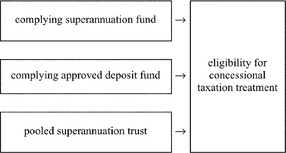
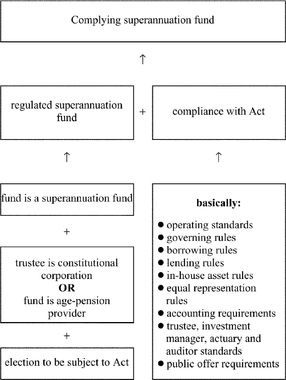
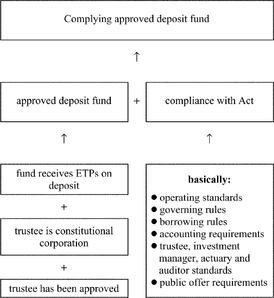
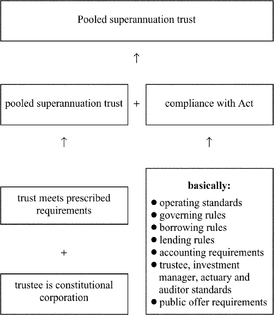
 View history note

